Like too many people, I sometimes make the mistake of talking about nuclear war, when it’s really annihilation and genocide we’re talking about.
Wars have winners and losers. In nuclear “war,” everyone loses. The planet loses. Life loses and death triumphs on a scale we simply can’t imagine.
Language is so important here. I grew up learning about nuclear exchanges. EXCHANGES! The U.S. military talks of nuclear modernization and “investing” in nukes when the only dividend of this “investment” is mass death.
One of the few honest acronyms is MAD, or mutually assured destruction. Lately, it’s an acronym that’s largely disappeared from American discourse.
More than anything, though, realistic images of a nuclear attack are perhaps the most compelling evidence against building more nukes, as in this powerful and unforgettable scene from Terminator 2:
To me, nothing beats that scene. That is nuclear “war.”
The U.S. has over 5000 nuclear weapons; the Russians close to 6000. That’s more than enough to destroy the earth and a few other earth-sized planets. Imagine the scene above repeated eleven thousand times on our planet.
The insanity, the immorality of spending another $2 trillion on new nukes … well, it boggles my mind. We’ve become like the mutants in Beneath the Planet of the Apes, worshipping the bomb, acolytes of death and destruction.
If we all don’t end up killing ourselves and the planet in “an exchange,” we’ll likely degenerate into utter barbarism, as depicted in Cormac McCarthy’s The Road. And even that grim novel has a life-affirming ending that is most unlikely.
Amazingly, after I wrote the above passages about nuclear “war” and “exchanges,” I came across Admiral TR Buchanan’s recent keynote address at the Center for Strategic and International Studies (CSIS), where he uses the word “exchange” in a remarkably banal (and frightening!) way.
BUCHANAN: Yeah, so it’s certainly complex because we go down a lot of different avenues to talk about what is the condition of the United States in a post-nuclear exchange environment. And that is a place that’s a place we’d like to avoid, right? And so when we talk about non-nuclear and nuclear capabilities, we certainly don’t want to have an exchange, right?
I think everybody would agree if we have to have an exchange, then we want to do it in terms that are most acceptable to the United States. So it’s terms that are most acceptable to the United States that puts us in a position to continue to lead the world, right? So we’re largely viewed as the world leader.
And do we lead the world in an area where we’ve considered loss? The answer is no, right? And so it would be to a point where we would maintain sufficient – we’d have to have sufficient capability.
We’d have to have reserve capacity. You wouldn’t expend all of your resources to gain winning, right? Because then you have nothing to deter from at that point.
So very complex problem, of course. And as I think many people understand, nuclear weapons are political weapons. I think Susan Rice said that at one point.
The motto of Admiral Buchanan might be: We had to destroy the world in order to lead it. Buchanan here is less sane than General Buck Turgidson in Dr. Strangelove.
This admiral thinks we might have to have “an exchange” with Russia, and that, if we do, we could do so “in terms that are most acceptable to the United States,” and that even after “an exchange,” the U.S. can still “continue to lead the world.”
Truly this is the banality of evil. I like how even after “the exchange,” we need to have a “reserve capacity” so that we can nuke the world again.
This is madness–sheer madness–but it’s received as probity and sane “strategic” thinking by the national security blob.
This guy was promoted to admiral precisely because he thinks this way. He thinks without thinking. With no humanity.
Well, as General Turgidson says in Dr. Strangelove, we might just get our hair mussed during a nuclear “exchange,” but does it really matter as long as we can kill more of them than us?
Being President of the United States (POTUS) is not a part-time job.
Apologists for Joe Biden suggest that he’s capable of doing the job during normal office hours. Say roughly 10AM to 4PM. But sadly last week’s debate started at 9PM and Biden was tired, he had a cold, and he just couldn’t think and speak clearly and coherently.
So, let’s remind America’s rivals that if they are to launch any attack that might, just might, activate nuclear contingency plans in the Biden administration, they had best do it when the president is capable of clear thinking, which apparently means a six-hour window, Monday through Friday, 10AM-4PM EST.
Seriously, as an American, all my life I’ve been told that being POTUS is the toughest, most demanding, job in the world. That POTUS has in his charge the nuclear “football,” the codes that would unleash America’s awesome, possibly world-destroying, nuclear arsenal, and that therefore the president had to be a person of sound body and of soundest mind. And now I’m being told that Joe Biden, a man in obvious decline, is exactly that person of sound body and of soundest mind to serve another four years as president and commander-in-chief.
The nuclear “football” is actually a briefcase containing the codes needed to authorize and authenticate a nuclear attack
The nuclear football is not something to fumble. Once those missiles are unleashed, there will be no redo.
Joe Biden’s recent debate performance featured sustained moments where he stared blankly into space, where he was obviously confused, where he spoke nonsense. Put bluntly, there were times when he quite literally didn’t know what he was saying.
Sure, Biden isn’t always confused, muddled, or whatever term you care to use to describe obvious mental compromise. But no POTUS can afford to be mentally muddled or compromised because you never know when he or she may be needed to make a decision (under the severest pressure and in a matter of minutes) involving nuclear weapons. It’s an awesome, almost unimaginable responsibility that requires the most stringent vetting of America’s candidates for POTUS.
Today’s Joe Biden is not up to that responsibility. Anyone who says otherwise is denying the evidence of their own eyes and ears.
Standard Disclaimer: This is not in any way an argument for Trump. It’s an argument for a fitter president, right now, and for the Democrats to nominate someone other than Biden to run against Trump this November.
Whenever I watch my hometown baseball team, the Boston Red Sox, at Fenway Park I’m told by a message painted along the first and third base lines to “build submarines.” At commercial breaks between innings, sometimes I get another reminder courtesy of the following ad:
The ad features some serious welding, including a comely female welder, showcasing the diversity of the military-industrial complex. Hooray America!
We build giants, the ad says, but there’s no sense of what those giants can do to the world. That’s where Frida Berrigan comes in. Her post today at TomDispatch.com details the awesome destructive power of the Navy’s new class of nuclear-missile-firing submarines. I like her title: The Art of the Submarine, or 5,824 Hiroshimas per Sub.
The new subs are part of the Columbia class, but they really should be called the Armageddon class. Here’s how Berrigan describes them:
Columbia Class nuclear submarines [are what] General Dynamics Electric Boat is building right now. The Navy’s budget for just 12 of those ballistic missile submarines is $126.4 billion. Imagine! If the Navy’s budget for that one weapons system was a country, it would have the third-largest military budget on earth.
The Columbia will be the biggest and most expensive submarine ever built. How perfectly American, right? Even down to the fact that it’s named in honor of the District of Columbia, the disenfranchised, desperately unequal, and remarkably segregatedcapital of the United States of America. I’d love to see an artwork that encapsulates that grim irony.
Those new Columbia subs will dwarf what Beatrice Cuming’s welders were working on when she captured them in 1944. Each will be 560 feet long, or a few feet more than the height of the Washington Monument. And its bulk will displace 20,810 tons of water.
But the size and expensiveness aren’t anywhere near as important as the payload of nuclear weapons it will carry with a power those welders of Cuming’s time could hardly have imagined and that Cuming would have been hard-pressed to render with brushes and paint. Each of those 12 new submarines will be equipped with 16 nuclear missile tubes for Trident II D5 submarine-launched ballistic missiles (SLBMs). And those tubes will each be able to house up to 12 independently targetable nuclear warheads, known as W88s, costing about $150 million each and packing a mind-boggling 455-kiloton wallop.
Okay, now do the math with me. What does 12 times 16 times 12 equal? That’s right: 2,304. Now, multiply that by the thermonuclear force of 455 kilotons, and you get more than one million kilotons. An unthinkable power.
America is yet again spending enormous sums of money on weaponry capable of ending life on Earth if those weapons should ever be used. Better dead than red, I suppose.
It’s great that welders are being put to work, but maybe they should be fixing America’s many bridges and buildings that are structurally less than sound. After all, why is it a good thing that our comely welder in the ad above is helping to build a “giant” that could very well destroy us all?
Instead of “build submarines” at my favorite ballpark, what we really need are ads like “repair bridges.” And maybe a message as well that submarines whose missiles are equivalent to thousands of Hiroshima bombs are, to put it mildly, a potential season-ending error, not only for Team America, but for team humanity.
As a late-stage baby boomer, a child of the 1960s, I grew up dreaming about America’s nuclear triad. You may remember that it consisted of strategic bombers like the B-52 Stratofortress, land-based intercontinental ballistic missiles (ICBMs) like the Minuteman, and submarine-launched ballistic missiles (SLBMs) like the Poseidon, all delivery systems for what we then called “the Bomb.” I took it for granted that we needed all three “legs” — yes, that was also the term of the time — of that triad to ward off the Soviet Union (aka the “evil empire”).
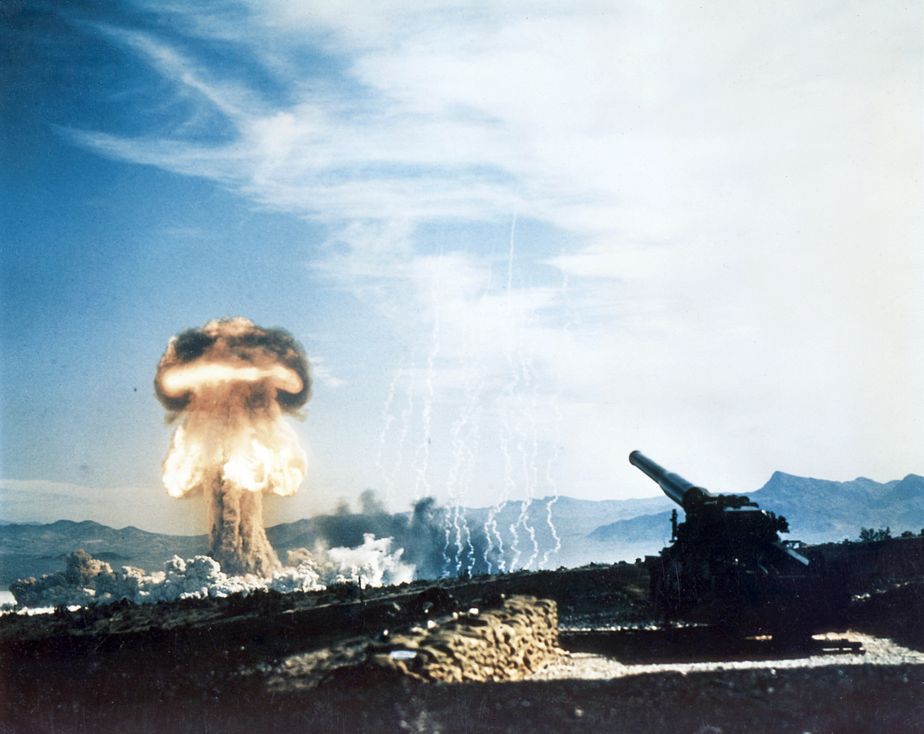
It took me some time to realize that the triad was anything but the trinity, that it was instead a product of historical contingency. Certainly, my mind was clouded because two legs of that triad were the prerogative of the U.S. Air Force, my chosen branch of service. When I was a teenager, the Air Force had 1,054 ICBMs (mainly Minutemen missiles) in silos in rural states like Montana, North Dakota, and Wyoming, along with hundreds of strategic bombers kept on constant alert against the Soviet menace. They represented enormous power not just in destructive force measured in megatonnage but in budgetary authority for the Air Force. The final leg of that triad, the most “survivable” one in case of a nuclear war, was (and remains) the Navy’s SLBMs on nuclear submarines. (Back in the day, the Army was so jealous that it, too, tried to go atomic, but its nuclear artillery shells and tactical missiles were child’s play compared to the potentially holocaust-producing arsenals of the Air Force and Navy.)
When I said that the triad wasn’t the trinity, what I meant (the obvious aside) was this: the U.S. military no longer needs nuclear strategic bombers and land-based ICBMs in order to threaten to destroy the planet. As a retired Air Force officer who worked in Cheyenne Mountain, America’s nuclear redoubt, during the tail end of the first Cold War, and as a historian who once upon a time taught courses on the atomic bomb at the Air Force Academy, I have some knowledge and experience here. Those two “legs” of the nuclear triad, bombers and ICBMs, have long been redundant, obsolete, a total waste of taxpayer money — leaving aside, of course, that they would prove genocidal in an unprecedented fashion were they ever to be used.
Nevertheless, such thoughts have no effect on our military. Instead, the Air Force is pushing ahead with plans to field — yes! — a new strategic bomber, the B-21 Raider, and — yes, again! — a new ICBM, the Sentinel, whose combined price tag will likely exceed $500 billion. The first thing any sane commander-in-chief with an urge to help this country would do is cancel those new nuclear delivery systems tomorrow. Instead of rearming, America should begin disarming, but don’t hold your breath on that one.
A Brief History of America’s Nuclear Triad
It all started with atomic bombs and bombers. In August 1945, the Japanese cities of Hiroshima and Nagasaki were obliterated by two atomic bombs carried by B-29 bombers, ending World War II. However, in the years that followed, as the Cold War with the Soviet Union heated up, the only “delivery system” the military had for its growing thermonuclear arsenal was the strategic bomber. Those were the glory days of the Strategic Air Command, or SAC, whose motto (believe it or not) was “Peace Is Our Profession” — the “peace” of a mass nuclear grave, had those hydrogen bombs ever been dropped on their intended targets in the Soviet Union and China.
However, as this country’s weapons makers produced ever more powerful hydrogen bombs and strategic bombers, a revolution was afoot in missile technology. By the late 1950s, missiles tipped with nuclear warheads became a practical reality. By the 1960s, the Air Force was already lobbying for 10,000 ICBMs, even if my old service had to settle for a mere thousand or so of them during the administration of President John F. Kennedy. Meanwhile, the Navy was maneuvering its way into the act by demonstrating that it was indeed possible for mobile, difficult-to-detect submarines to carry nuclear-tipped missiles.
By the late 1960s, that triad of potentially ultimate nuclear death had become so sacrosanct that it was untouchable. More than half a century later, America’s nuclear triad has endured and, all too sadly, is likely to do so far longer than you or me (if not, of course, used).
You might wonder why that should be so. It’s not for any sensible military or strategic reason. By the 1980s, if not before, bombers and ICBMs were obsolete. That was why President Jimmy Carter canceled the B-1 bomber in 1977 (though it would be revived under President Ronald Reagan, with the Air Force buying 100 of those expensive, essentially useless aircraft). That was why the Air Force developed the “peacekeeper” MX ICBM, which was supposed to be mobile (shuffled around by rail) or hidden via an elaborate shell game. Such notions were soon abandoned, though not the missiles themselves, which were stuffed for a time into fixed silos. The endurance of such weapons systems owes everything to Air Force stubbornness and the lobbying power of the industrial side of the military-industrial complex, as well as to members of Congress loath to give up ICBM and bomber bases in their districts, no matter how costly, unnecessary, and omnicidal they may be.
In that light, consider the Navy’s current force of highly capable Ohio-class nuclear submarines. There are 14 of them, each armed with up to 20 Trident II missiles, each with up to eight warheads. We’re talking, in other words, about at least 160 potentially devastating nuclear explosions, each roughly five to 20 times more powerful than the Hiroshima bomb, from a single sub. In fact, it’s possible that just one of those submarines has an arsenal with enough destructive power not just to kill millions of us humans, but to tip the earth into a nuclear winter in which billions more of us could starve to death. And America has 14 of them!
Why, then, does the Air Force argue that it, too, “needs” new strategic bombers and ICBMs? The traditional arguments go like this: bombers can be launched as a show of resolve and, unlike missiles, recalled. They are also allegedly more flexible. In Air Force jargon, they can be rerouted against “targets of opportunity” in a future nuclear war. Of course, generals can always produce a scenario, however world-ending, to justify any weapons system, based on what an enemy might or might not do or discover. Nonetheless, strategic bombers were already nearing obsolescence when Stanley Kubrick made his classic antinuclear satire, Dr. Strangelove (1964), so prominently featuring them.
And what about land-based ICBMs? Once the claim was that they had more “throw-weight” (bigger warheads) than SLBMs and were also more accurate (being launched from fixed silos rather than a mobile platform like a submarine). But with GPS and other advances in technology, submarine-launched missiles are now as accurate as land-based ones and “throw-weight” (sheer megatonnage) always mattered far less than accuracy.
Worse yet, land-based ICBMs in fixed silos are theoretically more vulnerable to an enemy “sneak” attack and so more escalatory in nature. The U.S. currently has 400 Minuteman III ICBMs sitting in silos. If possible incoming enemy nuclear missiles were detected, an American president might have less than 30 minutes — and possibly only 10 or so — to decide whether to launch this country’s ICBM force or risk losing it entirely.
That’s not much time to determine the all-too-literal fate of the planet, is it, especially given the risk that the enemy attack might prove to be a “false alarm“? Just before I arrived at Cheyenne Mountain, there were two such alarms (one stemming from a technical failure, the other from human error when a simulation tape was loaded into computers without any notification that it was just a “war game”). Until they were found to be false alarms, both led to elevated DEFCONs (defense readiness conditions) in preparation for possible nuclear war.
New ICBMs will only add “use them or lose them” pressure to the global situation. Mobile, elusive, and difficult to detect, the Navy’s submarine force is more than sufficient to deter any possible enemy from launching a nuclear attack on the United States. Strategic bombers and ICBMs add plenty of bang and bucks but only to the Air Force budget and the profits of the merchants of mass nuclear death who make them.
A Sane Path Forward for America’s Nuclear Force
I still remember the nuclear freeze movement, the stunningly popular antinuclear protest of the early 1980s. I also remember when President Reagan and Soviet leader Mikhail Gorbachev met in 1986 and seriously discussed total nuclear disarmament. I remember Barack Obama, as a 2008 presidential candidate, being joined by old Cold War stalwarts like Henry Kissinger and Sam Nunn in calling for the eventual elimination of nuclear weapons.
Today, we’re not supposed to recall any of that. Instead, we’re told to focus on the way a developing “new cold war” with Russia and China is driving a “requirement” for a “modernized” U.S. nuclear triad that could cost $2 trillion over the next 30 years. Meanwhile, we’re discouraged from thinking too much about the actual risks of nuclear war. The Biden administration, for example, professes little concern about the possibility that arming Ukraine with weaponry capable of hitting deep inside Russia could lead to destabilization and the possible use of nuclear weapons on the battlefield (something Vladimir Putin has threatened to do). Nor are we to fret about surrounding China with ever more U.S. military bases and sending ever more weaponry to Taiwan, while the Chinese are enlarging their own force of ICBMs; or, for that matter, about the fact that the last nuclear agreement limiting the size of the American and Russian arsenals will run out in less than 1,000 days.
To such issues, the only response America’s “best and brightest” ever have is this one: give us more/newer strategic bombers, more/newer ICBMs, and more/newer nuclear submarines (whatever the cost)! To those men, it’s as if nuclear war were a theoretical (and distinctly money-making) chess match — and yes, they are indeed still mostly men! — a challenging game whose only components are profits, jobs, money, and power. Yet when the only story to be told is one featuring more nuclear warheads and more delivery systems, it’s hard not to conclude that, in some horrific fashion, nuclear Armageddon is indeed us (or at least them).
And though few spend much time thinking about it anymore, that’s madness personified. What’s needed instead is a new conviction that a nuclear Armageddon must not be our fate and, to make that so, we must act to eliminate all ICBMs, cancel the B-21 bomber, retire the B-1s and B-2s, work on global nuclear disarmament, start thinking about how to get rid of those nuclear subs, and begin to imagine what it would be like to invest the money saved in rebuilding America. It sure beats destroying the world.
And again, in the most practical terms possible, if we’re set on preserving Armageddon, America’s existing force of Ohio-class nuclear submarines is more than enough both to do so and undoubtedly to “deter” any possible opponent.
There was a time, in the early stages of the first Cold War, when America’s leaders professed fears of “bomber” and “missile” gaps vis-à-vis the Soviet Union — gaps that existed only in their minds; or rather only in the reverse sense, since the U.S. was ahead of the Soviets in both technologies. Today, the bomber and missile “gaps” are, in fact, gaps in logic wielded by a Pentagon that insists strategic bombers and ICBMs remain a “must” for this country’s safety and security.
It’s all such nonsense and I’m disgusted by it. I want my personal thermonuclear odyssey to come to an end. As a kid in the 1970s, I built a model of the B-1 bomber. As a ROTC cadet in the early 1980s, I made a presentation on the U.S./Soviet nuclear balance. As a young Air Force officer, I hunkered down in Cheyenne Mountain, awaiting a nuclear attack that fortunately never came. When I visited Los Alamos and the Trinity Test Site at Alamogordo, New Mexico, in 1992, I saw what J. Robert Oppenheimer’s original atomic “gadget” had done to the tower from which it had been suspended. When the Soviet Union collapsed, I genuinely hoped that this country’s (and the world’s) long nuclear nightmare might finally be coming to an end.
Tragically, it was not to be. The gloomy Los Alamos of 1992, faced with serious cuts to its nuclear-weapons-producing budget, is once again an ebullient boom town. Lots of new plutonium pits are being dug. Lots more money is flooding in to give birth to a new generation of nuclear weapons. Of course, it’s madness, sheer madness, yet,this time, it’s all happening so quietly.
Even as the nuclear clock ticks ever closer to midnight, nobody is ducking and covering in America’s classrooms anymore (except against mass shooters). No one’s building a nuclear bomb shelter in their backyard (though doomsday shelters for the ultra-rich seem to have become status symbols). We’re all going about our business as if such a war were inconceivable and, in any case, akin to a natural disaster in being essentially out of our control.
And yet even as we live our lives, the possibility of a nuclear Armageddon remains somewhere in our deepest fears and fantasies. Worse yet, the more we suppress the thought of such horrors and the more we refuse even to think about acting to prevent them, the more likely it is that such an Armageddon will indeed come for all of us one day, and the “trinity” we’ll experience will be a horrific version of the blinding flash of light first seen by J. Robert Oppenheimer and crew at that remote desert site nearly 80 years ago.
Today is Earth Day: a good day to commit ourselves to saving the earth from the ravages of nuclear war. Global warming may get us in the long term, but nothing will kill the planet quicker than a nuclear war.
I’ve written a lot about the folly, the greed, the absurdity, of yet another round of “investment” in nuclear weapons. There’s no need for an updated nuclear triad when the present triad is more than enough to destroy the earth and probably several other planets as well.
America’s nuclear triad currently consists of land-based ICBMs (Minuteman III), bombers like the B-1 and B-2, and submarines that carry nuclear-tipped missiles. The Pentagon plans to “modernize” all these “legs” of the triad at a possible total cost of $2 trillion over the next 30 years.
First off, land-based ICBMs and nuclear bombers are no longer needed. The ICBMs are especially vulnerable to attack, putting pressure on DC decisionmakers to launch them quickly in case of a warning (perhaps false) of a nuclear attack against their silos.
All the U.S. truly needs for deterrence is the current Ohio-class sub force with its Trident II missiles. That force can be modernized without an entirely new class of sub being built, which is perhaps why we’re seeing ads about building new submarines as “job-creators.”
In the USA, more nukes are “justified” most often by threat inflation (or even threat creation) and military Keynesianism—morally dubious claims that jobs are created by building genocidal weapons and doomsday machines.
Speaking of America’s submarines and their missiles: Each Trident II D5 missile has up to 8 warheads, with up to 20 missiles per submarine. One submarine could conceivably destroy 160 targets, with each of those warheads having a “yield” of somewhere between 5 and 25 Hiroshima bombs. That arsenal, if launched, could very well tip the world into nuclear winter while killing tens of millions of people outright. A nuclear winter would kill billions. From one sub! And the Navy has 14 of them!
Senator George McGovern in 1963 complained about the absurd nuclear “overkill” the U.S. possesses. Just over 60 years ago, some members of Congress vowed to do something to stop the madness. And then came Vietnam … and so many other wars and rumors of war.
We Americans are so easily distracted by war and propagandized into believing that safety comes from swinging the biggest nuclear club.
Anyone who thinks about nuclear weapons and war games in the abstract should watch this scene from “Terminator II.” It’s perhaps the best, most visceral, image of what one nuclear bomb would produce.
“There’s no fate but what we make for ourselves.” The more nuclear weapons we build, the darker our fate becomes, and the closer we come to terminating ourselves and our planet.
On this Earth Day, the U.S. should commit itself to a “no first use” policy with respect to using nuclear weapons and to total nuclear disarmament, to be achieved over the next 20-30 years.
Something like a JFK-like vow is needed here: Before the decade is out, America should commit itself to halving its nuclear forces, working with other countries on the goal of nuclear disarmament.
Only the future of humanity, as well as that of the earth and all living things, is at stake here.
Comparing and contrasting low-yield theater nuclear weapons with conventional precision strike weapons leads to a nuanced conclusion that both contribute to deterrence.
Imagine that! Both nuclear and conventional weapons “contribute to deterrence.” Even though they’re apparently apples and oranges. Well, there’s “nuance” for you.
Anybody want a tasty nuclear “orange”? Fresh and juicy, and with a low yield. It may very well deter you from eating citrus fruit for, well, forever.
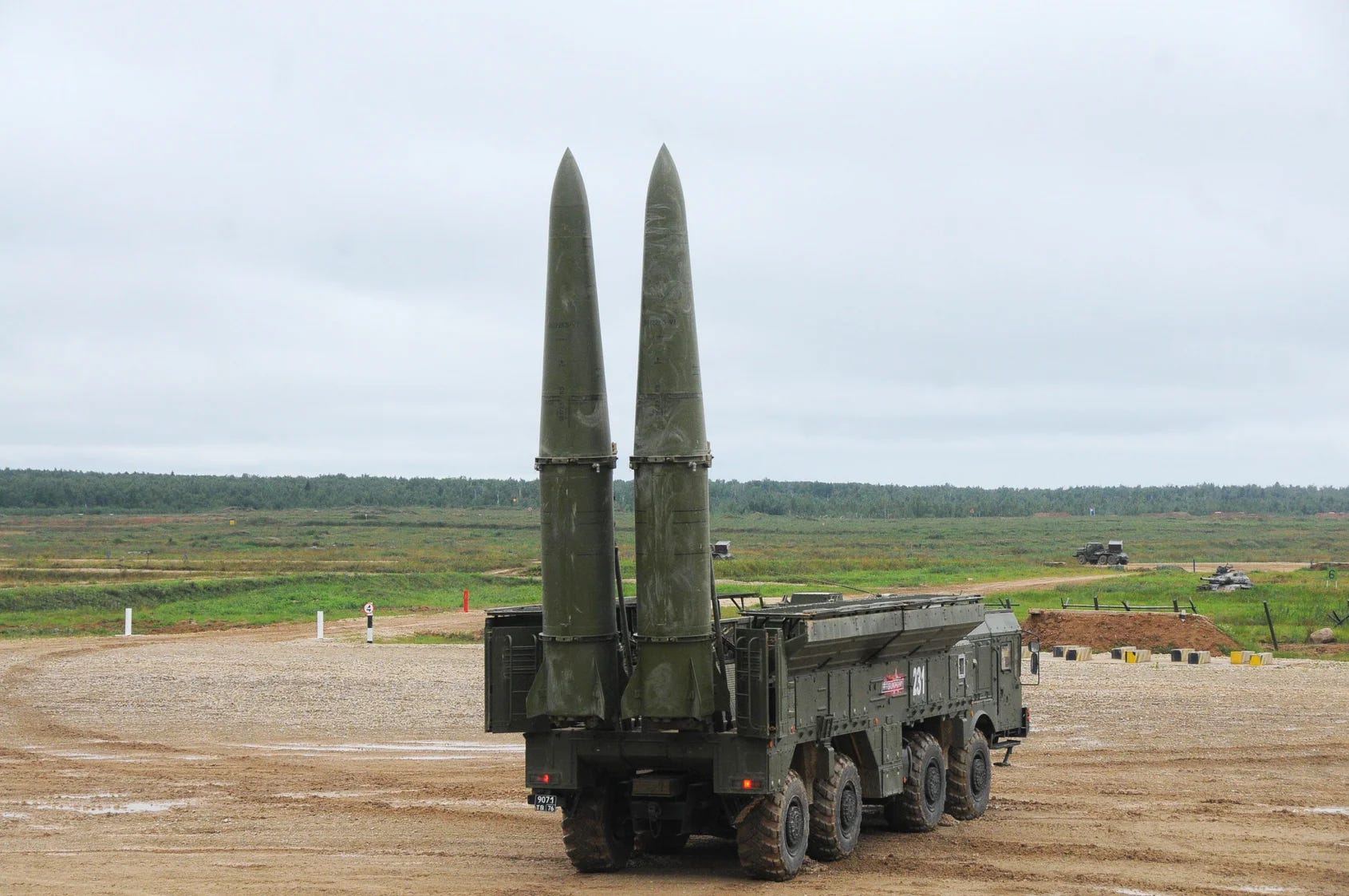
Potential delivery system for low-yield nukes. Think of them as juicy oranges
I’m not familiar with the authors of the piece. McCue is an Air Force lieutenant colonel with the Defense Threat Reduction Agency. I don’t know about you, but suggesting that low-yield nukes can be used in nuanced ways heightens my sense of threat. Lowther directs strategic deterrence programs at the National Strategic Research Institute, which makes me think anew about the meaning of “deterrence.” In this case, it seems to mean the willingness to use nuclear weapons against “bad actors” like China but especially Putin and Russia. And Davis is an Army major assigned to U.S. Central Command. It’s nice to know the Army, just like the Air Force, has a strange love for nukes.
In essence, the article’s argument is this: Russia, China, and North Korea are “investing” in low-yield nukes while the U.S. and other NATO allies have generally been reducing their arsenals of the same. To deter those three adversaries, the U.S. must make new “investments” in low-yield nukes, because you never know what those foreigners are up to.
Here’s how the authors put it in their conclusion: “In the right circumstances conventional weapons offer greater certainty of destruction than tactical nuclear weapons. The West must examine what this means for warfighting, as well as what adversaries are signaling by investing in low-yield nuclear weapons. The best solution may be the development of a state-of-the-art nuclear capability that ensures certain, prompt, proportionate, and in-kind response options. The perception of a missing rung on the American escalation ladder could prove alluring to Russia or China in a conflict.”
Mr. President, we must not allow a missing rung on America’s escalation ladder!
Even if that “missing rung” is only a “perception.”
Let’s keep that in mind if nuclear weapons start flying in Europe or Asia. We can console ourselves that at least we weren’t missing a rung in our escalatory ladder as millions get blasted, burnt, and irradiated.
I turn 60 this year. My health is generally good, though I have aches and pains from a form of arthritis. I’m not optimistic enough to believe that the best years of my life are ahead of me, nor so pessimistic as to assume that the best years are behind me. But I do know this, however sad it may be to say: the best years of my country are behind me.
Indeed, there are all too many signs of America’s decline, ranging from mass shootings to mass incarceration to mass hysteria about voter fraud and “stolen” elections to massive Pentagon and police budgets. But let me focus on just one sign of all-American madness that speaks to me in a particularly explosive fashion: this country’s embrace of the “modernization” of its nuclear arsenal at a price tag of at least $2 trillion over the next 30 years or so — and that staggering sum pales in comparison to the price the world would pay if those “modernized” weapons were ever used.
Just over 30 years ago in 1992, a younger, still somewhat naïve version of Bill Astore visited Los Alamos National Laboratory (LANL) in New Mexico and the Trinity test site in Alamogordo where the first atomic device created at that lab, a plutonium “gadget,” was detonated in July 1945. At the time I took that trip, I was a captain in the U.S. Air Force, co-teaching a course at the Air Force Academy on — yes, would you believe it? — the making and use of the atomic bombs that devastated the Japanese cities of Hiroshima and Nagasaki to end World War II. At the time of that visit, the Soviet Union had only recently collapsed, inaugurating what some believed to be a “new world order.” No longer would this country have to focus its energy on waging a costly, risky cold war against a dangerous nuclear-armed foe. Instead, we were clearly headed for an era in which the United States could both dominate the planet andbecome “a normal country in normal times.”
I was struck, however, by the anything-but-celebratory mood at Los Alamos then, though I really shouldn’t have been surprised. After all, budget cuts loomed. With the end of the Cold War, who needed LANL to design new nuclear weapons for an enemy that no longer existed? In addition, there was already an effective START treaty in place with Russia aimed at reducing strategic nuclear weapons instead of just limiting their growth.
At the time, it even seemed possible to imagine a gradual withering away of such great-power arsenals and the coming of a world liberated from apocalyptic nightmares. Bipartisan support for nuclear disarmament would, in fact, persist into the early 2000s, when then-presidential candidate Barack Obama joined old Cold War hawks like former Secretary of State Henry Kissinger and former Senator Sam Nunn in calling for nothing less than a nuclear-weapons-free world.
An Even More Infernal Holocaust
It was, of course, not to be and today we once again find ourselves on an increasingly apocalyptic planet. To quote Pink Floyd, the child is grown and the dream is gone. All too sadly, Americans have become comfortably numb to the looming threat of a nuclear Armageddon. And yet the Bulletin of Atomic Scientist’sDoomsday Clockcontinues to tick ever closer to midnight precisely because we persist in building and deploying ever more nuclear weapons with no significant thought to either the cost or the consequences.
Over the coming decades, in fact, the U.S. military plans to deploy hundreds — yes, hundreds! — of new intercontinental ballistic missiles (ICBMs) in silos in Wyoming, Montana, North Dakota, and elsewhere; a hundred or so nuclear-capable B-21 stealth bombers; and a brand new fleet of nuclear-missile-firing submarines, all, of course, built in the name of necessity, deterrence, and keeping up with the Russians and the Chinese. Never mind that this country already has thousands of nuclear warheads, enough to comfortably destroy more than one Earth. Never mind that just a few dozen of them could tip this world of ours into a “nuclear winter,” starving to death most creatures on it, great and small. Nothing to worry about, of course, when this country must — it goes without saying — remain the number one possessor of the newest and shiniest of nuclear toys.
And so those grim times at Los Alamos when I was a “child” of 30 have once again become boom times as I turn 60. The LANL budget is slated to expand like a mushroom cloud from $3.9 billion in 2021 to $4.1 billion in 2022, $4.9 billion in 2023, and likely to well over $5 billion in 2024. That jump in funding enables “upgrades” to the plutonium infrastructure at LANL. Meanwhile, some of America’s top physicists and engineers toil away there on new designs for nuclear warheads and bombs meant for one thing only: the genocidal slaughter of millions of their fellow human beings. (And that doesn’t even include all the other life forms that would be caught in the blast radii and radiation fallout patterns of those “gadgets.”)
The very idea of building more and “better” nuclear weapons should, of course, be anathema to us all. Once upon a time, I taught courses on the Holocaust after attending a teaching seminar at the U.S. Holocaust Memorial Museum. Now, the very idea of modernizing our nuclear arsenal strikes me as the equivalent of developing upgraded gas chambers and hotter furnaces for Auschwitz. After all, that’s the infernal nature of nuclear weapons: they transform human beings into matter, into ash, killing indiscriminately and reducing us all to nothingness.
I still recall talking to an employee of Los Alamos in 1992 who assured me that, in the wake of the collapse of the Soviet Union, the lab would undoubtedly have to repurpose itself and find an entirely new mission. Perhaps, he said, LANL scientists could turn their expertise toward consumer goods and so help make America more competitive vis-à-vis Japan, which, in those days, was handing this country its lunch in the world of electronics. (Remember the Sony Walkman, the Discman, and all those Japanese-made VCRs, laser disc players, and the like?)
I nodded and left Los Alamos hopeful, thinking that the lab could indeed become a life-affirming force. I couldn’t help imagining then what this country might achieve if some of its best scientists and engineers devoted themselves to improving our lives instead of destroying them. Today, it’s hard to believe that I was ever so naïve.
“Success” at Hiroshima
My next stop on that tour was Alamogordo and the Trinity test site, then a haunted, still mildly radioactive desert landscape thanks to the world’s first atomic explosion in 1945. Yes, before America nuked Japan that August at Hiroshima and Nagasaki, we nuked ourselves. The Manhattan Project team, led by J. Robert Oppenheimer, believed a test was needed because of the complex implosion device used in the plutonium bomb. (There was no test of the uranium bomb used at Hiroshima since it employed a simpler triggering device. Its first “test” was Hiroshima itself that August 6th and the bomb indeed “worked,” as predicted.)
J. Robert Oppenheimer, the “father” of the atomic bomb
So, our scientists nuked the desert near the Jornada del Muerto, the “dead man’s journey” as the Spanish conquistadors had once named it in their own febrile quest for power. While there, Oppenheimer famously reflected that he and his fellow scientists had become nothing short of “Death, the destroyer of worlds.” In the aftermath of Hiroshima, he would, in fact, turn against the military’s pursuit of vastly more powerful hydrogen or thermonuclear, bombs. For that, in the McCarthy era, he was accused of being a Soviet agent and stripped of his security clearance.
Oppenheimer’s punishment should be a reminder of the price principled people pay when they try to stand in the way of the military-industrial complex and its pursuit of power and profit.
But what really haunts me isn’t the “tragedy” of Opie, the American Prometheus, but the words of Hans Bethe, who worked alongside him on the Manhattan Project. Jon Else’s searing documentary film, The Day After Trinity, movingly catches Bethe’s responses on hearing about the bomb’s harrowing “success” at Hiroshima.
His first reaction was one of fulfillment. The crash program to develop the bomb that he and his colleagues had devoted their lives to for nearly three years was indeed a success. His second, he said, was one of shock and awe. What have we done, he asked himself. What have we done? His final reaction: that it should never be done again, that such weaponry should never, ever, be used against our fellow humans.
And yet here we are, nearly 80 years after Trinity and our country is still devoting staggering resources and human effort to developing yet more “advanced” nuclear weapons and accompanying war plans undoubtedly aimed at China, North Korea, Russia, and who knows how many other alleged evildoers across the globe.
Fire and Fury Like the World Has Never Seen?
Perhaps now you can see why I say that the best years of my country are behind me. Thirty years ago, I caught a fleeting glimpse out of the corner of my eye (Pink Floyd again) of a better future, a better America, a better world. It was one where a sophisticated lab like Los Alamos would no longer be dedicated to developing new ways of exterminating us all. I could briefly imagine the promise of the post-Cold-War moment — that we would all get a “peace dividend” — having real meaning, but it was not to be.
And so, I face my sixtieth year on this planet with trepidation and considerable consternation. I marvel at the persuasive power of America’s military-industrial-congressional complex. In fact, consider it the ultimate Houdini act that its masters have somehow managed to turn nuclear missiles and bombs into stealth weapons — in the sense that they have largely disappeared from our collective societal radar screen. We go about our days, living and struggling as always, even as our overlords spend trillions of our tax dollars on ever more effective ways to exterminate us all. Indeed, at least some of our struggles could obviously be alleviated with an infusion of an extra $2 trillion over the coming decades from the federal government.
Instead, we face endless preparations for a planetary holocaust that would make even the Holocaust of World War II a footnote to a history that would cease to exist. The question is: What can we do to stop it?
The answer, I think, is simply to stop. Stop buying new nuclear stealth bombers, new ICBMs, and new ultra-expensive submarines. Reengage with the other nuclear powers to halt nuclear proliferation globally and reduce stockpiles of warheads. At the very least, commit to a no-first-use policy for those weapons, something our government has so far refused to do.
I’ve often heard the expression “the nuclear genie is out of the bottle,” implying that it can never be put back in again. Technology controls us, in other words.
That’s the reality we’re all supposed to accept, but don’t believe it. America’s elected leaders and its self-styled warrior-generals and admirals have chosen to build such genocidal weaponry. They seek budgetary authority and power, while the giant weapons-making corporations pursue profits galore. Congress and presidents, our civilian representatives, are corrupted or coerced by a system that ensnares their minds. Much like Gollum in The Lord of the Rings, the nuclear button becomes their “precious,” a totem of power. Consider President Trump’s boast to Kim Jong-un that “his” nuclear button was much bigger than theirs and his promise that, were the North Korean leader not to become more accommodating, his country would “face fire and fury like the world has never seen.” The result: North Korea has vastly expandedits nuclear arsenal.
It wouldn’t have to be this way. To cite Dorothy Day, the Catholic peace activist, “Our problems stem from our acceptance of this filthy, rotten system.” Don’t accept it, America. Reject it. Get out in the streets and protest as Americans did during the nuclear freeze movement of the early 1980s. Challenge your local members of Congress. Write to the president. Raise your voice against the merchants of death, as Americans proudly did (joined by Congress!) in the 1930s.
If we were to reject nuclear weapons, to demand a measure of sanity and decency from our government, then maybe, just maybe, the best years of my country would still lie ahead of me, no matter my growing aches and pains on what’s left of my life’s journey.
Not to be morbid, but I suppose we all walk our own Jornada del Muerto. I’d like what’s left of mine to remain unlit by the incendiary glare of nuclear explosions. I’d prefer that my last days weren’t spent in a hardscrabble struggle for survival in a world cast into darkness and brutality by a nuclear winter. How about you?
Names Like Minuteman, Peacekeeper, and Sentinel Are Diabolically Dishonest
Ever think about names of U.S. weapons of war? Rarely are those names honest. I do applaud the relative honesty of Predator and Reaper drones, because those names capture the often predatory nature of U.S. foreign policy and the grim reaperish means that are often employed in its execution. Most names are not so suggestive. For example, U.S. fighter planes carry noble names like Eagle, Fighting Falcon, or Raptor. Nuclear bombers are an interesting case since they can carry thermonuclear bombs and missiles to kill hundreds of thousands, possibly millions, of people. So we have the B-52 Stratofortress (a great 1950s-era name), the B-1 Lancer, the B-2 Spirit, and the new B-21 Raider (the name has historical echoes to the Doolittle Raid on Tokyo in 1942).
Reaping what we sow? Just reaping? Whatever the case, the U.S. way of war is grim
Shouldn’t these bombers carry names like Megadeath or Mass Murder?
Think too of nuclear missiles. The Air Force’s Intercontinental Ballistic Missiles (ICBMs) have had names like Titan, Minuteman, Peacekeeper, and now the new Sentinel. But since these missiles carry warheads that could easily kill millions, wouldn’t a more honest name be The Holocaust ICBM? For that’s what these missiles promise: a nuclear holocaust.
Consider too the Navy’s Ohio-class nuclear missile-firing submarines (SSBN) with their Trident missiles. (Trident—gotta hand it to the Navy.) Just one submarine can carry 20 Trident II missiles, each with up to eight warheads, each warhead being roughly equivalent to six Hiroshima bombs. Again, roughly speaking, each of these submarines carries an arsenal equivalent to one thousand Hiroshima bombs. And the U.S. has fourteen of these submarines.
Instead of the Ohio-class of submarines, shouldn’t they be called the Armageddon-class? Or the Apocalypse-class? The Genocide-class?
With a bit more honesty, perhaps it wouldn’t be so easy to sell these horrific weapons to Congress and the American people. Then again, when the bottom line is higher budgets for the Pentagon and more jobs for Congressional districts, I guess America will buy most anything. Even Holocaust missiles and Armageddon submarines. And for upwards of $2 trillion over the next 30 years as well.
If they don’t bust the budget, perhaps they’ll destroy the world.
With Russia issuing warnings about using all weapons at its disposal to protect its position in Ukraine, it’s a good time to talk about the distinction between “tactical” and “strategic” nuclear weapons.
Put bluntly, there’s no real distinction. All nuclear weapons, regardless of size and yield, are devastating and potentially escalatory to a full-scale nuclear war. Were Russia to use “tactical” nuclear weapons, the U.S. and NATO would likely respond in kind. Even if a major nuclear war could be avoided, resulting political disruptions would likely aggravate ongoing economic dislocation, triggering a serious global recession, even a Great Depression, further feeding the growth of fascism and authoritarianism.
When you build weapons, there’s a temptation to use them. Weapons don’t exist in a vacuum. Within the military, people are trained to use them. Doctrine is developed along with contingency plans. Exercises are run to prepare for deployment and use in wartime, “just in case.” In short, we can’t count on sane heads to prevail here, not when some people seem to think you can use a “little” nuke to send a message.
Fortunately for the world, nuclear weapons haven’t been used in war since Hiroshima and Nagasaki in 1945. But they are used daily in the sense of intimidating other countries. Currently, Russia is using its nuclear forces to try to contain US/NATO aid to Ukraine and involvement in the Russia-Ukraine War. Russia is drawing a nuclear red line, and I doubt it’s a bluff.
It’s hypocritical of both the US and Russia to accuse the other of nuclear brinksmanship since both countries have contingency plans to use nukes. Hopefully, it’s obvious to both countries how devastating it would be if a nuclear exchange, even a “limited” or “tactical” one, were to occur.
Even as bluffs, nuclear threats are reckless, since there’s always some fool who may seek to call the bluff. Let’s hope the US/NATO collective doesn’t play the fool. We have enough problems in the world without tossing nuclear warheads of whatever size or yield at each other.
Supporting trillions of dollars “to update and modernize our nuclear arsenal” is akin to advocating for more production of Zyklon B and improved gas chambers.
Incendiary claim? I think not. Like Zyklon B, nuclear weapons are genocidal. They are designed to kill millions; used en masse, they will kill billions. They are ecocidal as well; nuclear weapons with their intense heat and blast and radiation kill virtually everything in their radius. How can anyone who’s sane want more of them?
I happened to catch Kelly Ayotte, a former U.S. senator who’s now the Chair of the Board of Directors for BAE Systems, a major weapons contractor, say that she’s “always” been a strong supporter of updating and modernizing the U.S. nuclear arsenal. Of course, she and her company stand to profit from this. But at what cost to life on this planet?
Nevertheless, nuclear “modernization” proceeds apace in the U.S. at an estimated cost of nearly $2 trillion over the next few decades. Is this not the very definition of a murderous insanity?
As Daniel Ellsberg pointed out, U.S. nuclear attacks plans in the early 1960s could have resulted in the death of 600 million people, mainly in China and the Soviet Union. As Ellsberg noted, the U.S. was prepared to launch 100 Holocausts in the name of defending its “ideals.” (And this was before we knew about the dangers of nuclear winter.)
This murderous madness has to stop before we put an end to ourselves and our planet.
We’ll produce new nuclear missiles like so many sausages. But it’s all OK because we need to “update” and “modernize” our (genocidal and ecocidal) nuclear arsenal. Sure makes me proud to be an American.
Addendum: When you think of nuclear weapons as “investments” or as “sensible” (see comments), please consider this scene from “Terminator II.”
What is “sensible” about any of this? Sorry, count me out of “investing” in mass death via nuclear holocaust.






 Bracing Views