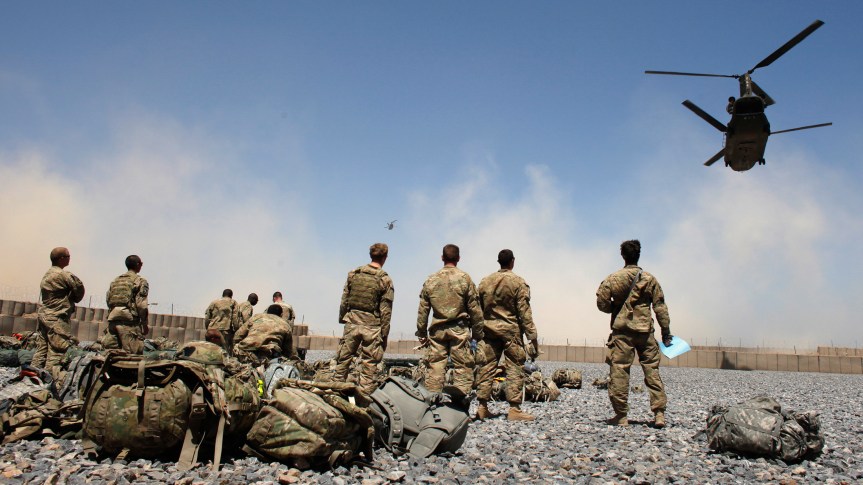
You can always count on the Pentagon to come up with jargon that unleashes hubris. When I was in the Air Force, it was all about “global reach, global power.” I also heard about “full-spectrum dominance.” Now the latest buzzword is “All-Domain Operations.” “All-domain” means land, sea, air, space, and cyberspace, which are supposed to be integrated by computers, with information being shared at the speed of light, or close to it. The U.S. military will know so much, be so nimble, and act in such a coordinated fashion that its rivals and enemies won’t have a chance.
This is what the Vice-Chairmen of the Joint Chiefs of Staff had to say about this:
“we’ll have a significant advantage over everybody in the world for a long time, because it’s the ability to integrate and effectively command and control all domains in a conflict or in a crisis seamlessly — and we don’t know how to do that. Nobody knows how to do that.”
I’ve been hearing about “seamless” and “global” integration for a long time, and it’s never going to happen. War is fundamentally messy, chaotic, a realm of chance, influenced by what Clausewitz termed “fog and friction,” and of course the enemy rarely reacts in ways that are predictable. No matter. A “global” vision of “all-domain” dominance has the virtue of justifying enormous defense budgets, so it’s likely here to stay.
As an aside, I do like the way the term has grown like Topsy, according to this report:
“Breaking Defense readers have seen these ideas evolve rapidly over the last few years, with even the terminology becoming ever more ambitious, from Multi-Domain Battleto Multi-Domain Operations to All-Domain Operations.”
Yes — who wants only multi-domain battles when you can have all-domain operations? Let’s show some ambition here!
Note how in this vision, there’s no talk of national defense or of upholding the U.S. Constitution. It’s all about power projection in the cause of dominance. It’s an enabler to forever war — one that will be increasingly driven by computers.
What could possibly go wrong with such a vision?
One thing is likely: if there’s ever a war of hubristic buzzwords in the future, the Pentagon might finally have a fighting chance.
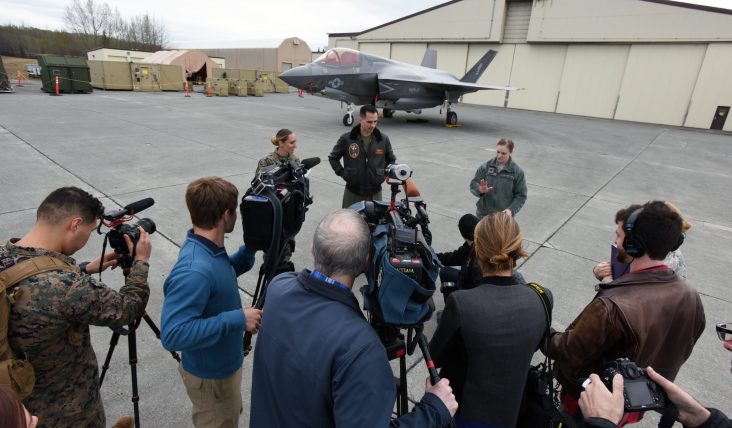
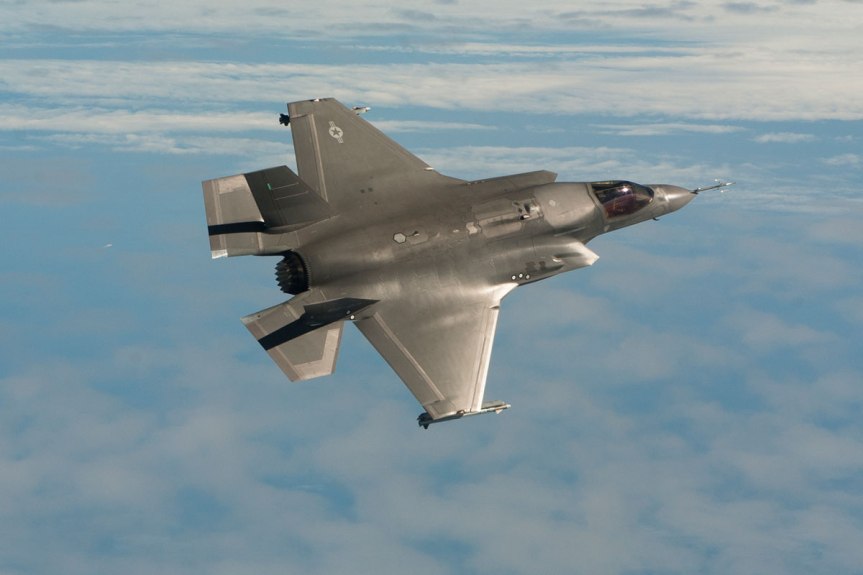
One of the pilots who flew at the Super Bowl in his F-35 gets a little media love
W.J. Astore
In my latest article for TomDispatch.com, I tackle the U.S. military and its self-defeating nature when it comes to wars overseas. But there is a “war” that the military-industrial complex truly is winning handily, even overwhelmingly, and that’s the one for money and power within and across American society. Put differently, when it comes to winning hearts and minds, the military fails spectacularly overseas but succeeds brilliantly here in the “homeland.”
Consider only one example: America’s major sporting events. Each one has now become a military celebration. At the Super Bowl this past weekend, four 100-year-old military veterans from World War II were the centerpiece of this year’s opening ceremonies (ostensibly to mark the 75th anniversary of the ending of that war in 1945, as well as the 100th year of the NFL), and of course no event is complete without military colorguards, saluting troops, and a loud flyover by combat jets at the close of the national anthem. This is all accepted as “normal” and patriotic, the very mundanity of which illustrates the triumph of the military-industrial complex in our lives.
What follows is an excerpt from my article from TomDispatch:
The Future Is What It Used to Be
Long ago, New York Yankee catcher and later manager Yogi Berra summed up what was to come this way: “The future ain’t what it used to be.” And it wasn’t. We used to dream, for example, of flying cars, personal jetpacks, liberating robots, and oodles of leisure time. We even dreamed of mind-bending trips to Jupiter, as in Stanley Kubrick’s epic film2001: A Space Odyssey. Like so much else we imagined, those dreams haven’t exactly panned out.
Yet here’s an exception to Berra’s wisdom: strangely enough, for the U.S. military, the future is predictably just what it used to be. After all, the latest futuristic vision of America’s military leaders is — hold onto your Kevlar helmets — a “new” cold war with its former communist rivals Russia and China. And let’s add in one other aspect of that military’s future vision: wars, as they see it, are going to be fought and settled with modernized (and ever more expensive) versions of the same old weapons systems that carried us through much of the mid-twentieth century: ever more pricey aircraft carriers, tanks, and top of the line jet fighters and bombers with — hey! — maybe a few thoroughly destabilizing tactical nukes thrown in, along with plenty of updated missiles carried by planes of an ever more “stealthy” and far more expensive variety. Think: the F-35 fighter, the most expensive weapons system in history (so far) and the B-21 bomber.
For such a future, of course, today’s military hardly needs to change at all, or so our generals and admirals argue. For example, yet more ships will, of course, be needed. The Navy high command is already clamoring for 355 of them, while complaining that the record-setting $738 billion Pentagon budget for 2020 is too “tight” to support such a fleet.
Not to be outdone when it comes to complaints about “tight” budgets, the Air Force is arguing vociferously that it needs yet more billions to build a “fleet” of planes that can wage two major wars at once. Meanwhile, the Army is typically lobbying for a new armored personnel carrier (to replace the M2 Bradley) that’s so esoteric insiders joke it will have to be made of “unobtainium.”
In short, no matter how much money the Trump administration and Congress throw at the Pentagon, it’s a guarantee that the military high command will only complain that more is needed, including for nuclear weapons to the tune of possibly $1.7 trillion over 30 years. But doubling down on more of the same, after a record 75 years of non-victories (not to speak of outright losses), is more than stubbornness, more than grift. It’s obdurate stupidity.
Why, then, does it persist? The answer would have to be because this country doesn’t hold its failing military leaders accountable. Instead, it applauds them and promotes them, rewarding them when they retire with six-figure pensions, often augmented by cushy jobs with major defense contractors. Given such a system, why should America’s generals and admirals speak truth to power? They are power and they’ll keep harsh and unflattering truths to themselves, thank you very much, unless they’re leaked by heroes like Daniel Ellsberg during the Vietnam War and Chelsea Manning during the Iraq War, or pried from them via a lawsuit like the one by the Washington Post that recently led to those Afghanistan Papers.
My Polish mother-in-law taught me a phrase that translates as, “Don’t say nothin’ to nobody.” When it comes to America’s wars and their true progress and prospects, consider that the official dictum of Pentagon spokespeople. Yet even as America’s wars sink into Vietnam-style quagmires, the money keeps flowing, especially to high-cost weapons programs.
Consider my old service, the Air Force. As one defense news site put it, “Congressional appropriators gave the Air Force [and Lockheed Martin] a holiday gift in the 2019 spending agreement… $1.87 billion for 20 additional F-35s and associated spare parts.” The new total just for 2020 is “98 aircraft — 62 F-35As, 16 F-35Bs, and 20 F-35Cs — at the whopping cost of $9.3 billion, crowning the F-35 as the biggest Pentagon procurement program ever.” And that’s not all. The Air Force (and Northrop Grumman) got another gift as well: $3 billion more to be put into its new, redundant, B-21 stealth bomber. Even much-beleaguered Boeing, responsible for the disastrous 737 MAX program, got a gift: nearly a billion dollars for the revamped F-15EX fighter, a much-modified version of a plane that first flew in the early 1970s. Yet, despite those gifts, Air Force officials continue to claim with straight faces that the service is getting the “short straw” in today’s budgetary battles in the Pentagon.
What does this all mean? One obvious answer would be: the only truly winning battles for the Pentagon are the ones for our taxpayer dollars.
Inspired by three recent articles at TomDispatch.com, I’d like to suggest why America’s wars never end.
The first article marking the 30th anniversary of the fall of the Berlin Wall is by James Carroll. It brought me back to when I was a young Air Force captain on active duty. All of us in the military were surprised when the wall came down. Soon the Soviet Union would collapse as well. I know because I got a certificate signed by President G.H.W. Bush congratulating us for winning the Cold War.
In the early 1990s there was much talk about a New World Order (largely undefined) and a Peace Dividend. The “new” world order quickly became global military adventurism for the U.S. and the peace dividend withered as Desert Shield/Storm and other operations commenced.
I recall some personnel cuts, but no real cuts in weaponry. And no change to strategy. NATO remained even though the Warsaw Pact had dissolved. Indeed, NATO would soon be expanded (in the cause of peace, naturally), even as U.S. imperial ambitions grew. It was the “end of history” and the U.S. had triumphed, or so we thought.
But why had we triumphed? Apparently the lesson our leaders took from it was that military strength was the key to our triumph, therefore more of the same would lead to new triumphs. Pax Americana was not about democracy or freedom: it was about weapons and wars. Peace through military strength (and destruction) was the driving philosophy.
Unbounded ambition and unbridled power – that was the new world order for America. The wall came down in Berlin, but it didn’t come down in our minds. Instead of an open society, Fortress America became the norm.
The second article is by Allegra Harpootlian and focuses on the “collateral damage” (murdered innocents) of America’s global bombing and drone campaigns. It made me think of a conversation I had with a student; he’d been in the U.S. Army and fought in Afghanistan. Basically, he described it as a dirt-poor country with a primitiveness that seemed Biblical to him. He got me thinking about how we “see” people like the Iraqis and Afghans as less than us. Different. Inferior. Primitive. From another time, and from another place.
So, when Americans kill civilians in those places, it’s almost like it’s cinematic, not real, “a long time ago, in a galaxy far, far away.” We just move on.
Of course, Americans are not encouraged to be empathetic people. The world is supposed to revolve around us. “You can have it all.” In a world of selfies, why care about others? Look out for #1!
To put a bow on this, consider evangelical Christianity and the prosperity gospel. (The idea God will reward you with material goods and money as a sign of righteousness.) Remember when charity to others was valued? Not anymore.
Another way of putting this: In America there’s a huge market for self-help books, videos, etc. But where are the books and videos encouraging us to help others?
The third article is by Andrew Bacevich and specifically addresses the never-ending nature of America’s wars. His piece made me think of Congresswoman Tulsi Gabbard, who as a presidential candidate has called for an end to regime-change wars (though not the war on terror). For her pains, she’s been accused of being a Russian asset by Hillary Clinton & Company.
Why is this? Because there’s just so much money – literally trillions of dollars – at stake here, and the military-industrial-congressional complex knows how to protect itself.
The Complex offers or supports hundreds of thousands of decent-paying jobs, building weapons, staffing think tanks, and so forth. President Trump may have voiced some skepticism about America’s failed and failing wars, yet he keeps giving the Pentagon more money. Hence the wars will continue, no matter what sounds come out of Trump’s mouth.
As Tom Engelhardt has noted, for the Pentagon, failure is success. Naval accidents mean the Navy needs more money. Failed wars mean the military needs more money to replace weaponry, “modernize,” and prepare for the next round. Defeat is victory, as in more money.
To recap, America’s wars persist because a martial imperialism is our new world order; because we have limited empathy for others, especially darker-skinned “primitives”; and because war is simply a thriving business, the Washington way to rule.
Here’s a final, bonus, reason America’s wars persist: thoughtfulness is not valued by the U.S. military. Another “t” word is: toughness. The U.S. military would rather be strong and wrong than smart and right.
For all the “think” tanks we have inside the Washington beltway, what matters more than thought is toughness. Action. Making the other guy whimper and cry, to cite President Trump. This is yet another reason why America loses. We prefer to act first, then (grudgingly) think, then act some more.
Here I think of U.S. officer performance reports, which also stress action, results, even when the results are “fragile,” “reversible,” or even made up. How many officers have been promoted on pacification campaigns that pacified no one? On training efforts, e.g. for the Iraqi Army, that trained no one? On battles or skirmishes “won” that had no staying power? Remember that Petraeus Surge in Iraq?
In a nutshell, perhaps we wage war without end simply because we want to. We’ll stop when we wake up from our madness – or when someone makes us stop.
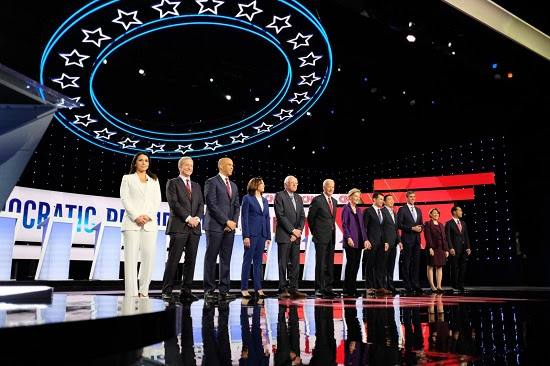
Last night witnessed another scrum among the top twelve Democratic challengers. It wasn’t really a debate since each candidate only had a minute or two to respond to questions. I’ve seen headlines describing the debate as “the moderates versus the progressives,” with the usual scorecards about which candidates “won” and “lost,” but I don’t think any candidate “won.” And it was the American people who clearly lost.
First, what was missing. There was no serious discussion of U.S. foreign policy, of America’s military-industrial complex and colossal “defense” budgets, or of climate change. The situation in Syria was discussed in the context of President Trump’s alleged betrayal of the Kurds, but that was all. There was no discussion about nuclear weapons and their proliferation (and America’s decision to “modernize” our arsenal at a cost of at least a trillion dollars). There was no discussion of America’s overseas empire of 800 military bases. There was no serious discussion about ending the Afghan War, or the enormous cost of America’s wars since 9/11.
So, what was discussed? Trump’s impeachment, of course. Medicare for all versus “choice.” A woman’s right to control her own body (obviously a very important subject). How and whether to change the Supreme Court. Taxes. Guns. Tech monopolies. Opioid abuse and holding drug companies responsible for the same. Even Ellen’s friendship with George W. Bush.
CNN and the New York Times sponsored the debate, hence they controlled the questions. The initial goal seemed to be to get Elizabeth Warren to admit she’d have to raise taxes to pay for her Medicare plan. She largely ducked the issue, insisting the rich and corporations would pay for it. Another question raised the specter of Bernie Sanders’s health after his recent heart attack, and also of Joe Biden’s age, i.e. that if he’s elected, he’ll turn 80 while he’s in office. It was that kind of “debate.”
Speaking of Joe Biden, he didn’t perform well in this debate. He often misspoke and his answers drifted off course. I can see why the smart money is gravitating toward Elizabeth Warren.
Another person who suffered from the debate format was Tulsi Gabbard. Few questions were directed her way, and she was often ignored or cut off as she tried to speak. Her attempt to challenge Elizabeth Warren on her qualifications to be commander-in-chief went unanswered as CNN cut to commercials. Nice try, Tulsi, but CNN was having none of that.
With respect to Trump and Syria, only Tulsi Gabbard attempted to explain the long history of U.S. involvement in the area, which was, in essence, a regime-change war directed against Bashar al-Assad. (Recall that President Obama in 2015 said that Assad had to go.) But again CNN was having none of that, and Tulsi’s point was left hanging as other candidates babbled about not serving the agenda of Vladimir Putin.
And there you have it: yet another debate from which the American empire and the military-industrial complex emerged as the clear victors.
A scene from America’s endless war in Afghanistan (Council on Foreign Relations)
Ronald Enzweiler
The current brouhaha in the U.S. Senate (and the larger neocon community) over President Trump’s decision to pull U.S. troops out of Syria is a repeat performance of the passion play that the same actors performed earlier this year when Trump first announced his intention to make good on his campaign promise to get our country out of its endless wars. In the leading role for the neocons last time, Senate Majority Leader Mitch McConnell made a speech on the Senate floor on January 19, 2019 excoriating Trump for doing what he told the electorate he would do if he was elected president.
Having been an interloper in our country’s national security state, I know how things work in Washington and the tactics the pro-war political establishment uses to sell the public on its interventionist foreign policy and endless wars. I wrote a book (When Will We Ever Learn?) on this subject based on my personal experiences.
As this drama plays out again, I’ve excerpted passages from my book that reveal the modus operandi the neocons used last time for overruling President Trump in determining U.S. military policy. My critique of Senator McConnell’s speech is as pertinent now in exposing the fallacious thinking underlying the neocons’ current “stay forever” battle cry for Syria as it was in the brawl Trump lost to the neocons earlier this year when he wanted to bring U.S. troops home from Afghanistan after 18 years. Let’s hope the president learned from that defeat.
It’s now “game on” in round two of this battle. The same players are back. Senator McConnell is even using the word “precipitous” again. Get your popcorn out and let’s see who wins this round in this heavyweight bout.
_________________________
We’ve already seen [earlier in my book] how the national security state sandbagged a Democrat president in his role as Commander-in-Chief in the conduct of the Afghan war. Let’s now see how Washington elites are trying to sandbag a Republican president in his attempt to end this 18-year long war – despite President Trump’s vow in his presidential campaign and strong public support in the polls for getting all U.S. troops out of Afghanistan.
The neocon foreign policy establishment used three of its most prominent members to maintain their control over national security matters: Senate Majority Leader Mitch McConnell; President of the Council on Foreign Relations (CFR) Richard Haass; and James Dobbins, Senior Fellow at the Rand Corporation. Mr. Dobbins was the lead author of the 15-page Rand Report dated January 7, 2019, Consequences of a Precipitous U.S. Withdrawal from Afghanistan. (Take note of the word “precipitous” in this title.)
For those who don’t recognize the name, Rand Corporation is a charter member of the national security state insiders’ club. Military history buffs might recall Rand wrote the Pentagon Papers for the DoD in the late 1960s. They were the War State’s obvious go-to think-tank for this important assignment on Afghan war policy.
First, let’s see what Senator McConnell had to say about President Trump’s decision to start pulling U.S troops out of Afghanistan and Syria. Below are remarks Senator McConnell made on the Senate floor on January 31, 2019.
“Simply put, while it is tempting to retreat to the comfort and security of our own shores, there is still a great deal of work to be done,” McConnell said. “And we know that left untended these conflicts will reverberate in our own cities.”
The United States is not the “world’s policeman,” it is the “leader of the free world” and must continue to lead a global coalition against terrorism and stand by allies engaged in the fight. He also stressed the importance of coordination between the White House and Congress to “develop long-term strategies in both nations, including a thorough accounting of the risks of withdrawing too hastily.”
“My amendment would acknowledge the plain fact that al-Qaeda, ISIS, and their affiliates in Syria and Afghanistan continue to pose a serious threat to our nation.” McConnell said his amendment “would recognize the danger of a precipitous withdrawal from either conflict and highlights the need for diplomatic engagement and political solutions to the underlying conflicts in Syria and Afghanistan.”
Notice the word “precipitous” in the Leader’s remarks. Do you think it’s a coincidence that the title of the Rand Report is Consequences of a Precipitous U.S. Withdrawal from Afghanistan? Obviously, Mitch got the memo from neocon headquarters.
He even got in the “we’re not the world’s policeman” line. In Washington-speak, this is called “a non-denial denial.” It translates to: “I’m really doing what I say I am not doing, but I can’t admit it, or you would catch on to how duplicitous I am.” I’ve hung around with Washington swamp creatures too long to know that this professed denial is really an affirmation.
The line “we know that left untended these conflicts will reverberate in our own cities” is also classic neocon-speak. It’s meant to scare the public. But what it really does is reveal the flawed logic in their interventionist foreign policy doctrine. The U.S. builds military bases around the world, starts wars, deposes governments, and occupies other countries – this is the interventionist foreign policy Senator McConnell champions as the head neocon in the U.S. Senate. But the local nationals affected by this U.S. militarism don’t like a foreign power meddling in their part of the world, changing their governments, and interfering with their way of life. (Who would?)
The obvious way to avoid blowback “in our cities” is for the U.S. to stop intervening in centuries-old ethnic, religious and territorial disputes in other parts of the world. Not realizing this cause and effect (or simply ignoring it), Senator McConnell’s solution is to “stay the course.” In neocon-speak, this means sending in more troops, intensifying bombing, and increasing extrajudicial drone killings. These actions only worsen the conflicts, causing the U.S. to sink deeper into quagmires.
Predictably, Senator McConnell’s amendment passed the Senate on a 63-28 non-binding vote, proving that bipartisanship isn’t dead in Washington when it comes to authorizing endless wars. This vote just shows how out of touch our elected officials are with the electorate as well as the power of the pro-military and pro-war lobby in Washington.
The other character on the neocon’s tag-team to undercut the President on his Afghan exit plan is Richard Haass, CFR President. Mr. Haass was a senior State Department official in the first term of the Bush administration when the Iraq war began. He’s one of several media savvy spokespersons for the national security state who apparently was charged with getting the word out on the Rand Report and endorsing its conclusion.
On the day after the report came out, Mr. Haass tweeted to his 150,000 followers:
“This report has it right: winning is not an option in Afghanistan (nor is peace) but losing (and renewed terrorism) is if we pull out U.S. forces any time soon. We should stay with smaller numbers and reduced level of activity.” Twitter, January 18, 2019.
In sum, even though there’s no chance of winning, America needs to keep fighting. How do they sell this nonsense?
This was a three-step process. First, the “let’s stay in Afghanistan forever” doctrine was composed by Mr. Dobbins in the Rand Report. It was next preached by CFR President Haass. And finally, it was ordained by Senate Majority Leader McConnell in his speech on the Senate floor with the hallelujah chorus being the 63 “yes” votes for his resolution.
Picking up the trio’s “let’s stay in Afghanistan forever” cue, guest op-eds and editorial board columns appeared in the usual pro-War State newspapers advocating the neocon position. Media talking heads – as semiofficial spokespersons for the Washington national security state – echoed the neocons’ talking points on this issue.
This modius operandi for keeping the national security state in charge of foreign and military policy – and its untouchable $1-trillion-plus/year War State budget– has been going on since the Kennedy presidency. Michael Swanson documents how this takeover evolved in his book War State. Most times, the story being sold (e.g., keep U.S. troops in Syria; stay in NATO after it became obsolete; continue the DoD’s $300-billion unworkable missile-defense program) is a front for the national security state’s real objectives (e.g., maintain U.S. influence in the Middle East to keep Israel’s supporters happy; keep the Cold War alive with Russia as an adversary; and fund make-work projects for defense contractors).
This duplicity is how business is done in Washington. It’s an insiders’ game where what’s good for the American people and U.S. national security is, at best, a secondary consideration. Among the Washington ruling class, what counts most is retaining power by keeping big donors happy. And if that means endless wars, so be it.
Mr. Enzweiler, who served in the US Air Force in the 1970s, has lived and worked extensively in the Middle East, serving seven years (2007-2014) as a field-level civilian advisor for the US government in the Iraq and Afghanistan wars. Now retired, he has written a book (When Will We Ever Learn?) that critiques US foreign and military policy.
My latest article for TomDispatch.com focuses on the F-35 stealth fighter, which is estimated to cost $1.5 trillion over the life of the program. I hope you can read all of the article here; what follows is an extended excerpt on the history of the program. Did you ever notice how Congress never asks where the money is coming from for these incredibly expensive weapons? But ask for money for education, environmental protection, infrastructure, and especially for poor people and Congress starts screaming about the deficit, which is booming under Trump. But there’s always money for weapons! We need to remember that “government” money is our money, and we need to start spending it on priorities that matter to us, not to defense contractors and generals.
A Brief History of the F-35 Program
I first heard of what would become the F-35 in 1995. I was then a captain in the Air Force, working on flight-planning software. I was told that a new Joint Strike Fighter, or JSF, was being developed. The “joint” meant that the Air Force, Navy, and Marines would all use it. Its big selling point at the time was the striking level of anticipated savings expected due to the commonality of the design, of spare parts, and of everything else. (Those in the know then, however, remembered the Pentagon’s previous shot at “jointness,” the TFX program in the 1960s; the resulting plane, the F-111, would be rejected by the Navy and unloved by the Air Force.)
The new JSF was advertised as offering the highest-tech possible at the lowest price imaginable, a fighter that would replace legacy aircraft like the Air Force’s F-16s and A-10s and the Navy’s F-18s. Winning the competition to develop the plane was weapons giant Lockheed Martin and a prototype F-35 Lightning II first took to the skies in 2006, by which time I was already retired from the Air Force. In the 13 years since then, the F-35 has gone through a mind-boggling series of major program delays and setbacks, burning money all the way.
In 2014, the plane’s woeful record finally caught the eye of CBS’s 60 Minutes, which documented how the program was seven years behind schedule and already $163 billion over budget. The Pentagon, however, simply plunged ahead. Its current plan: to buy more than 2,600 F-35s by 2037, with the assumption that their service lives will possibly extend to 2070. In Pentagon terms, think of it as a multi-generational warplane for America’s multi-generational wars.
Five years after that 60 Minutes exposé and 13 years after its first flight, the F-35 unsurprisingly remains mired in controversy. Harper’s Andrew Cockburn recently used it to illustrate what he termed “the Pentagon Syndrome,” the practice of expending enormous sums on weapons of marginal utility. The F-35, he noted, “first saw combat [in 2018], seventeen years after the program began. The Marines sent just six of them on their first deployment to the Middle East, and over several months only managed to fly, on average, one combat sortie per plane every three days. According to the Pentagon’s former chief testing official, had there been opposition, these ‘fighters’ could not have survived without protection from other planes.”
So far, in other words, the F-35 has had an abysmally low rate of availability. Technically speaking, it remains in “initial operational testing and evaluation,” during which, as defense journalist Dan Grazier has noted, it achieved a “fully mission capable rate” of just 11% in its combat testing phase. (The desired goal before going into full production is 80%, which is, in a sense, all you need to know about the “success” of that aircraft so many years later.) Compounding those dreadful percentages is another grim reality: the F-35’s design isn’t stable and its maintenance software has been a buggy nightmare, meaning the testers are, in a sense, trying to evaluate a moving and messy target.
These and similar problems led President Trump and former acting Defense Secretary Patrick Shanahan to push possible alternatives to the F-35 as a way of pressuring Lockheed Martin to improve its performance. In December 2016, before he even entered the Oval Office, for example, Trump tweeted about building F-18 Super Hornets in place of the F-35. Later, Shanahan advocated for an updated version of the venerable F-15 Eagle, made by Boeing, a company for which he had only recently been a senior executive. But the president’s tweets have moved on, as has Shanahan, and Lockheed Martin continues to hold all the cards. For the Pentagon, it’s still the F-35 or bust.
Unsurprisingly, the president has changed his tune, enthusing that the F-35 is invisible (“You literally can’t see it”) rather than merely difficult to detect on radar. (He has also referred to Marillyn Hewson, the CEO of Lockheed Martin, as Marillyn Lockheed.) The main selling point of the F-35 is indeed its stealth technology, marking it as a “fifth generation” fighter when compared to the older F-15s, F-16s, F-18s, and A-10s, which are decidedly unstealthy and radar detectable. Primarily because of such technology, the Pentagon argues that the F-35 will prove far more “survivable” than previous warplanes in any future conflict with Russia, China, or some other country equipped with sophisticated radars and surface-to-air missiles.
Yet such stealthiness comes at a real cost and not just in monetary terms. To maintain its stealthy profile, the F-35 must carry its weaponry internally, limiting its load and destructive power compared to “fourth generation” planes like the A-10 and F-15. It must also rely on an internal fuel system, which will limit its range in battle, while its agility in air-to-air combat seems poor compared to older fighters like the F-16. (The Pentagon counters, unconvincingly, that the F-35 wasn’t designed for such dogfighting.)
As a former Air Force project engineer and historian of technology and warfare, here’s my take on the F-35 program today: in trying to build an aircraft to meet the diverse requirements of three services, Lockheed Martin has produced a jack-of-all-trades, master-of-none albatross. Each military service piled requirements onto the F-35, as ever more esoteric features were added, including that stealth capability; special software featuring eight million lines of code; unique (and wildly expensive) helmets for its pilots; and vertical landing/short takeoff capacity for the Marines, which led to an airframe design that made it ever less maneuverable for the Air Force and Navy. The result: perhaps the classic example of a plane that is far less than the sum of its staggeringly expensive parts.
To get more specific, consider the mission of close air support, or CAS, which means supporting troops in or near combat. The best and most survivable plane for such a role remains the one specifically designed for it: the unglamorous A-10 Warthog, which ground troops love but Air Force officialdom hates (because it was designed in response to Army, not Air Force, needs). By comparison, the F-35, which is supposed to fill the A-10’s role, simply isn’t designed for such a mission. It’s too fast, meaning its loiter time over targets is severely limited; its weapons load is inadequate; it has only one engine, making it more vulnerable to ground fire; and its (malfunctioning) gun lacks punch. (It also costs twice as much to fly.) Despite all this, the Air Force continues to advocate for the F-35 in a CAS role, even as it grudgingly re-wings A-10s to extend their lives.
And keep in mind as well that, if you want an attack platform that can loiter for hours, while removing all risk to pilots, why not just use already existing drones like the military’s Reapers? Who even needs an expensive F-35 stealth fighter? To these and similar criticisms the Pentagon responds that it’s fifth generation! It’s new! It’s stealthy! It’s a game-changer! It scares the Russians and Chinese! And if those answers don’t work, there’s always that old standby: tell me why you hate our troops!
Meanwhile, Lockheed Martin’s profits are soaring as that company and the Pentagon sell the F-35 to allies around the world. Despite its delays, cost overruns, and performance issues, it’s still being promoted as America’s latest and greatest. Foreign military sales have the added benefit of driving down per-unit costs for the Pentagon, even as politicians tout the F-35 as a huge job creator. In short, with no alternative in sight, Lockheed Martin remains top gun in the Pentagon’s cockpit (Eat your heart out, Tom Cruise!), with virtually guaranteed profits for the next half-century.
The USA is a violent land. And perhaps that might be OK, if we limited the violence to us. But we’ve become the world’s leading exporter of deadly weaponry, a fact I was reminded of this morning as I read William Hartung’s latest article on the military-industrial complex at TomDispatch.com. In detailing the ever-growing power of the Complex, Hartung had this telling sentence:
When pressed, Raytheon officials argue that, in enabling mass slaughter, they are simply following U.S. government policy.
Tragic as that statement is, it’s also true. As I’ve written about before, weapons ‘r’ us. Our so-called peacetime economy is geared to war, homeland security, surveillance, and other forms of violent and coercive technologies and products. Even as America seeks to prevent other countries from acquiring weapons of mass destruction (WMD), we’re actively seeking to sell WMD to others, as long as those weapons are Made in the USA and go to “allies” that pay promptly, like the Saudis.
Being the world’s leading purveyor of violence can only lead to America’s spiritual death, as Martin Luther King Jr. argued so eloquently a half-century ago. As MLK’s words show, this tragic reality is nothing new in America. As Senator J. William Fulbright noted in 1970, the U.S. emerged after World War II to become “the world’s major salesman of armaments.” Fulbright went further and quoted Marine Corps General David M. Shoup, a Medal of Honor recipient, and Shoup’s conclusion that “America has become a militaristic and aggressive nation.” Remember, this was fifty years ago, when the U.S. at least faced a real threat from Communism, no matter how much we inflated it. We face no equivalent threat today, no matter how much the Pentagon hyperventilates about China and Russia.
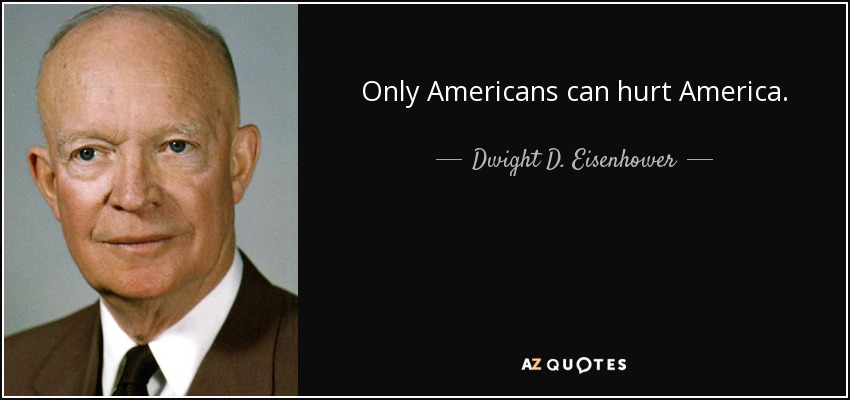
Returning to Hartung’s article, I like his title: “Eisenhower’s Worst Nightmare.” Indeed it is, in the sense that the military-industrial complex is, ultimately, an American complex. Which makes me think of another Eisenhower sentiment: that only Americans can truly hurt America. That our biggest enemy is within our borders: our own violence, aggression, fear, and hatred, especially of others.
Ike was right about the Complex, and he was right about how America would truly be hurt and defeated. The enemy is not from without. No walls will keep him out. No — the enemy is within. And it won’t — indeed, it can’t — be defeated by weapons and violence. Indeed, more weapons and violence only make it stronger.
Be an indispensable nation, America. Be exceptional. Be great. As Melania Trump might say, Be Best. How? Stop exporting violence. And stop the hurt within.
In my latest article for TomDispatch.com, I again turn to the Pentagon and the military-industrial complex, inspired by a critique written by J. William Fulbright almost a half-century ago. Given the murderous and disastrous war in Southeast Asia of Fulbright’s time, many Americans back then were willing to be highly critical of the military, especially with a draft still in force. (A draft that privileged men like Dick Cheney, Bill Clinton, and Donald Trump managed to avoid.) Nowadays, of course, Americans are encouraged to venerate the military, to salute “our” troops, to applaud as various warplanes soar overhead, as they did during Donald Trump’s recent militaristic July 4th ceremony. What we’re not encouraged to do is to criticize or even to question America’s vast military establishment and its enormous power, even though President Dwight D. Eisenhower warned us about that establishment in his famous farewell speech in 1961.
It’s high time we Americans listened to Ike as well as to J.W. Fulbright. Let’s give the latter a close listen, shall we?
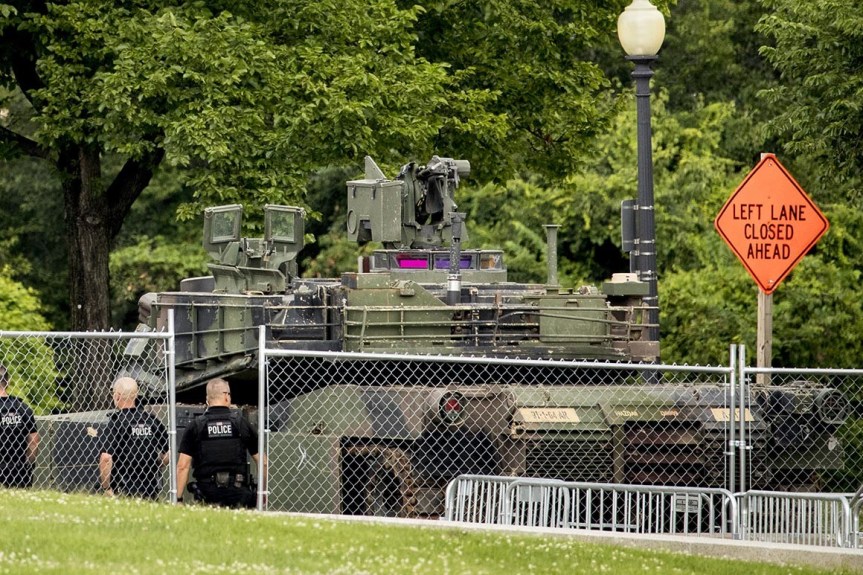
Because nothing says “America” like tanks, fences, barriers, police, and a sign saying the way is closed to the “left”
A while back … I stumbled across Senator J. William Fulbright’s 1970 book The Pentagon Propaganda Machine and, out of curiosity, bought it for the princely sum of five dollars. Now, talk about creepy. Fulbright, who left the Senate in 1974 and died in 1995, noted a phenomenon then that should ring a distinct bell today. Americans, he wrote, “have grown distressingly used to war.” He then added a line that still couldn’t be more up to date: “Violence is our most important product.” Congress, he complained (and this, too, should ring a distinct bell in 2019), was shoveling money at the Pentagon “with virtually no questions asked,” while costly weapons systems were seen mainly “as a means of prosperity,” especially for the weapons makers of the military-industrial complex. “Militarism has been creeping up on us,” he warned, and the American public, conditioned by endless crises and warnings of war, had grown numb, leaving “few, other than the young, [to] protest against what is happening.”
Back then, of course, the bogeyman that kept the process going was Communism. America’s exaggerated fear of Communism then (and terrorism now) strengthened militarism at home in a myriad of ways while, as Fulbright put it, “undermining democratic procedure and values.” And doesn’t that ring a few bells, too? Complicit in all this was the Pentagon’s own propaganda machine, which worked hard “to persuade the American people that the military is good for you.”
Perhaps my favorite passage from that book was a message the senator received from a citizen who had attended a Pentagon rah-rah “informational seminar.” Writing to Fulbright, he suggested that “the greatest threat to American national security is the American Military Establishment and the no-holds-barred type of logic it uses to justify its zillion-dollar existence.”
In a rousing conclusion on the “dangers of the military sell” that seems no less apt nearly a half-century later, Fulbright warned that America’s “chronic state of war” was generating a “monster [military] bureaucracy.” Citing the My Lai massacre in Vietnam, he noted how “the mindless violence of war” was eroding America’s moral values and ended by emphasizing that dealing with the growth of immoral militarism was vitally important to the country’s future.
“The best defense against militarism is peace; the next best thing is the vigorous practice of democracy,” he noted, citing the dissenters of his day who opposed America’s murderous war in Southeast Asia. And he added a warning no less applicable today: Americans shouldn’t put their faith in senior military men whose “parochial talents” were too narrow “to equip them with the balance of judgment needed to play the political role they now hold in our society.”
Reading Fulbright today, I couldn’t help but recall one of my dad’s favorite sayings, translated from the French: the more things change, the more they stay the same. Sure, the weaponry may be upgraded (drones with Hellfire missiles rather than bombers dropping napalm); the names of the countries may be different (Afghanistan, Iraq, and Somalia rather than Vietnam, Laos, and Cambodia); even the stated purpose of the wars of the moment may have altered (fighting terrorism rather than defeating Communism); but over the last 50 years, the most fundamental things have remained remarkably consistent: militarism, violence, the endless feeding of the military-industrial complex, the growth of the national security state, and wars, ever more wars, always purportedly waged in the name of peace.
Sometimes when you buy a used book, it comes with a bonus. This one held between its pages a yellowed clipping of a contemporary New York Times review with the telling title, “O What a Lovely Pentagon.” In agreeing with Fulbright, the reviewer, Herbert Mitgang, himself a veteran of World War II, wrote:
“To keep up the [Pentagon] budgets, all three services compete for bigger and better armaments in coordination with the publicity salesmen from the major corporations — for whom retired generals and admirals serve as front men. Thousands of uniformed men and millions of dollars are involved in hard-selling the Pentagon way of life.”
Change “millions” to “billions” and Mitgang’s point remains as on target as ever.
Citing another book under review, which critiqued U.S. military procurement practices, Mitgang concluded: “What emerges here is a permanent floating crap game with the taxpayer as loser and Congress as banker, shelling out for Pentagon and peace profiteers with an ineptitude that would bankrupt any other business.”
Spot on, Herb Mitgang, who perhaps played his share of craps during his Army service!
As I read Fulbright’s almost 50-year-old polemic and Mitgang’s hard-hitting review, I asked myself, how did the American people come to forget, or perhaps never truly absorb, such lessons? How did we stop worrying about war and come to love the all-volunteer military quite so much? (Thank you for your service!) So much so that, today, we engorge the Pentagon and the rest of the national security state with well more than a trillion taxpayer dollars annually — and the power to match…
Addendum: Along with Abrams tanks and Bradley Fighting Vehicles, Trump’s July 4th ceremony turned into a military air show of sorts. When you read the Declaration of Independence from 1776, you’re reminded that the colonists wanted to be free of the King’s wars and their high costs. Now, on Independence Day, we celebrate our military weaponry without mentioning the high costs, even as we ignore our unending wars.
It’s time for another political revolution against the king’s wars and their high costs. It’s time to throw off the heavy yoke of militarism in America.
Bernie and Tulsi: the only candidates willing to call out the military-industrial complex
W.J. Astore
I watched the two Democratic debates this week. Media outlets treat them as a horse race, announcing winners and losers. So perhaps you heard Kamala Harris scored big-time against Joe Biden. Or perhaps you heard Elizabeth Warren did well, or that Tulsi Gabbard generated lots of post-debate interest (Google searches and the like). I will say that Beto O’Rourke was clearly unprepared (or over-prepared) and unable to speak clearly and meaningfully, so count him as a “loser.”
All that said, the clear winner wasn’t on the stage; it wasn’t even among the 20 debate participants. The name of that clear winner: America’s military-industrial complex and its perpetual wars.
Sure, there was some criticism of the Afghan and Iraq wars, especially by candidates like Bernie Sanders and Tulsi Gabbard. But there was no criticism of enormous “defense” budgets ($750 billion and rising, with true outlays exceeding a trillion a year), and virtually no mention of Saudi Arabia and the war in Yemen. (Tulsi briefly mentioned the Saudis and was shut down; Bernie mentioned the war in Yemen and was ignored.)
The only direct mention of the military-industrial complex that I recall hearing was by Bernie Sanders. Otherwise, the tacit assumption was that soaring defense budgets are appropriate and, at least in these debates, unassailable.
Bernie and Tulsi also mentioned the threat of nuclear war, with Bernie making a passing reference to the estimated cost of nuclear forces modernization (possibly as high as $1.7 trillion). Again, he had no time to follow up on this point.
NBC’s talking heads asked the questions, so blame them in part for no questions on the MI Complex and the enormous costs of building world-ending nuclear weapons. Indeed, the talking heads were much more concerned with “gotcha” questions against Bernie, which attempted to paint him as a tax-and-spend socialist who doesn’t care about diversity. Yes, that really was NBC’s agenda.
Always, Democrats are asked, “How will you pay for that?” You know: “extravagances” like more affordable education, better health care, a tax cut that helps workers, or investments in job training programs and infrastructure. But when it comes to wars and weapons, there are never any questions about money. The sky’s the limit.
A reminder to Democrats: Donald Trump won in 2016 in part because he was willing to denounce America’s wasteful wars and to challenge defense spending (even though he’s done nothing as president to back up his campaign critique). We need true Peace Democrats with spine, so I remain bullish on candidates like Bernie Sanders and Tulsi Gabbard.
Hopefully, in future debates Bernie, Tulsi, and others will call for major reforms of our military and major cuts to our bloated Pentagon budget. But don’t count on that issue being raised by the mainstream media’s talking heads.
Bonus Winner: I can’t recall a single mention of Israel and the Palestinians, not even in the context of framing a peace plan. No mention of America’s role in Venezuela either. The imperial and aggressive neo-con agenda on foreign policy went almost unchallenged, but kudos to Tulsi Gabbard for calling out the “chickenhawks” (her word, and the right one) in the Trump administration.
Doing some housecleaning of the mind, so to speak:
I recently read a book that argued the U.S. military loses its wars due to poor strategy and lack of understanding of “limited” war. It was a sophisticated book that cited the usual suspects in classical military theory, like Clausewitz. And it got me to thinking. I don’t think the U.S. loses wars because of poor military theory or improper applications thereof. And I don’t think the U.S. can win wars by better/smarter theory. Rather, the wars the U.S. has been fighting since Korea should never have been started or joined to begin with. Whether it’s Vietnam in the 1960s or Afghanistan and Iraq today, these are and never were “winnable” wars. Why? Because they were unnecessary to U.S. national security. And the only way to “win” such wars is to end them.
Unnecessary wars persist for many reasons. A big one is profit, as in Ike’s military-industrial complex. Perhaps as well these wars are sustained by a belief the U.S. military could win them if only the generals hit on the right strategy. But there is no smarter way to win dumb wars. You win them when you end them.
War criminals. There’s been talk lately of President Trump wanting to pardon war criminals and how this would jeopardize order and discipline within the U.S. military. But let’s leave aside low-level offenders (your sergeants and captains) and talk about high-ranking war criminals. Indeed, what about the men who chose to go to war under false pretenses in the first place? If you choose not to prosecute men like Bush/Cheney/Rumsfeld, why pursue and prosecute the little guys?
I once read that the guilt for war crimes is greater the further you are from the crimes you effectively ordered. Adolf Eichmann didn’t dirty his own hands; he was a deskbound murderer. And perhaps that’s the worst kind.
Historically, we recognize the moral and legal culpability of high-ranking murderers like Eichmann. Should America’s top leaders be held responsible for the murderous results of wars that they launched?
Lady Liberty Locked and Loaded. The U.S. routinely brags of having the best military ever while leading the world in weapons sales while professing to be an exceptional bastion of liberty. And most Americans see no contradiction here. Simultaneously, men like Trump continue to vilify brown-skinned immigrants as bringing violence to America. Lady Liberty, in short, no longer lights her torch for the huddled masses. If we (or the French?) were making her today, she’d carry a .44 magnum (or an assault rifle?) in place of a torch. Do you feel lucky, immigrant punks?
Coincidence: A friend just sent me the Global Peace Index for the world’s 163 countries. The USA ranks #128. (Iceland is #1, followed by New Zealand at #2.) USA! USA! USA!
A friend of mine sent along a campaign ad for a woman running for Congress in Texas. Kim Olson is her name, and she has some good ideas. But the ad itself is telling for different reasons. A retired Air Force colonel, Olson appears in her military-issue flight jacket, complete with her rank, wings, and command patch, as she talks about being a “warrior.”
I have nothing against Colonel (retired) Olson. She’s gutsy and committed to public service. But enough of the “warrior” talk and enough with the military uniforms! You didn’t see Ike campaigning for president while wearing a jacket with five stars on it.
Readers of this blog may know that I taught at the Air Force Academy for six years. Impressive? Not according to the Secretary of the Air Force. In her words: “We are now boarding and recommending people for instructor duty and you’re not going to be able to do it unless you’re the best of the best. Historically, we didn’t value instructor duty. If you taught at Lackland or at the Air Force Academy or ROTC…that was kind of because you couldn’t get a better position and it was kind of a dead end. So now we’ve flipped that.”
I’ve changed my call sign to William “Dead End” Astore. It has a nice ring to it.
In all seriousness, the military has always favored doers over thinkers. Nowadays, you’re supposed to be a warrior, constantly doing…well…something. So we’ve been doing something, usually the same thing, repeatedly, in Iraq and Afghanistan, regardless of results. And history? Who cares? America’s military members barely know their own history, let alone the history of foreign peoples and cultures.
Incredibly, the military’s push for better education (defined as “intellectual overmatch,” I kid you not) is couched in terms of out-thinking the Russians and Chinese. In other words, we’re doomed.
As I put it to a friend, “The services need to develop senior officers with depth and breadth of vision, but the system is designed to produce narrow-minded true believers. It’s a little like trying to reform the Catholic church and its hierarchy of conservative, insular, cardinals and bishops.”
Or, as one of my Air Force friends put it, waxing satirically: “But you know, the problem really is that we don’t award enough ribbons, haven’t changed the uniform in a few years, and are allowing transgendered to serve while violating the rights of commanders by not allowing them to share [with subordinates] their [conservative Christian] faith.”
That’s enough random thoughts for this Thursday. What say you, readers?