Replacing an older suicide vest with a newer one is not a sound plan
We are losing the struggle for the heart and soul of our country.
That much is apparent by the government’s embrace of genocide in Gaza, its boasts of trillion dollar war budgets, and its pride in global weapons sales, which the U.S. dominates (more than 40% of the global arms trade consists of weapons made in the USA).
I’ve been involved in efforts to criticize America’s “merchants of death” and to challenge America’s love affair with the military-industrial complex (MIC), but seemingly nothing we say or do changes the abusive and sociopathic power structure in DC. I suppose that’s none too surprising, given the power of the MICIMATT and the persuasiveness of propaganda.
Still, we must persist in these efforts, bringing a positive message, which I think should focus on the revival of democracy by reinvesting in America while rejecting militarism and restoring peace. Peace should be America’s normal, not war and constant preparations for the same. Yet “peace” seems to be the hardest word, one that’s rarely spoken in the halls of power.
Anyhow, in 2022 I wrote the following email to likeminded colleagues; I hope it’s worth sharing. As I think about it, three years later, I marvel at the death of idealism in America and the triumph of militarism. When more than half of the federal government’s discretionary spending goes to the military and weaponry, despite the Pentagon’s failure to pass audit after audit for seven years running, we must conclude we are one sick society.
The question is: How do we restore ourselves to health? Because I for one do not believe that war is the health of the state.
*****
Written in 2022 to colleagues seeking to reform the military-industrial complex (MIC).
When I was a college student in the early 1980s, and in Air Force ROTC, I wrote against the Reagan “defense” buildup. Caspar Weinberger, he of the “Cap the knife” handle for cost-cutting, became “Cap the ladle” as Reagan’s SecDef, ladling money in huge amounts to the Pentagon. History is repeating itself again as the Biden administration prepares to ladle $813 billion (and more) to the Pentagon.
How do we stop this? Of course, we must recognize (as I’m sure we all do) what we’re up against. Both political parties are pro-military and, in the main, pro-war. Our economy is based on a militarized Keynesianism and our culture is increasingly militarized. Mainstream Democrats, seemingly forever afraid of being labeled “weak” on defense, are at pains to be more pro-military than the Republicans. Biden, in Poland, echoed the words of Obama and other past presidents, declaring the U.S. military to be “the finest fighting force” in history. Think about that boast. Think about how Biden added that the nation owes the troops big. This is a sign of a sick culture.
Ike gave his MIC speech in 1961, and for 61 years the MIC has been winning. Even after the collapse of the Soviet Union in the early ‘90s, the MIC held its own; after 9/11, it went into warp speed and is accelerating. To cite Scotty from Star Trek: “And at Warp 10, we’re going nowhere mighty fast.”
We need a reformation of our institutions; we need a restoration of our democracy; we need a reaffirmation of the U.S. Constitution; we need to remember who we are, or perhaps who we want to be, as a people.
Do we really want to be the world’s largest dealer of arms? Do we really want to spend a trillion or more dollars, each and every year, on wars and weapons, more than the next dozen or so countries combined, most of which are allies of ours? (“Yes” is seemingly the answer here, for both Democrats and Republicans.) Is that really the best way to serve the American people? Humanity itself?
Consider plans to “invest” in “modernizing” America’s nuclear triad. (Notice the words used here by the MIC.) What does this really mean? To me, it means we plan on spending nearly $2 trillion over the next 30 years to replace an older suicide vest with a newer one, except this suicide vest will take out humanity itself, as well as most other life forms on our planet.
As Ike said in 1953, “This is not a way of life at all … it is humanity hanging from a cross of iron.”
We will need the broadest possible coalition to tackle this outrage against civilization and humanity. That’s why I applaud these efforts, even as I encourage all of us to enlist and recruit more people to join our ranks.
My father enlisted in the Civilian Conservation Corps in 1935 to do his bit for his family and his nation. He fought forest fires in Oregon and later became a firefighter after serving in the Army during World War II. That was the last formally declared war that America fought. It was arguably the last morally justifiable war this country has fought, waged by citizens who donned a uniform, not “warriors” who are told that the nation owes them big.
In “It’s A Wonderful Life,” Jimmy Stewart, a true war hero, played a man who never fought in WW2, who stayed at home and helped ordinary people even as his younger brother Harry went off to war and earned the Medal of Honor. Yet the movie doesn’t celebrate Harry’s war heroism; it celebrates the nobility, decency, and humility of George Bailey.
How do we get back to that America? The America from before the MIC, that celebrated decency and kindness and humanitarianism?
Yes, I know. It’s just a Frank Capra movie, and America has never been a perfect shining city. All I’m saying is we need more of that spirit if we are to prevail.
I read the news today, oh boy. About a lucky man named Elon Musk. But he lost out on one thing: he didn’t get a top secret briefing on Pentagon war plans for China. And the news people breathed a sigh of relief.
With apologies to John Lennon and The Beatles, a day in the life is getting increasingly tough to take here in the land of the free. I’m meant to be reassured that Musk didn’t get to see America’s top-secret plans for — yes! — going to war with China, even as I’m meant to ignore the constant drumbeat of propaganda, the incessant military marches that form America’s background music, conveying the message that America must have war plans for China, that indeed war in or around China is possible, even probable, in the next decade. Maybe in 2027?
My fellow Americans, we should be far more alarmed by such secret U.S. war plans, along with those “pivots” to Asia and the Indo-Pacific, and the military base-building efforts in the Philippines, than reassured by the “good news” that Comrade Billionaire Musk was denied access to the war room, meaning (for Dr. Strangelove fans) he didn’t get to see “the big board.”
It’s war, war, everywhere in America. We do indeed have a strange love for it. I’ve been writing for TomDispatch for 18 years now — this is my 111th essay (the other 110 are in a new book of mine) — most of them focusing on militarism in this country, as well as our disastrous wars in Iraq, Afghanistan, and elsewhere, the ruinous weapons systems we continue to fund (including new apocalyptic nuclear weapons), and the war song that seems to remain ever the same.
A few recent examples of what I mean: President Trump has already bombed Yemen more than once. He’s already threatening Iran. He’s sending Israel all the explosives, all the weaponry it needs to annihilate the Palestinians in Gaza (so too, of course, did Joe Biden). He’s boasting of building new weapons systems like the Air Force’s much-hyped F-47 fighter jet, the “47” designation being an apparent homage by its builder, Boeing, to Trump himself, the 47th president. He and his “defense” secretary, Pete Hegseth, continually boast of “peace through strength,” an Orwellian construction that differs little from “war is peace.” And I could, of course, go on and on and on and on…
Occasionally, Trump sounds a different note. When Tulsi Gabbard became the director of national intelligence, he sang a dissonant note about a “warmongering military-industrial complex.” And however haphazardly, he does seem to be working for some form of peace with respect to the Russia-Ukraine War. He also talks about his fear of a cataclysmic nuclear war. Yet, if you judge him by deeds rather than words, he’s just another U.S. commander-in-chief enamored of the military and military force (whatever the cost, human or financial).
Consider here the much-hyped Department of Government Efficiency (DOGE) led by that lucky man Elon Musk. Even as it dismantles various government agencies like the Department of Education and USAID, it has — no surprise here! — barely touched the Pentagon and its vast, nearly trillion-dollar budget. In fact, if a Republican-controlled Congress has any say in the matter, the Pentagon budget will likely be boosted significantly for Fiscal Year 2026 and thereafter. As inefficient as the Pentagon may be (and we really don’t know just how inefficient it is, since the bean counters there keep failing audit after audit, seven yearsrunning), targeted DOGE Pentagon cuts have been tiny. That means there’s little incentive for the generals to change, streamline their operations, or even rethink in any significant fashion. It’s just spend, spend, spend until the money runs out, which I suppose it will eventually, as the national debt soars toward $37 trillion and climbing.
Even grimmer than that, possibly, is America’s state of mind, our collective zeitgeist, the spirit of this country. That spirit is one in which a constant state of war (and preparations for more of the same) is accepted as normal. War, to put it bluntly, is our default state. It’s been that way since 9/11, if not before then. As a military historian, I’m well aware that the United States is, in a sense, a country made by war. It’s just that today we seem even more accepting of that reality, or resigned to it, than we’ve ever been. What gives?
The Face of War: Confederate Dead at Antietam (Matthew Brady)
Remember when, in 1963, Alabama Governor George Wallace said, “Segregation now, segregation tomorrow, and segregation forever”? Fortunately, after much struggle and bloodshed, he was proven wrong. So, can we change the essential American refrain of war now, war tomorrow, and war forever? Can we render that obsolete? Or is that too much to hope for or ask of America’s “exceptional” democracy?
Taking on the MICIMATT(SH)
Former CIA analyst Ray McGovern did America a great service when he came up with the acronym MICIMATT, or the Military-Industrial-Congressional-Intelligence-Media-Academia-Think-Tank complex, an extension of President Dwight D. Eisenhower’s military-industrial complex, or MIC (from his farewell speech in 1961). Along with the military and industry (weapons makers like Boeing and Lockheed Martin), the MICIMATT adds Congress (which Eisenhower had in his original draft speech but deleted in the interest of comity), the intelligence “community” (18 different agencies), the media (generally highly supportive of wars and weapons spending), academia (which profits greatly from federal contracts, especially research and development efforts for yet more destructive weaponry), and think tanks (which happily lap up Pentagon dollars to tell us the “smart” position is always to prepare for yet more war).
You’ll note, however, that I’ve added a parenthetical SH to McGovern’s telling acronym. The S is for America’s sporting world, which eternally gushes about how it supports and honors America’s military, and Hollywood, which happily sells war as entertainment (perhaps the best known and most recent film being Tom Cruise’s Top Gun: Maverick, in which an unnamed country that everyone knows is Iran gets its nuclear ambitions spanked by a plucky team of U.S. Naval pilots). A macho catchphrase from the original Top Gun was “I feel the need — the need for speed!” It may as well have been: I feel the need — the need for pro-war propaganda!
Yes, MICIMATT(SH) is an awkward acronym, yet it has the virtue of capturing some of the still-growing power, reach, and cultural penetration of Ike’s old MIC. It should remind us that it’s not just the military and the weapons-makers who are deeply invested in war and — yes! — militarism. It’s Congress; the CIA; related intel “community” members; the mainstream media (which often relies on retired generals and admirals for “unbiased” pro-war commentary); academia (consider how quickly institutions like Columbia University have bent the knee to Trump); and think tanks — in fact, all those “best and brightest” who advocate for war with China, the never-ending war on terror, war everywhere.
But perhaps the “soft power” of the sporting world and Hollywood is even more effective at selling war than the hard power of bombs and bullets. National Football League coaches patrol the sidelines wearing camouflage, allegedly to salute the troops. Military flyovers at games celebrate America’s latest death-dealing machinery. Hollywood movies are made with U.S. military cooperation and that military often has veto power over scripts. To cite only one example, the war movie 12 Strong (2018) turned the disastrous Afghan War that lasted two horrendous decades into a stunningly quick American victory, all too literally won by U.S. troops riding horses. (If only the famed cowboy actor John Wayne had still been alive to star in it!)
The MICIMATT(SH), employing millions of Americans, consuming trillions of dollars, and churning through tens of thousands of body bags for U.S. troops over the years, while killing millions of people abroad, is an almost irresistible force. And right now, it seems like there’s no unmovable object to blunt it.
Believe me, I’ve tried. I’ve written dozens of “Tomgrams” suggesting steps America could take to reverse militarism and warmongering. As I look over those essays, I see what still seem to me sensible ideas, but they die quick deaths in the face of, if not withering fire from the MICIMATT(SH), then being completely ignored by those who matter.
And while this country has a department of war (disguised as a department of defense), it has no department of peace. There’s no budget anywhere for making peace, either. We do have a colossal Pentagon that houses 30,000 workers, feverishly making war plans they won’t let Elon Musk (or any of us) see. It’s for their eyes only, not yours, though they may well ask you or your kids to serve in the military, because the best-laid plans of those war-men do need lots of warm bodies, even if those very plans almost invariably (Vietnam, Afghanistan, Iraq, etc.) go astray.
So, to repeat myself, how do you take on the MICIMATT(SH)? The short answer: It’s not easy, but I know of a few people who had some inspirational ideas.
On Listening to Ike, JFK, MLK, and, Yes, Madison, Too
Militarism isn’t exactly a new problem in America. Consider Randolph Bourne’s 1918 critique of war as “the health of the state,” or General Smedley Butler’s confession in the 1930s that “war is a racket” run by the “gangsters of capitalism.” In fact, many Americans have, over the years, spoken out eloquently against war and militarism. Many beautiful and moving songs have asked us to smile on your brother and “love one another right now.” War, as Edwin Starr sang so powerfully once upon a time, is good for “absolutely nothin’,” though obviously a lot of people disagree and indeed are making a living by killing and preparing for yet more of it.
And that is indeed the problem. Too many people are making too much money off of war. As Smedley Butler wrote so long ago: “Capital won’t permit the taking of the profit out of war until the people — those who do the suffering and still pay the price — make up their minds that those they elect to office shall do their bidding, and not that of the profiteers.” Pretty simple, right? Until you realize that those whom we elect are largely obedient to the moneyed class because the highest court in our land has declared that money is speech. Again, I didn’t say it was going to be easy. Nor did Butler.
As a retired lieutenant colonel in the U.S. Air Force, I want to end my 111th piece at TomDispatch by focusing on the words of Ike, John F. Kennedy (JFK), Martin Luther King, Jr. (MLK), and James Madison. And I want to redefine what words like duty, honor, country, and patriotism should mean. Those powerful words and sentiments should be centered on peace, on the preservation and enrichment of life, on tapping “the better angels of our nature,” as Abraham Lincoln wrote so long ago in his First Inaugural Address.
Why do we serve? What does our oath of office really mean? For it’s not just military members who take that oath but also members of Congress and indeed the president himself. We raise our right hands and swear to support and defend the U.S. Constitution against all enemies, foreign and domestic, to bear true faith and allegiance to the same.
There’s nothing in that oath about warriors and warfighters, but there is a compelling call for all of us, as citizens, to be supporters and defenders of representative democracy, while promoting the general welfare (not warfare), and all the noble sentiments contained in that Constitution. If we’re not seeking a better and more peaceful future, one in which freedom may expand and thrive, we’re betraying our oath.
If so, we have met the enemy — and he is us.
Ike told us in 1953 that constant warfare is no way of life at all, that it is (as he put it), humanity crucifying itself on a cross of iron. In 1961, he told us democracy was threatened by an emerging military-industrial complex and that we, as citizens, had to be both alert and knowledgeable enough to bring it to heel. Two years later, JFK told us that peace — even at the height of the Cold War — was possible, not just peace in our time, but peace for all time. However, it would, he assured us, require sacrifice, wisdom, and commitment.
How, in fact, can I improve on these words that JFK uttered in 1963, just a few months before he was assassinated?
What kind of peace do we seek? Not a Pax Americana enforced on the world by American weapons of war. Not the peace of the grave or the security of the slave. I am talking about genuine peace, the kind of peace that makes life on earth worth living…
I speak of peace because of the new face of war. Total war makes no sense in an age… when the deadly poisons produced by a nuclear exchange would be carried by wind and water and soil and seed to the far corners of the globe and to generations yet unborn… surely the acquisition of such idle [nuclear] stockpiles — which can only destroy and never create — is not the only, much less the most efficient, means of assuring peace.
I speak of peace, therefore, as the necessary rational end of rational men. I realize that the pursuit of peace is not as dramatic as the pursuit of war — and frequently the words of the pursuer fall on deaf ears. But we have no more urgent task.
Are we ready to be urgently rational, America? Are we ready to be blessed as peacemakers? Or are we going to continue to suffer from what MLK described in 1967 as our very own “spiritual death” due to the embrace of militarism, war, empire, and racism?
Of course, MLK wasn’t perfect, nor for that matter was JFK, who was far too enamored of the Green Berets and too wedded to a new strategy of “flexible response” to make a clean break in Vietnam before he was killed. Yet those men bravely and outspokenly promoted peace, something uncommonly rare in their time — and even more so in ours.
More than 200 years ago, James Madison warned us that continual warfare is the single most corrosive force to the integrity of representative democracy. No other practice, no other societal force is more favorable to the rise of authoritarianism and the rule of tyrants than pernicious war. Wage war long and it’s likely you can kiss your democracy, your rights, and just maybe your ass goodbye.
America, from visionaries and prophets like MLK, we have our marching orders. They are not to invest yet more in preparations for war, whether with China or any other country. Rather, they are to gather in the streets and otherwise raise our voices against the scourge of war. If we are ever to beat our swords into plowshares and our spears into pruning hooks and make war no more, something must be done.
Let’s put an end to militarism in America. Let’s be urgently rational. To cite John Lennon yet again: You may say I’m a dreamer, but I’m not the only one. Together, let’s imagine and create a better world.
The Real Winner in November Won’t Be Harris or Trump
Former CIA analyst Ray McGovern coined the term MICIMATT to describe America’s sprawling national (in)security state. It’s an expanded version of President Dwight D. Eisenhower’s military-industrial-congressional complex, which Ike warned America about in 1961. (Ike originally included Congress in his warning, but in the speech he gave he left it out so as not to offend the DC elites.)
MICIMATT includes the military, industry (the weapons makers), Congress, the intelligence “community,” media, academia, and various think tanks funded by weapons makers and seeded with “thinkers” beholden to the donors. The acronym’s awkwardness is more than compensated by its acuity and scope. In fact, even MICIMATT isn’t quite sprawling enough. You’d also have to add Hollywood (all those movies and TV shows that glorify the military and war) and the sporting world to the mix. MICIMATTHS, perhaps? And I’m sure we could think of another letter or two to add, perhaps another “S” for the State Department, which has become a tiny branch of the Pentagon.
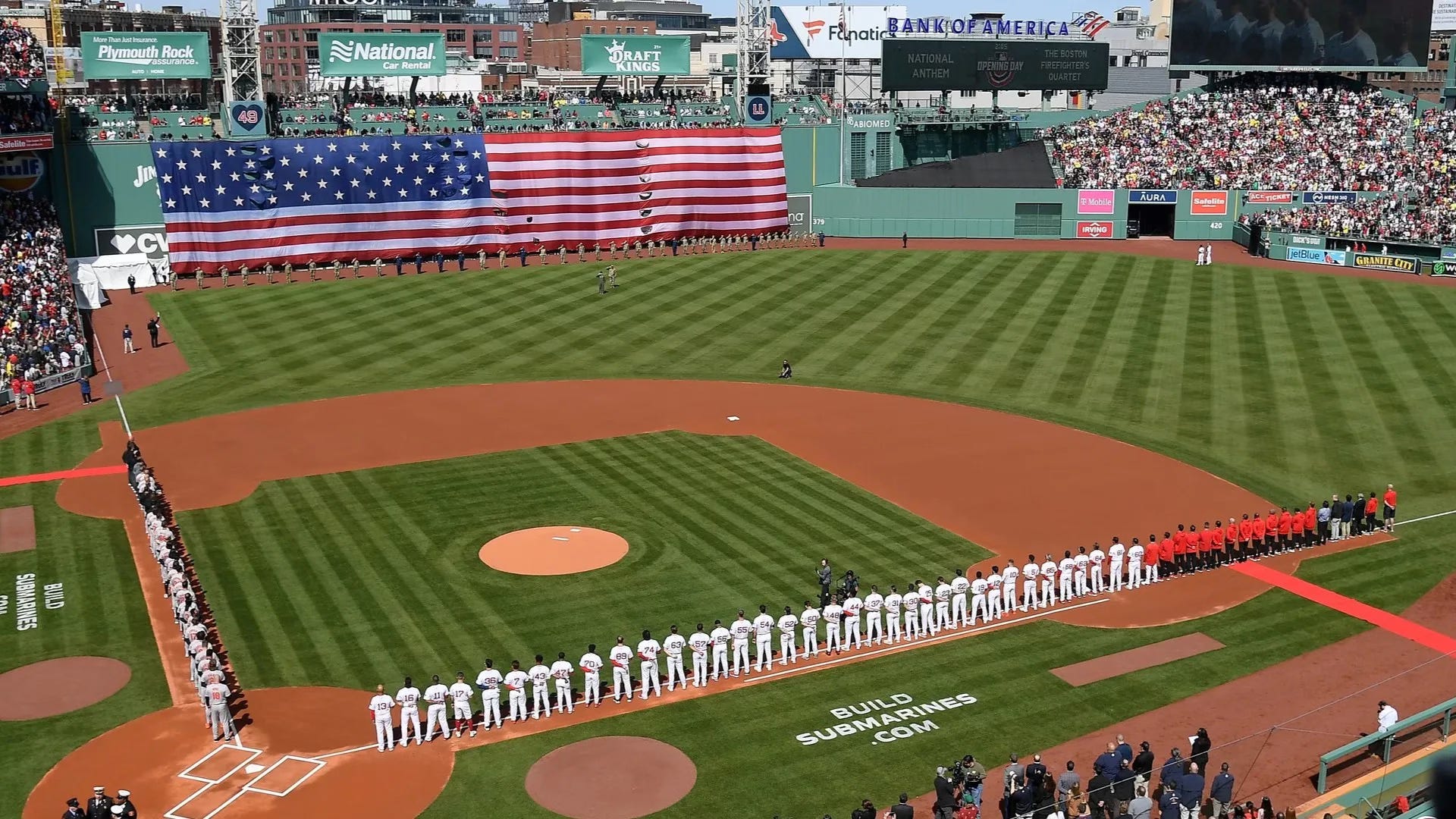
At every Boston Red Sox game this year, I’ve been reminded that America needs to build more nuclear submarines. Imagine an ad along each baseline that read: “PromotePeace”
Given the sweep as well as the power of the MICIMATT over our lives in America, especially our mindset, our culture, our way of thinking and doing, the real president that America is electing this November isn’t personages like Kamala Harris or Donald Trump. The real POTUS is the MICIMATT, a colossus that rules much of our lives and which dominates and largely determines U.S. foreign policy.
To tackle that colossus, you’ve got to cut its funding in a major way: 25% immediately, and perhaps 50% over the next five years. You’ve also got to change our culture. End threat inflation, end fear-mongering, end the worship of all things military. And I don’t see this happening whether the POTUS is Harris or Trump.
*****
On a related subject, I heard once again from my friend who believes I am too critical of Biden/Harris and insufficiently critical of Trump. For what it’s worth, here’s my reply:
Friend, as I’ve written time and time again, I’m against both Trump and Biden/Harris.
Lately, I’ve written more about Biden/Harris since the Dems are the party in power. Though I hope Trump doesn’t win, you’ll see plenty of articles criticizing him if he takes office again.
Also, there’s no shortage of anti-Trump articles in the mainstream media. I’m not about to repeat those. It’s not what my site is about. Why read BV if I just echo MSNBC?
I’m not confident that a Trump victory will produce a result that is more congenial to me with respect to the MICC and perpetual war. Even with Tulsi and RFK Jr. in the mix. Sorry, I can’t “own” that.
In my view, the worst outcome is another Trump victory. Close behind that is a Harris victory for reasons you already know, e.g. genocide in Gaza, more wars, tight embrace of Pentagon lethality, praise for the Cheneys and other Republcian neocons, etc.
In contributing to Harris and voting for her with some enthusiasm, are you prepared to “own” her tacit support of genocide in Gaza as well as her celebration of U.S. military lethality and her embrace of Republican neocons as true patriots?
Kamala Harris and Donald Trump have something in common. They both embrace colossal Pentagon budgets and both celebrate the “lethality” of the U.S. military, which, they agree, must be the strongest, bestest, in the world. They also agree on giving a blank check to Israel and its leaders to do whatever they want in Gaza to the Palestinians and will continue to provide whatever weapons Israel desires to kill massive numbers of Palestinians while flattening and destroying the Gaza Strip.
With respect to Iran, Harris appears to be even more hawkish than Trump, and indeed criticized him for not being aggressive enough with Iran’s leaders. Harris is also a strong supporter of Ukraine, seeing war as its best option to defeat Russia, whereas Trump is more skeptical of war and more open to diplomacy with Putin and Russia.
This isn’t surprising. Mainstream Democrats in DC are basically warmongering neo-conservatives on foreign policy, so a vote for Harris/Walz is a vote, as the “liberal” New York Times reported, for “muscular patriotism” (or, to paraphrase my wife, febrile and unapologetic nationalism). This is Washington Beltway conformity at its finest, as organs such as the National Interest write unironic articles about cheerleading the wonders of the military-industrial complex (MIC).
Ike got it all wrong. Embrace the MIC! Cheer for it!
See, President Dwight D. Eisenhower got it all wrong. We shouldn’t be wary of the MIC; we shouldn’t worry that its unchecked power threatens democracy and our very freedoms. No, we should embrace the MIC, celebrate it, enrich it with even more of our taxpayer dollars.
At Responsible Statecraft, Bill Hartung wrote a thoughtful response to the recent National interest piece. To me, it all depends on what vision of America you want to advance. If you want to advance America as the world’s hegemon, the empire of global reach, power, and dominance, the empire of constant warfare, then, heck, three cheers for the MIC.
But, if you want to advance America as a republic that leads “by the power of its example,” one that focuses on national defense and defense alone, then “three cheers for the MIC” guarantees the death of that republic and the corruption of its moral authority as an exemplar of democracy.
Of course, whether you choose to support Harris or Trump, we are witnessing exactly that latter fate. When you embrace the MIC, war, and empire, you set in motion the death of Democracy.
Whether America’s politicians put an “R” after their names or a “D,” it doesn’t alter the fundamental reality that the power of America’s example is very much driven and determined by examples of its military power. That is not about to change whether Harris or Trump prevails.
Even as the Military-Industrial Complex Becomes Ever Stronger and More Dangerous, We Must Keep Fighting Against It
In today’s article, I’d like to feature insights from friends and colleagues.
At TomDispatch, Tom Engelhardt takes on man’s seemingly endless addiction to war, an addiction most certainly manifested by the US of A, where bumper stickers tell me peace comes through superior firepower. Check out Tom’s article here. Not only do we wage war on each other, Tom notes, we wage war on the planet. In fact, few things degrade the environment more than war and all the destruction it brings with it.
John Rachel, a peace activist, has a telling theme: War is making us poor. He’s been making short punchy videos to hammer home the point. Check out his latest here:
Why are wars so persistent in the U.S., despite their stupidity, their destruction, their waste? One of my readers put it well in a comment to me:
The endless wars without a traditional definition of success have not been failures to those who have profited. For them, the only war that is lost, is the one that ends. God forbid one should be won under the standard definition and profits then ended.
Cynical? Not when you measure that statement against the U.S. experience of war since 1945.
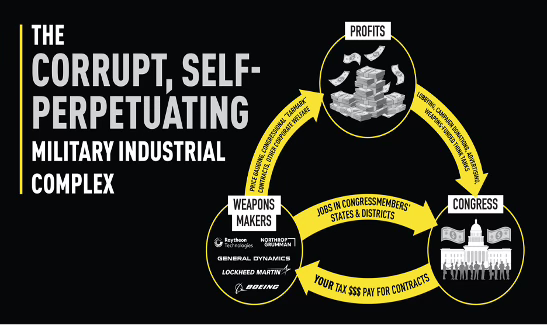
Finally, also at TomDispatch, David Vine and Theresa Arriola have an article: “The Military-Industrial Complex Is Killing Us All,” which is what Ike warned us about in 1961 if we refused to act as alert and knowledgeable citizens to keep that complex in check. Their article features clear and insightful charts on the basic features of the MIC and the dangers it poses. Here’s an example:
Vine and Arriola are part of an effort whose goal it is to dismantle, or very much to downsize, that complex. (I’ve been involved in their efforts.) Here’s the website:
Meanwhile, last week the “liberal” New York Times posted an article ostensibly written by Senator Roger Wicker calling for even more military spending by the U.S.
Here’s how The New York Times introduced Wicker’s op-ed on May 29th:
In a guest essay today, Senator Roger Wicker writes that we are approaching a version of that moment [a major war crisis] “faster than most Americans think.” Worse, he argues, the U.S. military is unprepared to meet the moment. After decades of underfunding, the American military lacks the strength or the equipment to deal with the wide range of new threats coming from our nation’s adversaries, including Iran, China, Russia and North Korea, he writes.
The answer to this problem, Wicker says, is a short-term “generational investment” in the U.S. military — and a national conversation on how to create a safer future for America. In a new white paper, he lays out a road map to “rebuild” the military, starting with an additional $55 billion in military spending in the 2025 fiscal year and an increase of annual military G.D.P. spending from its current projected level of around 3 percent to 5 percent over the next five to seven years.
That’s a serious amount of money that will inevitably raise big questions about where it will come from — and at the expense of what — at a moment when voices all along the political spectrum are questioning both U.S. military spending overseas and the role of the American military in the world today.
Wicker makes the case that the cost of a war with an increasingly powerful adversary like China would be far higher. “Regaining American strength will be expensive,” he writes. “But fighting a war — and worse, losing one — is far more costly.”
Readers, isn’t that inspiring? A “generational investment” in more guns, more bombs, and, as likely as not, more war? What a great idea!
Apparently, the only way to prevent a war is to prepare mightily for one, according to Senator Wicker. Wicker has apparently never heard, or read, or understood the words of Ike.
Senator Wicker is a shining example of the military-industrial-congressional complex that perpetuates war to the detriment of us all, indeed to all life on our planet. But it’s his words that are amplified by the “liberal” New York Times, not the wise words of my friends and colleagues here.
And so it goes, unless we act to put an end to it. We must be the alert and knowledgeable citizens that Ike implored us to be.
Yesterday, I appeared on Podcast by George. George Clark and I discussed the Russia-Ukraine War, Gaza, and the military-industrial-congressional complex. Here’s the video:
As George and I discussed America’s constant state of (very expensive and deadly) war, it occurred to me, not for the first time, that my country lost the Cold War that we allegedly won in 1991.
How so? After that “victory,” America was supposed to cash in on its peace dividends, becoming a normal country in normal times, to cite Jeanne Kirkpatrick. Instead, America doubled down on empire and the idea of imperial dominance. Militarism, not democracy, became a leading feature of our society, especially after the trauma of the 9/11 attacks. The U.S. government today remains shrouded in secrecy; those who would expose imperial war crimes, like Julian Assange or Daniel Hale, are imprisoned, even tortured.
The national security state, the MICIMATT,* is a colossus, far more insidious and invasive than anything even President Dwight D. Eisenhower imagined in his farewell address against the military-industrial complex in 1961. “Peace” is a word rarely heard in Washington, and the State Department has become a tiny branch of the Pentagon, bragging about weapons sales and shipments overseas rather than embracing diplomatic solutions to increasingly deadly conflicts. Even genocide in Gaza is dismissed as the Biden administration embraces Israel’s right to defend itself—against women and children in Gaza.
Courtesy of John Whitbeck, here’s a handy (and devastating) chart showing the damage inflicted on Gaza:
Chart prepared by the Euro-Med Human Rights Monitor available at this link:
*MICIMATT: military industrial congressional intelligence media academe think tank complex. We might also add Hollywood and the sports world to the complex, since both are so eager to celebrate war and “our” troops.
Democracy doesn’t die in darkness. It dies from constant warfare, as James Madison warned us about. It’s worth repeating his words:
Of all the enemies of true liberty, war is, perhaps, the most to be dreaded, because it comprises and develops the germ of every other. War is the parent of armies; from these proceed debt and taxes; and armies, and debts, and taxes are the known instruments for bringing the many under the domination of the few. In war, too, the discretionary power of the Executive is extended; its influence in dealing out offices, honors and emoluments is multiplied; and all the means of seducing the minds, are added to those of subduing the force, of the people. The same malignant aspect in republicanism may be traced in the inequality of fortunes, and the opportunities of fraud, growing out of a state of war, and in the degeneracy of manner and of morals, engendered in both. No nation can preserve its freedom in the midst of continual warfare …
The U.S. Senate Once Again Serves the Military-Industrial Complex
The U.S. Senate has worked tirelessly to pass a bill for $95 billion for more weapons and war. Surprise! Roughly $61 billion will go to Ukraine to continue that ghastly and largely stalemated war, $14 billion will go to Israel to facilitate the ongoing genocide in Gaza, roughly $9 billion will go to humanitarian aid, and roughly $5 billion will go to Taiwan and other countries in the region to stir up trouble with China.
Isn’t it nice to know the U.S. Senate has our backs? That senators have heard the cry of the American working classes and are going to help them by shipping more weapons overseas for more war?
Just think: Another $14 billion to Israel to produce more scenes like this in Gaza
I had to laugh when I saw this assertion from Heather Cox Richardson: “The fight over U.S. aid to Ukraine, Israel, Taiwan, and the other countries with which we have made partnerships is not about saving money—most of the funds for Ukraine are actually spent in the U.S.” Yes! It’s not about “saving money”! After all, most of the money will go to major weapons contractors, America’s merchants of death. So pay no attention to this, peasant. You’re getting a bargain.
In her article, Richardson mentions Dwight D. Eisenhower and the year he took office as president, 1953, which made me think of these famous words said by Ike in 1953:
Every gun that is made, every warship launched, every rocket fired signifies, in the final sense, a theft from those who hunger and are not fed, those who are cold and are not clothed. This world in arms is not spending money alone. It is spending the sweat of its laborers, the genius of its scientists, the hopes of its children… This is not a way of life at all, in any true sense. Under the cloud of threatening war, it is humanity hanging from a cross of iron.
Richardson is having none of this. The Senate’s $95 billion is not “a theft from those who hunger and are not fed,” but rather a wise investment that will pay dividends—as it will, for America’s vast military-industrial-congressional complex (MICC).
Fortunately, it appears the Senate’s $95 billion handout to the MICC (remember: don’t worry about saving money here!) is unlikely to survive the House of Representatives. Still, it is indicative of the total moral bankruptcy of the U.S. Senate and its supine obedience to the weapons makers.
Video bonus: Here I am, talking about the military-industrial complex, trying to channel a tiny bit of Ike and his wisdom:
The video link above is courtesy of the Merchants of Death Tribunal.
Reason and Rationality Have Little to Do with Them
It is often hard to understand the reasons for America’s wars, especially since World War II, but they always have a rationale backed up by lies. The rationale for Vietnam was the containment of communism and the domino theory. The lie was that U.S. naval ships had been attacked at Tonkin Gulf. The rationale for Iraq was overthrowing a ruthless dictator and spreading “freedom.” The lie was that he had WMD and that he was somehow connected to the 9/11 attacks.
Nations and peoples are not dominoes
The real reasons for America’s many disastrous wars are opaque. Domestic politics are almost always paramount. No U.S. president wants to be accused of losing a war or appearing to be weak, so starting or continuing a war is considered as “strength.” Congress doesn’t want to be accused of “tying the hands of the president” or of “betraying the troops,” so most members happily go along with wars. The military, of course, always thinks it can win, and wars are good for promotions and power. And military contractors, the “merchants of death,” are even more happy to make money off war. Not surprisingly, perhaps, President Dwight D. Eisenhower’s farewell speech in 1961 warned America of the military-industrial complex, to which Ike had added Congress in an earlier draft. Ike’s warning has been largely forgotten; even his own monument in DC obscures it.
In Washington today, the Democrats accuse the Republicans of being weak on Russia; the Republicans return the favor by accusing the Biden administration of being weak on China. Military and industry are happy to play this blame game, knowing the Pentagon budget will soar as a result, as it has. And thus a dangerous “new cold war” appears to be a certainty.
The folly and fallaciousness of America’s wars, along with their carnage, are enough to make any rational human angry, especially one who has served in one of these wars. Mike Murry, a Vietnam War veteran, is angry, and so am I. Back in 2017, I wrote a piece on the atrociousness of the Vietnam War, to which Mr. Murry appended this comment. It merits consideration by all thinking Americans.
The ”Rationale” of America’s Wars. Comment by Mike Murry in 2017.
An excellent choice of words, “rationale.” Not the reason for doing something in the first place, but a conscious lie made up beforehand just to get things started, or an excuse invented afterwards to avoid accountability and, where required, the necessary punishment that true justice occasionally administers. Marine Corps General Smedley Butler once said that we have only two acceptable reasons for going to war: to defend our homes or defend the Constitution. In not a single case after World War II has either of these conditions applied, so that none of the pointless and ruinous fighting — I won’t dignify these Presidential/Career Military misadventures by calling them “war” — has had any justifiable reason or purpose. Not surprisingly, no Congress has declared war on another nation state since 1941 because no nation state on planet earth has attacked either American homes or America’s Constitution. The United States has not just “gone abroad in search of monsters to destroy,” as our sixth President, John Quincy Adams, warned us against foolishly doing, but has invented imaginary hobgoblins at home before even setting out to vanquish them on the far side of the globe.
Of course, Smedley Butler only made his remarks after serving for thirty years as an admitted “gangster for capitalism,” probably the best summary description of the U.S. military offered to date by one who ought to know. Today, as for the past seventy-plus years, the U.S. military simply fights — aimlessly and disastrously — for the sake of fighting. The fighting has no “reason” other than to provide a steady stream of outrageous corporate CEO bonuses, stockholder dividends, and the pensions and perquisites of retired senior military officers. This Warfare Welfare and Make-work Militarism has secondary beneficiaries, of course, most notably the hothouse orchids, special snowflakes and privileged peacock pugilists known as United States as “political leaders.” Naturally, the feeding and maintenance of this system of corrupt cronyism requires a death grip on over half the nation’s discretionary budget. As George Orwell wrote in “The Theory and Practice of Oligarchical Collectivism” (the book-within-a-book from 1984):
“The primary aim of modern warfare (in accordance with the principles of doublethink, this aim is simultaneously recognized and not recognized by the directing brains of the Inner Party) is to use up the products of the machine without raising the general standard of living.”
In other words, the entire U.S. military/security monstrosity — which I like to call the Lunatic Leviathan — has only one purpose: to suck the life out of the domestic economy so that the productivity of the people’s labor will not result in the betterment of their station in life, which might in due course result in the discarding of America’s useless parasitic economic and political “elites.” Any transparent euphemism designed and deployed to disguise this ugly, fundamental truth properly deserves the label “rationale.” In no way do the usual and time-dishonored obfuscations amount to a reason. Reason has fled the United States, replaced by a deserved and rancid Ridicule. The country now consumes itself, lost in its own vicarious fears and fantasies featuring the celluloid exploits of our vaunted Visigoths vanquishing visions of vultures somewhere, someplace, at some time, until … eventually … after some “progress” and “fragile gains” … as T.S. Eliot wrote of The Hollow Men:
This is the way the world ends This is the way the world ends This is the way the world ends Not with a bang but a whimper.
Men and women so hollow that you can hear their own bullshit echoing in them even before they start moving their jaws and flapping their lips to begin lying.
If Dwight Eisenhower could somehow give his 1953 “Cross of Iron” address and his 1961 warning about the military-industrial complex to the American people today, I truly believe he’d be dismissed by the mainstream media (MSM) as a Putin puppet and as repeating Kremlin talking points. Why? Because Ike advocated for negotiation and peace instead of war; he documented how spending on weapons was intrinsically wasteful and a bane to democratic society; and he challenged citizens to be alert and knowledgeable, ready to take action against the growing power of a corporate-military nexus supported and strengthened by Congress.
To mark Ike’s integrity and wisdom, and also to update his cost calculations from 1953 for the present day, I wrote this article, my latest for TomDispatch.com. Again, the words of Ike, focusing on peace, the preciousness and burdens of democracy, and the dangers of militarism, are rarely if ever heard in our government and in the MSM today. And that suggests we are in a dark place indeed in this country of ours.
In April 1953, newly elected President Dwight D. Eisenhower, a retired five-star Army general who had led the landings on D-Day in France in June 1944, gave his most powerful speech. It would become known as his “Cross of Iron” address. In it, Ike warned of the cost humanity would pay if Cold War competition led to a world dominated by wars and weaponry that couldn’t be reined in. In the immediate aftermath of the death of Soviet dictator Josef Stalin, Ike extended an olive branch to the new leaders of that empire. He sought, he said, to put America and the world on a “highway to peace.” It was, of course, never to be, as this country’s emergent military-industrial-congressional complex (MICC) chose instead to build a militarized (and highly profitable) highway to hell.
Eight years later, in his famous farewell address, a frustrated and alarmed president called out “the military-industrial complex,” prophetically warning of its anti-democratic nature and the disastrous rise of misplaced power that it represented. Only an alert and knowledgeable citizenry, fully engaged in corralling, containing, and constraining it, he concluded, could save democracy and bolster peaceful methods and goals.
The MICC’s response was, of course, to ignore his warning, while waging a savage war on communism in the name of containing it. In the process, atrocious conflicts would be launched in Vietnam, Laos, and Cambodia as the contagion of war spread. Threatened with the possibility of peace in the aftermath of the Soviet Union’s collapse in 1991, the MICC bided its time with operations in Iraq (Desert Storm), Bosnia, and elsewhere, along with the expansion of NATO, until it could launch an unconstrained Global War on Terror in the aftermath of the attacks of September 11, 2001. Those “good times” (filled with lost wars) lasted until 2021 and the chaotic U.S. withdrawal from Afghanistan.
Not to be deterred by the fizzling of the nightmarish war on terror, the MICC seized on a “new cold war” with China and Russia, which only surged when, in 2022, Vladimir Putin so disastrously invaded Ukraine (as the U.S. had once invaded Afghanistan and Iraq). Yet again, Americans were told that they faced implacable foes that could only be met with overwhelming military power and, of course, the funding that went with it — again in the name of deterrence and containment.
In a way, in 1953 and later in 1961, Ike, too, had been urging Americans to launch a war of containment, only against an internal foe: what he then labeled for the first time “the military-industrial complex.” For various reasons, we failed to heed his warnings. As a result, over the last 70 years, it has grown to dominate the federal government as well as American culture in a myriad of ways. Leaving aside fundingwhere it’s beyond dominant, try movies, TV shows, video games, education, sports, you name it. Today, the MICC is remarkably uncontained. Ike’s words weren’t enough and, sadly, his actions too often conflicted with his vision (as in the CIA’s involvement in a coup in Iran in 1953). So, his worst nightmare did indeed come to pass. In 2023, along with much of the world, America does indeed hang from a cross of iron, hovering closer to the brink of nuclear war than at any time since the Cuban Missile Crisis of 1962.
Updating Ike’s Cross of Iron Speech for Today
Perhaps the most quoted passage in that 1953 speech addressed the true cost of militarism, with Ike putting it in homespun, easily grasped, terms. He started by saying, “Every gun that is made, every warship launched, every rocket fired signifies, in the final sense, a theft from those who hunger and are not fed, those who are cold and are not clothed.” (An aside: Can you imagine Donald Trump, Joe Biden, or any other recent president challenging Pentagon spending and militarism so brazenly?)
Ike then added:
“This world in arms is not spending money alone. It is spending the sweat of its laborers, the genius of its scientists, the hopes of its children. The cost of one modern heavy bomber is this: a modern brick school in more than 30 cities. It is two electric power plants, each serving a town of 60,000 population. It is two fine, fully equipped hospitals. It is some fifty miles of concrete pavement. We pay for a single fighter plane with a half million bushels of wheat. We pay for a single destroyer with new homes that could have housed more than 8,000 people.”
He concluded with a harrowing image: “This is not a way of life at all, in any true sense. Under the cloud of threatening war, it is humanity hanging from a cross of iron.”
Ike’s cost breakdown of guns versus butter, weapons versus civilian goods, got me thinking recently: What would it look like if he could give that speech today? Are we getting more bang for the military megabucks we spend, or less? How much are Americans sacrificing to their wasteful and wanton god of war?
Let’s take a closer look. A conservative cost estimate for one of the Air Force’s new “heavy” strategic nuclear bombers, the B-21 Raider, is $750 million. A conservative estimate for a single new fighter plane, in this case the F-35 Lightning II, is $100 million. A single Navy destroyer, a Zumwalt-class ship, will be anywhere from $4 to $8 billion, but let’s just stick with the lower figure. Using those weapons, and some quick Internet sleuthing, here’s how Ike’s passage might read if he stood before us now:
“The cost of one modern heavy bomber is this: a modern brick-veneer and reinforced concrete school in 75 cities. It is five electric power plants, each serving a town with 60,000 inhabitants. It is five fine, fully equipped hospitals. It is some 150 miles of pavement. We pay for a single fighter plane with more than 12 million bushels of wheat. We pay for a single destroyer with new homes that could have housed more than 64,000 people.”
(Quick and dirty figures for the calculations above: $10 million per elementary school; $150 million per power plant [$5,000/kilowatt for 30,000 homes]; $150 million per hospital; $5 million per new mile of road; $8 per bushel of wheat; $250,000 per home for four people.)
Grim stats indeed! Admittedly, those are just ballpark figures, but taken together they show that the tradeoff between guns and butter — bombers and jet fighters on the one hand, schools and hospitals on the other — is considerably worse now than in Ike’s day. Yet Congress doesn’t seem to care, as Pentagon budgets continue to soar irrespective of huge cost overruns and failed audits (five in a row!), not to speak of failed wars.
Without irony, today’s MICC speaks of “investing” in weapons, yet, unlike Ike in 1953, today’s generals, the CEOs of the major weapons-making corporations, and members of Congress never bring up the lost opportunity costs of such “investments.” Imagine the better schools and hospitals this country could have today, the improved public transportation, more affordable housing, even bushels of wheat, for the cost of those prodigal weapons and the complex that goes with them. And perish the thought of acknowledging in any significant way how so many of those “investments” have failed spectacularly, including the Zumwalt-class destroyers and the Navy’s Freedom-class littoral combat ships that came to be known in the Pentagon as “little crappy ships.”
Speaking of wasteful warships, Ike was hardly the first person to notice how much they cost or what can be sacrificed in building them. In his prescient book The War in the Air, first published in 1907, H.G. Wells, the famed author who had envisioned an alien invasion of Earth in The War of the Worlds, denounced his own epoch’s obsession with ironclad battleships in a passage that eerily anticipated Ike’s powerful critique:
The cost of those battleships, Wells wrote, must be measured by:
“The lives of countless men… spent in their service, the splendid genius and patience of thousands of engineers and inventors, wealth and material beyond estimating; to their account we must put stunted and starved lives on land, millions of children sent to toil unduly, innumerable opportunities of fine living undeveloped and lost. Money had to be found for them at any cost—that was the law of a nation’s existence during that strange time. Surely they were the weirdest, most destructive and wasteful megatheria in the whole history of mechanical invention.”
Little could he imagine our own era’s “wasteful megatheria.” These days, substitute nuclear intercontinental ballistic missiles, strategic bombers, aircraft carriers, and similar “modern” weapons for the ironclads of his era and the sentiment rings at least as true as it did then. (Interestingly, all those highly touted ironclads did nothing to avert the disaster of World War I and had little impact on its murderous course or ponderous duration.)
Returning to 1953, Eisenhower didn’t mince words about what the world faced if the iron cross mentality won out: at worst, nuclear war; at best, “a life of perpetual fear and tension; a burden of arms draining the wealth and labor of all peoples; a wasting of strength that defies the American system, or the Soviet system, or any system to achieve true abundance and happiness for the peoples of this earth.”
Ike’s worst-case scenario grows ever more likely today. Recently, Russia suspended the START treaty, the final nuclear deal still in operation, that oversaw reductions in strategic nuclear weapons. Instead of reductions, Russia, China, and the United States are now pursuing staggering “modernization” programs for their nuclear arsenals, an effort that may cost the American taxpayer nearly $2 trillion over the coming decades (though even such a huge sum matters little if most of us are dead from nuclear war).
In any case, the United States in 2023 clearly reflects Ike’s “cross of iron” scenario. It’s a country that’s become thoroughly militarized and so is slowly wasting away, marked increasingly by fear, deprivation, and unhappiness.
It’s Never Too Late to Change Course
Only Americans, Ike once said, can truly hurt America. Meaning, to put the matter in a more positive context, only we can truly help save America. A vital first step is to put the word “peace” back in our national vocabulary.
“The peace we seek,” Ike explained 70 years ago, “founded upon a decent trust and cooperative effort among nations, can be fortified, not by weapons of war but by wheat and by cotton, by milk and by wool, by meat and timber and rice. These are words that translate into every language on earth. These are the needs that challenge this world in arms.”
The real needs of humanity haven’t changed since Ike’s time. Whether in 1953 or 2023, more guns won’t serve the cause of peace. They won’t provide succor. They’ll only stunt and starve us, to echo the words of H.G. Wells, while imperiling the lives and futures of our children.
This is no way of life at all, as Ike certainly would have noted, were he alive today.
Which is why the federal budget proposal released by President Biden for 2024 was both so painfully predictable and so immensely disappointing. Calamitously so. Biden’s proposal once again boosts spending on weaponry and war in a Pentagon budget now pegged at $886 billion. It will include yet more spending on nuclear weapons and envisions only further perpetual tensions with “near-peer” rivals China and Russia.
This past year, Congress added $45 billion more to that budget than even the president and the Pentagon requested, putting this country’s 2023 Pentagon budget at $858 billion. Clearly, a trillion-dollar Pentagon budget is in our collective future, perhaps as early as 2027. Perish the thought of how high it could soar, should the U.S. find itself in a shooting war with China or Russia (as the recent Russian downing of a U.S. drone in the Black Sea brought to mind). And if that war were to go nuclear…
The Pentagon’s soaring war budget broadcast a clear and shocking message to the world. In America’s creed, blessed are the warmakers and those martyrs crucified on its cross of iron.
This was hardly the message Ike sought to convey to the world 70 years ago this April. Yet it’s the message the MICC conveys with its grossly inflated military budgets and endless saber-rattling.
Yet one thing remains true today: it’s never too late to change course, to order an “about-face.” Sadly, lacking the wisdom of Dwight D. Eisenhower, such an order won’t come from Joe Biden or Donald Trump or Ron DeSantis or any other major candidate for president in 2024. It would have to come from us, collectively. It’s time to wise up, America. Together, it’s time to find an exit ramp from the highway to hell that we’ve been on since 1953 and look for the on-ramp to Ike’s highway to peace.
And once we’re on it, let’s push the pedal to the metal and never look back.
Since Ike’s warning more than 60 years ago, the MIC has only grown stronger and more anti-democratic
President Dwight D. Eisenhower (Ike) had it right. The military-industrial complex (MIC) is fundamentally anti-democratic. The national security state has become the fourth branch of government and arguably the most powerful one. It gets the most money, more than half of the federal discretionary budget, even as the military remains America’s most trusted institution, despite a woeful record in wars since 1945.
A colleague, Christian Sorensen, says that when we look closely at the MIC we see something akin to American fascism. As he put it to me: “Our fascism certainly doesn’t look like past European movements, but it is far more durable, has killed millions and millions (SE Asia, Indonesia, Central America, Middle East), and has manifold expressions: wars abroad, wars at home, surveillance state, digital border, militarized law enforcement, economic warfare in the form of sanctions, militarization of space.”
It’s hard not to agree with him, not in the sense of Hitler’s Germany or Mussolini’s Italy but in the sense of concentrated government/corporate power that draws sustenance from nationalism at home and imperialism abroad. It’s true that America doesn’t have goose-stepping soldiers in the street. There are no big military parades (though Donald Trump once wanted one). It still seems like we have contending political parties. But when we look deeper, a militant nationalism and aggressive imperialism powered by corporations and enforced by government, including notably the Supreme Court, is the salient feature of this American moment.
Consider the classic symbol of the fasces, from which the word fascism is drawn. It’s a bundle of rods bound tightly together — the idea being that while one rod may be bent or broken, a bundle of them becomes far more resistant to bending or breaking. For me, this image conjures the MICIMATT. Bundle the military with industry, add Congress, roughly 17 intelligence agencies, the media, academe, and various think tanks, then bind them with nearly a trillion dollars and enormous political and cultural authority and you create a structure that is far stronger, insidiously so, than the sum of its individual parts.
Fasces, or rods bundled and bound together, sometimes with an axe head. A decent symbol for the MICIMATT
This is exactly what the MICIMATT constitutes: an imperial bundling and binding of powerful interests that possesses and commands enormous resources, including most importantly mental and emotional ones, like appeals to patriotism and the flag. Consider the mainstream media (MSM), which nowadays is pro-war, pro-military, and therefore highly critical of anti-war protests. Indeed, the MSM today in the U.S. employs retired generals, admirals, and ex-CIA and ex-FBI officials to support the establishment and attack and dismiss critics of the same as naive (at best) or as dupes or puppets of various enemies (most often of Russia).
Consider, for example, the smear in 2020 of Democratic Congresswoman Tulsi Gabbard, a veteran of the Iraq War who continues to serve in the Army National Guard. NBC News, together with prominent establishment figures like Hillary Clinton, portrayed Gabbard as a potential Russian asset and the favorite candidate of the Kremlin. Gabbard’s “crime” was her criticism of disastrous regime-change wars (such as Iraq) that Clinton had enthusiastically supported, along with Gabbard’s statements that echoed Ike in their criticism of the MIC.
Influential critics of war and the MIC are neutralized. For its prescient criticism of the Iraq War, Phil Donahue’s show was cancelled. Reporter Ashleigh Banfield, who critiqued Iraq War coverage, was demoted. Former Governor Jesse Ventura was hired to a lucrative three-year contract, then put on ice when MSNBC discovered he was against the Iraq War. Worse is the punishment allotted to those who truly embarrass the MIC, such as Chelsea Manning and Daniel Hale. Both were imprisoned for showing the American people the ugly face of the MIC’s wars. Worst of all is the persecution of Julian Assange, an Australian citizen who the U.S. government is seeking to prosecute and jail under laws passed during World War I to deter internal dissent within America. Edward Snowden, meanwhile, remains exiled in Russia, perhaps permanently, since to allow him to return might inspire other patriotic whistleblowers to come forward—and we can’t have that in the land of the free.
But I can write my blog so I’m free, right? The MIC is not worried by my critique. If it can survive and flourish despite Ike’s warning, it can certainly ignore me. We the people have no real power unless we too can combine. Sadly, a weakness of antiwar forces in America is internal disagreements and bickering, as witnessed recently before the Rage Against the War Machine Rally in DC. The MIC, in contrast, is tightly bound by greed and power.
Bending or breaking the MICIMATT seems well-nigh impossible. It could be weakened by making substantial cuts to its budget, but Congress insists on feeding it more money, not less, despite enormous waste and five failed audits in a row for the Pentagon.
If bending and breaking it is impossible, can we light it on fire? To do that would require a powerful incendiary movement, a concentrated blast as if from a flamethrower, yet the MICIMATT is wrapped in a fire-resistant coating of patriotic cant, so even incendiary ideas and actions have their limits.
Returning to Ike, I continue to find it painfully ironic (and tragic) that his warning about the MIC has been buried even at the Eisenhower Memorial in Washington, D.C. Not only buried: Ike’s warning has been downgraded to a caution and interpreted by a narrator sponsored by Boeing, a leading merchant of death in the MIC.
So, despite an article I wrote ten years ago, critiquing the idea of American fascism, I find myself coming to accept it, especially as Democrats try to outdo Republicans in embracing war, militarism, and weapons sales as the health of the state. With so-called progressives voting for massive war budgets, where is the hope and change?
I know progressives make noises about cutting the war budget, thus Barbara Lee and Mark Pocan are yet again sponsoring legislation to cut that budget by $100 billion. It’s pretty much a scam, notes David Swanson. They are allowed to do this because the MIC knows their initiative stands no hope of passing. Meanwhile, Republicans like Matt Gaetz have their own effort to cut Ukraine war funding, an effort also doomed to fail. What America truly needs is a bipartisan effort against the war machine, but instead it’s the MIC that continues to enjoy strong bipartisan support. The MIC is bound together (thus its strength); its opponents are both too disputatious and too few.
Which brings me to a sentiment attributed to Sinclair Lewis (though he didn’t use these exact words): If fascism comes to America, it will be wrapped in the flag and carrying a cross. Certainly, the MIC is wrapped in the flag. Remarkable too is how U.S. militarism is embraced as a form of muscular Christianity, a sign of America’s righteousness, with might making right. Across Christianity in America today, one hears remarkably little criticism of war, killing, and genocidal nuclear weapons. The vision of Christ as a peacemaker was long ago replaced by “Peacekeeper” nuclear missiles. Meanwhile, new nuclear ICBMs, bombers, and submarines are under construction today, increasing the chances of apocalyptic war (while guaranteeing large profits for the MIC).
Again, Ike warned us that the MIC is fundamentally anti-democratic. And, whatever else it is, the MIC is certainly not communist or leftist. Is it America’s version of fascism? That conclusion may seem shrilly alarmist, but that is arguably what we need: a shrill alarm to awaken us from our slumber.