
Greed-War: The Power and Danger of the Military-Industrial Complex

Ike
Ike in 1959: Too critical of the military to be elected today

W.J. Astore

President Dwight D. Eisenhower gave his most powerful speech as he left office in 1961.  He warned the American people about an emerging military-industrial complex, a complex that was already beginning to erode democratic rule in America.  Originally, Ike had Congress as a collaborator with and enabler of that Complex, but he deleted the reference in the final version, apparently deciding that by alienating Members of Congress, he’d only push them further into the Complex’s corner.

The military-industrial complex, the Complex for short, has only grown in power over the last half-century.  Today, more than half of Federal discretionary funding goes to it.  With the post-9/11 addition of Homeland Security and more and more intelligence agencies (seventeen of them at last count), the Complex continues to grow like Topsy.  It consumes roughly $750 billion each and every year, a sum likely to grow whether Trump or Clinton wins the presidency.  (Trump has promised to rebuild an allegedly shattered military; Clinton, meanwhile, is a steadfast supporter of the military as well as neo-con principles of aggressive foreign interventionism.)

In the U.S. today, the Complex is almost unchallengeable.  This is not only because of its size and power.  The Complex has worked to convince Americans that war is inevitable and therefore endless (it’s never the fault of the Complex, of course: it’s the terrorists, or the Russians, or the Chinese …), and also that military service (and spending) is virtuous and therefore a boon to democracy.

America’s founders like James Madison thought differently, knowing from bitter experience and deep learning that incessant wars and standing militaries are an insidious threat to democracy.  Nowadays, however, Americans say they trust their military more than any other societal institution, and mainstream society universally celebrates “our” troops as selfless heroes, the very best of America.  This moral, indeed metaphysical, elevation of the U.S. military serves to silence legitimate criticism of its failings as well as its corrosive effect on democratic principles and values.

All of these topics I’ve written about before, but I wish to cite them again by way of introducing an article by Maximilian C. Forte, an anthropologist who writes at Zero Anthropology (I first saw his work at Fabius Maximus).  The article Forte wrote is on Bernie Sanders and his limitations, but what struck me most was his reference to C. Wright Mills and his analysis of the nexus of interests and power between U.S. capitalism and militarism.

The following extended excerpt from Forte’s article shines much light into the darker corners of America’s corridors of power:

In The Power Elite (1956) and “The Structure of Power in American Society” (The British Journal of Sociology, March 1958), Mills’ explanations can look like an elaborated, in-depth version of what former president Dwight Eisenhower described as the military-industrial complex, but with a stronger focus on the role of private corporations and special interest lobbies. These approaches endure today — because the problem they describe and analyze continues — as shown in the work of anthropologists such as Wedel on Shadow Elite: How the World’s New Power Brokers Undermine Democracy, Government, and the Free Market[as well as works by other authors that showcase] the relationship between the stock market, multinational corporations and the US’ CIA-led coups against foreign governments …

For C. Wright Mills, the problem was not just “Wall St.,” nor the “Pentagon” alone — focusing on one over the other produces a half-headed understanding, with all of the political demerits that result. As he argued in his 1958 article, “the high military, the corporation executives, the political directorate have tended to come together to form the power elite of America” (pp. 32-33). The power elite is what he described as a “triangle of power,” linking corporations, executive government, and the military: “There is a political economy numerously linked with military order and decision. This triangle of power is now a structural fact, and it is the key to any understanding of the higher circles in America today” (Mills, 1958, p. 32).

Contrary to Bernie Sanders, Mills emphasizes the decisive influence of the military in the corporate oligarchic state (as Kapferer later called it):

“The military order, once a slim establishment in a context of civilian distrust, has become the largest and most expensive feature of government; behind smiling public relations, it has all the grim and clumsy efficiency of a great and sprawling bureaucracy. The high military have gained decisive political and economic relevance. The seemingly permanent military threat places a premium upon them and virtually all political and economic actions are now judged in terms of military definitions of reality: the higher military have ascended to a firm position within the power elite of our time”. (Mills, 1958, p. 33)

US politics are dominated, Mills argued, “by a few hundred corporations, administratively and politically interrelated, which together hold the keys to economic decision,” and the economy that results is “at once a permanent-war economy and a private-corporation economy”:

“The most important relations of the corporation to the state now rest on the coincidence between military and corporate interests, as defined by the military and the corporate rich, and accepted by politicians and public”. (Mills, 1958, p. 33)

Mills also pays attention to the history of this type of corporate-military state. The influence of private lobbies dates back deep into US political history, when the influence of railway tycoons, banana magnates, and tobacco barons was considerable at different times. From this Mills discerned the rise of what he called the “invisible government,” which existed starting from at least 50 years prior to his 1958 article…

“Fifty years ago many observers thought of the American state as a mask behind which an invisible government operated. But nowadays, much of what was called the old lobby, visible or invisible, is part of the quite visible government. The ‘governmentalization of the lobby’ has proceeded in both the legislative and the executive domain, as well as between them. The executive bureaucracy becomes not only the centre of decision but also the arena within which major conflicts of power are resolved or denied resolution. ‘Administration’ replaces electoral politics; the maneuvering of cliques (which include leading Senators as well as civil servants) replaces the open clash of parties”. (Mills, 1958, p. 38)

The corporate-military government is tied to US global dominance, and its power increased dramatically from 1939 onwards. As Mills noted, “the attention of the elite has shifted from domestic problems — centered in the ’thirties around slump — to international problems centered in the ’forties and ’fifties around war” (1958, p. 33). (As I argued elsewhere, this shift also registers in US anthropology, which moved from research at home, on domestic social problems, to fieldwork abroad as the dominant norm.)

Rather than challenge the arms industry, whose growing size and power stunned Eisenhower, Sanders would simply tax them more. It is open to debate whether Sanders is offering even half of a solution, and whether he sees even half of the bigger picture. Usually Sanders has voted in favour of military appropriations, supported the financing of wars in Iraq and Afghanistan, and has backed a range of regime change and “humanitarian interventionist” efforts, from NATO’s war in Kosovo, to support for the 1998 Iraq Liberation Act and for regime change in Libya (contrary to his false representations on the latter point). He is also an aggressive supporter of NATO and its anti-Russian posture. While he is not even half of anti-imperialist, some might argue that it is also too generous to see him as half of a socialist–either way, we need to do better than beat each other up with half-answers.

*** 

Forte’s criticism of Sanders is spot on.  My guess is that Sanders refused to take on the Complex precisely because of its financial, its political, and finally its cultural and societal clout.  There are only so many windmills you can tilt at, Sanders may have decided.  Yet, notwithstanding his willingness to appease the Complex, Sanders has been relegated to the sidelines by a corrupt Democratic establishment that did everything it could to ensure that one of its own, Complex-abettor Hillary Clinton, won the party nomination.

The fundamental problem for the U.S. today is as obvious as it appears insoluble.  The Complex has co-opted both political parties, Republican and Democratic.  It has at the same time redefined patriotism in militaristic terms, and loyalty in terms of unquestioning support of, even reverence for, American military adventurism and interventionism.  Candidates who have rival ideas, such as Libertarian Gary Johnson or Green Party candidate Jill Stein, are simply not allowed on the stage.  Their voices of dissent are suppressed.  They are never heard within the mainstream.

Johnson, for example, has suggested cuts to the Complex approaching 20%; Jill Stein has suggested cuts as deep as 50%.  Such suggestions, of course, are never seriously discussed in mainstream America.  Indeed, when they’re mentioned at all, they’re instantly dismissed by the “power elite” as the ravings of weak-kneed appeasers or unserious ignoramuses.  (Johnson, for example, is now depicted as an ignoramus by the mainstream media because he couldn’t place Aleppo or instantly name a foreign leader he adored.)

We have a new reality in U.S. government and society today: the Complex essentially rules unchallenged.  Back in the 1950s, Ike had the military and political authority to constrain it.  Today, well, no.  There are no restraints.  Just look at Hillary and Trump, both boasting of how many generals and admirals support them, as if they couldn’t run for office unless they’d been anointed by men in military uniforms wearing stars.

And America calls this democracy?

Democracy in America is dying.  It’s dying because it’s being strangled by winner-take-all capitalism and corrosive militarism.  Greed-war is consuming America’s resources.  Not just material, not just political, but mental and emotional resources as well.  The greed-war nexus as represented and nurtured by the Complex and its power elite is both narrowing and coloring the horizons of America.  Tortured by mindless fear and overwrought concerns about weakness and decline, Americans embrace the Complex ever tighter.

The result: America builds (and sells) more weapons, supports higher military spending, and wages more war.  Trump or Clinton, the war song remains the same.  It’s a narrowing of national horizons, a betrayal of American promise, that we will overcome only when we reject greed-war.

Afterword: The sad part is that Martin Luther King said it far better than I can fifty years ago in this speech on Vietnam.  Ike in 1961, MLK in 1967, both prophetic, both largely ignored today for their insights into the “spiritual death” represented by greed-war.  Even earlier, General Smedley Butler, twice awarded the Medal of Honor, argued in the 1930s that war is a racket and that it would end only when the profit motive was eliminated from it.

So, if I had one question for Hillary and Trump, this would be it: When it comes to your decision to enlarge the military-industrial complex, to feed it ever more money and resources, what makes your decision right and the warnings of Ike, MLK, and General Butler wrong?
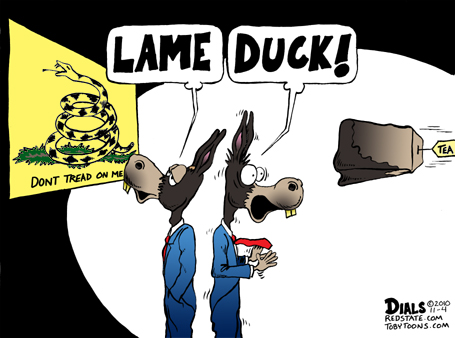
A Lame Duck Nation on Steroids

Lame duck, indeed.
It’s not just the Tea Party that’s lame (Toby Toons)

W.J. Astore

The more the United States has come to talk about dominance, the less dominant we’ve become.

To compensate, we’ve become a steroidal nation, to include the violent side effects associated with steroid use (just look at the latest stories out of the NFL about spousal and child abuse, or our steroidal police forces, including MRAPs and M-16s for school police).  If the story of the last fifty years is the gradual decline of the U.S., most notably in the economic and political realms, the story of today is how we’ve compensated with militarized Viagra.  We’ve reached “the age of knowing” that we’ve lost much of our potency as our country.  To compensate, we’re forever popping pills and flexing our muscles.  (Just look at John McCain’s enthusiasm for bombing.)

It’s precisely those steroids that are weakening us as a country.  As we’ve overcompensated with military weapons and bases, we’ve allowed our economy to slide.  As we’ve sought domination overseas, we’ve weakened our country right here at home.  We feverishly build and repair roads in Afghanistan but not here in the USA.  Same with schools — we’d rather build prisons, to include Gitmo, than colleges (since 1984, California has built 21 prisons but only one university).

Consider our binary debates on foreign policy.  It’s the hawks versus the doves, militarized “engagement” versus isolationist “appeasers,” the implication being that the latter is wrong — that minding one’s own business is not an option in a globalized world.  But the world is not some “global village”: it’s a conglomeration of fragments.  And U.S. efforts to dominate those fragments by military means are only accelerating that fragmentation.  Just look at what our government did and is doing to Iraq and Afghanistan.

Fragmentation facilitates dominance by multinational corporations even as the U.S. military is misused and overextended.  The result is more global instability and a retreat (or a return) to ideologies that promise coherence and order.  Witness the rise of militant Islam and ISIS.  By attacking it, the U.S. is acting as an accelerant to it.

As the U.S. weakens itself as a country, as it accumulates debt by constantly fighting wars while passing the costs along to future generations, large multinational corporations grow in power.  They are today’s equivalent to the British East India Company, the Dutch East India Company, and similar entities of the past.  Combine powerful multinationals with privatized mercenary outfits and you see echoes of the seventeenth century, to include wars over religion and resources.  Three centuries ago, it was Catholics versus Protestants and wars over spices like pepper and nutmeg.  Now it’s divisions within Islam and wars over oil.

We’re witnessing the decline of Enlightenment ideals and community-based Democracy, as seen by the way in which the U.S. government routinely betrays those ideals.  Any sense of shared, community-based, obligation is tainted by “socialism,” meaning that a Darwinian capitalism based on selfish individualism is promoted instead, which only feeds the growth of multinationals competing to sell “product” to the masses.

Everything is becoming a consumable, including the most vital parts of life.  As a consumable, it can be marketed, sold, and controlled by those same multinationals.  Even education is now an ephemeral product, marketed and sold as a commodity.

Corporations think and act for short-term profit.  But democracies are supposed to think strategically, over the long term.  Now the quarterly business cycle controls all.  Look at politics: A congressman is elected and instantly starts fund raising to win his next campaign.  Obama wins a second term and is almost instantly branded a lame duck.

But it’s not Obama who is the lame duck – it’s America.  And all the militarized steroids in the world won’t cure that lameness.  Indeed, they just aggravate it.

War! What Is It Good For? Profit and Power

Boeing B-52 bomber over Vietnam

I started writing for TomDispatch, a remarkable contrarian site founded and edited by Tom Engelhardt, a fine editor/writer and even finer gentleman, in October 2007.  My first article was on the Petraeus surge and how President Bush and his administration were hiding behind the absurdly bemedaled and beribboned uniform of that general.

Tom Engelhardt’s generous and consistent support of my writing opened new possibilities for me.  More importantly, Tom helped me to think for myself.  I’ve also met some great people through my writing, including the co-founder of The Contrary Perspective, b. traven.

I’ve greatly enjoyed the six years I’ve written for TomDispatch.  What follows is my 33rd original article (or “Tomgram,” as we like to call them) — and yes, it’s hard for me to believe that number, since I really thought I’d write only one or two.  Thanks so much Tom, Nick, and all the other editors and writers at TomDispatch.  It’s been a fun and enlightening ride.

From TomDispatch this evening:  Winners and losers in the business of war American-style — William J. Astore, “The Business of America Is War, Disaster Capitalism on the Battlefield and in the Boardroom” http://www.tomdispatch.com/blog/175762/

The Business of America Is War
Disaster Capitalism on the Battlefield and in the Boardroom
By William J. Astore

There is a new normal in America: our government may shut down, but our wars continue.  Congress may not be able to pass a budget, but the U.S. military can still launch commando raids in Libya and Somalia, the Afghan War can still be prosecuted, Italy can be garrisoned by American troops (putting the “empire” back in Rome), Africa can be used as an imperial playground (as in the late nineteenth century “scramble for Africa,” but with the U.S. and China doing the scrambling this time around), and the military-industrial complex can still dominate the world’s arms trade.

In the halls of Congress and the Pentagon, it’s business as usual, if your definition of “business” is the power and profits you get from constantly preparing for and prosecuting wars around the world.  “War is a racket,” General Smedley Butler famously declared in 1935, and even now it’s hard to disagree with a man who had two Congressional Medals of Honor to his credit and was intimately familiar with American imperialism.

War Is Politics, Right?

Once upon a time, as a serving officer in the U.S. Air Force, I was taught that Carl von Clausewitz had defined war as a continuation of politics by other means.  This definition is, in fact, a simplification of his classic and complex book, On War, written after his experiences fighting Napoleon in the early nineteenth century.

The idea of war as a continuation of politics is both moderately interesting and dangerously misleading: interesting because it connects war to political processes and suggests that they should be fought for political goals; misleading because it suggests that war is essentially rational and so controllable.  The fault here is not Clausewitz’s, but the American military’s for misreading and oversimplifying him.

Perhaps another “Carl” might lend a hand when it comes to helping Americans understand what war is really all about.  I’m referring to Karl Marx, who admired Clausewitz, notably for his idea that combat is to war what a cash payment is to commerce.  However seldom combat (or such payments) may happen, they are the culmination and so the ultimate arbiters of the process.

War, in other words, is settled by killing, a bloody transaction that echoes the exploitative exchanges of capitalism.  Marx found this idea to be both suggestive and pregnant with meaning. So should we all.

Following Marx, Americans ought to think about war not just as an extreme exercise of politics, but also as a continuation of exploitative commerce by other means.  Combat as commerce: there’s more in that than simple alliteration.

In the history of war, such commercial transactions took many forms, whether as territory conquered, spoils carted away, raw materials appropriated, or market share gained.  Consider American wars.  The War of 1812 is sometimes portrayed as a minor dust-up with Britain, involving the temporary occupation and burning of our capital, but it really was about crushing Indians on the frontier and grabbing their land.  The Mexican-American War was another land grab, this time for the benefit of slaveholders.  The Spanish-American War was a land grab for those seeking an American empire overseas, while World War I was for making the world “safe for democracy” — and for American business interests globally.

Even World War II, a war necessary to stop Hitler and Imperial Japan, witnessed the emergence of the U.S. as the arsenal of democracy, the world’s dominant power, and the new imperial stand-in for a bankrupt British Empire.

Korea?  Vietnam?  Lots of profit for the military-industrial complex and plenty of power for the Pentagon establishment.  Iraq, the Middle East, current adventures in Africa?  Oil, markets, natural resources, global dominance.

In societal calamities like war, there will always be winners and losers.  But the clearest winners are often companies like Boeing and Dow Chemical, which provided B-52 bombers and Agent Orange, respectively, to the U.S. military in Vietnam.  Such “arms merchants” — an older, more honest term than today’s “defense contractor” — don’t have to pursue the hard sell, not when war and preparations for it have become so permanently, inseparably intertwined with the American economy, foreign policy, and our nation’s identity as a rugged land of “warriors” and “heroes” (more on that in a moment).

War as Disaster Capitalism

Consider one more definition of war: not as politics or even as commerce, but as societal catastrophe.  Thinking this way, we can apply Naomi Klein’s concepts of the “shock doctrine” and “disaster capitalism” to it.  When such disasters occur, there are always those who seek to turn a profit.

Most Americans are, however, discouraged from thinking about war this way thanks to the power of what we call “patriotism” or, at an extreme, “superpatriotism” when it applies to us, and the significantly more negative “nationalism” or “ultra-nationalism” when it appears in other countries.  During wars, we’re told to “support our troops,” to wave the flag, to put country first, to respect the patriotic ideal of selfless service and redemptive sacrifice (even if all but 1% of us are never expected to serve or sacrifice).

We’re discouraged from reflecting on the uncomfortable fact that, as “our” troops sacrifice and suffer, others in society are profiting big time.  Such thoughts are considered unseemly and unpatriotic.  Pay no attention to the war profiteers, who pass as perfectly respectable companies.  After all, any price is worth paying (or profits worth offering up) to contain the enemy — not so long ago, the red menace, but in the twenty-first century, the murderous terrorist.

Forever war is forever profitable.  Think of the Lockheed Martins of the world.  In their commerce with the Pentagon, as well as the militaries of other nations, they ultimately seek cash payment for their weapons and a world in which such weaponry will be eternally needed.  In the pursuit of security or victory, political leaders willingly pay their price.

Call it a Clausewitzian/Marxian feedback loop or the dialectic of Carl and Karl.  It also represents the eternal marriage of combat and commerce.  If it doesn’t catch all of what war is about, it should at least remind us of the degree to which war as disaster capitalism is driven by profit and power.

For a synthesis, we need only turn from Carl or Karl to Cal — President Calvin Coolidge, that is.  “The business of America is business,” he declared in the Roaring Twenties.  Almost a century later, the business of America is war, even if today’s presidents are too polite to mention that the business is booming.

America’s War Heroes as Commodities

Many young people today are, in fact, looking for a release from consumerism.  In seeking new identities, quite a few turn to the military.  And it provides.  Recruits are hailed as warriors and warfighters, as heroes, and not just within the military either, but by society at large.

Yet in joining the military and being celebrated for that act, our troops paradoxically become yet another commodity, another consumable of the state.  Indeed, they become consumed by war and its violence.  Their compensation?  To be packaged and marketed as the heroes of our militarized moment. Steven Gardiner, a cultural anthropologist and U.S. Army veteran, has written eloquently about what he calls the “heroic masochism” of militarized settings and their allure for America’s youth.  Put succinctly, in seeking to escape a consumerism that has lost its meaning and find a release from dead-end jobs, many volunteers are transformed into celebrants of violence, seekers and givers of pain, a harsh reality Americans ignore as long as that violence is acted out overseas against our enemies and local populations.

Such “heroic” identities, tied so closely to violence in war, often prove poorly suited to peacetime settings.  Frustration and demoralization devolve into domestic violence and suicide.  In an American society with ever fewer meaningful peacetime jobs, exhibiting greater and greater polarization of wealth and opportunity, the decisions of some veterans to turn to or return to mind-numbing drugs of various sorts and soul-stirring violence is tragically predictable.  That it stems from their exploitative commodification as so many heroic inflictors of violence in our name is a reality most Americans are content to forget.

You May Not Be Interested in War, but War Is Interested in You

As Russian revolutionary Leon Trotsky pithily observed, “You may not be interested in war, but war is interested in you.”  If war is combat and commerce, calamity and commodity, it cannot be left to our political leaders alone — and certainly not to our generals.  When it comes to war, however far from it we may seem to be, we’re all in our own ways customers and consumers.  Some pay a high price.  Many pay a little.  A few gain a lot.  Keep an eye on those few and you’ll end up with a keener appreciation of what war is actually all about.

No wonder our leaders tell us not to worry our little heads about our wars — just support those troops, go shopping, and keep waving that flag.  If patriotism is famously the last refuge of the scoundrel, it’s also the first recourse of those seeking to mobilize customers for the latest bloodletting exercise in combat as commerce.

Just remember: in the grand bargain that is war, it’s their product and their profit.  And that’s no bargain for America, or for that matter for the world.

William Astore, a TomDispatch regular, is a retired lieutenant colonel (USAF).  He edits the blog contraryperspective.com and may be reached at wjastore@gmail.com.

Follow TomDispatch on Twitter and join us on Facebook or Tumblr. Check out the newest Dispatch book, Nick Turse’s The Changing Face of Empire: Special Ops, Drones, Proxy Fighters, Secret Bases, and Cyberwarfare.

Copyright 2013 William J. Astore.

The Bitter Logic of Capitalism

My Mom and Dad both worked in the candy factory in my hometown.  They knew the demands of hard work and low pay
My Mom and Dad worked in the candy factory in my hometown. They knew the demands of hard work at low pay

A friend of mine knew the big wigs at a leading manufacturer of agricultural equipment back in the late 1960s.  He recalls reading an article back then in the Wall Street Journal about the company being sued for the deaths of farmers.  The gas tanks on some of their tractors were exploding because they were on top of the engine and could overheat.   My friend recalls walking in to the office of the chairman and CEO of the company and asking him if as a result of the case they were relocating the gas tank.  The CEO replied they were not because that would be more expensive than fighting and settling the lawsuits.

That’s the logic of capitalism in a nutshell.  The bottom line has no ethics.  If you can save more money by settling lawsuits rather than reconfiguring an unsafe design, why not do so?  A few maimed or dead farmers is a small price to pay for added profit.  Right?

My father told me a similar story about the lack of empathy the rich have for the little people of the world.  In the 1940s my dad worked grueling shifts in a candy factory, where conditions were as demanding as the pay was low.  Several of the guys got together to demand a raise from the owners.  When the time came to approach the owners, some of the guys lost their nerve, but not my dad.  He told the owners that he deserved a dime per hour pay raise.  The owners agreed to a nickel, followed by another nickel bump in the future.  My dad agreed.

A month later one of the owners told my dad that the nickel pay raise was really stressing the company.

As my dad ruefully observed to me, all of the owners died millionaires.  For my dad, the moral to the story was “That the rich have no sympathy or use for the poor.”  That could stand as the moral to both of these stories.

Capitalism may be a great way for a lucky or plucky few to make lots of money, but its calculus is often bitter to those on the receiving end of its flawed products and feeble wages.  And if you don’t believe me, just ask all those fast food workers looking for a fair shake in today’s economy.  Or all those minimum wage workers running hell for leather in huge fulfillment warehouses to meet the needs of Amazon.com.

The rich may have no sympathy or use for the poor, but the rest of us need to hold the big wigs to account, else the legacy of uncontrolled capitalism will continue to be bitter.

W.J. Astore