Dare I say I haven’t been watching the impeachment proceedings against Trump? That’s because the charges brought against Trump by the Democrats are weak. They are basically for Trump acting like Trump. The Donald is not, never has been, and never will be a public servant. His existence as president revolves around rallies, golfing, watching Fox News, tweeting, and attending an occasional meeting, party, or other photo op. If you want to impeach him, why not for not doing his job as chief executive?
What Trump did with Ukraine is what Trump has always done. He pressured a guy to dig up dirt on another guy who could be a potential rival for his job. For Trump, this isn’t a crime: it’s business as usual. He has no grasp of his constitutional duties as president and no interest in learning.
Trump’s next crime has been to stonewall with lawyers and the like while going on the attack. Again, this is par for the course for him. He tells his underlings not to obey Congressional orders to testify. He fights delaying actions. He lies. He’s used these and similar tactics his whole life and has lived to fight another day.
Don’t get me wrong. I think Trump is unqualified to be president. I’d like to see him gone. But the charges the Democrats have brought are incredibly weak compared to the damage Trump has already wreaked. That damage, however, is largely bipartisan, meaning if the Democrats (like Nancy Pelosi) were to call Trump to account for his real crimes against America, they’d implicate themselves as well. And that’s not about to happen.
The analogy I’ve heard more than once for Trump’s impeachment is that it’s like going after Al Capone for income tax avoidance rather than his murderous reign as a gangster. Even here, though, it seems more like we’re going after Capone for unpaid parking tickets or for playing Italian opera too loud.
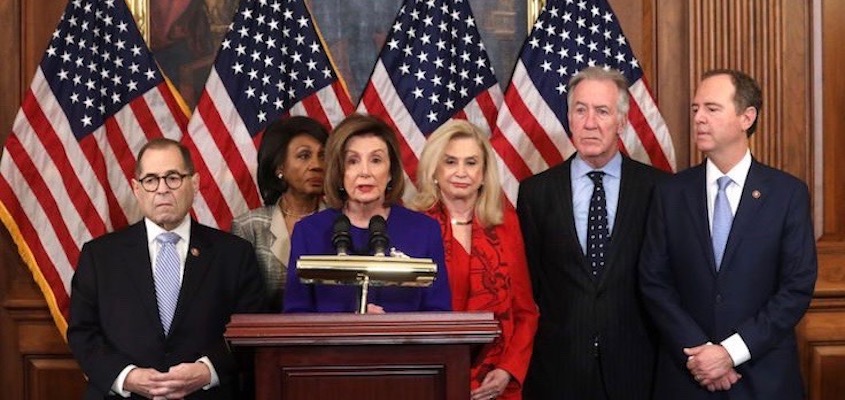
We’ve been told impeachment is a political act, not, strictly speaking, a legal one, and that surely is the case here. The cynic in me says this: Establishment democrats, led by Nancy Pelosi, knew they had to do something against Trump, if only to appease activists within the party. Yet they also know they can’t remove Trump, not only because the Senate is controlled by Republicans, but because they can’t charge him with real crimes without implicating themselves, e.g. continuing to sell arms to Saudi Arabia and supporting the House of Saud no matter what in the name of profit and the petrodollar, even if that means a genocide in Yemen. (It’s a lot worse than cajoling Ukraine to issue a negative statement about the Bidens, right?)
The Democrats know impeachment will fail in the Senate, but they can at least say they took a stand, even if they’re up to their necks in the swamps of DC. It’s all so sad and sordid, and so predictably the behavior of an opposition party that offers no real opposition.
President Obama with General Stanley McChrystal in the days of the ill-fated Afghan Surge
W.J. Astore
Ten years ago, President Barack Obama decided to “surge” in the Afghan War. The previous year he had run for the presidency on the idea of Iraq being the “bad” war but Afghanistan as the “good” war. Good as in “winnable” and as countering terrorism. But Obama’s surge in Afghanistan was a flop, even as American leaders tried to sell it as buying breathing space for the evolution of freer, more stable, Afghan government.
This sell/spin process was all lies, as the Washington Postrevealed yesterday:
A confidential trove of government documents obtained by The Washington Post reveals that senior U.S. officials failed to tell the truth about the war in Afghanistan throughout the 18-year campaign, making rosy pronouncements they knew to be false and hiding unmistakable evidence the war had become unwinnable.
Surprise, surprise! Sadly, the lies were obvious a decade ago, as I wrote about at TomDispatch.com in April of 2009. Here’s my article from that time. Remarkably, despite or rather because of all the lies, the war continues still, with no end in sight.
Mary McCarthy in Vietnam, Barack Obama in Afghanistan
Seven Lessons and Many Questions for the President
By William Astore (April 2009)
In 1967, outraged by the course of the Vietnam War, as well as her country’s role in prolonging and worsening it, Mary McCarthy, novelist, memoirist, and author of the bestseller The Group, went to Saigon, then the capital of South Vietnam, to judge the situation for herself. The next year, she went to the North Vietnamese capital, Hanoi. She wrote accounts of both journeys, published originally in pamphlet format as Vietnam (1967) and Hanoi (1968), and later gathered with her other writings on Vietnam as a book, The Seventeenth Degree (1974). As pamphlets, McCarthy’s accounts sold poorly and passed into obscurity; deservedly so, some would say.
Those who’d say this, however, would be wrong. McCarthy brought a novelist’s keen eye to America’s activities and its rhetoric in Vietnam. By no means a military expert, not even an expert on Vietnam — she only made a conscious decision to study the war in Vietnam after she returned from her trip to Saigon — her impressionistic writings were nevertheless insightful precisely because she had long been a critical thinker beholden to no authority.
Her insights into our approach to war-fighting and to foreign cultures are as telling today as they were 40 years ago, so much so that President Obama and his advisors might do well to add her unconventional lessons to their all-too-conventional thinking on our spreading war in Afghanistan and Pakistan.
What were those lessons? Here are seven of them, each followed by questions that, four decades later, someone at President Obama’s next press conference should consider asking him:
1. McCarthy’s most fundamental objection was to the way, in Vietnam, the U.S. government decided to apply “technology and a superior power to a political situation that will not yield to this.” At the very least, the United States was guilty of folly, but McCarthy went further. She condemned our technocentric and hegemonic form of warfare as “wicked” because of its “absolute indifference to the cost in human lives” to the Vietnamese people.
Even in 1967, the widespread, at times indiscriminate, nature of American killing was well known. For example, U.S. planes dropped roughly 7 million tons of bombs on Vietnam and parts of Laos and Cambodia during the war, nearly five times the tonnage used against Germany during World War II. The U.S. even waged war on the Vietnamese jungle and forest, which so effectively hid Vietnamese guerrilla forces, spraying roughly 20 million gallons of toxic herbicides (including the dioxin-contaminated Agent Orange) on it.
In her outrage, McCarthy dared to compare the seeming indifference of many of her fellow citizens toward the blunt-edged sword of technological destruction we had loosed on Vietnam to the moral obtuseness of ordinary Germans under Adolf Hitler.
Questions for President Obama: Aren’t we once again relying on the destructive power of technology to “solve” complex political and religious struggles? Aren’t we yet again showing indifference to the human costs of war, especially when borne by non-Americans? Even though we’re using far fewer bombs in the Af-Pak highlands than we did in Vietnam, aren’t we still morally culpable when these “precision-guided munitions” miss their targets and instead claim innocents, or hit suspected “terrorists” who suddenly morph into wedding parties? In those cases, do we not seek false comfort in the phrase, C’est la guerre, or at least that modern equivalent: unavoidable collateral damage?
2. As Richard Nixon campaigned for the presidency in 1968 by calling for “peace with honor” in Vietnam, McCarthy offered her own warning about the dangers that arose when the office of the presidency collided with an American desire never to be labeled a loser: “The American so-called free-enterprise system, highly competitive, investment-conscious, expansionist, repels a loser policy by instinctive defense movements centering in the ganglia of the presidency. No matter what direction the incumbent, as candidate, was pointing in, he slowly pivots once he assumes office.”
Questions for President Obama: Have you, like Vietnam-era presidents, pivoted toward yet another surge simply to avoid the label of “loser” in Afghanistan? And if the cost of victory (however defined) is hundreds, or even thousands, more American military casualties, hundreds of billions of additional dollars spent, and extensive collateral damage and blowback, will this “victory” not be a pyrrhic one, achieved at a price so dear as to be indistinguishable from defeat?
3. Though critical of the U.S. military in Vietnam, McCarthy was even more critical of American civilian officials there. “On the whole,” she wrote, they “behaved like a team of promoters with a dubious ‘growth’ stock they were brokering.” At least military men were often more forthright than the civilians, if not necessarily more self-aware, McCarthy noted, because they were part of the war — the product, so to speak — not its salesmen.
Questions for President Obama: In promising to send a new “surge” of State Department personnel and other civilians into Afghanistan, are you prepared as well to parse their words? Are you braced in case they sell you a false bill of goods, even if the sellers themselves, in their eagerness to speak fairy tales to power, continually ignore the Fantasyland nature of their tale?
4. Well before Bush administration officials boasted about creating their own reality and new “facts on the ground” in Iraq, Mary McCarthy recognized the danger of another type of “fact”: “The more troops and matériel committed to Vietnam, the more retreat appears to be cut off — not by an enemy, but by our own numbers. To call for withdrawal in the face of that commitment… is to seem to argue not against a policy, but against facts, which by their very nature are unanswerable.”
Questions for President Obama: If your surge in Afghanistan fails, will you be able to de-escalate as quickly as you escalated? Or will the fact that you’ve put more troops in harm’s way (with all their equipment and all the money that will go into new base and airfield and road construction), and committed more of your prestige to prevailing, make it even harder to consider leaving?
5. A cursory reading of The Pentagon Papers, the famously secret government documents on Vietnam leaked to the New York Times by Daniel Ellsberg, reveals how skeptical America’s top officials were, early on, in pursuing a military solution to the situation in South Vietnam. Nevertheless, knowing better, the “best and brightest,” as journalist David Halberstam termed them in his famous, ironic book title, still talked themselves into it; and they did so, as McCarthy noted, because they set seemingly meaningful goals (“metrics” or “benchmarks,” we’d say today), which they then convinced themselves they were actually achieving. When you trick yourself into believing that you’re meeting your goals, as Halberstam noted, there’s no reason to reexamine your course of action.
Questions for President Obama: Much has been written about an internal struggle within your administration over the wisdom of surging in Afghanistan. Now, you, too, have called for the setting of “benchmarks” for your new strategy’s success. Are you wise enough to set them to capture the complexities of political realities on the ground rather than playing to American strengths? Are you capable of re-examining them, even when your advisors assure you that they are being achieved?
6. In her day, Mary McCarthy recognized the inequities of burden-sharing at home when it came to the war in Vietnam: “Casualty figures, still low [in 1967], seldom strike home outside rural and low-income groups — the silent part of society. The absence of sacrifices [among the privileged classes] has had its effect on the opposition [to the war], which feels no need, on the whole, to turn away from its habitual standards and practices — what for? We have not withdrawn our sympathy from American power and from the way of life that is tied to it — a connection that is more evident to a low-grade G.I. in Vietnam than to most American intellectuals.”
Questions for President Obama: Are you willing to listen to the common G.I. as well as to the generals who have your ear? Are you willing to insist on greater equity in burden-sharing, since once again most of the burden of Iraq and Afghanistan has fallen on “the silent part of society”? Are you able to recognize that the “best and brightest” in the corridors of power may not be the wisest exactly because they have so little to lose (and perhaps much to gain) from our “overseas contingency operations”?
7. McCarthy was remarkably perceptive when it came to the seductiveness of American technological prowess. Our technological superiority, she wrote, was a large part of “our willingness to get into Vietnam and stay there… The technological gap between us and the North Vietnamese constituted, we thought, an advantage which obliged us not to quit.”
Questions for President Obama: Rather than providing us with a war-winning edge, might our robot drones, satellite imagery, and all our other gadgetry of war seduce us into believing that we can “prevail” at a reasonable and sustainable cost? Indeed, do we think we should prevail precisely because our high-tech military brags of “full spectrum dominance”?
One bonus lesson from Mary McCarthy before we take our leave of her: Even now, we speak too often of “Bush’s war” or, more recently, “Obama’s war.” Before we start chattering mindlessly about Iraq and Afghanistan as American tragedies, we would do well to recall what McCarthy had to say about the war in Vietnam: “There is something distasteful,” she wrote, “in the very notion of approaching [Vietnam] as an American tragedy, whose protagonist is a great suffering Texan [President Lyndon Baines Johnson].”
Yes, there is something distasteful about a media that blithely refers to Bush’s or Obama’s war as hundreds of thousands of Iraqis and Afghans suffer. For American troops, after all, are not the only ones paying the ultimate price when the U.S. fights foreign wars for ill-considered reasons and misguided goals.
Update: A cartoon panel by Matt Bors that sums it up:
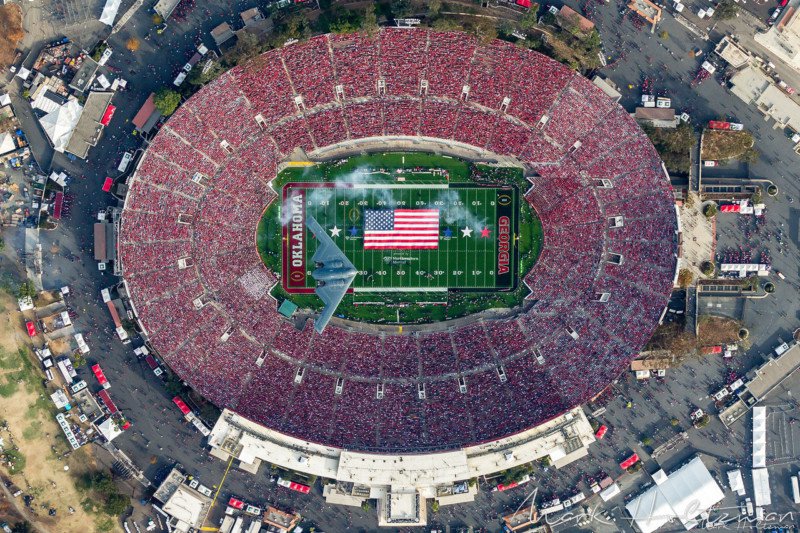
Nothing screams “America!” like huge stadiums, big bombers, and giant flags
W.J. Astore
A few weeks ago, a reader asked me a fair question: Why do I continue to watch football, given my comments on violence in the sport and the militarization of the game, including camouflage uniforms (even for coaches and cheerleaders!). I could have hedged and said I don’t watch much football. I don’t watch college games, and the only NFL game I regularly watch features my home team. In short, I watch about three hours a week, and a little more during the playoffs. Nevertheless, I still watch, so why do I do it?
I wrote back and identified four reasons: Because I’ve watched football since I was a kid (habit) and I enjoy the sport. Because I put my mind in neutral during the game and just enjoy the action (a form of denial, I suppose). Because, like so many Americans, I get caught up in the spectacle of it all, its ritualistic nature. Because it’s often unpredictable and real in a way that “reality” shows are not.
After sending that answer along, another reader noted how my reasons could be made to serve as partial justification for supporting America’s wars, and to be honest the thought had occurred to me before I sent my answer. So, you could say I’ve watched wars since I was a kid and on some level “enjoyed” them (the action, the drama, the spectacle of it all, the way things are “played for keeps”). Perhaps I put my mind in neutral as well (TV trance) while enjoying the “reality” and rooting for the home team (America!). Sports and war are connected in complex ways, and I’m only scratching the surface here.
I’d like to add two more reasons why I watch football. I enjoy rooting for “my” team, and when they win, I’m pleased. When they don’t, I’m bummed. I get over it quickly (after all, it’s just a game, right?), but on some level the games have meaning to me. I identify with “my” team, simple as that.
One more reason: nostalgia. These games recall a simpler time, when we threw a ball around with friends or our dad, then quit for the day to watch a game and scream and shout at the stadium or in our living rooms. (Such nostalgia is not unknown among combat veterans, who look back on war with mixed feelings of horror but also of love, or at least attraction in the sense of a powerful camaraderie and sense of belonging shared by those who were there. It’s one reason for war’s peculiar attraction and perhaps its endurance as well.)
What say you, readers? Do you watch football and, if so, why?
Another reason for the persistence of America’s wars is captured in a speech by Chief Dan George in the movie, “Little Big Man.” We have little sense of the sanctity of life, and we treat nature like our personal trash can. As Chief Dan George says, “If things keep trying to live, White Man will rub them out.” We need a much more enlightened approach to nature — and to ourselves — but we seem content instead to become purveyors of violence even as we play down or even deny the reality of death from our weapons and wars.
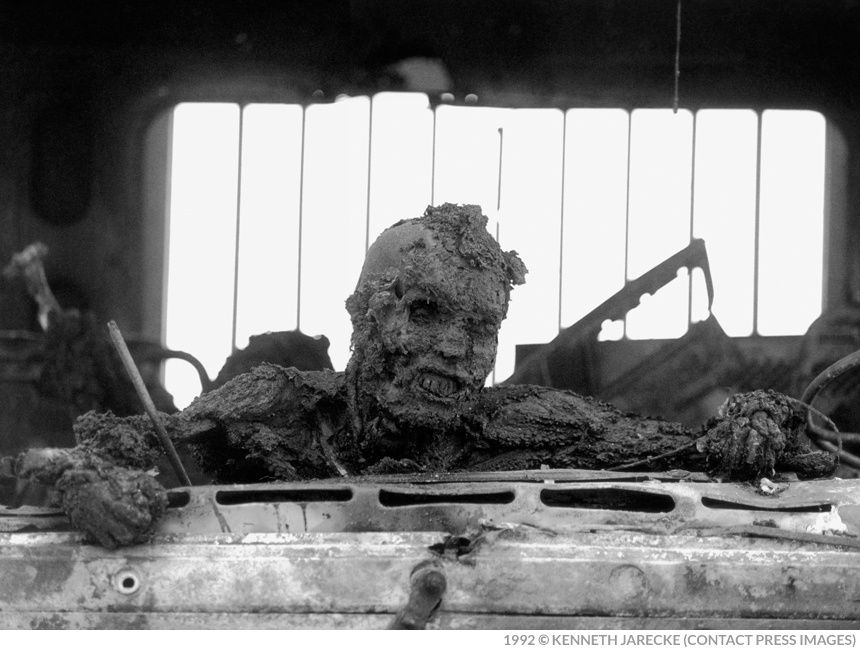
Kenneth Jarecke’s 1991 photo of a dead Iraqi was considered too disturbing to publish in America
W.J. Astore
Americans tend to fear death. It makes us uncomfortable. Yet death is inevitable. Its inevitability should teach us to revel in the richness of the here and now. It should also teach us the foolishness of undue pride.
All is vanity, the Bible teaches. Death reminds us of this — that human vanity, as unavoidable as it may be, is ultimately shallow. There are riches out there that we should seek away from the glaring and garish light of vanity. Riches that give deeper meaning to life.
Of all cultures in the world, I wonder if there’s another that ignores or denies death as much as American culture. We’re the culture of new beginnings, fresh starts, reinvention, and also of the perpetual now, of youth, of defying or denying death through face…
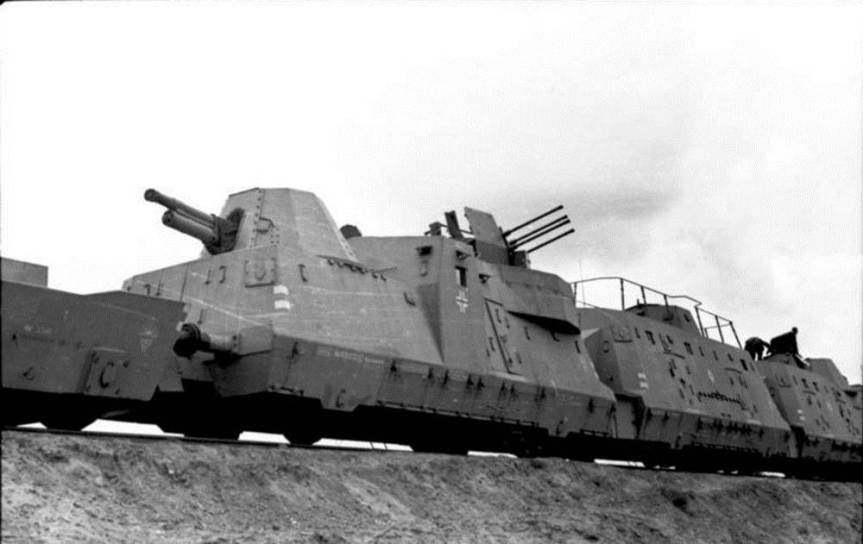
War train, vintage World War II. Peace train nowhere in sight.
W.J. Astore
In my latest article for TomDispatch.com, I look afresh at the many reasons why America’s wars persist — and why the “war train” is soundin’ ever louder across America and indeed much of the world.
Here’s an excerpt; please read the entire article at TomDispatch.
Think of this as the new American exceptionalism. In Washington, war is now the predictable (and even desirable) way of life, while peace is the unpredictable (and unwise) path to follow. In this context, the U.S. must continue to be the most powerful nation in the world by a country mile in all death-dealing realms and its wars must be fought, generation after generation, even when victory is never in sight. And if that isn’t an “exceptional” belief system, what is?
If we’re ever to put an end to our country’s endless twenty-first-century wars, that mindset will have to be changed. But to do that, we would first have to recognize and confront war’s many uses in American life and culture.
War, Its Uses (and Abuses)
A partial list of war’s many uses might go something like this: war is profitable, most notably for America’s vast military-industrial complex; war is sold as being necessary for America’s safety, especially to prevent terrorist attacks; and for many Americans, war is seen as a measure of national fitness and worthiness, a reminder that “freedom isn’t free.” In our politics today, it’s far better to be seen as strong and wrong than meek and right.
As the title of a book by former war reporter Chris Hedges so aptly put it, war is a force that gives us meaning. And let’s face it, a significant part of America’s meaning in this century has involved pride in having the toughest military on the planet, even as trillions of tax dollars went into a misguided attempt to maintain bragging rights to being the world’s sole superpower.
And keep in mind as well that, among other things, never-ending war weakens democracy while strengthening authoritarian tendencies in politics and society. In an age of gaping inequality, using up the country’s resources in such profligate and destructive ways offers a striking exercise in consumption that profits the few at the expense of the many.
In other words, for a select few, war pays dividends in ways that peace doesn’t. In a nutshell, or perhaps an artillery shell, war is anti-democratic, anti-progressive, anti-intellectual, and anti-human. Yet, as we know, history makes heroes out of its participants and celebrates mass murderers like Napoleon as “great captains.”
What the United States needs today is a new strategy of containment — not against communist expansion, as in the Cold War, but against war itself. What’s stopping us from containing war? You might say that, in some sense, we’ve grown addicted to it, which is true enough, but here are five additional reasons for war’s enduring presence in American life:
The delusional idea that Americans are, by nature, winners and that our wars are therefore winnable: No American leader wants to be labeled a “loser.” Meanwhile, such dubious conflicts — see: the Afghan War, now in its 18th year, with several more years, or even generations, to go — continue to be treated by the military as if they were indeed winnable, even though they visibly aren’t. No president, Republican or Democrat, not even Donald J. Trump, despite his promises that American soldiers will be coming home from such fiascos, has successfully resisted the Pentagon’s siren call for patience (and for yet more trillions of dollars) in the cause of ultimate victory, however poorly defined, farfetched, or far-off.
American society’s almost complete isolation from war’s deadly effects: We’re not being droned (yet). Our cities are not yet lying in ruins (though they’re certainly suffering from a lack of funding, as is our most essential infrastructure, thanks in part to the cost of those overseas wars). It’s nonetheless remarkable how little attention, either in the media or elsewhere, this country’s never-ending war-making gets here.
Unnecessary and sweeping secrecy: How can you resist what you essentially don’t know about? Learning its lesson from the Vietnam War, the Pentagon now classifies (in plain speak: covers up) the worst aspects of its disastrous wars. This isn’t because the enemy could exploit such details — the enemy already knows! — but because the American people might be roused to something like anger and action by it. Principled whistleblowers like Chelsea Manning have been imprisoned or otherwise dismissed or, in the case of Edward Snowden, pursued and indicted for sharing honest details about the calamitous Iraq War and America’s invasive and intrusive surveillance state. In the process, a clear message of intimidation has been sent to other would-be truth-tellers.
An unrepresentative government: Long ago, of course, Congress ceded to the presidency most of its constitutional powers when it comes to making war. Still, despite recent attempts to end America’s arms-dealing role in the genocidal Saudi war in Yemen (overridden by Donald Trump’s veto power), America’s duly elected representatives generally don’t represent the people when it comes to this country’s disastrous wars. They are, to put it bluntly, largely captives of (and sometimes on leaving politics quite literally go to work for) the military-industrial complex. As long as money is speech (thank you, Supreme Court!), the weapons makers are always likely to be able to shout louder in Congress than you and I ever will.
America’s persistent empathy gap. Despite our size, we are a remarkably insular nation and suffer from a serious empathy gap when it comes to understanding foreign cultures and peoples or what we’re actually doing to them. Even our globetrotting troops, when not fighting and killing foreigners in battle, often stay on vast bases, referred to in the military as “Little Americas,” complete with familiar stores, fast food, you name it. Wherever we go, there we are, eating our big burgers, driving our big trucks, wielding our big guns, and dropping our very big bombs. But what those bombs do, whom they hurt or kill, whom they displace from their homes and lives, these are things that Americans turn out to care remarkably little about.
All this puts me sadly in mind of a song popular in my youth, a time when Cat Stevens sang of a “peace train” that was “soundin’ louder” in America. Today, that peace train’s been derailed and replaced by an armed and armored one eternally prepared for perpetual war — and that train is indeed soundin’ louder to the great peril of us all.
Please read the rest of the article here at TomDispatch.com.
Congresswoman Tulsi Gabbard is a compelling choice for president in 2020. She’s principled, she’s against America’s disastrous regimen of regime-change wars, and she’s got the guts to criticize her own party for being too closely aligned with rich and powerful interests. She’s also a military veteran who enlisted in the Army National Guard in Hawaii after the 9/11 attacks (she currently serves as a major and deployed overseas to Iraq during that war).
What’s not to like about a female veteran who oozes intelligence and independence, a woman who represents diversity (she’s a practicing Hindu and a Samoan-American), an early supporter of Bernie Sanders who called out the DNC for its favoritism toward Hillary Clinton …
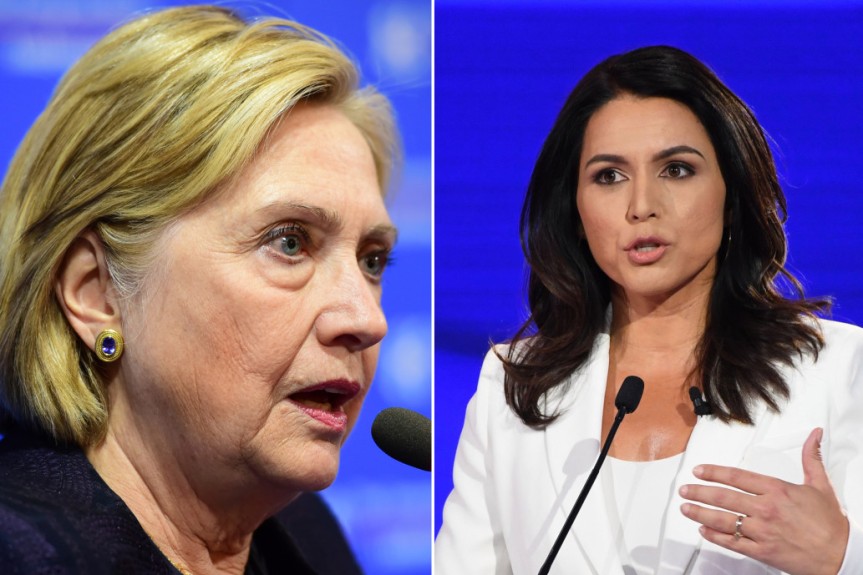
Aha! There you have it. Back in February 2016, Gabbard resigned her position as vice-chair of the DNC to endorse Sanders, and the DNC, controlled by establishment centrists like the Clintons as well as Barack Obama, have never forgiven her. Recently, Hillary Clinton smeared her (as well as Jill Stein, Green Party candidate from 2016) as a Russian asset, and various mainstream networks and news shows, such as “The View” and NBC, have suggested (with no evidence) she’s the favored candidate of Russia and Vladimir Putin.
Think about that. Hillary Clinton and much of the mainstream media are accusing a serving major in the U.S. military of being an asset to a foreign power. It’s an accusation bordering on a charge of treason — a charge that is libelous and recklessly irresponsible.
A reminder: Tulsi Gabbard enlisted in the military to serve her country in the aftermath of 9/11. What did Hillary Clinton do? Can you imagine Hillary going through basic training as a private, or serving in the military in a war zone? (Hillary did falsely claim that she came under sniper fire in Bosnia, but that’s a story for another day.)
Tulsi Gabbard is her own person. She’s willing to buck the system and has shown compassion and commitment on the campaign trail. She may be a long shot, but she deserves a long look for the presidency, especially when you consider the (low) quality of the enemies she’s made.
Last night was the fifth Democratic debate featuring the top ten candidates for the presidency. These are more “meet and greets” than debates, given the short time for responses and the sheer number of candidates, but they can be revealing. Rather than focusing on who “won” (here’s a typical “Who won?” article) or the best applause lines, I’d like to summarize each candidate in as few words as possible. Here goes (in alphabetical order):
1. Joe Biden: Fading. Biden often misspeaks and relies far too heavily on the dubious legacy of the Obama years. He has no apparent vision for the future.
2. Cory Booker: Wide-eyed. Booker tries to convey enthusiasm and optimism, but somehow it hasn’t worked for him. There’s a growing sense of desperation about his candidacy.
3. Pete Buttigieg: Salesman. To me, Mayor Pete looks like he should be going door-to-door, selling Bibles. The face of young milquetoast moderation within the Democratic party; unsurprisingly, he’s attracted a lot of establishment money.
4. Tulsi Gabbard: Composed. Tulsi is rarely flustered. Her poise and sense of calm come through in interviews and on the campaign trail, but doesn’t translate as well in debates.
5. Kamala Harris: Affected. Harris, a former “top tier” candidate (her words), has watched her support dwindle. Maybe that’s because there’s something scripted about her.
6. Amy Klobuchar: Establishment. She has positioned herself as a sensible centrist, which is another way of saying her positions are predictable half-measures that threaten no one in power.
7. Bernie Sanders: Passionate. Bernie has lost none of his outrage at a rigged system. He’s still calling for a political revolution. Good for him.
8. Tom Steyer: Billionaire. It’s interesting to see a rich guy espouse progressive ideas while vowing to attack climate change. I don’t think he has a chance, but he’s not your typical politician.
9. Elizabeth Warren: Prepared. Warren has a plan for everything. But will her professorial manner translate in a general election? Her crossover appeal seems limited.
10. Andrew Yang: Different. Yang thinks for himself and has an eye on the future. His out-of-the-box thinking adds some intellectual excitement to these often stale “debates.”
Of the ten candidates, Sanders and Warren are identified by the media as the “radical” progressives, whereas Biden, Booker, Buttigieg, Harris, and Klobuchar are seen as moderates or centrists. Gabbard and Yang are non-conformists but in different ways, and Steyer is anomalous in terms of his wealth.
For me, Bernie Sanders remains the clear choice for 2020.
President Obama with his Surge commander, Stanley McChrystal
W.J. Astore
Ten years ago, President Obama went to West Point to sell his “surge” in the Afghan War. Back then, I wrote two articles for Huffington Post on Obama’s decision to escalate that war and his choice of venue to announce his decision. Those two articles are re-posted below.
The Afghan War was supposed to be settled quickly, in America’s favor, by Obama’s surge. Yet here we are, a decade later, still mired in Afghanistan, with America’s generals either talking about several more years in Afghanistan, or several more generations. How can they be so foolish?
In telling the American people about his plans to escalate the war in Afghanistan, President Obama has selected a venue that at first blush seems to make sense. Yet by choosing the United States Military Academy at West Point, Obama is sending at least three disturbing messages. The first message is a tacit admission to the corps of cadets — and to the American people — that we’re facing a long war of at least five, possibly ten, perhaps even fifty, years. After all, why bother to address the class of 2013 unless these cadets can also expect to be deployed to Afghanistan as platoon commanders in 2014?
The second message is that Obama is more than willing to ape the tactics of former President George W. Bush. Often when Bush had a controversial decision to announce, he did so before a sympathetic audience of assembled troops, surrounded by waving flags and military brass. Critics rightly took Bush to task for speaking so often in front of admiring troops in uniform, thereby evading tough questioning from more critical, less deferential, audiences.
The third, somewhat more subtle, message is that Obama sees the situation in Afghanistan primarily in military terms — that, if there’s a solution to Afghanistan, it’s one that must be brokered or imposed by the U.S. military. If he wanted to stress the importance of diplomacy, for example, one might think Obama would have selected the State Department as a venue; if international diplomacy, one might have considered the United Nations. But West Point it is, and thus more escalation and militarization loom.
Here’s what I’d prefer: The President, speaking honestly and directly to the American people, from the Oval Office. No military trappings. No echoes, whether intentional or unintentional, of Douglas MacArthur’s “there is no substitute for victory” speech at West Point in 1962.
West Point is all about “duty, honor, country.” Young, idealistic, and dedicated cadets need no convincing by their commander-in-chief. It’s the rightly skeptical American people who truly need convincing.
By going to West Point, Obama is not just further militarizing his presidency — he’s taking the easy way out.
A week ago, I argued that President Obama sent three disturbing messages in choosing West Point as the site to announce his escalatory plans for the Afghan war. A week later, I’d like to make three further points. First, I believe that the President undermined the grave seriousness of his speech by deciding post-speech to press the flesh of cadets while posing for smiling photos. An urgent call to battle was transformed into a political photo-op. “Grip and grin” photos are best left to times of celebration, like class graduation, rather than to times of grim news of the need to commit more troops to a difficult and deadly war.
Second, the President was right to emphasize that West Point cadets “represent what is finest about our country.” His meaning here was clear: they’re the “finest” because they “stand up for our security.” Having myself taught military cadets for six years, these words resonated with me. But I wish the President had elaborated further because, in spelling out why he considers our troops to be our “finest,” Obama could have reminded us of the enormous burdens — and enormous price — of war.
Put bluntly, by ordering another 35,000 or so American troops to Afghanistan, Obama was ordering men and women, including some of the young cadets from West Point’s long grey line sitting in that very auditorium, to their deaths. Their willingness to sacrifice their lives in the service of their country — to support and defend the Constitution of the United States against all enemies, foreign and domestic — marks them as being among our finest.
The ultimate price these cadets are prepared to pay puts an enormous burden on the judgment and wisdom of their Commander-in-chief. For what president wants to send America’s finest to fight and perhaps die for a lost cause or, even worse, an unjust one?
It’s not for West Point cadets, or for any other serviceman or servicewoman, to question the orders of their Commander-in-chief. They are duty-bound to carry out his orders to the best of their ability. But as “pure” citizens, we are not duty-bound to snap to attention and to salute smartly.
Obama, after all, is not our Commander-in-chief: he’s our President, our most senior public servant. We owe it to our troops to challenge him if we believe escalation in Afghanistan is not the best course of action to secure America’s safety.
So, my third point is to remind us of our duty as informed citizens to ask the tough questions of our public servants — even, if necessary, to dissent and protest — precisely because our troops are prevented from doing so by their solemn oath of office.
But I worry that we are not informed citizens, and that because of that fact, and because our personal stake in our nation’s wars is so small compared to that of the West Point cadets, we largely don’t seem to care, or care enough.
In a decidedly unscientific poll, I asked three of my classes, a total of 59 students, if they had watched the President’s speech on Afghanistan. Only one student did (and these were students enrolled in History classes).
So, I worry. I worry about more American combat brigades being sent overseas, a momentous decision capped by a photo-op of our President surrounded by beaming cadets in the prime of life. I worry that so many of my students are seemingly so ill-informed, or so uninterested, about the ramifications of this decision.
But I hope, for the sake of our troops as well as for the Afghan people, that our President somehow got it right, and that the cause for which we fight is neither lost nor unjust.
Addendum: When I wrote this article ten years ago, I said this:
It’s not for West Point cadets, or for any other serviceman or servicewoman, to question the orders of their Commander-in-chief. They are duty-bound to carry out his orders to the best of their ability.
In writing this ten years ago, I made an assumption the president’s orders would be lawful.
No military member can be forced to follow unlawful orders, which I would define as contrary to the U.S. Constitution and/or consistent with war crimes. So, for example, LT Calley was ordering as well as committing war crimes at My Lai. No troops had to, or should have, followed such orders. But we know from history and from our knowledge of military command systems how difficult it is to disobey orders, even when they are unlawful to the point of enabling war crimes.
Military cadets are educated on these distinctions; they have to take courses on ethics and discuss these complex issues in the classroom. But it’s much easier to deal with these issues in class, tough as they are, than in the heat of battle.
Things get more slippery if you consider a whole war to be immoral and unjust. If you’re in the military and ordered to participate in such a war, what do you do? You may have an option to resign, assuming you have no service commitment. But often the option is obedience or punishment. And those who are willing to risk and/or endure punishment while taking a principled stance are to be respected, or at the very least not dismissed out of hand.
For me, Chelsea Manning is a true hero. She did what other service members should always do: remembering her oath, she acted to uphold it, irrespective of the cost to her.
But there’s a counterargument that should be considered. What individual soldier has perfect knowledge? In acting, perhaps with one-sided information, are you endangering your fellow troops? Are you truly acting selflessly, or selfishly?
Not every would-be whistleblower is acting wisely or thinking coherently.
These are tough calls where people pay a very high price indeed.
Obedience is needed in the military. Even in the face of death. But obedience is wrong in the face of illegality and immorality. Thus we should elect leaders who respect legality and display morality. Sadly, that is often the very opposite of what we do as a people.
When in January 2010 the Supreme Court ruled that money is speech and corporations are citizens, our democracy (or, if you prefer, our representative republic) took a serious hit. Since then, we’ve witnessed America’s ongoing transition to an oligarchy, and an increasingly militarized and authoritarian one at that.
This was obvious even to me when the Supreme Court rendered its Citizens United decision in favor of corporations. Right after that decision, I wrote this article for Truthout, which I’m re-posting below. What do you think, readers?
Corporations Are Citizens – What Are We?
January 24, 2010
This week’s Supreme Court ruling that corporations are protected by “free speech” rights and can contribute enormous sums of money to influence elections is a de jure endorsement of the de facto dominance of corporations over our lives. Indeed, corporations are the new citizens of this country, and ordinary Americans, who used to be known as “citizens,” now fall into three categories: consumers, warriors and prisoners.
Think about it. Perhaps you’ve noticed, as a friend of mine has, that the term “citizen” has largely disappeared from our public and political discourse. And what term has taken its place? Consumer. That’s our new role: not to exercise our rights as citizens (perish the thought, that’s for corporations to do!), but to exercise our credit cards as consumers. Here one might recall President George W. Bush’s inspiring words to Americans after 9-11 to “go shopping” and to visit Disney.
Think again of our regulatory agencies like the FDA or SEC. They no longer take action to protect us as “citizens.” Rather, they act to safeguard the confidence of “consumers.” And apparently the only news that’s worthy of note is that which affects us as consumers.
As one-dimensional “consumers,” we’ve been reduced to obedient eunuchs in thrall to the economy. Our sole purpose is to keep buying and spending. Corporations, meanwhile, are the citizen-activists in our politics, with the voting and speech rights to match their status.
At the same time we’ve reduced citizens to consumers, we’ve reduced citizen-soldiers to “warriors” or “warfighters.” The citizen-soldier of World War II did his duty in the military, but his main goal was to come home, regain his civilian job, and enjoy the freedoms and rights of American citizenship. Today, our military encourages a “warrior” mentality: a narrow-minded professionalism that emphasizes warfighting skills over citizenship and civic duty.
And if that’s not disturbing enough, think of our military’s ever-increasing reliance on private military contractors or mercenaries.
The final category of American is all-too-obvious: prisoner. No country in the modern industrialized world incarcerates more of its citizens than the United States. More than 7.3 million Americans currently languish somewhere in our prison system. Our only hope, apparently, for a decline in prison population is the sheer expense to states of caring and feeding all these “offenders.”
There you have it. Corporations are our new citizens. And you? If you’re lucky, you get to make a choice: consumer, warrior or prisoner. Which will it be?
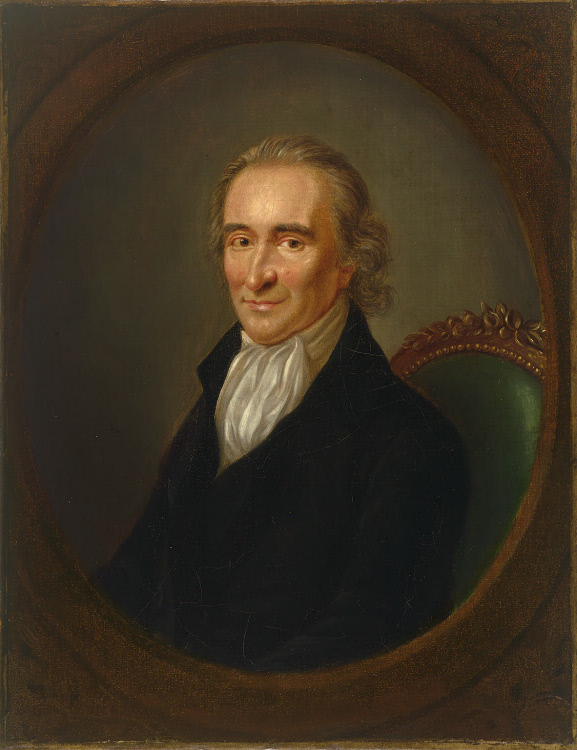
It’s time again to listen to the common sense of Thomas Paine
W.J. Astore
This past weekend, General Mark Milley, Chairman of the JCS, said U.S. troops would remain in Syria for another few years, ostensibly to prevent an ISIS resurgence, and that troops would also continue to fight the Afghan War for several years to come. This should have been been big news, but in an America now distracted by a public impeachment circus, endless wars are greeted with a collective shrug within the media.
Thomas Paine would not have been happy. Famously outspoken for writing “Common Sense” at the beginning of the American Revolutionary War, Paine had some choice words about war and empire that Americans would do well to read and heed today.
“If there is a sin superior to every other,” Paine wrote, “it is that of willful and offensive war … he who is the author of a war, lets loose the whole contagion of Hell, and opens a vein that bleeds a nation to death.”
Paine then wrote that “We leave it to England and Indians [allied with England] to boast of these honors; we feel no thirst for such savage glory; a nobler flame, a purer spirit animates America.”
Imagine an America today that felt no thirst for the savage glory of war!
Paine supported only defensive wars, for Freedom and against Tyranny, as he put it. Remind me how keeping troops in Syria to secure oil is a just war for freedom? Remind me how prolonging the Afghan War (now in its 18th year) by several more years is necessary for America’s defense and in the cause of freedom?
Paine further had choice words for empires that were foolish enough to wage ruinous wars far from home. Naturally, he had Britain most in mind:
“If ever a nation was mad and foolish, blind to its own interest and bent on its own destruction, it is Britain … Bless’d with all the commerce she could wish for, and furnished by a vast extension of dominion with the means of civilizing both the eastern and western world, she has made no other use of both than proudly to idolize her own ‘Thunder,’ and rip up the bowels of whole countries for what she could get; –like Alexander she has made war her sport, and inflicted misery for prodagality [sic] sake.”
Making war our sport while idolizing our “thunderous” military — isn’t that an apt description of much of U.S. foreign policy for the past few decades?
But Paine wasn’t finished. He made a dire prediction:
“All countries have sooner or later been called to their reckoning; the proudest empires have sunk when the balance was struck; and Britain, like an individual penitent, must undergo her day of sorrow, and the sooner it happens to her the better.”
No empire lasts forever — certainly not one that engages in endless and largely pointless wars. Paine warned Britain about the high costs of war with America and how British forces were fated to lose, and he was right.
In a country that supposedly respects and even worships its Founders, isn’t it time Americans listened to Thomas Paine on the horrors of war and the perils of empires blinded by power and greed?
End the wars, America. Bring our troops home. And restore freedom to our land.
(Quotations from Paine are from “The American Crisis” as published in Thomas Paine: Collected Writings, Library of America, pp. 108, 165-66, written originally in 1777 and 1778)