Afghanistan: Still Losing

Mary McCarthy
Mary McCarthy

W.J. Astore

In April of 2009, I wrote the following article for TomDispatch.com on the situation in Afghanistan.  During his 2008 campaign for President, Obama had claimed that Afghanistan was the right war to be fighting, and that Bush and Company had taken their eye off the Afghan ball when they chose to invade Iraq in 2003.

Here we are in August 2014 and the news from Afghanistan is about as grim as one could expect.  This week has witnessed costly “insider” attacks that killed an American major general as well as eleven Afghan police officers.  Progress toward democratic reforms and political stability remains elusive.  U.S. efforts to reshape and rebuild Afghanistan have cost more than $100 billion, exceeding the Marshall Plan that rebuilt Europe after World War II, but without corresponding results.

Obama appears to be channeling Richard Nixon.  Publicly, he’s seeking “peace with honor” in Afghanistan.  Privately, he’s seeking a “decent interval” between when the U.S. exits Afghanistan for good and when Afghanistan returns to Taliban and tribal control, i.e. chaos, or at least that’s my guess.  The “fall” of Afghanistan will then become a political football, with Republicans attempting to paint Democrats as being spineless in leaving Afghanistan, whereas the Democrats will likely paint Afghan leaders as corrupt and incompetent and ungrateful.  Perhaps a Democratic candidate will emerge in 2020 to explain to Americans that our failed efforts in Afghanistan were nevertheless part of a “noble cause” in the global war on terror.

What follows is my article from April of 2009.  I think lesson (2) below will be especially telling in the weeks and months ahead.

Mary McCarthy in Vietnam, Barack Obama in Afghanistan

Seven Lessons and Many Questions for the President
By William Astore

In 1967, outraged by the course of the Vietnam War, as well as her country’s role in prolonging and worsening it, Mary McCarthy, novelist, memoirist, and author of the bestseller The Group, went to Saigon, then the capital of South Vietnam, to judge the situation for herself. The next year, she went to the North Vietnamese capital, Hanoi. She wrote accounts of both journeys, published originally in pamphlet format as Vietnam (1967) and Hanoi (1968), and later gathered with her other writings on Vietnam as a book, The Seventeenth Degree (1974). As pamphlets, McCarthy’s accounts sold poorly and passed into obscurity; deservedly so, some would say.

Those who’d say this, however, would be wrong. McCarthy brought a novelist’s keen eye to America’s activities and its rhetoric in Vietnam. By no means a military expert, not even an expert on Vietnam — she only made a conscious decision to study the war in Vietnam after she returned from her trip to Saigon — her impressionistic writings were nevertheless insightful precisely because she had long been a critical thinker beholden to no authority.

Her insights into our approach to war-fighting and to foreign cultures are as telling today as they were 40 years ago, so much so that President Obama and his advisors might do well to add her unconventional lessons to their all-too-conventional thinking on our spreading war in Afghanistan and Pakistan.

What were those lessons? Here are seven of them, each followed by questions that, four decades later, someone at President Obama’s next press conference should consider asking him:

1. McCarthy’s most fundamental objection was to the way, in Vietnam, the U.S. government decided to apply “technology and a superior power to a political situation that will not yield to this.” At the very least, the United States was guilty of folly, but McCarthy went further. She condemned our technocentric and hegemonic form of warfare as “wicked” because of its “absolute indifference to the cost in human lives” to the Vietnamese people.

Even in 1967, the widespread, at times indiscriminate, nature of American killing was well known. For example, U.S. planes dropped roughly 7 million tons of bombs on Vietnam and parts of Laos and Cambodia during the war, nearly five times the tonnage used against Germany during World War II. The U.S. even waged war on the Vietnamese jungle and forest, which so effectively hid Vietnamese guerrilla forces, spraying roughly 20 million gallons of toxic herbicides (including the dioxin-contaminated Agent Orange) on it.

In her outrage, McCarthy dared to compare the seeming indifference of many of her fellow citizens toward the blunt-edged sword of technological destruction we had loosed on Vietnam to the moral obtuseness of ordinary Germans under Adolf Hitler.

Questions for President Obama: Aren’t we once again relying on the destructive power of technology to “solve” complex political and religious struggles? Aren’t we yet again showing indifference to the human costs of war, especially when borne by non-Americans? Even though we’re using far fewer bombs in the Af-Pak highlands than we did in Vietnam, aren’t we still morally culpable when these “precision-guided munitions” miss their targets and instead claim innocents, or hit suspected “terrorists” who suddenly morph into wedding parties? In those cases, do we not seek false comfort in the phrase, C’est la guerre, or at least that modern equivalent: unavoidable collateral damage?

2. As Richard Nixon campaigned for the presidency in 1968 by calling for “peace with honor” in Vietnam, McCarthy offered her own warning about the dangers that arose when the office of the presidency collided with an American desire never to be labeled a loser: “The American so-called free-enterprise system, highly competitive, investment-conscious, expansionist, repels a loser policy by instinctive defense movements centering in the ganglia of the presidency. No matter what direction the incumbent, as candidate, was pointing in, he slowly pivots once he assumes office.”

Questions for President Obama: Have you, like Vietnam-era presidents, pivoted toward yet another surge simply to avoid the label of “loser” in Afghanistan? And if the cost of victory (however defined) is hundreds, or even thousands, more American military casualties, hundreds of billions of additional dollars spent, and extensive collateral damage and blowback, will this “victory” not be a pyrrhic one, achieved at a price so dear as to be indistinguishable from defeat?

3. Though critical of the U.S. military in Vietnam, McCarthy was even more critical of American civilian officials there. “On the whole,” she wrote, they “behaved like a team of promoters with a dubious ‘growth’ stock they were brokering.” At least military men were often more forthright than the civilians, if not necessarily more self-aware, McCarthy noted, because they were part of the war — the product, so to speak — not its salesmen.

Questions for President Obama: In promising to send a new “surge” of State Department personnel and other civilians into Afghanistan, are you prepared as well to parse their words? Are you braced in case they sell you a false bill of goods, even if the sellers themselves, in their eagerness to speak fairy tales to power, continually ignore the Fantasyland nature of their tale?

4. Well before Bush administration officials boasted about creating their own reality and new “facts on the ground” in Iraq, Mary McCarthy recognized the danger of another type of “fact”: “The more troops and matériel committed to Vietnam, the more retreat appears to be cut off — not by an enemy, but by our own numbers. To call for withdrawal in the face of that commitment… is to seem to argue not against a policy, but against facts, which by their very nature are unanswerable.”

Questions for President Obama: If your surge in Afghanistan fails, will you be able to de-escalate as quickly as you escalated? Or will the fact that you’ve put more troops in harm’s way (with all their equipment and all the money that will go into new base and airfield and road construction), and committed more of your prestige to prevailing, make it even harder to consider leaving?

5. A cursory reading of The Pentagon Papers, the famously secret government documents on Vietnam leaked to the New York Times by Daniel Ellsberg, reveals how skeptical America’s top officials were, early on, in pursuing a military solution to the situation in South Vietnam. Nevertheless, knowing better, the “best and brightest,” as journalist David Halberstam termed them in his famous, ironic book title, still talked themselves into it; and they did so, as McCarthy noted, because they set seemingly meaningful goals (“metrics” or “benchmarks,” we’d say today), which they then convinced themselves they were actually achieving. When you trick yourself into believing that you’re meeting your goals, as Halberstam noted, there’s no reason to reexamine your course of action.

Questions for President Obama: Much has been written about an internal struggle within your administration over the wisdom of surging in Afghanistan. Now, you, too, have called for the setting of “benchmarks” for your new strategy’s success. Are you wise enough to set them to capture the complexities of political realities on the ground rather than playing to American strengths? Are you capable of re-examining them, even when your advisors assure you that they are being achieved?

6. In her day, Mary McCarthy recognized the inequities of burden-sharing at home when it came to the war in Vietnam: “Casualty figures, still low [in 1967], seldom strike home outside rural and low-income groups — the silent part of society. The absence of sacrifices [among the privileged classes] has had its effect on the opposition [to the war], which feels no need, on the whole, to turn away from its habitual standards and practices — what for? We have not withdrawn our sympathy from American power and from the way of life that is tied to it — a connection that is more evident to a low-grade G.I. in Vietnam than to most American intellectuals.”

Questions for President Obama: Are you willing to listen to the common G.I. as well as to the generals who have your ear? Are you willing to insist on greater equity in burden-sharing, since once again most of the burden of Iraq and Afghanistan has fallen on “the silent part of society”? Are you able to recognize that the “best and brightest” in the corridors of power may not be the wisest exactly because they have so little to lose (and perhaps much to gain) from our “overseas contingency operations”?

7. McCarthy was remarkably perceptive when it came to the seductiveness of American technological prowess. Our technological superiority, she wrote, was a large part of “our willingness to get into Vietnam and stay there… The technological gap between us and the North Vietnamese constituted, we thought, an advantage which obliged us not to quit.”

Questions for President Obama: Rather than providing us with a war-winning edge, might our robot drones, satellite imagery, and all our other gadgetry of war seduce us into believing that we can “prevail” at a reasonable and sustainable cost? Indeed, do we think we should prevail precisely because our high-tech military brags of “full spectrum dominance”?

One bonus lesson from Mary McCarthy before we take our leave of her: Even now, we speak too often of “Bush’s war” or, more recently, “Obama’s war.” Before we start chattering mindlessly about Iraq and Afghanistan as American tragedies, we would do well to recall what McCarthy had to say about the war in Vietnam: “There is something distasteful,” she wrote, “in the very notion of approaching [Vietnam] as an American tragedy, whose protagonist is a great suffering Texan [President Lyndon Baines Johnson].”

Yes, there is something distasteful about a media that blithely refers to Bush’s or Obama’s war as hundreds of thousands of Iraqis and Afghans suffer. For American troops, after all, are not the only ones paying the ultimate price when the U.S. fights foreign wars for ill-considered reasons and misguided goals.

Copyright 2009 William Astore
Dissent and Democracies

us constitution
W.J. Astore

Dissent is fundamental to democracy.  Or so we claim.  Until such dissent makes us angry or uncomfortable.  Then we yell at the dissenter to shut up; better yet, we denounce him or her as a traitor to … well, whatever fits.

But responsible criticism of the actions of one’s government is not disloyalty; rather, it’s often a form of higher loyalty, a loyalty to the ideal of freedom of speech as well as the ideal of organized political action.  The alternative is “My government, right or wrong.”  And who wants that, except for government leaders and their lackeys?

The USA and Israel claim to be democracies.  Yet in difficult times, dissent is often suppressed, and dissenters painted as disloyal.  Recall the aftermath of 9/11 in the USA, when those who questioned the rush to war against Iraq were painted as naive peaceniks (at best) or as dupes of Saddam Hussein or even (at worst) as supporters of Al Qaeda.  That was the mentality of Bush and Company, a Manichean “you’re either for us or against us.”  And look where that got us.

Sorry, I’m not “for” a government and its leaders.  I’m “for” the US Constitution and our essential rights and liberties, including the right to dissent from my government when I believe it is wrong.

Today, the debate on Israel and Gaza is similarly heated.  Those who risk expressing sympathy for the Palestinians often get painted as supporters of Hamas and terrorism.  Jon Stewart showcased this mentality on The Daily Show here.  Similarly, David Harris-Gershon wrote a telling article with the meaningful title, “Empathizing with Gaza does NOT make me anti-Semitic, nor pro-Hamas or anti-Israel.  It makes me human.”

It almost goes without saying that Stewart and Harris-Gershon are Jewish. Indeed, Harris-Gershon’s wife was seriously injured by a terrorist bomb in Israel, an ordeal he wrote about in his book, “What Do You Buy the Children of the Terrorist Who Tried to Kill Your Wife?  A Memoir of Jerusalem.”  That they have to fight against the charge of being “self-hating Jews” or enemy sympathizers says much about the suppression of dissent by authoritarian elements in Israel as well as the USA.

Look: The situation in Gaza is highly inflammatory.  As an organization, Hamas is quite obviously dedicated to launching rockets against innocents and building tunnels to launch terrorist attacks.  Few people can blame Israel for wanting to stop the rocket attacks and destroy the tunnels.  But honest people in good faith can definitely disagree with how the Israeli government is going about it.

Let me close with a comment from a Jewish friend.  He wrote to me with grave concern about Israel’s actions in Gaza.  What he said resonated with me.  He said that the Israeli government’s actions in Gaza were betraying a fundamental core value of Jewish identity.

That value?  Compassion.

You may agree or disagree with him.  But is it too much to ask that we take his concern seriously, without denouncing him as naive or misguided or calling him a self-hating Jew or even a traitor?

Update (8/4/14): Call it “dissent” or call it “gumption” (the word Andrew Bacevich uses below): We need it when the experts are marching in lockstep in the pursuit of bad policies, as they did with the Tonkin Gulf Resolution in August 1964 that enabled the disastrous escalation of the Vietnam War.  But let Bacevich tell it:

“It takes gumption to question truths that everyone “knows” to be true. In the summer of 1964, gumption was in short supply. As a direct consequence, 58,000 Americans died, along with a vastly larger number of Vietnamese, Cambodians, and Laotians.

“After 9/11, similar mistakes — deference to the official line and to the conventional wisdom (“terrorism” standing in for communism) — recurred, this time with even less justification. The misbegotten Iraq war was one result. Yet even today, events in Syria, Ukraine, and elsewhere elicit an urge to ‘do something,’ accompanied by the conviction that unless troops are moving or bombs dropping the United States is somehow evading its assigned responsibilities. The question must be asked: Are Americans incapable of learning?”

We’re especially incapable of learning when those few who dare to question the wrongheaded policies of our government are painted as malcontents or traitors.

Check out Bacevich’s article here.

A Century of Mass Slaughter

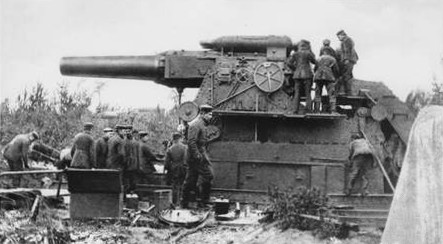
Big Bertha (wiki)
Big Bertha (wiki)

W.J. Astore.  Also featured at Huffington Post.

This August marks the 100th anniversary of the start of World War I. That “Great War” was many things, but it was most certainly a war of machines, of dreadnought battleships and “Big Bertha” artillery, of newfangled airplanes and tortoise-like tanks. Industrial juggernauts like Great Britain, France, and Germany succeeded more or less in mobilizing their economies fully for war; their reward was reaping the horrors of death-dealing machinery on a scale theretofore thought impossible.

In that summer of 1914, most experts expected a short war, so plans for sustaining machine-age warfare through economic mobilization were lacking. Confronted by trench warfare and stalemate on the Western Front which owed everything to modern industrialism and machinery, the “big three” antagonists strove to break that stalemate using the means that had produced it: weapons and munitions. Those empires caught up in the war that were still industrializing, e.g. Russia, Austria-Hungary, the Ottoman Empire, found themselves at a serious disadvantage.

Together, Britain and France forged an industrial alliance that proved (with help from the U.S.) to be a war-winning “arsenal of democracy.” Yet this alliance contributed to an overvaluing of machines and munitions at the soldiers’ expense. For Entente leaders — even for old-school cavalry officers like Britain’s Field Marshal Sir Douglas Haig — new artillery with massive stockpiles of shells promised to produce the elusive breakthrough and a return to mobile warfare and glorious victory.

Thus it was that at the Battle of the Somme that began on July 1, 1916, British soldiers were reduced to trained occupiers. Lengthy pre-battle artillery barrages, it was believed, would annihilate German defenders, leaving British troops to slog uncontested across no-man’s land to occupy the enemy’s shattered and empty trenches.

But those trenches were not empty. Germany’s defenses survived Britain’s storm of steel largely intact. And Britain’s soldiers paid the price of misplaced faith in machine warfare: nearly 20,000 dead on that first day, with a further 40,000 wounded.

The Somme is but one example of British and French commanders being overwhelmed by the conditions of machine warfare, so much so that they placed their faith in more machines and more munitions as the means to victory. After underestimating the impact of technology on the battlefield up to 1914, commanders quickly came to overestimate it. As a result, troops were inadequately trained and tactics inadequately developed.

As commanders consumed vast quantities of machinery and munitions, they became accustomed to expending lives on a similarly profligate scale. Bodies piled up even as more economic means were tapped. Meanwhile, the staggering sacrifices required by destructive industrialism drove nations to inflate strategic ends. Industrialized warfare that spat out lead and steel while consuming flesh and bone served only to inflame political demands, negating opportunities for compromise. Total victory became the only acceptable result for both sides.

In retrospect it’s remarkable how quickly leaders placed their faith in the machinery of war, so much so that military power revved uncontrollably, red-lined, then exploded in the faces of its creators. Industrialized destruction and mass slaughter were the predictable outcomes of a crisis whose resolution was driven by hardware — more weaponry, more machinery, more bodies. The minds of the men who drove events in that war could not sanction negotiation or compromise; those were forms of “weakness” that neither side could accept. Such murderous inflexibility was captured in the postwar observation of novelist Virginia Woolf that “It was a shock to see the faces of our rulers in the light of the shell fire. So ugly they looked — German, English, French — so stupid.” Note how she includes her own countrymen, the English, in the mix of the ugly and the stupid.

In World War I, Carl von Clausewitz’s dictum of war as an extreme form of politics became tragically twisted to war as the only means of politics, with industrialized mass destruction as the only means of war. The resulting failure to negotiate a lasting peace came as no surprise since the war had raced not only beyond politics, but beyond the minds of its military and political leaders.

The Great War had unleashed a virus, a dynamic of destruction, that would only be suppressed, and even then only imperfectly, by the wanton destruction of World War II. For what was Auschwitz but a factory of death, a center for mass destruction, a mechanized and murderous machine for efficient and impersonal slaughter, a culmination of the industrialized slaughter (to include mass gassing) of World War I?

The age of mass warfare and mass destruction was both catalyst for and byproduct of the age of machinery and mass production. Today’s age is less industrial but no less driven by machinery and mass consumption (which requires a form of mass destruction inflicted largely on the environment).

Aerial drones and cyber warfare are already providing disturbing evidence that the early 21st century may yet echo its predecessor in introducing yet another age of misplaced faith in the machinery of warfare. The commonality remains the vulnerability of human flesh to steel, as well as human minds to manipulation.

A century has passed, yet we’re still placing far too much faith in the machinery of war.

A New Thirty Years’ War in the Middle East?

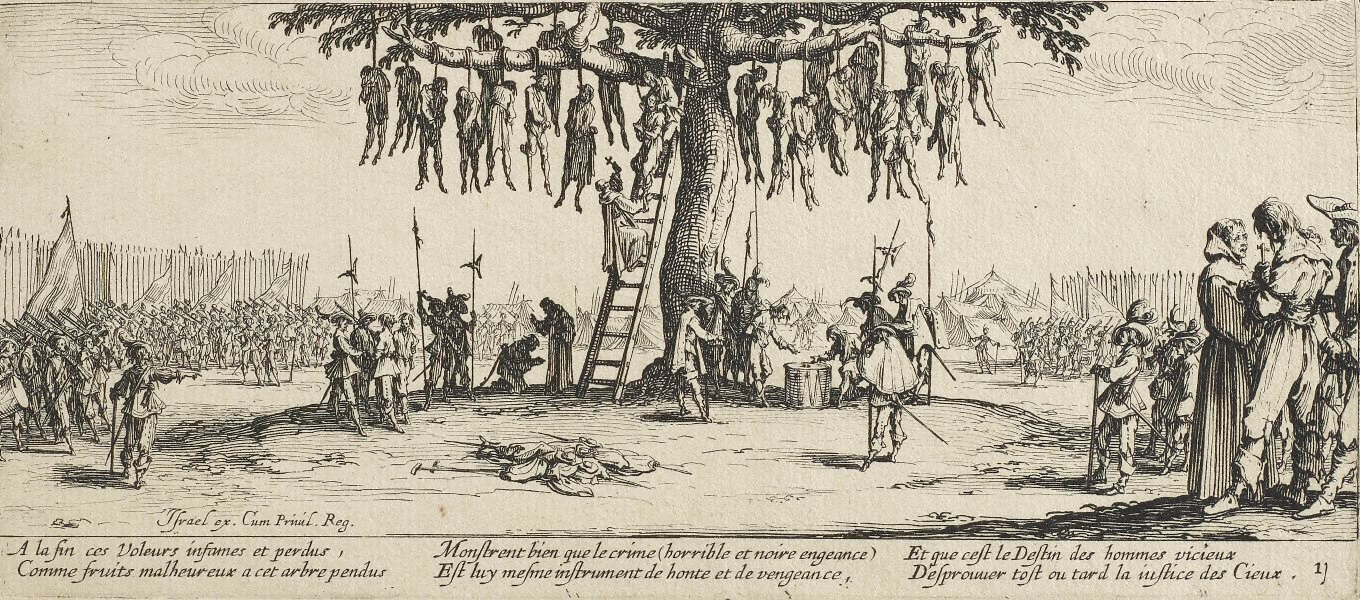
Jacques Callot captured the miseries of the Thirty Years' War.  Here we see a mass hanging
Jacques Callot captured the miseries of the Thirty Years’ War. Here we see a mass hanging

W.J. Astore

The Middle East of the early 21st century is looking more and more like the Thirty Years’ War of the early 17th century that tore apart the Germanic states of the Holy Roman Empire.  Religious sectarianism?  In the 17th century, Catholics and Protestants killed each other with gusto.  Disunity?  Yes, within and among the various Germanic states of the Holy Roman Empire.  Great power intervention that made matters far worse?  Yes, Protestant Sweden and Catholic France intervened in a big way, among a host of other lesser powers. Privatized, for-profit militaries that threw more fuel on the fire?  Yes, Albrecht von Wallenstein, the greatest mercenary captain of the age, created his own empire until he was assassinated in 1634.

The war finally ended when it burnt itself out, and when European leaders realized the more they intervened, the more they risked the infection spreading to their own kingdoms.  Thus came the Peace of Westphalia in 1648, but not before roughly eight million people, most of them civilians, died in and of the war.

When will conflicts in the Middle East finally burn themselves out?  In 2048?  When the oil is finally gone? (Sadly, water may replace oil as a major source of conflict.)

And when will great powers like the United States realize the more they intervene, the more the infection spreads elsewhere?  Indeed, the more it comes home to endanger the United States?

Speaking of 30 years, when did the war for the greater Middle East truly begin?  With the Iraq-Iran war of the 1980s?  The creation of Israel in 1948?  The end of World War I and the breakup of the Ottoman Empire in 1918?  Biblical times?

The Thirty Years’ War worked to delay German unification until 1871, after which Germany, late to European power politics, decided to rattle its saber for a bigger seat at the table.  World War I was the result.

What will be the long-term effects of constant warfare in the Middle East?  Impossible to see, perhaps, but the short-term ones are before our eyes: more instability ahead, more innocents dead, more hatred spread.

The time is now to put a stop to the killing.

David versus Goliath in the Middle East

david and goliath_aaron wolpert

W.J. Astore

When I was a kid, I was a big admirer of Israel.  I saw Israel as being surrounded by implacable enemies bent on its destruction.  Israel was the plucky underdog, David against Goliath, with Goliath being Arab countries like Egypt and Syria, having militaries trained and equipped by the Soviet Union, sworn enemy of the U.S. during the Cold War (or so my ten-year-old mind saw it).  I recall keeping a scrapbook of articles on the Yom Kippur War of 1973.  I cheered the Israeli “blitzkrieg” (What an odd term for a daring Jewish armored attack!) that crossed the Suez Canal and isolated the Egyptian Third Army, as well as the Israeli riposte on the Golan Heights against Syria.

That was 1973.  Forty-one years later, Israel is engaged in yet another assault on Gaza and the Palestinians.  Compared to the Israeli Defense Forces (IDF), the Palestinian militants are undergunned and hopelessly outclassed.  Organizations like Hamas rely on the traditional tactics of terrorists (or freedom-fighters, choose your loaded word): hit-and-run raids, random attacks (unguided rockets), war in the shadows (or in the tunnels).  Who is David and who is Goliath now?

What hasn’t changed, of course, is the mainstream media in the U.S., which cheers the Israelis while condemning Hamas and any other Palestinians who choose resistance instead of compliance.  Watching a snippet of CNN, I witnessed Wolf Blitzer, who poses as a disinterested journalist, demanding from his Palestinian interviewee an immediate stoppage in rocket attacks.  Blitzer had nothing critical to say of Israeli air raids or the disproportionate casualties suffered by the Palestinians in this latest skirmish in a very long war.

What can be done?  As one of my historian friends put it, the Middle East has “a massive legacy of entropy.”  All I know is that more bloodshed, and more innocents killed, like those four young boys playing soccer on the beach, only adds to that entropy — and the legacy of hatred.

Perhaps one thing I’ve learned in four decades is that negotiations in good faith can’t occur when either side sees itself as a heroic David fighting against a glowering Goliath.  Until Israelis and Palestinians see each other as fellow human beings, as equals rather than as monsters, wars will continue, innocents will suffer, and hopes will be left in the dust, slayed like so many Goliaths by self-anointed Davids.

Global Reach, Global Power, Has Deep Roots in America’s Past

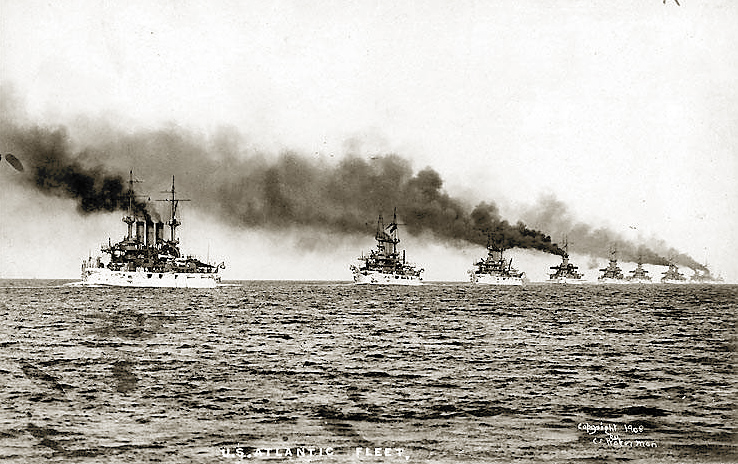
Mahan's vision attained: The U.S. Atlantic Fleet in 1907
Mahan’s vision attained: The U.S. Atlantic Fleet in 1907

W.J. Astore

The U.S. military today openly boasts of global reach, global power.  Full spectrum dominance is the goal, with that spectrum encompassing land, sea, and air operations, but also extending to space (“the shining stars, and beyond,” one Air Force advertisement claimed) and cyberspace.

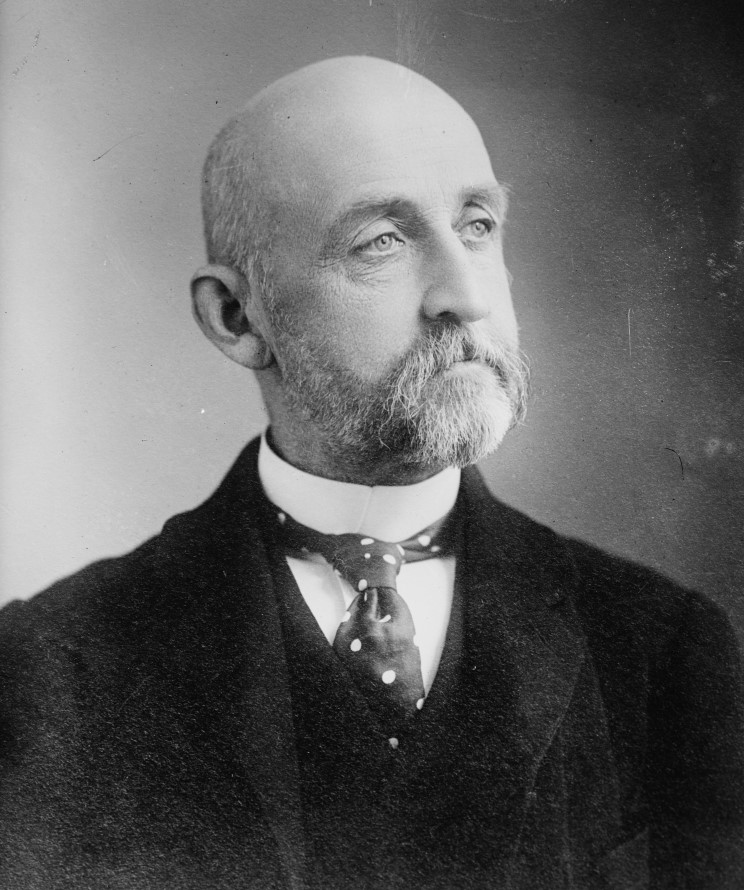
The desire for global dominance has deep roots in American strategic thought.  In American strategic circles the foremost proponent of this vision was Alfred Thayer Mahan.  More than a century ago, Mahan promoted a vision of American dominance achieved through naval power, in those days big-gunned battleships.  Mahan believed America was the successor to England and was destined to build a great empire.

Mahan’s imperial vision was occasionally superseded by American tendencies toward isolationism, in which case the U.S. Navy sold its fleet as America’s best defender.  (This is also how early airpower proponents sold bombers in the 1920s; even though airpower enthusiasts embraced the offensive, they could spin on a dime to promote bombers as being more cost effective than naval ships and army coastal artillery in defending America’s coasts when isolationism held sway.)

Today’s U.S. military is inherently Mahanian.  Even though most Americans think of our military as defensive (after all, it’s advertised as the Department of Defense), our military is obviously structured to take the fight to the enemy. America’s “warriors” are forever leaning forward in the foxhole, forever on alert, forever ready for the next exercise in global reach, global power.

Alfred Thayer Mahan, prophet of global reach, global power

In part, we can thank Mahan and England’s boisterous imperialism for this.  What follows is an essay I wrote in 1992 for a Strategic Studies Seminar.  Perhaps it’s still worth reading, at least as a precis on how we became a country that openly sought (and brazenly exercised) global power.  It all started with Mahan and the navy, today’s “global force for good.”

Alfred Thayer Mahan, Julian Corbett, and Naval Strategy before World War I (Written in 1992)

W.J. Astore

Prior to World War I, an uncritical demand for naval power, or Navalism, led to the greatest warship building boom in history. Nations built great battle fleets to help establish and protect colonial empires whether they could afford them or not. As Chancellor Bulow of Germany declared, “The question is not whether we want to colonize or not, but that we must
colonize, whether we want it or not.”

The rapid growth of England’s empire provided the justification for Navalism. In 1800 the British Empire had 20 million subjects, spread over 1.5 million square miles. In 1900 she had 390 million subjects, spread over 11 million square miles. Explaining England’s success was one mission of Captain Alfred Thayer Mahan, United States Navy (USN). In his Influence of Sea Power Upon History, 1660-1783, published in 1890, Mahan plainly stated England dominated the world because of her holy naval trinity of merchant shipping, colonies, and, most importantly, her navy. He observed “a country’s power and influence must depend upon her hold upon regions without her own borders, and to which the sea leads. The influence of the little British islands gives a lesson our people will surely learn.” Mahan’s primary purpose in Influence was rhetorical: to persuade Americans that a large USN built around battleships was essential for their wealth and security, and to move them to support, with their votes and purses, such a navy.

This rhetorical subtext drove Mahan’s writings on naval strategy. Of the three traditional naval strategies — superior fleet, fleet in being, guerre de course — Mahan heaped scorn on the latter two while brazenly proclaiming the superiority of the former. “It is not the taking of individual ships or convoys…that strikes down the money power of a nation,” Mahan observed; “it is the possession of that overbearing power on the sea which drives the enemy’s flag from it, or allows it to appear only as a fugitive; and which, by controlling the great common, closes the highways by which commerce moves… This overbearing power can only be exercised by great navies.”

Mahan further drove home his lesson that superior fleets bring command of the sea and its subsequent benefits of national growth, prosperity, and security by using examples from history. He warned Americans they were “being led, by a like [that is, like France’s] redundancy of home wealth, into the same neglect of that great instrument [a navy].” France’s “false policy of continental extension swallowed up the resources of the country,” asserted Mahan, “expos[ing] the greatest source of [her] wealth [commerce and colonies] to be cut off, as in fact happened.” The one instance the French got it right was during the American Revolution. The French rebuilt their navy and got temporary control of the seas, partly due to blunders by the Royal Navy. To support his call for a larger USN, Mahan cleverly quoted George Washington on the decisive role the revitalized French fleet played at Yorktown.

To understand Mahan’s fixation on the superior fleet strategy, we need to study the distinctly American context in which he wrote. Mark Shulman showed in The Journal of Military History that there was an influential movement in America in the 1880s to reinterpret the War of 1812 between the United States and England. This movement played up the role of the USN at the expense of the Army, and emphasized the need for a powerful navy to protect America and to project American power abroad. Theodore Roosevelt’s The Naval War of 1812, published in 1882, was a prime example of the revisionist literature of this group. Mahan’s book is only the best known polemic of an American Navalist movement which sought to revitalize a USN struggling through fifteen years of post-bellum neglect.

Neglect there was. Elting Morison, a leading naval historian, has said that for about twenty years after the Civil War, “In [US naval] strategy the highest thought was that you existed to protect the coastline. You went out on station if there was a war and waited for the enemy to come to you. You then went close to her and at very short ranges either boarded or rammed or poured broadsides into her.” Mahan would have agreed with Morison; in his words, there was no formulated naval policy after the Civil War, only “apathetic drift,” a period of “decadence.” And while some pointed to the stunning successes won by the USN pursuing guerre de course in the War of 1812 as a possible future strategy, Mahan stressed our dismal failure to command the seas, which allowed the nasty Britons to burn our capital, stop our commerce, and threaten our national existence.

Mahan’s vision was a USN that would at least rival the Royal Navy. He thus unashamedly simplified naval strategy to mean battleship building, as when he stated “Naval strategy has indeed for its end to found, support, and increase, as well in peace as in war, the sea power of a country.” The USN needed to grow, and a superior fleet strategy provided the most room for the USN’s future growth.

Mahan turned to Jomini when he dealt with the specifics of naval strategy. He quoted with approval Jomini’s definition of strategy as deciding where to act. Under “strategy” he listed such issues as the selection of the theater of war, the paramount importance of securing lines of communication, the role of military ports, and the choice of the objective and how to achieve it. Like Jomini, he stressed the geometry of strategy and the value of concentration, warning the USN must never divide the fleet into Atlantic and Pacific squadrons.

Mahan helped speed-up naval modernization in the US, and his efforts appeared justified by the Spanish-American War of 1898. But Mahan’s influence went far beyond American shores, and for several reasons. First, Mahan, imitating Jomini, searched for scientific or timeless principles of naval warfare. His Influence is a practical handbook enlivened by history, not a Hegelian tome obscured by dialectic like Clausewitz’s On War. Second, Mahan writes well. I hesitate to quote once again his melodramatic depiction of Nelson’s navy, “those far-distant, storm-beaten ships, upon which Napoleon’s soldiers never looked, [that] stood between them and the conquest of the world.” Nonetheless, it is worth quoting to demonstrate Mahan’s popular appeal. One can’t imagine Kaiser Wilhelm committing every word of Clausewitz to memory, good Prussian though he was. Third, and perhaps most importantly, Mahan wrote the perfect book for the time. England had already voted for the Two Power Standard in 1889, which Mahan’s book seemed to verify as wise. His most attentive audience, however, was in Germany, where the Kaiser and Admiral Tirpitz seized upon his work to justify their naval buildup in pursuit of Germany’s place in the sun and world-power status.

Mahan’s drawbacks are well-known and many: he overestimated the decisiveness of navies in warfare, subordinating history to his “artistic” (as he termed it) vision of a powerful USN ruling the seas, and he almost completely ignored land-sea cooperation. Although he paid homage to the political dimensions of war, he preached almost exclusively that “victory goes to the side with the bigger fleets,” in effect reducing naval strategy to naval shipbuilding.

While it is true Mahan neglected such traditional naval functions as amphibious operations, he probably did so so as to not water down his argument for a powerful, blue water navy. His heavy-handed dismissal of guerre de course and fleet-in-being as viable strategies can be seen in a similar light. With respect to the former, Mahan admitted the importance of commerce raiding as a secondary naval operation, but he stressed “the great object of naval warfare” was first to get command of the sea through decisive fleet actions. The side commanding the seas, Mahan predicted, could severely restrict an enemy’s commerce-raiders (mostly cruisers at this time) by capturing their coaling stations. He did not foresee the rise of submarines as commerce-raiders, but this is hardly surprising, given the primitive state
of submarine technology. He did remark, based on second-hand knowledge of the Russo-Japanese War, that submarines, because they lay so low in the water, had a limited horizon and thus had difficulty locating ships.

He also criticized the fleet-in-being strategy, saying its utility had “been much overstated” and that the superior fleet would always sink or otherwise neutralize the inferior. Events in the Russo-Japanese War seemed to support his ideas. The Russian fleet in being at Port Arthur proved of little value, Mahan wrote, and the Japanese simply “masked” it by blockade. He did observe that if one was stuck with an inferior fleet, the proper strategy was to divide the enemy’s superior fleet by some tactic, then crush it in detail. He termed this the “defensive-offensive,” and here he spoke highly of the Dutch Admiral De Ruyter’s efforts against the Royal Navy during the Anglo-Dutch wars of the 17th century.

Mahan exerted a powerful influence over naval strategy in the United States, Japan, and Germany. In America, the USN became a top-heavy force of mainly battleships, serving as the nation’s “first line of defense.” Mahan’s dictum of “Never divide the fleet!” remained gospel up until World War II. In Japan, Mahan’s Influence was adopted as a text in all her naval and military colleges. In Germany, the Kaiser had it translated and boasted that all his naval officers were reading it. But while the United States and Japan prospered by following his teachings, Germany embarked on a dangerous and costly naval arms race with the Royal Navy. In building dreadnoughts to win command of the sea, the Germans created a cold war between themselves and the British while wasting valuable resources that could have been devoted to land warfare.

It is within the context of an England threatened by Germany’s naval program that we need to place Julian Corbett and his book Some Principles of Maritime Strategy, published in 1911. Two obvious differences — the time and the country in which he’s writing — separate his work from Mahan’s. Corbett had little need to convince his fellow Britons of the importance of a navy, nor did he need or want to win over a world audience already enthralled by Mahan. War loomed, and Corbett wanted to ensure the Royal Navy had given the matter some thought. His book is a sophisticated reading of Clausewitz and how the Prussian’s ideas can be applied to naval warfare.

Sir Julian Corbett
Sir Julian Corbett

Corbett, who taught naval history at the Royal Navy college at Greenwich, defined maritime strategy as the mutual relations of navy and army in a plan for war. War itself he defined in Clausewitzian terms as the continuation of policy by other means. Corbett’s strategic theory is more modern sounding than Mahan’s precisely because of his use of Clausewitz, but also because he believed that through close cooperation, armies and navies could produce a synergistic effect. While he should be applauded for his lack of service parochialism, Corbett was reasserting the critical role the navy played in strategy at a time when the British Army was controlling the terms of strategic debate in England.

Corbett defined naval strategy in relation to maritime strategy. Naval strategy was the movement and actions of the fleet which best advanced the maritime strategy. While this might involve attacking the enemy fleet and gaining command of the seas, it might also involve amphibious operations. The strategy adopted would depend on the circumstances of the conflict. Reading the circumstances and taking the proper actions, Corbett believed, were skills enhanced by the study of history and strategic theory. Most commonly, gaining command of the sea was the primary object of naval warfare. Once command was gained, either through battle or blockade, one could then control the all-important lines of communication or trade routes. Command was best gained by battleships, whereas control was best exercised by cruisers which could protect one’s own trade while interdicting the enemy’s.

Corbett’s distinction between gaining command of the sea and exercising that command was crucial to his thinking. His approach to naval strategy was thoughtful and descriptive, rather than prescriptive. He recognized a fleet-in-being could dispute control of local communication lines and prevent a superior fleet from gaining positive results, as the German High Seas fleet did to some extent during World War I. Like Mahan, though, he rejected guerre de course as a viable strategy. Commerce raiders would have limited range, and he thought improvements in technology such as wireless radios favored the defense. He saw submarines working in concert with fleets-in-being to threaten superior fleets, but he overlooked their potential as commerce raiders.

Keeping the German fleet firmly in mind, Corbett cautioned the Royal Navy and the Fisher school against reckless attacks to obtain an immediate decision by fleet action. If the Germans refused to sail, Corbett recommended a blockade, distinguishing between its naval and commercial functions. Through a blockade, which most likely had to be “open” or “loose” because new technologies such as torpedoes made close blockades too risky, the Royal Navy could prevent the Germans from putting to sea, thereby effectively gaining command of the sea. With command won, the navy would mount a commercial blockade to control trade. The ultimate target was Germany’s will and her finances. This is essentially the strategy the Grand Fleet and Admirals Jellicoe and Beatty followed against Germany during the Great War. It was exhausting sea duty lacking in glory, but it worked.

To conclude, Mahan charted the dimensions of naval strategy, while Corbett plumbed its depths. Both of their strategies must be understood in their context. Mahan developed a strategy for a navy adrift and in need of ideas. At a time when strategic naval thought was arguably neglected in England, Corbett forced his navy to think more deeply about their rich tradition and come up with strategies which fit the crisis at hand. Both men repay reading, although Corbett, like his mentor Clausewitz, is more thought-provoking.

World War I, the Death of Chivalry, and the False End of War

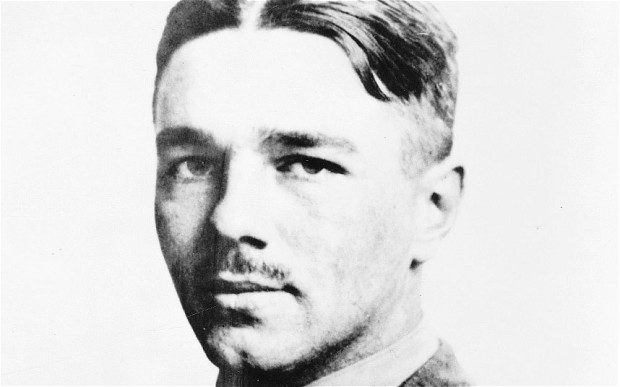
Wilfred Owen
Wilfred Owen

W.J. Astore

This summer marks the 100th anniversary of World War I.  Today in my daily “alert” from The New York Times, there are five articles related to the war.  Steven Erlanger writes about how the war brought fundamental changes to the world; Jim Yardley writes about the Yanks in the Second Battle of the Marne in 1918; Alison Smale recounts the costs of German militarism, then and today; John F. Burns raises the specter of Gavrilo Princip’s assassination (on June 28th, 1914) of the Archduke Franz Ferdinand and its legacies in the Balkans and specifically in Bosnia; and Tim Arango recaptures the Gallipoli Campaign of 1915 and how it forged national identities among the Turks and Australians.

An immensely destructive war, World War I saw the full application of mass production and the machine age applied to warfare.  Mass production enabled mass mobilization as well as mass destruction; the machine age enabled the machine gun and automated death on such a massive scale that bodies were collected in ossuaries, boneyards of doomed youth.

Four decades ago, Paul Fussell famously captured the loss of idealism that accompanied mass death on an industrial scale in his book The Great War and Modern Memory (1975).  As Fussell noted in a separate essay on “The Fate of Chivalry,” idealistic codes of chivalry, popular in the Victorian age, became “ludicrously inappropriate” in World War I, defeated entirely by “poison gas, zeppelin raids on civilians, the machine gun, and unrestricted submarine warfare, not to mention such very unchivalric experiences as soldiers’ passively trembling under artillery shelling hour after hour or soiling their trousers for weeks with acute dysentery (sometimes requiring the cutting of large holes in the rear of their clothing), or milking down their penises monthly before the eyes of bored and contemptuous medical officers alert for unreported gonorrheal discharges.”

Wilfred Owen, a British officer and war poet, condemned the “old lie” of Horace, Dulce et decorum est pro patria mori (Sweet and fitting it is to die for one’s country), in his famous poem, which concludes:

If you could hear, at every jolt, the blood
Come gargling from the froth-corrupted lungs,
Obscene as cancer, bitter as the cud
Of vile, incurable sores on innocent tongues,
My friend, you would not tell with such high zest
To children ardent for some desperate glory,
The old Lie; Dulce et Decorum est
Pro patria mori.

Amazingly, the ideal of military service and war as ennobling, even liberating, survived World War I and is thriving today, most notably in the United States.  The “doomed youth” of World War I, marching off to mass death, have become the universal heroes of the American moment, to be sent to places like Iraq as liberators.

We would do well to recall that World War I, a “war to end all wars,” has led only to new wars, with today’s unrest in the Middle East connected to the fall of the Ottoman Empire in 1918 and conflicting agreements made at the time by manipulative power players like Great Britain and France.

Once again, at least in the United States, the cry is for more military action in the Middle East – more killing – as a solution to complex political, social, economic, and religious problems.  Those who are most strident in sending in more bombs, if not more troops, are usually those “donkeys” who are well past military age themselves, and most concerned about appearing tough and decisive.  Great believers in the utility of war, they seem to have no regard for the big lesson of World War I: the utter unpredictability as well as the horrifying destructiveness of modern, machine-age war.

All sides marched to war in the summer of 1914 looking ahead to decisive victories.  The fighting was supposed to be over by Christmas, and it was: well, not 1914, but 1918.  The result?  Four empires in ruin, ten million dead, and legacies of massive destruction and revolutionary change that we’re still coming to grips with.

And yet despite all this there are still those who call for more weapons and more war.  In the U.S. they are held up as serious and respectable statesmen.  Yet they are merely old men propagating old lies.

If they are so ardent for some desperate glory, let them take up the lance and charge forth in foreign fields.  Until they do, let’s hear no talk of more weapons and more war.

Uncle Sam Doesn’t Want You — He Already Has You

Uncle Sam wants us.  But who, exactly, is Uncle Sam?
Uncle Sam — He Already Has Us

The Militarized Realities of Fortress America

By William J. Astore (Featured at TomDispatch.com)

I spent four college years in the Reserve Officers’ Training Corps (ROTC) and then served 20 years in the U.S. Air Force.  In the military, especially in basic training, you have no privacy.  The government owns you.  You’re “government issue,” just another G.I., a number on a dogtag that has your blood type and religion in case you need a transfusion or last rites.  You get used to it.  That sacrifice of individual privacy and personal autonomy is the price you pay for joining the military.  Heck, I got a good career and a pension out of it, so don’t cry for me, America.

But this country has changed a lot since I joined ROTC in 1981, was fingerprinted, typed for blood, and otherwise poked and prodded. (I needed a medical waiver for myopia.)  Nowadays, in Fortress America, every one of us is, in some sense, government issue in a surveillance state gone mad.

Unlike the recruiting poster of old, Uncle Sam doesn’t want you anymore — he already has you.  You’ve been drafted into the American national security state.  That much is evident from Edward Snowden’s revelations. Your email?  It can be read.  Your phone calls?  Metadata about them is being gathered.  Your smartphone?  It’s a perfect tracking device if the government needs to find you.  Your computer?  Hackable and trackable.  Your server?  It’s at their service, not yours.

Many of the college students I’ve taught recently take such a loss of privacyfor granted.  They have no idea what’s gone missing from their lives and so don’t value what they’ve lost or, if they fret about it at all, console themselves with magical thinking — incantations like “I’ve done nothing wrong, so I’ve got nothing to hide.”  They have little sense of how capricious governments can be about the definition of “wrong.”

Consider us all recruits, more or less, in the new version of Fortress America, of an ever more militarized, securitized country.  Renting a movie?  Why not opt for the first Captain America and watch him vanquish the Nazis yet again, a reminder of the last war we truly won?  Did you head for a baseball park on Memorial Day?  What could be more American or more innocent?  So I hope you paid no attention to all those camouflaged caps and uniforms your favorite players were wearing in just another of an endless stream of tributes to our troops and veterans.

Let’s hear no whining about militarized uniforms on America’s playing fields.  After all, don’t you know that America’s real pastime these last years has been war and lots of it?

Be a Good Trooper

Think of the irony.  The Vietnam War generated an unruly citizen’s army that reflected an unruly and increasingly rebellious citizenry.  That proved more than the U.S. military and our ruling elites could take.  So President Nixon ended the draft in 1973 and made America’s citizen-soldier ideal, an ideal that had persisted for two centuries, a thing of the past.  The “all-volunteer military,” the professionals, were recruited or otherwise enticed to do the job for us.  No muss, no fuss, and it’s been that way ever since. Plenty of war, but no need to be a “warrior,” unless you sign on the dotted line.  It’s the new American way.

But it turned out that there was a fair amount of fine print in the agreement that freed Americans from those involuntary military obligations.  Part of the bargain was to “support the pros” (or rather “our troops”) unstintingly and the rest involved being pacified, keeping your peace, being a happy warrior in the new national security state that, particularly in the wake of 9/11, grew to enormous proportions on the taxpayer dollar.  Whether you like it or not, you’ve been drafted into that role, so join the line of recruits and take your proper place in the garrison state.

If you’re bold, gaze out across the increasingly fortified and monitoredborders we share with Canada and Mexico.  (Remember when you could cross those borders with no hassle, not even a passport or ID card?  I do.)  Watch for those drones, home from the wars and already hovering in or soon to arrive in your local skies — ostensibly to fight crime.  Pay due respect to your increasingly up-armored police forces with their automatic weapons, their special SWAT teams, and their converted MRAPs (mine-resistant ambush protected vehicles).  These vintage Iraqi Freedom vehicles are now military surplus given away or sold on the cheap to local police departments.  Be careful to observe their draconian orders for prison-like “lockdowns” of your neighborhood or city, essentially temporary declarations of martial law, all for your safety and security.

Be a good trooper and do what you’re told.  Stay out of public areas when you’re ordered to do so.  Learn to salute smartly.  (It’s one of the first lessons I was taught as a military recruit.)  No, not that middle-finger salute, you aging hippie.  Render a proper one to those in authority.  You had best learn how.

Or perhaps you don’t even have to, since so much that we now do automatically is structured to render that salute for us.  Repeated singings of “God Bless America” at sporting events.  Repeated viewings of movies that glorify the military.  (Special Operations forces are a hot topic in American multiplexes these days from Act of Valor to Lone Survivor.)  Why not answer the call of duty by playing militarized video games like Call of Duty?  Indeed, when you do think of war, be sure to treat it as a sport, a movie, a game.

Surging in America 

I’ve been out of the military for nearly a decade, and yet I feel more militarized today than when I wore a uniform.  That feeling first came over me in 2007, during what was called the “Iraqi surge” — the sending of another 30,000 U.S. troops into the quagmire that was our occupation of that country. It prompted my first article for TomDispatch.  I was appalled by the way our civilian commander-in-chief, George W. Bush, hid behind the beribboned chest of his appointed surge commander, General David Petraeus, to justify his administration’s devolving war of choice in Iraq.  It seemed like the eerie visual equivalent of turning traditional American military-civilian relationships upside down, of a president who had gone over to the military.  And it worked.  A cowed Congress meekly submitted to “King David” Petraeus and rushed to cheer his testimony in support of further American escalation in Iraq.

Since then, it’s become a sartorial necessity for our presidents to donmilitary flight jackets whenever they address our “warfighters” as a sign both of their “support” and of the militarization of the imperial presidency.  (For comparison, try to imagine Matthew Brady taking a photo of “honest Abe” in the Civil War equivalent of a flight jacket!)  It is now de rigueur for presidents to praise American troops as “the finest military in world history” or, as President Obama typically said to NBC’s Brian Williams in aninterview from Normandy last week, “the greatest military in the world.”  Even more hyperbolically, these same troops are celebrated across the country in the most vocal way possible as hardened “warriors” andbenevolent freedom-bringers, simultaneously the goodest and the baddest of anyone on the planet — and all without including any of the ugly, as in the ugliness of war and killing.  Perhaps that explains why I’ve seen military recruitment vans (sporting video game consoles) at the Little League World Series in Williamsport, Pennsylvania.  Given that military service is so beneficent, why not get the country’s 12-year-old prospects hopped up on the prospect of joining the ranks?

Too few Americans see any problems in any of this, which shouldn’t surprise us.  After all, they’re already recruits themselves.  And if the prospect of all this does appall you, you can’t even burn your draft card in protest, so better to salute smartly and obey.  A good conduct medal will undoubtedly be coming your way soon.

It wasn’t always so.  I remember walking the streets of Worcester, Massachusetts, in my freshly pressed ROTC uniform in 1981.  It was just six years after the Vietnam War ended in defeat and antiwar movies likeComing Home, The Deer Hunter, and Apocalypse Now were still fresh in people’s minds.  (First Blood and the Rambo “stab-in-the-back” myth wouldn’t come along for another year.)  I was aware of people looking at me not with hostility, but with a certain indifference mixed occasionally with barely disguised disdain.  It bothered me slightly, but even then I knew that a healthy distrust of large standing militaries was in the American grain.

No longer.  Today, service members, when appearing in uniform, are universally applauded and repetitiously lauded as heroes.

I’m not saying we should treat our troops with disdain, but as our history has shown us, genuflecting before them is not a healthy sign of respect.  Consider it a sign as well that we really are all government issue now.

Shedding a Militarized Mindset

If you think that’s an exaggeration, consider an old military officer’s manual I still have in my possession.  It’s vintage 1950, approved by that great American, General George C. Marshall, Jr., the man most responsible for our country’s victory in World War II.  It began with this reminder to the newly commissioned officer: “[O]n becoming an officer a man does not renounce any part of his fundamental character as an American citizen.  He has simply signed on for the post-graduate course where one learns how to exercise authority in accordance with the spirit of liberty.”  That may not be an easy thing to do, but the manual’s aim was to highlight the salutary tension between military authority and personal liberty that was the essence of the old citizen’s army.

It also reminded new officers that they were trustees of America’s liberty, quoting an unnamed admiral’s words on the subject: “The American philosophy places the individual above the state.  It distrusts personal power and coercion.  It denies the existence of indispensable men.  It asserts the supremacy of principle.”

Those words were a sound antidote to government-issue authoritarianism and militarism — and they still are.  Together we all need to do our bit, not as G.I. Joes and Janes, but as Citizen Joes and Janes, to put personal liberty and constitutional principles first.  In the spirit of Ronald Reagan, who toldSoviet leader Mikhail Gorbachev to “tear down this [Berlin] wall,” isn’t it time to begin to tear down the walls of Fortress America and shed our militarized mindsets?  Future generations of citizens will thank us, if we have the courage to do so.

William J. Astore, a retired lieutenant colonel (USAF) and TomDispatch regular, edits the blog The Contrary Perspective.

Follow TomDispatch on Twitter and join us on Facebook and Tumblr. Check out the newest Dispatch Book, Rebecca Solnit’s Men Explain Things to Me.

Copyright 2014 William J. Astore

The Best Air Raid Ever

vonnegut

W.J. Astore

I finally had a chance to read Kurt Vonnegut’s classic book, Slaughter-House Five, based upon his experiences in World War II as a POW who survived the firebombing of Dresden in 1945.

I grew up on war stories featuring air raids by the German Luftwaffe as well as the Allied combined bombing offensive of World War II. Favorite paperbacks that I read include Cajus Bekker’s The Luftwaffe War Diaries, Adolf Galland’s The First and the Last, and Big Week by Bill Yenne (about the week in February 1944 when the Allies turned the tide of the air campaign against the Luftwaffe in the skies over Germany).  All of these books had one thing in common: they were written from the perspective of the air crews, not from the perspective of those on the receiving end of bombs and bullets and fire.  As such, they read like adventure stories, at least to my excitable teenage mind.

Kurt Vonnegut gave us a different perspective in Slaughter-House Five: at the ground level, during and after the firestorm that destroyed Dresden in February 1945, one year after the Allies had allegedly turned the tide and “won” the air battle during Big Week.  The moon scape that Vonnegut encountered after leaving his shelter was evidence of the perfect firestorm the Allies had created in their bombing raids over Dresden, which combined area bombing at night by Britain’s Royal Air Force (using a mix of high explosive and incendiary bombs) with daylight “precision” bombing by U.S. bomber forces.

But I don’t want to speak about the horrors of that raid.  No need to repeat Vonnegut’s account.  What struck me in reading his book was an imaginary air raid, an air raid that runs backwards.  In Vonnegut’s words:

American planes, full of holes and wounded men and corpses took off backwards from an airfield in England. Over France, a few German fighter planes flew at them backwards, sucked bullets and shell fragments from some of the planes and crewmen. They did the same for wrecked American bombers on the ground, and those planes flew backwards to join the formation.

The formation flew backwards over a German city that was in flames. The bombers opened their bomb bay doors, exerted a miraculous magnetism which shrunk the fires, gathered them into cylindrical steel containers, and lifted the containers into the bellies of the planes. The containers were stored neatly in racks. The Germans below had miraculous devices of their own, which were long steel tubes. They used them to suck more fragments from the crewmen and planes. But there were still a few wounded Americans, though, and some of the bombers were in bad repair. Over France, though, German fighters came up again, made everything and everybody as good as new.

When the bombers got back to their base, the steel cylinders were taken from the racks and shipped back to the United States of America, where factories were operating night and day, dismantling the cylinders, separating the dangerous contents into minerals. Touchingly, it was mainly women who did this work. The minerals were then shipped to specialists in remote areas. It was their business to put them into the ground, to hide them cleverly, so they would never hurt anybody ever again.

There you have it: the best air raid ever, brought to you via the imagination of a great writer who survived one of the worst air raids ever.

I’m not sure Vonnegut’s words would have resonated with my teenage mind, caught as it was in dramatic and deadly duels in the skies over Europe.  As Vonnegut knew, there’s an endless supply of dumb teenagers fantasizing about war.  So it goes.


The Great War: Why the Germans Lost World War I

trench

W.J. Astore

To mark the 100th anniversary of World War I, which began in the summer of 1914, I’m posting this essay, which I wrote as a graduate student in 1992.  I’ve decided not to edit it since I believe my general conclusions remain sound.  Germany may have had the best military during World War I, but that wasn’t enough for the Kaiser and crew to win the war.

Today, the U.S. should learn from Germany’s mistakes, especially since we are as fond in 2014 of boasting about having the world’s greatest military as the Kaiser was of boasting about his a century ago in 1914.

Strategy is the relationship between national means, ends, and will.  Given the results of the Great War, one might question whether any country followed a sound strategy.  As J.F.C. Fuller observed, at war’s end “Britain was bankrupted and France bled white; Russia and Germany were in the throes of revolution; the Austro-Hungarian Empire had vanished; the Ottoman Empire had been dismembered; Italy was distraught; and every other country in Europe was scorched by the fiery blast – an epoch had gone up in flames.”  However, there were – at least in the short term – winners and losers.  The winners prevailed because their strategies were sounder in balancing means and will with ends than those of their opponents.

Strategies at Sea During the Great War

Britain’s strategic ends in 1914 were to maintain the balance of power in Europe and her hold over her Empire.  Her chief means were the ships of the Royal Navy.  A German victory on the continent threatened these ends and means.  A victorious Germany would dominate Europe, and she might build an even larger navy, one which would threaten the Empire or even Britain itself.  With her will fortified by news of Germany’s violation of neutral Belgium, Britain declared war on Germany on 5 August 1914.

At the outset of the war, the Royal Navy gained command of the sea and never lost it.  Enforcing a loose or distant blockade against German merchant shipping, the Royal Navy slowly constricted the economies (the means) of the Central Powers.  Meanwhile, Britain’s command of the sea ensured that supplies, and eventually troops, came safely from her Empire and America.

As elaborated by Admiral Jellicoe, the navy’s strategy was: 1) neutralize any hostile action of the German High Seas Fleet; 2) protect Entente trade, while blockading German trade; 3) protect Great Britain from invasion.  In brief, the navy’s strategic ends were to prevent the German fleet from affecting the war’s course, and through blockade, to erode Germany’s means and will to fight.

The Royal Navy has been criticized for not doing more with its command of the sea, but Jellicoe and Beatty were understandably cautious.  They had the German fleet encircled, and they controlled the choke points to the Atlantic and Mediterranean.  With excellent intelligence of German fleet movements, they stymied German attempts to break-out.  While the Royal Navy might have preferred to fight another Trafalgar, a battle of annihilation between dreadnoughts, they never took risks that threatened naval supremacy in the home waters.  They triumphed by putting political ends first, and by using their means – the superior fleets of the Royal Navy – to erode the economic means of Germany and the will of her people.  Their “indirect approach” contributed significantly to the collapse of the German homefront in October 1918.

In contrast to the British, who balanced naval means with national ends, the Germans wasted their High Seas Fleet.  The wisdom of building such a fleet was questionable to begin with.  Despite Mahan’s warning that it was probably impossible for a land power to divert enough human and material resources to challenge the Royal Navy’s command of the sea, Tirpitz and Kaiser Wilhelm II persisted.  For them, a navy was a way to gain influence and win friends.  They saw their imitation of the Royal Navy as the sincerest form of flattery, but the British were not appreciative.  Germany was living in a fool’s paradise, believing she could have a fleet that rivaled Britain’s without making Britain a rival.

The resulting rivalry polluted German naval strategy.  Expecting the Royal Navy to mount a close blockade or launch a preemptive strike against her bases, the High Seas Fleet sat put and lost the initiative.  Forced to fight with an inferior fleet at Jutland, Scheer tried to steer Jellicoe’s dreadnoughts onto a series of submarine-laid minefields, hoping thereby to destroy the Grand Fleet’s cohesiveness and defeat it in detail.  He failed, and the Germans never broke the blockade which eventually sapped their will.  Surprised that war had been declared, left without a role to play in the Schlieffen Plan due to poor interservice cooperation with the army, the High Seas Fleet was a means whose main end became self-preservation, its only goal being to intimidate Britain during peace negotiations (to be held after the German army won the war on land).

German naval strategy reflected the defects of strategic mirror-imaging.  To challenge the Royal Navy, the German navy believed it had to be just like it. Billions were spent from 1895-1914 on a surface fleet, devouring funding for innovations like the submarine (only 25 seagoing subs were ready for service in August 1914).  In the end, the Germans only drove the British to improve; even worse, by allocating a large percentage of her industrial resources towards naval production, Germany fatally weakened herself on land.  She tried to be a great land and sea power simultaneously, but the only country in history able to afford the exorbitant costs has been the United States during, and perhaps after, World War II.

Another country whose strategic mirror-imaging absorbed scarce resources to little end was the Soviet Union in the 1970s and 1980s.  The Soviet naval push only spurred the US Navy to improve, which surged to 600 ships under John Lehman.  A bankrupt strategic policy led to a bankrupt Soviet economy.  Today, the Soviet aircraft carrier Admiral Kuznetsov sits in drydock, a second big carrier is up for sale, apparently to China or Iran, and a third was scrapped before completion.  According to the London Times (Oct 1992), there are no Russian naval ships presently in the Indian Ocean or the Mediterranean.  Strategy is the art of the possible, not the striving for the impossible.  Before one embarks on an end, one must be able to afford the resources or means to achieve it.  Germany in the 1900s and 1910s, and the Soviet Union in the 1970s and 1980s, embarked on an end they did not need and could not afford.

The bankruptcy of German naval strategy was best shown in 1917 with the decision to resume unrestricted submarine warfare.  The Germans gambled they could wear down the will of Britain before American troops reached the continent.  What they apparently failed to realize, however, was that the very entry of the US into the war would reinforce the will of the Entente Powers.  Meanwhile, Britain muddled through the U-boat crisis and reformed her naval strategy, learning that the defensive was a more effective means of destroying submarines than the offensive, and that destroyers were better used guarding convoys than the Grand Fleet.  The Germans had expected a short war in which navies would scarcely matter.  Caught in the stalemate of the Western Front, she found she couldn’t improvise an effective maritime strategy.

Strategies on Land on the Western Front

Turning to land warfare on the Western Front, and keeping in mind the definition of strategy as relating means, ends, and will, one must first recognize the changing nature of warfare.  The American Civil War marked a revolution in warfare.  Militaries no longer fought solely against other militaries but also waged war against an enemy’s economy and will.  In hindsight, the stalemate on the Western Front owed everything to modern industrialism.  Ironically, in 1914 most Europeans had believed a long war of attrition was impossible because of modern industry.  In Schlieffen’s words:

A nation’s existence depends upon the uninterrupted continuation of trade and industry, and a quick decision is necessary to start the wheels of industry turning again.  A strategy of attrition is impossible when the maintenance of armies of millions requires the expenditure of billions.

What people failed to foresee was, once hundreds of thousands of men were killed in 1914, nations were willing to pay billions and gear their economies for war rather than negotiate from a weak position.  Since the war was one of economic mobilization, those countries with underdeveloped economies, e.g.  Austria-Hungary, had the most trouble fighting it.  Here the alliance system was crucial.  As Paul Kennedy has observed, Britain kept France fighting, France and Britain kept Italy fighting after Caporetto, and Germany kept Austria-Hungary fighting.  Ivan Bloch, the self-made Warsaw banker, turned out to be right: the ultimate decision was in the hands of starvation of home populations.  The Central Powers starved first.

This fate was by no means obvious, however.  Until the middle of 1918, the Central Powers appeared to be winning the war.  Despite fundamental strategic flaws, Germany, with Austria-Hungary marching reluctantly behind, broke Russia, threw the French army into mutiny, and sowed despair in England.  Germany’s tactical and operational brilliance, however, could not conceal, and in fact contributed to, an underlying strategic rot.

This rot was revealed in the words of the Kaiser.  “The soldiers and the army, not parliamentary majorities and decisions, have welded the German Empire together,” Wilhelm declared. “I put my trust in the army.” But the army, beginning with von Moltke the Elder, had subordinated grand strategy to operational art.  Reinforced by Schlieffen, this trend reached the height of military absurdity under Ludendorff in 1918, when victory on the battlefield became the means and end of Germany’s strategy, as well as the balm which would restore the flagging will of Germany, Austria-Hungary, even Turkey!  In the Great War, Germany experienced a fundamental breakdown in civil-military relationships.  With the military determining policy, Clausewitz’s dictum that war as a form of politics became tragically twisted to war as the only form of politics.

This debasement of politics was not complete until 1917.  By Christmas 1914, Germany realized her strategic nightmare had come true: a two-front war of attrition loomed.  Adopting a defensive stance in the West, Falkenhayn sought victory in the East, nearly achieving a knockout blow against Russia at Gorlice-Tarnow in May 1915.  With Bethmann-Hollweg, Falkenhayn hoped to translate a limited military victory in the East into a political settlement with Russia.  Frederick the Great had institutionalized this concept of fighting limited wars for definite political ends.  However, despite her losses on the battlefield, Russia failed to see the wisdom of negotiations.  Despite criticism by Hindenburg and Ludendorff that he had failed to grasp the total military victory in the East that was still within reach, Falkenhayn turned to the West and Verdun in 1916.

Falkenhayn’s strategic concept for Verdun was simple: by attacking French national pride at Verdun, he would force them to bleed themselves dry in counterattacks.  Britain would then be compelled, before her new armies were ready, to come to the aid of France, exposing herself to decisive German counterattacks.  Falkenhayn made two errors here.  First, and most importantly, he did not coordinate his strategy with Hotzendorff’s in Austria-Hungary.  As a result, the Central Powers lost their advantage of interior lines and their chance to defeat Russia in 1916.  Second, Falkenhayn failed to explain his strategy to his subordinates.  His desire to avoid casualties and unnecessary sacrifice was subverted once Germany’s national pride was inflamed.  Expecting a loss ratio of 2.5:1 in his favor, the actual ratio was a grim 1.075:1.

Verdun was the Great War’s equivalent to Kursk in World War II.  While the Germans gave better than they got, it was they who could least afford the price.  Like the Soviets in 1943, the French had learned.  Petain refused to waste his troops in poorly planned attacks, preferring to rely on artillery and firepower rather than elan to retake ground.  In the end, Falkenhayn failed to enforce his will on the Entente.  He did not force Britain to launch an offensive prematurely, and Russia surprised him by launching the Brusilov offensive in Galicia.  For his failure, Falkenhayn was sacked and Ludendorff effectively assumed command of the German war effort.

1917 was a banner year for the German war effort.  In the West, the Germans wisely retreated to the Siegfried Line, shortening their front and creating a defensive barrier which withstood Nivelle’s disastrous offensives and Haig’s bullheaded assaults at Third Ypres.  With Russia in chaos, Ludendorff could finally concentrate all his resources on the Western Front for the “Victory Offensive” in 1918.

Here again, however, German strategy failed to relate means to ends.  Ludendorff simply didn’t have the means in 1918 to conduct a decisive offensive in the West, and his end was unclear even to himself.  All will be solved once we pierce a hole, he stated.  Attacking along the seam separating the British and French armies, the Germans failed to exploit their initial successes due to Ludendorff’s vague and shifting strategic aims and shortages of manpower and transport.  Like Napoleon in 1815, Ludendorff desperately committed his superbly trained troops one last time.   But like Napoleon, the coalition arrayed against him was too powerful.  Primacy in operational art was not enough to overcome economic blockade and the bigger battalions of fresh troops arriving daily from the Empire and the US.  Shattered by the Entente’s counteroffensive at Amiens on 8 August 1918, and faced with national starvation, the German homefront collapsed.

Why the Entente Won — And Germany Lost

The Entente had won.  But was this due to superior strategy?  Clearly, the Entente suffered some of the same strategic shortcomings as the Central Powers: a breakdown in military-civil relations, with the military reigning supreme; a cult of the offensive as the ultimate arbiter of war; and a lack of contingency planning.  Moreover, the Entente achieved a level of tactical proficiency approaching Germany’s only in mid-1918, if then.  But while it’s been fashionable to attack the “donkeys” and “British butchers and bunglers of World War One,” on the whole Britain and France properly balanced means and ends with will.

Developing a strategy wasn’t easy, though.  Kitchener caught the confusion of his colleagues when he exclaimed: “I don’t know what is to be done – this isn’t war!”.  He came to realize, as Michael Howard has pointed out, that Britain had to “make war as we must; not as we should like.” Like Sherman during the American Civil War, Kitchener knew it would be a long war, and he oversaw the expansion of the British Army from Haldane’s six divisions in 1914 to seventy divisions in 1918.  Pursuing a strategy remarkably similar to the Union’s in the Civil War, the Entente wore down the tactically superior German army on the battlefield as Grant had worn down Lee’s army in 1864.  Through economic blockade, the Entente strangled the German economy as Scott’s Anaconda Plan had suffocated the Confederacy.

The Entente strategy was hardly this clear-cut, however.  Many in Britain preferred an indirect approach, but this seemed to fail at Salonika and Gallipoli.  And while Kitchener may have seen the need for waging a costly war of attrition, most Entente leaders still placed their faith in the offensive.  The Somme, Third Ypres, the Nivelle Offensives: these and other offensives forced the Germans to use up men and materiel, but their primary end was not attrition but breakthrough and decisive victory.  Haig for one pursued offensives long after they were feasible, and wore down his own army in the effort.  Nivelle did the same.  That their costly offensives bore fruit was more by accident than design.  The strain they put on Germany forced her to take desperate measures, the deadliest being her decision to resume unrestricted submarine warfare on 1 February 1917.

Besides blundering into the bloody, tedious, but effective combination of attrition warfare on land, economic warfare at sea, the Entente demonstrated other strategic edges versus their opponents.  With the rise of Lloyd George and Clemenceau, the Entente gradually reasserted civilian control over policy and the war’s course, obeying Clausewitz far better than their German counterparts.  The Entente also waged coalition warfare more effectively than the Central Powers.  While distrust and stubbornness existed within the Entente, France and Britain tended to work towards the same end, unlike Germany and Austria-Hungary, who were usually fighting uncoordinated battles on different fronts against different enemies.

Finally, the Entente used a wider array of strategic means in pursuit of their ends.  The British were especially clever in their use of propaganda to strengthen public will at home and to convince the US to enter the war.  In short, the Entente recognized more clearly than the Central Powers the widening dimensions of strategy.  Battles were only one means to victory, and not always the most important when compared with political, economic, intellectual, and psychological means.  The “genius” of the German military was evident but restricted to operations; the Entente bumbled about on the battlefield but used a wider array of means, under firmer political control, to wear down the will of Germany.

Yet despite her defeats in the First and Second World Wars, too much has been made, at least in the American military, of German battle skill.  In Vietnam, one might argue that like Germany, American grand strategy was irredeemably flawed no matter how many victories we won on the battlefield.  And while the operational brilliance of our victory in Desert Storm is clear, we must not let it blind us to our need to balance needs, ends and will in strategy.