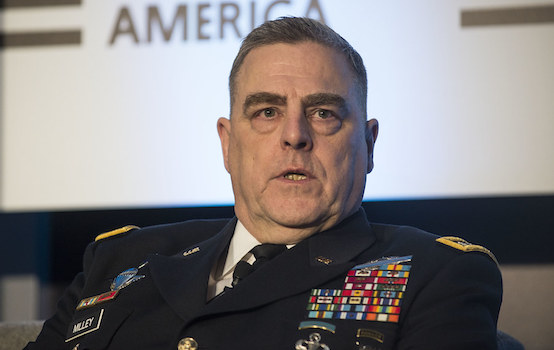
General Mark Milley. So many ribbons, so few victories (Gabriella Demczuk/New America)
Tom Engelhardt. Introduction by W.J. Astore.
Ever since that fateful day of 9/11/2001, Americans have been trying to process what can only be termed a colossal defeat. Showing our usual capacity for denial, we’ve rebranded it as a day for patriotism. We built the Freedom Tower, exactly 1776 feet high, on the ruins of the Twin Towers. We “got” Osama bin Laden. Yet the first victims of our collective rage, the Taliban in Afghanistan, have somehow emerged triumphant in a long destructive war against U.S. and NATO forces.
With his usual powerful prose, careful research, and keen eye for telling details, Tom Engelhardt has written a compelling introduction to Rajan Menon’s latest article on the Afghan War. It’s reposted here with Tom’s permission.W.J. Astore
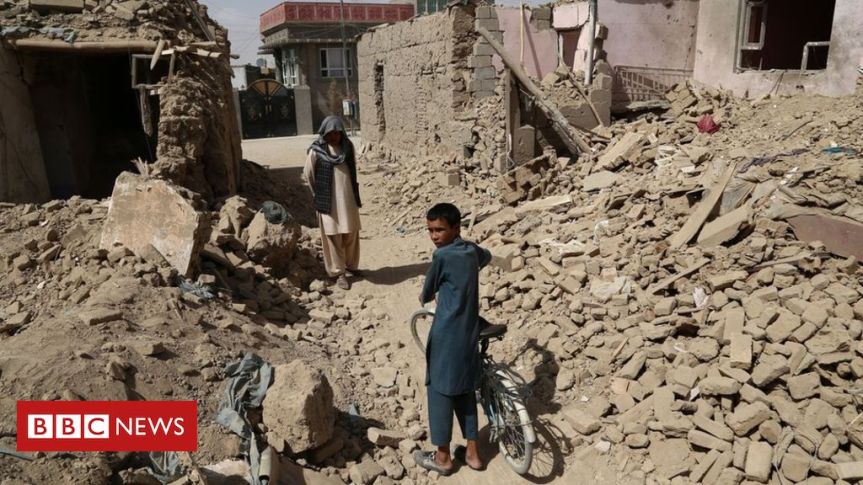
It started with three air strikes on September 11, 2001. The fourth plane, heading perhaps for the Capitol (a building that wouldn’t be targeted again until last January 6th), ended up in a field in Pennsylvania. Those three strikes led to an American invasion of Afghanistan, beginning this country’s second war there in the last half-century. Almost 20 years later, according to the New York Times, there have been more than 13,000 U.S. air strikes in Afghanistan. Call that payback after a fashion. There’s only one problem: the greatest military on the planet, with a budget larger than that of the next 10 countries combined, has visibly lost its war there and is now in full-scale retreat. It may not be withdrawing the last of its forces on May 1st, as the Trump administration had agreed to do, but despite the pressure of the American military high command, President Biden “overrode the brass” and announced that every last American soldier would be gone by the 20th anniversary of those first airstrikes against the Pentagon and the World Trade Center.
At this late date, consider it grimly fascinating that the generals who all those years kept claiming that “corners” were being turned and “progress” made, that we were “on the road to winning” in Afghanistan, as the present Chairman of the Joint Chiefs Mark Milley insisted back in 2013, simply can’t let go of one of their great failures and move on. Under the circumstances, don’t for a second assume that the American war in Afghanistan is truly over. For one thing, the Taliban have not yet agreed to the new withdrawal date, as they did to the May 1st one. Instead, some of its commanders are promising a “nightmare” for U.S. troops in the months to come. Were they, for instance, to attack an air base and kill some American soldiers, who knows what the reaction here might be?
In addition, the Pentagon high command and this country’s intelligence agencies are still planning for possibly making war on Afghanistan from a distance in order to “prevent the country from again becoming a terrorist base.” As Eric Schmitt and Helene Cooper of the New York Timesreported recently, “Planners at the military’s Central Command in Tampa, Fla., and Joint Staff in Washington have been developing options to offset the loss of American combat boots on the ground.”
In other words, the American war in Afghanistan may be ending but, as with so much else about that endless experience, even the finale is still up for grabs. In that context, consider the thoughts of TomDispatch regular Rajan Menon on what has, without any doubt, been the American war from hell of this century. Tom
Please read Rajan Menon’s latest article at TomDispatch.com.
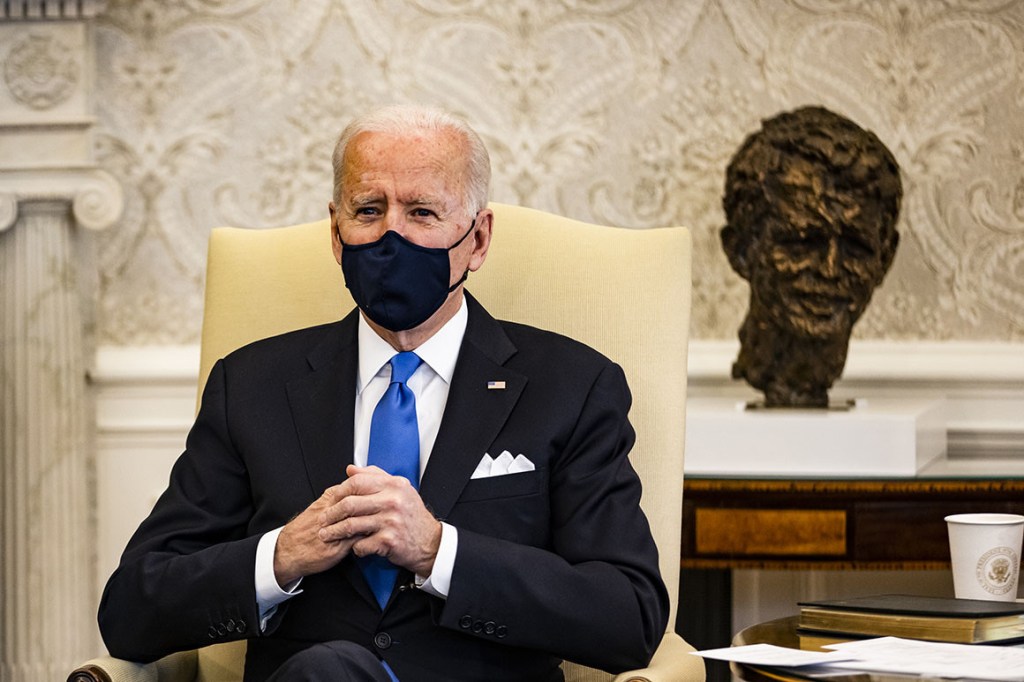
Like much of Biden’s face, America’s Afghan War is kept hidden behind a dark mask (Samuel Corum/Getty Images)
W.J. Astore
President Biden has announced that all U.S. military combat troops will be withdrawn from Afghanistan by 9/11/2021. That date was chosen deliberately and cynically. Recall that 15 of the 19 terrorist hijackers of 9/11 were Saudi. Recall that Osama bin Laden was Saudi. Recall that it was Al Qaeda, not the Taliban in Afghanistan, that was behind the 9/11 attacks on America. Yet America’s Afghan War has always been falsely advertised as both preemptive and preventative, i.e. America went to war to preempt another 9/11-style attack and has continued that war to prevent similar attacks coming from Afghanistan. It’s a false narrative that has largely worked to sustain the Afghan War for twenty years, and Biden is reinforcing it.
Another critical issue: What does it really mean when Biden says those combat troops will be withdrawn? What it doesn’t mean is that the war will end. Doubtless the CIA and similar intelligence operatives will remain behind, shrouded in secrecy. Doubtless some special forces units will stay. Doubtless private contractors, many of them ex-military, will stay. Doubtless America will reserve the “right” to continue to bomb Afghanistan and to conduct drone strikes from halfway across the world, ostensibly in support of the Afghan “national” government in Kabul. So is the war really ending?
Meanwhile, the Pentagon is getting what it wants: a boosted budget (even above what Trump requested) and a future defined by plans for war with China and Russia (and perhaps Iran as well). I’ve seen plenty of articles screaming that China is building a powerful navy, that China is building dangerous missiles, that China is building advanced fighter jets, and so on, which is exactly what the Pentagon wants: a “near-peer” rival to justify even more military spending, especially for big-ticket items like aircraft carriers, fighters, bombers, missile defense systems, and so on.
Biden’s linking of the failed Afghan War to 9/11 and its forthcoming 20th anniversary is yet another exercise in pernicious lying by America’s vast national security state. Once again, we’re reminded that the first casualty in war is truth. And perhaps the last casualty of the Afghan War (whenever it really ends, at least for America) will also be truth.
1. Recently I came across a reference to the U.S. military complaining that it never fights with a “home field” advantage. That the fight is always “away,” in sports speak, on the other guy’s field. And the gist of the comment was that the U.S. military must always be prepared to fight at a disadvantage. It seemingly never occurs to the decisionmakers that maybe, just maybe, the U.S. doesn’t have to fight on the other guy’s field. Maybe, just maybe, Vietnam was a bad idea. Iraq was a bad idea. Afghanistan was and remains a bad idea. China in the future would be a very, very, bad idea. And so on.
Or maybe, just maybe, the Pentagon and America’s generals are just too vainglorious in identifying the entire world as their home court?
2. Surprise! Joe Biden’s Pentagon budget is basically the same as Trump’s with a few extra billion thrown in for good measure. So much for reforming “defense” spending in any meaningful way.
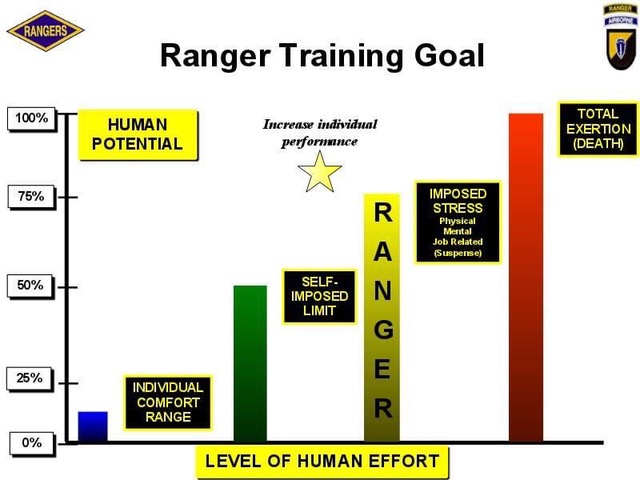
3. The U.S.. military continues to define exertion (and merit) mainly in physical terms. Consider this chart sent along by a friend:
As my friend amusingly put it, “If I read this chart correctly, humans reach their full potential only at the moment of death.”
I wrote back to him: Why is exertion in the military always physical? Maybe we should be thinking harder too? It’s fascinating this devotion to physical strength and fitness when modern weaponry is truly the great equalizer. If I can sit in an air-conditioned trailer in Nevada and smite evil-doers in Afghanistan via a drone strike, should I be kicked out if I fail to do 50 pushups or run the obstacle course?
Mental fitness is rarely considered in the U.S. military except in the sense of weeding out the mentally ill or those who can’t conform to military discipline.
Even military promotion seems driven more by brawn than brains. If I run a sub-3 hour marathon, I bet the OPR (officer proficiency report) bullet would be far more favorable than if I wrote an article for Armed Forces Journal.
As another friend of mine, the distinguished military historian Dennis Showalter, said to me: Some flab around the waistline is preferable to flabby thought processes. Just think here of David Petraeus and Stanley McChrystal, both celebrated in the U.S. media as running and exercise enthusiasts.
5. To come back to the subject of “home field” advantage, it’s precisely because we never have that that U.S. troops have to wear heavy body armor and carry all kinds of gear with them. Whereas the “enemy,” whether in Vietnam, Afghanistan, or Iraq, is at “home” and can wear street/farm clothes and carry a much lighter load, e.g. a rifle, some ammo, some rations.
The result is that U.S. troops often look like the imperial stormtroopers of “Star Wars” who are always bungling and losing to the lighter-armed rebel alliance.
You do need to be in decent physical shape to carry so much armor and so much weaponry and gear into hostile and foreign lands. But, maybe instead of turning every soldier into Rambo, we should find smart ways to advance our policies without having to fight at all?
It certainly is smarter than a bunch of Army Rangers driving themselves to the brink of death in the cause of maximizing their “human potential.”
In my latest for TomDispatch.com, I tackle the Pentagon’s latest proclivity for “near-peer” conflicts, the near-peers being China and Russia, which conveniently serves to justify huge war budgets in perpetuity. It’s the Cold War, rebooted and rebranded, with a new generation of nuclear weapons thrown into the mix to make things even more interesting. As they say, what could possibly go wrong?
What follows is an excerpt that focuses on a “Star Trek” episode that has much to teach us:
In the 1970s, in fact, I avidly watched reruns of the original Star Trek. Lately, one episode, “A Taste of Armageddon,” has been on my mind. It featured two planets, Eminiar VII and Vendikar, at war with each other for 500 years. Here was the catch: those planets no longer used real weapons. Instead, they fought bloodlessly with computer-simulated attacks, even as citizens marked as “dead” had to report to disintegration chambers in a bizarre ritual meant to keep the peace through a computer-driven holocaust. The peoples of these two planets had become so accustomed to endless war that they couldn’t imagine an alternative, especially one that ended in a negotiated peace.
So many years later, I can’t help thinking that our country’s military establishment has something in common with the leaders of Eminiar VII and Vendikar. There’s so much repetition when it comes to America’s wars — with little hope of negotiated settlements, little talk of radically different approaches, and a remarkably blasé attitude toward death — especially when it’s largely the death of others; when foreign peoples, as if on another planet, are just “disintegrated,” whether by monster bombs like MOAB or more discrete Hellfire missile strikes via remotely piloted drones.
What gives? Right now, America’s military leaders are clearly turning back to the war they’d prefer to be fighting, the one they think they can win (or at least eternally not lose). A conventional warlike state vis-à-vis those near-peers seems to play to their skills. It’s also a form of “war” that makes loads of money for the military-industrial complex, driving lucrative acquisition decisions about weaponry in a remarkably predictable fashion.
Near-peer “war” remains largely a fantasy set of operations (though with all-too-real dangers of possible conflagrations to come, right up to nuclear disaster). In contrast, real war, as in this century’s terror wars, is a realm of chaos. So much the better to keep things as predictable as possible. Fresh and original ideas about war (and peace) are unlikely to prove profitable for the military-industrial complex. Worse yet, at an individual level, they could damage one’s chances for promotion or, on retirement, for future posts within the industrial part of that complex. It’s a lot healthier to salute smartly, keep planning for a near-peer future, and conform rather than fall on one’s sword for a dissenting idea (especially one related to peace and so to less money for the Pentagon).
Please read the article in its entirety here at TomDispatch.
On Eminiar VII, “casualties” of computer war willingly enter disintegration chambers to die as a way of keeping “peace”
At the Guardian today, I saw the following headline: US Navy: for first time in history four women of color command war ships; Kimberly Jones, LaDonna Simpson, Kristel O’Cañas and Kathryn Wijnaldum break new ground in white and male-dominated field.
Are we supposed to love the military because more women of color are reaching positions of command?
Don’t get me wrong: this is a good thing. My boss at my last job in the Air Force was a Black female colonel. Serving in the U.S. military, I saw and befriended plenty of “diverse” people during my career. (In today’s military-media context, I guess “diverse” means anything but your standard white male.) Few people seemed to care about gender, race, sex, color, ethnicity, and so on as long as the person was competent. Good bosses come in all shapes, shades, and sizes — and so do bad ones.
So, I don’t want to join Tucker Carlson in a misinformed and ridiculous rant against an alleged feminization of the U.S. military. For a military and a country that is supposedly too feminine or too soft or whatever, we still spend more on war than the next ten countries combined (and most of those countries are America’s allies); we continue to have a global network of 800 or so military bases; we still dominate the world’s trade in deadly weaponry; we still throw our weight around like bullies and fancy ourselves the world’s lone superpower. Are any of these facts changed or softened because more women or more people of color are reaching high rank within that military?
That the Secretary of Defense is a Black male doesn’t seem to have affected policy decisions in any meaningful way. Why should it, when he spent his life in the U.S. military and then joined Raytheon and profited greatly after retiring?
Again, it’s a good thing that people of color aren’t as hamstrung as they used to be in reaching positions of command in the U.S. military. But does it change anything if the Hellfire missiles that kill civilians in Afghanistan are launched from a Reaper drone by a Black female pilot rather than a white guy?
I remember during this year’s Super Bowl festivities that the lead B-2 bomber pilot was a woman. Good for her! But if she pilots a B-2 into a nuclear war, will anyone be pleased that a city gets nuked by a woman rather than a man?
The only “diversity” the Pentagon seemingly rejects is anyone who wants to pursue a new, more peaceful, course, in which the military is not the primary tool of U.S. foreign policy. How about some “diverse” people who will put an end to the war in Afghanistan? Who will argue for less spending on wars and weapons?
Women can be warriors too. We get it. The Greeks had Athena. The Romans had Bellona. This is not new. As others have said, it’s not enough to put Black faces in high places. Or for women to shatter glass ceilings. Not if the policies and power arrangements stay the same.
America recently marked the 18th anniversary of the Iraq War by basically ignoring it. The 20th anniversary of the Afghan War approaches, and it appears we’ll get there since President Biden is saying U.S. forces can’t leave until this November at the earliest. Apparently, our withdrawal of troops must be “responsible” and based on ever-changing benchmarks. Leaving aside the harrowing human cost, these calamitous wars have cost the American taxpayer at least $6 trillion, yet they go on and on.
One person who’s learned a lot from these wars is Andrew Bacevich, a retired U.S. Army colonel who runs the Quincy Institute for Responsible Statecraft. In his latest article for TomDispatch.com, Bacevich had this to say about America’s seemingly unending pursuit of peace through war:
The longest war in U.S. history [the Afghan War] should by now have led Americans to reflect on the consequences that stem from succumbing to imperial temptations in a world where empire has long since become obsolete. Some might insist that present-day Americans have imbibed that lesson. In Washington, hawks appear chastened, with few calling for President Biden to dispatch U.S. troops to Yemen or Myanmar or even Venezuela, our oil-rich “neighbor,” to put things right. For now, the nation’s appetite for military intervention abroad appears to be sated.
But mark me down as skeptical. Only when Americans openly acknowledge their imperial transgressions will genuine repentance become possible. And only with repentance will avoiding further occasions to sin become a habit. In other words, only when Americans call imperialism by its name will vows of “never again” deserve to be taken seriously.
Bacevich is right to be skeptical. The prevailing narrative in the USA still rejects the notion of imperial wars. America’s wars are always sold as defensive. Put simply, we allegedly fight “them” over there so we won’t have to fight them over here. The Afghan War is still being sold as preventing terrorist attacks on America. The Iraq War was sold as preventing Saddam Hussein from using his non-existent weapons of mass destruction against us. In short, Americans are routinely sold a false bill of goods, and the price tag attached, $6 trillion and rising, again leaving aside the human cost, is truly prodigal to behold.
I urge you to read all of Bacevich’s article here. And I urge all Americans to think about our leaders’ imperial ambitions and their horrendous costs. Like the Romans, we are too fond of creating deserts with our weaponry and calling it “peace.” We can and must open our eyes and do better.
War is not pretty, whether in Iraq or Afghanistan or Syria or Anywhere
Why has the U.S. military failed so consistently since World War II? A popular thesis advanced most notably by Tom Ricks is that today’s military leaders simply aren’t called on the carpet and dismissed for poor performance as in the “greatest generation” era. But is it that simple? Should we simply stop coddling generals and cashier a few to encourage the others? Dan White begs to differ, turning to the writings of two generals, James Gavin and Robin Olds, for support. White persuasively argues that more firings and ostensibly tougher generals are not necessarily the answer, not when America’s wars are so poorly defined and essentially unwinnable to begin with. So why does the U.S. military both acquiesce to and persist in waging unwinnable wars for unattainable objectives? And what does that tell us about America’s approach to and understanding of war? Read on! W.J. Astore
A Flailing and Failing Military Has Forgotten the Fundamental Tenets of War
Daniel N. White
Tom Ricks, the Washington Post military affairs correspondent, argued in his book The Generals that US military failures in our ongoing and recently past wars are due to a reluctance to relieve commanders for cause. Ricks tells of how in World War II numerous mid-level and senior officers were relieved for cause—nonperformance of their units on the battlefield. Under-performing units turned around (every time, Mr. Ricks?) with new commanders and relieved commanders were given second chances that they often succeeded at. Ricks argues that despite the obvious military failure in our current military ventures, no general officer has yet to be relieved for cause. According to him, this sea-change in US military policy and practice is what now ails us.
Ricks, however, fails to look at the overall history of relieving officers in the US military in wartime; thus his conclusions are suspect. America’s current military failures have little to do with a failure to relieve officers for cause during wartime. Ricks, like so much of this country’s population at large, its political and media elites in particular, looks no further back in our history than to World War II. The American obsession with the “good war” fought by the “greatest generation” is a blinding defect that will ultimately kill many more Americans unless we wise up soon.
Consider World War I, for example. The US Army in the First World War generally didn’t perform very well on the battlefield. Yet to my knowledge no studies have been done that affirm that relieving officers for cause improved US battlefield performance.
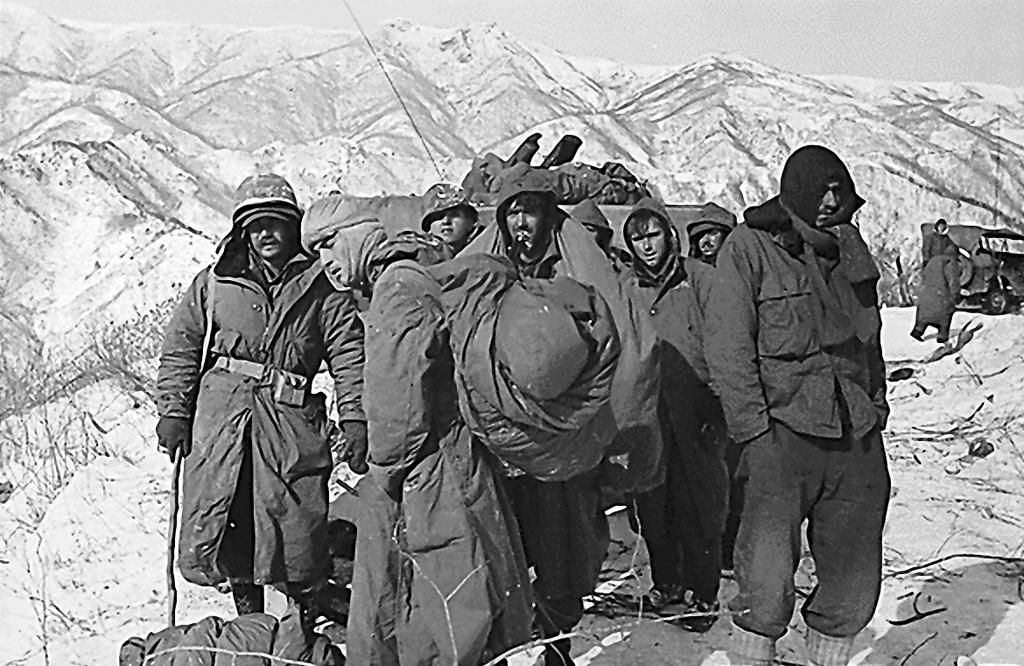
Consider the Korean War as well. The Army performed poorly in the opening stages of the war and was beaten again after the Inchon turnaround at Chosin Reservoir, after which General Matthew Ridgway turned things around and the US Army became a capable fighting force again. Anyone who wants to argue about how relieving officers for cause is the key to effective performance on the battlefield needs to look at the US Army and its relief of officers in World War I and Korea. Ricks doesn’t.
The Retreat from Chosin Reservoir, Korea
Now let’s consider the Vietnam War. The US Army officer corps was riddled with ticket-punching and widespread personal and professional dishonesty and a wide range of other vices during that war, yet it still managed to relieve officers in the field for cause. The 1st Infantry Division regularly relieved officers for cause, while other divisions rarely used the practice. Was there any real difference in the field performance between the two types of divisions? Ricks doesn’t say.
A better argument to be made against Ricks’ premise is from General James Gavin, in his war memoirs, On to Berlin (1978). Gavin and the elite 82nd Airborne Division were sent to the Battle of the Bulge (1944), where they fought alongside the 7th Armored and the 106th Infantry Divisions. The 7th was an experienced unit whose performance in fighting while badly outnumbered in the first days of the battle is now generally considered an outstanding example of defensive fighting against odds. The 106th was a green division whose performance Gavin considered as good as could be expected under the circumstances, and whose commanding general gets several favorable mentions from Gavin for his performance in those most difficult circumstances of a green unit being attacked by superior forces.
These two units led the US defense in the key defensive battle of St. Vith, a battle that didn’t get the press that its less important crossroads battle of Bastogne got, despite its larger importance. Bernard Montgomery said of these two units’ performance, as they withdrew from their defensive positions they had held for the first week of the battle to new ones further back: “They can come back with all honour. They come back to the more secure positions. They put up a wonderful show.” Gavin quotes the official Army history on Montgomery’s comments on two retreating US Army divisions: “Montgomery showed the ability to honor the fighting men which had endeared him to the hearts of the Desert Rats in North Africa.”
Gavin further tells of how the commanders of both of these divisions were relieved once they finished their withdrawal to their new positions. In the case of the CG of the 7th Armored, Gen. Robert Hasbrouck, the orders for his relief were sent at 6:25 on the morning of Dec. 22nd, while the countermanding orders, from the same Corps Commander, were sent to him restoring him to his command of the division the same evening, at 7:00 pm. The CG of the 106th Inf., Alan W. Jones, wasn’t so lucky and was relieved permanently from his command. Gavin has this to say about the matter here, and the US Army’s quickness to relieve officers for cause in WWII—which Ricks finds most admirable—here, on p. 258:
Once again I was struck by the manner in which the system treats senior officers in combat. I have a haunting memory that does not diminish with the passage of time of how unfairly and thoughtlessly we treated some of our senior officers. And I use the word ‘system’ because that is what it is. It is not a personal matter. It is something that one has come to expect of senior officers in our Army. In this case, one is particularly impressed by the manner in which Montgomery congratulated all those who fought at St. Vith for the fine job they did. We relieved the two senior commanders, although one was restored. In the situation at Arnhem, in our earlier battle in Holland, the British general lost three-quarters of his command and a battle. He returned home a hero and was personally decorated by the King.
There is no doubt that in our system he would have been summarily relieved and sent home in disgrace. In the case of General Jones and his 106th Division, higher command knew no more about the German plans than he did. Higher command also knew of his dispositions and approved them. His leading green regiments were overwhelmed before they could offer much resistance, and there is little that he—or anyone else, for that matter—could have done about it. Summarily relieving senior officers, it seems to me, makes others pusillanimous and indeed discourages other potential combat leaders from seeking high command. Again, it is not individuals acting against other individuals—it is not a personal matter–it is the way the system works and is expected to work. It must be changed. The shift from peacetime to a war footing and then to battle has a tremendous psychological impact on individuals. Summarily relieving those who do not appear to measure up in the first shock is not only a luxury that we cannot afford—it is very damaging to the Army as a whole. We have much to learn from the British about senior command relationships.
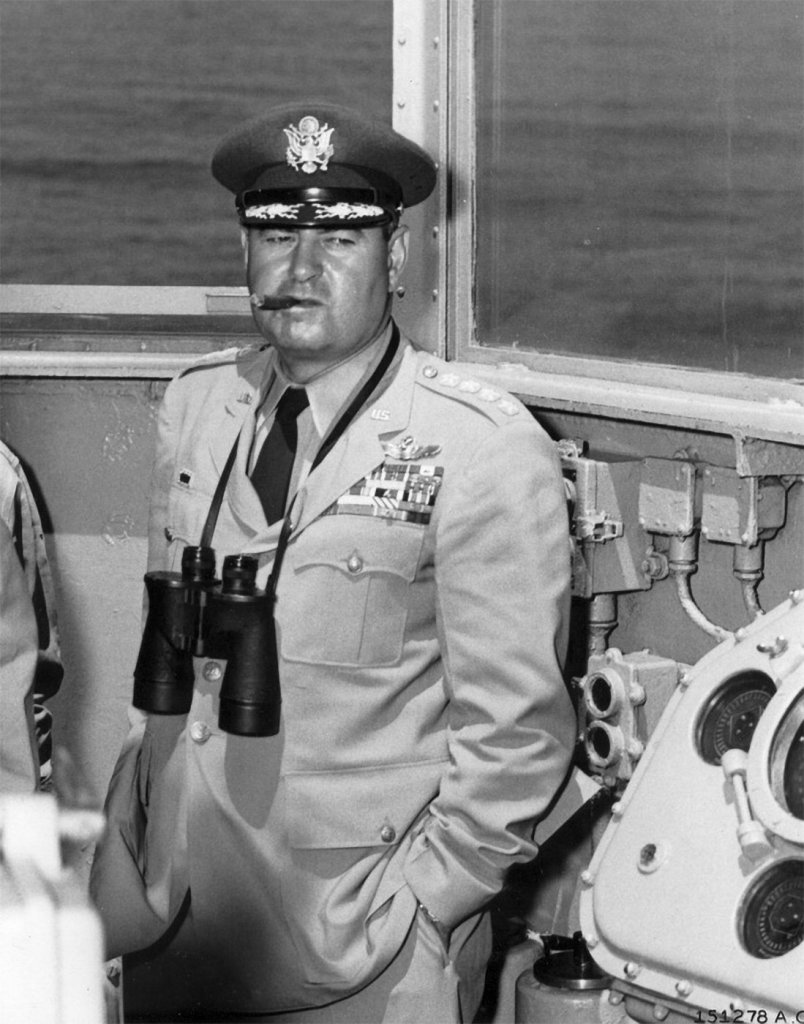
And it is worth bringing to the table peacetime relief of command for cause. The US military organization most famous for that practice was Strategic Air Command (SAC) in the US Air Force, in its halcyon days of General Curtis LeMay.* SAC was in its day notorious for a horrific pressure-cooker environment but is nowadays regarded by some as a model of a peacetime military organization at the top of its form—the most highly skilled personnel, running the most technologically advanced weaponry, all ready 24/7/365 at the drop of a hat.
General Curtis LeMay, on a Navy ship, ready to observe a nuclear bomb test
SAC awaits a truly critical historian, but whoever it might be will be wise to heed the comments about SAC made by BGen. Robin Olds, an outstanding fighter pilot, a triple-ace, and wartime military leader and commander, in his posthumous memoirs, Fighter Pilot. Olds was thoroughly dissatisfied with what he saw of SAC in the late 1970s, and wrote in his memoirs, on p. 372, of SAC’s longstanding history of relieving officers from command slots at the drop of a hat:
Under their (SAC’s) rules, if a wing commander messed even a little bit he was canned and gone forever, so SAC fostered attitudes about how tough they were. What they really did was make a bunch of liars out of many wing commanders, DM’s, and DO’s. Guys at wing level were scared people. They would lie, cheat, steal, and deny—anything to make themselves look good.
The net result of this over time is described by Olds on p. 374:
When LeMay scared the hell out of his people, he made some-thing out of them that I don’t think was in their true nature. He made them cringe and hide the truth. He made them say,
’Yes Sir, Yes Sir,’ becoming chronic liars protecting their own skins…A man like that has to have someone working for him that he can dominate and he is invariably going to pick a lesser individual (for promotion) … a big group of guys were developed into people who were afraid to think for themselves. They damned near destroyed the air force in the process… (emphasis mine)**
Gavin and Olds versus Ricks on the merits of the US military’s past quickness to relieve commanders. The choice is yours. I’m with Gavin and Olds.
Ricks and his writings on war and the US military deserve more comment than I want to give them here. Fundamentally Ricks is a fan of the US military and of things military in general. A fan isn’t an impartial judge of whatever it is they are a fan of. That’s simply the nature of fandom. Perhaps Ricks sees himself as a friend of the US military, but fans aren’t true friends, either.
The worst sort of fans are accurately described by the athletes themselves as crotch sniffs, and that’s a telling turn of phrase. Ricks is fundamentally a crotch sniff for the US military. Journalists have mostly (and editors invariably) been a bunch of crotch sniffs for their own country’s militaries and Ricks is no exception.
There’s unfortunately nothing new about that situation; it has almost always been the case about military/war journalism ever since newspapers were invented. Anyone wanting to argue otherwise needs to reread Phillip Knightley’s The First Casualty (1975), 3rd edition in 2004, still the best book on war reportage.
A complicating factor is that what most Americans know about war and warfare comes via Hollywood, whether they realize it or not—and most Americans lack the self-perception to realize how much Hollywood/ PR they’ve internalized. An additional compounding factor is that the military is one of those institutions, like the judiciary, that invariably gets a pass from editors from critical analysis, and from probably the same reasons. Most journalists simply know little of war or law, and when you combine technical ignorance with institutional sacred cowism you get uncritical coverage. Ricks to his credit isn’t ignorant; he’s knows a fair amount about the US military and military history. But Ricks’ strong belief in the goodness and efficacy of the US military dooms his writings to hackwork status, much like the rest of his militarily ignorant journalist colleagues’.***
Ricks deserves credit for trying to come to grips with why the institution he admires so much has failed so badly against weak opponents like the Iraqis and Afghans. His is an all too typical American attitude, particularly among conservatives, of harkening back to the glory days of World War II, when America seemed completely right and completely omnipotent. This belief in America’s goodness in those days is dumb and wrong, yet it’s a belief that’s endemic in this country, and one that shows no signs of ever soon diminishing.
The reasons for America’s recent military failures are more obvious than Ricks wants to acknowledge. America simply had (and has) no realistic objective for wars whether in Iraq or Afghanistan. Both wars had lies as their stated rationales, and nobody has yet explained how any sort of good is supposed to come from wars started by and waged on lies. What is worse, far, far worse than that, is that both wars lacked any coherent political or military objective, at any time before or during their commission, and if there is a worse crime or sin in the professions of politics or arms than fighting wars without objective I cannot name it. I defy anyone else to, either.
The US military has continued both wars in the face of obvious failures to achieve meaningful goals, despite however many times the political leadership here moved the goalposts. Persons who remember the Vietnam War, or who bothered to learn anything about it beyond the Rambo cartoons, should be noticing more similarities than dissimilarities in our failed efforts then and our failed efforts now.
Ricks fails to address how (as have likewise, for decades now, most all others in the media, political world, our moral leadership, and intelligentsia), once again, the US military has saluted smartly while participating in wars in distant lands that required more men in the field and a bigger war effort than they knew they were going to get from the home front. Once again, senior military leaders willingly involved themselves and their organizations in efforts that they knew from the beginning were almost certain to fail. They fought wars without realistic war objectives and without adequate resources (most especially, support at home). This is institutional failure at the highest level, a master class in moral cowardice and corruption.
Sadly, instead of covering this, most media sites post the usual puff pieces about our noble troops as they fight terrorists in the cause of freedom. Few people have asked the dreaded question of whether and why our military leaders are willingly participating in odious demi-wars staged largely for domestic political reasons. The sickness and corruption—moral and professional corruption of the worst sort possible—that this question raises is an issue that fans like Ricks simply cannot comprehend.
Ricks, who is again a reporter with considerable military knowledge, simply misses the target here. The US military isn’t flailing and failing because it hasn’t fired enough generals: It’s flailing and failing because it engages in wars that are lost causes to begin with, as well as being illegal and immoral to boot. Ricks is too much of a military fanboy to see this; so too are most Americans, who continue to salute the troops as heroes without ever questioning their actions in the field. It is all most discouraging.
Daniel N. White has lived in Austin, Texas, for a lot longer than he originally planned to. He reads a lot more than we are supposed to, particularly about topics that we really aren’t supposed to worry about. He works blue-collar for a living–you can be honest doing that–but is somewhat fed up with it right now. He will gladly respond to all comments that aren’t too insulting or dumb. He can be reached at Louis_14_le_roi_soleil@hotmail.com.
*My favorite story about SAC and its willingness to relieve commanders comes from its earlier days when a B-36 Wing Commander was called on the mat by LeMay for a low level of operational readiness of his aircraft. The Wingco explained that his squadrons at the base had had a rash of bird strike accidents involving buzzards, and these accidents had caused damage to parts of the airframes that were beyond the capabilities of wing maintenance to repair, and that new airframe parts from Convair were necessary to restore safe airworthiness to the airplanes. The USAF didn’t have these airframe parts in its inventory, and Convair did not have them as spare parts yet, and Convair was unwilling to interrupt its production schedule for new B-36s by pulling the necessary parts off of its assembly lines and shipping them to his squadrons’ repair shops like he’d asked them to. LeMay listened and said: “I have neither the time nor inclination to distinguish between the unfortunate and the incompetent. You are relieved.”
**SAC was the preeminent branch of the US military during its Cold War salad days. It had more money than God courtesy of a complacent Congress that gave it everything it wanted and then some. There is of course nothing to show for all this expenditure; such is always the case for military expenditures. But this line of Olds is as good an epitaph for SAC as an institution as it is ever going to get. And SAC, as big and significant an American institution as it was in its day, really needs a good historian to look at it with a critical eye, before everyone involved in it is dead. Most already are.
***Anyone who thinks I’m being too hard on Ricks needs to go read his account of the Battle of Fallujah in his first book on the Iraq War, Fiasco. A truly revolting bit of crotch sniffery towards the jarheads.
Today, I’d like to revive an article I wrote in July of 2010 about America’s folly in continuing its war in Afghanistan. Here we are, a decade later, and the Biden administration is contemplating continuing that war. Stupidity is obviously unbounded.
Anyway, as Julian Assange rots in prison for the crime of doing journalism, it behooves us to recall that WikiLeaks provided convincing evidence of America’s Afghan folly. Obviously, Assange the messenger must be shot, or at least punished severely for daring to air America’s dirty laundry.
Here’s my post from 2010. Does it make any sense in any universe to keep this going?
What WikiLeaks Reveals: We’re Playing the Fool in Afghanistan
07/27/2010
Perhaps the most predictable, as well as the most maddening, headline to emerge from the latest WikiLeaks controversy is this one from the Washington Post: “WikiLeaks Disclosures Unlikely to Change Course of Afghanistan War.”
Doubtless this “stay the course” approach will be spun as a sign of American resolve and tenacity. Of course, it was Albert Einstein who defined insanity as doing the same thing over and over again and expecting different results.
Naturally, there’ll be some who’ll say that Obama and General Petraeus have new cards up their sleeves, so perhaps they’re not “insane.” But they (and we) sure are looking more and more like fools.
Partly this is because President Obama and his advisors are still looking at Afghanistan as a problem to be solved, a war to be won, a situation to be handled. Or they see it as a high-stakes poker match, a deadly game of raises and bluffs, of gambling at long odds, but a match we can ultimately win as long as we keep playing and pumping in more chips.
But what if Afghanistan is none of these? What if we’re playing the fool?
Recall how proud we were, in the 1980s, at providing arms and aid to the Afghan “freedom fighters” who were then fighting the Soviets. It was the Soviet Union’s own Vietnam, we said, the final nail in the coffin of Soviet communism, and we congratulated ourselves on our own cleverness.
Fast forward two decades, and now we’re the ones bogged down in Afghanistan, yet we still think we can “surge” or escalate or otherwise rescue a faltering and untenable war effort.
Faltering? Untenable? Few people will dispute the following facts, many of which are now further supported by the WikiLeaks documents:
1. We’ve already spent $300 billion on our war in Afghanistan with very little to show for it.
3. We’ve almost completely eliminated Al Qaeda in Afghanistan, the immediate cause of our intervention in 2001, yet we continue to send more troops and more money there.
4. We’ve allied ourselves with a corrupt government and leaders who are enriching themselves at our expense.
5. We pay bribes to protect our convoys, and some of this money ends up in the hands of the Taliban.
6. We’re working with a regional ally, Pakistan, whose interests are often contrary to our own, and yet whose allegiance we attempt to buy with more military aid.
7. In trying to win the hearts and minds of ordinary Afghans, we’ve largely looked the other way with respect to the opium and heroin trade. The result? A drug-based Afghan economy.
8. In fighting an American-style war, we’ve relied on massive firepower, often from the air, that inevitably results in civilian casualties that undermine our counterinsurgency efforts.
9. At a time when we’re still trying to create jobs and pull ourselves out of a Great Recession, we continue to dedicate tens of billions of dollars to a seemingly endless war, with Congress currently preparing to approve yet another $33.5 billion for Afghanistan.
10. While largely ignoring civilian casualties in Afghanistan, we also downplay the cost of constant warfare to our troops, not just those who are killed or wounded in action (horrible as that price is), but to those who are brutalized by war, those whose families are destroyed or damaged by constant deployments, by domestic violence, and by suicides. Yet we reassure ourselves this price is bearable since our troops are “all volunteers.”
These are hard facts, and the WikiLeaks evidence has only made them harder. Only a fool refuses to face facts, and hardheaded Americans are not fools.
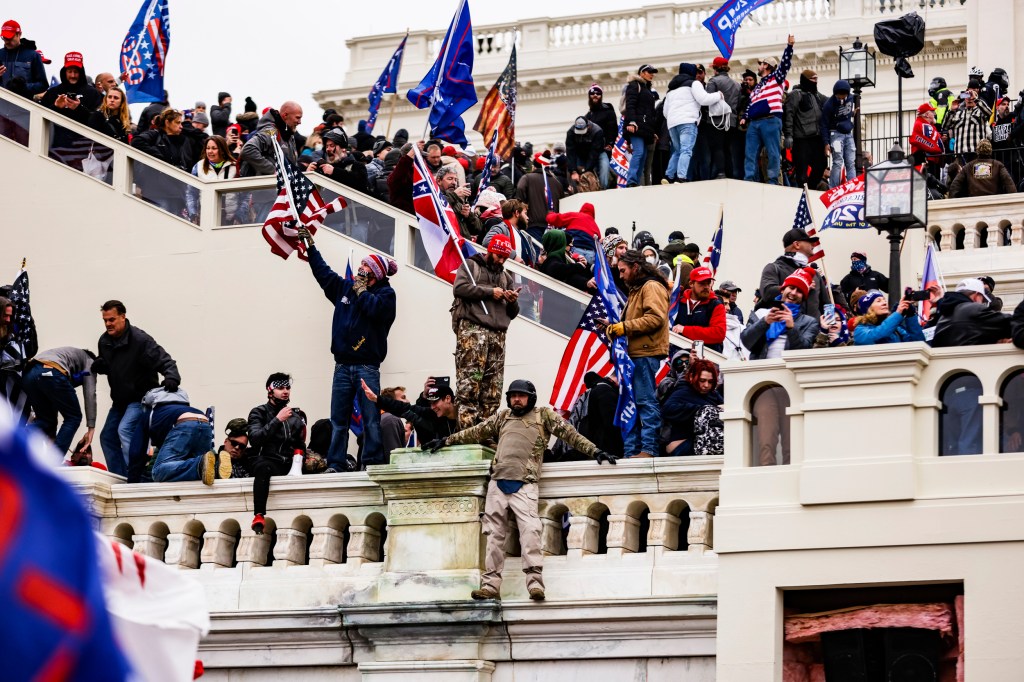
Pro-Trump supporters storm the U.S. Capitol, January 6, 2021 (Photo by Samuel Corum/Getty Images)
W.J. Astore
When I taught the core course in military history at the U.S. Air Force Academy, it focused on “major” wars. A review of my syllabus from 20 years ago confirms that we spent most of our time teaching military cadets about the American Revolutionary War, the U.S. Civil War, World Wars I and II, Korea and the Cold War, and Vietnam. There were special lessons that focused on airpower history and strategic thinkers like Clausewitz and Jomini, but the main focus was on “conventional” wars. I was OK with this, since mastering the course material was my main challenge, not challenging subjects within the course.
An astute student of U.S. military history would quickly note what’s missing. Genocidal wars against Native Americans were rarely mentioned. There were no specific lessons devoted to the Mexican-American War, the Spanish-American War, the Filipino Insurrection, or any of America’s frequent regime-change wars in Latin America. American imperialism wasn’t specifically addressed. Critiques of American imperialism by critics like Mark Twain and General Smedley Butler were rarely (if ever) heard.
What that means is this: America’s young officers go out into the world with little knowledge of America’s military interventions beyond the victories (more or less) in World Wars I and II, stalemate in Korea, and a misbegotten war in Vietnam that America could (and perhaps should) have won with better tactics and/or less civilian interference, or so they are often taught. Small wonder that disasters like Iraq, Afghanistan, Libya, and others occur and persist, though I wouldn’t put the blame for these simply on a lack of critical teaching about America’s various for-profit cock-ups and screw-ups.
This was on my mind as I read Kevin Tillman’s recent article at TomDispatch.com. As Tillman notes, America’s regime-change wars and propensity for foreign coups came home to our own country on January 6th with the storming of the Capitol. That such an action so deeply shocked Americans is a sign of our collective amnesia when it comes to remembering the totality of our military history.
Here’s an except from his article, which I encourage you to read in its entirety at TomDispatch:
Kevin Tillman, Capitol Blowback
Just about everyone was shocked by what happened at the Capitol building on January 6th. But as a former soldier in America’s forever wars, horrifying as the scenes were, I also found what happened strangely familiar, almost inevitable. I thought that, if only we had taken our country’s imperial history seriously, none of us would have found that day either shocking or unprecedented.
Honestly, it could only seem that way if you imagined our domestic politics as completely separate from our foreign policy. But if we’re to learn anything from that maladroit attempt at a government-toppling coup, it should be that they are anything but separate. The question isn’t whether then-President Donald Trump incited the assault on the Capitol — of course he did. It is rather: Since when have we cared if an American president lies to incite an illegal insurrection? In all honesty, our commanders-in-chief have been doing so abroad for generations with complete impunity. It was only a matter of time before the moral rot finally made its way home.
Back in 2007, I actually met Nancy Pelosi whom those insurrectionists were going after — “Tell Pelosi we’re coming for that b**ch. Tell f***ing Pelosi we’re coming for her!” — in that very Capitol building. That day, my family was testifying before the House Committee on Oversight and Reform concerning the U.S. government’s disinformation campaign about how, three years earlier, my brother Pat Tillman had died in Afghanistan (as a result of “friendly,” not enemy, fire). We would testify alongside former soldier Jessica Lynch who had suffered a similar disinformation fate in the wake of a tragic ambush of her convoy in Nasiriyah, Iraq, where soldiers died and she was taken prisoner. After the hearing, we discussed the case with Pelosi, who then took us on a brief personal tour of the halls of the building. Given the circumstances, it was a thoughtful gesture and a humbling experience.
So, it was personally quite unsettling to watch that rabid mob of insurrectionists storm our Capitol, some actively seeking to kill the woman who had walked our family through those same halls, wearing her signature green business suit. To see people desecrating that building over grievances rooted in demonstrable and absurd untruths manufactured by President Trump was both grotesque and shameful.
And yet, however surreal, disappointing, disqualifying, even treasonous that assault and the 57-43 Senate acquittal of the president would be, what took place should, in another sense, not have been a shock to anyone. The idea that January 6th was something new for this country and so a unique affront to the American idea of democracy, not to speak of common decency, was simply wrong. After all, ever since 1945, this country has regularly intervened in elections all over the globe and done far worse as well. What’s disorienting, I suppose, is that this time we did it to ourselves.
Around the Globe, Generation after Generation
My own limited experience with American interventionism involves the occupations of Afghanistan and Iraq. After the September 11th attacks, I enlisted in the U.S. Army with Pat. We would be assigned to the 75th Ranger Regiment and our unit would in March 2003 be sent into Iraq, one of so many tools in the Bush administration’s war of aggression there. We would help remove Iraqi leader Saddam Hussein by force. It was hardly the mission I had in mind when I signed up, but I was naive when it came to foreign policy. Being part of illegal invasions, however, leaves lasting impressions.
That particular intervention in Iraq began with a barrage of administration lies about Saddam’s supposed supply of weapons of mass destruction, his reputed links to al-Qaeda, and the idea that we were liberating the Iraqi people. Some of us actually were assigned to run around Baghdad, “east, west, south, and north somewhat,” looking for those nonexistent weapons of mass destruction. The whole invasion would prove catastrophic, of course, resulting in the destruction of Iraqi society, the deaths of hundreds of thousands of Iraqis and thousands of American soldiers, even as that country’s leadership was removed and its military disbanded (mission accomplished!). Of course, neither President George W. Bush, nor the rest of the top officials of his administration were held responsible for what happened.
So, when I watched the January 6th insurrection unfold, my mind was immediately drawn to the period leading up to the Iraq war — except this time, the drumbeat of lies had to do with massive voter fraud, voting irregularities, “dead voters,” rigged software, and other fabrications. Obviously, the two events were drastically different in scale, complexity, and destructiveness. Still, they seemed to share common fundamental threads.
Examples of American interference in the governance of foreign countries via coups, regime change, and other ploys are commonplaces of our modern history. Among the best known would be the replacing of a number of democratically elected leaders like Iranian Prime Minister Mohammad Mosaddegh with the Shah (1953), Guatemalan President Jacobo Arbenz with Colonel Carlos Castillo Armas (1954), Chilean President Salvador Allende with General Augusto Pinochet (1973), or Honduran President Manuel Zelaya in a U.S.-backed coup (2009). In other words, we’re not talking about a few one-off mistakes or a couple of dumb wars.
In truth, there has been an endless supply of such U.S. interventions around the globe: invasions, military coups, soft coups, economic sanctions, secretly funding candidates of Washington’s choice, the fueling of existing conflicts, you name it and it’s probably happened.
Take for example our neighbors in South America, Central America, and the Caribbean. I honestly don’t know if there is a single nation in Latin America that hasn’t fallen victim to a U.S. intervention of some sort: Argentina (1976), Bolivia (1971), Brazil (1964), Cuba (1961), El Salvador (the 1980s), Grenada (1983), Haiti (2004), Honduras (1980 and 2009), Panama (1989), Paraguay (1962), Peru (1968), Suriname (the 1980s), Uruguay (1973), Venezuela (the present moment). Maybe Costa Rica was spared?
Please read the rest of Kevin Tillman’s article here at TomDispatch.com.
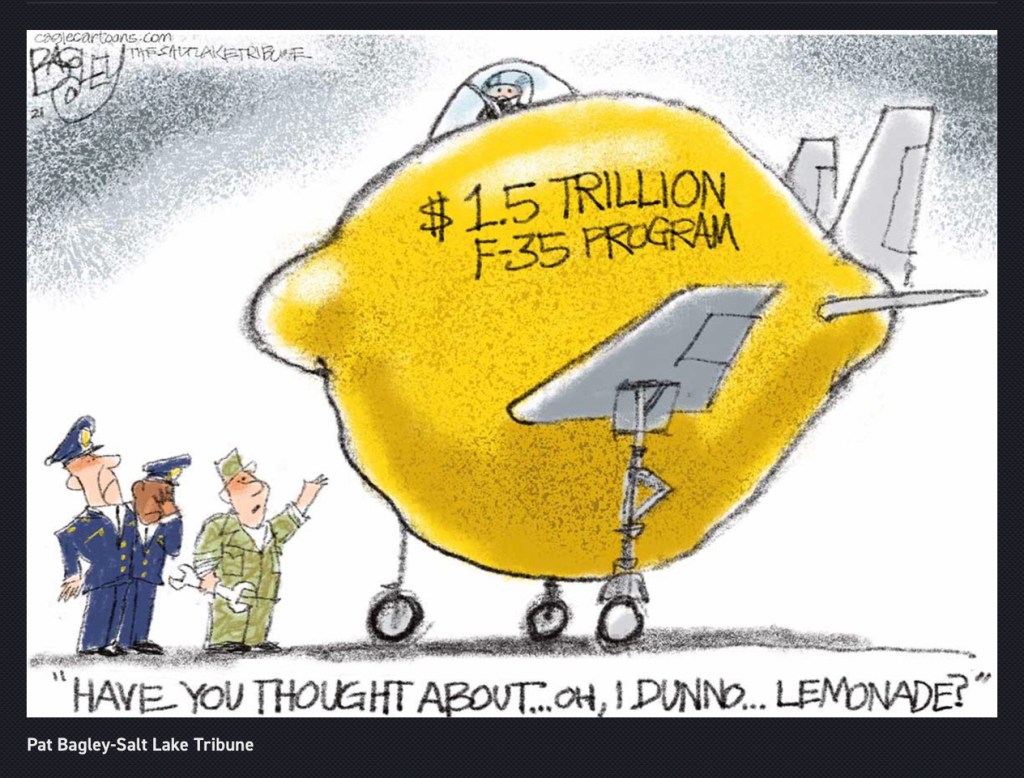
Now the “lemon” is up to $1.7 trillion. Even more lemonade?
W.J. Astore
Imagine you’re a soldier in combat. What’s the most important feature of any weapon system? That it works. That it’s reliable. Nobody wants a weapon that jams in a firefight. Reliability, simplicity, ruggedness are key features of weaponry. Yet the Pentagon and the military-industrial complex seem to specialize in unreliable, complex, fragile ones. Ones that don’t work, or that don’t work very well, and at inflated prices as well. This is the subject of my latest article at TomDispatch, and here’s an excerpt from it:
Cancel culture is a common, almost viral, term in political and social discourse these days. Basically, somebody expresses views considered to be outrageous or vile or racist or otherwise insensitive and inappropriate. In response, that person is “canceled,” perhaps losing a job or otherwise sidelined and silenced. In being deplatformed by Twitter, Facebook, and other social media sites, for instance, this country’s previous president has, it could be argued, been canceled — at least by polite society. More than a few might add, good riddance.
Cancel culture is all around us, with a single glaring exception: the U.S. military. No matter how poorly a major weapons system performs, no matter how much it goes over budget, no matter how long it takes to field, it almost never gets canceled. As a corollary to this, no matter how poorly a general performs in one of our twenty-first-century wars, no matter his lack of victories or failure to achieve mission objectives, he almost never gets cashiered, demoted, or even criticized. A similar thing could be said of America’s twenty-first-century wars themselves. They are disasters that simply never get canceled. They just go on and on and on.
Is it any surprise, then, that a system which seems to eternally reward failure consistently produces it as well? After all, if cancel culture should apply anywhere, it would be to faulty multibillion-dollar weapons systems and more than a few generals, who instead either get booted upstairs to staff positions or retire comfortably onto the boards of directors of major weapons companies.
Let’s take a closer look at several major weapons systems that are begging to be canceled — and a rare case of one that finally was.
* The F-35 stealth fighter: I’ve writtenextensively on the F-35 over the years. Produced by Lockheed Martin, the plane was at one point seven years behind schedule and $163 billion over budget. Nonetheless, the U.S. military persisted and it is now nearing full production at a projected total cost of $1.7 trillion by the year 2070. Even so, nagging problems persist, including engine difficulties and serious maintenance deficiencies. Even more troubling: the plane often can’t be cleared for flying if lightning is anywhere in the area, which is deeply ironic, given that it’s called the Lightning II. Let’s hope that there are no thunderstorms in the next war.
* The Boeing KC-46 tanker: A tanker is basically a flying gas station, air-to-air refueling being something the Air Force mastered half a century ago. Never underestimate the military’s ability to produce new problems while pursuing more advanced technology, however. Doing away with old-fashioned windows and an actual airman as a “boom operator” in the refueling loop (as in a legacy tanker like the KC-135), the KC-46 uses a largely automated refueling system via video. Attractive in theory, that system has yet to work reliably in practice. (Maybe, it will, however, by the year 2024, the Air Force now says.) And what good is a tanker that isn’t assured of actually transferring fuel in mid-air and turns out to be compromised as well by its own fuel leaks? The Air Force is now speaking of “repurposing” its new generation of tankers for missions other than refueling. That’s like me saying that I’m repurposing my boat as an anchor since it happened to spring a leak and sink to the bottom of the lake.
* And speaking of boats, perhaps you won’t be surprised to learn that the Navy has had serious problems of its own with its most recent Gerald R.Ford-class aircraft carriers. That service started building carriers in the 1920s, so one might imagine that, by now, the brass had gained some mastery of the process of updating them and building new ones. But never underestimate the allure of cramming unproven and expensive technologies for “next generation” success on board such vessels. Include among them, when it comes to the Ford-class carriers, elevators for raising munitions that notoriously don’t operate well and a catapult system for launching planes from the deck (known as the Electromagnetic Aircraft Launch System or EMALS) that’s constantly breaking down. As you might imagine, not much can happen on an aircraft carrier when you can’t load munitions or launch planes effectively. Each new Ford-class carrier costs in the neighborhood of $14 billion, yet despite all that money, it simply “isn’t very good at actually being a carrier,” as an article in Popular Mechanics magazine bluntly put it recently. Think of it as the KC-46 of the seas.
* And speaking of failing ships, let’s not forget the Navy’s Littoral Combat Ships (LCS), which have earned the nickname “little crappy ships.” A serious propulsion design flaw may end up turning them into “floating garbage piles,” defense journalist Jared Keller recently concluded. The Navy bought 10 of them for roughly half a billion dollars each, with future orders currently on hold. Lockheed Martin is the lead contractor, the same one responsible for the wildly profligate (and profitable) F-35.
* Grimly for the Navy, problems were so severe with its Zumwalt-class of stealth destroyers that the program was actually canceled after only three ships had been built. (The Navy initially planned to build 32 of them.) Critiqued as a vessel in search of a mission, the Zumwalt-class was also bedeviled by problems with its radar and main armament. In total, the Navy spent $22 billion on a failed “next generation” concept whose cancelation offers us that utter rarity of our moment: a weapon so visibly terrible that even the military-industrial complex couldn’t continue to justify it.
Chief of Naval Operations Admiral Michael Gilday has gone on record as rejecting the idea of integrating exotic, largely untried and untested technologies into new ship designs (known in the biz as “concurrent development”). Godspeed, admiral!
Much like the troubled F-35 and the Littoral Combat Ship, the Zumwalt’s spiraling costs were due in part to the Pentagon’s fixation on integrating just such “leading-edge” technologies into designs that themselves were in flux. (Not for nothing do military wags refer to them as bleeding edge technologies.) Such wildly ambitious concurrent development, rather than saving time and money, tends to waste plenty of both, leading to ultra-expensive less-than-fully effective weapons like the Zumwalt, the original version of which had a particularly inglorious breakdown while passing through (or rather not passing through) the Panama Canal in November 2016.
Given such expensive failures, you might be forgiven for wondering whether, in the twenty-first century, while fighting never-ending disastrous wars across significant parts of the planet, America’s military isn’t also actively working to disarm itself. Seriously, if we’re truly talking about weapons that are vital to national defense, failure shouldn’t be an option, but far too often it is.
With this dubious record, one might imagine the next class of Navy vessel could very well be named for Philip Francis Queeg, the disturbed and incompetent ship captain of novelist Herman Wouk’s The Caine Mutiny. It’s also quite possible that the Pentagon’s next advanced fighter jet will fulfill former Martin Marietta CEO Norman Augustine’s estimate from the 1980s that, by the year 2054, the entire Pentagon budget would be needed to buy one — and only one – combat aircraft. Perhaps a Death Star for America’s new Space Force?
Be sure to read the rest of the article here at TomDispatch.com.