Nuclear proliferation and global warming are two big issues that Donald Trump is wrong about. They’re also the two biggest threats to our planet. Nuclear war followed by nuclear winter could end most life on earth within a matter of weeks or months. Global warming/climate change, though not as immediate a threat as nuclear war and its fallout, is inexorably leading to a more dangerous and less hospitable planet for our children and their children.
What does “The Donald” believe? On nuclear proliferation, which only makes nuclear war more likely, Trump is essentially agnostic and even in favor of other nations joining the nuclear club, nations like Japan, South Korea, even Saudi Arabia. When all countries should be earnestly working to reduce and then eliminate nuclear stockpiles, Trump is advocating their expansion. (An aside: recall in a previous debate that Trump had no idea what America’s nuclear triad is; add intellectual sloth to his many sins.)
On global warming, Trump is essentially a skeptic on whether it exists (“hoax” and “con job” are expressions of choice), even as he seeks to protect his resorts from its effects. Along with this rank hypocrisy, Trump is advocating an energy plan that is vintage 1980, calling for more burning of fossil fuels, more drilling and digging, more pipelines, as if fossil fuel consumption was totally benign to the environment and to human health.
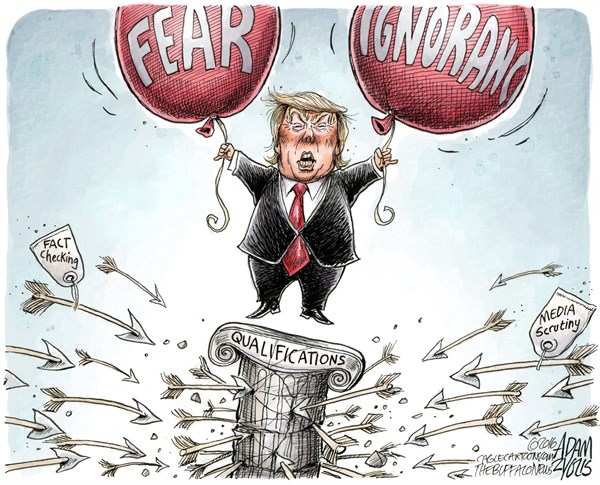
Along with his tyrannical and fascist tendencies, Trump is wrong on two of the biggest issues facing our planet today. His ignorance and recklessness render him totally unfit to be president.
The United States is addicted to war — and to war-spending. That’s the message of Bill Hartung’s latest article at TomDispatch.com. Hartung, the director of the Arms and Security Project at the Center for International Policy, writes:
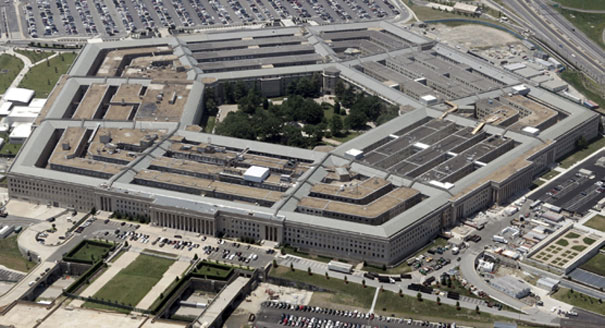
The more that’s spent on “defense”… the less the Pentagon wants us to know about how those mountains of money are actually being used. As the only major federal agency that can’t pass an audit, the Department of Defense (DoD) is the poster child for irresponsible budgeting.
It’s not just that its books don’t add up, however. The DoD is taking active measures to disguise how it is spending the hundreds of billions of taxpayer dollars it receives every year — from using the separate “war budget” as a slush fund to pay for pet projects that have nothing to do with fighting wars to keeping the cost of its new nuclear bomber a secret. Add in dozens of other secret projects hidden in the department’s budget and the Pentagon’s poorly documented military aid programs, and it’s clear that the DoD believes it has something to hide.
Having served in the military and DoD for twenty years and having read about it for twenty more, none of this surprises me.
Here’s the thing: In the Pentagon and the wider military, there’s absolutely no incentive to save money. Indeed, the incentive is to spend as much as possible, because that is the best way to increase next year’s budgetary allotment. The military is filled with “Type A” officers whose job it is to spend, spend, spend, while fighting sister services for a bigger slice of the budgetary pie. The more money you get for your program and service, the more likely you’ll get pats on the back, a medal or two, and a glowing promotion recommendation.
Next, Members of Congress. Their incentive is also to spend — to bring home the pork to their districts. And the most lucrative source of pork is “defense” spending, which has the added benefit of being easily spun as “patriotic” and in “support” of the troops.
Finally, the President. His incentive is also to spend. That’s the best way to avoid being charged as being “weak” on defense. It’s also about the only leverage the US has left in foreign policy. Just look at President Obama’s recent trip to Vietnam. The headlines have focused on the US ending its 50-year arms embargo with Vietnam, as if that’s a wonderful thing for Americans and the Vietnamese. As Peter Van Buren noted, normalizing relations with Vietnam by selling them lethal weapons is truly an exercise in cynicism by a declining American empire.
Whether it’s the Pentagon, the Congress, or the president, the whole defense wars and weapons complex is structured to spend the maximum amount of money possible while engorging and enlarging itself. Small wonder it’s never passed an audit!
Making matters worse is how the Pentagon uses various shady practices (e.g. secret budgets) to hamstrung reformers seeking to corral the system’s excesses. After detailing the Byzantine complexity of the budgetary process, Hartung concludes that:
If your head is spinning after this brief tour of the Pentagon’s budget labyrinth, it should be. That’s just what the Pentagon wants its painfully complicated budget practices to do: leave Congress, any administration, and the public too confused and exhausted to actually hold it accountable for how our tax dollars are being spent. So far, they’re getting away with it.
Put succinctly, the US National Security State may be losing its overseas wars, yet losing equates to winning when it comes to increased budgetary authority abetted by a Congress that prefers enablement to oversight. And as any military officer knows, authority without responsibility is a recipe for serious abuse.
Donald Trump’s faults are legion. But which ones are truly awful?
A crass womanizer who brags about his penis. But wait a minute. Lyndon B. Johnson was vulgar and crude and crass and a womanizer – and LBJ was easily eclipsed as a womanizer by John F. Kennedy.
A bigot who attacks Mexican immigrants and Muslims among other “undesirables.” But wait a minute. Richard Nixon railed against the Blacks and the Jews, among other “enemies” of Nixon’s righteous “silent majority” of Americans.
An ignoramus who knows little of foreign policy. But wait a minute. Many presidential candidates have lacked foreign policy experience (Jimmy Carter and Barack Obama, to cite two recent examples).
A posturing tough-guy who supports torture for America’s enemies and the murder of terrorists’ families. But wait a minute. The Bush/Cheney administration freely used torture (they just called it “enhanced interrogation techniques”), and the Obama administration freely uses drones to “take out” terrorists and whoever may be with them (including innocent family members).
A serial liar who can’t be taken at his word. But wait a minute. Name any president, other than Jimmy Carter, who prioritized truth-telling.
A bully who bludgeons his opponents into submission. But wait a minute. Just think of LBJ, Nixon, and Dick Cheney (yes, he was a Vice President, but still). These men were all bullies.
A shameless showman who exploits the media while professing to hate it. But wait a minute. Nixon despised the media; the media colluded with Kennedy to hide his negative qualities; and Obama has cozied up to the corporate media even as he’s actively prosecuted whistleblowers.
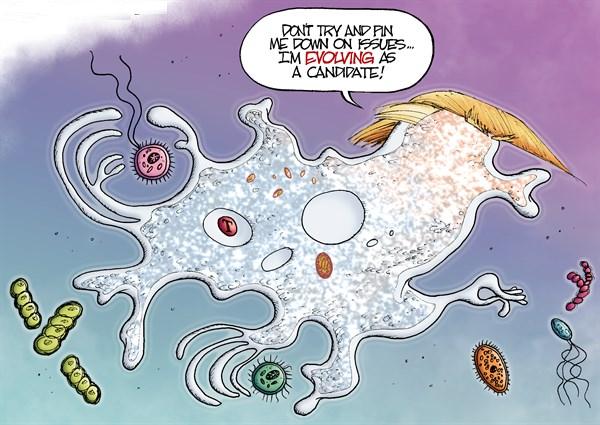
Focusing on Trump’s many “awfuls” is not the best way to defeat him, since America’s presidents have hardly been choir boys. Put simply, Trump’s prejudicial attitudes toward women, minorities, and other groups or peoples he doesn’t like don’t mark him as exceptional, nor does his record of flip-flops on issues, as the American people have come to expect that politicians are basically liars.
Where Trump is vulnerable, I believe, is his tyrannical qualities. Trump’s past behavior suggests he sees himself as above the law. Put differently, he sees himself as a law unto himself. And if he wins the presidency I simply don’t believe he’ll honor his oath of office to the U.S. Constitution.
Remember during the Frost Interviews when Nixon said, If the president does it, that means it’s legal? That’s Trump in a nutshell. Recall during the Republican presidential debates when Trump said the U.S. military would obey his orders regardless of their legality under the U.S. Constitution. Yes, he later recanted that dictatorial position, but his initial answer revealed his essential nature: I’m in charge, I’ll do what I want, everyone else has to obey me.
Here “Star Trek” fans may recall an episode from the original series called “Space Seed,” featuring Ricardo Montalban as Khan. A tyrant from Earth’s past, Khan speaks of unifying humanity under a strong leader. Spock’s reply is telling: “Unify, sir? Like a team of animals under one whip?”
Khan then waxes about the wonders of one-man rule, eventually blurting out, “We offered the world order!” The Donald, today’s version of Khan, offers to make America great again.
Trump has the makings of a tyrant. His approach to the presidency is fundamentally undemocratic. His statements and behavior suggest if he becomes president he’ll do what he wants and expect others to fall into line, even the U.S. military, which swears its oath to the U.S. Constitution and not to any one leader. At a time when Congress has abdicated its responsibility to declare war or to check executive warmaking prerogatives, a tyrant like Trump is an especially dangerous prospect as president.
Because of this, Trump is truly an awful choice for president.
Should we enlarge the military, buy more weapons, or fight more wars? Heck, let’s do all three!
W.J. Astore
Inside the Washington beltway, the debate is never focused on making major cuts to the defense budget, then using that money to improve infrastructure, health care, education, and other projects that benefit all of us domestically. No: the debate is whether we should fight more wars overseas or buy more weapons and enlarge the military for those wars.
That is the lesson from the following summary at FP: Foreign Policy that I’m pasting below:
There’s a fight brewing over the 2017 Defense Department budget, and right in the middle of the scrum is how to use the $58 billion the White House has set aside to pay for military operations in Iraq, Syria, and Afghanistan. The House of Representatives votes this week on its version of the bill, which yanks $18 billion from that account and uses it to buy more ships, dozens of fighter jets, and adding about 50,000 more troops to the rolls.
The White House and Pentagon aren’t happy about the whole thing.
On Monday, the Office of Management and Budget released a memo threatening a presidential veto of the bill, calling the move a “gimmick.” The memo added, “shortchanging wartime operations by $18 billion and cutting off funding in the middle of the year introduces a dangerous level of uncertainty for our men and women in uniform carrying out missions in Afghanistan, Iraq, Syria, and elsewhere. ”
And there are lots of elsewheres. Yemen, Somalia, Libya, Cameroon, and the Central African Republic, just to name a few. On Thursday, the Senate Armed Services Committee passed its own version of the 2017 defense policy bill, which rejects the House funding plan. The entire defense bill is $610 billion.
Indeed, there are lots of “elsewheres.” And how are those “elsewhere” wars going for the United States? As Peter Van Buren wrote on Sunday at TomDispatch.com, those wars have been repetitive disasters.
Peter Van Buren
Van Buren, who learned firsthand about the folly and fruitlessness of US reconstruction efforts in Iraq while working for the State Department, writes that:
Starting wars under murky circumstances and then watching limited commitments expand exponentially is by now so ingrained in America’s global strategy that it’s barely noticed. Recall, for instance, those weapons of mass destruction that justified George W. Bush’s initial invasion of Iraq, the one that turned into eight years of occupation and “nation-building”? Or to step a couple of no-less-forgettable years further into the past, bring to mind the 2001 U.S. mission that was to quickly defeat the ragged Taliban and kill Osama bin Laden in Afghanistan. That’s now heading into its 16th year as the situation there only continues to disintegrate…
Or for those who like to look ahead, the U.S. has just put troops back on the ground in Yemen, part of what the Pentagon is describing as “limited support” for the U.S.-backed war the Saudis and the United Arab Emirates launched in that country.
The new story is also the old story: just as you can’t be a little pregnant, the mission never really turns out to be “limited,” and if Washington doesn’t know where the exit is, it’s going to be trapped yet again inside its own war, spinning in unpredictable and disturbing directions.
The baseball-philosopher Yogi Berra coined the motto for recent US military efforts in the Greater Middle East: It’s like deja-vu, all over again. The same saying applies to Pentagon budget “debates.” It’s never about how to save money, or what “defense” truly means to America. It’s always about how to get more money, and whether it should be spent on enlarging the military, buying more weapons, or fighting more wars. The perfect trifecta is doing all three. Perhaps that’s the true “triad” of US defense policy.
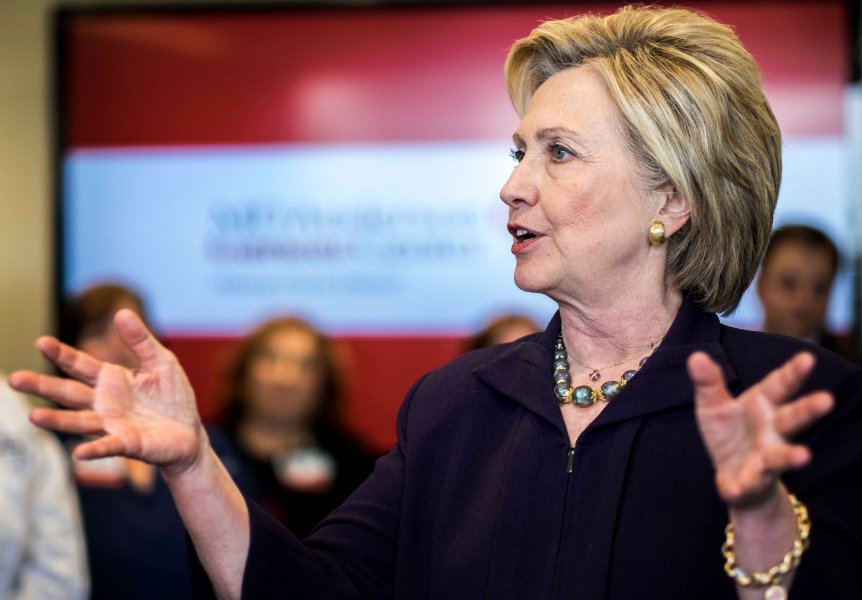
Hillary Clinton with medical professionals at Cooper University Hospital’s MD Anderson Cancer Center in Camden, New Jersey, May 11, 2016. (Melina Mara/The Washington Post)
W.J. Astore
Readers of this blog know I’m not enamored with either Hillary Clinton or Donald Trump for the presidency. Since both candidates have high negatives, I’m sure many Americans share my sentiments. The question is: Do we need more “major” candidates for the presidency? (Leaving aside Libertarian, Green, and similar “fringe” party candidates.)
Many Republicans would welcome an alternative candidate to Trump, a true establishment conservative, someone like House Speaker Paul Ryan. Of course, Ryan has recently vowed to work together with Trump, so that option is out. Similarly, many Democrats would welcome a more progressive alternative to Clinton, a principled liberal. someone like Bernie Sanders. But Sanders has ruled out a third party run, so we’re back at square one with Trump versus Clinton.
But what would happen if more “big name” presidential candidates threw their hat in the ring? In that event, I think the most likely ending is the election of Donald Trump. Trump has succeeded in mobilizing new voters and rallying them to his cause. He is, in short, a charisma candidate. His supporters, I sense, are less likely to bolt to new candidates. Clinton, in contrast, is the very definition of the establishment. Her support is broader than Trump’s but also weaker, and therefore more vulnerable to third- and fourth-party challengers.
It appears we’re stuck with Trump versus Clinton this fall since no new candidate, say one with name recognition and financial means like Michael Bloomberg, who’s already said no, wants to be branded as the spoiler who ensured a Trump victory.
According to the experts, who don’t have the greatest track record in this election, the electoral map is “completely daunting” for Trump. Perhaps so. But it would be foolish indeed to underestimate Trump’s chances against Hillary, given his gift for political posturing and her lack of appeal to independents and other fence-straddlers.
With nearly six months still to go between now and the election in November, almost anything could happen. The smart money remains on Clinton. My CNN Primary calendar gives her a two-in-three chance of victory, but that means Trump has a 1-in-3 chance, and who guessed that in 2015?
At Salon.com, Patrick Smith has a telling article on the Obama administration’s foreign policy. He details the way in which style has triumphed over substance, and how tightly the Obama administration controls the narrative in the mainstream media. Essentially, Smith provides more evidence of the way in which reporters and journalists serve as stenographers to the powerful.
Many journalists, notes Smith, are twenty-somethings who attempt to provide coverage of foreign affairs from inside the Washington Beltway. Under such conditions, even a diligent reporter has to rely far too heavily on official mouthpieces at the Pentagon, State Department, and similar governmental agencies. Those reporters who buck the system risk losing access; in short, they risk losing their privileges — and their jobs. Most end up conforming.
This is nothing new to anyone familiar with Stephen Colbert’s famous take-down of insider journalists at the Washington Correspondents’ Dinner in 2006. As Colbert said a decade ago:
But, listen, let’s review the rules. Here’s how it works. The President makes decisions. He’s the decider. The press secretary announces those decisions, and you people of the press type those decisions down. Make, announce, type. Just put ’em through a spell check and go home. Get to know your family again. Make love to your wife. Write that novel you got kicking around in your head. You know, the one about the intrepid Washington reporter with the courage to stand up to the administration? You know, fiction!
Along with that critique, Smith is excellent on critiquing the fundamental unoriginality, the militarized banality, of much of Obama’s foreign policy. As Smith notes:
There can be no radical shift in American conduct abroad, of course, until goals and purposes are addressed very forthrightly. This means taking on, in explicit fashion, our inherited tropes—our claims to exceptionalism and universalism—as well as the hegemonic ambitions the Pentagon shares with American corporations. It is a question, as noted in a previous column, of techne and telos, two words from ancient Greek. You can change the former—your method, your means—all you like, but it will matter little until you alter your telos, your aims, the ideal you strive for …
What is the new [Obama administration] narrative, then? May we know, please? I address the question to Ben Rhodes, David Samuels and Samuels’ editors at the Times Magazine. All this palaver about a brilliant foreign policy innovator and not one word about his masterstroke innovation, a reimagined frame for American conduct abroad?
The lapse is a symptom of the above-noted problem: style without substance, form without content. We cannot count even the openings to Iran and Cuba as any great departures, given Washington’s behavior since. There is no new narrative, only a new way of telling the old narrative.
Just so. Consider recent events. More U.S. “advisers” (troops) to Iraq. More foreign weapons sales. The commitment of ABM missiles to Romania. Sending B-52s (a symbol of the Cold War) to strike at ISIS. More talk of the dangers of a resurgent Russia. And (of course) more talk of enlarging the Pentagon and feeding it more money.
Yes, the Obama administration has been more reluctant than Bush/Cheney to commit big battalions of the regular army to overseas invasions and wars, but otherwise the foreign policy song has remained pretty much the same. Obama just prefers a smaller stage presence or “footprint,” as defined by Washington as drones and special ops, together with privatized militaries and extensive weapons sales, rather than big battalions.
That’s hardly a new narrative in U.S. foreign policy — precisely the point of Smith’s telling critique.
Bernie Sanders has won yet another primary against Hillary Clinton, this time in West Virginia. He’s likely to win more, perhaps even California in June. Yet what is the headline at the “liberal” New York Times?
The primary victory by the senator from Vermont will force his Democratic rival to continue a distracting nominating fight.
Can you believe the nerve of that man? Bernie Sanders is “forcing” his rival, Hillary Clinton, “to continue a distracting nominating fight.”
I suppose Democrats should just hand the nomination to Hillary, uncontested. Now that’s true democracy in action.
Without the “superdelegates,” i.e. without the support of the establishment within the Democratic Party, Hillary and Bernie would be running neck-and-neck. You’d think the media would love a close horse race like this. But no: the media is slavering for a Trump versus Hillary race. Bernie is already an afterthought, even as he keeps winning.
Bernie’s victories highlight Hillary’s weaknesses. Progressives don’t trust her. Independents are not impressed. Young people are turned off (her politics as usual is uninspiring, to say the least). Working-class whites find little of appeal in her message and record.
Yet the media, even the so-called liberal media, has already declared victory for Hillary, looking ahead to the joys of months of mud-slinging between Hillary and Trump.
Please stay in the race, Bernie. You have nothing to lose — and the country has much to gain.
I lived and taught in a rural and conservative area in Pennsylvania for nine years, an area that’s “flyover country” for Beltway elites. Back in 2008, I remember how the locals went gaga over Sarah Palin’s visit to the area, and how crestfallen so many people were when Barack Obama was elected president. I remember how people sported Bush/Cheney stickers on their cars and trucks (even the faculty at the largely vocational college at which I taught), long after these men had left office. Sadly, I also recall a lot of Confederate flag license plates, especially on trucks, but there were also people who flew them at home from their flagpoles. This was not about “heritage,” since Pennsylvania was Union country in the Civil War. No – it was about being a White “redneck” and taking the country back from, well, the “other” – Blacks, Muslims, immigrants, anyone considered to be an outsider, anyone part of the “influx,” a racially-loaded word that referred to outsiders (where I lived, mainly Blacks from Philadelphia and its environs).
Rural PA, previously Sarah Palin country, is now Trump country. In the recent presidential primary, fifty thousand Democrats in PA changed party affiliation so they could vote Republican. An educated guess: they weren’t switching parties to vote for Kasich or Cruz. They were caught up in Trump hype about making America great again!
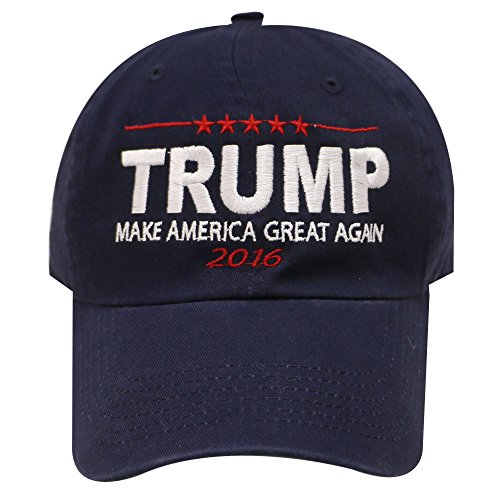
It says so on his hat!
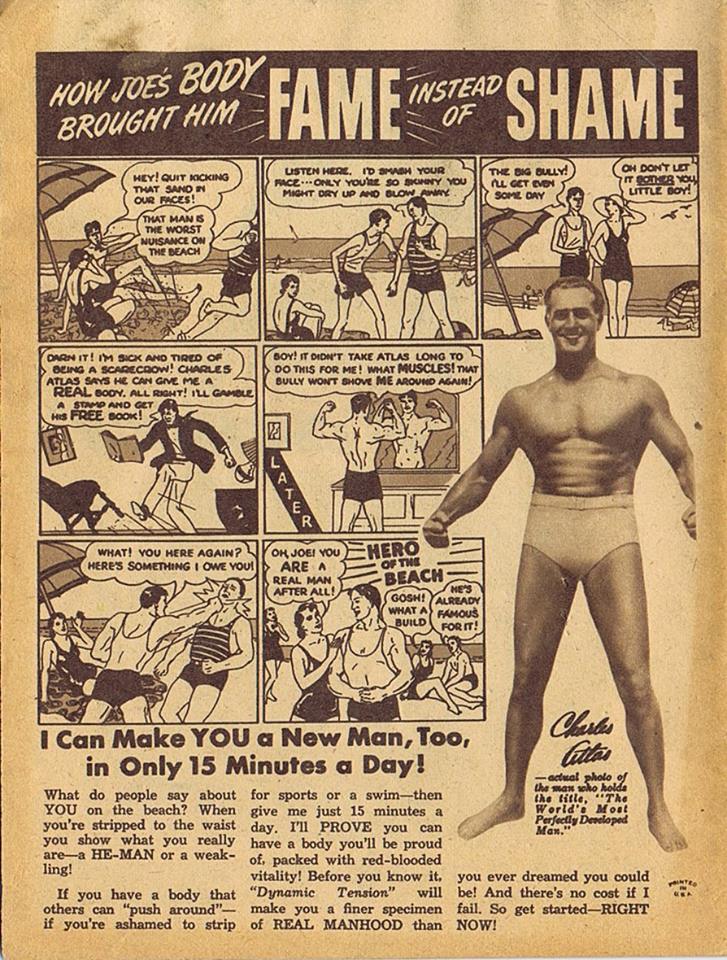
That’s a slogan to be reckoned with. Some say it’s a racist dog whistle. Those with ears attuned to the frequency hear the message as “making America great again by making it White again.” There’s truth to this, but the message is also one of nostalgia. Trump, like many of his followers, has recognized that the USA is no longer NUMBER ONE in all things, and he’s got the balls (as his followers might say) to say it plainly. No BS about America being the exceptional nation, the bestest, the kind of nonsense that flows freely from the mouths of most U.S. politicians. America is acting like a 99-pound weakling, Trump says, and he’s the Charles Atlas to whip us back into shape.
Trump’s vulgarity, his elaborate comb over, his tackiness, the shallowness of his knowledge (especially on foreign affairs), have contributed to the establishment’s ongoing dismissal of him. A recent article by Glenn Greenwald and Zaid Jilani documented the many dead certain (yet dead wrong) predictions of Trump’s imminent demise, even as he was winning primary after primary and gaining in the polls. The establishment elites just couldn’t believe that a man not vetted by them – a man best known for bloated casinos and lowbrow reality TV – could be a viable candidate for the presidency. And indeed they continue to predict his imminent demise at the hands of one of their own (Hillary Clinton) in the fall. Yet as I wrote back in July 2015, Trump is not to be underestimated.
What exactly is the appeal of Trump? Speaking his mind is one. Yes, he’s vulgar, he’s boorish, he’s ignorant, he’s sexist. Just like many of his followers. In a way, Trump revels in his flaws. He has the confidence to own them. Many people are attracted to him simply because (like Sarah Palin) he’s not a typical mealy-mouthed politician.
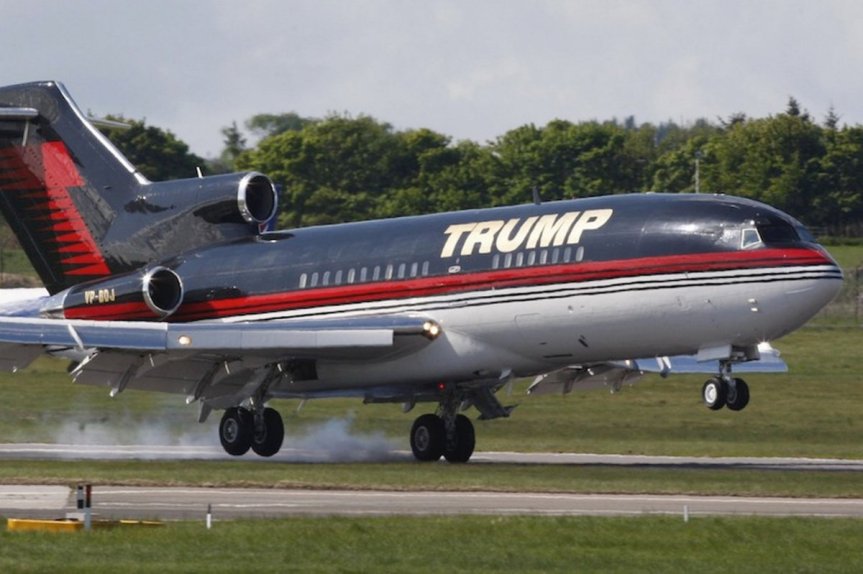
Another obvious appeal: He’s a rich celebrity who acts like a rube. Indeed, he acts like many regular folks would if they’d just won a Powerball jackpot. He’s got the trophy wife. He’s got a lot of pricey toys (How about that Trump jet?). He doesn’t have much class, but so what? Trump is Archie Bunker with money, a blowhard, an American classic. What you see is pretty much what you get. And that’s a refreshing feature for many of his followers, who have little use for complexity or nuance.
Not presidential? He already has his own “Trump Force One”
For all that, let’s not ignore Trump’s positions (such as they are) on the issues. He’s against a lot of things that many Americans are also against. He’s critical of immigration. He’s more than wary of Muslims. He despises “political correctness.” He’s against trade deals (so he says). The Chinese and Japanese come in for special opprobrium as trade cheaters. “And China! And China!” Trump declaims as he launches another round of attacks on the Chinese for stealing American jobs. Trump’s followers believe they’ve finally found their man, someone who will stand up to the Chinese, the Mexicans, the Muslims, and all those other foreigners who are taking their jobs and hurting America.
Trump is a master of scapegoating. But more than this, he takes positions that show a willingness to depart from Republican orthodoxy. He’s expressed support for Planned Parenthood (except for its abortion services) because of the health care it provides to women. He’s outspokenly critical of U.S. wars and nation-building (as well as Bush/Cheney and company). He wants to rebuild America’s infrastructure. He wants to force America’s allies to pay a greater share of their own defense costs. He’s not slavishly pro-Israel. He’s not enamored with neo-conservative principles and the status quo in U.S. foreign policy. He wants to put “America first.” As far as they go, these are respectable positions.
Yet I’ve not come to praise Trump but to explain, at least partially, his appeal and its persistence. Trump’s negatives are well known, and indeed I’ve written articles that are highly critical of him (see here and here and here). Most of Trump’s supporters are aware of the negatives yet plan to vote for him regardless. Why?
Desperation, to start. Americans are drowning in debt. They’re scared. Not just the lower classes but the middle classes as well. Just consider the title of a recent article at The Atlantic: The Secret Shame of Middle-Class Americans: Nearly half of Americans would have trouble finding $400 to pay for an emergency. Times are far tighter for ordinary Americans than Beltway elites know or are willing to admit.
In tough times an unconventional candidate like Trump (or Bernie Sanders) offers hope – the promise of significant change. What does Hillary Clinton offer? So far, more of the same. But scared or desperate people don’t want the same, with perhaps a few more crumbs thrown their way by establishment-types. They want a political revolution, to quote Bernie Sanders. They want freshness. Authenticity.
Strangely, despite all his flaws and insults and bigotry, or rather in part because of them, Trump seems more genuine, more of a candidate of the people, than does Hillary. Bernie Sanders, another genuine candidate with big ideas, beats him handily in the fall, I believe. But Bernie is being elbowed out by the establishment powerbrokers in the Democratic Party. The big money (of both parties) is pegging its hopes on Hillary. It’s already predicted her sobriety and “experience” will triumph over Trump’s wildness and inexperience.
Given the record of “expert” predictions so far in this election, as well as Trump’s own track record, I wouldn’t be too confident in betting against The Donald.
With Trump now the presumptive nominee after his victory in Indiana and Ted Cruz’s withdrawal from the race, the Republican narrative seems clear. Trump’s appeal is summed up nicely here by NBC:
Trump won by discovering a primal desire among GOP voters for a swaggering populist who would buck orthodoxy on trade, protect entitlements, build a border wall, deport all undocumented immigrants, and implement an “America First” foreign policy that demanded allies pay for U.S. protection or go it alone.
Millions of supporters, distrustful of their party’s leaders, rallied behind him as a unique figure whose personal fortune enabled him to spurn donors and say what he wanted with impunity.
His presumptive opponent: Hillary Clinton. But not so fast! Playing the spoiler, Bernie Sanders won in Indiana and has an outside chance of denying the nomination to Hillary. As Bernie pointed out in Indiana, he’s winning the vote of those 45 years of age and younger, and his appeal is strong among liberals and independents.
A large part of Bernie’s appeal is that he’s a man of principle with a clear message. I can easily tell you what Bernie is for. He’s for a political revolution. He wants a single-payer health care system. He wants free college tuition for students at state colleges. He wants campaign finance reform. He wants a $15 minimum wage. He wants to break up big banks. He was against the Iraq War and wants a less bellicose foreign policy. The man knows how to take a stand and stick with it.
Now: What does Hillary Clinton want, besides the presidency of course? It’s hard to say. For the last few months, she’s essentially been responding to Bernie. As his progressive and idealistic message resonates with voters, Hillary cautiously adopts aspects of it. For example, she was against a $15 minimum wage until she was for it. She’s made noises about getting big money out of politics even as she’s siphoned up as many Benjamins as she could. Lately, she’s pivoted and begun to run against Trump, as if Bernie has no chance at all to deny her the nomination.
Here’s the problem for Hillary: She’s a MOTS candidate, or more of the same. She’s promised a continuation of President Obama’s policies, at least domestically, while in foreign policy she’s promised to take a harder line than Obama. But I’m hard-pressed to name a single major policy initiative that’s uniquely hers, and I’ve watched virtually all of the Democratic debates and town halls. She’s running as a technocrat, as an insider, as Obama in a pantsuit but with iron fists.
Assuming it’s Hillary versus Trump in the fall, it’ll be Trump who has the ideas, crazy or divisive or unsustainable as they may be. And it’ll be Hillary who’ll be running as the “safe” candidate, the anti-Trump, the one whose motto might be, “the audacity of establishment incrementalism.”
Is that what American voters are looking for? Establishment incrementalism? More of the same?
Stay in the race, Bernie Sanders, and give us a real choice this fall.
You’ve seen the headlines: Can Donald Trump beat Hillary Clinton?
The short answer: Of course he can. And so can she beat him.
It’s a long time until November, and so much can (and will) happen between now and then. But some obvious points about the volatility of this year’s presidential race:
1. Both candidates have high negatives. An NBC/Wall Street Poll suggests that 68% of voters doubt whether they could vote for Trump – and 58% of voters doubt they could vote for Hillary. High negatives suggest lack of enthusiasm as well as antipathy. Turned off by the candidates, many voters may simply stay home in November. And that makes for a volatile race.
2. Trump is prone to gaffes. The man will say almost anything: Women seeking an abortion deserve to be punished. Women reporters who challenge him are cranky from their period. Mexican immigrants are thugs and rapists. Muslims must be banned from the U.S. Terrorists’ families should be hunted down and killed. Protesters at his rallies should be punched and thrown out. And on and on. So far, Trump has been a Teflon candidate: His outlandish statements have not harmed him appreciably. But how long before he says something equally offensive, or worse, as we head toward the general election this fall?
3. Trump’s business record. Trump University, anyone? That trial should be interesting. As lawsuits stalk Trump, how long before some past deal, either dodgy or dishonest, blows up in his face?
4. Hillary’s political record. Benghazi, anyone? But potentially worse than Libya is the ongoing FBI investigation into Hillary’s emails. Perhaps she’ll be cleared of wrongdoing, but the taint of wrongdoing will remain. Indeed, a hint of scandal has always surrounded the Clintons – and it’s not just because of a “vast right-wing conspiracy.”
5. Hillary’s lack of political acumen: It’s hard to get enthusiastic about Clinton. Other than the fact she’d be the first female president (a big milestone, of course), there’s nothing new about her. Consider her race against Bernie Sanders. It was Bernie who drove the narrative. It was Bernie who won the vote among the young, both male and female. Hillary is the staid old establishment. When she raves, it’s about continuity. But who wants continuity in America today? What American is truly happy with the status quo (besides members of the establishment, of course)?
6. Wildcard events: Another 9/11-like attack. A bear market on Wall Street. Wider conflict in the Middle East. An incident with China in the Pacific. A Russian move against Ukraine. Will a crisis favor the “experience” of Clinton, or will people prefer Trump because “he gets things done” or “puts America first”? As Yoda the Jedi Master says, “Difficult to see. Always in motion the future.”
7. Finally, consider the fact that Bernie Sanders has run an issues-oriented campaign against Clinton. He hasn’t attacked her on her emails. He’s left Bill Clinton’s past behavior out of the mix. But just wait until the fall when the Republican attack dogs are unleashed. Hillary is fond of saying she’s seen it all from Republicans, but with the stakes this high, I’m guessing there’s much she hasn’t seen.
So, yes, Trump can beat Clinton, and vice-versa. The sorry fact is that regardless of which candidate wins, the country will be left with a deeply flawed leader who’ll be despised or disliked by more than half the electorate.