Trump’s latest press conference is worrisome for so many reasons. He seems to live in his own reality (e.g. his administration is “a fine-tuned machine“). He’s still obsessed with Hillary Clinton and the margin of his victory. He seems only recently to have learned how serious the prospects of a nuclear holocaust could and would be. He continues to defend General Michael Flynn, saying that even though Flynn undermined the Obama administration and lied to Vice President Mike Pence, his rapprochement to Russia was laudable (with Trump suggesting that, even though he hadn’t approved Flynn’s actions, he might have). He even tasked a Black reporter to set up a meeting with the Congressional Black Caucus for him!
What to make of The Donald? Trump seems to thrive on creating animosity, then exploiting it. Special targets for him include the U.S. intelligence community and the media, both of which he sees as implacable enemies. But is animosity and chaos any way to run a country or to represent a people?
I can see how calling out your perceived enemies might work in business, especially a personal one, though Trump’s bankruptcies suggest otherwise. But Trump is no longer a free-wheeling real estate tycoon. He’s president now, a symbol (like it or not) of America. Generating animosity and discord as a public servant is divisive, fractious, selfish, and unwise.
A united America is much stronger than a disunited America, but since Trump thrives on division, his personal style is weakening our country. You might say he’s the opposite of Abraham Lincoln, who appealed to the better angels of our nature in a noble but ultimately failed attempt to unite a disunited country. Whatever else Trump is about, it’s not better angels.
Instead of making America great again, Trump is making it divided and uncivil again.
Mister President: Please stop blaming the media, or Hillary, or the intelligence community, or judges, or anyone else for that matter. Get on with the job of being a public servant. America needs inspired leadership, not self-serving rhetoric. We need a uniter, not a divider.
Rise above the pettiness, Mister President. For the nation’s sake, don’t be the pettiness.
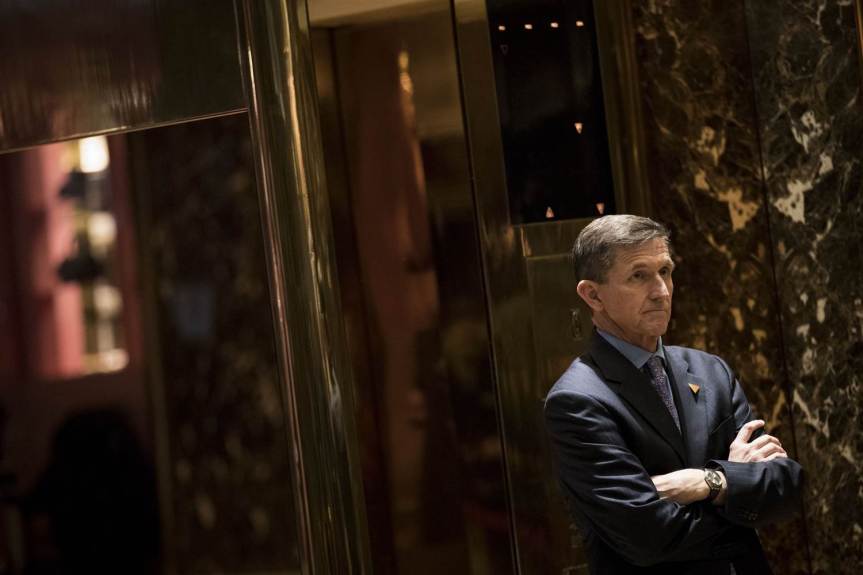
Flynn waiting for an elevator in Trump Tower back in December (NBC)
W.J. Astore
General Michael Flynn’s resignation as National Security Adviser is good news, and not only because of his lack of candor in regards to Russia. Flynn is a believer in religious war. He sacralized the war on terror and saw himself as a holy warrior against radical Islamist terrorists. (Of course, he couldn’t perceive his own extremism and radicalism.)
Both in religious terms and in predatory terms, men like Flynn and Steve Bannon see radical Islamists as the enemy. These “animals” cut off heads! A creed war that treats the enemy as animals is a combustible combination. When you see the enemy as an inferior yet insidious “Other,” there is no opportunity for compromise. Vermin can only be exterminated. Especially when they are allegedly out to destroy your “Judeo-Christian” values.
Flynn’s war against radical Islamists would be unending, driven as it would be by outrage against what he saw as a verminous enemy. In such a “holy” war, killing acquires quasi-sacred meaning. Flynn’s war was not to be a Clausewitzian war of politics by other means. Nor was it a greed-war driven by money and empire. His war was far more insidious.
When you conceive of the enemy as predators who simultaneously have the human ability to enslave you with their own creed (Sharia Law): Well, this enemy is a shape-shifting monster. Small wonder that Flynn infamously tweeted: “Fear of Muslims is RATIONAL.”
What was the source of his fear? In theory, what is the biggest threat to humans? Not tigers or snakes or other predators; they can be identified. The biggest threat is something human but not quite human. Something that looks human, has human skills, human smarts, but is ruthlessly inhuman, even as it readily blends in with “normal” humans.
They look like us — act like us — and that’s precisely the problem! Even a five-year-old Muslim refugee, no matter how innocent-looking, is seen by Sean Spicer and crew as an opening to an unstoppable invasion of America, hence Trump’s hurried and sweeping ban on Muslim immigration.
Flynn’s ideology supported the dynamic of permanent religious war. His writings and tweets were consistent with an exterminatory struggle for existence of the worst kind. His actions and views would only perpetuate jihad, a struggle he apparently sees as inevitable.
Until we neutralize jihadists like Flynn (and Bannon) and his Islamist counterparts, until we see a common humanity instead of viewing the enemy as insanely ferocious predators who are out to destroy our way of life, there is no hope for even a semblance of peace in this world.
Nora al-Awlaki, 8 years old, killed in the Yemen raid
W.J. Astore
The Trump administration’s first “kinetic” military action, last weekend’s raid on Yemen that killed a Navy SEAL as well as fifteen women and children, was an operational failure. Aggravating that failure has been the aggressive propaganda spin applied by the White House. According to White House spokesman Sean Spicer, the operation was a major success:
“Knowing that we killed an estimated 14 AQAP [Al Qaeda in the Arabian Peninsula] members and that we gathered an unbelievable amount of intelligence that will prevent the potential deaths or attacks on American soil – is something that I think most service members understand, that that’s why they joined the service.”
Later, Spicer doubled down, accusing Senator John McCain (and other critics of the raid) of defaming the dead Navy SEAL when he suggested the raid had been something less than a towering success. McCain, Spicer said, owed the dead SEAL an apology.
Trump himself then joined the fray, accusing John McCain in a tweet of emboldening the enemy and suggesting he’d “been losing so long he doesn’t know how to win anymore.”
Yet, by Spicer’s logic, President Trump himself owes an apology to all U.S. troops killed in the Iraq and Afghan wars, since Trump has criticized these wars as either unnecessary or botched in execution. Recall here that Trump said he was against the Iraq invasion in 2003, but once the U.S. invaded, he said the U.S. government botched it by not taking Iraq’s oil, which, he claimed, would have prevented the rise of ISIS.
The Iraq war, Trump has said, was a mistake, a failure, a loss. He promised to show America how to “win” again. Is the recent Yemen raid what he meant by a “win”?
Nearly everything went wrong in the Yemen raid. Surprise wasn’t achieved. U.S. troops were killed and wounded. Far too many non-combatants (innocent civilians) were killed, including an eight-year-old girl. A $75 million Osprey malfunctioned and had to be destroyed.
To hazard a guess, this raid probably cost the U.S. in the neighborhood of $250 million while failing to achieve its main objective. Meanwhile, the enemy put up fierce resistance with weaponry, mainly small arms and explosives, that probably cost less than $100,000.
In brief, the U.S. raid on Yemen was prodigal in cost, profligate in resources, and unproductive in results.
Of course, I can’t say for certain that the raid didn’t secure vital intelligence. According to Spicer, an “unbelievable” amount of intelligence was seized. But early signs are unpromising. The U.S. military chose to share, in the immediate aftermath of the raid, a video of bomb-making training by al-Qaeda (apparently from a seized laptop), only to remove it when they learned the training video was a decade old and readily available on YouTube. Some intelligence coup!
The Trump administration is promising to launch more raids, featuring an “easier approval cycle” than witnessed under President Obama. Indeed, some reports suggest President Trump was goaded into approving the Yemen raid by being told his predecessor wouldn’t have approved it.
If the Yemen raid is the new face of “winning” under Trump, America may yet long for the days of “losing” under previous presidents.
Show me your budget and I’ll tell you what you value. Under the Trump administration, what is valued is spending on military weaponry and wars. The Pentagon is due to get a major boost under Trump, as reported by the Associated Press and FP: Foreign Policy:
Money train. It’s looking like it might be Christmas in February for the U.S. defense industry. The Pentagon has delivered a $30 billion wish list to Congress that would fund more ships, planes, helicopters, drones, and missiles, the AP reports.
And that might only be the beginning.
President Trump has already ordered the Pentagon to draft a “supplemental” budget for 2017 that would include billions more for the U.S. military on top of the $600 billion the Obama administration budgeted for…
As FP’s Paul McLeary and Dan De Luce recently reported, there are proposals floating around for a defense budget as high as $640 billion for 2018, which would bust through congressionally-mandated spending caps that Democrats — and many Republicans — are happy to keep in place. Defense Secretary Jim Mattis has been tasked with completing the supplemental request by March 1.
The Pentagon, which has never passed a financial audit and which has wasted more than two trillion dollars over the years (this figure came in 2001, when Donald Rumsfeld was Secretary of Defense under Bush/Cheney), is due to be given even more money to spend, irrespective of past performance or future need.
Naturally, each military service is already posturing and clamoring for the extra money promised by Trump. Consider the U.S. Navy, which, according to Vice Chief of Naval Operations Admiral William Moran, will be “Just Flat Out Out Of Money” without this supplemental funding boost from Congress.
According to the Navy and Marine Corps:
Five attack submarines would see their maintenance availabilities canceled this year and be put at risk of being decertified if no supplemental were passed out of Congress, Moran added, in addition to similar cuts to surface ship maintenance availabilities.
Assistant Commandant Gen. Glenn Walters said “we would stop flying in about July” without a supplemental. He clarified that forward forces would continue to operate, but for units training at home, “all training would cease without a supplemental, and that includes the parts money and the flying hour money.”
Even if the supplemental – which could total between $30 and $40 billion for all the armed services – is passed in a timely manner, the Navy and Marine Corps still face massive readiness issues that money can’t immediately address.
That last part is disturbing indeed. Even with billions in additional funding, the Navy still faces “massive readiness issues.”
Well, here are a few radical suggestions for Trump and the Pentagon:
If money is tight, why not re-prioritize? If readiness is compromised, why not scale back the mission?
Before boosting funding, why not force the Pentagon to pass a financial audit?
If trillions of dollars have gone “missing” over the last decades (remember, a Republican Secretary of Defense made this claim), why not launch missions to find that money before spending billions of new money?
You don’t reform a bureaucracy that wastes money by giving them more money. It’s like reforming an addict on drugs by giving him more money to spend on drugs. Until the Pentagon can account for its spending, its budget needs to be flatlined or cut.
The only way to force the Pentagon to think about “defense” spending is to limit its budget. Throwing money at the Pentagon just ensures more of the same, only more: as in more weaponry, more wars, and more fraud, waste, and abuse.
Given the Pentagon’s track record over the last half-century, does anyone truly think that more money is a solution to anything?
Democrats need an honest post-mortem – not dishonest scapegoating – in the aftermath of their devastating 2016 defeat.
Transferred nationalism, like the use of scapegoats, is a way of attaining salvation without altering one’s conduct. – George Orwell, “Notes on Nationalism” (London: Polemic, 1945)
Many have written about the recent Women’s March in Washington, D.C. — and in other cities across the United States – which occurred in response to President Donald Trump’s early executive orders, cabinet appointments, in-your-face culture-war media-baiting, and (of course) his signature late-night twitter trolling. Lots of things to legitimately oppose and protest, surely, but to my knowledge, few of these articles have analyzed the women-led protest marches from the standpoint of exculpatory political scapegoating, if not transferred nationalism, as George Orwell explained the meaning of that term in his famous essay. For my part, I would like to try and address this imbalance.
First off, several signs that I saw from the Women’s March addressed President Donald Trump personally in terms that I had difficulty connecting with Women’s Rights, such as I understand them. I don’t have a problem with either the imagery or the language, however crude or even profane, since Donald Trump himself seems to delight in offending as many persons, nations, and institutions as he possibly can if it serves his purposes. So, if he receives rough treatment, in picture or word, then he has it coming. He gets no sympathy from me. My problem with these signs stems not from their tone of deserved disrespect, but from their strange fixation on Russia and Russian President Vladimir Putin who – as far as I can tell – has no power to deny an American woman equal pay, access to a safe abortion, maternity leave, or quality public education for her children, among other issues that women – as women – typically consider important.
For example, take the following piece of work, a pointed paraphrase of an old children’s nursery rhyme:
I saw other signs of a similar nature, another of which I will cite later as a further example. I cannot speak to the generality of such sentiments, and I would hope that only a few persons harbor them, but this unfortunate expression of malignant partisan irrelevancy immediately gets to the point raised by Robert Parry in an article he wrote for Consortium News (February 1, 2017): namely, “Dangers of Democratic Putin-Bashing – Exclusive: As national Democratic leaders continue to blame Russian President Putin for their 2016 defeat, they’re leading their party into a realignment with the neocons and other war hawks.”
While I concur with Mr. Parry’s article in the main, I have to disagree with his use of the present progressive tense and the word “realignment.” As a matter of fact, the alignment of the Democratic Party with “neocons and other war hawks” took place decades ago, with President Bill Clinton. President Barack Obama and the hapless Democrats in Congress, for their part, have only reinforced and strengthened this alignment. To speak of this dreadful reality as if it exists only as a possible development in the future rather misstates the truly grim and long-established reality. Otherwise, and specifically as this article relates to the Women’s March, consider a comment I came across in response to Robert Parry’s article:
“evelync”
February 1, 2017 at 11:35 am
I have to admit that I was unable to drag myself to the women’s march because I was unsettled by the concern that it was being used, perhaps, to try to keep Hillary Clinton’s foot in the door.
Another commenter wrote:
“D5-5”
February 1, 2017 at 2:15 pm
I don’t know that having allowed themselves to sink into the behaviors employed to knock off [Senator Bernie] Sanders, then expanding these to Russia-bashing, as the Dems and Clinton did, will likely take them in the direction of an ‘oh, let’s get honest here and see why we lost the election, and straighten ourselves right out to become an actually decent alternative to offer to the American people.’
Two points here:
(1) Why not blame the Democratic Party and its deeply unpopular, demonstrably inept, largely unaccomplished, and repeatedly discredited candidate, You-Know-Her [Hillary Clinton], for losing instead of crediting the political rookie Donald Trump – and by extension, Russian President Vladimir Putin – for “winning”?
(2) Why not insist that the losing Democrats conduct a long-overdue autopsy, summarily purge their Wall-Street/Permanent-War “leadership” (the names Clinton and Obama come to mind here), and reform themselves into a truly working-class, anti-war party capable of winning back the loyalty of those impoverished Americans whom they have betrayed and abandoned for Ivy-League University degrees and swell vacations on Martha’s Vineyard with other newly rich members of their privileged “professional” class?
But attaining emotional salvation through scapegoating – so as not to require actually doing anything to cure the real political and economic disease of neoliberalism – does seem the order of the day among these marchers, most of whom one must suppose voted for You-Know-Her and the neoliberal status quo that downwardly dropping American workers hate with an abiding and vengeful passion. The Damsel of Distress has done it again, snatching defeat from the jaws of victory as only a “New Democrat” named Clinton could manage. How that must hurt!
Moving right along, I came across another image from the Women’s March that showed a man holding a mask of Vladimir Putin in front of his face while holding what looked like marionette strings from which dangled the image of Donald Trump as a puppet.
Now, I know You-Know-Her openly called Donald Trump a “puppet” of Vladimir Putin during one of the fall campaign debates, so it does not surprise me that some of her partisan supporters would credulously accept this gratuitous slur without bothering to think through the preposterous illogic behind it. For as those who have read the WikiLeaks documents have explained, the Clinton campaign tried everything they could to promote the candidacy of Donald Trump on the theory that he would make the weakest opponent, one whom You-Know-Her would have the least trouble vanquishing. Consider the following excerpt from the article “They Always Wanted Trump: Inside Team Clinton’s year-long struggle to find a strategy against the opponent they were most eager to face”, by Gabriel Debenedetti, Politico (November 07, 2016):
Clinton’s team drew up a plan to pump Trump up. Shortly after her kickoff, top aides organized a strategy call, whose agenda included a memo to the Democratic National Committee: “This memo is intended to outline the strategy and goals a potential Hillary Clinton presidential campaign would have regarding the 2016 Republican presidential field,” it read.
“The variety of candidates is a positive here, and many of the lesser known can serve as a cudgel to move the more established candidates further to the right. In this scenario, we don’t want to marginalize the more extreme candidates, but make them more ‘Pied Piper’ candidates who actually represent the mainstream of the Republican Party,” read the memo.
“Pied Piper candidates include, but aren’t limited to: Ted Cruz, Donald Trump, Ben Carson
We need to be elevating the Pied Piper candidates so that they are leaders of the pack and tell the press to [take] them seriously.”
Now, aside from the arrogant (but not implausible) notion that You-Know-Her’s campaign could tell [as in, “command”] the press whom to take seriously, no one has ever questioned the accuracy of these memoranda from John Podesta to You-Know-Her’s campaign. But just consider what they tell us.
First, if Donald Trump owed his candidacy to You-Know-Her’s campaign to promote him as a Pied Piper over all the other Republican candidates, and if Russian President Vladimir Putin somehow contrived to make all this happen, then that would credit Vladimir Putin with first manipulating one puppet, You-Know-Her, to control Trump, another puppet. In the interest of metaphorical accuracy, then, the marching protester here should have worn a Putin mask while holding the strings to a puppet of You-Know-Her holding the strings to another puppet, All-About-Him [Trump].
Second, if President Putin had successfully pulled off this convoluted manipulation of both presidential candidates, then why would he possibly let that fact come to light in these WikiLeaks memos? Wouldn’t he want to keep his sinister Machiavellian machinations a secret, so as not – as America’s CIA spooks like to say – reveal his “sources and methods”? As a former KGB intelligence officer, surely he knows his espionage tradecraft better than that. So, logically, President Putin would have no interest in revealing his omnipotent control of America’s two hapless presidential candidates. It makes no sense that Russia would leak anything about this to WikiLeaks or any other journalistic source. That would only discredit Trump as a dupe of both You-Know-Her and Vladimir Putin.
Complete bullshit, either way. It would appear that – in truth – John Podesta and You-Know-Her got just the opponent they wanted to run against: Donald Trump. Then they lost to their own “Pied Piper” puppet. But still they want to scapegoat Russian President Vladimir Putin for their own manifest failure to recognize and respond to the seething desperation of America’s working class. The people want jobs and incomes, not more NAFTA or TPP trade deals. You-Know-Her promised more of the latter. Trump promised at least some of the former. Gee whiz. Who could have ever figured out which way that “choice” would go?
Not that Republican Donald Trump will necessarily deliver anything more than tax cuts and deregulation to the Corporate Oligarchy while shoveling loads of crappy culture war to the proles who voted for him, but sheer luck, some media-sense, and good timing have given him the chance. I seriously doubt that he has the knowledge and competence to pull off anything resembling PEACE, but he does now have that opportunity. Who knows if he has the wit to seize it?
At any rate, it appears as if the defeated Democrats have chosen Russian President Putin as an attractive scapegoat simply due to (1) his “foreignness” and (2) the nature of transferred nationalism. This psychological transference, Orwell wrote, “has an important function. … It makes it possible for [the nationalist] to be much more nationalistic – more vulgar, more silly, more malignant, more dishonest – than he [or she] could ever be on behalf of [their] native country, or any unit of which [they] had real knowledge.”
Americans know little, if anything, about the Russian Federation or its duly elected, competent, domestically popular, and internationally respected president. Creative costumes and too-clever-by-half slogans aside, it seems like a monumental waste of time, energy, and limited American attention span for the Democrats to scapegoat President Putin for their own stupidity, arrogance, and insensitivity to their party’s traditional base.
The Democrats had better look inward and get their own act together. Either that, or get another goat.
Michael Murry is a Vietnam Veteran, gargoyle sculptor, and poet. A loyal correspondent to Bracing Views, he is also a contributor to The Contrary Perspective.
Linda with her hat and the note that accompanied it
Linda Roller
Editor’s Intro: Linda Roller is a good friend who owns one of those used bookstores that bibliophiles dream about, complete with cats and books and ephemera and located in an old church in the middle of rural Pennsylvania. It’s an area that went for Trump in last year’s election; it’s not an area associated with political activism for progressive causes. Yet Linda’s community filled three buses of concerned citizens, all willing to sacrifice their time to make a statement in a March on Washington that was, in a word common to last year’s election, huge. Can the momentum for a true people’s movement be sustained? With powerful women like Linda on the march, I am hopeful. W.J. Astore
Check out Linda’s bookstore at this link. She has a great selection of used books at low prices.
I Went Down to The Demonstration…
The March on Washington can be seen — six hours of it — on You Tube. I almost tuned in the other day, but I resisted until I had a chance to write down what I saw there. For I never saw the speeches, heard the words. I never saw the jumbotrons. And I never got to the elliptical. But that’s okay. That was recorded, and what I saw was the stuff that is not covered by any media, but was important to me and will be with me forever.
Waiting on the World to Change…
Perhaps the first inkling that this was going to be far more than “a bus ride and a demonstration” was the early morning in a Sears parking lot in Muncy, Pennsylvania. A sea of cars was there, just waiting for the three buses from our rural, conservative, suspicious of outsiders (both people and ideas) area. It wasn’t just the people who demonstrate here, and who identify themselves as “true Progressives.” Frankly, that group wouldn’t fill a bus. It was really a diverse lot of folks, and although there were many older, white women, there were African-American women from Williamsport, and even a good percentage of people under 40. The women who organized this trip were not the “usual suspects,” which may account for the different people on the buses.
The trip started with a glitch. Two of the three buses were late — the buses organized through the national group. This could have led to defections, but … people waited. The local bus left to collect the women from down the Susquehanna valley. The other arrived an hour later.
The chief organizer here is a woman who owns her own little yarn and knitting shop, and has never done anything like this before. But the knitting connection was the catalyst for all members who wanted to get a “pussy hat.” She had hats from around the globe, the last shipment being from Australia. Mine was knitted by Lori in Indianapolis, and it warmed me to know that another woman from a conservative state felt strongly enough to knit for others. Both buses stopped at a rather small service station, with a small women’s restroom. We discovered that the men’s room was even smaller, as we commandeered it for the over 75 women who had to use it in less than 30 minutes. One guy tried to assert his rights, and we were apologetic but firm.
Normally, leaving from here at 5:20am on a weekend morning would get you to DC by 9:30 or so on a charter bus. But traffic was amazingly heavy, and we got in a little late. The bus captains went over safety tips, non-confrontation issues, how not to be arrested—and that the buses were leaving at 6:30pm, with or without us. And then we got off the bus.
Fired Up! — Ready to Go!!
Off the bus in an ocean of buses…from everywhere! The first woman I met was from San Francisco, visiting family in Delaware and marching. We had been told that the metro was too full, even though the Mayor of DC had brought all lines up to rush hour levels to accommodate the march. I saw an older woman in a walker headed to the metro stop at RFK stadium from the buses, with the kind of determination that moves mountains. And with that, our group of four headed to the National Mall, a little over two miles away. Although our group were the only people that I could locate from the bus at that moment, we were hardly alone. We were simply part of a river streaming ahead, north and west to the center. And we were not invisible. We were met early by DC traffic safety, who reminded us to mind the roads near RFK, to block some roads, and with a smile welcoming us to DC. “We’re glad you’re here!”
Indeed, it seemed as though all the good citizens of the District were out to welcome the marchers, as we blocked their streets and removed any way for these folks to move cars and go about a normal Saturday. They waved, said “Thank you for coming!” Members of Capitol Hill Seventh Day Adventist Church stood on the steps and chanted, and the minister came down and shook marchers’ hands, as we disrupted their day of worship. About halfway to the National Mall, the signs with quotes from Martin Luther King popped up everywhere, for MLK day was less than a week ago. Music poured out of windows for the marchers — “Girls Just Wanna Have Fun”… (as in Fundamental Rights).
And with that it began to feel like something even bigger—it all began to take on echoes of other marches, other days, other people. By now, we were chanting, and really marching. Five blocks out, and we were already there, doing the work we came to DC to do. And then we got to the US Capitol Building, and the enormity of it all washed over our group of marchers. Before us, there was an ocean of people—people who were deeply concerned, and here to stand. To stand for Women’s Equality, for immigrants who feel threatened, for people of every race, creed, religion, sexual orientation, and for a sense of justice. And yes, to show concern and anger at President Trump’s statements and actions. But the overall feeling was that we stood in solidarity with one another, even if we did not totally agree on all the issues.
Before I left, I did a small piece on Facebook about why I marched, and one of the things that I said was that I marched for those who could not. Time and time again, people talked about a mother, a sister, a friend that was symbolically with the marcher. One woman I saw had a placard on her back with over 50 names of women she marched for. It was simply staggering.
Standing on the Side of Love
Like I said, I never saw the stage, or heard the addresses of the day. There was no chance that I could get there. I never saw the jumbotrons where proceedings were broadcast. That’s okay. I saw and talked to people just like me from all over the country, and people just like me but different. They had different clothes, different hair, different skin, different religion, different age—but the same heartfelt wishes, the same fears for the future, the same willingness to stand and be here today.
And those of us who made a march were kind to each other — all our Mommas had made polite people on this day. And that was tested—as there were few places to sit, no places to get a bite to eat or drink, and in many places on the National Mall, no place even to stand. At one point, the four of us were crushed against a barrier, and could not move. A woman in the crowd began to have a claustrophobic reaction, and the people made a tunnel for her and her people to get out of there, even when so many others would have liked to move. We apologized for stepping on toes, we allowed people in and around, and most importantly, we talked to each other, asked where we were from, and regarded each other as people. And at noon, a group of Muslim women unfolded blankets and prayed, while others gave them space and peace.
Sure, I saw some great signs. One person knitted a 4-5 foot uterus as a sign. That’s dedication. A group walked about with a 10-12 foot globe and chanted. That’s heavy lifting. Lots of humorous signs, signs of exasperation. Organized signs. Disorganized signs. Signs made by people for weeks, signs made by people after they got there, on scraps of cardboard. And the “official” signs were incredibly artistic and you could download them for free and print them.
There was some “cosplay” too. I marched beside Wonder Woman for about 3 minutes. WW must have been cold in the outfit, and I have no idea who it was. I saw a few Superwoman socks – the ones with the capes on them. Since most of us marched around 10 miles if we walked from RFK, I think we all were worthy of a set of those. I saw some Power Rangers get photographed, and on the top of pallet stacks, people climbed and tried to help the rest of us see where people were needed. People on lampposts tried to give directions, but that was mostly futile.
Tell Me What Democracy Looks Like…This is What Democracy Looks Like!!!
In some sense, the wheels had fallen off this wagon. The planned speeches and march were simply dwarfed by the numbers of people. We couldn’t march the planned route. It was full, as were many other streets. We couldn’t get to the Washington Monument. The way there was full of people – and in that sense, it was a complete, perpetual march around everything by all of us.
The most common chant was “This is what democracy looks like.” Indeed. It is the look of citizens– concerned, aroused citizens. It was a whole lot of a gentle, angry people. Some more gentle, some more angry—and all of them chanting for a country they all deeply believe in. That this march was so large had an impact that transcended the original plans. And while we marched, information about all the other marches all over the world swirled through the National Mall to waves of cheers.
Finally, it was the witching hour – the time to go back to the bus. We worked our way out of the mall and began the slog up to RFK. We were so hungry, with sore feet. A beer in a pub would have been heaven, but heaven was already claimed by others, and the wait was too long for us to meet the bus. We eventually found a coffee shop. Nancy got us a chai latte, and nothing ever tasted so good or felt so warm. I sat on the curb outside, just for a chance to sit. And I sat with others from the march, and we talked, waited for a little bit of food, took the chance to relax, and talked about the march – but not in a “processed” sort of way.
It was as if the event was too big to be contained inside us. Cars going by honked and waved. On the way to try for a beer, we crossed in front of a car, filled with people we did not know. But the windows rolled down, and we talked to each other. They were not even involved in the march, just locals. But the signs and buttons made us approachable, and the day of talking to so many people in the march had our skills oiled up, too. At the coffee shop, we all decided that if we could get a cab or uber, we would take a ride for the 2 miles. It wasn’t long before we had that cab, and then got up to RFK. And that move allowed some shirt buying, a round of great hot dogs, and then the ½ mile from the actual stadium to the bus.
Laura and Nancy had a much better idea of where our bus was than I did and there we were—near the back of the lot. All the people on our bus made it back by 6:30, but we waited for a couple people in the second bus, who ended up taking a taxi back. On the road by 7PM. Nancy organized a better bus stop at a different location, where there were two large gas/convenience store/restrooms. We talked a bit, but surprisingly we slept, even though we thought we were too excited to do that.
The days since have been “processing days”—time to think about what happened and time to begin the plan beyond the march. The march was a mountaintop moment. It was a place and time, a gathering of like-minded people, a time to feel connected, and a time to feel the power of the people. Now the hard work of creating and recreating the vision continues.
I have not been an activist for many years. I feel that demonstrations are performance art. I am more at home in the life of the mind. But as the sign says,
“Thank you, President Trump.
You have created an activist in me.”
Linda Roller is a writer and owner of a used bookstore in Avis, PA. Be sure to visit her shop (link here) and browse her selection of used books at great prices.
In a recent article for TomDispatch.com, I argued that Americans have embraced weapons and warriors, guns and gun exports, prisons and guards, all supported by a steady stream of fear. The end result has been a cesspool of violence largely of our own making. In such an environment, a man like Donald Trump, more opportunist than populist, more power-driven than public servant, more cynic than idealist, has ample opportunities to thrive.
The complete article is here; in this excerpt, I focus on Trump’s rise as well as the rise of a uniquely American anti-hero, the vigilante Dark Knight, AKA Batman.
Since the end of the Cold War, America has been exporting a mirror image of its domestic self — not the classic combo of democracy and freedom, but guns, prisons and security forces. Globally, the label “Made in the USA” has increasingly come to be associated with violence and war, as well, of course, as Hollywood action flicks sporting things that go boom in the night.
Such exports are now so commonplace that, in some cases, Washington has even ended up arming our enemies. Just consider the hundreds of thousands of small arms sent to Iraq and Afghanistan that were simply lost track of. Many of them evidently ended up on sale at local black markets.
Or consider the weapons and equipment Washington provided to Iraq’s security forces, only to see them abandoned on the battlefield and captured by the Islamic State.
Look as well at prisons like Gitmo — which Donald Trump has no intention of ever closing — and Abu Ghraib, and an unknown number of black sites that were in some of these years used for rendition, detention and torture, and gave the United States a reputation in the world that may prove indelible.
And, of course, American-made weaponry like tear gas canisters and bombs, including cluster munitions, that regularly finds its way onto foreign soil in places like Yemen and, in the case of the tear gas, Egypt, proudly sporting those “Made in the USA” labels.
Strangely, most Americans remain either willfully ignorant of, or indifferent to, what their country is becoming. That American-made weaponry is everywhere, that America’s warriors are all over the globe, that America’s domestic prisons are bursting with more than two million captives, is even taken by some as a point of pride…
Increasingly, Americans are submerged in a violent cesspool of our own making. As a man who knows how to stoke fear as well as exploit it, President Trump fits into such an atmosphere amazingly well. With a sense of how to belittle, insult and threaten, he has a knack for inflaming and exploiting America’s collective dark side.
But think of Trump as more symptom than cause, the outward manifestation of an inner spiritual disease that continues to eat away at the country’s societal matrix. A sign of this unease is America’s most popular superhero of the moment. He even has a new Lego movie coming. Yes, it’s Batman, the vigilante alter-ego of Bruce Wayne, ultra-rich philanthropist and CEO of Wayne Enterprises.
The popularity of Batman, Gotham City’s Dark Knight, reflects America’s fractured ethos of anger, pain, and violence. Americans find common cause in his tortured psyche, his need for vengeance, his extreme version of justice. But at least billionaire Bruce Wayne had some regard for the vulnerable and unfortunate.
America now has a darker knight than that in Donald J. Trump, a man who mocks and assaults those he sees as beneath him, a man whose utterances sound more like a Batman villain, a man who doesn’t believe in heroes — only in himself.
The Dark Knight may yet become, under Trump, a genuine dark night for America’s collective soul. Like Batman, Trump is a product of Gotham City. And if this country is increasingly Gotham City writ large, shining the Batman symbol worldwide and having billionaire Trump and his sidekick — Gen. Michael Flynn? — answer the beacon is a prospect that should be more than a little unnerving.
It wasn’t that long ago that another superhero represented America — Superman. Chivalrous, noble, compassionate, he fought without irony for truth, justice and the American way. And his alter ego, of course, was mild-mannered Clark Kent, a reporter no less.
In Trump’s America, imagine the likelihood of reporters being celebrated as freedom fighters as they struggle to hold the powerful accountable. Perhaps it’s more telling than its makers knew that in last year’s dreary slugfest of a movie, Batman v Superman: Dawn of Justice, the bat rode high while the son of Krypton ended up six feet under.
Let me, in this context, return to that moment when the Cold War ended.
Twenty-five years ago, I served as escort officer to Gen. Robinson Risner as he spoke to cadets at the U.S. Air Force Academy. Risner’s long and resolute endurance as a prisoner of war during the Vietnam War — captured in his memoir, The Passing of the Night — had made him something of a real-life superhero to us then.
He talked to the cadets about public service, love of country and faith in God — noble virtues, based on humility, grace and inner strength. As I look back to that night, as I remember how Gen. Risner spoke with quiet dignity of the virtues of service and sacrifice, I ask myself how America today could have become such a land of weapons and warriors, guns and gun exports, prisons and fear, led by a boastful and boorish bullyboy.
How did America’s ideals become so twisted? And how do we regain our nobility of purpose? One thing is certain — the current path, the one of ever greater military spending, of border walls and extreme vetting, of vilification of the Other, justified in terms of toughness and “winning,” will lead only to further violence and darker (k)nights.
Be sure to check out TomDispatch.com, a regular antidote to the mainstream media.
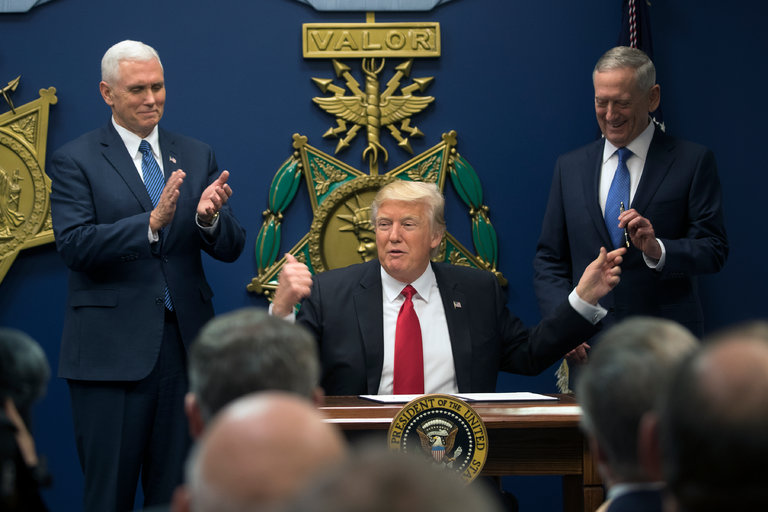
Trump has done it again. At the Pentagon, before a backdrop that honors America’s highest award for valor, the Medal of Honor, Trump signed an Executive Order on immigration. The backdrop seemed to suggest that Trump was doing something honorable and brave himself in signing yet another Executive Order. This EO, as the New York Timesreported, “suspended entry of all refugees to the United States for 120 days, barred Syrian refugees indefinitely and blocked entry for 90 days for citizens of seven predominantly Muslim countries. It also allows Christians to be granted priority over Muslims.”
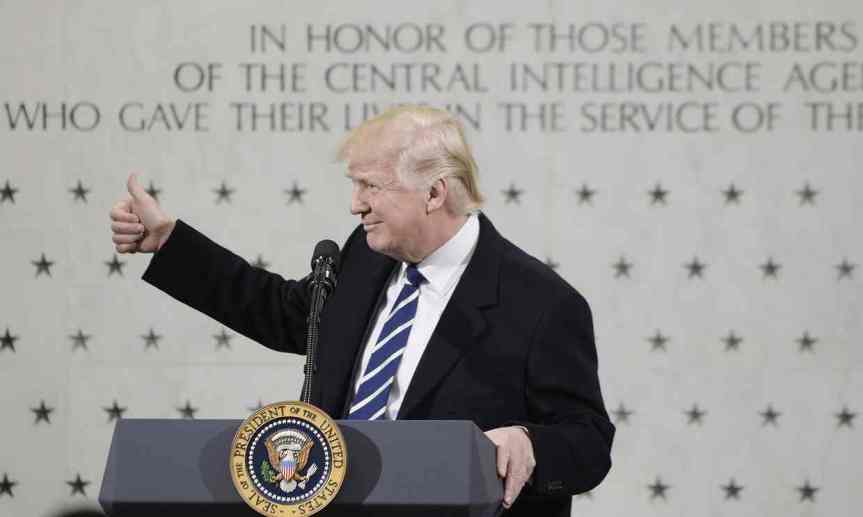
Last week, Trump appeared at the CIA, before its wall of heroes, blustering again about grabbing Iraq’s oil and boasting of the number of times he’d appeared on Time magazine (more than Patriots quarterback Tom Brady, which seemed to please him to no end).
Perhaps Trump will next appear before Christ on the cross to complain about how he (Trump) is being crucified in the press.
You’ve got to hand it to Trump: the man simply has no shame. And no taste either.
Trump’s pomposity was captured perfectly yesterday in a quip at my local bank. I was asking the teller about dollar coins (yes, we still have those), and she showed me a couple. They looked too much like quarters so I passed on getting any. The gent behind me quipped: “Just wait until Trump puts himself on the coin.” As I laughed and said words to the effect of, I can see it happening, the gent then quipped, “Trump will be on both sides!”
That about sums it up. Trump would indeed put his own mug on both sides of the coin. It would be a clear case of “heads he wins, tails we lose.”
Yesterday, I caught President Trump’s speech before the CIA. As he stood before the wall of honor, surrounded by the stars on that wall that represent those who gave their lives for their country, Trump deviated from his prepared comments to boast about how many times he’d appeared on the cover of Time magazine.
Here’s what he said: I HAVE BEEN ON THEIR COVER ABOUT 14 OR 15 TIMES. I THINK WE HAVE THE ALL-TIME RECORD IN THE HISTORY OF TIME MAGAZINE — IF TOM BRADY IS ON THE COVER, IT’S ONE TIME. I’VE BEEN ON 15 TIMES. I THINK THAT’S A RECORD THAT COULD NEVER BE BROKEN.
Really, President Trump? You’re giving a speech before members of the CIA, and what comes to mind is the number of times your own mug has appeared on a magazine cover? And you’re doing this in front of the CIA’s wall of honor, which, according to your own words, is “very special”?
Whatever one thinks of the CIA and its history, one thing is certain from this speech: America has elected an appallingly tone-deaf and callous narcissist as its 45th president.
Reporter David Barstow (right) in 2014. He won a Pulitzer in 2009 for his reporting on retired generals serving as Pentagon hacks (referenced in the article below)
W.J. Astore
Note to reader: In May of 2008, I wrote this draft article, which became the basis of a shorter piece published at Nieman Watchdog later that year under the title, “Networks should replace Pentagon cheerleaders with independent military analysts.” Media coverage of the U.S. military and America’s wars is often lamentable as well as one-sided; if anything, media coverage as well as access under Obama has worsened. I’ve decided not to edit what I wrote in 2008, partly because the underlying dynamic remains the same. Rare it is for the curtain to be lifted on the messy realities of war; and those who choose to lift it, like Chelsea Manning, pay a high price indeed for honesty.
Obama’s recent decision to commute Manning’s prison sentence was a rare case of mercy, in this case extended to a truth-teller who did far more than the silver-haired generals cited below to educate Americans about war and its awful realities. 1/18/2017
The first thing that came to mind as I read David Barstow’s exposé [April 2008] in the New York Times, “Behind TV Analysts, Pentagon’s Hidden Hand,” was the classic scene in Casablanca where Claude Rains expresses his shock to Humphrey Bogart at the gambling going on, even as he collects his own winnings. Surely, Americans knew that the retired generals and colonels being paraded before them on network news were, in spite of their mufti, anything but unbiased, independent, “civilian” critics?
OK, maybe I’m more skeptical than some. But I was genuinely surprised, even shocked, at the brazenness of the Pentagon’s PR campaign, the fact that so many retired military men eagerly joined in “to carry [the Pentagon’s] water,” even at how eagerly they traded on their military expertise. Some even continued to advise top defense contractors as they offered supposedly disinterested testimony on TV. At times, however, their testimony merely echoed talking points fed to them during invitation-only briefings at the Pentagon. These briefings were designed not to support troops in harm’s way (a laudable goal) but to defend [Secretary of Defense] Don Rumsfeld and the Bush Administration’s strategy. (Those few officers who refused to parrot the Pentagon’s line found their access curtailed or even denied, Barstow shows.)
Not surprisingly, the mainstream media has either ignored Barstow’s exposé or effectively dismissed it as old news or business as usual. Fortunately, Glenn Greenwald at Salon has tenaciously pursued the story, revealing ever more clearly how the Pentagon’s propaganda campaign tried “to put the best possible face” (one retired officer’s words) on failing efforts in Iraq.
Clearly, the Pentagon courted these retired military men, identifying reliable “go to guys” and rewarding them with access to the Pentagon and the Secretary of Defense (access being pure gold within the Washington beltway). Such access included the aforementioned, invitation-only, PowerPoint briefings, which included “talking points” that these officers could then robotically repeat on TV, passing them off as their own informed and unbiased opinions. Such collusion indicates a well-oiled, influence-peddling, Pentagonal machine serviced by sycophantic cheerleaders, and it assuredly warrants investigation by Congress.
Seven Reasons to Dismiss the Sycophants
That said, the very idea of relying on retired military men as expert critics was fundamentally flawed from the beginning. The obvious reason why networks relied on these men (and they were all men) as expert commentators was because they lacked their own in-house experts. That, and the fact that they wanted to purchase the authority of these colonels and generals while being seen by viewers at home as patriotic and supportive of the troops.
I’d like to suggest seven reasons why this reliance on retired military “talking heads” was so wrongheaded, some obvious, some perhaps less so:
Despite their civilian coat-and-tie camouflage, these officers are not ex-generals and ex-colonels: they are retired colonels and generals–a distinction with a difference. They still carry their rank; they still wear the uniform at military functions; the rank-and-file still deferentially call them “sir”; their cars still have military stickers with eagles (for full colonels) and stars (for generals); they’re still saluted smartly when they drive on- and off-post. These men enjoy constant reminders and privileges of their high military status, and I’d wager nearly all of them think of themselves as military men first, “civilians” second. In short, these men identify with the U.S. military–indeed, they are the military–hardly a recipe for disinterested or dispassionate analysis of our military’s performance in Iraq, or anywhere else for that matter.
Along with identifying closely with the military, many of these media generals and colonels serve as advisors to defense contractors, who potentially stand to profit from continued fighting. This remarkable state of affairs persists despite the fact that, throughout their career, military officers are taught to avoid even the appearance of conflicts of interest, precisely because the potential for impropriety taints the integrity of the officer as well as the entire military-contractor process. It’s not enough to say, “I’m a man of integrity and I’d never compromise it for self-interest or personal gain.” You must strive to avoid even the appearance of a conflict of interest–a maxim that is so drilled into military training that it should be reflexive to these men, like coming to attention and saluting the flag as the National Anthem is played. Yet several of these men apparently saw no conflict in advising defense contractors while marching before the TV cameras to present “critical” and “independent” military analysis.
Within the military, there’s a strong bias against Monday-morning quarterbacks. There’s a natural tendency to defer to the commander-in-the-field, and to allow him or her to get on with the job without being micro-managed or second-guessed. As newly minted “civilian” advisors to the networks, these men don’t want to become what they themselves probably despised while they still wore the uniform–those cold, timid, milquetoast critics who’ll never know the triumphs and tribulations of Teddy Roosevelt’s mythical man in the arena.
Along with a strong bias against second-guessing, many military men see criticism as disloyal and destructive, not loyal and constructive. As a concept, loyalty within the military is simple to define but incredibly complex in its manifestations. Officers swear an oath to the Constitution of the United States, of course, and to that they must remain loyal. But there also exist strong personal and institutional loyalties; sometimes, these loyalties are so strong that they come to obscure the somewhat more abstract, if higher, loyalty to the Constitution. Sadly, some military men put loyalty to their service branch first, even before loyalty to the Constitution. Or they conflate the two: What’s good for the Army is ipso facto good for the country.
This is not to say these military men are somehow “bad”–only that they’re human. To understand this better, let’s look at a typical general’s background. In a very powerful way, this man probably lives for and loves the military. Military service may be in his family tree for generations. Perhaps he followed his father from post to post as a child (a military “brat,” it’s called, with affection). He then attends a service academy like Annapolis or West Point, where he’s told incessantly that he’s the best, and where he also learns that loyalty to one’s peers and service is paramount. As a commissioned officer, he then serves for thirty or more years in uniform, achieving flag rank and all the privileges as well as burdens that come with that rank. After this man retires, would we expect him to become a dynamic and even outspoken critic of an institution that defined his life? An institution that he loves?
It’s unlikely that senior military men will provide trenchant criticism, not only because they identify closely and personally with the military, but because they don’t want to run the risk of possibly undermining troop morale in the field. Related to this is the belief that “negative” and “biased” media criticism led to America’s defeat in Vietnam, the old “stab-in-the-back” myth that I’ve addressed elsewhere, and that Barstow’s exposé proves is still alive and well in today’s military.
Thus the testimony of these military men is not simply self-interested. They genuinely believe their boosterism is helping to redress the balance of otherwise negatively-biased, “liberal,” anti-military media coverage. Lending credence to this reading is a recent article in the Naval Institute’s Proceedings (January 2008). In “Stop Blaming the Press,” journalist David Danelo recalls a comment made by the current Commandant of the Marine Corps, General James Conway, back in September 2006. Lauding Marine reporters, Conway barked to rousing applause, “Maybe if we could get the rest of the media to do the job like you folks, we might have a chance of winning the war [in Iraq].”
In defending the evenhandedness of most media coverage, Danelo’s piece drew two strong dissents in the February issue of Proceedings. One Navy officer wrote to complain that Danelo failed “to level criticism at reporters for not doing their part to ensure victory.” Today’s press, this officer implied, neither supported the American soldier nor wanted to see America succeed in the war. Another officer, a retired Marine, wrote that “just one negative story” from an American journalist “bolsters our enemies’ confidence and resolve while equally destroying support from the public at home, thus eroding our servicemen’s and women’s resolve on the battlefield.” Refusing to suffer such journalistic “fools,” whose “stories could not have been more harmful than if al Qaeda had written them,” this officer demanded immediate military censorship of media working in-theater. Those journalists who refused to cooperate “would operate at their own risk and without military protection,” he concluded ominously.
Such opinions remain a commonplace in today’s military, especially among men of a certain age who began their service at the tail end or soon after the end of the Vietnam War. Indeed, evidence strongly suggests Senator John McCain shares this opinion.
Paradoxically, the fact that the war in Iraq has not gone well may be a reason why some of these military men believe we can’t afford criticism, especially if you believe this war can and must be won, as most of them do. Call this the “You can’t handle the truth” argument, combined with the “wars are always messy” argument. These arguments lead military men to suppress their own doubts, fearing that, if they air them fully, they’ll not only fatally wound an already faltering war effort, but that their peers may even see them as having given aid and comfort to the enemy.
The last, and perhaps most powerful, reason why networks should not lean heavily on retired military men as commentators is that it’s extremely difficult for anyone, let alone a diehard military man, to criticize our military because such criticism is taken so personally by so many Americans. When you criticize the military, people don’t necessarily recognize the patriotic subtlety of your exposé of the military-industrial complex. They hear you attacking Johnny and Suzy—the efforts of their son and daughter, or the boy and girl next door, who selflessly joined the military to defend America and make a positive difference in the world. Who really wants to hear that Johnny and Suzy may possibly be fighting (and dying) for a mistake? (Another way of putting this might be, “Why doesn’t that Cindy Sheehan shut up already?”) And, assuming he believed it, what retired military man wants to pass along that message to an audience of millions on TV?
What Is to be Done?
Relying on senior military officers, recently retired, to serve as disinterested critics is a bit like inviting Paul von Hindenburg, ex-Field Marshal of the German Army, to testify in 1919 on why his army lost World War I. You may get some interesting testimony–just don’t expect it to be critical or for that matter even true.
What the mainstream media must do now is act. Specifically, they must develop their own, independent, military experts, ones not beholden to the military-industrial complex, ones who don’t own stock in the defense industry, ones who don’t serve as advisors to defense contractors.
The mainstream media must also be willing to risk the ire of the American people by criticizing the military in stronger terms. The fact that major media outlets have come to rely on military talking heads for “critical” analysis reveals the inherent timidity of today’s media in taking on the Pentagon and the Bush Administration. Media outlets must get over their fear of being perceived as unpatriotic. They must air tough-minded criticism, even if some viewers tune out, turn off, and drop in to “patriotic” outlets like Fox News.
Obviously, it will take time for the media to develop its own, truly independent, military experts. In the meantime, they should consider using junior officers and NCOs, with recent combat experience, who have separated from the service. Why does an “expert” have to be a retired, white-haired colonel or general?
For that matter, why does an “expert” need to have worn an American military uniform? Some of the most creative analysis may come from “civilian” military historians or even from foreign military officers who are not emotionally connected to the U.S. military, and who thus don’t have to worry about having their patriotism questioned each time they hazard a criticism of U.S. strategy or tactics.
Until the mainstream media takes these steps, it will continue to be in thrall to the military, as is Congress itself, which also largely refuses to challenge the military before or during a war, in part because members of Congress fear being accused of defeatism and thus of losing elections.
The truth is that there’s a creeping militarism in our country–an excessive deference to military men, whether retired or still on active duty. Just look at the acclaim awarded to General Petraeus each time he comes to testify before Congress. Indeed, the presumptive Republican presidential nominee, John McCain, is already deferring to Petraeus, stating he would not make any decision regarding diverting troops to Afghanistan to search for Osama bin Laden without first receiving the blessing of the presumptive commanding general of CENTCOM.
If that’s where we’re headed, why don’t we just declare Petraeus to be our Caesar and appoint our “civilian” mainstream media military experts to command his Praetorian Guard? It sure would make matters clearer to the American people.