Trump’s Emerging Kleptocracy

usa-trump-11
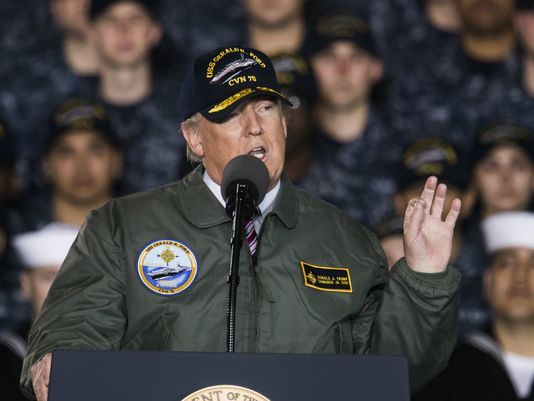
Trump’s latest “con man” hat puts USA front and center, with 45 on the side (Trump, sadly, will be America’s 45th president, unless widespread sanity breaks out)

W.J. Astore

Back in 2010, I wrote an article for TomDispatch.com in which I compared the U.S. government and its corporate handlers to a kleptocracy.  Here’s what I wrote:

What drives America today is, in fact, business — just as was true in the days of Calvin Coolidge. But it’s not the fair-minded “free enterprise” system touted in those freshly revised Texas guidelines for American history textbooks; rather, it’s a rigged system of crony capitalism that increasingly ends in what, if we were looking at some other country, we would recognize as an unabashed kleptocracy.

That’s what we’re witnessing right now with Trump and his family: crony capitalism. Unabashed kleptocracy.  It’s nothing new, except now it’s being done openly and unapologetically by the president-elect, who claims the law of the land says he can’t have conflicts of interest, because as president he’s exempted from those laws.

Recall the saying that history repeats itself, first as tragedy and then as farce.  Trump is both tragedy and farce, but more than anything, he’s a tragedy for our democracy.

Here’s more of what I wrote back in 2010.  It’s prescient, I think, and I’m not proud to say that:

An old Roman maxim enjoins us to “let justice be done, though the heavens fall.”  Within our kleptocracy, the prevailing attitude is an insouciant “We’ll get ours, though the heavens fall.”  This mindset marks the decline of our polity.  A spirit of shared sacrifice, dismissed as hopelessly naïve, has been replaced by a form of tribalized privatization in which insiders find ways to profit no matter what.

Tom Engelhardt documents Trump’s opportunistic greed in his latest introduction to Nick Turse’s humorously painful article on the farce that is Trump.  Here’s what Engelhardt has to say about Trump’s emerging kleptocracy:

Trump is a family man in every sense of the word. His business is a family business. No matter what anyone tells you, there’s no more way to separate him from his brand, with his kids running it, than there is to separate a shark from the ocean or Ivanka from her line of jewelry. There’s no way this administration can be anything but a walking, talking conflict of interest of a kind never before seen or even imagined in this country.  It’s easy, in fact, to guarantee one thing: that foreign business and political interests will have a field day when it comes to applying pressure to the new American president.

Truer words were never written.  Imagine placing Gordon “Greed is Good” Gekko (he of cinematic “Wall Street” infamy) in charge of America, and that’s Trump, except Trump seems to have even fewer scruples.

Anyway, the intrepid Nick Turse journeyed to Trump Tower in Manhattan to survey the farce that is the Trump transition team.  I urge you to read his article in full, but here’s his conclusion:

Descending the switchback escalators [in the Trump Tower], I found myself gazing at the lobby where a scrum of reporters stood waiting for golden elevator doors to open, potentially disgorging a Trump family member or some other person hoping to serve at the pleasure of the next president. Behind me water cascaded several stories down a pink marble wall, an overblown monument to a bygone age of excess.  Ahead of me, glass cases filled with Trump/Pence 2016 T-shirts, colognes with the monikers “Empire” and “Success,” the iconic red “Make America Great Again” one-size-fits-all baseball cap, stuffed animals, and other tchotchkes stood next to an overflowing gilded garbage can.  Heading for the door, I thought about all of this and Joe [a secret service agent] and his commando-chic colleague and Trump’s deserted private-public park, and the army of cops, the metal barricades, and the circus that awaited me on the street.  I felt I’d truly been given some hint of the future, a whisper of what awaits. I also felt certain I’d be returning to Trump Tower — and soon.

Circus, indeed.  Trump has mastered that, but will he provide the bread as well to complete the bread and circuses pairing?  And will the people be satisfied with empty spectacle and a few crumbs of bread as Trump takes America for a kleptocratic ride?

It was said about the Emperor Nero that he fiddled while Rome burned.  Instead of fiddling, Trump, one assumes, will make deals and sell trinkets, all for his personal profit, even as American democracy burns.

Welcome to kleptocracy in the open, America.  As the inferno rages, remember this happy fact: For only $10,000 you too can wear Ivanka’s bracelet!

bracelet-question-still-shoppable
One bracelet to bring them all and in the darkness bind them.


The Indispensable Nation?

101222_pentagon_605_reuters
With Trump’s election, it’s a bull market at the Pentagon

W.J. Astore

In two recent speeches, President Obama has repeated the conceit that the United States is “the indispensable nation.”  Apparently, that means the U.S. must lead “the free world,” with a none-too-subtle corollary that other “free” nations must follow.  Yet the conceit of indispensability gets the U.S. into serious trouble.  It facilitates interventionism and meddling, and when the U.S. intervenes and meddles, it’s almost always in military ways, often disastrously (Afghanistan, Iraq, Libya are just three recent examples).

This is hardly surprising.  The U.S. military has roughly 800 bases worldwide.  Its aircraft carriers are essentially mobile American bases, bristling with weapons and munitions.  The U.S. spends roughly $600 billion a year maintaining this military and empire, even as it continues to dominate the world’s arms trade.  This heavy investment in weaponry and war-making, abetted by a mentality that celebrates “global reach, global power,” is a strange way to define your nation as being “indispensable.”

How did America come to invest so much of itself in military weaponry and incessant wars?  One reason is the quest for total safety.  As one of my friends put it:

It [the notion of total safety] must be a post-1941 thing [after the shocking sneak attack on Pearl Harbor]. I think in both cases (1917 [U.S. entry into World War I] and 1941 and maybe 2001) the question Americans have asked is how to keep an evil “over there” somehow from affecting us. In all three cases, I think the answer was neutrality until neutrality no longer seemed to offer safety. My guess is that the idea that total safety required global involvement comes from c.1948, fears of the USSR’s globalism, atomic paranoia, and the desire to protect and preserve the new American affluence. Thus NSC-68 gets passed with nary a whisper of opposition.

What is NSC-68?  We must turn the clock back to 1950, the Cold War, and the Truman Administration, as detailed here by The History Channel:

According to the [National Security Council’s] report, the United States should vigorously pursue a policy of “containing” Soviet expansion. NSC-68 recommended that the United States embark on rapid military expansion of conventional forces and the nuclear arsenal, including the development of the new hydrogen bomb. In addition, massive increases in military aid to U.S. allies were necessary as well as more effective use of “covert” means to achieve U.S. goals. The price of these measures was estimated to be about $50 billion; at the time the report was issued, America was spending just $13 billion on defense.

Under President Trump, we’re likely to see a new version of NSC-68, another expansion of the U.S. military (and U.S. militarism), along with covert action by a newly empowered CIA, this time in the name of containing and defeating radical Islam rather than godless communism.

Defense company stocks are already soaring at the prospect of much higher military spending under Trump, notes William Hartung today at TomDispatch.com.  Trump is difficult to predict, so Hartung takes him at his word in this passage:

A window into Trump’s thinking [on defense] can be found in a speech he gave in Philadelphia in early September. Drawing heavily on a military spending blueprint created by Washington’s right-wing Heritage Foundation, Trump called for tens of thousands of additional troops, a Navy of 350 ships (the current goal is 308), a significantly larger Air Force, an anti-missile, space-based Star Wars-style program of Reaganesque proportions, and an acceleration of the Pentagon’s $1 trillion “modernization” program for the nuclear arsenal (now considered a three-decade-long project).

Todd Harrison of the Center for Strategic and International Studies estimates that, if Trump faithfully follows the Heritage Foundation’s proposal, he could add more than $900 billion to the Pentagon’s budget over the next decade. 

In other words, Obama’s America, the “indispensable nation,” is likely under Trump to channel enormous resources into more weapons even as Trump’s military advisers, men like retired general Mike Flynn, posture for a no-holds-barred crusade against “the cancer” of radical Islam around the globe.

Here’s a harsh truth: America has allowed its arsenal of democracy of World War II fame to become simply an arsenal.  A nation that fought in the name of democracy in two world wars has become one that wages endless wars driven by a crusader’s righteousness.

Remind me: What is so “indispensable” about that?

Why the Democrats Lost

hillary
Hillary: too much hedging, not enough honesty

W.J. Astore

I’ve read a lot of articles on why the Democrats lost the presidency.  All sorts of reasons have been cited.  Some people have blamed Bernie Sanders or Jill Stein.  Others have blamed Comey and the FBI, or Republicans for voter suppression, or white women for voting for Trump, or a message that was too liberal or progressive or too supportive of diversity (too much LGBTQ and transsexuals sharing bathrooms with little girls, and so on).

All of this is nonsense.  The Democrats lost because they fielded a candidate whose personal negatives were too high, whose image as a thoroughly establishment candidate was out of tune with too many people, people seeking change at almost any price.

Hillary Clinton’s weaknesses in this election were legion.  She was an indifferent campaigner.  She chose a man who was largely unknown as her running mate.  She refused to embrace a progressive agenda.  She ran as the only “sane” alternative to her rival, but she had no clear message of her own: just more of the same.  Her motto, “stronger together,” was insipid.  She ran as a hawk on national defense.  Finally, too many people were just tired of the Clintons, just as too many Republicans were tired of the Bushes, hence the early exit by Jeb! Bush.

Here’s what I wrote just after Hillary clinched the nomination in early June:

I remember the first commercial Hillary made, the announcement of her candidacy.  A tedious spot, it focused on her grandmotherly qualities.  It had no vision, no bite, and little hope.  It was about trying to make us feel comfortable with Hillary.  Hey, she’s a mom and a grandma!  Other women like her!  She’s just like us!

It went downhill from there.  Hillary’s campaign has been carefully scripted and modulated, the opposite of impassioned.  Vapidness replaced vision.  That’s why a democratic socialist Jew from Vermont via Brooklyn [Bernie Sanders] gave her a run for her money, because she had no passion or vision and he did (and does).

For me, the defining moment of their debates came when Bernie argued strongly for a $15.00 minimum wage for workers and Hillary was content with offering workers a $12.00 wage. (More than enough, peasants!)  Combine that moment with her infamous statement about the gobs of money she made in three speeches to Goldman Sachs (“Well, that’s what they offered”) and you get a clear sense of who she is and what she’s about.

A quick note: A nursing aide making Hillary’s generous $12.00 hourly wage at 40 hours a week would take 28 years to earn the $675,000 that Clinton “earned” in a few short hours giving those speeches.

As Peter Van Buren explained at his blog, We Meant Well, Hillary’s email controversy “in many voters’ minds became shorthand for a range of issues related to trust, ethics, and propriety, including the Clinton Foundation, pay-for-play, and the Goldman-Sachs speeches.”

Too many people simply didn’t trust Hillary.  I myself didn’t vote for Trump, but I also couldn’t vote for Clinton. For different reasons, I didn’t trust either one.

Hillary could have settled the email controversy fairly easily.  Recall that the story broke back in March of 2015.  All she had to say then was, “I was stupid — and careless — and I’m sorry. I learned my lesson. It won’t happen again.”

But no … being Hillary means never having to say you’re sorry.  Not in a contrite and sincere and fulsome way.

And that’s the primary reason why the Democrats lost the election.

What Will “Freedom” Mean in a Trump Administration?

Big Brother
Remember the 1st and 4th Amendments?

W.J. Astore

What will freedom mean in a Trump administration?  During his campaign, why did Trump harp on the Second Amendment but none of the others?  How did our country come to define freedom as buying lots of guns and ammo without restrictions, or flying objectionable symbols such as Confederate battle flags?  What kind of “freedom” is the freedom to spend lots of money on guns? What kind of “speech” is flying a symbol that is highly offensive and hateful to many Americans?

The “freedom” to fly a flag associated with slavery, rebellion, oppression, and racism doesn’t seem to me to be much of a “freedom.” The same is true of the “freedom” to spend lots of money on guns and ammo. What is so “free” about that?

The “freedom” of the average Joe has come to be defined as the right to carry guns or the right to fly racist flags. But what about the right to a living wage, the right to privacy, the right to good health care, the right to a decent education, the right to clean water and fresh air, the right to have a real say in the political process?  These rights are being increasingly abridged, yet so many Americans see no infringement to their “freedom” here.

Surely one of the great triumphs of the power elite has been the redefinition of “freedom” such that the freedoms that are allowed, like buying lots of guns, make no impact on the elite’s ability to rule and to exploit.

A couple of sobering facts.  During his campaign, Trump railed against the press, suggesting that he’d work to change libel laws so that he could sue and punish the press for writing critical stories about him.  Also, Trump has suggested some kind of national registry for Muslims, and members of his staff have suggested internment camps for unreliable elements, citing the internment of Japanese-Americans during World War II as a laudable precedent.

What the hell?

As the Trump administration takes shape, apparently with men like Jeff Sessions as Attorney General and retired General Michael Flynn as National Security Advisor, Americans would do well to read and re-read the Bill of Rights, all of them, not just rights like the Second Amendment.  For what good is it to be able to buy lots of guns if you need to worry about your religion, your right to privacy, your ability to organize and protest, and your right to a press that is untrammeled by the government?

Alarmist?  Consider the following facts about retired General Flynn, according to FP: Foreign Policy:

Earlier this year, Flynn Tweeted that “fear of Muslims is RATIONAL,” and just last month offered his support for a prominent Alt-Right writer and activist. In his book Field of Fight released earlier this year, Flynn wrote, “I’m totally convinced that, without a proper sense of urgency, we will be eventually defeated, dominated, and very likely destroyed” by Islamic militants, FP’s Paul McLeary and Dan De Luce noted in a story about the book.

Sitting in your walled bunker, surrounded by guns as well as the stars and bars and “Don’t Tread on Me” flags, is not much of a “freedom” if the government is illegally watching you, or getting ready to intern you in a camp because you worship God in the name of Allah instead of Yahweh or Jehovah, or getting ready to deport you because not all of your papers are perfectly in order.

First they came for undocumented immigrants, and I did not speak out, for I was not undocumented.  Then they came for the Muslims, and I did not speak out, for I was not Muslim.  Then they came for the protesters, and I did not speak out, for I was not a protester.  Then they came for me–and there was no one left to speak for me.

A Silver Lining?

Bernie
Bernie Sanders pointed the way forward for Democrats

M. Davout

Editor’s Intro: My good friend M. Davout is a Democrat.  Like me, he favored Bernie Sanders in the primaries.  After donating to Sanders, holding a Sanders fundraising dinner with like-minded Democrats, making calls on his behalf and voting for him on Super Tuesday, Davout gave his vote to Clinton in the general election. In this article, he suggests that, in this dark political moment, the Sanders primary campaign continues to have a positive impact. For those dedicated to a form of democratic self-rule based on mutual respect and fraternal solidarity, a silver lining exists in the example set by the Sanders campaign of an opposition movement built on a democratic socialist vision that is centered on America’s working families. W.J. Astore

Hillary Clinton was the best-known Democratic establishment politician in the country.  She led a state-of-the-art campaign organization, which enjoyed the unstinting support of a popular incumbent president and first lady, the incumbent vice president, her former primary opponent, and her husband/former president. Her shocking defeat at the hands of an authoritarian-minded political amateur who ran as an unapologetic nativist and bigot should give little satisfaction to progressives.

For the next two years and possibly for the next eight, the federal government will be entirely controlled by a Republican Party, whose decades-long promotion of an “every man for himself” ethos may finally result in the gutting of most, if not all, of the remaining institutional legacies of the Great Society, New Deal and Progressive eras. Or, if Trump’s most objectionable instincts and his impulsive nature are not adequately controlled by the Republican establishment, we may be in for worse—a destabilizing foreign policy that may land us in conflicts that will make George W. Bush’s Iraq adventure seem harmless by comparison.

The silver lining for progressives in this grim picture? It isn’t the expectation that Trump’s election will lead to such catastrophic outcomes that U.S. voters will finally come to their senses and swing in overwhelming numbers to the political left. Stories (whether apocryphal or not) about German leftists of the Thirties, who saw Adolf Hitler’s elevation to the chancellorship in just such terms, should disenthrall us of this idea.

The silver lining, rather, is that Bernie Sanders gave Clinton a real run for her money in the primaries. Had he not run and had she been coronated as the party nominee (an outcome fervently wished by the then-DNC chair and other DC establishmentarians), the electoral defeat of Democrats would likely have been worse and the current feeling of despair would be far deeper. That Sanders, articulating a compelling social democratic vision of sensible self-government for the common good, was able to motivate and mobilize so many young people offers Democrats and left-leaning independents a path forward.

Sanders demonstrated that there is a significant opening for a social democratic party that can appeal across racial and ethnic lines and forge alliances with unions and new economy business people (e.g., producers of green tech and energy, internet entrepreneurs, and urban-based economic interests supportive of mass transit). The importance of that demonstration, which came in the form of millions of votes and volunteer hours, a campaign funding juggernaut powered by small donations, and over 20 state primary or caucus victories, should not be underestimated.

Whether one believes that a party led by Sanders would not have lost Michigan, Wisconsin, and Pennsylvania, the reality is that future candidates of the left cannot afford to cede those states to the party of Reagan-Bush-Trump. If the Democratic Party cannot be reshaped into the social democratic party evoked by Sanders (and soon), his and our goal should be to persuade progressive Democratic politicians to join a new party of the left.

One thing is certain: Another establishment candidate in the mold of a Hillary Clinton, a candidate who is so comfortably ensconced in elite circles that he or she would not recognize the problem in accepting quarter-of-a-million dollar speaking fees from a Wall Street investment firm that helped tank the economy or in declaring Henry Kissinger to be a foreign policy making role model, will only ensure the triumph of reactionary candidates such as Trump.

It’s time for Democratic politicians to recognize the economic realities of ordinary Americans and fight unashamedly for progressive policies that answer the challenge of fostering lives of decency and mutual respect.  It’s time not only to embrace progressive candidates willing to reject a rigged system in the cause of economic and social justice but also to create (or re-create) a political party deserving of such candidates.

Trump and the Art of the Con

trumps-wall-l

W.J. Astore

The ink hasn’t yet dried on Trump’s victory and we’re already hearing about how his campaign promises are being “modified,” i.e. reneged on.  Trump’s infamous wall along the border with Mexico is already becoming more virtual than real, with admissions that Mexico will not pay for it. Trump himself has suggested he favors certain features of Obamacare (no denial of coverage based on preexisting conditions, and coverage extended to “children” until the age of 26), so there’ll be no wholesale “repeal and replace,” as he promised.  He also promised to appoint a special prosecutor to go after Hillary Clinton, to “lock her up,” as his followers chanted, but he’s backtracked on that as well.  Talk about draining the swamps of government, of bringing in fresh faces and new ideas, has produced tired old faces like Pence, Gingrich, Giuliani, and Christie.  In a classic case of nepotism, the “fresh” faces are those in his own family, his two sons and daughter Ivanka (she seems to be the one with the most smarts).

Many Trump voters appear to have voted for him because he represented “change,” a rejection of the usual suspects in the establishment.  Yes, the Clintons and their fellow travelers are out, but the hardline Republican establishment is back in, complete with the usual corporate hacks and think tanks.  And if you think these “conservatives” are going to start embracing the working classes and helping them financially with higher wages and better job prospects, I have a Chris Christie bridge for you that’s named after our first president.

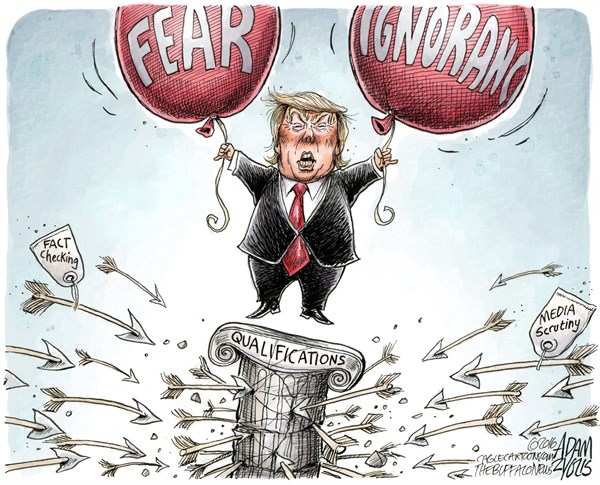
These events are hardly surprising.  Trump is a con man.  For him, “the art of the deal” is basically the art of the con.  Consider his promise of bringing back American jobs.  How is that supposed to happen?  Simply through higher tariffs against foreign goods?  Who’s going to replace those with American-made goods at an affordable price to the working classes?

Here’s an example.  I got dressed this morning with no thought about using my clothes as an illustration for this article.  My jeans are made in Mexico (of fabric from the USA, so why weren’t they made here?).  My shirt is from Thailand.  My leather belt is from China, and so too are my shoes.  We all know why.  Labor costs in those countries are much cheaper than those in the USA.  Profits to corporations are thus much higher.  How is Trump going to change this dynamic?

I actually try to buy clothes that are made in America.  I got a nice pair of shoes that are made in Maine.  I got them on sale for a great price, but they retail for over $300.  If they were made in China, they’d probably retail for about $100.  How many members of the working classes are able to spend roughly triple the price for the privilege of wearing shoes and clothes “Made in the USA”?

Here’s one thing Trump could do: Raise the minimum wage to $15 an hour so that Americans can afford the up-charge for domestic goods.  Any chance that Trump’s regime is going to do this?

It’s great to talk about bringing back American manufacturing jobs that pay well.  It’s possible to raise barriers to foreign trade to make American goods more competitive.  But who’s going to build the new factories?  And where are the skilled workers with the requisite knowledge base?  With the right advanced tools and technologies?

Speaking of technology, there’s an ever greater push in America to automate everything, even long-haul driving jobs, a job that provides a decent living for many Americans.  Is Trump going to reverse this push?  Is he going to preserve American blue-collar jobs against the pressure applied by multinational corporations to cut costs and maximize profits, workers be damned?  Given Trump’s own record of using cheaper foreign labor and goods, this doesn’t seem bloody likely.

Believe me, I hope I’m wrong, but the early signs are that America’s working classes, along with a lot of Trump enthusiasts, are already getting conned.


Trump: A Worrisome Commander-in-Chief

Trump holds a rally with supporters at the Suburban Collection Showplace in Novi, Michigan, U.S.
He doesn’t speak softly, even as he now inherits a very big U.S. military stick. REUTERS/Jonathan Ernst

W.J. Astore

I’d never watched a U.S. presidential candidate who scared me – truly scared me – until the Republican debate on March 3, 2016.  This candidate literally gave me the creeps.  As a historian and as a retired U.S. military officer, his answer to a question on torture and the potential illegality of his orders if he became the military’s civilian commander-in-chief horrified me.  The next day, I wrote a short blog post in which I argued that this candidate had disqualified himself as a candidate for the presidency.  That candidate’s name was Donald Trump.

What did candidate Trump say that so horrified me?  He said this: They [U.S. military leaders] won’t refuse [my illegal orders]. They’re not going to refuse me. Believe me.  After again calling for waterboarding and more extreme forms of (illegal) torture, as well as not denying he’d target terrorists’ families in murderous reprisal raids, candidate Trump then said this: I’m a leader. I’m a leader. I’ve always been a leader. I’ve never had any problem leading people. If I say do it, they’re going to do it. That’s what leadership is all about.

As I wrote at the time, “Our military does not follow blindly orders issued by ‘The Leader.’ Our military swears an oath to the Constitution.  We swear to uphold the law of the land. We don’t swear allegiance to a single man (or woman) as president.”

“Trump’s performance … reminded me of Richard Nixon’s infamous answer to David Frost about Watergate: ‘When the president does it, that means it’s not illegal.’ No, no, a thousand times no.  The president has to obey the law of the land, just as everyone else has to.  No person is above the law, an American ideal that Trump seems neither to understand nor to embrace.”

“And that disqualifies him to be president and commander-in-chief.”

Yes, I wrote those words just before the Ides of March.  And yet here we are, with Trump as our president-elect and, come January 2017 the U.S. military’s next commander-in-chief.  What the hell?

Confronted with criticism of his remarks that the U.S. military would follow his orders irrespective of their legality, Donald Trump soon walked them back.  But for me his dictatorial instincts, his imperiousness, and, worst of all, his ignorance of or indifference to the U.S. Constitution, stood revealed in horrifyingly stark relief.  Little that Trump said or did after this major, to my mind disqualifying, gaffe convinced me that he was fit to serve as commander-in-chief.

Here’s what I wrote back in March about the prospect of Trump serving as commander-in-chief:

Donald Trump: Lacks an understanding of the U.S. Constitution and his role and responsibilities as commander-in-chief.  Though he has shown a willingness to depart from orthodoxies, e.g. by criticizing the Iraq War and the idea of nation-building, Trump’s temperament is highly suspect.  His bombast amplified by his ignorance could make for a deadly combination.  Hysterical calls for medieval-like torture practices are especially disturbing.

Another disturbing tack he took was to suggest that he’d clean house among the military’s senior ranks — apparently, America today doesn’t have enough men like George Patton and Douglas MacArthur, Trump’s all-time favorite generals.  Patton was a notorious hothead, and MacArthur was vainglorious, egotistical, and insubordinate.  Leaving that aside, Trump doesn’t seem to understand that the president is not a dictator who can purge the military officer corps. Officers are appointed by Congress, not by the president, and they serve at the will of the American people, not at the whim of the president.

Combine Trump’s ignorance of the U.S. Constitution with his cavalier attitude toward nuclear weapons and you truly have a combustible formula.  Clearly, Trump had no idea what America’s nuclear triad was during the Republican primary debates, but few people in the media seemed to care.  (Gary Johnson, meanwhile, was pilloried by the press for not knowing about Aleppo.)  Trump gave statements that seemed to favor nuclear proliferation, and seemed to suggest he saw nuclear weapons as little different from conventional ones.  He also repeated that hoary chestnut, vintage 1960, that some sort of “missile gap” existed between the U.S. and Russia: the lie that Russia was modernizing its nuclear forces and the USA was falling hopelessly behind.  Again, there was little push back from the press on Trump’s ignorance and lies: they were enjoying the spectacle and profits too much.

When it comes to nuclear war, ignorance and lies are not bliss.  Can Trump grow up?  Can he become an adequate commander-in-chief? America’s future, indeed the world’s, may hinge on this question.

Trump Wins! A Few Thoughts on Why

sap
“I won’t play the sap for you.”

W.J. Astore

In my last post, I predicted Trump would lose.  I thought his declinist message and his blatant vulgarity would ultimately cost him too many votes.  As Trump would say, “wrong.”

What are we to take from Trump’s stunning upset?  Here are a few quick thoughts:

  1.  The Democrats ran the wrong candidate.  Remember when Bernie Sanders was saying he had the best chance to defeat Trump?  That the polls favored him and not Hillary? Turns out Bernie was right. People were looking for a candidate who represented change. Real change.  Bernie had that. So too did Trump.  But Hillary was the establishment personified. Not only that, but she had extensive baggage that led to high negatives. Too many people just didn’t like her. Or they simply wanted a fresh face and a new approach — even if that face was Trump.
  2. The October surprise.  Does Trump win without the last minute intervention of the FBI in the email follies? We’ll never know, but Hillary had the momentum prior to the letter issued by the FBI. That letter may have slowed her momentum just enough to allow Trump to win.
  3. All politics is local — or, at least, personal.  The Democrats addressed global issues like climate change.  The Republicans basically denied it’s happening.  The Democrats talked about embracing immigrants and tolerating Muslims.  The Republicans did neither.  What the Republicans did was to emphasize personal pain. The pain of those who’ve seen their jobs disappear and their way of life suffer.  The Republicans also played to nostalgia.  Yes, America is in decline, they said, but we can make the country great again (by making it less inclusive, by keeping out the “bad” people, by being tough).  That message proved appealing to so many Americans who see in Trump the possibility of returning to “the good old days” (whatever that may mean).
  4. I won’t play the sap for you.”  That’s a Humphrey Bogart line from “The Maltese Falcon.”  Many Americans believe they are being played for saps by foreign powers. Trump recognized this.  He called for tougher trade deals.  He called for NATO and other U.S. allies to pay their way.  He promised a new approach to foreign policy, one where enemies would be smashed even as Americans would avoid dumb wars like Iraq.  Basically, Trump promised that America would no longer play the sap for the rest of the world.  And the American people liked what they heard.

That’s my quick take.  Lots of Americans truly wanted a change in course — a sort of reactionary revolution.  That desire led them to downplay Trump’s sexism, ignorance, incivility, and vulgarity.  (Of course, there were some who embraced Trump precisely for these qualities.)  In essence, they simply had no patience for Hillary’s “politics as usual” message.

Finally, let’s not forget that Trump said the election is “rigged.”  He was a sore loser even before the results were in.  What kind of winner will he be?  Much will depend on the answer to that question.

Why Donald Trump Will Lose

schopenhauer
Arthur Schopenhauer

W.J. Astore

Donald Trump claims that if he loses the election it’s because the whole process is rigged.  But a rigged game is not why Trump will lose.  He’s going to lose because he’s offered no compelling vision about why he should be president.  (I don’t think “making America great again” is such a vision.)

What’s most remarkable to me about Trump’s campaign is how negative it’s been.  America is in decline!  Our inner cities are wastelands! Immigrants are thugs and rapists!  Muslims are out to get us!  Our leaders are stupid and crooked!  Indeed, until recently, Trump argued our top leader wasn’t even born in America.

A relentlessly negative campaign says a lot more about Trump than it does about America.  Sure, this country has problems.  But there are many silver linings in the dark clouds (economy on the mend; job growth up; health care extended to more people; rights for the LGBTQ community more accepted; the U.S. auto industry is back; more action on climate change is forthcoming, as long as Trump doesn’t win).

I was reading Arthur Schopenhauer’s “Counsels and Maxims” and came across a passage that reminded me of Trump.  Here it is:

No man can see over his own height … You cannot see in another man any more than you have in yourself; and your own intelligence strictly determines the extent to which he comes within its grasp …. Hence intercourse with others involves a process of leveling down.  The qualities which are present in one man, and absent in another, cannot come into play when they meet; and the self-sacrifice which this entails upon one of the parties, calls forth no recognition from the other.

Consider how sordid, how stupid, in a word, how vulgar most men are, and you will see that it is impossible to talk to them without becoming vulgar yourself for the time being.  Vulgarity is in this respect like electricity; it is easily distributed…

That’s Trump in a nutshell: vulgar.  Vulgar language.  Vulgar action. Vulgar appeals.  The question is: Will that vulgarity triumph on election day?  Is it enough?  My guess is that it isn’t.  That it won’t be.

His opponent, Hillary Clinton, has her own set of issues, but compared to Trump she has run a more hopeful campaign, or, at the very least, a much less vulgar one.  “Stronger together” is a tepid slogan, but it does stress togetherness, a certain strength in numbers, a degree of tolerance.  And Hillary has simply done a better job than Trump at reaching out to wider constituencies with a message that is positive rather than declinist.

Sure, a lot of people will vote for Trump, and for many reasons.  They don’t like or trust Hillary.  They’re loyal to the Republican Party.  They see something in Trump that resonates with them.  They feel they’ve gotten the shaft and think that a wild card like Trump can help them more than a face card like Hillary.

But ultimately I believe Trump will be done in by his own vulgarity.  He will lose because he couldn’t see past the limitations of his own height — his own flawed character.

But if I’m wrong, prepare yourself for four years of vulgar appeals, of sordidness and stupidity, to quote Schopenhauer.  For as the philosopher said, vulgarity is easily distributed.

What Would My Parents Think of this Election?

001 (2)
My parents in the 1970s

W.J. Astore

In 1976, I remember my mom voted for Jimmy Carter for president.  It surprised me because I was a fan of Gerald Ford, the Republican candidate.  Both Carter and Ford were decent men, and their debates were informative and issues-oriented.  Back then, the big scandal was Jimmy Carter’s admission, in an interview for Playboy magazine, that he had lusted in his heart. What innocent times!  Two generations later, we have a Republican candidate, Donald Trump, who by his own words has done far more than lust in his heart.

My mom would have been appalled by Trump (as are many people today).  My dad, I think, would have found Trump objectionable and shallow.  One of my dad’s favorite sayings was “the empty barrel makes the most noise.”  He didn’t respect other men who bragged and bellowed about themselves.  And he didn’t like anyone who was a sore loser, those who, when they lost, resorted to “sour grapes.”  Even before Trump has lost (if he does), he’s already resorted to sour grapes, claiming the election is “rigged” against him.

I know my parents would be against Trump.  Would they be for Hillary?  I don’t know.  I think my mom would have voted for Hillary, respecting her struggles as a woman for equality and fair treatment in a man’s game (and politics in America is still very much a man’s game, despite important strides made by women).  My dad?  When in doubt, he voted for the Democratic Party.  As a firefighter, he was a union man who knew first-hand the hard experience of factory workers and the penury of a hand-to-mouth existence during the Great Depression.

Resuscitating my parents to vote in 2016: yes, it’s fantasy, one that I share with Tom Engelhardt, who wrote this telling article at TomDispatch.com on next week’s election and what his parents would have thought of the whole spectacle.  To me, two aspects of election 2016 are especially telling when compared to 1976:

  1.  On foreign policy and national defense, Hillary Clinton is running to the right, not only of Jimmy Carter, but of Gerald Ford, a moderate Republican.
  2. Donald Trump not only lacks the fundamental decency of Carter and Ford: he lacks any experience in public service.  His entire life has been dedicated to making money. This may qualify him to run a business, but it doesn’t qualify him to run a country and to represent a people.

A few more words on Trump and what his rise represents.  Trump is the candidate of casino capitalism.  He’s the logical terminus of a system that wants to run everything for profit, winner-take-all.  Such public systems and concerns as education, health care, the prison system, even the military, are increasingly run as businesses, often privatized, the operative words being “efficiency” and “productivity” and “growth.”

With so many sectors of American society being privatized and run as for-profit businesses, with corporations being enshrined as superpower citizens with especially deep pockets to influence public elections, with the media also almost completely privatized and also run for-profit, is it any wonder a candidate like Trump has emerged as the business leader to “make America great again”?  Americans used to call men like Trump “robber-barons.”  Now, some Americans treat Trump as a savior.

In America, we seem to measure societal progress strictly in terms of economic growth as measured by GDP and the stock market.  Such measures are indicative not of true progress but of our shallow desires, our preference for glitzy materialism.  Again, isn’t Trump the very embodiment of insatiable appetite, bottomless greed, and casino capitalism?

I know my parents — decent members of the working classes — wouldn’t have voted for him.  Hillary, I think, would have been their (reluctant) choice.  And I think they’d hope for better candidates in 2020, or, at the very least, a political process that takes vitally important issues like climate change seriously.

Seriousness of purpose is what we need in America, along with courage, honesty, and strength of mind. Let’s strive for those in the aftermath of this depressing election season.