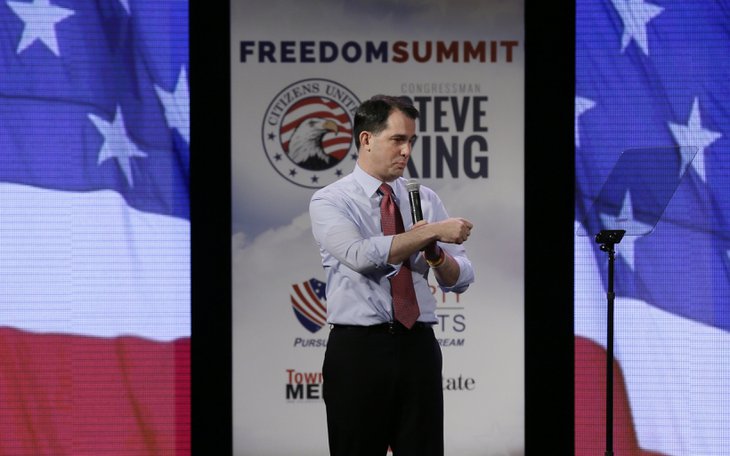
OK. I should know better. When you pay attention to what conservatives are saying at the Iowa Freedom Forum, attended as it is by religious activists, you’re going to hear kookiness and craziness. But what’s sad is how the “red meat” issues raised by the likes of Ted Cruz, Scott Walker, and Rick Santorum are so devoid of nutritional value. Empty calories, all of it.
You hear the usual talk about lower taxes and less governmental regulation, even though Republicans under Reagan and the Bushes (along with the Democrats as well) oversaw expansions in government. George H.W. Bush famously said, “Read my lips — no new taxes,” before proceeding to raise taxes once he became president. Along with lower taxes and smaller government, Republicans also claim to support “family values,” a vapid phrase that basically means whatever you want to read into it. I’m not a fan of Obama’s priorities and policies, but one thing I can say for the man is that his life, his wife, and his teenage girls have exuded family values, Thanksgiving controversy or no.
So we know Republicans are supposedly for lower taxes, smaller government, and family values. What else are they for? Abortion, of course, as in restricting it further or even eliminating it. Voter ID laws, because we all know how the “wrong” kind of people are being bussed in en masse to skew voting results in favor of socialism (talk about an urban myth!). And more gun rights, like open carry laws and easier approval for concealed permits to carry.
Egads! These are the issues that sway the activist base of the Republican Party? Fetuses, the specter of more disadvantaged people of color voting, and guns.
Wow. Our country faces serious issues. A crumbling infrastructure. An unsustainable prison system. Perpetual wars. Climate change (even Republicans admit it’s real, though they won’t blame humans for it). Ever widening gaps between rich and poor. Student loan and credit card debt that threaten a fragile economic recovery. Mediocre education. Ever rising health care costs (still the number one cause for personal bankruptcies in America). But forget all that: let’s talk about fetuses, non-existent voter fraud, and guns.
And Republicans like Santorum wonder why “too many people don’t think we care about them.” Gee… I wonder why, Rick.
(A personal note: In 1976, though too young to vote, I supported Gerald Ford rather than Jimmy Carter. In 1984, I voted for Ronald Reagan because I believed Walter Mondale lacked the gravitas to be president at a crucial moment in US-Soviet affairs. Ever since then, the Republican Party has lost me with its cynical culture wars and active suppression of democracy, among other reasons.)
Former Army Ranger Rory Fanning has a thoughtful article at TomDispatch.com on why young men should not join the Army to fight the war on terror in distant lands.
Here’s an excerpt:
Believe me, it [the Afghan War] was ugly. We were often enough targeting innocent people based on bad intelligence and in some cases even seizing Afghans who had actually pledged allegiance to the U.S. mission… I know now that if our country’s leadership had truly had peace on its mind, it could have all been over in Afghanistan in early 2002.
If you are shipped off to Iraq for our latest war there, remember that the Sunni population you will be targeting is reacting to a U.S.-backed Shia regime in Baghdad that’s done them dirty for years. ISIS exists to a significant degree because the largely secular members of Saddam Hussein’s Ba’ath party were labeled the enemy as they tried to surrender after the U.S. invasion of 2003 … Given the reign of terror that followed, it’s hardly surprising to find former Baathist army officers in key positions in ISIS and the Sunnis choosing that grim outfit as the lesser of the two evils in its world. Again, the enemy you are being shipped off to fight is, at least in part, a product of your chain-of-command’s meddling in a sovereign country. And remember that, whatever its grim acts, this enemy presents no existential threat to American security, at least so says Vice President Joe Biden. Let that sink in for a while and then ask yourself whether you really can take your marching orders seriously.
Fanning makes persuasive points here: How the U.S. military bungled its wars of choice in Iraq and Afghanistan; how often Iraqi and Afghan innocents were killed due to bad intelligence and the usual deadly mistakes associated with war; how the wars fed, and continue to feed, a cycle of violence that is perpetuated by new U.S. troop deployments and weapons sales (with respect to weapons sales, see this excellent article by Peter Van Buren, which details how the U.S. is hawking M1 Abrams main battle tanks to the Iraqis).
Yet persuading young American men against joining the military, let alone convincing them not to strive to be elite Rangers, is not, sadly, an exercise in logic. In American society today, young men, especially from the working classes, seek an identity and a status that affirms masculinity. They want to earn the respect of their peers, parents, and prospective dates (and mates). American society provides few options for such men, especially if they’re living in straitened circumstances in dead-end jobs. Consider that many physical jobs, such as working in a warehouse, pay only slightly better than minimum wage, with weekly hours curtailed so that employers don’t have to provide health care.
Military service, which exudes masculinity while conveying societal respect (and free health care, among other benefits), is in many ways the most viable option for working-class men (and more than a few women, obviously). Like it or not, young men often aspire to being “the biggest and baddest,” or at least serving with a unit of such men. They seek community and a sense of belonging within unapologetically masculine settings. They may also have dreams of being heroes, or at least of proving themselves as capable within a community of likeminded tough guys.
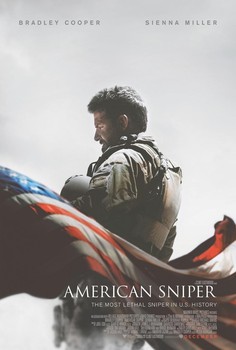
American society bombards such impressionable young men with images of soldiers, often deified in movies like “Act of Valor” or “Lone Survivor.” Consider the popular success of “American Sniper,” with its depiction of the resolute sniper as avenger and punisher. Movies like this are powerful in persuading impressionable youth to sign on the dotted line as volunteers for military service.
Military service, which conveys personal dignity, adds a dash of grandeur. By joining the military, you become part of something much larger than yourself. A sense of masculine challenge, especially in elite units like the Army Rangers or Navy SEALs, combined with societal respectability prove alluring to young men. Sadly, no amount of logic about the lack of wisdom and efficacy of America’s war on terror will convince them otherwise.
Some will say there’s nothing wrong with this. Why not encourage young men to join the military and to fight in foreign lands? Yet if those fights serve fallacious causes that amount to strategic folly, our troops’ sacrifices amount to little.
One thing we can do: American society should provide more jobs for young men that convey respect within masculine codes but which don’t require donning a uniform and killing an enemy overseas.
For nearly a decade, I taught working-class students, mostly young men, in rural Pennsylvania. My students came to class wearing camo fatigues. Many looked like they had just climbed down from a tree stand in the woods (a big holiday for my students was the first day of rifle deer season). They drove pickup trucks, listened to country music, dipped Skoal or smoked Marlboros. They’re not guys who aspire to be metrosexuals sipping lattes at Starbucks. They’re looking for a job that screams “man,” and sometimes they find it: in welding, as a heavy equipment operator, in residential construction, and so on.
But for those who can’t find such “masculine” vocations that provide decent pay and benefits, military service is powerfully alluring, and almost impossible to resist, especially when there are so few alternatives.
In September 2008, I called for a revival of the Civilian Conservation Corps, national service that is dedicated to rebuilding America. We need to instill an ethic of national service that goes beyond war and killing. An ethic that inspires young men with patriotic pride and that conveys societal identities that appeal to them as men.
What we need, in short, are fewer “American snipers” and more American workers and builders.
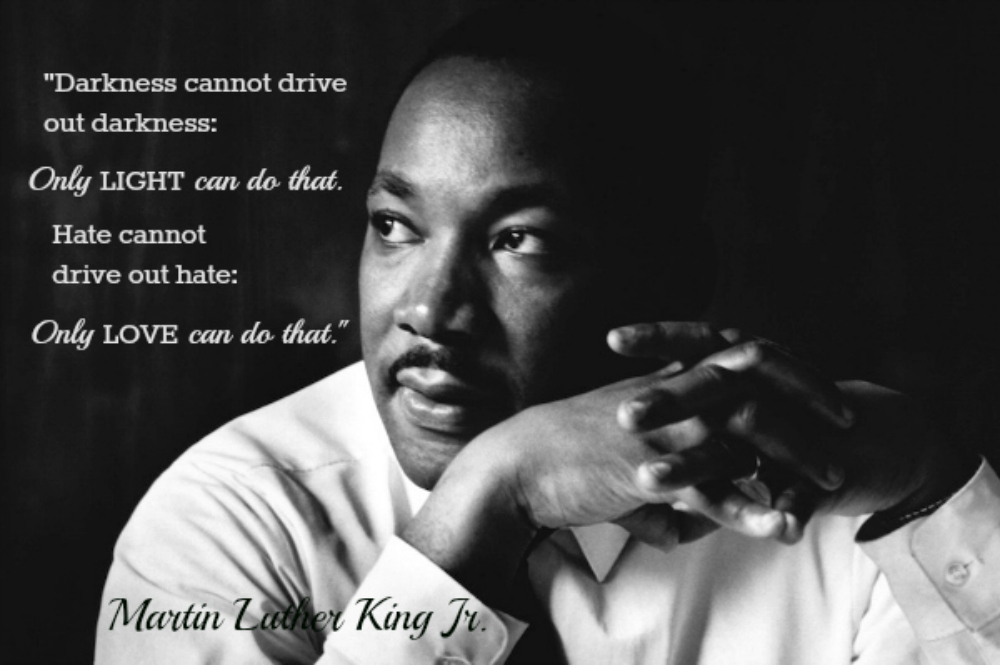
On April 4, 1967, Martin Luther King Jr. gave a powerful speech (“Beyond Vietnam – A Time to Break Silence”) that condemned America’s war in Vietnam. Exactly one year later, he was assassinated in Memphis.
What follows are excerpts from MLK’s speech. I urge you to read it in its entirety, but I’d like to highlight this line:
A nation that continues year after year to spend more money on military defense than on programs of social uplift is approaching spiritual death.
MLK called for a revolution of values in America. In his address, he noted that:
There is nothing except a tragic death wish to prevent us from reordering our priorities so that the pursuit of peace will take precedence over the pursuit of war.
MLK didn’t just have a dream of racial equality. He had a dream for justice around the world, a dream of a world committed to peace, a world in which America would lead a reordering of values in the direction of universal brotherhood.
Both of MLK’s dreams remain elusive. Racial inequalities and biases remain, though America is better now than it was in the 1960s in regards to racial equity. And what of a commitment to peace? Sadly, America remains dedicated to war, spending nearly a trillion dollars yearly on defense, Homeland Security, nuclear weapons, and “overseas contingency operations,” i.e. wars.
America has failed to dream the dreams of Martin Luther King, Jr., and we are the worse for it. W.J. Astore
Excerpts from MLK’s Speech on Vietnam, April 4, 1967
At this point I should make it clear that while I have tried in these last few minutes to give a voice to the voiceless in Vietnam and to understand the arguments of those who are called “enemy,” I am as deeply concerned about our own troops there as anything else. For it occurs to me that what we are submitting them to in Vietnam is not simply the brutalizing process that goes on in any war where armies face each other and seek to destroy. We are adding cynicism to the process of death, for they must know after a short period there that none of the things we claim to be fighting for are really involved. Before long they must know that their government has sent them into a struggle among Vietnamese, and the more sophisticated surely realize that we are on the side of the wealthy, and the secure, while we create a hell for the poor.
Somehow this madness must cease. We must stop now. I speak as a child of God and brother to the suffering poor of Vietnam. I speak for those whose land is being laid waste, whose homes are being destroyed, whose culture is being subverted. I speak of the — for the poor of America who are paying the double price of smashed hopes at home, and death and corruption in Vietnam. I speak as a citizen of the world, for the world as it stands aghast at the path we have taken. I speak as one who loves America, to the leaders of our own nation: The great initiative in this war is ours; the initiative to stop it must be ours…
If we continue, there will be no doubt in my mind and in the mind of the world that we have no honorable intentions in Vietnam. If we do not stop our war against the people of Vietnam immediately, the world will be left with no other alternative than to see this as some horrible, clumsy, and deadly game we have decided to play. The world now demands a maturity of America that we may not be able to achieve. It demands that we admit that we have been wrong from the beginning of our adventure in Vietnam, that we have been detrimental to the life of the Vietnamese people. The situation is one in which we must be ready to turn sharply from our present ways. In order to atone for our sins and errors in Vietnam, we should take the initiative in bringing a halt to this tragic war…
It is with such activity in mind that the words of the late John F. Kennedy come back to haunt us. Five years ago he said, “Those who make peaceful revolution impossible will make violent revolution inevitable.” Increasingly, by choice or by accident, this is the role our nation has taken, the role of those who make peaceful revolution impossible by refusing to give up the privileges and the pleasures that come from the immense profits of overseas investments. I am convinced that if we are to get on the right side of the world revolution, we as a nation must undergo a radical revolution of values. We must rapidly begin…we must rapidly begin the shift from a thing-oriented society to a person-oriented society. When machines and computers, profit motives and property rights, are considered more important than people, the giant triplets of racism, extreme materialism, and militarism are incapable of being conquered.
A true revolution of values will soon cause us to question the fairness and justice of many of our past and present policies. On the one hand, we are called to play the Good Samaritan on life’s roadside, but that will be only an initial act. One day we must come to see that the whole Jericho Road must be transformed so that men and women will not be constantly beaten and robbed as they make their journey on life’s highway. True compassion is more than flinging a coin to a beggar. It comes to see that an edifice which produces beggars needs restructuring.
A true revolution of values will soon look uneasily on the glaring contrast of poverty and wealth. With righteous indignation, it will look across the seas and see individual capitalists of the West investing huge sums of money in Asia, Africa, and South America, only to take the profits out with no concern for the social betterment of the countries, and say, “This is not just.” It will look at our alliance with the landed gentry of South America and say, “This is not just.” The Western arrogance of feeling that it has everything to teach others and nothing to learn from them is not just.
A true revolution of values will lay hand on the world order and say of war, “This way of settling differences is not just.” This business of burning human beings with napalm, of filling our nation’s homes with orphans and widows, of injecting poisonous drugs of hate into the veins of peoples normally humane, of sending men home from dark and bloody battlefields physically handicapped and psychologically deranged, cannot be reconciled with wisdom, justice, and love. A nation that continues year after year to spend more money on military defense than on programs of social uplift is approaching spiritual death.
America, the richest and most powerful nation in the world, can well lead the way in this revolution of values. There is nothing except a tragic death wish to prevent us from reordering our priorities so that the pursuit of peace will take precedence over the pursuit of war. There is nothing to keep us from molding a recalcitrant status quo with bruised hands until we have fashioned it into a brotherhood.
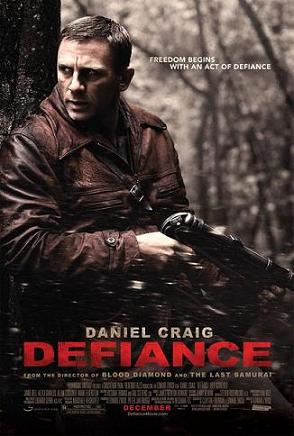
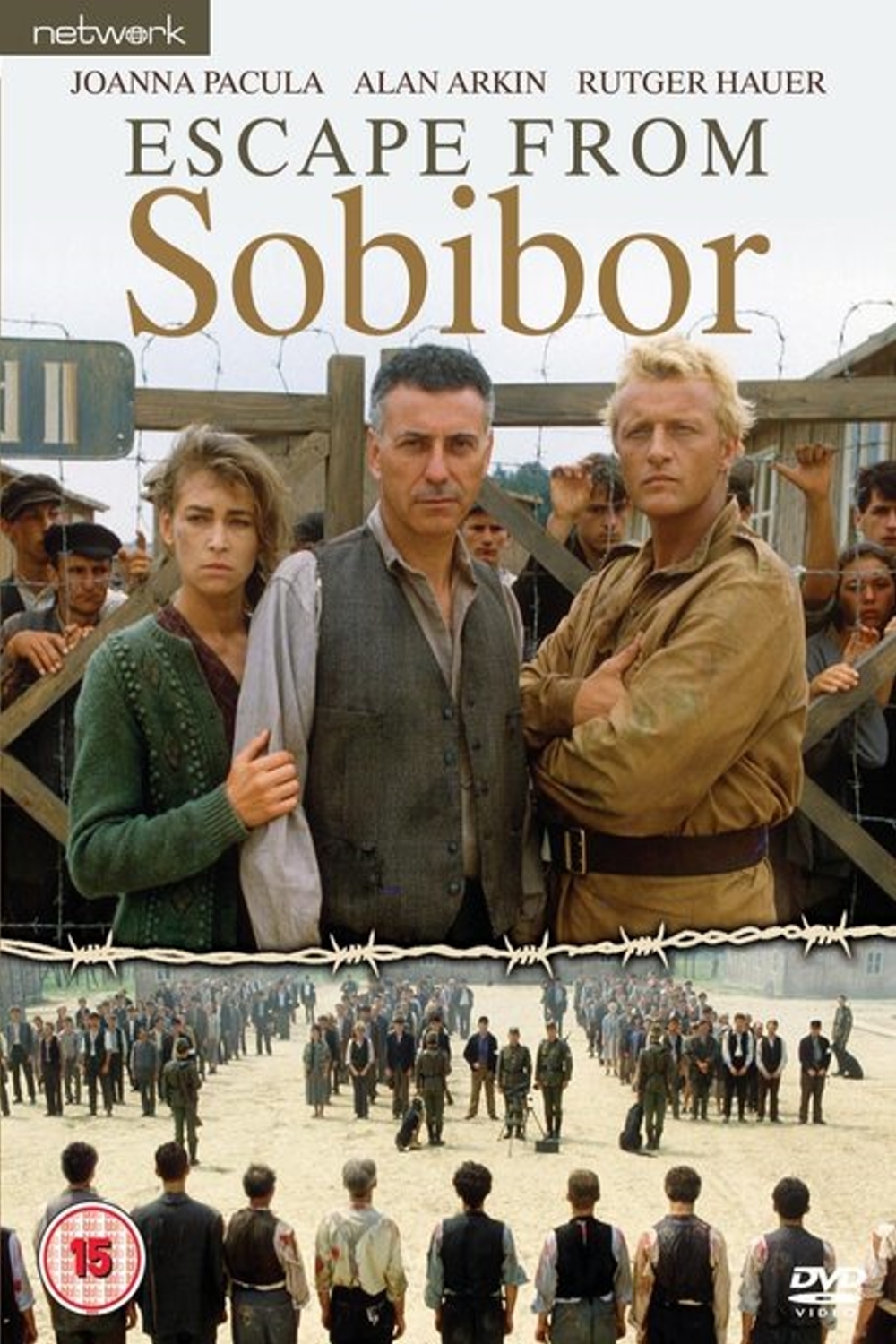
“Defiance” is one of the few mainstream movies that depict Jewish resistance to the Holocaust. Another good movie is “Escape from Sobibor”
W.J. Astore
In 2006, I presented the following talk on Jewish resistance to the Holocaust. It’s a dangerous myth, and sadly a common one, that Jewish people did not resist the Nazis in meaningful or effective ways. From this myth stems a far more insidious one: that Jewish people were somehow complicit in the murderous campaigns against them. I gave this paper to counter these dangerous myths.
The Nazis exterminated nearly six million Jews during World War II. Those who claim that Jews went meekly like sheep to the slaughter ignore the many instances of remarkable courage in the face of this staggering crime against humanity. In reality, Jewish resistance took many forms. That it often proved futile reflects the poignant vulnerability of Jews rather than any lack of bravery or courage.
Resistance can be divided into two general categories: passive and active. Passive resistance took the form of cultural and spiritual endurance and assertiveness. Jews confined to ghettos like Warsaw continued to practice their culture and religion despite prohibitions; they organized symphonies, drama clubs, schools, and other voluntary and educational associations; they also risked their lives by trading across ghetto walls despite threats of torture and execution.
Passive resistance drew on a long and esteemed Jewish tradition of outlasting the persecutor. Initially believing that the Nazis and their various European sympathizers and lackeys wanted to put Jews in their place, not in their graves, Jewish leaders sought to endure discriminatory laws, pogroms, and deportations, hoping for an eventual relaxation of anti-Semitic policies or perhaps even the defeat of their oppressors on the battlefield.
Thus Jewish resistance remained largely non-violent until 1943, in part because the Germans succeeded in deceiving the Jews. They were helped in this by the fact that their predecessors—the German soldiers of World War I—had generally behaved decently, treating Jewish non-combatants humanely. Jews in Poland and the East initially expected similar behavior from Nazi invaders. Even after it became apparent to Jews that Nazi soldiers and especially police were intent on human butchery on a scale previously unimaginable, Jewish cultures that embraced sanctity and sheer joy of life found it difficult to comprehend a Nazi culture built on hate and murderous brutality, especially one that continued to worship civilized icons like Goethe and Beethoven. Many Jews put their faith in God, hoping for the best, preparing for the worst, yet daring not at first to think the unthinkable.
When Jewish communities and individuals recognized the unthinkable—that the Nazis and their various European fellow travelers wanted to exterminate systematically all Jews in Europe—active and armed resistance increased. Active resistance included acts of industrial sabotage in munitions factories or isolated bombings of known gathering spots of Nazis. One must recognize, however, the near utter futility of Jews “winning” pitched battles against their killers. The Nazis had machine guns, dogs, usually superior numbers, and could call on tanks, artillery, and similar weapons of industrialized modern warfare. Facing them were Jewish resisters, often unarmed, some at best having pistols or rifles with limited ammunition, perhaps supplemented by a few precious hand grenades. Such unequal odds often made the final result tragically predictable, yet many Jews decided it was better to die fighting than to face extermination in a death camp.
When it became apparent that they were being deported to Treblinka to be gassed, Warsaw Jews at first refused to assemble, then led a ghetto uprising in April 1943 whose ferocity surprised the Germans. More than 2000 German soldiers supported by armored cars, machine guns, flamethrowers, and unlimited ammunition faced approximately 750 Jews with little to no military training. The SS General in command, Jürgen Stroop, had estimated he would need two days to suppress the uprising. In fact, he needed a full month as Jews armed mainly with pistols, homemade grenades, and Molotov cocktails fought franticly and ferociously from street to street, bunker to bunker. The Warsaw ghetto uprising was only the most famous example of nearly 60 other armed uprisings in Jewish ghettos.
Resistance was less common in death camps like Chelmno, Sobibor, and Treblinka, mainly because there was not enough time for networks of resistance to form. Resistance requires leaders, organization, and weapons. These elements cannot be improvised and acted upon in a few hours or even days: they require months of planning and training. Despite nearly insurmountable difficulties, however, Jews did lead revolts at all three of these death camps as well as at Auschwitz-Birkenau and 18 forced-labor camps.
Jews also participated actively in resistance networks in Poland, the Soviet Union, France, and other countries. Their plight was difficult in the extreme, since anti-Semitism within these networks often required Jews to hide their ethnicity. In some cells of the Polish resistance, Jews were killed outright. Many Soviet partisans distrusted and exploited Jews; nevertheless, between 20,000 and 30,000 Jews fought as partisans in the USSR against Nazi invaders. In France, Jews made up less than one percent of the population yet 15 to 20 percent of the French underground. In 1944, nearly 2000 Jewish resisters in France united to form the Organisation Juive de Combat (Jewish Fighting Organization), which supported Allied military operations by attacking railway lines and German military installations and factories.
Impressive as it was, Jewish resistance was always hamstrung for several reasons. In general, Jews lacked combat experience since many countries forbade Jewish citizens from serving in the military. Like Soviet prisoners-of-war (POWs) captured by the Nazis, many Jews, especially those confined in ghettos, were weakened by disease and deliberate starvation. Under these conditions, trained Soviet soldiers died with hardly a murmur of protest, so it is hardly surprising that Jewish families who had never been exposed to the hardships of war would similarly succumb.
The Nazis succeeded in creating a Hobbesian state of nature in which people were so focused on surviving from hour to hour that their struggles consumed virtually all their energy and attention. Dissension within Jewish communities also inhibited resistance, with older Jews and members of Judenräte (Jewish councils) tending to support a policy of limited cooperation with the Nazis, hoping that by contributing to the German war effort, they might thereby preserve the so-called productive elements of Jewish communities.
More controversially, Jewish resistance was hampered by weak and irresolute international support. Fearing that Nazi propaganda would exploit pro-Jewish statements as proof that a Jewish-Bolshevist conspiracy was behind the war, Western leaders refrained from condemning Nazi actions. Official Catholic and Protestant statements were equally tentative and tepid. Irresolute and sporadic support unintentionally played into the hands of Nazi plans for Jewish extermination.
Observant Jews were people of God’s law, the Torah, who put their faith in God, with Jewish culture in general tending to disavow militant actions. Confronted by murderous killing squads possessing all the tools of industrialized mass warfare, Jews nevertheless resisted courageously, both passively and actively. That their resistance often ended tragically does not mean that it failed.
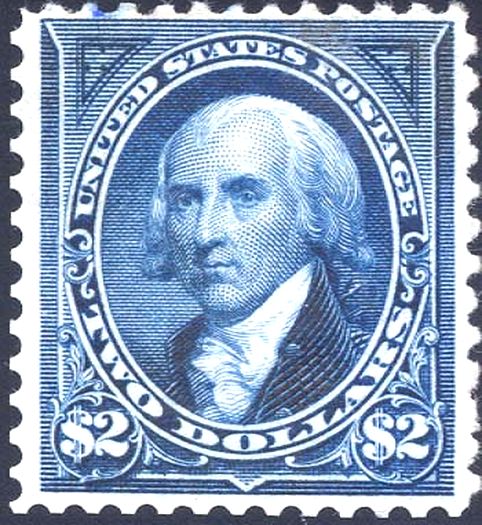
James Madison warned that perpetual war is the worst enemy of personal liberty
W.J. Astore
So, Republicans now control the Senate as well as the House. As we the people endure the forced march to 2016 and the next presidential election, our new political landscape is sure to produce more military escalations.
The reason is as obvious as it is sad. De-escalation of military conflicts is defined, especially by Republicans, as “losing” whereas escalation is defined as “doing something,” as being “decisive,” even when decision is nowhere in sight. Even when military action just makes matters worse.
Once again, as we approach 2016, the Republicans will bash the Democrats as appeaseniks. And the Republicans will be right. The Democrats are appeaseniks — to the national security state.
You can almost guarantee that the hawkish Hillary Clinton — doing her best imitation of Margaret Thatcher — will be the Democratic candidate. Meanwhile, Republican candidates will run to the right of Attila the Hun as they blame Obama for having “lost” both Iraq and Afghanistan (even though both of those countries were never ours to “win”). Dishonest (or disingenuous) the Republicans may be, but they know how to win elections via the Big Lie.
As Tom Engelhardt noted this week, the national security state has built a militarized escalation machine that will execute its function of perpetual war regardless of whom is sworn in as the next commander-in-chief.
As my wife said to me today, our country is in big trouble. Yes, we are, because as James Madison pointed out, perpetual war is the enemy of democracy and freedom.
As for me, I’ll vote for any candidate who has the spine to stand up for an end to perpetual war. Show me a candidate who’s willing to abandon fear-mongering about overseas threats while telling the truth about the threats we face right here at home from America’s power brokers and I’ll show you a candidate worthy of being elected. Either that, or show me a candidate who’s so worried about those overseas threats that he or she takes up arms (I mean literally) in the trenches against the enemy, and I’ll show you a candidate who at least is not a hypocrite.
But I fear 2016 will be the year of Benghazi! Benghazi! and who lost Iraq/Afghanistan/and similar countries we never “found” to begin with.
Did I mention my smarter wife said our country is in trouble?
Out shopping today at my local used bookstore and came across an early paperback copy (from 1952) of George Orwell’s 1984. A little overpriced at $15.00, but the cover called to me. What a classic!
My “new” old copy of Orwell’s 1984
If you click on the picture, you can just make out, if you look closely, the slogans on the Ministry of Truth in the upper left: War Is Peace, Freedom Is Slavery, Ignorance Is Strength.
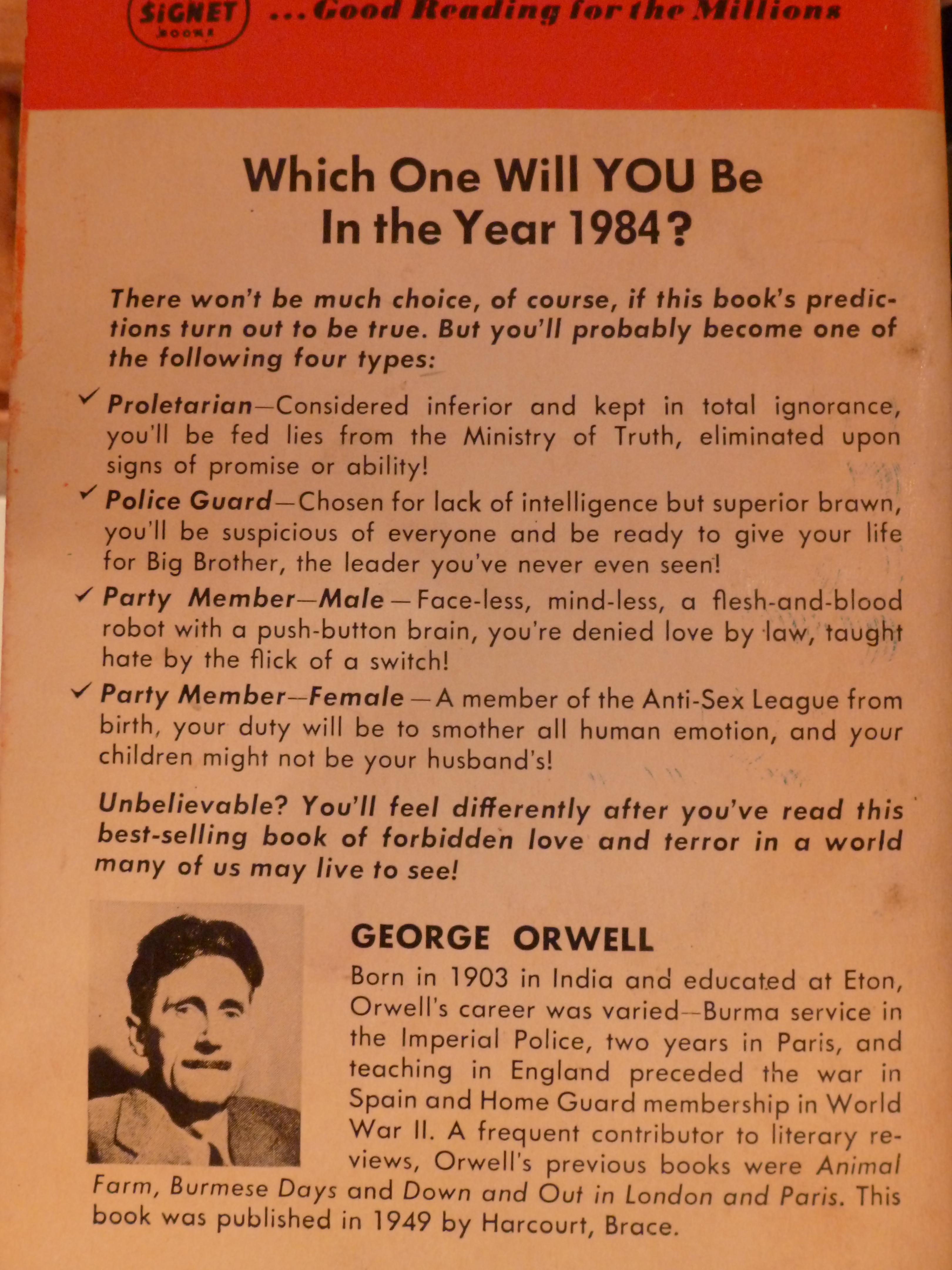
The reverse of the cover is also quite well done:
Which one will you be in 2014?
That tag line haunts me: “in a world many of us may live to see!” Hype, reader? Or prophecy?
I haven’t read Orwell since college, circa 1984 in fact. Time to get crackin’ before my old copy is confiscated and sent down the memory hole.
Columbus Day Parade, a celebration of Italian heritage
W.J. Astore
In 1492, Columbus sailed the ocean blue. And he discovered a new world. New to him, of course, and his fellow Europeans, not to the indigenous peoples already living there. Yes, Columbus gets too much credit for that “discovery.” Yes, he and his fellow Europeans were incredibly ambitious, often vicious, and not overly interested in the fate of indigenous people. The three Gs of overseas exploration usually applied — God, Glory, and Gold, often with greed for gold and other valuables taking first priority over spreading the Gospel or winning a reputation (titles and other personal honors).
But are we truly showing sensitivity to Native Americans by changing the name of Columbus Day to Indigenous Peoples’ Day, as the Seattle city council did earlier this week?
For many years, I taught world history. The key event that touched off the modern world was the Columbian Exchange, the reconnection of the Old and New Worlds and the transfer/diffusion of peoples, animals and plants, products, ideas, and so on between those two worlds. Of course, this transfer greatly favored Europeans and utterly devastated indigenous people, especially since Europeans brought all of their “old world” diseases with them, such as smallpox, which ripped through Native American populations that lacked immunity to those diseases. As indigenous people experienced mass death, mainly due to these diseases, Europeans sought another labor source they could exploit for their plantations and mines and farms in the New World, tapping into a preexisting trade in African peoples. The rapid expansion in exportation of African slaves (more than 12 million being shipped to the New World between Columbus’s voyage and the end of the slave trade in the 19th century) is another ghastly and haunting feature of the Columbian Exchange.
Columbus’s voyage changed the world, usually for the worse for the indigenous peoples of America as well as the peoples of Africa. But are we truly showing cultural sensitivity and enlightenment by renaming Columbus Day in honor of indigenous people? By rectifying a name, are we really doing anything to rectify a wrong?
Long ago in the United States, Columbus Day ceased being connected in any solid way to Columbus. It morphed into a celebration by Italian-Americans of their heritage while much of the rest of America went shopping (at least that’s what we’re told to do by incessant ads and by the media). Dismissing the celebratory traditions of Italian-Americans in the name of cultural sensitivity for indigenous peoples seems more than a little contradictory.
Want to show sensitivity to indigenous peoples? Give them back their land. Treat them with dignity and respect — you know, like they’re human beings just like you and me.
Vigorously patting yourself on the back for your sensitivity in inaugurating an “indigenous peoples’ day” — well, it just seems like another flabby exercise in cheap grace that requires no real sacrifice — and no real penance as well.
It’s not just the Tea Party that’s lame (Toby Toons)
W.J. Astore
The more the United States has come to talk about dominance, the less dominant we’ve become.
To compensate, we’ve become a steroidal nation, to include the violent side effects associated with steroid use (just look at the latest stories out of the NFL about spousal and child abuse, or our steroidal police forces, including MRAPs and M-16s for school police). If the story of the last fifty years is the gradual decline of the U.S., most notably in the economic and political realms, the story of today is how we’ve compensated with militarized Viagra. We’ve reached “the age of knowing” that we’ve lost much of our potency as our country. To compensate, we’re forever popping pills and flexing our muscles. (Just look at John McCain’s enthusiasm for bombing.)
It’s precisely those steroids that are weakening us as a country. As we’ve overcompensated with military weapons and bases, we’ve allowed our economy to slide. As we’ve sought domination overseas, we’ve weakened our country right here at home. We feverishly build and repair roads in Afghanistan but not here in the USA. Same with schools — we’d rather build prisons, to include Gitmo, than colleges (since 1984, California has built 21 prisons but only one university).
Consider our binary debates on foreign policy. It’s the hawks versus the doves, militarized “engagement” versus isolationist “appeasers,” the implication being that the latter is wrong — that minding one’s own business is not an option in a globalized world. But the world is not some “global village”: it’s a conglomeration of fragments. And U.S. efforts to dominate those fragments by military means are only accelerating that fragmentation. Just look at what our government did and is doing to Iraq and Afghanistan.
Fragmentation facilitates dominance by multinational corporations even as the U.S. military is misused and overextended. The result is more global instability and a retreat (or a return) to ideologies that promise coherence and order. Witness the rise of militant Islam and ISIS. By attacking it, the U.S. is acting as an accelerant to it.
As the U.S. weakens itself as a country, as it accumulates debt by constantly fighting wars while passing the costs along to future generations, large multinational corporations grow in power. They are today’s equivalent to the British East India Company, the Dutch East India Company, and similar entities of the past. Combine powerful multinationals with privatized mercenary outfits and you see echoes of the seventeenth century, to include wars over religion and resources. Three centuries ago, it was Catholics versus Protestants and wars over spices like pepper and nutmeg. Now it’s divisions within Islam and wars over oil.
We’re witnessing the decline of Enlightenment ideals and community-based Democracy, as seen by the way in which the U.S. government routinely betrays those ideals. Any sense of shared, community-based, obligation is tainted by “socialism,” meaning that a Darwinian capitalism based on selfish individualism is promoted instead, which only feeds the growth of multinationals competing to sell “product” to the masses.
Everything is becoming a consumable, including the most vital parts of life. As a consumable, it can be marketed, sold, and controlled by those same multinationals. Even education is now an ephemeral product, marketed and sold as a commodity.
Corporations think and act for short-term profit. But democracies are supposed to think strategically, over the long term. Now the quarterly business cycle controls all. Look at politics: A congressman is elected and instantly starts fund raising to win his next campaign. Obama wins a second term and is almost instantly branded a lame duck.
But it’s not Obama who is the lame duck – it’s America. And all the militarized steroids in the world won’t cure that lameness. Indeed, they just aggravate it.
In December 2010, I wrote the article below for Truthout. Even as the economy was sputtering and jobs were scarce, Congress was seeking to cut unemployment benefits. Eventually, a compromise was forged to maintain the benefits; the price was more tax cuts for the richest Americans. Angered by the hypocrisy and greed on display, and inspired by my father’s words and experiences, I penned my very own tale of two cities. It’s not Dickens, but it has the merit of being far shorter.
The Rich Get Richer, the Poor Poorer (Posted originally at Truthout on 12/7/2010)
William Astore
More tax breaks for the rich in exchange for another year’s worth of unemployment benefits for the desperate: Now there’s a compromise that makes me proud to be an American. My father wouldn’t have been surprised. He grew up during the Great Depression and worked in factories before he was drafted and served in the Army during World War II. Dad told me that the harder he worked (physically), the less he got paid. And he told me there was nothing like repetitive and physically-grueling factory work to make you want to improve yourself. By becoming a civil servant (a firefighter), he escaped the factory and its dismal pay for a job that paid enough to provide five children with a lower middle class existence.
Today’s political elites seem to think that the proper way to stimulate economic growth is to empower the exploiters. That way, some of their enormous wealth will trickle down on the little people. My father knew from experience that it usually wasn’t money that trickled down from the high heights of the rich.
In the spirit of the holiday season, here’s a story from my Dad that recounts his attempt to get a dime pay raise at the local factory. Consider it a parable for the realities our working classes face day in and day out in this country:
It seems that Mike Calabrese on his own asked Harry Callahan [one of the owners] for a pay raise and he was refused. Mike decided to organize the men members and go down in a group. In our group he got ten men to approach Harry C. for a raise. But when it was time to “bell the cat” only three fellows went to see Harry. Well Mike said he couldn’t join the group because he had already tried to get a raise. I knew I was being used but I was entitled to a raise. Well Harry said to me, “What can I do for you men?” So I said to Harry: 1) Living costs were going up; 2) We deserved a raise. So Harry said, “How much?” and I said ten cents an hour would be a fair raise. So he said I’ll give you a nickel an hour raise and later you’ll get the other nickel. We agreed. So, I asked Harry will everyone get a raise and he replied, “Only the ones that I think deserve it.”
Well a month later I was drinking water at the bubbler and Harry saw me and said what a hard job they had to get the money to pay our raises. Well, Willie, Harry Callahan and his brother Sam and their two other Italian brother partners all died millionaires. No other truer saying than, That the rich have no sympathy or use for the poor.
Today, Americans are uncomfortable calling attention to pay discrepancies and exploitation because it smacks of class warfare or even Marxism. It’s true that some of the worst abuses have been curbed (for example, my father worked from 6PM to 6AM without the benefit of overtime pay or time-and-a-half), but today’s workers are simply scared: scared that their jobs will be outsourced, scared that they’ll be fired; scared that they’ll be replaced by automated robots. Thus they put up and shut up.
So, what’s the moral to the story? Our president promised hope and change. “Hope” has come in the form of more tax breaks for the rich. And “change”? To paraphrase my father: No truer saying than that politicians have no sympathy or use for the poor.
This year the USA celebrates the 200th anniversary of The Star-Spangled Banner. Francis Scott Key wrote the lyrics, inspired by the battle at Fort McHenry during the War of 1812, and it officially became the National Anthem in 1931. Notoriously difficult to sing (my favorite rendition is Whitney Houston’s, complete with combat jets at the end), it’s a song of resolve and resilience suffused with images of battle, which only makes sense given the conditions under which it was composed.
Along with the National Anthem, the other patriotic song most commonly sung at sporting events and other official gatherings is God Bless America. Penned by Irving Berlin in 1918 and made famous by Kate Smith’s renditions, it’s usually performed today without its placatory preamble (“While the storm clouds gather far across the sea/Let us swear allegiance to a land that’s free/Let us all be grateful for a land so fair/As we raise our voices in a solemn prayer”). Most performances that I hear today are neither solemn nor placatory; they’re boastful in the sense of suggesting that God uniquely blesses America, that of course God blesses America. We’re so great — how could He not? Here I recall the saying of Abraham Lincoln that we must not presume God is on our side, but rather we must be concerned we are on His side.
A third and unofficial anthem for many Americans today is Lee Greenwood’s God Bless the USA, with its refrain “And I’m proud to be an American,” the popularity of which is consistent with the strongly affirmational qualities of the National Anthem and God Bless America.
Why is this? I think it’s because these three songs are less bellicose, less boastful, and more insistent that the defining qualities of America are national beauty and brotherhood, liberty and freedom, and equality of access for all, rather than of bellicosity and boastfulness about being uniquely blessed and favored by God.
The most contrarian is Woody Guthrie’s “This Land.” Most people have never heard the stanzas that Guthrie included in the original version that highlight inequality and suffering in the USA. Yet even without those, Guthrie’s song stayed with me as a youth because it stressed that the land was made for you as well as me: that we share the land together as a form of commonwealth.
Here are the original stanzas to Guthrie’s song as he composed them in 1940:
This land is your land, this land is my land
From California to the New York Island,
From the Redwood Forest, to the Gulf stream waters,
This land was made for you and me.
As I went walking that ribbon of highway
And saw above me that endless skyway,
And saw below me the golden valley, I said:
This land was made for you and me.
I roamed and rambled and followed my footsteps
To the sparkling sands of her diamond deserts,
And all around me, a voice was sounding:
This land was made for you and me.
Was a high wall there that tried to stop me
A sign was painted said: Private Property,
But on the back side it didn’t say nothing —
This land was made for you and me.
When the sun come shining, then I was strolling
In wheat fields waving and dust clouds rolling;
The voice was chanting as the fog was lifting:
This land was made for you and me.
One bright sunny morning in the shadow of the steeple
By the Relief Office I saw my people —
As they stood hungry, I stood there wondering if
This land was made for you and me.
Recalling that my father and his family went hungry during the Great Depression, and remembering my father’s saying that the rich have no use or sympathy for the poor, I think he would have appreciated the honesty and integrity of Guthrie’s song.
On this Labor Day weekend, patriotic songs will be in vogue. But let’s not sing just the first three above; let’s sing the final three, including Woody Guthrie’s. Let’s stress, and stress again, the importance of national beauty and brotherhood, liberty and freedom, and equality of access for all.







 Bracing Views