The Pentagon as Business and Church

Ike
Ike had it right

W.J. Astore

Military spending is supposed to be about keeping America safe.  It’s supposed to be tied to vital national interests.  And at roughly $750 billion a year (for defense, homeland security, wars overseas, the VA, and nuclear weapons), it’s a colossal chunk of money, representing nearly two-thirds of federal discretionary spending.

There’s also a colossal amount of waste in defense spending, and nearly all of the major candidates currently running for commander-in-chief want more.  Only Bernie Sanders has suggested, tepidly, that defense spending might be cut.

Why is this?  It’s because much of Pentagon spending is not about “keeping us safe.” Listen to the social critic and essayist Lewis Lapham.  For him, the U.S. military establishment is both “successful business enterprise and reformed church.”  In his words, “How well or how poorly the combined services perform their combat missions matters less than their capacity to generate cash and to sustain the images of omnipotence.  Wars, whether won or lost, and the rumors of war, whether true or false, increase the [defense] budget allocations, stimulate the economy, and add to the stockpile of fear that guarantees a steady demand for security and promotes a decent respect for authority.”

Is Lapham too cynical?

It’s true that the more ISIS or China or Russia are hyped as threats, the more money and authority the Pentagon gains.  Not much incentive – if any – exists within the Pentagon to play down the threats it perceives itself as facing.  Minimizing danger is not what the military is about.  Nor does it seek to minimize its funding or its authoritative position within the government or across American society.  Like a business, the Pentagon wants to enlarge its market share and power.  Like a church, it’s jealous of its authority and stocked with true believers.

There was a time when Americans, as well as their commander-in-chief, recognized the onerous burden of defense spending as a regressive tax on society and humanity.  That time was 1953, and that commander was Dwight D. Eisenhower, the former five-star general who’d led the D-Day invasion on June 6, 1944.

This is what Ike had to say about “defense” spending:

Every gun that is made, every warship launched, every rocket fired signifies, in the final sense, a theft from those who hunger and are not fed, those who are cold and not clothed. This world in arms is not spending money alone. It is spending the sweat of its laborers, the genius of its scientists, the hopes of its children. This is not a way of life at all in any true sense. Under the cloud of threatening war, it is humanity hanging from a cross of iron.

Economists use the term “opportunity cost,” and certainly massive spending on weapons and warfare is an opportunity lost for greater spending in needed areas such as education, infrastructure, environmental preservation, and alternative energies.

Keeping Ike’s words in mind, Americans may yet come to recognize that major cuts in the Pentagon “tax” are in the best interests of all.  Even, I daresay, the Pentagon.
 

Bernie is More Generous to Workers than Hillary

Bernie

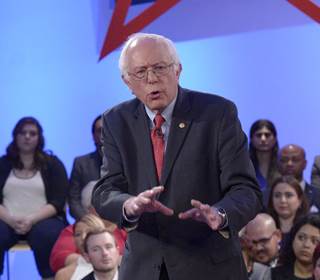
Last night’s town hall in Nevada revealed a crucial difference between Bernie Sanders and Hillary Clinton.  Bernie came out strongly for a $15 per hour minimum wage.  A living wage, as he called it.  Hillary demurred, suggesting that $12 per hour was sufficient, though she mentioned municipalities with higher minimums (places like San Francisco, which have a very high cost of living).

An extra $3.00 and hour, for 40 hours a week, for 50 weeks a year, is an extra $6000 in the pockets of workers (before taxes, of course).  For many working families, that’s the difference between struggling in poverty and making enough to live with a modicum of security.

Hillary went unchallenged on her $12 per hour figure.  But let’s remind ourselves that Hillary made $675,000 for three speeches to Goldman Sachs.  A person working for Hillary’s “generous” $12 wage would need 28 years to match what she made in three speeches that took her all of a few hours to make.

Indeed, Hillary’s “minimum wage” for her speeches to big banks and Wall Street is in the neighborhood of $100,000 to $200,000 per hour.  “Hey, that’s what they offered,” Hillary said.  And so Hillary is offering you, sales associate at Walmart, $12 per hour.  Are you not entertained?

When asked if she’d release transcripts of her speeches to the Wall Street banks and investment houses, Hillary essentially said no.  Of course, she didn’t say “no” because that would be honest.  Instead, she said she’d release her transcripts if all the other candidates did the same.  She knows that’s not happening, so her answer is no.

Perhaps Hillary could contact Goldman Sachs and ask them to start inviting workers to give speeches at her going rate.  A lot of American working families would deeply appreciate making $225,000 for a couple of hours of sharing their hard-won experiences with Wall Street bankers and investors.


Lactation Station Nation

readyandresilient_header5
Where do lactating troops fit in this picture?

Walter Stewart (Guest Post)

Sleep tight tonight, America.  At least some of the roughly one million soldiers of your Modern Volunteer Army (MOVAR, a dated acronym), part of the “finest fighting force in the history of the world,” remain awake.

A relative few are awake because they are in harm’s way.  Sleep in “Indian Country,” as my gun platoon warriors called the Mekong Delta badlands in Vietnam, is difficult.  More of our MOVAR troops are awake because of the harm their countrymen did to their bodies and minds by launching them on one of this nation’s many undeclared and therefore unwinnable wars – their restlessness will last a lifetime.

And then there are those awake breastfeeding infants or “expressing milk,” whatever that means.

It’s hard for this old soldier to get his mind around the concept of lactating troops and the realities of dealing with new Department of the Army guidance, such as “Non-restroom lactation areas must include a flat space where the soldier can rest her breast pump.”  It’s even harder to fathom how lactating “Ranger Janes” can be anything but a drag on the common defense.

Regarding the common defense, I observe that in my pre-MOVAR days there were more than enough America males to fill the ranks of a far larger army – and from a national population roughly half what it is now.  Countrymen, what happened to turn so many of us boys to beating the war drums while hiding behind skirts?  To borrow a term from Arnold Schwarzenegger, it’s as if “girly-men” have taken over to do nothing more than cheer the troops into battle while chugging one cup of “finest-military-ever” Kool-Aid after another.  Too many of us, gentlemen, are pantywaists.

It wasn’t supposed to be this way.  Throw enough money at the MOVAR, promised big government facilitator Alan Greenspan, and more than enough quality males would enlist as servicemen.  Regrettably, this bit of Greenspan happy talk wasn’t any better than his pre-meltdown assurance of bank health, so now, with the ordered opening of all service positions to females, we launch on a quest to flesh out service ranks with quality women, some nursing, some expressing.

Having led troops in war and peace, I’m trying to figure out how I would accomplish giving female soldiers time to express milk “with the intent to maintain physiological capability for lactation.”  I’m not sure what that means, but if we’re at war can the noise of a lactation pump reveal friendly positions to the enemy?  These questions, and more, need to be asked and answered.  However, and with certainty, service seniors will just go along to get along.

That’s what I would do – go into survival mode.  Take the pay, perks, pensions, and “thank you for your service” platitudes, while remembering Rudyard Kipling’s admonition to keep your head while all those about you are losing theirs.

Lactation station nation, that’s us, pumping pap to those so delusional as to believe that in the world of warriors, males and females are universally interchangeable.

Walter Stewart rose from a private in the army of regulars, reservists, and draftees raised to fight in Vietnam, to a major general serving with the thousands of citizen-soldiers of the 28th Infantry Division, Pennsylvania Army National Guard. Now retired, Stewart is a strong advocate for a citizen-military and a saner world.

A Surefire Recipe for the End of Democracy

cheerleader camo
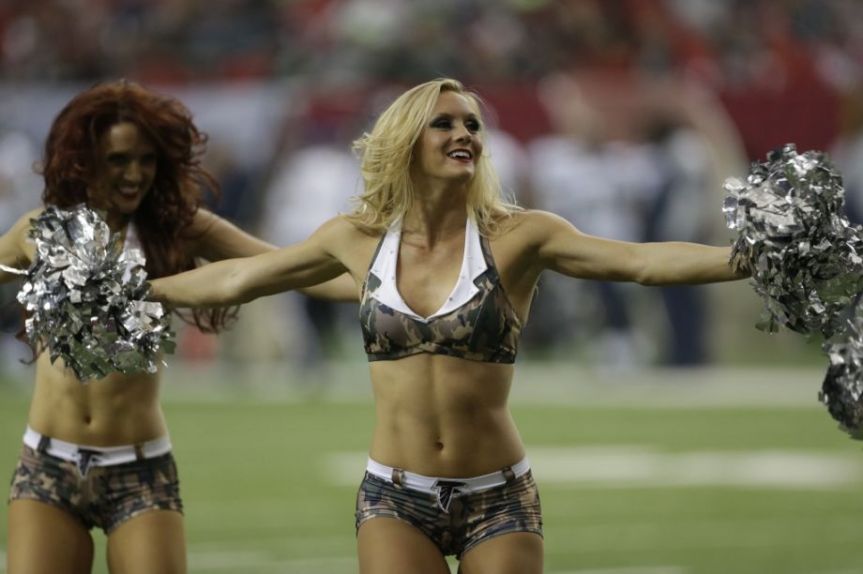
Camo-clad NFL Cheerleaders “Salute” the Troops

W.J. Astore

I’ve written several articles about the United States and creeping militarism (see here and here, for example).  This should be obvious, but I’ll say it again: Calling attention to the militarization of American society is pro-democracy, not anti-military.  Indeed, back in the citizen-soldier era of my father, being “gung ho” for the military wasn’t even applauded within the military!

As one veteran wrote to me:

When I was in the military, being “gung ho” was not considered a compliment by most of my friends… Of course we were not professional military types, just taking our turns to do our duty. We remembered the American soldier epitomized by Bill Mauldin as “Willie” and “Joe” who fought successfully against the German Army and the Japanese fanatics…The popular war movies of WWII after the war usually pitted the austere, indoctrinated Nazis fighting to demonstrate the Nazi superiority against the average American citizen soldier. Remember the movie “Battleground”? Today the images of our Army uncomfortably remind me of the way the German superman was portrayed that we overcame. 

As America today celebrates its “superman” warriors (one soldier recently called this “the age of the commando”), our country neglects these same men and women when they leave the military, often with crippling physical and psychological wounds.

As another veteran wrote to me:

[There is a] disjunction between the cult of military hero-worship in American society and American ignorance of veterans’ problems.  I am continually disgusted with those who are pimping off the mystique [surrounding our troops] who don’t deserve any special regard for their military service.  And a final but important point: many combat vets, knowing full well the realities of combat and its effects on combatants, do not want to be thanked at all [by the public].

America’s militarism both feeds and draws support from our endless wars.  The war on terror has been ongoing since 2001.  So too the war in Afghanistan.  Iraq keeps getting more chaotic.  Miscalculation in Syria could lead to World War III.

Speaking of future wars, just look at the rhetoric of our more popular political candidates for president, to include Donald “bomb those suckers” Trump and Ted “carpet bomb” Cruz.  Chickenhawk politicians are nothing but opportunists.  They may be leading the war charge, but they know they’re backed by a society in thrall to military spectacle (as represented, for example, by pom-pom shaking cheerleaders in skimpy camouflage outfits).

Unstinting praise of America’s “warriors” and “heroes” is reinforced by feel-good corporate/military advertising.  Recall Budweiser’s “welcome home” party for an Army lieutenant that aired during the Super Bowl a couple of years back.  Or red-white-and-blue Budweiser cans to “honor” the troops on July 4th.  “Saluting” the troops with colorful beer cans – really?

Signs of militarism USA are everywhere.  Police forces with MRAPs and similar tank-like vehicles.  Colleges and universities jostling for “defense” funding (even bucolic campuses want those war bucks).  Popular games that glorify military mayhem, such as the “Call of Duty” video games.  Even mundane items like camouflage headsets for NFL coaches.

It’s time to end the madness.  Paraphrasing Dwight Eisenhower, only Americans can defeat America.  Constant celebration of all things military is not a recipe for victory.  But it is a surefire recipe for the end of democracy.

School Cops with Assault Rifles: Make My Day — Not

swat
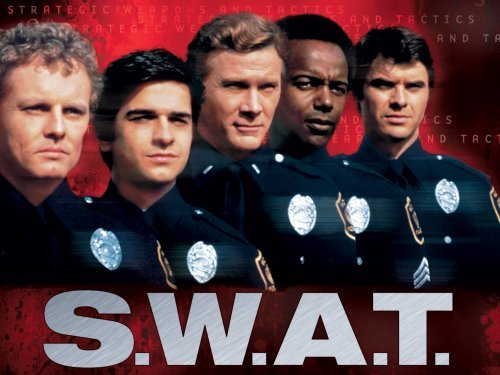
Keeping American TV “safe” since 1975

W.J. Astore

At Northeastern University in Massachusetts, members of campus security are now routinely carrying military assault rifles in their vehicles. The rationale is that you never know when and where terrorists will strike, so you have to be prepared to outgun them at all times.

Many Americans equate guns with safety — and bigness with value. So, the bigger the gun, the safer you are.  Right?

It didn’t used to be this way.

Back in the 1970s, I remember when the police got by with .38 revolvers. Up-arming the police meant going from .38 specials to .357 magnums.  Of course, these were six-shot revolvers.  Then cops started carrying 9mm handguns with clips that could carry 15-18 rounds.  Now some cops carry .40 caliber semi-automatics, which are more powerful than the 9mm but also more difficult to control.

You might call it the “Dirty Harry” syndrome (that bigger guns are better), except that that’s being unfair to Harry (played so memorably by Clint Eastwood).

As a teen, I was a big “Dirty Harry” fan, so I remember the rationale for Harry’s Smith & Wesson .44 magnum.  He carried it because he was a pistol champion (as he said, “I hit what I aim at”), and because he wanted a round with “penetration” (he noted that .38 rounds “careen off of windshields”). Finally, Harry said he used a “light special” load to limit recoil, saying it was like firing a .357 with wadcutters.  (All of this is from memory, which shows you the impression those “Dirty Harry” movies made on a typical teen interested in guns.)

Soon after Harry started boasting about his .44 magnum, a new TV show aired in America: SWAT (standing for “special weapons and tactics”). Police SWAT teams are now common in America, but they were somewhat of a novelty forty years ago.  I recall that the team carried AR-15 assault rifles along with specialized sniper rifles and shotguns.  They drove around in a big police van and arrived each week just in the nick of time to save the day.  My favorite character was the guy who carried the sniper rifle.

My excuse?  Heck, I was a teenager! What’s disturbing to me is how my teen enthusiasm for guns is now considered the height of maturity in the USA.  So much so that we arm campus police with assault rifles and see it as a prudent and sensible measure to safeguard young students.

The ready availability of guns of all types has created our very own “arms race” in America — an arms race that is being played out, in deadly earnest, each and every day on our streets and in our buildings.  We’ve allowed the cold, bold “Dirty Harry” of the early 1970s to be outgunned not only by today’s hardened criminals but by campus cops as well.

Assault rifles and SWAT teams are part of America’s new normal. Rare in the 1970s, they are now as American as baseball and apple pie.

I don’t think even Dirty Harry would be pleased with America’s new reality.  Make my day — not.

I Didn’t Raise My Boy to be a Soldier: A Mother’s Plea for Peace

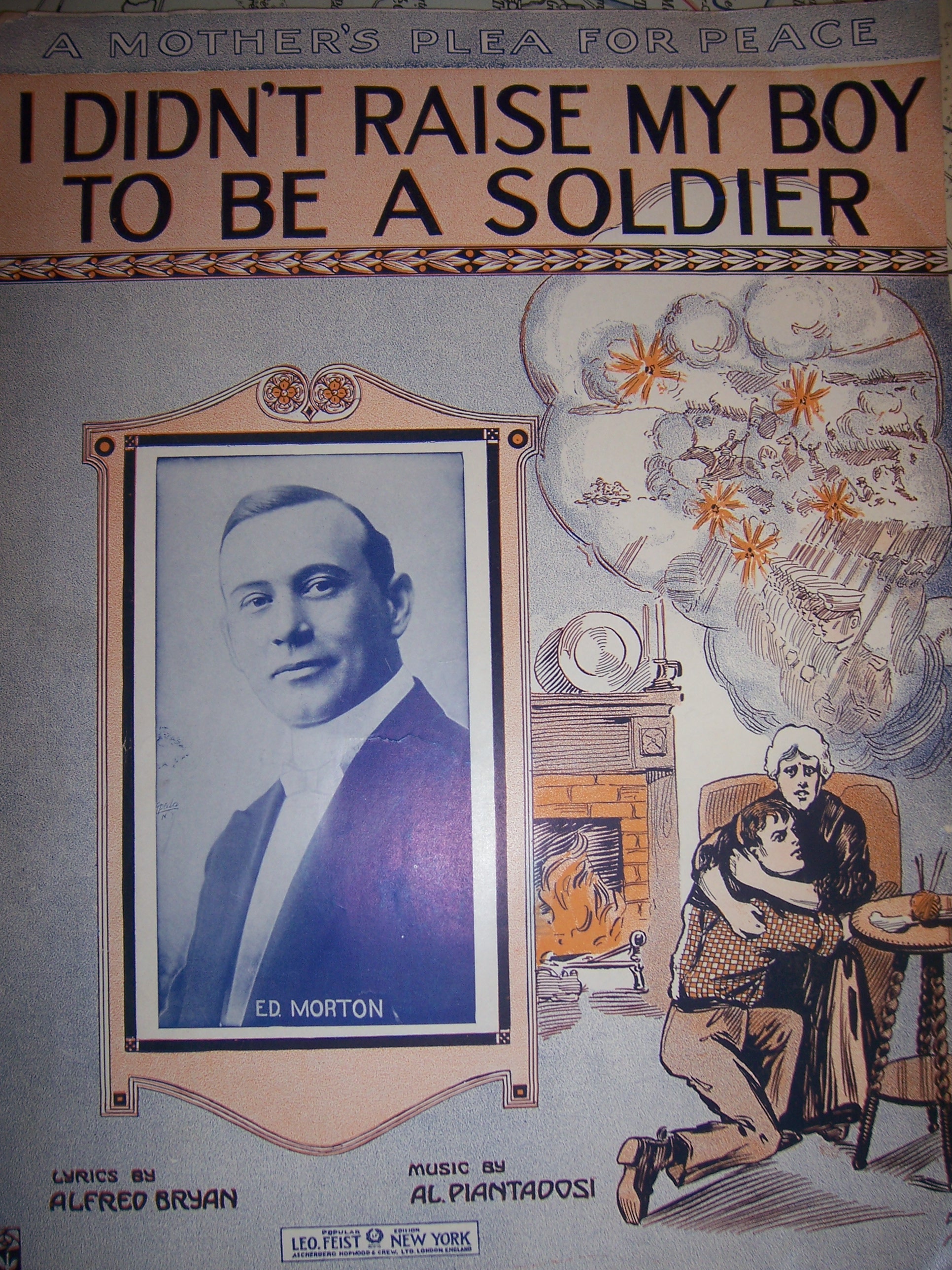
My copy of the sheet music (1915)

W.J. Astore

The year was 1915.  Europe, indeed much of the world, was embroiled in the devastating Great (or World) War.  Under President Woodrow Wilson, the United States was proud to have stayed out of the war, the massive bloodletting of which seemed peculiarly European, an “Old World” form of militarized madness that most Americans wanted no part of.  In fact, in 1916 Wilson would be reelected in large part because he had kept America out of Europe’s great war.  (Of course, the very next year the United States did choose to join the war effort against Germany.)

Yet in 1915 the idea of celebrating the military, nobilizing the military experience, finding higher purpose and meaning in war, was the furthest thing from the minds of most Americans.  Unlike the America of 2015, there was no mantra of “support our troops,” no publicity campaigns that encouraged citizens to “salute” the troops.  What publicity existed discouraged Americans from getting involved in war, a fact exhibited by some old sheet music that I recently ran across in a local thrift shop.

“I Didn’t Raise My Boy to be a Soldier,” copyright 1915 and “respectfully dedicated to Every Mother – Everywhere,” shows a mother protectively holding her grown son as visions of battle assault her mind near the family hearth.  It was a popular song; you can listen to an old Edison recording here.

The lyrics are as simple as they are telling:

Ten million soldiers to the war have gone,

Who may never return again.

Ten million mothers’ hearts must break,

For the ones who died in vain.

Head bowed down in sorrow in her lonely years,

I heard a mother murmur thro’ her tears:

Chorus:

I didn’t raise my boy to be a soldier,

I brought him up to be my pride and joy,

Who dares to put a musket on his shoulder,

To shoot some other mother’s darling boy?

Let nations arbitrate their future troubles,

It’s time to lay the sword and gun away,

There’d be no war today,

If mothers all would say,

I didn’t raise my boy to be a soldier.

(Chorus)

What victory can cheer a mother’s heart,

When she looks at her blighted home?

What victory can bring her back,

All she cared to call her own.

Let each mother answer in the years to be,

Remember that my boy belongs to me!

Nowadays, such lyrics seem hopelessly quaint and naïve, or even cowardly and defeatist.  America must stand up to evildoers around the world.  We must fight ISIS and other elements of radical Islam.  We must “stay the course” in Afghanistan.  We must maintain large and deadly military forces, ever ready to slay other mothers’ sons and daughters in the name of making peace.  Or so we are told, almost daily, by our leaders.

Indeed, our new national chorus goes something like this:  Let’s have another drink of war!  We haven’t had too many.  Keep the bullets coming and the blood flowing.  That is the way to victory!

But as we dream about “victory” by arms, we should recall the line from “I didn’t raise my boy to be a soldier”:

What victory can bring her back, All she cared to call her own.

Unlike in 1915, that’s a question that’s never asked in today’s America.

The Yearly Federal Budget for Planned Parenthood: About the Cost of Two F-35 Fighter Jets

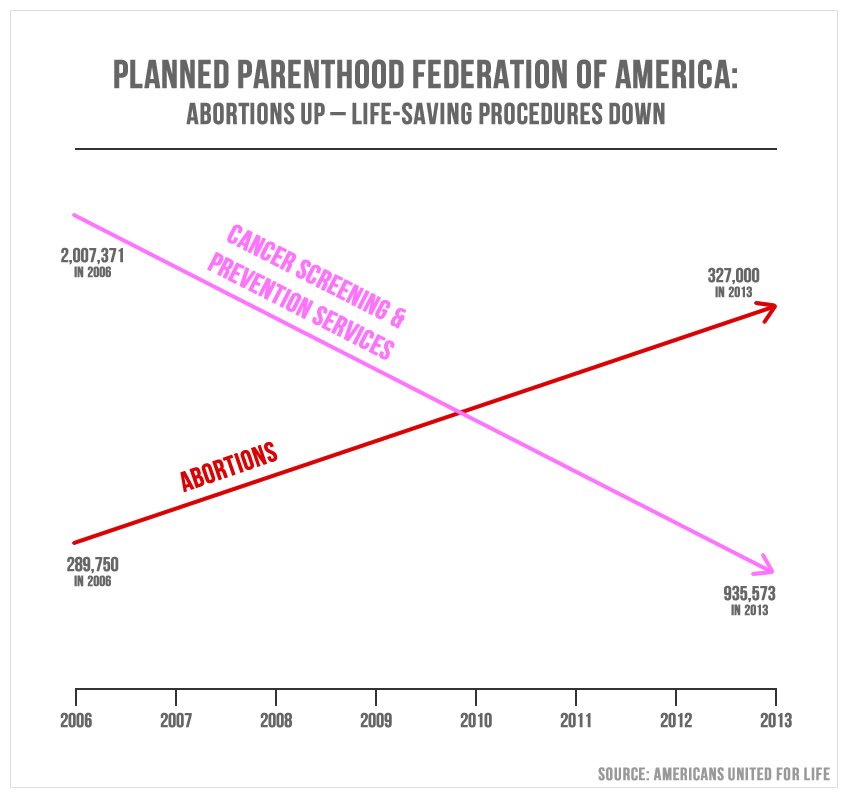
Misleading and dishonest chart shown at Congressional hearing to attack Planned Parenthood

W.J. Astore

My wife and I were talking about the Republican attack on Planned Parenthood and how ludicrous it is in the grand scheme of things.  The Federal Government contributes just over $500 million to the budget of Planned Parenthood.  That’s the equivalent of two F-35 jet fighters to support vitally important health services provided at 700 clinics across the country.  Talk about bang for the buck!

If a person playing with a full deck had to make a choice, which would she choose to fund: basic medical and information services for nearly three million Americans each year, or two underperforming F-35 jet fighters?  Indeed, for the projected cost of the F-35 program, you could easily fund Planned Parenthood for more than 2000 years!

Speaking of Planned Parenthood, it’s reassuring to know such centers and clinics exist, especially given how squeamish Americans are, generally speaking, about sex.  Planned Parenthood provides invaluable services at low cost, but I guess Congress prefers funding extraneous jet fighters at sky-high cost.

The true chart for the services rendered by Planned Parenthood is below, courtesy of Politifact.  The false chart had been used to suggest Planned Parenthood was increasing abortions and decreasing cancer screening services.  But a decline in cancer screening is due mainly to changes in frequency of pap smears, and abortion rates have held steady across time.  Note all of the other services provided, to include screening for STDs.

<

Of course, phony charts and Congressional hearings are all about politics and hot button issues like abortion.  Hysterical opposition to Planned Parenthood is a cynical exercise in emotional manipulation by disinformation and scare-mongering.  The sad thing is how easily it gains traction in our country.

Even as Republican men (yes — it’s mostly men) beat their collective chests about Planned Parenthood, consider that the Federal Budget (discretionary) for FY 2016 is $1.168 trillion.  Recall that total federal funding for Planned Parenthood is a mere $500 million.  If this was shown on a pie chart, the budgetary piece for Planned Parenthood would not be a slice; not even a sliver.  It would be a flake off of the crust.

Compare this to defense spending, Homeland Security, and war funding, which constitutes more than half the federal pie (discretionary spending), and which a Republican Congress wants to increase.  Still think we should focus on flakes off the crust of the pie?

For shame, Congress.  For shame, all of us, for allowing our politics to be manipulated by liars, opportunists, and ignoramuses.

(Note: Planned Parenthood “provides sexual and reproductive health care, education, information, and outreach to more than five million women, men, and adolescents worldwide each year.  2.7 million women and men in the United States annually visit Planned Parenthood affiliate health centers for trusted health care services and information.”  Well, they would say that, wouldn’t they?  Except that it’s true.)

Four Sayings from My Dad

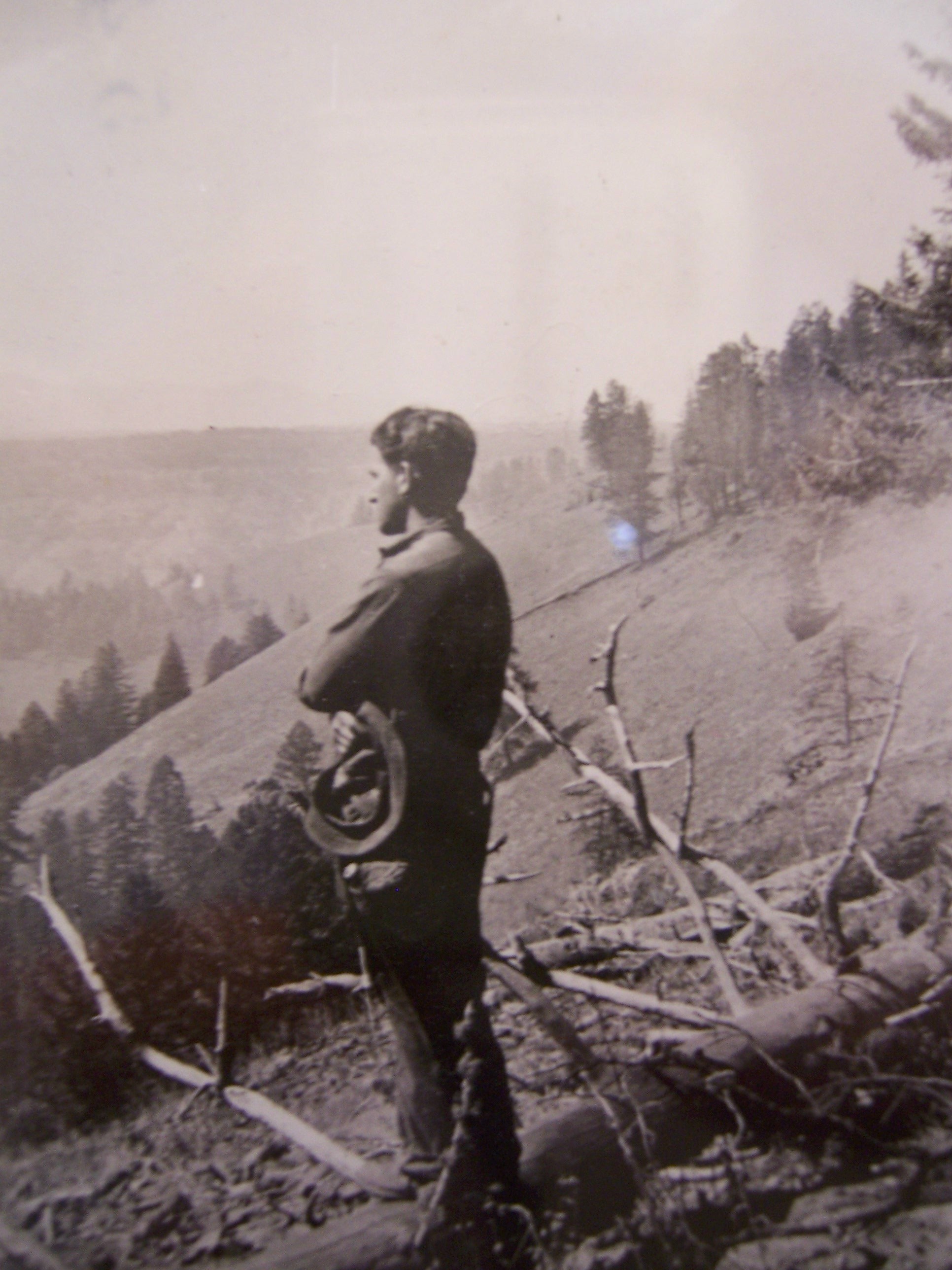
My Dad in Oregon, 1937

W.J. Astore

We tackle heavy subjects at this site, but occasionally we throw in a change of pace.  My Dad was a fount of homespun wisdom and sayings.  Three of them immediately spring to mind. “Water seeks its own level,” meaning (for him) that you don’t have to coddle talented kids—they’ll find their own path in life. “The peaches don’t drop too far from the tree,” meaning kids are often a lot like their parents, even when (especially when) they take pains to deny it.  And “The cream rises to the top.”

That last one is less than obvious to today’s generation.  In these days of homogenized milk, many people have no experience skimming the cream from the top of a glass bottle or bucket of milk.  But my father did.  He recounts his experience in a short anecdote he titled, “A full mess cup,” when he was in the Civilian Conservation Corps in 1937:

We were in a rest area [in Oregon] when the pickup truck loaded with five gallon cans of fresh milk came in.

I was first in line with my mess cup.  I guess it held more than a pint.  Those days milk wasn’t homogenized.  Being first my cup was filled with 100% cream.  Who thought of fat and cholesterol in those days?  What a taste treat.

Sometimes it pays to be first in line, especially when you can skim the cream from the top.

My father’s fourth saying?  It’s one of my favorites: “The empty barrel makes the most noise.”  I think of this whenever I encounter blowhards — someone like Donald Trump, perhaps?

The United States of Militarism

Waving the flag and wielding a gun: Hey, it's the USA!
Waving the flag and wielding a gun: Hey, it’s the USA!

W.J. Astore

A century ago, the USA was a dynamic, forward-looking, freedom-espousing country that was focused on science and technology and its practical applications, as represented by Thomas Edison and Henry Ford.  We were about to reelect a president, Woodrow Wilson, precisely because he had kept the country out of World War I.  With the exception of the Navy, the U.S. military was small, and few Americans (Teddy Roosevelt comes to mind) boasted about the “manly” virtues of military service and war.

Here we are, a century later, in a country that has taken up militarism, a country which is increasingly reactionary, authoritarian, and backward-leaning, a country that leads the world not in innovation for ordinary people as in the days of Edison and Ford, but in weapons exports to the world’s trouble spots.

Anyone with a sense of history — indeed, anyone with common sense — should recognize that militaries are antithetical to democracy.  Indeed, most Americans recognized exactly that in 1915.  A true democracy has a military as a reluctant and regrettable choice, driven by the need to defend itself in a hostile and violent world. But over the last century a regrettable choice has become, not only requisite, but celebratory in the USA.  Like so many amped up Teddy Roosevelt’s, striving to prove our manhood, America now believes military service conveys nobility.  Heroic meaning.

Yet celebrating the military, nobilizing the military experience, finding purpose and meaning in continuous war, is the very definition of militarism.

Admittedly, American militarism is a peculiar strain.  It’s not the Germanic kind in which a conservative aristocracy found its reason for being and its privileged position in military service.  There are no Prussian Junkers who willingly revel in a martial code of honor and duty in war.  Indeed, America’s aristocracy of wealth reserves the right to exclude itself from military service even as it applauds the sons and daughters of the lower orders who enlist to fight (and sometimes to die).

Again, it’s a strange militarism, militarism USA, one in which military service is indeed one of the few avenues for America’s working classes to rise by merit (tightly defined within a hierarchical structure that breeds and rewards conformity), and where a few generals actually attain a measure of cult status, however temporary (recent examples include Colin Powell, Tommy Franks, and David Petraeus).  Yet celebrated generals come and go, even as America’s wars are continuous.

Indeed, we’ve become so accustomed to living with the drumbeats of war that we no longer hear them.  It reminds me of a lesson an officer taught on World War I at the Air Force Academy.  He played sounds of an artillery barrage for the entire 50 minutes of the lesson.  When you first walked in, the noise hit you.  Then you sort of forgot about it as he taught the lesson.  Just before the end, he turned off the noise, and the silence spoke.  You realized, just a little, what it had been like for troops in the trenches in 1916 living under artillery bombardment.  And you also realized how quickly we can all become more or less accustomed to the drumbeats of war.

We’re hearing them all the time today — it’s the background noise to our lives.  For some, it’s even become sweet music.  But war and militarism is never sweet music to a functioning democracy.

One final point: Some Americans react as if calling attention to the militarization of our society/culture is the same as being anti-military.  Being against militarism and war is not being anti-military: more the reverse.  There’s a strange conflation or confusion there — and this conflation/confusion is a sign of how far militarism has gotten under our collective skin and into the nation’s blood stream.

Donald Trump and American Fascism?

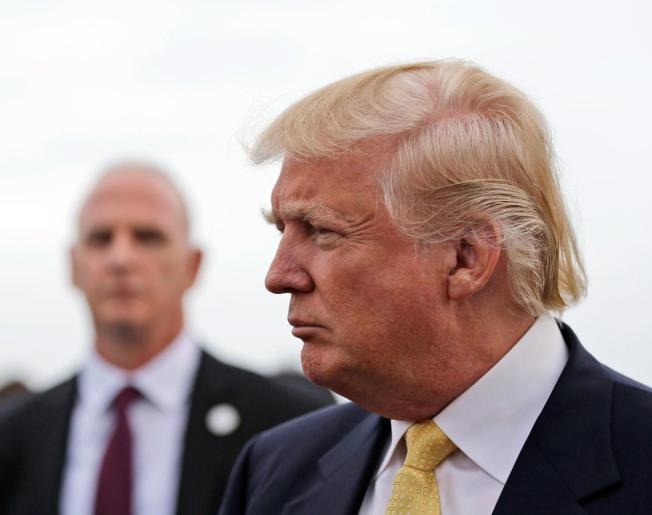
The Donald: Easy to make fun of ... too easy
The Donald: Easy to make fun of … too easy (AP/Seth Wenig)

W.J. Astore

A reader wrote to me this morning about Donald Trump and American fascism.  Is Trump, with his anti-immigrant posturing and his generally bombastic demeanor, tapping into a “fascist spring” in America?

The question seems unduly alarming as well as absurd.  But let’s pause for a moment.  I recently saw on TV the results of a poll in which Americans were asked, “Which presidential candidate would best revive the American economy?”  The clear winner: Donald Trump. Yes, maybe it’s just name recognition or an association of Trump’s name with money-making, but the result was nevertheless disturbing.

Here’s the thing: It’s easy to view Trump as a joke.  His bad hair.  His vulgar manner.  His obvious bombast.

But guess who else was dismissed as a joke?  Adolf Hitler.

Before he got his grip on power, many in Germany thought that Hitler was a joke: bad haircut, ill-fitting clothes, vulgar accent. Hitler was known as the “Bohemian Corporal,” a euphemism which in colloquial American English translates to “Hillbilly Grunt.”  As a result, “good” Germans just couldn’t take Hitler that seriously.  They underestimated him — and when they tried to move against him, it was far too late.

Of course, I’m not saying that Trump is some kind of Hitler.  What I am saying is that popular demagogues are easy to make fun of — easy, that is, until they gain power.

Sinclair Lewis had it right: It Can Happen Here.  All it takes is a megalomaniacal and messianic leader, a crisis to make the people desperate (such as the Great Depression that facilitated Hitler’s rise), various elites who cynically and opportunistically throw their support behind the “great leader,” and enough of the rest of us who choose, out of fear or indifference or ignorance, to do nothing.

Update (8/23/15): The Donald is still gaining in the polls, notes the New York Times, despite (or rather because of) the outrageous things he says:

In poll after poll of Republicans, Mr. Trump leads among women, despite having used terms like “fat pigs” and “disgusting animals” to denigrate some of them. He leads among evangelical Christians, despite saying he had never had a reason to ask God for forgiveness. He leads among moderates and college-educated voters, despite a populist and anti-immigrant message thought to resonate most with conservatives and less-affluent voters. He leads among the most frequent, likely voters, even though his appeal is greatest among those with little history of voting.

One thing is certain: Trump draws support from people who are simply tired of traditional candidates like Jeb Bush.  But does Trump stand for anything other than himself?  He’s notably vague on the issues, perhaps learning from the Obama Campaign in 2008 that it’s far better to sell vague slogans like “hope” and “change” to the American people.  Trump’s slogan is “Make America Great Again!” — and that may be all that many Americans want to hear.