The Pick Is In: Amy Coney Barrett

W.J. Astore

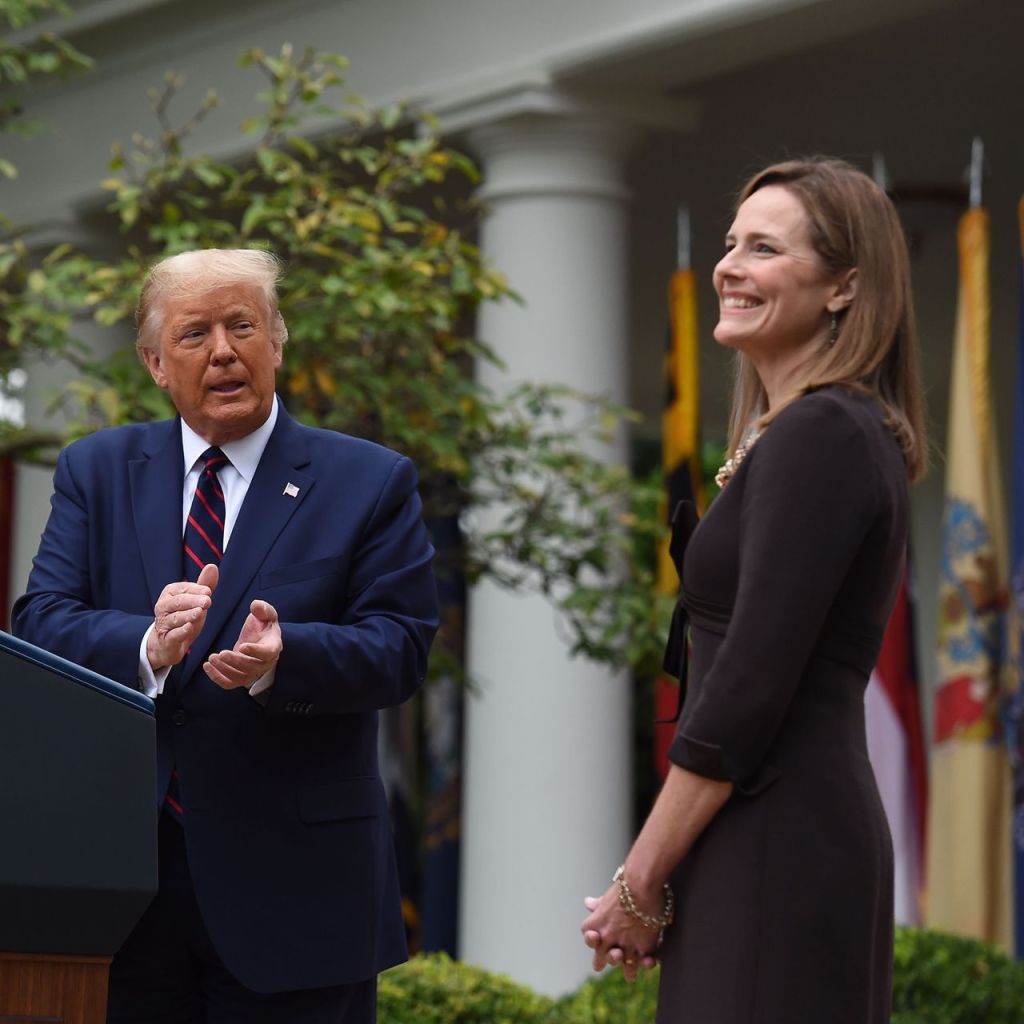
As expected, President Trump has selected Amy Coney Barrett for the Supreme Court. Intellectually, she’s qualified. But any candidate supported strongly by Trump’s evangelical base is suspect. The reason is simple: evangelicals wouldn’t support her if they weren’t confident of her opposition to Roe v. Wade. And Trump has indeed gone on the record as predicting she will be instrumental in overturning it.

Amy Coney Barrett, it’s fair to say, is a conservative Catholic. I can relate to her because into my early 20s I was a church-going Catholic. (I even carried a Catholic study bible to church.) Following the lead of the church, I thought abortion was wrong, and I tended to have a holier-than-thou attitude about it. Except in cases of rape or incest or the life of the mother, I saw no reason to publicly fund abortions. If I recall correctly, I accepted the church’s teaching that life begins at the moment of conception.

My problem was conflating my personal religious beliefs, guided by Catholic dogma, with politics and public policy. Put bluntly, I was mixing religion with politics, as if my religion had all the right answers for all Americans. But I got over it. I met more people of different religions, traveled, read a lot, got my master’s and doctorate (focusing on relations between science and religion in historical terms), and realized my personal religious beliefs should neither intrude nor interfere with the rights and privileges and beliefs of my fellow citizens.

Amy Coney Barrett will doubtless say all the right things at her Senate confirmation hearing. She’ll affirm that her religious beliefs won’t determine or even shape her decisions on the law; she won’t say how she’ll rule on Roe v. Wade, but she’ll affirm that she respects judicial precedent; she’ll affirm she’s a believer in judicial restraint; in brief, she knows the drill at these hearings.

But all this won’t be the full truth. She’s not the dream pick of evangelicals because she’s unbiased and disinterested. They know from her record (and her personal life) she’s a critic of Roe v. Wade. They also know she can be counted on to rule in favor of moneyed interests. For example, if she votes against Obamacare, as her record indicates she will, the richest Americans will see a financial windfall (they will effectively get a substantial tax cut). She can be counted on to deliver for the richest among us as well as for evangelicals and conservative Catholics, else she wouldn’t have been picked to begin with.

Two more items of interest. The conservative Catholic organization she belongs to is rather retrograde, to put it mildly, in arguing for a nuclear family of heterosexuals with the man as the “head” of the family. Homosexuality is seen as aberrational and sinful, which is how I saw it when I was carrying my Catholic study bible around. Again, all the evangelicals who support Barrett know exactly where she stands here. Finally, while being pro-life, she is also a strong supporter of gun rights and the Second Amendment.

So there you have it. Amy Coney Barrett is much like I was when I was in my early 20s. Back then I thought I had a lot of life’s answers right there in my holiest of books, and I was unafraid to suggest that public policy should be informed, if not determined, by my personal religious beliefs. But I grew up. Trump’s evangelical friends are counting on the fact that Barrett remains what she’s always been: a conservative Catholic loyalist whose religious views will very much inform how she rules from the bench.

So, goodbye to Roe v. Wade. Goodbye to Obamacare and health care for millions. Hello to a land in which corporations as “citizens” will have even more power than before. A 6-3 conservative majority on the Supreme Court will say this is justice — until the rest of us say otherwise.

Bring Back National Service

Dad in Oregon
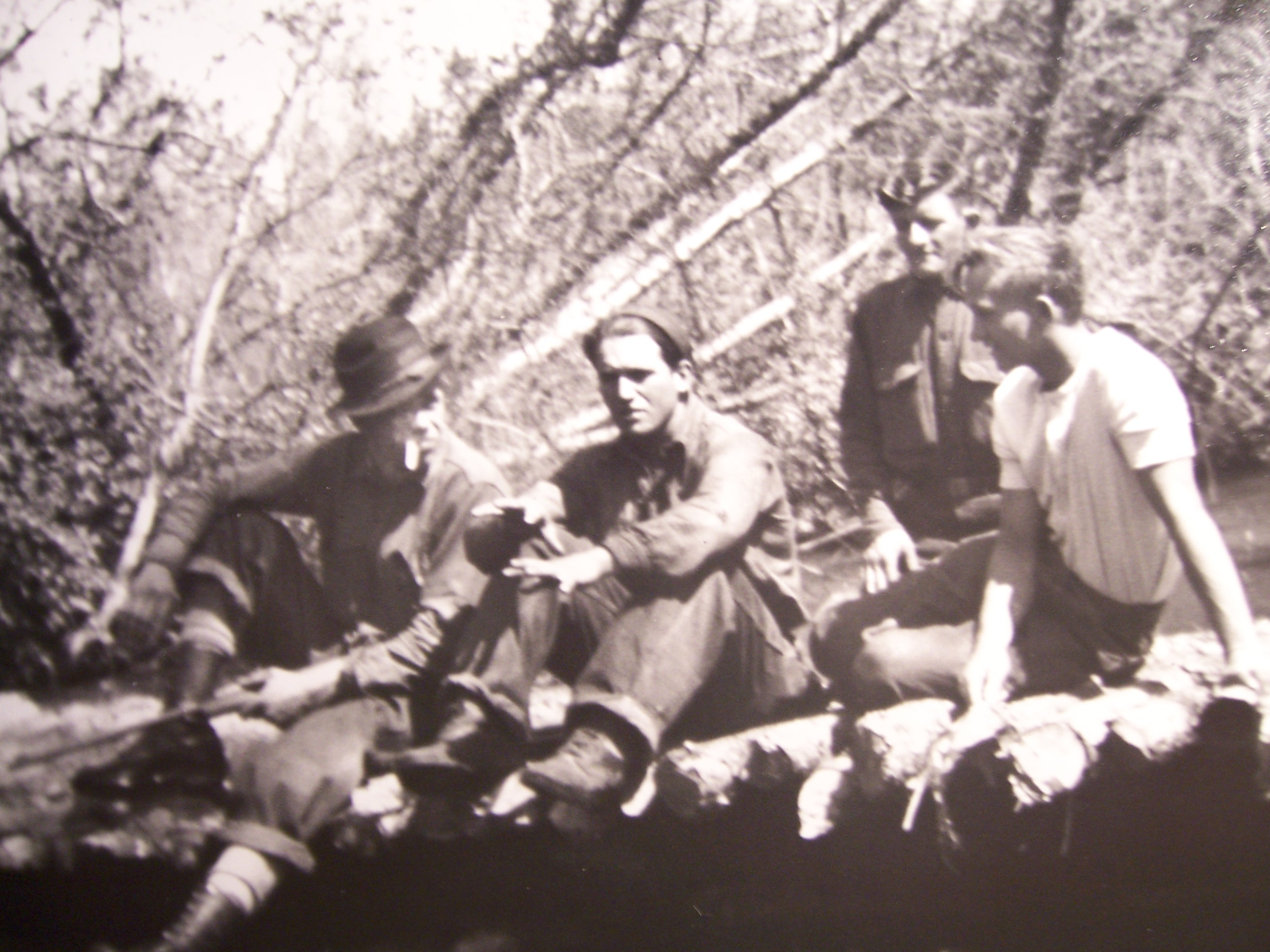
My dad (2nd from left) in Oregon with some of the “fellows,” c.1937

With fires raging in California and Oregon, and with unemployment rates high, I recalled the experiences of my dad, which I wrote about twelve years ago for TomDispatch.com.  My dad served in the Civilian Conservation Corps (CCC), mainly fighting forest fires in Oregon.  The CCC was one of those alphabet soup agencies created by FDR’s administration to put people back to work while paying them a meaningful wage.  You might call it “democratic socialism,” but I prefer to call it common sense and applaud its spirit of service to country.

We need to revive national service while deemphasizing its military aspects.  There are all sorts of honorable services one can render to one’s fellow citizens, as my father’s example shows from the 1930s, an era that now seems almost biblical in its remoteness from today’s concerns.

Hey, Government! How About Calling on Us?
Reviving National Service in a Big Way
By William J. Astore

Lately, our news has focused on tropical depressions maturing into monster hurricanes that leave devastation in their wake — and I’m not just talking about Gustav and Ike. Today, we face a perfect storm of financial devastation, notable for the enormity of the greed that generated it and the somnolent response of our government in helping Americans left devastated in its wake.

As unemployment rates soar to their highest level in five years and home construction sinks to its lowest level in 17 years, all our federal government seems able to do is buy up to $700 billion in “distressed” mortgage-related assets, bail-out Fannie Mae and Freddie Mac (at a cost of roughly $200 billion) or “loan” $85 billion to liquidate insurance giant AIG. If you’re Merrill Lynch, you get a hearing; if you’re just plain Marilyn Lynch of Topeka, what you get is a recession, a looming depression, and a federal tax bill for the fat-cat bail-outs.

But, amazingly enough, ordinary Americans generally don’t want bail-outs, nor do they want handouts. What they normally want is honorable work, decent wages, and a government willing to wake up and help them contribute to a national restoration.

How America Was Once Rebuilt

Before surging ahead, however, let’s look back. Seventy-five years ago, our country faced an even deeper depression. Millions of men had neither jobs, nor job prospects. Families were struggling to put food on the table. And President Franklin Delano Roosevelt acted. He created the Civilian Conservation Corps, soon widely known as the CCC.

From 1933 to 1942, the CCC enrolled nearly 3.5 million men in roughly 4,500 camps across the country. It helped to build roads, build and repair bridges, clear brush and fight forest fires, create state parks and recreational areas, and otherwise develop and improve our nation’s infrastructure — work no less desperately needed today than it was back then. These young men — women were not included — willingly lived in primitive camps and barracks, sacrificing to support their families who were hurting back home.

My father, who served in the CCC from 1935 to 1937, was among those young men. They earned $30 a month for their labor — a dollar a day — and he sent home $25 of that to support the family. For those modest wages, he and others like him gave liberally to our country in return. The stats are still impressive: 800 state parks developed; 125,000 miles of road built; more than two billion trees planted; 972 million fish stocked. The list goes on and on in jaw-dropping detail.

Not only did the CCC improve our country physically, you might even say that experiencing it prepared a significant part of the “greatest generation” of World War II for greatness. After all, veterans of the CCC had already learned to work and sacrifice for something larger than themselves — for, in fact, their families, their state, their country. As important as the G.I. Bill was to veterans returning from that war and to our country’s economic boom in the 1950s, the CCC was certainly no less important in building character and instilling an ethic of teamwork, service, and sacrifice in a generation of American men.

Today, we desperately need to tap a similar ethic of service to country. The parlous health of our communities, our rickety infrastructure, and our increasingly rickety country demands nothing less.

Of course, I’m hardly alone in suggesting the importance of national service. Last year, in Time Magazine, for example, Richard Stengel called for a revival of national service and urged the formation of a “Green Corps,” analogous to the CCC, and dedicated to the rejuvenation of our national infrastructure.

To mark the seventh anniversary of 9/11, John McCain and Barack Obama recently spoke in glowing terms of national service at a forum hosted by Columbia University. Both men expressed support for increased governmental spending, with McCain promising that, as president, he would sign into law the Kennedy-Hatch “Serve America Act,” which would, among other things, triple the size of the AmeriCorps. (Of course, McCain had just come from a Republican convention that had again and again mocked Obama’s time as a “community organizer” and, even at Columbia, he expressed a preference for faith-based organizations and the private sector over service programs run by the government.) Obama has made national service a pillar of his campaign, promising to spend $3.5 billion annually to more than triple the size of AmeriCorps, while also doubling the size of the Peace Corps.

It all sounds impressive. But is it? Compared to the roughly $900 billion being spent in FY2009 on national defense, homeland security, intelligence, and the wars in Iraq and Afghanistan, $3.5 billion seems like chump change, not a major investment in national service or in Americans. When you consider the problems facing American workers and our country, both McCain and Obama are remarkable in their timidity. Now is surely not the time to tinker with the controls on a ship of state that’s listing dangerously to starboard.

Do I overstate? Here are just two data points. Last month our national unemployment rate rose to 6.1%, a five-year high. This year alone, we’ve shed more than 600,000 jobs in eight months. If you include the so-called marginally attached jobless, 11 million Americans are currently out of work, which adds up to a real unemployment rate of 7.1%. Now, that doesn’t begin to compare to the unemployment rate during the Great Depression which, at times, exceeded 20%. In absolute terms, however, 11 million unemployed American workers represent an enormous waste of human potential.

How can we get people off the jobless rolls, while offering them useful tasks that will help support families, while building character, community, and country?

Here’s where our federal government really should step in, just as it did in 1933. For we face an enormous national challenge today which goes largely unaddressed: shoring up our nation’s crumbling infrastructure. The prestigious American Society of Civil Engineers did a survey of, and a report card on, the state of the American infrastructure. Our country’s backbone earned a dismal “D,” barely above a failing (and fatal) grade. The Society estimates that we need to invest $1.6 trillion in infrastructure maintenance and improvements over the next five years or face ever more collapsing bridges and bursting dams. It’s a staggering sum, until you realize that we’re already approaching a trillion dollars spent on the Iraq war alone.

No less pressing than a trillion-dollar investment in our nation’s physical health is a commensurate investment in the emotional and civic well-being of our country — not just the drop-in-the-bucket amounts both Obama and McCain are talking about, but something commensurate with the task ahead of us. As our president dithers, even refusing to use the “R” word of recession, The Wall Street Journal quotes Mark Gertler, a New York University economist, simply stating this is “the worst financial crisis since the Great Depression.”

The best and fairest way to head off that crisis is not simply to spend untold scores of billions of taxpayer dollars rescuing (or even liquidating) recklessly speculative outfits that gave no thought to ordinary workers while they were living large. Rather, our government should invest scores of billions in empowering the ordinary American worker, particularly those who have suffered the most from the economic ravages of our financial hurricane.

Just as in 1933, a call today to serve our country and strengthen its infrastructure would serve to reenergize a shared sense of commitment to America. Such service would touch millions of Americans in powerful ways that can’t be fully predicted in advance, just as it touched my father as a young man.

What “Ordinary” Americans Are Capable Of

My father was a self-confessed “regular guy,” and his CCC service was typical. He was a “woodsman-falling,” a somewhat droll job title perhaps, but one that concealed considerable danger. In the fall of 1936, he fought the Bandon forest fire in Oregon, a huge conflagration that burned 100,000 acres and killed a dozen people. To corral and contain that fire, he and the other “fellows” in his company worked on the fire lines for five straight weeks. At one point, my father worked 22 hours straight, in part because the fire raged so fiercely and so close to him that he was too scared to sleep (as he admitted to me long after).

My father was 19 when he fought that fire. Previously, he had been a newspaper boy and had after the tenth grade quit high school to support the family. Still, nothing marked him as a man who would risk his own life to save the lives of others, but his country gave him an opportunity to serve and prove himself, and he did.

Before joining the CCC, my father had been a city boy, but in the Oregon woods he discovered a new world of great wonder. It enriched his life, just as his recollections of it enrich my own:

“Thunder and lightning are very dangerous in the forest. Well, one stormy night a Forest Ranger smoke chaser got a call from the fire tower. They spotted a small night fire; getting the location the Ranger took me and another CCC boy to check it out. After walking about a mile in the woods we spotted the fire. It had burned a circle of fire at least 100 yards in diameter from the impact of the lightning bolt.

“You never saw anything so beautiful. The trees were all lit in fire; the fire on the ground was lit up in hot coals. Also fiery embers were falling off the trees. Some of the trees were dried dead snags. It looked like the New York skyline lit up at night. The Ranger radioed back for a fire crew. Meanwhile the three of us started to contain the fire with a fire trail.

“Later, we got caught in a thunderstorm in the mountains. We stretched a tarpaulin to protect ourselves from the downpours. You could see the storm clouds, with thunder and lightning flashing, approaching and passing over us. Then the torrents of rain. It would stop and clear with stars shining. And sure enough it must have repeated the sequence at least five times. What a night.”

Jump ahead to 2008 and picture a nineteen-year-old high school dropout. Do you see a self-centered slacker, someone too preoccupied exercising his thumbs on video games, or advertising himself on MySpace and Facebook, to do much of anything to help anyone other than himself?

Sure, there are a few of these. Aren’t there always? But many more young Americans already serve or volunteer in some capacity. Even our imaginary slacker may just need an opportunity — and a little push — to prove his mettle. We’ll never know unless our leaders put our money where, at present, only their mouths are.

Remaking National Service — And Our Country

Today, when most people think of national service, they think of military service. As a retired military officer, I’m hardly one to discount the importance of such service, but we need to extend the notion of service beyond the military, beyond national defense, to embrace all dimensions of civic life. Imagine if such service was as much the norm as in the 1930s, rather than the exception, and imagine if our government was no longer seen as the problem, but the progenitor of opportunity and solutions?

Some will say it can no longer be done. Much like Rudy Giuliani, they’ll poke fun at the whole idea of service, and paint the government as dangerously corrupt, or wasteful, or even as the enemy of the people — perhaps because they’re part of that same government.

How sad. We don’t need jaded “insiders” or callow “outsiders” in Washington; what we need are doers and dreamers. We need leaders with faith both in the people — the common worker with uncommon spirit — and the government to inspire and get things done.

The unselfish idealism, work ethic, and public service of the CCC could be tapped again, if only our government remembers that our greatest national resource is not exhaustible commodities like oil or natural gas, but the inexhaustible spirit and generosity of the American worker.

William J. Astore, a retired lieutenant colonel (USAF), taught at the Air Force Academy and the Naval Postgraduate School. He now teaches at the Pennsylvania College of Technology, and is the author of Hindenburg: Icon of German Militarism (Potomac Press, 2005), among other works. He may be reached at wastore@pct.edu.

Copyright 2008 William Astore

The USA as a Fourth World Country

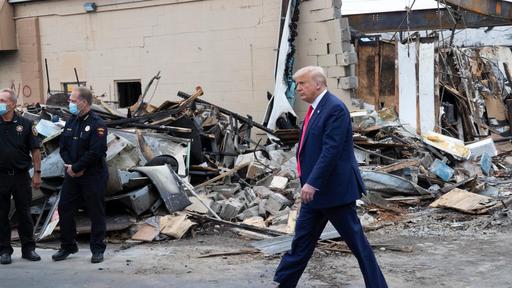
Trump, striding to protect precious property

W.J. Astore

1+3=4. It’s a simple equation that says much about the American moment, suggests Tom Engelhardt today at TomDispatch.com. Think about it. America remains a first world country with its unmatched military might, its powerful corporate and financial sectors, and the quality of life available to the affluent and well-connected. But for most other Americans? The country increasingly seems 3rd world, with crumbling infrastructure, low wages, lack of good jobs, lack of health care coverage for the less fortunate, and so on.

Perhaps that’s why Trump gets away with tweets about thug-ridden streets (that he connects to the Black Lives Matter movement). People may not see these thugs, but they sense something is wrong out there, and someone may indeed be coming for them, very shortly, perhaps to evict or foreclose on them.

There is a unique ideology to our fourth world country. Our two main parties, the Democrats and Republicans, agree that to invest in society is socialism, but to “invest” in weaponry and wars is the height of prudence and sanity. I know: a few Democrats like Bernie Sanders and AOC make noises, more or less sincere, about helping workers and investing in people, but they are shunted aside by the corporate Democrats whose main job it is to keep “socialists” like Bernie out of power. It’s the one thing they’re good at, led as they are by those icons of charisma and homespun goodness, Nancy Pelosi and Chuck Schumer.

Meanwhile, Trump continues to rant about American carnage, doing his level best to create it where it doesn’t yet exist. “Law&Order” is his new cry, usually shouted in all caps, even as he himself leads an administration that’s lawless and disordered. Roughly one-third of likely voters find him attractive as a tough-guy leader, the plutocrat populist, so mark this down as another weird feature of fourth worldness.

Fourth worldness: to invest in people is socialism and wrong; to invest in wars and weaponry is not militarism and is right. To elect a (democratic) socialist like Bernie Sanders would be un-American, but to reelect a sociopathic plutocrat posing as a populist is about keeping America great.

That’s America! You can’t love it “as is,” unless you’re crazy, and you can’t leave it ’cause we’re all Covid pariahs to the rest of the world.

So maybe, just maybe, we should change it?

Proud to be a deplorable

W.J. Astore

Today, my wife got stuck behind a pickup truck sporting a bumper sticker of considerable meaning: “Proud to be a deplorable.” No, this wasn’t red state Mississippi; it was blue state Massachusetts.

It’s worth a chuckle or two, until you realize its larger meaning. Many people are proud to vote for Trump because establishment Democrats like Hillary Clinton don’t speak to them, except when they’re dismissing them as deplorables that are “irredeemable,” as Hillary put it in 2016.

Take that, Hillary and all you “libtards”!

It’s never smart to dismiss potential voters as dumbasses without hope, but Hillary thought she had the election in the bag. She lost because she ran a poor campaign and because her elitism and sense of privilege were so obvious. But she also had no compelling messages for the “deplorables.” And Trump did. Trump talked about bad trade deals, the offshoring of jobs, the betrayal of ordinary Americans by the financial set, the big money people, the ones who paid Hillary so handsomely for a few empty speeches.

Of course, Trump didn’t and doesn’t care about ordinary Americans. From all appearances, Trump cares only about himself (and perhaps his immediate family). Nevertheless, he was smart enough to offer the people something, even if all they were left with in the end was a rebel identity as a deplorable.

Establishment Democrats, demonstrating their ability to learn nothing, are once again offering “deplorables” nothing specific. No universal health care (indeed, Joe Biden said he’d veto such a bill if it reached his desk as president). No firm and trustworthy commitment to a $15 minimum wage. No firm and trustworthy commitment to ending those endless foreign wars. Biden promises nothing more than he’s not Trump, end of story.

His choice of Vice President backs this up. Kamala Harris is a conservative Democrat; she’s establishment through and through. But she’s a woman who’s multiracial, so this is considered proof of her diversity and her commitment to helping the less fortunate. Come again?

As Tulsi Gabbard pointed out during a debate, Harris smugly joked about smoking marijuana even as she put “deplorable” users into prison, among other positions that showcased her privileged hypocrisy, but no matter. Even though Harris dropped out early (after boasting of being a top-tier candidate), even though she couldn’t win a single delegate in the primaries, she was handpicked by Joe Biden to lend some excitement to the ticket. Mission unaccomplished.

So I fear, like Michael Moore, that Trump could win again, probably losing the popular vote but winning enough swing states to put him over the top in the electoral college. Trump could win because the “deplorables” in their trucks across blue- and red state America know how to stand by their man. Even though he’s a no-good cheatin’ fool, Trump offers them something, something unquantifiable but powerful, an identity, perhaps, and the ability, in casting their votes, to give a big FU to all the elites that keep telling them they don’t measure up — and never will.

Staying Sane in the Age of Trump

parallel-universe

Richard Sahn

As a social scientist living through horrific political, economic, and public health crises, I should be embracing with all my might philosophical materialism, the epistemological model behind science.  That I don’t could cost me personal and collegial respect, not to mention friendships. So, what exactly is philosophical materialism, and why do I find it ultimately non-collegial?

Philosophy precedes science.  It’s impossible to have science (or the sciences) without a presupposition about what is real, which is the arena of philosophy.  Philosophical materialism says that all that is real or factual is material or physical in nature.  And I find this too limiting.

I am more attuned to the Eastern philosophical model, intellectually supported these days by quantum physics, particularly the early 20th-century German physicist Werner Heisenberg.  It holds that non-material phenomena, such as dreams and hallucinations, are as real as physical phenomenon such as rocks and rivers, in one sense, even more real. (My dream is a reality sui generis. It is not electrochemical activity in my brain.) What’s more, all material and non-material phenomena come into existence from individual conscious intention and belief; there is no truly independent universe out there.

The good philosophical news here about the anti-materialist epistemological model is the plausibility of a multi-world or multi-dimensional universe.  If reality is a product of consciousness, rather than the other way around, it seems to me Franklin Delano Roosevelt’s claim that we have “nothing to fear but fear itself” is really possible. In fact, the psycho-therapeutic value of that statement is considerable.

But what do I do with my propensity toward progressive activism? And what do I do with those great discussions I have with my friends on how disgusting and horrible the Trump administration is? Can I have both perspectives at the same time? Emerson said that consistency is the hobgoblin of little minds. And it seems counterintuitive to be, following the Bible, “in the world but not of the world,” to see everyday life as play, as a sort of game created by me and only for me.

Don’t get me wrong.  I’m not arguing for “alternative facts,” as the supporters of Trump do.  I’m not denying science or the dangers of Covid-19.  When I go out, I social distance and wear a mask as needed.  But I also believe there is a reality outside of rocks and rivers, so to speak, a reality created by my consciousness, an immaterial realm that has its own existence, whether for me or for all of us.  Some might call this a “higher” realm; I prefer to see it as linked to the material, for I myself am both physical and mental, both material and immaterial.

Those epistemological paradigms, material and  immaterial, provide me with solace in these dark days.  Not everything is controlled by others, and especially not by the Cult of Trump.  I decide.  And for me that’s an empowering thought at a time when power is being actively denied to so many of us.

Richard Sahn is a retired sociology professor and a regular contributor to Bracing Views.

Trump’s Garden of Heroes

Statues
Silent teachers in stone and metal: U.S. Capitol

W.J. Astore

While castigating the “radical left” in his latest vitriolic speech before Mount Rushmore, Trump proposed a new garden of heroes to celebrate meaningful Americans.  Naturally, that list has generated controversy.  As others have noted, Native Americans are absent from the list; so too are Hispanics; and so too are Democratic presidents.

Here’s a look at Trump’s “heroes”:

John Adams, Susan B. Anthony, Clara Barton, Daniel Boone, Joshua Lawrence Chamberlain, Henry Clay, Davy Crockett, Frederick Douglass, Amelia Earhart, Benjamin Franklin, Billy Graham, Alexander Hamilton, Thomas Jefferson, Martin Luther King, Jr., Abraham Lincoln, Douglas MacArthur, Dolley Madison, James Madison, Christa McAuliffe, Audie Murphy, George S. Patton, Jr., Ronald Reagan, Jackie Robinson, Betsy Ross, Antonin Scalia, Harriet Beecher Stowe, Harriet Tubman, Booker T. Washington, George Washington, Orville and Wilbur Wright.

It’s easy to pick apart any list.  Why this person and not that one?  Or why not this person and that one?  For example, why not MLK Jr. and Malcolm X?  Why not Jackie Robinson and Muhammad Ali?  Is it because MLK Jr. and Jackie are considered safer, or less controversial, or more American because they were “less angry”?

Among other absences, there’s another I’d like to highlight: Any person dedicated to the cause of peace.*

Again, looking at Trump’s list, what struck me was the predictable worship of military men, not just Joshua Lawrence Chamberlain from the Civil War or Audie Murphy from World War II but the usual generals Trump professes to love, Patton and MacArthur.  Two vainglorious wannabe Caesars, the very opposite of America’s citizen-soldier ideal, are Trump’s idea of America’s noblest generals.  Not George C. Marshall and Omar Bradley, also of World War II fame, and both more deserving of acclaim, and more suited to America’s military traditions.  Or how about General Smedley Butler, twice awarded the Medal of Honor, who became an outspoken critic of war after his retirement?

What also struck me was the presence of “the usual suspects” in the list.  Do we really need yet another statue to George Washington?  Abraham Lincoln?  Benjamin Franklin?  Can’t we come up with some lesser known heroes worthy of acclaim, perhaps someone like Prudence Crandall, a schoolteacher who established the first school for African-American girls in New England, and who faced mob violence as she fought to keep her school open.  Or how about Elihu Burritt, the Learned Blacksmith, who fought so hard in antebellum America against war.  America has a wealth of unsung heroes; why not take this chance to celebrate “ordinary” Americans doing extraordinary things?

Notice, naturally, the deep bow to conservative icons such as Billy Graham, Ronald Reagan, and Antonin Scalia.  An evangelist, a president, and a Supreme Court Justice, respectively.  So how about Dorothy Day, Jimmy Carter, and Harry Blackmun to balance the partisan ledger?

Some science might be injected with Carl Sagan or James Watson.  Some environmentalism with Rachel Carson.  During a pandemic, why not Jonas Salk?  And why is America’s greatest inventor, Thomas Edison, not on this list?  Of course, you could go on almost endlessly here.

Perhaps what amused me most was the stipulation the statues have to be lifelike or realistic, not abstract or modernist representations.  They are to be “silent teachers in solid form of stone and metal,” per Trump’s executive order.  This rejection of abstract or modernist representation put me to mind of Nazi Germany’s rejection of so-called degenerate art.  The Nazis preferred art that celebrated uncontroversially the heroism of Germans and the human form: art that was open only to the most obvious interpretation.  As a good friend put it, “Combine Trump’s classical garden of heroes with his edict that public buildings be made ‘beautiful again’ in a neoclassical style and all he’s missing is a catchy antisemitic drinking song.”

In other words, Trump wants a garden of heroes in which we’re expected to bow our heads in awe, rather than hold our heads in thought.  Awe is befitting to a dictatorship, but thought is becoming to a democracy.

* I’ve applauded MLK Jr.’s efforts to end the Vietnam War; he deserves to be recognized as a peace activist, but of course he’s on Trump’s list for his civil rights record, not his critique of America as the world’s greatest purveyor of violence.  One name I’d love to see added to the list is Daniel Ellsberg, who risked everything to expose American lies with the release of the Pentagon Papers.

Trump’s Culture War

200704-trump-rushmore-axc-1205a_5601cdb840d1a993a5148125620777b3.nbcnews-fp-1200-630
Shameless, thy name be Trump

W.J. Astore

President Trump’s strategy for winning in 2020 is to fan the flames of culture war, including blatant references to white power.  Even some Republicans seem embarrassed, though not enough to make any difference in Trump’s reprehensible tactics.  Trump’s emptiness is incalculable — this and his cult-like “base” make him a dangerous man indeed.  He needs to be denounced and voted out of office; how disappointing is it that the Democratic alternative is Joe Biden, a man with his own record of lies, a man with little going for him except that he’s not Donald Trump.

Along with culture war, Republicans are also doing their best to discourage voting.  The tactics here are many: fewer polling stations, meaning longer lines and wait times; voter ID laws to counter non-existent voter fraud; disenfranchisement of voters through purges of rolls; opposition to mail-in ballots and other efforts to make voting easier and safer in the age of Covid-19; the presence of “monitors” at polling sites as a form of intimidation.

Rally the base while suppressing the overall vote: this, apparently, is what Trump is counting on this November.

Why?  Because Trump has nothing real to run on.  His biggest “accomplishment” was a tax break for corporations and for the richest Americans.  When asked by Fox News about what he wanted to accomplish in his second term, Trump had nothing specific to say.  No policy goals.  Nothing.  The one thing he seems determined to do, besides building his wall, is eliminating Obamacare, which would throw tens of millions off their health care plans during a pandemic.

If cynicism has a bottom, Trump hasn’t found it yet, though not for want of trying.

Of course, Trump’s culture war is as ugly as it is racist.  It’s also a distraction from rampant and blatant kleptocracy.  For example, the latest “defense” budget calls for $740 billion in spending, yet the key issue for Trump is to defend military posts that are named for Confederate officers.  Trump, a New York City trust fund baby, as Yankee as a Yankee can be, poses as a principled defender of Confederate leaders and the Confederate battle flag, in the name of “respecting our past.”  Consider him the quintessential con man as cultural carpetbagger, cynically adopting any position that he can use to inflame his base and drive them to the polls this November.

Truly, these are bizarre times.  Trump, the Vietnam draft dodger, the man of heel spurs infamy, celebrates Generals George Patton and Douglas MacArthur as his ideals.  As military leaders, both were deeply flawed; both were vainglorious; both were over-celebrated and overrated.  Small wonder that Trump sees something in them that he sees in himself: overweening egotism, the quest for victory at any cost, including the deaths of their own troops.

Trump wants America to turn on itself, to consume itself, and as long as he wins another term, he couldn’t care less about the cost.  Why?  Because he doesn’t see us as his fellow citizens — he sees us as his subjects.  And even if you count yourself in his “base,” he likely sees you as nothing more than a patsy.  A sucker.  And, based on his total lack of leadership when it comes to Covid-19, he literally doesn’t care if you live or die.

Trump is a wannabe king, and he will say or do most anything to keep his grip on power.  Having just marked another July 4th celebration of America’s independence from a capricious monarch, King George III, it doesn’t make any sense to re-empower another mad king.

Don’t be distracted by Trump’s culture wars and his incessant divisiveness, America.  Remember its intent: to divide is the way to conquer.  Trump doesn’t want “to keep America great.”  He wants to keep it servile to him.  He wants you under his spell, shouting his name, laughing at his cruel jokes.

Is that what you want for yourself and for our country?

Black, Irish, White: A Case Study of Policing

cropped_MI_Paddy-wagon-Irish-echo
“Paddy Wagon” — generally considered a derogatory term against the Irish

M. Davout

The police killing of a subdued and helpless George Floyd and the worldwide demonstrations against systematic police brutality against Black Americans it provoked have rightly put a spotlight on policing in the US.  Floyd’s senseless killing and the populist pushback have also raised the question of the extent to which the institution of policing in this country originated and evolved as an instrument of group domination by self-identified whites.

Policing has never been my academic research specialty but I did once have a close-up encounter with reams of data that appertained to the question of how policing has worked in this country. Many decades ago, over several weeks of a hot Boston summer, I was employed by a sociology PhD student to code data from arrest records contained in old ledgers piled in a dusty basement of the Suffolk County Courthouse.  I remember going through dozens of ledgers from years that spanned the turn of the nineteenth to the twentieth century and recording surnames of individuals who had been arrested by Boston police officers, as well as the crimes they were charged with.

While the specialized legal abbreviations and idiosyncrasies of penmanship of those long dead clerks took a while to decipher, it wasn’t long before I was making quick progress through years of arrest records. And, almost immediately, a pattern was evident. The overwhelming majority of the defendant names were Irish, while the infractions charged were relatively few: public drunkenness, disorderly conduct, with, perhaps, some counts of resisting arrest thrown in. As it turned out, the PhD student was writing a dissertation about the relationship of Boston’s Irish population to the local police. And from the data I was coding, it looked to my unscholarly eyes that that relationship had been a contentious one, with Irish-surnamed folk filling Boston’s jails for decades at least. Needless to say, the court records did not indicate how many of those charges of public drunkenness or disorderly conduct were trumped up.

Growing up in southeastern Massachusetts in the 1970s, I experienced people with Irish-sounding surnames as figures of authority and accomplishment: grade schoolteachers, parish priests, local and state politicians, and, of course, the Kennedy clan. It was a far cry from that earlier time when Irish-Americans were a despised and impoverished immigrant group (“Irish Need Not Apply”) and were the targets of popular discrimination and systematic harassment and repression by many Protestant establishment political elites who controlled public institutions in the Bay State.

no-irish-need-apply-the-new-york-times-10-may-1859

Purely by coincidence during that same summer of research in the basement of the Suffolk County Courthouse, I was reading J. Anthony Lukas’s Pulitzer Prize-winning book about the contentious history of school busing, Common Ground, and came across a passage describing the Massachusetts State legislature’s confiscation of control of the Boston police force from city hall in 1895. Just ten years earlier, the city elected its first Irish-born mayor, which “launch[ed] an era of Irish-American dominance of Boston City Hall.”

It seems that even when the Boston Irish had made progress through the ballot box, their newfound control over the city’s main instrument of coercion could be stripped away by their long-time political nemesis acting at the state level. In the end, it may have been only after Irish-Americans, who had long been considered a race apart from Protestant America, could move across what W.E.B. Dubois called America’s “Color Line” and become “White” that they could escape the worst effects of policing. The same path, needless to say, has not been available to Black Americans.

M. Davout is the pen name for a political science professor who teaches in the Deep South.

Wear the Mask! Wear the Mask!


660594ab-c019-4810-b23c-a52f946cddff_750x422
Why was this so much easier in 1918? (Georgia Tech game, 1918, courtesy of Andy McNeil)

W.J. Astore

I keep seeing headlines like this one from Alternet today: Trump ‘patriots’ ready to die for freedom shout down county commissioners because they don’t want to wear face masks.

How do you convince such “patriots” that wearing a face mask is not an assault on their freedom?

Perhaps by telling them that the Covid virus is much like those bad people invading us from the south.  You know: those “rapists” and “killers” and other viral elements poring through our border, as Trump warned us about in his first speech as a candidate in 2015.  A “threat” we can stop with a chant: “Build the wall!  Build the wall!”

Think of all those Covid viral droplets as unwanted and dangerous invaders — but we can stop them before they ruin America.  How?  Wear the mask!  Wear the mask!

Just think of the mask as a wall between you and the bad people out to ruin America.  There — don’t you feel like a patriot now, wearing your “wall” mask?  You can even get masks with American flags on them.  Wear with pride!

Corporations Are Citizens — What Are We?

citizen
I sure wish this image reflected reality

W.J. Astore

Back in January 2010, I wrote the following article for Truthout in the aftermath of the Citizens United decision.  Despite recent mass protests driven by murders of blacks such as George Floyd, not much has changed.  Police reforms are stalled at the federal level, and a racist president continues to inflame even as he seeks greater power.  Americans are told change will come via the ballot box, but when politicians are essentially owned by citizen-corporations, changing a few faces in Congress or even the Oval Office will change little.  As George Carlin explained to a skeptical audience: “You have owners.  They own you.”  And so we are reduced to certain roles in society, mainly as consumers but also as warriors and prisoners – or so I argued in 2010:

Corporations Are Citizens — What Are We?

This week’s Supreme Court ruling [Citizens United] that corporations are protected by “free speech” rights and can contribute enormous sums of money to influence elections is a de jure endorsement of the de facto dominance of corporations over our lives. Indeed, corporations are the new citizens of this country, and ordinary Americans, who used to be known as “citizens,” now fall into three categories: consumers, warriors and prisoners.

Think about it. Perhaps you’ve noticed, as a friend of mine has, that the term “citizen” has largely disappeared from our public and political discourse. And what term has taken its place? Consumer. That’s our new role: not to exercise our rights as citizens (perish the thought, that’s for corporations to do!), but to exercise our credit cards as consumers. Here one might recall President George W. Bush’s inspiring words to Americans after 9-11 to “go shopping” and to visit Disney.

Think again of our regulatory agencies like the FDA or SEC. They no longer take action to protect us as “citizens.” Rather, they act to safeguard the confidence of “consumers.” And apparently the only news that’s worthy of note is that which affects us as consumers.

As one-dimensional “consumers,” we’ve been reduced to obedient eunuchs in thrall to the economy. Our sole purpose is to keep buying and spending. Corporations, meanwhile, are the citizen-activists in our politics, with the voting and speech rights to match their status.

At the same time we’ve reduced citizens to consumers, we’ve reduced citizen-soldiers to “warriors” or “warfighters.” The citizen-soldier of World War II did his duty in the military, but his main goal was to come home, regain his civilian job, and enjoy the freedoms and rights of American citizenship. Today, our military encourages a “warrior” mentality: a narrow-minded professionalism that emphasizes warfighting skills over citizenship and civic duty.

And if that’s not disturbing enough, think of our military’s ever-increasing reliance on private military contractors or mercenaries.

The final category of American is all-too-obvious: prisoner. No country in the modern industrialized world incarcerates more of its citizens than the United States. More than 7.3 million Americans currently languish somewhere in our prison system [awaiting trial, on parole, or in jail]. Our only hope, apparently, for a decline in prison population is the sheer expense to states of caring and feeding all these “offenders.”

There you have it. Corporations are our new citizens. And you? If you’re lucky, you get to make a choice: consumer, warrior or prisoner. Which will it be?