Creator of Bracing Views. Contributor to TomDispatch, Truthout, HNN, Alternet, Huffington Post, Antiwar, and other sites. Retired AF lieutenant colonel and professor of history. Senior fellow, Eisenhower Media Network
The National Security Agency (NSA) has always been highly classified, a fact captured by the joke that NSA really stands for Nonesuch Agency.
Lately, with all the revelations by Edward Snowden about “inadvertent” and “unintentional” spying on Americans, the NSA seems to be defining a new acronym for itself. Call it the
Nothing to See here, move Along, outfit.
The American people are being told by their government and their media that NSA domestic spying is a non-story. The headline is something like: They’ve always done it, or They’re doing it to keep you safe, or You can trust powerful government agencies that have access to your private data.
In other words, nothing to see here, move along.
A true democracy jealously guards the rights of its citizens, notably the right to privacy. A true democracy also has sufficient checks to guard against the acquisition of power and influence, whether sought or unsought, by the military-intelligence complex. We are no longer such a democracy.
Perhaps the biggest “reveal” of the whole Snowden affair is how much of government intelligence is not government. It’s been outsourced, privatized. We’ve added the profit motive to spying, ostensibly in the name of efficiency.
So, along with acquiescing to government spying, we’ve now made it a for-profit business in which lobbyists give money to Congress to ensure that this intelligence complex continues to grow in power and reach. All in the name of keeping us safe, naturally.
The Army has an off-color saying: Don’t piss on my leg and tell me it’s raining. Please don’t tell me you’re spying on me and mining my data so that I’m “safer.”
There is something to see here, citizens. And what it is is not pretty.
Americans generally, and politicians in particular, proudly proclaim that we live in “the greatest” country. But how should we measure the greatness of a country? I’d suggest that quality of life should be a vitally important measure.
And what is more fundamental to quality of life than ready access to health care? When you’re sick or suffering, you should be able to see a medical specialist. And those costs should be — wait for it — free to you. Because health care is a fundamental human right that transcends money. Put succinctly, the common health is the commonwealth. And we should use the common wealth to pay for the common health.
Here’s the truth: We all face the reality of confiscatory taxation. If you’re like me, you pay all sorts of taxes. Federal, state, and local income taxes. Property taxes. School taxes. Social security. State lotteries are a regressive tax aimed at the poor and the gullible. We pay these taxes, and of course some for health care as well (Medicare/Medicaid), amounting to roughly 30 percent of our income (or higher, depending on your tax bracket, unless you’re super-rich and your money comes from dividends and capital gains, then you pay 15 percent or lower: see Romney, Mitt).
Yet despite this tax burden, medical care for most of us remains costly and is usually connected somehow to employment (assuming you have a good job that provides health care benefits). Even if you have health care through your job, there’s usually a substantial deductible or percentage that you have to pay out-of-pocket.
America, land of the free! But not free health care. Pay up, you moocher! And if you should lose your job or if you’re one of the millions of so-called underinsured … bankruptcy.
Health care is a moral issue, but our leaders see it through a business/free market lens. And this lens leads to enormous moral blind spots. One example: Our colleges and universities are supposed to be enlightened centers of learning. They educate our youth and help to create our future. Higher Ed suggests a higher purpose, one that has a moral center — somewhere.
But can you guess the response of colleges and universities to Obamacare? They’re doing their level best to limit adjunct professors’ hours to fewer than thirty per week. Why? So they won’t be obligated by law to provide health care benefits to these adjuncts.
Adjuncts are already underpaid; some are lucky to make $3000 for each course they teach. Now colleges and universities are basically telling them, “Tough luck, Adjunct John Galt. If you want medical benefits, pay for health insurance yourself. And we’re limiting your hours to ensure that you have to.”
So, if Adjunct John Galt teaches 10 courses a year (probably at two or three institutions of “higher” learning) and makes $30,000, he then faces the sobering reality of dedicating one-third of this sum to purchasing private health insurance. If that isn’t a sign of American greatness, I don’t know what is.
I groan as much as the next guy when I pay my taxes. But I’d groan a lot less if I knew my money was funding free health care for all (including me and mine). Commonwealth for the common health. With no death panels in sight.
As “Dirty Harry” said in a different context, “I know what you’re thinking.” Free health care for all is simply too expensive. We say this even as we spend a trillion dollars a year on national defense and homeland security, to include the funding of 16 intelligence agencies to watch over us.
A healthy republic that prides itself on “greatness” should place the health of its citizens first. That we don’t is a cause for weeping — and it should be a cause for national soul-searching.
One of my favorite quotations comes from the Jamaican bobsled coach. Remember how the Jamaican bobsled team captured the world’s fancy? A bobsled team from the Caribbean … how crazy is that? They weren’t very good, but so what? They gave it their all.
Anyway, here’s the quotation:
“If you’re not enough before the gold medal, you won’t be enough with it.”
As soon as I read it, I recognized the wisdom and truth of those words.
Medals, trophies, awards, titles: they won’t fill the emptiness inside. Oh, they’ll make you feel good for a few hours or a few days, but the feeling soon wears out.
We live in a hyper-competitive society in which it’s all about “winning,” whatever that means. So focused are we on winning — which is usually both short-term and ephemeral — that we forget what’s really important in life. Family, friends, health, a life of meaning and service, stuff like that. Stuff that you may not win a gold medal for, but the stuff that truly matters.
A society based on competition and consumerism always pressures us to associate winning with acquisition. I need that gold medal for affirmation! And if I can’t get that, at least I can buy that Lexus SUV, that Kate Spade bag, or some other shiny object that feeds my ego.
Forget about medals and ribbons and titles. Living a life of meaning is its own reward.
Here, as promised, is what I hope is some fresh thinking. I also posted this at Huffington Post.
Currently, so-called “fresh” thinking on national security from the Obama administration includes the pivot to Asia, more emphasis on cyberwar and drones, continued expansion of Special Forces, a withdrawal from Afghanistan in super-slow motion, and intervention (sending arms at minimum; troops possibly to follow) in Syria. “Defense” budgets are to remain high, with each service getting its usual assortment of high-priced weapons (most notoriously, the $400 billion devoted to procure the F-35 joint strike fighter for the Air Force, Navy, and Marines).
In other words, it’s pretty much business as usual at the Pentagon.
How about some truly fresh thinking on national security? Here are five ideas that are more visionary than anything our sclerotic and self-absorbed bureaucracy will ever produce:
1. Eliminate nuclear weapons in U.S. military arsenals by the year 2025.
The U.S. remains the only country ever to use nuclear weapons (Hiroshima and Nagasaki). It would send a powerful message to the world if we took the lead in eliminating nuclear weapons from the planet. And we can afford to take this risk. Why? Precisely because of our enormous conventional (non-nuclear) military might. Such a bold step would also help to restore our moral standing in the world.
2. Get out of Afghanistan now.
If the Afghan National Army (ANA) isn’t ready to take charge after a decade of U.S. training and scores of billions of dollars, it never will be. The U.S. effort to train the ANA was always a case of putting the cart before the horse, since you can hardly create a national army where there is no nation. It’s time to cut our losses and leave.
3. Define a new “Good Neighbor” Policy.
Remember when FDR declared a “Good Neighbor” policy to improve relations with Latin American countries? Yes, it was eight decades ago. It’s high time that we reach out again to our immediate neighbors, even the “bad boy” ones like Cuba and Venezuela, rather than wasting resources in faraway places like Afghanistan.
4. Renew the Monroe Doctrine — With A Twist.
Remember the Monroe Doctrine? In the early 19th century, we said “hands off our hemisphere” to the other major powers of the world. Backed up by the power of Britain’s Royal Navy, we helped to keep foreign meddling in the Americas to a minimum (we, of course, filled the gap and did plenty of meddling of our own).
Related to (3) above, we need a new Monroe Doctrine, one in which we vow to keep our hands off of other hemispheres.
It’s time to come home, America. We’ve got plenty of problems to fix here. The kind that can’t be fixed by buying more ultra-expensive jet fighters, unwanted main battle tanks, and superfluous nuclear attack submarines.
5. Put an end to threat inflation. In other words, grow up.
Do we have to react like Chicken Little to every threat, real or unreal? China has a stealth fighter! So? We’ve had them for four decades. China has an aircraft carrier (Russian-built)! And they’re building another one! So? We have 10 carrier task forces and 90 years’ experience operating them. Indeed, our Navy must be ecstatic: Finally a problem we understand!
These are not “threats,” unless you’re trying to justify business as usual at the Pentagon and among major defense contractors.
The same goes for terrorist attacks, whether successful or failed. How long are we supposed to doff our shoes at airport security checkpoints because of the inept “shoe bomber”? Another 10 years? Twenty? Forever?
Most Americans know the world is a dangerous place. But the greatest danger isn’t Chinese stealth fighters or the occasional terrorist attack (however tragic for the victims). The greatest danger is the ongoing erosion of our rights as citizens as we continue to expand the militarization of our society in the name of “safety” and “patriotism.”
America is slowly being turned into an enormous prison in which we meekly acquiesce to being monitored and even “locked down” (for our own safety, naturally). This is not the nation of John Wayne and Gary Cooper that I admired in countless westerns I watched as a boy.
Well, there are my five steps to a better national security policy. As a bonus step (and an obvious one), the U.S. must close Gitmo. The prison there is a blot on our nation’s moral standing in the world, and a cause célèbre for would-be terrorists everywhere.
Finally, and perhaps most of all, we need to change our mentality. We need a much broader definition of what “national security” really means. It’s not about having the biggest military or 16 intelligence agencies or expensive weapons. It’s about living a life worth living in which we respect others.
After all, the U.S. is supposed to be a shining city on a hill, not a bristling citadel on a hill.
It’s impossible for Washington to think outside of the Pentagonal Box
Andrew Bacevich, a retired U.S. Army colonel and professor of international relations, writing in January 2009 as Barack Obama took office as president, made the following cogent observation about the need for true “change” in Washington:
When it comes to national security, the standard navigational charts used to guide the ship of state are obsolete. The assumptions, doctrines, habits, and routines falling under the rubric of “national security policy” have outlived their usefulness. The antidote to the disappointments and failures of the Bush years, illustrated most vividly in the never-ending wars in Iraq and Afghanistan, is not to try harder, but to think differently. Only then will it become possible to avoid the patently self-destructive behavior that today finds Americans facing the prospect of perpetual conflict that neither our army nor our economy can sustain.
Of course, Obama promised “change,” but with respect to national security policy, the sum total of the last five years of his watch has simply been more of the same.
Admittedly, the war in Iraq finally ended (for U.S. troops, not for the Iraqi people), but that was only because the Iraqis themselves refused to countenance the eternal presence of our troops there (of course, our boondoggle of an embassy in Baghdad survives). Obama didn’t get us out of Iraq; he acquiesced to a deal Bush had already struck with the Iraqis.
Meanwhile, the U.S. remains ensnared in Afghanistan, squandering lives and resources to the tune of $100 billion a year. Vague promises are made of an American withdrawal in 2014, but with an “enduring presence” (God help us) for another ten years after that. Under Obama, drone strikes have expanded and continue; the national security state remains fat as it ever was, garrisoning the globe and spying on the world (including, as we recently learned, American citizens); and various tough-talking “experts” in Congress continue to call for new military interventions in places like Iran and Syria.
Why has this happened? One reason is that Obama and his team wanted to be reelected in 2012, so they embraced the Bush neo-conservative approach of a hyper-kinetic, interventionist, foreign policy. Fresh thinking was nowhere to be found, since any downsizing of American military commitments or its national security apparatus would have exposed Obama to charges of being “soft” on (Muslim) terror.
With respect to a bloated national security apparatus and wasteful military interventions, change didn’t come in 2008. It was a case, as The Who song says, of “Meet the new boss. Same as the old boss.” Nor is change coming, seemingly, in the future. Americans remain wedded to a colossal national security state that neither the president nor the Congress appears willing to challenge, let alone change.
Fresh thinking is the one thing you can’t buy in Washington because it’s priceless. And for the lack of it, we’re paying a very high price indeed.
Next Article: Some fresh thinking on where we should be headed.
Confederate dead at Antietam, 1862, photo by Alexander Gardner (National Park Service)
In our media and our culture today, there’s an unfortunate tendency to see military service as uniquely efficacious and ennobling, and to see war as necessary and even to view it as antiseptic (notably our so-called “surgical” drone strikes).
But real war is dirty. It’s as likely to infect us, to spread sepsis through our bodies and souls, as it is to ennoble us by calling forth sacrifice.
This dark reality is captured in this quotation by the cultural critic Louis Menand:
War is specially terrible not because it destroys human beings, who can be destroyed in plenty of other ways, but because it turns human beings into destroyers.
Think here of Staff Sergeant Robert Bales in Afghanistan, who plead guilty to the premeditated murder of sixteen Afghan civilians. Think here of the atrocities committed by American troops in Vietnam, harrowingly documented in Nick Turse’s recent book, Kill Anything that Moves: The Real American War in Vietnam (2013).
The point is not to condemn American troops, who generally serve honorably under challenging, even horrendous, conditions. The point is to condemn war.
War warps. War corrupts. War murders. It warps men’s souls, corrupts their morals, murders their innocence.
Just posted a new article to Huffington Post. Here’s the link and the article (pasted below):
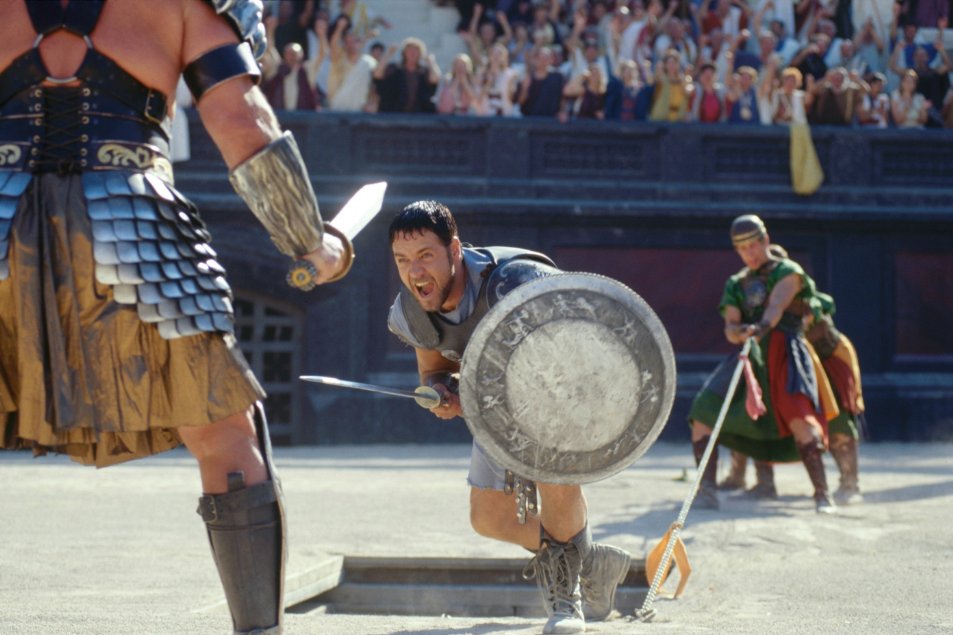
The expression “bread and circuses” captures a certain cynical political view that the masses can be kept happy with fast food (think Cartman’s “Cheesy Poofs” on South Park) and faster entertainment (NASCAR races, NFL games, and the like). In the Roman Empire, it was bread and chariot races and gladiatorial games that filled the belly and distracted the mind, allowing emperors to rule as they saw fit.
There’s truth to the view that people can be kept tractable as long as you fill their bellies and give them violent spectacles to fill their free time. Heck, Americans are meekly compliant even when their government invades their privacy and spies upon them. But there’s a deeper, more ominous, sense to bread and circuses that is rarely mentioned in American discourse. It was pointed out to me by Amy Scanlon.
In her words:
Basically ancient Rome was a society that completely revolved around war, and where compassion was considered a vice rather than a virtue… [The] Romans saw gladiatorial contests not as a form of decadence but as a cure for decadence. And decadence to the Romans had little to do with sexual behavior or lack of a decent work ethic, but a lack of military-style honor and soldierly virtues. To a Roman compassion was a detestable vice, which was considered both decadent and feminine. Watching people and animals slaughtered brutally [in the arena] was seen as a way to keep the civilian population from this ‘weakness’ because they didn’t see combat…
Scanlon then provocatively asks, “Could our society be sliding towards those Roman attitudes in a bizarre sort of way?”
I often think that America suffers from an empathy gap. We are simply not encouraged to put ourselves in the place of others. For example, how many Americans fancy the idea of a foreign power operating drones in our sovereign skies, launching missiles at gun-toting Americans suspected by this foreign power of being “militants“? Yet we operate drones in places like Afghanistan, Pakistan, and Yemen, killing suspected militants with total impunity. Even when innocent women and children are killed, our emperors and our media don’t encourage us to have compassion for them. We are basically told to think of them as collateral damage, regrettable, perhaps, but otherwise inconsequential.
Certainly, our military in the last two decades has put new stress on American troops as “warriors” and “warfighters,” a view more consistent with the hardened professionals of the Roman Empire than with the citizen-soldiers of the Roman Republic. Without thinking too much about it, we’ve come to see our troops as an imperial guard, ever active on the ramparts of our empire. War, meanwhile, is seen not as a last course of defense but as a first course to preempt the evil designs of the many hidden enemies of America. Our troops, therefore, are our protectors, our heroes, the defenders of America, even though that “defense” treats the entire globe as a potential killing field.
Scanlon’s view of the Roman use of bread and circuses — as a way to kill compassion to ensure the brutalization of Roman civilians and thus their compliance (or at least their complacency) vis-à-vis Imperial expansion and domestic policing — is powerful and sobering.
At the same time, the Obama administration is increasingly couching violent military intervention in humanitarian terms. Deploying troops and tipping wars in our favor is done in the name of defeating petty tyrants (e.g. Khadafy in Libya; Is Assad of Syria next?). Think of it as our latest expression of “compassion.”
All things considered, perhaps our new national motto should be: When in America, do as the Roman Empire would do. Eat to your fill of food and violence, cheer on the warfighters, and dismiss expressions of doubt or dismay about military interventions and drone killings as “feminine” and “weak.”
At least we can applaud ourselves that we no longer torture and kill animals in the arena like the Romans did. See how civilized we’ve become?
A recent article at NBC News is unusual in that it highlights the awfulness of war even when the killing is “surgical” and done by drones. Brandon Bryant, a former drone operator for the Air Force, suffers from PTSD and feels that killing by drone caused him to lose respect for life, that he became like a sociopath. Especially upsetting to Bryant was when his commander gave him a “diploma” (most likely an award citation) that stated he had contributed to the deaths of 1,626 people.
Drone strikes are basically extra-judicial death sentences from the sky. For Americans, they seem unproblematic because we’re not exposed to them and because our government tells us only “militants” and evil-doers are being killed.
But the temptations of drone warfare are considerable, as I wrote in an article for Truthout in August 2012. Here’s what I said back then:
What happens when we decouple war’s terrible nature from its intoxicating force? What happens when one side can kill with impunity in complete safety? General Robert E. Lee’s words suggest that a nation that decouples war from its terrors will likely grow too fond of it. The temptation to use deadly force will no longer be restrained by knowledge of the horrors unleashed by the same.
Such thoughts darken the reality of America’s growing fondness for drone warfare. Ourland-based drone pilots patrol the skies of foreign lands like Afghanistan in complete safety. They unleash appropriately named Hellfire missiles to smite our enemies. The pilots see a video feed of the carnage they inflict; the American people see and experience nothing. In rare cases when ordinary Americans see drone footage on television, what they witness is something akin to a “Call of Duty” video game combined with a snuff film. War porn, if you will.
Many Americans seem happy that we can smite foreign “militants” at no risk to ourselves. They trust that our military (and the CIA) rarely misidentifies a terrorist, and that “collateral damage,” that mind-numbing euphemism that obscures the reality of innocent men, women, and children obliterated by missiles, is the regrettable price of keeping America safe.
But the reality is that sloppy intelligence and the fog and friction of war combine to make seemingly antiseptic drone warfare much like all other forms of war: bloody, wasteful, and terrible. Terrible, that is, for those on the receiving end of American firepower. Not terrible for us.
There is a real danger that today’s drone warfare has become the equivalent to the Dark Side of the Force as described by Yoda in The Empire Strikes Back: a quicker, easier, more seductive form of terror. It is indeed seductive to deploy the technological equivalent of Darth Vader’s throat-constricting powers at a safe distance. We may even applaud ourselves for our prowess while doing so. We tell ourselves that we are killing only the bad people, and that the few innocents caught in the crosshairs constitute an accidental but nonetheless unavoidable price of keeping America safe.
My copy. Not the sexiest cover, but a good primer nonetheless
When I entered the Air Force in 1985, I grabbed a pamphlet by Brian M. Jenkins of Rand. The title caught my eye: International Terrorism: The Other World War. Back then, the country was focused on the Cold War against the Evil Empire of the Soviet Union. Jenkins suggested there was another war we should be focusing on.
In his pamphlet, he provided a “working definition” of terrorism:
“Terrorism is the use of criminal violence to force a government to change its course of action.”
And: “Terrorism is a political crime. It is always a crime…”
But Jenkins also knew that terrorism, as a word and concept, was contentious and politicized. As he explained:
“Some governments are prone to label as terrorism all violent acts committed by their political opponents, while antigovernment extremists frequently claim to be the victims of governmental terror. Use of the term thus implies a moral judgment. If one group can successfully attach the label terrorist to its opponent, then it has indirectly persuaded others to adopt its moral and political point of view, or at least to reject the terrorists’ view. Terrorism is what the bad guys do. This drawing of boundaries between what is legitimate and what is illegitimate, between the right way to fight and the wrong way to fight, brings high political stakes to the task of definition.”
Jenkins correctly notes that the word “terrorism” implies both a political and moral (and legal) judgment. By his working definition, to be a terrorist is to be a criminal.
Can nation-states be terrorists? Interestingly, no. Not if you accept the definitional imperative common to international relations. Nation-states draw their identity (and authority) in part by and through their ability to monopolize the means of violence. Because a state monopolizes or “controls” violence in a legally sanctioned international system, it cannot commit a criminal act of terror, however terrorizing that act might be. (By this definition, dropping atomic bombs on Hiroshima and Nagasaki and killing 200,000 people were not terrorist acts, even though the intent was to terrorize the Japanese into surrendering.) Put differently, a state can sponsor terrorism, but it cannot commit it.
It’s an unsatisfying definition to many. AsGlenn Greenwald, constitutional lawyer and journalist for the Guardian, has noted many times, terrorism as a concept is now so highly politicized, so narrowly defined and closely tied to evil acts committed by Muslim extremists, that the word itself has become polluted. It’s more weapon than word, with an emotional impact that hits with the explosive power of a Hellfire missile.
Terrorism, in short, has become something of an Alice in Wonderland word. As Humpty Dumpty put it, “When I use a word, it means just what I choose it to mean — neither more nor less.” Such is the case with “terrorist” and “terrorism”: they’re often just epithets, ones we reserve for people and acts we find heinous.
Terrorism exists, of course. But so too does politically-motivated manipulation of the English language, as George Orwell famously warned. If terrorist = criminal = always them but never us (because we’re a nation, and a good-hearted one at that), we absolve ourselves of blame even as we shout, like the Queen of Hearts in Alice, “Off with their heads!” at the “terrorists.”
That shout may be satisfying, but it may also be all too easy — and all too biased.
A good friend of mine wrote to me the other day about an increasingly rare privilege he enjoyed, courtesy of a visitor from Europe. In my friend’s words,
Yesterday we had a friend visit from Europe. We sat from about 7 PM to midnight just talking about anything from personal or work problems to politics and the time just flew by… The contrast with the limited ability of the well-educated Americans we have met here to really discourse was astounding. Free discourse and examination of competing ideas is fundamental to democracy yet most Americans today consider it either “impolite” or “bad manners” to reveal themselves in even random conversations. Most Americans have decided to live in a black or white world, not the grey that is the reality.
Imagine that! My friend’s European guest demonstrated both the ability to reason, distinguishing facts from theories and conjecture, as well as tolerance, the ability to entertain other points of view, even when they disagree with your own.
Remember when Americans enjoyed the cut and fray of conversation, the pleasure of minds working hard to shed light on difficult matters? Just as our bodies prosper from demanding physical chores, so too do our minds.
Sadly, discourse in the USA today, such as it is, is mostly polarized. It’s I’m right and you’re wrong, and the way I prove it is to outshout you. This is one reason why otherwise thoughtful people tend to avoid protracted or revealing conversations. What’s the point, when all the other person wants to do is to cow you, condemn you, or convert you?
That said, Americans are slowly losing the ability to converse, for lots of different reasons. Young people are educated indoctrinated to get a job, with “success” measured by their pay and benefits. They place little value on becoming educated, informed, critical thinkers. They’re constantly distracted by various electronic devices and video games, and constantly bombarded with trivial information masquerading as meaningful news.
Immersion in the trivial stifles creative discourse and is an ever-present threat, as Alexandr Solzhenitsyn warned us 35 years ago:
People also have the right not to know, and it is a much more valuable one. The right not to have their divine souls stuffed with gossip, nonsense, vain talk. A person who works and leads a meaningful life does not need this excessive burdening flow of information.
Solzhenitsyn
A large part of leading a meaningful life is healthy communal discourse. But our society no longer sees discourse — the true exchange of ideas — as valuable. You can’t put a dollar figure on it, you can’t sell advertising for it, you can’t assign a metric to it, so just abandon it.
Writing skills are also degenerating. My students have difficulty sustaining an argument in print. They have difficulty in conversing intelligently on a range of subjects. They can’t distinguish facts from propaganda, or they prefer to deny facts that disagree with their received opinions. And they are tainted by me-first American exceptionalism.
And it’s only gotten worse since 9/11. As my friend noted, “On top of the social attitudes of feeling that conversation on serious topics is outré, the post 9/11 suppression of free speech has had a devastating effect on private discussion of national politics.”
In these times of conformity and confusion and complicity with power, we need thoughtful and contrarian discourse more than ever.
Come, let us reason together. And let’s not be afraid of heated discussion. A controlled burn can stop the most raging wildfire in the mind. We all need to burn more brightly to shed the light that is the essence of an active mind and a thriving democracy.