

Of Presidential Betrayal
AUG 10, 2026
U.S. presidents since Lyndon B. Johnson, if not before then (think here of Woodrow Wilson’s false promises in 1916 to keep America out of the Great War, known now as World War I), always promise peace, especially while running for office. Trump is the most recent example here. Yet whether Democrat or Republican, as soon as they become president, it’s war and more war. LBJ led America into the disastrous Vietnam War; Trump led America into the ongoing disaster of the Iran War; and the overseas wars just never seem to end, whether George W. Bush is issuing the orders or Barack Obama.
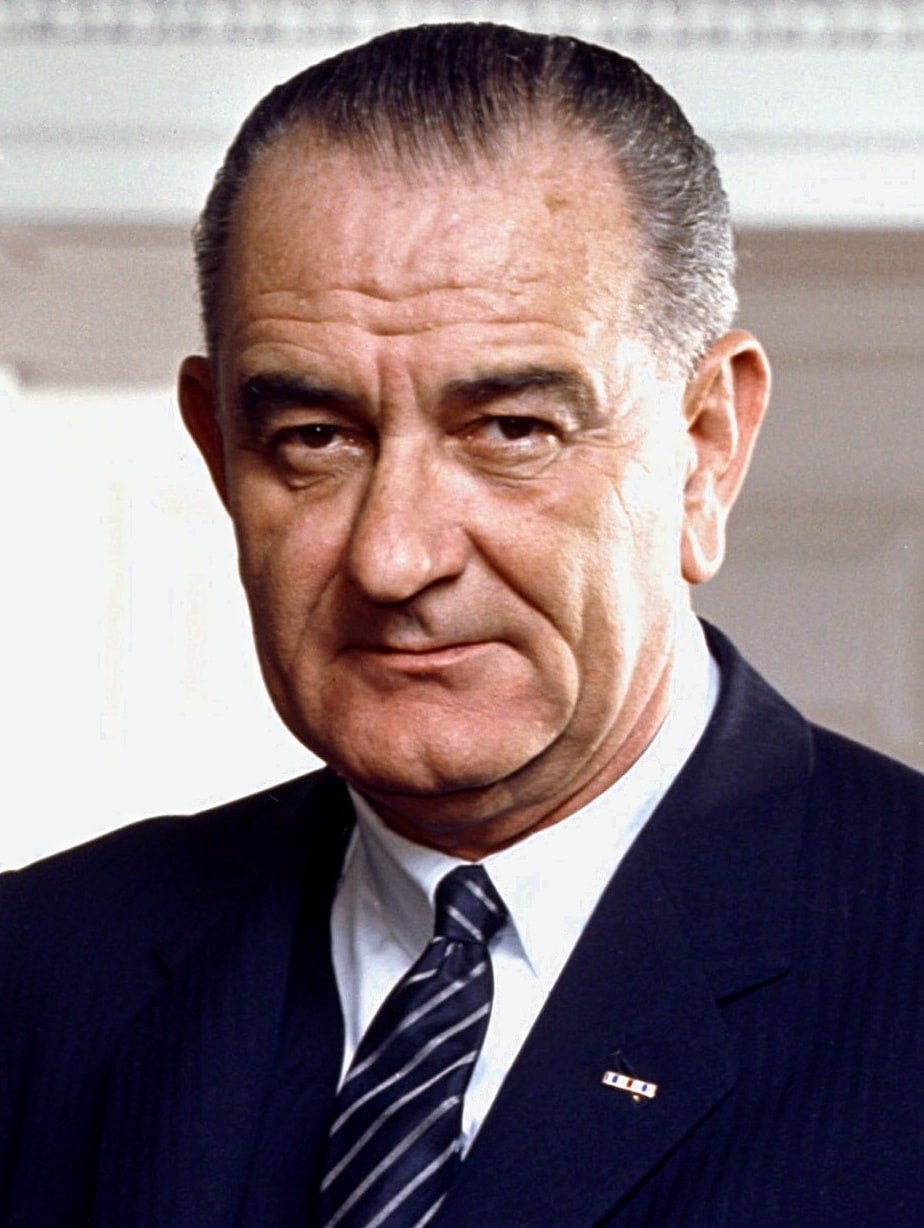
I had this thought as I re-read a comment from Mike Murry, a frequent Bracing Views contributor and an astute student of U.S. political and cultural history. Murry, a Vietnam War veteran, had this to say back in 2018:
Then, in the first semester of my senior hear in 1964, JFK’s successor as President: Lyndon Johnson, started his campaign for re-election, promising not to send us American boys to fight a war in Asia that Asian boys could fight themselves. He sounded just like Donald Trump did last year [January 2017], before assuming office. Johnson beat Goldwater in a landslide. The American people did not want another Korean War and made that overwhelmingly clear. But President Johnson betrayed us all, the way all U.S. Presidents now regularly do. Every one of them without exception preaches peace to win election. Then they invariably give their generals the wars that they demand. It happens every time. The stunning cynicism of that betrayal by President Johnson, I think, severed once and for all time any sense of “patriotism” that I might once have felt for the “America” of my youth. From that point on, I became an alien in my own land. My government would later send me abroad for the worst possible reasons, to do the most unnecessary and shameful of things. That same me never came home again. Someone else did. A damaged, but better man, I think. But much less an “American” one.
Today, the most important act to restore America is to end these needless and disastrous wars overseas. And not just overseas but here at home, as Trump promotes the malicious and mendacious notion of an enemy within, often labeled as the “radical left” with “terroristic” tendencies.
Nothing, I think, is more important to America’s health now and in the future than ending wars that waste so much, that kill and destroy so many, and that estrange our own citizen-soldiers from their country.


Johnson had, like most politicians, a driving ambition. His skill as a legislator with long experience in Congress paid off for we the people with his ambition to make the US a better place bucking the very people, southern Democrats, of which he was a charter member. But when it came to foreign policy his ambition did not serve us and he went down unable to “nail the coonskin to the wall”. He is the modern model of a theme of ancient Greek tragedy.
LikeLiked by 1 person
Indeed, “The Tragedy of Lyndon Johnson” by Eric F. Goldman (1969) and “The Triumph & Tragedy of Lyndon Johnson: the White House Years” by Joseph Califano (1991).
LikeLiked by 2 people
I’m engaging in largely unsubstantiated, amateur historical revisionism here, but I want to cut Johnson some slack, and to illustrate that the matter may have been more intricate and complex but no less sinister than he is blamed for. The thesis is this:
Johnson was a domestic policy president, he wanted to be another FDR, only greater. Foreign policy wasn’t a focus of his. He inherited Vietnam, possibly with some knowledge that Kennedy wanted out, but that’s not certain, given how he was mostly left of the loop.
So he suddenly assumes the presidency. What’s he to do? He’s in no position to adopt a whole new agenda, at least early on, indeed I believe he even stated in his first address before Congress after the assassination that his duty was to carry on the legacy of Kennedy, how could he not?
But he began work immediately on the host of social welfare legislation comprising what he announced in his first State of the Union address on January 4, 1965 as “The Great Society.” This was his dream.
Astute politician that he was, he could also see that Vietnam was posing a threat to his lifetime aspiration. Consistent with his political experience, he was hoping he could “cut a deal” with Ho Chi Minh, reconstruction and other aid for an end to the war. But this was a different war for America, not amenable to deal cutting other than getting out where we, and the French before us, didn’t belong.
That avenue shut off, Johnson was becoming desperate for a way out. He consulted the “Wise Men” of American foreign policy from WWII and the post-war period, other advisors. Some said get out. Most said, until too late, to show resolve. What was he to do? If get out, he’d risk savage attack from the Right, and the end of his Great Society. Up the ante, and maybe enough North Vietnamese would be killed that they’d capitulate, after all, we were dropping more bombs there than in all of WWII. Either way he was at great risk. Opted for the latter, which he tried to ameliorate with the lies, deceptions, and falsehoods to paint a picture that victory could be achieved.
So the argument isn’t that it was Johnson alone. There was a whole apparatus – approximated by what we now call the MICIMATT-SH, but more than that – that was responsible for Vietnam. Johnson was also a casualty of it.
LikeLiked by 1 person