It seems like forever and a day, but I finally published my dad’s journal with my notes and photos at Amazon. Here’s the link.
It’s available for $10 in paperback, $5 on Kindle, or free if you have Kindle unlimited.
Here’s my description of the book:
Before he died, my father wrote a journal about his life. Born in 1917, he lived through the Great Depression, served in the Civilian Conservation Corps (mainly in Oregon) in the 1930s, survived working in factories and in the U.S. Army during World War II, and eventually became a firefighter for the City of Brockton (MA), serving for over 30 years.
Though he never finished high school, he read philosophy, loved classical music, and was an avid opera fan. The son of Italian immigrants, his story is the story of America, the story of a young man who worked hard and who in the process acquired a lot of wisdom from life’s setbacks.
This journal recounts many episodes in his life and the lessons he learned from them. It is one remarkable note in a fanfare for the common man.
*****
I started transcribing my dad’s journal soon after he died in 2003, but it took me two decades to put it all together in book form. If you find time to read it and you like it, perhaps you can bop on over to Amazon and write a review of it.
Thanks so much to all my readers. I hope you enjoy my book about my dad.
I started blogging in 2007 for TomDispatch.com. Tom Engelhardt, the mastermind of that indispensable site, saw something in an article I sent him on saving the U.S. military from itself. That is, from its own vainglory, its own global ambitions for power and dominance, its own illusions of being number one, both the world’s toughest military and also the world’s freedom-bringers. Certainly, the megalomania and Messiah-like fantasies weren’t a military mindset alone; it was even more pronounced among the neocons who orbited the Bush/Cheney administration and who still largely define U.S. foreign policy in the Biden/Harris administration. Things are so bad that some (wrongly) believe Trump/Vance offer a more moderate, far less warlike, alternative, when Trump’s record suggests little of the sort.
Anyhow, this is my 108th article for TomDispatch in the 17 years I’ve been writing for the site, a mark of persistence that suggests a certain folly on my part, and considerable patience on Tom’s part.
During World War II, American leaders proudly proclaimed this country the “arsenal of democracy,” supplying weapons and related materiel to allies like Great Britain and the Soviet Union. To cite just one example, I recall reading about Soviet armored units equipped with U.S. Sherman tanks, though the Soviets had an even better tank of their own in the T-34 and its many variants. However, recent news that the United States is providing yet more massive arms deliveries to Israel (worth $20 billion) for 2026 and thereafter caught me off guard. Israel quite plainly is engaged in the near-total destruction of Gaza and the massacre of Palestinians there. So, tell me, how over all these years did the self-styled arsenal of democracy become an arsenal of genocide?
Israel, after all, couldn’t demolish Gaza, killing at least 40,000 Palestinians in a population of only 2.1 million, including thousands of babies and infants, without massive infusions of U.S. weaponry. Often, the U.S. doesn’t even sell the weaponry to Israel, a rich country that can pay its own bills. Congress just freely gifts body- and baby-shredding bombs in the name of defending Israel from Hamas. Obviously, by hook or crook, or rather by shells, bombs, and missiles, Israel is intent on rendering Gaza Palestinian-free and granting Israelis more living space there (and on the West Bank). That’s not “defense” — it’s the 2024 equivalent of Old Testament-style vengeance by annihilation.
As Tacitus said of the rampaging Romans two millennia ago, so it can now be said of Israel: they create a desert — a black hole of death in Gaza — and call it “peace.” And the U.S. government enables it or, in the case of Congress, cheers on its ringleader, Israeli Prime Minister Bibi Netanyahu.
Of course, anyone who knows a little American history should have some knowledge of genocide. In the seventeenth century, Native Americans were often “satanized” by early colonial settlers. (In 1994, a friend of mine, the historian David Lovejoy, wrote a superband all-too-aptly titled article on exactly that topic: “Satanizing the American Indian.”) Associating Indians with the devil made it all the easier for the white man to mistreat them, push them off their lands, and subjugate or eradicate them. When you satanize an enemy, turning them into something irredeemably evil, all crimes become defensible, rational, even justifiable. For how can you even consider negotiating or compromising with the minions of Satan?
Growing up, I was a strong supporter of Israel, seeing that state as an embattled David fighting against a Goliath, most notably during the Yom Kippur War of 1973. Forty years later, I wrote an article suggesting that Israel was now the Goliath in the region with Palestinians in Gaza playing the role of a very much outgunned and persecuted David. An American-Jewish friend told me I just didn’t get it. The Palestinians in Gaza were all terrorists, latent or incipient ones in the case of the infants and babies there. At the time, I found this attitude uncommon and extreme, but events have proven it to be far too common (though it certainly remains extreme). Obviously, on some level, the U.S. government agrees that extremism in the pursuit of Israeli hegemony is no vice and so has provided Israel with the weaponry and military cover it needs to “exterminate all the brutes.” Thus, in 2024, the U.S. “cradle of democracy” reveals its very own heart of darkness.
Looking Again at the World Wars That Made America “Great”
When considering World Wars I and II, we tend to see them as discrete events rather than intimately connected. One was fought from 1914 to 1918, the other from 1939 to 1945. Americans are far more familiar with the Second World War than the First. From both wars this country emerged remarkably unscathed compared to places like France, Germany, Russia, the United Kingdom, China, and Japan. Add to that the comforting myth that America’s “greatest generation” pretty much won World War II, thereby saving democracy (and “Saving Private Ryan” as well).
Perhaps, however, we should imagine those years of conflict, 1914-1945, as a European civil war (with an Asian wing thrown in the second time around), a new Thirty Years’ War played out on a world stage that led to the demise of Europe’s imperial powers and their Asian equivalent and the rise of the American empire as their replacement. Germanic militarism and nationalism were defeated but at an enormous cost, especially to Russia in World War I and the Soviet Union in World War II. Meanwhile, the American empire, unlike Germany’s Second and Third Reichs or Japan’s imperial power, truly became for a time an untrammeled world militarist hegemon with the inevitable corruption inherent in the urge for near-absolute power.
Vast levels of destruction visited upon this planet by two world wars left an opening for Washington to attempt to dominate everywhere. Hence, the roughly 750 overseas bases its military set up to ensure its ultimate global reach, not to speak of the powerful navy it created, centered on aircraft carriers for power projection and nuclear submarines for possible global Armageddon, and an air force that saw open skies as an excuse for its own exercises in naked power projection. To this you could add, for a time, U.S. global economic and financial power, enhanced by a cultural dominance achieved through Hollywood, sports, music, and the like.
Not, of course, that the United States emerged utterly unchallenged from World War II. Communism was the specter that haunted its leaders, whether in the Soviet Union, China, or Southeast Asia (where, in the 1960s and early 1970s, it would fight a disastrous losing war, the first of many to come, in Vietnam, Laos, and Cambodia). Here, there, and everywhere, even under the very beds of Americans, there was a fear of the “commie rat.” And for a while, communism, in its Soviet form, did indeed threaten capitalism’s unbridled pursuit of profits, helping American officials to create a permanent domestic war state in the name of containing and rolling back that threat. The collapse of the Soviet Union in 1991 erased that fear, but not the permanent war state that went with it, as Washington sought new enemies to justify a Pentagon budget that today is still rising toward the trillion-dollar mark. Naturally (and remarkably disastrously), it found them, whether in Afghanistan, Iraq, or so many other places in the case of the costly and ultimately futile Global War on Terror in the aftermath of the 9/11 attacks.
And eternally losing (or at least not winning) its wars raised the question: What will replace it? What will happen as imperial America continues to decline, burdened by colossal debt and strategic overreach, and crippled from within by a rapacious class of oligarchs who fancy themselves as a new all-American aristocracy. Will that decline lead to collapse or can its officials orchestrate a soft landing? In World Wars I and II, Europeans fought bitterly for world dominance, powered by militarism, nationalism, racism, and greed. They suffered accordingly and yet did recover even if as far less powerful nations. Can the U.S. manage to curb its own militarism, nationalism, racism, and greed in time and so recover similarly? And by “racism,” I mean, for example, reviving the idea (however put) of China as a “yellow peril,” or the tendency to see the darker-skinned peoples of the Middle East as violent “terrorists” and the latest minions of Satan.
And then, of course, there’s always the fear that, in the future, a world war could once again break out, raising the possibility of the use of nuclear weapons from global arsenals that are always being “modernized” and the possible end of most life on Earth. It’s an issue worth highlighting, since the U.S. continues to “invest” significant sums in producing yet more nuclear weapons, even as it ratchets up tensions with nuclear powers like Russia and China. Though a winnable nuclear war among the great powers on this planet is inconceivable, that hasn’t stopped my country from pushing for a version of nuclear superiority (disguised, of course, as “deterrence”).
Making America Sane Again
The world wars of the previous century facilitated America’s global dominance in virtually all its dimensions. That, in fact, was their legacy. No other nation in history had, without irony or humility, divided the globe into military combatant commandslike AFRICOM for Africa, CENTCOM for the Middle East, and NORTHCOM here at home. There are also “global” commands for strategic nuclear weapons, cyber dominance, and even the dominance of space. It seemed that the only way America could be “safe” was by dominating everything everywhere all at once. That insane ambition, that vainglory, was truly what made the U.S. the “exceptional” nation on the world stage.
Such a boundless pursuit of dominance, absurdly disguised as benefiting democracy, is now visibly fraying at the seams and may soon come apart entirely. In 2024, it’s beyond obvious that the United States no longer dominates the world, even if its military-industrial-congressional complex (MICC) does indeed dominate its national (in)security state and so increasingly the country. What an irony, in fact, that defeating European militarism in two world wars only accelerated the growth of American militarism and nationalism, making the world’s lone superpower for so many decades the scariest country for all too many peoples outside its borders.
Think, in fact, of the U.S. emerging from World War II with what might be thought of as victory disease. The last nearly 80 years of its foreign policy witnessed the remarkable progression of that “disease,” despite a lack of actual victories (unless you count minor escapades like the invasion of Grenada). Put differently, the U.S. emerged from World War II so singularly an economic, financial, and cultural juggernaut that subsequent military defeats almost didn’t seem to matter.
Even as America’s economic, financial, and cultural power has waned in this century, along with its moral position (consider President Obama’s curt “We tortured some folks” admission, along with support for Israel’s ongoing genocide), the government does continue to double-down on military spending. Pentagon budgets and related “national security” costs now significantly exceed $1 trillion annually even as arms shipments and sales continue to surge. War, in other words, has become big business in America or, as General Smedley Butler so memorably put it 90 years ago, a first-class “racket.”
Worse yet, war, however prolonged and even celebrated, may be the very definition of insanity, a deadly poison to democracy. Don’t tell that to the MICC and all its straphangers and camp followers, though.
Ironically, the two countries, Germany and Japan, that the U.S. took credit for utterly defeating in World War II, forcing their unconditional surrender, have over time emerged in far better shape. Neither of them is perfect, mind you, but they largely have been able to avoid the militarism, nationalism, and constant warmongering that so infects and weakens American-style democracy today. Whatever else you can say about Germany and Japan in 2024, neither of them is bent in any fashion on either regional or global domination, nor are their leaders bragging of having the finest military in all human history. American presidents from George W. Bush to Barack Obama have indeed bragged about having a matchless, peerless, “finest” military. The Germans and Japanese, having known the bitter price of such boasts, have kept their mouths shut.
My brother Stevie once memorably said: “No brag, just facts.”
My brother has a saying: no brag, just facts. And when we look at facts, the pursuit of global dominance has been driving the American empire toward an early grave. The “finest” military lost disastrously, of course, in Vietnam in the last century, and in Afghanistan and Iraq in this one. It functionally lost its self-proclaimed Global War on Terror and it keeps losing in its febrile quest for superiority everywhere.
If we met a person dressed in a military uniform who insisted he was Napoleon, boasted that his Imperial Guard was the world’s best, and that he could rule the world, we would, of course, question his sanity. Why are we not questioning the collective sanity of America’s military and foreign-policy elites?
This country doesn’t need to be made great again, it needs to be made sane again by the rejection of wars and the weaponry that goes with them. For if we continue to follow our present pathway, MADness could truly lie in wait for us, as in the classic nuclear weapons phrase, mutually assured destruction (MAD).
Another form of madness is having a president routinely implore God — yes, no one else! — to protect our troops. This is not a knock on Joe Biden alone. He’s just professing a nationalist piety that’s designed to win applause and votes. Assuming Biden has the Christian God in mind, consider the irony, not to say heresy, of functionally begging Christ, the Prince of Peace, to protect those who are already armed to the teeth. It’s also an abdication of the commander-in-chief’s responsibility to support and defend the U.S. Constitution while protecting those troops himself. Who has the biggest impact, God or the president, when it comes to ensuring that troops aren’t sent into harm’s way without a justifiable cause supported by the American people through a Congressional declaration of war?
Consider the repeated act of looking skyward to God to support military actions as a major league cop-out. But that’s what U.S. presidents routinely do now. Such is the pernicious price of pursuing a vision that insists on global reach, global power, and global dominance. America’s leaders have, in essence, elevated themselves to a god-like position, a distinctly angry, jealous, and capricious one, far more like Zeus or Ares than Jesus. Speaking of Jesus, he is alleged to have said, “Suffer the children to come unto me.” The militarized American god, however, says: suffer the children of Gaza to die courtesy of bombs and shells made here in the U.S.A. and shipped off to Israel at a remarkably modest price (given the destruction they cause).
To echo a popular ad campaign, Jesus may “get” us, but our leaders (self-avowed Christians, all) sure as hell don’t get him. I may be a lapsed Catholic, not a practicing one like Joe Biden, but even I remember my catechism and a certain commandment that Thou shalt not kill.
Student Protest and the White Rose Movement in Nazi Germany
Apologists for the Israeli government and its genocidal policies are now warning us about “radicalized” college and university students. Apparently, it’s “radical” to protest genocide, famine, and ceaseless bombing. Contrariwise, it’s apparently “normal” to support mass murder, total destruction, and widespread starvation. Talk about a world turned upside down …
Of course, it’s only “radical” to oppose genocide if you live in a totalitarian state that’s prosecuting that genocide or aiding others in prosecuting it. Anyone with a working conscience and a smidgen of humanity would think it’s normal and sane to oppose mass murder and to protest against it.
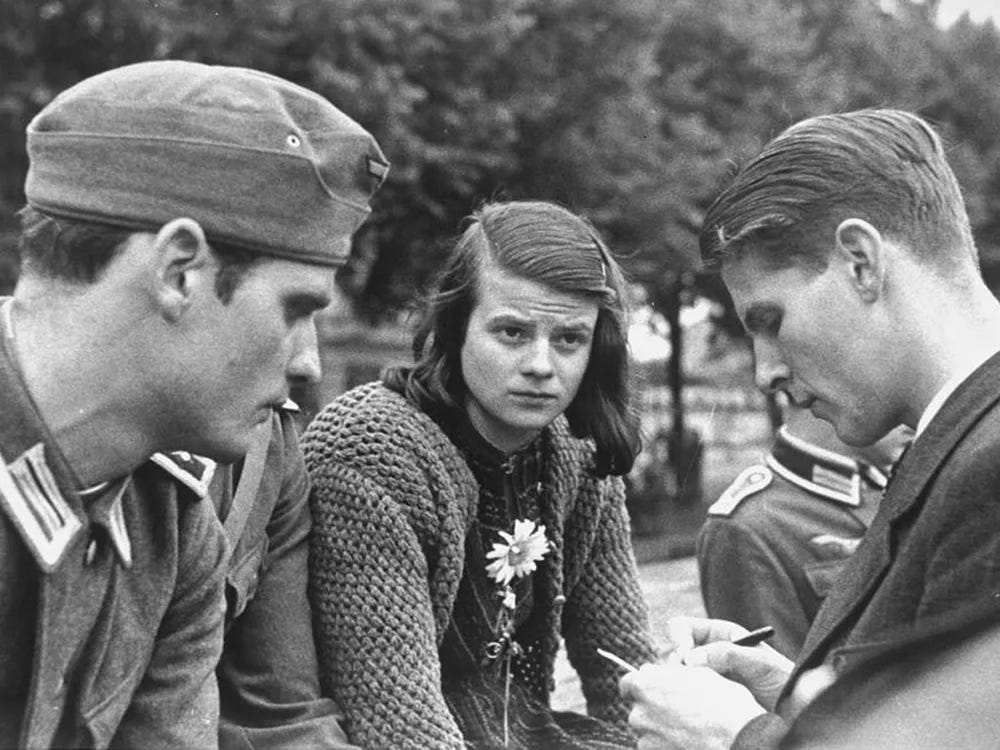
Sophie Scholl flanked by her brother, Hans (L) and friend Christoph Probst (R) in 1942
Consider a university student who famously protested against genocide: Sophie Scholl. She, her brother Hans, and the rest of the White Rose movement in Nazi Germany are celebrated as heroes today in Germany because they spoke out at great risk against mass murder, and indeed the Nazis executed them in 1943 after holding show trials.
Again, we don’t dismiss Sophie Scholl as a campus “radical” for standing up for Jews and protesting against the murderous policies of the Third Reich. We see her as a paradigmatic individual, an example of the very best of us, a young woman of great moral courage. Of course, the Nazis thought otherwise, arresting her then executing her, her brother, and other White Rose members as traitors to their “race.”
Perhaps the Scholls were radical after all: radical in their courage and their commitment to human rights and values for all.
If you want to watch a powerful movie about young campus “radicals,” check out “Sophie Scholl: The Final Days,” from 2005. I highly recommend it. Back in 2013, I put together a list of 13 movies about the Holocaust and genocide for a college course I taught. In that course, I used well-known movies and documentaries like “Schindler’s List,” “The Sorrow and the Pity,” and “Night and Fog.” The list below was my attempt to expand on that and to point my students to some movies and documentaries that they may not have seen.
Here’s the original article I posted back in 2013:
Thirteen Movies About the Holocaust
I’ve seen a lot of movies and documentaries about the Holocaust or with themes related to the Holocaust and totalitarianism. Of the films I’ve seen, these are the thirteen that stayed with me. Please note that these movies have adult themes; they may not be suitable for children or teens.
American History X (1998): Searing movie about neo-Nazis and the power of hate. Violent scenes for mature audiences only.
Anne Frank: The Whole Story (2001): Excellent dramatization of Anne Frank’s life, to include the tragic end at Bergen-Belsen.
For My Father (2008): A movie about Palestinians, Israelis, and suicide bombers, but also a movie about the difficulties of confronting and overcoming prejudice.
Hotel Rwanda (2004): The genocide in Rwanda, and how one brave man made a difference.
Judgment at Nuremberg (1961): Powerful indictment of Nazi war criminals after World War II.
Katyn (2007): A reminder that the Nazis weren’t the only mass murderers in World War II.
The Last Days (1998): Incredibly moving documentary that explores the fate of Hungarian Jews. Highly recommended.
Life Is Beautiful (1997): It’s hard to believe that a comedy could be made about the Holocaust. But I think this movie works precisely because the main character is so resourceful and full of life.
The Lives of Others (2006): Astonishing movie about life under a totalitarian regime (East Germany). A “must see” to understand how people can be controlled and cowed and coerced, but also how some find ways to resist.
Lore (2012): Movie about a German teenager who has to survive in the chaos of 1945 as the Third Reich comes crashing down. Various small scenes show the hold that Hitler had over the German people, and the reluctance of many Germans to believe that the Holocaust occurred and that Hitler had ordered it.
Sarah’s Key (2010): Heart-wrenching movie about the roundup of Jews in France, which reminds us that the Nazis had plenty of helpers and collaborators.
Sophie Scholl: The Final Days (2005): Inspiring movie about Hans and Sophie Scholl and the White Rose movement in Nazi Germany. The Scholls were college students who took a courageous stand against the Nazis. Executed as traitors in 1943, they are now celebrated as heroes in Germany.
The Wave (2008): Compelling movie about the allure of fascism and “the Fuhrer (leader) principle.” Highly recommended, especially if you want to know how Hitler got so many young people to follow him.
All around us things are falling apart. Collectively, Americans are experiencing national and imperial decline. Can America save itself? Is this country, as presently constituted, even worth saving?
For me, that last question is radical indeed. From my early years, I believed deeply in the idea of America. I knew this country wasn’t perfect, of course, not even close. Long before the 1619 Project, I was aware of the “original sin” of slavery and how central it was to our history. I also knew about the genocide of Native Americans. (As a teenager, my favorite movie — and so it remains — was Little Big Man, which pulled no punches when it came to the white man and his insatiably murderous greed.)
Nevertheless, America still promised much, or so I believed in the 1970s and 1980s. Life here was simply better, hands down, than in places like the Soviet Union and Mao Zedong’s China. That’s why we had to “contain” communism — to keep themover there, so they could never invade our country and extinguish our lamp of liberty. And that’s why I joined America’s Cold War military, serving in the Air Force from the presidency of Ronald Reagan to that of George W. Bush and Dick Cheney. And believe me, it proved quite a ride. It taught this retired lieutenant colonel that the sky’s anything but the limit.
In the end, 20 years in the Air Force led me to turn away from empire, militarism, and nationalism. I found myself seeking instead some antidote to the mainstream media’s celebrations of American exceptionalism and the exaggerated version of victory culture that went with it (long after victory itself was in short supply). I started writingagainst the empire and its disastrous wars and found likeminded people at TomDispatch — former imperial operatives turned incisive critics like Chalmers Johnson and Andrew Bacevich, along with sharp-eyed journalist Nick Turse and, of course, the irreplaceable Tom Engelhardt, the founder of those “tomgrams” meant to alert America and the world to the dangerous folly of repeated U.S. global military interventions.
But this isn’t a plug for TomDispatch. It’s a plug for freeing your mind as much as possible from the thoroughly militarized matrix that pervades America. That matrix drives imperialism, waste, war, and global instability to the point where, in the context of the conflict in Ukraine, the risk of nuclear Armageddon could imaginably approach that of the 1962 Cuban Missile Crisis. As wars — proxy or otherwise — continue, America’s global network of 750-odd military bases never seems to decline. Despite upcoming cuts to domestic spending, just about no one in Washington imagines Pentagon budgets doing anything but growing, even soaring toward the trillion-dollar level, with militarized programs accounting for 62% of federal discretionary spending in 2023.
Indeed, an engorged Pentagon — its budget for 2024 is expected to rise to $886 billionin the bipartisan debt-ceiling deal reached by President Joe Biden and House Speaker Kevin McCarthy — guarantees one thing: a speedier fall for the American empire. Chalmers Johnson predicted it; Andrew Bacevich analyzed it. The biggest reason is simple enough: incessant, repetitive, disastrous wars and costly preparations for more of the same have been sapping America’s physical and mental reserves, as past wars did the reserves of previous empires throughout history. (Think of the short-lived Napoleonic empire, for example.)
Known as “the arsenal of democracy” during World War II, America has now simply become an arsenal, with a military-industrial-congressional complex intent on forging and feeding wars rather than seeking to starve and stop them. The result: a precipitous decline in the country’s standing globally, while at home Americans pay a steep price of accelerating violence (2023 will easily set a record for mass shootings) and “carnage” (Donald Trump’s word) in a once proud but now much-bloodied“homeland.”
Lessons from History on Imperial Decline
I’m a historian, so please allow me to share a few basic lessons I’ve learned. When I taught World War I to cadets at the Air Force Academy, I would explain how the horrific costs of that war contributed to the collapse of four empires: Czarist Russia, the German Second Reich, the Ottoman empire, and the Austro-Hungarian empire of the Habsburgs. Yet even the “winners,” like the French and British empires, were also weakened by the enormity of what was, above all, a brutal European civil war, even if it spilled over into Africa, Asia, and indeed the Americas.
And yet after that war ended in 1918, peace proved elusive indeed, despite the Treaty of Versailles, among other abortive agreements. There was too much unfinished business, too much belief in the power of militarism, especially in an emergent Third Reich in Germany and in Japan, which had embraced ruthless European military methods to create its own Asiatic sphere of dominance. Scores needed to be settled, so the Germans and Japanese believed, and military offensives were the way to do it.
As a result, civil war in Europe continued with World War II, even as Japan showed that Asiatic powers could similarly embrace and deploy the unwisdom of unchecked militarism and war. The result: 75 million dead and more empires shattered, including Mussolini’s “New Rome,” a “thousand-year” German Reich that barely lasted 12 of them before being utterly destroyed, and an Imperial Japan that was starved, burnt out, and finally nuked. China, devastated by war with Japan, also found itself ripped apart by internal struggles between nationalists and communists.
As with its prequel, even most of the “winners” of World War II emerged in a weakened state. In defeating Nazi Germany, the Soviet Union had lost 25 to 30 million people. Its response was to erect, in Winston Churchill’s phrase, an “Iron Curtain” behind which it could exploit the peoples of Eastern Europe in a militarized empire that ultimately collapsed due to its wars and its own internal divisions. Yet the USSR lasted longer than the post-war French and British empires. France, humiliated by its rapid capitulation to the Germans in 1940, fought to reclaim wealth and glory in “French” Indochina, only to be severely humbled at Dien Bien Phu. Great Britain, exhausted from its victory, quickly lost India, that “jewel” in its imperial crown, and then Egypt in the Suez debacle.
There was, in fact, only one country, one empire, that truly “won” World War II: the United States, which had been the least touched (Pearl Harbor aside) by war and all its horrors. That seemingly never-ending European civil war from 1914 to 1945, along with Japan’s immolation and China’s implosion, left the U.S. virtually unchallenged globally. America emerged from those wars as a superpower precisely because its government had astutely backed the winning side twice, tipping the scales in the process, while paying a relatively low price in blood and treasure compared to allies like the Soviet Union, France, and Britain.
History’s lesson for America’s leaders should have been all too clear: when you wage war long, especially when you devote significant parts of your resources — financial, material, and especially personal — to it, you wage it wrong. Not for nothing is war depicted in the Bible as one of the four horsemen of the apocalypse. France had lost its empire in World War II; it just took later military catastrophes in Algeria and Indochina to make it obvious. That was similarly true of Britain’s humiliations in India, Egypt, and elsewhere, while the Soviet Union, which had lost much of its imperial vigor in that war, would take decades of slow rot and overstretch in places like Afghanistan to implode.
Meanwhile, the United States hummed along, denying it was an empire at all, even as it adopted so many of the trappings of one. In fact, in the wake of the implosion of the Soviet Union in 1991, Washington’s leaders would declare America the exceptional “superpower,” a new and far more enlightened Rome and “the indispensable nation” on planet Earth. In the wake of the 9/11 attacks, its leaders would confidently launch what they termed a Global War on Terror and begin waging wars in Afghanistan, Iraq, and elsewhere, as in the previous century they had in Vietnam. (No learning curve there, it seems.) In the process, its leaders imagined a country that would remain untouched by war’s ravages, which was we now know — or do we? — the height of imperial hubris and folly.
For whether you call it fascism, as with Nazi Germany, communism, as with Stalin’s Soviet Union, or democracy, as with the United States, empires built on dominance achieved through a powerful, expansionist military necessarily become ever more authoritarian, corrupt, and dysfunctional. Ultimately, they are fated to fail. No surprise there, since whatever else such empires may serve, they don’t serve their own people. Their operatives protect themselves at any cost, while attacking efforts at retrenchment or demilitarization as dangerously misguided, if not seditiously disloyal.
That’s why those like Chelsea Manning, Edward Snowden, and Daniel Hale, who shined a light on the empire’s militarized crimes and corruption, found themselves imprisoned, forced into exile, or otherwise silenced. Even foreign journalists like Julian Assange can be caught up in the empire’s dragnet and imprisoned if they dare expose its war crimes. The empire knows how to strike back and will readily betray its own justice system (most notably in the case of Assange), including the hallowed principles of free speech and the press, to do so.
Perhaps he will eventually be freed, likely as not when the empire judges he’s approaching death’s door. His jailing and torture have already served their purpose. Journalists know that to expose America’s bloodied tools of empire brings only harsh punishment, not plush rewards. Best to look away or mince one’s words rather than risk prison — or worse.
Yet you can’t fully hide the reality that this country’s failed wars have added trillions of dollars to its national debt, even as military spending continues to explode in the most wasteful ways imaginable, while the social infrastructure crumbles.
Clinging Bitterly to Guns and Religion
Today, America clings ever more bitterly to guns and religion. If that phrase sounds familiar, it might be because Barack Obama used it in the 2008 presidential campaign to describe the reactionary conservatism of mostly rural voters in Pennsylvania. Disillusioned by politics, betrayed by their putative betters, those voters, claimed the then-presidential candidate, clung to their guns and religion for solace. I lived in rural Pennsylvania at the time and recall a response from a fellow resident who basically agreed with Obama, for what else was there left to cling to in an empire that had abandoned its own rural working-class citizens?
Something similar is true of America writ large today. As an imperial power, we cling bitterly to guns and religion. By “guns,” I mean all the weaponry America’s merchants of death sell to the Pentagon and across the world. Indeed, weaponry is perhaps this country’s most influential global export, devastatingly so. From 2018 to 2022, the U.S. alone accounted for 40% of global arms exports, a figure that’s only risen dramatically with military aid to Ukraine. And by “religion,” I mean a persistent belief in American exceptionalism (despite all evidence to the contrary), which increasingly draws sustenance from a militant Christianity that denies the very spirit of Christ and His teachings.
Yet history appears to confirm that empires, in their dying stages, do exactly that: they exalt violence, continue to pursue war, and insist on their own greatness until their fall can neither be denied nor reversed. It’s a tragic reality that the journalist Chris Hedges has written about with considerable urgency.
The problem suggests its own solution (not that any powerful figure in Washington is likely to pursue it). America must stop clinging bitterly to its guns — and here I don’t even mean the nearly 400 million weapons in private hands in this country, including all those AR-15 semi-automatic rifles. By “guns,” I mean all the militarized trappings of empire, including America’s vast structure of overseas military bases and its staggering commitments to weaponry of all sorts, including world-ending nuclearones. As for clinging bitterly to religion — and by “religion” I mean the belief in America’s own righteousness, regardless of the millions of people it’s killed globally from the Vietnam era to the present moment — that, too, would have to stop.
History’s lessons can be brutal. Empires rarely die well. After it became an empire, Rome never returned to being a republic and eventually fell to barbarian invasions. The collapse of Germany’s Second Reich bred a third one of greater virulence, even if it was of shorter duration. Only its utter defeat in 1945 finally convinced Germans that God didn’t march with their soldiers into battle.
What will it take to convince Americans to turn their backs on empire and war before it’s too late? When will we conclude that Christ wasn’t joking when He blessed the peacemakers rather than the warmongers?
As an iron curtain descends on a failing American imperial state, one thing we won’t be able to say is that we weren’t warned.
It began in August 1914, a war in Europe that was supposed to be over by Christmas of that year. But it exploded out of control, becoming the “Great War” or “The World War” or even “The War to End All Wars.” And when it finally ended on 11/11 in 1918, something like ten million troops were dead.
We know it as World War I or the First World War because we know what came after it: yet another calamitous world war, a sequel, one that was far worse than the original. And after that war finally ended in 1945, something like 75-80 million people were dead around the world, including 25 million in the Soviet Union, six million Jews in the Holocaust, and 250,000 at Hiroshima and Nagasaki.
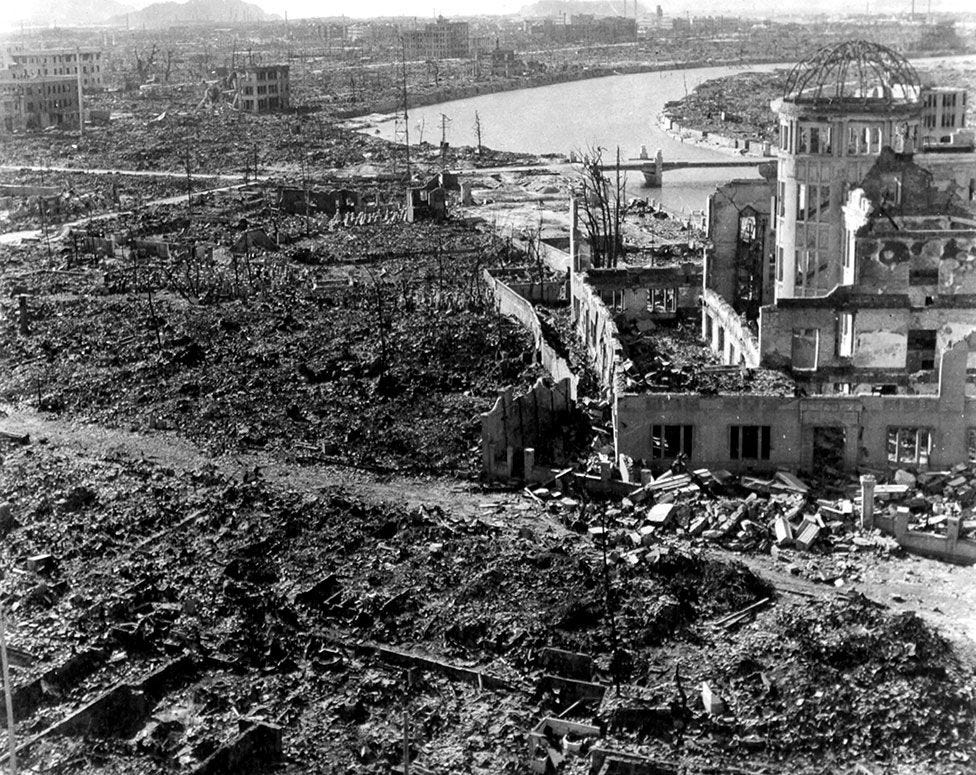
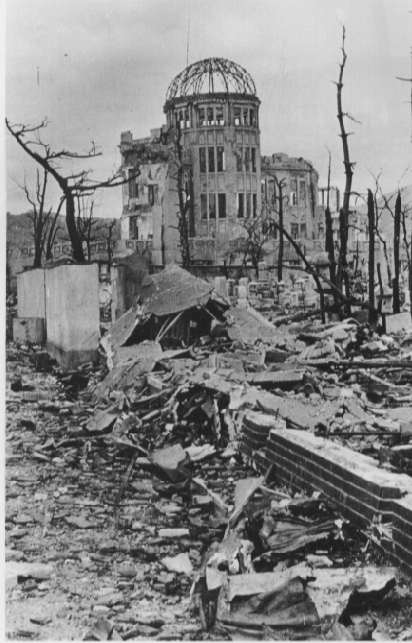
Hiroshima, 1945, after a “small” atomic bomb. Nuclear attacks in a “new” Cold War will be inconceivably worse
Of course, World War II also wasn’t the end of the killing. The so-called Iron Curtain descended in Europe, leading to the Cold War between the U.S. and the Soviet Union that almost ended with Armageddon in 1962 during the Cuban Missile Crisis. That Cold War came to an end in 1991 with the collapse of the Soviet Union. The U.S. celebrated its apparent victory, even calling briefly for “peace dividends” in the 1990s. It was not to be.
Thirty years after the (First) Cold War, we now hear of a “new Cold War.” We hear again that China and Russia are America’s enemies, a new “Axis of Evil,” notes Caitlin Johnstone. America is already engaged in a proxy war with Russia in Ukraine. Now America’s leaders are posturing over Taiwan and threatening war with China if the Chinese military makes aggressive moves against that country. (Of course, the Chinese consider Taiwan to be China, a “One China” policy the U.S. used to support.)
It does seem as if “my” Cold War, when I served in the U.S. military, may be remembered to history as the First Cold War, and that America has already begun a Second Cold War. And, just as World War II was far worse than World War I in casualties and destruction, Cold War II could conceivably be a LOT worse than Cold War I if we choose to continue to wage it.
Sequels, as a general rule, are usually worse, sometimes far worse, than the originals. We had better stop this nonsense of a new Cold War before we relearn this in the hardest way possible.
As I mentioned in a previous Bracing View, I was invited to participate in a forum to generate new ideas to tackle the military-industrial complex (MIC) that President Dwight D. Eisenhower warned us about in 1961. Here are a few more thoughts in response to this stimulating collaboration:
When I was a college student in the early 1980s, and in Air Force ROTC, I wrote critically of the Reagan defense buildup. Caspar Weinberger, he of the “Cap the knife” handle for cost-cutting, became “Cap the ladle” as Reagan’s Secretary of Defense, ladling money in huge amounts to the Pentagon. History is repeating itself again as the Biden administration prepares to ladle $813 billion (and more) to the Pentagon.
How do we stop this? Of course, we must recognize (as I’m sure we all do) what we’re up against. Both political parties are pro-military and, in the main, pro-war. Our economy is based on a militarized Keynesianism and our culture is increasingly militarized. Mainstream Democrats, seemingly forever afraid of being labeled “weak” on defense, are at pains to be more pro-military than the Republicans. Biden, in Poland, echoed the words of Obama and other past presidents, declaring the U.S. military to be “the finest fighting force” in history. Think about that boast. Think about how Biden added that the nation owes the troops big. This is a sign of a sick culture.
Ike gave his MIC speech in 1961, and for 61 years the MIC has been winning. Even after the collapse of the Soviet Union in the early ‘90s, the MIC held its own; after 9/11, it went into warp speed and is accelerating. To cite Scotty from Star Trek: “And at Warp 10, we’re going nowhere mighty fast.”
We need a reformation of our institutions; we need a restoration of our democracy; we need a reaffirmation of the U.S. Constitution; we need to remember who we are, or perhaps who we want to be, as a people.
Do we really want to be the world’s largest dealer of arms? Do we really want to spend a trillion or more dollars, each and every year, on wars and weapons, more than the next dozen or so countries combined, most of which are allies of ours? (“Yes” is seemingly the answer here, for both Democrats and Republicans.) Is that really the best way to serve the American people? Humanity itself?
Consider plans to “invest” in “modernizing” America’s nuclear triad. (Notice the words used here by the MIC.) What does this really mean? To me, it means we plan on spending nearly $2 trillion over the next 30 years to replace an older suicide vest with a newer one, except this suicide vest will take out humanity itself, as well as most other life forms on our planet. To channel Greta Thunberg’s righteous anger, “How dare you!” https://www.youtube.com/watch?v=xVlRompc1yE
Or, as Ike said in 1953, “This is not a way of life at all … it is humanity hanging from a cross of iron.”
We will need the broadest possible coalition to tackle this outrage against civilization and humanity. That’s why I applaud these efforts to tackle the MIC, even as I encourage all of us to enlist and recruit more people to join our ranks.
My father enlisted in the Civilian Conservation Corps in 1935 to do his bit for his family and his nation. He fought forest fires in Oregon and later became a firefighter after serving in the Army during World War II. That was the last formally declared war that America fought. It was arguably the last morally justifiable war this country has fought, waged by citizens who donned a uniform, not “warriors” who are told that the nation owes them big.
In “It’s A Wonderful Life,” Jimmy Stewart, a true war hero, played a man who never fought in World War II, who stayed at home and helped ordinary people even as his younger brother Harry went off to war and earned the Medal of Honor. Yet the movie doesn’t celebrate Harry’s war heroism; it celebrates the nobility, decency, and humility of George Bailey.
How do we get back to that America? The America from before the MIC, that celebrated decency and kindness and humanitarianism?
Yes, I know. It’s just a Frank Capra movie, and America has never been a perfect shining city. All I’m saying is we need more of that spirit, and more of the righteous anger of Greta Thunberg, if we are to prevail.
Remember the days when America had to be attacked before it went to war? And when it did, it made formal Congressional declarations of the same?
In December 1941, the Japanese attacked the U.S. Pacific Fleet at Pearl Harbor as well as elsewhere in the Pacific. In response to those attacks, President Franklin Roosevelt asked Congress for a formal declaration of war. Nazi Germany then declared war on the U.S., after which the U.S. responded in kind. Compared to the future wars of U.S. empire, Americans were generally united and had some understanding of what the war (World War II, of course) was about.
We haven’t had that kind of unity and clarity since 1945, which is certainly the biggest reason America has suffered so many setbacks and defeats in unpromising places like Vietnam, Iraq, and Afghanistan. In all three of those places, there really wasn’t a clear and compelling cause for war, hence there was no Congressional declaration of the same. Hmm … maybe that should have told us something?
In Vietnam, the Gulf of Tonkin Resolution by Congress followed on the heels of an “attack” that had never happened. In Iraq, the “evil dictator” didn’t have the weapons of mass destruction we accused him of having, nor had he played any role in the 9/11 attacks. In Afghanistan, the Taliban had played a secondary role in providing a safe haven to Osama bin Laden prior to 9/11, but it was Al Qaeda, not the Taliban, that was behind the 9/11 attacks.
Indeed, since 15 of the 19 Al Qaeda terrorists were Saudi, as well as their leader, Osama bin Laden, it would have made much more sense to have declared war on Saudi Arabia and invade that country than to have invaded Afghanistan. Of course, it made no sense at all to have declared a general “war on terror,” and rather unsurprisingly, that 20-year-war has only succeeded in spreading terror further.
Now we turn to today’s situation between Russia and Ukraine. Frankly, I don’t see a border dispute between these two countries as constituting a major threat to U.S. national security. It’s certainly no reason for America to go to war. Yet the Biden Administration is taking a hard line with its economic sanctions, its weapons shipments, and its troop deployments to the region.
Somehow, America’s leaders seem to think that such actions will deter, or at least punish, Russia and its leader. But there’s another possibility, one equally as likely, that sanctions and weapons and troops will lead to escalation and a wider war, and for what reason? A Russian-Ukrainian border dispute? This dispute might resolve itself if the U.S. and NATO just had the sense and patience to mind its own business.
A rush to war made sense in 1941, when the U.S. faced powerful and implacable enemies that were focused on its destruction. It hasn’t made sense since then, nor does it make sense today.
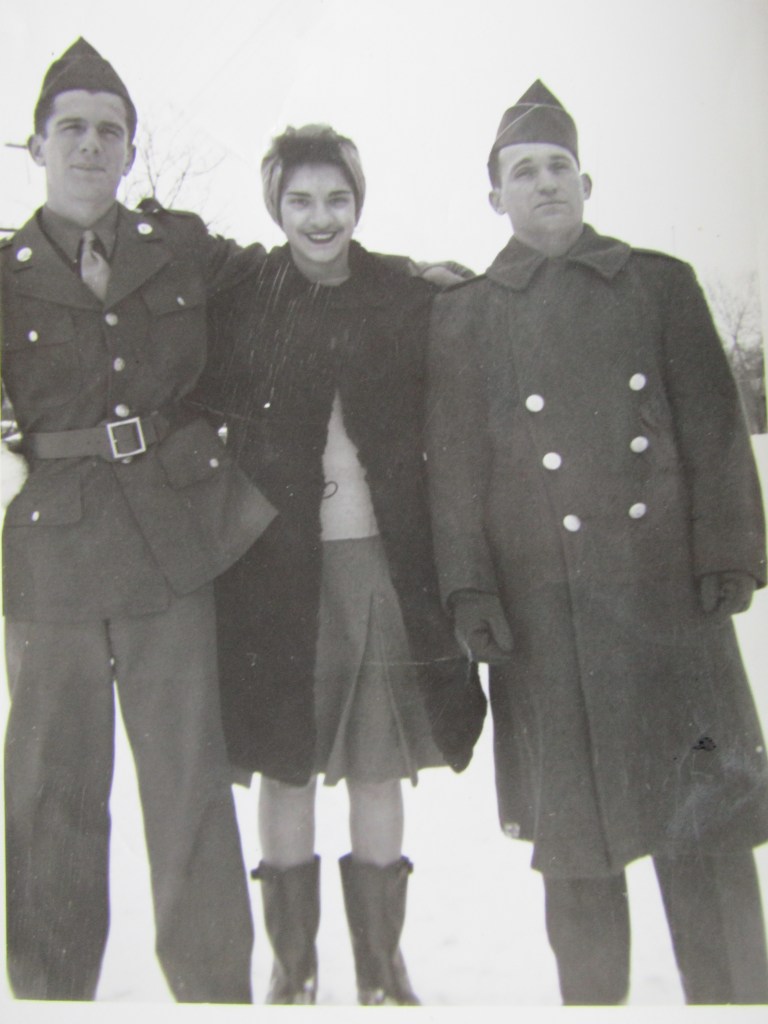
My dad (R) home on leave with his brother Gino, c. 1944
W.J. Astore
I come from a family of veterans. My father and his two brothers served in the military during World War II. My mother’s brother fought at Guadalcanal against the Japanese and was awarded the Bronze Star. Later, my eldest brother enlisted in the Air Force at the tail end of the Vietnam War, which my brother-in-law had fought in as a radio operator attached to the artillery. Their service helped to inspire my decision to become an officer in the U.S. Air Force.
Military service is honorable, not because of wars waged or lives taken, but because of its purpose: to support and defend the Constitution of the United States. And this should be the purpose of Veterans Day: to take note of our veterans and their service in upholding the ideals of our Constitution, including freedom of speech and assembly, freedom of the press, a right to privacy, and most of all a government that is responsive to our needs and accountable to our oversight.
Yet since World War II America has fought wars without formal Congressional declarations. The Korean War, the Vietnam War, wars in Afghanistan and Iraq and elsewhere, have lacked the wholehearted support of the American people. They were arguably unnecessary wars in the sense these countries and peoples posed no direct threat to America and our Constitution. Indeed, prosecuting these wars often posed more of a threat to that very Constitution.
Naturally, America associates veterans with wars and combat, and we say the dead made “the ultimate sacrifice,” which indeed they did. But for what purpose, and to what end? We owe it to veterans to ask these questions: for what purposes are we risking their lives, and to what end are these wars being waged? If we can’t answer these simple questions, in terms intimately associated with our Constitution and the true needs of national defense, we should end these wars immediately.
Unending wars are the worst enemy of freedom and liberty. This isn’t just my sentiment. As James Madison put it, “Of all the enemies of true liberty, war is, perhaps, the most to be dreaded … No nation can preserve its freedom in the midst of continual warfare.” America once knew this; we were once a nation that was slow to anger and with little taste for large military establishments.
A few years ago, I stumbled across old sheet music in a bookstore. Catching my eye was the title of the song: “I Didn’t Raise My Boy to be a Soldier,” respectfully dedicated to “Every Mother – Everywhere.” From 1915, this popular song captured American resistance to the calamitous “Great War” that we now call World War I. Anti-war sentiment was strong that year in America, and indeed Woodrow Wilson would be reelected president in 1916 in large part because he had kept Americans out of the war. The lyrics put it plainly: a mother who’d brought her son up “to be my pride and joy” didn’t want to see that same son having “to shoot some other mother’s darling boy.”
The contrast in these lyrics to recent U.S. military recruitment commercials couldn’t be starker. In a new Department of Defense advertising campaign, featuring the catchphrase “Their success tomorrow begins with your support today,” mothers are shown incongruously in military settings asking their sons why they wanted to sign up. Weapons are featured prominently in these ads, but no combat. There’s much talk of teamwork and being part of something larger than yourself but no talk of the U.S. Constitution. At the end of these spots, the young men depicted have convinced their mothers that it’s desirable indeed to have your boy become a soldier.
Recruitment ads, of course, have never been at pains to show the true costs of war. When I was a teen, the Army’s motto was “Be all that you can be.” For the Navy, service was about “adventure.” For the Air Force, it was about “a great way of life.” These ads, by ignoring or eliding war’s costs, have contributed to America’s tighter embrace of war on the world stage and its severe impact, not only on our veterans but on our democracy. America’s strategy of “global reach, global power” has embroiled us in wars of choice that we increasingly choose not to end. Surely, it’s time to chart a more pacific path.
Sometimes the best offense is a good defense. On this Veterans Day, let’s remind ourselves that veterans exist to defend our Constitution and our country, but that endless warfare, and intensifying militarism, are in fact among the most pressing dangers to our democracy.
William Astore, a retired lieutenant colonel (USAF) and history professor, is a senior fellow at the Eisenhower Media Network (EMN), an organization of critical veteran military and national security professionals.
Note: I wrote this article in 2015 on the 70th anniversary of Hiroshima. Nuclear weapons should be eliminated from the planet.
August 6, 1945. Hiroshima. A Japanese city roughly the size of Houston. Incinerated by the first atomic bomb. Three days later, Nagasaki. Japanese surrender followed. It seemed the bombs had been worth it, saving countless American (and Japanese) lives, seeing that a major invasion of the Japanese home islands was no longer needed. But was the A-bomb truly decisive in convincing the Japanese to surrender?
President Truman’s decision to use atomic bombs against Japan is perhaps the most analyzed, and, in the United States, most controversial decision made during World War II. The controversy usually creates more heat than light, with hardliners posed on mutually opposed sides. The traditional interpretation is that Truman used the A-bombs to convince a recalcitrant Japanese Emperor that the war was truly lost. A quick Japanese surrender appeared to justify Truman’s choice. It also saved tens of thousands of Allied lives in the Pacific (while killing approximately 250K Japanese). This thesis is best summed up in Paul Fussell’s famous essay, “Thank God for the Atomic Bomb.”
Even before Hiroshima, however, a small number of scientists argued that the A-bomb should not be used against Japan without a prior demonstration in a remote and uninhabited location. Later, as the horrible nature of radiation casualties became clearer to the American people, and as the Soviet Union developed its own arsenal of atomic weapons, threatening the United States with nuclear Armageddon, Americans began to reexamine Truman’s decision in the context of the Cold War and the nuclear arms race. Gar Alperovitz’s revisionist view that Truman was practicing “atomic diplomacy” won its share of advocates in the 1960s. (Alperovitz expanded upon this thesis in the 1990s.) Other historians suggested that racism and motives of revenge played a significant role in shaping the U.S. decision. This debate reached its boiling point in the early 1990s, as the Smithsonian’s attempt to create a “revisionist” display to mark the bomb’s 50th anniversary became a lightning rod in the “culture wars” between a Democratic administration and a resurgent Republican Congress.
Were the atomic bombs necessary to get the Japanese to surrender? Would other, more humane, options have worked, such as a demonstration to the Japanese of the bomb’s power? We’ll never know with certainty the answer to such questions. Perhaps if the U.S. had been more explicit in their negotiations with Japan that “unconditional surrender” did not mean the end of Japan’s Emperor, the Japanese may have surrendered earlier, before the A-bomb was fully ready. Then again, U.S. flexibility could have been interpreted by Japanese hardliners as a sign of American weakness or war fatigue.
Unwilling to risk appearing weak or weary, U.S. leaders dropped the A-bomb to shock the Japanese into surrendering. Together with Stalin’s entry into the war against Japan, these shocks were sufficient to convince the Japanese emperor “to bear the unbearable,” in this case total capitulation, a national disgrace.
A longer war in the Pacific — if only a matter of weeks — would indeed have meant higher casualties among the Allies, since the Japanese were prepared to mount large-scale Kamikaze attacks. Certainly, the Allies were unwilling to risk losing men when they had a bomb available that promised results. The mentality seems to have been: We developed it. We have it. Let’s use it. Anything to get this war over with as quickly as possible.
That mentality was not humane, but it was human. Truman had a weapon that promised decisiveness, so he used it. The attack on Hiroshima was basically business as usual, especially when you consider the earlier firebombing raids led by General Curtis LeMay. Indeed, such “conventional” firebombing raids continued after Hiroshima and Nagasaki until the Japanese finally sent a clear signal of surrender.
Of course, an event as momentous, as horrific, as Hiroshima took on extra meaning after the war, given the nuclear arms race, the Cold War and a climate represented by the telling acronym of MAD (mutually assured destruction). U.S. decisionmakers like Truman were portrayed as callous, as racist, as war criminals. Yet in the context of 1945, it’s difficult to see any other U.S. president making a different decision, especially given Japan’s apparent reluctance to surrender and their proven fanaticism at Iwo Jima, Okinawa and elsewhere.
As Andrew Rotter notes in Hiroshima: The World’s Bomb (2008),World War II witnessed the weakening, if not erasure, of distinctions between combatants and non-combatants, notably during LeMay’s firebombing of Tokyo in March 1945 but in many other raids as well (Rotterdam and Coventry and Hamburg and Dresden, among so many others). In his book, Rotter supports the American belief that Japan would fight even more fanatically for their home islands than they did at Iwo Jima and Okinawa, two horrendous battles in 1945 that preceded the bomb. But he argues that Truman and Secretary of War Henry Stimson engaged in “self-deception” when they envisioned that the effects of the atomic bomb could be limited to “a purely military” target.
A quarter of a million Japanese died at Hiroshima and Nagasaki and in the years and decades following. They died horrible deaths. And their deaths serve as a warning to us all of the awful nature of war and the terrible destructiveness of nuclear weapons.
Hans Bethe worked on the bomb during the Manhattan Project. A decent, humane, and thoughtful man, he nevertheless worked hard to create a weapon of mass destruction. His words of reflection have always stayed with me. They come in Jon Else’s powerful documentary, “The Day After Trinity: J. Robert Oppenheimer and the Atomic Bomb.”
Here is what Bethe said (edited slightly):
The first reaction we [scientists] had [after Hiroshima] was one of fulfillment. Now it has been done. The second reaction was one of shock and awe: What have we done? What have we done. The third reaction was it should never be done again.
It should never be done again: Just typing those words here from memory sends chills up my spine.
Let us hope it is never done again. Let us hope a nuclear weapon is never used again. For that way madness lies.
Here are two comments I made in response to previous comments on this article:
1.
I think the comments once again show that no consensus is possible on whether the atomic bombs were decisive in ending the war sooner. Even well-informed people at the time disagreed.
Again, I return to the context of August 1945. A war-weary America, facing the prospect of a delayed Japanese surrender, was using every weapon at its disposal to drive the Japanese into the ground. That included blockade, firebombing, and invasions (Iwo Jima and Okinawa). A longer blockade and more Japanese would have starved. More firebombing, more dead Japanese. More invasions, more dead Japanese, and of course Allied troops as well. The Japanese were well indoctrinated to fall in battle like cherry blossoms in the service of the emperor, whom they viewed as a god.
How to get a Japanese leadership and people to surrender when they saw the very act as dishonorable to the warrior code of Bushido? How to persuade a military that was already committing suicide on a massive scale in Kamikaze attacks against Allied ships to capitulate and live on with the shame of defeat?
It’s clear from the evidence that Truman believed the atomic bomb would shock the “beast” of Japan (“beast” was Truman’s word, a description that Allied soldiers and other Asian peoples who suffered at the hands of Japan, e.g. the Chinese, the Vietnamese, the Koreans, would have agreed with). It surely did shock them. Profoundly. Was it sufficient? Was it necessary?
Again, there is no alternate reality in which the atomic bomb wasn’t dropped, and thus no way of knowing whether in that other reality, the Japanese would have agreed to surrender on August 15th.
2.
My reading of the evidence is that impressing the Soviets was a factor, but not THE factor, in the decision to use the bomb. Ending the war as quickly as possible was the driving factor. If the bomb had been ready in December 1944, it would have been used against Nazi Germany as the Battle of the Bulge raged. But the bomb wasn’t ready until July 1945, when the Germans had already surrendered.
Iwo Jima and Okinawa were fresh in the minds of everyone. Though the Japanese had extended peace-feelers, others in Japan were hardline and didn’t wish to surrender on any terms. Faced with a war that could last weeks or months longer, perhaps into 1946 if an invasion of the Japanese home islands had been necessary, the US leadership decided the bomb could be the shock that would force the Japanese to capitulate. And so it seemed, after the fact.
It’s a very complicated question that I’ve read a lot about, and written about as well. Many people at the time simply saw the bomb as a “bigger” bomb, not as something world-changing. Only a few people truly grasped the horror of atomic weapons.
I know this probably isn’t convincing, but again this is my reading of the evidence. Certainly, Nagasaki was completely unnecessary — it came far too quickly for the Japanese to process what had happened at Hiroshima.
It’s worth pausing this month to mark the 75th anniversary of the end of World War II in Europe, marked by Adolf Hitler’s suicide and Germany’s unconditional surrender. The Allied victory was a triumph of coalition warfare, the “Big Three” represented by the Soviet Union, the United States, and Great Britain, joined by so many other countries and peoples.
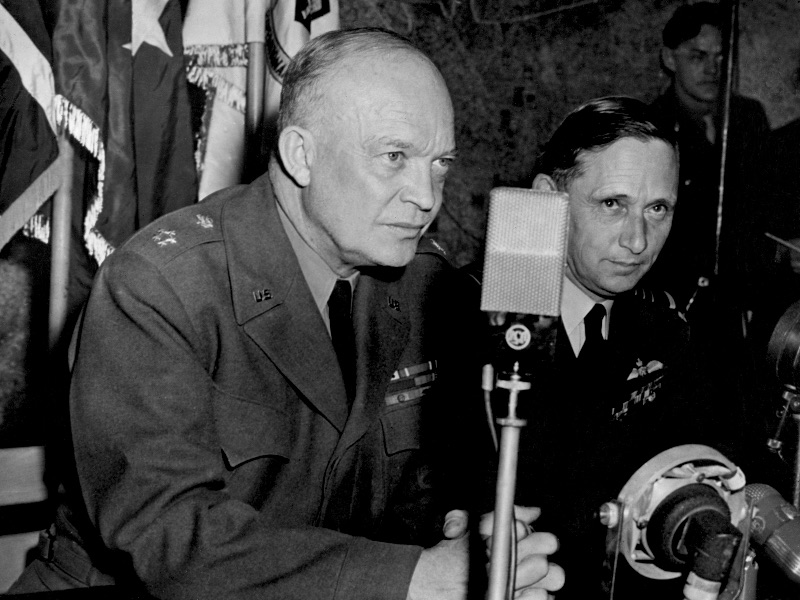
The Supreme Commander of the Allied Expeditionary Force, Dwight D. Eisenhower, sent a disarmingly simple message to mark Germany’s total defeat and surrender:
“The mission of this Allied Force was fulfilled at 0241, local time, May 7th, 1945.”
It was a true “mission accomplished” moment — perhaps the last clear one America has had in any major war or conflict since then.
Eisenhower was a complex man who presented himself as a simple one. One thing he knew was how to lead, to bring people together, to keep hotheads like Field Marshal Bernard Montgomery and General George Patton under control while maximizing their gifts. It’s difficult to imagine a better coalition commander than Ike.
I love this image of Ike from May 7, 1945 (Ike is seen here with his deputy commander, Air Chief Marshal Sir Arthur Tedder of the Royal Air Force):
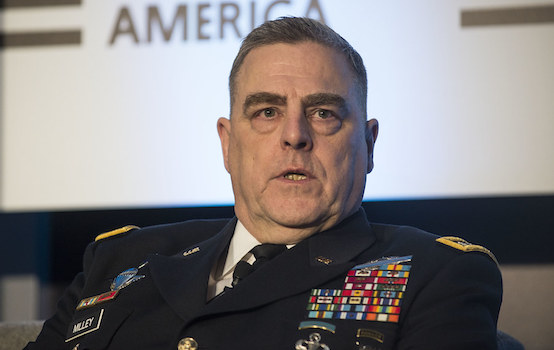
Note the simplicity of Ike’s uniform (just three rows of ribbons, and no badges, devices, or other military gewgaws). The same can be said of Tedder’s uniform (a few ribbons, his wings, and that’s about it). Compare their uniforms to America’s current Chairman of the JCS, Mark Milley:
With all this self-congratulation and self-glorification, is it any wonder America’s generals found stalemate in Korea and defeat in Vietnam, Iraq, and Afghanistan?
VE Day represented enormous sacrifices by peoples around the world to defeat a murderous fascistic regime in Germany. Well should we remember it and learn from it.





 Bracing Views