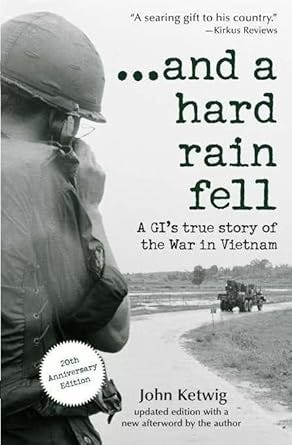
I’ve been reading John Ketwig’s memoir “…and a hard rain fell: A GI’s true story of the War in Vietnam,” and it’s reminding me just how plain dumb, destructive, and duplicitous America’s wars have been since World War II.
America’s wars are always dressed up with a necessary, even allegedly noble, cause. In Vietnam, we had to stop communism and all those dominoes from falling. In Iraq, it was about WMD and stopping Saddam Hussein, “the next Hitler.” In Afghanistan, it was about vengeance for 9/11, then creating democracy and even helping women. (How about helping women in America? Never mind.)
Vietnam is nominally communist today—and a big trading partner of the U.S. and an ally of sorts against China. No dominoes fell. Iraq didn’t have WMD and Saddam wasn’t the next Hitler; he was merely a regional strongman and a former U.S. ally who got a little too big for his britches, especially for Israel. Afghanistan was a war in search of a clear mission and attainable goals. After twenty years of effort and roughly $2 trillion in expenditures, the U.S. replaced the Taliban with—the Taliban. (I heard Norman Finkelstein say this first.)
We’re always told versions of the same lie: We need to fight them over there so that we don’t have to fight them here. Communism had to be rolled back in Vietnam else commies would be landing in Manhattan. Iraq had to be pummeled and Saddam overthrown before WMD landed in Boston. Afghanistan had to be pacified and modernized before the Taliban enforced conservative Sharia law in Biloxi.
None of this was true. The United States would have been perfectly safe without committing any troops to Vietnam, Iraq, and Afghanistan. In fact, the U.S. would have been far better off if those wars had never been fought. Certainly Vietnam, Iraq, and Afghanistan would have been far better off if they’d never become free-fire zones for American munitions (including the poisonous Agent Orange in Vietnam and, more recently, depleted uranium and other poisons in Iraq and Afghanistan).
Now we’re hearing about a possible U.S. war with Iran, allegedly to stop that country from acquiring an atomic bomb. It’s OK for the U.S. to have more than 5000 nuclear warheads and for Israel to have 200 or so, but it’s not OK for Iran to have even one, because reasons.
The U.S. military, vast as it is, with a vision of global dominance, always needs enemies. Of course, it’s not simply the military but the whole military-industrial complex, the MICIMATT,* which needs war and conflict to sustain itself.
I recently read “American War,” a powerful novel by Omar El Akkad. It imagines a second U.S. civil war starting roughly 50 years from now. It’s a fascinating book, well worth reading because it captures the horror of war, with all its atrocities, its massacres, its war crimes, and the deep wounds war leaves behind even among the most resolute survivors. John Ketwig’s book does the same as he recounts the fears and horrors of his year in Vietnam and the personal struggles he endured in coming to terms with what he’d seen and endured.
So, count me among those who are already against the next war, whether against Iran, China, or for that matter any other country. Sure, I think America needs to defend itself; I don’t think peace is going to break out spontaneously around the world; but I know for a fact that fighting constant wars is not a way toward greater peace and prosperity. Quite the opposite.
If you want to know what desperate and profoundly wounded war survivors are capable of, read “American War.” If you want to know what desperate and profoundly confused troops are capable of, read “…and a hard rain fell.” And ponder the continued propaganda here of the “good war,” the wonders of warriors and warfighters, and the repetition of slogans like “peace through strength,” a specific form of strength measured in kilotons and megatons of explosives, in massive body counts and military production figures.
Ask yourself: Is that “strength”? Are constant wars truly the path toward peace? How can we possibly be so dumb as to believe this?
MICIMATT: military-industrial-congressional-intelligence-media-academe-think-tank complex. It employs millions of people and spends more than a trillion dollars a year. It’s not easily confronted. Nor is it easily contained, let alone curtailed.
It’s Independence Day in America, so it seems like a good day to declare our independence from the insanity of war.
Sadly, since the presidency of George W. Bush if not before, it’s become routine for U.S. commanders-in-chief to boast of having the world’s finest military in all of history. Obama did it routinely, and Biden recently said the same during his disastrous debate with Trump. Few Americans stop to think about the implications of boasting about having the world’s greatest military—is such a boast truly consistent with democracy, liberty, and freedom?
Certainly, empires rely on strong militaries. Think of the Roman Empire or the Mongol Empire, or the Third Reich (Empire) of Nazi Germany. Do we want to be like them?
Those empires lived by the sword (quite literally so with the Roman Empire) and died by it as well. Their militaries, I would argue, were also more effective than the U.S. one, which hasn’t won a major war since 1945, the latter with a lot of help from our “friends” like the Soviet Union. The Roman, Mongol, and German empires are no more, worn down in part through the constant costs and demands of war. We need to learn more from history than the “fact” that America’s military is supposedly the world’s best since forever and a day ago.
I’ve been reading Oriana Fallaci’s “Nothing, and So Be It,” in which she recounted her time reporting on the Vietnam War. Two conversations with U.S. troops in Vietnam caught my attention. On pages 22-23, she recounts a conversation with Army Captain Scher, during which Scher confesses his disgust with war:
God, how disgusting war is. Let me say it—I’m a soldier. People who enjoy making war, who find it glorious and exciting, must have twisted minds. There’s nothing glorious, nothing exciting; it’s just a filthy tragedy you can only cry over. You cry for the man you refused a cigarette to and who didn’t come back with the patrol. You cry for the man you bawled out and who is blown to pieces in front of you. You cry for the man who killed your friends …
Later in the book, she interviews a Marine Lieutenant whose surname is Teanek (pages 174-75). Here’s what he had to say:
Teanek: “Men have been saying that [we should abolish war] for thousands of years, and with the justification that they’re abolishing war, they’ve soaked the greatest periods of their civilization in blood.”
Fallaci: “That’s no good reason to keep on doing it.”
Teanek: “Theoretically, you’re right, but in practice what you’re saying is very silly. It’s like convincing yourself—as I bet you do—that when you describe people dying in war you’re helping to abolish war. On the contrary. The more you see people who’ve been killed in war, the more you want to go on fighting wars: it’s a mystery of the human soul.”
It is indeed “a mystery of the human soul” why we humans persist in killing each other in such vast numbers through war. Of course, it’s partly because we glorify it, when we should recognize, as Fallaci does on page 187, that “War is a madhouse.”
I am sane!
One of my favorite scenes in any war film came in “The Big Red One,” a World War II movie by Samuel Fuller starring Lee Marvin as a grizzled Army sergeant of the 1st Infantry Division. It’s a scene in which U.S. troops liberate an insane asylum.
The unforgettable part of this scene for me is when one of the madhouse residents picks up a submachine gun and starts blasting away, crying “I am one of you. I am sane!”
A 52-Year-Old Letter Says Much About America’s Failed Wars
A friend sent along an old Time magazine from May 8th, 1972, which I’ve thoroughly enjoyed perusing. Back in the 1970s, I had a subscription to Time, but my old copies were long ago consigned to the trash. Anyhow, in reading the “Letters” section, I came across a stunning missive written by Oriana Fallaci, an Italian war correspondent who wrote for Europeo Magazine.
Fallaci in 1960, showing some serious attitude (Wiki)
Here’s what Ms. Fallaci had to say about the U.S. war effort in Vietnam:
As an Italian, as a longtime war correspondent in Viet Nam, as the author of a book on the Viet Nam War, I have to answer the sort of judgment made by the unnamed Rand Corp. analyst who said that the South could hold out against the North Vietnamese “unless the North Vietnamese are all Prussians and the South Vietnamese are all Italians.”
I assume that he refers to the fact that the Italian soldiers fought with total lack of enthusiasm during the second World War and particularly in its last phase. Yes, indeed they did. They showed the same lack of enthusiasm that the American soldiers have shown in Viet Nam. Many times, while following your GIs in combat, I have had the impression that I was seeing Italians and not Americans. Do you know why? Because both those Italians and those Americans were fighting a war they did not believe in, a war they were ashamed of.
She nails it. When you realize the war you’re fighting is a dishonest one, an unnecessary one, even one that is shameful, you generally don’t fight well. It doesn’t matter what nationality you are.
Ms. Fallaci’s book on the Vietnam War
When and what was the last war U.S. troops truly believed in, one that they weren’t entirely ashamed of? I think you’d have to go back to World War II, and of course even then more than a few U.S. troops had their doubts, as citizen-soldiers of a democracy are wont to have, because there’s no such thing as a “good” war.
Anyhow, note as well how the prediction of that Rand Corporation “expert” proved wrong. Instead of South Vietnam holding out against the north, it folded fairly quickly three years later in 1975. I guess its soldiers all fought like Italians and those of North Vietnam all fought like Prussians.
Waging war is a horrible thing—especially when the war one is called on to wage is false and shameful. Ms. Fallaci knew that.
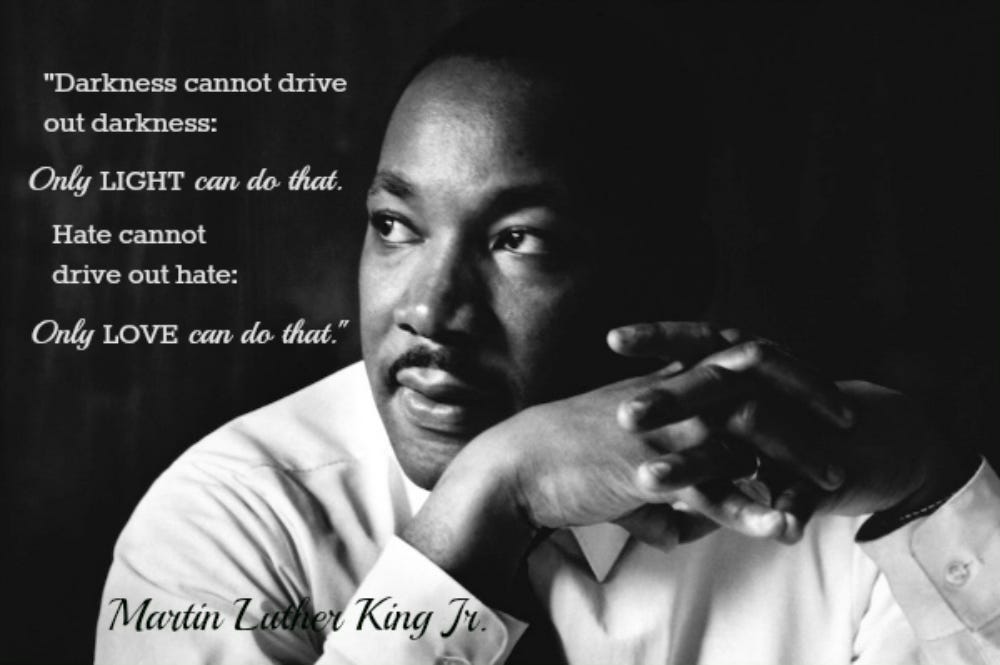
MLK recognized the evils of racism, extreme materialism, and militarism
Martin Luther King, Jr., hero for peace.
It’s sad that the word “hero” is so often modified by or married to “war” in history. He’s a war hero, we say, without giving it too much thought. As if wars are somehow ennobling and sublime.
Waging peace is far more noble than waging war. MLK Jr. recognized this in his famous speech against the Vietnam War on April 4, 1967. Back in 2015, I posted this article on MLK and his warning that America was close to suffering a spiritual death in its constant warmongering. Today, we see America enabling genocide by Israel in Gaza with nary a complaint from those in power. Spiritual death, indeed.
*****
On April 4, 1967, Martin Luther King Jr. gave a powerful speech (“Beyond Vietnam – A Time to Break Silence”) that condemned America’s war in Vietnam. Exactly one year later, he was assassinated in Memphis.
What follows are excerpts from MLK’s speech. I urge you to read it in its entirety, but I’d like to highlight this line:
A nation that continues year after year to spend more money on military defense than on programs of social uplift is approaching spiritual death.
MLK called for a revolution of values in America. In his address, he noted that:
There is nothing except a tragic death wish to prevent us from reordering our priorities so that the pursuit of peace will take precedence over the pursuit of war.
MLK didn’t just have a dream of racial equality. He had a dream for justice around the world, a dream of a world committed to peace, a world in which America would lead a reordering of values in the direction of universal brotherhood.
Both of MLK’s dreams remain elusive. Racial inequalities and biases remain, though America is better now than it was in the 1960s in regards to racial equity. And what of a commitment to peace? Sadly, America remains dedicated to war, spending nearly a trillion dollars yearly on defense, Homeland Security, nuclear weapons, and “overseas contingency operations,” i.e. wars.
America has failed to dream the dreams of Martin Luther King, Jr., and we are the worse for it. (Bolded passages below are my emphasis.)
Excerpts from MLK’s Speech on Vietnam, April 4, 1967
At this point I should make it clear that while I have tried in these last few minutes to give a voice to the voiceless in Vietnam and to understand the arguments of those who are called “enemy,” I am as deeply concerned about our own troops there as anything else. For it occurs to me that what we are submitting them to in Vietnam is not simply the brutalizing process that goes on in any war where armies face each other and seek to destroy. We are adding cynicism to the process of death, for they must know after a short period there that none of the things we claim to be fighting for are really involved. Before long they must know that their government has sent them into a struggle among Vietnamese, and the more sophisticated surely realize that we are on the side of the wealthy, and the secure, while we create a hell for the poor.
Somehow this madness must cease. We must stop now. I speak as a child of God and brother to the suffering poor of Vietnam. I speak for those whose land is being laid waste, whose homes are being destroyed, whose culture is being subverted. I speak of the — for the poor of America who are paying the double price of smashed hopes at home, and death and corruption in Vietnam. I speak as a citizen of the world, for the world as it stands aghast at the path we have taken. I speak as one who loves America, to the leaders of our own nation: The great initiative in this war is ours; the initiative to stop it must be ours…
If we continue, there will be no doubt in my mind and in the mind of the world that we have no honorable intentions in Vietnam. If we do not stop our war against the people of Vietnam immediately, the world will be left with no other alternative than to see this as some horrible, clumsy, and deadly game we have decided to play. The world now demands a maturity of America that we may not be able to achieve. It demands that we admit that we have been wrong from the beginning of our adventure in Vietnam, that we have been detrimental to the life of the Vietnamese people. The situation is one in which we must be ready to turn sharply from our present ways. In order to atone for our sins and errors in Vietnam, we should take the initiative in bringing a halt to this tragic war…
It is with such activity in mind that the words of the late John F. Kennedy come back to haunt us. Five years ago he said, “Those who make peaceful revolution impossible will make violent revolution inevitable.” Increasingly, by choice or by accident, this is the role our nation has taken, the role of those who make peaceful revolution impossible by refusing to give up the privileges and the pleasures that come from the immense profits of overseas investments. I am convinced that if we are to get on the right side of the world revolution, we as a nation must undergo a radical revolution of values. We must rapidly begin…we must rapidly begin the shift from a thing-oriented society to a person-oriented society. When machines and computers, profit motives and property rights, are considered more important than people, the giant triplets of racism, extreme materialism, and militarism are incapable of being conquered.
A true revolution of values will soon cause us to question the fairness and justice of many of our past and present policies. On the one hand, we are called to play the Good Samaritan on life’s roadside, but that will be only an initial act. One day we must come to see that the whole Jericho Road must be transformed so that men and women will not be constantly beaten and robbed as they make their journey on life’s highway. True compassion is more than flinging a coin to a beggar. It comes to see that an edifice which produces beggars needs restructuring.
A true revolution of values will soon look uneasily on the glaring contrast of poverty and wealth. With righteous indignation, it will look across the seas and see individual capitalists of the West investing huge sums of money in Asia, Africa, and South America, only to take the profits out with no concern for the social betterment of the countries, and say, “This is not just.” It will look at our alliance with the landed gentry of South America and say, “This is not just.” The Western arrogance of feeling that it has everything to teach others and nothing to learn from them is not just.
A true revolution of values will lay hand on the world order and say of war, “This way of settling differences is not just.” This business of burning human beings with napalm, of filling our nation’s homes with orphans and widows, of injecting poisonous drugs of hate into the veins of peoples normally humane, of sending men home from dark and bloody battlefields physically handicapped and psychologically deranged, cannot be reconciled with wisdom, justice, and love. A nation that continues year after year to spend more money on military defense than on programs of social uplift is approaching spiritual death.
America, the richest and most powerful nation in the world, can well lead the way in this revolution of values. There is nothing except a tragic death wish to prevent us from reordering our priorities so that the pursuit of peace will take precedence over the pursuit of war. There is nothing to keep us from molding a recalcitrant status quo with bruised hands until we have fashioned it into a brotherhood.
Perhaps it seemed in 1967, even to MLK Jr., with all his experience to the contrary, that America could lead the world in a revolution of values, a pursuit of peace. MLK’s dream of such a revolution is dead, drowned in the vast profits of the merchants of death.
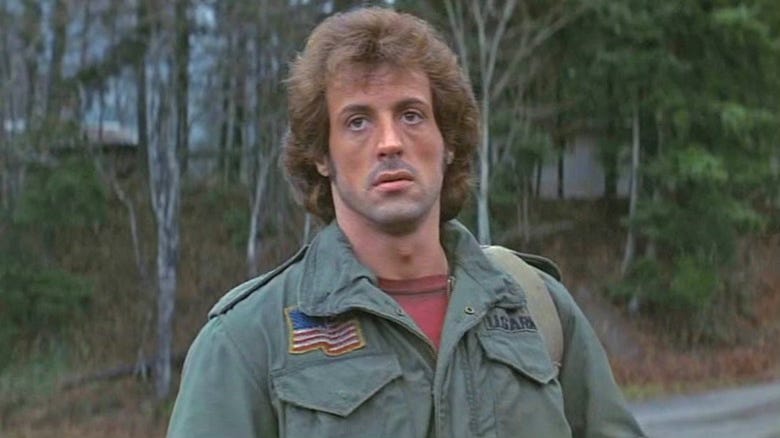
I remember seeing the first Rambo flick (“First Blood”) in a movie theater in 1982 when I was nineteen and rooting for Sly Stallone’s character against the police and national guardsmen who are sent to kill him. The police think it’ll be easy to subdue one man, but we the viewers know better. As Colonel Trautman, Rambo’s former commanding officer, says in the movie: In war, it’s wise to have “a good supply of body bags” on hand, a telling reminder about the harsh reality of combat.
In “First Blood,” military clothing and the flag offer no protection to John Rambo, who’s treated as a lowlife by the local sheriff
Yet, there’s a deeper meaning to “First Blood” captured near the end of the movie, when John Rambo, having improbably acted as a one-man invincible army (a true “Army of One”), bitterly reflects on his own post-Vietnam experiences. Rambo, breaking down, admits he can’t adapt to regular civilian life. A loner, he feels himself to be a loser, even though he was decorated for heroism in war with the Medal of Honor. Wounded and haunted by war, his soul seared by violence, he surrenders to Colonel Trautman.
The original Rambo movie wasn’t necessarily deep, but it did remind us that soldiers like Rambo carried hidden wounds of war; it also highlighted a societal suspicion, whether just or unjust, of military veterans. The sheriff in “First Blood” has no respect for Rambo as a military “hero”; he sees him as a disreputable and dangerous outsider and just wants to be rid of him, one way or another.
Subsequent Rambo films would portray him as a virtually unstoppable killing machine. In the first sequel, Rambo is sent back to Vietnam to rescue American POWs betrayed and abandoned by the U.S. government. Perhaps the most famous line from that movie is when Rambo asks Colonel Trautman whether, in returning to Vietnam, the government will finally allow U.S. soldiers to win this time. It was a concise statement of the stab-in-the-back myth, the idea the U.S. military would have won the war in Vietnam if only it hadn’t been betrayed by a duplicitous and spineless government.
“Do we get to win this time?” That’s a question that should haunt all Americans, since we haven’t won a war since 1945. But who is to blame for not winning? And have the wars America has fought since World War II really been worth fighting to begin with?
Update (9/2923): A lot has changed in forty years, as a couple of my friends pointed out in response to this article. We could imagine at least two scenarios for a revised Rambo made in 2023:
Version 1: In 2023, the sheriff wouldn’t have to call in the National Guard. All his deputies would gear up with assault rifles, sniper rifles, body armor, and MRAPs donated by the Pentagon as excess gear and the local SWAT team would be mobilized and deployed to find and kill Rambo.
Version 2: Perhaps the most likely one: Rambo would be wearing a “blue lives matter” flag, the sheriff’s patrol car would be festooned with “support our troops” stickers, and they’d call a town meeting to give Rambo the keys to the town as a Medal of Honor winner.
It was November 1967. The Vietnam War was at its height. His brother, the President, had been shot and killed in Dallas four years earlier. He himself would die of an assassin’s bullet within the next year. It was time for Robert F. Kennedy Sr. to “Face the Nation.”
TV was more serious back then, and very few politicians today, certainly not Donald Trump and Joe Biden, could speak with RFK’s clarity and eloquence.
It’s worth listening to Bobby Kennedy’s interview from 1967, but especially the last six minutes (beginning at the 18-minute mark) as he attempts to explicate his moral reservations and objections to America’s war against Vietnam. Such moral objections to war are rarely if ever heard today from Democrats and Republicans in DC. Bobby Kennedy wasn’t just saying the Vietnam War was dumb, that the U.S. military was employing bad strategy, that the war was too expensive, that it was a distraction from pressing domestic concerns, and so on.
Near the end of this interview, Bobby Kennedy called for serious and deep moral reflection on the use of U.S. military power overseas. He asked Americans to examine their consciences and cited the tens of thousands of civilians killed and wounded (not just U.S. troops). He said America was losing its moral position in the world due to the war. He was right.
RFK wasn’t anti-war. He recognized war was occasionally unavoidable. Yet he was willing to articulate war’s horrors. The deaths of tens of thousands of innocent women and children from wanton American firepower and especially napalm. The creation of millions of war refugees. The harsh realities of war should trouble Americans, Kennedy said, especially when its awful costs are justified on dubious grounds. Was it truly the case, Kennedy asked, that America had to fight communism over there so that we didn’t have to fight it over here? Did the U.S. have the moral right to wage a ghastly war against North Vietnam on the off-chance that a communist victory there might eventually pose a threat to America?
What I heard here from Bobby Kennedy was a dramatic appeal to conscience. An appeal to Americans to look within themselves and to stop needless violence, not only in Vietnam but also here at home in America’s streets.
In November 1967, Bobby Kennedy said something truly vital. Appealing to moral conscience, he recognized we are all human. That all lives matter, not only those of U.S. troops in Vietnam. And that far too often the decision makers in Washington had forgotten this most basic of moral facts.
I can’t say what Bobby would have achieved, killed as he was by an assassin’s bullet. But I think he was a healer, a man who had matured much since the death of his brother, a man of compassion and conscience, a man willing to reject the notion that might makes right and that million of “others” can and should be killed, wounded, or made refugees simply because it could be justified in terms of “protecting America.”
Do we have that right? Bobby asks. Plainly, he believed we didn’t.
Reason and Rationality Have Little to Do with Them
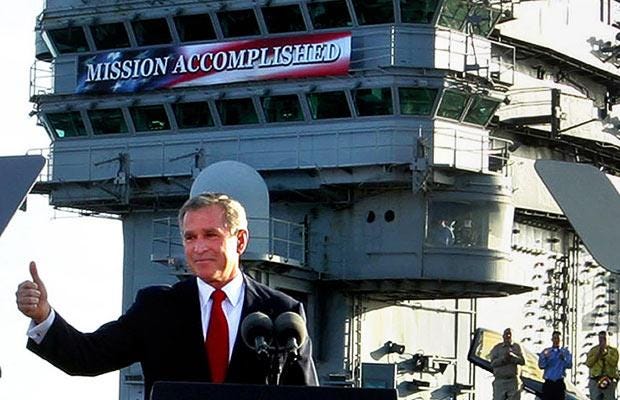
It is often hard to understand the reasons for America’s wars, especially since World War II, but they always have a rationale backed up by lies. The rationale for Vietnam was the containment of communism and the domino theory. The lie was that U.S. naval ships had been attacked at Tonkin Gulf. The rationale for Iraq was overthrowing a ruthless dictator and spreading “freedom.” The lie was that he had WMD and that he was somehow connected to the 9/11 attacks.
Nations and peoples are not dominoes
The real reasons for America’s many disastrous wars are opaque. Domestic politics are almost always paramount. No U.S. president wants to be accused of losing a war or appearing to be weak, so starting or continuing a war is considered as “strength.” Congress doesn’t want to be accused of “tying the hands of the president” or of “betraying the troops,” so most members happily go along with wars. The military, of course, always thinks it can win, and wars are good for promotions and power. And military contractors, the “merchants of death,” are even more happy to make money off war. Not surprisingly, perhaps, President Dwight D. Eisenhower’s farewell speech in 1961 warned America of the military-industrial complex, to which Ike had added Congress in an earlier draft. Ike’s warning has been largely forgotten; even his own monument in DC obscures it.
In Washington today, the Democrats accuse the Republicans of being weak on Russia; the Republicans return the favor by accusing the Biden administration of being weak on China. Military and industry are happy to play this blame game, knowing the Pentagon budget will soar as a result, as it has. And thus a dangerous “new cold war” appears to be a certainty.
The folly and fallaciousness of America’s wars, along with their carnage, are enough to make any rational human angry, especially one who has served in one of these wars. Mike Murry, a Vietnam War veteran, is angry, and so am I. Back in 2017, I wrote a piece on the atrociousness of the Vietnam War, to which Mr. Murry appended this comment. It merits consideration by all thinking Americans.
The ”Rationale” of America’s Wars. Comment by Mike Murry in 2017.
An excellent choice of words, “rationale.” Not the reason for doing something in the first place, but a conscious lie made up beforehand just to get things started, or an excuse invented afterwards to avoid accountability and, where required, the necessary punishment that true justice occasionally administers. Marine Corps General Smedley Butler once said that we have only two acceptable reasons for going to war: to defend our homes or defend the Constitution. In not a single case after World War II has either of these conditions applied, so that none of the pointless and ruinous fighting — I won’t dignify these Presidential/Career Military misadventures by calling them “war” — has had any justifiable reason or purpose. Not surprisingly, no Congress has declared war on another nation state since 1941 because no nation state on planet earth has attacked either American homes or America’s Constitution. The United States has not just “gone abroad in search of monsters to destroy,” as our sixth President, John Quincy Adams, warned us against foolishly doing, but has invented imaginary hobgoblins at home before even setting out to vanquish them on the far side of the globe.
Of course, Smedley Butler only made his remarks after serving for thirty years as an admitted “gangster for capitalism,” probably the best summary description of the U.S. military offered to date by one who ought to know. Today, as for the past seventy-plus years, the U.S. military simply fights — aimlessly and disastrously — for the sake of fighting. The fighting has no “reason” other than to provide a steady stream of outrageous corporate CEO bonuses, stockholder dividends, and the pensions and perquisites of retired senior military officers. This Warfare Welfare and Make-work Militarism has secondary beneficiaries, of course, most notably the hothouse orchids, special snowflakes and privileged peacock pugilists known as United States as “political leaders.” Naturally, the feeding and maintenance of this system of corrupt cronyism requires a death grip on over half the nation’s discretionary budget. As George Orwell wrote in “The Theory and Practice of Oligarchical Collectivism” (the book-within-a-book from 1984):
“The primary aim of modern warfare (in accordance with the principles of doublethink, this aim is simultaneously recognized and not recognized by the directing brains of the Inner Party) is to use up the products of the machine without raising the general standard of living.”
In other words, the entire U.S. military/security monstrosity — which I like to call the Lunatic Leviathan — has only one purpose: to suck the life out of the domestic economy so that the productivity of the people’s labor will not result in the betterment of their station in life, which might in due course result in the discarding of America’s useless parasitic economic and political “elites.” Any transparent euphemism designed and deployed to disguise this ugly, fundamental truth properly deserves the label “rationale.” In no way do the usual and time-dishonored obfuscations amount to a reason. Reason has fled the United States, replaced by a deserved and rancid Ridicule. The country now consumes itself, lost in its own vicarious fears and fantasies featuring the celluloid exploits of our vaunted Visigoths vanquishing visions of vultures somewhere, someplace, at some time, until … eventually … after some “progress” and “fragile gains” … as T.S. Eliot wrote of The Hollow Men:
This is the way the world ends This is the way the world ends This is the way the world ends Not with a bang but a whimper.
Men and women so hollow that you can hear their own bullshit echoing in them even before they start moving their jaws and flapping their lips to begin lying.
A blast from my past, vintage 2009, with a postscript
Back in 2009, when President Barack Obama was debating a new “surge” in Afghanistan, I wrote an article for TomDispatch that urged him to reconsider, citing the words of Norman Mailer that he applied against the Vietnam War. Naturally, my article had no impact whatsoever on policy, though it was picked up by many outlets, including Salon. I was checking something else today at Salon and came across my old piece. I hope you enjoy reading (or re-reading) it.
This was that rare article I wrote that was actually excerpted at the New York Times. My article is mentioned at the end if you follow this link.
After this piece appeared, I had an opportunity to write a chapter for a book on “Star Wars and History.” Through the grapevine I heard George Lucas wasn’t too sure he wanted a retired military officer to write for a book in his “Star Wars” universe until he heard I’d recommended Norman Mailer (or someone like him) for Secretary of Defense. That seemed to persuade Lucas that my contribution might be acceptable.
POSTSCRIPT: In retrospect, I got one big thing right and one wrong here. I was right: the Afghan surge was doomed to fail. But what I didn’t realize was that its failure didn’t matter. What mattered was that Obama showed his obedience to Washington rules. He showed he’d largely defer to the Pentagon and the generals. His deference, his willingness to play the game rather than trying to end it, probably ensured his second term as president.
Yes, the surge was a failure, and the Afghan War would last another 12 years. But Obama easily won a 2nd term by showing he could wage war just like his predecessors, Bush/Cheney.
So, how was Joe Biden finally able to end the Afghan War in 2021? Two reasons. He could blame the Trump administration for putting him in an untenable position, and he could neutralize Pentagon opposition by giving them even more money even as he pulled troops from Afghanistan. Instead of the Pentagon budget decreasing by roughly $50 billion, the yearly cost of the Afghan War, it increased by that amount even as that war finally crashed and burned. There was never, ever, any talk of peace dividends, and once Russia invaded Ukraine early in 2022, vast increases in U.S. and NATO military spending were guaranteed. And so today’s Pentagon budget soars toward $900 billion, which doesn’t even include aid to Ukraine.
If Biden wins a 2nd term in 2024, it may be largely because he’s shown himself to be a slavish servant of the military-industrial-congressional complex and the national security state.
Anyhow, from October of 2009:
Norman Mailer for secretary of defense
On Afghanistan, Obama needs the input of freethinking outsiders, not generals. What if LBJ had listened to Mailer?
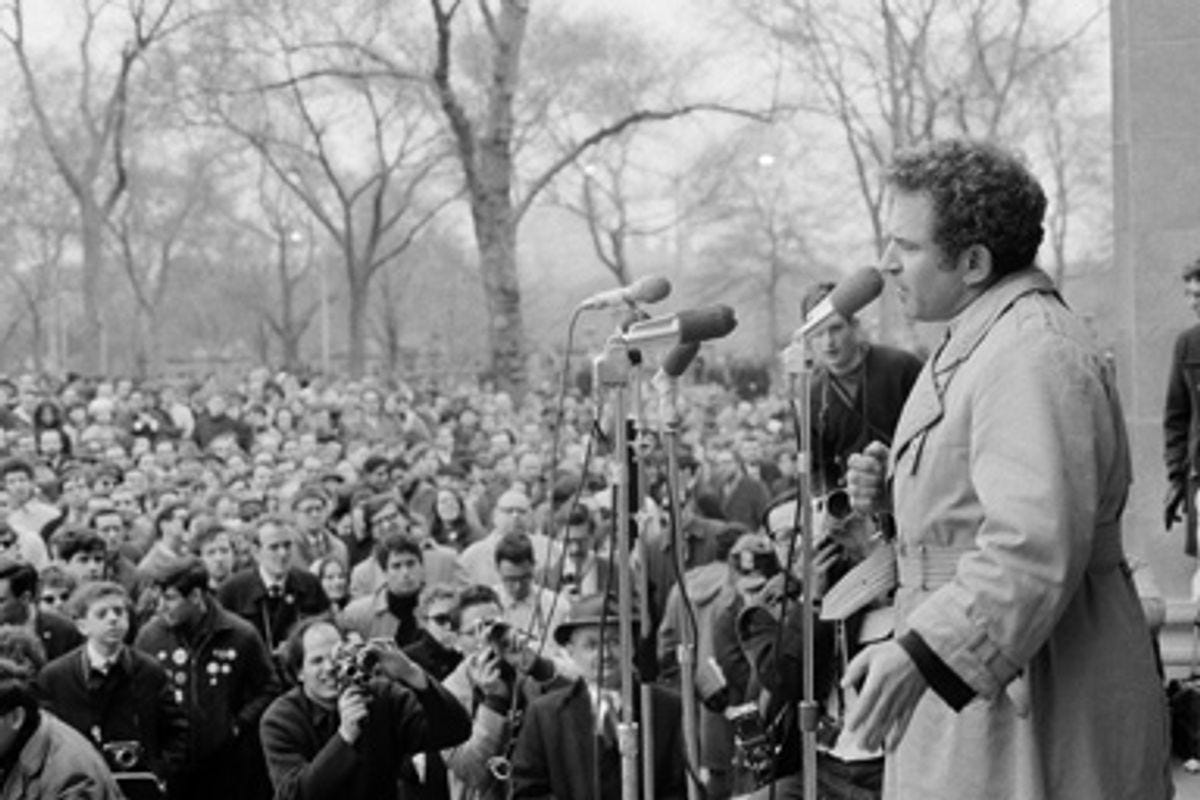
Author Norman Mailer speaks at an anti-war rally at the bandshell in New York’s Central Park, March 26, 1966.
It’s early in 1965, and President Lyndon B. Johnson faces a critical decision. Should he escalate in Vietnam? Should he say “yes” to the request from U.S. commanders for more troops? Or should he change strategy, downsize the American commitment, even withdraw completely, a decision that would help him focus on his top domestic priority, “The Great Society” he hopes to build?
We all know what happened. LBJ listened to the generals and foreign policy experts and escalated, with tragic consequences for the United States and calamitous results for the Vietnamese people on the receiving end of American firepower. Drawn deeper and deeper into Vietnam, LBJ would soon lose his way and eventually his will, refusing to run for reelection in 1968.
President Obama now stands at the edge of a similar precipice. Should he acquiesce to General Stanley A. McChrystal’s call for 40,000 to 60,000 or more U.S. troops for Afghanistan? Or should he pursue a new strategy, downsizing our commitment, even withdrawing completely, a decision that would help him focus on national healthcare, among his other top domestic priorities?
The die, I fear, is cast. In his “war of necessity,” Obama has evidently already ruled out even considering a “reduction” option, no less a withdrawal one, and will likely settle on an “escalate lite” program involving more troops (though not as many as McChrystal has urged), more American trainers for the Afghan army, and even a further escalation of the drone war over the Pakistani borderlands and new special operations actions.
By failing his first big test as commander-in-chief this way, Obama will likely ensure himself a one-term presidency, and someday be seen as a man like LBJ whose biggest dreams broke upon the shoals of an unwinnable war.
The conventional wisdom: Military escalation
To whom, we may ask, is Obama listening as he makes his decision on Afghanistan strategy and troop levels? Not the skeptics, it’s safe to assume. Not the freethinkers, not today’s equivalents of Mary McCarthy or Norman Mailer. Instead, he’s doubtless listening to the generals and admirals, or the former generals and admirals who now occupy prominent “civilian” positions at the White House and inside the beltway.
By his actions, Obama has embraced the seemingly sober conventional wisdom that senior military officers, whether on active duty or retired, have, as they say in the corridors of the Pentagon, “subject matter expertise” when it comes to strategy, war, even foreign policy.
Don’t we know better than this? Don’t we know, as Glenn Greenwald recently reminded us, that General McChrystal’s strategic review was penned by a “war-loving foreign policy community,” in which the usual suspects — “the Kagans, a Brookings representative, Anthony Cordesman, someone from Rand” — were rounded up to argue for more troops and more war?
Don’t we know, as Tom Engelhardt recently reminded us, that Obama’s “civilian” advisors include “Karl W. Eikenberry, a retired lieutenant general who is the U.S. ambassador to Afghanistan, Douglas Lute, a lieutenant general who is the president’s special advisor on Afghanistan and Pakistan (dubbed the “war czar” when he held the same position in the Bush administration), and James Jones, a retired Marine Corps general, who is national security advisor, not to speak of Secretary of Defense Robert Gates, a former director of the Central Intelligence Agency”? Are we surprised, then, that when we “turn crucial war decisions over to the military, [we] functionally turn foreign policy over to them as well”? And that they, in turn, always opt for more troops, more money and more war?
One person unsurprised by this state of affairs would have been Norman Mailer, who died in 2007. War veteran, famed author of the war novel “The Naked and the Dead” (1948) as well as the Pulitzer Prize-winning report on Vietnam-era protests, “The Armies of the Night” (1968), self-styled tough guy who didn’t dance, Mailer witnessed (and dissected) the Vietnam analog to today’s Afghan events. Back in 1965, Mailer bluntly stated that the best U.S. option was “to get out of Asia.” Period.
The unconventional wisdom: Military extrication
Can Obama find the courage and wisdom to extricate our troops from Afghanistan? Courtesy of Norman Mailer, here are three unconventional pointers that should be driving him in this direction:
1. Don’t fight a war, and clearly don’t escalate a war, in a place that means so little to Americans. In words that apply quite readily to Afghanistan today, Mailer wrote in 1965: “Vietnam [to Americans] is faceless. How many Americans have ever visited that country? Who can say which language is spoken there, or what industries might exist, or even what the country looks like? We do not care. We are not interested in the Vietnamese. If we were to fight a war with the inhabitants of the planet of Mars there would be more emotional participation by the people of America.”
2. Beware of cascading dominoes and misleading metaphors, whether in Southeast Asia or anywhere else. The domino theory held that if Vietnam, then split into north and south, was united under communism, other Asian countries, including Thailand, the Philippines, perhaps even India, would inevitably fall to communism as well, just like so many dominoes toppling. Instead, it was communism that fell or, alternately, morphed into a version that we could do business with (to paraphrase former British Prime Minister Margaret Thatcher).
We may no longer speak metaphorically of falling dominoes in today’s Af-Pak theater of operations. Nevertheless, our fears are drawn from a similarly misleading image: If Afghanistan falls to the Taliban, Pakistan will surely follow, opening a nuclear Pandora’s box to anti-American terrorists in which, in our fevered imaginations, smoking guns will once again become mushroom clouds.
Despite the fevered talk of falling dominoes in his era, Mailer was unmoved. Such rhetoric suggests, he wrote in 1965, “that we are not protecting a position of connected bastions so much as we are trying to conceal the fact that the bastions are about gone — they are not dominoes, but sand castles, and a tide of nationalism is on the way in. It is curious foreign policy to use metaphors in defense of a war; when the metaphors are imprecise, it is a swindle.”
To this I’d add that, in viewing countries and peoples as so many dominoes, which by the actions — or the inaction — of the United States are either set up or knocked down, we vastly exaggerate our own agency and emphasize our sense of self-importance. And before we even start in on the inevitable argument about “Who lost Afghanistan?” or “Who lost Pakistan?” is it too obvious to say that never for a moment did we own these countries and peoples?
3. Carrots and sticks may work together to move a stubborn horse, but not a proud people determined to find their own path. As Mailer put it, with a different twist: “Bombing a country at the same time you are offering it aid is as morally repulsive as beating up a kid in an alley and stopping to ask for a kiss.”
As our Predator and Reaper drones scan the Afghan terrain below, launching missiles to decapitate terrorists while unintentionally taking innocents with them, we console ourselves by offering aid to the Afghans to help them improve or rebuild their country. As it happens, though, when the enemy hydra loses a head, another simply grows in its place, while collateral damage only leads to a new generation of vengeance-seekers. Meanwhile, promised aid gets funneled to multinational corporations or siphoned off by corrupt government officials, leaving little for Afghan peasants, certainly not enough to win their allegiance, let alone their “hearts and minds.”
If we continue to speak with bombs while greasing palms with dollars, we’ll get nothing more than a few bangs for our $228 billion (and counting).
What if LBJ had listened to Mailer in ’65?
Not long before LBJ crossed his Rubicon and backed escalation in Vietnam, he could have decided to pull out. Said Mailer:
The image had been prepared for our departure — we heard of nothing but the corruption of the South Vietnam government and the professional cowardice of the South Vietnamese generals. We read how a Viet Cong army of 40,000 soldiers was whipping a government army of 400,000. We were told in our own newspapers how the Viet Cong armed themselves with American weapons brought to them by deserters or captured in battle with government troops; we knew it was an empty war for our side.
Substitute “the Hamid Karzai government” for “the South Vietnam government” and “Taliban” for “Viet Cong” and the same passage could almost have been written yesterday about Afghanistan. We know the Karzai government is corrupt, that it stole the vote in the last election, that the Afghan army is largely a figment of Washington’s imagination, that its troops sell their American-made weapons to the enemy. But why do our leaders once again fail to see, as Mailer saw with Vietnam, that this, too, is a recognizably “empty war for our side”?
Mailer experienced the relentless self-regard and strategic obtuseness of Washington as a mystery, but that didn’t stop him from condemning President Johnson’s decision to escalate in Vietnam. For Mailer, LBJ was revealed as “a man driven by need, a gambler who fears that once he stops, once he pulls out of the game, his heart will rupture from tension.” Johnson, like nearly all Americans, Mailer concluded, was a member of a minority group, defined not in racial or ethnic terms but in terms of “alienat[ion] from the self by a double sense of identity and so at the mercy of a self which demands action and more action to define the most rudimentary borders of identity.”
This American drive for self-definition through constant action, through headlong acceleration, even through military escalation, the novelist described, in something of a mixed metaphor, as “the swamps of a plague” in which Americans had been caught and continued to sink. He saw relief of the desperate condition coming only via “the massacre of strange people.”
To be honest, I’m not sure what to make of Mailer’s analysis here, more emotionally “Heart of Darkness” than coolly rational. But that’s precisely why I want someone Mailer-esque — pugnacious, free-swinging, and prophetical, provocative and profane — advising our president. Right now.
As Obama’s military experts wield their battlefield metrics and call for more force (to be used, of course, with ever greater precision and dexterity), I think Mailer might have replied: We think the only thing they understand is force. What if the only thing we understand is force?
Mailer, I have no doubt, would have had the courage to be seen as “weak” on defense, because he would have known that Americans had no dog in this particular fight. I think he would intuitively have recognized the wisdom of the great Chinese strategist Sun Tzu, who wrote more than 2,000 years ago in “The Art of War” that “to win one hundred victories in one hundred battles is not the acme of skill. To subdue the enemy without fighting is the acme of skill.” Our generals, by way of contrast, seem to want to fight those 100 battles with little hope of actually subduing the enemy.
What Obama needs, in other words, is fewer generals and ex-generals and more Norman Mailers — more outspoken free-thinkers who have no interest in staying inside the pentagonal box that holds Washington’s thinking tight. What Obama needs is to silence the endless cries for more troops and more war emanating from the military and foreign policy “experts” around him, so he can hear the voices of today’s Mailers, of today’s tough-minded dissenters. Were he to do so, he might yet avoid repeating LBJ’s biggest blunder — and so avoid suffering his political fate as well.
What has America learned from the colossal failure of the Iraq War? Not what it should have learned, notes historian (and retired U.S. Army colonel) Greg Daddis at War on the Rocks. Daddis recently attended a 20-year retrospective symposium on the Iraq War, where he heard two distinctive narratives. As he put it:
Most, if not all, veterans of “Iraqi Freedom” told an inward-facing story focusing on tactical and operational “lessons” largely devoid of political context. Meanwhile, Iraqi scholars and civilians shared a vastly different tale of political and social upheaval that concentrated far more on the costs of war than on the supposed benefits of U.S. interventionism.
In short, the U.S. view of the Iraq War remains insular and narcissistic. The focus is on what U.S. troops may have gotten wrong, and how the military could perform better in the future. It’s about tactical and operational lessons. In this approach, Iraq and the Iraqi people remain a backdrop to American action on the grand stage. Put differently, the Iraqis are treated much like clay for Americans to mould or discard should they refuse to behave themselves under our hands.
So the “lessons” for America focus on how to become better, more skilled, manipulators of the “clay” at hand. Issues of right and wrong aren’t addressed. The morality or legality of war isn’t questioned. And Iraqis themselves, their suffering, their plight, even their say in determining their own futures within their country, is pretty much dismissed as irrelevant. And the same is largely true when considering the Vietnam War or the Afghan War; we matter, they don’t, even when we’re fighting in their country and spreading enormous destruction in undeclared and illegal wars.
As Mike Murry, a Vietnam veteran who comments frequently at this site, has said: you can’t do a wrong thing the right way. America’s Vietnam War was wrong; the Iraq War was wrong. There was no “right” way to do these wars. Yet, far too often, U.S. military officers and veterans, joined by far too many Americans who lack military experience, want to focus on how to wage a wrong war in a better, smarter, often more ruthless, way
Indeed, the narrative at times is reduced to “We lost because we weren’t ruthless enough, or we were about to win until the U.S. military was betrayed.” I wrote about this back in 2007 after I heard Senator John McCain speak on PBS. Basically, his point was that if America lost the Iraq War (which we already had), it wouldn’t be the U.S. military’s fault. It would be the fault of anyone who questioned the war. McCain, in other words, was spouting yet another exculpatory stab-in-the-back myth.
What can we learn from the Iraq War, then? Let’s start with these basic lessons: Don’t fight a war based on governmental lies and unfounded fears. Don’t fight illegal and immoral wars. Don’t fight undeclared wars. Don’t meddle in the societies of other people where you are seen as invaders and about which you are ignorant. Don’t wage war, period, unless the domestic security of the U.S. is truly threatened.
Those seem like the right lessons to me, not lessons about how to recognize insurgencies or how to respond more quickly to asymmetries like IEDs and ambushes.
In sum, learn this lesson: Vietnam, Iraq, Afghanistan, were and are countries with rich pasts and proud peoples who were not about to submit to American invaders and agendas, no matter how well-intentioned those invaders believed or advertised themselves to be.
How do we stop the next war built on lies from being waged?
(I prepared these notes for a talk I gave on “Truth-killers: The Corporate Media and the Military-Industrial Complex,” sponsored by Massachusetts Peace Action. David Swanson also spoke.)
I served in the U.S. military for 20 years, and for the last 15 years I’ve been writing articles that are generally critical of that military and our nation’s drift into militarism and endless warfare. Here are two lessons I’ve learned:
1. I agree with I.F. Stone that all governments lie.
2. As a historian who’s read and studied military history for most of my life, I agree that the first casualty of war is truth.
Because all governments lie and because lies are especially common during war, a healthy democracy must have an outspoken and independent media that challenges and questions authority while informing the public.
But the mainstream media (MSM) in America is neither outspoken nor independent. The MSM in America serves as stenographers to the powerful. Far too often, the U.S. military/government lies and leaks, the MSM believes and repeats.
The result is clear: disastrous wars (Vietnam, Afghanistan, Iraq) from which little is ever learned, enabled by a media culture that is deeply compromised by, or openly in league with, President Dwight D. Eisenhower’s military-industrial-congressional complex (MICC).
Here’s the fundamental issue: We need a skeptical and powerful media to deter the MICC from wars, war profiteering, and folly. The MSM should, and must, serve as a check on the MICC while holding it accountable when it fails. By doing neither, it serves various “big lies,” enabling future abuses of power by the national security state. There is no accountability for failure, so failure is neither punished now nor is it curtailed in the future.
Even when the MICC fails, and since the Vietnam War it has failed frequently, it gets more money. Consider the FY2023 Pentagon budget, which sits at $858 billion, a nearly inconceivable sum and which is roughly $45 billion more than the Biden administration asked for.
The challenge, as I see it: How do we stop the next war built on lies from being waged?
Something to ponder: Could a more critical, more courageous, truly independent media have shortened or stopped the Vietnam War? Iraq? Afghanistan?
In his famous speech warning Americans about the MICC in 1961, Eisenhower (Ike) said that only an alert and knowledgeable citizenry could guard against the acquisition of power by the MICC. This may indeed be why most citizens are not kept informed or are misinformed about the U.S. military and its wars. It’s hard to act when you’re kept ignorant. You’ll also be reluctant to act when you’re told to defer to the “experts” in the MSM, most of whom are deeply compromised, often by conflicts of interest that are kept hidden from you.
Military Mendacity
Put simply, the U.S. military, in its upper ranks, lacks honor. What matters most is reputation and budgetary authority. Sharing negative news with the media is the absolute last thing the military wants to do. Surprisingly, most in the MSM are willing to look the other way, assuming they even know of military mendacity and malfeasance.
What this means, essentially, is that the MICC is unaccountable to the people–the very antithesis of democracy.
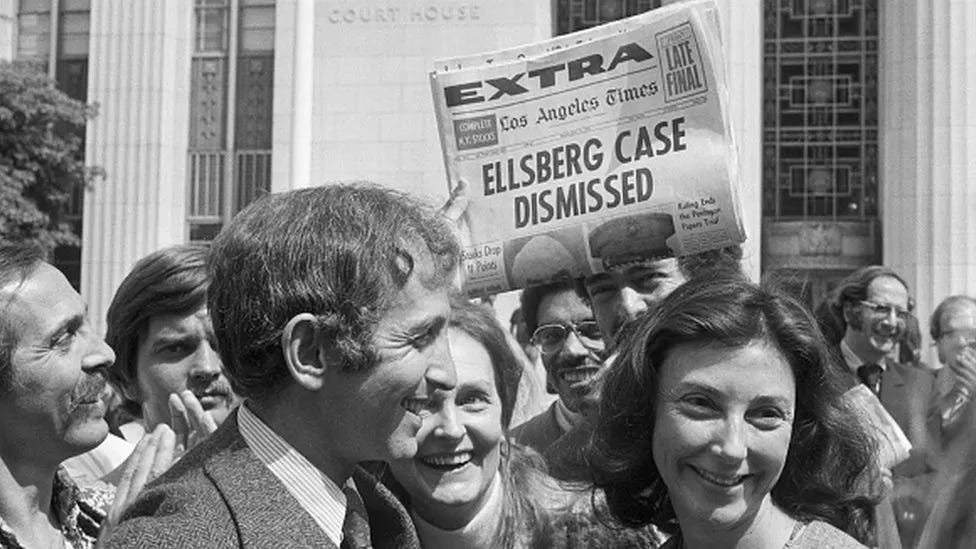
Three big examples of MICC mendacity: The Pentagon Papers revealed by Daniel Ellsberg during the Vietnam War; the Iraq War and lies about WMD (weapons of mass destruction); and the Afghan War Papers. Even as the U.S. military was losing these three wars, military commanders and government officials spoke publicly and confidently of lights at the end of tunnels, of corners being turned toward victory. (Privately, however, they talked of serious problems and lack of progress.)
With “The Pentagon Papers,” Daniel Ellsberg revealed the lies that helped fuel the Vietnam War
The MSM (with notable exceptions) largely repeated the happy-talk lies. Since 9/11, this is unsurprising, since the MSM leans heavily on senior retired military officers, CIA officials, and the like to “interpret” events in places like Iraq and Afghanistan. As journalist David Barstow showed, these “interpreters” were and are fed talking points by the Pentagon. Whatever this is, it’s not honest reporting. It’s not journalism. It’s state propaganda.
It’s not that the American people can’t handle the truth about “their” military. It’s that the MICC prefers to keep a lid on the truth, because the truth is often unfavorable to their positions, power, prestige, and profits.
There are many ways the MICC works with a complicit media (and a compliant Congress) to keep the truth from us.
1. Bad news is not reported. Or it’s classified or otherwise hushed up. Consider the My Lai Massacre in Vietnam or the “collateral murder” video from the Iraq War revealed by Chelsea Manning and Wikileaks.
2. Critical information is omitted. Coverage is edited. Consider the ban on showing flag-draped coffins by the Bush/Cheney administration, or official reports about drone strikes that omitted the true number of civilian/non-combatant casualties.
3. The military has its own PAOs (public affairs offices and officers) who feed news of “progress” and similar “good news” stories to the media. This is also true of the State Department. (See Peter Van Buren’s account, “We Meant Well,” of his Potemkin Village-like experience in Iraq.)
4. Ever-present appeals to patriotism and warnings that critical information will give aid and comfort to the enemy. Even worse, portraying critics as pro-Putin, as possible traitors, as in the NBC smear campaign against Congresswoman Tulsi Gabbard, abetted also by Hillary Clinton.
5. Run-of-the-mill propaganda. Consider, for example, how almost all U.S. sporting events include glowing coverage of the military and veterans. If all military members are “heroes,” how dare we question them! Instead, you’re encouraged to salute smartly and remain silent.
Media Complicity
Why is the MSM so hobbled and often so complicit with the MICC?
1. Intimidation. Critics are punished. Examples include Ashleigh Banfield, Phil Donahue, and Chris Hedges in the early days of the Iraq War. Think of Julian Assange today. Edward Snowden. Daniel Hale. Smart journalists know (or learn) that critics and whistleblowers are punished; cheerleaders are promoted, e.g. Brian Williams, demoted for stolen valor but redeemed for declaring his awe at “the beauty” of U.S. missiles.
2. Ratings/Economics. Recall that MSNBC fired Phil Donahue over concerns that his critical coverage of the Iraq War was turning off viewers, i.e. that the network wasn’t being seen as “patriotic” as rivals like CNN or Fox News, thereby losing market share and money.
3. Embedding Process. Reporters who want to cover war are often embedded with U.S. military units. They come to identify with “their” troops, who, after all, are protecting them from harm. The embedding process forges a sense of dependency and camaraderie that interferes with disinterested and balanced reporting.
4. Reliance on deeply conflicted experts from the MICC instead of independent journalists. Whatever else they are, retired generals and CIA directors are not reporters or journalists.
5. Corporate advertising dollars. Why air a report critical of Boeing or Northrop Grumman when that company is a major advertiser on your network? Why bite the hand that feeds you?
You don’t need a top secret “Mockingbird” project by the CIA to infiltrate and influence the MSM, as we witnessed during the Cold War and Vietnam. Today, the MSM and its owners acquiesce in their own infiltration, hiring retired CIA agents and similar senior government officials to give/sell their “unbiased” opinions.
Again, military contractors pay for ads and sponsor shows on TV. The media is not about to challenge or criticize a big revenue stream. And it’s not always a weapons maker like Boeing or Raytheon. Think of ExxonMobil. Their thirstiest customer is the U.S. military; ExxonMobil is unlikely to support media reports that criticize its biggest customer.
Meanwhile, there are precious few reporters and journalists willing to risk their careers to challenge the MICC. With so-called access journalism, if you reveal uncomfortable facts, you’ll likely lose access to the powerful, alienate your bosses, and probably lose your job.
Food for Thought: Journalists are selected and groomed for compliance to mainstream militarized agendas. They’ve learned and internalized what is acceptable and what isn’t. If they refuse to play along, they’re fired or shunted aside. (See Noam Chomsky and the manufacturing of consent.)
For the U.S. military, full-spectrum dominance includes information and the control of the same, including most especially in America.
A final shocking truth: The U.S. military lost in Vietnam, Iraq, Afghanistan, and elsewhere while avoiding responsibility. Indeed, its cultural authority and its command over the media have only grown stronger. Worse, the military promulgates, or goes along with, various stab-in-the-back myths that exculpate itself while mendaciously blaming the few good media outlets for accurate reporting about the MICC’s failings.
A crucial step in preventing future disastrous wars is a media culture that sees the MICC for what it is: a danger to democracy and liberty, as Ike warned us in 1961 in his farewell address. How we get there is a crucial issue; the failures above suggest remedies.
One remedy I wrote about in 2008: the major networks need to develop their own, independent, journalists who are experts on the military, rather than relying largely on retired military officers and other senior government officials.
We are told that America has independent media rather than state media like China or Russia. Yet, if America had official state media, would its coverage differ from today’s content? The MSM supports state and corporate agendas because that’s how it makes money even as it claims it’s “independent.”
A Couple of Anecdotes
A journalist colleague told me of his experience teaching students at one of America’s universities. His sense: most students today don’t want to be Bob Woodward and Carl Bernstein. They aspire to be on-air personalities who make six-figure salaries while being invited to all the right parties. They don’t want to afflict the comfortable while comforting the afflicted; they want to be among the most comfortable. Crusading for truth isn’t what they’re about. They seek to be insiders.
From the Robert Redford movie, “Three Days of the Condor.” If a whistleblower goes to the MSM (in the movie, it’s The New York Times), will the truth ever see the light of day? More to the point, if the American people do see it, will they even care?
What we’re witnessing in America, according to Matt Taibbi, is an “elaborate, systematized method of censorship and opinion control.” Taibbi mentions agencies like Homeland Security and Justice/FBI and their focus on “collecting domestic intelligence on a grand scale … seeking to distort the public’s perception of reality through mass moderation, via programs we’ve been told little to nothing about.”
While Taibbi, in his latest investigation, focused on social media and especially Twitter, the reality is that the MSM (and social media as well) is complicit with the government/military, collaborating on what “truths” are fed to the people while suppressing facts that are deemed dangerous, embarrassing, inconvenient, and otherwise not in the interest of the MICC.
With so many Americans now getting their news from social media sites rather than the MSM, that the government serves as a powerful content-moderator for what counts as “reliable” news on social media should disturb us all.
Again, it’s hard for Americans to serve as Ike’s “alert and knowledgeable” citizenry when they are fed lies, disinformation, and propaganda by the government and MSM.
Even more fundamentally, when corporations are elevated and protected as super-capable “citizens” and when citizens themselves are reduced to passive consumers—when corporations own the MSM while profiting greatly from war and militarism—there’s little hope of fostering freedom and of ever escaping from a state of permanent warfare.