Fat Man, the atomic bomb that devastated Nagasaki on August 9, 1945
W.J. Astore
The big story today is Trump’s threat to North Korea about “fire and fury like the world has never seen” in response to any aggression against the U.S. and its allies. The world witnessed American “fire and fury” in August of 1945 when Hiroshima and Nagasaki were obliterated by atomic bombs (indeed, today is the 72nd anniversary of the Nagasaki bombing). Roughly 250,000 people were killed in those two bombings, and Trump is apparently promising a worst form of fury against North Korea (“like the world has never seen”).
Back in October 2016, I wrote a piece at this site with the title: “On nuclear weapons, Trump is nightmarishly scary,” and that nightmare is beginning to take shape. As I wrote back then, Trump’s worst attribute is his “sweeping ignorance to the point of recklessness when it comes to matters of national defense, and specifically America’s nuclear arsenal.” I further wrote that:
Back in March … Trump boasted at a debate that the U.S. military would follow his orders irrespective of their legality. In this latest debate, he yet again revealed that he has no real knowledge of America’s nuclear capability and how modern and powerful (and scary) it truly is.
Sure, Trump is crude, lewd, and sexist, but those qualities won’t destroy the world as we know it. Ignorance about nuclear weapons, combined with impetuosity and an avowed affection for he-man wild-card generals like George S. Patton and Douglas MacArthur, is a recipe for utter disaster.
A man of Trump’s vanity and impetuosity — a man of raging grievances who lives in his own reality of alternative facts — is hardly a reassuring figure to have at the top of America’s “fire and fury” nuclear arsenal. Is it all just bluster? It’s impossible to know, and that’s truly the scary part.
All this fire and fury, even if it remains only bluster, should teach the world a critical lesson: the necessity of nuclear disarmament. Holding millions of people hostage to nuclear terror (as we’ve been doing since the Cold War) has long been immoral, inhumane, and unconscionable.
Instead of making nightmarish threats, a sober and mature U.S. president might actually lead the world in serious efforts to reduce and ultimately to eliminate nuclear weapons. That would be real moral leadership, That would be real guts.
Trump’s easy boasts of “fire and fury” do signify something vital — the need for global nuclear disarmament, no matter how long it takes.
Update (8/10/17): There’s been a lot of talk, more or less sensible, that Trump’s “fire and fury” rhetoric is just that: rhetoric. That it will not become reality because North Korean leaders are sensible and rational actors, and that U.S. leaders like Tillerson and Mattis provide a counterbalance to Trump. Well, maybe. But escalatory rhetoric can become reality, i.e. it serves to exacerbate tensions that can lead to miscalculation and war.
Think of North Korea’s latest threat to shoot missiles in the direction of Guam. If that threat is carried out, a U.S. attack on North Korean missile sites is quite likely, and where that would lead is impossible to say.
Reckless rhetoric is not harmless; words can and do box nations as well as people in, often leading to unexpected actions. Just think of hateful words flung by people in domestic disputes that escalate into something far worse. Rationality does not always win out.
Update 2 (8/10/17): Trump recently boasted that, during his short presidency, his actions have led to a U.S. nuclear arsenal that is “now far stronger and more powerful” than it was under President Obama. The truth is that this arsenal hasn’t measurably changed at all. The Washington Post gives Trump “four Pinocchios” for his latest lie, but surely big lies about nuclear weapons deserve a different rating system. Should we call it a four megaton lie? Lie-mageddon?
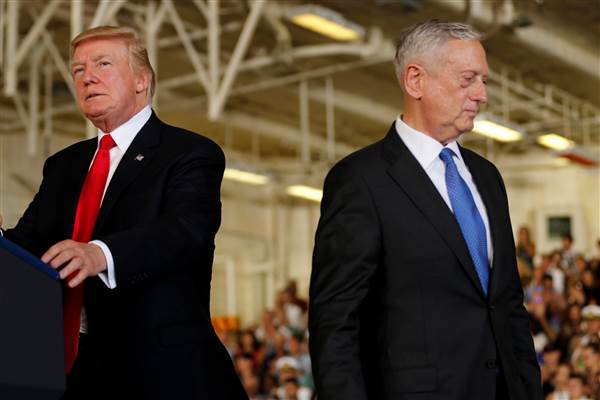
Not seeing eye-to-eye: Trump and Mattis (Jonathan Ernst / Reuters)
W.J. Astore
NBC news reports that President Trump is skeptical about the U.S. military’s prospects in Afghanistan. The military is losing, not winning, Trump said, and he further suggested the U.S. commander on the scene should be fired. Meanwhile, China is cleaning up with mineral rights (such as copper mining), even as America’s generals continue with a “stay the course” policy, a policy that’s led to sixteen years of “stalemate” (the U.S. military’s word) at a cost of roughly a trillion dollars.
I highly recommend reading the NBC article for at least two reasons. First, Trump is right to question his advisers’ stale advice. He’s right to question the generals. Indeed, that’s his job as president and commander-in-chief. If sixteen years of effort and a trillion dollars has produced “stalemate” (at best) in Afghanistan, can one blame the president for seeking a new strategy? Perhaps even a withdrawal?
Second, and most interesting, is the push-back from NBC News and its hired guns: the retired generals and admirals who work for NBC as “consultants.” Let’s look closely at their comments.
Retired Admiral James Stavridis, a former head of NATO and an NBC News analyst, basically blames the Trump administration, not the military, for the Afghan stalemate. In his words:
“The situation in Afghanistan is not improving, but I think it’s hardly irretrievable at this point, and what the president needs to be doing is deciding on the strategy.”
“What is hurting the process at the moment is this back and forth about do we stay or do we go, how many troops,” he added. “Any commander is going to be incredibly handicapped in an environment like that. So I think the fundamental problem here is lack of decisiveness in Washington, specifically in the White House.”
Now, let’s turn to retired General Barry McCaffrey. President Trump had the audacity to ask experienced combat veterans in Afghanistan (i.e., not only the generals) for advice on the war. and McCaffrey is having none of that:
“One of the last things you necessarily want to do is form policy advice based on what the current combatants think about something in a war zone,” said Gen. McCaffrey, an MSNBC military analyst. “They’re qualified totally to talk about tactics and things like that and what they’re seeing, but the president’s job is to formulate strategy and policy not to do tactical decisions.”
In short, a retired admiral and general at NBC News are taking the President to task for (1) Not being quick enough to rubber-stamp the military’s latest call for more troops in Afghanistan; (2) Daring to listen to the advice of lower-level U.S. combat veterans of the Afghan war, veterans who are rightly critical of the war.
Tell me again: Where’s that “liberal” media bias we’re always hearing about?
Trump is right to question his generals, and he’s right to seek advice from those who don’t wear stars on their shoulders. And he’s certainly right in not making a hasty decision.
Finally, to NBC News: Can’t you find military experts who aren’t retired generals and admirals? And with critical perspectives? Your article essentially supports the generals and their strategy (if that’s the right word) for endless war in Afghanistan. Is that really the best and only course for America and Afghanistan? Where’s the talk of negotiation? Withdrawal? An end to America’s seemingly endless commitment to Afghanistan?
Trump is more skeptical of the Afghan war than NBC News and its team of “starry” experts. Advantage, Trump.
Why did Donald Trump win the presidency? A big reason is that he was willing to take unpopular stances. He criticized the Afghan and Iraq wars in the strongest terms. He attacked Wall Street. He called for closer relations with Russia. Of course, to cite one example, when he became president, Trump willingly embraced Wall Street — no surprise here. Trump is not about consistency. The larger point is that he appeared authentic, or at the very least not tied to traditional politics of the mealymouthed, which involves focus groups and think tanks and polls and triangulation before any policy position is taken.
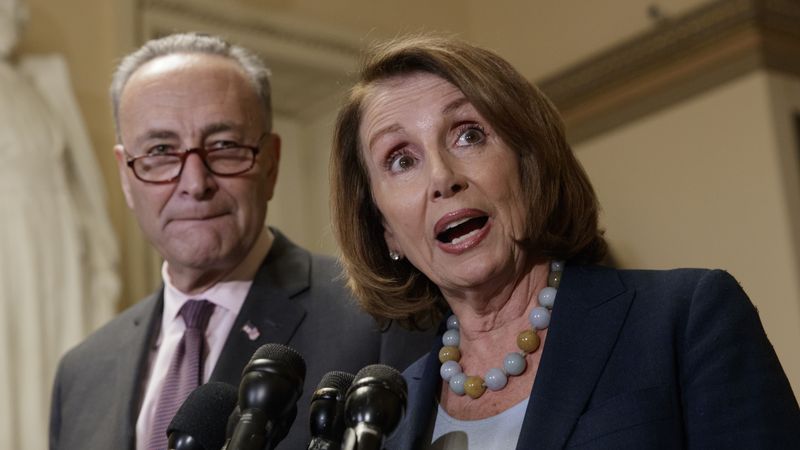
The Democratic Party has learned nothing from Trump’s success, nor for that matter from Bernie Sanders’s rise. It’s rejecting the energy and popularity of Sanders’s progressive platform for the tired bromides of economic competitiveness, moderate tax increases on the rich, and infrastructure improvements (which Trump has also called for). It’s refusing to critique America’s enervating and endless overseas wars. It’s even refusing to focus on serious social issues (too divisive!), as reported here at Mic Network:
The new [Democratic] agenda will be released under the title, “A Better Deal: Better Skills, Better Jobs, Better Wages.”
According to the Washington Post’s Dana Milbank, the plan “jettisoned social and foreign policy issues for this exercise, eschewing the identity politics and box-checking that has plagued Democratic campaigns in the past.”
Leaving social justice issues out of the platform is sure to anger many progressives in the party who have been pushing for issues like police brutality, systemic racism and transgender rights to be front-and-center on the Democratic agenda.
Likewise, the absence of any foreign policy agenda is likely to irk the left’s many critics of America’s never-ending wars.
What’s the point of voting for a Democratic Party that refuses to address such vitally important issues? And don’t you just love the unimaginative title of the plan?
A Better Deal: Better Skills, Better Jobs, Better Wages.
If you have to repeat the word “better” four times, I’m less than convinced that the deal is actually “better.” It sounds like a used car salesman trying to sell a lemon. I’ll give you a better deal on this beat-up Yugo! At a better price, with a better warranty, with better loan payments! Sure … right.
I think I can come up with five “better” titles for the Democrats just off the top of my head. I’ll give it a whirl:
No Guts, No Glory: A Bold New Plan for Our Country
America the Bountiful: Tapping Our Greatness — and Goodness
Better Angels: Reviving America’s Nobility
Comrade! March with Me to the Towers and Pitchfork the Rich!
OK. Maybe not number 5. I’m not saying my titles are great — just that they hold some promise of raising ourselves to a higher level. We should be thinking about making a better America, not for skills or jobs or the economy, but for our children. For our and their collective futures. A little idealism, please! The fierce urgency of now!
Where’s the emotional appeal in “better” skills or a “better” job? It’s funny: I don’t recall the Founders talking about skills and jobs. They talked about personal liberty, about freedom, about coming together and raising new hopes. And they didn’t just talk — they acted. Give me liberty or give me death. Now that took guts!
I see no inspiration — and no guts — in the current Democratic Party establishment. And until the party finds some, they will continue to lose.
A concept that you learn quickly in the military is that you can delegate authority but not responsibility. The buck stops with the guy or gal in charge, and when it’s policy at the national level, that guy is the commander-in-chief, currently Donald Trump. Yet when it comes to the Afghan war, it appears Trump may be seeking to evade responsibility even as he delegates the specifics of strategy and troop levels to his “civilian” Secretary of Defense, retired General James Mattis.
That’s the news out of Washington: that Trump has delegated to Mattis the decision as to how many additional U.S. troops should be sent to Afghanistan, and what strategy they should employ in a war that Mattis admits the U.S. military is “not winning.”
Think about that. After nearly 16 years and a trillion dollars spent, the U.S. is “not winning” in Afghanistan, which is, to put it honestly, an admission of defeat. “Not winning” means we’re losing, yet how likely is it that the U.S. military, effectively under the command of retired General Mattis, is going to shift gears completely and withdraw?
Mattis testified to Congress that the Taliban “had a good year last year” and that “winning,” which we’re currently not doing, is a scenario in which U.S. forces, working with Afghan forces, are able to provide local security after several years of “frequent skirmishing” with the Taliban and other insurgent forces.
Yes — that’s the definition of “winning.” A long-term U.S. commitment of more troops and more money with continued internecine warfare in Afghanistan.
In the near-term, Mattis will likely send more troops (“trainers” and “advisers”) and more money, promising that this time American training and methods will work, that this time corruption will be curtailed, that this time the Taliban will be neutralized (I doubt Mattis is foolish enough to promise “victory”). Trump will rubber-stamp Mattis’s decision, which gives him the ability to blame his generals if and when the Afghan war takes yet another turn that is contrary to U.S. imperatives. (Recall how Trump blamed his generals for losing the Navy SEAL in the bungled raid on Yemen.)
As a candidate, Trump deplored the waste of America’s wars and suggested he would try to end them. As president, Trump is kowtowing to the Pentagon, ensuring these wars will continue. Worst of all, even as he delegates authority, he is evading responsibility.
It’s a recipe for incessant warfare, yet more suffering, and the continued erosion of democracy in America.
An Afterthought: Let’s suppose for a moment that Trump actually wanted to end the Afghan war. It would require considerable political capital to take on the national security state — capital that Trump currently doesn’t have, embroiled as he is in controversy (lawsuits!) and ongoing investigations. This is hardly ever remarked upon in the media: the fact that Trump, who ran on a platform that was often quite critical of conventional wisdom and wasteful wars, has little latitude to act on this platform (assuming he’d want to) when he’s constantly under attack in the media as a Putin stooge, or worse. Some would say he has only himself to blame here, but it goes deeper than that, I think.
Update (6/16/17): Surprise! News out of the Pentagon today suggests that another 4000 or so U.S. troops will be sent as a mini-surge to help train and advise Afghan forces. And so the “stalemate” in Afghanistan will continue.
As I wrote back in February for TomDispatch.com:
That a few thousand troops could somehow reverse the present situation and ensure progress toward victory is obviously a fantasy of the first order, one that barely papers over the reality of these last years: that Washington has been losing the war in Afghanistan and will continue to do so, no matter how it fiddles with troop levels.
Update 2 (6/16/17): Editorial title at the New York Times: Afghanistan Is Trump’s War Now. It reflects a major flaw and a fatal conceit — that Afghanistan is a war and not a country or a people, that it only matters as a war (at least to Americans), and that somehow Trump now owns it. Recall that before Americans wage war, it’s supposed to require a Congressional declaration. Wars are not supposed to be owned by presidents and waged at their whim. WTF, America?
Update 3 (6/17/17): Watching retired General David Petraeus last night on PBS was a grim experience. He spoke of a generational war in Afghanistan and a U.S. commitment that might come to rival our time in South Korea, i.e. 60+ years. Most revealing of all was the language he used. He spoke of achieving “a sustainable, sustained commitment” to Afghanistan. 4000 additional troops are part of that “sustainable, sustained commitment.”
There was the usual talk of regional stability, of maintaining a base against terrorism, and so on. But what the Petraeus interview revealed was the total bankruptcy of American strategy and thinking, encapsulated so well by the concept of a “generational war” modulated by a “sustainable, sustained commitment.”
Update 4 (6/17/17): Good god. At Fox News, retired General Jack Keane is calling for an additional 10,000 to 20,000 troops to change the momentum in the Afghan war. These troops will somehow change the “absolute disgrace” of the war (he mainly blamed President Obama for refusing to make the necessary commitment to win the war).
These generals never ask the question: Why are our “enemies” doing just fine without U.S. troops and billions of dollars in heavy equipment and air power? Whether in Vietnam or Afghanistan or elsewhere, the answer for these generals is always more: more U.S. troops, more firepower, more aid to our “allies.”
If these generals were investors, they’d keep funneling money to Bernie Madoff even after his fund had been revealed as a Ponzi scheme. After all, the initial returns were promising, and if we keep sending more money, this time, maybe this time, it won’t all be stolen …
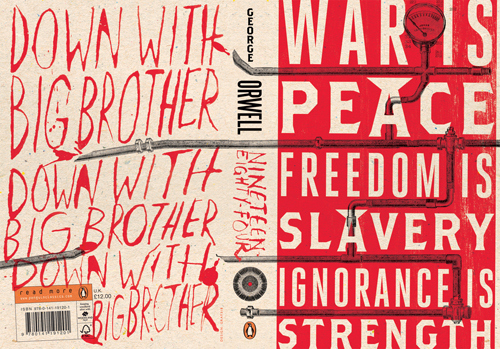
George Orwell’s 1984 is filled with wisdom. Perhaps my favorite saying from that book is Orwell’s statement about history and its importance. He said, he who controls the past controls the future. He who controls the present controls the past.
If you have the power, in the present, to rewrite history, to redefine the past, enshrining your version of history as fact while consigning all the bits you don’t like to oblivion (“down the memory hole”), you can define people’s sense of reality as well as what they believe is possible. You can limit what they see, their horizons. You can limit how and what they think. You can, in a major way, control the future. Add the control of language to the restriction and re-definition of history and you have a powerful means to dominate meaning, discourse, and politics in society.
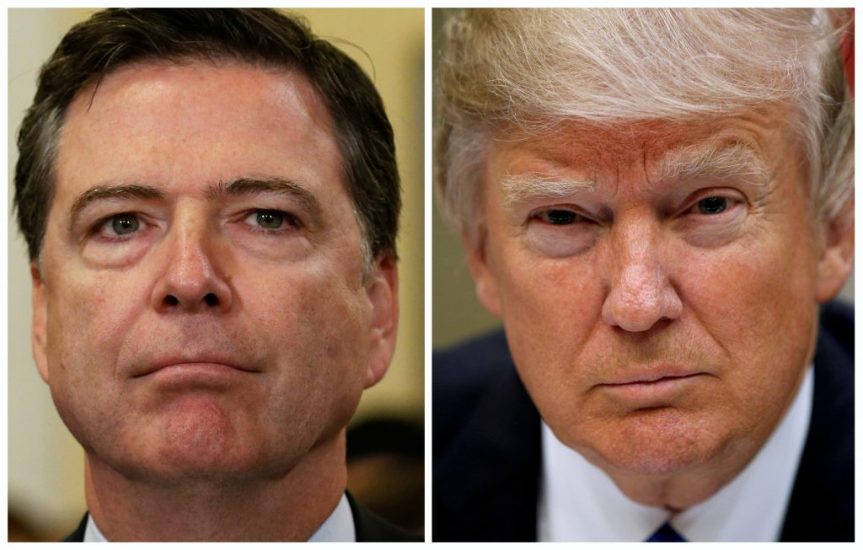
Donald Trump and Company are brazen in their rewriting of history, notes Rebecca Gordon in her latest post at TomDispatch.com. They make no apologies and take no prisoners. They simply claim lies to be true, repeating them over and over until some people come to accept them as truth. The examples she cites include the size of Trump’s inauguration crowd (“Bigly!”), the reality of global warming (“Chinese lie!”), and why Trump fired FBI Director James Comey (“He hurt Hillary!”).
Another example of the big lie is the whole concept of “Trumpcare,” the recent revision to Obamacare as passed by the House. They sell this as a health care plan instead of what it really is: a health coverage denial plan and tax cut for the rich.
The GOP health care bill would insure 23 million fewer people than current law after a decade, while potentially impacting many with pre-existing conditions, according to the nonpartisan Congressional Budget Office.
The bill would spend $1.1 trillion less on health care and use the savings primarily to finance large tax cuts for high-income earners and medical companies. Overall, it would reduce deficits by $119 billion over ten years.
I know one thing: that’s not a health care plan.
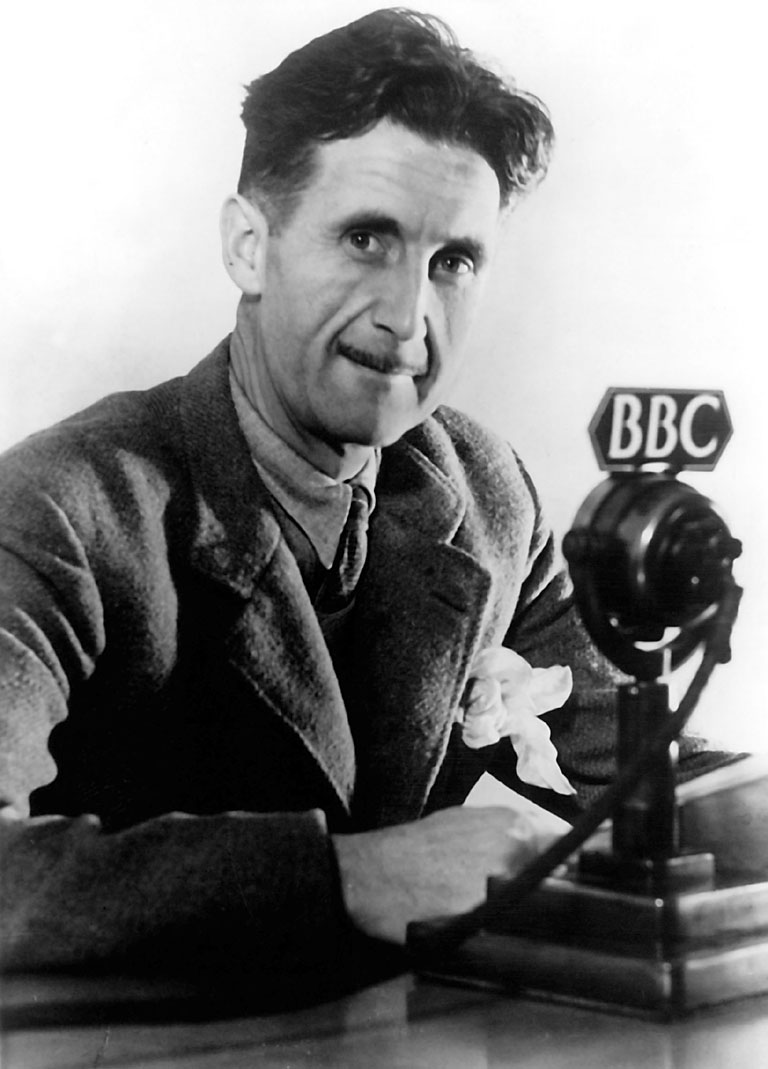
George Orwell
Returning to language, a big theme of Orwell’s 1984 is how language will be simplified, or dumbed down, stripping away meaning and subtlety and substituting unreflective obedience and coarseness in their place. Think here about how Donald Trump speaks. Orwellian expressions like “doubleplusgood” are not foreign to a man who speaks in glittering generalities to sell his ideas and hyperbolic superlatives to extol his own virtues.
In his introduction today to Rebecca Gordon’s article, Tom Engelhardt quotes Trump’s recent graduation speech at the Coast Guard Academy, during which Trump did what he does best — sell himself with lies (“alternative facts!”):
I’ve accomplished a tremendous amount in a very short time as president. Jobs pouring back into our country… We’ve saved the Second Amendment, expanded service for our veterans… I’ve loosened up the strangling environmental chains wrapped around our country and our economy, chains so tight that you couldn’t do anything — that jobs were going down… We’ve begun plans and preparations for the border wall, which is going along very, very well. We’re working on major tax cuts for all… And we’re also getting closer and closer, day by day, to great healthcare for our citizens.
One thing Trump does know is how to manipulate language — in short, to lie — to his own benefit.
In this age of Trump, a sense of history has rarely been more important. We have to fight for the richness, the complexity, as well as the accuracy of our history and our language. The very existence of the American republic depends on it.
Another day, another Trump scandal, this one stemming from a memo written by the former FBI director, James Comey, in the aftermath of a private conversation he had with the President. According to the Comey memo, the president urged him to drop the FBI’s investigation into Michael Flynn’s ties to Russia, using these words: “I hope you can see your way clear to letting this go, to letting Flynn go. He is a good guy. I hope you can let this go.”
Obstruction of justice? Impeachable offense? That’s debatable. But the alleged conversation obviously takes on heightened meaning after Trump fired Comey, in part because of frustration with the FBI’s investigation into alleged collusion between the Trump campaign and Russia during the election.
It’s unclear if any crimes were committed here. What is clear is that Trump is a poor manager of himself as well as his staff. Flynn, with his dodgy record, should never have been hired. Furthermore, the president should not have gone out on a limb to defend him, cajoling the FBI director, in so many words, to go easy on my guy.
Perhaps Trump’s biggest flaw is his combination of boastfulness, lack of judgment, and his ego-driven need to take charge. He reminds me of an Air Force saying: “He’s all Mach and no compass heading.” He’ll break the sound barrier while moving in the opposite direction to sound governance.
I wrote back in March of 2016 that candidate Trump had disqualified himself from the presidency by boasting about how America’s generals would follow his orders irrespective of their legality. My main point was that Trump had no understanding of his Constitutional responsibilities, nor did he seem to care much about learning them. If Comey’s memo is accurate, I think it’s another instance of Trump either not knowing or not caring about propriety, about the rule of law.
Trump’s experience in life is as a CEO of a family business. Everyone has always worked for him; in essence, he’s been King Trump. Even though he’s now president, he still acts like a king, making up his own rules as he goes along, not knowing a rule book already exists.
Will Trump survive his first term? As Yoda might say, Difficult to see — always in motion the future. One thing is certain: Trump continues to consume all the oxygen in Washington, extinguishing any hope of real progress or effective governance at the federal level.
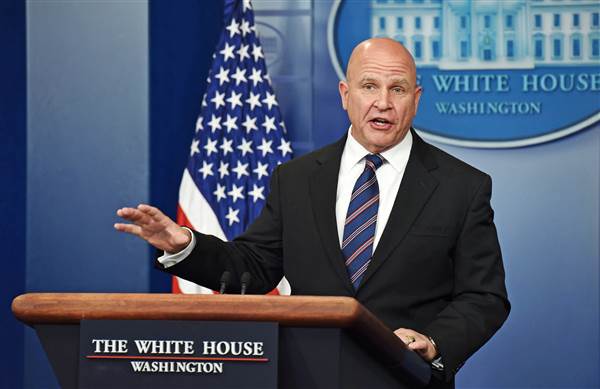
U.S. media outlets have been consumed by the story today that President Trump improperly or unwisely shared classified material on ISIS with the Russians, material that apparently came from Israel. For its part, the Trump administration denies the charge that information was improperly or unwisely shared.
Today, National Security Adviser H.R. McMaster defends Trump’s decision to share classified information with the Russians
A couple of comments. First, the president has broad powers of declassification and the discretion to share sensitive secrets with others. Sharing classified information with the Russians, an ally of a sort in the struggle against ISIS, is not necessarily a bad idea. Trump seems to have decided it was a way to strengthen relations and build trust at high levels with the Russian government, a defensible position, in my view.
Second, I’ll repeat here what I said about classification and the Hillary Clinton email scandal: Far too much information is classified by the U.S. government. Classification is vastly overused by our government to conceal many sins, blunders, nefarious designs, and who knows what else. There’s nothing sacred about secrecy; indeed, a democracy should prefer transparency, rather than stamping everything “secret” or “top secret” and thereby keeping nearly all Americans in the dark.
Obviously, I’m not privy to the exact nature of the intelligence shared, the sensitivity and vulnerability of the source(s) and collection methods, and so on. I’m not an intelligence trade-craft expert. So far, Israeli operatives seem unconcerned, but whether their blase attitude is feigned or not is unknown.
Americans elected Trump because he promised to do things differently. He campaigned on the idea of being unorthodox; indeed, he is unorthodox. Surely no one should be surprised when he decides to speak in the clear to Russian government officials on matters concerning ISIS and terrorism.
Repeat after me, America: Secrecy is not sacred. Transparency is desirable. So too is building trust with rivals as well as friends. Trump has his faults, major ones I believe, but this current controversy is a tempest in a teapot.
Today, I saw another article on why America is losing its wars in places like Iraq, Afghanistan, and elsewhere. The gist of this and similar articles is that America’s wars are winnable. That is, if we bomb more, or send more troops, or change our strategy, or alter our ROE (rules of engagement), or give more latitude to the generals, or use all the weapons at our disposal (to include nukes?), and so on, these wars will prove tractable and even winnable. This jibes with President Trump’s promises about America winning again, everywhere, especially in wars.
Sorry: The Missions Are Never Going to be “Accomplished”
Nonsense. The U.S. military hasn’t won these wars since the wars themselves are unwinnable by U.S. military action. Indeed, U.S. military action only makes them worse.
Consider Iraq. Our invasion in 2003 and our toppling of Saddam kicked off a regional, religious, ethnic, and otherwise complicated civil war that is simply unwinnable by American troops. Indeed, the presence of (and blunders made by) American troops in Iraq helped to produce ISIS, much-hyped as the current bane of American existence.
Consider Afghanistan. Our invasion in 2001 toppled the Taliban, at least for a moment, but did not produce peace as various Afghan factions and tribes jostled for power. Over time, the U.S. and NATO presence in the country produced instability rather than stability even as the Taliban proved both resilient and resurgent. U.S. and NATO forces have simply become yet another faction in the Afghan power game, but unless we want to stay there permanently, we are not going to “win” by any reasonable definition of that word.
You could say the same of the U.S. military’s involvement in similar conflicts like Yemen or Syria (look at the mess we made of Libya). We can kill a lot of “terrorists” and drop a lot of bombs, spreading our share of chaos, but we aren’t going to win, not in the sense of these wars ending on terms that enhance U.S. national security.
This hard reality is one that the U.S. military explains away by using jargon. Military men talk of generational wars, of long wars, of fourth generation warfare, of gray zones, of military operations other than war (which has its own acronym, MOOTW), and so on. A friend of mine, an Air Force captain, once quipped: “You study long, you study wrong.” You can say something similar of war: “You wage war for long, you wage it wrong.” This is especially true for a democracy.
America’s wars today are unwinnable. They are unwinnable not only because they are not ours to win: they aren’t even ours. We refuse to take ownership of them. At the most fundamental level, we recognize they are not vital to us, since we don’t bother to unify as a country to declare war and to wage it. Most Americans ignore them because we can ignore them. The Afghans, the Iraqis, the Syrians, and so on don’t have the luxury of ignoring them.
Trump, with all his talk of winning, isn’t going to change this. The more he expands the U.S. military, the more he leans on “his” generals for advice, the more he’s going to fail. Our new commander-in-chief needs to learn one lesson: The only way to win America’s wars is to end them.
Seven years ago, I wrote an article for TomDispatch.com on American kleptocracy. At the time, it seemed a bit of a stretch. Sure, America was (and is) plutocratic. But kleptocratic? Like a third-world dictatorship in which family members of the ruler enrich themselves while being appointed to government offices for which they’re eminently unqualified? Surely not! But here we are, in 2017, with Trump as president and his son-in-law Jared Kushner seemingly running everything and with daughter Ivanka the “First Daughter” and pseudo-First Lady. I didn’t see that one coming.
Jared and Ivanka: Good at looking good
Anyway, here’s my original article, unedited, from 2010.
American Kleptocracy
How Fears of Socialism and Fascism Hide Naked Theft
By William J. Astore
Kleptocracy — now, there’s a word I was taught to associate with corrupt and exploitative governments that steal ruthlessly and relentlessly from the people. It’s a word, in fact, that’s usually applied to flawed or failed governments in Africa, Latin America, or the nether regions of Asia. Such governments are typically led by autocratic strong men who shower themselves and their cronies with all the fruits of extracted wealth, whether stolen from the people or squeezed from their country’s natural resources. It’s not a word you’re likely to see associated with a mature republic like the United States led by disinterested public servants and regulated by more-or-less transparent principles and processes.
In fact, when Americans today wish to critique or condemn their government, the typical epithets used are “socialism” or “fascism.” When my conservative friends are upset, they send me emails with links to material about “ObamaCare” and the like. These generally warn of a future socialist takeover of the private realm by an intrusive, power-hungry government. When my progressive friends are upset, they send me emails with links pointing to an incipient fascist takeover of our public and private realms, led by that same intrusive, power-hungry government (and, I admit it, I’m hardly innocent when it comes to such “what if” scenarios).
What if, however, instead of looking at where our government might be headed, we took a closer look at where we are — at the power-brokers who run or influence our government, at those who are profiting and prospering from it? These are, after all, the “winners” in our American world in terms of the power they wield and the wealth they acquire. And shouldn’t we be looking as well at those Americans who are losing — their jobs, their money, their homes, their healthcare, their access to a better way of life — and asking why?
If we were to take an honest look at America’s blasted landscape of “losers” and the far shinier, spiffier world of “winners,” we’d have to admit that it wasn’t signs of onrushing socialism or fascism that stood out, but of staggeringly self-aggrandizing greed and theft right in the here and now. We’d notice our public coffers being emptied to benefit major corporations and financial institutions working in close alliance with, and passing on remarkable sums of money to, the representatives of “the people.” We’d see, in a word, kleptocracy on a scale to dazzle. We would suddenly see an almost magical disappearing act being performed, largely without comment, right before our eyes.
Of Red Herrings and Missing Pallets of Money
Think of socialism and fascism as the red herrings of this moment or, if you’re an old time movie fan, as Hitchcockian MacGuffins — in other words, riveting distractions. Conservatives and tea partiers fear invasive government regulation and excessive taxation, while railing against government takeovers — even as corporate lobbyists write our public healthcare bills to favor private interests. Similarly, progressives rail against an emergent proto-fascist corps of private guns-for-hire, warrantless wiretapping, and the potential government-approved assassination of U.S. citizens, all sanctioned by a perpetual, and apparently open-ended, state of war.
Yet, if this is socialism, why are private health insurers the government’s go-to guys for healthcare coverage? If this is fascism, why haven’t the secret police rounded up tea partiers and progressive critics as well and sent them to the lager or the gulag?
Consider this: America is not now, nor has it often been, a hotbed of political radicalism. We have no substantial socialist or workers’ party. (Unless you’re deluded, please don’t count the corporate-friendly “Democrat” party here.) We have no substantial fascist party. (Unless you’re deluded, please don’t count the cartoonish “tea partiers” here; these predominantly white, graying, and fairly affluent Americans seem most worried that the jackbooted thugs will be coming for them.)
What drives America today is, in fact, business — just as was true in the days of Calvin Coolidge. But it’s not the fair-minded “free enterprise” system touted in those freshly revised Texas guidelines for American history textbooks; rather, it’s a rigged system of crony capitalism that increasingly ends in what, if we were looking at some other country, we would recognize as an unabashed kleptocracy.
Recall, if you care to, those pallets stacked with hundreds of millions of dollars that the Bush administration sent to Iraq and which, Houdini-like, simply disappeared. Think of the ever-rising cost of our wars in Iraq and Afghanistan, now in excess of a trillion dollars, and just whose pockets are full, thanks to them.
If you want to know the true state of our government and where it’s heading, follow the money (if you can) and remain vigilant: our kleptocratic Houdinis are hard at work, seeking to make yet more money vanish from your pockets — and reappear in theirs.
From Each According to His Gullibility — To Each According to His Greed
Never has the old adage my father used to repeat to me — “the rich get richer and the poor poorer” — seemed fresher or truer. If you want confirmation of just where we are today, for instance, consider this passage from a recent piece by Tony Judt:
In 2005, 21.2 percent of U.S. national income accrued to just 1 percent of earners. Contrast 1968, when the CEO of General Motors took home, in pay and benefits, about sixty-six times the amount paid to a typical GM worker. Today the CEO of Wal-Mart earns nine hundred times the wages of his average employee. Indeed, the wealth of the Wal-Mart founder’s family in 2005 was estimated at about the same ($90 billion) as that of the bottom 40 percent of the U.S. population: 120 million people.
Wealth concentration is only one aspect of our increasingly kleptocratic system. War profiteering by corporations (however well disguised as heartfelt support for our heroic warfighters) is another. Meanwhile, retired senior military officers typically line up to cash in on the kleptocratic equivalent of welfare, peddling their “expertise” in return for impressive corporate and Pentagon payouts that supplement their six-figure pensions. Even that putative champion of the Carhartt-wearing common folk, Sarah Palin, pocketed a cool $12 million last year without putting the slightest dent in her populist bona fides.
Based on such stories, now legion, perhaps we should rewrite George Orwell’s famous tagline from Animal Farm as: All animals are equal, but a few are so much more equal than others.
And who are those “more equal” citizens? Certainly, major corporations, which now enjoy a kind of political citizenship and the largesse of a federal government eager to rescue them from their financial mistakes, especially when they’re judged “too big to fail.” In raiding the U.S. Treasury, big banks and investment firms, shamelessly ready to jack up executive pay and bonuses even after accepting billions in taxpayer-funded bailouts, arguably outgun militarized multinationals in the conquest of the public realm and the extraction of our wealth for their benefit.
Such kleptocratic outfits are, of course, abetted by thousands of lobbyists and by politicians who thrive off corporate campaign contributions. Indeed, many of our more prominent public servants have proved expert at spinning through the revolving door into the private sector. Even ex-politicians who prefer to be seen as sympathetic to the little guy like former House Majority Leader Dick Gephardt eagerly cash in.
I’m Shocked, Shocked, to Find Profiteering Going on Here
An old Roman maxim enjoins us to “let justice be done, though the heavens fall.” Within our kleptocracy, the prevailing attitude is an insouciant “We’ll get ours, though the heavens fall.” This mindset marks the decline of our polity. A spirit of shared sacrifice, dismissed as hopelessly naïve, has been replaced by a form of tribalized privatization in which insiders find ways to profit no matter what.
Is it any surprise then that, in seeking to export our form of government to Iraq and Afghanistan, we’ve produced not two model democracies, but two emerging kleptocracies, fueled respectively by oil and opium?
When we confront corruption in Iraq or Afghanistan, are we not like the police chief in the classic movie Casablanca who is shocked, shocked to find gambling going on at Rick’s Café, even as he accepts his winnings?
Why then do we bother to feign shock when Iraqi and Afghan elites, a tiny minority, seek to enrich themselves at the expense of the majority?
Shouldn’t we be flattered? Imitation, after all, is the sincerest form of flattery. Isn’t it?
Throwing money at the Pentagon is never a good idea
W.J. Astore
Anyone who’s been in the military knows what happens as the end of a fiscal year approaches: wild spending. Any money that’s left in your budget must be spent, if only to justify next year’s budgetary appropriation. Woe to any unit with leftover money! Not only is there no incentive to economize at the Pentagon: there’s a negative incentive to save money, and a positive one to spend as much as possible within your yearly allotment, while complaining to anyone within earshot that you never have enough.
Trump has already promised to enlarge Pentagon funding by 10% next year, or roughly $54 billion. According to Mick Mulvaney, director of the Office of Management and Budget, Trump’s budget is all about “hard-power,” a signal to “our allies and our potential adversaries that this is a strong-power administration.” At $54 billion, that is indeed a very expensive signal.
Forget about the global fight against ISIS: The big focus at the Pentagon is now going to be on spending that windfall of taxpayers’ dollars. And, unlike the ISIS fight, which is expected to last for at least another generation, the “fight” to spend lots of money quickly is one that the Pentagon will surely win. Believe me, the military-industrial-Congressional complex knows how to spend.
Want to make the Pentagon a better, more effective, place? Cut its budget by 10%. And keep cutting, year by year, while downsizing its mission. Force it to economize – force it to think.
Let me give you a few examples. How does the stealthy, super-expensive, F-35 jet fighter contribute to the war on terror? It doesn’t. Does the U.S. Navy really need more super-expensive aircraft carriers? No, it doesn’t. Do U.S. nuclear forces really need to be modernized and expanded at a cost of nearly a trillion dollars over the next few decades? No, they don’t. More F-35s, more carriers, and more nukes are not going “to make America great again.” What they will do is consume enormous amounts of money for little real gain.
Throwing cash at the Pentagon is not the way to greater security: it’s a guarantee of frivolous military wish lists and “more of the same, only more” thinking. In case you haven’t noticed, the Pentagon’s record since 9/11/2001 is more than a little mixed; some would say it’s been piss-poor. Why is this? One thing is certain: shortage of money hasn’t been the problem.
Want to send a signal about “hard-power,” President Trump? Go hard on the Pentagon by cutting its budget. Spend the savings on alternative energy development and similar investments in American infrastructure. That’s the best way to put America first.