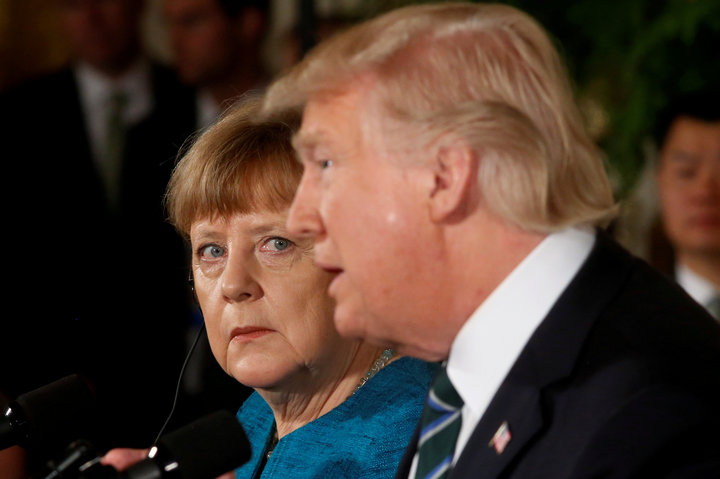
Yesterday’s Trump-Merkel Press Conference was disturbing on several levels. Worst of all was the scene of a German Chancellor listening to an American president boast about how strong his military is, and how much stronger it soon will be. Not that long ago in historical terms, Germany was a country that stressed military dominance. Two lost world wars cured Germany of its militarism. American militarism has taken its place.
As Trump responded to questions, again and again he returned to the U.S. military, vowing that he’s going to strengthen it from its “depleted” condition, perhaps to a level of power that “we’ve never seen before.”
America as a country is “very strong, very strong,” said Trump, a “very powerful company/country,” and soon the U.S. military would be “stronger,” and “perhaps far stronger than ever before.” Naturally, the president added that he hoped he wouldn’t have to use that “far stronger” military, even as the U.S. military garrisons the globe at more than 700 bases while launching ongoing attacks against “radical Islamic terrorism” (Trump loves enunciating those three words) in places like Yemen.
She’s right to be worried …
This coming year, Trump is enlarging the military with a fresh influx of $54 billion. “My generals,” as Trump likes to refer to James Mattis and John Kelly and Company, support him in part because he’s boosting military spending. But will they continue to support Trump and his advisers like Steve Bannon when the President uses that “much stronger” military in unwise ways?
When you forge a bigger hammer, you tend not to leave it unused in the tool shed. No — you look for bigger nails to strike. As Trump noted at the press conference, he’s not an isolationist. “Fake news,” he said.
That Trump, with his “far stronger” military, is not an isolationist is disturbing “real” news indeed. Small wonder that the German Chancellor looked discomfited; her country has seen it all before.
What price military dominance? Perhaps Chancellor Merkel could explain that to President Trump, if only he’d listen.
Is Donald Trump going to be yet another American war president? Come to think of it, is there any other kind?
This is no accident. Tom Engelhardt has an insightful article at TomDispatch today about how Trump the blowhard is a product of blowback from America’s failed wars, notably Iraq. There’s much truth in this insight, since it’s hard to imagine demagogue Trump’s rise to power in a pacific climate. Trump arose in a climate of fear: fear of the Other, especially of the terrorist variety, but also of any group that can be marginalized and vilified. Think of Mexicans and the infamous Wall, for example.
In a separate post, Engelhardt noted the recent death of Marilyn Young, an historian who found herself specializing in America’s wars, notably Vietnam. He cited a New York Timesobituary on Young that highlighted her attentiveness to America’s wars and their continuity.
Since her childhood, Young noted, America had been at war: “the wars were not really limited and were never cold and in many places have not ended — in Latin America, in Africa, in East, South and Southeast Asia.”
She confessed that:
“I find that I have spent most of my life as a teacher and scholar thinking and writing about war. I moved from war to war, from the War of 1898 and U.S. participation in the Boxer Expedition and the Chinese civil war, to the Vietnam War, back to the Korean War, then further back to World War II and forward to the wars of the 20th and early 21st centuries.”
“Initially, I wrote about all these as if war and peace were discrete: prewar, war, peace or postwar,” she said. “Over time, this progression of wars has looked to me less like a progression than a continuation: as if between one war and the next, the country was on hold.”
As George Orwell wrote in 1984, all that matters is for a state of war to exist (whether declared or, nowadays in the USA, undeclared). A war mentality is the driver for autocratic excesses of all sorts. It serves to focus the attention of people to various perceived enemies, whether from without or from within. It promotes simplified thinking and generates fear, and fear is the mind-killer. “Us and Them,” as Pink Floyd sang.
Aggravating simplistic and hateful “us and them” thinking in the USA is the lack of a major political party dedicated to peace. In the USA, we have two war parties. Trump knew this and readily exploited (and continues to exploit) it. He knows the modern Democratic Party won’t seriously challenge the war rhetoric that drove and drives America’s new militarized reality.
Why? Because the Democrats nurtured it. Recall that in 2004 John Kerry “reported for duty” by saluting the Democratic National Convention. Barack Obama in 2008 quickly morphed from a “hope and change” liberal to a drone-wielding assassin-in-chief while pursuing his “good” war in Afghanistan. Hillary Clinton in 2016 proudly embraced Henry Kissinger and projected a harsh exterior as a hardheaded hawk. “We came, we saw, he died,” she famously chuckled about Libya and the death of Qaddafi. Even Bernie Sanders, with all his dreams, said little about cutting the Pentagon’s budget.
You can go back further and tag other recent Democratic presidents, such as LBJ during the Vietnam War or JFK during the Cuban Missile Crisis. Candidate Kennedy wantonly exaggerated the “missile gap” in nuclear capability between the US and USSR (JFK had it backwards; it was the US that had clear superiority). Jimmy Carter took a different approach, but he too soon learned his lesson, ordering a huge military buildup (overseen by the Reagan Administration) and declaring the “Carter Doctrine” to safeguard Persian Gulf oil supplies as a vital US interest. That policy contributed in its own way to America’s recent disasters in the Greater Middle East.
Did Jimmy Carter, then, lead to Donald Trump? Indirectly, yes. America’s insatiable hunger for global resources (especially oil) and its desire for global power bred the conditions under which blowback came to America’s shores. Blowback helped to generate the fear and confused desires for revenge that Trump tapped with great success in his campaign.
Today, America’s state of incessant warfare is consuming its democracy, yet President Trump’s answer is to call for more military spending, more violent attacks overseas, and more walls at home, all in a vain quest to “win” again. Small wonder then that he’s ramping up military spending while ordering more attacks.
Trump knows what got him to the Oval Office, and it wasn’t his keen intelligence or gentlemanly charm or skill at diplomacy. Recall that his favorite generals, George Patton and Douglas MacArthur, were all about “winning” even as they both wanted to wage the wrong wars (Patton was ready to take on the Soviets in 1945; MacArthur wanted to cross the Yalu River and invade China during the Korean War).
Will Trump, like his favorite World War II generals, seek to wage the wrong wars? Will he recognize that fighting the wrong war is a loss even when you “win”? Does he want to be a “war president,” and, if so, who will stop him?
At TomDispatch.com today, Rebecca Gordon writes about “American carnage” resulting from forever wars across the globe. Her article references King George III, the “mad king” of Britain during the American Revolution, which raises an interesting point. In Britain today, there’s a Royal Navy and a Royal Air Force, but there is no Royal Army. That’s because the British acted to limit the authority of the monarchy, notably in the aftermath of the disastrous English Civil War and the rise of Cromwell in the 17th century. Royal armies, the British learned, can be powerful forces for suppression of the rights of citizens.
In the 18th century, America’s founders tapped into a commonly held fear of royal armies to motivate fence-straddling colonists to rebel against King George III. The colonists, as Gordon notes, accused the king in the Declaration of Independence of making “the Military independent of and superior to the Civil power.”
Thus it was when the colonists gained their independence, they acted to keep America’s standing army as small as possible while subjecting it firmly to civilian control. America wanted no “royal” army, no class of aristocrats whose identity resided in that army, and certainly no leader who postured and posed as a military commander, as kings of that age typically did.
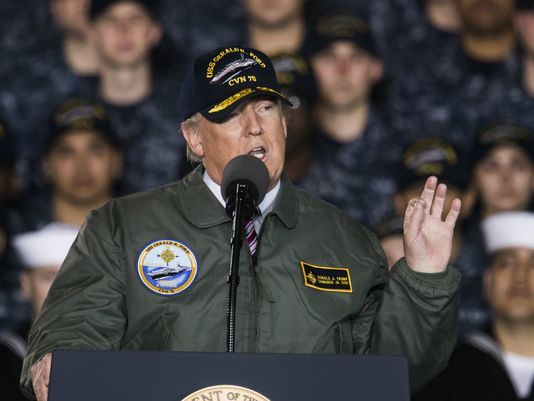
What America has witnessed since the end of World War II is the emergence of a large standing military that is increasingly identified with our president as a quasi-monarch “commander-in-chief.” And like monarchs of the past, U.S. presidents now dress up in military uniforms, strutting about as if they literally are “the king” of their military. (Trump, for example, talks of “my” generals.) Meanwhile, a U.S. president has, with the paramilitary CIA, his own private military augmented by a newly empowered military within the military, Special Operations Command, whose operations are often so highly classified as to be beyond effective civilian oversight.
America has regressed to the pre-revolutionary 17th century, when monarchs fought long wars against other monarchs, often in religious/confessional conflicts which were also motivated by money, power, resources, and similar concerns and which lasted for decades or even centuries. These wars, often involving mercenaries and warrior-corporations, ran out of control and eventually came to bankrupt states, leading to an “enlightenment” witnessed at the creation of the United States, whose founders tried to rein in the tyranny of monarchs and their wasteful forever wars.
Sadly, America is no longer “enlightened.” King Trump is a mix of Mad King George III and France’s imperious and vainglorious Louis XIV (“I am the state”), but without George’s or Louis’s interest in science and wider forms of knowledge. And, much like royal courtiers of the past, King Trump’s courtiers are often “aristocratic” generals or slithering sycophants.
Consider a Trump courtier who’s been getting a lot of press lately: Sebastian Gorka. He’s embraced the idea of a war against radical Islamic terrorism, tracing that war to jihadist flaws within Islam. This virulent disease within Islam, Gorka and likeminded advisers to Trump argue, must and can be wiped out by American-led military action. Much like Catholic King Philip II, who launched the Spanish Armada to extirpate the heresy of English Protestantism under Queen Elizabeth I, Trump and Gorka and Crew seek to unleash the American armada against the heresy of radical jihadist Islam.
King Trump I is about to escalate what he and his courtiers see as a religious/civilizational war. Donning a military cap and flight jacket, Trump promises quick victories against a dastardly enemy. Even as he pursues his wars, the U.S. military will continue to expand, as will paramilitaries and warrior-corporations. Even as victory proves as elusive as the fighting is enervating to domestic concerns, Mad King Trump will persist. America must win. For he is the state.
Under Trump, as with mad King George III, big changes are ahead. Just not the ones these monarchs imagined for themselves and their empires.
He can read from a teleprompter without barking: presidential?
W.J. Astore
One word defines Trump and his cronies: cynicism. His cabinet picks illustrate this; many of them are against the very agencies’ missions that they’re supposed to uphold, like public education, environmental protection, and decent health care. He hires billionaires for his cabinet in the name of draining the swamp and championing the cause of the working classes. Meanwhile, even as Trump poses as commander-in-chief, he ducks responsibility for the failed raid on Yemen, shifting it to “his” generals, whom he otherwise praises as super-capable and deeply respected.
Under Trump, Americans are witnessing the negation of idealism. Some might say that America’s ideals such as liberty and freedom and democracy have been observed more in the breach than in practice (consider slavery, for example, or the treatment of Native Americans), but at least we had ideals. They were imperfectly practiced, but with Trump ideals no longer matter. It’s just cynicism, a naked grab for wealth and power.
Cynics don’t believe in much of anything, except perhaps their own perspicacity in seeing the world “as it is.” If you don’t believe in anything, you can lash out at anything, without guilt. And Trump is a lasher. He attacks everything: “failed” generals, “murderous” Mexicans, “terrorist” Muslims, the “lying” press, unfair judges, even Rosie O’Donnell , beauty queens, and Nordstrom (!). Anyone and everything can be attacked and vilified when you’re a cynic with no core beliefs other than your own rectitude.
Trump is not a leader, he’s a cynic. A negator of meaning. What’s amazing to me is that some in the media recently suggested he looked presidential just because he read a speech written by others off a teleprompter without barking or snarling. Of course, cynicism is not unique to Trump; Hillary and the Democrats have their share, as Chris Hedges has noted. Recall, for example, the silencing of anti-war protesters at the Democratic National Convention in July. Trump just has less class, even trotting out a war widow while passing the buck on taking responsibility for her grief.
Why is cynicism so dangerous? I recall watching a documentary on the Holocaust in which a witness to a massacre described the horrific events. He ended with a cry against cynicism. The negation of human life he’d witnessed had, at its core, the cynical belief that human life simply didn’t matter. That people were just so much matter, just things to be exploited or disposed of as their “masters” decreed.
Cynicism, a denial of idealism, of higher meaning, and of humanity, was a propellant to, an accelerant of, the Holocaust. We see cynicism in Trump’s reference to the dead Navy SEAL in the Yemen raid. His service and death is celebrated as uniquely heroic and noble (“etched in eternity”), whereas the many Yemeni people killed, including several children, are forgotten. They simply don’t count; they are beneath being noticed.
Cynicism is spreading in America, with Jewish tombstones being toppled over, with darker-skinned immigrants being shot and killed in the name of “taking back one’s country,” of certain Muslims being excluded solely on their country of origin. Policies are being driven by cynicism – a cold calculus of profit and power.
To a cynic, all facts are “alternative,” which is to say a lie is judged the same way truth is, by the criterion of whether it advances one’s agenda and one’s power. What’s “true” is what’s expedient. To a cynic, facts are unimportant. All that matters is what you can get people to believe, how you can manipulate them and get them to act to fulfill your agenda.
Cynicism is the enemy of idealism, of truth, of humanity. Where it ends I truly hesitate to say.
Trump’s latest press conference is worrisome for so many reasons. He seems to live in his own reality (e.g. his administration is “a fine-tuned machine“). He’s still obsessed with Hillary Clinton and the margin of his victory. He seems only recently to have learned how serious the prospects of a nuclear holocaust could and would be. He continues to defend General Michael Flynn, saying that even though Flynn undermined the Obama administration and lied to Vice President Mike Pence, his rapprochement to Russia was laudable (with Trump suggesting that, even though he hadn’t approved Flynn’s actions, he might have). He even tasked a Black reporter to set up a meeting with the Congressional Black Caucus for him!
What to make of The Donald? Trump seems to thrive on creating animosity, then exploiting it. Special targets for him include the U.S. intelligence community and the media, both of which he sees as implacable enemies. But is animosity and chaos any way to run a country or to represent a people?
I can see how calling out your perceived enemies might work in business, especially a personal one, though Trump’s bankruptcies suggest otherwise. But Trump is no longer a free-wheeling real estate tycoon. He’s president now, a symbol (like it or not) of America. Generating animosity and discord as a public servant is divisive, fractious, selfish, and unwise.
A united America is much stronger than a disunited America, but since Trump thrives on division, his personal style is weakening our country. You might say he’s the opposite of Abraham Lincoln, who appealed to the better angels of our nature in a noble but ultimately failed attempt to unite a disunited country. Whatever else Trump is about, it’s not better angels.
Instead of making America great again, Trump is making it divided and uncivil again.
Mister President: Please stop blaming the media, or Hillary, or the intelligence community, or judges, or anyone else for that matter. Get on with the job of being a public servant. America needs inspired leadership, not self-serving rhetoric. We need a uniter, not a divider.
Rise above the pettiness, Mister President. For the nation’s sake, don’t be the pettiness.
Nora al-Awlaki, 8 years old, killed in the Yemen raid
W.J. Astore
The Trump administration’s first “kinetic” military action, last weekend’s raid on Yemen that killed a Navy SEAL as well as fifteen women and children, was an operational failure. Aggravating that failure has been the aggressive propaganda spin applied by the White House. According to White House spokesman Sean Spicer, the operation was a major success:
“Knowing that we killed an estimated 14 AQAP [Al Qaeda in the Arabian Peninsula] members and that we gathered an unbelievable amount of intelligence that will prevent the potential deaths or attacks on American soil – is something that I think most service members understand, that that’s why they joined the service.”
Later, Spicer doubled down, accusing Senator John McCain (and other critics of the raid) of defaming the dead Navy SEAL when he suggested the raid had been something less than a towering success. McCain, Spicer said, owed the dead SEAL an apology.
Trump himself then joined the fray, accusing John McCain in a tweet of emboldening the enemy and suggesting he’d “been losing so long he doesn’t know how to win anymore.”
Yet, by Spicer’s logic, President Trump himself owes an apology to all U.S. troops killed in the Iraq and Afghan wars, since Trump has criticized these wars as either unnecessary or botched in execution. Recall here that Trump said he was against the Iraq invasion in 2003, but once the U.S. invaded, he said the U.S. government botched it by not taking Iraq’s oil, which, he claimed, would have prevented the rise of ISIS.
The Iraq war, Trump has said, was a mistake, a failure, a loss. He promised to show America how to “win” again. Is the recent Yemen raid what he meant by a “win”?
Nearly everything went wrong in the Yemen raid. Surprise wasn’t achieved. U.S. troops were killed and wounded. Far too many non-combatants (innocent civilians) were killed, including an eight-year-old girl. A $75 million Osprey malfunctioned and had to be destroyed.
To hazard a guess, this raid probably cost the U.S. in the neighborhood of $250 million while failing to achieve its main objective. Meanwhile, the enemy put up fierce resistance with weaponry, mainly small arms and explosives, that probably cost less than $100,000.
In brief, the U.S. raid on Yemen was prodigal in cost, profligate in resources, and unproductive in results.
Of course, I can’t say for certain that the raid didn’t secure vital intelligence. According to Spicer, an “unbelievable” amount of intelligence was seized. But early signs are unpromising. The U.S. military chose to share, in the immediate aftermath of the raid, a video of bomb-making training by al-Qaeda (apparently from a seized laptop), only to remove it when they learned the training video was a decade old and readily available on YouTube. Some intelligence coup!
The Trump administration is promising to launch more raids, featuring an “easier approval cycle” than witnessed under President Obama. Indeed, some reports suggest President Trump was goaded into approving the Yemen raid by being told his predecessor wouldn’t have approved it.
If the Yemen raid is the new face of “winning” under Trump, America may yet long for the days of “losing” under previous presidents.
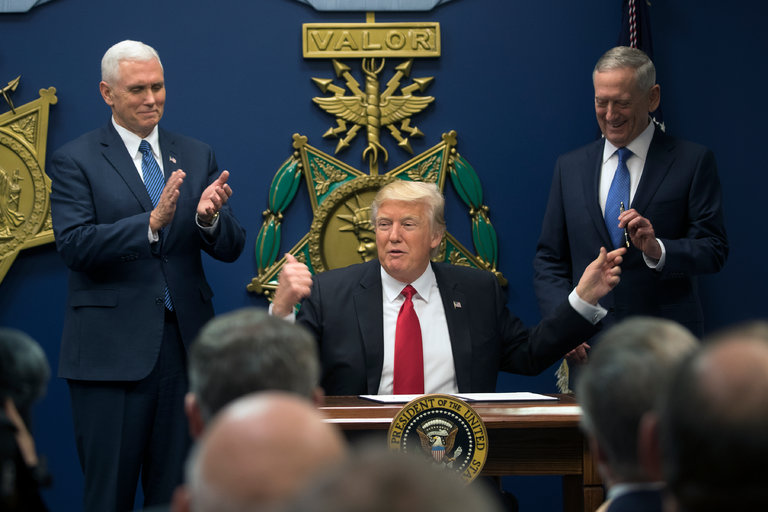
Trump has done it again. At the Pentagon, before a backdrop that honors America’s highest award for valor, the Medal of Honor, Trump signed an Executive Order on immigration. The backdrop seemed to suggest that Trump was doing something honorable and brave himself in signing yet another Executive Order. This EO, as the New York Timesreported, “suspended entry of all refugees to the United States for 120 days, barred Syrian refugees indefinitely and blocked entry for 90 days for citizens of seven predominantly Muslim countries. It also allows Christians to be granted priority over Muslims.”
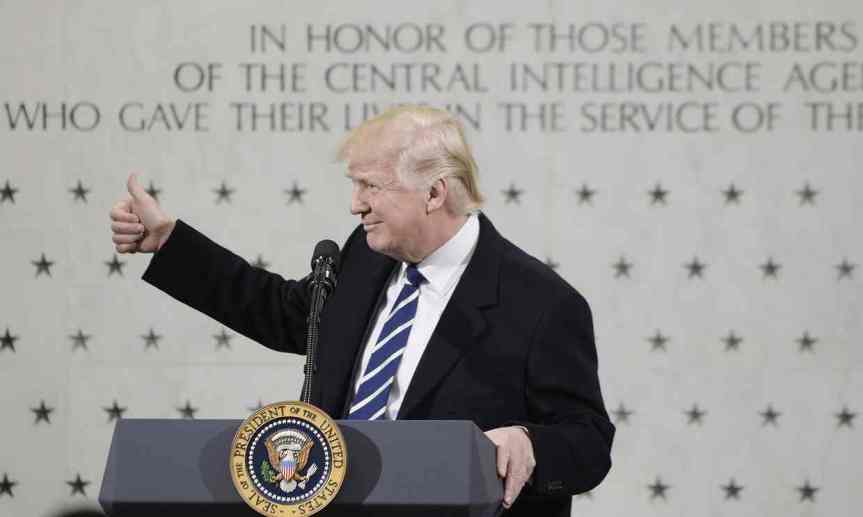
Last week, Trump appeared at the CIA, before its wall of heroes, blustering again about grabbing Iraq’s oil and boasting of the number of times he’d appeared on Time magazine (more than Patriots quarterback Tom Brady, which seemed to please him to no end).
Perhaps Trump will next appear before Christ on the cross to complain about how he (Trump) is being crucified in the press.
You’ve got to hand it to Trump: the man simply has no shame. And no taste either.
Trump’s pomposity was captured perfectly yesterday in a quip at my local bank. I was asking the teller about dollar coins (yes, we still have those), and she showed me a couple. They looked too much like quarters so I passed on getting any. The gent behind me quipped: “Just wait until Trump puts himself on the coin.” As I laughed and said words to the effect of, I can see it happening, the gent then quipped, “Trump will be on both sides!”
That about sums it up. Trump would indeed put his own mug on both sides of the coin. It would be a clear case of “heads he wins, tails we lose.”
Yesterday, I caught President Trump’s speech before the CIA. As he stood before the wall of honor, surrounded by the stars on that wall that represent those who gave their lives for their country, Trump deviated from his prepared comments to boast about how many times he’d appeared on the cover of Time magazine.
Here’s what he said: I HAVE BEEN ON THEIR COVER ABOUT 14 OR 15 TIMES. I THINK WE HAVE THE ALL-TIME RECORD IN THE HISTORY OF TIME MAGAZINE — IF TOM BRADY IS ON THE COVER, IT’S ONE TIME. I’VE BEEN ON 15 TIMES. I THINK THAT’S A RECORD THAT COULD NEVER BE BROKEN.
Really, President Trump? You’re giving a speech before members of the CIA, and what comes to mind is the number of times your own mug has appeared on a magazine cover? And you’re doing this in front of the CIA’s wall of honor, which, according to your own words, is “very special”?
Whatever one thinks of the CIA and its history, one thing is certain from this speech: America has elected an appallingly tone-deaf and callous narcissist as its 45th president.
But America has been edging toward post-truth for a long time — even at its founding, skeptics might say. The “City on a Hill,” forged on an image of Christian rectitude, witnessed the genocide of Native Americans (“savages”) and the embrace of slavery based on specious theories of racial inferiority, even as the Bible taught the love of neighbor and the equality of all before God.
More recently, America has witnessed the triumph of post-truth in the aftermath of 9/11. Recall how the attacks on 9/11 were falsely connected to Iraq, which was then connected to false claims of Iraq having active programs of WMD development, including “yellowcake” uranium as well as chemical and biological agents spread by aerial drones. All proven false, but all used to justify the invasion of Iraq in 2003.
Indeed, many Americans continue to believe that Saddam Hussein planned the 9/11 attacks (in league with Osama Bin Laden). Recall here the rare honesty of Britain’s Downing Street Memo of 2002, which asserted that the “facts” being offered by the Bush/Cheney administration were being manufactured (“fixed”) around a pre-determined policy of invasion. The result? Iraq was yet another un-democratic war, based in part on lies. Indeed, it’s no accident that Congress hasn’t issued a formal declaration of war since 1941. (Another war based on lies: the Vietnam War, e.g. recall the false reports of attacks at Tonkin Gulf.)
Another example of post-truth was the Surge of 2007, advertised as a “win” for America even as General David Petraeus warned that progress in Iraq was both “fragile” and “reversible.” So it has proved, for here we are, a decade later, trying to recapture territory (such as Mosul) that had allegedly been pacified under Petraeus.
America’s post-truth crew has now been captured by a shameless con man, the Tweeter-in-chief, Donald Trump. Recall a saying often attributed to P.T. Barnum that “a sucker is born every minute.” Trump knows this — and will exploit it to the hilt, if the American people let him.
As January 20th approaches, Americans need to prepare themselves for a post-truth presidency. As my dad used to say to me: “Don’t believe anything that you read and only half of what you see.” Wise words for the days and years to come, but they come with a major problem. Some sense of truth, of consensus based on acknowledged facts and a rigorous and fair-minded process of reasoning, is needed for a democracy to function.
Without integrity, which is based on facts and honesty and a willingness to reason together in good will and with honorable intentions, democracy simply cannot function. Put simply, a post-truth America is an anti-democratic America. For without truth, without some consensus based on facts, all you have is lies, misinformation, and spin: a foundation of sand upon which nothing of worth can be built.
In a longer article for TomDispatch.com, I recently wrote about Donald Trump’s team of generals for national defense and homeland security. Trump wants four senior retired generals, two from the Army and two from the Marine Corps, to serve as his senior civilian advisers in matters of defense and security.
Here’s the point: You simply can’t have civilian control of the military when you appoint senior generals to these positions.
I’m astonished more Americans aren’t outraged at this. It’s a sign of how much militarism has gripped our nation and government, as well as the sweep and scope of the national security state.
I was reading Samuel Hynes’ excellent book, The Soldiers’ Tale: Bearing Witness to Modern War, and came across two passages that resonated with me. In talking about war as a culture, Hynes notes that “Military traditions, values, and patterns of behavior penetrate every aspect of army [and Marine Corps] life and make the most ordinary acts and feelings different.”
The generals Trump is hiring are all military careerists, men whose “traditions, values, and patterns of behavior” are steeped in the ways of the Army and Marine Corps, affecting even “the most ordinary acts and feelings.” Their behavior, their commitments, their loyalties, their world views, are the antithesis to civilian culture and to the ethos of democracy. (For example, General James Mattis, Trump’s selection as Secretary of Defense, is most often described as a “warrior-monk,” a man with a Spartan-like dedication to war. But would Athens have anointed a Spartan, even as its minister of war?)
Again, the point is not to attack the military. It’s that the U.S. government already has plenty of generals in charge, wielding enormous authority. Trump’s decision to add yet another layer of military authority to his government makes it less of a democracy and more of a junta.
A second point from Hynes. He notes how most citizen-soldiers in America’s military past were not war-lovers, but that a few were, notably General George S. Patton. In the same breath, Hynes notes that dictators like Hitler and Mussolini “loved war.”
Which American general does Trump profess to admire the most? George S. Patton. And who among his generals most resembles Patton as a “real” warrior? According to Trump, it’s General Mattis.
Again, the point is not to attack the military, but rather to note the U.S. national security state already has plenty of warriors and warfighters in charge. Putting an alleged Patton-clone in charge of the Pentagon represents an abrogation of two centuries of American tradition that insisted on civilian supremacy over the military.
Given his inflammatory tweets about nuclear arms races with their “bring it on” mentality, Trump has all the makings of tinpot provocateur, an unstable military poseur who likes to speak loudly while swinging a nuclear-tipped stick. Will Trump’s generals, his Pattons and MacArthurs, serve as a check to his provocations and his posturings? It doesn’t seem likely.
Congress should reject Trump’s choices for Secretary of Defense (Mattis) and Homeland Security (Kelly). Not because these retired generals are bad men, but because they are the wrong kind of people. If you want civilian control of the military (and don’t we still want that?), you need to hire true civilians. Men and women whose identities haven’t been forged in armories. Independent thinkers and patriots with some history of dissent.
How about someone like Daniel Ellsberg for Secretary of Defense? And, since global warming is a huge threat to the U.S., how about Bill McKibben for Homeland Security?
After all, whether they’re in or out of uniform, the U.S. government already has plenty of generals.