COVID-19: Not impressed by weak, dumb, and irresolute leaders
W.J. Astore
If nothing else is true, COVID-19 is a wake-up call to all of us about the need for strong, smart, and resolute leadership.
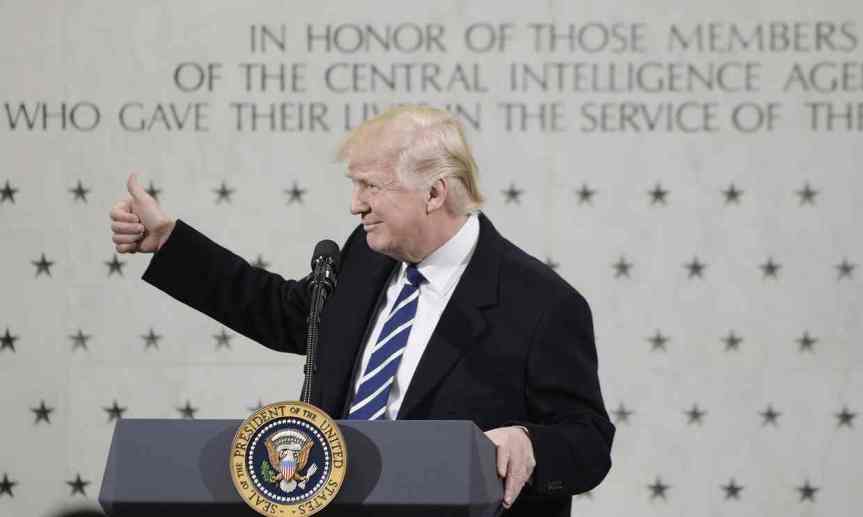
Donald Trump is not that kind of leader. He ducks all responsibility for mistakes, provides false information, and blames the crisis on others (Europeans, a “foreign” virus, the Obama administration, and so on). His VP, Mike Pence, has been a non-entity for years and has done nothing to allay the concerns of Americans.
Meanwhile, the Democratic front runner, Joe Biden, has given short remarks read off a teleprompter. I see headlines like “Can Biden handle a two-hour debate?” and I wince. If serious people think Biden may not have the physical and mental endurance to perform well in a staged political conversation, how can we possibly believe he is fit enough to be president for four years? Biden will be 78 in November, and none of us is getting younger. If there are serious concerns about his mental and physical stamina now, when he’s not being pushed, how can there not be profound concerns about his ability to handle the burden of presidential leadership? Severe stress ages everyone, and we shouldn’t close our eyes to this reality.
Roughly the same age, Bernie Sanders appears mentally and physically robust, and his speeches on the pandemic have been sensible, detailed, and smart. But even Bernie isn’t getting any younger.
In Biden’s case, people may argue that Joe can always fall back on his VP if he fails in office. But we don’t elect a president with the idea that he’s infirm and may soon need to pass his duties to a younger man or woman.
There is one presidential candidate still in the running for the Democrats who is strong, smart, and resolute and who is young to boot: Tulsi Gabbard. She is 39 and has dramatic ideas to help ordinary Americans during this crisis. Yet she’s been excluded from the Democratic debate by the DNC that can’t forgive her for supporting Bernie Sanders in 2016 while criticizing corruption within the party.
As Americans, we need to get serious about our leaders. Trump has shown he has no answers. Biden’s debate performances (among other public appearances) raise serious questions about his mental and physical capacity for office.
Yet as of this moment these two men appear to be our likely choices come November. At a time of severe crisis, that’s no choice at all.
Wisdom can be found in many places. I was watching Professional Bull Riding today, and the announcer (didn’t catch his name) dropped this pearl of wisdom:
Professional bull riding is not a sport based on hope. It’s a sport based on belief.
I caught his meaning. When you’re preparing to ride a bull, you can’t “hope” you’re going to stay on its back. You have to believe you’re going to do it. And even when you believe, often the bull is still going to win.
What does this have to do with Trump and the Democrats? Consider Trump as an intemperate bull. Sure, he’s ageing, but he’s got plenty of kick left. How do you “ride” this bull and defeat him? Not by bringing a weak case of impeachment that you know is going to fail in the Senate. Not by giving Trump several big victories, such as a massive defense budget and a new trade bill, so-called NAFTA 2.0. Not by offering only the most tepid objections to his warmongering with Iran.
Consider the DNC and its preferred presidential candidate, Joe Biden. Is a corporate Democrat who’s both compromised and fading really the best candidate to ride Trump out of office? As Joe Biden himself might say, give me a break.
You can’t hope you’re going to ride Trump out of office in 2020. You have to believe it. And you have to give the American people a candidate with some balls, with firm and principled beliefs, a bull rider like Bernie Sanders or Tulsi Gabbard.
Hope may have been important to Barack Obama’s success in 2008, but it’s not going to defeat Trump in 2020. To ride that bull, you have to believe.
They’re so proud of Trump’s wall, though new sections proved surprisingly easy to cut through
W.J. Astore
I caught this snippet via the New York Times today:
“Border wall funding: President Trump plans to divert $7.2 billion from the military for the construction of a wall on the southern border, two people familiar with the plans told The Times. Congress set aside $1.375 billion for it last month.”
Diverting money that’s been appropriated by Congress is an impeachable offense, but the Democrats will do little since they know Trump will spin their opposition as being pro-immigrant and anti-American, irrespective of the lies contained in that spin.
Trump was elected in part through his fear-mongering about immigrants (he spoke of murderers, rapists, gang members, even Muslim terrorists hidden within the “caravans” approaching America’s southern border). “Build the wall” is a popular chant at his rallies, and Trump knows the issue still stirs up his base.
What’s it all about? Recently I was reading “Shadow of the Silk Road,” by Colin Thubron. This is what Thubron had to say about the Great Wall of China:
As a true bulwark the Wall was senseless. Huns, Mongols, Manchus overswept it almost at will. The Sinologist Owen Lattimore proposed that it was built to keep the Chinese in rather than the nomads out. Perhaps, unwittingly, it was less a physical defence than a monstrous definition. It separated civilisation from barbarism, light from darkness. It was an act of shuddering denial: over there is not what we are. And it was steeped in fear. [Emphasis in original.]
“Over there is not what we are”: Trump recognizes how “his” wall serves as a dividing line between the “good” people (Americans) versus the “bad hombres” (his term) seeking to “invade” America. And it is, as Thubron says, both a monstrous definition and an act of shuddering denial.
Of course, the wall already exists, as Greg Grandin notes in his book, “The End of the Myth: From the Frontier to the Border Wall in the Mind of America.” Trump merely wants to lengthen it, mostly in areas where a wall is redundant due to already forbidding terrain.
But the wall is not about protecting America from “hordes” of “invaders.” It’s about defining America in retrograde ways, contrasting the alleged barbarism of brown-skinned people with the civilization of (mostly) White America.
Walls demarcate and divide. They are also a denial of common humanity. They pit us against them in battles over turf. In short, they’re a perfect symbol for Trump’s vision of greatness.
Trump boasting of big missiles while denouncing Democrats
W.J. Astore
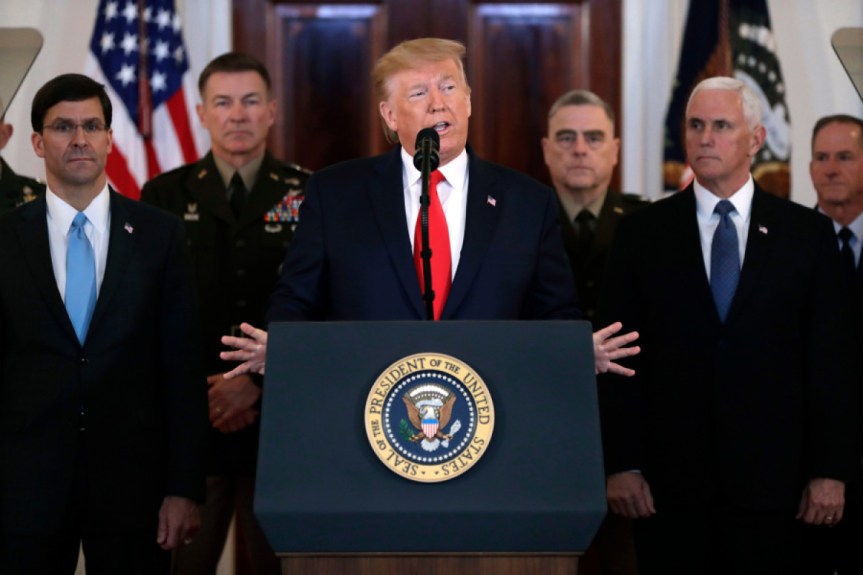
I watched Trump’s speech today to the nation on Iran. It had the usual boasts about the U.S. military and its “big” and “lethal” missiles, the usual bombast, the usual lies. But this passage of his speech truly struck me as beyond the pale:
Iran’s hostilities substantially increased after the foolish Iran nuclear deal was signed in 2013, and they were given 150 billion dollars, not to mention 1.8 billion dollars in cash. Instead of saying thank you to the United States, they chanted Death to America.
In fact, they chanted Death to America the day the agreement was signed. Then Iran went on a terrorist spree funded by the money from the deal and created hell in Yemen, Syria, Lebanon, Afghanistan, and Iraq. The missiles fired last night at us and our allies were paid for with the funds made available by the last administration.
That’s right: the missiles used against U.S. forces last night we’re paid for by the Obama administration. Not only that: Iran went on a “terrorist spree” funded by the “foolish” Iran nuclear treaty, spreading “hell” throughout Yemen, Syria, Lebanon, Afghanistan, and Iraq. I’m sure glad Saudi Arabia, Israel, the United States, and other military actors in the region never spread any “hell,” despite all those Hellfire missiles launched from American drones.
So here’s a new claim for you. If the U.S. military is losing in Iraq and Afghanistan and elsewhere, the culprit is clear: the Obama administration and by extension the Democrats, the appeasers who funded Iran and made possible all of its “terrorist” activities.
Best of all, Trump wished peace and prosperity to the Iranian people, but you heard nothing about working peacefully and in prosperous ways with the Democrats.
Clearly, Trump sees the real enemy of America: Obama and the Democrats.
Photo that allegedly persuaded Trump that Afghanistan wasn’t a lost cause
W.J. Astore
Trump was elected president in 2016 partly because he railed against America’s wasteful wars. So, what did his advisers talk him into? A mini-surge of troops to Afghanistan. I still recall the odd news of Trump being shown photos of Afghan women in skirts (vintage 1972) to convince him that westernization and modernization of Afghanistan was possible.
Several thousand additional U.S. troops were sent to Afghanistan in 2017, predictably achieving nothing of note. A little more than two years later, we have another item of “big” news today, according to CNN:
The Trump Administration is preparing to announce a long-awaited reduction of US troops in Afghanistan, a senior administration official confirmed to CNN. There are between 12,000 and 13,000 US troops in the country right now, and the US has maintained a solid presence throughout the 18-year war in the area. This drawdown would remove up to 4,000 troops, with more possible reductions in the future, the official said. That matches the claim Trump made on Fox News Radio in August that his administration would take the number “down to 8,600.” The reduction comes at the same time the US is restarting peace talks with the Taliban, and some worry the troop drawdown could be seen as a concession to the terrorist group.
Where to begin with this CNN snippet?
The “reduction” is not a reduction but a return to previous troop levels at the end of the Obama administration.
The U.S. “has maintained a solid presence”? Good god. You’d never know about all the bombing, droning, and killing the U.S. has done over the last 18+ years. Or is that the “solid presence” we’ve been maintaining?
The troop “drawdown” as a “concession” to the Taliban? Guess what: The Taliban aren’t going anywhere, and they’re winning. A few thousand U.S. troops, either as a “plus-up” or “drawdown,” have had and will have no impact on the reality on the ground.
Sometimes I don’t know whether to laugh, cry, or do both. Perhaps my dad put it best: “We laugh to hide the tears.”
Update (12/17): Speaking of laughing to hide the tears, the Pentagon has responded to the systematic lying revealed by the so-called Afghan Papers. It won’t surprise you the response consists of three artless dodges:
Dare I say I haven’t been watching the impeachment proceedings against Trump? That’s because the charges brought against Trump by the Democrats are weak. They are basically for Trump acting like Trump. The Donald is not, never has been, and never will be a public servant. His existence as president revolves around rallies, golfing, watching Fox News, tweeting, and attending an occasional meeting, party, or other photo op. If you want to impeach him, why not for not doing his job as chief executive?
What Trump did with Ukraine is what Trump has always done. He pressured a guy to dig up dirt on another guy who could be a potential rival for his job. For Trump, this isn’t a crime: it’s business as usual. He has no grasp of his constitutional duties as president and no interest in learning.
Trump’s next crime has been to stonewall with lawyers and the like while going on the attack. Again, this is par for the course for him. He tells his underlings not to obey Congressional orders to testify. He fights delaying actions. He lies. He’s used these and similar tactics his whole life and has lived to fight another day.
Don’t get me wrong. I think Trump is unqualified to be president. I’d like to see him gone. But the charges the Democrats have brought are incredibly weak compared to the damage Trump has already wreaked. That damage, however, is largely bipartisan, meaning if the Democrats (like Nancy Pelosi) were to call Trump to account for his real crimes against America, they’d implicate themselves as well. And that’s not about to happen.
The analogy I’ve heard more than once for Trump’s impeachment is that it’s like going after Al Capone for income tax avoidance rather than his murderous reign as a gangster. Even here, though, it seems more like we’re going after Capone for unpaid parking tickets or for playing Italian opera too loud.
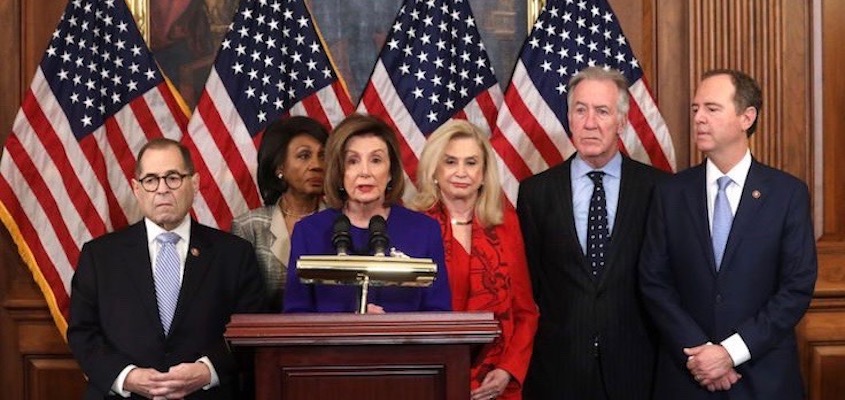
We’ve been told impeachment is a political act, not, strictly speaking, a legal one, and that surely is the case here. The cynic in me says this: Establishment democrats, led by Nancy Pelosi, knew they had to do something against Trump, if only to appease activists within the party. Yet they also know they can’t remove Trump, not only because the Senate is controlled by Republicans, but because they can’t charge him with real crimes without implicating themselves, e.g. continuing to sell arms to Saudi Arabia and supporting the House of Saud no matter what in the name of profit and the petrodollar, even if that means a genocide in Yemen. (It’s a lot worse than cajoling Ukraine to issue a negative statement about the Bidens, right?)
The Democrats know impeachment will fail in the Senate, but they can at least say they took a stand, even if they’re up to their necks in the swamps of DC. It’s all so sad and sordid, and so predictably the behavior of an opposition party that offers no real opposition.
There’s a new article at The Atlantic by Mark Bowden that cites America’s generals to condemn Donald Trump’s leadership of the military. Here’s how the article begins:
For most of the past two decades, American troops have been deployed all over the world—to about 150 countries. During that time, hundreds of thousands of young men and women have experienced combat, and a generation of officers have come of age dealing with the practical realities of war. They possess a deep well of knowledge and experience. For the past three years, these highly trained professionals have been commanded by Donald Trump.
That’s quite the opening. A few comments:
It’s not a good thing that American troops have been deployed to nearly 150 countries over the last 20 years. Indeed, it points to the scattershot nature of U.S. strategy, such as it is, in the “global war on terror.”
Hundreds of thousands of troops have “experienced combat” — and this is a good thing? What wars have they won? What about the dead and wounded? What about the enormous monetary cost of these wars?
Dealing with “the practical realities of war” — Please tell me, again, how Afghanistan, Iraq, Libya, etc., have played out?
“Highly trained professionals” with “a deep well of knowledge and experience.” Again, tell me which wars America has clearly won.
The gist of Bowden’s article is that Trump is capricious, vain, contrary, and ignorant. But his biggest sin is that he doesn’t listen to the experts in the military and the intelligence community, whereas George W. Bush and Barack Obama did.
Aha! Tell me again how things worked out for Bush and Obama. Bush led the USA disastrously into Afghanistan and Iraq; Obama “surged” in Afghanistan (a failure), created a disaster in Libya, and oversaw an expansion of Bush’s wars against terror. And these men did all this while listening to the experts, those “highly trained professionals” with those allegedly “deep” wells of knowledge and experience.
Given this record, can one blame Trump for claiming he’s smarter than the generals? Can one fault him for trying to end needless wars? He was elected, after all, on a platform of ending costly and foolish wars. Is he not trying, however inconsistently or confusingly, to fulfill that platform?
The point here is not to praise Donald Trump, who as commander-in-chief is indeed capricious and ignorant and too convinced of his own brilliance. The point is to question Bowden’s implied faith in the generals and their supposed “deep well” of expertise. For if you judge them by their works, and not by their words, this expertise has failed to produce anything approaching victory at a sustainable cost.
Bowden’s article concludes with this warning: In the most crucial areas, the generals said, the military’s experienced leaders have steered Trump away from disaster. So far.
“The hard part,” one general said, “is that he may be president for another five years.”
The generals “have steered Trump away from disaster.” Really. Tell me who’s going to steer the generals away from their disasters — Afghanistan, Iraq, Libya, Yemen, Somalia, the list goes on.
Bowden, it must be said, makes valid points about Trump’s weaknesses and blind spots. But in embracing and even celebrating the generals, Bowden reveals a major blind spot of his own.
For most Americans, patriotism means love of country. But I’d like to suggest this “love” is misplaced for three reasons. First, I’d like to suggest that “country” is an imaginary construct. Two, I’d like to show how patriotism is misused and abused by the powerful, most infamously by President Donald Trump. And three, I’d like to suggest a new form of patriotism, the love of the tangible, and by this I mean our fellow human beings.
“Country” as an imaginary construct
“Imagine there’s no countries,” John Lennon wrote nearly fifty years ago. Generally, citizens of a given country insist they love their nation. But can one truly “love America,” or any other country or nation? For that matter can you love any state, city, town, or sports team?
In general semantics, a branch of linguistics which is itself a branch of philosophy, the word is not the thing, the map is not the territory. Canada, France, the Red Sox are only names, concepts, phenomena of consciousness. Or a neurological system in the brain if you adhere to the Western materialist worldview.
Think about it: You can’t see, touch, feel, hear, or taste “France.” But you can taste a French pastry made in “France” and see and touch the Eiffel Tower. ”Vive La France” does not mean that French people collectively are going to live a long life. In fact, the concept of France vanishes if there are no longer any human beings left after, say, France is devastated by a massive nuclear attack.
Now, one can literally love the beauty of the land that comprises the legal territory of a given country. I love the mountains and the deserts of the Western U.S., the woods of northern Maine, the seacoasts of California. I love Fourth of July celebrations, the fireworks and cookouts. I even love the old Frank Sinatra song, “The House I Live In” because it names things in America that you can put your hands on, such as the line “the ‘howdy’ and the handshake.” And then the concluding lyric, “that’s America to me.” (Notice there is no insinuation there is an America out there, only the symbolic meaning of the phrase.)
Love of country, in short, is nonsensical because a country, a nation, is an abstraction, a conceptual phenomenon, a byproduct of mental processes, that has no existence in the material universe. Perhaps Lennon’s dream of “imagine there’s no countries” will only become reality when we no longer perceive people as enemies or opponents merely because they live elsewhere or look different.
The misuse and abuse of patriotism
Politicians and journalists tend to affirm, for obvious reasons, that it’s important to state how much you love America. Not to do so could easily result in your career or ambitions heading south. Still, proclaiming your love of country, whatever country that is, all too often has undesirable and destructive consequences. For instance, it becomes easier to support a government taking the country to war. Or colossal military budgets in the name of “defending” the “country.”
To an unreflective patriot the country is not seen as the sum of its parts but as a reality sui generis, perhaps symbolized by a father figure like Uncle Sam.
You know Uncle Sam isn’t real, right?
If I can make a sweeping generalization, among rural chauvinists “country” is part of the “God, Country, and Guns” trinity. This idea is well captured by the Merle Haggard song from 1970 that “When they’re runnin’ down our country, man/They’re walkin’ on the fightin’ side of me.”
President Trump’s recent call for members of the so-called squad, the four progressive Congresswomen of color, to “go back” to where they came from (a takeoff of “love it or leave it”) is one step away from “I will hurt you if I see you again.” Obviously, there is no place natural-born U.S. citizens can go back to. And even if they were not citizens by birth, why should they have to leave after having become U.S. citizens? Trump’s “patriotism” is racist nationalism – and shamelessly so.
Patriotism, in the narrow Trumpian usage of that word, demands opponents, sides, an “us versus them” mentality. And that’s a mentality calculated for division, distraction, and destruction.
Real patriotism
We humans can’t see national borders from space, but we do see our planet. Our real “homeland.” Nevertheless, the false choice of “America: love it or leave it” has recently been revived from the days when protesters against the Vietnam War were denounced as unpatriotic. In truth, they were performing the most patriotic act imaginable, if patriotism is properly defined as love of one’s fellow human beings. In that sense, real patriotism is humanitarianism. It’s focused on humans and the home where we live, not on constructs that are insensible.
False patriotism may remain “the last refuge of a scoundrel,” as Samuel Johnson, the 18th century British social philosopher, observed. Even so, a literal belief in “my country, right or wrong” could still do us all in some sunny day. A dangerous myth, indeed.
Richard Sahn is a retired professor of sociology. You may also wish to read his article on sports and reification.
President Donald Trump, it now seems clear, pressured the Ukrainian president to investigate a political rival, Joe Biden. He exerted this pressure by withholding military aid to Ukraine approved by Congress, and by calling Ukraine’s president and asking him for a “favor,” the said favor being the investigation of Biden and his son, Hunter. The White House apparently acted to “lock down” transcripts of the phone call, but a whistleblower came forward backed by an inspector general.
And my first reaction was: Can Trump be impeached for stupidity?
Joe Biden is a weak candidate for the presidency. It’s questionable whether he’ll win the nomination next year. Why bother going after him in such an egregiously illegal way when Biden is very likely to implode as a candidate on his own?
I can’t answer that question, but I can guess. Trump, to put it mildly, has never been a public servant, and I include his term as president in this statement. Trump is always about himself; the world revolves around him, or so he thinks. He has no conception of following laws simply because he believes he is above them. Furthermore, Biden may be a weak rival, but rival he is nonetheless. And Trump, operating from his experience in the take-no-prisoners world of New York real estate, casino management, and similar escapades, knows what to do with a rival: you search for any edge you can get, including pressuring those who are dependent on you to dig up dirt on said rival.
Put bluntly, in this case Trump simply did what he regularly does. The only difference is that a whistleblower wouldn’t play the game of “nothing to see here, move along.”
If only Trump had done what he promised as a candidate. If only he’d acted to drain the swamp; if only he’d worked hard to end America’s forever wars; if only he’d truly put America first by rebuilding our country’s infrastructure and cutting taxes for workers. Instead, he hired the swamp; he refueled those forever wars; he abandoned infrastructure along with meaningful tax cuts for workers.
Trump lacks integrity. In short, he’s just another self-interested politician. More than this, however, is Trump’s complete lack of respect for the law. It’s time for him to go.
Update (9/27/19)
A few comments in passing:
1. Investigating Trump, on credible charges, is not an example of Trump Derangement Syndrome.
2. Saying that Biden is also corrupt, or that Democrats are corrupt, in no way exonerates Trump. For my money, let’s prosecute all corruption everywhere.
3. Often, the cover-up is worse than the crime. That may well be the case here.
4. Trump, as is his wont, is making matters worse, suggesting the whistleblower’s sources acted like spies and suggesting execution would be appropriate. (Please don’t say he was vague; we all know what he meant.)
5. Readers of this blog know that I voted third party in 2016. If you examine my articles, you’ll find I’m critical of both Democrats and Republicans.
6. Justice should not be partisan, even as it’s inevitably influenced by it.
7. I don’t care if the Republican-controlled Senate chooses not to convict Trump. Our lawmakers will have to go on the record, as they should, History will render the final verdict.
8. I don’t know if impeachment will make Trump stronger or weaker, and I don’t care. What it will do, assuming the evidence is sufficient, is to make justice in America stronger. No man should be above the law.
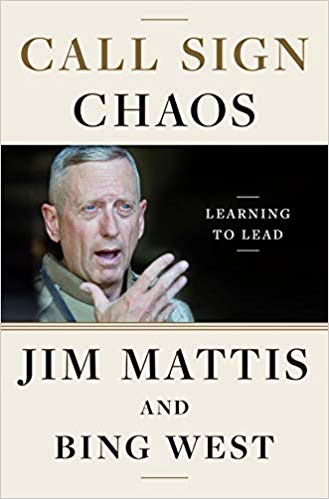
James Mattis is making the talk show rounds, promoting his new book, “Call Sign Chaos.” Interestingly, while openly critical of President George W. Bush for being unprepared for the Iraq War, and President Barack Obama for lacking a strategy and being too soft toward enemies like Iran, Mattis is remarkably circumspect about his service as Secretary of Defense under President Donald Trump. Perhaps Trump’s non-disclosure agreements really do pack a punch?
I’ve written about Mattis before. Trump may have picked him in part because he looks a little like George S. Patton of World War II fame. While serving under Trump, Mattis was deferential but not as big of an ass-kisser as most of Trump’s subordinates. Mattis was a disappointment nonetheless, bought off by all the money Trump and the Republicans (and Democrats as well) shoveled to the Pentagon.
Mattis, among several generals Trump called “his” own, did nothing to end America’s disastrous overseas wars and the profligate spending on them. He also did nothing to curb the U.S. military’s desire to spend $1.7 trillion on genocidal nuclear weapons. He had no vision for a U.S. military that would be less imperial, less wasteful, and, in two words, less stupid.
Mattis was more interested in better relations with allies than was Trump, especially NATO, but that was about the only notable difference. That and the fact that Mattis seemed even more dedicated to using the U.S. military in debacles like Afghanistan and Syria, whereas Trump, displaying his usual fickleness and ignorance, waxed between total destruction and total withdrawal.
Strategic chaos has been the result of Mattis’s service under Trump, so the book’s title is unintentionally accurate. If only retired generals would do what they used to do way back when, such as fishing and golfing, enjoying a sinecure or two but otherwise doing no harm. But, sadly, that’s no longer the American way. Too many generals, retired or otherwise, are spoiling the Democracy, and Mattis is one of them.
Among noteworthy American generals who could, men like Patton and Ike and Grant and Sherman, Mattis is yet another pretender like David Petraeus, a man who couldn’t. He couldn’t win a major, enduring, victory, and he didn’t define a new course forward that would truly safeguard America’s national security. Call sign chaos, indeed.