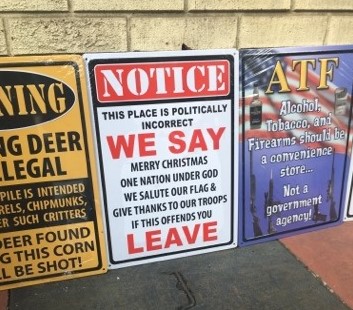
So much of what passes for America’s Kulturkampf (culture struggle) consists of phony, made up, manufactured issues. Consider the following sign, sent to me by a friend as he toured the wilds of Pennsylvania:
It is supposedly “politically incorrect” to say Merry Christmas, to state the Pledge of Allegiance (“one nation under God”), to salute the flag, and to thank the troops. Those who do all these things apparently take pride in their alleged outspokenness and their love of all things American.
Sigh.
Forgive me for stating the obvious, but it’s never been politically incorrect to say Merry Christmas. Virtually all Americans say they believe in God or some higher power. Nearly all Americans respect the flag (even those who kneel in protest, I’d argue), and America’s respect for the military has never been higher.
But this sign with its false narrative encapsulates much of the Republican/Trumpian message: We’re the real Americans. And anyone who says “Happy Holidays” or who suggests separation of church and state or who sees protest as legitimate free speech is obviously un-American and should leave the country.
I just wonder at all those Americans who buy signs like this, thinking that by doing so they’re showcasing their bravery at being non-PC and their pride in being so “American.”
One thing is certain: this manufactured culture war is a great way to distract and divide the commoners as the rich and powerful continue their looting of America.
Over at ABC News, an article asks whether Donald Trump is a white supremacist. Bernie Sanders thinks so. Elizabeth Warren does too.
I’m not so sure. Trump sounds like a white supremacist. His rhetoric encourages white supremacists. He has a long history of bigotry and racism. QED?
I’m hesitant to say it’s proven, but I know one thing is certain: Trump is a Trump supremacist.
A self-confessed “very stable genius.” A man without a racist bone in his body. The least racist person you’ll ever meet, according to Trump himself. A president who ranks himself as roughly equal to Abraham Lincoln, considered by most historians to have been America’s finest president.
Vanity, thy name is Trump. And because Trump is a white male, ipso facto white men are supreme; they must be, because Trump is one of them, indeed the finest example of them, at least in his own mind.
So, I think it’s tempting yet too simplistic to say Trump is a white supremacist. Trump is a Trump supremacist. Everyone else is inferior to Trump, some more so than others. The less you look like Trump, or act like Trump, the less he thinks of you. Thus it’s no surprise he surrounds himself with mostly white men, many with dubious pasts of sexism or racism. To Trump, these are not disqualifiers. How could they be? He’s sexist and racist, so how can that ultimately be a bad thing?
From his lofty perch as the greatest human in all of history, Trump looks down on all of us. He just sneers a bit more if you’re brown or black or less than 100% boorishly male.
What can you say about mass shootings in America that hasn’t already been said? El Paso and Dayton (not Toledo, Mr. Trump) are the most recent in a seemingly unending series of shootings in America. A grim statistic:
“Dayton was the 22nd mass killing in America this year, according to an AP/USA Today/Northeastern University mass murder database, which tracks all attacks involving four or more people killed.”
Or, alternatively: “The shooting in Ohio marked the 31st deadly mass shooting in America this year, defined as those where at least three people are killed by gun violence in a single episode.”
“As of today (Aug. 4), we are 216 days into 2019. In the US over that time, more than 1,300 people have been injured or killed in mass shootings, according to data collected by the Gun Violence Archive.
QUARTZ
Injuries and deaths related to mass shootings.
The nonprofit organization, which is based in Washington, DC, defines a mass shooting as an event in which at least four people were shot. By its calculations, that means there have been some 292 mass shootings in the US since the year began.”
In a prepared statement this morning, President Trump came out against white supremacy, racism, and bigotry, but tragically this is a clear case of “Do what I say, not what I do” for Trump. He compounded his hypocrisy by ignoring the ready availability of assault weapons, blaming instead mental illness and violent video games, among other factors.
Firstly, the mentally ill are more likely to be the victims of violence than the perpetrators of it. Secondly, violent video games are a global phenomenon, but I’m not reading about dozens of mass shootings each year in Japan or Korea or Sweden.
Trump’s weak-willed words were thoroughly predictable; he’s closely aligned with the National Rifle Association and its total fixation on gun rights to the exclusion of all others. He’s not alone in this. When I taught in rural Pennsylvania, my students knew all about the Second Amendment. But their knowledge of the First, Fourth, and Fifth Amendments was far weaker. Yes, for many Americans guns really do trump free speech, freedom of the press, and similar rights.
Predictably, Americans search for a magic bullet (pun intended) after these horrifying massacres to put a stop to them. How about better background checks? Eliminating extended magazines for the millions of assault rifles that are already in the hands of Americans? Better databases to track the mentally ill and the criminally violent? And so on. And we should have better background checks before you can buy a gun; we should stop selling military-style hardware; we should keep better track of dangerous people. But steps such as these will only stem the violence (if that). They won’t put an end to it.
Our culture is suffused with violence. At the same time, powerful forces are at play (stoked by our very own president) to divide us, to inflame our passions, to turn us against them, where “them” is some category of “other,” as with the El Paso shooter, who targeted immigrants “invading” America.
To stop mass shootings, we must change our culture of violence. This is made much more difficult by men like Trump, who’ve embraced violent rhetoric for their own selfish purposes. But we must change it nonetheless, else witness more carnage across America.
Note to readers: This is not the first time I’ve written about violence and guns in America. Here are links to a few articles on this subject at Bracing Views:
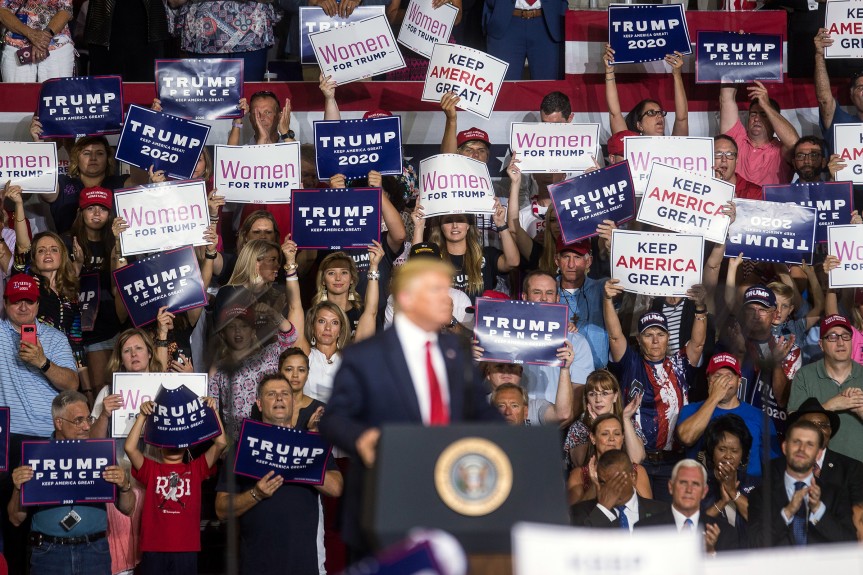
As long as enough Americans keep cheering, Trump will keep ruling through denunciation, disdain, and divisiveness (but note the guy next to Pence, covering his face with his hand, hopefully in disgust)
W.J. Astore
Robert Mueller testified before Congress today (7/24), the big takeaway being that his report didn’t exonerate Trump of, well, something.
From what I’ve seen, there’s no evidence that proves Trump colluded with Russia to influence the presidential election in 2016. There is evidence Trump tried to obstruct Mueller’s inquiry, but his own subordinates disobeyed or ignored him, thereby protecting him from his own stupidity.
So, Trump didn’t collude with Russia and Mueller was able to complete his investigation, therefore Trump is essentially in the clear, especially on the damning charge of treason. Right?
Not so fast. I recently read Sebastian Junger’s fine book, Tribe: On Homecoming and Belonging (2016), and the following passage resonated:
“politicians occasionally accuse rivals of deliberately trying to harm their own country–a charge so disruptive to group unity that most past societies would probably have just punished it as a form of treason. It’s complete madness, and the veterans know this. In combat, soldiers all but ignore differences of race, religion, and politics within their platoon. It’s no wonder many of them get so depressed when they come home.”
Junger nails it. Accusing your political rivals of deliberately trying to harm America, which Trump routinely does when he denounces Democrats at his rallies, could be construed as a form of treason. Seeking to divide Americans on the basis of race, religion, and other qualities, which Trump also routinely does, is another behavior that could be construed as treasonous to American ideals and treacherous to our ability to come together and govern ourselves.
Trump’s treason (if you want to call it that) is in plain sight. It’s in the way he divides Americans and denounces his opponents as putting America (and Israel!) in danger. His treachery is blatant. The problem is that roughly 40% of Americans seem willing either to follow Trump or to look the other way as he rules through denunciation, disdain, and divisiveness.
Trump will use any tactic to protect his power and privilege. He is an unprincipled and rank opportunist who works for his own self-aggrandizement.
Perhaps that’s not the legal definition of treason, but it is the defining characteristic of a man who should be voted out of office in 2020.
In my latest article for TomDispatch.com, I again turn to the Pentagon and the military-industrial complex, inspired by a critique written by J. William Fulbright almost a half-century ago. Given the murderous and disastrous war in Southeast Asia of Fulbright’s time, many Americans back then were willing to be highly critical of the military, especially with a draft still in force. (A draft that privileged men like Dick Cheney, Bill Clinton, and Donald Trump managed to avoid.) Nowadays, of course, Americans are encouraged to venerate the military, to salute “our” troops, to applaud as various warplanes soar overhead, as they did during Donald Trump’s recent militaristic July 4th ceremony. What we’re not encouraged to do is to criticize or even to question America’s vast military establishment and its enormous power, even though President Dwight D. Eisenhower warned us about that establishment in his famous farewell speech in 1961.
It’s high time we Americans listened to Ike as well as to J.W. Fulbright. Let’s give the latter a close listen, shall we?
Because nothing says “America” like tanks, fences, barriers, police, and a sign saying the way is closed to the “left”
A while back … I stumbled across Senator J. William Fulbright’s 1970 book The Pentagon Propaganda Machine and, out of curiosity, bought it for the princely sum of five dollars. Now, talk about creepy. Fulbright, who left the Senate in 1974 and died in 1995, noted a phenomenon then that should ring a distinct bell today. Americans, he wrote, “have grown distressingly used to war.” He then added a line that still couldn’t be more up to date: “Violence is our most important product.” Congress, he complained (and this, too, should ring a distinct bell in 2019), was shoveling money at the Pentagon “with virtually no questions asked,” while costly weapons systems were seen mainly “as a means of prosperity,” especially for the weapons makers of the military-industrial complex. “Militarism has been creeping up on us,” he warned, and the American public, conditioned by endless crises and warnings of war, had grown numb, leaving “few, other than the young, [to] protest against what is happening.”
Back then, of course, the bogeyman that kept the process going was Communism. America’s exaggerated fear of Communism then (and terrorism now) strengthened militarism at home in a myriad of ways while, as Fulbright put it, “undermining democratic procedure and values.” And doesn’t that ring a few bells, too? Complicit in all this was the Pentagon’s own propaganda machine, which worked hard “to persuade the American people that the military is good for you.”
Perhaps my favorite passage from that book was a message the senator received from a citizen who had attended a Pentagon rah-rah “informational seminar.” Writing to Fulbright, he suggested that “the greatest threat to American national security is the American Military Establishment and the no-holds-barred type of logic it uses to justify its zillion-dollar existence.”
In a rousing conclusion on the “dangers of the military sell” that seems no less apt nearly a half-century later, Fulbright warned that America’s “chronic state of war” was generating a “monster [military] bureaucracy.” Citing the My Lai massacre in Vietnam, he noted how “the mindless violence of war” was eroding America’s moral values and ended by emphasizing that dealing with the growth of immoral militarism was vitally important to the country’s future.
“The best defense against militarism is peace; the next best thing is the vigorous practice of democracy,” he noted, citing the dissenters of his day who opposed America’s murderous war in Southeast Asia. And he added a warning no less applicable today: Americans shouldn’t put their faith in senior military men whose “parochial talents” were too narrow “to equip them with the balance of judgment needed to play the political role they now hold in our society.”
Reading Fulbright today, I couldn’t help but recall one of my dad’s favorite sayings, translated from the French: the more things change, the more they stay the same. Sure, the weaponry may be upgraded (drones with Hellfire missiles rather than bombers dropping napalm); the names of the countries may be different (Afghanistan, Iraq, and Somalia rather than Vietnam, Laos, and Cambodia); even the stated purpose of the wars of the moment may have altered (fighting terrorism rather than defeating Communism); but over the last 50 years, the most fundamental things have remained remarkably consistent: militarism, violence, the endless feeding of the military-industrial complex, the growth of the national security state, and wars, ever more wars, always purportedly waged in the name of peace.
Sometimes when you buy a used book, it comes with a bonus. This one held between its pages a yellowed clipping of a contemporary New York Times review with the telling title, “O What a Lovely Pentagon.” In agreeing with Fulbright, the reviewer, Herbert Mitgang, himself a veteran of World War II, wrote:
“To keep up the [Pentagon] budgets, all three services compete for bigger and better armaments in coordination with the publicity salesmen from the major corporations — for whom retired generals and admirals serve as front men. Thousands of uniformed men and millions of dollars are involved in hard-selling the Pentagon way of life.”
Change “millions” to “billions” and Mitgang’s point remains as on target as ever.
Citing another book under review, which critiqued U.S. military procurement practices, Mitgang concluded: “What emerges here is a permanent floating crap game with the taxpayer as loser and Congress as banker, shelling out for Pentagon and peace profiteers with an ineptitude that would bankrupt any other business.”
Spot on, Herb Mitgang, who perhaps played his share of craps during his Army service!
As I read Fulbright’s almost 50-year-old polemic and Mitgang’s hard-hitting review, I asked myself, how did the American people come to forget, or perhaps never truly absorb, such lessons? How did we stop worrying about war and come to love the all-volunteer military quite so much? (Thank you for your service!) So much so that, today, we engorge the Pentagon and the rest of the national security state with well more than a trillion taxpayer dollars annually — and the power to match…
Addendum: Along with Abrams tanks and Bradley Fighting Vehicles, Trump’s July 4th ceremony turned into a military air show of sorts. When you read the Declaration of Independence from 1776, you’re reminded that the colonists wanted to be free of the King’s wars and their high costs. Now, on Independence Day, we celebrate our military weaponry without mentioning the high costs, even as we ignore our unending wars.
It’s time for another political revolution against the king’s wars and their high costs. It’s time to throw off the heavy yoke of militarism in America.
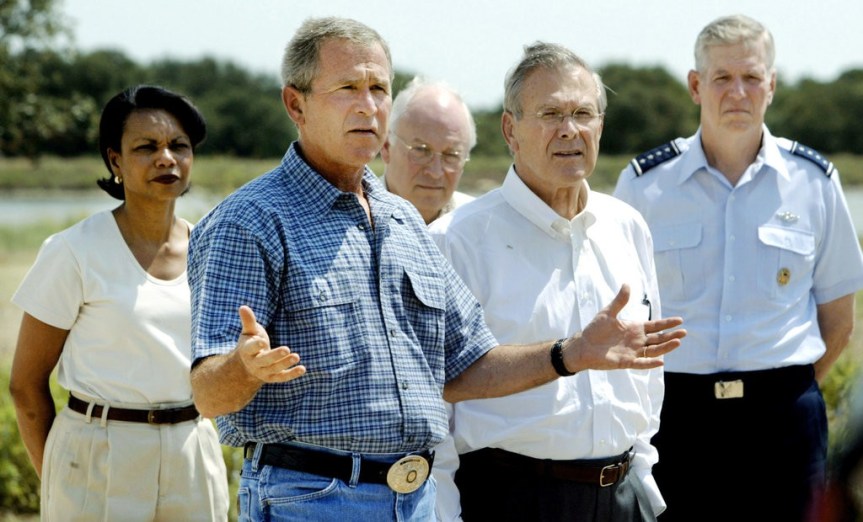
Look at Bush at his “ranch.” Look at that belt buckle! And you dare claim masculinity is in decline?
W.J. Astore
Is the American male dead? I’ve seen enough articles and books espousing a “war” on men and boys, amounting to a concerted attack on masculinity, to suggest that males are, if not dead, very much in decline in America, threatened by a “feminized” society that devalues manly virtues.
An article at the National Review, “Understanding the Inescapable Reality of Masculinity,” suggests that men as men have an “essential nature,” one that is “physical, aggressive, violent,” but that these traits are under attack as wider American society works to deny men their “inherent masculinity.” The article further argues there aren’t enough male role models in the lives of young boys – especially fathers and father-figures. This is a well-worn argument on the vital importance of the nuclear family with a man like Ward Cleaver in charge of it. There’s nothing wrong with that, except not all fathers are patient, kind, and intelligent mentors like Ward on “Leave it to Beaver.” Sadly, more than a few drive young boys to be aggressive and violent in selfish and dangerous ways.
Leaving that aside, it seems odd that this narrative of the decline of masculinity persists so strongly in Trump’s America. Now there’s a man! He’s physical, aggressive, unafraid to boast of pussy-grabbing or the size of his penis. He’s urged his followers at rallies to get physical with protesters. He supports torture and even hints at shooting immigrants as a rational “get tough” policy. Posing like Winston Churchill, he scowls and frowns in a simulacrum of manly determination. If the president is America’s chief role model, Trump’s doing his best to project masculinity as he understands it.
Indeed, you might argue Trump won the presidency in part because of his unapologetic “masculine” posing. Contrast this to Hillary Clinton, often portrayed as a “ball-buster,” an emasculating female. (Indeed, I had a Hillary nutcracker, a novelty gift from a friend.) Male voters (joined by a majority of White women) in 2016, perhaps looking for a “real” man to vote for and turned off by an alleged nut-cracking harridan, broke for Trump.
Trump’s win—and continued tolerance of his bullying, boastful, and bellicose manner—give the lie to the decline of masculinity narrative in America. Why does it persist, then? Because it’s yet another way to divide us. Consider similar narratives of an alleged war on Christianity, or that higher education is driven by hegemonic liberal/leftist agendas. In fact, Christianity is more powerful than ever in America—just look at Mike Pence and the influence of evangelicals in the U.S. government—and higher education is increasingly about serving the needs of business, industry, and the military-industrial complex.
But truth is unimportant when the object is stirring up divisiveness. Tell American men they’re threatened: that radical feminists, effete city dwellers, Ivy League elites, and other disreputable elements are out to get them. Then urge “threatened” males to vote for retrograde (fake) tough guys like Trump. It may not be the most subtle tactic, but it works.
In this narrative, masculinity is defined in “can-do,” action-oriented ways. Man as Alpha male, as doer, as fighter, whether in a bad way (as a killer) or in a good way (as a protector). It’s warrior-and empire-friendly. And indeed U.S. foreign policy today is distinctly masculine, with loads of emphasis on domination, on bossing other peoples around, simply because we’re bigger and badder than them.
What’s truly worrisome is not false narratives about masculinity’s decline but how it’s narrowly defined in violent and aggressive ways. We forget that macho posturing by America’s “leaders” has created enormous problems. Just think of George W. Bush and all his macho strutting before and during the Iraq war.
America needs fewer calls about putting on “big boy” pants and more emphasis on engaging in negotiation and diplomacy, along with action to end America’s chaotic and unwinnable wars. America is already carrying a big stick. It can afford to speak softly instead of shouting.
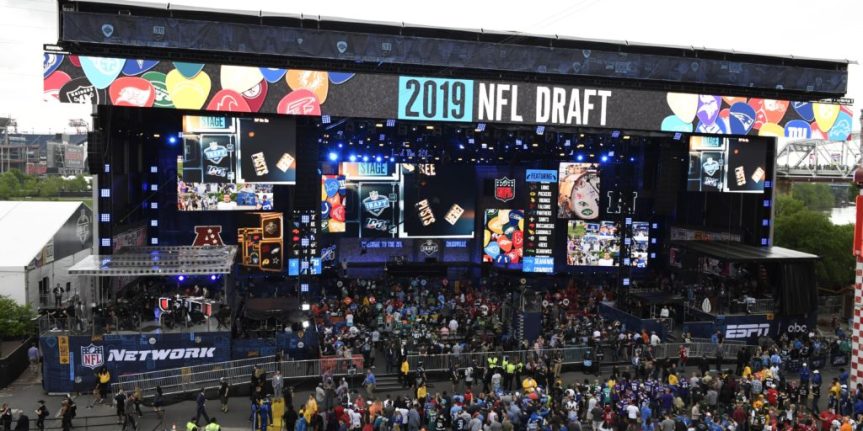
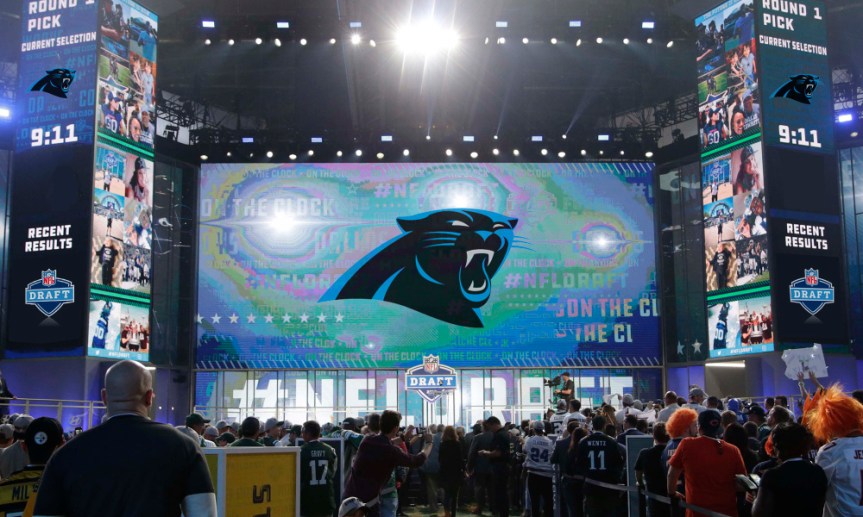
Every year, I watch a little of the NFL draft, one of America’s most revealing cultural displays. This year the draft was held in Nashville over two nights and one day. The NFL claimed 200,000 people showed up in Nashville for the draft, and indeed the outdoor audience resembled a mass political rally. Video boards and celebrities were everywhere. Last year, I wrote about the draft here, and so I won’t repeat those arguments. Suffice to say the draft is a massive commercial for the NFL and a massive exercise in nationalism.
Of course, the NFL is at pains to celebrate the military, and the military is at pains to boost recruitment, which lately has been disappointing. So predictably there was a prominent pro-military display during the draft. Early in the third round of the draft, there was a pause in the “auctioneering” of the athletes. Nine troops walked out in dress uniform: three Marines, two soldiers, two sailors, and two airmen. They stood at attention as the rally members chanted “USA! USA!” Then Lee Greenwood’s anthem came on: “God Bless the USA.” And the assembled masses sang along.
It was an exercise in pure, unadulterated, propaganda. “Proud to be an American,” indeed!
Last August, I wrote about sports and the military for TomDispatch.com, where I quoted this telling observation by Norman Mailer, which he made prior to the Iraq War in 2003:
“The dire prospect that opens, therefore, is that America is going to become a mega-banana republic where the army will have more and more importance in Americans’ lives… [D]emocracy is the special condition — a condition we will be called upon to defend in the coming years. That will be enormously difficult because the combination of the corporation, the military, and the complete investiture of the flag with mass spectator sports has set up a pre-fascistic atmosphere in America already.”
A pre-fascistic atmosphere: a mass rally of 200,000 fans (fanatics?), applauding troops in uniform and singing about how proud they are to be Americans, where at least they know they’re free, as college athletes get auctioned off to NFL mega-millionaire and billionaire owners, all captured on gigantic video boards on prime-time television. Talk about making America great again!
Speaking of the Donald, Trump naturally had to get involved with the draft. One pro-Trump player who was drafted (Nick Bosa) had criticized ex-NFL quarterback Colin Kaepernick, who had taken a knee at several games to raise consciousness of violence against blacks. Bosa had tweeted various insults against Kaepernick, calling him “Crappernick” and “a clown.” Trump, showing his usual leadership skills, urged Bosa in a tweet to “always stay true to yourself,” concluding “MAKE AMERICA GREAT AGAIN!”
Ah, “greatness” has so many different meanings, does it not? But something tells me America’s founders didn’t think “greatness” resided in the conjunction of sports, the military, corporations, and jingoistic shouts of “USA! USA!”
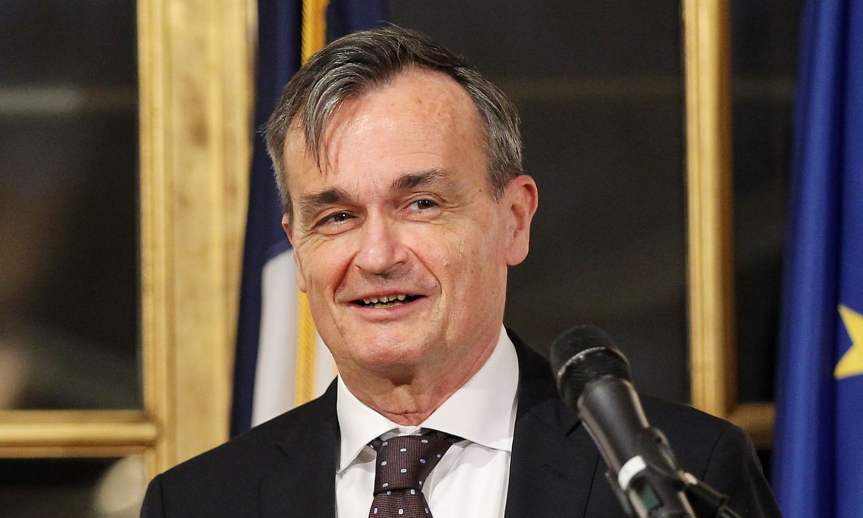
French Ambassador Araud: Like Louis XIV, Trump believes he is the state.
W.J. Astore
The redacted Mueller Report is out, and there’s plenty of evidence that President Trump attempted to obstruct the investigation, which he saw as a partisan “witch hunt.” Indeed, Trump was saved by his aides, who refused to follow his orders to impede the investigation and to fire Robert Mueller. Predictably, Republicans still support Trump, whereas prominent Democrats like Elizabeth Warren are calling for impeachment.
Should Trump be impeached? No, I don’t think so.
I’m no fan of Trump. I think he disqualified himself as a candidate in 2016 when he said he’d issue illegal orders to the U.S. military, which his generals would be obliged to follow. Trump is not a public servant; in fact, he’s not much of a leader, period. His basic instinct is to divide and conquer. He looks for toadies and yes-men. He cares little for anyone but himself and his immediate family. He’s a master of regressive politics, a fomenter of discord. His idea of justice is everything for Trump.
In sum, I don’t reject impeachment because I favor Trump. I reject impeachment since the process will consume Congress and the country.
We have much higher priorities to address in America. People are hurting. Congress should focus (for once!) on helping ordinary people, not chasing Trump down various rabbit holes.
The outgoing French ambassador to the U.S. put it well in a recent interview. Comparing Trump to Louis XIV, Ambassador Araud said “You have an old king, a bit whimsical, unpredictable, uninformed, but he wants to be the one deciding.” Part of his act is to humiliate his subordinates as a way of showing his “mastery” of them. He saves his admiration for other “strong men” like Vladimir Putin and Kim Jong-un. That’s who Trump is.
Trump’s an awful president. But impeachment won’t kill him — it will likely make him stronger. Put differently, Trump has already been convicted in the court of public opinion. Even some of his followers recognize that Trump’s a con man who can’t be trusted. The point is not to remove him via impeachment, but to defeat him in 2020 by offering a progressive vision rather than a regressive one.
Focus on helping the American people, Congress. Leave the “old king” to his ignorance and whimsies.
Give me five minutes, and I can tell you exactly what Bernie Sanders believes in. Single-payer health care for all. A $15 minimum wage. Higher taxes on the richest Americans. College education that doesn’t bankrupt families and leave students with crushing debt. Criminal justice reform. Investment in infrastructure and renewable energy. He gives specifics, and he’s walked a principled walk for decades.
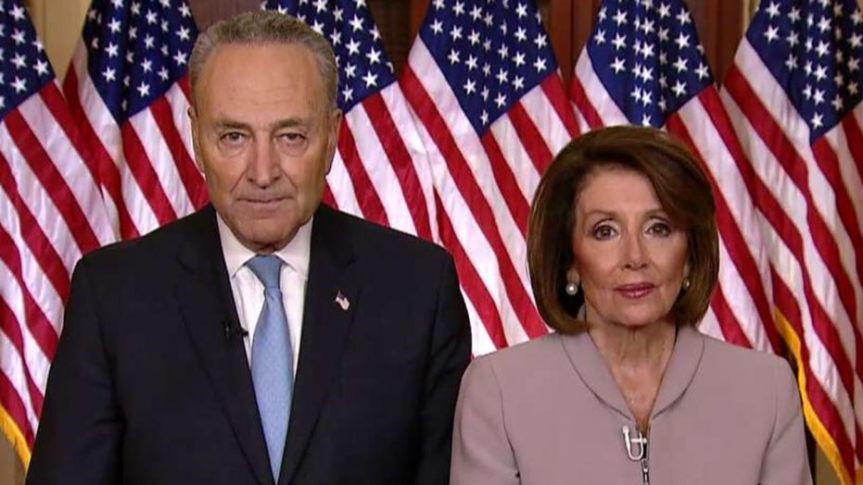
But what does the Democratic Partly leadership believe in? As this article at Truthdig put it, “Nancy Pelosi Believes In Nothing.” Of course, she does believe in something: her own power and privilege, which she seeks to maintain and expand. But principles like those held by Bernie Sanders? Forget about it.
I’ve been reading Matt Taibbi’s “The Great Derangement,” a terrific book that came out in 2008, and Taibbi nails it in this passage (pages 243-4):
The Democrats’ error was in believing that people wouldn’t notice this basic truth [that the party’s ideology is driven by power and nothing more] about their priorities. They were wrong on that score. In fact, a Quinnipiac poll taken around that time [2007] found the approval rating of Congress had fallen to 23 percent. Other polls saw the number plummet to the teens. The rating of the Democratic Congress was even lower than [George W.] Bush’s, and it was not hard to see why. Bush was wrong and insane, but he stood for something. It was a fucked-up something, but it was something. The Democrats stood for nothing; they viewed their own constituents as problems to be handled, and even casual voters were beginning to see this.
If you substitute Trump’s name for Bush’s in the above quotation, it makes even more sense. “[Trump] was wrong and insane, but he stood for something. It was a fucked-up something, but it was something.”
This is the biggest issue for corporate Democrats: What do you stand for? For so many in the establishment, what they stand for is themselves. The perpetuation of their own power and privilege. This is the biggest reason why Hillary Clinton lost in 2016. It was always all about her.
Another quotation from Matt Taibbi made me laugh out loud even as I winced at the harsh truth of it (page 190):
You don’t elect politicians to commit crimes; you elect politicians to make your crimes legal. That is the whole purpose of the racket of government.
In this case, the “you” in question are all the banks, corporations, and other vested interests that essentially buy our politicians. Until we get big money out of politics, this corruption will persist.
Bernie Sanders doesn’t take corporate money. Neither does Tulsi Gabbard. But most of the current batch of Democratic candidates for president in 2020 do take money from big corporate and financial donors. And that should tell you what they believe in: their own power and privilege, and little else.
Speaking of Bernie Sanders, I recently read a depressing article in the Nation by Eric Alterman who argued Bernie can’t win in 2020. Why? Supposedly because Americans won’t elect a socialist, and also because Trump and the Republican attack machine will convince Americans he’s simply too radical.
WTF? Americans are desperate for leaders who believe in something rather than nothing. That’s why Trump won in 2016. Again, in the spirit of Taibbi, Trump may be batshit crazy, but he does take a stand, e.g. “Build the wall.” The best way to defeat Trump in 2020 is to go bold: to nominate a candidate with strong core beliefs. A candidate who connects with young and old and who inspires enthusiastic participation. That’s Bernie.
But perhaps Jimmy Dore, the comedian/political commentator, is right: establishment Democrats like Pelosi would rather defeat Progressives like Bernie Sanders than win the presidential election against Trump in 2020. Because if Trump wins, they can continue to serve (and profit from) corporate interests while posing as being anti-Trump, i.e. they can continue life as they know it, with all the power and privilege that comes with it.
As my wife quipped today, “They don’t let their beliefs get in their way, do they?” Which is another way of saying they really have no beliefs at all.
The Mueller Report has finally landed, not with a thud, but with a whisper. No collusion. No more indictments. Inconclusive evidence of obstruction of justice.
Readers of Bracing Views won’t be surprised. Back in February 2017, Mike Murry wrote an article for this site (Get Another Goat) in which he explained the inept methods and bizarre mentality of establishment Democrats in blaming Putin and the Russians rather than themselves for losing to a two-bit con man:
At any rate, it appears as if the defeated Democrats have chosen Russian President Putin as an attractive scapegoat simply due to (1) his “foreignness” and (2) the nature of transferred nationalism. This psychological transference, Orwell wrote, “has an important function. … It makes it possible for [the nationalist] to be much more nationalistic – more vulgar, more silly, more malignant, more dishonest – than he [or she] could ever be on behalf of [their] native country, or any unit of which [they] had real knowledge” …
it seems like a monumental waste of time, energy, and limited American attention span for the Democrats to scapegoat President Putin for their own stupidity, arrogance, and insensitivity to their party’s traditional base.
Echoing Mike Murry, it has indeed been “a monumental waste of time, energy, and limited American attention span” to connect Trump’s victory in 2016 to an organized campaign of collusion with Russia. Mainstream networks like MSNBC and high-profile reporters like Rachel Maddow have spent the last 2+ years pushing the narrative of collusion and even treason when they could have been attacking Trump and his administration for its specific policies and decisions that hurt ordinary Americans. By pushing the collusion/treason narrative and coming up empty, they’ve only made Trump stronger as he prepares to run for reelection in 2020.
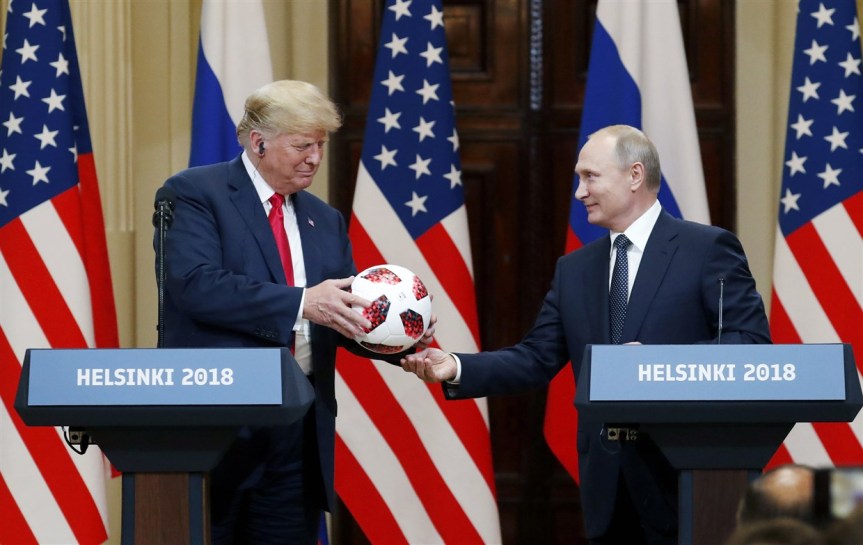
As I wrote here in July of 2018, it’s a fundamental misunderstanding of Trump to accuse him of being a “puppet” because he’s incapable of serving anyone but himself:
Consider the accusations of Russian meddling in the 2016 presidential election. Trump is never going to side with his intelligence agencies on this issue. He thinks that, by doing so, he’d be admitting that maybe he didn’t win fair and square over “Crooked Hillary.” He refuses to countenance Russian meddling, not because he’s a Putin stooge, but rather because he’s an egomaniac. He’ll admit to nothing that diminishes, however slightly, his victory — and his ego.
Russia doesn’t matter to Trump. Indeed, America doesn’t matter to Trump. With Trump, it’s really all about him… Trump lives in his own reality, a narcissistic swirl of fabrications, falsehoods, and lies. He’s happiest when he’s commanding the scene, when people are kowtowing to him, when he can boast about himself and advertise his businesses…
In short, Trump is not treasonous. He simply has no concept of public service. He has no capacity to serve any cause other than himself.
Trump may be a blowhard, a bully, a braggart, a bigot, and a buffoon, but that doesn’t make him a “traitor” who “colluded” with Russia. By pushing a false narrative for 2+ years, establishment Democrats and the mainstream media have yet again colluded in their usual inept way to strengthen Trump while discrediting themselves.
Ordinary Americans looking for a little more safety and equity in their lives are, of course, the biggest losers.