The U.S. and Germany are currently discussing sending German Leopard 2 tanks to Ukraine. This is in addition to British Challenger 2 tanks. These weapons are needed so that Ukraine can take the offensive and evict Russian forces from Ukrainian territory, according to Andriy Yermak, head of the Ukrainian presidential administration.
Who knew that Cold War-era German Panzers would possibly meet their Soviet counterparts in a clash of armor featuring Ukraine against Russia? I don’t think anyone predicted that scenario forty years ago.
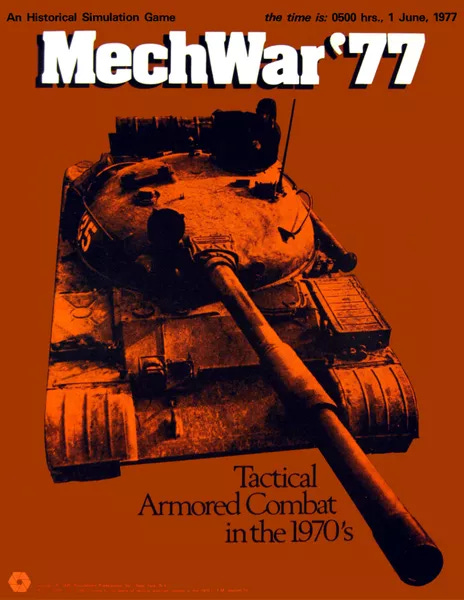
In fact, as a teenager in the 1970s, I played war games such as “MechWar ‘77,” which envisioned a massive Soviet armored thrust into West Germany countered by NATO armored forces consisting primarily of German and U.S. tanks. You know, the good old days.
In “MechWar ‘23,” it’s now possible that German- and British-made tanks, crewed by Ukrainians, will face their Soviet/Russian counterparts in heated combat. The Germans, considering the legacy of Panzers in Russian and Ukrainian territory in World War II, are understandably reluctant to send tanks to Ukraine to kill Russians. The historical echoes here are more than faintly disturbing.
As the U.S. and NATO keep sending heavier and more powerful offensive weaponry to Ukraine, the dangers of escalation continue to creep upwards. So too do the ambitions of those involved. What started in the West as an allegedly limited effort to help Ukraine defend its soil against Russian attacks is rapidly becoming a full-fledged war to roll back Russian forces not only in Ukraine but also in the Crimea.
Again, what could possibly go wrong in MechWar ‘23?
U.S. foreign policy is a place where logic goes to die.
Antony Blinken, the U.S. Secretary of State, said yesterday that the quickest way to end the Russia-Ukraine War is “to give Ukraine a strong hand on the battlefield,” by which he meant more and more weaponry, including Bradley Infantry Fighting Vehicles and Patriot missile systems together with Challenger II tanks from Great Britain. Not surprisingly, then, the White House also hinted at yet another aid package for Ukraine, which may be announced “as soon as the end of this week.”
A “strong hand” for Ukraine?
Logic suggests the quickest way to end a war is to stop fighting. Announce a cease fire, negotiate, and find acceptable terms for an armistice or peace treaty. Stop the killing—stop the war.
Of course, the U.S. State Department is really a tiny branch of the Pentagon. It’s been that way for decades. The Pentagon budget, $858 billion for this year, is 14 times greater than the State Department’s at $60 billion. It often seems that a primary mission of the State Department is to market and sell U.S. weaponry overseas. Small wonder that Blinken sees more deadly weaponry in Ukraine as the answer to ending a catastrophic war.
In a way, Blinken’s blinkered thinking is typically American. What’s the quickest way to end a war on crime? A drug war? Or almost any other problem in America? Obviously, more guns, more security cameras, more metal detectors, more body armor, and so on. Think about our “solutions” to gun violence in schools, which include armored backpacks for eight-year-olds and semi-automatic pistols for teachers. Too many Americans look to guns as a “solution” to life’s problems; count Blinken among the gun-lovers, at least when it’s in the form of U.S. arms exports.
While it’s true U.S. arms exports and aid may keep Ukraine from losing quickly, it’s highly unlikely these same weapons will help Ukraine to win quickly and decisively. Russia can and likely will match any escalation to this war, and at a cheaper price than the U.S. taxpayer is currently paying (now over $100 billion and rising).
Blinken’s bloodless language about war is also revealing. It’s all about giving Ukraine “a strong hand on the battlefield,” as if Ukraine and Russia are playing a polite game of poker. More weapons to Ukraine means more bloody death and destruction; attrition or even escalation is far more likely than a quick end in Ukraine’s favor.
Blinken probably knows this, but a large part of his intellectual training was spent at Harvard and Columbia Law, just as Jake Sullivan, his younger counterpart at the National Security Council, trained at Yale and Yale Law. These men aren’t stupid, they’re just narrowly trained and partisan functionaries willing to spout whatever the empire needs them to say in the cause of imperial hegemony.
And so U.S. lawyers continue to send guns and money to Ukraine, especially guns, while saying this is the best and quickest way for Ukraine to beat Putin and end the war with Russia. Logic, however, suggests more fighting and dying and a lack of decision for either side.
Best not confuse a “strong hand” with a dead man’s one.
In 2023, let’s embrace the Vulcan salute, not military ones
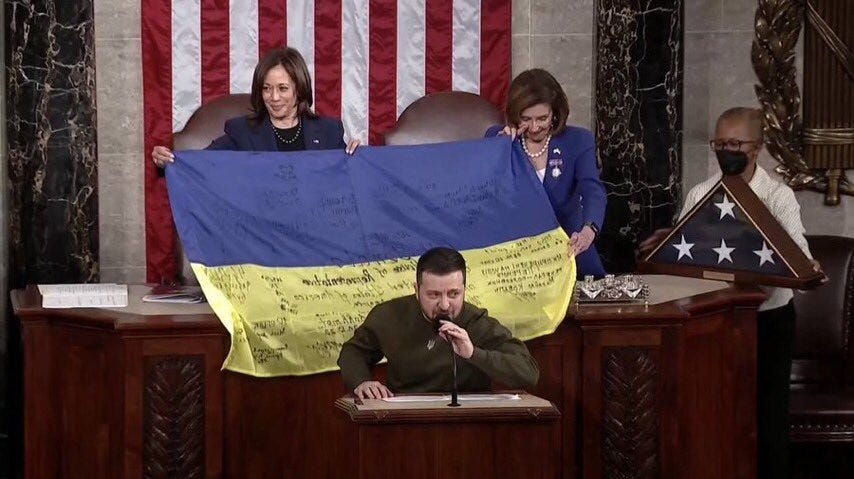
2022 has been the year of living dangerously. The Russia-Ukraine War escalated with no immediate end in sight. U.S. government officials, most notably the Democratic Party, have gotten behind Ukraine as if it’s the 51st American state. Aid to Ukraine, mainly in the form of weapons and other war materiel, has approached $100 billion in less than a year. Zelensky has been touted as a “wartime” leader akin to Winston Churchill and lionized before Congress. President Biden, meanwhile, has called for Putin to be removed from power, joined by Republican voices like Senator Lindsey Graham. Biden, with Armageddon on his mind, as in nuclear war, nevertheless persisted in rejecting calls for diplomatic efforts to end the war.
As we turn toward 2023, wars and rumors of war persist. Fear of possible Chinese moves against Taiwan helped drive a record Pentagon budget of $858 billion, $45 billion more than Joe “Armageddon” Biden requested. The Air Force requested 100 new B-21 nuclear bombers and hundreds of new Sentinel ICBMs at a projected cost of roughly $500 billion. That the Pentagon yet again failed an audit, its fifth failure in a row, is no reason to cut or even to control massive military spending, so Congress has collectively concluded.
The so-called leftist or liberal Democrats have emerged as America’s war party; Republicans, meanwhile, are torn between calling for yet higher military spending and trying to curtail military aid to Ukraine and runaway spending on “Ferrari” weapons systems like the F-35. No one of any prominence in either party is calling for peace and for serious reductions in spending on wars and weapons.
Show me your budget and I’ll tell you what you value, Biden once said. Obviously, the Washington elites value war and profits from the same. It’s an anti-democratic commitment that fosters greater authoritarianism and repression in the so-called homeland as well as abroad.
I wish I could say 2023 promises change. It doesn’t, at least not from our government and its leaders. The change will have to come from us.
I have an old polaroid from 1/1/1980. In that photo, I’m caught rendering the Vulcan gesture of welcome with a high school friend. Recently, I got together with another old friend and gave the same salute:
Your author, out in the wild
The message, of course, of the Vulcan salute is “Peace. Live long and prosper.” The Vulcans, those eminently logical aliens of “Star Trek” fame, did their best to change their warlike nature, adopting logic and emotional control in place of violence and mass murder. While I doubt America is prepared to adopt logic and emotional control en masse, surely we can find a way to cultivate peace. We have the means as well to “live long and prosper,” assuming we can ever stop wasting so much of our energy and efforts on war and weaponry.
There is much wisdom contained in the Vulcan salute. May we learn to embrace its message in 2023.
How about words of praise for “peacetime” presidents?
I caught only a couple of minutes of mainstream media coverage of the Zelensky visit, and I suppose that makes me lucky. In that brief period, I heard Zelensky described twice in positive terms as a “wartime” president. As if it’s a great thing to be the leader of Ukraine during a devastating war.
Remember when George W. Bush took a fancy to being described as a “wartime” president in the aftermath of 9/11? The mainstream media seems to fancy the term as well. What a wonderful, praiseworthy thing it is to be a wartime president! Look at how Zelensky dresses so simply, in olive drab, as if he just stepped out of a command post. What a guy.
War shouldn’t be a spectacle. Battle flags are far less impressive than flags of peace
When I caught that media coverage yesterday of Zelensky’s visit, which included a quick meet and greet with Joe and Jill Biden with Marine Corps guards saluting in the background, I was with my brother. My brother Stevie is mentally ill. But as I watched the coverage on TV, in my brother’s room, I reflected that he’s far saner than those media types gushing about war, and a far wiser and more honest soul than the so-called leaders I was watching at the White House.
There’s nothing like being a “wartime” leader that makes certain people gush. Obviously, many leaders love it too, since wartime grants them far more authority in the cause of waging and “winning” the war. And all this is treated as the height of sobriety and sanity within our war-crazed society.
When is the mainstream media going to praise our leaders for being peacetime presidents? Jesus Christ, after all, was the Prince of Peace. We need some princes of peace today. Then again, look what they did to Jesus.
It’s time for a Christmas truce followed by negotiation
Three articles related to the Russia-Ukraine War caught my attention today.
The first, at NBC News, argues that Patriot missile batteries are not enough to defend Ukraine. The article urges the U.S. to provide Gray Eagle drones to Ukraine to enable attacks deep into the interior of Russia, including most especially bases where strategic bombers are located. The subtitle to this article is especially provocative: “Western limitations on providing Kyiv with long-distance offensive capabilities are becoming nonsensical.”
Did you get that? It’s “nonsensical” to be concerned about providing offensive weaponry that would exert more escalatory pressure on this war.
The second article, also at NBC News, suggests that Ukraine in the near future may possess the military wherewithal to take Crimea from Russia. Some concern was expressed that Putin could respond with nuclear weapons if Russia’s hold on Crimea was threatened.
The third article from the British Guardian addresses recent Russian attacks on Kharkiv, as follows: “Kharkiv left without power, heating and water as Russian attack causes ‘colossal’ damage, says mayor. Ukraine’s second-largest city, Kharkiv, is without power, heating and water after Russian missile strikes on Friday morning caused ‘colossal’ damage to infrastructure, its mayor Ihor Terekhov said.”
What this all adds up to is a war that is growing increasingly dangerous and destructive not just for Ukraine and Russia but possibly for Europe and indeed the world.
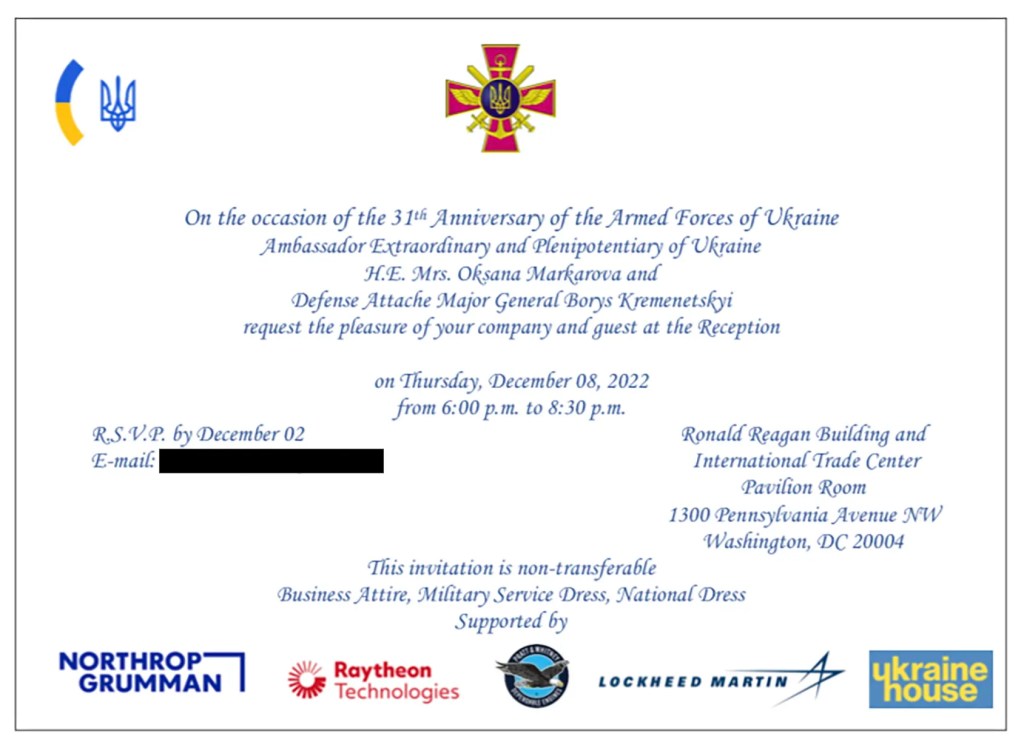
Meanwhile, a friend sent me this article from Vox about a recent party in Washington D.C. focused on Ukraine and the war. The party’s invitations were sponsored by major U.S. weapons contractors, in this case Northrop Grumman, Raytheon, and Lockheed Martin.
Invitation obtained by Vox for a party supported by big hitters in the military-industrial complex
Strangely, I heartily approve of this invitation because the sponsors are, for once, obvious. Can’t say that I blame the corporations: they know a great opportunity when they see it.
What Russia and Ukraine need are not more pressures to escalate but more reasons to talk, to negotiate, to put an end to this war before it truly runs out of control.
Unfortunately, many people in the U.S. see more weaponry as the answer. One thing is certain: you won’t get an argument on that from those “supporters” listed on the invitation above.
Can we not, as Vera Brittain argued, find the courage to end these cycles of vengeance and violence? We must learn to say “no” to killing. “No” to war. In that spirit, I signed a declaration calling for a Christmas truce in Ukraine. Here’s an article from Codepink on the effort.
Here’s hoping for a Christmas truce that gains traction.
Zelensky is no Chamberlain; talking is not appeasement
A fascinating aspect of the Russia-Ukraine War is the argument that negotiation would be unwise, especially if Ukraine were to initiate it. Typical arguments include that you can’t negotiate with a dictator like Putin, that negotiation would be a sign of weakness and would somehow reward Putin for his invasion, and that negotiation is ipso facto appeasement that would lead to further (and much wider) Russian attacks. All these arguments are faulty.
First, my pro-Ukrainian friends tell me that Ukraine is winning the war and therefore resolution will come with total victory at the front. Perhaps so, but fortunes of war often prove fickle. If indeed Ukraine has a winning edge, what better time to negotiate? It’s always preferable to negotiate from a position of strength, so now is the time, assuming Putin is amenable. What’s to be lost by asking?
Second, negotiation, again from a position of strength, is the very opposite of appeasement. When Neville Chamberlain infamously negotiated with Adolf Hitler in 1938, he was doing so from a position of relative weakness. Nazi Germany was rearming and mobilizing for World War II, and Great Britain and its allies were very much behind. Hitler, of course, lied that territory in Czechoslovakia was his “last demand,” but few in the know were truly fooled about the danger Hitler and the German military represented. Still, Chamberlain hoped that a viable treaty to prevent war was possible, even as Britain and its allies began in earnest to prepare for war as the “peace” deal was being struck.
Interestingly, Hitler didn’t see Chamberlain’s “appeasement” as a victory. He was livid. Hitler wanted to go to war in 1938. The deal Hitler struck delayed his attack on Poland until September of 1939. By the time Germany attacked Britain and France in May of 1940, the British were better prepared, materially and mentally, to resist Hitler. (The shockingly quick fall of France is another story entirely.)
One could argue that Chamberlain’s failed appeasement delayed Hitler’s war plans to an extent that ultimately favored eventual allied victory. Hitler was, after all, decisively defeated five years after he launched his invasion of France. And, after Hitler betrayed his promises to Chamberlain, there was no doubt whatsoever among the allies that military victory was the only way to end the Nazi threat.
My point is that even Chamberlain’s dreadful “appeasement” wasn’t quite as bad as we’re so often told. More importantly to this moment: No one mistakes Zelensky and his soldier-like image for Chamberlain with his umbrella. Again, Zelensky and Ukraine have fought well; their resistance has been steadfast. Why not negotiate? Ukraine may win more at the negotiating table than it ever could on the battlefield, while sparing the lives of countless Ukrainian (and Russian) troops.
Third, another argument I’ve heard is that, if the war ends by negotiation, Putin and Russia will just reinvade after a period of rest and rearming. Anything is possible, but why would Putin relaunch a war that’s already proven to be a quagmire? And won’t Ukraine also use the time to rest and rearm, with plenty of help from the U.S. and NATO?
Wars don’t have to end in total victory or total defeat. One side doesn’t have to collapse in exhaustion or to flee ignominiously. Wars can be ended by negotiation if both parties are open to compromise. Temper tantrums at the negotiating table are better than more bullets and bombs and bodies.
Ukraine and Russia share a long border and a tempestuous history. They need to learn to live together, else they will surely die together, as they are now. Why not talk and choose life over more death?
A blank check of support is often a dangerous thing, especially in war
Remarkably, U.S. aid to Ukraine may soon exceed $100 billion if the Biden administration’s latest ask is approved. And more than a few Americans believe Ukraine merits this vast sum—and more.
They argue the Ukraine war is a necessary one and applaud the Biden administration for taking a firm stance against Russian aggression. They see Putin as a dangerous dictator who seeks to revive a Russian empire at the expense of Europe, and they wholeheartedly approve of U.S. and NATO military aid. They argue Ukraine is winning the war and that, once the war is won, Ukraine should be invited to join NATO. They see NATO as a benign presence and dismiss Russian concerns that NATO expansion is in any way provocative. And they see negotiation with Putin as at best premature and at worst as rewarding Putin for his Hitlerian aggression.
My stance is different. Yes, I denounce Putin’s invasion of Ukraine and hope that he loses, but I’d prefer to see a negotiated settlement. The longer the war lasts, the more people die, Russian and Ukrainian, and the greater the chance of miscalculationfollowed by escalation, possibly even to nuclear weapons.
I don’t think the U.S. government cares a whit about defending democracy in Ukraine; heck, it barely defends democracy in America. I think the government and specifically the MICC (military-industrial-congressional complex) has several goals:
1. To weaken Russia militarily and economically via what some term a proxy war.
2. To sell more natural gas to Europe (hence the sabotage of the Nord Stream pipelines).
3. To sell massive amounts of weaponry to Ukraine.
4. To elevate Russia to an “evil empire” once again, ensuring higher Pentagon spending. Notice how there’s been no “peace dividend” in the aftermath of the Afghan War. Indeed, Pentagon budgets have soared since the Russian invasion.
5. To support the narrative of a new cold war against Russia and China, ensuring even more spending on weapons and wars.
6. Finally, as Biden stated openly, the desire to effect regime change in Russia, i.e. the overthrow of Putin by his own people.
Again, I’m no Putin fan, and I truly wish he’d give up and withdraw his forces. But I very much doubt he’ll do that. It seems more likely that both sides, Ukraine and Russia, will continue launching missiles and drones at each other while the war escalates further. Consider recent reports of Ukrainian attacks on Russian barracks in the Crimea even as Russia targets infrastructure in Odesa.
So, while it’s true U.S. and NATO aid will keep Ukraine in the war, it’s also true Ukrainians and Russians will continue to suffer and die in a war that is already escalating in dangerous ways. It all has the makings of a far-reaching disaster, but what we’re encouraged to do is to ask no questions while flying the Ukrainian flag just below our American ones.
A blank check of support is often a dangerous thing, especially in war.
Tune In to War, Turn On to Heroes, Otherwise Drop Out
In 2010, I wrote an article for TomDispatch on “the new American isolationism.” I argued that Americans were being kept isolated from the horrific costs of the war on terror, rather than pursuing old-style isolationist policies to keep us out of war. Here’s how I opened that article:
“A new isolationism is metastasizing in the American body politic. At its heart lies not an urge to avoid war, but an urge to avoid contemplating the costs and realities of war. It sees war as having analgesic qualities — as lessening a collective feeling of impotence, a collective sense of fear and terror. Making war in the name of reducing terror serves this state of mind and helps to preserve it. Marked by a calculated estrangement from war’s horrific realities and mercenary purposes, the new isolationism magically turns an historic term on its head, for it keeps us in wars, rather than out of them.”
This is as true today as it was when I wrote it a dozen years ago. Americans are never encouraged to look at the ugly face of war, unless it involves alleged war crimes by “evildoers” like Russia. With Russia’s invasion of Ukraine, Americans have been encouraged to think about alleged mass rapes, mass murder, deliberate targeting of civilians, and the like. Alleged crimes by Ukraine, by comparison, are largely dismissed as Russian propaganda.
All wars produce atrocities because war itself is an atrocity. Tell me how constant artillery shelling won’t produce civilian casualties; tell me how bullets being sprayed everywhere, missiles being fired from a distance, explosive drones being employed, mines being planted, bombs being dropped: tell me how war won’t kill innocents. Tell me how war, in all its confusion and chaos, won’t produce “friendly fire” casualties. (Remember Pat Tillman?) Tell me how POWs won’t be mistreated by both sides, despite the Geneva Convention, or how civilian populations won’t be exploited in one way or another. War has always been recognized as a plague on humanity and civilization, which is why it should be the absolute last resort.
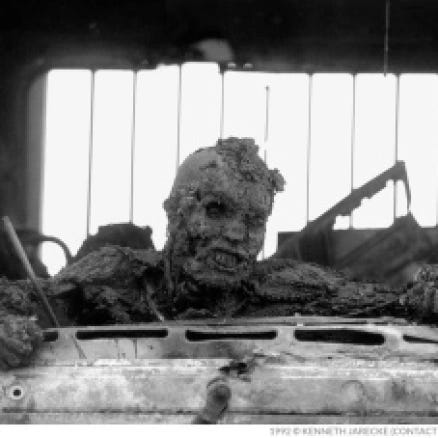
Yet far too often war is sold as necessary, even desirable, with heavy censorship accompanying it. Recall that in the Bush/Cheney years, as U.S. KIA (killed in action) figures rose, especially in Iraq, Americans weren’t allowed to see flag-draped caskets returning to our soil. Out of sight, out of mind, right? We were told to salute the generals and support “our” troops, but not to question Bush and Cheney’s wars and not to consider their horrific costs, certainly not to Iraqis and Afghans or other “foreigners.”
Grisly images like this one of a dead Iraqi soldier were not shown in America
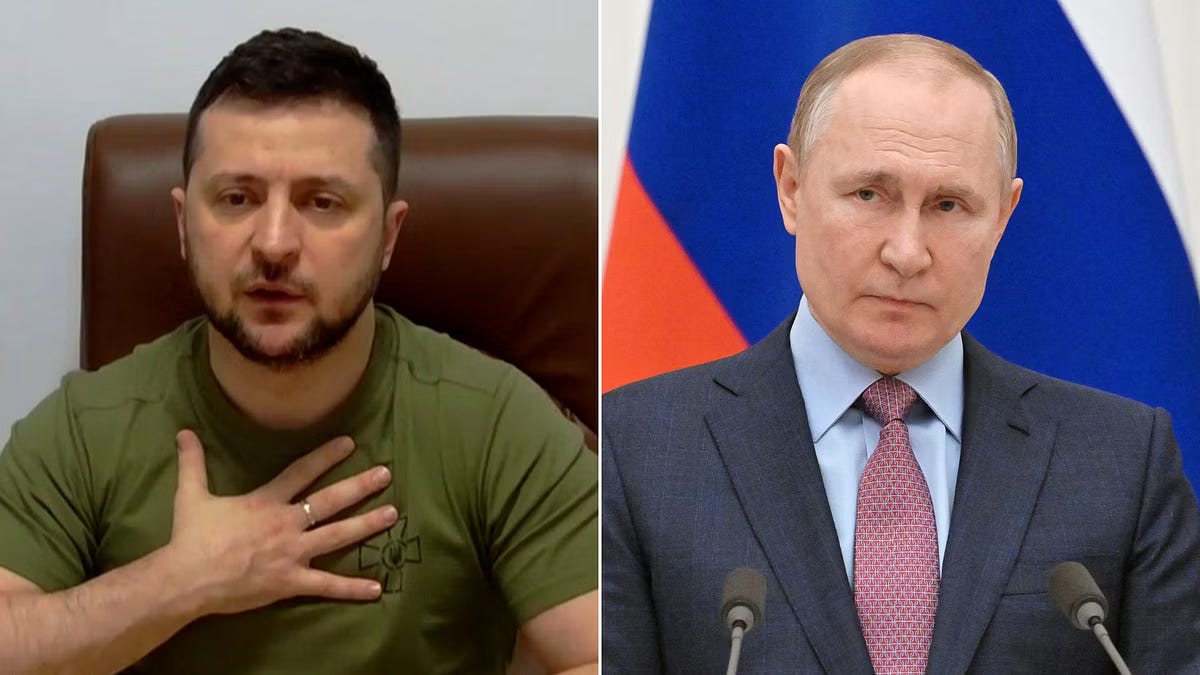
Today in America, Ukrainians are almost universally celebrated as the good guys, the Russians are bad, thus the more dead Russians the better. Not surprisingly, Ukraine’s leader is Time Magazine’s person of the year. He is a hero, Putin is the devil, and that’s all you need to know.
Demonizing an enemy is a dangerous thing, for how can you negotiate with the devil? It’s a surefire way of firing people up but also of prolonging a war, which means more destruction, more atrocities, and a lot more body bags. Yes, I want Russia to withdraw from Ukraine. Yes, I don’t want Putin to “win” in any sense of the word. But at what price total victory for Ukraine?
So I read passages that Ukraine must “push back” and “expel” the Russian invader and that all territory must be “won back.” Bloodless phrases that reduce war to something like a game of Risk, where troops are just counters on a game board, and where winning and losing is determined by a roll of the dice.
In actuality what expressions like these mean is perhaps another 100,000 Russian and Ukrainian troops killed and wounded; buildings and homes blasted; plants and animals obliterated by more human-caused destruction; water and the land itself poisoned.
Will it be worth it? Is there perhaps another way? Couldn’t Ukrainians and Russians come together to talk, to settle their differences, without more killing? How many more widows must be made, how many more children must be killed or left as orphans, in the cause of “victory”?
I’m told it’s not up to me to decide. I’m encouraged to support Time Magazine’s Person of the Year in his holy war against the evil Putin. But all I see is more and more dead bodies, even as more and more “Made in USA” weapons are sent to Ukraine to multiply the dead, even as my taxpayer dollars help to fund it.
And, once again, I am kept isolated from it all, physically of course but also mentally, encouraged to tune in to pro-Ukrainian war coverage, to turn on to heroic leaders like Zelensky, but otherwise to drop out of truly thinking about war and its horrendous costs as well as its escalatory pressures.
Ukrainian Attacks on Russia Are Dangerously Escalatory
Reports that Ukraine is launching modified drones to strike airbases deep in Russia highlight the unpredictability and escalatory nature of wars. Ukraine is no longer content at defending itself against Russian aggression; Russia itself must be made a target, which will likely provoke harsher Russian counterattacks. Meanwhile, the U.S. Congress continues to authorize billions in military aid to Ukraine, which is pitched as defending democracy and freedom.
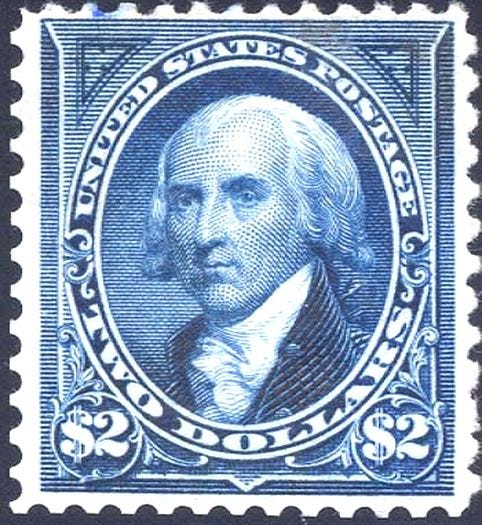
War is many things but it is rarely democratic. Indeed, as James Madison warned, war is inherently anti-democratic. It strengthens authoritarian forces and contributes to abuses of power and corruption. As the Russia-Ukraine War goes on, with no clear resolution in sight, Ukraine suffers more even as the chances of escalation rise.
James Madison warned that no nation can preserve its freedom in the midst of continual warfare
What’s needed now is resolute diplomacy — a committed effort to end the war by all parties involved, obviously Russia and Ukraine but also the U.S. and NATO. The longer this disastrous war lasts, the more unpredictable it will become, the more atrocious it will prove, and the more likely ordinary Ukrainians and Russians will suffer and die, whether at various battlefronts or on the homefront.
Negotiation is not weakness nor is it appeasement. Negotiation is sensible, rational, and life-affirming. But there’s little reason for Ukraine to negotiate when it’s enjoying a blank check of support from the U.S. and NATO.
Meanwhile, as Ukraine continues striking deep into Russia, one wonders to what extent the U.S. military and intelligence agencies are involved. Did the U.S. provide technology? Targeting information? Intelligence? Or is Ukraine doing this entirely on its own, a scenario that is less than comforting?
I sure hope the U.S. and Russia are talking. In the confusion and chaos of war, how is Russia to know for sure that an attack on one of their strategic air bases is coming from Ukraine and not from NATO territory? Even if it’s clearly coming from Ukraine, if these attacks are enabled or approved by the U.S./NATO, will the Russians see them as an act of war? Will they respond militarily, creating even more escalatory pressure?
Bizarrely, Ukraine’s defensive war against Russia has been sold as America’s “good” war, a chance to weaken Russia and Putin in the cause of defending Ukrainian “democracy.” But as Ukraine’s tactics turn more offensive, and as the Ukrainian government likely becomes more authoritarian due to the pressures of war, how wise is it for the United States to continue to send massive amounts of military aid there while discouraging diplomacy?
Policies that end in prolonging the Russia-Ukraine War in the name of teaching Putin a lesson and eroding his power may teach us all a lesson in how war is not just anti-democratic. War runs to extremes, and only fools believe they can control it in a way that is conducive to liberty and freedom and justice.
Whatever else it is, the Russia-Ukraine War is a major money-making opportunity
Warfare is welfare for the merchants of death. Consider the Russia-Ukraine War. In the name of Ukrainian liberation, the U.S. Congress is preparing to approve another $37.7 billion in mostly military aid, bringing the total to nearly $100 billion in less than a year. This remarkable sum represents roughly 5% of federal discretionary spending, nearly the same as what the federal government spent on education in America this year. So far, all Democrats in Congress have supported aid to Ukraine, with only a minority of Republicans objecting.
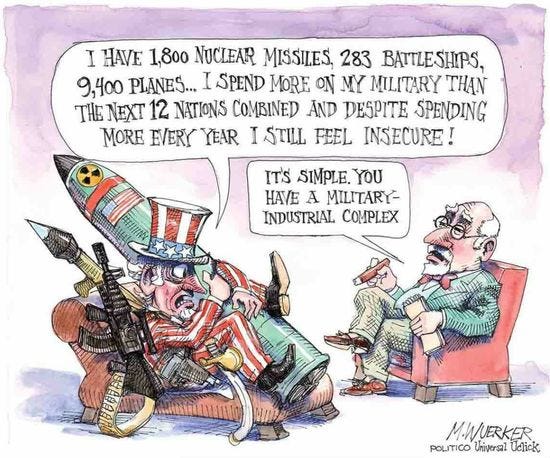
Why is this? America is fertile ground for anti-Russian sentiment, but that’s not the main reason. It’s all about the Benjamins, as war is always immensely profitable for some sectors of society. Recall that President Dwight D. Eisenhower warned us of the disastrous rise of misplaced power represented by the military-industrial-congressional complex (MICC). Congress is heavily influenced by weapons contractors, not only through campaign contributions but by the jobs in their districts tied to the production of weapons of all sorts.
In a refreshing burst of honesty from the 1930s, the U.S. Senate referred to weapons contractors as “merchants of death,” and so they are. Weapons, from mundane bullets and artillery shells to “sexy” stealth fighters like the wildly expensive F-35, are designed to kill our fellow human beings. That’s why Eisenhower famously said in 1953 that humans essentially crucify themselves on a cross of iron when they prioritize weapons building over hospitals, schools, and other necessities of a civilized life.
More and more money to the merchants of death ensures three things: more power to weapons contractors, higher profits for them, and in this particular case a lot more dead Russians and Ukrainians. Some Americans seem to think it’s all worth it, though I’m skeptical about Ukrainian liberation being an important goal to officials in Washington.
Ike exhibited basic common sense when he noted the MICC is fundamentally anti-democratic. That it threatened our liberties and democratic processes. He told us to take nothing for granted, and challenged us to remain alert and knowledgeable. For when you empower the MICC, you weaken democracy. You also choose death over life.
Whether it’s the Russia-Ukraine War or previous ones like Vietnam, Iraq, and Afghanistan, the MICC has been and is making a killing in America and indeed across the globe— and in more ways than one. And as Ike said, that’s no way of life at all.
What is to be done? We need to start by recognizing that the MICC is fundamentally anti-democratic, often wasteful, driven by greed, and consistent with imperialism of the worst sort. Again, I’m not really saying anything new here; Ike, a five-star general and two-term president, said the same almost 70 years ago. His sentiments were echoed by James Madison when Madison wrote in 1795 that a large standing military and incessant warfare were deadly to democracy and liberty.1 Yet wars continue to find a way, and the MICC continues to thrive and expand its reach and power.
To resort to Scripture, not only is the flesh weak in America when it comes to reining in war and weapons: so too is the spirit. The spirit is unwilling because we are saturated in war and violence. An imperial vision like “full-spectrum dominance” has come to dominate American culture and society. Too many people believe that freedom is best projected and protected through the barrel of a gun.
The words of Ike come to me again when he said that only Americans could truly hurt America. The primary dangers are within not without. In that spirit, Ike warned us about a danger within, the MICC. We would do well to heed his warning if we wish to preserve and strengthen the tree of liberty.
How best to heed his warning? With respect to the Russia-Ukraine War, stop sending weapons that drive more killing. Put more effort on diplomacy. With respect to America itself, abandon the concept of a “new cold war” with Russia and China. Recognize America’s strength instead of focusing incessantly on hypothetical weaknesses. Stop listening to the screech of war hawks. Invest in life instead of death. Start from a place of life-affirming confidence rather than of fear and doubt.
There’s a powerful scene in “Enemy at the Gates” about the Battle of Stalingrad where Soviet political officers are debating how to inspire the troops to fight to the last. The Soviets had been relying on fear, and indeed at Stalingrad Soviet units killed thousands of their own troops for “cowardice” in the face of the Nazi enemy. One commissar is brave enough to offer something other than fear and death. “Give them hope!” he cries. Hope that they can and would prevail against a ruthless enemy.
That’s what we need in America today, a lot less fear and a lot more hope.
Madison wrote that: “Of all the enemies of true liberty, war is, perhaps, the most to be dreaded, because it comprises and develops the germ of every other. War is the parent of armies; from these proceed debt and taxes; and armies, and debts, and taxes are the known instruments for bringing the many under the domination of the few. In war, too, the discretionary power of the Executive is extended; its influence in dealing out offices, honors and emoluments is multiplied; and all the means of seducing the minds, are added to those of subduing the force, of the people. The same malignant aspect in republicanism may be traced in the inequality of fortunes, and the opportunities of fraud, growing out of a state of war, and in the degeneracy of manner and of morals, engendered in both. No nation can preserve its freedom in the midst of continual warfare.”




 Bracing Views