U.S. presidents since Lyndon B. Johnson, if not before then (think here of Woodrow Wilson’s false promises in 1916 to keep America out of the Great War, known now as World War I), always promise peace, especially while running for office. Trump is the most recent example here. Yet whether Democrat or Republican, as soon as they become president, it’s war and more war. LBJ led America into the disastrous Vietnam War; Trump led America into the ongoing disaster of the Iran War; and the overseas wars just never seem to end, whether George W. Bush is issuing the orders or Barack Obama.
LBJ lacked the courage to resist the siren call of war
I had this thought as I re-read a comment from Mike Murry, a frequent Bracing Views contributor and an astute student of U.S. political and cultural history. Murry, a Vietnam War veteran, had this to say back in 2018:
Then, in the first semester of my senior hear in 1964, JFK’s successor as President: Lyndon Johnson, started his campaign for re-election, promising not to send us American boys to fight a war in Asia that Asian boys could fight themselves. He sounded just like Donald Trump did last year [January 2017], before assuming office. Johnson beat Goldwater in a landslide. The American people did not want another Korean War and made that overwhelmingly clear. But President Johnson betrayed us all, the way all U.S. Presidents now regularly do. Every one of them without exception preaches peace to win election. Then they invariably give their generals the wars that they demand. It happens every time. The stunning cynicism of that betrayal by President Johnson, I think, severed once and for all time any sense of “patriotism” that I might once have felt for the “America” of my youth. From that point on, I became an alien in my own land. My government would later send me abroad for the worst possible reasons, to do the most unnecessary and shameful of things. That same me never came home again. Someone else did. A damaged, but better man, I think. But much less an “American” one.
Today, the most important act to restore America is to end these needless and disastrous wars overseas. And not just overseas but here at home, as Trump promotes the malicious and mendacious notion of an enemy within, often labeled as the “radical left” with “terroristic” tendencies.
Nothing, I think, is more important to America’s health now and in the future than ending wars that waste so much, that kill and destroy so many, and that estrange our own citizen-soldiers from their country.
On a very warm and humid Sunday morning, here are a few random thoughts for today:
1. It’s rather amazing that the U.S./Israel War against Iran has entered its six month with no end in sight. Remember when the Trump administration suggested it would last no longer than eight weeks? The war is holding the world economy hostage, apparently for “greater Israel” and continued U.S. dominance of trade in fossil fuels. I say “apparently” because the war doesn’t make much sense to most Americans, who are in the main against it. The only selling point Trump keeps repeating is that Iran must not be allowed to have a nuclear weapon, even as Israel is allowed to have up to 300 of them. His own intelligence chief told Trump that Iran was not working to field a nuclear weapon, but the Israelis told him otherwise, and we know who Trump is most obeisant toward.
2. Patrick Lawrence has a great piece on the DSA, the Democratic Socialists of America, and how they want to abolish ICE and possibly the presidency itself while defunding the police, the Pentagon, and other instruments of authority and coercion. One sympathizes, but it’s neither a practical nor a winning political message. So I wrote this comment at his site:
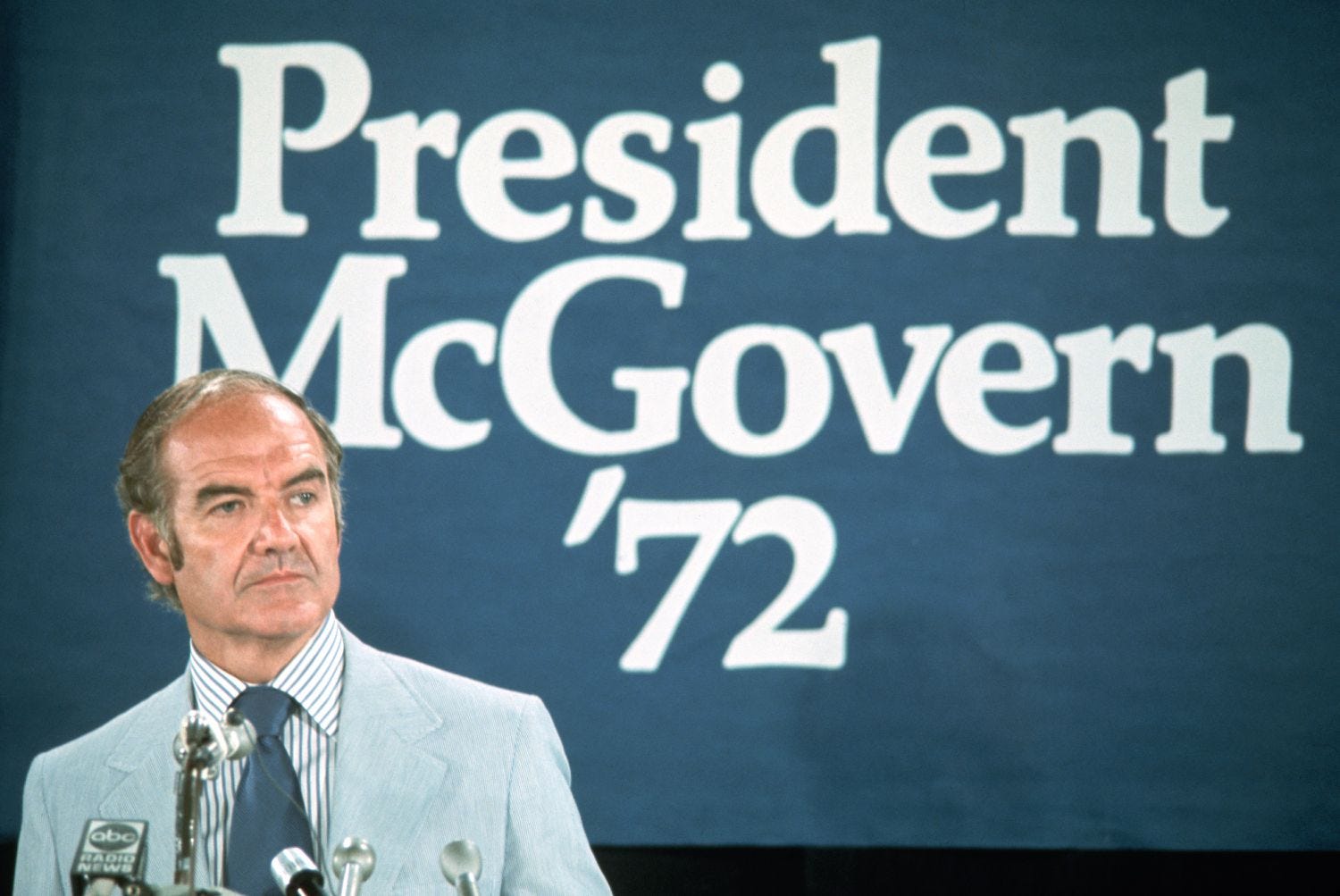
Echoing George McGovern, “Come home, America.” You can’t abolish or dismantle everything. But we can downsize the imperium and reinvest in America rather than “investing” in more wars and Zionist Israel.
If the DSA wants to make a contribution, it should focus on that — downsizing the empire, putting the American people first, rather than dreaming of abolishing everything. For what will replace it?
Make the lives of average Americans better, more affordable, more livable. Clean up our environment. And forget the magical thinking and empty posturing.
Come home, America. Come home from wanton, wasteful, and immoral wars.
3. I was breezing through “The Devil’s Dictionary” by Ambrose Bierce and stumbled on his acerbic definition of “Aborigines”:
1. Persons of little worth found cumbering the soil of a newly discovered country. They soon cease to cumber; they fertilize.
2. Considerate persons who will not trouble the lexicographer of the future to describe them.
Bierce, a veteran of the U.S. Civil War, didn’t mince words here. There are always “persons of little worth” to oppressors who’d prefer that they leave or die. What was true of aboriginal peoples of the 19th and early 20th centuries is true of the Palestinians today: they are seen as obstacles to be overcome, even as terrorists to be exterminated.
4. Antiwar forces in America remain fragmented, and that’s partly by design. To oversimplify, you have the so-called radical left, which is antiwar, sometimes anti-military, often as critical of America as it is of empire, versus the “unpatriotic” (to Trump) right, which is anti-dumb wars, generally pro-military, and animated by putting “America first.” Left and right have much in common: they want less war, less militarism, and more investment and support for Main Street USA. If they could combine, they would make a formidable force against the MICC and incessant warfare. Which is why each side is encouraged to distrust and even hate the other, i.e. the “radical left” is told the right is racist and reactionary and the “unpatriotic right” is told the left is woke, arrogant, and un-American.
The MICC and “Deep State” know that these two groups must be kept divided. They must never be allowed to cooperate in meaningful ways.
5. Ike said only an alert and knowledgeable citizenry could tame and reduce the anti-democratic forces unleashed by the MICC. Note how Ike said nothing about the left or right. Being for democracy, freedom, and liberty isn’t a right or left issue. The same applies to being against war and killing and massively wasteful military budgets. These are human issues that should unite everyone irrespective of political allegiances.
Caveat: Any foolishness written above is on account of the heat, but fortunately I’ve been told global warming is a Chinese hoax. Stay cool, everyone.
Extractive capitalism is the economic model for the United States.
We’ve been living through a brutal experiment of how much work and wealth can be extracted from the working- and middle classes and funneled upward before the former are exhausted. The same brutal experiment is being inflicted on Mother Earth: how much lithium, gold, fossil fuels, strategic metals and minerals, even drinking water can be commodified and extracted before the earth itself is exhausted.
It’s a gusher up, trickle down system where almost all the profit is absorbed by corporations and the oligarchs. It’s a system we’re told that’s inevitable—the best possible system, the most efficient, market-driven, a reflection of the “genius” of men like Jeff Bezos and Elon Musk. And it is indeed a reflection of those men—and their boundless greed.
It’s truly amazing how much wealth is being extracted from workers. The tax code targets wages more than capital gains. Inflation (gas, groceries, and other essentials) cuts into largely fixed incomes. Health care costs continue to rise and are the leading cause of personal bankruptcies. Higher education often leads to onerous student debt that cannot be discharged through personal bankruptcy. Workers are bombarded with ads to bet money on sports using apps on their phones. Lottery tickets are everywhere, selling the dream of a financial windfall at very long odds. Expensive prescription drugs are sold as a solution to excessive weight and even to addiction to other drugs such as opioids.
The term “debt slavery” describes the status of many Americans; they own so little, not their houses (assuming they can afford one), not their cars and trucks, in some cases not even their furniture.
Productive capitalism is possible. So too is a “share the wealth” system centered on communal health rather than the greed of billionaires. But we are fed constant BS that “lifestyles of the rich and famous” are what we should all aspire toward.
How long a top-heavy system of extractive capitalism can last before it collapses under the weight of its own greed and waste is an experiment we’re currently conducting. What will come after the collapse is unknown.
To me, it seems the idea of a social contract is dead. America’s oligarchs and corporations are driven by profit margins, and workers’ jobs are being ruthlessly curtailed or eliminated in the process. AI is being pushed largely to make salaried employees redundant. Who needs people when machines can perform the same function, even if the machines are limited and only as reliable as their (faulty) programming?
Corporations say they exist to maximize shareholder value. Billionaires say they deserve all the money they can extract because they are the “makers” and creators (the rest of us, of course, are takers and drones). They owe us (the little people) nothing, so they say, and if we complain, we are told to work harder toward the American dream, even if it takes three jobs, none of which may provide health care benefits.
Small wonder that the American people want a different system; small wonder we are so heavily propagandized against anything that smacks of “communism” or even democratic socialism.
It’s laughable that Trump and Company sell communism (!) as a leading threat to America when it’s so obviously extractive capitalism that threatens to bury us. Meanwhile, extractive capitalism is protected (and accelerated) by unbridled U.S. militarism as the Pentagon’s budget soars to $1.5 trillion (or higher) in FY2027.
A militant extractive system is very good for a few at the expense of a great many. I suppose this is why my dad warned me that “the rich get richer and the poor poorer” and that tough times were ahead that might rival his experience of surviving the Great Depression in the 1930s.
I don’t know if it’s too late to change course. Whether we’ve already hit the iceberg and are just fighting over the lifeboats as the ship of state goes down remains to be seen. America, I like to think, still has the potential to rally. What is so deeply frustrating is that we’re being led by rogues and villains who seek to keep us in steerage even as they dance in the ballroom.
And when the ship finally slips beneath the waves, they won’t be onboard, dressed in their best while waiting for their demise. They will be long gone, motoring away on their luxury yachts.
Note to Readers: The short essay below represents a joint effort of the Eisenhower Media Network, or EMN, an organization of former military and government officials who seek a wiser course for America and a more peaceful world. I’ve been a member since EMN’s founding.
In Common Sense, Thomas Paine challenged Americans to question an institution that had long seemed beyond challenge. He wrote, “A long habit of not thinking a thing wrong gives it a superficial appearance of being right.” Two hundred and fifty years later, those words apply just as well to America’s defense budget. What has become accepted through habit is neither sustainable nor accountable. Only the American people can change it.
The “defense of custom” now comes from the Military-Industrial-Congressional Complex that President Dwight Eisenhower warned against in his farewell address. Years earlier, in his famous “Cross of Iron” speech, Eisenhower observed: “Every gun that is made, every warship launched, every rocket fired signifies, in the final sense, a theft from those who hunger and are not fed… Under the cloud of threatening war, it is humanity hanging from a cross of iron.”
More than seventy years later, Eisenhower’s warning has become reality. The United States spends more on its military than the next eight countries combined, most of them allies, while millions of Americans struggle with the costs of health care, child care, education, and housing.
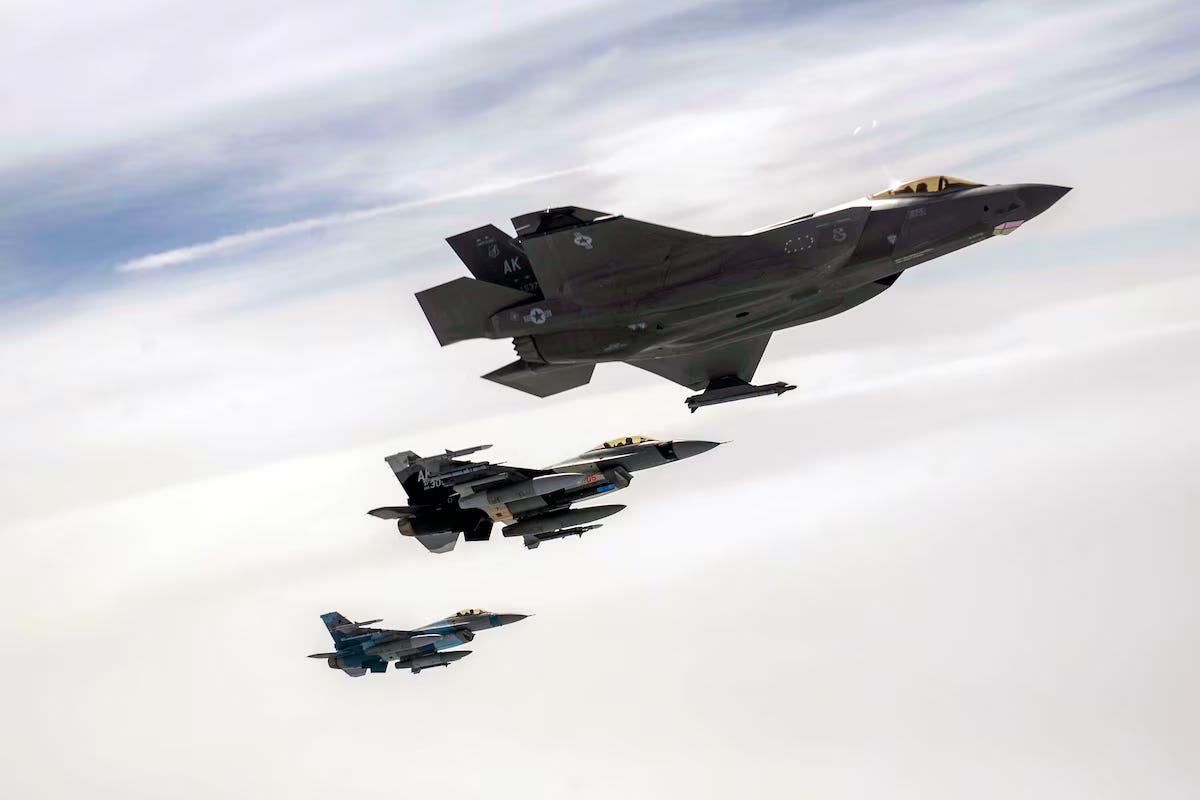
The Military-Industrial-Congressional Complex thrives by portraying every international challenge as justification for ever-larger Pentagon budgets. Defense contractors finance political campaigns and employ armies of lobbyists who help shape the annual National Defense Authorization Act. Taxpayer dollars then flow back into executive compensation, shareholder dividends, stock buybacks, and continued political influence, creating a self-perpetuating cycle that rewards corporate profits rather than national security. Even maintenance contracts are often structured so that only the original contractor can repair the equipment, locking taxpayers into decades of additional costs. The troubled F-35 fighter program—billions over budget, years behind schedule, and only partially mission capable—has become a symbol of this dysfunction.
An Air Force general described the F-35 (top) as a Ferrari, meaning it’s ultra-expensive, less than reliable, and overall less effective than the two F-16s also shown in the photo (Official AF photo)
Yet despite these enormous expenditures, America’s recent military record raises serious questions about whether ever-increasing budgets produce better outcomes. Since World War II, the United States has rarely achieved the political objectives it set out to accomplish in major conflicts, despite possessing the world’s largest military establishment and one of the most geographically secure nations on Earth.
Even more troubling, the Pentagon remains unable to account for how it spends taxpayer money. It has repeatedly failed the financial audits required by law, something every other federal department has managed to complete. Nevertheless, it is now requesting a budget approaching $1.5 trillion. Asking taxpayers to approve such an increase before explaining where previous funding went reflects a level of fiscal irresponsibility that would be unacceptable anywhere else in government—or in any American household.
Thomas Paine understood that institutions derive their power not only from force but from unquestioned assumptions. Britain’s empire appeared invincible in 1776 until Americans decided its authority no longer deserved their consent. Today, questioning the continual expansion of military spending may seem equally unfashionable, but history reminds us that accepted practices are not always wise ones.
A $1.5 trillion Pentagon budget represents more than $9,000 per taxpayer. As America marks its 250th anniversary, we should ask whether endless increases in military spending truly make us more secure, or whether they come at the expense of the investments that strengthen our nation at home. The courage required today is not to defeat an empire abroad, but to confront the entrenched interests of the Military-Industrial-Congressional Complex and reclaim a government that serves the American people rather than the economics of perpetual war.
In July 1776, courageous colonists came together to declare their independence from the perceived tyranny of King George III. “Rebels” like Thomas Jefferson urged the colonists to start down a new path, one of independence from the Crown, one that put life, liberty, and the pursuit of happiness before fealty to a king. It was a long-shot effort, but the rebels somehow pulled it off.
Today, America has a new “king.” It’s the national security state, with all its threat inflation, its wars, and its appetite for more, always more. Combine that with President Trump and self-styled Secretary of War Pete Hegseth and their reckless pursuit of war irrespective of the Constitution and of international law, let alone Christian concepts of morality, and you have a form of tyranny that Americans must declare their independence from.
So, consistent with Jefferson, we need a new American revolution, or if you prefer a restoration of the republic, one that recognizes that immense imperial militaries are corrosive to democracy and individual liberty.
2026 can be a new 1776 if America rejects the tyranny of war and ever-higher Pentagon spending. America needs new sons and daughters of liberty, committed to diplomacy and peace, as fostered in a true participatory democracy that puts the needs of U.S. citizens first.
America’s Founders knew that persistent war is a most insidious and pernicious enemy to our freedoms. America today is a structure infested by the termites of war. If we fail to get rid of them, our house will collapse in a pile of dust.
Since 1776, many patriotic Americans have warned of the dangers of persistent warfare and steroidal military spending. Perhaps most famously, President Dwight D. Eisenhower in 1953 spoke of the immense waste of weapons spending: how humanity would crucify itself on a cross of iron if wars endured and war budgets kept rising. He spoke again in 1961 of how America’s military-industrial complex was threatening the fundamental freedoms and liberty of Americans, especially if that complex was allowed to spread and grow. Ike’s warning went unheeded as America fought disastrous and unnecessary wars in Vietnam, Afghanistan, Iraq, Iran and elsewhere.
Ike came to recognize the astonishing waste and dangers of militarism and war. So should we all. Let us on our nation’s 250th birthday declare our independence from persistent and pernicious militarism and warfare.
Sad to say it doesn’t seem to matter what we the people think about war and military spending.. President Trump doesn’t care that at least 70% of Americans are against the Iran War. Dick Cheney infamously replied, “So?” when he was told by a reporter that Americans opposed further escalation in the Iraq War.
It might matter what we thought if we lived in a democracy, but we don’t. We live in a kleptocracy, a kakistocracy.
First, we must recognize we’ve lost our say–that we don’t have a government that represents us–then we need to reform, re-create, or otherwise change that government.
Again, in the main, Americans don’t want militarism and wars–but there are other forces at work that do want these things, for their reasons, and they are in control.
Americans, I believe, don’t want more nuclear weapons. We’re getting them anyway. Read this article by Bill Hartung on the profiteers of Armageddon.
Americans, I believe, don’t want to spend between $1.5 trillion to $2.3 trillion each year on the Pentagon and war (read this POGO report on the true total U.S. military budget), but the warmongers and the military-industrial complex spend that money anyway.
As George Carlin said, the owners don’t care about you—at all! At all! At all! Your preferences, your needs, simply don’t matter. You have no say. To “our” leaders, the owners, inflation is good—just ask President Trump. Rising gas prices are great—for fossil fuel companies. Rising credit card balances and debt are healthy—for bankers.
We need to act. We need to change American-made destruction into American-made construction. We must become builders again, not destroyers.
The weapons they fund and build, the wars they prosecute, all the shredded human bodies, and for what? What morally abject fools the weapons makers and warmongers are. Why do we allow them to get away with it?
Until we regain our morality and our nerve, until we cast aside the kakistocrats and kleptocrats ruling us, we will remain stuck in the malaise of mindless militarism and endless war.
Withhold your consent. Run for office yourself. Organize and protest. Talk to your neighbors. Even write a blog. Whatever you can do to derail the war train rushing toward Armageddon is a good thing.
With the Iran War, two men determined America’s attack on Iran, and one was a foreign leader. The latest aggression against Iran is inconceivable without Bibi Netanyahu and Donald Trump. Of course, there are plenty of operators and schemers and interests behind these men, but they are proud to take credit as the deciders.
This isn’t supposed to be how America goes to war. War is supposed to be a constitutional process involving the Congress and the people. There is to be no war without the consent of the governed. And there should be no wars of aggression, for a democracy should know that persistent wars are an insidious and pernicious enemy of freedom and liberty.
In spite of that, war persists in America. If you’re 25 years old or younger in America, you’ve never known a time when your country has been at peace. Nor is there any prospect of peace in the next three years. I’ve lost track of the countries the Trump administration has bombed or attacked or snatched the leader of, but besides Iran the list would include Venezuela, Somalia, Nigeria, and Yemen. And let us not forget U.S. efforts in the Russia-Ukraine War, for nuclear-armed Russia surely won’t forget.
There’s simply no end to America’s wars partly because it’s all just so easy.
A common expression inside the Washington Beltway is that “all options are on the table,” meaning the worst option, that of deadly attacks and even war, is always an option. A harsh truth is that it’s increasingly the only option considered in DC circles.
The U.S. State Department has become a tiny branch of the Pentagon. Diplomacy takes time. Patience. Expertise. Empathy. A willingness to compromise. Within the Trump administration, these are qualities in short supply, even as they’re not respected. Washington sees itself as a hegemon, the lone and dominant superpower, barking out orders and threats with unrestrained profligacy.
It’s a recipe for disaster and that is what it’s produced: disaster after disaster.
Yesterday, the House finally and narrowly approved a resolution to halt military action against Iran. Its immediate impact is limited and mainly symbolic. As usual, the Democrats fumbled the messaging, making it about gas and grocery prices:
“Enough is enough,” said Rep. Gregory Meeks of New York, the top Democrat on the House Foreign Affairs Committee, who led the effort.
“It is time for the president to do the right thing,” he said. “The people are tired of suffering because of his war of choice — suffering at the gas pump, suffering at the supermarkets.”
Let’s not focus on the unconstitutional nature of the war, the needless deaths of thousands of Iranians, the enormous price tag of $100 billion or more. It’s really about Americans having to pay more to gas up their steroidal SUVs and monster trucks.
As America approaches its 250th birthday, it’s enduring a tyranny of the warmongers. Yet again, Americans find themselves under the thumb of a tyrannical and foreign government. It is exceedingly difficult to see how we chart a new course when we are so hopelessly lost.
Take heart, America: At least there will be cage fighting soon on the White House lawn. Bread is dear, but the circuses are here.
UFC cage fight to celebrate Trump’s 80th birthday on June 14th!
I woke up this morning with a depressing reality in my head: Americans may have freedom of speech (be careful criticizing Zionist Israel, though), but we have no say. Those who have a say in (and sway over) “our” government are those with the most money and power. AIPAC is just one example of a powerful, highly organized, lobby that wields say and sway over “our” elected representatives. Other powerful lobbyists hail from Big Pharmaceutical companies, fossil fuels, Wall Street in general, the banks, and of course the military-industrial complex.
Generally speaking, Americans don’t want wars (Trump’s war on Iran is deeply unpopular) and they don’t want $1.5 trillion war budgets. Sorry, you have no say here. I may be able to write critiques of disastrous wars, bloated Pentagon budgets, and kleptocratic insiders, but it doesn’t move the needle because I have no say.
This reminds me of when I wrote to my senator back in 2018 about endless wars and the military-industrial complex. The response I received is recounted in the article below.
(Re-reading my article for TomDispatch in 2018, I noted that the Trump administration was scheming for war with Iran back then, which led me to a letter I cited signed by Veteran Intelligence Professionals for Sanity (VIPS), warning that such a war would be catastrophic. The VIPS, professionals like Larry C. Johnson and Ray McGovern, have been proven right, but even they have no say. When it comes to the Iran War, Israel and AIPAC arguably have had the most say of all.)
Endless War and the Lack of a Progressive Critique of the Pentagon
The Pentagon has won the war that matters most
W.J. Astore (Written in 2018)
In my latest article for TomDispatch.com, I argue the Pentagon has won the war that matters: the struggle for the “hearts and minds” of America. Pentagon budgets are soaring even as wars in places like Afghanistan continue to go poorly. Despite poor results, criticism of the Pentagon is rare indeed, whether in the mainstream U.S. media or even among so-called liberals and progressives, a point hammered home to me when I contacted my senator. Here’s an excerpt from TomDispatch; you can read my article in full here.
A Letter From My Senator
A few months back, I wrote a note to one of my senators to complain about America’s endless wars and received a signed reply via email. I’m sure you won’t be surprised to learn that it was a canned response, but no less telling for that. My senator began by praising American troops as “tough, smart, and courageous, and they make huge sacrifices to keep our families safe. We owe them all a true debt of gratitude for their service.” OK, I got an instant warm and fuzzy feeling, but seeking applause wasn’t exactly the purpose of my note.
My senator then expressed support for counterterror operations, for, that is, “conducting limited, targeted operations designed to deter violent extremists that pose a credible threat to America’s national security, including al-Qaeda and its affiliates, the Islamic State in Iraq and Syria (ISIS), localized extremist groups, and homegrown terrorists.” My senator then added a caveat, suggesting that the military should obey “the law of armed conflict” and that the authorization for the use of military force (AUMF) that Congress hastily approved in the aftermath of 9/11 should not be interpreted as an “open-ended mandate” for perpetual war.
Finally, my senator voiced support for diplomacy as well as military action, writing, “I believe that our foreign policy should be smart, tough, and pragmatic, using every tool in the toolbox — including defense, diplomacy, and development — to advance U.S. security and economic interests around the world.” The conclusion: “robust” diplomacy must be combined with a “strong” military.
Now, can you guess the name and party affiliation of that senator? Could it have been Lindsey Graham or Jeff Flake, Republicans who favor a beyond-strong military and endlessly aggressive counterterror operations? Of course, from that little critical comment on the AUMF, you’ve probably already figured out that my senator is a Democrat. But did you guess that my military-praising, counterterror-waging representative was Elizabeth Warren, Democrat of Massachusetts?
Full disclosure: I like Warren and have made small contributions to her campaign. And her letter did stipulate that she believed “military action should always be a last resort.” Still, nowhere in it was there any critique of, or even passingly critical commentary about, the U.S. military, or the still-spreading war on terror, or the never-ending Afghan War, or the wastefulness of Pentagon spending, or the devastation wrought in these years by the last superpower on this planet. Everything was anodyne and safe — and this from a senator who’s been pilloried by the right as a flaming liberal and caricatured as yet another socialist out to destroy America.
I know what you’re thinking: What choice does Warren have but to play it safe? She can’t go on record criticizing the military. (She’s already gotten in enough trouble in my home state for daring to criticize the police.) If she doesn’t support a “strong” U.S. military presence globally, how could she remain a viable presidential candidate in 2020?
And I would agree with you, but with this little addendum: Isn’t that proof that the Pentagon has won its most important war, the one that captured — to steal a phrase from another losing war — the “hearts and minds” of America? In this country in 2018, as in 2017, 2016, and so on, the U.S. military and its leaders dictate what is acceptable for us to say and do when it comes to our prodigal pursuit of weapons and wars.
So, while it’s true that the military establishment failed to win those “hearts and minds” in Vietnam or more recently in Iraq and Afghanistan, they sure as hell didn’t fail to win them here. In Homeland, U.S.A., in fact, victory has been achieved and, judging by the latest Pentagon budgets, it couldn’t be more overwhelming.
If you ask — and few Americans do these days — why this country’s losing wars persist, the answer should be, at least in part: because there’s no accountability. The losers in those wars have seized control of our national narrative. They now define how the military is seen (as an investment, a boon, a good and great thing); they now shape how we view our wars abroad (as regrettable perhaps, but necessary and also a sign of national toughness); they now assign all serious criticism of the Pentagon to what they might term the defeatist fringe.
In their hearts, America’s self-professed warriors know they’re right. But the wrongs they’ve committed, and continue to commit, in our name will not be truly righted until Americans begin to reject the madness of rampant militarism, bloated militaries, and endless wars.
When it comes to war (and more war), the USA is a dictatorship.
Consider Trump’s words that he will make “the final determination” whether the Iran War will persist. Roughly 342 million Americans and 93 million Iranians await Trump’s decision. The decision of an egotistical narcissist who’s convinced he must always be seen to be “winning”—that all that really matters is his own self-image.
How Trump sees himself (courtesy of the Guardian)
Trump, America’s de facto dictator, if not yet de jure, recently told the American people he didn’t care if the war was hurting their finances or making life more difficult for them. As Dick Cheney once said about American opposition to the Iraq War: “So?” So what? Who cares what the people think. What matters is what the dictators think.
What’s especially shameful here is mainstream media coverage, which presents Trump’s absolute power over war as completely normal—even legal.
Remember when wars were supposed to be declared only by Congress in the name of the people?
Saying when to fight, when to go to war, when to send U.S. troops into harm’s way, is the ultimate power, literally the power over life and death, and we the people, as much as I hate to say this, have accepted with little protest that Trump has total power here.
Meanwhile, the Democrats mutter something about affordability. And there’s always a Democrat or two (“the rotating villain”) in Congress who prevents any curb to Trump’s war-making authority.
Welcome to America’s shamocracy. We might be able to remove Trump’s name from the JFK Center for the Performing Arts, but we can’t remove Trump from sending U.S. troops to their deaths in an illegal war. Where’s Congress? Where’s SCOTUS? Why do they leave war-making to the whims of one greedy and power-driven man?
I was reading an old Atlantic Monthly from November 2007 and came across this quote:
We’ve got to be patient and committed [in Iraq], but we’ve got to multitask … We’ve got to talk about Iran—Iran is more dangerous than Iraq—and we have got to get the job done in Afghanistan and in Pakistan.
That was Rudolph Giuliani, speaking as a Republican presidential candidate in July 2007.
Back then, the saying was that everyone wants to go to Baghdad but that real men want to go to Tehran. Weirdly, neither Iran nor Iraq had anything to do with the 9/11 attacks in 2001. What those countries did have was oil—and lots of it.
The Iran obsession persists, of course, and it’s shared by both political parties. When she ran for president in 2024, Kamala Harris identified Iran as the greatest adversarythe United States faced in the world.
The truth is that neither Iran nor Iraq posed a direct or imminent threat to the USA. What each country possessed was an enormous amount of oil and political leaders who didn’t want to kowtow to U.S. economic imperatives.
A joke I learned circa 1975 involving calculators (fairly new back then) remains revealing of what drives the American obsession with the Middle East. It goes like this: 142 Israelis fight 154 Arabs over 69 oil wells for 5 years. Who wins? Punch 14215469 into your calculator, multiply by 5, then invert your calculator.
The result, which was amusing when I was about twelve years old:
Shell Oil!
Of course, U.S. and British meddling in Iran dates back to 1953 with the overthrow of its democratically elected leader Mohammad Mosaddegh so that British oil interests wouldn’t be threatened by efforts to nationalize Iran’s huge oil reserves.
Which brings me back to 1975 and one of my favorite movies, Three Days of the Condor, and a little honesty about what Americans expect from the CIA. I’ve always loved the speech near the end by CIA deputy director Higgins, played memorably by Cliff Robertson:
Higgins: It’s simple economics. Today it’s oil, right? In ten or fifteen years, food. Plutonium. Maybe even sooner. Now, what do you think the people are gonna want us to do then?
Higgins: Not now – then! Ask ‘em when they’re running out. Ask ‘em when there’s no heat in their homes and they’re cold. Ask ‘em when their engines stop. Ask ‘em when people who have never known hunger start going hungry. You wanna know something? They won’t want us to ask ‘em. They’ll just want us to get it for ‘em!
*****
And yet, despite what Higgins says, today the US government isn’t even that effective at stealing the oil, though it is true that Shell Oil and other fossil fuel conglomerates are making a killing as oil and gas prices soar.
Addendum: Shell Oil is now Shell plc or Shell Global. Judging by the Shell quarterly dividend report from the first quarter of this year, things are looking very bright indeed:
Shell delivered strong results enabled by our relentless focus on operational performance in a quarter marked by unprecedented disruption in global energy markets… Last week we announced the acquisition of ARC Resources, accelerating our strategy by adding complementary, high-quality, low-cost liquids and gas assets that we believe will deliver value for decades to come. Today, consistent with our value driven capital allocation philosophy, we are rebalancing our shareholder distributions, with a $3 billion share buyback programme for the next 3 months and a 5% increase in the dividend, in line with our existing 40-50% of CFFO distribution policy.
Excuse the snark, but the real green energy surge, “green” as in money, remains dirty fossil fuels.