Imagining a Progressive Pentagon

W.J. Astore

13 Tasks and 3 Maxims for a Very Different Pentagon

Also at TomDispatch.com.

A progressive Pentagon? Talk about an oxymoron! The Pentagon continues to grow and surge with ever larger budgets, ever more expansive missions (for example, a Space Force to dominate the heavens and yet more bases in the Pacific to encircle China), and ever greater ambitions to dominate everywhere, including if necessary through global thermonuclear warfare. No wonder it’s so hard, to the point of absurdity, to imagine a Pentagon that would humbly and faithfully serve only the interests of “national defense.”

Yet, as a thought experiment, why not imagine it? What would a progressive Pentagon look like? I’m not talking about a “woke” Pentagon that touts and celebrates its “diversity,” including its belated acceptance of LGBTQ+ members. I’m glad the Pentagon is arguably more diverse and tolerant now than when I served in the Air Force beginning in the early 1980s. Yet, as a popular meme has it, painting “Black Lives Matter” and rainbow flags on B-52 bombers doesn’t make the bombs dropped any less destructive. To be specific: Was it really a progressive milestone that the combat aircraft in last year’s Super Bowl flyover were operated and maintained entirely by female crews? Put differently, are the bullets and bombs of trans Black G.I. Jane somehow more tolerant and less deadly than cis White G.I. Joe’s?

A progressive military shouldn’t stop with “more Black faces in high places,” more female generals “leaning in” around conference tables, and similar so-called triumphs for diversity. Consider Lloyd Austin, the first Black secretary of defense, whose views and actions have been little different from those of former Defense Secretaries James Mattis or Donald Rumsfeld, and whose background as a retired Army four-star general and well-paid former board member of Raytheon makes him the very stereotype of Dwight D. Eisenhower’s military-industrial complex.

No, all-female air crews aren’t nearly enough. Indeed, they are, I’d argue, a form of “woke” camouflage for a predatory military leopard that refuses to change its spots — or curb its appetite.

A truly progressive military should start with the fundamentals. All service members swear an oath to support and defend the Constitution, the system of laws that defines and enshrines our vital rights and freedoms (speech, a free press, the right to assemble, privacy, and so on); in short, the right to live untrammeled by domineering forces. Yet, almost by definition, that right is threatened, if not violated, by a massive military-industrial-congressional complex that penetrates nearly every domain of American life. That complex, after all, is anti-democratic, shrouded in secrecy, and jealous of its power, as well as fundamentally and profoundly anti-progressive. Indeed, it’s fundamentally and profoundly anti-truth.

Consider these hard facts. All too many Americans didn’t know how badly they’d been lied to about the Vietnam War until the Pentagon Papers emerged near the end of that disastrous conflict. All too many Americans didn’t know how badly they’d been lied to about the Afghan War until the Afghan War Papers emerged near the end of that disastrous conflict. All too many Americans didn’t know how badly they’d been lied to about the Iraq War until the myth of Saddam Hussein’s weapons of mass destruction (which had been part of the bogus rationale for invading that country) crumbled; nor did they know how badly they continued to be lied to until the myth of the American “surge” there collapsed when the Islamic State forces triumphed all too easily over an American-built Iraqi security structure that collapsed like a rotten house of cards. Perhaps some of them didn’t truly know until a loudmouthed Republican candidate for president, Donald J. Trump, dared to say that the Iraq War had been an unmitigated disaster, or, in Trump-speak, “a big fat mistake.” That burst of honesty helped him win the presidency in 2016. (His rival in that election, Hillary Clinton, remained essentially the chief spokesperson for the Pentagon.)

Yet despite the horrendous failures (and war crimes) of Vietnam, Afghanistan, Iraq, and other U.S. military ventures of this century, no one is ever punished! Sure, you could point to Donald Rumsfeld being cashiered as secretary of defense amid the rubble of “the Global War on Terror,” a belated admission by the administration of President George W. Bush and Vice President Dick Cheney that the Iraq War was going poorly indeed. Still, all those cracks were later papered over with the myth of “the surge” and when Rumsfeld died in 2021, he would receive remarkably glowing tributes in obituaries, as well as bipartisan salutes for his “service” to America rather than condemnation for his numerous crimes and blunders.

The Pentagon’s rampant culture of dishonesty, a cancer that above all infects the brass, led one serving Army officer, Lieutenant Colonel Paul Yingling, to write a now-renowned (or, if you’re part of the Pentagon, infamous) paper for Armed Forces Journal in 2007 on America’s failure of generalship. As he memorably noted, a U.S. Army private suffered far more dearly for losing a rifle than America’s generals did for losing a war. The Army’s response was — no surprise — to change nothing, leading Yingling to retire early.

13 Tasks for a Progressive Pentagon

Venturing into the Pentagon’s innermost corridors of power, one might be excused for recalling Obi-Wan Kenobi’s warning to Luke Skywalker in Star Wars as they approached the spaceport of Mos Eisley: “You will never find a more wretched hive of scum and villainy. We must be cautious.”

How does one possibly reform such a top-heavy, self-serving, and dishonest institution along progressive lines? A moment in Greek mythology comes to mind: Hercules and the Augean Stables. Let me nevertheless press ahead with this all too herculean task.

Dreaming is free, as Blondie once sang, so why not dream a little dream with me? Here’s a list — a baker’s dozen, in fact — of ways a progressive Pentagon would both exist and act far differently from America’s current regressive (and very, very aggressive) version of the same.

A progressive Pentagon would:

* Take the lead in working to eliminate all nuclear weapons everywhere — that is, total nuclear disarmament — rather than investing vast sums in the coming decades in the U.S. nuclear arsenal. It would disavow using nuclear weapons first (“no first use”) in any conflict. It would cancel all plans to “modernize” the current nuclear triad of missiles, planes, and submarines at an estimated cost of $2 trillion. It would also immediately eliminate obsolete and vulnerable land-based Intercontinental Ballistic Missiles, or ICBMs, and cancel as redundant the Air Force’s new B-21 stealth bomber.

* Oppose sending any more of those devastating cluster munitions or depleted uranium tank shells to Ukraine; indeed, it would take the lead in eliminating such awful weaponry.

* Stop inflating threats and end all talk of a “new Cold War” with China and Russia.

* Celebrate the insights of Generals Smedley Butler and Dwight D. Eisenhower that war is fundamentally a racket (Butler) and that the military-industrial-congressional complex poses the severest of threats to freedom and democracy in America (President Eisenhower).

* Reject the language of militarism, including describing its troops as “warriors” and “warfighters,” as profoundly undemocratic and un-American.

* Recognize the costs of wars already fought to those troops and ensure full funding of the Department of Veterans Affairs, including for post-traumatic stress disorder (PTSD), traumatic brain injury (TBI), and moral injuries, among the other wounds of war.

* End the war on terror, launched just after the attacks of September 11, 2001, and urge Congress to repeal the open-ended war authorization it passed then with but a single dissenting vote, because war itself is terror.

* Refuse to go to war unless there’s a formal congressional declaration of the same as the Constitution demands. If the United States had followed that rule, the last war we would have fought was World War II.

* Reject its present culture of secrecy as profoundly counterproductive to success not just in war but in general. That doesn’t mean, of course, sharing specific battle plans (of which there should be far fewer) or detailed information about weaponry with potential enemies. It does mean a willingness to speak truth to the American people, whose support would be needed to prosecute any genuinely necessary war, assuming there even is such a thing.

* Embrace honor and integrity including a willingness of the U.S. military to fall on its own sword — that is, take genuine responsibility for both its deeds and its misdeeds.

* Recognize that one cannot serve both a republic and an empire, that a choice must be made, and that a Pentagon of the present kind in a genuine republic would voluntarily downsize itself, while largely dismantling its imperial infrastructure of perhaps 800 overseas bases.

* Lead the way in demilitarizing space, including eliminating America’s fledgling Space Force and its “guardians.”

* Clearly acknowledge that large, standing militaries and constant wars, as well as preparations for more of the same, are corrosive to democracy, liberty, and the Constitution, as America’s founders recognized.

Imagine that! A progressive Pentagon of peace rather than a regressive one of power and unending warfare. You may say I’m a dreamer, but I’m not the only one.

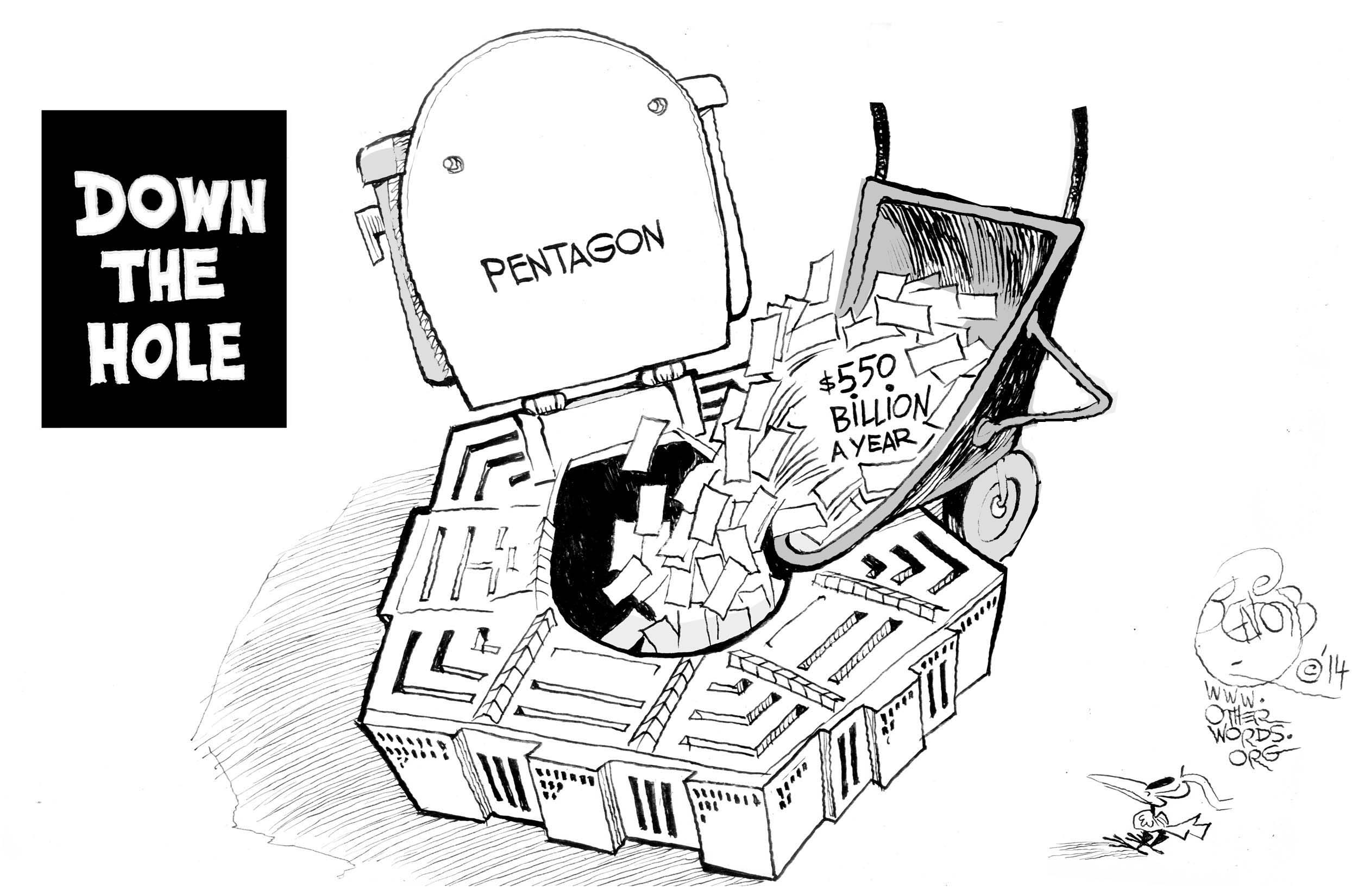
What was $550 billion down the crapper in 2014 is approaching $900 billion a decade later

Three Maxims for a Progressive Pentagon

Careful readers won’t be surprised to learn that I was an early Star Wars fan. Naturally, I rooted for the underdog rebels against the evil empire and its henchman, Darth Vader. I saw myself as a potential Jedi Knight, wielding an elegant weapon, a protector of freedom and the republic. (In my defense, I was 14 years old in 1977 when I first saw Star Wars.)

Then, in 1980, I watched The Empire Strikes Back, just as I was pursuing an Air Force ROTC scholarship for college. I heard Yoda, the Jedi master, declare to Luke that “wars not make one great.” That pearl of wisdom floored me then and continues to inform my life.

I’ve read my share of “heavy” philosophy and have the academic credentials to pose as a “serious” enough thinker. Yet I come back to the homespun wisdom captured in certain movies and TV shows that still carries weight for me. Let me share bits of such wisdom with you.

The first is from Kung Fu, the 1970s TV series starring David Carradine. As a young Kwai Chang Caine meets Master Po for the first time, he is astonished to discover that his master is blind. He takes pity on Po, suggesting that his life must be one of endless darkness. Master Po instantly corrects him. “Fear,” he says, “is the only darkness.”

The second is from The Outlaw Josey Wales, a classic western starring Clint Eastwood, also from the 1970s. Josey Wales is a renegade, a wanted man who leaves dead bodies in his wake wherever he travels. Yet he’s also tired of killing, a man in search of peace. In a moving scene, he negotiates just such a peace with Ten Bears, a Comanche chief, saying that there must be a way for people to live together without butchering one another, without constant bloodletting, without race-based hatreds.

A progressive Pentagon would recognize the deep truth of those three maxims: that wars not make one great, that fear is the only darkness, and that there’s a better way for people to live together than constantly butchering one another.

As a Catholic youth, I was taught that the beginning of wisdom is the fear of God. Today, I’d put that differently. The beginning of wisdom is the quest to master one’s fear, the urge to turn away from fear-driven hatreds, to find better, more pacific, more loving ways.

At the core of the original Star Wars trilogy, George Lucas implanted a message that anger, fear, aggression, and violence — the “dark side” of the Force, as he put it — should be resisted. As Darth Vader confesses to Luke, the power of that dark side is nearly irresistible. Fear and related negative emotions, eerily seductive as they are, can consume our minds (and, as it turns out, given the Pentagon budget, our taxpayer dollars as well).

Too many Americans are prey to the dark side, allowing fear to be the mind-killer. It’s not entirely our fault. From the end of World War II until this very moment, we’ve been told time and again to fear — and fear some more. Fear the communists in Korea and Vietnam. Fear Saddam Hussein and his weapons of mass destruction in Iraq. Fear Russia and its Hitleresque leader, Vladimir Putin. Fear China and its growing authoritarian power. Closer to home, we’re even now regularly told to fear our neighbors, MAGA or “woke,” depending on your “blue” or “red” team allegiance.

In truth, though, fear is the true darkness. You shouldn’t have to be a Jedi master to know that wars not make one great, that the darkness of fear (and arming ourselves against it) is a path to hell, and that people could indeed live together without eternally slaughtering one another. Those, then, would be my three maxims for a newly progressive Pentagon.

To echo the words of Steven Tyler of Aerosmith: Dream until your dreams come true.

Everything that’s wrong with America in one sentence

W.J. Astore

Guess who’s exempt from a potential government shutdown?

I saw this today at CNN.

The Pentagon has also determined that the training and support of Ukrainian forces is exempt from a potential government shutdown, and will continue even in the increasingly likely event that Congress fails to pass a spending bill in the coming days.

Isn’t it nice to know that even if the U.S. federal government shuts down, Ukraine will still get all the weapons and related military aid they need to continue to fight and kill Russians? Americans may be furloughed from their jobs or have to work for no pay, but Ukraine will get paid.

That one sentence shows you the priorities for “your” government. Guess what? You’re not a priority, but war overseas is. You’re not exempt from a government shutdown, but Ukrainian military forces are.

So, if you want to get paid, America, or enter a federal facility that may be closed due to a shutdown, just wave a blue-and-yellow flag and tell the government it’s all for the war effort in Ukraine.

Bring this flag with you and tell the government you’re exempt from the looming government shutdown

“The Greatest Fighting Force in Human History”

W.J. Astore

Militarized Hype Obscures Deep Rot in the American Empire

Also at TomDispatch.com.

In his message to the troops prior to the July 4th weekend, Secretary of Defense Lloyd Austin offered high praise indeed. “We have the greatest fighting force in human history,” he tweeted, connecting that claim to the U.S. having patriots of all colors, creeds, and backgrounds “who bravely volunteer to defend our country and our values.”

As a retired Air Force lieutenant colonel from a working-class background who volunteered to serve more than four decades ago, who am I to argue with Austin? Shouldn’t I just bask in the glow of his praise for today’s troops, reflecting on my own honorable service near the end of what now must be thought of as the First Cold War?

Yet I confess to having doubts. I’ve heard it all before. The hype. The hyperbole. I still remember how, soon after the 9/11 attacks, President George W. Bush boasted that this country had “the greatest force for human liberation the world has ever known.” I also remember how, in a pep talk given to U.S. troops in Afghanistan in 2010, President Barack Obama declared them “the finest fighting force that the world has ever known.” And yet, 15 years ago at TomDispatch, I was already wondering when Americans had first become so proud of, and insistent upon, declaring our military the world’s absolute best, a force beyond compare, and what that meant for a republic that once had viewed large standing armies and constant warfare as anathemas to freedom.

In retrospect, the answer is all too straightforward: we need something to boast about, don’t we? In the once-upon-a-time “exceptional nation,” what else is there to praise to the skies or consider our pride and joy these days except our heroes? After all, this country can no longer boast of having anything like the world’s best educational outcomes, or healthcare system, or the most advanced and safest infrastructure, or the best democratic politics, so we better damn well be able to boast about having “the greatest fighting force” ever.

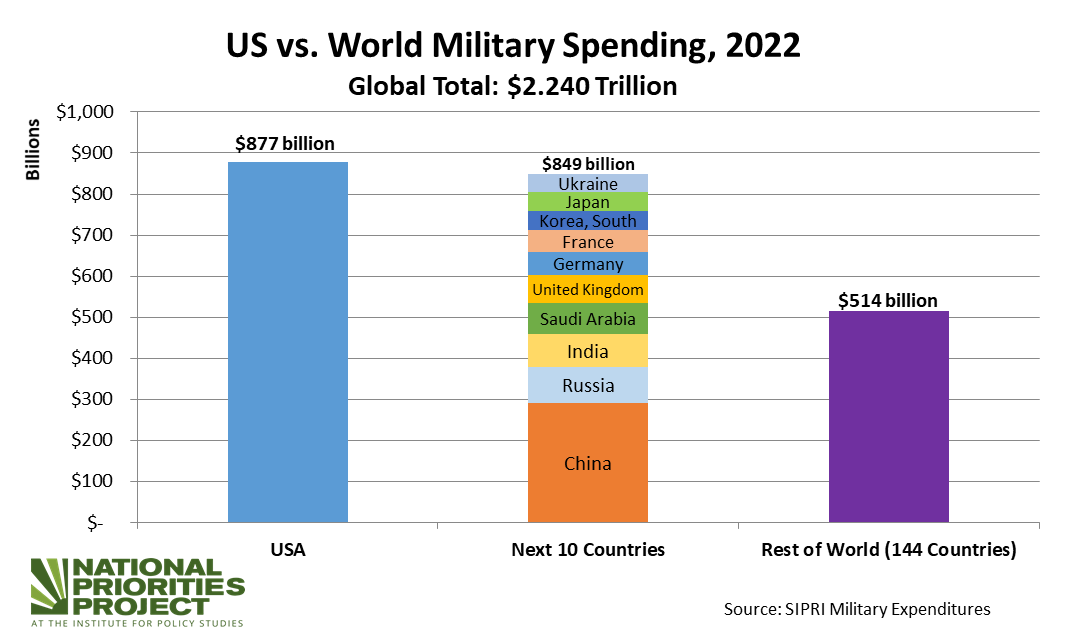
Leaving that boast aside, Americans could certainly brag about one thing this country has beyond compare: the most expensive military around and possibly ever. No country even comes close to our commitment of funds to wars, weapons (including nuclear ones at the Department of Energy), and global dominance. Indeed, the Pentagon’s budget for “defense” in 2023 exceeds that of the next 10 countries (mostly allies!) combined.

And from all of this, it seems to me, two questions arise: Are we truly getting what we pay so dearly for — the bestest, finest, most exceptional military ever? And even if we are, should a self-proclaimed democracy really want such a thing?

The answer to both those questions is, of course, no. After all, America hasn’t won a war in a convincing fashion since 1945. If this country keeps losing wars routinely and often enough catastrophically, as it has in places like Vietnam, Afghanistan, and Iraq, how can we honestly say that we possess the world’s greatest fighting force? And if we nevertheless persist in such a boast, doesn’t that echo the rhetoric of militaristic empires of the past? (Remember when we used to think that only unhinged dictators like Adolf Hitler boasted of having peerless warriors in a megalomaniacal pursuit of global domination?)

Actually, I do believe the United States has the most exceptional military, just not in the way its boosters and cheerleaders like Austin, Bush, and Obama claimed. How is the U.S. military truly “exceptional”? Let me count the ways.

Yes, the Pentagon budget, enormous and still growing, is as large as the next ten countries in the world combined. We’re #1 in wars and weapons!

The Pentagon as a Budgetary Black Hole

In so many ways, the U.S. military is indeed exceptional. Let’s begin with its budget. At this very moment, Congress is debating a colossal “defense” budget of $886 billion for FY2024 (and all the debate is about issues that have little to do with the military). That defense spending bill, you may recall, was “only” $740 billion when President Joe Biden took office three years ago. In 2021, Biden withdrew U.S. forces from the disastrous war in Afghanistan, theoretically saving the taxpayer nearly $50 billion a year. Yet, in place of any sort of peace dividend, American taxpayers simply got an even higher bill as the Pentagon budget continued to soar.

Recall that, in his four years in office, Donald Trump increased military spending by 20%. Biden is now poised to achieve a similar 20% increase in just three years in office. And that increase largely doesn’t even include the cost of supporting Ukraine in its war with Russia — so far, somewhere between $120 billion and $200 billion and still rising.

Colossal budgets for weapons and war enjoy broad bipartisan support in Washington. It’s almost as if there were a military-industrial-congressional complex at work here! Where, in fact, did I ever hear a president warning us about that? Oh, perhaps I’m thinking of a certain farewell address by Dwight D. Eisenhower in 1961.

In all seriousness, there’s now a huge pentagonal-shaped black hole on the Potomac that’s devouring more than half of the federal discretionary budget annually. Even when Congress and the Pentagon allegedly try to enforce fiscal discipline, if not austerity elsewhere, the crushing gravitational pull of that hole just continues to suck in more money. Bet on that continuing as the Pentagon issues ever more warnings about a new cold war with China and Russia.

Given its money-sucking nature, perhaps you won’t be surprised to learn that the Pentagon is remarkably exceptional when it comes to failing fiscal audits — five of them in a row (the fifth failure being a “teachable moment,” according to its chief financial officer) — as its budget only continued to soar. Whether you’re talking about lost wars or failed audits, the Pentagon is eternally rewarded for its failures. Try running a “Mom and Pop” store on that basis and see how long you last.

Speaking of all those failed wars, perhaps you won’t be surprised to learn that they haven’t come cheaply. According to the Costs of War Project at Brown University, roughly 937,000 people have died since 9/11/2001 thanks to direct violence in this country’s “Global War on Terror” in Afghanistan, Iraq, Libya, and elsewhere. (And the deaths of another 3.6 to 3.7 million people may be indirectly attributable to those same post-9/11 conflicts.) The financial cost to the American taxpayer has been roughly $8 trillion and rising even as the U.S. military continues its counterterror preparations and activities in 85 countries.

No other nation in the world sees its military as (to borrow from a short-lived Navy slogan) “a global force for good.” No other nation divides the whole world into military commands like AFRICOM for Africa and CENTCOM for the Middle East and parts of Central and South Asia, headed up by four-star generals and admirals. No other nation has a network of 750 foreign bases scattered across the globe. No other nation strives for full-spectrum dominance through “all-domain operations,” meaning not only the control of traditional “domains” of combat — the land, sea, and air — but also of space and cyberspace. While other countries are focused mainly on national defense (or regional aggressions of one sort or another), the U.S. military strives for total global and spatial dominance. Truly exceptional!

Strangely, in this never-ending, unbounded pursuit of dominance, results simply don’t matter. The Afghan War? Bungled, botched, and lost. The Iraq War? Built on lies and lost. Libya? We came, we saw, Libya’s leader (and so many innocents) died. Yet no one at the Pentagon was punished for any of those failures. In fact, to this day, it remains an accountability-free zone, exempt from meaningful oversight. If you’re a “modern major general,” why not pursue wars when you know you’ll never be punished for losing them?

Indeed, the few “exceptions” within the military-industrial-congressional complex who stood up for accountability, people of principle like Daniel Hale, Chelsea Manning, and Edward Snowden, were imprisoned or exiled. In fact, the U.S. government has even conspired to imprison a foreign publisher and transparency activist, Julian Assange, who published the truth about the American war on terror, by using a World War I-era espionage clause that only applies to American citizens.

And the record is even grimmer than that. In our post-9/11 years at war, as President Barack Obama admitted, “We tortured some folks” — and the only person punished for that was another whistleblower, John Kiriakou, who did his best to bring those war crimes to our attention.

And speaking of war crimes, isn’t it “exceptional” that the U.S. military plans to spend upwards of $2 trillion in the coming decades on a new generation of genocidal nuclear weapons? Those include new stealth bombers and new intercontinental ballistic missiles (ICBMs) for the Air Force, as well as new nuclear-missile-firing submarines for the Navy. Worse yet, the U.S. continues to reserve the right to use nuclear weapons first, presumably in the name of protecting life, liberty, and the pursuit of happiness. And of course, despite the countries — nine! — that now possess nukes, the U.S. remains the only one to have used them in wartime, in the atomic bombings of Hiroshima and Nagasaki.

Finally, it turns out that the military is even immune from Supreme Court decisions! When SCOTUS recently overturned affirmative action for college admission, it carved out an exception for the military academies. Schools like West Point and Annapolis can still consider the race of their applicants, presumably to promote unit cohesionthrough proportional representation of minorities within the officer ranks, but our society at large apparently does not require racial equity for its cohesion.

A Most Exceptional Military Makes Its Wars and Their Ugliness Disappear

Here’s one of my favorite lines from the movie The Usual Suspects: “The greatest trick the devil ever pulled was convincing the world he did not exist.” The greatest trick the U.S. military ever pulled was essentially convincing us that its wars never existed. As Norman Solomon notes in his revealing book, War Made Invisible, the military-industrial-congressional complex has excelled at camouflaging the atrocious realitiesof war, rendering them almost entirely invisible to the American people. Call it the new American isolationism, only this time we’re isolated from the harrowing and horrific costs of war itself.

America is a nation perpetually at war, yet most of us live our lives with little or no perception of this. There is no longer a military draft. There are no war bond drives. You aren’t asked to make direct and personal sacrifices. You aren’t even asked to pay attention, let alone pay (except for those nearly trillion-dollar-a-year budgets and interest payments on a ballooning national debt, of course). You certainly aren’t asked for your permission for this country to fight its wars, as the Constitution demands. As President George W. Bush suggested after the 9/11 attacks, go visit Disneyworld! Enjoy life! Let America’s “best and brightest” handle the brutality, the degradation, and the ugliness of war, bright minds like former Vice President Dick (“So?”) Cheney and former Secretary of Defense Donald (“I don’t do quagmires”) Rumsfeld.

Did you hear something about the U.S. military being in Syria? In Somalia? Did you hear about the U.S. military supporting the Saudis in a brutal war of repression in Yemen? Did you notice how this country’s military interventions around the world kill, wound, and displace so many people of color, so much so that observers speak of the systemic racism of America’s wars? Is it truly progress that a more diverse military in terms of “color, creed, and background,” to use Secretary of Defense Austin’s words, has killed and is killing so many non-white peoples around the globe?

Praising the all-female-crewed flyover at the last Super Bowl or painting rainbow flags of inclusivity (or even blue and yellow flags for Ukraine) on cluster munitionswon’t soften the blows or quiet the screams. As one reader of my blog Bracing Viewsso aptly put it: “The diversity the war parties [Democrats and Republicans] will not tolerate is diversity of thought.”

Of course, the U.S. military isn’t solely to blame here. Senior officers will claim their duty is not to make policy at all but to salute smartly as the president and Congress order them about. The reality, however, is different. The military is, in fact, at the core of America’s shadow government with enormous influence over policymaking. It’s not merely an instrument of power; it is power — and exceptionally powerful at that. And that form of power simply isn’t conducive to liberty and freedom, whether inside America’s borders or beyond them.

Wait! What am I saying? Stop thinking about all that! America is, after all, the exceptional nation and its military, a band of freedom fighters. In Iraq, where war and sanctions killed untold numbers of Iraqi children in the 1990s, the sacrifice was “worth it,” as former Secretary of State Madeleine Albright once reassured Americans on 60 Minutes.

Even when government actions kill children, lots of children, it’s for the greater good. If this troubles you, go to Disney and take your kids with you. You don’t like Disney? Then, hark back to that old marching song of World War I and “pack up your troubles in your old kit-bag, and smile, smile, smile.” Remember, America’s troops are freedom-delivering heroes and your job is to smile and support them without question.

Have I made my point? I hope so. And yes, the U.S. military is indeed exceptional and being so, being #1 (or claiming you are anyway) means never having to say you’re sorry, no matter how many innocents you kill or maim, how many lives you disrupt and destroy, how many lies you tell.

I must admit, though, that, despite the endless celebration of our military’s exceptionalism and “greatness,” a fragment of scripture from my Catholic upbringing haunts me still: Pride goeth before destruction and a haughty spirit before a fall.

Copyright 2023 William J. Astore

Pentagon Leaks! Mass Shootings!

W.J. Astore

Another Morning (and More Mourning) in America

Yet another mass shooting, this one in Louisville, Kentucky, and once again I marvel at the language used to describe such occurrences. The shooting that left five dead at a bank was described as a “tragic event,” akin to a tornado, something that simply can’t be prevented. The “heroes” were the responding police officers, and they certainly deserve credit for their bravery in confronting the shooter and killing him (one officer remains in critical condition).

What is to be said that hasn’t been already said? We live in a violent society with roughly 400 million guns, and we’ve already seen 146 mass shootings in 2023, according to the Gun Violence Archive. Democrats, of course, advocate for an assault rifle ban or other half-measures, knowing that they won’t have to follow through since Republicans control the House and will block gun control measures.

Perhaps the folly of all this is captured by the Onion headline that they repeat for nearly every mass shooting: ‘No Way To Prevent This,’ Says Only Nation Where This Regularly Happens. That about covers it.

Turning to the Pentagon, leaked papers are on the Internet that reveal Ukraine’s position is tenuous in its war with Russia. To summarize quickly, Ukrainian air defenses are short on missiles, Ukrainian forces are short on ammo, and offensive prospects look grim for this year. Senior American officials expect continued stalemate in the war, even as “happy talk” of a smashing Ukrainian spring offensive toward Crimea is spouted in some circles of the mainstream media. The leaked papers also reveal apparent U.S. spying on allies such as South Korea, not exactly a good look for America.

What’s revealing is how the mainstream media takes the Pentagon’s side, basically deploring the leak of this classified information and calling for more censorship on the Internet. I take the opposite tack. In a democracy, government actions are supposed to be transparent to us. I want to know what my government is up to; we all should. Certainly, the media should want to know. Instead, we’re encouraged to side with the Pentagon, perhaps the most powerful and secretive agency of the government.

And so we learned that our government continues to spy on allies even as it continues to provide massive amounts of military aid to Ukraine in a war that is currently a grinding stalemate and about which senior officials are far more pessimistic in private than they are in public. Valuable information, I’d say, that shouldn’t be kept secret from us.

The juxtaposition of these two stories suggests a possible solution to both. America has far too many guns and far too much ammo in private hands. Ukraine needs guns and ammo. Is it time for a “guns and ammo” drive for Ukraine across America? “Save Ukraine—donate your assault rifles and bullets!” Yes, I’m joking. I guess the violent reality of America is making me more than a bit crazy.

Dwight Eisenhower on the Cost of Permanent War

W.J. Astore

Ike’s Cross of Iron Speech, 70 Years Later

If Dwight Eisenhower could somehow give his 1953 “Cross of Iron” address and his 1961 warning about the military-industrial complex to the American people today, I truly believe he’d be dismissed by the mainstream media (MSM) as a Putin puppet and as repeating Kremlin talking points. Why? Because Ike advocated for negotiation and peace instead of war; he documented how spending on weapons was intrinsically wasteful and a bane to democratic society; and he challenged citizens to be alert and knowledgeable, ready to take action against the growing power of a corporate-military nexus supported and strengthened by Congress.

To mark Ike’s integrity and wisdom, and also to update his cost calculations from 1953 for the present day, I wrote this article, my latest for TomDispatch.com. Again, the words of Ike, focusing on peace, the preciousness and burdens of democracy, and the dangers of militarism, are rarely if ever heard in our government and in the MSM today. And that suggests we are in a dark place indeed in this country of ours.

In April 1953, newly elected President Dwight D. Eisenhower, a retired five-star Army general who had led the landings on D-Day in France in June 1944, gave his most powerful speech. It would become known as his “Cross of Iron” address. In it, Ike warned of the cost humanity would pay if Cold War competition led to a world dominated by wars and weaponry that couldn’t be reined in. In the immediate aftermath of the death of Soviet dictator Josef Stalin, Ike extended an olive branch to the new leaders of that empire. He sought, he said, to put America and the world on a “highway to peace.” It was, of course, never to be, as this country’s emergent military-industrial-congressional complex (MICC) chose instead to build a militarized (and highly profitable) highway to hell.

Eight years later, in his famous farewell address, a frustrated and alarmed president called out “the military-industrial complex,” prophetically warning of its anti-democratic nature and the disastrous rise of misplaced power that it represented. Only an alert and knowledgeable citizenry, fully engaged in corralling, containing, and constraining it, he concluded, could save democracy and bolster peaceful methods and goals. 

The MICC’s response was, of course, to ignore his warning, while waging a savage war on communism in the name of containing it. In the process, atrocious conflicts would be launched in Vietnam, Laos, and Cambodia as the contagion of war spread. Threatened with the possibility of peace in the aftermath of the Soviet Union’s collapse in 1991, the MICC bided its time with operations in Iraq (Desert Storm), Bosnia, and elsewhere, along with the expansion of NATO, until it could launch an unconstrained Global War on Terror in the aftermath of the attacks of September 11, 2001.  Those “good times” (filled with lost wars) lasted until 2021 and the chaotic U.S. withdrawal from Afghanistan.

Not to be deterred by the fizzling of the nightmarish war on terror, the MICC seized on a “new cold war” with China and Russia, which only surged when, in 2022, Vladimir Putin so disastrously invaded Ukraine (as the U.S. had once invaded Afghanistan and Iraq). Yet again, Americans were told that they faced implacable foes that could only be met with overwhelming military power and, of course, the funding that went with it — again in the name of deterrence and containment. 

In a way, in 1953 and later in 1961, Ike, too, had been urging Americans to launch a war of containment, only against an internal foe: what he then labeled for the first time “the military-industrial complex.” For various reasons, we failed to heed his warnings. As a result, over the last 70 years, it has grown to dominate the federal government as well as American culture in a myriad of ways. Leaving aside fundingwhere it’s beyond dominant, try moviesTV showsvideo gameseducationsports, you name it. Today, the MICC is remarkably uncontained. Ike’s words weren’t enough and, sadly, his actions too often conflicted with his vision (as in the CIA’s involvement in a coup in Iran in 1953). So, his worst nightmare did indeed come to pass. In 2023, along with much of the world, America does indeed hang from a cross of iron, hovering closer to the brink of nuclear war than at any time since the Cuban Missile Crisis of 1962.

Updating Ike’s Cross of Iron Speech for Today

Perhaps the most quoted passage in that 1953 speech addressed the true cost of militarism, with Ike putting it in homespun, easily grasped, terms. He started by saying, “Every gun that is made, every warship launched, every rocket fired signifies, in the final sense, a theft from those who hunger and are not fed, those who are cold and are not clothed.” (An aside: Can you imagine Donald Trump, Joe Biden, or any other recent president challenging Pentagon spending and militarism so brazenly?)

Ike then added:

“This world in arms is not spending money alone. It is spending the sweat of its laborers, the genius of its scientists, the hopes of its children. The cost of one modern heavy bomber is this: a modern brick school in more than 30 cities. It is two electric power plants, each serving a town of 60,000 population. It is two fine, fully equipped hospitals. It is some fifty miles of concrete pavement. We pay for a single fighter plane with a half million bushels of wheat. We pay for a single destroyer with new homes that could have housed more than 8,000 people.”

He concluded with a harrowing image: “This is not a way of life at all, in any true sense. Under the cloud of threatening war, it is humanity hanging from a cross of iron.”

Ike’s cost breakdown of guns versus butter, weapons versus civilian goods, got me thinking recently: What would it look like if he could give that speech today? Are we getting more bang for the military megabucks we spend, or less?  How much are Americans sacrificing to their wasteful and wanton god of war?

Let’s take a closer look. A conservative cost estimate for one of the Air Force’s new “heavy” strategic nuclear bombers, the B-21 Raider, is $750 million. A conservative estimate for a single new fighter plane, in this case the F-35 Lightning II, is $100 million. A single Navy destroyer, a Zumwalt-class ship, will be anywhere from $4 to $8 billion, but let’s just stick with the lower figure. Using those weapons, and some quick Internet sleuthing, here’s how Ike’s passage might read if he stood before us now:

“The cost of one modern heavy bomber is this: a modern brick-veneer and reinforced concrete school in 75 cities.  It is five electric power plants, each serving a town with 60,000 inhabitants. It is five fine, fully equipped hospitals. It is some 150 miles of pavement. We pay for a single fighter plane with more than 12 million bushels of wheat. We pay for a single destroyer with new homes that could have housed more than 64,000 people.”

(Quick and dirty figures for the calculations above: $10 million per elementary school; $150 million per power plant [$5,000/kilowatt for 30,000 homes]; $150 million per hospital; $5 million per new mile of road; $8 per bushel of wheat; $250,000 per home for four people.)

Grim stats indeed! Admittedly, those are just ballpark figures, but taken together they show that the tradeoff between guns and butter — bombers and jet fighters on the one hand, schools and hospitals on the other — is considerably worse now than in Ike’s day. Yet Congress doesn’t seem to care, as Pentagon budgets continue to soar irrespective of huge cost overruns and failed audits (five in a row!), not to speak of failed wars.

Without irony, today’s MICC speaks of “investing” in weapons, yet, unlike Ike in 1953, today’s generals, the CEOs of the major weapons-making corporations, and members of Congress never bring up the lost opportunity costs of such “investments.” Imagine the better schools and hospitals this country could have today, the improved public transportation, more affordable housing, even bushels of wheat, for the cost of those prodigal weapons and the complex that goes with them. And perish the thought of acknowledging in any significant way how so many of those “investments” have failed spectacularly, including the Zumwalt-class destroyers and the Navy’s Freedom-class littoral combat ships that came to be known in the Pentagon as “little crappy ships.”

Speaking of wasteful warships, Ike was hardly the first person to notice how much they cost or what can be sacrificed in building them. In his prescient book The War in the Air, first published in 1907, H.G. Wells, the famed author who had envisioned an alien invasion of Earth in The War of the Worlds, denounced his own epoch’s obsession with ironclad battleships in a passage that eerily anticipated Ike’s powerful critique:

The cost of those battleships, Wells wrote, must be measured by:

“The lives of countless men… spent in their service, the splendid genius and patience of thousands of engineers and inventors, wealth and material beyond estimating; to their account we must put stunted and starved lives on land, millions of children sent to toil unduly, innumerable opportunities of fine living undeveloped and lost. Money had to be found for them at any cost—that was the law of a nation’s existence during that strange time.  Surely they were the weirdest, most destructive and wasteful megatheria in the whole history of mechanical invention.”

Little could he imagine our own era’s “wasteful megatheria.” These days, substitute nuclear intercontinental ballistic missiles, strategic bombers, aircraft carriers, and similar “modern” weapons for the ironclads of his era and the sentiment rings at least as true as it did then. (Interestingly, all those highly touted ironclads did nothing to avert the disaster of World War I and had little impact on its murderous course or ponderous duration.)

Returning to 1953, Eisenhower didn’t mince words about what the world faced if the iron cross mentality won out: at worst, nuclear war; at best, “a life of perpetual fear and tension; a burden of arms draining the wealth and labor of all peoples; a wasting of strength that defies the American system, or the Soviet system, or any system to achieve true abundance and happiness for the peoples of this earth.”

Ike’s worst-case scenario grows ever more likely today. Recently, Russia suspended the START treaty, the final nuclear deal still in operation, that oversaw reductions in strategic nuclear weapons.  Instead of reductions, Russia, China, and the United States are now pursuing staggering “modernization” programs for their nuclear arsenals, an effort that may cost the American taxpayer nearly $2 trillion over the coming decades (though even such a huge sum matters little if most of us are dead from nuclear war).

In any case, the United States in 2023 clearly reflects Ike’s “cross of iron” scenario. It’s a country that’s become thoroughly militarized and so is slowly wasting away, marked increasingly by feardeprivation, and unhappiness.

It’s Never Too Late to Change Course

Only Americans, Ike once said, can truly hurt America.  Meaning, to put the matter in a more positive context, only we can truly help save America. A vital first step is to put the word “peace” back in our national vocabulary.

“The peace we seek,” Ike explained 70 years ago, “founded upon a decent trust and cooperative effort among nations, can be fortified, not by weapons of war but by wheat and by cotton, by milk and by wool, by meat and timber and rice. These are words that translate into every language on earth. These are the needs that challenge this world in arms.”

The real needs of humanity haven’t changed since Ike’s time. Whether in 1953 or 2023, more guns won’t serve the cause of peace. They won’t provide succor. They’ll only stunt and starve us, to echo the words of H.G. Wells, while imperiling the lives and futures of our children.

This is no way of life at all, as Ike certainly would have noted, were he alive today.

Which is why the federal budget proposal released by President Biden for 2024 was both so painfully predictable and so immensely disappointing. Calamitously so. Biden’s proposal once again boosts spending on weaponry and war in a Pentagon budget now pegged at $886 billion. It will include yet more spending on nuclear weapons and envisions only further perpetual tensions with “near-peer” rivals China and Russia.

This past year, Congress added $45 billion more to that budget than even the president and the Pentagon requested, putting this country’s 2023 Pentagon budget at $858 billion. Clearly, a trillion-dollar Pentagon budget is in our collective future, perhaps as early as 2027. Perish the thought of how high it could soar, should the U.S. find itself in a shooting war with China or Russia (as the recent Russian downing of a U.S. drone in the Black Sea brought to mind).  And if that war were to go nuclear…

The Pentagon’s soaring war budget broadcast a clear and shocking message to the world. In America’s creed, blessed are the warmakers and those martyrs crucified on its cross of iron.

This was hardly the message Ike sought to convey to the world 70 years ago this April. Yet it’s the message the MICC conveys with its grossly inflated military budgets and endless saber-rattling.

Yet one thing remains true today: it’s never too late to change course, to order an “about-face.” Sadly, lacking the wisdom of Dwight D. Eisenhower, such an order won’t come from Joe Biden or Donald Trump or Ron DeSantis or any other major candidate for president in 2024. It would have to come from us, collectively. It’s time to wise up, America. Together, it’s time to find an exit ramp from the highway to hell that we’ve been on since 1953 and look for the on-ramp to Ike’s highway to peace.

And once we’re on it, let’s push the pedal to the metal and never look back.

What’s the best way to end a war?

W.J. Astore

Sending more weapons to Ukraine isn’t the answer

U.S. foreign policy is a place where logic goes to die.

Antony Blinken, the U.S. Secretary of State, said yesterday that the quickest way to end the Russia-Ukraine War is “to give Ukraine a strong hand on the battlefield,” by which he meant more and more weaponry, including Bradley Infantry Fighting Vehicles and Patriot missile systems together with Challenger II tanks from Great Britain. Not surprisingly, then, the White House also hinted at yet another aid package for Ukraine, which may be announced “as soon as the end of this week.”

A “strong hand” for Ukraine?

Logic suggests the quickest way to end a war is to stop fighting. Announce a cease fire, negotiate, and find acceptable terms for an armistice or peace treaty. Stop the killing—stop the war.

Of course, the U.S. State Department is really a tiny branch of the Pentagon. It’s been that way for decades. The Pentagon budget, $858 billion for this year, is 14 times greater than the State Department’s at $60 billion. It often seems that a primary mission of the State Department is to market and sell U.S. weaponry overseas. Small wonder that Blinken sees more deadly weaponry in Ukraine as the answer to ending a catastrophic war.

In a way, Blinken’s blinkered thinking is typically American. What’s the quickest way to end a war on crime? A drug war? Or almost any other problem in America? Obviously, more guns, more security cameras, more metal detectors, more body armor, and so on. Think about our “solutions” to gun violence in schools, which include armored backpacks for eight-year-olds and semi-automatic pistols for teachers. Too many Americans look to guns as a “solution” to life’s problems; count Blinken among the gun-lovers, at least when it’s in the form of U.S. arms exports.

While it’s true U.S. arms exports and aid may keep Ukraine from losing quickly, it’s highly unlikely these same weapons will help Ukraine to win quickly and decisively. Russia can and likely will match any escalation to this war, and at a cheaper price than the U.S. taxpayer is currently paying (now over $100 billion and rising).

Blinken’s bloodless language about war is also revealing. It’s all about giving Ukraine “a strong hand on the battlefield,” as if Ukraine and Russia are playing a polite game of poker. More weapons to Ukraine means more bloody death and destruction; attrition or even escalation is far more likely than a quick end in Ukraine’s favor.

Blinken probably knows this, but a large part of his intellectual training was spent at Harvard and Columbia Law, just as Jake Sullivan, his younger counterpart at the National Security Council, trained at Yale and Yale Law. These men aren’t stupid, they’re just narrowly trained and partisan functionaries willing to spout whatever the empire needs them to say in the cause of imperial hegemony.

And so U.S. lawyers continue to send guns and money to Ukraine, especially guns, while saying this is the best and quickest way for Ukraine to beat Putin and end the war with Russia. Logic, however, suggests more fighting and dying and a lack of decision for either side.

Best not confuse a “strong hand” with a dead man’s one.

The Pentagon’s National Defense Strategy

W.J. Astore

Bombs, Bullets, and Bellicosity Instead of Brains

In my latest article for TomDispatch.com, I parse the meaning of America’s latest National Defense Strategy. Hint: It’s not about defense.

More than two millennia ago, in the History of the Peloponnesian War, Thucydides recounted a disastrous conflict Athens waged against Sparta. A masterwork on strategy and war, the book is still taught at the U.S. Army War College and many other military institutions across the world. A passage from it describing an ultimatum Athens gave a weaker power has stayed with me all these years. And here it is, loosely translated from the Greek: “The strong do what they will and the weak suffer as they must.”

Recently, I read the latest National Defense Strategy, or NDS, issued in October 2022 by the Pentagon, and Thucydides’s ancient message, a warning as clear as it was undeniable, came to mind again. It summarized for me the true essence of that NDS: being strong, the United States does what it wants and weaker powers, of course, suffer as they must. Such a description runs contrary to the mythology of this country in which we invariably wage war not for our own imperial ends but to defend ourselves while advancing freedom and democracy. Recall that Athens, too, thought of itself as an enlightened democracy even as it waged its imperial war of dominance on the Peloponnesus. Athens lost that war, calamitously, but at least it did produce Thucydides, a military leader who became a historian and wrote all too bluntly about his country’s hubristic, ultimately fatal pursuit of hegemony.

Imperial military ambitions contributed disastrously to Athens’s exhaustion and ultimate collapse, a lesson completely foreign to U.S. strategists. Not surprisingly, then, you’ll find no such Thucydidean clarity in the latest NDS approved by Secretary of Defense Lloyd Austin. In place of that Greek historian’s probity and timeless lessons, the NDS represents an assault not just on the English language but on our very future. In it, a policy of failing imperial dominance is eternally disguised as democratic deterrence, while the greatest “strategic” effort of all goes (remarkably successfully) into justifying massive Pentagon budget increases. Given the sustained record of failures in this century for what still passes as the greatest military power on the planet — Afghanistan, Iraq, and Libya, of course, but don’t forget SomaliaSyriaYemen, and indeed the entire $8 trillion Global War on Terror in all its brutality — consider the NDS a rare recent “mission accomplished” moment. The 2023 baseline “defense” budget now sits at $858 billion, $45 billion more than even the Biden administration requested.

With that yearly budget climbing toward a trillion dollars (or more) annually, it’s easy to conclude that, at least when it comes to our military, nothing succeeds like failure. And, by the way, that not only applies to wars lost at a staggering cost but also financial audits blown without penalty. After all, the Pentagon only recently failed its fifth audit in a row. With money always overflowing, no matter how it may be spent, one thing seems guaranteed: some future American Thucydides will have the material to produce a volume or volumes beyond compare. Of course, whether this country goes the way of Athens — defeat driven by military exhaustion exacerbated by the betrayal of its supposedly deepest ideals leading to an ultimate collapse — remains to be seen. Still, given that America’s war colleges continue to assign Thucydides, no one can say that our military and future NDS writers didn’t get fair warning when it comes to what likely awaits them.

Bludgeoning America with Bureaucratese

If you can’t dazzle them with brilliance, baffle them with BS.

That’s a saying I learned early in my career as an Air Force officer, so I wasn’t exactly surprised to discover that it’s the NDS’s guiding philosophy. The document has an almost Alice in Wonderland-like quality to it as words and phrases take on new meanings. China, you won’t be surprised to learn, is a “pacing challenge” to U.S. security concerns; Russia, an “acute threat” to America due to its “unprovoked, unjust, and reckless invasion of Ukraine” and other forms of “irresponsible behavior”; and building “combat-credible forces” within a “defense ecosystem” is a major Pentagon goal, along with continuing “investments in mature, high-value assets” (like defective aircraft carriers, ultra-expensive bombers and fighter jets, and doomsday-promising new ICBMs).

Much talk is included about “leveraging” those “assets,” “risk mitigation,” and even “cost imposition,” a strange euphemism for bombing, killing, or otherwise inflicting pain on our enemies. Worse yet, there’s so much financial- and business-speak in the document that it’s hard not to wonder whether its authors don’t already have at least one foot in the revolving door that could, on their retirement from the military, swing them onto the corporate boards of major defense contractors like Boeing and Raytheon.

Perhaps my favorite redefined concept in that NDS lurks in the word “campaigning.” In the old days, armies fought campaigns in the field and generals like Frederick the Great or Napoleon truly came to know the price of them in blood and treasure. Unlike U.S. generals since 1945, they also knew the meaning of victory, as well as defeat. Perish the thought of that kind of campaigning now. The NDS redefines it, almost satirically, not to say incomprehensibly, as “the conduct and sequencing of logically-linked military initiatives aimed at advancing well-defined, strategy-aligned priorities over time.” Huh?

Campaigning, explains the cover letter signed by Secretary of Defense Austin (who won’t be mistaken for Frederick II in his bluntness or Napoleon in his military acuity), “is not business as usual — it is the deliberate effort to synchronize the [Defense] Department’s activities and investments to aggregate focus and resources to shift conditions in our favor.”

Got it? Good!

Of course, who knows what such impenetrable jargon really means to our military in 2023? This former military officer certainly prefers the plain and honest language of Thucydides. In his terms, America, the strong, intends to do what it will in the world to preserve and extend “conditions in our favor,” as the NDS puts it — a measure by which this country has failed dismally in this century. Weaker countries, especially those that are “irresponsible,” must simply suffer. If they resist, they must be prepared for some “cost imposition” events exercised by our “combat-credible forces.” Included in those are America’s “ultimate backstop” of cost imposition… gulp, its nuclear forces.

Again, the NDS is worthy of close reading (however pain-inducing that may be) precisely because the secretary of defense does claim that it’s his “preeminent guidance document.” I assume he’s not kidding about that, though I wish he were. To me, that document is to guidance as nuclear missiles are to “backstops.” If that last comparison is jarring, I challenge you to read it and then try to think or write clearly.

Bringing Clarity to America’s Military Strategy

To save you the trauma of even paging through the NDS, let me try to summarize it quickly in my version — if not the Pentagon’s — of English:

  1. China is the major threat to America on this planet.
  2. Russia, however, is a serious threat in Europe.
  3. The War on Terror continues to hum along successfully, even if at a significantly lower level.
  4. North Korea and Iran remain threats, mainly due to the first’s growing nuclear arsenal and the second’s supposed nuclear aspirations.
  5. Climate change, pandemics, and cyberwar must also be factored in as “transboundary challenges.”

“Deterrence” is frequently used as a cloak for the planetary dominance the Pentagon continues to dream of. Our military must remain beyond super-strong (and wildly overfunded) to deter nations and entities from striking “the homeland.” There’s also lots of talk about global challenges to be met, risks to be managed, “gray zone” methods to be employed, and references aplenty to “kinetic action” (combat, in case your translator isn’t working) and what’s known as “exploitable asymmetries.”

Count on one thing: whatever our disasters in the real world, nobody is going to beat America in the jargon war.

Missing in the NDS — and no surprise here — is any sense that war is humanity’s worst pastime. Even the mass murder implicit in nuclear weapons is glossed over. The harshest realities of conflict, nuclear war included, and the need to do anything in our power to prevent them, naturally go unmentioned. The very banality of the document serves to mask a key reality of our world: that Americans fund nothing as religiously as war, that most withering of evils.

Perhaps it’s not quite the banality of evil, to cite the telling phrase political philosopher Hannah Arendt used to describe the thoughts of the deskbound mass-murderers of the Holocaust, but it does have all of war’s brutality expunged from it. As we stare into the abyss, the NDS replies with mind-numbing phrases and terms that wouldn’t be out of place in a corporate report on rising profits and market dominance.

Yet as the military-industrial complex maneuvers and plots to become ever bigger, ever better funded, and ever more powerful, abetted by a Congress seemingly lustful for ever more military spending and weapons exports, hope for international cooperation, productive diplomacy, and democracy withers. Here, for instance, are a few of the things you’ll never see mentioned in this NDS:

  1. Any suggestion that the Pentagon budget might be reduced. Ever.
  2. Any suggestion that the U.S. military’s mission or “footprint” should be downsized in any way at all.
  3. Any acknowledgement that the U.S. and its allies spend far more on their militaries than “pacing challengers” like China or “acute threats” like Russia.
  4. Any acknowledgment that the Pentagon’s budget is based not on deterrence but on dominance.
  5. Any acknowledgement that the U.S. military has been far less than dominant despite endless decades of massive military spending that produced lost or stalemated wars from Korea and Vietnam to Afghanistan and Iraq.
  6. Any suggestion that skilled diplomacy and common security could lead to greater cooperation or decreased tensions.
  7. Any serious talk of peace.

In brief, in that document and thanks to the staggering congressional funding that goes with it, America is being eternally spun back into an age of great-power rivalry, with Xi Jinping’s China taking the place of the old Soviet Union and Vladimir Putin’s Russia that of Mao Zedong’s China. Consistent with that retro-vision is the true end goal of the NDS: to eternally maximize the Pentagon budget and so the power and authority of the military-industrial-congressional complex.

Basically, any power that seeks to push back against the Pentagon’s vision of security through dominance is defined as a threat to be “deterred,” often in the most “kinetic” way. And the greatest threat of all, requiring the most “deterrence,” is, of course, China.

In a textbook case of strategic mirror-imaging, the Pentagon’s NDS sees that country and its People’s Liberation Army (PLA) as acting almost exactly like the U.S. military. And that simply cannot be allowed.

Here’s the relevant NDS passage:

“In addition to expanding its conventional forces, the PLA is rapidly advancing and integrating its space, counterspace, cyber, electronic, and information warfare capabilities to support its holistic approach to joint warfare. The PLA seeks to target the ability of the [U.S.] Joint Force to project power to defend vital U.S. interests and aid our Allies in a crisis or conflict. The PRC [China] is also expanding the PLA’s global footprint and working to establish a more robust overseas and basing infrastructure to allow it to project military power at greater distances. In parallel, the PRC is accelerating the modernization and expansion of its nuclear capabilities.”

How dare China become more like the United States! Only this country is allowed to aspire to “full-spectrum dominance” and global power, as manifested by its 750 military bases scattered around the world and its second-to-none, blue-water navy. Get back to thy place, China! Only “a free people devoted to democracy and the rule of law” can “sustain and strengthen an international system under threat.” China, you’ve been warned. Better not dare to keep pace with the U.S. of A. (And heaven forfend that, in a world overheating in a devastating way, the planet’s two greatestgreenhouse gas emitters should work together to prevent true catastrophe!)

Revisiting the Oath of Office

Being a retired U.S. military officer, I always come back to the oath of office I once swore to uphold: “To support and defend the Constitution of the United States against all enemies, foreign and domestic.” Naturally, if China, Russia, or any other country or entity attacks or otherwise directly menaces the U.S., I expect our military to defend this country with all due vigor.

That said, I don’t see China, Russia, or weaker countries like Iran or North Korea risking attacks against America proper, despite breathless talk of world “flashpoints.” Why would they, when any such attack would incur a devastating counterattack, possibly including America’s trusty “backstop,” its nuclear weapons?

In truth, the NDS is all about the further expansion of the U.S. global military mission. Contraction is a concept never to be heard. Yet reducing our military’s presence abroad isn’t synonymous with isolationism, nor, as has become ever more obvious in recent years, is an expansive military structure a fail-safe guarantor of freedom and democracy at home. Quite the opposite, constant warfare and preparations for more of it overseas have led not only to costly defeats, most recently in Afghanistan, but also to the increasing militarization of our society, a phenomenon reflected, for instance, in the more heavily armed and armored police forces across America.

The Pentagon’s NDS is a classic case of threat inflation cloaked in bureaucratese where the “facts” are fixed around a policy that encourages the incessant and inflationary growth of the military-industrial complex. In turn, that complex empowers and drives a “rules-based international order” in which America, as hegemon, makes the rules. Again, as Thucydides put it, the strong do what they will and the weak suffer as they must.

Yet, to paraphrase another old book, what does it profit a people to gain the whole world yet lose their very soul?  Like Athens before it, America was once a flawed democracy that nevertheless served as an inspiration to many because militarism, authoritarianism, and imperial pretense didn’t drive it. Today, this country is much like Thucydides’s Athens, projecting power ever-outwards in a misbegotten exercise to attain mastery through military supremacy.

It didn’t end well for Athens, nor will it for the United States.

The Military-Industrial Complex Wins Again!

W.J. Astore

Election 2022 Truly Had a Clear Winner

With Veterans Day in mind, I was asked as a retired U.S. military officer for a comment on the 2022 election results, which produced this:

When both political parties pose as pro-military, when both are pro-war, when both are enablers of record-high Pentagon spending, when both act as if a new cold war with China and Russia is inevitable, do election results even matter?  No matter which party claims victory, the true victor remains the military-industrial-Congressional complex.

We have a winner, America!

To paraphrase Joe Biden, nothing fundamentally changed in the 2022 elections when it comes to colossal military spending, incessant wars and preparations for the same, and non-stop imperialism around the globe. There is no new vision for lower Pentagon spending, for fewer wars and weapons exports, and for a smaller, less domineering, imperial mission.

As General and President Dwight D. Eisenhower warned us in 1961, the military-industrial-Congressional complex represents a disastrous rise of misplaced power that is profoundly anti-democratic. Collectively, we’ve failed to heed Ike’s warning. The result has been one unnecessary and disastrous war after another, even as democracy in America withers. The Vietnam War—disaster. The Iraq War—disaster. The Afghan War—disaster. The War on Terror—disaster. Even the war America ostensibly won, the Cold War against the USSR, is now apparently about to be refought.

I suppose we need to refight the Cold War we “won” thirty years ago so we can lose that one too.

With the Democrats doing somewhat better than expected at the polls, war business should continue to grow in Washington, D.C. Most political commentators seem to think this is a good thing, when they think about it at all. Few seem to recall Ike’s warning that a military establishment of vast proportions is antithetical to democracy.

In this election cycle, I’ve heard nothing about peace. I’ve heard nothing about strengthening and preserving democracy by downsizing our military and imperial presence around the globe. Not from Democrats and Republicans.

So the winner in 2022 is the same winner as always: the military-industrial-Congressional complex. It’s a sad result to contemplate with Veterans Day looming.

To Help the U.S. Military, Slash the Pentagon Budget

Isn’t it reassuring to know your taxpayer dollars are buying lots of “Ferraris” for the U.S. military?

W.J. Astore

If you truly want to help the U.S. military, slash its yearly budget.

It’s counterintuitive, right? We think more money will help the Pentagon field effective forces and to be better prepared to defend America. But that hasn’t proven to be the case. The more money the Pentagon gets, the more money gets spent on unnecessary and often poorly performing weapons systems. Take my old service, the U.S. Air Force. It doesn’t need the B-21 bomber. It doesn’t need new ICBMs. The F-35 fighter is a major disappointment, a “Ferrari” according to the Air Force Chief of Staff, i.e. an exotic and temperamental plane you fly only on occasion, which isn’t what the Air Force wanted or needed. Similarly, the Navy is building aircraft carriers that can’t launch planes effectively and “little crappy ships” that have no role at all. And the Army has thousands of M-1 Abrams tanks parked in storage that it’ll probably never use.

Do you have a friend with too much money? Maybe he got an inheritance or some other windfall. And the money makes him stupid. It’s stipulated in the inheritance that he must spend all of it within a year or two (the way Pentagon appropriations work), and if he fails to spend it, he’ll get less in the future. So he spends wildly, without giving it much thought, because he’s got the money and because he has to. And spending money on expensive “Ferraris” is fun. He’s not encouraged to think about how to use the money wisely, rather the reverse. So he just buys big ticket items willy-nilly.

Congress, of course, is the Pentagon’s enabler. Whatever the military wants nowadays, Congress is determined to give the brass more, in the false name of supporting the troops. It’s not the troops that see the money, it’s the industrial side of Ike’s military-industrial complex that profits the most. There’s something truly unseemly about Congress throwing money at the Pentagon while camp-following weapons contractors siphon it up.

Technically, incredibly, the U.S. military is no longer at war, i.e. “large-scale combat operations,” according to Secretary of Defense Lloyd Austin. Perhaps you missed the announcement that new U.S. troops coming on active duty wouldn’t automatically receive the National Defense Service Medal, as they have since 9/11 and the subsequent global war on terror. With those “large-scale” wars finally ended, shouldn’t the Pentagon’s budget decrease in a big way? Wars in Iraq and Afghanistan were costing the U.S. over $100 billion a year, yet as they have ended, the Pentagon’s budget has increased by more than $100 billion. Talk about counterintuitive! Wars end as war budgets increase. Only in America.

There is no logic here. I’m reminded of a scene from the original Star Trek in which Spock is befuddled by an attack on Captain Kirk because there’s apparently no logic to it. As an alien patiently explains to Spock, “Perhaps you should forget logic and devote yourself to motivations of passion or gain.” It’s a telling lesson for anyone looking to explain the illogic of America’s defense budget.

Get rid of the passion and gain in the Pentagon’s budget, America. It’s time to use logic and make major cuts. Force the military to think rather than to spend. Who knows … we may end up with a leaner, even a smarter, military, one committed less to war and more to supporting and defending the U.S. Constitution.

A Modest Plea for a Sane Defense Budget

The Pentagon will never be forced to make choices if Congress keeps shoveling money its way

W.J. Astore

In the tradition of the U.S. Army, which talks about BLUF, or bottom line up front, here’s what I consider to be a sane defense budget for the United States: $333 billion.

I arrived at this figure by complex math. The U.S. population currently sits at just under 333 million. A reasonable figure to spend per person on national defense is $1000. Hence my figure for a sane defense budget.

How does this immense sum compare to other countries’ budgets? Russia’s defense budget (before its war with Ukraine) hovered around $70 billion a year. China’s defense budget hovered around $245 billion. So my “sane” defense budget easily surpasses the combined budgets of Russia and China, America’s main rivals, or so our military experts say.

Other countries that spend impressively on defense include Germany, France, and the U.K. But note that these are American allies; their spending should serve to lessen the need for our own.

Now, I wish to stress my budget is about defense, as in defending the U.S. against all enemies, foreign and domestic. My budget is not about projecting imperial power around the globe; it’s not about full-spectrum dominance; it’s not about spending more than a trillion dollars over the next thirty years on unneeded nuclear weapons, or more than a trillion to buy and maintain more underperforming F-35 jet fighters.

Again, my sane budget is not a war budget, an imperial budget, or a budget to enrich U.S. weapons makers. It’s a budget intended to DEFEND our country.

So, let’s now compare my sane budget to the actual “defense” budget planned for FY2023. It appears that budget will likely exceed $833 billion, more than half a trillion higher than mine!

What could America do with half a trillion dollars? Think of how many good-paying jobs we could create, how much better our country could be, with safer roads and bridges, more alternative sources of energy, improved schools and hospitals, a cleaner environment. How about drinking water without lead in it? The list is long because we have so many needs as a country.

It wasn’t that long ago that $300 billion was considered more than enough for national defense. But since 9/11 the budget has spiraled upwards as the U.S. government pursued forever wars like Iraq and Afghanistan that ended disastrously. Things are now so bad that the Pentagon can’t even begin to pass a basic audit. Send a small army of accountants to the Pentagon and the brass surrenders instantly.

$333 billion is still an enormous sum of money, yet there will be many who’ll suggest this figure isn’t close to being enough for the brass, all those wearing stars who call the shots. My response: try it. If it doesn’t work, you can always boost the budget. But if you really want the Pentagon to think creatively, cut the budget to $333 billion and watch the real wars begin within the five-sided puzzle palace on the Potomac.