Is the U.S. military doomed? I’d say yes. But it’s not because our troops are uncommitted, our weapons are bad, and our tactics are flawed. Rather it’s because of the conventional wisdom in Washington and the Pentagon that continues to commit our troops to unnecessary and unwinnable wars.
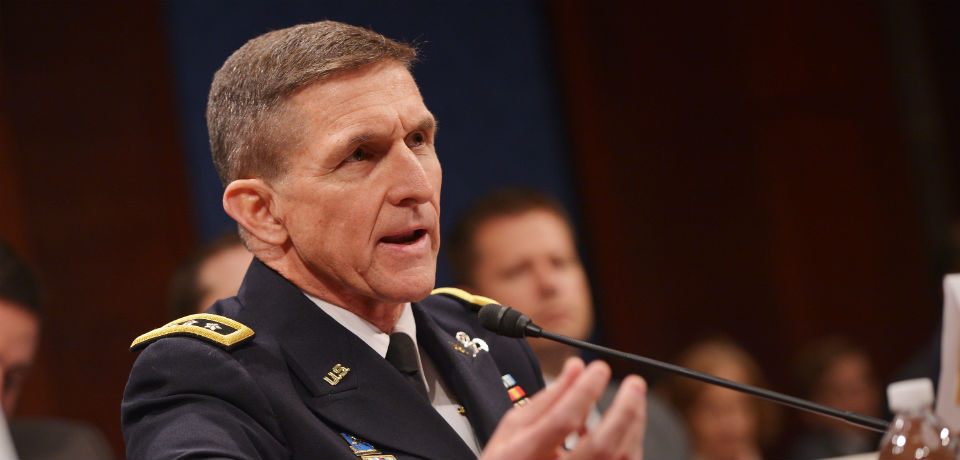
This conventional wisdom is perhaps best summed up in a speech by retired Lieutenant General Michael T. Flynn, the ex-chief of the Defense Intelligence Agency (DIA). It’s worth reading the speech in full, not because it’s especially original or insightful, but because it’s so unreflective and representative of Washington’s collective wisdom.
Here are General Flynn’s main points as I see them:
1. The American public must be committed to an open-ended ideological war “for decades.”
2. That war is against “grotesque” Islamic extremists who “hate our ideals” and who are “committed to the destruction of freedom and the American way of life.”
3. To win the war, America must be ready to use “overwhelming power” to defeat or deter the enemy, even if the U.S. must act alone.
4. Special Operations Forces (SOF) must be “well resourced” for this war, meaning they must be expanded even further and given even more money and latitude.
5. The model for this ideological war against extremist Islam is Ronald Reagan’s war against communism.
That is General Flynn’s strategic vision. It’s a vision widely shared within the Pentagon. And it’s a vision that dooms America to defeat.
Why? Mainly because radical Islam is a political/religious/social phenomenon. It is not amenable to military solutions. Indeed, the more America makes it into THE enemy, the more legitimacy organizations like ISIS gain within their communities and across the Muslim World.
Military force is a blunt instrument, even when it’s applied by the Special Ops community. Expanding the American SOF presence throughout the world is a recipe for more blowback, not more victories. Consider how well we’ve done so far in Afghanistan or Libya or Yemen. Or for that matter Iraq. Can anyone say that U.S. military intervention has produced stability in these countries? Has it contributed to the defeat of radical Islam? Indeed, in destabilizing Iraq and Libya and Yemen, has the U.S. not contributed to the spread of Islamic extremism?
Military professionals like General Flynn really know only one solution: “overwhelming power” applied “for decades.” And if you don’t accept their solution, they dismiss you as misguided (at best) or as arguing for “Retreat, retrenchment, and disarmament,” which “are historically a recipe for disaster,” according to General Flynn.
Well, I’m not aware of anyone seriously arguing for disarmament (fat chance of that happening in the USA!). I’m not aware of anyone arguing for “retreat,” as if this was the Chosin Reservoir in the Korean War. I’m not aware of anyone seriously working toward “retrenchment”; indeed, the SOF community keeps expanding, already mounting operations in 105 countries around the world in FY2015 (i.e., since October 2014). It’s easy to bayonet a straw man, general.
I have a few words for the general: Committing the American military to an ideological war “for decades” against radical Islam is pure folly. Chances are you won’t hammer it into non-existence: your blows will just spread it further, while wasting the energies of America and the lives of its troops.
Stop looking to Reagan and the collapse of communism for lessons and start looking at the actual results over the last 20-30 years of American meddling in Afghanistan, Iraq, Libya, and Yemen. And tell me: Is this what “victory” looks like? You want to double down on “overwhelming power” applied “for decades” as defending American “ideals” and “way of life”?
Which “ideals” are those, exactly? A permanent state of war in which military men are deferred to as the heroes and sages of the moment?
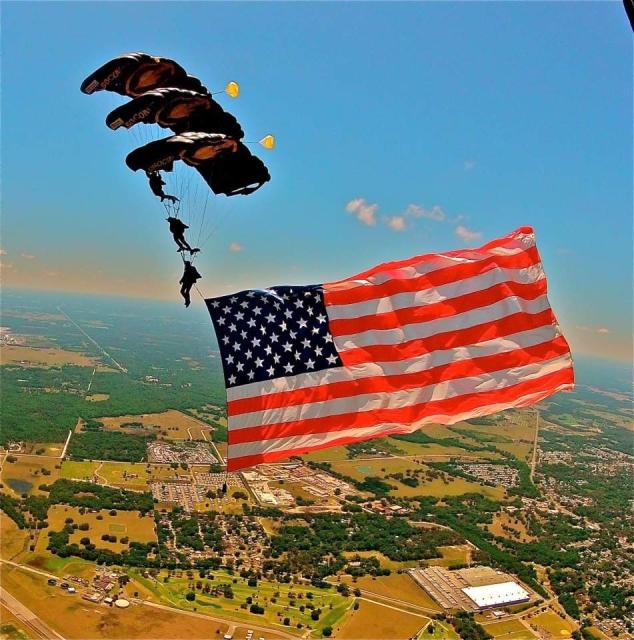
A Triple Stack of Special Ops with Flag — Hooah! (Photo Credit: SOCOM)
W.J. Astore
Nick Turse has a revealing new piece at TomDispatch.com on the rise of Special Forces and SOCOM (Special Ops Command) within the U.S. military. (For a telling critique of America’s excess of enthusiasm for Special Forces, see last year’s article here by Dan White for The Contrary Perspective.)
What are we to make of U.S. Special Forces being involved, in one way or another, in the affairs of 150 countries in the world over the last three years? And, as Turse points out, just 66 days into Fiscal Year 2015, U.S. Special Forces have already made their presence known in 105 countries, a presence that seems never to wane.
One historical analogy that occurs to me (which I’ve used before) is the rise of the Society of Jesus, the Jesuits, within an embattled Catholic Church during the Reformation. A besieged Church needed true believers to take the fight to heretical Protestants who were bent on the Church’s destruction. So along came Ignatius Loyola and his church militant of Jesuit priests, sworn to believe that black was white if the Holy Church deemed it so. Considered an elite within the Church, the Jesuits took the fight to the Protestants during the Catholic Counter Reformation in Europe and across the world. Jesuits were everywhere, from China in the Old World to nearly everywhere in the New World, crusading for the Church and against the incursions of Protestantism and its various sects.
So, how does the 16th century shed light on the 21st? America’s Vatican is obviously the Pentagon. Its primary methods are wars and weapons sales and military training. Its Loyola was until recently Admiral William McRaven, head of SOCOM. And its Jesuit priests are America’s Special Ops troops, true believers who are committed to defending the faith of America.
In the aftermath of 9/11, in a rare outburst of honesty, George W. Bush said America was on a crusade across the world. You might say against “protestants” and other heretics to the American way of life. And who are our crusaders? Who is being sent virtually everywhere (remember those 150 countries in three years?) on various “missions”?
Like it or not, America’s Special Forces are our lead missionaries, our Jesuits, our church militant.
The new head of SOCOM, General Joseph Votel III, West Point grad and Army Ranger, put it plainly back in August that America is witnessing “a golden age for special operations.” What a telling phrase. And indeed it’s getting increasingly difficult to recall “golden ages” in America’s past that weren’t linked to the military.
But that’s no accident when the national church is the Pentagon and its Special Ops troops are acclaimed as so many missionary heroes.
Back in January, James Carroll had an op-ed in the Boston Globe that called for eliminating the Air Force as a separate service. He claimed that the Air Force’s strategic components (its nuclear ICBMs and manned bombers) were now largely irrelevant, that the Air Force’s tactical mission could be folded into the Army and Navy, and that unmanned aerial vehicles or drones would soon largely replace manned surveillance and attack planes.
By folding the Air Force into its two older rivals, the Army and Navy, Carroll suggested the Pentagon would be forced to economize, the magic coming from reorganization. I highly doubt that.
OK. I’m a retired Air Force officer, so I’m biased. But there are certain things the Air Force does, certain skills the Air Force has, that won’t be easily duplicated and probably will be lost in a bureaucratic war touched off by elimination and reorganization. Here’s a quick list:
1. The Air Force concentrates on air and space, just like the Army concentrates on land and the Navy on sea. These are unique elements, requiring unique services with specialized mindsets.
2. The Air Force is not just about fighter planes and nuclear missiles. Much of the Air Force’s mission is in the less glorious aspects of air and space control. Missions like cargo transport, tankers for aerial refueling, aerial and satellite reconnaissance, and the like. Do we really believe the Army and Navy will adequately focus on and fund these vital missions?
3. The U.S. Air Force was hardly the first independent air force in the world. Great Britain saw the need for an independent air force in 1918 when the Royal Air Force was created. (The USAF had to wait until 1947, i.e. after World War II.) An independent air force reflects the technological revolution inaugurated by the Wright Brothers in 1903 and the inherent reach and power of aerial vehicles. This is especially relevant to “island” nations such as Great Britain — and the United States.
4. Related to (2), the Air Force has a wide range of missions, to include aerial intelligence-gathering, AWACS (airborne warning and control) and vital national command planes such as Air Force One. Again, are these missions truly suited to the Army or Navy?
5. In the chaos that is war, there’s something to be said for military continuity and tradition and experience. Eliminating the Air Force and folding it into the Army and Navy will generate enormous internal friction within the Pentagon, possibly destabilizing a national defense system that is already less than optimal in its stability (as well as its wisdom).
The Air Force today certainly has its problems. It’s the most top heavy of the services, with far too many colonels and generals. It spends way too much on under-performing aircraft such as the F-35 Lightning II. It’s always shied away from adequately funding the close air support mission, which is why the Army pursues its own fleet of attack helicopters. Since its early days, it’s placed way too much faith in the efficacy of bombing, so much so that it’s generated its own Strangelovian caricatures, men like Curtis LeMay.
That said, the last thing we need is more internecine warfare in the Pentagon. Eliminating the Air Force is not a recipe for cost-savings. It’s a recipe for a bureaucratic bloodbath that will ultimately hurt rather than help America’s national defense.
The Pentagon brass and bureaucrats can’t win foreign wars, but they sure as hell kick ass in domestic budgetary wars. That point is clear from Mattea Kramer’s new article at TomDispatch.com. Allowing the Pentagon a largely untouchable second budget to fund the ongoing military occupation of Afghanistan is an invitation both to prolong that war and for exercises in money-changing. Masters at budgetary sleight of hand, the military spins any reduction, no matter how small, in apocalyptic terms, as we saw with claims that cuts in the end strength of the US Army would reduce it to 1940 levels, i.e. the somnolent peacetime days just before Pearl Harbor.
Any cut to military spending is spun as “appeasement,” as recklessly endangering our security vis-a-vis the exaggerated threats of the day, usually China or Russia or both. Yet the true “threat” that the Pentagon sees is not so much China or Russia (they can be handled) but cuts to their privileges and power. The Pentagon still maintains an unimaginably top-heavy bureaucracy that continues to throw pallets of money into the afterburners of costly weapons programs like the F-35 jet fighter.
Here is Kramer’s full text, courtesy of TomDispatch. Isn’t it nice to know that in lean times the Pentagon continues to live off the fat of the land?
The Pentagon’s Phony Budget War: Or How the U.S. Military Avoided Budget Cuts, Lied About Doing So, Then Asked for Billions More
By Mattea Kramer
Washington is pushing the panic button, claiming austerity is hollowing out our armed forces and our national security is at risk. That was the message Secretary of Defense Chuck Hagel delivered last week when he announced that the Army would shrink to levels not seen since before World War II. Headlines about this crisis followed in papers like the New York Times and members of Congress issued statements swearing that they would never allow our security to be held hostage to the budget-cutting process.
Yet a careful look at budget figures for the U.S. military — a bureaucratic juggernaut accounting for 57% of the federal discretionary budget and nearly 40% of all military spending on this planet — shows that such claims have been largely fictional. Despite cries of doom since the across-the-board cuts known as sequestration surfaced in Washington in 2011, the Pentagon has seen few actual reductions, and there is no indication that will change any time soon.
This piece of potentially explosive news has, however, gone missing in action — and the “news” that replaced it could prove to be one of the great bait-and-switch stories of our time.
The Pentagon Cries Wolf, Round One
As sequestration first approached, the Pentagon issued deafening cries of despair. Looming cuts would “inflict lasting damage on our national defense and hurt the very men and women who protect this country,” said Secretary Hagel in December 2012.
Sequestration went into effect in March 2013 and was slated to slice $54.6 billion from the Pentagon’s $550 billion larger-than-the-economy-of-Sweden budget. But Congress didn’t have the stomach for it, so lawmakers knocked the cuts down to $37 billion. (Domestic programs like Head Start and cancer research received no such special dispensation.)
By law, the cuts were to be applied across the board. But that, too, didn’t go as planned. The Pentagon was able to do something hardly recognizable as a cut at all. Having the luxury of unspent funds from previous budgets — known obscurely as “prior year unobligated balances” — officials reallocated some of the cuts to those funds instead.
In the end, the Pentagon shaved about 5.7%, or $31 billion, from its 2013 budget. And just how painful did that turn out to be? Frank Kendall, who serves as the Undersecretary of Defense for Acquisition, Technology, and Logistics, has acknowledged that the Pentagon “cried wolf.” Those cuts caused no substantial damage, he admitted.
And that’s not where the story ends — it’s where it begins.
Sequestration, the Phony Budget War, Round Two
A $54.6 billion slice was supposed to come out of the Pentagon budget in 2014. If that had actually happened, it would have amounted to around 10% of its budget. But after the hubbub over the supposedly devastating cuts of 2013, lawmakers set about softening the blow.
And this time they did a much better job.
In December 2013, a budget deal was brokered by Republican Congressman Paul Ryan and Democratic Senator Patty Murray. In it they agreed to reduce sequestration. Cuts for the Pentagon soon shrank to $34 billion for 2014.
And that was just a start.
All the cuts discussed so far pertain to what’s called the Pentagon’s “base” budget — its regular peacetime budget. That, however, doesn’t represent all of its funding. It gets a whole different budget for making war, and for the 13th year, the U.S. is making war in Afghanistan. For that part of the budget, which falls into the Washington category of “Overseas Contingency Operations” (OCO), the Pentagon is getting an additional $85 billion in 2014.
And this is where something funny happens.
That war funding isn’t subject to caps or cuts or any restrictions at all. So imagine for a moment that you’re an official at the Pentagon — or the White House — and you’re committed to sparing the military from downsizing. Your budget has two parts: one that’s subject to caps and cuts, and one that isn’t. What do you do? When you hit a ceiling in the former, you stuff extra cash into the latter.
It takes a fine-toothed comb to discover how this is done. Todd Harrison, senior fellow for defense studies at the Center for Strategic and Budgetary Assessments, found that the Pentagon was stashing an estimated extra $20 billion worth of non-war funding in the “operation and maintenance” accounts of its proposed 2014 war budget. And since all federal agencies work in concert with the White House to craft their budget proposals, it’s safe to say that the Obama administration was in on the game.
Add the December budget deal to this $20 billion switcheroo and the sequester cuts for 2014 were now down to $14 billion, hardly a devastating sum given the roughly $550 billion in previously projected funding.
And the story’s still not over.
When it was time to write the Pentagon budget into law, appropriators in Congress wanted in on the fun. As Winslow Wheeler of the Project on Government Oversight discovered, lawmakers added a $10.8 billion slush fund to the war budget.
All told, that leaves $3.4 billion — a cut of less than 1% from Pentagon funding this year. It’s hard to imagine that anyone in the sprawling bureaucracy of the Defense Department will even notice. Nonetheless, last week Secretary Hagel insisted that “[s]equestration requires cuts so deep, so abrupt, so quickly that… the only way to implement [them] is to sharply reduce spending on our readiness and modernization, which would almost certainly result in a hollow force.”
Yet this less than 1% cut comes from a budget that, at last count, was the size of the next 10 largest military budgets on the planet combined. If you can find a threat to our national security in this story, your sleuthing powers are greater than mine. Meanwhile, in the non-military part of the budget, sequestration has brought cuts that actually matter to everything from public education to the justice system.
Cashing in on the “Cuts,” Round Three and Beyond
After two years of uproar over mostly phantom cuts, 2015 isn’t likely to bring austerity to the Pentagon either. Last December’s budget deal already reduced the cuts projected for 2015, and President Obama is now asking for something he’s calling the “Opportunity, Growth, and Security Initiative.” It would deliver an extra $26 billion to the Pentagon next year. And that still leaves the war budget for officials to use as a cash cow.
And the president is proposing significant growth in military spending further down the road. In his 2015 budget plan, he’s asking Congress to approve an additional $115 billion in extra Pentagon funds for the years 2016-2019.
My guess is he’ll claim that our national security requires it after the years of austerity.
Mattea Kramer is a TomDispatch regular and Research Director at National Priorities Project, which is a 2014 nominee for the Nobel Peace Prize. She is also the lead author of the book A People’s Guide to the Federal Budget.
The World as Confessional, with the NSA as its Priests
W.J. Astore
At TomDispatch.com, Tom Engelhardt has an especially fine exposé of the National Security State as a religion with its own priesthood, holy books, dogma, and true believers/followers.
I recommend reading the entire article, but I do want to highlight some implications of his argument. Like the Catholic Church (and I’m Catholic), the National Security State is hierarchical, conservative, and often anti-democratic. We, the laity, have little if any say in how the system operates, even as we’re the ones who fill the coffers and collection plates. We are subject to a militarized (or militant) aristocracy that sees itself as uniquely privileged, the “best and the brightest,” working to keep us safe from the devil of the day. To question the system and privileges of the powerful is to risk being seen as an apostate.
But the Catholic Church is, at least in theory, dedicated to the cause of peace (though historically sometimes at the point of a sword). The U.S. National Security State, despite (or rather because of) the evangelicals or true-believers in its midst, is dominated by a church militant and a church triumphant. This is unsurprising. Powerful militaries seek military solutions. Defeats or stalemates like Iraq and Afghanistan are reinterpreted as triumphs (at least for the U.S. military). If they defy reinterpretation, defeats can always be attributed to Judas-like figures within the body of the American politic, like the anti-war hippies of the Vietnam era (even if the latter looked more like Jesus than Lucifer).
The biggest problem is how the dominance of the National Security State weakens our democratic structures, including our right to privacy. Consider the penetration and interception of all forms of electronic communication by the NSA and similar “intelligence” agencies. Like the Catholic Church with its rite of confession, the NSA listens to our “sins” in the name of safeguarding us from harm. In the bad old days, the Church used its rite of confession to gain access to the secrets of the powerful. Leave it to the NSA to trump the Church by turning the whole world into a confessional booth.
Such a subversion of privacy doesn’t preserve democracy – it destroys it. Like the Catholic Church of the late 15th and early 16th centuries, the National Security State is choking on its own power and privileges, losing its sense of mission as it wallows in money and sanctimony.
Where is Martin Luther when you need him? For like the Catholic Church in the 16th century, the U.S. National Security State needs a serious reformation.
Update (1/7): At TomDispatch.com, Nick Turse has a great article today on the growing reach and power of Special Operations Command (SOCOM) within the U.S. military. It’s a powerful coda to Engelhardt’s article. Extending the Catholic Church analogy, SOCOM in the U.S. military today is much like the Jesuit Order of the Catholic Church — missionaries of the American military across the world. And like the Jesuits they see themselves as an elite, as true believers, as holy warriors deserving of secrecy and privilege and power.
As such, they believe they should not be accountable to the laity — meaning us. Neither do they believe they are accountable to our legal representatives in Congress. They answer to their Loyola (Admiral McRaven) and ultimately to the Pope (whoever the commander in chief happens to be, as long as he supports them).
The National Security State has truly become the new national religion of America. We worship at its Pentagon of Power, its huge NSA facilities. They are America’s true national cathedrals.
A juxtaposition of two stories is revealing of our sad American moment. The first involves Iraq. Fallujah, the city for which Americans fought and died (and largely destroyed) in the Iraq War is now in the hands of Al Qaeda. Let’s recall that before the US invaded Iraq in 2003, Al Qaeda didn’t exist in Iraq.
The second story involves the desperate struggle for unemployment benefits by ordinary Americans–benefits that Congress allowed to expire in the name of fiscal austerity.
Naturally, the Pentagon has been rewarded for its failed policies with a huge budget in 2014. Meanwhile, Congress continues to dither about renewing unemployment benefits to workers desperate for help.
Congress can’t spare a dime for ordinary people even as they empty our national purse for the Pentagon and defense contractors.
Isn’t this an illustration of the American moment? For shame, America.
Cheerleaders may support our troops, but media cheerleaders are bad at covering our wars
W.J. Astore
Five years ago, I wrote an article for Nieman Watchdog with the title, “Networks Should Replace Pentagon Cheerleaders with Independent Military Analysts.” Major media networks rely on retired colonels, generals, and admirals to give “unbiased” and “disinterested” commentary on military matters to the wider public. At the same time, many of these same retired military talking heads serve on boards for major defense contractors, a clear conflict of interest, as revealed most tellingly by David Barstow. I argued that media outlets need to develop their own, independent, commentators, ones that are not embedded with (or in bed with) the military and companies that profit from war.
In five years, I’ve witnessed no change to military coverage on TV and cable news. It’s wave-the-flag boosterism, pure and simple. The main problem with such uncritical coverage is that it keeps us in untenable (and unwinnable) wars. Consider the latest announcement from Afghanistan that American troops will remain in that country for another decade. Such an announcement is greeted with collective yawns by the U.S. media, even though a majority of Americans want U.S. troops out of Afghanistan now. After a dozen years of death and waste and corruption, who can blame them?
Critical documentaries have been made about the U.S. military and its wars, but they are consigned largely to leftist fringes and seen by audiences that need little convincing about the peril of war. To name just three, consider watching The Ground Truth (veterans’ perspectives from Iraq), Dirty Wars (based on the Jeremy Scahill book by the same title), and Unmanned: America’s Drone Wars (currently streaming for free online). These documentaries give the lie to the idea that America’s wars are heroic and clean and necessary.
Nevertheless, a pervasive myth is the belief that the U.S. media is “liberal” and “anti-military.” In “Stop Blaming the Press,” journalist David Danelo (in the U.S. Naval Institute’s Proceedings from January 2008) recalled a comment made by the Commandant of the Marine Corps, General James Conway, in September 2006. Lauding Marine reporters, General Conway barked, “Maybe if we could get the rest of the media to do the job like you folks, we might have a chance of winning the war [in Iraq].” Stormy applause greeted this comment.
To his credit, Danelo defended the fairness of most U.S. media coverage, which drew strong dissents in the February 2008 issue of Proceedings. A Navy officer complained that Danelo failed “to level criticism at reporters for not doing their part to ensure victory.” Today’s press, this officer implied, neither supported American troops nor wanted America to succeed in its wars. Another officer, a retired Marine, wrote that “just one negative story” from an American journalist “bolsters our enemies’ confidence and resolve while equally destroying support from the public at home, thus eroding our servicemen’s and women’s resolve on the battlefield.” Refusing to suffer such journalistic “fools,” whose “stories could not have been more harmful than if al Qaeda had written them,” this officer demanded immediate military censorship of media working in-theater. Those journalists who refused to cooperate “would operate at their own risk and without military protection,” this retired Marine concluded ominously.
The idea that critical media coverage provides aid and comfort to the enemy is a commonplace. It serves to muzzle U.S. media watchdogs, ensuring that America will continue to unleash its dogs of wars across the world.
Sadly, the saying “The first casualty in war is truth” has never been more true. When our media coverage of wars is compromised, so too are our wars. And when our wars are fought for ill-conceived notions, so too will our media coverage be ill-conceived and notional.
As long as our nation keeps lying to itself in its wave-the-flag media coverage of war, our nation’s wars will persist.
It’s impossible for Washington to think outside of the Pentagonal Box
Andrew Bacevich, a retired U.S. Army colonel and professor of international relations, writing in January 2009 as Barack Obama took office as president, made the following cogent observation about the need for true “change” in Washington:
When it comes to national security, the standard navigational charts used to guide the ship of state are obsolete. The assumptions, doctrines, habits, and routines falling under the rubric of “national security policy” have outlived their usefulness. The antidote to the disappointments and failures of the Bush years, illustrated most vividly in the never-ending wars in Iraq and Afghanistan, is not to try harder, but to think differently. Only then will it become possible to avoid the patently self-destructive behavior that today finds Americans facing the prospect of perpetual conflict that neither our army nor our economy can sustain.
Of course, Obama promised “change,” but with respect to national security policy, the sum total of the last five years of his watch has simply been more of the same.
Admittedly, the war in Iraq finally ended (for U.S. troops, not for the Iraqi people), but that was only because the Iraqis themselves refused to countenance the eternal presence of our troops there (of course, our boondoggle of an embassy in Baghdad survives). Obama didn’t get us out of Iraq; he acquiesced to a deal Bush had already struck with the Iraqis.
Meanwhile, the U.S. remains ensnared in Afghanistan, squandering lives and resources to the tune of $100 billion a year. Vague promises are made of an American withdrawal in 2014, but with an “enduring presence” (God help us) for another ten years after that. Under Obama, drone strikes have expanded and continue; the national security state remains fat as it ever was, garrisoning the globe and spying on the world (including, as we recently learned, American citizens); and various tough-talking “experts” in Congress continue to call for new military interventions in places like Iran and Syria.
Why has this happened? One reason is that Obama and his team wanted to be reelected in 2012, so they embraced the Bush neo-conservative approach of a hyper-kinetic, interventionist, foreign policy. Fresh thinking was nowhere to be found, since any downsizing of American military commitments or its national security apparatus would have exposed Obama to charges of being “soft” on (Muslim) terror.
With respect to a bloated national security apparatus and wasteful military interventions, change didn’t come in 2008. It was a case, as The Who song says, of “Meet the new boss. Same as the old boss.” Nor is change coming, seemingly, in the future. Americans remain wedded to a colossal national security state that neither the president nor the Congress appears willing to challenge, let alone change.
Fresh thinking is the one thing you can’t buy in Washington because it’s priceless. And for the lack of it, we’re paying a very high price indeed.
Next Article: Some fresh thinking on where we should be headed.




 Bracing Views