Yesterday, the Merchants of Death Tribunal concluded with a verdict of “guilty” for all those U.S. dealers and exporters of weapons globally. Yes, the merchants of death are guilty as sin, even as they account for 40% of the global trade in deadly weaponry. Who says nothing is made in America today? We make plenty of things that go “bang.”
In our culture today, it’s considered “patriotic” to make loads of money, especially by selling guns. Just look at the National Rifle Association (NRA) and its enablers in Congress and all the gun companies domestically.
Assault weapons are highly profitable, much more so than pistols, and isn’t it all about making money? Thoughts and prayers to those innocents caught in the crossfire, of course. No worries–more “good guys with guns” will save us from the bad guys with guns.
If we Americans embrace (or, refuse to stop) the sale of firearms, especially dangerous assault weapons, domestically, indeed, if we fetishize it with ideas of potency and manliness, is it any surprise we brag of weapons sales overseas and our dominance of that trade? If we don’t care (or care enough) about the safety of our own children, why should we care about dead kids in Gaza?
Our culture is violent and sick, and until we reform it, there’s little hope of meaningful change.
That said, it’s encouraging to hear of a ceasefire in Gaza. Perhaps the Trump administration can achieve a ceasefire in Ukraine as well. The problem is there always seems to be another war or wars looming on the horizon for the U.S., more conflicts that America’s merchants of death can make a killing on.
America has the war but not the peace
If there’s an American Leo Tolstoy out there, he couldn’t write a book on this epoch with the title of War and Peace. Today’s version for America has a single-word title: War.
Peace is rarely if ever mentioned in mainstream political discourse and culture. That’s not surprising. Roughly 60% of U.S. federal discretionary spending goes to the Pentagon, Homeland Security, nuclear weapons, and weapons shipments to places like Israel and Ukraine. President Biden once said: Show me your budget and I’ll tell you what you value. Looks like America values war very highly indeed.
Until we stop valuing and valorizing war and start embracing peace, the merchants of death will continue to thrive. Sure, they’re guilty, but so are we all if we keep feeding them our money and keep looking to them for “safety” and “security.”
“Peace” is a word rarely heard in American discourse. No matter the year, there are wars and rumors of war for America. This is obviously unhealthy for society, for the environment, for everything, an idea caught by a Vietnam War-era slogan, “War is not healthy for children and other living things.”
About all that war is “healthy” for is the continued growth of the military-industrial-congressional complex, the MICIMATT that truly runs much of America. As America’s war budget soars to $900 billion and as America dominates the world’s market in weaponry, accounting for 40% of that deadly trade, acts of violence and extremism continue to rise. The U.S., for example, has provided roughly $200 billion over the last three years to support Ukraine and Israel, most of it in the form of deadly weaponry. This is sold to the American people as a job-creator.
Back in 2021, I wrote about endless war feeding extremism in America for the Eisenhower Media Network. You can read the entire report here; what follows in an excerpt of what I wrote.
Endless War Fosters and Favors Extremism
Written in 2021
Since the attacks of 9/11/2001, America has been at war. A U.S. military vision of global reach and global power morphed into a global war on terror (GWOT). The GWOT led to invasions of Afghanistan and Iraq—wars that were based on lies and which promoted atrocity. Iraq had no weapons of mass destruction, the leading issue publicly in America’s decision to invade in 2003. Afghanistan had no direct role in the 9/11 attacks; indeed, 15 of the 19 Al Qaeda terrorists were Saudi nationals. Yet the Afghan War was waged both in the false name of avenging 9/11 and of preventing such attacks in the future.
Both wars cost thousands of American lives killed, tens of thousands grievously wounded, and both failed. Temporary gains secured by U.S. troops at high cost in “surges” in Iraq and Afghanistan proved fragile and reversible, two words used by General David Petraeus himself, and at the time, to qualify them.
Nevertheless, whether these wars were led by Petraeus or a series of otherwise forgettable generals, progress proved elusive even as real money was being squandered (the two wars are estimated to have cost America more than $6.4 trillion by May of 2021). Yet as Army Lieutenant Colonel Paul Yingling wrote in 2007, a private losing a rifle suffers quicker and more adverse punishment than generals who continually lose wars.
America’s wars have proven to be losers, shamefully so, yet no senior leaders have been punished or even demoted. Bewildered troops returning home from these meaningless wars often discovered grim prospects despite slogans of “support our troops” and “20%-off mattress sales” ostensibly held in honor of veterans and their service.
Donald Trump, a reality TV star and failed casino owner, gained popularity and eventually the presidency in part by promising to end America’s wasteful and winless wars overseas. It was a promise he failed to keep. Nevertheless, Trump’s message about wasteful and fruitless wars was noteworthy, demonstrating the domestic impact and blowback of open-ended and disastrous foreign military interventions.
Winless, seemingly endless, and often brutal wars have had a brutalizing impact on the troops who served. A state of constant war, James Madison warned, is corrosive to democracy. Wars without progress, wars without purpose, wars unsupported by the people (Congress has not issued a formal declaration of war since World War II), breed alienation, bitterness, and dismay. They also foster extremism.
Nearly one in five of the Capitol rioters charged for their actions on January 6, 2021 were military veterans. White supremacy is a known and increasing problem in the U.S. military. In response to riots and extremism, Secretary of Defense Lloyd Austin in February 2021 ordered military units to observe a one-day stand-down to address extremism. Remarkably, troops had to be reminded that attempts to seize seats of power in the U.S. government, as during the Capitol riot, were contrary to their oaths to the Constitution and against the law.
And it’s not just rank-and-file service members who apparently require lessons in civilian primacy. A letter signed by 124 retired generals and admirals warned of Marxism and socialism within the U.S. military and questioned President Joe Biden’s mental and physical fitness to serve as commander-in-chief. The civil-military divide manifested by this letter echoed a similar one in France where right-wing military officers warned of a civilizational struggle within France allegedly being aggravated by Muslim immigration and Islamism.
Extremism within the U.S. military undeniably exists; manipulation by senior leaders spouting big lies remains a serious concern, as do groups such as QAnon and the Oath Keepers that specialize in radicalization via misinformation. Yet the ultimate source of radicalization within the U.S. military, and possibly within wider U.S. society, is war itself.
Wars that are waged without the people’s support, under false pretenses, and with no profit to society other than to America’s military-industrial-congressional complex are conducive to rampant corruption and societal decay.
Endless wars and the deep wounds that come from them have served as an ideal incubator of extremism in America. The first and most vital step in ending extremism, therefore, is to end these undeclared wars and the resentments, violence, and hatred they breed.
This weekend marks the 55th anniversary of humanity’s first trip to the moon, when Neil Armstrong and Buzz Aldrin got moon dust on their boots as Michael Collins waited in moon orbit to pick them up. It all went remarkably well, if not perfectly smoothly, for Apollo 11.
Humans haven’t been back to the moon to cavort on it for more than fifty years. Apollo 17 was the last mission in December of 1972. Once America beat the Soviets to the moon and explored it a few times, the program lost its impetus as people grew nonchalant if not bored with the Apollo missions. What a shame!
Replica from the National Air and Space Museum
Apollo 11 left a plaque on the moon saying they went there in the name of peace and for all mankind. It’s a groovy sentiment, but tragically space has become yet another realm of war. Instead of occupying the moral high ground, the United States with its Space Force wants to dominate the military “high ground” of space. The dream of space as a realm for peace is increasingly a nightmare of information dominance and power projection.
A powerful trend is space exploitation by billionaires rather than space exploration funded and supported by the people. Privatization of space and its weaponization are proceeding together, even feeding off each other.
Of course, the military has always dreamed of weaponizing space. The new dream, apparently, is becoming super-rich by mining rare strategic minerals and the like, along with space tourism by the ultra-rich.
Again, the U.S. military sees space as its domain, working with a diverse range of countries, such as the UK, South Korea, and Sweden, among others, on new space ports, radar and launch sites, and related facilities. A key buzzword is “interoperability” between the U.S. and its junior partners in space, which, for you “Star Trek” fans, is akin to being assimilated by the Borg collective. (All the Borg are “interoperable”; too bad they have no autonomy.)
We humans should not be exporting our violence and wars beyond our own planet. If you believe space should be reserved for peace, check out Space4Peace.org. Follow this link. It’s a global organization of people dedicated to the vision that space should remain free of weapons and wars. The group is kind enough to list me as one of its “advisers.”
Mark your calendars for the next “Keep Space for Peace” week from October 5-12. Together, let’s reject star wars and instead embrace peaceful star treks.
With apologies to Elton John and Bernie Taupin, “peace” seems to be the hardest word, for both Democrats and Republicans.
This is hardly surprising. The National Security State is the unofficial fourth branch of government and arguably the most powerful. Presidents and Congress serve it, and the SCOTUS carves out special exceptions for it. Back in the days of a bit more honesty, it was called the Department of War. And so it remains.
Let’s say you’re like me and you see war as humanity’s greatest failing. We kill and maim each other, we scorch and kill every living thing in the path of our weapons, we destroy the environment, we even have the capacity to destroy life on earth via nuclear weapons. War—it really is good for absolutely nothin’, unless, of course, you profit from it.
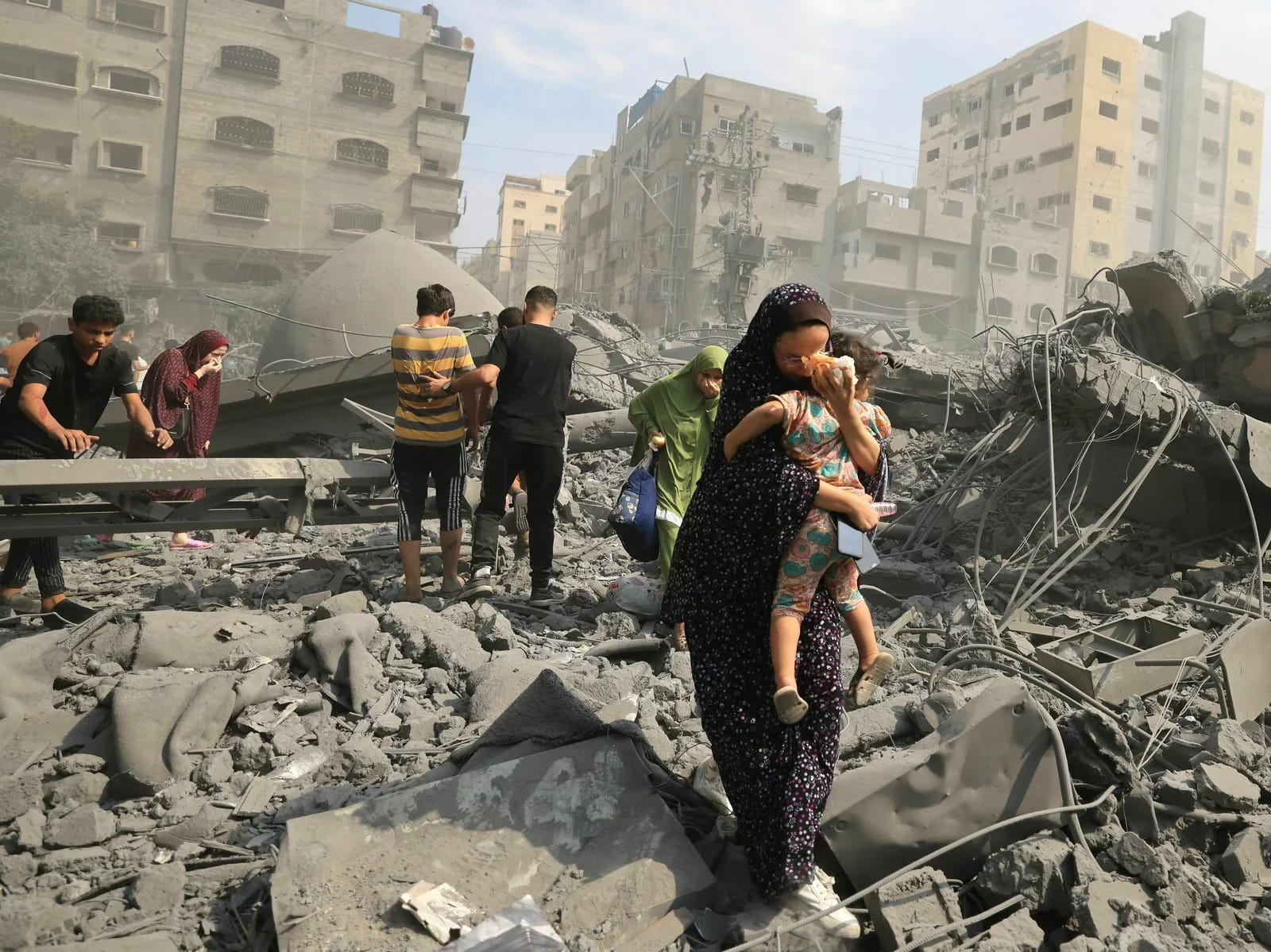
Gaza after an Israeli bombing attack. Anyone want more war?
So, who are you going to vote for in America who sees the awfulness of war and who’s willing to pursue diplomacy and peace instead? Democrats? Republicans?
Generally speaking, Democrats are fixated on war with Russia. They support massive aid to Ukraine and are against negotiations. They also support massive aid to Israel in its ongoing genocide against Palestinians in Gaza. And they fully support the military-industrial-congressional complex (MICC) and soaring spending on weapons and war, including “investing” in new nuclear weapons.
Republicans are much the same, except they tend to see China rather than Russia as the main threat, e.g. Donald Trump and J.D. Vance are willing to negotiate an end to the Russia-Ukraine War. But, in the main, Republicans fervently support Israel in its genocide, are outspoken critics of Iran (Got to punch them hard, Vance recently said), are willing enablers of the MICC, and also vote for massive spending on weaponry and war, including nuclear weapons.
Neither major U.S. political party, the red or blue teams, is pro-peace. Both are pro-aggression and pro-empire. They just occasionally choose different targets for their ire, even as they accuse the other team of “weakness,” of being “Putin puppets” or “Manchurian candidates.”
As I’ve said before, the only word or sentiment apparently forbidden among the red and blue teams is “peace.” If you want an antiwar candidate in America, you have to go outside the two main parties to the Greens or similar fringe parties.
In America, “antiwar” is defined by America’s propaganda machine, otherwise known as the corporate media, as weak and unAmerican, because “the health of the state” is war. Every election, whether the red or blue team prevails, the National Security State, the old War Department, wins. And humanity loses.
The last mainstream candidate for the presidency who spoke consistently of peace was George McGovern in 1972. Unless we the people demand peace, we will continue to get war. In fact, in a bizarrely Orwellian way, colossal military spending and incessant wars are sold to us as keeping America safe. “War is peace” is quite literally the message of the National Security State and its Ministry of Truth, the corporate-owned media.
What is the solution? Here’s one possible approach: Whenever America deploys troops overseas, those troops most immediately in harm’s way must be drawn from the ranks of America’s most privileged and their children. So, corporate CEOs, Members of Congress, lawyers at White Shoe firms, private equity billionaires and millionaires and their progeny, Hollywood celebrities and America’s best-known sports stars: those Americans who prosper and profit the most from empire should be the first to serve it. And that service must be made mandatory, no exceptions, no way to buy your way out or plead that you have “higher” priorities.
Those who want war should serve in war, leaving the rest of us alone. This rule, more than any other, might just keep the chickenhawks from screeching for more war with Russia, or China, or Iran, or North Korea, or Syria, or somebody. A few minutes at the front, facing bullets and shells and cluster munitions while hearing the screams of the dying, might just cure these wannabe “warriors” of their fever.
Want a war? Go to war. And leave the rest of us in peace.
American foreign policy remains in the grip of heretics. They believe that the Prince of Peace is actually a god of war. They believe America is strengthened by entangling alliances (think here of our so-called alliance with Israel). They believe in constant war as a recipe both for dominant power and greater freedom and democracy throughout the world. They believe that spending roughly a trillion dollars each year on weapons and war is a wise “investment.” And they believe they are the toughest and truest of patriots, the ones who see further, the ones with the guts to get things done, no matter how poorly America’s wars have gone from Korea and Vietnam through Afghanistan, Iraq, and today’s proxy wars.
There used to be a different America, a much less militaristic and bellicose one. The American tradition is rich and complex; it contains multitudes, as Walt Whitman might say. Why are we so stuck on warmongers, thieves, and vainglorious simps of empire?
As an American, I’m very much a part of my country’s complexity and richness. And the America that speaks to me contains elements and lessons such as these:
George Washington’s prescient warning about the dangers of entangling alliances with foreign powers.
James Madison’s warning that constant warfare is the direst of enemies of liberty, freedom, and democracy in America.
General Smedley Butler’s confession that “war is a racket” and that he had often served as a “gangster for capitalism.”
The Nye Commission in the U.S. Senate that investigated arms manufacturers and weapons makers as “Merchants of Death” that profited greatly from war.
President Dwight D. Eisenhower’s “cross of iron” speech and his warning about the growing power and insidious nature of the military-industrial complex.
President John F. Kennedy’s powerful peace speech in which he extended an olive branch to the Soviet Union.
Martin Luther King Jr.’s powerful speech against the Vietnam War and the perils of militarism, racism, and materialism in America.
Of course, America has always had its dark side, with slavery and the genocidal treatment of Native Americans being at the top of the list. Yet America also has had its triumphs of wisdom and goodness. That is the America we should be embracing and celebrating. I believe it’s captured in the words of Washington, Madison, JFK, MLK, and so many others who’ve fought for peace and sanity, people like Dorothy Day, the Catholic activist who fought against war and all its awful excesses.
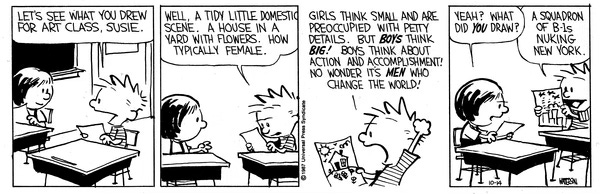
All that said, sometimes cartoons can express truths in ways that are as powerful as they are simple. In the cartoon below, the heretics of U.S. foreign policy are so many Calvins, spreading destruction and employing nukes in the name of manly seriousness. They are wrong. They are heretics. And if we continue to allow them to rule, they will surely lead America (as they already are in Gaza) to mass graves.
As a late-stage baby boomer, a child of the 1960s, I grew up dreaming about America’s nuclear triad. You may remember that it consisted of strategic bombers like the B-52 Stratofortress, land-based intercontinental ballistic missiles (ICBMs) like the Minuteman, and submarine-launched ballistic missiles (SLBMs) like the Poseidon, all delivery systems for what we then called “the Bomb.” I took it for granted that we needed all three “legs” — yes, that was also the term of the time — of that triad to ward off the Soviet Union (aka the “evil empire”).
It took me some time to realize that the triad was anything but the trinity, that it was instead a product of historical contingency. Certainly, my mind was clouded because two legs of that triad were the prerogative of the U.S. Air Force, my chosen branch of service. When I was a teenager, the Air Force had 1,054 ICBMs (mainly Minutemen missiles) in silos in rural states like Montana, North Dakota, and Wyoming, along with hundreds of strategic bombers kept on constant alert against the Soviet menace. They represented enormous power not just in destructive force measured in megatonnage but in budgetary authority for the Air Force. The final leg of that triad, the most “survivable” one in case of a nuclear war, was (and remains) the Navy’s SLBMs on nuclear submarines. (Back in the day, the Army was so jealous that it, too, tried to go atomic, but its nuclear artillery shells and tactical missiles were child’s play compared to the potentially holocaust-producing arsenals of the Air Force and Navy.)
When I said that the triad wasn’t the trinity, what I meant (the obvious aside) was this: the U.S. military no longer needs nuclear strategic bombers and land-based ICBMs in order to threaten to destroy the planet. As a retired Air Force officer who worked in Cheyenne Mountain, America’s nuclear redoubt, during the tail end of the first Cold War, and as a historian who once upon a time taught courses on the atomic bomb at the Air Force Academy, I have some knowledge and experience here. Those two “legs” of the nuclear triad, bombers and ICBMs, have long been redundant, obsolete, a total waste of taxpayer money — leaving aside, of course, that they would prove genocidal in an unprecedented fashion were they ever to be used.
Nevertheless, such thoughts have no effect on our military. Instead, the Air Force is pushing ahead with plans to field — yes! — a new strategic bomber, the B-21 Raider, and — yes, again! — a new ICBM, the Sentinel, whose combined price tag will likely exceed $500 billion. The first thing any sane commander-in-chief with an urge to help this country would do is cancel those new nuclear delivery systems tomorrow. Instead of rearming, America should begin disarming, but don’t hold your breath on that one.
A Brief History of America’s Nuclear Triad
It all started with atomic bombs and bombers. In August 1945, the Japanese cities of Hiroshima and Nagasaki were obliterated by two atomic bombs carried by B-29 bombers, ending World War II. However, in the years that followed, as the Cold War with the Soviet Union heated up, the only “delivery system” the military had for its growing thermonuclear arsenal was the strategic bomber. Those were the glory days of the Strategic Air Command, or SAC, whose motto (believe it or not) was “Peace Is Our Profession” — the “peace” of a mass nuclear grave, had those hydrogen bombs ever been dropped on their intended targets in the Soviet Union and China.
However, as this country’s weapons makers produced ever more powerful hydrogen bombs and strategic bombers, a revolution was afoot in missile technology. By the late 1950s, missiles tipped with nuclear warheads became a practical reality. By the 1960s, the Air Force was already lobbying for 10,000 ICBMs, even if my old service had to settle for a mere thousand or so of them during the administration of President John F. Kennedy. Meanwhile, the Navy was maneuvering its way into the act by demonstrating that it was indeed possible for mobile, difficult-to-detect submarines to carry nuclear-tipped missiles.
By the late 1960s, that triad of potentially ultimate nuclear death had become so sacrosanct that it was untouchable. More than half a century later, America’s nuclear triad has endured and, all too sadly, is likely to do so far longer than you or me (if not, of course, used).
You might wonder why that should be so. It’s not for any sensible military or strategic reason. By the 1980s, if not before, bombers and ICBMs were obsolete. That was why President Jimmy Carter canceled the B-1 bomber in 1977 (though it would be revived under President Ronald Reagan, with the Air Force buying 100 of those expensive, essentially useless aircraft). That was why the Air Force developed the “peacekeeper” MX ICBM, which was supposed to be mobile (shuffled around by rail) or hidden via an elaborate shell game. Such notions were soon abandoned, though not the missiles themselves, which were stuffed for a time into fixed silos. The endurance of such weapons systems owes everything to Air Force stubbornness and the lobbying power of the industrial side of the military-industrial complex, as well as to members of Congress loath to give up ICBM and bomber bases in their districts, no matter how costly, unnecessary, and omnicidal they may be.
In that light, consider the Navy’s current force of highly capable Ohio-class nuclear submarines. There are 14 of them, each armed with up to 20 Trident II missiles, each with up to eight warheads. We’re talking, in other words, about at least 160 potentially devastating nuclear explosions, each roughly five to 20 times more powerful than the Hiroshima bomb, from a single sub. In fact, it’s possible that just one of those submarines has an arsenal with enough destructive power not just to kill millions of us humans, but to tip the earth into a nuclear winter in which billions more of us could starve to death. And America has 14 of them!
Why, then, does the Air Force argue that it, too, “needs” new strategic bombers and ICBMs? The traditional arguments go like this: bombers can be launched as a show of resolve and, unlike missiles, recalled. They are also allegedly more flexible. In Air Force jargon, they can be rerouted against “targets of opportunity” in a future nuclear war. Of course, generals can always produce a scenario, however world-ending, to justify any weapons system, based on what an enemy might or might not do or discover. Nonetheless, strategic bombers were already nearing obsolescence when Stanley Kubrick made his classic antinuclear satire, Dr. Strangelove (1964), so prominently featuring them.
And what about land-based ICBMs? Once the claim was that they had more “throw-weight” (bigger warheads) than SLBMs and were also more accurate (being launched from fixed silos rather than a mobile platform like a submarine). But with GPS and other advances in technology, submarine-launched missiles are now as accurate as land-based ones and “throw-weight” (sheer megatonnage) always mattered far less than accuracy.
Worse yet, land-based ICBMs in fixed silos are theoretically more vulnerable to an enemy “sneak” attack and so more escalatory in nature. The U.S. currently has 400 Minuteman III ICBMs sitting in silos. If possible incoming enemy nuclear missiles were detected, an American president might have less than 30 minutes — and possibly only 10 or so — to decide whether to launch this country’s ICBM force or risk losing it entirely.
That’s not much time to determine the all-too-literal fate of the planet, is it, especially given the risk that the enemy attack might prove to be a “false alarm“? Just before I arrived at Cheyenne Mountain, there were two such alarms (one stemming from a technical failure, the other from human error when a simulation tape was loaded into computers without any notification that it was just a “war game”). Until they were found to be false alarms, both led to elevated DEFCONs (defense readiness conditions) in preparation for possible nuclear war.
New ICBMs will only add “use them or lose them” pressure to the global situation. Mobile, elusive, and difficult to detect, the Navy’s submarine force is more than sufficient to deter any possible enemy from launching a nuclear attack on the United States. Strategic bombers and ICBMs add plenty of bang and bucks but only to the Air Force budget and the profits of the merchants of mass nuclear death who make them.
A Sane Path Forward for America’s Nuclear Force
I still remember the nuclear freeze movement, the stunningly popular antinuclear protest of the early 1980s. I also remember when President Reagan and Soviet leader Mikhail Gorbachev met in 1986 and seriously discussed total nuclear disarmament. I remember Barack Obama, as a 2008 presidential candidate, being joined by old Cold War stalwarts like Henry Kissinger and Sam Nunn in calling for the eventual elimination of nuclear weapons.
Today, we’re not supposed to recall any of that. Instead, we’re told to focus on the way a developing “new cold war” with Russia and China is driving a “requirement” for a “modernized” U.S. nuclear triad that could cost $2 trillion over the next 30 years. Meanwhile, we’re discouraged from thinking too much about the actual risks of nuclear war. The Biden administration, for example, professes little concern about the possibility that arming Ukraine with weaponry capable of hitting deep inside Russia could lead to destabilization and the possible use of nuclear weapons on the battlefield (something Vladimir Putin has threatened to do). Nor are we to fret about surrounding China with ever more U.S. military bases and sending ever more weaponry to Taiwan, while the Chinese are enlarging their own force of ICBMs; or, for that matter, about the fact that the last nuclear agreement limiting the size of the American and Russian arsenals will run out in less than 1,000 days.
To such issues, the only response America’s “best and brightest” ever have is this one: give us more/newer strategic bombers, more/newer ICBMs, and more/newer nuclear submarines (whatever the cost)! To those men, it’s as if nuclear war were a theoretical (and distinctly money-making) chess match — and yes, they are indeed still mostly men! — a challenging game whose only components are profits, jobs, money, and power. Yet when the only story to be told is one featuring more nuclear warheads and more delivery systems, it’s hard not to conclude that, in some horrific fashion, nuclear Armageddon is indeed us (or at least them).
And though few spend much time thinking about it anymore, that’s madness personified. What’s needed instead is a new conviction that a nuclear Armageddon must not be our fate and, to make that so, we must act to eliminate all ICBMs, cancel the B-21 bomber, retire the B-1s and B-2s, work on global nuclear disarmament, start thinking about how to get rid of those nuclear subs, and begin to imagine what it would be like to invest the money saved in rebuilding America. It sure beats destroying the world.
And again, in the most practical terms possible, if we’re set on preserving Armageddon, America’s existing force of Ohio-class nuclear submarines is more than enough both to do so and undoubtedly to “deter” any possible opponent.
There was a time, in the early stages of the first Cold War, when America’s leaders professed fears of “bomber” and “missile” gaps vis-à-vis the Soviet Union — gaps that existed only in their minds; or rather only in the reverse sense, since the U.S. was ahead of the Soviets in both technologies. Today, the bomber and missile “gaps” are, in fact, gaps in logic wielded by a Pentagon that insists strategic bombers and ICBMs remain a “must” for this country’s safety and security.
It’s all such nonsense and I’m disgusted by it. I want my personal thermonuclear odyssey to come to an end. As a kid in the 1970s, I built a model of the B-1 bomber. As a ROTC cadet in the early 1980s, I made a presentation on the U.S./Soviet nuclear balance. As a young Air Force officer, I hunkered down in Cheyenne Mountain, awaiting a nuclear attack that fortunately never came. When I visited Los Alamos and the Trinity Test Site at Alamogordo, New Mexico, in 1992, I saw what J. Robert Oppenheimer’s original atomic “gadget” had done to the tower from which it had been suspended. When the Soviet Union collapsed, I genuinely hoped that this country’s (and the world’s) long nuclear nightmare might finally be coming to an end.
Tragically, it was not to be. The gloomy Los Alamos of 1992, faced with serious cuts to its nuclear-weapons-producing budget, is once again an ebullient boom town. Lots of new plutonium pits are being dug. Lots more money is flooding in to give birth to a new generation of nuclear weapons. Of course, it’s madness, sheer madness, yet,this time, it’s all happening so quietly.
Even as the nuclear clock ticks ever closer to midnight, nobody is ducking and covering in America’s classrooms anymore (except against mass shooters). No one’s building a nuclear bomb shelter in their backyard (though doomsday shelters for the ultra-rich seem to have become status symbols). We’re all going about our business as if such a war were inconceivable and, in any case, akin to a natural disaster in being essentially out of our control.
And yet even as we live our lives, the possibility of a nuclear Armageddon remains somewhere in our deepest fears and fantasies. Worse yet, the more we suppress the thought of such horrors and the more we refuse even to think about acting to prevent them, the more likely it is that such an Armageddon will indeed come for all of us one day, and the “trinity” we’ll experience will be a horrific version of the blinding flash of light first seen by J. Robert Oppenheimer and crew at that remote desert site nearly 80 years ago.
$95 Billion “Supplemental” for More Weapons and War
Who knew mass death was such a growth industry? And by “death” I mean not only of humans but of any organism in a war zone.
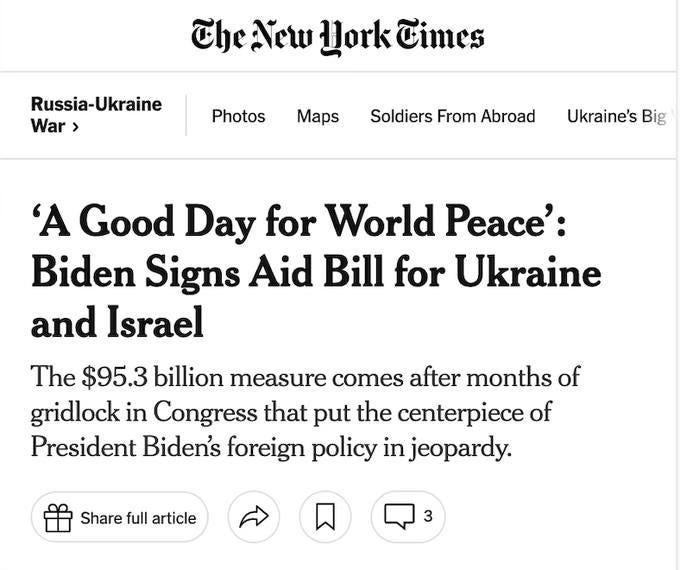
We humans are a self-absorbed lot. We blast the earth and obliterate life without a thought to the ravages we commit against nature. Indeed, we pass and sign bills for $95 billion for more weapons and war and we dare call it “peace”!
Yes, President Biden thinks “peace” is advanced through weapons and war. It’s a sentiment that recalls Tacitus and his condemnation of the Roman Empire: “They create a desert and call it ‘peace.’”
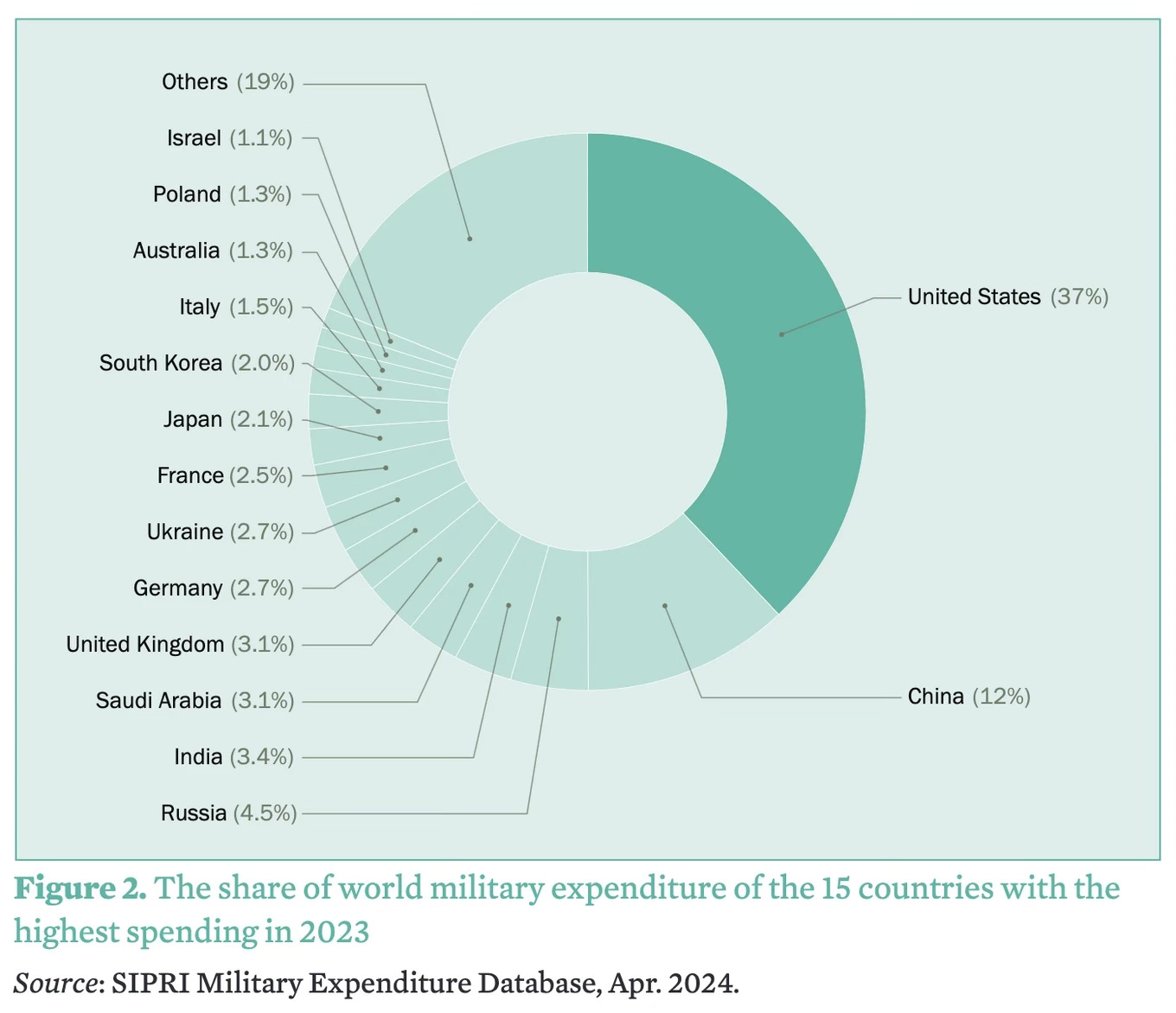
So, even though the USA spends triple what China does and eight times what Russia does, we’re the nation allegedly most committed to advancing peace. Call it a logic bomb, and we’re the best at producing them.
Finally, here’s a quick summary about what real high explosive bombs are doing in Gaza:
No worries: the president says it’s a “good day” for world peace. In Gaza, call it the peace of the grave, as so many innocent Palestinians are buried in mass graves or under rubble.
In an age when American presidents routinely boast of having the world’s finest military, where nearly trillion-dollar war budgets are now a new version of routine, let me bring up one vitally important but seldom mentioned fact: making major cuts to military spending would increase U.S. national security.
Why? Because real national security can neither be measured nor safeguarded solely by military power (especially the might of a military that hasn’t won a major war since 1945). Economic vitality matters so much more, as does the availability and affordability of health care, education, housing, and other crucial aspects of life unrelated to weaponry and war. Add to that the importance of a Congress responsive to the needs of the working poor, the hungry and the homeless among us. And don’t forget that the moral fabric of our nation should be based not on a military eternally ready to make war but on a determination to uphold international law and defend human rights. It’s high time for America to put aside its conveniently generic “rules-based order” anchored in imperial imperatives and face its real problems. A frank look in the mirror is what’s most needed here.
It should be simple really: national security is best advanced not by endlessly preparing for war, but by fostering peace. Yet, despite their all-too-louddisagreements, Washington’s politicians share a remarkably bipartisan consensus when it comes to genuflecting before and wildly overfunding the military-industrial complex. In truth, ever-rising military spending and yet more wars are a measure of how profoundly unhealthy our country actually is.
“The Scholarly Junior Senator from South Dakota”
Such insights are anything but new and, once upon a time, could even be heard in the halls of Congress. They were, in fact, being aired there within a month of my birth as, on August 2, 1963, Democratic Senator George McGovern of South Dakota — later a hero of mine — rose to address his fellow senators about “New Perspectives on American Security.”
George McGovern
Nine years later, he (and his vision of the military) would, of course, lose badly to Republican Richard Nixon in the 1972 presidential election. No matter that he had been the one who served in combat with distinction in World War II, piloting a B-24 bomber on 35 missions over enemy territory, even as Nixon, then a Navy officer, amassed a tidy sum playing poker. Somehow, McGovern, a decorated hero, became associated with “weakness” because he opposed this country’s disastrous Vietnam War, while Nixon manufactured a self-image as the staunchest Cold Warrior around, never missing a chance to pose as tough on communism (until, as president, he memorably visited Communist China, opening relations with that country).
But back to 1963, when McGovern gave that speech (which you can read in the onlineSenate Congressional Record, volume 109, pages 13,986-94). At that time, the government was already dedicating more than half of all federal discretionary spending to the Pentagon, roughly the same percentage as today. Yet was it spending all that money wisely? McGovern’s answer was a resounding no. Congress, he argued, could instantly cut 10% of the Pentagon budget without compromising national security one bit. Indeed, security would be enhanced by investing in this country instead of buying yet more overpriced weaponry. The senator and former bomber pilot was especially critical of the massive amounts then being spent on the U.S. nuclear arsenal and the absurd planetary “overkill” it represented vis-à-vis the Soviet Union, America’s main competitor in the nuclear arms race. As he put it then:
“What possible advantage [can be had] in appropriating additional billions of dollars to build more [nuclear] missiles and bombs when we already have excess capacity to destroy the potential enemy? How many times is it necessary to kill a man or kill a nation?”
How many, indeed? Think about that question as today’s Congress continues to ramp up spending, now estimated at nearly $2 trillion over the next 30 years, on — and yes, this really is the phrase — “modernizing” the country’s nuclear triad of intercontinental ballistic missiles (ICBMs), as well as its ultra-expensive nuclear-missile-firing submarines and stealth bombers. And keep in mind that the U.S. already has an arsenal quite capable of wiping out life on several Earth-sized planets.
What, according to McGovern, was this country sacrificing in its boundless pursuit of mass death? In arguments that should resonate strongly today, he noted that America’s manufacturing base was losing vigor and vitality compared to those of countries like Germany and Japan, while the economy was weakening, thanks to trade imbalances and the exploding costs of that nuclear arms race. Mind you, back then, this country was still on the gold standard and unburdened by an almost inconceivable national debt, 60 years later, of more than $34 trillion, significant parts of it thanks to this country’s failed “war on terror” in Iraq, Afghanistan, and elsewhere across all too much of the planet.
McGovern did recognize that, given how the economy was (and still is) organized, meaningful cuts to military spending could hurt in the short term. So, he suggested that Congress create an Economic Conversion Commission to ensure a smoother transition from guns to butter. His goal was simple: to make the economy “less dependent upon arms spending.” Excess military spending, he noted, was “wasting” this country’s human resources, while “restricting” its political leadership in the world.
In short, that distinguished veteran of World War II, then serving as “the scholarly junior Senator from South Dakota” (in the words of Senator Jennings Randolph of West Virginia), was anything but proud of America’s “arsenal of democracy.” He wasn’t, in fact, a fan of arsenals at all. Rather, he wanted to foster a democracy worthy of the American people, while freeing us as much as possible from the presence of just such an arsenal.
To that end, he explained what he meant by defending democracy:
“When a major percentage of the public resources of our society is devoted to the accumulation of devastating weapons of war, the spirit of democracy suffers. When our laboratories and our universities and our scientists and our youth are caught up in war preparations, the spirit of [freedom] is hampered.
“America must, of course, maintain a fully adequate military defense. But we have a rich heritage and a glorious future that are too precious to risk in an arms race that goes beyond any reasonable criteria of need.
“We need to remind ourselves that we have sources of strength, of prestige, and international leadership based on other than nuclear bombs.”
Imagine if his call had been heeded. This country might today be a far less militaristicplace.
Something was, in fact, afoot in the early 1960s in America. In 1962, despite the wishes of the Pentagon, President John F. Kennedy used diplomacy to get us out of the Cuban Missile Crisis with the Soviet Union and then, in June 1963, made a classic commencement addressabout peace at American University. Similarly, in support of his call for substantial reductions in military spending, McGovern cited the farewell address of President Dwight D. Eisenhower in 1961 during which he introduced the now-classic phrase “military-industrial complex,” warning that “we must never let the weight of this combination [of the military with industry, abetted by Congress] endanger our liberties or democratic processes.”
Echoing Ike’s warning in what truly seems like another age, McGovern earned the approbation of his Senate peers. His vision of a better, more just, more humane America seemed, however briefly, to resonate. He wanted to spend money not on more nuclear bombs and missiles but on “more classrooms, laboratories, libraries, and capable teachers.” On better hospitals and expanded nursing-home care. On a cleaner environment, with rivers and streams saved from pollution related to excessive military production. And he hoped as well that, as military bases were closed, they would be converted to vocational schools or healthcare centers.
McGovern’s vision, in other words, was aspirational and inspirational. He saw a future America increasingly at peace with the world, eschewing arms races for investments in our own country and each other. It was a vision of the future that went down fast in the Vietnam War era to come, yet one that’s even more needed today.
Praise from Senate Peers
Here’s another way in which times have changed: McGovern’s vision won high praise from his Senate peers in the Democratic Party. Jennings Randolph of West Virginia agreed that “unsurpassed military power in combination with areas of grave economic weakness is not a manifestation of sound security policy.” Like McGovern, he called for a reinvestment in America, especially in underdeveloped rural areas like those in his home state. Joseph Clark, Jr., of Pennsylvania, also a World War II veteran, “thoroughly” agreed that the Pentagon budget “needs most careful scrutiny on the floor of the Senate, and that in former years it has not received that scrutiny.” Stephen Young of Ohio, who served in both World War I and World War II, looked ahead toward an age of peace, expressing hope that “perhaps the necessity for these stupendous appropriations [for weaponry] will not be as real in the future.”
Possibly the strongest response came from Frank Church of Idaho, who reminded his fellow senators of their duty to the Constitution. That sacred document, he noted, “vests in Congress the power to determine the size of our military budget, and I feel we have tended too much to rubberstamp the recommendations that come to us from the Pentagon, without making the kind of critical analysis that the Senator from South Dakota has attempted… We cannot any longer shirk this responsibility.” Church saluted McGovern as someone who “dared to look a sacred cow [the Pentagon budget] in the teeth.”
A final word came from Wayne Morse of Oregon. Very much a gadfly, Morse shifted the topic to U.S. foreign aid, noting that too much of that aid was military-related, constituting a “shocking waste” to the taxpayer even as it proved detrimental to the development of democracy abroad, most notably in Latin America. “We should be spending the money for bread, rather than for military aid,” he concluded.
Imagine that! Bread instead of bullets and bombs for the world. Of course, even then, it didn’t happen, but in the 60 years since then, the rhetoric of the Senate has certainly changed. A McGovern-style speech today would undoubtedly be booed down on both sides of the aisle. Consider, for example, consistent presidential and Congressional clamoring now for more military aid to Israel during a genocide in Gaza. So far, U.S. government actions are more consistent with letting starving children in Gaza eat lead instead of bread.
Peace Must Be Our Profession
What was true then remains true today. Real national defense should not be synonymous with massive spending on wars and weaponry. Quite the reverse: whenever possible, wars should be avoided; whenever possible, weapons should be beaten into plowshares, and those plowshares used to improve the health and well-being of people everywhere.
Oh, and that Biblical reference of mine (swords into plowshares) is intentional. It’s meant to highlight the ancient roots of the wisdom of avoiding war, of converting weapons into useful tools to sustain and provide for the rest of us.
Yet America’s leaders on both sides of the aisle have long lost the vision of George McGovern, of John F. Kennedy, of Dwight D. Eisenhower. Today’s president and today’s Congress, Republicans and Democrats alike, boast of spending vast sums on weapons, not only to strengthen America’s imperial power but to defeat Russia and deter China, while bragging all the while of the “good” jobs they’re allegedly creatinghere in America in the process. (This country’s major weapons makers would agreewith them, of course!)
McGovern had a telling rejoinder to such thinking. “Building weapons,” he noted in 1963, “is a seriously limited device for building the economy,” while an “excessive reliance on arms,” as well as overly “rigid diplomacy,” serve only to torpedo promising opportunities for peace.
Back then, it seemed to politicians like McGovern, as well as President Kennedy, that clearing a path toward peace was not only possible but imperative, especially considering the previous year’s near-cataclysmic Cuban Missile Crisis. Yet just a few months after McGovern’s inspiring address in the Senate, Kennedy had been assassinated and his calls for peace put on ice as a new president, Lyndon B. Johnson, succumbed to pressure by escalating U.S. military involvement in what mushroomed into the catastrophic Vietnam War.
In today’s climate of perpetual war, the dream of peace continues to wither. Still, despite worsening odds, it’s important that it must not be allowed to die. The high ground must be wrested away from our self-styled “warriors,” who aim to keep the factories of death churning, no matter the cost to humanity and the planet.
My fellow Americans, we need to wake up from the nightmare of forever war. This country’s wars aren’t simply being fought “over there” in faraway and, at least to us, seemingly forgettable places like Syria and Somalia. In some grim fashion, our wars are already very much being fought right here in this deeply over-armed country of ours.
George McGovern, a bomber pilot from World War II, knew the harsh face of war and fought in the Senate for a more peaceful future, one no longer haunted by debilitating arms races and the prospect of a doomsday version of overkill. Joining him in that fight was John F. Kennedy, who, in 1963, suggested that “this generation of Americans has already had enough, more than enough, of war, and hate, and oppression.”
If only.
Today’s generation of “leaders” seems not yet to have had their fill of war, hate, and oppression. That tragic fact — not China, not Russia, not any foreign power — is now the greatest threat to this country’s “national security.” And it’s a threat only aggravated by ever more colossal Pentagon budgets still being rubberstamped by a spinelessly complicit Congress.
I’m a member of the Eisenhower Media Network, or EMN. We’re a small network of retired military types and former U.S. government officials who are openly critical of the military-industrial-congressional complex, America’s open-ended forever wars (the global war on terror; the cold war against Russia and China), and rising militarism within and across our society.
Recently, EMN issued a new letter in opposition to the Washington bipartisan consensus for war and more war. I’m proud to say I had a hand in writing it, as did Matthew Hoh and other members of EMN. Here’s what we had to say:
Military and Foreign Policy Experts Open Letter on U.S. Diplomatic Malpractice
Does America inspire the world by the power of its example or the example of its power? Far too often, and despite President Joe Biden’s words during his inaugural address, America’s overmilitarized power and diplomatic malpractice are its examples to the world.
We must change that. To make America truly essential and indispensable, we must not remain the world’s leading arms maker and weapons exporter. We must instead become the world’s greatest and most committed peacemaker and diplomat.
The problem is that America continues to make war, continues being “essential” only as the world’s leading merchant of death, and continues seeking dominance through military supremacy that ends, in places like Afghanistan, Iraq, and earlier in Vietnam, in mass death and colossal folly.
In our first open letter last spring in The New York Times, we, the undersigned, argued that a thoroughly militarized U.S. foreign policy would generate ruinous and worsening consequences and increasingly limited options for the U.S. and the world. Recent events bear this out.
The results of U.S. diplomatic malpractice are cruelly displayed in Eastern Europe, the Middle East and the Indo-Pacific. Risks of further escalation and a world war are rising. Predictably, a militarized foreign policy characterized by rejecting or ignoring international laws and treaties and by disingenuous negotiations and talks has offered no solutions to volatile wars in Eastern Europe and the Middle East while making war more likely in the Indo-Pacific.
Militarized solutions breed and feed more war. Earnest and deliberate diplomacy is the best hope to bring peace, stability and reconciliation to the world.
We chose Ike as our inspiration because he warned Americans of the dangers of the military-industrial complex and because he rejected a world dedicated to manufacturing weapons to commit mass murder.
War in Ukraine
The failure to pursue diplomacy in Eastern Europe, both before and after Russia’s invasion of Ukraine, has resulted in a costly and destructive stalemate for which there are two likely futures:
The collapse of the Ukrainian state due to a deteriorating economic and military situation hastened by corruption.Here, Ukraine’s fragility resembles that of previous houses of cards built by the U.S. in Afghanistan, Iraq, and Vietnam.
A harrowing and bloody stalemate in Ukraine where firepower, made more lethal by technological advances, rules a battlefield where neither side can achieve decisive tactical or operational gains. The pursuit of ways out of this stalemate likely entails horizontal and vertical escalation, neither of which offers solace to those seeking an end to death and destruction in Ukraine and the establishment of peace and stability.
Horizontal escalation sees the war extending further to civilian population centers and infrastructure and includes the possibility of other nations joining the conflict. Vertical escalation sees the expansion of arsenals to weapons of greater range, lethality, and consequence, including nuclear weapons. These two forms of escalation may be intertwined and reinforcing. So, as the war may expand horizontally to resemble The War of Cities between Iran and Iraq in the 1980s, it may expand vertically as well with more powerful weapons being introduced by both sides. The use of nuclear weapons is increasingly conceivable under these conditions.
These two likely futures may intersect. For example, a Ukrainian collapse could see NATO forces, likely Polish and Romanian, marching into western and central Ukraine to counter a Russian push to fill a collapsing Ukrainian state. Such an event could lead to a war between NATO and Russia, a war that conceivably could go nuclear.
Hamas, Israel and the Middle East
The Russia-Ukraine War now rages concurrently with the war between Hamas and Israel. This war, too, is born of a U.S. refusal to foster diplomacy. Unlike the conventional war between Russia and Ukraine, we are witnessing an asymmetrical conflict more akin to the wars of insurgency many of us experienced in Vietnam, Afghanistan, and Iraq.
Worse, the Hamas/Israel bloodletting in Gaza is characterized by an ethnic cleansing campaign that would be impossible without U.S. diplomatic, economic, media, military and political support. We are disgusted by and find repugnant the brazen and bipartisan support by the U.S. government for rampant violations of international law by Israel. Ethnic cleansing in Gaza, long planned by senior members of the Israeli government and powerful elements of Israel’s reactionary right wing, follows in the ghastly wake of Hamas atrocities against civilians on October 7.
Here, the U.S. government isn’t just passively witnessing war crimes; it is enabling them. With the frightening possibility of escalation to a regional or even a world war, the violence in Gaza has fed and feasted upon decades of deliberate diplomatic malpractice in America. Decades of putting Israel first, second, and last while ignoring the plight and pleas of Palestinians have made political settlements to the blockade of Gaza and the occupation of East Jerusalem and the West Bank nearly impossible.
Whereas a month ago, we lived with the risk of nuclear war as an outcome of escalating conflict in Ukraine, we now face the elevated risk of a rightfully feared world war as a consequence of entangling alliances between nuclear-armed Moscow and Washington in the Middle East.
China and the Path Ahead
To this, we must add the dangers of war with China, something hyped by leading U.S. politicians; the still unpaid costs of the $8 trillion wars in Afghanistan and Iraq; a militarized federal budget for which 60% of discretionary spending goes to war and all its wounds; and a hollowed American economy.
Decades of reckless U.S. war-making, both direct and via proxies, while coddling corrupt, ruthless, and unjust foreign governments has, not surprisingly, made the world more dangerous and less stable. Failure to invest in and maintain our country has weakened and corroded America’s infrastructure, institutions, and industries. A hypocritical flaunting of international law and an espousal of an ethereal rules-based order, coupled with an arrogant disregard for past U.S. crimes and blunders, have caused dozens of nations to flock to competitors – a movement away from America that will undoubtedly accelerate if we remain on our current militaristic path.
Moreover, decades of colossal military spending have witnessed few strategic gains for the U.S. Our military, often saluted as the world’s greatest by politicians, hasn’t won a major war since World War II. That same military annually faces significant recruiting shortfalls that cast considerable doubt on the integrity and staying power of the All-Volunteer Force. America’s legacy of failed wars is not redeemed by ongoing displays of vacuous military boosterism. Feel-good patriotism can’t suppress the bitterness many of us military veterans feel toward the past, nor does it calm the worries we have about our nation’s future.
Pope Francis has spoken of a “famine of peace” that exists in the world today. In this spirit, we call for immediate ceasefires, without conditions, in Gaza and Ukraine.
The surest way to prevent wars from exploding into uncontainable wildfires is to starve them of fuel. To think or speak that these conflagrations can be managed, adjusted as if by damper or thermostat, is a fool’s conceit or a liar’s word. We have been burned too many times in our professional lives to believe hot wars can be “won” by throwing more gasoline on them, whether rhetorically or in the form of cluster munitions, depleted uranium shells, and similar forms of “aid.”
A better path ahead is clear. Peace, not war, must be fostered. In embracing peace through diplomacy conducted in good faith, America would indeed exhibit the power of its example, becoming essential to a world that cries out for liberty and justice for all.
When the Soviet Union fell in 1991, America heard something about “peace dividends” and “a new world order.” With the Soviet Union gone, the Cold War over, America could take all the hundreds of billions it had been spending on weapons and wars and spend it instead on America. We could, in theory, embrace peace, reinvest in America, and save our children from a world of incessant wars and preparations for the same.
It was not to be.
The collapse of the Soviet Union coincided with Desert Shield/Storm, when America allegedly kicked its “Vietnam Syndrome” once and for all, according to then-President George H.W. Bush. This “syndrome” was allegedly inhibiting America’s pursuit of righteous victory through military means, and the expulsion of Iraqi forces from Kuwait was allegedly proof that America was back and that military force had powerful efficacy for good.
Out went the idea of peace dividends. This was America’s moment to dominate, a Pax Americana achieved through military force or threats of the same. U.S. dominance of the Middle East contributed to the decision by Al Qaeda to launch attacks against the USA, but any U.S. culpability for 9/11 was swept away by another President Bush, George W., who explained that Al Qaeda had no rationale for 9/11 other than their hatred of American freedoms.
The aftermath of 9/11 was an orgy of American violence directed against “evildoers” everywhere. It was a two-decade global war on terror, GWOT as jihad, leading to wars in Afghanistan, Iraq, Libya, and elsewhere. Even as these wars proved disastrous, those who advocated for them saluted themselves as being right but (perhaps) for the wrong reason, the “wrong” reason being some version of having loved America too much, whereas those who’d opposed these wars were “wrong” even though events had proven them to be right (they were wrong apparently because they didn’t love America enough, especially its domineering government).
It’s been a long time, more than three decades, since I’ve heard anyone mention peace dividends. Even when President Biden ended the Afghan War in 2021, military spending soared upwards, and this was before the Russia-Ukraine War. With the Hamas attacks on Israel and the impending invasion and destruction of Gaza by the IDF, America will likely embrace war and increase military spending with even more fervor.
War is America’s growth stock. Our politicians brag that military aid to countries like Ukraine and Israel serves to create jobs in America. Rarely is any mention made of Russian dead, of Palestinian dead, or for that matter of any dead, as America dominates the global trade in weaponry. The idea of “the merchants of death,” the opposition by the U.S. Senate in the 1930s to making profits by killing people, seems like ancient history, seems absurd, given America’s tight embrace of militarism. If we’re not fighting wars we’re arming others to fight wars. And we console ourselves that we’re only providing “good guys” with guns, for, as the NRA taught us, the only way to stop bad guys with guns is to give good guys even more guns.
Perhaps that’s the essence of U.S. foreign policy today. We give “good guys” like Ukrainians and Israelis all the guns they want to go kill “bad guys” like Russians and Palestinians while congratulating ourselves for “investing” in America’s arms manufactures. Indeed, members of Congress have said that providing older weapons from U.S. stockpiles of the same to countries like Ukraine is positively wonderful, since it forces the U.S. military to buy new weapons for itself, helping to create more jobs among the makers of guns, ammo, and bombs. What a win-win!
Lately I’ve been reading a lot about President Lyndon Johnson and how his “Great Society” and fight against poverty was done in by the calamitous Vietnam War in the 1960s. What’s tragic today in America is that we no longer have a vision of a great society, a better society, a fairer, more just, and more equitable society. Endless war and wildly excessive military expenditures is our only vision.
We put it on our stamps. And that’s where it remains.
The result is that “peace” has become a word rarely heard in America, a Pollyanna-like concept, easily dismissed as pie-in-the-sky. In fact, the last U.S. president to speak sincerely and powerfully for peace was John F. Kennedy, and that was sixty years ago. No president since JFK has stood before us to advance a vision of eventual world peace rather than of endless war and expensive preparations for the same.
We are told and taught today that peace is impossible and war is inevitable. Those who promote peace are dismissed as dreamers and weaklings as the “warriors” and hawks are promoted for their alleged realism and toughness.
Constant wars and preparations for the same destroy democracy and lead to spiritual death, to cite the words of James Madison and Martin Luther King Jr. Those are the true dividends of war, not jobs in American factories producing bullets and bombs. The true dividends of peace are a restoration of democracy and spiritual renewal in America.










 Bracing Views