We’re #1 (once again) in selling weapons! Amazingly, the USA now accounts for 43% of the world’s trade in deadly weaponry. No country beats more plowshares into swords and pruning hooks into spears than America, which is also, obviously, the most Christian nation in the world.
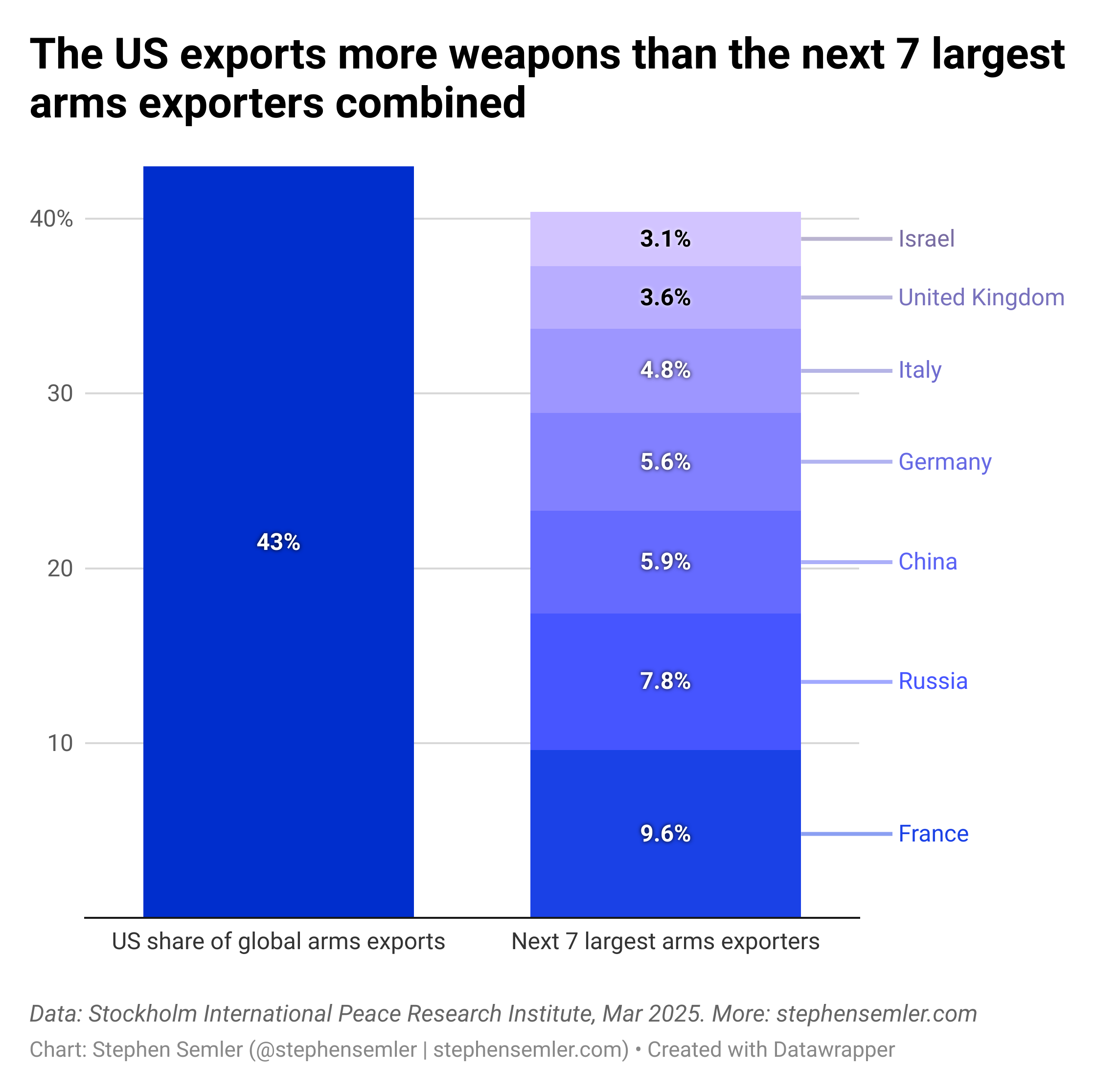
Let’s take a look at a useful chart from Stephen Semler (be sure to check out his blogon Substack):
*****
Finding #1: The US is the world’s largest arms dealer
The US accounts for 43% of global arms exports, more than the next seven largest arms-exporting countries combined. All the countries outside the top eight account for less than 17% of the worldwide total.
^Alt text for screen readers: The U.S. exports more weapons than the next 7 largest arms exporters combined. This graph has two columns, one showing the U.S.’s 43% share of global arms transfers, and the other showing the combined share of France, Russia, China, Germany, Italy, U.K., and Israel, totaling 40.4%.
For another perspective on America’s record-breaking year of selling deadly weaponry, check out this column by Lenny Broytman.
*****
Way back in 2012, I wrote a column for TomDispatch: “Weapons ‘r’ us,” in which I examined America’s dominance of the weapons trade. Here’s what I wrote back then:
Yes, we’re the world’s foremost “merchants of death,” the title of a best-selling exposé of the international arms trade published to acclaim in the U.S. in 1934. Back then, most Americans saw themselves as war-avoiders rather than as war-profiteers. The evil war-profiteers were mainly European arms makers like Germany’s Krupp, France’s Schneider, or Britain’s Vickers.
Not that America didn’t have its own arms merchants. As the authors of Merchants of Death noted, early on our country demonstrated a “Yankee propensity for extracting novel death-dealing knickknacks from [our] peddler’s pack.” Amazingly, the Nye Committee in the U.S. Senate devoted 93 hearings from 1934 to 1936 to exposing America’s own “greedy munitions interests.” Even in those desperate depression days, a desire for profit and jobs was balanced by a strong sense of unease at this deadly trade, an unease reinforced by the horrors of and hecatombs of dead from the First World War.
We are uneasy no more. Today we take great pride (or at least have no shame) in being by far the world’s number one arms-exporting nation. A few statistics bear this out. From 2006 to 2010, the U.S. accounted for nearly one-third of the world’s arms exports, easily surpassing a resurgent Russia in the “Lords of War” race. Despite a decline in global arms sales in 2010 due to recessionary pressures, the U.S. increased its market share, accounting for a whopping 53% of the trade that year. Last year saw the U.S. on pace to deliver more than $46 billion in foreign arms sales. Who says America isn’t number one anymore?
Who, indeed? And we remain, of course, our own best customers, as this year’s Pentagon budget soars to $900 billion, even as the Trump administration argues for “peace through strength,” or, put bluntly, peace through superior firepower.
Only in America is Jesus heavily armed and packing heat. Truly exceptional!
Obviously, American Jesus preached peace through strength
Readers here have heard of Ray McGovern’s MICIMATT, the military-industrial-congressional-intelligence-media-academe-think-tank complex. It’s gargantuan and lubricated with enormous sums of money.
I wonder why these think tanks tend to favor the agendas and interests of America’s various weapons makers? Hard to offer “neutral” or “balanced” advice when so much of your funding is coming from the merchants of death.
Now consider these stats, courtesy of former Congressman Dennis Kucinich and The Kucinich Report on Substack:
Military Contractors’ Political Contributions (2023-2024)
According to OpenSecrets, the top defense contractors contributed significantly to political campaigns in the current election cycle:
Lockheed Martin – $4,470,698 total ($2,393,034 to Democrats, $2,021,283 to Republicans)
Northrop Grumman – $3,354,889 total ($1,903,884 to Democrats, $1,385,924 to Republicans)
RTX Corp (Raytheon) – $2,805,535 total ($1,472,920 to Democrats, $1,258,511 to Republicans)
General Atomics – $2,507,912 total ($595,947 to Democrats, $1,660,970 to Republicans)
L3Harris Technologies – $2,475,712 total ($1,126,096 to Democrats, $1,331,975 to Republicans)
In the presidential race, defense contractors have donated:
Kamala Harris – $4,440,605
Donald Trump – $1,787,259
In total, the defense sector has contributed over $41.4 million in the 2023-2024 election cycle. For every $1 contributed to political campaigns, these companies receive $10,000 in government contracts—a return on investment most businesses could only dream of.
*****
As weapons makers like Lockheed Martin and RTX throw around millions of dollars to influence Congress, presidential elections, and think tanks, peace organizations that I’m familiar with operate on shoestring budgets where a donation of $1000 is considered large.
My dad taught me the saying, He who pays the piper calls the tune. The weapons makers are paying the piper (think tanks, Congress, the media), and the tunes they’re calling are military marches.
America, we truly get what they pay for, which is war and more war.
A Coda: So far, Bracing Views has received $0.00 from weapons makers. 🙂
Yesterday, the Merchants of Death Tribunal concluded with a verdict of “guilty” for all those U.S. dealers and exporters of weapons globally. Yes, the merchants of death are guilty as sin, even as they account for 40% of the global trade in deadly weaponry. Who says nothing is made in America today? We make plenty of things that go “bang.”
In our culture today, it’s considered “patriotic” to make loads of money, especially by selling guns. Just look at the National Rifle Association (NRA) and its enablers in Congress and all the gun companies domestically.
Assault weapons are highly profitable, much more so than pistols, and isn’t it all about making money? Thoughts and prayers to those innocents caught in the crossfire, of course. No worries–more “good guys with guns” will save us from the bad guys with guns.
If we Americans embrace (or, refuse to stop) the sale of firearms, especially dangerous assault weapons, domestically, indeed, if we fetishize it with ideas of potency and manliness, is it any surprise we brag of weapons sales overseas and our dominance of that trade? If we don’t care (or care enough) about the safety of our own children, why should we care about dead kids in Gaza?
Our culture is violent and sick, and until we reform it, there’s little hope of meaningful change.
That said, it’s encouraging to hear of a ceasefire in Gaza. Perhaps the Trump administration can achieve a ceasefire in Ukraine as well. The problem is there always seems to be another war or wars looming on the horizon for the U.S., more conflicts that America’s merchants of death can make a killing on.
America has the war but not the peace
If there’s an American Leo Tolstoy out there, he couldn’t write a book on this epoch with the title of War and Peace. Today’s version for America has a single-word title: War.
Peace is rarely if ever mentioned in mainstream political discourse and culture. That’s not surprising. Roughly 60% of U.S. federal discretionary spending goes to the Pentagon, Homeland Security, nuclear weapons, and weapons shipments to places like Israel and Ukraine. President Biden once said: Show me your budget and I’ll tell you what you value. Looks like America values war very highly indeed.
Until we stop valuing and valorizing war and start embracing peace, the merchants of death will continue to thrive. Sure, they’re guilty, but so are we all if we keep feeding them our money and keep looking to them for “safety” and “security.”
Jack Gilroy has his day in court against the Merchants of Death
This afternoon at 2:00PM, 89-year-old Jack Gilroy has his day in court in Endicott Village, New York. His crime: trespassing. His real “crime”: protesting against genocide in Gaza and a murderous war in Ukraine and U.S. support of and profiteering from the same.
Believe me, this video is available, but YouTube prefers to dissuade you from watching it
Jack reached out to me a week ago. He’s a “Bracing Views” reader and asked if I might share his ideas and plight with all of you. Hell yes, I said, so here are some words from Jack Gilroy as he prepares for his day in court later this afternoon:
My reward [for peace activism] at St Francis Xavier Parish (Jesuit) in NYC was just last week when I was given a nice plaque for my peace and justice actions over the decades. It was the first recognition since I received Soldier of the Month in my Infantry Battalion in the Austrian Alps in June of 1955. I had just come back from Vienna and some face-to-face confrontation with Godless Communists. I saw just young people like me, and I was just turning 20 at the time. The good Catholic sisters (IHM) who taught me in Carbondale, Pa a little coal town, were the same ones that taught Joe Biden just a few miles away in Scranton and seven years younger than me. I woke up to the lie of militarism in 1955 but Joe is still trapped in the lies of the Cold War.
Today I will go on trial in a village court in Endicott NY for trespass on the property that I pay for with tax dollars, nearby BAE Systems. I was attempting to deliver a letter to warn management and workers that they are part of a series of criminal law-breaking as outlined in our Veterans For Peace Six Broken Laws Letter. I was arrested when BAE Security called the cops.
In my attempt to get folks to come to my trial, I note the trial is not about me, but the Merchants of Death, and BAE Systems is one of the largest.
We (VFP, Pax Christi and Peace Action members) started Tax Day 2024, April 15 at the 155mm shell factory of General Dynamics in Scranton (like BAE, General Dynamics makes a lot of dough from nuclear weapons but 155mm shells are the most desired ammo of both Israel and Ukraine). They would not take my letter so we left it for an armed soldier to maybe deliver it. He said he could not take letters. Our little cortege of vehicles drove north to nearby Archbald, PA, where Lockheed Martin makes Paveway I and Paveway II bombs to blow apart children and other living beings anywhere in the world, e.g. Gaza. A security guard took the letter and likely got his ass reamed out when he took it to a superior–the Chief of Police of Archbald was there (I called his office the day before) and he seemed surprised to learn we were opposing the company that has done so much for the depressed anthracite coal valley.
Then, back in our cars and on to Endicott NY where others met us and where I used the envelope in my attempt to deliver the letter.
We have videos of all that [see above video], and I will defend myself in court (my last time out was very expensive for attorney fees in Syracuse, where I refused to take a plea bargain like the other 31 who did outside the gate of the 174th Attack Wing of the NYS National Guard. My sentence was three months in the Jamesville Penitentiary and the biggest Community Service anyone had ever seen at 1500 hours.
This offense will not be like my other trespass times like the SOA and my trips to four federal prisons shortly after retiring as a high school Participation in Government Teacher. One U.S. Marshall said as he scanned my file, “Schoolteacher, eh. Well, we’re going to give you a lesson.” The lesson was called Diesel Therapy and I won’t get into it.
So, maybe you can squeeze in a column on this only trial that we know going on that challenges the Merchants of Death. I’ve been in contact with Josh Paul, who resigned his position as Director of the Department of State because he said laws were being broken and he didn’t want to be part of it.
Well, we put members of the Krupp family in prison following the Nuremberg Trials in 1945-47, so let’s start looking at CEOs and others from Lockheed Martin, General Dynamics, and my nearby BAE Systems, who most people around here think electric buses are their only product. (96 % of BAE contracts are military.)
Jack Gilroy then added a few more details about Congress and the military-industrial complex:
Dems and Repubs are always at the war factories when a new contract is announced. What nice smiles Senators Chuck Schumer and Kirsten Gillibrand have when the big bucks are announced. Schumer takes more money from the war merchants than any other U.S. politician.
And Senator Gillibrand married into a British family who are major stockholders in BAE Systems. Her in-laws sold their stock when she became a Senator (but funded her campaign with a half million bucks).
Readers, please keep Jack in your thoughts as he faces the judge today. And especially keep his words here in mind: “Nobody should profit from the slaughter of innocents. We must protest loudly and persistently, lest we ourselves become complicit in war crimes and genocide.”
American foreign policy remains in the grip of heretics. They believe that the Prince of Peace is actually a god of war. They believe America is strengthened by entangling alliances (think here of our so-called alliance with Israel). They believe in constant war as a recipe both for dominant power and greater freedom and democracy throughout the world. They believe that spending roughly a trillion dollars each year on weapons and war is a wise “investment.” And they believe they are the toughest and truest of patriots, the ones who see further, the ones with the guts to get things done, no matter how poorly America’s wars have gone from Korea and Vietnam through Afghanistan, Iraq, and today’s proxy wars.
There used to be a different America, a much less militaristic and bellicose one. The American tradition is rich and complex; it contains multitudes, as Walt Whitman might say. Why are we so stuck on warmongers, thieves, and vainglorious simps of empire?
As an American, I’m very much a part of my country’s complexity and richness. And the America that speaks to me contains elements and lessons such as these:
George Washington’s prescient warning about the dangers of entangling alliances with foreign powers.
James Madison’s warning that constant warfare is the direst of enemies of liberty, freedom, and democracy in America.
General Smedley Butler’s confession that “war is a racket” and that he had often served as a “gangster for capitalism.”
The Nye Commission in the U.S. Senate that investigated arms manufacturers and weapons makers as “Merchants of Death” that profited greatly from war.
President Dwight D. Eisenhower’s “cross of iron” speech and his warning about the growing power and insidious nature of the military-industrial complex.
President John F. Kennedy’s powerful peace speech in which he extended an olive branch to the Soviet Union.
Martin Luther King Jr.’s powerful speech against the Vietnam War and the perils of militarism, racism, and materialism in America.
Of course, America has always had its dark side, with slavery and the genocidal treatment of Native Americans being at the top of the list. Yet America also has had its triumphs of wisdom and goodness. That is the America we should be embracing and celebrating. I believe it’s captured in the words of Washington, Madison, JFK, MLK, and so many others who’ve fought for peace and sanity, people like Dorothy Day, the Catholic activist who fought against war and all its awful excesses.
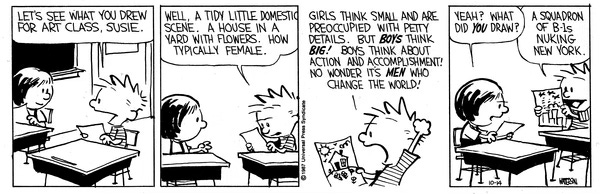
All that said, sometimes cartoons can express truths in ways that are as powerful as they are simple. In the cartoon below, the heretics of U.S. foreign policy are so many Calvins, spreading destruction and employing nukes in the name of manly seriousness. They are wrong. They are heretics. And if we continue to allow them to rule, they will surely lead America (as they already are in Gaza) to mass graves.
“A Ministry of Risk” is a new book on Philip Berrigan that gathers his “writings on peace and nonviolence.” It’s edited by Brad Wolf, who has helped to lead the ongoing “Merchants of Death” war crimes tribunal against the vast profiteering of America’s military-industrial complex. (Full disclosure: I participated in the tribunal and blurbed the book.)
The Berrigan brothers, Phil and Dan, fought courageously against war and for peace, coming from a deeply felt Catholicism centered in Christ’s teachings, e.g. blessed are the peacemakers, for they shall be called the children of God. I previously wrote about Dan Berrigan and his spirited protest against the Vietnam War as part of the Catonsville Nine. Phil was equally devoted to peace, being a Christian witness against America’s deep-seated culture of war and other forms of violence.
Phil wrote with great eloquence about the need to change America, and his short entry on “Liberation from Fear” in 1969 from New Politics vividly shows the brilliance of his insights. I’ve written before about the salience of fear in America and the need to counter it. Given my own peculiar interests, I’ve cited a powerful saying from “Dune” that “fear is the mind-killer” as well as the words of Master Po from “Kung Fu” that “fear is the only darkness.”
This is what Phil Berrigan had to say about fear, love, and the need for a revolution in America, not, hopefully, a violent revolution, but a complete change in values:
As for myself [wrote Berrigan], I fail to see how a society can be thrown into revolution except through massive civil disobedience, which in the case of America means that domestic and foreign business is rendered unprofitable, and hence inoperable. And I fail to see how extensive civil disobedience can be an effective factor unless the movement is built of people who are less concerned about power and more about justice; who are fearless but not rash; who are disciplined but not bureaucratic; who are patient but not dilatory; who are moral but not moralistic—in private and in public.
But above all, a movement must be built of those who would risk the jaws of the Beast, not in the prospect of being torn alive but rather in trust of their own weapons—truth, justice, freedom, love. Revolution is a time of personal and public purification if it is truly revolution, and the liberation principally sought after is a liberation from fear. Doesn’t Scripture say something about perfect love casting out fear? Which may suggest that the chief obstacle to revolution is fear, or the fear to love. And revolution without vast resources of love will be a bloodbath and, at best, a mere shift in power.
These words pulse with meaning and insight. America needs a revolution, and one based on love is the one least likely to end in a violent bloodbath. Marianne Williamson, to her credit, campaigned on a message of love four years ago to counter the fear she saw being stoked by candidates like Donald Trump. She wasn’t wrong about this.
Hellfire Missiles and Cluster Munitions under the White House Christmas Tree
As Christmas approaches, it doesn’t seem to be the season to be jolly, unless you’re a U.S. weapons manufacturer. It seems instead yet another season for war, as the president and Congress fight over how much deadly weaponry to send to Ukraine and Israel (and to Taiwan as well). Look under the White House Christmas tree and you’ll find Hellfire missiles for Israel, cluster munitions for Ukraine, and similar gifts offering joy to the world.
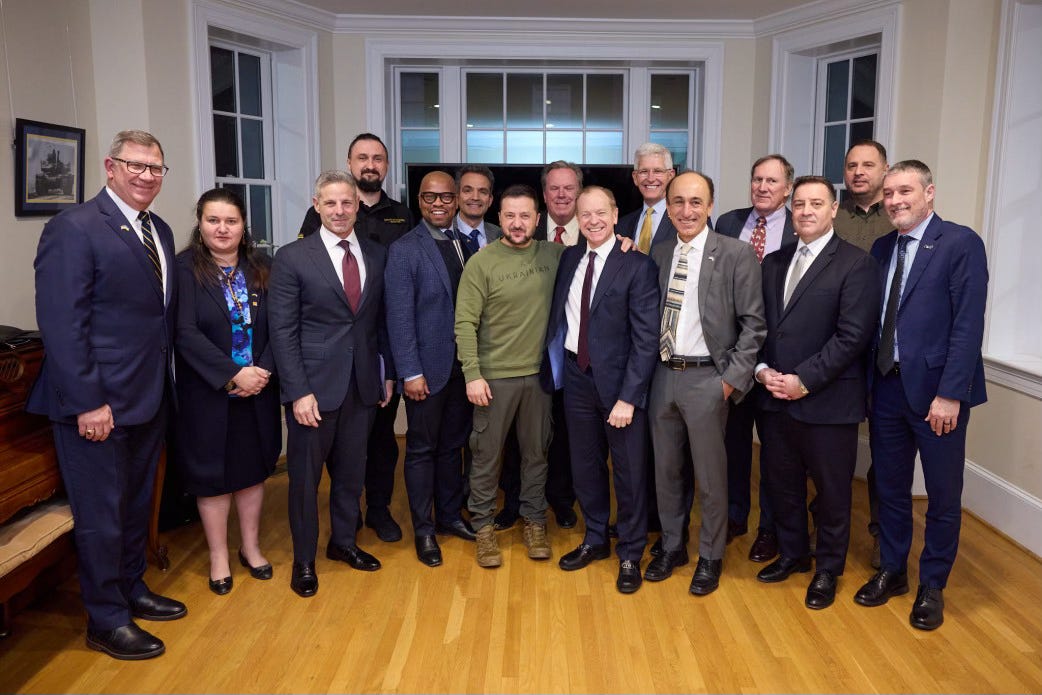
Last week, Ukraine’s president paid a visit to Washington where he posed with his most fervent supporters and gift-givers: U.S. arms manufacturers. Talk about a photo op!
Zelensky meets with high-ranking executives of the “merchants of death,” or Santa’s DC Beltway elves
Zelensky is no dummy. He knows that Congress and the President ultimately answer to the military-industrial complex. Look for a compromise bill in January that gives Ukraine most of the weapons that it’s requesting.
Meanwhile, the U.S. continues to send Israel the bombs, missiles, and shells it’s using to level Gaza. Last night, I was reading a book and came across this quote about war. Can you guess the person speaking?
“The victor will not be asked afterwards whether he told the truth or not [about the war]. When starting and waging a war it is not right that matters, but victory. Close your hearts to pity. Act brutally. [The] people must obtain what is their right. Their existence must be made secure. The stronger man is right. The greatest harshness.”
“The greatest harshness” might give the game away. It’s Adolf Hitler before the Nazi invasion of Poland in 1939. It’s from Ian Kershaw’s definitive two-volume biography of Hitler, v.2, p. 209.
A brutal, pitiless, war of the greatest harshness: that description doesn’t seem alien to our world today.
We are witnessing the obliteration of Gaza. The death toll has already surpassed 16,000 as Israel continues to pummel targets with American-made bombs and missiles. Even CNN is worried (from my email update this AM):
Top UN officials are warning of an “apocalyptic” situation in Gaza with “no place safe to go” for civilians as the deepening humanitarian crisis sparks international concern. Israel is expanding ground operations to the entire territory to “eliminate” Hamas and has told Palestinians to flee large swaths of southern Gaza, where many had previously sought refuge. But the war-torn region is in the midst of a near-total internet blackout as the last major telecommunications operator said services are completely cut off. This means many Palestinians are unable to communicate with one another or call for help while evacuating, and emergency workers can’t coordinate their responses.
Caitlin Johnstone has a telling article in which she states an important truth: Israel couldn’t be doing this without generous U.S. support. Israel is dropping the bombs, firing the missiles, and shooting the artillery rounds and bullets, but the U.S. is largely serving as the merchant of death for all this, though “merchant” is the wrong word. The U.S. is giving all this deadly weaponry to Israel as “aid,” even as there’s much rhetorical gnashing of teeth in Washington about Israel’s “indiscriminate” bombing and wanton killing of Palestinian innocents, including thousands of children. I say “rhetorical” because as Johnstone notes, the U.S. government could curtail Israeli military action by turning off the spigot of arms flowing from U.S. arsenals and warehouses to Israel.
But that’s not going to happen. AIPAC has a hammerlock on Congress; those few members of Congress who’ve called for a ceasefire in Gaza are already being targeted by the powerful pro-Israel lobby, with AIPAC promising to spend upwards of $100 million to unseat those politicians who aren’t consumed by bloodlust against Gaza. The power of AIPAC is reinforced here by the MICC, the military-industrial-congressional complex that Ike warned us about in 1961, which stands to profit immensely from more war in the Middle East as well as Ukraine. The combination of AIPAC with the MICC is akin to Mechagodzilla, an almost unstoppable monster of immense power.
They create a desert and call it “peace”: Gaza turned to rubble
Godzilla in its various incarnations would be hard-pressed to duplicate the scenes of devastation we’re seeing in Gaza. Israel is practicing its own version of the infamous statement from America’s war against Vietnam: “It became necessary to destroy the town to save it.”
The Israeli version: We had to destroy Gaza to save it from Hamas.
It made no sense in Vietnam, and it makes no sense today in Gaza. But this is not about making sense: it’s about power and vengeance and profit.
The intent of this “tribunal” is to draw attention to America’s overwhelming dominance of the world’s trade in deadly weaponry and the cost we all pay when “weapons ‘r’ us.” How did the U.S. come to embrace this deadly trade, to the point of boasting of our market dominance as a sign of America’s health and fitness? How did we come to equate arsenals with democracy? And isn’t it high time we denounced this trade in death, as the U.S. Senate did back in the 1930s with the Nye Commission?
Back in 2012, I wrote an article for TomDispatch, “Confessions of a Recovering Weapons Addict,” in which I admitted my own childish enthusiasm for weaponry and all things that go “bang”—and kill. It’s reposted today at TomDispatch and also here below.
Perhaps you’ve heard of “Makin’ Thunderbirds,” a hard-bitten rock & roll song by Bob Seger that I listened to 30 years ago while in college. It’s about auto workers back in 1955 who were “young and proud” to be making Ford Thunderbirds. But in the early 1980s, Seger sings, “the plants have changed and you’re lucky if you work.” Seger caught the reality of an American manufacturing infrastructure that was seriously eroding as skilled and good-paying union jobs were cut or sent overseas, rarely to be seen again in these parts.
If the U.S. auto industry has recently shown sparks of new life (though we’re not making T-Birds or Mercuries or Oldsmobiles or Pontiacs or Saturns anymore), there is one form of manufacturing in which America is still dominant. When it comes to weaponry, to paraphrase Seger, we’re still young and proud and makin’ Predators and Reapers (as in unmanned aerial vehicles, or drones) and Eagles and Fighting Falcons (as in F-15 and F-16 combat jets), and outfitting them with the deadliest of weapons. In this market niche, we’re still the envy of the world.
Yes, we’re the world’s foremost “merchants of death,” the title of a best-selling exposé of the international arms trade published to acclaim in the U.S. in 1934. Back then, most Americans saw themselves as war-avoiders rather than as war-profiteers. The evil war-profiteers were mainly European arms makers like Germany’s Krupp, France’s Schneider, or Britain’s Vickers.
Not that America didn’t have its own arms merchants. As the authors of Merchants of Death noted, early on our country demonstrated a “Yankee propensity for extracting novel death-dealing knickknacks from [our] peddler’s pack.” Amazingly, the Nye Committee in the U.S. Senate devoted 93 hearings from 1934 to 1936 to exposing America’s own “greedy munitions interests.” Even in those desperate depression days, a desire for profit and jobs was balanced by a strong sense of unease at this deadly trade, an unease reinforced by the horrors of and hecatombs of dead from the First World War.
We are uneasy no more. Today we take great pride (or at least have no shame) in being by far the world’s number one arms-exporting nation. A few statistics bear this out. From 2006 to 2010, the U.S. accounted for nearly one-third of the world’s arms exports, easily surpassing a resurgent Russia in the “Lords of War” race. Despite a decline in global arms sales in 2010 due to recessionary pressures, the U.S. increased its market share, accounting for a whopping 53% of the trade that year. Last year saw the U.S. on pace to deliver more than $46 billion in foreign arms sales. Who says America isn’t number one anymore?
For a shopping list of our arms trades, try searching the Stockholm International Peace Research Institute database for arms exports and imports. It reveals that, in 2010, the U.S. exported “major conventional weapons” to 62 countries, from Afghanistan to Yemen, and weapons platforms ranging from F-15, F-16, and F-18 combat jets to M1 Abrams main battle tanks to Cobra attack helicopters (sent to our Pakistani comrades) to guided missiles in all flavors, colors, and sizes: AAMs, PGMs, SAMs, TOWs — a veritable alphabet soup of missile acronyms. Never mind their specific meaning: they’re all designed to blow things up; they’re all designed to kill.
Rarely debated in Congress or in U.S. media outlets is the wisdom or morality of these arms deals. During the quiet last days of December 2011, in separate announcements whose timing could not have been accidental, the Obama Administration expressed its intent to sell nearly $11 billion in arms to Iraq, including Abrams tanks and F-16 fighter-bombers, and nearly $30 billion in F-15 fighter jets to Saudi Arabia, part of a larger, $60 billion arms package for the Saudis. Few in Congress oppose such arms deals since defense contractors provide jobs in their districts — and ready donationsto Congressional campaigns.
Let’s pause to consider what such a weapons deal implies for Iraq. Firstly, Iraq only “needs” advanced tanks and fighter jets because we destroyed their previous generation of the same, whether in 1991 during Desert Shield/Storm or in 2003 during Operation Iraqi Freedom. Secondly, Iraq “needs” such powerful conventional weaponry ostensibly to deter an invasion by Iran, yet the current government in Baghdad is closely aligned with Iran, courtesy of our invasion in 2003 and the botched occupation that followed. Thirdly, despite its “needs,” the Iraqi military is nowhere near ready to field and maintain such advanced weaponry, at least without sustained training and logistical support provided by the U.S. military.
As one U.S. Air Force officer who served as an advisor to the fledging Iraqi Air Force, or IqAF, recently worried:
“Will the IqAF be able to refuel its own aircraft? Can the Iraqi military offer adequate force protection and security for its bases? Can the IqAF provide airfield management services at its bases as they return to Iraqi control after eight years under US direction? Can the IqAF ensure simple power generation to keep facilities operating? Will the IqAF be able to develop and retain its airmen?… Only time will tell if we left [Iraq] too early; nevertheless, even without a renewed security agreement, the USAF can continue to stand alongside the IqAF.”
Put bluntly: We doubt the Iraqis are ready to field and fly American-built F-16s, but we’re going to sell them to them anyway. And if past history is a guide, if the Iraqis ever turn these planes against us, we’ll blow them up or shoot them down — and then (hopefully) sell them some more.
Our Best Arms Customer
Let’s face it: the weapons we sell to others pale in comparison to the weapons we sell to ourselves. In the market for deadly weapons, we are our own best customer. Americans have a love affair with them, the more high-tech and expensive, the better. I should know. After all, I’m a recovering weapons addict.
Well into my teen years, I was fascinated by military hardware. I built models of what were then the latest U.S. warplanes: the A-10, the F-4, the F-14, -15, and -16, the B-1, and many others. I read Aviation Week and Space Technology at my local library to keep track of the newest developments in military technology. Not surprisingly, perhaps, I went on to major in mechanical engineering in college and entered the Air Force as a developmental engineer.
Enamored as I was by roaring afterburners and sleek weaponry, I also began to read books like James Fallows’sNational Defense (1981) among other early critiques of the Carter and Reagan defense buildup, as well as the slyly subversive and always insightful Augustine’s Laws (1986) by Norman Augustine, later the CEO of Martin Marietta and Lockheed Martin. That and my own experience in the Air Force alerted me to the billions of dollars we were devoting to high-tech weaponry with ever-ballooning price tags but questionable utility.
Perhaps the best example of the persistence of this phenomenon is the F-35 Lightning II. Produced by Lockheed Martin, the F-35 was intended to be an “affordable” fighter-bomber (at roughly $50 million per copy), a perfect complement to the much more expensive F-22 “air superiority” Raptor. But the usual delays, cost overruns, technical glitches, and changes in requirements have driven the price tag of the F-35 up to $160 million per plane, assuming the U.S. military persists in its plans to buy 2,400 of them. (If the Pentagon decides to buy fewer, the cost-per-plane will soar into the F-22 range.) By recent estimates the F-35 will now cost U.S. taxpayers (you and me, that is) at least $382 billion for its development and production run. Such a sum for a single weapons system is vast enough to be hard to fathom. It would, for instance, easily fund all federal government spending on education for the next five years.
The escalating cost of the F-35 recalls the most famous of Norman Augustine’s irreverent laws: “In the year 2054,” he wrote back in the early 1980s, “the entire defense budget will [suffice to] purchase just one aircraft.” But the deeper question is whether our military even needs the F-35, a question that’s rarely asked and never seriously entertained, at least by Congress, whose philosophy on weaponry is much like King Lear’s: “O, reason not the need.”
But let’s reason the need in purely military terms. These days, the Air Force is turning increasingly to unmanned drones. Meanwhile, plenty of perfectly good and serviceable “platforms” remain for attack and close air support missions, from F-16s and F-18s in the Air Force and Navy to Apache helicopters in the Army. And while many of our existing combat jets may be nearing the limits of airframe integrity, there’s nothing stopping the U.S. military from producing updated versions of the same. Heck, this is precisely what we’re hawking to the Saudis — updated versions of the F-15, developed in the 1970s.
Because of sheer cost, it’s likely we’ll buy fewer F-35s than our military wants but many more than we actually need. We’ll do so because Weapons ‘R’ Us. Because building ultra-expensive combat jets is one of the few high-tech industries we haven’t exported (due to national security and secrecy concerns), and thus one of the few industries in the U.S. that still supports high-paying manufacturing jobs with decent employee benefits. And who can argue with that?
The Ultimate Cost of Our Merchandise of Death
Clearly, the U.S. has grabbed the brass ring of the global arms trade. When it comes to investing in militaries and weaponry, no country can match us. We are supreme. And despite talk of modest cuts to the Pentagon budget over the next decade, it will, according to President Obama, continue to grow, which means that in weapons terms the future remains bright. After all, Pentagon spending on research and development stands at $81.4 billion, accounting for an astonishing 55% of all federal spending on R&D and leaving plenty of opportunity to develop our next generation of wonder weapons.
But at what cost to ourselves and the rest of the world? We’ve become the suppliers of weaponry to the planet’s hotspots. And those weapons deliveries (and the training and support missions that go with them) tend to make those spots hotter still — as in hot lead.
As a country, we seem to have a teenager’s fascination with military hardware, an addiction that’s driving us to bust our own national budgetary allowance. At the same time, we sell weapons the way teenage punks sell fireworks to younger kids: for profit and with little regard for how they might be used.
Sixty years ago, it was said that what’s good for General Motors is good for America. In 1955, as Bob Seger sang, we were young and strong and makin’ Thunderbirds. But today we’re playing a new tune with new lyrics: what’s good for Lockheed Martin or Boeing or [insert major-defense-contractor-of-your-choice here] is good for America.
When the Soviet Union fell in 1991, America heard something about “peace dividends” and “a new world order.” With the Soviet Union gone, the Cold War over, America could take all the hundreds of billions it had been spending on weapons and wars and spend it instead on America. We could, in theory, embrace peace, reinvest in America, and save our children from a world of incessant wars and preparations for the same.
It was not to be.
The collapse of the Soviet Union coincided with Desert Shield/Storm, when America allegedly kicked its “Vietnam Syndrome” once and for all, according to then-President George H.W. Bush. This “syndrome” was allegedly inhibiting America’s pursuit of righteous victory through military means, and the expulsion of Iraqi forces from Kuwait was allegedly proof that America was back and that military force had powerful efficacy for good.
Out went the idea of peace dividends. This was America’s moment to dominate, a Pax Americana achieved through military force or threats of the same. U.S. dominance of the Middle East contributed to the decision by Al Qaeda to launch attacks against the USA, but any U.S. culpability for 9/11 was swept away by another President Bush, George W., who explained that Al Qaeda had no rationale for 9/11 other than their hatred of American freedoms.
The aftermath of 9/11 was an orgy of American violence directed against “evildoers” everywhere. It was a two-decade global war on terror, GWOT as jihad, leading to wars in Afghanistan, Iraq, Libya, and elsewhere. Even as these wars proved disastrous, those who advocated for them saluted themselves as being right but (perhaps) for the wrong reason, the “wrong” reason being some version of having loved America too much, whereas those who’d opposed these wars were “wrong” even though events had proven them to be right (they were wrong apparently because they didn’t love America enough, especially its domineering government).
It’s been a long time, more than three decades, since I’ve heard anyone mention peace dividends. Even when President Biden ended the Afghan War in 2021, military spending soared upwards, and this was before the Russia-Ukraine War. With the Hamas attacks on Israel and the impending invasion and destruction of Gaza by the IDF, America will likely embrace war and increase military spending with even more fervor.
War is America’s growth stock. Our politicians brag that military aid to countries like Ukraine and Israel serves to create jobs in America. Rarely is any mention made of Russian dead, of Palestinian dead, or for that matter of any dead, as America dominates the global trade in weaponry. The idea of “the merchants of death,” the opposition by the U.S. Senate in the 1930s to making profits by killing people, seems like ancient history, seems absurd, given America’s tight embrace of militarism. If we’re not fighting wars we’re arming others to fight wars. And we console ourselves that we’re only providing “good guys” with guns, for, as the NRA taught us, the only way to stop bad guys with guns is to give good guys even more guns.
Perhaps that’s the essence of U.S. foreign policy today. We give “good guys” like Ukrainians and Israelis all the guns they want to go kill “bad guys” like Russians and Palestinians while congratulating ourselves for “investing” in America’s arms manufactures. Indeed, members of Congress have said that providing older weapons from U.S. stockpiles of the same to countries like Ukraine is positively wonderful, since it forces the U.S. military to buy new weapons for itself, helping to create more jobs among the makers of guns, ammo, and bombs. What a win-win!
Lately I’ve been reading a lot about President Lyndon Johnson and how his “Great Society” and fight against poverty was done in by the calamitous Vietnam War in the 1960s. What’s tragic today in America is that we no longer have a vision of a great society, a better society, a fairer, more just, and more equitable society. Endless war and wildly excessive military expenditures is our only vision.
We put it on our stamps. And that’s where it remains.
The result is that “peace” has become a word rarely heard in America, a Pollyanna-like concept, easily dismissed as pie-in-the-sky. In fact, the last U.S. president to speak sincerely and powerfully for peace was John F. Kennedy, and that was sixty years ago. No president since JFK has stood before us to advance a vision of eventual world peace rather than of endless war and expensive preparations for the same.
We are told and taught today that peace is impossible and war is inevitable. Those who promote peace are dismissed as dreamers and weaklings as the “warriors” and hawks are promoted for their alleged realism and toughness.
Constant wars and preparations for the same destroy democracy and lead to spiritual death, to cite the words of James Madison and Martin Luther King Jr. Those are the true dividends of war, not jobs in American factories producing bullets and bombs. The true dividends of peace are a restoration of democracy and spiritual renewal in America.







 Bracing Views