Can We Agree on a Few Basics?

W.J. Astore

Sides in War Are Not “Teams”

1. Killing civilians and especially children is wrong.

2. Cutting off water, food, electricity, and fuel to millions of vulnerable people is wrong.

3. Forced mass evacuations of hundreds of thousands of people in preparation for a destructive invasion is wrong.

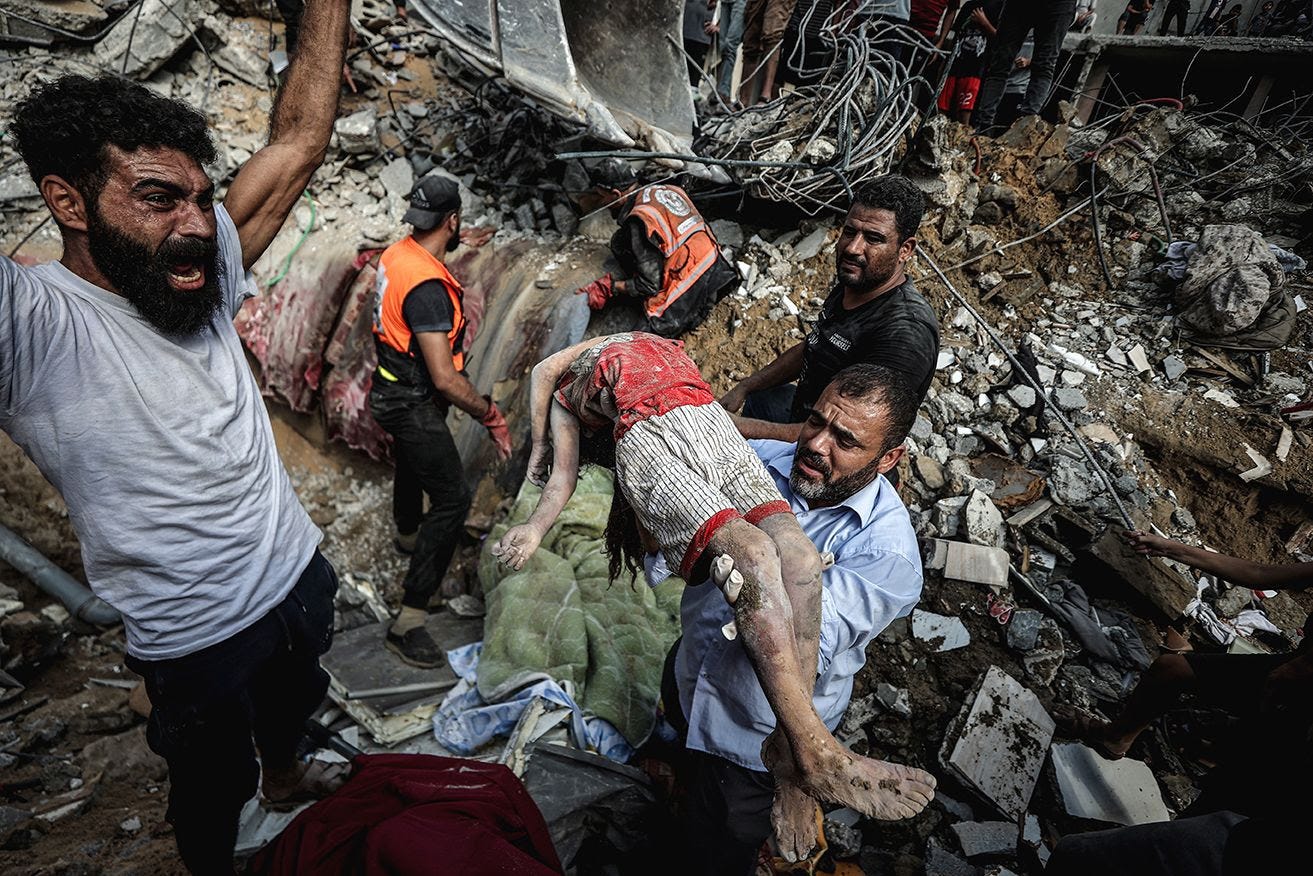
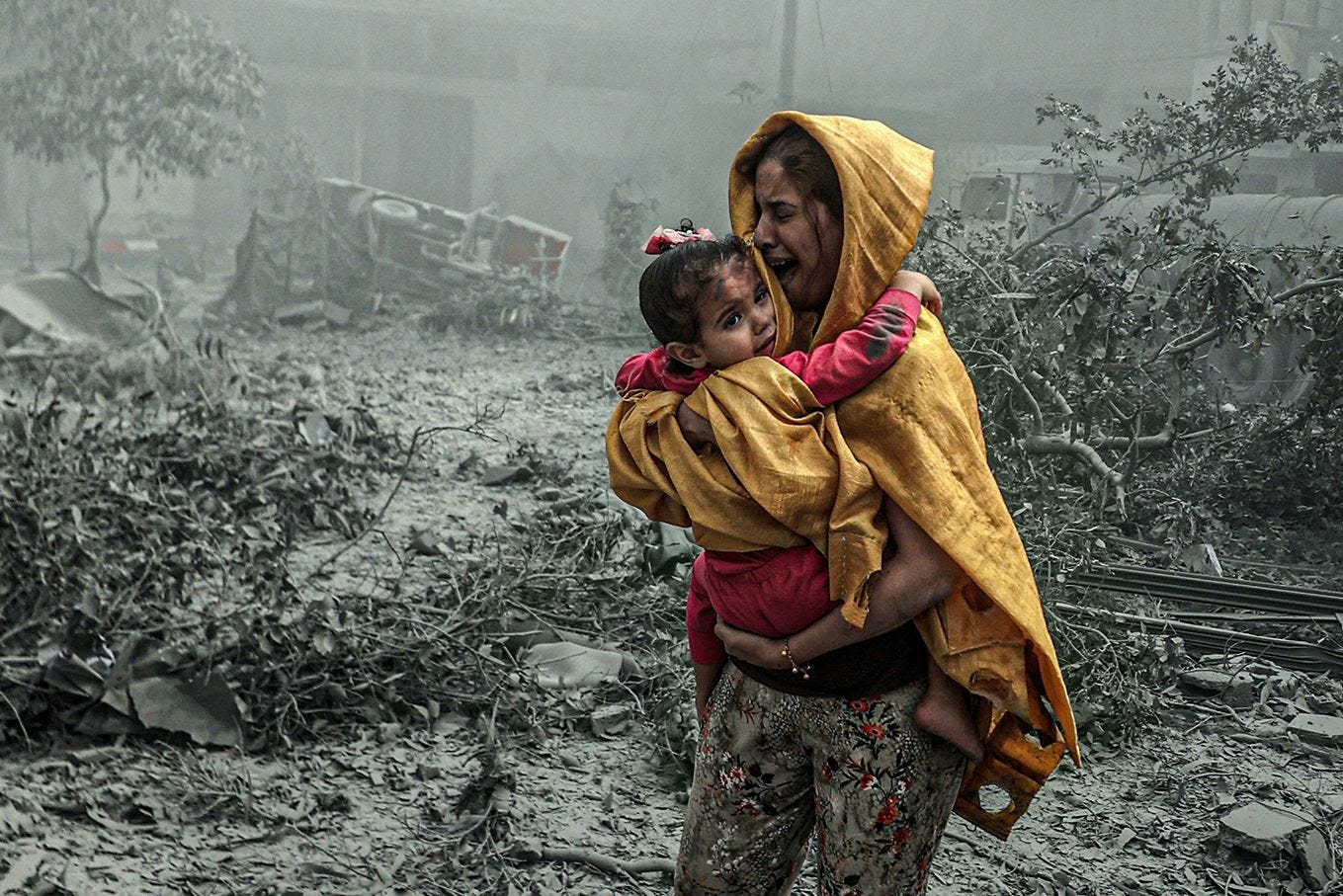
4. Dropping thousands of bombs and killing thousands of innocents is wrong. So is launching hundreds of unguided rockets and killing scores of innocents. 

5. Holding hostages and threatening to slay them is wrong.

Whether Hamas or Israel are doing these things, they are wrong.  Putting an end to such wrongs through a ceasefire is right.  Certainly, it’s less wrong.

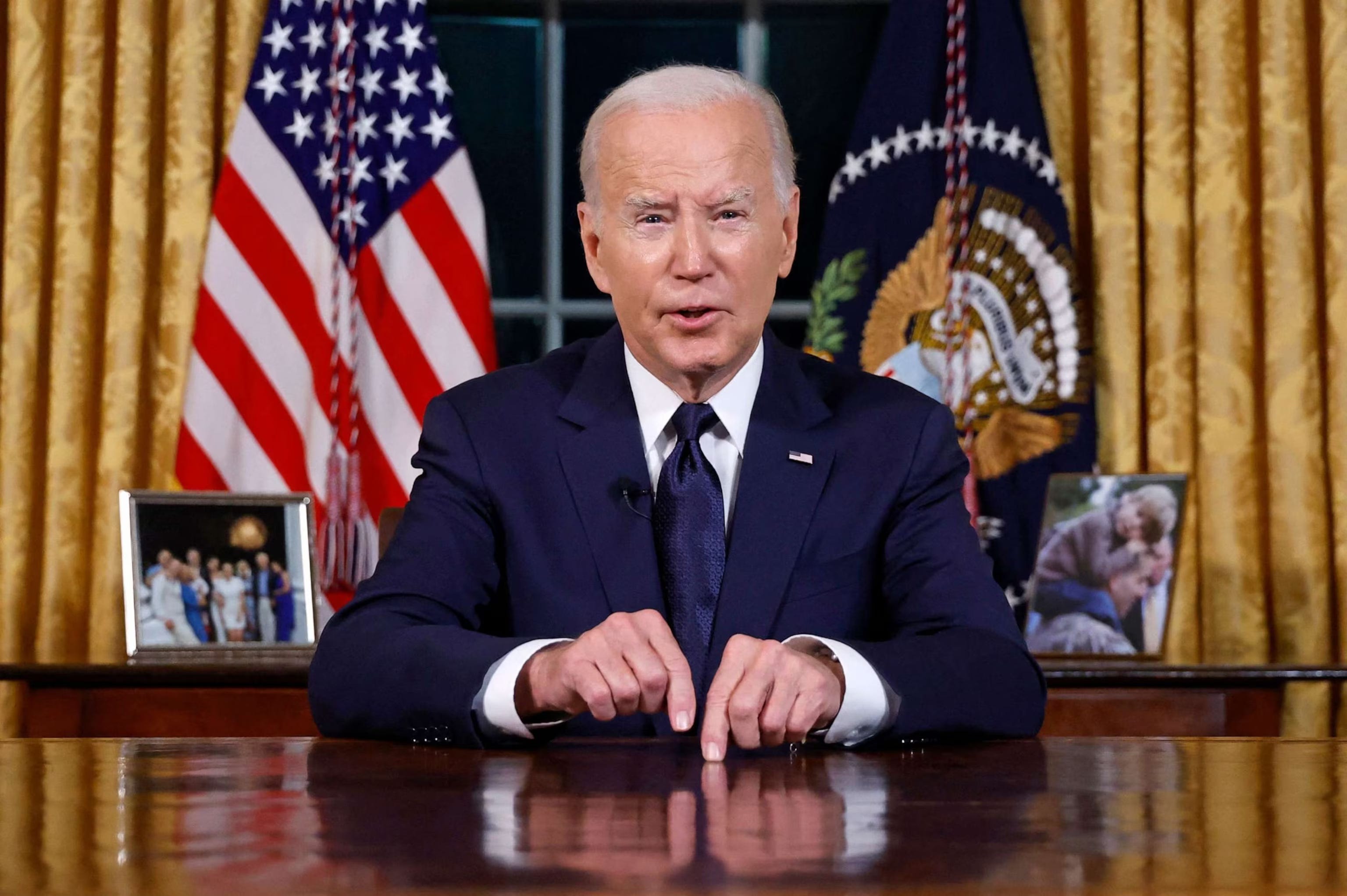
In going to Israel and embracing Netanyahu, President Biden is obviously choosing one side, that of Israel, and empowering it to do whatever it wants in Gaza. Interestingly, Biden claimed that yesterday’s destruction of a hospital in Gaza was done in his words by the “other team,” meaning Hamas.

The terminology here is striking. Israel and Hamas are not sports “teams” in which we choose to root for one side against the other. Israelis and Palestinians are people equally deserving of human dignity and human rights.

I’ve written about the invasion (so to speak) of war terms into sports and vice-versa. Biden’s dismissal of Hamas as the “other team” that’s allegedly responsible for the hospital’s destruction and the deaths of hundreds of innocents trivializes a deep human tragedy.

Are we ever going to move beyond this “team” mentality where we root for the total victory of one “team” over another?

What, Exactly, Is “Repugnant” About Efforts to Stop Mass Killing?

W.J. Astore

The Biden Administration Embraces War and Israel

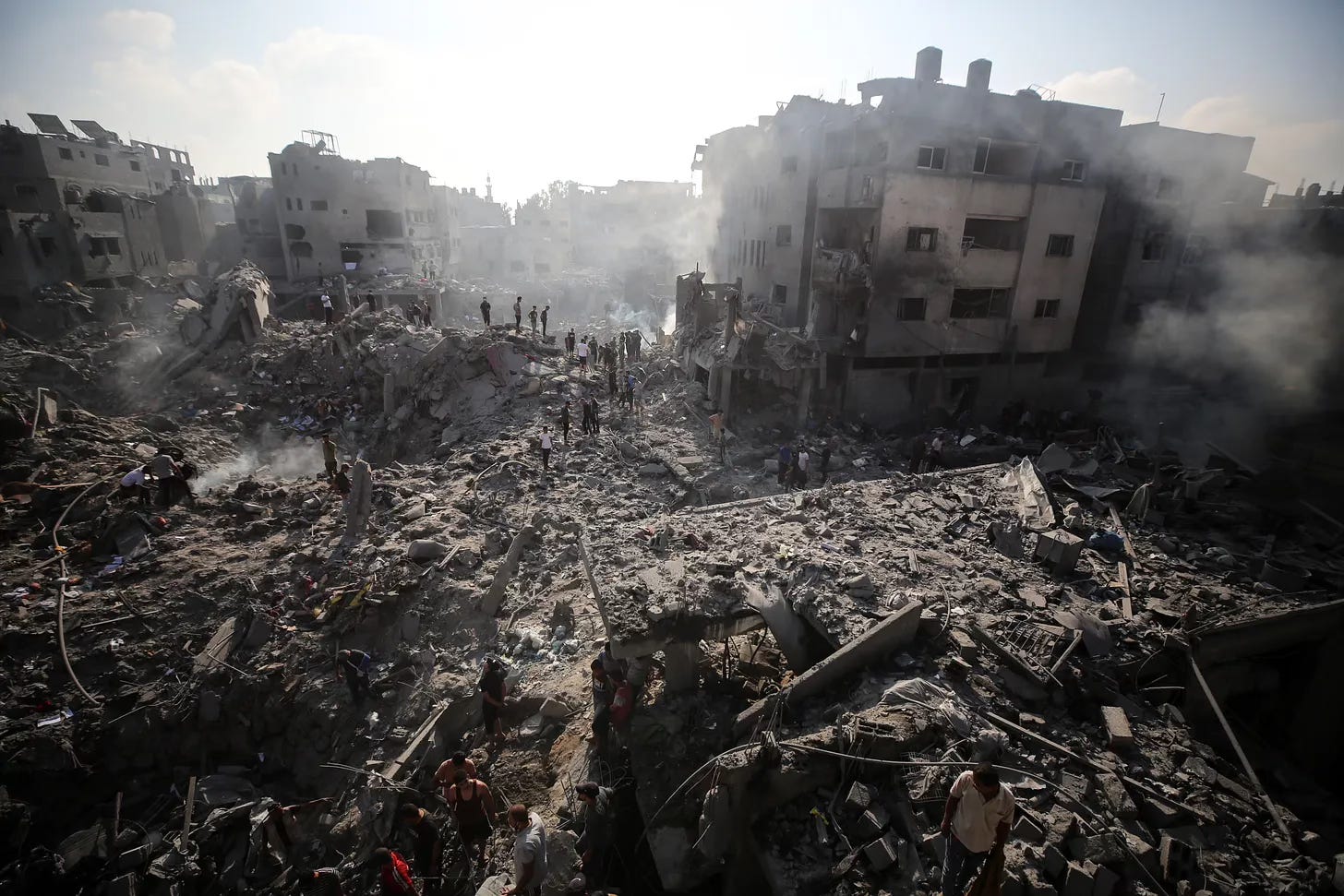
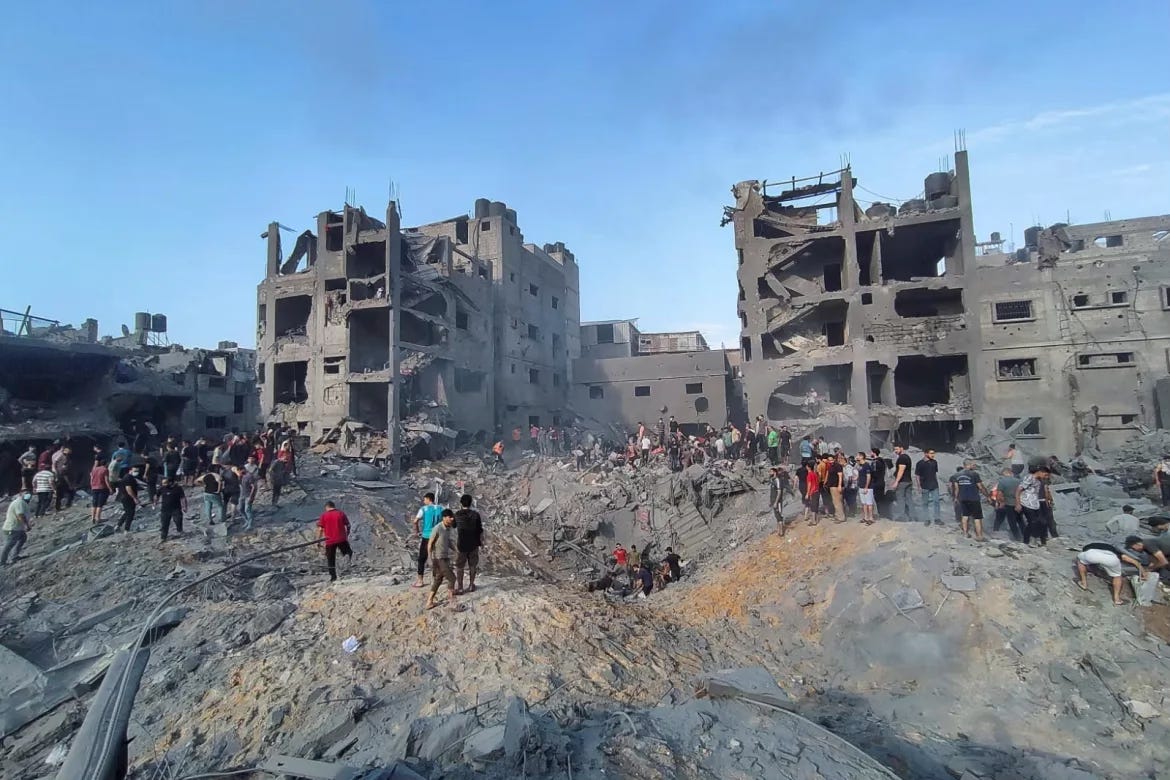
Remarkably, the press secretary of the Biden administration stated that calls for deescalation of conflict in Gaza, calls for restraint, calls for a ceasefire, are “disgraceful” and “repugnant.” There are not two sides to the conflict, the press secretary said. There’s only the Israeli side of righteousness. And Israel must be given a blank check, as well as plenty of U.S. weaponry, to strike back. And so Israel has, dropping 6000 bombs in six days. Obviously, Israel had a prepared list of targets; you don’t drop one thousand bombs a day on Gaza in “precision” strikes without being long prepared to do so.

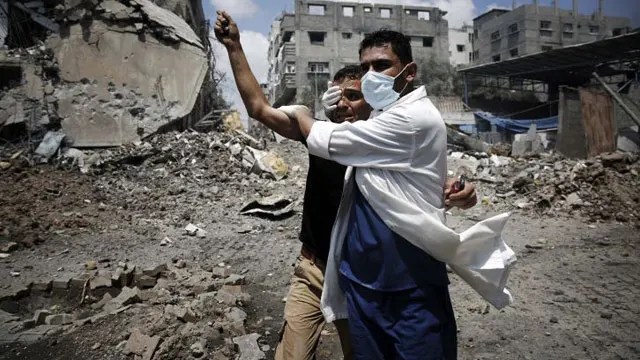
Sure looks “precise” to me. Jabalia, Gaza Strip, 10/11/23 (Hatem Moussa/AP) 

Meanwhile, President Joe Biden said he had seen photos of Hamas attackers beheading Israeli babies. No such photos exist. Indeed, the initial claim of Hamas beheading babies was false, a frontline rumor that was debunked by the reporter who put it out there.

By recklessly repeating an unsubstantiated battlefield rumor of heinous atrocities and inventing “photos” to support it, President Biden demonstrated his complete lack of fitness to serve as president.

Think about it. In what world is it acceptable for America’s president to claim he’d seen actual photos of beheadings of babies when no such photos exist? How could the president be so recklessly confused, assuming it was simply confusion?

As far as I know, the only candidate for the presidency in 2024 who’s acquitted himself with dignity is Cornel West. West actually accepts that Palestinian babies and children are just as precious and worthy of life as their Israeli counterparts. Every other “name” candidate, e.g. Marianne Williamson and Robert F. Kennedy Jr. as well as all the Republicans, are at pains to support Israel without reservation or qualification.

Indeed, far more debate is allowed in Israel about the actions of the government there than is allowed in the U.S. mainstream media and in Congress. Congress is far more obedient to Netanyahu than the Knesset. Perhaps he should be nominated as the new House Speaker? He’d win in a landslide.

Of course, I deplore the Hamas attacks and the deaths of innocent Israelis, just as I deplore the deaths of innocent Palestinians caught in the reprisal bombings. It’s horrible when innocent people die. Isn’t this how any normal and sane human being would feel? Shouldn’t we all unite in calling for a ceasefire, an end to the killing, and some kind of way forward that doesn’t end in mass death and the total destruction of Gaza?

What is so “repugnant” about that?

6000 Bombs in Six Days

W.J. Astore

The Israeli Air War on Gaza

I read today that Israel has already dropped 6000 bombs on Gaza in six days. Here’s the report from the Wall Street Journal:

The Israeli Air Force said it has dropped about 6,000 bombs targeted at Hamas in Gaza since the war began, adding that it will continue the campaign as long as necessary. The airstrikes killed hundreds of Hamas militants and damaged the group’s military infrastructure, the Israeli Air Force said in a post on X, formerly known as Twitter.

The Israeli airstrikes caused extensive damage in several neighborhoods in Gaza, killing more than 1,500 Palestinians, nearly half of whom were women and children, according to the Palestinian Ministry of Health in Gaza. More than 1,300 Israelis have died since the Hamas assault began.

In 2019, I wrote an article for TomDispatch on the dark side of airpower. Included within were ten cautionary tenets about the use of airpower, with its illusion of “surgical” and “precision” strikes and the way video footage of the same obscures the deaths of innocents. Below are those tenets, unchanged from 2019.

More bombs will be dropped on Gaza in the coming days and weeks. I’m sure Israel will claim, just as U.S. military officials typically have in other wars, that those bombs mainly killed terrorists and other evildoers and that “collateral damage” (all those dead women and children and other innocents), though regrettable, has been limited. And so it goes.

Bomb crater in the Gaza Strip. We see damage to buildings and infrastructure but rarely do we see dead bodies. (Naaman Omar/Zuma Press)

Ten Cautionary Tenets About Air Power (2019)

1. Just because U.S. warplanes and drones can strike almost anywhere on the globe with relative impunity doesn’t mean that they should. Given the history of air power since World War II, ease of access should never be mistaken for efficacious results.

2. Bombing alone will never be the key to victory. If that were true, the U.S. would have easily won in Korea and Vietnam, as well as in Afghanistan and Iraq. American air power pulverized both North Korea and Vietnam (not to speak of neighboring Laos and Cambodia), yet the Korean War ended in a stalemate and the Vietnam War in defeat. (It tells you the world about such thinking that air power enthusiasts, reconsidering the Vietnam debacle, tend to argue the U.S. should have bombed even more — lots more.) Despite total air supremacy, the recent Iraq War was a disaster even as the Afghan War staggers on into its 18th catastrophic year. 

3. No matter how much it’s advertised as “precise,” “discriminate,” and “measured,” bombing (or using missiles like the Tomahawk) rarely is. The deaths of innocents are guaranteed. Air power and those deaths are joined at the hip, while such killings only generate anger and blowback, thereby prolonging the wars they are meant to end.

Consider, for instance, the “decapitation” strikes launched against Iraqi autocrat Saddam Hussein and his top officials in the opening moments of the Bush administration’s invasion of 2003. Despite the hype about that being the beginning of the most precise air campaign in all of history, 50 of those attacks, supposedly based on the best intelligence around, failed to take out Saddam or a single one of his targeted officials. They did, however, cause “dozens” of civilian deaths. Think of it as a monstrous repeat of the precision air attacks launched on Belgrade in 1999 against Slobodan Milosevic and his regime that hit the Chinese embassy instead, killing three journalists. 

Here, then, is the question of the day: Why is it that, despite all the “precision” talk about it, air power so regularly proves at best a blunt instrument of destruction? As a start, intelligence is often faulty. Then bombs and missiles, even “smart” ones, do go astray. And even when U.S. forces actually kill high-value targets (HVTs), there are always more HVTs out there. A paradox emerges from almost 18 years of the war on terror: the imprecision of air power only leads to repetitious cycles of violence and, even when air strikes prove precise, there always turn out to be fresh targets, fresh terrorists, fresh insurgents to strike.

4. Using air power to send political messages about resolve or seriousness rarely works. If it did, the U.S. would have swept to victory in Vietnam. In Lyndon Johnson’s presidency, for instance, Operation Rolling Thunder (1965-1968), a graduated campaign of bombing, was meant to, but didn’t, convince the North Vietnamese to give up their goal of expelling the foreign invaders — us — from South Vietnam. Fast-forward to our era and consider recent signals sent to North Korea and Iran by the Trump administration via B-52 bomber deployments, among other military “messages.” There’s no evidence that either country modified its behavior significantly in the face of the menace of those baby-boomer-era airplanes.

5. Air power is enormously expensive. Spending on aircraft, helicopters, and their munitions accounted for roughly half the cost of the Vietnam War. Similarly, in the present moment, making operational and then maintaining Lockheed Martin’s boondoggle of a jet fighter, the F-35, is expected to cost at least $1.45 trillion over its lifetime. The new B-21 stealth bomber will cost more than $100 billion simply to buy. Naval air wings on aircraft carriers cost billions each year to maintain and operate. These days, when the sky’s the limit for the Pentagon budget, such costs may be (barely) tolerable. When the money finally begins to run out, however, the military will likely suffer a serious hangover from its wildly extravagant spending on air power.

6. Aerial surveillance (as with drones), while useful, can also be misleading. Command of the high ground is not synonymous with god-like “total situational awareness.” It can instead prove to be a kind of delusion, while war practiced in its spirit often becomes little more than an exercise in destruction. You simply can’t negotiate a truce or take prisoners or foster other options when you’re high above a potential battlefield and your main recourse is blowing up people and things.

7. Air power is inherently offensive. That means it’s more consistent with imperial power projection than with national defense. As such, it fuels imperial ventures, while fostering the kind of “global reach, global power” thinking that has in these years had Air Force generals in its grip.

8. Despite the fantasies of those sending out the planes, air power often lengthens wars rather than shortening them. Consider Vietnam again. In the early 1960s, the Air Force argued that it alone could resolve that conflict at the lowest cost (mainly in American bodies). With enough bombs, napalm, and defoliants, victory was a sure thing and U.S. ground troops a kind of afterthought. (Initially, they were sent in mainly to protect the airfields from which those planes took off.) But bombing solved nothing and then the Army and the Marines decided that, if the Air Force couldn’t win, they sure as hell could. The result was escalation and disaster that left in the dust the original vision of a war won quickly and on the cheap due to American air supremacy.

9. Air power, even of the shock-and-awe variety, loses its impact over time. The enemy, lacking it, nonetheless learns to adapt by developing countermeasures — both active (like missiles) and passive (like camouflage and dispersion), even as those being bombed become more resilient and resolute. 

10. Pounding peasants from two miles up is not exactly an ideal way to occupy the moral high ground in war. 

The Road to Perdition

If I had to reduce these tenets to a single maxim, it would be this: all the happy talk about the techno-wonders of modern air power obscures its darker facets, especially its ability to lock America into what are effectively one-way wars with dead-end results.

For this reason, precision warfare is truly an oxymoron. War isn’t precise. It’s nasty, bloody, and murderous. War’s inherent nature — its unpredictability, horrors, and tendency to outlast its original causes and goals — isn’t changed when the bombs and missiles are guided by GPS. Washington’s enemies in its war on terror, moreover, have learned to adapt to air power in a grimly Darwinian fashion and have the advantage of fighting on their own turf.

Who doesn’t know the old riddle: If a tree falls in the forest and no one is there to hear it, does it make a sound? Here’s a twenty-first-century air power variant on it: If foreign children die from American bombs but no U.S. media outlets report their deaths, will anyone grieve? Far too often, the answer here in the U.S. is no and so our wars go on into an endless future of global destruction.

In reality, this country might do better to simply ground its many fighter planes, bombers, and drones. Paradoxically, instead of gaining the high ground, they are keeping us on a low road to perdition.

War Destroys History

W.J. Astore

The God of War Consumes All

The ancients were wise to make war a god. Violent, unpredictable, destructive, seductive, brutal, and capricious. And of course very, very powerful in its hold on the human mind.

Ares, the Greek god of war

I trained as a historian, where an understanding of facts, context, and other forms of evidence is all-important. War destroys history. War creates its own “facts.” Who needs context when you hear the cry: “We’re at war!”

Consider the Russia-Ukraine War. Americans are encouraged to believe the war began with Putin’s invasion in February 2022. All you need to know is that Putin is evil and that he wants to conquer and subjugate Ukraine. A bit of history is introduced by equating Putin with Hitler; sometimes you see claims that Putin is “worse than Hitler.” But that’s about all the “history” you’re encouraged to know.

To follow the war, you might go to the Guardian, which tells me this is Day 596 of Putin’s invasion. Again, it’s implied that what came before Putin’s decision to invade simply doesn’t matter.  NATO expansion to Russia’s borders, for example, is dismissed as irrelevant. Russia shouldn’t have felt threatened by benevolent, peace-loving NATO. Nor do you need to know anything about U.S. meddling in Ukrainian politics. Focus on the war, cheer on the Ukrainians, and see all Russians as guilty, more or less, even Russian opera singers and tennis players.

Consider as well the war between Israel and Hamas in the Gaza Strip. Again, Americans are encouraged to believe the war began with terrorist attacks by Hamas. All you need to know is that Hamas is engaged in “pure, unadulterated evil” (President Biden) and that Israel must defend itself however it deems fit. Hamas is evil, Israel is good, end of story.

Americans saw this with 9/11 and the Bush/Cheney response to it. President Bush encouraged us to believe that Al Qaeda attacked the U.S. because they hated us for our freedoms. They hate us because they ain’t us, simple as that. Meanwhile, Bush told the world you’re either for us or you’re for the terrorists.

War is the great and terrifying simplifier. We go to war shouting “Remember the Alamo!” or “Remember the Maine; to hell with Spain!” or “Remember Pearl Harbor!” with vengeance on our minds. There’s no need to think. There no need to seek any understanding. Who cares about history and context? It’s time to kill-kill-kill. That’s the only language *they* understand, because they’re pure evil even as we represent pure goodness. Our wrath is righteous and measured; their wrath is unbounded and insane, evil, the work of “human animals.”

Recall what Congresswoman Barbara Lee said when she cast the lone vote of dissentafter 9/11. Instead of authorizing a blank check of support for Bush/Cheney and U.S. military action everywhere, Lee advised restraint and asked a nation in mourning to pause. Citing a clergy member, she memorably cautioned that “as we act, let us not become the evil that we deplore.” Her speech was a profile in courage for which she was widely attacked and condemned.

What followed 9/11 was an orgy of violence by the U.S., a global war on terror akin to a jihad, producing the Afghan War, the Iraq War, Libya’s collapse into chaos, Gitmo, Abu Ghraib, the collateral murder video, torture, and so many other deplorable acts. Yet we as Americans are told by our leaders and the mainstream media to forget these “excesses,” these “mistakes,” because we meant well and we had no choice but to respond to evil terrorists with massive military might.

And so now Israel, aided by the U.S., faces the same choice: how best to respond to a terrorist attack. And it appears their response will be an exercise in massive military might. Because history doesn’t matter. The god of war has taken over. And that god demands vengeance. Violence. Blood sacrifice.

Yet there is wisdom in the Bible when it says (Romans 12:19-21):

Dearly beloved, avenge not yourselves, but rather give place unto wrath: for it is written, Vengeance is mine; I will repay, saith the Lord.
Therefore if thine enemy hunger, feed him; if he thirst, give him drink: for in so doing thou shalt heap coals of fire on his head.
Be not overcome of evil, but overcome evil with good.

What War Does to Us

W.J. Astore

It Makes Us Hate; It Leads Us to Slaughter

From the Gaza Strip, the Hamas offensive against Israel has been murderously effective. The vaunted and much-celebrated Israeli military was caught by surprise and is responding to the Hamas attacks with its own version of murder, as captured in this announcement:

Israel Defense Minister: “I have ordered a complete siege on the Gaza Strip. There will be no electricity, no food, no fuel, everything is closed. We are fighting human animals and we act accordingly.” [emphasis added]

Actually, we have laws against allowing animals to starve. Think of the SPCA, the society for the prevention of cruelty to animals. Furthermore, comparing humans to animals is most often an insult to animals. Animals’ thirst for blood is sated quickly compared to humans and our thirst.

Let’s be clear: Hamas and the Palestinian people are not “human animals.” They are not lesser humans or beasts. Are the Jewish people forgetting the way that the Nazis reduced them to lesser humans or beasts to be exterminated during the Holocaust?

The Gaza Strip has been described as the world’s largest open-air prison.

Announcing a siege against all Palestinians in the Gaza Strip (no food, no power, mostly unsafe water) is the equivalent of launching a holocaust in slow motion. How is this in any way a proportionate and defensible response to the attacks by Hamas?

Meanwhile, as usual the U.S. government, showing its inherent unity and conformity, is 100% behind Israel, sending an aircraft carrier and issuing blank checks of unequivocal support. The mainstream media once again is telling Americans which side to hate. Think of the Palestinians as a gaggle of little Putins and you’ll be applauded for your right-think.

This is why I hate war. It turns us into killers. It leads us to hate those we kill. And hate kills our minds and makes us even more willing killers.

I applaud and support neither Hamas nor Israel. I applaud and support those who fight for a peaceful future in which we don’t see each other as “human animals” to be slaughtered with impunity.

The USA and Israel as Big and Little Prussia

download
Co-joined Twins?

W.J. Astore

As a kid, I was a big admirer of Israel.*  I kept a scrapbook on the Yom Kippur War in 1973.  Back then, Israel was America’s plucky ally, David against Goliath, helping to keep the Soviet bear at bay, or so it seemed to me.

Through a kid’s eyes, Israel in 1973 was an island seemingly surrounded by a sea of well-armed enemies: Egypt, Syria, Iraq, Jordan, Saudi Arabia. Outnumbered and outgunned.  And now look at today’s reality: Egypt and Iraq have been neutralized.  Syria is devastated.  Jordan is wisely (sort of) neutral.  The Saudis are a quasi-ally.  Outside of the more-or-less manageable threat of terrorism (Hamas and Hezbollah), Israel’s chief enemy today appears to be itself.

What I mean by that is this: Israel, which over the last 70 years has fought several wars for its survival, is now a regional superpower.  Yet the mindset of David versus Goliath persists, even though Goliath is hobbled and defeated.  Meanwhile, as Israel combats terrorism and the legacies of West Bank occupation and isolation of the Gaza Strip, the government prosecutes policies that are considered illiberal and dangerous by many Jewish critics within Israel itself.

A similar David-Goliath mindset exists in the USA, but with far less cause.  Bizarrely, the world’s military superpower envisions itself as being surrounded by enemies.  Its response is something like Israel’s, as if the USA is Israel writ large.  Both countries seek total military dominance over their perceived enemies and rivals; both are led by strong men dogged by claims of corruption; both glorify their militaries; both appear to be spoiling for war with Iran.

Interestingly, both are also obsessed with demographic “enemies within”: many Israelis fear growing Arab/Muslim influence within; many Americans fear minorities will soon constitute the majority (estimates say non-whites will outnumber whites in the year 2045, but some Americans – like Laura Ingraham on Fox News – feel it’s already happened).  The result: the ruling administrations of both countries have doubled down on security and identity politics.  Israel has made Arabs second-class citizens, a form of apartheid; Trump & Co. has vilified immigrants (especially Mexicans) as rapists and murderers.  Both are building walls to keep the “enemy” without.  Both see massive military spending (and nuclear weapons) as the ultimate guarantors of peace.

Israel is little Prussia; the USA is big Prussia.  And like Prussia (and Germany) of the past, they pose as the aggrieved party, surrounded by enemies, hemmed in and oppressed.  It’s never wrong to be strong – that’s their guiding motto.  And by strength they mean hardness: military strength, police strength, the strength of superior weapons technology, embraced by leaders willing to kill or torture or imprison others in the name of preserving a “democratic” way of life.

It’s a mindset conducive to authoritarianism, to militarism, to nationalism, even to kleptocracy disguised as essential spending on national security.  At its root is fear, which generates a “no compromise” attitude toward the Other (whether Palestinian “terrorists” or immigrant “killers” and “animals”).  As the Palestinian activist Bassam Aramin put it in an interview in The Sun (October 2016):

“I think our main enemy is the Israelis’ fear.  It’s part of their consciousness.  When they talk about security, the Holocaust is always in the background.  If I throw a stone at an armored tank, they interpret it as the beginning of a new Holocaust.”

Fear is the mind-killer.  It enables perpetual warfare and a police state – and lots of profit and power to those who facilitate the same.

The original Prussia became consumed by militarism and nationalism and collapsed after two devastating world wars.  What will happen to today’s Big and Little Prussia?  Perhaps a war against Iran, timed to coincide with the 2020 presidential campaign season in the USA?  Such an unnecessary and likely disastrous war can’t be ruled out.

Consider the dynamic between the current leaders of the USA and Israel, each egging the other one on to be tougher, less compromising, more Prussian.  A pacific future is not in the cards for these military “superpowers.”  Not when they’re so busy emulating Prussia.

*Why are Americans, generally speaking, supporters and admirers of Israel?  So much so that politicians ostentatiously wear co-joined US/Israel flag lapel pins?  For several reasons:

1.   The US media is generally pro-Israel.  Meanwhile, the Arab world is often synonymous with terrorism in our media.

2.  Israelis seem more like Americans.  What I mean is this: Israeli spokespeople wear western dress and speak English with a faint accent.  Until recently, Arab spokespeople on TV looked and dressed “foreign” and spoke English with a heavier accent.

3.  The power of pro-Israeli political lobbies such as AIPAC and fear among politicians that criticism of Israel will be construed (and demonized) as anti-Semitism.

4.  The Holocaust.

5.  The Evangelical Context: I remember listening to a talk show on the radio, soon after the Yom Kippur War, in the mid-1970s.  The speaker predicted the Second Coming was near.  That got my attention!  Why was that?  Because, this person said, Israel had gained control over Jerusalem in apparent fulfillment of Biblical prophecy.  Fast forward forty years to today and you hear basically the same evangelical predictions about the Second Coming of Christ being imminent as Israel expands its hegemony over the “holy land” in Palestine.

One cannot underrate the importance of (selective) Biblical prophecy as advanced by fundamentalist Christians nestled within today’s Republican Party.  These evangelicals couldn’t care less about Trump’s sins and transgressions.  Their eyes are on the prize: Armageddon and Christ’s return, which they link to Israel’s domination of the region – which will lead to more wars, a brutal future seen as inevitable, even desirable.

A Curious Aspect of Air Power

Crash Site
Crash site of Israeli F-16 Fighter Jet

W.J. Astore

Over the past several days, Russia and Israel have lost fighter jets over Syria.  This shouldn’t come as a surprise to those countries.  When jets attack people on the ground, those people tend to fire back (if they have weapons at hand), and sometimes they even hit their targets.

What is interesting is the Russian and Israeli reaction, which was in essence identical: immediate escalation.  More air attacks.  More bombs.  All justified as “reprisal” raids that are couched in terms of self-defense.

The mentality goes something like this: How dare you little people on the ground have the temerity to fire back at us and actually hit our planes?  For that you must be punished with more air attacks and more bombs until you stop firing at and hitting our planes.

I think this reaction is linked to the imagery of jet aircraft as a symbol of technological superiority, a marker of power, potency, and prowess.  Losing a jet over Syrian lands isn’t just seen as a mundane loss of military equipment in combat: it’s seen as a loss of potency by the attacker.  This “loss” necessitates a bigger show of force so as to punish the enemy while regaining that sense of inviolate power from the skies that advanced countries like Russia, Israel, and the USA believe they are entitled to, simply by being “advanced” countries, as measured by military hardware like sophisticated jets.

Air power is a tricky thing.  Students of the American involvement in the Vietnam War may recall that in 1965 U.S. Marine units were initially sent in to guard air bases from attack.  Of course, their mission quickly escalated from static defense to “active” defense to “taking the fight to the enemy,” i.e. full-scale, offensive, military operations.

Today, U.S. ground troops are similarly involved in places like the Middle East and Africa, helping to establish and protect air and drone bases.  Yet, as history teaches us, those missions often expand quickly to aggressive military operations on the ground, often in the name of “securing” those very air bases.  Air attacks may lead to ground operations, which lead to more air attacks in support of the ground ops, which lead to air planes being shot down and then reprisal attacks …

Air power, as I’ve written before, is neither cheap nor surgical nor decisive.  It also often creates its own escalatory dynamic, which is what we’re witnessing now in the skies over Syria.  Israeli jets, Russian jets, American jets, all attempting through force to alter the facts on the ground, but all instead creating conditions that are likely to generate more violence, more instability, and more war.

Curious indeed.

Jerusalem and an Alabama Senate Race

171116210448-roy-moore-1116-exlarge-169
Roy Moore: Was the timing of Trump’s Jerusalem announcement driven by his election bid?

M. Davout

The December 6 announcement by Trump of U.S. recognition of Jerusalem as the capital of Israel and his administration’s intention to move the U.S. embassy from Tel Aviv to that storied city sparked much consternation and puzzlement, both prospectively and in its aftermath. The consternation, especially among career diplomats and Middle East policy experts, revolved around the likely effects of such a move both for Israeli-Palestinian relations and U.S. relationships with the larger Arab world. Wouldn’t this policy change, by making a unilateral concession to Israel, make even more difficult a two-state solution and unnecessarily inflame Arab world opinion?

The puzzlement stemmed from the timing. Why announce this now? Israel declared Jerusalem as its eternal, united and undivided capital in 1980 and the U.S. Congress passed a law requiring the U.S. to move its embassy to Jerusalem in 1995 but U.S. presidents, including Trump, have signed a waiver of the law every six months for the last two decades justifying their actions in terms of national security concerns. Why didn’t Trump wait another six months or year or announce this policy change six months ago?

The consensus answer to why Trump broke with precedent is that his actions are being driven by domestic political priorities, in particular, the support for a militant Israel evinced by members of his white evangelical base as well as of deep-pocketed rightwing donors such as casino magnate Sheldon Adelson. Johnnie Moore, co-chairman of Trump’s unofficial faith advisory board, said in the aftermath of Trump’s announcement that, “The issue was–to many–second only to concerns about the judiciary among the president’s core evangelical supporters.”

While this macro-scale view of Trump’s domestic political support might explain why he is choosing to break with U.S. foreign policy precedent and risk so much, it does not explain why this break is happening now.  For a more nuanced and plausible answer to this latter question, one has to zoom in for a closer look at Trump’s domestic political landscape and ask what Jerusalem might have to do with a closely contested Alabama senate race between Republican Roy Moore, proud fundamentalist and accused pedophile, and Democrat Doug Jones.

For several weeks after the accusations against Moore for sexual abuse and harassment of teenage girls during the time he was in his thirties, he seemed radioactive to the national Republican establishment. Trump changed that with his December 4 early morning tweet endorsing Moore. The very next day, Steve Bannon, Trump’s alt-right alter ego, spoke at a Moore rally in Mobile, Alabama. And on December 6, Trump upended U.S. policy in the Middle East with his Jerusalem announcement.

Is the quick succession of these events a coincidence? Or is it evidence that Bannon continues in his former role as Don Trump’s consigliere? Changing U.S. policy was something Trump had wanted to do from the start. He was evidently persuaded to forego the move six months ago and sign the waiver. However, the unexpected events of late November turned what would have been a shoo-in for the Republican Senate candidate in Alabama into a slogging match with a capable Democratic contender. Might this turn of events have seemed to Trump (if not also to Bannon) the perfect moment to throw some red meat to the base in Alabama and motivate any evangelicals having second thoughts about voting in an accused pedophile to go to the polls on December 12?

Whatever the motivation for Trump’s move on Jerusalem, one thing is certain. This president’s first and (apparently) only priority is to please his base by fulfilling as many of his election season promises as he can. In doing so, he demonstrates that he truly is the President of Red America.

M. Davout (pseudonym) is a professor of political science who teaches in the Deep South.

Trump Shares Classified Material with Russia — Duck and Cover!

W.J. Astore

U.S. media outlets have been consumed by the story today that President Trump improperly or unwisely shared classified material on ISIS with the Russians, material that apparently came from Israel.  For its part, the Trump administration denies the charge that information was improperly or unwisely shared.

mcmaster
Today, National Security Adviser H.R. McMaster defends Trump’s decision to share classified information with the Russians

A couple of comments.  First, the president has broad powers of declassification and the discretion to share sensitive secrets with others.  Sharing classified information with the Russians, an ally of a sort in the struggle against ISIS, is not necessarily a bad idea. Trump seems to have decided it was a way to strengthen relations and build trust at high levels with the Russian government, a defensible position, in my view.

Second, I’ll repeat here what I said about classification and the Hillary Clinton email scandal: Far too much information is classified by the U.S. government.  Classification is vastly overused by our government to conceal many sins, blunders, nefarious designs, and who knows what else.  There’s nothing sacred about secrecy; indeed, a democracy should prefer transparency, rather than stamping everything “secret” or “top secret” and thereby keeping nearly all Americans in the dark.

Obviously, I’m not privy to the exact nature of the intelligence shared, the sensitivity and vulnerability of the source(s) and collection methods, and so on.  I’m not an intelligence trade-craft expert.  So far, Israeli operatives seem unconcerned, but whether their blase attitude is feigned or not is unknown.

Americans elected Trump because he promised to do things differently.  He campaigned on the idea of being unorthodox; indeed, he is unorthodox.  Surely no one should be surprised when he decides to speak in the clear to Russian government officials on matters concerning ISIS and terrorism.

Repeat after me, America: Secrecy is not sacred.  Transparency is desirable.  So too is building trust with rivals as well as friends.  Trump has his faults, major ones I believe, but this current controversy is a tempest in a teapot.

On the Afghan War and Israeli Aid

sparring
Netanyahu: A man who knows how to spar

W.J. Astore

The FP: Foreign Policy feed that I receive had two items that grabbed my attention this morning.  The first involves the war in Afghanistan.  In short, there’s no end in sight.  Unlike in the Vietnam War, no one is seeing any lights at the end of tunnels.  Nevertheless, U.S. and NATO leaders vow to keep supporting Afghan forces as they continue to lose territory to a resurgent Taliban that had basically given up in 2001.

Here’s the latest from FP (co-authored by Paul McLeary with Adam Rawnsley):

NATO’s not done in Afghanistan. It looks like the United States and NATO are going to stick it out in Afghanistan for at least a few more years, as the Afghan army continues to battle a resurgent Taliban with no end in sight. Following a NATO meeting in Brussels this week, British Defense Secretary Michael Fallon told reporters that U.S. Defense Secretary Ash Carter “told us the troop numbers and the dispositions are being looked at again,” as President Barack Obama weighs whether to draw the U.S. presence in Afghanistan down from 9,800 to 5,000 by the end of this year. NATO says it’s in, at least through the end of next year. Secretary-General Jens Stoltenberg said the allies are abandoning their plans to pull back to Kabul by the end of this year, and “will have what we call a flexible regional approach, meaning that we will continue to be of course in Kabul but also out in the different regions.”

That’s significant. So are comments by an anonymous NATO diplomat who told the AP that the alliance will most likely come up with the $5 billion needed to fund the current number of Afghan security forces through 2020. The longest of the Long Wars grinds on.

Put bluntly, U.S. and NATO leaders continue to reinforce failure in Afghanistan.  Their strategy, such as it is, is simply more of what hasn’t worked over the last fifteen years.  Apparently, forever war is sustainable to the U.S. and NATO.  No one seems to be asking whether the cost is sustainable to the Afghan people.

The second item involves American aid to Israel, which is primarily military aid.  Here’s how the folks at FP put it:

Israel: After much back and forth sparring, the U.S. and Israel appear to be nearing an agreement on a U.S. military aid package. Israeli officials had been hoping that the Obama administration would agree to a memorandum of understanding (MOU) promising $40 billion in aid over a decade — an increase of $10 billion over the last MOU. So far, the U.S. has been discussing a deal in the range of $35-37 billion. Other questions about the aid remain up in the air such as whether the final package will include money for missile defense and how much of the money Israel will be able to spend among its own defense contractors versus American companies.

There you have it: the “sparring” between Israel and the U.S. is about whether Israel will get a huge chunk of America aid, or a gargantuan chunk of aid.  Meanwhile, the U.S. government seems to have no influence over the Israeli government.  Netanyahu does pretty much what he wants to do, even as he thumbs his nose at Obama.

The “punishment” for Netanyahu’s intractability – well, there is none.  As a punch-drunk American heavyweight boxer staggers about the ring, a sneering Israeli lightweight launches punch after punch, taunt after taunt.  And after absorbing the punishment the heavyweight simply throws in the towel and agrees to the lightweight’s terms.

Of course, none of this will change under President Hillary Clinton.  If anything, Clinton will pursue the Afghan War with more vigor and ladle even more “aid” to Israel.  Under President Trump, who knows?  All bets are truly off since Trump changes his positions as often as most men change their underwear.  (For example, Trump first affirmed neutrality in negotiating between the Israelis and Palestinians, then pledged one-sided support for Israel in a speech to AIPAC.)

Well, my dad always said, the more things change, the more they remain the same.  In these two cases, he was right – yet again.