The Best Don’t Have to Boast: The Dangerous Myth of American Military Omnipotence

download
No matter the results, U.S. leaders praise the military as the very best in all of human history

W.J. Astore

[Note: I originally wrote this article for Truthout, where it appeared in August 2011.  Little has changed since then; indeed, the current president has surrounded himself with advisers who are both screaming hawks and true believers in U.S. military strength.  It’s a curious feature of American exceptionalism that our leaders parrot the notion that the U.S. military is “the finest fighting force” in history — and this boast comes despite disastrous results in Iraq, Afghanistan, and elsewhere.  As my dad used to say, the best don’t have to boast.]

A line at the tail end of Nicholas Schmidle’s article in The New Yorker (August 8, 2011) on SEAL Team Six’s takedown of Osama bin Laden captured the military zeitgeist of the moment. Upon meeting the SEAL team, President Obama gushed that the team was, “literally, the finest small-fighting force that has ever existed in the world.”

As a military historian, I was struck by the sweeping nature of that boast.

The “finest small-fighting force” ever in the history of the world? What about the Spartan 300 who gave their all at Thermopylae against the Persians, thereby saving Greek civilization for posterity? What about those Royal Air Force pilots in the Battle of Britain, about whom Winston Churchill said, “Never in the field of human conflict was so much owed by so many to so few”? Turning to an American example, what about the Rangers lionized by President Ronald Reagan for their sacrificial service at Pointe du Hoc to mark the 40th anniversary of the D-Day invasion of Normandy during World War II?

Such caveats are not meant to diminish the bravery and toughness of the SEALs and other US Special Forces teams; the deadly risks they take are only too evident, as the helicopter crash in Afghanistan on August 6 [2011] reminds us. But immoderate boasts of how the US military is the “best ever” contributes to a myth of American omnipotence that has disturbing implications for the conduct of our wars and even for the future of our country.

The historian George Herring made an important point when he noted that a key reason the US lost in Vietnam was “the illusion of American omnipotence, the traditional American belief that the difficult we do tomorrow, the impossible may take a while.” Because of this illusion, we’re psychologically unprepared when events go south, therefore, we tend, as Herring notes, to “find scapegoats in our own midst: the poor judgment of our leaders, the media, or the anti-war movement.”

We’re so wrapped up in our own ethnocentric drama, Herring suggests, that we deny any agency or initiative to the enemy, as well as the vital importance of “the nature of the conflict itself, the weakness of our ally, the relative strength of our adversary.” We have no context, in other words, in which to process setbacks, to reconsider our commitment of troops overseas, to know when it’s both prudent and wise to walk away. How can we, when we’re always at pains to celebrate our troops as the finest warriors ever on planet Earth?

Our military is full of highly motivated professionals, but no matter how tempting it may be, we should take great care in elevating them to the pantheon of the warrior heroes of Valhalla. For only the dead gain access to its hall.

Nor should we mistake warrior prowess for true national security. As President Dwight D. Eisenhower said in his State of the Union address in 1957, “National security requires far more than military power. Economic and moral factors play indispensable roles.” Eschewing Ike’s wisdom, our government today equates national security with astronomical defense budgets and global military intervention, never mind the damage done to our economy or to our moral standing.

Better than anyone, perhaps, Ike came to recognize the perils of misplaced power and the folly of placing too much faith in military action. Afforded the luxury of space provided by two oceans, rich natural resources and the wisdom of the founders who forged a representative democracy (however imperfect) based on personal liberty, the United States had the option of preferring peace and prosperity to war and destitution.

Yet, partly because we’ve come to believe in our own military omnipotence, we seem today to be determined to choose the latter option of war and destitution. We persist in dissipating our economy and our energy in endless military action, a fate Ike perhaps had in mind when he said, “Only Americans can hurt America.”

We can do better. And one small step we can take is to stop boasting of how great we supposedly are at fielding the “finest” fighting forces ever.


The U.S. Military Takes Us Through the Gates of Hell

nationunmade

By Tom Engelhardt

[This essay is the introduction to Tom Engelhardt’s new book, A Nation Unmade by War, a Dispatch Book published by Haymarket Books.]

(Since 2007, I’ve had the distinct honor of writing for Tom Engelhardt and TomDispatch.com.  Tom is a patriot in the best sense of that word: he loves his country, and by that I mean the ideals and freedoms we cherish as Americans.  But his love is not blind; rather, his eyes are wide open, his mind is sharp, and his will is unflagging.  He calls America to account; he warns us, as Dwight D. Eisenhower did, about the many dangers of an all-powerful national security state; and, as Ike did sixty years ago, he reminds us that only Americans can truly hurt America.  I think Ike would have commended his latest book, “A Nation Unmade by War.”  Having read it myself, I highly recommend it to thinking patriots everywhere.  W.J. Astore.)

Tom Engelhardt, A Staggeringly Well-Funded Blowback Machine

As I was putting the finishing touches on my new book, the Costs of War Project at Brown University’s Watson Institute published an estimate of the taxpayer dollars that will have gone into America’s war on terror from September 12, 2001, through fiscal year 2018. That figure: a cool $5.6 trillion (including the future costs of caring for our war vets). On average, that’s at least $23,386 per taxpayer.

Keep in mind that such figures, however eye-popping, are only the dollar costs of our wars. They don’t, for instance, include the psychic costs to the Americans mangled in one way or another in those never-ending conflicts. They don’t include the costs to this country’s infrastructure, which has been crumbling while taxpayer dollars flow copiously and in a remarkably — in these years, almost uniquely — bipartisan fashion into what’s still laughably called “national security.” That’s not, of course, what would make most of us more secure, but what would make them — the denizens of the national security state — ever more secure in Washington and elsewhere. We’re talking about the Pentagon, the Department of Homeland Security, the U.S. nuclear complex, and the rest of that state-within-a-state, including its many intelligence agencies and the warrior corporations that have, by now, been fused into that vast and vastly profitable interlocking structure.

In reality, the costs of America’s wars, still spreading in the Trump era, are incalculable. Just look at photos of the cities of Ramadi or Mosul in Iraq, Raqqa or Aleppo in Syria, Sirte in Libya, or Marawi in the southern Philippines, all in ruins in the wake of the conflicts Washington set off in the post–9/11 years, and try to put a price on them. Those views of mile upon mile of rubble, often without a building still standing untouched, should take anyone’s breath away. Some of those cities may never be fully rebuilt.

And how could you even begin to put a dollars-and-cents value on the larger human costs of those wars: the hundreds of thousands of dead? The tens of millions of people displaced in their own countries or sent as refugees fleeing across any border in sight? How could you factor in the way those masses of uprooted peoples of the Greater Middle East and Africa are unsettling other parts of the planet? Their presence (or more accurately a growing fear of it) has, for instance, helped fuel an expanding set of right-wing “populist” movements that threaten to tear Europe apart. And who could forget the role that those refugees — or at least fantasy versions of them — played in Donald Trump’s full-throated, successful pitch for the presidency? What, in the end, might be the cost of that?

Opening the Gates of Hell

America’s never-ending twenty-first-century conflicts were triggered by the decision of George W. Bush and his top officials to instantly define their response to attacks on the Pentagon and the World Trade Center by a tiny group of jihadis as a “war”; then to proclaim it nothing short of a “Global War on Terror”; and finally to invade and occupy first Afghanistan and then Iraq, with dreams of dominating the Greater Middle East — and ultimately the planet — as no other imperial power had ever done.

Their overwrought geopolitical fantasies and their sense that the U.S. military was a force capable of accomplishing anything they willed it to do launched a process that would cost this world of ours in ways that no one will ever be able to calculate. Who, for instance, could begin to put a price on the futures of the children whose lives, in the aftermath of those decisions, would be twisted and shrunk in ways frightening even to imagine? Who could tote up what it means for so many millions of this planet’s young to be deprived of homes, parents, educations — of anything, in fact, approximating the sort of stability that might lead to a future worth imagining?

Though few may remember it, I’ve never forgotten the 2002 warning issued by Amr Moussa, then head of the Arab League. An invasion of Iraq would, he predicted that September, “open the gates of hell.” Two years later, in the wake of the actual invasion and the U.S. occupation of that country, he altered his comment slightly. “The gates of hell,” he said, “are open in Iraq.”

His assessment has proven unbearably prescient — and one not only applicable to Iraq. Fourteen years after that invasion, we should all now be in some kind of mourning for a world that won’t ever be. It wasn’t just the US military that, in the spring of 2003, passed through those gates to hell. In our own way, we all did. Otherwise, Donald Trump wouldn’t have become president.

I don’t claim to be an expert on hell. I have no idea exactly what circle of it we’re now in, but I do know one thing: we are there…

Read the rest of Tom’s article here at TomDispatch.com.

America’s Wars as a Bad Novel

51j4UrRkj3L
America’s bad novel has a one-word title: War (with apologies to Tolstoy)

W.J. Astore

A curious feature of America’s wars is their lack of thematic coherence.  Lacking a clear beginning (other than the 9/11 attacks), they also lack a clear end point.  It’s all middle – repetition without meaning, action without progress, like a bad novel that introduces lots of characters but that never goes anywhere.  Look at the rolling cast of characters in charge of America’s wars in places like Afghanistan and Iraq.  Other than generals who disgraced themselves in ways unrelated to combat performance (David Petraeus and Stanley McChrystal), their names are unmemorable.

The American people have largely cast aside the “bad novel” of America’s wars.  They find it boring, repetitive, inconsequential (at least to them).  But that doesn’t mean people aren’t paying for it, each and every day.

In the absence of Congressional declarations, America’s wars today are not being waged in the name of the people.  Cowed by the Executive branch and coerced by money, a spineless Congress willingly sidelines itself. In turn the Executive branch keeps the American people isolated from war even as it misleads them with lies and half-truths.

And thus the American people refuse to take ownership of these wars.  And who can blame them, since these wars aren’t being fought in their name or for their interests.  America’s wars are the preserve of the commander-in-chief and his various “experts” in and out of uniform, men like retired general and current Secretary of Defense James Mattis, John Bolton, the new National Security Advisor, and Mike Pompeo, the CIA chief who now leads the State Department.  Unconcerned with the will and concerns of the people, these men favor aggressive stances and support U.S. military interventions around the globe.

What’s the solution to America’s “bad novel”?  Ignoring or disowning it only empowers its authors and their predilection for waging war, however falsely, in our name.  Instead, we have to overcome America’s ethos of violence and its climate of fear.  Campaign finance reform is vital if we want to suppress the influence of war profiteers.  Cutting the Pentagon budget by at least 20% is essential as well.  Finally, we need to educate ourselves about war, and to insist that wars are fought only when authorized by Congress, and only as a last resort instead of the first.

If we don’t take these steps, America will be forever stuck reading a bad novel with a one-word title: War.

Ending Wars, Not “Winning” Them, Should Be America’s Goal


Củ_Chi_tunnels_entrance
Beware the tunnels you choose to go down (Wikimedia)

W.J. Astore

You can’t win wars that should never have been fought.  The U.S. should never have fought the Iraq and Afghan wars, nor should we have fought the Vietnam War.

It’s not that we need to know and master the foreign enemy.  We need to know and master the enemy within.  The domestic enemy.  For the U.S. is defeating only itself in fighting these wars.  Yet “experts” in the military and government focus on how to prosecute war more effectively; rarely do they think seriously about ending or, even better, avoiding wars.

Part of this is cultural.  Americans are obsessed with the idea of winning, defined in terms of dominance, specifically military/physical dominance, taking the fight to the enemy and never backing down.  The best defense is a good offense, as they say in the NFL.  Winning is the only thing, as Vince Lombardi said.  While those maxims may apply to football, they don’t apply to wars that should never have been fought.

Turning from football to tunnels, how about that image made popular during the Vietnam War that “We can see the light at the end of the tunnel”?  Victory, in other words, is in sight and can be reached if we “stay the course” until the tunnel’s end.  Few ask why we’re in the tunnel to begin with.  Why not just avoid the tunnel (of Vietnam, of Iraq, of Afghanistan) and bask in the light of liberty here in the USA?  Indeed, why not brighten liberty’s torch so that others can see and enjoy it?  But instead U.S. military forces are forever plunging into foreign tunnels, groping in the dark for the elusive light of victory, a light that ultimately is illusory.

Another point is that the Pentagon is often not about winning wars without; it’s about winning wars within, specifically budgetary wars.  Here the Pentagon has been amazingly successful, especially in the aftermath of the Cold War, which should have generated a major reduction in U.S. military spending (and overseas military deployments).  The other “war” the Pentagon has won is the struggle for cultural authority/hegemony in the USA.  Here again, the Pentagon has won this war, as represented by presidents from Bush to Obama to Trump boasting of the 4F military (the finest fighting force since forever), and as represented by the fact that the military remains the most trusted governmental institution in America.  Indeed, most Americans don’t even think of “our” military as being part of the federal government.  They think of it as something special, even as they profess to distrust Congress and hate “big government.”  Yet nothing screams “big” like our steroidal federal military, and few entities are more wasteful.

My point is that many military commentators and critics frame the problem wrongly.  It’s not about reforming the U.S. military so that it can win wars.  Americans must reform our culture and our government so that we can avoid wars, even as we end the ones we’re in.  For constant warfare is the enemy of democracy and the scourge of freedom.

A final point about winning that’s rarely acknowledged: America’s wars overseas are not all about us.  Winning (whatever that might mean) should be unconscionable when it comes at the price of hundreds of thousands of dead, millions of refugees, and regions blasted and destabilized.

In sum, ending wars is winning them.

Why Is It Bad News When Military Spending Declines?

Dwight_D._Eisenhower,_official_photo_portrait,_May_29,_1959
Ike knew the real cost of military spending

W.J. Astore

Scanning my email updates, I saw two articles dealing with allegedly declining militaries.  The Weekly Standard complained that the British military is “damn, busted.”  The article cites Britain’s lack of main battle tanks (only 227) compared to Russia’s 20,000, concluding that Britannia’s leaders have a “narrow-minded, cost-driven vision [that] has left Britain unprepared for great-power conflict.”  And here I thought the Cold War ended in c.1991 and that an island nation historically and sensibly is far more concerned with its navy and air forces than its army.

As Britain’s military withers, so too, apparently, does Germany’s.  Hence the following brief from FP: Foreign Policy:

Germany’s defense minister pushes for expanded military budget. German Defense Minister Ursula von der Leyen has requested an additional $14.6 billion for the country’s military budget, saying the current budget of $45 billion is vastly inadequate for the military modernization Germany needs. Germany is currently still below the 2% GDP military budget that NATO asks of members.

The sober, sane, thing to do, according to military experts, is always to expand military spending.  The unwise, perhaps insane, thing to do is to attempt to set sensible goals that focus on national defense, and to spend no more than what’s necessary for a sound deterrent.

Put slightly differently, when we (the United States) announce plans to spend $1.2 trillion on modernizing an already world-smashing and life-ending nuclear force, it’s considered sensible by the president (whether Obama or Trump), Congress, and of course the military-industrial complex.  But when other countries develop a relatively puny force (North Korea) or have the potential to develop a puny force (Iran), these countries are denounced as monstrous dangers to world peace.

And of course U.S. rearmament is always for peace!

Every now and then, it’s worth reading Dwight D. Eisenhower’s message on what we forfeit when we spend money on weapons:

Every gun that is made, every warship launched, every rocket fired signifies, in the final sense, a theft from those who hunger and are not fed, those who are cold and are not clothed. This world in arms is not spending money alone. It is spending the sweat of its laborers, the genius of its scientists, the hopes of its children… This is not a way of life at all, in any true sense. Under the cloud of threatening war, it is humanity hanging from a cross of iron.

Just so, Ike.  Higher military spending is not something to celebrate.  Lower military spending is.

The NFL Draft: USA! USA!

draft
Being drafted in the first round is like winning the lottery

W.J. Astore

Nothing screams “USA!” like the NFL draft held yearly at the end of April, and I managed to watch a few minutes here and there across the three days of blanket coverage offered by ESPN and the NFL network (I also noticed the draft was in prime time on the Fox network).  The National Football League (NFL) puts on an extravaganza for the draft.  This year I caught a ceremony featuring the family of dead soldier; they “helped” to make a pick in the draft for the Dallas Cowboys.  The huge video screen featured the soldier (Captain Ellery Ray Wallace) who’d been killed, and the fans in the dome started chanting “USA! USA!” in homage to a man who must have loved the Cowboys when he was alive.  The spectacle of it all just made me sad, no matter how much the NFL tried to sell this and similar photo ops as exercises in helping grieving families to recover from the tragedy of losing a loved one in war.

As I wrote about last year’s draft, “I’m always dazed and amazed by the sheer work that goes into the NFL draft: the thoroughness of it all, the expertise on display, the active and informed involvement of the fans. Imagine if ESPN (or any media outlet, for that matter) covered America’s wars with the same commitment to detail and facts as is displayed yearly for American football!”

And as I wrote about the NFL draft two years ago:

If you’re not familiar with NFL football or ESPN coverage of the same in the USA, you should be, because it says much about the American moment.  The first round of the draft kicks off on Thursday night in prime time, followed by the second and third rounds on Friday night in prime time.  The draft concludes on Saturday with rounds four through seven, roughly 250 total picks …

Yet this quick summary vastly understates the coverage devoted to the draft.  From the end of the Super Bowl early in February to the draft itself at the end of April, coverage of the draft on ESPN is virtually non-stop, with innumerable “mock” drafts for each team and a parade of “experts” speculating about the prospects of each player and team. Exhaustive (and exhausting) is the word to describe this coverage.  Interminable is another one.

When Round One finally kicks off, it’s essentially a parade of soon-to-be millionaires. These players, selected from various college football teams, can count on multi-year contracts and signing bonuses in the millions of dollars.  ESPN and the NFL stage manages the selection process, turning it into an extravaganza complete with musicians, cheering (or booing) fans, and plenty of past NFL greats, along with the draftees and their families and friends. Coverage also includes shots of the “war rooms” of the various NFL teams as they decide which players to pick, which draft picks to trade, and so on.

The war room — isn’t that a telling phrase?

Indeed, let’s push that further.  Most red-blooded NFL fans would be hard-pressed to find Iraq or Afghanistan on a map, but they can tell you all about their team’s draft picks, rattling off statistics such as times in the 40-yard dash, vertical leap, even the size of a player’s hands (considered especially pertinent if he’s a quarterback or wide receiver). What always astonishes me is the sheer wealth of detail gathered about each player, the human intelligence (or HUMINT in military terms).  Players, especially those projected to go in the first few rounds, are scrutinized from every angle: physical, mental, emotional, you name it.

With millions of dollars at stake, such an exhaustive approach is not terribly surprising. Yet even with a wealth of data, each year there are major draft busts (e.g. Ryan Leaf, selected #2 overall in the first round and a flop) and major surprises (e.g. Tom Brady, selected late in the 6th round as the 199th pick, meaning that not much was expected from him, after which he won four [now five] Super Bowls).  Results from the NFL draft should teach us something about the limits of data-driven “intelligence” in “wars,” yet our various military intelligence agencies continue to believe they can quantify, predict, and control events.

But again what wows me is the extent as well as the slickness of ESPN’s coverage of the draft.  As soon as a player is selected, ESPN instantly has video of that player’s college highlights, together with his vital statistics (height, weight, performance at the draft combine in various drills, and so on).  Video and stats are backed up by interviews with a draftee’s previous coaches, who extol his virtues, along with interviews with those “war rooms” again as to why they decided to draft that particular player and not another.  Once the draft is completed, teams are then awarded “grades” by various commentators, even though these players have yet to play a snap in the NFL.  (Imagine if your kid received an instant grade in college — before he attended a single class or completed a single assignment — based upon his performance in high school.)

But you have to hand it to ESPN: their coverage of the draft is an exercise in total information awareness.  It’s blanket coverage, an exercise in full-spectrum dominance. It’s slick, professional, and driven by a relentless pursuit of victory by each team (and a relentless pursuit of ratings by ESPN).

In 2016, I made the following proposal, in jest of course, but I repeat it here because I still think it’s telling:

Let’s put ESPN in charge of intelligence gathering and coverage [of America’s wars].  Just imagine if your average red-blooded American devoted as much attention to foreign wars as they do to their favorite NFL team!  Just imagine if America’s leaders were held accountable for poor results as NFL coaches and staffs are! America still might not win its wars, but at least we’d squarely face the fact that we’re continuing to lose at incredibly high cost.  Indeed, someone high-up in the government might actually be held accountable for these losses.

I know: It’s a frivolous suggestion to treat war like a sport.  But is it?  After all, America currently treats the NFL draft with all the seriousness of a life-and-death struggle, even as it treats wars with comparative frivolity.

Our wars are games and our games are wars.  Small wonder America continues to lose its wars while fielding some winning NFL teams.

My Dad’s Silver Dollars

W.J. Astore

My dad left me two silver dollars.  They’re worth much in sentimental value (I’ll explain in a moment), but they also teach us something about how America has changed.

Here’s a photo of them.  Lady Liberty is on the front, an eagle is on the back.

IMG_1681

These were “peace” dollars issued in the aftermath of World War I.  (Note the word “peace” under the eagle.)  Imagine that: a coin issued by the USA dedicated to and celebrating peace!  It’s truly hard to imagine such a coin being issued today, and not only because our currency is now made only with base metal (a debased currency?).

In keeping with U.S. foreign policy today, an equivalent 2018 (faux silver) dollar would doubtless feature the god of war on the front with a menacing eagle clutching missiles, drones, and bombs on the back.

Anyway, I promised a story about my dad’s silver dollars, and I’m going to let him tell it:

“I have a silver dollar in my coin collection. Helen and I were courting at the time. At Nantasket beach [in Massachusetts] there was a glass container with prizes, candy, coins, etc. Also a crank on the unit which when turned controlled a flexible scoop. The idea was to work the scoop to pick up something of value. Well, I took a chance. It was like magic; the scoop just went down and picked up the silver dollar. I gave it to Ma as a remembrance. We’ve had it ever since.”

“The other silver dollar has a story also. A buddy in the service [Army] gave it to me for a birthday present [during World War II].”

After my dad died, these coins passed to me.  One is from 1922, the other from 1924.  I love the “peace” eagle they feature, though we know peace was not in the cards for long after the Great War.  And of course I love my dad’s stories of how he came to possess them.

When will America’s coinage next feature a tribute to the end of war and the promise of peace?

Technology Substitutes for Strategy in U.S. Military Operations

Agm-158_JASSM
Yet more weapons: The JASSM

W.J. Astore

Once again, the U.S. military has launched Tomahawk cruise missiles against Syria, as well as a new weapon called the JASSM-ER, described as “a stealthy long-range air-fired cruise missile.”  According to FP: Foreign Policy, the latter weapon is “likely being closely watched in Tokyo, where military officials are considering purchasing the missile to give the country’s military a long-range strike capability against North Korean targets, Japan Times reports.”  In short, the U.S. military demonstrated a new weapon for an ally and potential client while striking a country (Syria) that has no way of striking back directly at the U.S.

Here’s a report from Defense Industry Daily on the weapons used:

April 16/18: JASSM-ER makes its combat debut The USAF has fired Lockheed Martin’s AGM-158B Joint Air-to-Surface Standoff Missile Extended Range (JASSM-ER) missile in combat for the first time. 19 such missiles were launched from two B-1B Lancer bombers during last weekend’s sortie against Syrian chemical weapon research and storage facilities, and were joined by 57 Tomahawk missiles launched from US naval assets, as well as Storm Shadow and SCALP missiles from British and French warplanes. While Russian sources in Syria claim that Russian and Syrian air defenses managed to down 71 or the total 105 cruise missiles launched during the Friday night operation—claims Washington refutes—a report on the mission by the Aviationist reckon the newer missiles—in particular the JASSM-ER, SCALP and Storm Shadow—would have been highly effective against their targets. 

One thing is certain: business is booming yet again for Lockheed Martin.

Technology shapes thought even as it becomes a substitute for it.  It amazes me, for example, how the U.S. military threw technology at the “problem” of Vietnam in an attempt to “win” that war.  Everything short of nuclear weapons was unleashed on Southeast Asia, yet those brave people refused to surrender.  U.S. Presidents from Kennedy to Nixon were always sending messages through airpower and other forms of destructive technology, but the Vietnamese couldn’t have cared less about those “messages.”  They had one goal: expel the invader, unify the country, and they stuck to it despite all the high explosive, napalm, defoliants, electronic fences, and everything else inflicted upon them.

Americans tend to see technology as a panacea.  Even deadly technology.  So, for example, what’s the proposed solution to gun violence in the USA?  According to the NRA and our president, it’s more guns.  What’s the solution to violence in Syria?  According to the military and our president, it’s more bombs and missiles.  One clear winner emerges here: those who produce the guns, bombs, and missiles.

Tomahawks and drones and similar weapons are all about action at a distance. They incur no risk of harm to U.S. troops.  As a result, America’s leaders use them liberally to send “signals” and to add to the body count.  They strike because they can and because it’s relatively easy.  Action serves as a substitute for thought.  The only strategy is to keep blowing things up.

The U.S. strategy, such as it is, is defined and driven by Tomahawks and drones and related weaponry.  These weapons make possible “global reach, global power,” but they do not facilitate global thinking.  Promising decision or at least quick results, they lead only to more bodies and deeper quagmires.

The U.S. keeps getting bogged down in wars in part because of the faith the government places in technology.  So much is invested in military weaponry that it becomes a substitute for thought.

But there are no missions accomplished: there is only more destruction.

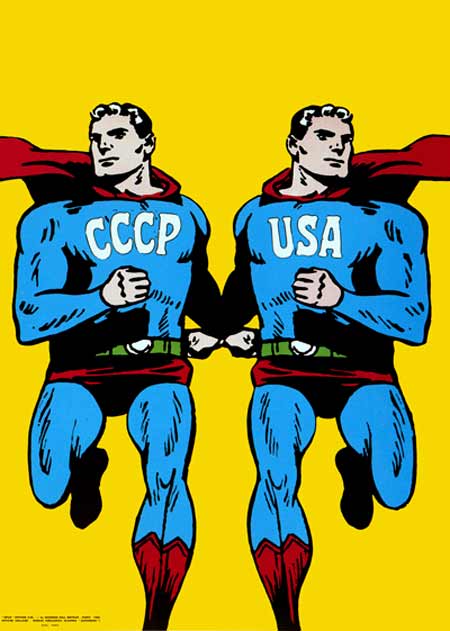
Refighting the Cold War

superman
I thought the USA already won?

W.J. Astore

Within the U.S. “defense” establishment there’s an eagerness to refight the Cold War with Russia and China, notes Michael Klare at TomDispatch.com.  The “long war” on terror, although still festering, is not enough to justify enormous defense budgets and traditional weapon systems like aircraft carriers, bomber and fighter jets, and tanks and artillery.  But hyping the Russian and Chinese threats, as Defense Secretary James Mattis is doing, is a proven method of ensuring future military growth along well-trodden avenues.

Hence an article at Fox News that I saw this morning.  Its title: “Here’s why Russia would lose a second Cold War — and would be unwise to start one.”  The article happily predicts the demise of Russia if that country dares to challenge the U.S. in a Cold War-like binge of military spending.  Bring it on, Russia and China, our defense hawks are effectively saying.  But recall what happened when George W. Bush said “Bring it on” in the context of the Iraq insurgency.

Our military leaders envision Russian and Chinese threats that directly challenge America’s conventional and nuclear supremacy.  They then hype these alleged threats in the toughest war of all: budgetary battles at the Pentagon and in Congress.  The Navy wants more ships, the Air Force wants more planes, the Army wants more soldiers and more weapons — and all of these are more easily justified when you face “peer” enemies instead of guerrillas and terrorists whose heaviest weapons are usually RPGs and IEDs.

Yet Russia and China aren’t stupid.  Why should they challenge the U.S. in hyper-expensive areas like aircraft-carrier-building or ultra-modern “stealth” bombers when they can easily assert influence in unconventional and asymmetric ways?  The Russians, for example, have proven adept at exploiting social media to exacerbate political divisions within the U.S., and the Chinese too are quite skilled at cyberwar.  More than anything, however, the Chinese can exploit their financial and economic clout, their growing dominance of manufacturing and trade, as the U.S. continues to hollow itself out financially in a race for conventional and nuclear dominance in which its main rival is its own distorted reflection.

In essence, then, America’s “new” National Defense Strategy under Trump is a return to the Reagan era, circa 1980, with its much-hyped military buildup.   Yet again the U.S. is investing in military hardware, but China and Russia are investing more in software, so to speak.  It makes me think of the days of IBM versus Bill Gates. Bill Gates’ genius was recognizing the future was in the software, the operating systems, not in the hardware as IBM believed.

But the U.S. is being led by hardware guys.  A hardware guy all the way, Donald Trump is all about bigger missiles and massive bombs. Indeed, later this year he wants a parade of military hardware down Pennsylvania Avenue.  It’s as if we’re living in 1975 — time to review the troops, comrade general.

Who knew the triumphant “new world order” of 1991 would become a quarter-century later a sad and tragic quest by the USA to refight the very Cold War we claimed back then to have won?  Isn’t it easy to envision Trump boasting like an old-style Soviet leader of how, under his “very stable genius” leadership, “America is turning out missiles like sausages”?

Reinforcing Failure in Afghanistan

Saighan 05-2011 -
The Tough Terrain of Afghanistan (Photo by Anna M.)

W.J. Astore

Back in 2009, as the Obama administration was ramping up its ill-fated surge in Afghanistan, I wrote the following article on the contradictions of U.S. military strategy in that country.  Like the British in the 19th century and the Soviets in the 20th century, both defeated by the Afghan people as well as the harsh environment, the Americans in the 21st century are a foreign and invasive presence in Afghanistan that will ultimately be fought off and ejected.  (Interestingly, the U.S. military has it exactly backwards, seeing itself as antibodies to a foreign terrorist threat in Afghanistan.)  Despite the weight of history and the lack of U.S. progress in Afghanistan over the last two decades, the U.S. government in 2018 refuses to withdraw, wasting an additional $45 billion a year on a trillion-dollar campaign that’s gone nowhere.

Little did I know in 2009 that, nearly a decade later, the U.S. military would still be mired in that country, yet still be talking about some kind of victory in a war that retired General David Petraeus says will last for “generations.”  The British and Soviets learned their lesson and withdrew; when will the U.S. learn the lesson of Afghanistan and withdraw?

Why is the U.S. military still there?  If it’s to suppress terrorism or the Taliban, the exact opposite has happened: terrorism has spread and the Taliban has grown stronger.  The heroin trade has also accelerated.  Is it about gas pipelines?  Strategic minerals?  Bases from which Iran can be attacked?  Maintaining American “credibility”?  All of the above?  I would guess most Americans have no clue why the U.S. military is still in Afghanistan, other than some vague notion of fighting a war on terror.  And in war vague notions are a poor substitute for sound strategy and communal will.

Here’s my article from 2009:

In the U.S. debate on Afghanistan, virtually all experts agree that it’s not within the power of the American military alone to win the war. For that, Afghanistan needs its own military and police force, one that is truly representative of the people, and one that is not hopelessly corrupted by drug money and the selfish concerns of the Karzai government [now gone] in Kabul.

The conundrum is that any Afghan military created by outsiders — and America, despite our image of ourselves, is naturally seen by most Afghans as a self-interested outsider — is apt to be viewed as compromised and illegitimate.

Committing more American troops and advisors only exacerbates this problem. The more U.S. troops we send, the more we’re “in the face” of the Afghan people, jabbering at them in a language they don’t understand. The more troops we send, moreover, the more likely it is that our troops will take the war’s burdens on themselves. If history is any guide, we’ll tend to push aside the “incompetent” and “unreliable” Afghan military that we’re so at pains to create and celebrate.

We have a classic Catch-22. As we send more troops to stiffen Afghan government forces and to stabilize the state, their high-profile presence will serve to demoralize Afghan troops and ultimately to destabilize the state. The more the U.S. military takes the fight to the enemy, the less likely it is that our Afghan army-in-perpetual-reequipping-and-training will do so.

How to escape this Catch-22? The only answer that offers hope is that America must not be seen as an imperial master in Afghanistan. If we wish to prevail, we must downsize our commitment of troops; we must minimize our presence.

But if we insist on pulling the strings, we’ll likely as not perform our own dance of death in this “graveyard of empires.”

A little history. Some two centuries ago, and much like us, the globe-spanning British Empire attempted to extend its mastery over Afghanistan. It did not go well. The British diplomat in charge, Montstuart Elphinstone, noted in his book on “Caubool” the warning of an Afghan tribal elder he encountered: “We are content with discord, we are content with alarms, we are content with blood; but we will never be content with a master.”

As imperial masters, British attitudes toward Afghans were perhaps best summed up in the Encyclopaedia Britannica, Ninth Edition (1875). The Afghans, according to the Britannica, “are familiar with death, and are audacious in attack, but easily discouraged by failure; excessively turbulent and unsubmissive to law or discipline; apparently frank and affable in manner, especially when they hope to gain some object, but capable of the grossest brutality when that hope ceases. They are unscrupulous in perjury, treacherous, vain, and insatiable in vindictiveness, which they will satisfy at the cost of their own lives and in the most cruel manner …. the higher classes are too often stained with deep and degrading debauchery.”

One wonders what the Afghans had to say about the British.

The accuracy of this British depiction is not important; indeed, it says more about imperial British attitudes than it does Afghan culture. What it highlights is a tendency toward sneering superiority exercised by the occupier, whether that occupier is a British officer in the 1840s or an American advisor today. In the British case, greater familiarity only bred greater contempt, as the words of one British noteworthy, Sir Herbert Edwardes, illustrate. Rejecting Elphinstone’s somewhat favorable estimate of their character, Edwardes dismissively noted that with Afghans, “Nothing is finer than their physique, or worse than their morale.”

We should ponder this statement, for it could have come yesterday from an American advisor. If the words of British “masters” from 150 years ago teach us anything, it’s that Afghanistan will never be ours to win. Nor is an Afghan army ours to create. Like the British, we might fine-tune Afghan physiques, but we won’t be able to instill high morale and staying power.

And if we can’t create an Afghan army that’s willing to fight and die for Karzai or some other government we consider worthy of our support, we must face facts: There’s no chance of winning at any remotely sustainable or sensible cost to the United States.

Nevertheless, we seem eager to persist in our very own Catch-22. We may yet overcome it, but only by courting a singularly dangerous paradox. In Vietnam, our military spoke of destroying villages in order to save them. Will we have to destroy the American military in order to save Afghanistan?

For that may be the ultimate price of “victory” in Afghanistan.

An Addendum (2018): This year, the Trump administration’s Afghan “strategy” seems to be to pressure the Pakistanis by withholding foreign aid, to bomb and drone and kill as many “terrorists” as possible without committing large numbers of American troops, and to “brown the bodies,” i.e. to fight to the last Afghan government soldier.  That’s apparently what the U.S. military learned from its failed Afghan surge of 2009-10: minimize U.S. casualties while continuing the fight, irrespective of the costs (especially to Afghanistan) and lack of progress.  So I was wrong in 2009: Unlike the Vietnam War, in which the U.S. military came close to destroying itself in a vain pursuit of victory, the Afghan War has been tamped down to a manageable level of effort, or so Washington and the Pentagon seem to think.

What Washington experts will never seriously consider, apparently, is withdrawal from a war that they already lost more than a decade ago.  Thus they commit an especially egregious error in military strategy: they persist in reinforcing failure.

Update (4/2/18): Just after I wrote this, I saw this update at FP: Foreign Policy:

“This is not another year of the same thing we’ve been doing [in Afghanistan] for 17 years,” Gen. Joseph Dunford , chairman of the Joint Chiefs of Staff, told the Washington Post. “This is a fundamentally different approach.”

That notes of optimism comes as the Taliban have made significant territorial gains, with the group now openly active in 70 percent Afghanistan’s territory. Afghan military forces, meanwhile, are taking casualties at a record level. Afghan President Ashraf Ghani continues to drum up support for a peace initiative that would bring the Taliban to the negotiating table, but so far a a breakthrough appears far off.