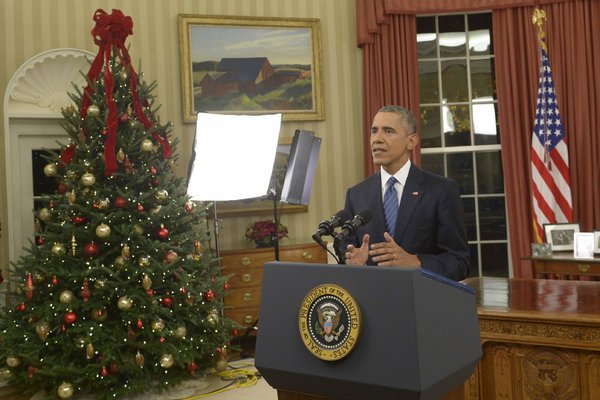
My wife and I watched the president’s speech last night. Overall, it was a solid, even praiseworthy, performance. First, we had to get past the NBC pre-speech fear-mongering. Lester Holt and Chuck Todd, the NBC commentators, were talking about how afraid Americans were, hinting that we all feared our holiday parties would be invaded by active shooters bent on murder. My wife and I looked at each other. Are you fearful, honey? Neither am I.
President Obama himself made many good points. Yes, we shouldn’t vilify Muslim-Americans or condemn all of Islam. Yes, we shouldn’t commit major ground forces to the Middle East to chase ISIL terrorists. Yes, we need sane gun control measures in the USA. Nobody needs an AK-47 or AR-15 (these are not hunting guns: they are military assault rifles designed to kill people). And nobody needs the right to buy a gun if they’re on a “no fly” list as a possible terror threat.
These were “common sense” points, and it pains me to think the president has to belabor what should be obvious. But he does. Because the National Rifle Association wants no restrictions on gun ownership, and the radical right does want to vilify Muslims, commit large numbers of U.S. ground troops to the Middle East, and extend a regimen of militarized surveillance and security at home that will make us even less safe.
Where President Obama consistently disappoints is what he leaves unsaid. That the U.S. invasion and occupation of Iraq essentially created ISIL; and that his policy of overthrowing the Syrian government by arming indigenous Arab forces contributed to it (according to Lieutenant General Michael Flynn, formerly head of the Defense Intelligence Agency). That his strategy of drone assassination (so-called signature strikes that are often based on faulty intelligence) is creating more terrorists than it kills, as several military drone operators have recently argued.
Defenders of the U.S. drone assassination program argue that it’s not the intent of the U.S. government to kill innocents, therefore the U.S. is free from blame. Try telling that to those who have lost loved ones to drones. (So sorry: We didn’t mean to kill your mother/brother/loved one. Wrong place/wrong time: an explanation as infuriating as it is unconvincing.)
President Obama concluded by arguing that he needed even more of a blank check (in the form of a Congressional authorization) to prosecute the war on terror. All in the name of keeping Americans safe, naturally. But he has it exactly backwards. Congress needs to exercise more oversight, not less. Imagine giving President Donald Trump a Congressional blank check to exercise the war on terror. Not such a good idea, right?
Finally, and disappointingly, Obama misunderstands the solemn duty of his office. As commander in chief, Obama believes his first duty is to keep Americans safe and secure. Wrong. His first duty is to “preserve, protect and defend” the U.S. Constitution and the rights, freedoms, and responsibilities defined within. Put bluntly, you can’t keep Americans safe and secure by abridging their rights to freedom of speech or to privacy or to dissent. “Safety” and “security” were not the bywords of America’s founders. Liberty was. And liberty entails risks.
A saying popular on the right is Thomas Jefferson’s “The tree of liberty must be refreshed from time to time with the blood of patriots and tyrants.” In the USA today, “tyranny” is most likely to come in the form of a leader who promises to keep us safe and secure at any cost. (Just look at the Republican candidates for president with their calls for Muslim detention camps, mass expulsion of immigrants, the shuttering of houses of worship, and similar measures of repression.)
The president was right to argue that we must not betray our values. He was right to talk about human dignity. He was right to say that freedom is more powerful than fear. Now we as Americans need to live up to those words. And so does he.
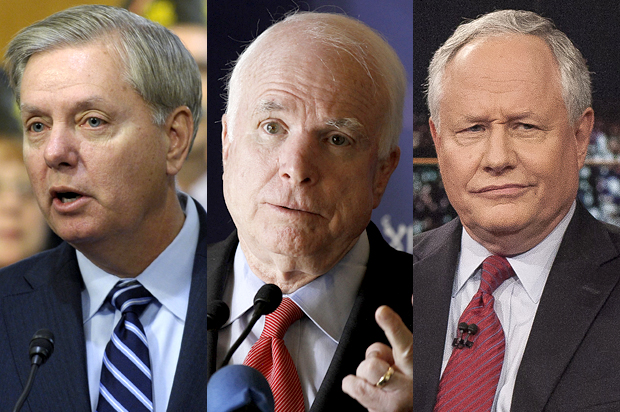
John McCain (middle) bookended by “warriors” Lindsey Graham (left) and Bill Kristol (right)
W.J. Astore
In his latest introduction at TomDispatch.com, Tom Engelhardt reveals a remarkable double standard — perhaps craziness is a better term — in the U.S. approach to terrorism in the wake of the Paris attacks. Prominent “conservative” leaders are calling for a major U.S. military invasion of territory controlled by ISIS, even though they know that ISIS has the “home field advantage.” They know, in short, that such an invasion will be both risky and costly, spreading chaos even further in the region, but they just can’t help themselves: they must “do something,” and the “something” in this case is sending other people’s sons and daughters into harm’s way.
But when it comes to incurring any risk, no matter how remote, to the American “homeland” from allowing refugees fleeing the chaos of the Middle East (chaos partly made by the USA and its previous military interventions, of course) to enter, these same conservative leaders cower. We can’t let “them” in. Too dangerous!
So, where the U.S. has an overwhelming “home field” advantage, these self-styled warriors retreat into paralyzing timidity. “Not in my backyard,” they say. But we sure as hell will send “our” troops into their backyards. See how brave we are in taking the fight to ISIS?
Here is Engelhardt’s introduction that so clearly highlights this tension:
In Washington, voices are rising fast and furiously. “Freedom fries” are a thing of the past and everyone agrees on the need to support France (and on more or less nothing else). Now, disagreements are sharpening over whether to only incrementally “intensify” the use of U.S. military power in Syria and Iraq or go to “war” big time and send in the troops. The editor of the right-wing Weekly Standard, Bill Kristol, is already calling for 50,000 American troops to take the Islamic State’s “capital,” Raqqa. Republican presidential candidate Senator Lindsey Graham, who has been urging that another 20,000 troops be dispatched to the region for months, offers this illuminating analogy to sports: “I’m looking for an away game when it comes to ISIL, not a home game. I want to fight them in their backyard.”
And don’t forget that increasingly angry sideline discussion about the Obama administration’s plan to let 10,000 Syrian refugees, carefully vetted for up to two years, trickle into the country. Alternatives proposed include setting up even harsher, more time-consuming vetting processes to insure that few of them can make it, allowing only certified, God-fearing Christian Syrians in while — give a rousing cheer for the “clash of civilizations” — leaving Muslims to rot in hell, or just blocking the whole damn lot of them.
I’m all for Bill Kristol and Lindsey Graham’s warrior fervor. I wish them every success as they deploy to Raqqa in their “away game” against ISIS.
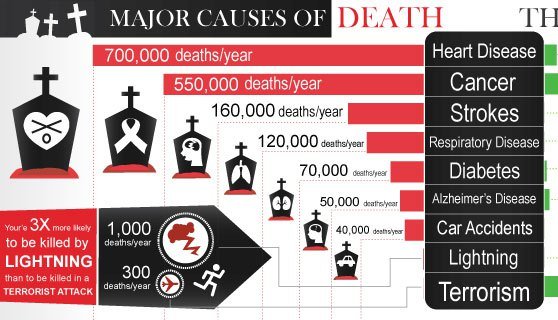
Over the last ten years in the United States, more than 280,000 Americans (more than 300,000 by some counts) have died because of guns. Over that same period, roughly 350,000 Americans have died on the roads in vehicular accidents. That’s roughly 630,000 Americans dying every decade either in road accidents or by gunshots, which is roughly the number of Americans who died in the horrible carnage of the U.S. Civil War from 1861 to 1865, America’s bloodiest war.
In other words, at the hands of guns and vehicles, Americans suffer the equivalent of a civil war-like bloodletting each and every decade. Is it time to declare war on guns and cars? (And now roughly 30,000 people each year are dying from drug overdoses related to the abuse of prescription painkillers and other opiates.)
The U.S. media and our leaders prefer to fixate on radical Islamic terrorism, which has accounted for 24 deaths over the same period. Indeed, by the numbers the White supremacist threat to America is twice as serious as threats from ISIS or other external radical groups.
According to the Washington Times,
“In the 14 years since the Sept. 11 terror attacks, nearly twice as many people have been killed in the United States by white supremacists and anti-government radicals than by Muslim jihadis, according to a new study.”
“White supremacists and anti-government radicals have killed 48 Americans … versus 26 killings by Muslim radicals, according to a count by New America, a Washington research center.”
“New America program associate David Sterman said the study shows that white supremacy and anti-government idealists are a major problem, that their growth rate needs to be addressed and that there is an ‘ignored threat’ woven in the fabric of American society.”
Given these numbers and realities, why are America’s leaders so fixated on hyping the threat of radical Islamic terrorists? Shouldn’t we be focusing on saving lives on our roads? Reducing gun accidents and gun crimes and suicide by guns? On reducing hate-filled radicalism within our own country?
We should be, but we’re not. Our leaders prefer threat inflation: They believe in making political hay while the foreign terrorist threat shines. So presidential candidates like Jeb Bush and Marco Rubio predictably call for a war on terrorism, for military “boots on the ground” in Syria and Iraq, and (of course) for higher military spending and more surveillance, in the name of protecting America. Threat inflation knows no political party, of course, with Hillary Clinton joining the chorus of the tough-talkers against terror.
Threat inflation sells. And threat inflation pays. This is an important theme in Tom Engelhardt’s latest tour de force at TomDispatch.com, “The National Security State’s Incestuous Relationship with the Islamic State.” As Engelhardt notes, threat inflation drives a dance of death even as it eliminates grey zones — opportunities for dialog, diplomacy, compromise, forms of accommodation. It enforces a black and white world of crusaders and jihadists bent on killing one another in the name of righteousness.
Here is how Engelhardt puts it:
the officials of [the U.S. national] security state have bet the farm on the preeminence of the terrorist “threat,” which has, not so surprisingly, left them eerily reliant on the Islamic State and other such organizations for the perpetuation of their way of life, their career opportunities, their growing powers, and their relative freedom to infringe on basic rights, as well as for that comfortably all-embracing blanket of secrecy that envelops their activities. Note that, as with so many developments in our world which have caught them by surprise, the officials who run our vast surveillance network and its staggering ranks of intelligence operatives and analysts seemingly hadn’t a clue about the IS plot against Paris (even though intelligence officials in at least one other country evidently did). Nonetheless, whether they see actual threats coming or not, they need Paris-style alarms and nightmares, just as they need local “plots,” even ones semi-engineered by FBI informers or created online by lone idiots, not lone wolves. Otherwise, why would the media keep prattling on about terrorism or presidential candidates keep humming the terror tune, and how, then, would public panic levels remain reasonably high on the subject when so many other dangers are more pressing in American life?
The relationship between that ever-more powerful shadow government in Washington and the Islamic terrorists of our planet is both mutually reinforcing and unnervingly incestuous.
Of course, Engelhardt knows that terrorism must be fought. The point is not to lose our collective heads over the (much exaggerated) threat of it. To cite Frank Herbert’s insight in Dune, “Fear is the mind-killer.” Yet our media and leaders seem determined to hype fear so as to kill our minds.
As our media and politicians stoke our fear by exaggerating the threat posed by terrorism, ask yourself to what purpose are they attacking your minds.
Greg Grandin has a new book on Henry Kissinger and a new article at TomDispatch.com. Kissinger, writes Grandin, had an affinity (or perhaps an avidity) for power, especially air power, as a way of demonstrating his (and America’s) resolve.
Notes Grandin:
Henry Kissinger is, of course, not singularly responsible for the evolution of the U.S. national security state into a monstrosity. That state has had many administrators. But his example — especially his steadfast support for bombing as an instrument of “diplomacy” and his militarization of the Persian Gulf — has coursed through the decades, shedding a spectral light on the road that has brought us to a state of eternal war …
Kissinger was very hands-on. “Strike here in this area,” Sitton recalled Kissinger telling him, “or strike here in that area.” The bombing galvanized the national security adviser. The first raid occurred on March 18, 1969. “K really excited,” Bob Haldeman, Nixon’s chief of staff, wrote in his diary. “He came beaming in [to the Oval Office] with the report.”
In fact, he would supervise every aspect of the bombing. As journalist Seymour Hersh later wrote, “When the military men presented a proposed bombing list, Kissinger would redesign the missions, shifting a dozen planes, perhaps, from one area to another, and altering the timing of the bombing runs… [He] seemed to enjoy playing the bombardier.” (That joy wouldn’t be limited to Cambodia. According to Washington Post reporters Bob Woodward and Carl Bernstein, when the bombing of North Vietnam finally started up again, Kissinger “expressed enthusiasm at the size of the bomb craters.”) A Pentagon report released in 1973 stated that “Henry A. Kissinger approved each of the 3,875 Cambodia bombing raids in 1969 and 1970” — the most secretive phase of the bombing — “as well as the methods for keeping them out of the newspapers.”
All told, between 1969 and 1973, the U.S. dropped half-a-million tons of bombs on Cambodia alone, killing at least 100,000 civilians. And don’t forgetLaos and both North and South Vietnam. “It’s wave after wave of planes. You see, they can’t see the B-52 and they dropped a million pounds of bombs,” Kissinger told Nixon after the April 1972 bombing of North Vietnam’s port city of Haiphong, as he tried to reassure the president that the strategy was working: “I bet you we will have had more planes over there in one day than Johnson had in a month… Each plane can carry about 10 times the load [a] World War II plane could carry.”
As the months passed, however, the bombing did nothing to force Hanoi to the bargaining table. It did, on the other hand, help Kissinger in his interoffice rivalries. His sole source of power was Nixon, who was a bombing advocate. So Kissinger embraced his role as First Bombardier to show the tough-guy militarists the president had surrounded himself with that he was the “hawk of hawks.” And yet, in the end, even Nixon came to see that the bombing campaigns were a dead end. “K. We have had 10 years of total control of the air in Laos and V.Nam,” Nixon wrote him over a top-secret report on the efficacy of bombing, “The result = Zilch.” (This was in January 1972, three months before Kissinger assured Nixon that “wave after wave” of bombers would do the trick).
During those four-and a half years when the U.S. military dropped more than 6,000,000 tons of bombs on Southeast Asia, Kissinger revealed himself to be not a supreme political realist, but the planet’s supreme idealist. He refused to quit when it came to a policy meant to bring about a world he believed heought to live in, one where he could, by the force of the material power of the U.S. military, bend poor peasant countries like Cambodia, Laos, and North Vietnam to his will — as opposed to the one he did live in, where bomb as he might he couldn’t force Hanoi to submit. As he put it at the time, “I refuse to believe that a little fourth-rate power like North Vietnam does not have a breaking point.”
In fact, that bombing campaign did have one striking effect: it destabilized Cambodia, provoking a 1970 coup that, in turn, provoked a 1970 American invasion, which only broadened the social base of the insurgency growing in the countryside, leading to escalating U.S. bombing runs that spread to nearly the whole country, devastating it and creating the conditions for the rise to power of the genocidal Khmer Rouge…
Bombing for Kissinger was a way to show he was tough within an inner circle around Nixon that put a premium on toughness. It was also a way to minimize casualties to Americans while demonstrating a total disregard for casualties among the peoples of Southeast Asia.
Kissinger the bombardier was seduced by the seemingly god-like potential of air power — the ability to strike from on high, to smite evil-doers and those who would thwart Kissinger’s designs. Best of all, Kissinger never had to bloody his own hands. (Can you imagine Kissinger in a knife fight? Of course not. But you can imagine him gleefully gushing over bombing reports and bomb craters as bomber jets knifed through the sky.)
There’s a “Star Trek” episode in which Captain Kirk says, “Above all else, a god needs compassion.” Kissinger the “air power god” had no compassion. It was all about power. The little people who refused to kowtow to him — the Vietnamese, the Cambodians, the Chileans, and so on — these people were simply abstractions for Kissinger. Put differently, they were pawns on the geopolitical chessboard, to be sacrificed at will by self-styled grandmasters like Kissinger.
In his book “Secrets,” Daniel Ellsberg captured Kissinger’s blithe disregard for the lives of others in a probing question about Vietnamization. Was it moral, Ellsberg asked, to turn the war over to the South Vietnamese, knowing they were going to incur high casualties while fighting North Vietnam, even as American troops withdrew? Kissinger had no answer, one senses because the morality of his policies didn’t much matter to him. The goal was to save America’s “face” in Vietnam; for Kissinger the fates of the peoples of Southeast Asia paled in comparison to the importance of American prestige.
In his deliberately ponderous Germanic accent, Kissinger spoke softly as he wielded the big stick of American bombing. It didn’t work then, nor is it working today for those who still worship at the altar of Kissinger’s Realpolitik.
Back in January 2010, I wrote the following article for TomDispatch.com on the possibility of “a very American coup” occurring in conjunction with the presidential election of 2016. I make no claims to prescience: for example, the “great recession” I predicted didn’t come to pass, and there are as yet very few protesters in the streets, and no concerted movement rallying disaffected troops that I’m aware of. Nevertheless, I think there’s validity to some of my predictions in this article, and I encourage your comments in the section below on the path our country is treading as we head into 2016.
Here is the article, unchanged from when I wrote it nearly six years ago.
A Very American Coup Coming Soon to a Hometown Near You By William J. Astore
The wars in distant lands were always going to come home, but not this way.
It’s September 2016, year 15 of America’s “Long War” against terror. As weary troops return to the homeland, a bitter reality assails them: despite their sacrifices, America is losing.
Iraq is increasingly hostile to remaining occupation forces. Afghanistan is a riddle that remains unsolved: its army and police forces are untrustworthy, its government corrupt, and its tribal leaders unsympathetic to the vagaries of U.S. intervention. Since the Obama surge of 2010, a trillion more dollars have been devoted to Afghanistan, Iraq, Pakistan, and other countries in the vast shatter zone that is central Asia, without measurable returns; nothing, that is, except the prolongation of America’s Great Recession, now entering its tenth year without a sustained recovery in sight.
Disillusioned veterans are unable to find decent jobs in a crumbling economy. Scarred by the physical and psychological violence of war, fed up with the happy talk of duplicitous politicians who only speak of shared sacrifices, they begin to organize. Their motto: take America back.
Meanwhile, a lame duck presidency, choking on foreign policy failures, finds itself attacked even for its putative successes. Health-care reform is now seen to have combined the inefficiency and inconsistency of government with the naked greed and exploitative talents of corporations. Medical rationing is a fact of life confronting anyone on the high side of 50. Presidential rhetoric that offered hope and change has lost all resonance. Mainstream media outlets are discredited and disintegrating, resulting in new levels of information anarchy.
Protest, whether electronic or in the streets, has become more common — and the protestors in those streets increasingly carry guns, though as yet armed violence is minimal. A panicked administration responds with overlapping executive orders and legislation that is widely perceived as an attack on basic freedoms.
Tapping the frustration of protesters — including a renascent and mainstreamed “tea bag” movement — the former captains and sergeants, the ex-CIA operatives and out-of-work private mercenaries of the War on Terror take action. Conflict and confrontation they seek; laws and orders they increasingly ignore. As riot police are deployed in the streets, they face a grim choice: where to point their guns? Not at veterans, they decide, not at America’s erstwhile heroes.
A dwindling middle-class, still waving the flag and determined to keep its sliver-sized portion of the American dream, throws its support to the agitators. Wages shrinking, savings exhausted, bills rising, the sober middle can no longer hold. It vents its fear and rage by calling for a decisive leader and the overthrow of a can’t-do Congress.
Savvy members of traditional Washington elites are only too happy to oblige. They too crave order and can-do decisiveness — on their terms. Where better to find that than in the ranks of America’s most respected institution: the military?
A retired senior officer who led America’s heroes in central Asia is anointed. His creed: end public disorder, fight the War on Terror to a victorious finish, put America back on top. The United States, he says, is the land of winners, and winners accept no substitute for victory. Nominated on September 11, 2016, Patriot Day, he marches to an overwhelming victory that November, embraced in the streets by an American version of the post-World War I GermanFreikorps and the police who refuse to suppress them. A concerned minority is left to wonder (and tremble) at the de facto military coup that occurred so quickly, and yet so silently, in their midst.
It Can Happen Here, Unless We Act
Yes, it can happen here. In some ways, it’s already happening. But the key question is: at this late date, how can it be stopped? Here are some vectors for a change in course, and in mindset as well, if we are to avoid our own stealth coup:
1. Somehow, we need to begin to reverse the ongoing militarization of this country, especially our ever-rising “defense” budgets. The most recent of these, we’ve just learned, is a staggering $708 billion for fiscal year 2011 — and that doesn’t even include the $33 billion President Obama has requested for his latest surge in Afghanistan. We also need to get rid of the idea that anyone who suggests even minor cuts in defense spending is either hopelessly naïve or a terrorist sympathizer. It’s time as well to call a halt to the privatization of military activity and so halt the rise of security contractors like Xe (formerly Blackwater), thereby weakening the corporate profit motive that supports and underpins the American version of perpetual war. It’s time to begin feeling chastened, not proud, that we’re by far the number one country in the world in arms manufacturing and the global arms trade.
2. Let’s downsize our global mission rather than endlessly expanding our military footprint. It’s time to have a military capable of defending this country, not fighting endless wars in distant lands while garrisoning the globe.
3. Let’s stop paying attention to major TV and cable networks that rely onretired senior military officers, most of whom have ties both to the Pentagon and military contractors, for “unbiased” commentary on our wars. If we insist on fighting our perpetual “frontier” wars, let’s start insisting as well that they be covered in all their bitter reality: the death, the mayhem, the waste, the prisons, and the torture. Why is our war coverage invariably sanitized to “PG” or even “G,” when we can go to the movies anytime and see “R” rated, pornographically violent films? And by the way, it’s time to be more critical of the government’s and the media’s use of language and propaganda. Mindlessly parroting the Patriot Act doesn’t make you patriotic.
4. It’s time to elect a president who doesn’t surround himself with senior “civilian” advisors and ambassadors who are actually retired military generals and admirals, one who won’t accept a Nobel Peace Prize by defending war in theory and escalating it in practice.
5. Let’s toughen up. Let’s stop deferring to authority figures who promise to “protect” us while abridging our rights. Let’s stop bowing down before men and women in uniform, before they start thinking that it’s their right to be worshipped and act accordingly.
6. Let’s act now to relieve the sort of desperation bred by joblessness and hopelessness that could lead many — notably male workers suffering from the “He-Cession” — to see a militarized solution in “the homeland” as a credible last resort. It’s the economy, stupid, but with Main Street’s health, not Wall Street’s, in our focus.
7. Let’s take Sarah Palin and her followers seriously. They’re tapping into anger that’s real and spreading. Don’t let them become the voices of the angry working (and increasingly unemployed) classes.
8. Recognize that we face real enemies in our world, the most powerful of which aren’t in distant Afghanistan or Yemen but here at home. The essence of our struggle to sustain our faltering democracy should not be against “terrorists,” with their shoe and crotch bombs, but against various powerful, perfectly legal groups here whose interests lie in a Pentagon that only grows ever stronger.
9. Stop thinking the U.S. is uniquely privileged. Don’t take it on faith that God is on our side. Forget about God blessing America. If you believe in God, get out there and start trying to earn His blessing through deeds.
10. And, most important of all, remember that fear is the mind-killer that makes militarism possible. Ramping up “terror” is an amazingly effective way of shredding our Constitution. Putting our “safety” above all else is asking for trouble. The only way we’ll be completely safe from the big bad terrorists, after all, is when we’re all living in a maximum security state. Think of walking down the street while always being subject to a “full-body scan.”
That’s my top 10 things we need to do. It’s a daunting list and I’m sure you have a few ideas of your own. But have faith. Ultimately, it all boils down to Franklin Delano Roosevelt’s words to a nation suffering through the Great Depression: the only thing we have to fear is fear itself. These words came to mind recently as I read the following missive from a friend and World War II veteran who’s seen tough times:
“It’s very hard for me to accept how soft the American people have become. In 1941, with the western world under assault by powerful and deadly forces, and a large armada of ships and planes attacking us directly, I never heard a word of fear as we faced three powerful nations as enemies. Sixteen million of us went into the military with the very real possibility of death and I never once heard of fear, except from those exposed to danger. Now, our people let [their leaders] terrify them into accepting the destruction of our economy, our image in the world, and our democracy… All this over a small group of religious fanatics [mostly] from Saudi Arabia whom we kowtow to so we can drive 8-cylinder SUV’s. Pathetic!
“How many times have I stood in ‘security lines’ at airports and when I complained of the indignity of taking off shoes and not having water and the manhandling of passengers, have well educated people smugly said to me, ‘Well, they’re just keeping us safe.’ I look at the airport bullshit as a training ground to turn Americans into docile sheep in a totalitarian state.”
A public conditioned to act like sheep, to “support our troops” no matter what, to cower before the idea of terrorism, is a public ready to be herded. A military that’s being used to fight unwinnable wars is a military prone to return home disaffected and with scores to settle.
Angry and desperate veterans and mercenaries already conditioned to violence, merging with “tea baggers” and other alienated groups, could one day form our own Freikorps units, rioting for violent solutions to national decline. Recall that the Nazi movement ultimately succeeded in the early 1930s because so many middle-class Germans were scared as they saw their wealth, standard of living, and status all threatened by the Great Depression.
If our Great Recession continues, if decent jobs remain scarce, if the mainstream media continue to foster fear and hatred, if returning troops are disaffected and their leaders blame politicians for “not being tough enough,” if one or two more terrorist attacks succeed on U.S. soil, wouldn’t this country be well primed for a coup by any other name?
Don’t expect a “Seven Days in May” scenario. No American Caesar will return to Washington with his legions to decapitate governmental authority. Why not? Because he won’t have to.
As long as we continue to live in perpetual fear in an increasingly militarized state, we establish the preconditions under which Americans will be nailed to, and crucified on, a cross of iron.
It’s Halloween, America, which perhaps explains the gruesome results of the latest Republican presidential debate. I watched a sliver of them (terrifying!), and read as much as I could stand of the debate transcript (horrifying!). As usual, the Republicans want you to be afraid, very afraid, of the bogeyman. With respect to the economy, the bogeyman is variously described as a socialist, a Bolshevik, even a Menshevik (!), someone who favors big government to make all of your decisions on health care, education, and what not.
The Republican solution? Trust the free market! Empower the makers by cutting their taxes. Vilify the moochers and takers while starving them of their entitlement candy. Something like this cartoon, perhaps:
Long ago, George H.W. Bush described Reagan’s “supply side” tax plan as “voodoo economics.” That’s the idea you can cut taxes on the richest and most privileged Americans, thereby supposedly stimulating investment and growth, in which case the benefits would “trickle down” to the lowest of Americans on the economic ladder, even as the federal budget miraculously balanced itself.
If you thought that voodoo was thirty-five years in the grave, think again. It’s been exhumed from the graveyard of dead ideas, stalking us yet again, this time from the stage of that presidential debate in Boulder, Colorado.
For me, the scariest part of the Republican debate was its total lack of original ideas. Talk of Bolshevism is Cold War rhetoric that was dead a generation ago; supply-side economics was dead on arrival almost two generations ago; but like zombies these dead ideas are consuming the brains of the Republican candidates.
I don’t need to watch the TV series “The Walking Dead” to see zombies. For that, I just need to watch the Republican presidential debates.
Edward Snowden: Face the music — or perhaps a firing squad
W.J. Astore
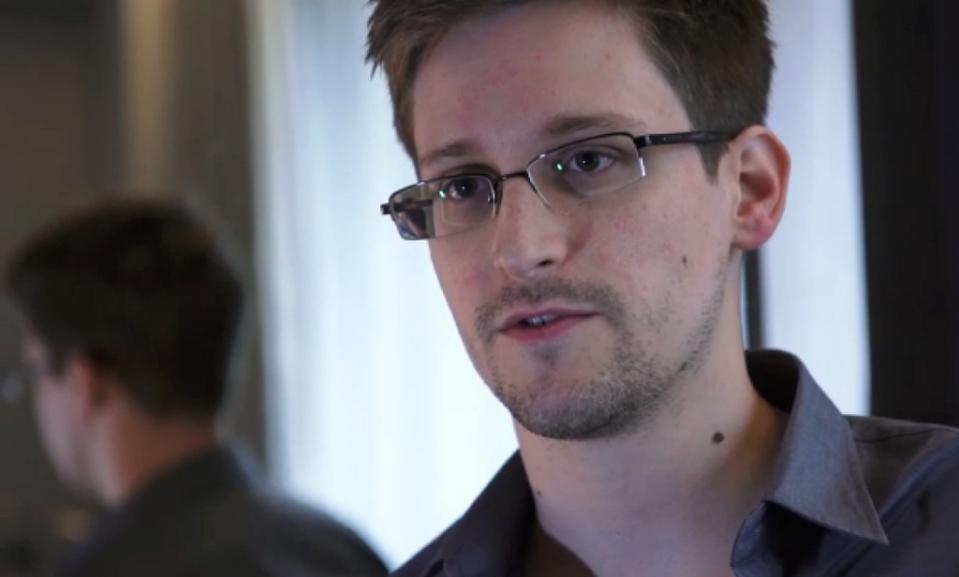
A revealing question and answer came in this week’s presidential debate among the Democratic candidates. They were asked if Edward Snowden, the whistleblower who revealed illegal spying by the NSA and the U.S. government, should be considered a hero or traitor.
Hillary Clinton’s answer was revealing of who she is and what she stands for; here it is in full:
CLINTON: He broke the laws of the United States. He could have been a whistleblower. He could have gotten all of the protections of being a whistleblower. He could have raised all the issues that he has raised. And I think there would have been a positive response to that.
COOPER: Should he do jail time?
ClINTON: In addition — in addition, he stole very important information that has unfortunately fallen into a lot of the wrong hands. So I don’t think he should be brought home without facing the music.
According to Hillary, Snowden is not officially a whistleblower, since he failed to apply for such status within the government. If he had, she suggests he would have been given a fair hearing. (Right! Just like the “positive response” Hillary Clinton’s State Department gave Peter Van Buren, who for his honesty about Iraq reconstruction was outcast and hounded into retirement.) She also suggests that Snowden’s revelations have “fallen into a lot of the wrong hands,” by which I think she means not foreign terrorists but the American people — what she terms “everyday” people to distinguish them from people like her.
But, finally, this sentence is the killer: I don’t think he should be brought home without facing the music.
Facing the music: Do you know what that potentially means for Edward Snowden? Accused of treason (his information having fallen into all those “wrong hands“), he would face the possibility of execution by the U.S. government. Facing the music in this case may mean facing a firing squad. At the very least, we’re talking about a LONG jail sentence, doubtless in a maximum security federal penitentiary.
By comparison to Hillary, the other candidates showed measures of compassion. Lincoln Chaffee said he wanted to bring Snowden home: that he deserved praise for revealing illegal activities by the U.S. government. Martin O’Malley essentially agreed with Clinton but without the ominous warning about the need to face the music. Bernie Sanders applauded Snowden for his role in educating the people about their dishonest and abusive government; he said that important service should be taken into account if and when Snowden returns for trial. Jim Webb punted the question to “the legal system” but he also highlighted the dangers of uncontrolled surveillance and how such power can be used for undemocratic purposes: “We’ve got a vast data bank of information that is ripe for people with bad intentions to be able to use,” Webb said. Of course, we truly wouldn’t know the full extent of this without the revelations provided by Snowden.
Following on from what Webb said, the conclusion is obvious: Edward Snowden is a hero. He should be brought back to the United States and praised for his courage in revealing how our government has spied illegally, not only on the American people but on much of the world. Untrammeled spying is not making us safer; it’s people like Snowden, those who still have integrity and who believe in the ideals of democracy, who are making us safer.
On the question of Snowden, hero or traitor, all the candidates disappointed. But in calling for Snowden to face the music, Hillary Clinton’s answer represented the deepest bow to the National Security State.
If I were Snowden, I wouldn’t plan on returning to the USA if Clinton is elected president.
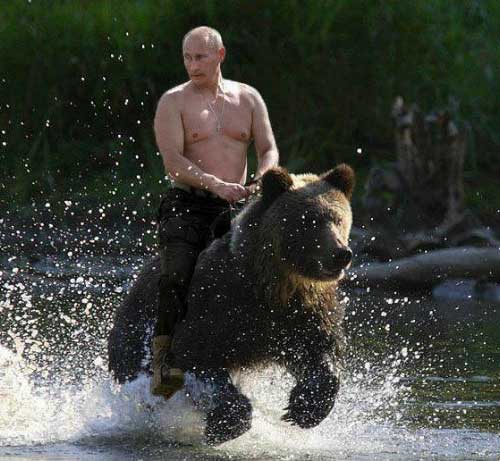
A Barechested Putin Riding Bareback on a Bear: The Ideal Republican Candidate for President!
W.J. Astore
At the New York Times, Robert Draper had a fascinating article last month on how Republican candidates for president are positioning themselves on foreign policy. Rand Paul excepted, all of the Republican candidates are calling for a more “aggressive” U.S. foreign policy, one that promises more military interventions and higher military spending. The goal is apparently to show more muscle than President Obama, who has been “weak,” according to these same Republicans.
The language here fascinates me. Again and again in Draper’s article, you see references to “a more muscular foreign policy.” Showcasing muscles appears to be a favorite trope of Republican advisers, as is the need to be more “aggressive” overseas (Obama, of course, is viewed as being passive and timid). Republicans according to Draper favor the “aggressive promotion of American values” (whatever those are), an aggression that will somehow avoid recklessness (good luck with that). So, ISIS will be aggressively “destroyed,” even as the Middle East is stabilized by infusing it with “American values” (freedom? democracy? human rights?) promulgated by (as near as I can tell) American military muscle.
To cite just one example, consider this political ad featuring Senator Lindsey Graham, seen in his Air Force reserve uniform, highlighting his promise to “destroy” ISIS.
A muscular and aggressive foreign policy to destroy America’s enemies: If that excites you, vote Republican. But consider the cost of this love affair with muscles and aggression. And then ask yourself: Are they not the real “American values”?
All this talk of bulging military muscles and coldly calculated aggression: the ideal candidate for gung ho Republicans is not the reincarnation of Ronald Reagan. It’s an American Vladimir Putin.
As David Vine reports for TomDispatch.com, the U.S. has roughly 800 military bases in foreign countries. Maintaining these bases costs upwards of $100 billion each year, more than the federal government spends on U.S. education.
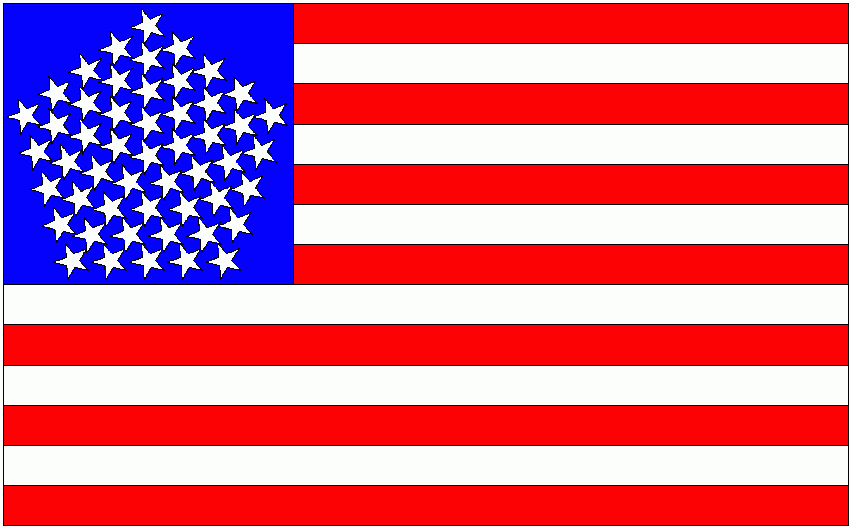
The sheer extent and cost of these bases got me to thinking. Each base is basically a “little America,” with a few of those bases being large enough to constitute an American city. If we can envision them collectively, would they not constitute America’s 51st state? But instead of adding one more star to the American flag, we’d have to add a white Pentagon to the field of blue to represent the controlling interest of “base world,” our 51st state.
Fifty stars and one Pentagon: Or, if you prefer, 51 stars arranged in the shape of a Pentagon.
Sound crazy? Not when you consider “base world’s” population, its corporate interests, its influence on American politics, and its leading role in American foreign policy. “Base world” is at least as significant to U.S. interests as real states like Wyoming. We really should have two U.S. senators elected from “base world.” Then again, they’re not really needed, since all 100 of our current U.S. senators represent the Pentagon (as long as the Pentagon keeps funneling money to their respective states, of course).
We have all these foreign bases because America needs them to protect our far-flung national interests against evil-doers. Right? Let’s think about these bases for a moment, the influence they wield, and the image they present of America. After all, for many foreigners, the USA = base world. What they know of America is represented by our military facilities and our troops. Most of our troops are decent individuals; believe me, I’ve known a lot of them. But there’s a reason why the Third Amendment to the U.S. Constitution forbids the quartering of troops in American households.
Ever been around a major military base in the USA? Often it’s easy to find them. Look for pawn shops, strip clubs, tattoo parlors, payday loan shops, and predatory car dealers. And if you think such “attractions” are a little sordid, perhaps you best not go overseas. This may surprise a few people, but young troops overseas are not always chaste and sage ambassadors of democracy. America’s “base world” is often not pretty, as young troops look for cheap suits and cheaper women, among other “bennies” (benefits) of an overseas deployment.
Statement of the obvious: Young troops of any nationality misbehave, especially when abroad. And that’s how many foreigners come to know America: through the misbehavior of our young troops from “base world.”
And here’s another point about “base world” that’s as obvious as it’s rarely made: How many Americans would like it if foreign troops had major military facilities near or within our cities? Perhaps some Russians or Saudis or Iranians in LA and Chicago and NYC. Because those “allies” would be “protecting” us with their bases on American soil. Right? Let’s add some foreign fighter jets into the mix, and perhaps some aerial drones as well. Surely we can trust our allies and their jets armed with bombs above our heads — right?
Incredibly expensive, often counterproductive, and sometimes disruptive, America’s “base world” needs to be downsized dramatically. If you truly want to shrink government, don’t start with your local post office. Start with America’s mega military bases overseas.
Much is being made of Hillary Clinton’s private email server, which she used when she was Secretary of State. To me, the real issue is not that Hillary endangered national security by sending classified information in the clear. No — the real issue is that the Clintons act as if they are above the rules and laws that apply to “the little people.” They are superior and smug, totally devoted to themselves and their pursuit of power and the privileges that come with it. It’s a matter of character, in other words. Hillary’s evasiveness, her lack of transparency, her self-righteousness, her strong sense of her own rectitude, make her a dangerous candidate for the presidency.
My second point is this: The issue of classification should be turned on its head. The real issue is not that Hillary potentially revealed secrets. No — the real issue is that our government keeps far too much from us. Our government uses security classification not so much to keep us safe, but to keep the national security state safe — safe from the eyes of the American people.
“A committee established by Congress, the Public Interest Declassification Board, warned in December that rampant over-classification is ‘imped[ing] informed government decisions and an informed public’ and, worse, ‘enabl[ing] corruption and malfeasance’. In one instance it documented, a government agency was found to be classifying one petabyte of new data every 18 months, the equivalent of 20m filing cabinets filled with text.”
Nowadays, seemingly everything is classified. And if it’s classified, if it’s secret, we can’t know about it. Because we can’t be trusted with it. That’s a fine idea for an autocracy or dictatorship, but not so fine for a democracy.
Government of the people, by the people, for the people? Impossible when nearly everything of any importance is classified.
Too bad Hillary didn’t send everything in the clear — what a service she would have done for the American people and for democracy!