Yes, the U.S. military is involved throughout the world. But even smart maps like this one neglect the one country truly conquered by that military: the USA
W.J. Astore
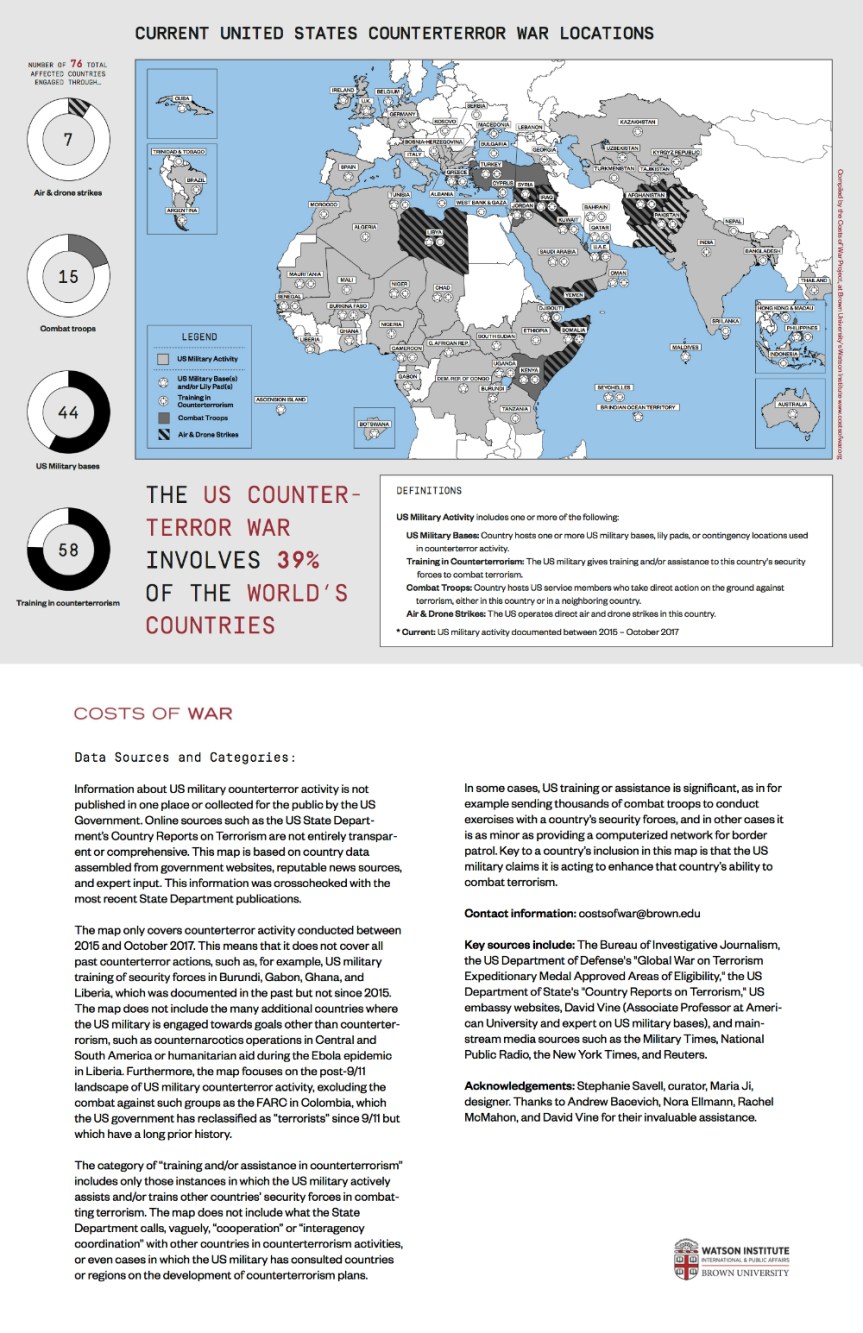
When the U.S. military boasts of “global reach, global power,” it’s not kidding. As Nick Turse notes in his latest article at TomDispatch.com, that military’s Special Operations forces deployed in one way or another to 149 countries in 2017, roughly 75% of countries on the globe. Talk about reach! Meanwhile, those forces have more than doubled since 2001, sitting at 70,000 effectives today, the equivalent to five divisions. (Consider it a military within the military.) All of this has come at tremendous cost, with this year’s defense budget sitting at $700 billion–and rising for the foreseeable future.
For all the bucks, what about the bang–what about results? Let’s just say that Iraq, Afghanistan, Libya, Yemen, Syria, Niger, and other U.S. military interventions haven’t gone well.
Yet there is one country where the U.S. military truly rules; one country which the U.S. military has truly conquered. Where and which? The USA, of course. No matter its losses and frustrations overseas, the U.S. military keeps winning more money and influence here at home. Congress loves it, presidents love it, our culture (mostly) loves it, or at least is urged to “support” it irrespective of results.
It’s not just the trillions of dollars it’s consumed since 9/11 or the extent to which retired generals rule the roost in Washington. Think about popular culture: our sports, our toys, our TV and movies. Kids dress up as soldiers on Halloween. Toys are of the “Call of Duty” variety. In TV shows like “SEAL Team,” Special Forces are all the rage. Hollywood has embraced them too, in movies like “Act of Valor” and the upcoming “12 Strong,” about a small team of American “horse soldiers” in Afghanistan soon after 9/11, riding to the rescue like so many John Waynes.
And one more item, a vitally important one, to consider: there is no talk of peace, anytime, anywhere, in the mainstream media, hence no talk of declining military budgets.
The military has conquered us. Indeed, global military action is a rare area of bipartisan accord in Washington, whether the commander-in-chief is Bush or Obama or Trump.
So, while it’s true the U.S. military is in an astonishing 149 countries, the one that really matters is the USA. It may lose in Afghanistan or Somalia, but it has won here — and that’s all that really matters to the further growth and vitality of America’s national security state.
If there’s one area of bipartisan agreement today, it’s politicians’ professed love of the U.S. military. Consider George W. Bush. He said the U.S. military is the greatest force for human liberation the world has ever known. Consider Barack Obama. He said that same military is the finest fighting force the world has ever known. Strong praise, indeed.
Today’s politicians are not to be outdone. This past weekend at Camp David, Paul Ryan praised the military for keeping America safe. Mike Pence noted the military remains “the strongest in the world,” yet paradoxically he said it needs rebuilding. He promised even more “investment” in the military so that it would become “even stronger still.”
Apparently, no matter how strong and superior the U.S. military is, it must be made yet stronger and yet more superior. All in an effort to “keep us safe,” to cite Paul Ryan’s words. Small wonder that the Pentagon’s budget is soaring above $700 billion.
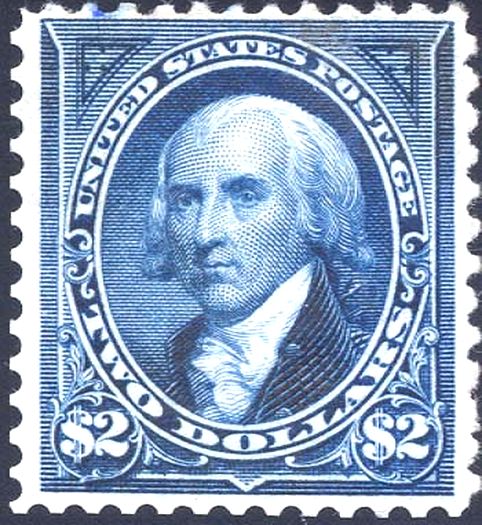
It didn’t use to be this way. President Dwight D. Eisenhower, formerly a five-star general and a man who knew the military intimately, warned us in 1961 of the anti-democratic nature of the military-industrial complex. James Madison, one of America’s founders, warned us in the 18th century of the perils of endless war and how armies drive authoritarian tendencies and contribute to financial debt and national ruin.
Ike knew that national safety shouldn’t be equated with military prowess; quite the reverse, as he warned us against the unchecked power of a burgeoning military-industrial-Congressional complex. Madison knew that armies weren’t “investments”; rather, they were, in historical terms, positive dangers to liberty.
But for America’s politicians today, the idea of national safety has become weaponized as well as militarized. In their minds personal liberty and national democracy, paradoxically, are best represented by an authoritarian and hierarchical military, one possessing vast power, whether measured by its resources across the globe or its reach within American society.
Our politicians find it easy to be uncritical cheerleaders of the U.S. military. They may even think they’re doing a service by issuing blank checks of support. But Ike and Madison would disagree, and so too would anyone with knowledge of the perils of military adulation.
Here’s a New Year’s resolution: How about ending America’s quagmire wars?
There are many reasons why Afghanistan, Iraq, and similar countries will always be quagmires for the U.S. military. U.S. troops have difficulty identifying friend from foe, and indeed “friendly” troops and police sometimes turn on their U.S. counterparts. U.S. troops will always be a foreign presence, heavily armed and invasive, often (mis)guided by incomplete or misleading intelligence. Almost inevitably, they are seen as backing corrupt and kleptocratic governments, whether in Kabul or Baghdad. At the same time, U.S. bombing and search and destroy missions kill innocents even as they generate refugees—and new enemies. Under such violent and tumultuous conditions, you can forget about winning hearts and minds or creating lasting political stability.
Facing this no-win scenario, savvy U.S. leaders would pull troops out immediately, but of course pulling out is never an option. Whether it’s Bush or Obama or Trump, the preferred “solution” to unwinnable quagmires is to “surge” (more troops, more airpower, more “advisers,” more weaponry) or to dither with tactics. Old theories are trotted out, such as pacification and counterinsurgency and nation-building, dressed up with new terms and acronyms such as asymmetrical warfare, the gray zone, MOOTW (military operations other than war), and VEOs, or violent extremist organizations, known to most people as terrorists.
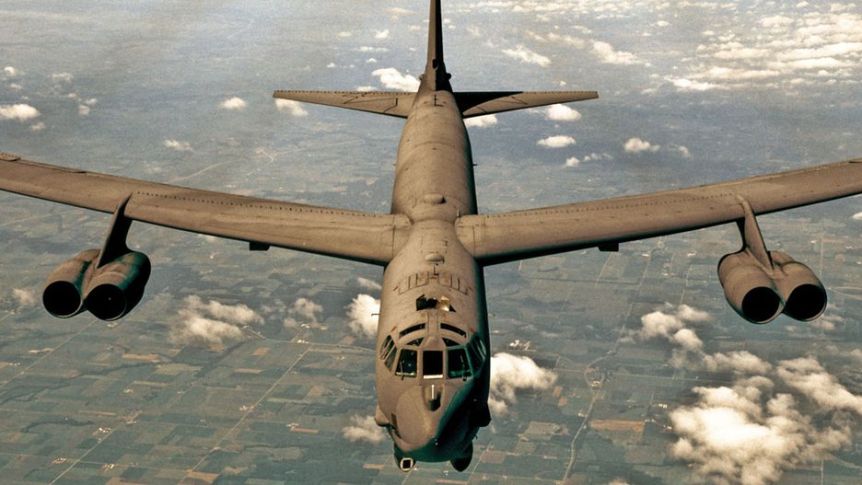
The mentality among America’s generals is that the war must go on. There must be a can-do way to defeat VEOs in the grey zone using asymmetrical warfare while engaged in MOOTW. Thus B-52s, those venerable strategic bombers from the early Cold War era, are now being used in Afghanistan to “asymmetrically” destroy drug laboratories associated with Taliban funding, yet another instance of the U.S. military swinging a sledgehammer to kill a gnat.
After 16 years, if you’re calling in B-52s to flatten small drug labs, this is not a sign of impending victory. It’s a sign of desperation — a sign of a totally bankrupt strategy.
The same is true of the use of MOAB in 2017. It’s not a sign of strength to use such blockbuster bombs on an undeveloped country like Afghanistan. It’s a sign of desperation. Of having no coherent strategy. Of throwing munitions at the wall and seeing which one makes the biggest boom.
Of course, a key aspect of this is domestic politics. The target of B-52s and MOABs isn’t always the Taliban and similar VEOs. It’s American public opinion. For Trump, it’s like, “See? We used MOAB. We’re using B-52s. Obama didn’t do this. We’re tougher–better–stronger. We’re taking the gloves off.”
When America’s military is not taking metaphorical gloves off, it’s learning to eat soup with a knife. That’s the title of Lieutenant Colonel John Nagl’s book on counterinsurgency, abbreviated as COIN in military circles. A decade ago, Nagl worked with General David Petraeus to rewrite the book on COIN, which enjoyed a brief renaissance during the Iraq and Afghan surges. But COIN methods (the idea of killing or otherwise neutralizing guerrillas/terrorists/VEOs while winning the hearts and minds of the people) haven’t worked to clean up American-made messes in those countries, a result contained within the metaphor. For if you really want to eat soup, best to put away military knives, pick up the soup bowl, and slurp away.
But America’s warfighters, with their affinity for knives, persist in efforts to develop new and “better” ones (spoons are for wimps!) as they flail away in various soup bowls (or, if you prefer, Petri dishes, which was General John Nicholson’s, the U.S. commander in Afghanistan, “bowl” of choice to describe the Af-Pak region in his testimony to Congress in 2017).
To use a different soup metaphor, too many cooks spoil the broth. The U.S. military’s interventions—its various and varying recipes for success, the ingredients of which are almost exclusively violent—never add up to a palatable product.
William S. Smith put it well in a recent article for The American Conservative. American military interventions, Smith notes, driven in large part by COIN theory, mostly ignore local history, religion, and culture. The resulting quagmire, according to Smith, is predictable:
The fact is that all political order at all times and everywhere emerges from an extremely complex set of unique symbols, practices, and beliefs that are rooted in history, culture, and religion. Political order does not merely flow from safety and the protection of property but out of a cultural inheritance that provides citizens with a sense that their society embodies something larger than themselves. To them, the symbols and traditions of their society reflect a certain divine order. An invading army from a foreign civilization will always be seen as a threat to that order whether citizens embrace violence or not. Without a major revolution in culture an occupying army will be in no position to generate more than a skin-deep and transitory political reconciliation. (Emphasis added)
Call it COINfusion followed by defeat. The U.S. military tried the “occupying army” part of this with its various surges in Iraq and Afghanistan, and the political results were as Smith says: skin-deep and transitory. The “new” American approach seems to be a variation of Richard Nixon’s Vietnamization policy of turning the fight over to the “indigenous” peoples, whether Afghans, Iraqis, etc. while continuing to bomb, to supply weaponry, and to provide training and “advice” with U.S. boots on the ground. Such an approach is sold to the American people as staying the course to victory, with the exact terms of “victory” left undefined.
But what price “victory”, even an illusory one? A staggering one. By the end of fiscal year 2018, America’s post-9/11 wars will have cost the taxpayers nearly $5.6 trillion, notes the “Cost of Wars” project at Brown University. With U.S. generals speaking of “generational” wars, this enormous burden will only continue to grow in the future—unless we wise up.
So my New Year’s resolution for 2018 is simple. End quagmire wars. Bring the troops home. After all, what’s wrong with saving blood and treasure?
VP Pence, in his military flight jacket, posing for selfies with the troops
W.J. Astore
Vice President Mike Pence made a surprise visit to Bagram air base in Afghanistan, reassuring the assembled troops that they are winning the war there, despite evidence to the contrary. For the occasion he donned a spiffy-looking leather military flight jacket, customized for him, as have other presidents and VPs going back at least as far as Ronald Reagan.
I’ve written about this before, this adoption of military clothing by civilian commanders. It’s an insidious blurring of the lines between the civilian chain of command — and the crucial idea of civilian control of the military — and the military chain. You don’t see generals and admirals on active duty showing up to testify before Congress in civilian coat and tie: they wear their uniforms because that’s who they are–commissioned military officers. Similarly, our civilian leaders, whether Ronald Reagan or Barack Obama or Donald Trump, should wear their “uniform,” typically civilian coat and tie, for that is who they are. They should never wear military flight jackets and similar items, no matter how “cool” or “supportive” they think they look. It sends the wrong sartorial and political signals.
I just can’t imagine Dwight D. Eisenhower, who was of course a five-star general before he became president, wearing military jackets and hats while he was president. Ike knew better. He was the civilian commander in chief, thus he dressed like it. Same with George C. Marshall. He wasn’t parading around in military jackets when he was Secretary of State in the aftermath of World War II.
Hitting another common theme, Pence was at pains to praise the troops as heroes, noting that “You are the best of us.” Why this need for endless flattery of the troops? Recall that President Obama praised the U.S. military as the finest fighting force in history. Satirically, you might call it the 4F military: the finest fighting force since forever.
America’s civilian leaders need to put aside hyperbolic praise and wannabe military uniform items. There’s a far better way of complimenting our troops while leading America. That better way? Ending America’s wars and bringing the troops home.
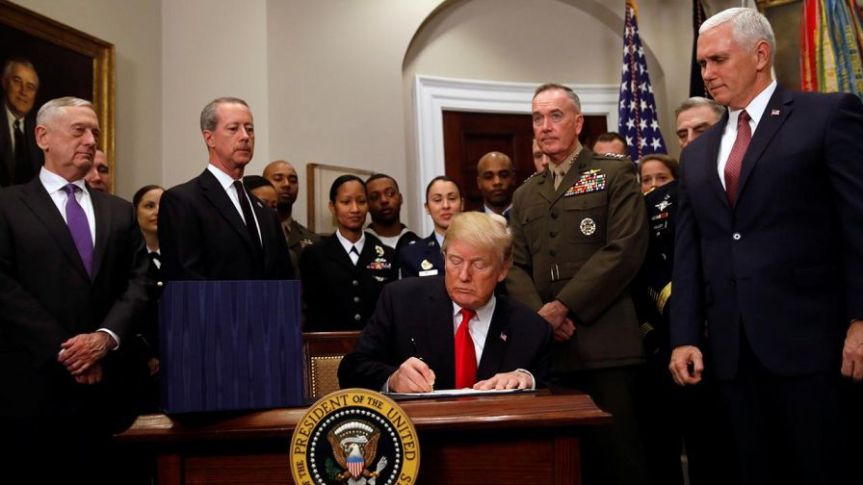
Trump, surrounded by the military, vows to give it more (and more!) money
W.J. Astore
Today at 2PM, the Trump administration releases its National Security Strategy. It’s already making news because Trump is dropping climate change (added by the Obama administration) as a threat. Instead, Trump is placing new emphasis on economic competitiveness and border security (“Build the wall!”), which are two corporate-friendly policies (read: boondoggles).
I’d like to cite two threats that Trump won’t mention in his national security strategy. These two threats are perhaps the biggest ones America faces, and they are related. The first is threat inflation, and the second is the U.S. military itself, as in Dwight D. Eisenhower’s military-industrial-Congressional complex.
Threat inflation is a huge problem in America. The threat of terrorism is vastly inflated, as is the threat from North Korea. If we wanted to focus on what threatens Americans, we’d be redoubling efforts to help those with opioid addictions even as we work to cut deaths by guns and in road accidents. Roughly 120,000 Americans are dying each year from opioid overdoses, road accidents, and shootings. How many are dying from terrorism or from attacks by North Korea?
North Korea is a weak regional power led by an immature dictator who is desperate to keep his grip on power. Kim Jong-un knows that any use of nuclear weapons by North Korea would end in his death and the annihilation of his country. He also knows that nuclear weapons serve as a deterrent and a symbol of prestige domestically and internationally. Does he need to be deterred? Yes. Should Americans cower in fear? Of course not.
Cyberwar is certainly a threat–just look at Russian meddling in our last presidential election. China and Russia are nuclear powers and rivals that bear close watching, but they are not enemies. Indeed, since the end of the Cold War the United States hasn’t faced serious peer enemies. We should have been cashing in our “peace dividends” for the last 25 years. Why haven’t we?
Enter the military-industrial-Congressional complex. Ike warned us about it in 1961. He warned about its misplaced power, its persistence, and its anti-democratic nature. Ike, a retired five-star general who led the allied armies on the Western Front in World War II against the Nazis, knew of what he spoke. He knew the Complex exaggerated threats, such as missile or bomber “gaps” (which didn’t exist) vis-a-vis the Soviet Union. Ike knew the military, its corporate feeders and enablers, and Congress always wanted one thing: more. He did his best to control the military, but once he left office, it was the Complex that took control, leading America into a disastrous war in Vietnam, the first of many “wars of choice” that ended in American defeats, but which proved highly profitable to the Complex itself.
Those endless wars that feed the Complex persist today. Elements of the U.S. military are deployed to 149 countries and 800 foreign bases at a budgetary cost of $700 billion (that’s just for the “defense” budget). Spending so much money on the military represents a tremendous opportunity cost–for that money, Americans could have free health care and college tuition, but who wants good health and a sound education, right?
Ike recognized the opportunity cost of “defense” spending in 1953 in this famous speech:
Every gun that is made, every warship launched, every rocket fired signifies, in the final sense, a theft from those who hunger and are not fed, those who are cold and are not clothed.
This world in arms is not spending money alone. It is spending the sweat of its laborers, the genius of its scientists, the hopes of its children. The cost of one modern heavy bomber is this: a modern brick school in more than 30 cities. It is two electric power plants, each serving a town of 60,000 population. It is two fine, fully equipped hospitals. It is some fifty miles of concrete pavement. We pay for a single fighter with a half-million bushels of wheat. We pay for a single destroyer with new homes that could have housed more than 8,000 people. . . . This is not a way of life at all, in any true sense. Under the cloud of threatening war, it is humanity hanging from a cross of iron.
What Ike said. The point is not that Ike was a perfect man (look at the Iran coup, also in 1953), but he sure as hell was a sound and at times a penetrating thinker, a mature man who knew the awful burdens of war.
And now we have Trump, the opposite of Ike, an unsound and shallow thinker, an immature man who knows nothing of the awfulness of war. Add Trump himself–his immaturity, his bellicosity, his ignorance, and his denial of reality–as a threat to our national security.
So, a quick summary of three big threats that won’t make Trump’s “strategy” today:
Threat inflation: terrorism, North Korea, Iran, etc.
The Complex itself and its profligate, prodigal, and anti-democratic nature.
Trump.
And add back one more: climate change/global warming. Because flooding, fires, droughts, famines, etc., exacerbated by global warming, are already creating security challenges, which will only grow worse over the next half-century. Denying that reality, or calling it “fake news,” won’t change Mother Nature; she has her own implacable ways,
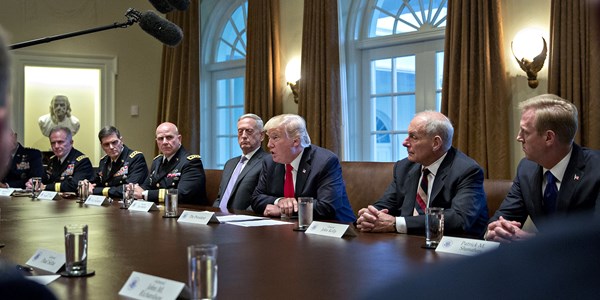
An article yesterday at NBC focusing on Trump and “his” generals got me to thinking on this subject again. Its author, Suzanne Garment, suggests that Trump likes generals as obedient alpha males. They lend him credibility without directly threatening his delicate ego. And there’s truth in this.
Trump and his generals. Mattis and Kelly flanking Trump. From the NBC article.
But I want to focus on other reasons for Trump’s preference for generals in high positions. A year ago, I wrote an article for TomDispatch.com on “All the President’s Generals.” That article focused mainly on the potential impact of these generals on America’s foreign policy and domestic culture. As I wrote last December:
Collectively, the team of Mattis, Flynn, and Kelly could not be more symbolic of the ongoing process of subversion of civilian control of the military. With Trump holding their reins, these self-styled warriors will soon take charge of the highest civilian positions overseeing the military of the world’s sole superpower. Don’t think of this, however, as a “Seven Days in May” scenario in which a hard-headed general mounts a coup against an allegedly soft-hearted president. It’s far worse. Who needs a coup when generals are essentially to be given free rein by a president-elect who fancies himself a military expert because, as a teenager, he spent a few years at a military-themed boarding school?
In all of this, Trump represents just the next (giant) step in an ongoing process. His warrior-steeds, his “dream team” of generals, highlight America’s striking twenty-first-century embrace of militarism.
I continue to think this is true. Trump is empowering further military adventurism, even as he reinforces military-style solutions to problems. But there are other reasons for Trump’s tight and eager embrace of the military.
Basically, by embracing the military and elevating it (while feeding it lots of money), Trump has neutralized it as a rival to his power. Indeed, he is borrowing from the military’s authority and standing within our culture to bolster his own.
Recall how Candidate Trump was often quite critical of the U.S. military. He knew more than the generals, he said. Their wars he often called wasteful follies. He was going to win (or end) these wars, he claimed, and hinted that quite a few “loser” generals might be on the receiving end of his infamous “You’re fired” line.
You hear none of this today. Trump is at pains to praise the military and his generals. He says they’re on a winning path, even in Afghanistan (because of Trump’s decisions, naturally). He rewards them with record budgets and unalloyed praise.
And it’s working. The military (and the larger national security state) is content with Trump. He’s letting them have their way, which is another way of saying Trump is having his way.
In American society today, there aren’t too many power centers that truly can challenge Trump. The media he’s diminished with all his attacks (“Fake news!”). A Republican Congress remains quietly subservient. Trump is stacking the judiciary with conservative judges to his liking. The Democratic Party remains feckless and divided. Bankers and corporations? Trump has hired the former and given a huge gift to the latter in the latest Republican tax cut for the richest.
When you think about it, the one power center that could challenge Trump is the military-industrial complex: America’s fourth branch of government. Yet by hiring so many of its generals and by praising it while passing loads of moola its way, Trump has co-opted its authority and power, attaching it to himself in his role as commander-in-chief.
Trump’s last hurdle may be the Robert Mueller investigation into Russian meddling and possible complicity or obstruction by Trump. If Trump gets past this (perhaps even by firing Mueller), is there anyone left with the balls, the sand, the spine, the guts, the moxie (choose your favorite measure of fortitude) and the authority to stop his ambition and designs as an authoritarian leader?
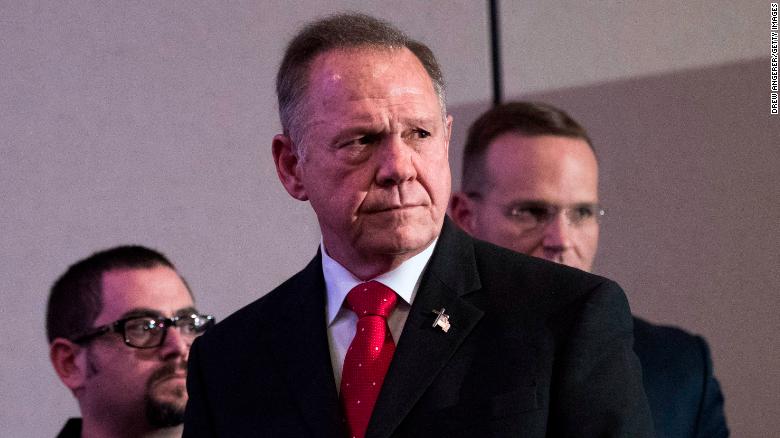
Roy Moore: Was the timing of Trump’s Jerusalem announcement driven by his election bid?
M. Davout
The December 6 announcement by Trump of U.S. recognition of Jerusalem as the capital of Israel and his administration’s intention to move the U.S. embassy from Tel Aviv to that storied city sparked much consternation and puzzlement, both prospectively and in its aftermath. The consternation, especially among career diplomats and Middle East policy experts, revolved around the likely effects of such a move both for Israeli-Palestinian relations and U.S. relationships with the larger Arab world. Wouldn’t this policy change, by making a unilateral concession to Israel, make even more difficult a two-state solution and unnecessarily inflame Arab world opinion?
The puzzlement stemmed from the timing. Why announce this now? Israel declared Jerusalem as its eternal, united and undivided capital in 1980 and the U.S. Congress passed a law requiring the U.S. to move its embassy to Jerusalem in 1995 but U.S. presidents, including Trump, have signed a waiver of the law every six months for the last two decades justifying their actions in terms of national security concerns. Why didn’t Trump wait another six months or year or announce this policy change six months ago?
The consensus answer to why Trump broke with precedent is that his actions are being driven by domestic political priorities, in particular, the support for a militant Israel evinced by members of his white evangelical base as well as of deep-pocketed rightwing donors such as casino magnate Sheldon Adelson. Johnnie Moore, co-chairman of Trump’s unofficial faith advisory board, said in the aftermath of Trump’s announcement that, “The issue was–to many–second only to concerns about the judiciary among the president’s core evangelical supporters.”
While this macro-scale view of Trump’s domestic political support might explain why he is choosing to break with U.S. foreign policy precedent and risk so much, it does not explain why this break is happening now. For a more nuanced and plausible answer to this latter question, one has to zoom in for a closer look at Trump’s domestic political landscape and ask what Jerusalem might have to do with a closely contested Alabama senate race between Republican Roy Moore, proud fundamentalist and accused pedophile, and Democrat Doug Jones.
For several weeks after the accusations against Moore for sexual abuse and harassment of teenage girls during the time he was in his thirties, he seemed radioactive to the national Republican establishment. Trump changed that with his December 4 early morning tweet endorsing Moore. The very next day, Steve Bannon, Trump’s alt-right alter ego, spoke at a Moore rally in Mobile, Alabama. And on December 6, Trump upended U.S. policy in the Middle East with his Jerusalem announcement.
Is the quick succession of these events a coincidence? Or is it evidence that Bannon continues in his former role as Don Trump’s consigliere? Changing U.S. policy was something Trump had wanted to do from the start. He was evidently persuaded to forego the move six months ago and sign the waiver. However, the unexpected events of late November turned what would have been a shoo-in for the Republican Senate candidate in Alabama into a slogging match with a capable Democratic contender. Might this turn of events have seemed to Trump (if not also to Bannon) the perfect moment to throw some red meat to the base in Alabama and motivate any evangelicals having second thoughts about voting in an accused pedophile to go to the polls on December 12?
Whatever the motivation for Trump’s move on Jerusalem, one thing is certain. This president’s first and (apparently) only priority is to please his base by fulfilling as many of his election season promises as he can. In doing so, he demonstrates that he truly is the President of Red America.
M. Davout (pseudonym) is a professor of political science who teaches in the Deep South.
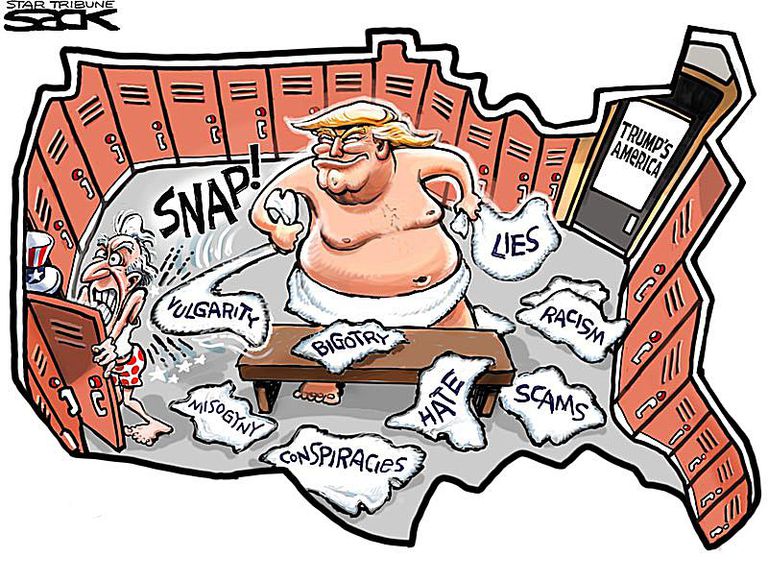
Donald Trump is waging a global war on truth. He is the anti-truth president. From Trump steaks to his “university” to his support of the “birther” movement against Barack Obama, he’s perpetually selling lies. Now he’s selling lies on a global stage. By making everything potentially a lie, e.g. climate change as a “Chinese hoax,” Trump is doing his best to demolish facts, paving the way to do whatever he pleases.
Trump believes he can have his own facts and tweet them too. We can blame Trump for being the vain, venal, and vile man that he is, but America elected him (yes, not all Americans, but enough to carry the Electoral College). He’s a con man, a crafty one, and the media can’t look away, nor can the rest of us.
How did we end up with Trump and his assault on truth? I’d like to focus on two reasons. The first was noted by Bernie Sanders back in September of 1998. Then a congressman, Sanders noted how the Democratic Party under the Clinton regime, with its corporate-friendly pursuit of “free” trade and feel-good globalization, was screwing the working classes. Sanders then issued the following warning (in an editorial in The Nation entitled, “Globalization’s the Issue”):
Right-wing populists like Pat Buchanan are lining up to ride to power on public fear and anger about globalization. If corporate globalism continues to result in deteriorating conditions of life for ordinary Americans, we’re likely to see a rise of scapegoating demagogy and virulent right-wing economic nationalism.
Scapegoating demagogy? Trump and Mexicans, Trump and Muslims, Trump and immigrants in general. Right-wing economic nationalism? Trump and “making America great again” through massive military spending and weapons exports combined with tax cuts that are sold as helping the poor even as they reward the rich.
By betraying the working classes and becoming yet another business party, the Clinton Democrats helped pave the way for right-wing populists and unprincipled opportunists like Trump. Indeed, by running the corporate-friendly Hillary Clinton against Trump in 2016, the Democratic Party turned its back on their own populist, Bernie Sanders, who genuinely was (and is) concerned with helping the working classes.
The second reason for Trump’s assault on truth has been all around us for decades, but it was exacerbated by the 9/11 attacks. Think back to the Vietnam War, the Pentagon Papers, and Watergate. If there’s one thing we learned from these debacles, it’s how much our government lies to us. Now fast-forward to 9/11. In the aftermath of those attacks, the Bush/Cheney administration did its level best to deflect all responsibility, and especially their responsibility, for the attack. Al Qaeda inflicted a major defeat on the U.S., yet no one took the blame. The buck stopped nowhere. Instead, Bush/Cheney drove a climate of fear and revenge, attacking Afghanistan followed by a disastrous war in Iraq.
By turning so quickly to war on a massive scale, Bush/Cheney knew that most Americans would rally around the flag. They further cynically used the moment to pass the PATRIOT Act to extend their power and that of the government. Choosing not to rally Americans, they instead made them fearful, obedient, and passive (Go to Disney! Go shopping!).
The leaders and the government that so badly let us down on 9/11 worked to convince us that only those same leaders and government could keep us safe after 9/11. Bush/Cheney and Crew, in essence, told a Big Lie that led, I think directly, to a Big Liar being elected as president in 2016. But I don’t just blame Bush/Cheney. The Obama administration refused to call these men to account, e.g. no prosecution for torture and other war crimes. Furthermore, Obama expanded the legacy of illegal surveillance, excessive secrecy, and incessant warfare that has characterized the manic opportunism of a government that refuses accountability, whether for the defeat of 9/11 or for the ongoing disasters of Afghanistan, Iraq, Libya, et al.
Long in the making, Trump’s victory march of 2016 quickened its pace in the aftermath of 9/11 and all the anti-Muslim, anti-immigrant, and anti-anything-I-don’t-like, hysteria stirred up by Bush/Cheney and Crew. But its impetus goes back further: to the lies and deceptions revealed by the Pentagon Papers, to the sordid lies and cover-ups of Watergate, and to the abandonment of the working classes by Democrats, the latter of which provided fertile soil for right-wing populist demagogy to take root and grow.
Whether led by democrats or republicans, our government has been telling us so many lies for so long that it’s not surprising we now have a president whose chief skill is as a con man and a liar. His global war on truth is the culmination of too much governmental lying and too little attention paid to the real needs of ordinary Americans.
The U.S. government still keeps 41 prisoners at the Guantánamo Bay Detention Camp in Cuba. Incredibly, some of these so-called alien enemy combatants have been imprisoned for up to 15 years without benefit of trial; indeed, without even being charged with a crime. How is this possible in a democracy? What does it say about our country?
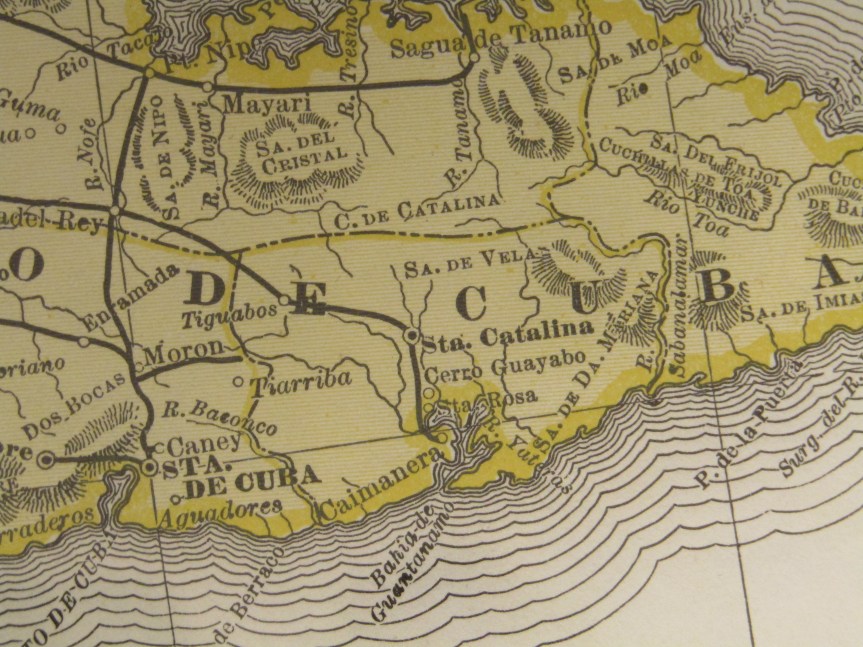
I happen to own an old map of Cuba from 1897 that shows Guantánamo Bay, which is along the southeastern coast of Cuba. Here’s a photo of a segment of my old map that shows the Bahia de Guantánamo:
Who could have predicted that when our government, in an imperial land grab, “leased” this base from Cuba in 1903, it would become a century later the site of a loathsome prison for Muslim men snatched mostly from central Asia in a “global war on terror”?
In the immediate aftermath of 9/11, the U.S. government needed a place to send prisoners gathered in the chaotic roundup of suspects in the war’s opening stages. Among other locations they chose the U.S. naval base at Guantánamo, considered a “safe” spot since it’s both isolated and not in the USA while also being far from the eyes of the media. What was an expedient, a temporary holding facility, became permanent. President Obama vowed to close it and failed; President Trump has vowed to expand it with fresh batches of prisoners.
In a remarkable piece at TomDispatch.com, Erin Thompson reminds us that the prisoners at Guantánamo are human beings. She did (and does) this by curating and displaying their art works. Their paintings, ship models, and other creations remind us that they exist, that they create, that they hope, that they dream. The U.S. government has responded by asserting ownership rights over their art.
America’s prison at Guantánamo Bay has been a spectacular fail. Its very existence amounts to a huge propaganda victory for terrorists and would-be terrorists everywhere. It’s a stain on our democracy (what’s left of it). In the eyes of much of the world, it reveals the USA itself to be a terrorist.
The persistence of this prison shows America is losing its own “war on terror.” Our government lacks the courage to try these men because of fear a few might go free and perhaps spearhead future attacks, despite a national security complex that spends roughly three quarters of a trillion dollars to predict and prevent such attacks.
To paraphrase Shakespeare in Julius Caesar: Cowards die a thousand deaths; a hero dies but once. By keeping this prison open, and by refusing to offer justice to its occupants out of fear of what they might do if released, we are dying a thousand deaths.
In a word, dishonesty. That’s the key reason why America keeps losing its wars of choice, whether in Iraq, Afghanistan, Libya, Syria, or elsewhere.
Dishonesty is nothing new, of course. Recall the lessons from the Pentagon Papers in the Vietnam War. U.S. leaders knew the war was lost, yet they lied to the American people about seeing lights at the end of tunnels. Recall the Iraq war and the “fixing” of intelligence to justify the invasion. Today the newspeak for Afghanistan is “corners,” as in we’ve turned yet another corner toward victory in that 16-year conflict, according to military testimony before Congress this week.
About those “corners,” here’s a concise summary from FP: Foreign Policy:
Afghanistan turning a corner. Again.Or still? After 16 years of war, the United States and its Afghan partners “have turned the corner,” and Kabul’s battered forces are “on a path to a win.” the top U.S. general there told reporters on Tuesday.
But FP’s Paul McLeary notes that we’ve heard this before. American generals have been seeing victory on the horizon since at least 2007, and “Gen. John Nicholson is at least the eighth top commander in the last decade to forecast a pathway to victory in a war that has dragged on nearly all century, and his optimistic forecasts contrast starkly with deteriorating Afghan government control and a resurgent Taliban.”
The military and our leaders can’t even level with us on the number of troops deployed in Syria. Consider this report today, courtesy of FP: Foreign Policy:
The Pentagon is good at a great many things, but they can do absolutely magical things with troop numbers. The U.S. Central Command announced this week that it was pulling 400 Marines out of Syria, where they had been providing artillery support for the Syrian Democratic Forces battling ISIS.
The number is remarkable given that the military continues to insist there are only 503 U.S. troops in Syria overall. And somehow, that 503 number has managed to remain exactly the same even after the Marines left. Recently, a general running U.S. special operations in Iraq and Syria said there were 4,000 U.S. troops in Syria. He quickly backtracked, saying the number was around 500 and holding steady, despite all actual physical evidence to the contrary.
Do we have 500 troops in Syria, or 2000, or 4000? Who are our generals trying to fool? Our rivals and enemies know how many troops we have in their regions and countries. Why can’t the American people have a full and honest accounting of what “our” troops are up to in places like Syria?
Whether from the Executive branch or from the military, the dishonesty keeps coming. This is exactly why we fail.
Why are we so persistent in our folly? For several reasons. Some people come to believe their own lies, their own happy talk. Careerism plays a role; so does politics. Money is a big concern, since there’s so much of it to be made in war. Some people even think it’s OK to lie if it’s for the “right” reason, i.e. better to project an image of dumb strength than one of pacific wisdom. America must never appear “weak”! For some, that means never quitting a war, no matter how foolish. Better to lie about “progress” than to admit problems that should lead to dramatic change.
Deception is at the heart of war, but we’re supposed to be deceiving the enemy, not ourselves. We’ve allowed public relations — driven by dishonesty — to rule our thinking and reporting on war. But, to paraphrase a saying of Richard Feynman with respect to the Space Shuttle Challenger disaster,
To wage a successful war, reality must take precedence over public relations, for the war gods cannot be fooled.
And to borrow from the penultimate sentence of his report (using the Pentagon in place of NASA): The Pentagon “owes it to the citizens from whom it asks support to be frank, honest, and informative, so that these citizens can make the wisest decisions for the use of their limited resources.”
Imagine if our leaders were frank, honest, and informative about our wars and their costs? But they prefer dishonesty instead — and that is why they (and we) fail.



 Bracing Views