Yes, the U.S. military is involved throughout the world. But even smart maps like this one neglect the one country truly conquered by that military: the USA
W.J. Astore
When the U.S. military boasts of “global reach, global power,” it’s not kidding. As Nick Turse notes in his latest article at TomDispatch.com, that military’s Special Operations forces deployed in one way or another to 149 countries in 2017, roughly 75% of countries on the globe. Talk about reach! Meanwhile, those forces have more than doubled since 2001, sitting at 70,000 effectives today, the equivalent to five divisions. (Consider it a military within the military.) All of this has come at tremendous cost, with this year’s defense budget sitting at $700 billion–and rising for the foreseeable future.
For all the bucks, what about the bang–what about results? Let’s just say that Iraq, Afghanistan, Libya, Yemen, Syria, Niger, and other U.S. military interventions haven’t gone well.
Yet there is one country where the U.S. military truly rules; one country which the U.S. military has truly conquered. Where and which? The USA, of course. No matter its losses and frustrations overseas, the U.S. military keeps winning more money and influence here at home. Congress loves it, presidents love it, our culture (mostly) loves it, or at least is urged to “support” it irrespective of results.
It’s not just the trillions of dollars it’s consumed since 9/11 or the extent to which retired generals rule the roost in Washington. Think about popular culture: our sports, our toys, our TV and movies. Kids dress up as soldiers on Halloween. Toys are of the “Call of Duty” variety. In TV shows like “SEAL Team,” Special Forces are all the rage. Hollywood has embraced them too, in movies like “Act of Valor” and the upcoming “12 Strong,” about a small team of American “horse soldiers” in Afghanistan soon after 9/11, riding to the rescue like so many John Waynes.
And one more item, a vitally important one, to consider: there is no talk of peace, anytime, anywhere, in the mainstream media, hence no talk of declining military budgets.
The military has conquered us. Indeed, global military action is a rare area of bipartisan accord in Washington, whether the commander-in-chief is Bush or Obama or Trump.
So, while it’s true the U.S. military is in an astonishing 149 countries, the one that really matters is the USA. It may lose in Afghanistan or Somalia, but it has won here — and that’s all that really matters to the further growth and vitality of America’s national security state.
If there’s one area of bipartisan agreement today, it’s politicians’ professed love of the U.S. military. Consider George W. Bush. He said the U.S. military is the greatest force for human liberation the world has ever known. Consider Barack Obama. He said that same military is the finest fighting force the world has ever known. Strong praise, indeed.
Today’s politicians are not to be outdone. This past weekend at Camp David, Paul Ryan praised the military for keeping America safe. Mike Pence noted the military remains “the strongest in the world,” yet paradoxically he said it needs rebuilding. He promised even more “investment” in the military so that it would become “even stronger still.”
Apparently, no matter how strong and superior the U.S. military is, it must be made yet stronger and yet more superior. All in an effort to “keep us safe,” to cite Paul Ryan’s words. Small wonder that the Pentagon’s budget is soaring above $700 billion.
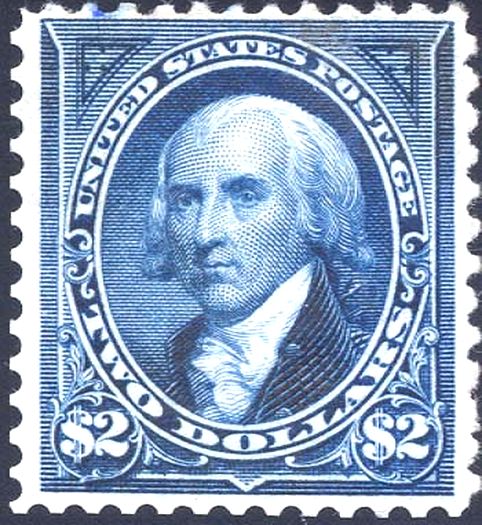
It didn’t use to be this way. President Dwight D. Eisenhower, formerly a five-star general and a man who knew the military intimately, warned us in 1961 of the anti-democratic nature of the military-industrial complex. James Madison, one of America’s founders, warned us in the 18th century of the perils of endless war and how armies drive authoritarian tendencies and contribute to financial debt and national ruin.
Ike knew that national safety shouldn’t be equated with military prowess; quite the reverse, as he warned us against the unchecked power of a burgeoning military-industrial-Congressional complex. Madison knew that armies weren’t “investments”; rather, they were, in historical terms, positive dangers to liberty.
But for America’s politicians today, the idea of national safety has become weaponized as well as militarized. In their minds personal liberty and national democracy, paradoxically, are best represented by an authoritarian and hierarchical military, one possessing vast power, whether measured by its resources across the globe or its reach within American society.
Our politicians find it easy to be uncritical cheerleaders of the U.S. military. They may even think they’re doing a service by issuing blank checks of support. But Ike and Madison would disagree, and so too would anyone with knowledge of the perils of military adulation.
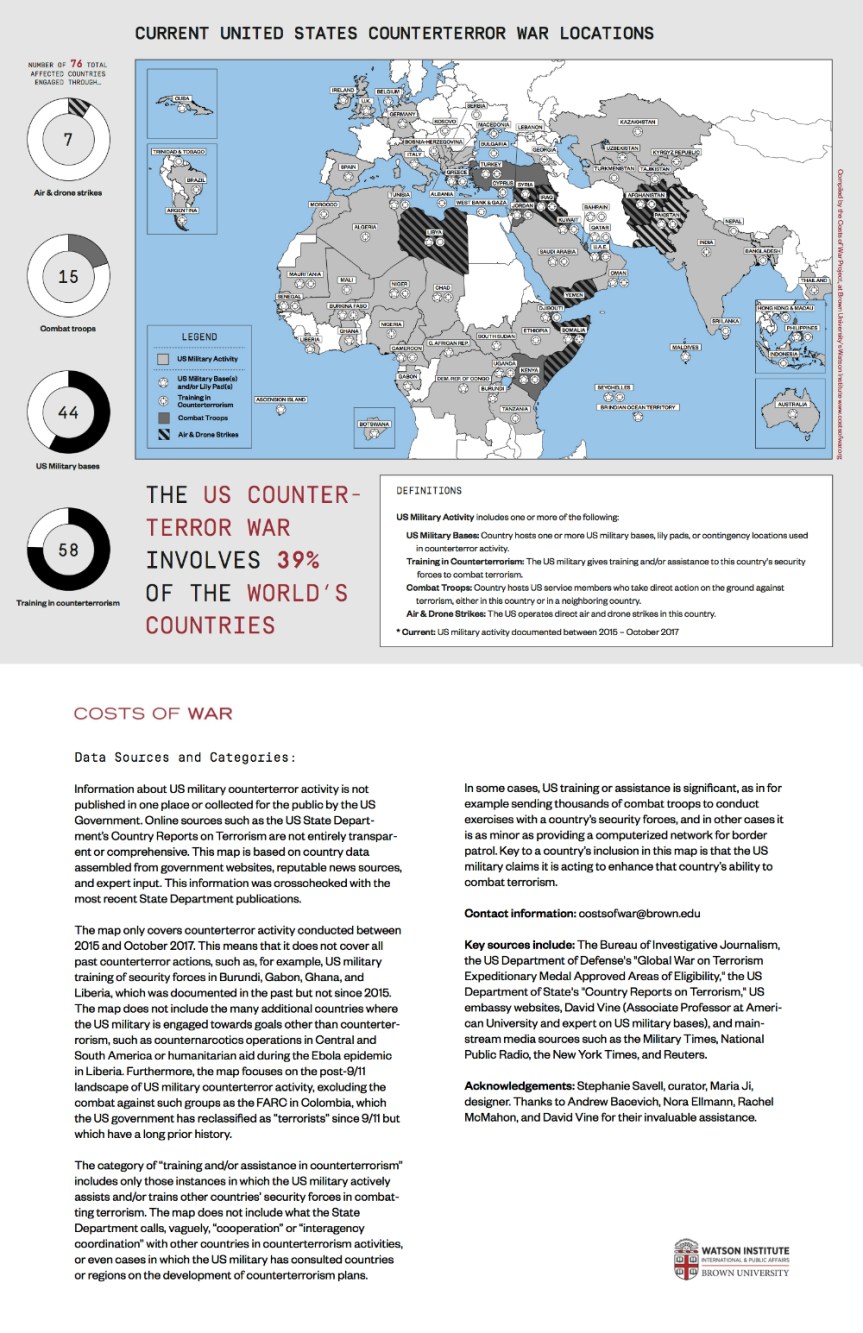
At TomDispatch.com, Tom Engelhardt has a revealing article on the truly global nature of America’s war on terror, accompanied by a unique map put together by the Costs of War Project at Brown University’s Watson Institute for International and Public Affairs. The map reveals that America’s war on terror has spread to 76 countries, as shown below:
This metastasizing of “counterterror” efforts is truly paradoxical: the more the U.S. military works to stop terror, the more terror spreads. “Progress” is measured only by the growth of efforts to stem terror networks in more and more countries. But the notion of “progress” is absurd: That 76 countries are involved in some way in this war on terror is a sign of regress, not progress. After 16 years and a few trillion dollars, you’d think terror networks and efforts to eradicate them would be decreasing, not increasing. But the war on terror has become its own cancer, or, in social-media-speak, it’s gone viral, infecting more and more regions.
A metaphor I like to use is from Charles Darwin. Consider the face of nature — or of terrorism — as a series of tightly interlinked wedges. Now, consider the U.S. military and its kinetic strikes (as well as weapons sales and military assistance) as hammer blows. Those hammer blows disturb and contort the face of nature, fracturing it in unpredictable ways, propagating faults and creating conditions for further disturbances.
By hammering away at the complex ecologies of regions, the U.S. is feeding and complicating terrorism with its own violence. Yet new fracture lines are cited as evidence of the further growth of terrorism, thus necessitating more hammer blows (and yet more military spending). And the cycle of violence repeats as well as grows.
A sensible approach: Stop hammering away with missiles and bombs and drones. Stop feeding the terrorist wolf with more blood and violence.
But the U.S. government is caught up in a seemingly endless cycle of violence and war, as Engelhardt notes here:
Let me repeat this mantra: once, almost seventeen years ago, there was one [country, Afghanistan, the U.S. targeted]; now, the count is 76 and rising. Meanwhile, great cities have been turned into rubble; tens of millions of human beings have been displaced from their homes; refugees by the millions continue to cross borders, unsettling ever more lands; terror groups have become brand names across significant parts of the planet; and our American world continues to be militarized.
This should be thought of as an entirely new kind of perpetual global war. So take one more look at that map. Click on it and then enlarge it to consider the map in full-screen mode. It’s important to try to imagine what’s been happening visually, since we’re facing a new kind of disaster, a planetary militarization of a sort we’ve never truly seen before. No matter the “successes” in Washington’s war, ranging from that invasion of Afghanistan in 2001 to the taking of Baghdad in 2003 to the recent destruction of the Islamic State’s “caliphate” in Syria and Iraq (or most of it anyway, since at this moment American planes are still dropping bombs and firing missiles in parts of Syria), the conflicts only seem to morph and tumble on.
A new kind of perpetual global war: Engelhardt nails it. To end it, we need to stop feeding it. But as the map above indicates, it seems likely that U.S. hammer blows will continue and even accelerate, with results as violently unpredictable as they are counterproductive.
Here’s a New Year’s resolution: How about ending America’s quagmire wars?
There are many reasons why Afghanistan, Iraq, and similar countries will always be quagmires for the U.S. military. U.S. troops have difficulty identifying friend from foe, and indeed “friendly” troops and police sometimes turn on their U.S. counterparts. U.S. troops will always be a foreign presence, heavily armed and invasive, often (mis)guided by incomplete or misleading intelligence. Almost inevitably, they are seen as backing corrupt and kleptocratic governments, whether in Kabul or Baghdad. At the same time, U.S. bombing and search and destroy missions kill innocents even as they generate refugees—and new enemies. Under such violent and tumultuous conditions, you can forget about winning hearts and minds or creating lasting political stability.
Facing this no-win scenario, savvy U.S. leaders would pull troops out immediately, but of course pulling out is never an option. Whether it’s Bush or Obama or Trump, the preferred “solution” to unwinnable quagmires is to “surge” (more troops, more airpower, more “advisers,” more weaponry) or to dither with tactics. Old theories are trotted out, such as pacification and counterinsurgency and nation-building, dressed up with new terms and acronyms such as asymmetrical warfare, the gray zone, MOOTW (military operations other than war), and VEOs, or violent extremist organizations, known to most people as terrorists.
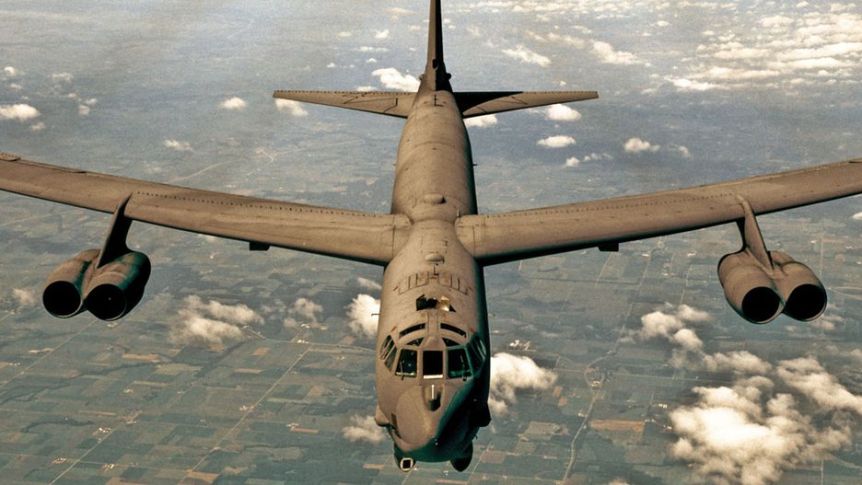
The mentality among America’s generals is that the war must go on. There must be a can-do way to defeat VEOs in the grey zone using asymmetrical warfare while engaged in MOOTW. Thus B-52s, those venerable strategic bombers from the early Cold War era, are now being used in Afghanistan to “asymmetrically” destroy drug laboratories associated with Taliban funding, yet another instance of the U.S. military swinging a sledgehammer to kill a gnat.
After 16 years, if you’re calling in B-52s to flatten small drug labs, this is not a sign of impending victory. It’s a sign of desperation — a sign of a totally bankrupt strategy.
The same is true of the use of MOAB in 2017. It’s not a sign of strength to use such blockbuster bombs on an undeveloped country like Afghanistan. It’s a sign of desperation. Of having no coherent strategy. Of throwing munitions at the wall and seeing which one makes the biggest boom.
Of course, a key aspect of this is domestic politics. The target of B-52s and MOABs isn’t always the Taliban and similar VEOs. It’s American public opinion. For Trump, it’s like, “See? We used MOAB. We’re using B-52s. Obama didn’t do this. We’re tougher–better–stronger. We’re taking the gloves off.”
When America’s military is not taking metaphorical gloves off, it’s learning to eat soup with a knife. That’s the title of Lieutenant Colonel John Nagl’s book on counterinsurgency, abbreviated as COIN in military circles. A decade ago, Nagl worked with General David Petraeus to rewrite the book on COIN, which enjoyed a brief renaissance during the Iraq and Afghan surges. But COIN methods (the idea of killing or otherwise neutralizing guerrillas/terrorists/VEOs while winning the hearts and minds of the people) haven’t worked to clean up American-made messes in those countries, a result contained within the metaphor. For if you really want to eat soup, best to put away military knives, pick up the soup bowl, and slurp away.
But America’s warfighters, with their affinity for knives, persist in efforts to develop new and “better” ones (spoons are for wimps!) as they flail away in various soup bowls (or, if you prefer, Petri dishes, which was General John Nicholson’s, the U.S. commander in Afghanistan, “bowl” of choice to describe the Af-Pak region in his testimony to Congress in 2017).
To use a different soup metaphor, too many cooks spoil the broth. The U.S. military’s interventions—its various and varying recipes for success, the ingredients of which are almost exclusively violent—never add up to a palatable product.
William S. Smith put it well in a recent article for The American Conservative. American military interventions, Smith notes, driven in large part by COIN theory, mostly ignore local history, religion, and culture. The resulting quagmire, according to Smith, is predictable:
The fact is that all political order at all times and everywhere emerges from an extremely complex set of unique symbols, practices, and beliefs that are rooted in history, culture, and religion. Political order does not merely flow from safety and the protection of property but out of a cultural inheritance that provides citizens with a sense that their society embodies something larger than themselves. To them, the symbols and traditions of their society reflect a certain divine order. An invading army from a foreign civilization will always be seen as a threat to that order whether citizens embrace violence or not. Without a major revolution in culture an occupying army will be in no position to generate more than a skin-deep and transitory political reconciliation. (Emphasis added)
Call it COINfusion followed by defeat. The U.S. military tried the “occupying army” part of this with its various surges in Iraq and Afghanistan, and the political results were as Smith says: skin-deep and transitory. The “new” American approach seems to be a variation of Richard Nixon’s Vietnamization policy of turning the fight over to the “indigenous” peoples, whether Afghans, Iraqis, etc. while continuing to bomb, to supply weaponry, and to provide training and “advice” with U.S. boots on the ground. Such an approach is sold to the American people as staying the course to victory, with the exact terms of “victory” left undefined.
But what price “victory”, even an illusory one? A staggering one. By the end of fiscal year 2018, America’s post-9/11 wars will have cost the taxpayers nearly $5.6 trillion, notes the “Cost of Wars” project at Brown University. With U.S. generals speaking of “generational” wars, this enormous burden will only continue to grow in the future—unless we wise up.
So my New Year’s resolution for 2018 is simple. End quagmire wars. Bring the troops home. After all, what’s wrong with saving blood and treasure?
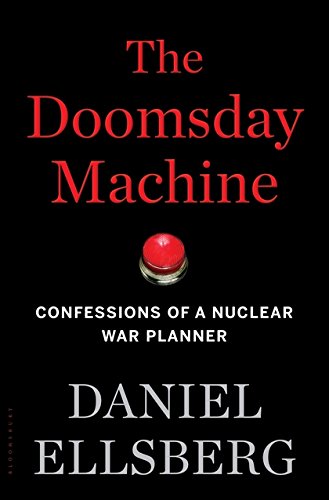
I just finished Daniel Ellsberg’s new book, The Doomsday Machine: Confessions of a Nuclear War Planner. Talk about hair-raising! Ellsberg, of course, is famous for leaking the Pentagon papers, which helped to end the Vietnam war and the presidency of Richard Nixon as well. But before Ellsberg worked as a senior adviser on the Vietnam war, he helped to formulate U.S. nuclear policy in the late 1950s and early 1960s. His book is a shattering portrayal of the genocidal nature of U.S. nuclear planning during the Cold War — and that threat of worldwide genocide (or omnicide, a word Ellsberg uses to describe the death of nearly everything from a nuclear exchange that would generate disastrous cooling due to nuclear winter) persists to this day.
Rather than writing a traditional book review, I want to list some memorable facts and lessons I took from the book, lessons that should lead us to question the very sanity of America’s leaders. To wit:
U.S. nuclear war plans circa 1960 envisioned a simultaneous attack on the USSR and China that would generate 600 million deaths after six months. As Ellsberg notes, that is 100 Holocausts. This plan was to be used even if China hadn’t directly attacked the U.S., i.e. the USSR and China were lumped together as communist bad guys who had to be eliminated together in a general nuclear war. Only one U.S. general present at the briefing objected to this idea: David M. Shoup, a Marine general and Medal of Honor winner, who also later objected to the Vietnam War.
The U.S. military consistently overestimated the Soviet nuclear threat, envisioning missile and bomber gaps that didn’t exist. In the nuclear arms race, the U.S. was often racing itself in the fielding of more and more nuclear weapons.
General Curtis LeMay, the famous commander of Strategic Air Command (SAC) and later AF Chief of Staff, said that once war started, politicians like the president had no role to play in decision-making.
When the atomic bomb was first tested in 1945, there were fears among the scientists involved that the atmosphere could be ignited, ending all life on earth. The chance was considered remote (perhaps 3 in a million), so the scientists pressed ahead.
The Cuban Missile Crisis of 1962 came much closer to nuclear war than most people recognize. Soviet submarines in the area, attacked by mock U.S. depth charges, were prepared to launch nuclear torpedoes against U.S. ships. Fidel Castro’s air defenses were also preparing to shoot down American planes, which may have ended in U.S. air attacks and an invasion in which Soviet troops on Cuba may have used nuclear weapons to defend themselves.
The U.S. military was (and probably still is) extremely reluctant to reveal nuclear secrets to senior American civilian leaders, including even the President himself. Ellsberg, possessing the highest security clearances and acting with presidential authority, had to pry answers from military officers who refused to provide detailed and complete information.
The U.S. has always refused, and continues to refuse, to pledge to a “no first use” policy for nuclear weapons.
The U.S. remains the only country to have used nuclear weapons (Hiroshima and Nagasaki). Yet, as Ellsberg notes, the U.S. uses nuclear weapons all the time — by threatening their use, as President Eisenhower did during the Korean War, as President Nixon did during the Vietnam War, and as President Trump is doing today, promising “fire and fury” against North Korea. The U.S. uses nuclear weapons like a loaded gun — holding it to an enemy’s head and threatening to pull the trigger, Ellsberg notes. In short, there’s nothing exceptional about Trump and his nuclear threats. All U.S. presidents have refused to take nuclear attacks “off the table” of options for U.S. action.
Interservice rivalry has always been a driver of U.S. nuclear force structure and strategy. The Navy (with its nuclear submarine programs, Polaris followed by Trident) and especially the Air Force (with its ICBMs and bombers) jealously guard their nuclear forces and the prestige/power/budgetary authority they convey.
President Eisenhower’s emphasis on massive retaliation (as represented by SAC and its war plan, the SIOP) was a way for him to limit the power of the military-industrial complex (MIC). But once Ike was gone, so too was the idea of using the nuclear deterrent as a way of restricting U.S. expenditures on conventional weaponry and U.S. adventurism in foreign wars, e.g. Vietnam. (It should be said that Ike’s exercise at limiting the MIC in America held the world as a nuclear hostage.)
Ellsberg shows convincingly that control over U.S. nuclear weapons was decentralized and delegated to much lower levels than most Americans know. It’s not the case that only the president can launch a nuclear war. Especially in the late 1950s and early 1960s, Ellsberg shows how it was possible that field-grade officers (majors and colonels) could have made decisions in the heat of battle to release nuclear weapons without direct orders from the president.
Most Americans, Ellsberg notes, still don’t understand the huge quantitative and qualitative differences between atomic bombs and hydrogen (thermonuclear) weapons. Hydrogen bombs are measured in megatons in equivalent TNT yield; atomic bombs are in kilotons. In short, hydrogen bombs are a thousand times more destructive than atomic ones. And this is just their explosive yield. Radioactive fallout and massive fires are even bigger threats to life on earth.
Most Americans still don’t understand that even a smallish nuclear exchange involving a few dozen hydrogen bombs could very well lead to nuclear winter and the deaths of billions of people on the earth (due to the widespread death of crops and resulting famine and disease).
Despite the genocidal threat of nuclear weapons, the U.S. is persisting in plans to modernize its arsenal over the next 30 years at a cost of $1 trillion.
Ellsberg sees this all as a form of collective madness, and it’s hard to disagree. He quotes Nietzsche to the effect that madness in individuals is rare, but that it’s common among bureaucracies and nations. The tremendous overkill inherent to U.S. nuclear weapons — its threat of worldwide destruction — is truly a form of madness. For how do you protect a nation or uphold its ideals by launching a nuclear war that would kill nearly everyone on earth? How does that make any sense? How is that not mad?
Ellsberg ends his “confessions” with many sane proposals for downsizing nuclear arsenals across the world. But is anyone in power listening? Certainly not U.S. presidents like Trump or Obama, who both signed on to that trillion dollar modernization program for U.S. nuclear weapons.
Ellsberg shows us there have been many chair-bound paper-pushers in the U.S. government who’ve drawn up plans to murder hundreds of millions of people — to unleash doomsday — all in the name of protecting America. He also shows how close they’ve come to doing just that, especially during the Cuban Missile Crisis, but during other crises as well.
Nuclear brinksmanship, threats of nuclear war, and similar uses of nuclear weapons to intimidate hold the potential for catastrophe. Miscalculations, mishaps, mistakes, are more than possible in an atmosphere of mistrust, when words and actions can be misinterpreted.
Ellsberg’s recommendations for changes point the way to a better world, a world where the threat of nuclear doomsday could be much reduced, perhaps eliminated completely. The question remains: Is anyone in power listening?
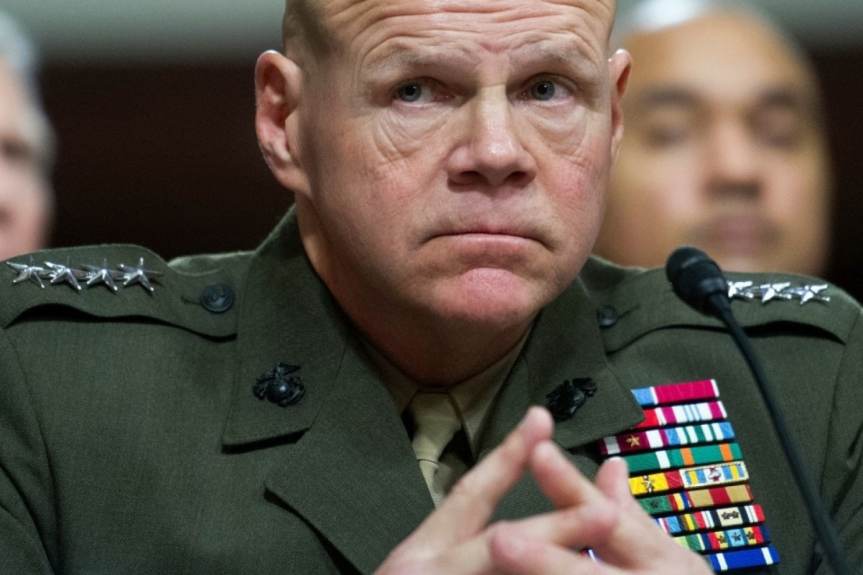
General Robert Neller, the Commandant of the Marine Corps, is in the news since he told Marines to get ready for a big fight. This doesn’t really alarm me. A military exists to be ready to fight, and the Marines place a premium on combat readiness. No — what bothers me is the nine rows of ribbons General Neller is sporting on his uniform.
He may need a bigger chest for all those ribbons
And compared to the other services (Army, Navy, and Air Force), the Marines are usually the most reluctant to hand out ribbons freely.
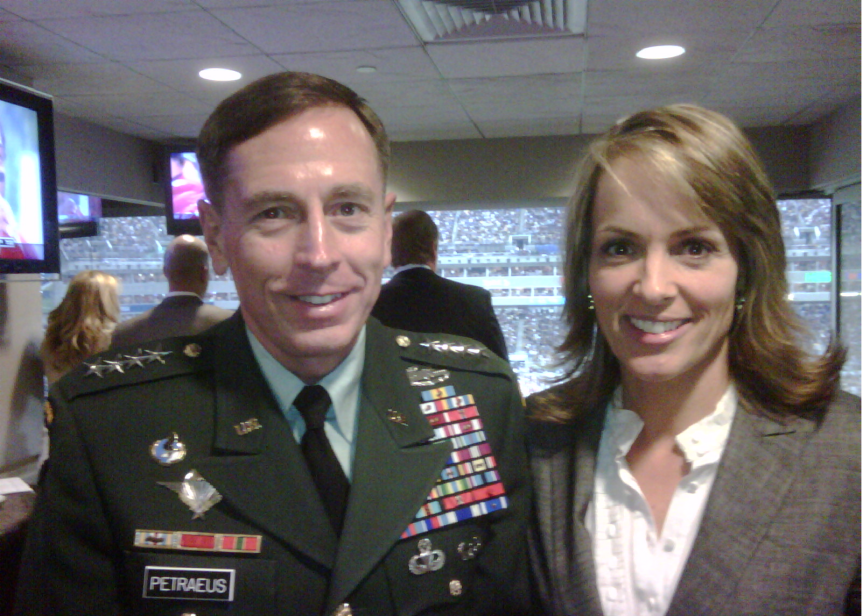
I wrote about this back in 2007: why medals and metrics in the U.S. military mislead. A big offender back then was General David Petraeus, whose uniform was festooned with ribbons and badges of all kinds, most of them of the “been there” rather than “done that” variety.
Petraeus: 10 rows of ribbons, plus a bonus row
When I was an LT in the Air Force, circa 1987, I took part in a random survey in which I was asked, “What one change would you make to military practices,” or some such question. My answer was to get rid of all the “everyman” ribbons, the meaningless awards and medals that made a sergeant’s or captain’s uniform in 1987 look like that of General George Patton’s in 1945.
You can see how much my recommendation made a great impact on today’s military!
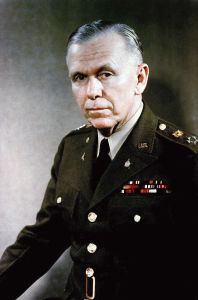
How did General Marshall win World War II with so few ribbons?
Seriously, though, our military is suffering from rampant grade inflation. We are giving ourselves far too many trophies. When even the Marines fall prey to ribbon and medal proliferation, it’s not a good sign for future combat effectiveness.
Military uniforms should not look like overdecorated Christmas trees.
VP Pence, in his military flight jacket, posing for selfies with the troops
W.J. Astore
Vice President Mike Pence made a surprise visit to Bagram air base in Afghanistan, reassuring the assembled troops that they are winning the war there, despite evidence to the contrary. For the occasion he donned a spiffy-looking leather military flight jacket, customized for him, as have other presidents and VPs going back at least as far as Ronald Reagan.
I’ve written about this before, this adoption of military clothing by civilian commanders. It’s an insidious blurring of the lines between the civilian chain of command — and the crucial idea of civilian control of the military — and the military chain. You don’t see generals and admirals on active duty showing up to testify before Congress in civilian coat and tie: they wear their uniforms because that’s who they are–commissioned military officers. Similarly, our civilian leaders, whether Ronald Reagan or Barack Obama or Donald Trump, should wear their “uniform,” typically civilian coat and tie, for that is who they are. They should never wear military flight jackets and similar items, no matter how “cool” or “supportive” they think they look. It sends the wrong sartorial and political signals.
I just can’t imagine Dwight D. Eisenhower, who was of course a five-star general before he became president, wearing military jackets and hats while he was president. Ike knew better. He was the civilian commander in chief, thus he dressed like it. Same with George C. Marshall. He wasn’t parading around in military jackets when he was Secretary of State in the aftermath of World War II.
Hitting another common theme, Pence was at pains to praise the troops as heroes, noting that “You are the best of us.” Why this need for endless flattery of the troops? Recall that President Obama praised the U.S. military as the finest fighting force in history. Satirically, you might call it the 4F military: the finest fighting force since forever.
America’s civilian leaders need to put aside hyperbolic praise and wannabe military uniform items. There’s a far better way of complimenting our troops while leading America. That better way? Ending America’s wars and bringing the troops home.
The business of America is weapons sales. That much is true when you consider the following snippet today from FP: Foreign Policy:
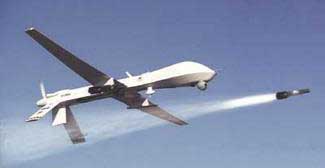
Drone sales. The United States is looking to make changes to a major international arms control treaty that would open the door for wider exports of military drones, Defense Newsreports. The proposed change to the Missile Technology Control Regime would make it easier for nations to sell drones.
Proliferation of drones: What could go wrong?
America is the world’s leader in drone technology, and the companies that have developed them see even bigger profits on the horizon if they can sell them to America’s allies around the globe. The nature of drones is that they make killing easier — usually bloodless — for those countries that possess the technology. They promise results, but the American use of drones in places like Iraq and Afghanistan has not led to any resolution of those conflicts. Only the body count has increased.
A famous utterance attributed to General Robert E. Lee during the U.S. Civil War is, “It is well that war is so terrible – lest we should grow too fond of it.” His words capture the idea that war is an elemental thing – and also a seductive one. Much like a storm-tossed ocean, war is relentless, implacable, and unsparing. It is chaotic, arbitrary, and deadly. It is not to be bargained with; only to be endured.
Given its ferocity, its rapacity, the enormity of its waste and devastation, war is best to be avoided, especially since war itself has its appeals, especially since war itself can be intoxicating, as the quotation from Lee suggests, and as the title of Anthony Loyd’s fine book on the war in Bosnia, My War Gone By, I Miss It So (1999), indicates.
What happens when we decouple war’s terrible nature from its intoxicating force? What happens when one side can kill with impunity in complete safety? Lee’s words suggest that a nation that decouples war from its terrors will likely grow too fond of it. The temptation to use deadly force will no longer be restrained by knowledge of the horrors unleashed by the same.
Such thoughts darken the reality of America’s growing fondness for drone warfare. Our land-based drone pilots patrol the skies of foreign lands like Afghanistan in complete safety. They unleash appropriately named Hellfire missiles to smite our enemies. The pilots see a video feed of the carnage they inflict; the American people see and experience nothing. In rare cases when ordinary Americans see drone footage on television, what they witness is something akin to a “Call of Duty” video game combined with a snuff film. War porn, if you will.
Many Americans seem happy that we can smite foreign “militants” at no risk to ourselves. They trust that our military (and the CIA) rarely misidentifies a terrorist, and that “collateral damage,” that mind-numbing euphemism that obscures the reality of innocent men, women, and children obliterated by missiles, is the regrettable price of keeping America safe.
But the reality is that sloppy intelligence and the fog and friction of war combine to make seemingly antiseptic drone warfare much like all other forms of war: bloody, wasteful, and terrible. Terrible, that is, for those on the receiving end of American firepower. Not terrible for us.
There is a real danger that today’s drone warfare has become the equivalent to the Dark Side of the Force as described by Yoda in The Empire Strikes Back: a quicker, easier, more seductive form of terror. It is indeed seductive to deploy the technological equivalent of Darth Vader’s throat-constricting powers at a safe distance. We may even applaud ourselves for our prowess while doing so. We tell ourselves that we are killing only the bad people, and that the few innocents caught in the crosshairs constitute an accidental but nonetheless unavoidable price of keeping America safe.
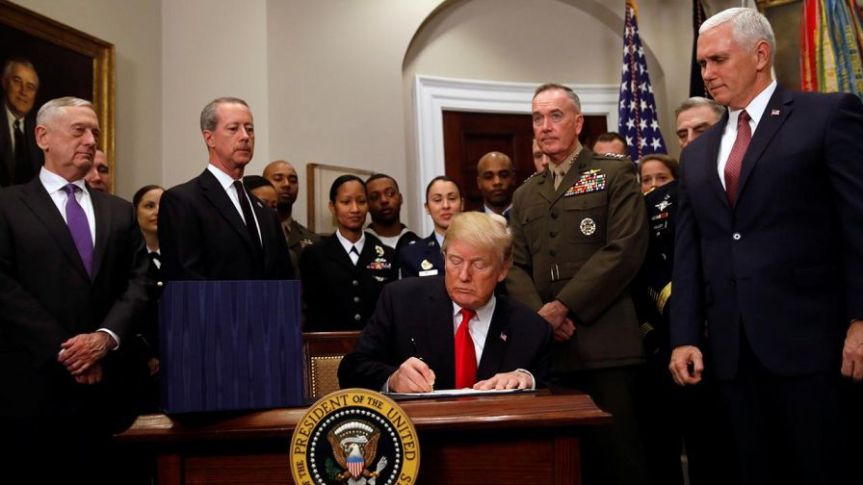
Trump, surrounded by the military, vows to give it more (and more!) money
W.J. Astore
Today at 2PM, the Trump administration releases its National Security Strategy. It’s already making news because Trump is dropping climate change (added by the Obama administration) as a threat. Instead, Trump is placing new emphasis on economic competitiveness and border security (“Build the wall!”), which are two corporate-friendly policies (read: boondoggles).
I’d like to cite two threats that Trump won’t mention in his national security strategy. These two threats are perhaps the biggest ones America faces, and they are related. The first is threat inflation, and the second is the U.S. military itself, as in Dwight D. Eisenhower’s military-industrial-Congressional complex.
Threat inflation is a huge problem in America. The threat of terrorism is vastly inflated, as is the threat from North Korea. If we wanted to focus on what threatens Americans, we’d be redoubling efforts to help those with opioid addictions even as we work to cut deaths by guns and in road accidents. Roughly 120,000 Americans are dying each year from opioid overdoses, road accidents, and shootings. How many are dying from terrorism or from attacks by North Korea?
North Korea is a weak regional power led by an immature dictator who is desperate to keep his grip on power. Kim Jong-un knows that any use of nuclear weapons by North Korea would end in his death and the annihilation of his country. He also knows that nuclear weapons serve as a deterrent and a symbol of prestige domestically and internationally. Does he need to be deterred? Yes. Should Americans cower in fear? Of course not.
Cyberwar is certainly a threat–just look at Russian meddling in our last presidential election. China and Russia are nuclear powers and rivals that bear close watching, but they are not enemies. Indeed, since the end of the Cold War the United States hasn’t faced serious peer enemies. We should have been cashing in our “peace dividends” for the last 25 years. Why haven’t we?
Enter the military-industrial-Congressional complex. Ike warned us about it in 1961. He warned about its misplaced power, its persistence, and its anti-democratic nature. Ike, a retired five-star general who led the allied armies on the Western Front in World War II against the Nazis, knew of what he spoke. He knew the Complex exaggerated threats, such as missile or bomber “gaps” (which didn’t exist) vis-a-vis the Soviet Union. Ike knew the military, its corporate feeders and enablers, and Congress always wanted one thing: more. He did his best to control the military, but once he left office, it was the Complex that took control, leading America into a disastrous war in Vietnam, the first of many “wars of choice” that ended in American defeats, but which proved highly profitable to the Complex itself.
Those endless wars that feed the Complex persist today. Elements of the U.S. military are deployed to 149 countries and 800 foreign bases at a budgetary cost of $700 billion (that’s just for the “defense” budget). Spending so much money on the military represents a tremendous opportunity cost–for that money, Americans could have free health care and college tuition, but who wants good health and a sound education, right?
Ike recognized the opportunity cost of “defense” spending in 1953 in this famous speech:
Every gun that is made, every warship launched, every rocket fired signifies, in the final sense, a theft from those who hunger and are not fed, those who are cold and are not clothed.
This world in arms is not spending money alone. It is spending the sweat of its laborers, the genius of its scientists, the hopes of its children. The cost of one modern heavy bomber is this: a modern brick school in more than 30 cities. It is two electric power plants, each serving a town of 60,000 population. It is two fine, fully equipped hospitals. It is some fifty miles of concrete pavement. We pay for a single fighter with a half-million bushels of wheat. We pay for a single destroyer with new homes that could have housed more than 8,000 people. . . . This is not a way of life at all, in any true sense. Under the cloud of threatening war, it is humanity hanging from a cross of iron.
What Ike said. The point is not that Ike was a perfect man (look at the Iran coup, also in 1953), but he sure as hell was a sound and at times a penetrating thinker, a mature man who knew the awful burdens of war.
And now we have Trump, the opposite of Ike, an unsound and shallow thinker, an immature man who knows nothing of the awfulness of war. Add Trump himself–his immaturity, his bellicosity, his ignorance, and his denial of reality–as a threat to our national security.
So, a quick summary of three big threats that won’t make Trump’s “strategy” today:
Threat inflation: terrorism, North Korea, Iran, etc.
The Complex itself and its profligate, prodigal, and anti-democratic nature.
Trump.
And add back one more: climate change/global warming. Because flooding, fires, droughts, famines, etc., exacerbated by global warming, are already creating security challenges, which will only grow worse over the next half-century. Denying that reality, or calling it “fake news,” won’t change Mother Nature; she has her own implacable ways,
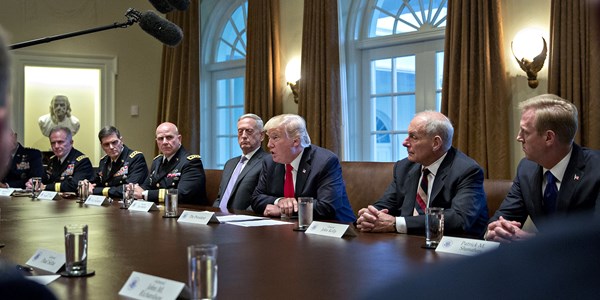
An article yesterday at NBC focusing on Trump and “his” generals got me to thinking on this subject again. Its author, Suzanne Garment, suggests that Trump likes generals as obedient alpha males. They lend him credibility without directly threatening his delicate ego. And there’s truth in this.
Trump and his generals. Mattis and Kelly flanking Trump. From the NBC article.
But I want to focus on other reasons for Trump’s preference for generals in high positions. A year ago, I wrote an article for TomDispatch.com on “All the President’s Generals.” That article focused mainly on the potential impact of these generals on America’s foreign policy and domestic culture. As I wrote last December:
Collectively, the team of Mattis, Flynn, and Kelly could not be more symbolic of the ongoing process of subversion of civilian control of the military. With Trump holding their reins, these self-styled warriors will soon take charge of the highest civilian positions overseeing the military of the world’s sole superpower. Don’t think of this, however, as a “Seven Days in May” scenario in which a hard-headed general mounts a coup against an allegedly soft-hearted president. It’s far worse. Who needs a coup when generals are essentially to be given free rein by a president-elect who fancies himself a military expert because, as a teenager, he spent a few years at a military-themed boarding school?
In all of this, Trump represents just the next (giant) step in an ongoing process. His warrior-steeds, his “dream team” of generals, highlight America’s striking twenty-first-century embrace of militarism.
I continue to think this is true. Trump is empowering further military adventurism, even as he reinforces military-style solutions to problems. But there are other reasons for Trump’s tight and eager embrace of the military.
Basically, by embracing the military and elevating it (while feeding it lots of money), Trump has neutralized it as a rival to his power. Indeed, he is borrowing from the military’s authority and standing within our culture to bolster his own.
Recall how Candidate Trump was often quite critical of the U.S. military. He knew more than the generals, he said. Their wars he often called wasteful follies. He was going to win (or end) these wars, he claimed, and hinted that quite a few “loser” generals might be on the receiving end of his infamous “You’re fired” line.
You hear none of this today. Trump is at pains to praise the military and his generals. He says they’re on a winning path, even in Afghanistan (because of Trump’s decisions, naturally). He rewards them with record budgets and unalloyed praise.
And it’s working. The military (and the larger national security state) is content with Trump. He’s letting them have their way, which is another way of saying Trump is having his way.
In American society today, there aren’t too many power centers that truly can challenge Trump. The media he’s diminished with all his attacks (“Fake news!”). A Republican Congress remains quietly subservient. Trump is stacking the judiciary with conservative judges to his liking. The Democratic Party remains feckless and divided. Bankers and corporations? Trump has hired the former and given a huge gift to the latter in the latest Republican tax cut for the richest.
When you think about it, the one power center that could challenge Trump is the military-industrial complex: America’s fourth branch of government. Yet by hiring so many of its generals and by praising it while passing loads of moola its way, Trump has co-opted its authority and power, attaching it to himself in his role as commander-in-chief.
Trump’s last hurdle may be the Robert Mueller investigation into Russian meddling and possible complicity or obstruction by Trump. If Trump gets past this (perhaps even by firing Mueller), is there anyone left with the balls, the sand, the spine, the guts, the moxie (choose your favorite measure of fortitude) and the authority to stop his ambition and designs as an authoritarian leader?



 Bracing Views