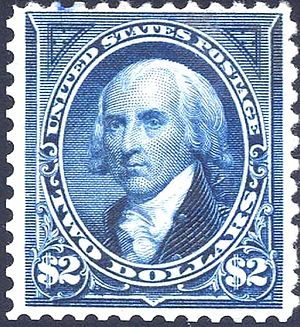
James Madison knew that endless war is the harshest enemy of liberty
W.J. Astore
Democracies should be slow to start wars and quick to end them. James Madison taught us that. Why is America today the very opposite of this?
I thought of this as I read Danny Sjursen’s fine article at TomDispatch.com. Sjursen, a retired Army major, is a strong critic of America’s forever wars. He served in Iraq and Afghanistan and lost soldiers under his command. He knows the bitter cost of war and expresses it well in his article, which I encourage you to read. Here’s an excerpt:
Recently, my mother asked me what I thought my former students [West Point cadets] were now doing or would be doing after graduation. I was taken aback and didn’t quite know how to answer.
Wasting their time and their lives was, I suppose, what I wanted to say. But a more serious analysis, based on a survey of U.S. Army missions in 2019 and bolstered by my communications with peers still in the service, leaves me with an even more disturbing answer. A new generation of West Point educated officers, graduating a decade and a half after me, faces potential tours of duty in… hmm, Afghanistan, Iraq, or other countries involved in the never-ending American war on terror, missions that will not make this country any safer or lead to “victory” of any sort, no matter how defined.
Repetition. Endless repetition. That is the theme of America’s wars today.
Remember the movie “Groundhog Day,” with Bill Murray? Murray’s character repeats the same day, over and over again. He’s stuck in an infinite loop from which he can’t escape. Much like America’s wars today, with one exception: Murray’s character actually learns some humility from the repetition. He shows a capacity for growth and change. And that’s how he escapes his loop. He changes. He grows. The U.S. military’s leadership? Not so much.
But I don’t just blame the senior leaders of the U.S. military. They’re not that dumb. It’s the system of greed-war they and we inhabit. Why change endless war when certain powerful forces are endlessly profiting from it? War, after all, is a racket, as General Smedley Butler knew. It’s a racket that’s contrary to democracy; one that buttresses authoritarianism and even kleptocracy, since you can justify all kinds of theft in the cause of “keeping us safe” and “supporting our troops.”
Danny Sjursen, a true citizen-soldier, remembers that war is supposed to be waged in accordance with the Constitution and only to protect our country against enemies. But being a citizen-soldier has gone out of style in today’s military. Everyone is supposed to identify as a warrior/warfighter, which has the added benefit of suppressing thought about why we fight.
Eager to fight, slow to think, might be the new motto of America’s military. Such a motto, consistent with forever war, is inconsistent with democracy.
Inspired by three recent articles at TomDispatch.com, I’d like to suggest why America’s wars never end.
The first article marking the 30th anniversary of the fall of the Berlin Wall is by James Carroll. It brought me back to when I was a young Air Force captain on active duty. All of us in the military were surprised when the wall came down. Soon the Soviet Union would collapse as well. I know because I got a certificate signed by President G.H.W. Bush congratulating us for winning the Cold War.
In the early 1990s there was much talk about a New World Order (largely undefined) and a Peace Dividend. The “new” world order quickly became global military adventurism for the U.S. and the peace dividend withered as Desert Shield/Storm and other operations commenced.
I recall some personnel cuts, but no real cuts in weaponry. And no change to strategy. NATO remained even though the Warsaw Pact had dissolved. Indeed, NATO would soon be expanded (in the cause of peace, naturally), even as U.S. imperial ambitions grew. It was the “end of history” and the U.S. had triumphed, or so we thought.
But why had we triumphed? Apparently the lesson our leaders took from it was that military strength was the key to our triumph, therefore more of the same would lead to new triumphs. Pax Americana was not about democracy or freedom: it was about weapons and wars. Peace through military strength (and destruction) was the driving philosophy.
Unbounded ambition and unbridled power – that was the new world order for America. The wall came down in Berlin, but it didn’t come down in our minds. Instead of an open society, Fortress America became the norm.
The second article is by Allegra Harpootlian and focuses on the “collateral damage” (murdered innocents) of America’s global bombing and drone campaigns. It made me think of a conversation I had with a student; he’d been in the U.S. Army and fought in Afghanistan. Basically, he described it as a dirt-poor country with a primitiveness that seemed Biblical to him. He got me thinking about how we “see” people like the Iraqis and Afghans as less than us. Different. Inferior. Primitive. From another time, and from another place.
So, when Americans kill civilians in those places, it’s almost like it’s cinematic, not real, “a long time ago, in a galaxy far, far away.” We just move on.
Of course, Americans are not encouraged to be empathetic people. The world is supposed to revolve around us. “You can have it all.” In a world of selfies, why care about others? Look out for #1!
To put a bow on this, consider evangelical Christianity and the prosperity gospel. (The idea God will reward you with material goods and money as a sign of righteousness.) Remember when charity to others was valued? Not anymore.
Another way of putting this: In America there’s a huge market for self-help books, videos, etc. But where are the books and videos encouraging us to help others?
The third article is by Andrew Bacevich and specifically addresses the never-ending nature of America’s wars. His piece made me think of Congresswoman Tulsi Gabbard, who as a presidential candidate has called for an end to regime-change wars (though not the war on terror). For her pains, she’s been accused of being a Russian asset by Hillary Clinton & Company.
Why is this? Because there’s just so much money – literally trillions of dollars – at stake here, and the military-industrial-congressional complex knows how to protect itself.
The Complex offers or supports hundreds of thousands of decent-paying jobs, building weapons, staffing think tanks, and so forth. President Trump may have voiced some skepticism about America’s failed and failing wars, yet he keeps giving the Pentagon more money. Hence the wars will continue, no matter what sounds come out of Trump’s mouth.
As Tom Engelhardt has noted, for the Pentagon, failure is success. Naval accidents mean the Navy needs more money. Failed wars mean the military needs more money to replace weaponry, “modernize,” and prepare for the next round. Defeat is victory, as in more money.
To recap, America’s wars persist because a martial imperialism is our new world order; because we have limited empathy for others, especially darker-skinned “primitives”; and because war is simply a thriving business, the Washington way to rule.
Here’s a final, bonus, reason America’s wars persist: thoughtfulness is not valued by the U.S. military. Another “t” word is: toughness. The U.S. military would rather be strong and wrong than smart and right.
For all the “think” tanks we have inside the Washington beltway, what matters more than thought is toughness. Action. Making the other guy whimper and cry, to cite President Trump. This is yet another reason why America loses. We prefer to act first, then (grudgingly) think, then act some more.
Here I think of U.S. officer performance reports, which also stress action, results, even when the results are “fragile,” “reversible,” or even made up. How many officers have been promoted on pacification campaigns that pacified no one? On training efforts, e.g. for the Iraqi Army, that trained no one? On battles or skirmishes “won” that had no staying power? Remember that Petraeus Surge in Iraq?
In a nutshell, perhaps we wage war without end simply because we want to. We’ll stop when we wake up from our madness – or when someone makes us stop.
What’s wrong with this image? For too many Americans, nothing is wrong with it.
W.J. Astore
In my latest article for TomDispatch.com, I talk about militarism in the USA, a subject that’s been on my mind ever since President George W. Bush hid behind the bemedaled chest of General David Petraeus in 2007. Here’s an excerpt from my article:
Besides TV shows, movies, and commercials, there are many signs of the increasing embrace of militarized values and attitudes in this country. The result: the acceptance of a military in places where it shouldn’t be, one that’s over-celebrated, over-hyped, and given far too much money and cultural authority, while becoming virtually immune to serious criticism.
Let me offer just nine signs of this that would have been so much less conceivable when I was a young boy watching reruns of Dragnet:
1. Roughly two-thirds of the federal government’s discretionary budget for 2020 will, unbelievably enough, be devoted to the Pentagon and related military functions, with each year’s “defense” budget coming ever closer to a trillion dollars. Such colossal sums are rarely debated in Congress; indeed, they enjoy wide bipartisan support.
2. The U.S. military remains the most trusted institution in our society, so say 74% of Americans surveyed in a Gallup poll. No other institution even comes close, certainly not the presidency (37%) or Congress (which recently rose to a monumental 25% on an impeachment high). Yet that same military has produced disasters or quagmires in Afghanistan, Iraq, Libya, Syria, Somalia, and elsewhere. Various “surges” have repeatedly failed. The Pentagon itself can’t even pass an audit. Why so much trust?
3. A state of permanent war is considered America’s new normal. Wars are now automatically treated as multi-generational with little concern for how permawar might degrade our democracy. Anti-war protesters are rare enough to be lone voices crying in the wilderness.
4. America’s generals continue to be treated, without the slightest irony, as “the adults in the room.” Sages like former Secretary of Defense James Mattis (cited glowingly in the recent debate among 12 Democratic presidential hopefuls) will save America from unskilled and tempestuous politicians like one Donald J. Trump. In the 2016 presidential race, it seemed that neither candidate could run without being endorsed by a screaming general (Michael Flynn for Trump; John Allen for Clinton).
5. The media routinely embraces retired U.S. military officers and uses them as talking heads to explain and promote military action to the American people. Simultaneously, when the military goes to war, civilian journalists are “embedded” within those forces and so are dependent on them in every way. The result tends to be a cheerleading media that supports the military in the name of patriotism — as well as higher ratings and corporate profits.
6. America’s foreign aid is increasingly military aid. Consider, for instance, the current controversy over the aid to Ukraine that President Trump blocked before his infamous phone call, which was, of course, partially about weaponry. This should serve to remind us that the United States has become the world’s foremost merchant of death, selling far more weapons globally than any other country. Again, there is no real debate here about the morality of profiting from such massive sales, whether abroad ($55.4 billion in arms sales for this fiscal year alone, says the Defense Security Cooperation Agency) or at home (a staggering 150 million new guns produced in the USA since 1986, the vast majority remaining in American hands).
7. In that context, consider the militarization of the weaponry in those very hands, from .50 caliber sniper rifles to various military-style assault rifles. Roughly 15 million AR-15s are currently owned by ordinary Americans. We’re talking about a gun designed for battlefield-style rapid shooting and maximum damage against humans. In the 1970s, when I was a teenager, the hunters in my family had bolt-action rifles for deer hunting, shotguns for birds, and pistols for home defense and plinking. No one had a military-style assault rifle because no one needed one or even wanted one. Now, worried suburbanites buy them, thinking they’re getting their “man card” back by toting such a weapon of mass destruction.
8. Paradoxically, even as Americans slaughter each other and themselves in large numbers via mass shootings and suicides (nearly 40,000 gun deaths in 2017 alone), they largely ignore Washington’s overseas wars and the continued bombing of numerous countries. But ignorance is not bliss. By tacitly giving the military a blank check, issued in the name of securing the homeland, Americans embrace that military, however loosely, and its misuse of violence across significant parts of the planet. Should it be any surprise that a country that kills so wantonly overseas over such a prolonged period would also experience mass shootings and other forms of violence at home?
9. Even as Americans “support our troops” and celebrate them as “heroes,” the military itself has taken on a new “warrior ethos” that would once — in the age of a draft army — have been contrary to this country’s citizen-soldier tradition, especially as articulated and exhibited by the “greatest generation” during World War II.
What these nine items add up to is a paradigm shift as well as a change in the zeitgeist. The U.S. military is no longer a tool that a democracy funds and uses reluctantly. It’s become an alleged force for good, a virtuous entity, a band of brothers (and sisters), America’s foremost missionaries overseas and most lovable and admired heroes at home. This embrace of the military is precisely what I would call soft militarism. Jackbooted troops may not be marching in our streets, but they increasingly seem to be marching unopposed through — and occupying — our minds.
Please read the entire article here at TomDispatch.com.
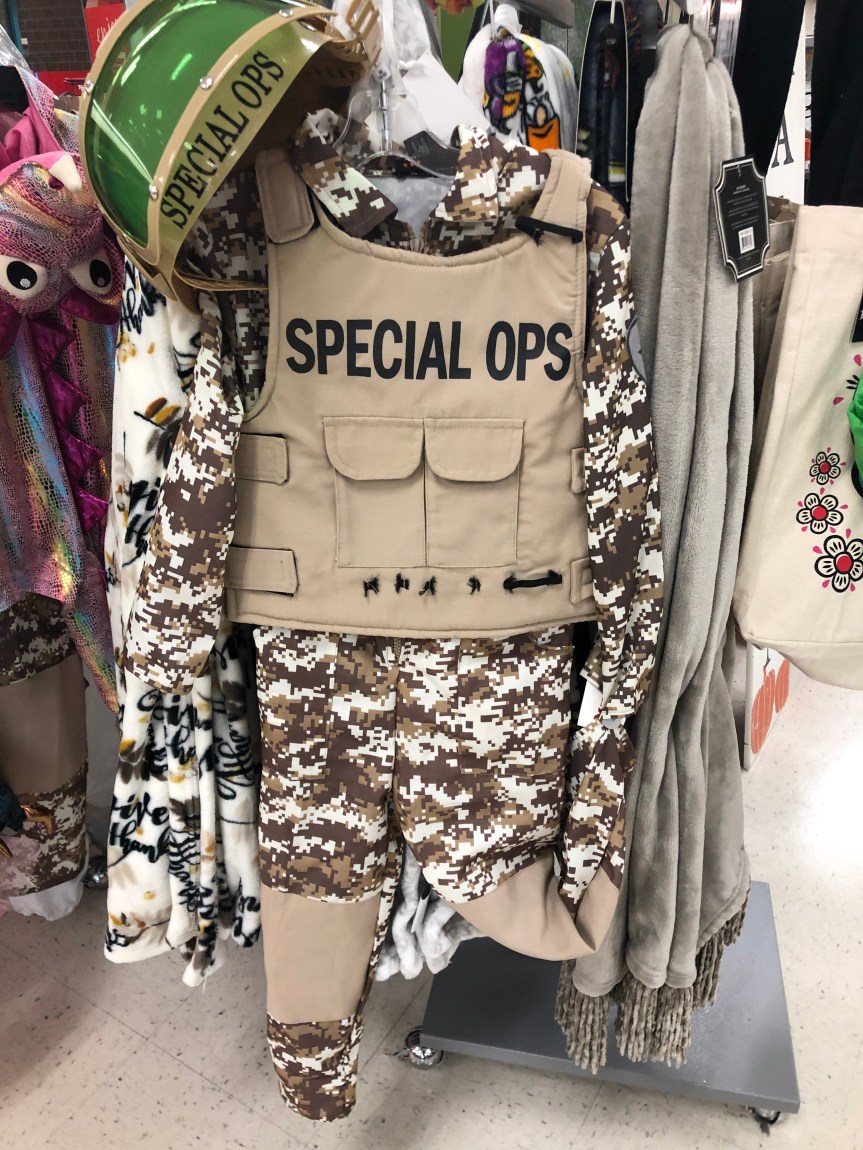
Update (10/25/19): Speaking of militarization, let’s not forget the popularity of video games (or “shooter” games) such as Call of Duty. And with Halloween coming, who can resist costumes such as this (photo taken by a military friend):
You thus have war reduced to a game and a costume party. Welcome to Amerika!
Donald Trump attended a high school military academy. But when the Vietnam War came calling, he developed heel spurs that kept him out of the military. In the case of Joe Biden, it was asthma that kept him on the sidelines of that war. Dick Cheney had multiple student deferments and “higher priorities” than serving, as he put it. George W. Bush got a safe spot in the Texas Air National Guard. John Kerry, ironically, did serve in the military during Vietnam but famously turned against that war. His service was “Swift-boated” into infamy even as Bush/Cheney were being applauded by some for their alleged toughness.
When it comes to service in the military, U.S. politicians typically vote with their feet, meaning they double-time away from joining the ranks. This is nothing new, of course. During the U.S. Civil War, the rich could pay for substitutes if they were drafted. When it comes to war, it’s very often a rich man’s war, but a poor man’s fight.
Interestingly, there are two Democratic candidates who are veterans of America’s most recent wars: Mayor Pete Buttigieg and Congresswoman Tulsi Gabbard. According to his website, Mayor Pete “served as a lieutenant in the U.S. Navy Reserve and took an unpaid seven-month leave during his mayoral term to deploy to Afghanistan. For his counterterrorism work, he earned the Joint Service Commendation Medal.” Sounds impressive, yet a “joint service commendation medal” is a standard-issue medal for any company-grade officer who completes such an assignment without screwing up in a major way. It’s a little like a participation trophy in a Little League tournament.
Despite Mayor Pete’s fairly limited military experience, his web site boasts that if he’s elected president, he’ll take office with the most military experience since George H.W. Bush, who served in the U.S. Navy in combat during World War II.
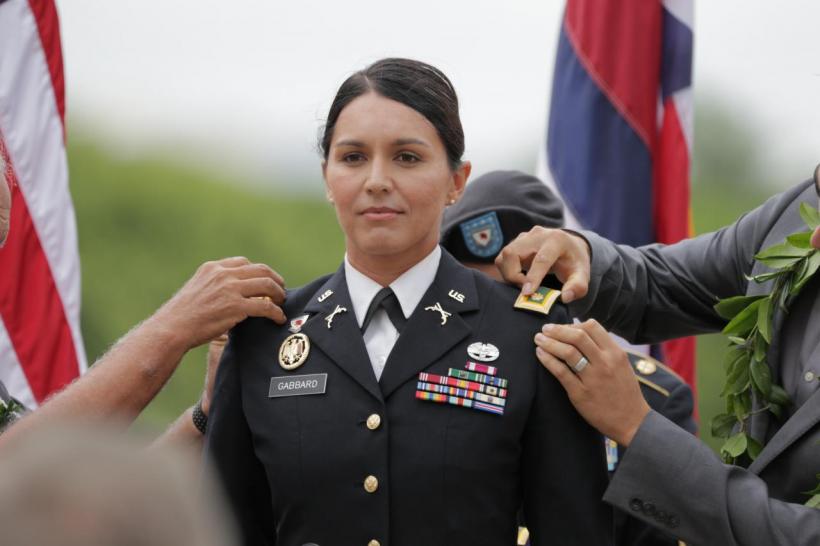
Hawaii Congresswoman Tulsi Gabbard’s military record is far more extensive than Mayor Pete’s. She joined the Army National Guard soon after 9/11 and deployed to Iraq during some of the most bitter fighting in that country. She’s currently a major in the Guard and has spoken extensively about how her military service informs her positions against wasteful, regime-change, wars. According to her web site, “Having experienced first-hand the true cost of war, Tulsi made a personal vow to find a way to ensure that our country doesn’t continue repeating the mistakes of the past, sending our troops into war without a clear mission, strategy, or purpose.”
Tonight, there’s yet another Democratic debate featuring Mayor Pete as well as Congresswoman Gabbard. It will be interesting to see if they’re called on specifically for their views on military issues, such as Trump’s recent decision to pull U.S. troops from northern Syria.
In fact, I’d like to hear the views of all twelve Democrats on that stage tonight on the question of America’s forever wars, and why these wars have illustrated that old story of war being in the service of the rich even as the poor pay the ultimate price. Given America’s supine Congress, our presidents have enormous power over life and death in making war across the globe. When are we going to rein that power in? When are we going to stop fighting foolish and destructive wars that have nothing to do with safeguarding America?
Until we honestly — even ruthlessly — address these questions, America will continue to witness generational wars for the rich fought by the poor.
There’s a new article at The Atlantic by Mark Bowden that cites America’s generals to condemn Donald Trump’s leadership of the military. Here’s how the article begins:
For most of the past two decades, American troops have been deployed all over the world—to about 150 countries. During that time, hundreds of thousands of young men and women have experienced combat, and a generation of officers have come of age dealing with the practical realities of war. They possess a deep well of knowledge and experience. For the past three years, these highly trained professionals have been commanded by Donald Trump.
That’s quite the opening. A few comments:
It’s not a good thing that American troops have been deployed to nearly 150 countries over the last 20 years. Indeed, it points to the scattershot nature of U.S. strategy, such as it is, in the “global war on terror.”
Hundreds of thousands of troops have “experienced combat” — and this is a good thing? What wars have they won? What about the dead and wounded? What about the enormous monetary cost of these wars?
Dealing with “the practical realities of war” — Please tell me, again, how Afghanistan, Iraq, Libya, etc., have played out?
“Highly trained professionals” with “a deep well of knowledge and experience.” Again, tell me which wars America has clearly won.
The gist of Bowden’s article is that Trump is capricious, vain, contrary, and ignorant. But his biggest sin is that he doesn’t listen to the experts in the military and the intelligence community, whereas George W. Bush and Barack Obama did.
Aha! Tell me again how things worked out for Bush and Obama. Bush led the USA disastrously into Afghanistan and Iraq; Obama “surged” in Afghanistan (a failure), created a disaster in Libya, and oversaw an expansion of Bush’s wars against terror. And these men did all this while listening to the experts, those “highly trained professionals” with those allegedly “deep” wells of knowledge and experience.
Given this record, can one blame Trump for claiming he’s smarter than the generals? Can one fault him for trying to end needless wars? He was elected, after all, on a platform of ending costly and foolish wars. Is he not trying, however inconsistently or confusingly, to fulfill that platform?
The point here is not to praise Donald Trump, who as commander-in-chief is indeed capricious and ignorant and too convinced of his own brilliance. The point is to question Bowden’s implied faith in the generals and their supposed “deep well” of expertise. For if you judge them by their works, and not by their words, this expertise has failed to produce anything approaching victory at a sustainable cost.
Bowden’s article concludes with this warning: In the most crucial areas, the generals said, the military’s experienced leaders have steered Trump away from disaster. So far.
“The hard part,” one general said, “is that he may be president for another five years.”
The generals “have steered Trump away from disaster.” Really. Tell me who’s going to steer the generals away from their disasters — Afghanistan, Iraq, Libya, Yemen, Somalia, the list goes on.
Bowden, it must be said, makes valid points about Trump’s weaknesses and blind spots. But in embracing and even celebrating the generals, Bowden reveals a major blind spot of his own.
Here we go again. Trump is being impeached over his dealings with Ukraine, even as he accuses Democrats like Adam Schiff of treason. This sordid spectacle will doubtless dominate the news for the next few months, and probably longer. Impeachment, as they say, is a political process, and thus partisanship will reign supreme, fueled by Trump’s temper tantrums and his rhetoric of coups and civil wars.
Trump is, simply put, constitutionally unsuited to be president. Not just because he doesn’t know the U.S. Constitution: he doesn’t have a public service bone in his body. It makes perfect sense to him to use his position and its powers for his own personal gain. He’s been doing that his entire life, so why stop now? Trump also sees himself as a victim — the biggest victim in all of history. He reminds me of the comedian Rodney Dangerfield, whose shtick was about how he got no respect.
It’s all so sad and depressing, and it’s only just begun.
America’s MAGA President, Donald Trump, has generated enormous criticism for his news conference with Vladimir Putin. Typical of this is James Fallows at The Atlantic, who wrote that “Never before have I seen an American president consistently, repeatedly, publicly, and shockingly advance the interests of another country over those of his own government and people.” A “national nightmare,” opined The Washington Post. A “train wreck,” said NBC News, that made Russians “gleeful.”
Is Trump advancing the interests of Russia? Is this an example of high crimes and misdemeanors, perhaps even rising to treason?
Methinks not. Trump, if he is advancing Russian interests, is doing so indirectly. Because only one thing matters to Trump: his own interests. With Trump, it really is all about him.
Consider the accusations of Russian meddling in the 2016…
Remember these generals? The “adults in the room” for Trump? How well did that work out?
W.J. Astore
As the Trump administration prepares to deploy more U.S. troops to serve the needs of Saudi Arabia, I got to thinking about America’s forever wars in the Middle East and Central Asia. Back on August 17th, I clipped an article from the New York Times entitled “Debate Flares Over Afghanistan as Trump Considers Troop Withdrawal.” I noted the usual “arguments” presented by U.S. military leaders and chickenhawks of both parties. That withdrawals would constitute a “retreat” that would be “premature” and “reckless.” That U.S. troops had to remain to counter “an enduring terrorist threat.” That the Taliban enemy had perfected “weasel language” that would allow them to win any peace treaty. Making his usual appearance was General (retired) David Petraeus, who warned ominously that a complete withdrawal from Afghanistan “would be even more ill-advised and risky than the Obama administration’s disengagement from Iraq.” Petraeus, of course, has argued for a generational commitment to Afghanistan that could last as long as seventy years.
A few points to make here:
1. A U.S. withdrawal wouldn’t be “premature.” Rather, it’s at least seventeen years overdue.
2. Terrorist threats are nothing new (I was reading about them on active duty in 1985). Moreover, they are often fed by the presence of U.S. troops and bases as well as by “kinetic” actions, i.e. killing people, especially innocent civilians.
3. It’s funny that the Taliban can’t be trusted for its “weasel” language, whereas Americans always negotiate in good faith.
4. Why is Petraeus, a man who disgraced himself by illegally sharing classified information with his mistress, always the go-to guy for advice on any military situation?
Speaking of “premature withdrawals,” Tom Engelhardt noted how these same “arguments” were used to support the Iraq War in 2010. The war song always remains the same: any military withdrawal is “premature” without total U.S. victory (whatever that may mean).
I swear if the U.S. military had had its way, U.S. forces would still be in Vietnam, and generals would still be arguing that withdrawal from Southeast Asia is “premature.”
In 2016, then-Candidate Trump deplored America’s dumb and costly wars, yet as President he now embraces the same tired tactics of the generals and their neo-con enablers. All these men have a great fear of premature withdrawal — are they confusing it with premature ejaculation?
Even as America’s leaders boast about having the world’s greatest and most powerful military, their actions betray fears of defeat, of a lack of potency, and a concern they’re being played (i.e. those “weasel” words). And indeed they are losing, they are showcasing their own impotence, they are being played, as long as these disastrous wars persist.
Today, Friday September 20th, is a global strike day to address global warming/climate change.
It’s hard to believe we need a teenager from another country, Greta Thunberg, to remind Congress and the American people to listen to scientists on the subject of climate change, but that’s the sad reality in the Land of Greedica. We all know the world is getting hotter, storms are getting more intense, birds and insects are dying in large numbers, coral reefs are dying off due to bleaching — the list goes on. And we also know human actions are contributing to global warming.
But we also know there are trillions of dollars of fossil fuels still in the ground, or under our oceans, or in rapidly melting arctic regions, and that fossil fuel companies want the profits from the extraction, production, and sale of the same. And those companies buy as many politicians as they can, they control as much of the media as they can, they even buy scientists to present “contrary” evidence about global warming, all in the cause of greed and power.
They get away with it in part because we’ve been trained to think in the short term. We keep daily and even hourly calendars. The business cycle is quarterly and yearly. Even those long Communist plans of the past dealt with five-year cycles. We humans simply aren’t used to thinking in terms of generations, nor are we encouraged to.
The process of global warming has been occurring slowly, gradually, over the last few generations, but it’s beginning to pick up speed, with major changes occurring faster than many scientists predicted.
Speaking of generational changes, it’s interesting that the Pentagon and its generals easily think in generational terms when it comes to America’s wars, and encourage Americans to do the same, but we’re not encouraged at all to work persistently and patiently to win the “war” on climate change. (As an aside, the fossil-fuel-driven U.S. military is obviously not helping the cause of ameliorating the impact of global warming, though the Pentagon is planning for global disruptions to be caused by climate change. With military budgets approaching a trillion a year, I’d say they’re winning, even as the planet loses.)
As Tom Engelhardt noted this week at TomDispatch.com, we humans need to stop empowering the pyromaniacs who’d prefer to see the earth burn as long as they’re making money off of it. We need to act globally to protect our planet from irreversible harm, or we’re pretty much screwed as a species.
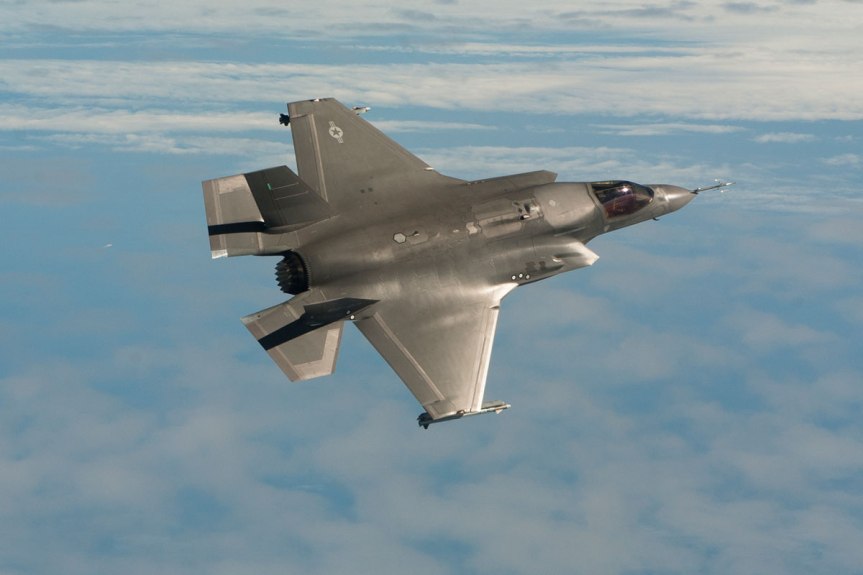
My latest article for TomDispatch.com focuses on the F-35 stealth fighter, which is estimated to cost $1.5 trillion over the life of the program. I hope you can read all of the article here; what follows is an extended excerpt on the history of the program. Did you ever notice how Congress never asks where the money is coming from for these incredibly expensive weapons? But ask for money for education, environmental protection, infrastructure, and especially for poor people and Congress starts screaming about the deficit, which is booming under Trump. But there’s always money for weapons! We need to remember that “government” money is our money, and we need to start spending it on priorities that matter to us, not to defense contractors and generals.
A Brief History of the F-35 Program
I first heard of what would become the F-35 in 1995. I was then a captain in the Air Force, working on flight-planning software. I was told that a new Joint Strike Fighter, or JSF, was being developed. The “joint” meant that the Air Force, Navy, and Marines would all use it. Its big selling point at the time was the striking level of anticipated savings expected due to the commonality of the design, of spare parts, and of everything else. (Those in the know then, however, remembered the Pentagon’s previous shot at “jointness,” the TFX program in the 1960s; the resulting plane, the F-111, would be rejected by the Navy and unloved by the Air Force.)
The new JSF was advertised as offering the highest-tech possible at the lowest price imaginable, a fighter that would replace legacy aircraft like the Air Force’s F-16s and A-10s and the Navy’s F-18s. Winning the competition to develop the plane was weapons giant Lockheed Martin and a prototype F-35 Lightning II first took to the skies in 2006, by which time I was already retired from the Air Force. In the 13 years since then, the F-35 has gone through a mind-boggling series of major program delays and setbacks, burning money all the way.
In 2014, the plane’s woeful record finally caught the eye of CBS’s 60 Minutes, which documented how the program was seven years behind schedule and already $163 billion over budget. The Pentagon, however, simply plunged ahead. Its current plan: to buy more than 2,600 F-35s by 2037, with the assumption that their service lives will possibly extend to 2070. In Pentagon terms, think of it as a multi-generational warplane for America’s multi-generational wars.
Five years after that 60 Minutes exposé and 13 years after its first flight, the F-35 unsurprisingly remains mired in controversy. Harper’s Andrew Cockburn recently used it to illustrate what he termed “the Pentagon Syndrome,” the practice of expending enormous sums on weapons of marginal utility. The F-35, he noted, “first saw combat [in 2018], seventeen years after the program began. The Marines sent just six of them on their first deployment to the Middle East, and over several months only managed to fly, on average, one combat sortie per plane every three days. According to the Pentagon’s former chief testing official, had there been opposition, these ‘fighters’ could not have survived without protection from other planes.”
So far, in other words, the F-35 has had an abysmally low rate of availability. Technically speaking, it remains in “initial operational testing and evaluation,” during which, as defense journalist Dan Grazier has noted, it achieved a “fully mission capable rate” of just 11% in its combat testing phase. (The desired goal before going into full production is 80%, which is, in a sense, all you need to know about the “success” of that aircraft so many years later.) Compounding those dreadful percentages is another grim reality: the F-35’s design isn’t stable and its maintenance software has been a buggy nightmare, meaning the testers are, in a sense, trying to evaluate a moving and messy target.
These and similar problems led President Trump and former acting Defense Secretary Patrick Shanahan to push possible alternatives to the F-35 as a way of pressuring Lockheed Martin to improve its performance. In December 2016, before he even entered the Oval Office, for example, Trump tweeted about building F-18 Super Hornets in place of the F-35. Later, Shanahan advocated for an updated version of the venerable F-15 Eagle, made by Boeing, a company for which he had only recently been a senior executive. But the president’s tweets have moved on, as has Shanahan, and Lockheed Martin continues to hold all the cards. For the Pentagon, it’s still the F-35 or bust.
Unsurprisingly, the president has changed his tune, enthusing that the F-35 is invisible (“You literally can’t see it”) rather than merely difficult to detect on radar. (He has also referred to Marillyn Hewson, the CEO of Lockheed Martin, as Marillyn Lockheed.) The main selling point of the F-35 is indeed its stealth technology, marking it as a “fifth generation” fighter when compared to the older F-15s, F-16s, F-18s, and A-10s, which are decidedly unstealthy and radar detectable. Primarily because of such technology, the Pentagon argues that the F-35 will prove far more “survivable” than previous warplanes in any future conflict with Russia, China, or some other country equipped with sophisticated radars and surface-to-air missiles.
Yet such stealthiness comes at a real cost and not just in monetary terms. To maintain its stealthy profile, the F-35 must carry its weaponry internally, limiting its load and destructive power compared to “fourth generation” planes like the A-10 and F-15. It must also rely on an internal fuel system, which will limit its range in battle, while its agility in air-to-air combat seems poor compared to older fighters like the F-16. (The Pentagon counters, unconvincingly, that the F-35 wasn’t designed for such dogfighting.)
As a former Air Force project engineer and historian of technology and warfare, here’s my take on the F-35 program today: in trying to build an aircraft to meet the diverse requirements of three services, Lockheed Martin has produced a jack-of-all-trades, master-of-none albatross. Each military service piled requirements onto the F-35, as ever more esoteric features were added, including that stealth capability; special software featuring eight million lines of code; unique (and wildly expensive) helmets for its pilots; and vertical landing/short takeoff capacity for the Marines, which led to an airframe design that made it ever less maneuverable for the Air Force and Navy. The result: perhaps the classic example of a plane that is far less than the sum of its staggeringly expensive parts.
To get more specific, consider the mission of close air support, or CAS, which means supporting troops in or near combat. The best and most survivable plane for such a role remains the one specifically designed for it: the unglamorous A-10 Warthog, which ground troops love but Air Force officialdom hates (because it was designed in response to Army, not Air Force, needs). By comparison, the F-35, which is supposed to fill the A-10’s role, simply isn’t designed for such a mission. It’s too fast, meaning its loiter time over targets is severely limited; its weapons load is inadequate; it has only one engine, making it more vulnerable to ground fire; and its (malfunctioning) gun lacks punch. (It also costs twice as much to fly.) Despite all this, the Air Force continues to advocate for the F-35 in a CAS role, even as it grudgingly re-wings A-10s to extend their lives.
And keep in mind as well that, if you want an attack platform that can loiter for hours, while removing all risk to pilots, why not just use already existing drones like the military’s Reapers? Who even needs an expensive F-35 stealth fighter? To these and similar criticisms the Pentagon responds that it’s fifth generation! It’s new! It’s stealthy! It’s a game-changer! It scares the Russians and Chinese! And if those answers don’t work, there’s always that old standby: tell me why you hate our troops!
Meanwhile, Lockheed Martin’s profits are soaring as that company and the Pentagon sell the F-35 to allies around the world. Despite its delays, cost overruns, and performance issues, it’s still being promoted as America’s latest and greatest. Foreign military sales have the added benefit of driving down per-unit costs for the Pentagon, even as politicians tout the F-35 as a huge job creator. In short, with no alternative in sight, Lockheed Martin remains top gun in the Pentagon’s cockpit (Eat your heart out, Tom Cruise!), with virtually guaranteed profits for the next half-century.
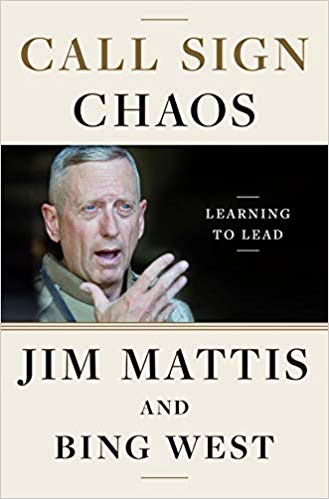
James Mattis is making the talk show rounds, promoting his new book, “Call Sign Chaos.” Interestingly, while openly critical of President George W. Bush for being unprepared for the Iraq War, and President Barack Obama for lacking a strategy and being too soft toward enemies like Iran, Mattis is remarkably circumspect about his service as Secretary of Defense under President Donald Trump. Perhaps Trump’s non-disclosure agreements really do pack a punch?
I’ve written about Mattis before. Trump may have picked him in part because he looks a little like George S. Patton of World War II fame. While serving under Trump, Mattis was deferential but not as big of an ass-kisser as most of Trump’s subordinates. Mattis was a disappointment nonetheless, bought off by all the money Trump and the Republicans (and Democrats as well) shoveled to the Pentagon.
Mattis, among several generals Trump called “his” own, did nothing to end America’s disastrous overseas wars and the profligate spending on them. He also did nothing to curb the U.S. military’s desire to spend $1.7 trillion on genocidal nuclear weapons. He had no vision for a U.S. military that would be less imperial, less wasteful, and, in two words, less stupid.
Mattis was more interested in better relations with allies than was Trump, especially NATO, but that was about the only notable difference. That and the fact that Mattis seemed even more dedicated to using the U.S. military in debacles like Afghanistan and Syria, whereas Trump, displaying his usual fickleness and ignorance, waxed between total destruction and total withdrawal.
Strategic chaos has been the result of Mattis’s service under Trump, so the book’s title is unintentionally accurate. If only retired generals would do what they used to do way back when, such as fishing and golfing, enjoying a sinecure or two but otherwise doing no harm. But, sadly, that’s no longer the American way. Too many generals, retired or otherwise, are spoiling the Democracy, and Mattis is one of them.
Among noteworthy American generals who could, men like Patton and Ike and Grant and Sherman, Mattis is yet another pretender like David Petraeus, a man who couldn’t. He couldn’t win a major, enduring, victory, and he didn’t define a new course forward that would truly safeguard America’s national security. Call sign chaos, indeed.






 Trump gets a soccer ball from Putin. A win-win?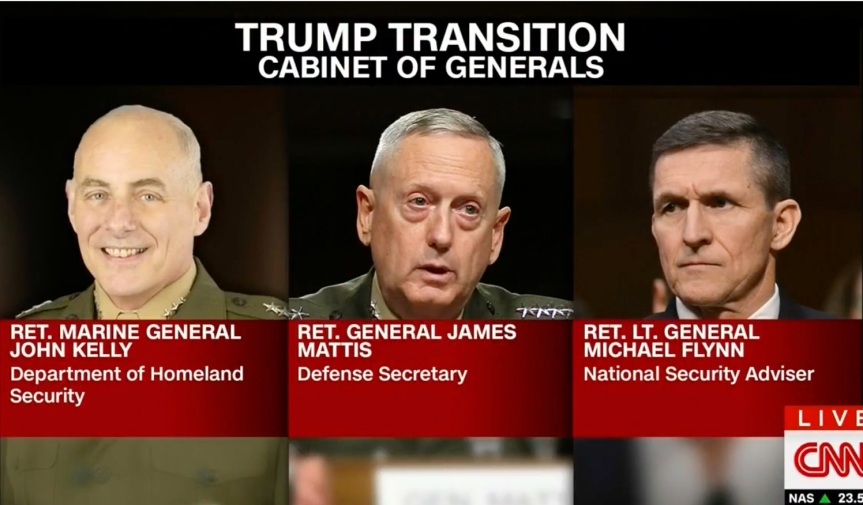

 Bracing Views