President Trump claims the USA is being invaded. “Masses of illegal aliens” are going to “overrun” America. “Giant” caravans. Bad people from Central America. Fear them!
Isn’t it amazing that a nation of over 300 million people — which claims to have “the world’s finest fighting force” in all of history — fears an “invasion” by a few thousand desperate people, mainly women and children, who most likely would be happy cleaning toilets and doing other jobs that most Americans believe are beneath them?
This election cycle seems like a gloss on the “The Empire Strikes Back,” with the Dark Side of the Force triumphing on the Republican side. As Yoda the Jedi Master put it, “anger, fear, aggression.” They are “quicker, easier, more seductive” than the good side.
Trump and his minions know this. They know what stirs up his base and drives them to the polls to vote.
Trump is more opportunistic grifter than evil Sith Lord, but he’s stirring up anger, fear, aggression among voters to sustain his power.
Is the Dark Side stronger? We’ll soon see.
Update (11/4/18): A U.S. military report suggests that most of the several thousand people currently in the caravan in Mexico are unlikely to reach the U.S. border. To face down the roughly one thousand people who are likely to reach the border and apply legally for asylum, Trump is deploying roughly 15,000 troops while threatening that rock-throwers will be met by Army bullets.
This isn’t tough-talking; it’s irresponsible, it’s inflammatory, it’s even bat-shit crazy. Will bat-shit crazy work for Trump? Stay tuned: same bat-time, same bat-channel.
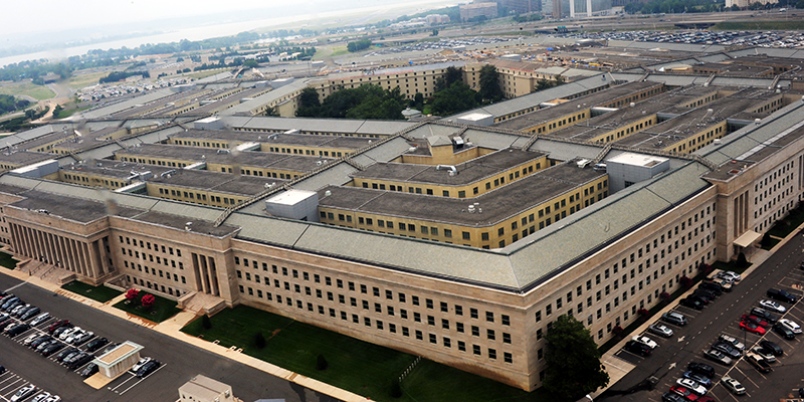
In my latest article for TomDispatch.com, I argue the Pentagon has won the war that matters: the struggle for the “hearts and minds” of America. Pentagon budgets are soaring even as wars in places like Afghanistan continue to go poorly. Despite poor results, criticism of the Pentagon is rare indeed, whether in the mainstream U.S. media or even among so-called liberals and progressives, a point hammered home to me when I contacted my senator. Here’s an excerpt from TomDispatch; you can read my article in full here.
A Letter From My Senator
A few months back, I wrote a note to one of my senators to complain about America’s endless wars and received a signed reply via email. I’m sure you won’t be surprised to learn that it was a canned response, but no less telling for that. My senator began by praising American troops as “tough, smart, and courageous, and they make huge sacrifices to keep our families safe. We owe them all a true debt of gratitude for their service.” OK, I got an instant warm and fuzzy feeling, but seeking applause wasn’t exactly the purpose of my note.
My senator then expressed support for counterterror operations, for, that is, “conducting limited, targeted operations designed to deter violent extremists that pose a credible threat to America’s national security, including al-Qaeda and its affiliates, the Islamic State in Iraq and Syria (ISIS), localized extremist groups, and homegrown terrorists.” My senator then added a caveat, suggesting that the military should obey “the law of armed conflict” and that the authorization for the use of military force (AUMF) that Congress hastily approved in the aftermath of 9/11 should not be interpreted as an “open-ended mandate” for perpetual war.
Finally, my senator voiced support for diplomacy as well as military action, writing, “I believe that our foreign policy should be smart, tough, and pragmatic, using every tool in the toolbox — including defense, diplomacy, and development — to advance U.S. security and economic interests around the world.” The conclusion: “robust” diplomacy must be combined with a “strong” military.
Now, can you guess the name and party affiliation of that senator? Could it have been Lindsey Graham or Jeff Flake, Republicans who favor a beyond-strong military and endlessly aggressive counterterror operations? Of course, from that little critical comment on the AUMF, you’ve probably already figured out that my senator is a Democrat. But did you guess that my military-praising, counterterror-waging representative was Elizabeth Warren, Democrat of Massachusetts?
Full disclosure: I like Warren and have made small contributions to her campaign. And her letter did stipulate that she believed “military action should always be a last resort.” Still, nowhere in it was there any critique of, or even passingly critical commentary about, the U.S. military, or the still-spreading war on terror, or the never-ending Afghan War, or the wastefulness of Pentagon spending, or the devastation wrought in these years by the last superpower on this planet. Everything was anodyne and safe — and this from a senator who’s been pilloried by the right as a flaming liberal and caricatured as yet another socialist out to destroy America.
I know what you’re thinking: What choice does Warren have but to play it safe? She can’t go on record criticizing the military. (She’s already gotten in enough trouble in my home state for daring to criticize the police.) If she doesn’t support a “strong” U.S. military presence globally, how could she remain a viable presidential candidate in 2020?
And I would agree with you, but with this little addendum: Isn’t that proof that the Pentagon has won its most important war, the one that captured — to steal a phrase from another losing war — the “hearts and minds” of America? In this country in 2018, as in 2017, 2016, and so on, the U.S. military and its leaders dictate what is acceptable for us to say and do when it comes to our prodigal pursuit of weapons and wars.
So, while it’s true that the military establishment failed to win those “hearts and minds” in Vietnam or more recently in Iraq and Afghanistan, they sure as hell didn’t fail to win them here. In Homeland, U.S.A., in fact, victory has been achieved and, judging by the latest Pentagon budgets, it couldn’t be more overwhelming.
If you ask — and few Americans do these days — why this country’s losing wars persist, the answer should be, at least in part: because there’s no accountability. The losers in those wars have seized control of our national narrative. They now define how the military is seen (as an investment, a boon, a good and great thing); they now shape how we view our wars abroad (as regrettable perhaps, but necessary and also a sign of national toughness); they now assign all serious criticism of the Pentagon to what they might term the defeatist fringe.
In their hearts, America’s self-professed warriors know they’re right. But the wrongs they’ve committed, and continue to commit, in our name will not be truly righted until Americans begin to reject the madness of rampant militarism, bloated militaries, and endless wars.
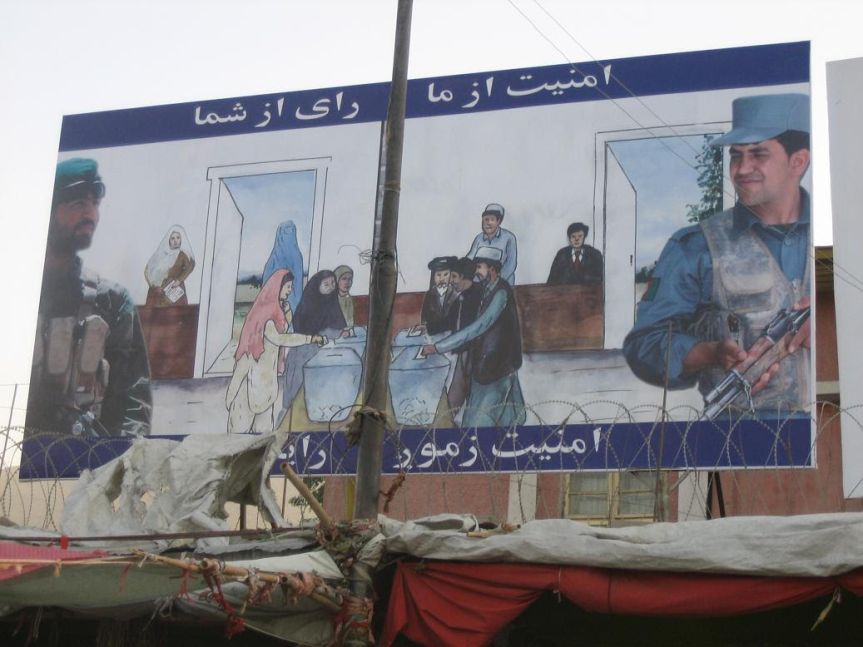
An idealized view of Afghan elections. Reality is harsher.
By Pamela
Editor’s Note: Checking the news this morning, I saw the following report from Afghanistan:
“A suicide bomber blew himself up in the Afghan capital on Saturday, killing at least 15 people as voting concluded in parliamentary elections that were overshadowed by the threat of attacks and serious organizational problems.” Other attacks on a smaller scale killed or wounded dozens of others, noted the report. Meanwhile, the Taliban in Afghanistan called on people to boycott the elections.
Western efforts to bring (or impose) a semblance of democracy on Afghanistan have been deeply flawed from the beginning, notes Pamela in this article that she graciously agreed to write for this site. The Afghan people were told democracy would naturally follow from elections, but the reality has been far different and more tragic, notes Pamela based on her own experiences in observing prior elections. W.J. Astore
Today, October 20th, Afghanistan is to hold parliamentary and provincial elections which had been postponed since 2016. I’ve witnessed all the previous ones, with the local ones stirring more emotions among the population than the presidential ones.
The first one of these (in 2005) was very popular and people went to vote in droves. I worked then in Jalalabad, a rather traditional city close to the border with Pakistan. A colleague told me he was going to vote and what’s more, for a woman who had taught him in university ‘because women do not use guns to settle disputes and are not corrupted’ (the latter of course being debatable). Security was still reasonable; its abrupt decline did not start until 2006. As later became clear, however, that enthusiasm was the result of a misunderstanding.
People had been endlessly brainwashed that voting would bring ‘democracy’. And that in turn would miraculously produce the human rights, security & prosperity they were desperately yearning for after more than 25 years of wars and oppression. After all, if ‘democracy’ was to be judged by how well off its European and American adepts were, it clearly was worth voting for! Thus all these unfamiliar western concepts conflated in many people’s minds into a magic future of instant peace, security and prosperity.
It’s not like Afghans did not have their own forms of human rights and democratic ways of decision making including elected bodies who represented them, but our concepts as such were alien. Since 2005 even in rural areas the access to television and internet has increased tremendously, but in those days even in major cities electricity was rare and the internet hardly available and very expensive. Particularly illiterate persons (70% of the population) therefore had no way to supplement from public sources their limited understanding of what we proposed.
Our half-baked extension efforts led many people to believe that democracy and human rights were basically two terms for the same phenomenon and that to obtain that universal panacea, all they had to do is go and vote.
No wonder then, that by 2009 (presidential elections) and 2010 (parliamentary and provincial ones) they had realised that ‘democracy’ had not changed anything much and had not brought about the promised miracles, so enthusiasm for the elections was much less and so was turnout. Despite positive developments like more than 25 % of all seats in parliament being reserved for women, too many former warlords with blood on their hands were still ruling and there had been no accountability for the perpetrators of war crimes. Voting enthusiasm also waned because by then security had dramatically decreased as compared to 2005, so the risk of being maimed or even killed when voting for the democracy mirage was only too real. Billboards were supposed to ‘motivate’ people to go and vote in these ‘free and fair democratic elections’, as NATO was touting them.
Those presidential elections were the ones when the US openly repudiated the increasingly critical Hamid Karzai and then had to scramble to adjust the rhetoric when in spite of that he did win anyway. Interestingly, an amazing outsider came in third, Dr. Ramazan Bashardost. Amazing, because he is from the Hazara minority which always is at the bottom of the pecking order. But he inspired confidence as an honest person above corruption, he was no ancient warlord with blood on his hands, part of ‘the usual suspects’, or compromised with foreign powers. He would travel to election meetings in distant provinces by ordinary yellow taxi, as he had no limousine or other privileges.
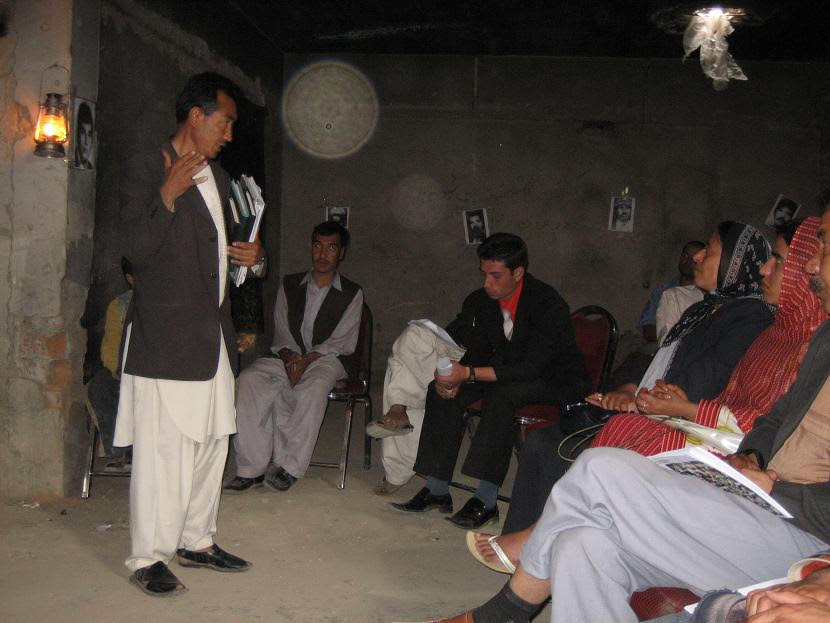
Bashardost (as usual carrying his documents under his arm) discussing with the audience after a theatre performance by and for war victims, ten years ago in the ruins of the Soviet cultural complex in Kabul
The next presidential election took place in the fateful year 2014 – the one in which the foreign armies were to withdraw, which prospect had in the years leading up to it caused corruption at all levels to skyrocket to cash in before the dollar manna would dry up. I only witnessed the start of the presidential campaign, but the result is well known: endless squabbling between the two ‘winners’ – Ashraf Ghani and Abdullah Abdullah. John Kerry eventually brokered some sort of power-sharing compromise which created a government even more dysfunctional than the previous ones, which has been limping along ever since. Insecurity had again increased exponentially since 2009, which additionally demotivated voters.
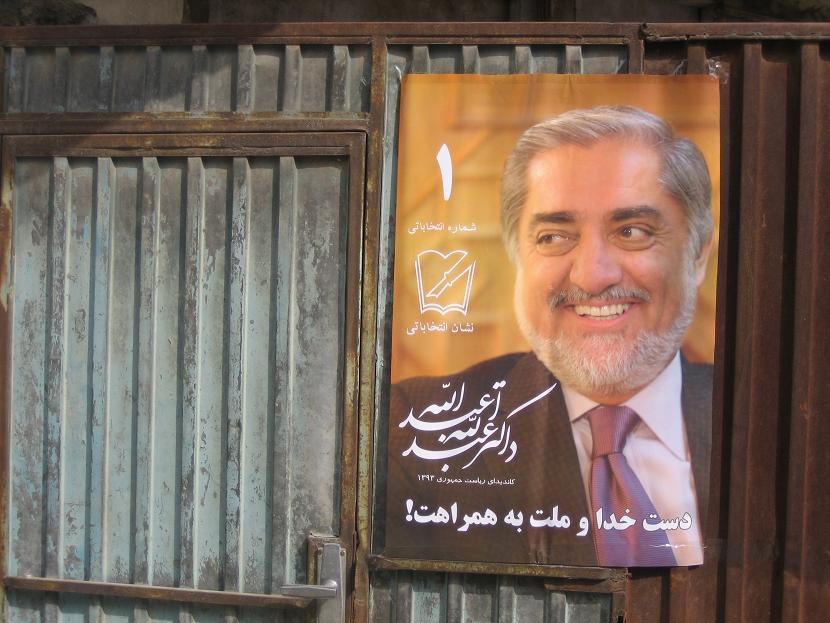
Tadjik ophthalmologist and close friend of Masood, Abdullah Abdullah the eternal loser, eventually thanks to Kerry becoming a ‘Chief Executive’
As for the parliamentary & provincial elections which were scheduled for 2016, they never materialised and will be held only now (and presidential ones next year).
So now it’s 2018 and yet another round of this futile exercise, whose purpose evidently is to flatter our conscience and embellish our annual reports rather than to improve Afghan lives. The last time I was in Afghanistan was three years ago, so I cannot vouch for the opinions and feelings of the Afghans, but I do follow what is happening there. Several coordinated deadly attacks on voters’ registration centres already had severely limited the number of registered voters. Governmental attempts to inflate their number by relaxing control of voter identities additionally undermined the population’s trust in the election’s transparency.
Last minute distribution of electronic voting equipment can be expected to add to the confusion. This is a far cry from the ballot boxes which during the 2005 elections were transported under UN supervision to remote mountains areas on donkey-back.
The expanding presence of ISIL and their ruthless readiness to kill random civilians (particularly those of the Shia Hazara minority) rather than the Taliban’s usual foreign, military and governmental targets, adds to the risk of any involvement with the elections, whether by organising & securing them or as a mere voter.
Ten local candidates have already been killed in terrorist attacks, as well as many more accidental bystanders and members of the police and army when trying to protect voter registration centres and election rallies. Only yesterday, three top level authorities were killed in Kandahar, including the provincial governor and the police chief who had been fiercely anti-Taliban and had managed to introduce a modicum of security and order in what used to be the most dangerous part of the country. Therefore, the elections will be postponed for a week in Kandahar. According to the Taliban, their target in fact was General Miller – who ‘strongly denies’ this.
How many Afghans will be willing to risk their lives to vote and how many will be maimed or dead by the end of the day? And maybe most importantly, what will it change for the better for the Afghans who have lived under armed conflict for 39 years already, with no end in sight?
Update by Pamela (10/21/18): Few people are interested in Afghanistan anymore and that is understandable with Yemen and Syria being much bigger crises.
And now all are absorbed by the Jamal Khashoggi case, which has the collateral advantage to finally shine the light on Saudi crimes, but otherwise is another dreadful example of western hypocrisy. Millions of starving Yemenis could not produce the outcry that one — evidently well-connected — only mildly dissident Saudi did.
I understand that media are outraged as it concerns one of their own and journalists are threatened world-wide. But that does not apply to governments.
‘Disappearing’, torturing and killing one’s own (in addition to foreign) citizens has been done by all the countries who now sanctimoniously shed crocodile tears while silently praying that Secretary of State Mike Pompeo & Saudi Crown Prince Mohammad bin Salman (known as MBS) will manage to concoct an acceptable ‘explanation’, which will allow them to keep on selling arms to the Saudis and enjoy their investments.
A good example of that is the second part of a documentary about Qaddafi’s Libya, which highlights western collusion with him which led to rendition of Libyan dissidents including pregnant wives and children. Not to mention al Libi’s rendition to Egypt where this poor guy was tortured for six months until he agreed to sign a paper which stated that he had evidence of Saddam Hussein colluding with al-Qaeda, which ‘confession’ was used to ‘justify’ the war in Iraq in 2003.
After which he was sent back to Libya where he ‘committed suicide’ in prison, four days before the US reopened a consulate/embassy there. I’ve been following these cases since long ago, but this documentary added some more info:
Pamela, a former aid worker with a decade’s worth of on-the-ground experience in Afghanistan, worked with the Afghan people in relationships characterized by trust and friendship.
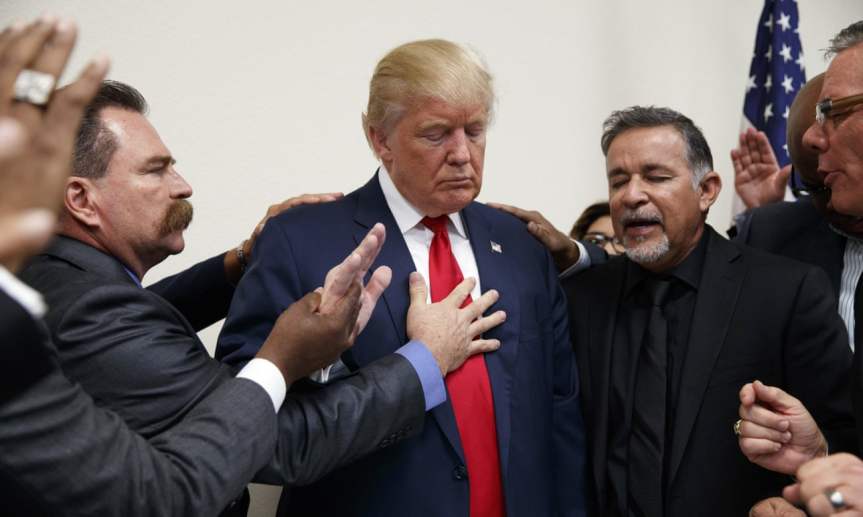
Pastors pray with Trump in Nevada, October 2016 (Photograph: Evan Vucci/AP)
W.J. Astore
Five years ago, I wrote an article to suggest “American fascism” was a misleading concept. Here’s some of what I wrote:
Certainly, since the attacks of 9/11 the U.S. has become more authoritarian, more militarized, and less free (witness the Patriot Act, NSA spying, and the assassination of American citizens overseas by drones). The U.S. Supreme Court has empowered corporations and the government at the expense of individual citizens. Powerful banks and corporations reap the benefits of American productivity and of special tax breaks and incentives available only to them, even as average American citizens struggle desperately to keep their heads above water.
But to describe this as “fascism” is misleading. It’s also debilitating and demoralizing.
It’s misleading because fascism has a specific historical meaning. The best definition I’ve seen is from the historian Robert Paxton’s The Anatomy of Fascism:
“A form of political behavior marked by obsessive preoccupation with community decline, humiliation or victimhood and by compensatory cults of unity, energy and purity, in which a mass-based party of committed nationalist militants, working in uneasy but effective collaboration with traditional elites, abandons democratic liberties and pursues with redemptive violence and without ethical or legal restraints goals of internal cleansing and external expansion.”
What about it? Is the U.S. fascistic? Plainly, no. We don’t have a messiah-like dictator. Our justice system still works, however imperfectly. Our votes still count, even if our political speech often gets drowned out by moneyed interests.
Here we are, in 2018, and the idea of American fascism no longer seems as misleading as it did to me in 2013. For his followers, Donald Trump is a messiah-like dictator. There’s even a movie making the rounds (“The Trump Prophecy“) about how Trump’s election in 2016 was an act of God. Meanwhile, the American justice system is increasingly partisan, increasingly captive to the political right, even as it remains favorably predisposed to the powerful. Our votes are increasingly suppressed: polling stations are closed in minority neighborhoods; onerous voter ID laws work to restrict voting by the “wrong” kind of people; early voting is being curtailed; voting rolls are being purged; and gerrymandering is widespread. All of these steps are designed to protect one party in particular: the Republican.
To return to Paxton’s definition in the light of 2018: Trump ran on a platform of American decline. He sees himself and his followers as victims; nationalist militarism is growing in popularity; democratic liberties are being eroded (whoever thought children would be separated from parents at the border and put into what are effectively concentration camps?).
Ethical and legal restraints still exist on the worst of this behavior, but for how long?
Fascism, Norman Mailer wrote, is “a murderous mode of deadening reality by smothering it with lies.” Nowadays we call these lies “fake news” or “alternative facts.” Whatever you call them, they feed what Mailer called “an insidious, insipid sickness” in society that “demands a violent far-reaching purgative.”
That’s where all of Trump’s lies may be leading us: to violent purges internally and violent surges externally. It’s a grim vision, one that no longer seems as far-fetched to me as it did in 2013.
He wrote me beautiful letters — then we fell in love!
W.J. Astore
Here are a few random thoughts I’ve had over the last few days.
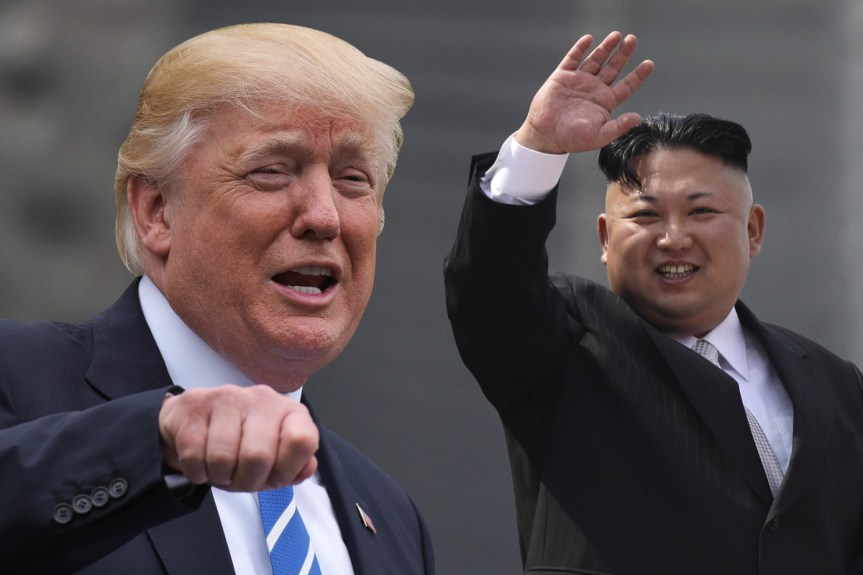
1. I’m still reeling from Donald Trump confessing how he and Kim Jong-un “fell in love.” Imagine if Barack Obama had gushed about falling in love with a communist dictator? Fox News and the Republicans would have crucified him.
2. Brett Kavanaugh is now a Supreme Court justice. But imagine if he’d been black. Would he have survived sexual assault allegations from three white women? Or imagine if he’d been a woman and boasted of liking beer, lots of beer, while losing self-control before the Senate judiciary committee. A female Kavanaugh would have been dismissed as hysterical and unsuited for the pressures of the court, methinks. In sum, a certain type of privilege still exists for certain types of white males.
3. Last night, Donald Trump accused Hillary Clinton of colluding with the Russians. Trump’s tactics on this issue have run the gamut from denying he colluded, to saying it’s not illegal to collude, to charging his opponent with the (apparent) crime of colluding. This is not to say I believe Trump colluded with the Russians (though his constant denials make me think he’s got a lot to hide). While we wait for the Mueller investigation to conclude, it’s worth recalling that candidate Trump asked the Russians to hack Hillary’s server to find her missing emails. Perhaps this was merely a snide remark by an unhinged candidate, but why were Trump campaign staffers meeting with Russians? To help speed adoption of Russian kids by Americans?
But here’s a key point: Trump didn’t win because of Russian “collusion.” He won because Hillary ran a poor campaign. The collusion story (assuming there’s something to it) is a minor issue compared to the real damage Trump does every day as president, e.g. dismissing the perils of climate change as a “Chinese hoax.”
4. At TomDispatch.com, Juan Cole has a fine piece on Islamophobia and how it’s promoted by the Trump administration. It has at least three components. The first is resentment stemming from 9/11, which embarrassed the Republicans since it happened on their watch. The second is religion, that old crusading spirit of evangelicals and conservative Catholics. The third is entitlement/resentment. You know the saying: Who put America’s oil under the desert sands of the Middle East? America’s leaders, and so many of their countrymen, believe all that oil should be theirs.
5. There’s an argument that Trump is no worse than other politicians like Obama or the Clintons. Indeed, that in some way his mendacity is refreshing: that he’s torn the mask off American exceptionalism, revealing all the hypocrisy, all the duplicity, all the crimes against humanity, that other politicians work to keep hidden.
It’s tempting to say “they all do it.” But Trump’s dishonesty is constant. He lies just to stay in shape. And his lies are calculated to sow discord — to divide. Divide and rule is his strategy. Reaping profit for himself is his goal. He’s always been a con man, but now the entire country, indeed the entire world, is his mark.
Because he’s anti-democratic, because he’s a divider, because he loves dictators while mocking people weaker than him, for these and many other reasons, Trump is worse. Trump is making cruelty normal, even admirable (at least to his followers). He’s not so much ripping a mask off America as he is reveling in his own nastiness while encouraging likeminded people in America and around the world to join him.
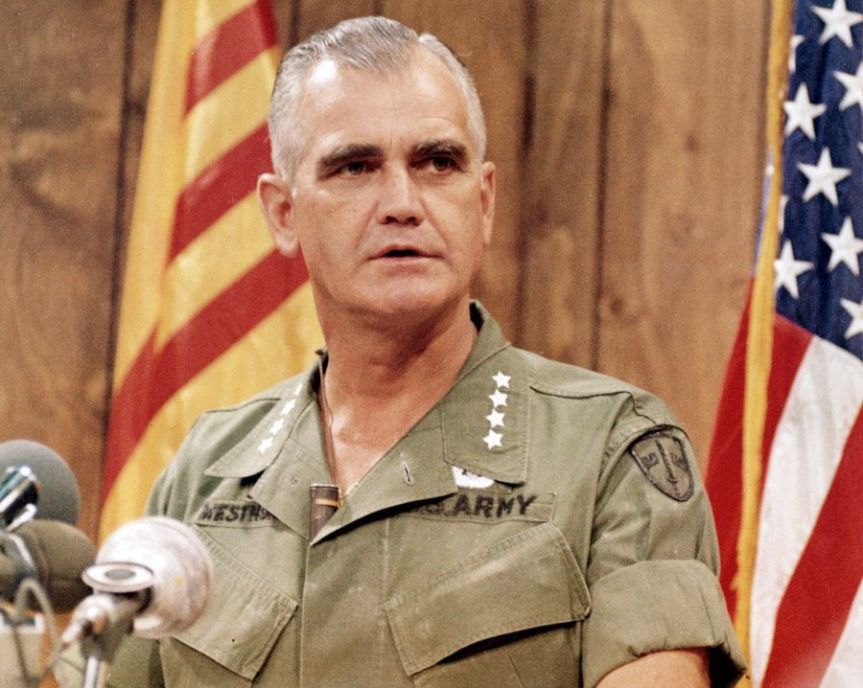
General William Westmoreland in 1968 (Stars and Stripes)
W.J. Astore
Fear of defeat drives military men to folly. Early in 1968, General William Westmoreland, America’s commanding general in Vietnam, feared that communist forces might overrun U.S. military positions at Khe Sanh. His response, according to recently declassified cables as reported in the New York Times today, was to seek authorization to move nuclear weapons into Vietnam. He planned to use tactical nuclear weapons against concentrations of North Vietnamese Army (NVA) troops. President Lyndon Johnson cancelled Westmoreland’s plans and ordered that discussions about using nuclear weapons be kept secret (i.e. hidden from the American people), which for the last fifty years they have been.
Westmoreland and the U.S. military/government had already been lying to the American people about progress in the war. Khe Sanh as well as the Tet Offensive of 1968 were illustrations that there was no light in sight at the end of the tunnel — no victory loomed by force of arms. Thus the call for nuclear weapons to be deployed to Vietnam, a call that President Johnson wisely refused to countenance.
Westmoreland’s recourse to nuclear weapons would have made a limited war (“limited” for U.S. forces, not for the Vietnamese on the receiving end of U.S. firepower) unlimited. A nuclear attack in Vietnam likely would have been catastrophic to world order, perhaps leading to a much wider war in Asia that could have led to world-ending nuclear exchanges. But Westmoreland seems to have had only Khe Sanh in his sights: only the staving off of defeat in a position that American forces quickly abandoned after they had “won” the battle.
War, as French leader Georges Clemenceau famously said, is too important to be left to generals. Generals often see the battlefield in narrow terms, seeking victory at any price, if only to avoid the stain of defeat.
But what price victory if the world ends as a result?
As a kid, I was a big admirer of Israel.* I kept a scrapbook on the Yom Kippur War in 1973. Back then, Israel was America’s plucky ally, David against Goliath, helping to keep the Soviet bear at bay, or so it seemed to me.
Through a kid’s eyes, Israel in 1973 was an island seemingly surrounded by a sea of well-armed enemies: Egypt, Syria, Iraq, Jordan, Saudi Arabia. Outnumbered and outgunned. And now look at today’s reality: Egypt and Iraq have been neutralized. Syria is devastated. Jordan is wisely (sort of) neutral. The Saudis are a quasi-ally. Outside of the more-or-less manageable threat of terrorism (Hamas and Hezbollah), Israel’s chief enemy today appears to be itself.
What I mean by that is this: Israel, which over the last 70 years has fought several wars for its survival, is now a regional superpower. Yet the mindset of David versus Goliath persists, even though Goliath is hobbled and defeated. Meanwhile, as Israel combats terrorism and the legacies of West Bank occupation and isolation of the Gaza Strip, the government prosecutes policies that are considered illiberal and dangerous by many Jewish critics within Israel itself.
A similar David-Goliath mindset exists in the USA, but with far less cause. Bizarrely, the world’s military superpower envisions itself as being surrounded by enemies. Its response is something like Israel’s, as if the USA is Israel writ large. Both countries seek total military dominance over their perceived enemies and rivals; both are led by strong men dogged by claims of corruption; both glorify their militaries; both appear to be spoiling for war with Iran.
Interestingly, both are also obsessed with demographic “enemies within”: many Israelis fear growing Arab/Muslim influence within; many Americans fear minorities will soon constitute the majority (estimates say non-whites will outnumber whites in the year 2045, but some Americans – like Laura Ingraham on Fox News – feel it’s already happened). The result: the ruling administrations of both countries have doubled down on security and identity politics. Israel has made Arabs second-class citizens, a form of apartheid; Trump & Co. has vilified immigrants (especially Mexicans) as rapists and murderers. Both are building walls to keep the “enemy” without. Both see massive military spending (and nuclear weapons) as the ultimate guarantors of peace.
Israel is little Prussia; the USA is big Prussia. And like Prussia (and Germany) of the past, they pose as the aggrieved party, surrounded by enemies, hemmed in and oppressed. It’s never wrong to be strong – that’s their guiding motto. And by strength they mean hardness: military strength, police strength, the strength of superior weapons technology, embraced by leaders willing to kill or torture or imprison others in the name of preserving a “democratic” way of life.
It’s a mindset conducive to authoritarianism, to militarism, to nationalism, even to kleptocracy disguised as essential spending on national security. At its root is fear, which generates a “no compromise” attitude toward the Other (whether Palestinian “terrorists” or immigrant “killers” and “animals”). As the Palestinian activist Bassam Aramin put it in an interview in The Sun (October 2016):
“I think our main enemy is the Israelis’ fear. It’s part of their consciousness. When they talk about security, the Holocaust is always in the background. If I throw a stone at an armored tank, they interpret it as the beginning of a new Holocaust.”
Fear is the mind-killer. It enables perpetual warfare and a police state – and lots of profit and power to those who facilitate the same.
The original Prussia became consumed by militarism and nationalism and collapsed after two devastating world wars. What will happen to today’s Big and Little Prussia? Perhaps a war against Iran, timed to coincide with the 2020 presidential campaign season in the USA? Such an unnecessary and likely disastrous war can’t be ruled out.
Consider the dynamic between the current leaders of the USA and Israel, each egging the other one on to be tougher, less compromising, more Prussian. A pacific future is not in the cards for these military “superpowers.” Not when they’re so busy emulating Prussia.
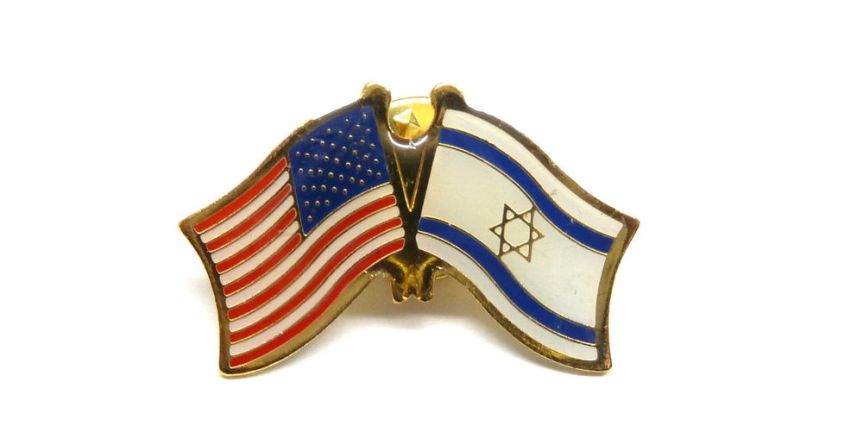
*Why are Americans, generally speaking, supporters and admirers of Israel? So much so that politicians ostentatiously wear co-joined US/Israel flag lapel pins? For several reasons:
1. The US media is generally pro-Israel. Meanwhile, the Arab world is often synonymous with terrorism in our media.
2. Israelis seem more like Americans. What I mean is this: Israeli spokespeople wear western dress and speak English with a faint accent. Until recently, Arab spokespeople on TV looked and dressed “foreign” and spoke English with a heavier accent.
3. The power of pro-Israeli political lobbies such as AIPAC and fear among politicians that criticism of Israel will be construed (and demonized) as anti-Semitism.
4. The Holocaust.
5. The Evangelical Context: I remember listening to a talk show on the radio, soon after the Yom Kippur War, in the mid-1970s. The speaker predicted the Second Coming was near. That got my attention! Why was that? Because, this person said, Israel had gained control over Jerusalem in apparent fulfillment of Biblical prophecy. Fast forward forty years to today and you hear basically the same evangelical predictions about the Second Coming of Christ being imminent as Israel expands its hegemony over the “holy land” in Palestine.
One cannot underrate the importance of (selective) Biblical prophecy as advanced by fundamentalist Christians nestled within today’s Republican Party. These evangelicals couldn’t care less about Trump’s sins and transgressions. Their eyes are on the prize: Armageddon and Christ’s return, which they link to Israel’s domination of the region – which will lead to more wars, a brutal future seen as inevitable, even desirable.
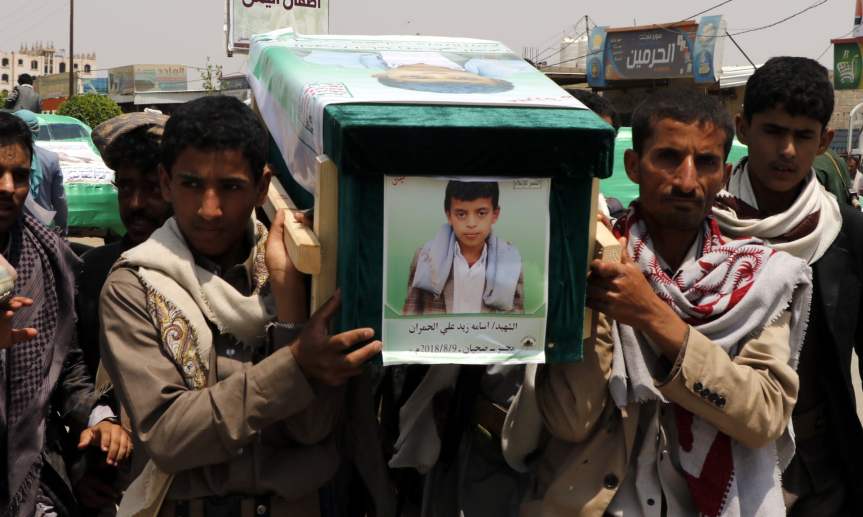
Just another civilian casualty incident? Original caption: Mourners carry the coffin of a child at the funeral procession for those killed in an airstrike on a bus in Yemen. Photograph: Mohammed Hamoud/Getty Images
W.J. Astore
Last night, as I was watching the PBS News Hour, I snapped to attention as I heard a new euphemism for murdered innocents from bombing: “civilian casualty incidents.”
A PBS reporter used it, unthinkingly I believe, repeating bureaucratic jargon about all the innocents in Yemen smashed to bits or shredded by “dumb” bombs, cluster munitions, and even “smart” bombs that are really only as smart as the pilots launching them (and the often imperfect “actionable intelligence” gathered to sanction them).
The overall tone of the PBS report was reassuring. General Mattis appeared to comfort Americans that the Saudis are doing better with bombing accuracy, and that America’s role in helping the Saudis is limited to aerial refueling and intelligence gathering about what not to hit. Of course, the Saudis can’t bomb without fuel, so the U.S. could easily stop aerial massacres if we wanted to, but the Saudis are our allies and they buy weapons in massive quantities from us, so forget about any real criticism here.
I’ve written about Orwellian euphemisms for murderous death before: “collateral damage” is often the go-to term for aerial attacks gone murderously wrong. To repeat myself: George Orwell famously noted the political uses of language and the insidiousness of euphemisms. Words about war matter. Dishonest words contribute to dishonest wars. They lead to death, dismemberment, and devastation. That’s not “collateral” — nor is it merely a “civilian casualty incident” — that’s a defining and terrifying reality.
What if innocent Americans were being killed? Would they be classified and covered as regrettable if inevitable “civilian casualty incidents”?
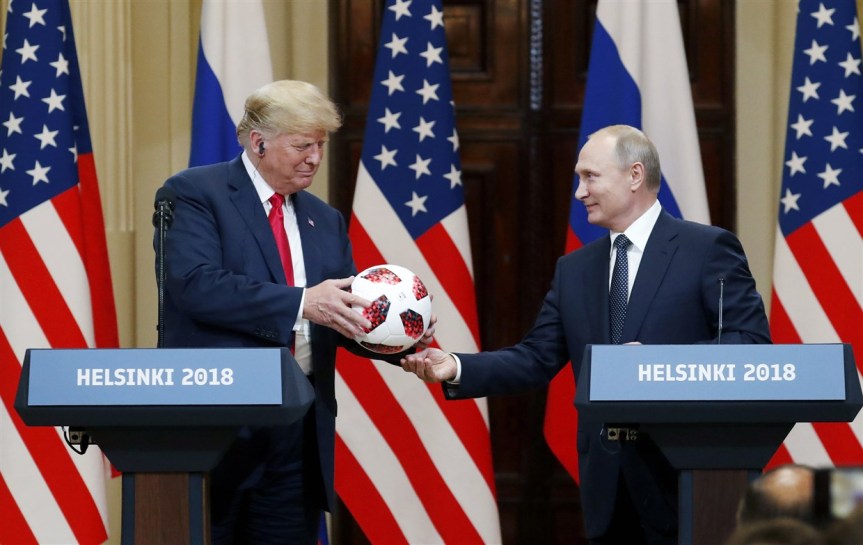
America’s MAGA President, Donald Trump, has generated enormous criticism for his news conference with Vladimir Putin. Typical of this is James Fallows at The Atlantic, who wrote that “Never before have I seen an American president consistently, repeatedly, publicly, and shockingly advance the interests of another country over those of his own government and people.” A “national nightmare,” opined The Washington Post. A “train wreck,” said NBC News, that made Russians “gleeful.”
Is Trump advancing the interests of Russia? Is this an example of high crimes and misdemeanors, perhaps even rising to treason?
Methinks not. Trump, if he is advancing Russian interests, is doing so indirectly. Because only one thing matters to Trump: his own interests. With Trump, it really is all about him.
Consider the accusations of Russian meddling in the 2016 presidential election. Trump is never going to side with his intelligence agencies on this issue. He thinks that, by doing so, he’d be admitting that maybe he didn’t win fair and square over “Crooked Hillary.” He refuses to countenance Russian meddling, not because he’s a Putin stooge, but rather because he’s an egomaniac. He’ll admit to nothing that diminishes, however slightly, his victory — and his ego.
Russia doesn’t matter to Trump. Indeed, America doesn’t matter to Trump. With Trump, it’s really all about him. Recall how he visited the CIA and boasted about himself while standing before the wall that commemorates fallen CIA officers. Recall how he declared the military would follow his orders regardless of their legality. He rashly accuses Democrats of not caring about the troops or border security whenever they oppose his policies. He does best with foreign leaders, like the Saudis and Israelis, who are at pains to flatter him. He apparently can’t stand Angela Merkel because she doesn’t play the flattery game.
Trump lives in his own reality, a narcissistic swirl of fabrications, falsehoods, and lies. He’s happiest when he’s commanding the scene, when people are kowtowing to him, when he can boast about himself and advertise his businesses (during this latest trip, he went to a Trump golf course in Scotland and waxed about its “magical” qualities).
In short, Trump is not treasonous. He simply has no concept of public service. He has no capacity to serve any cause other than himself.
Readers, what do you think of the treason accusations against Trump?
Weekends are a good time to sit back, reflect, and think. Here are a few ideas I’ve been thinking about:
1. Remember 9/11/2001? Of course you do. Almost everyone back then seemed to compare it to Pearl Harbor, another date that would live in infamy — and that was a big mistake. In 1941, the USA was attacked by another sovereign nation. In 2001, we were attacked by a small group of terrorists. But international terrorism was nothing new, and indeed the U.S. was already actively combating Al Qaeda. The only new thing was the shock and awe of the 9/11 attacks — especially the images of the Twin Towers collapsing.
By adopting the Pearl Harbor image, our response was predetermined, i.e. the deployment of the U.S. military to wage war. Even that wasn’t necessarily a fatal mistake, if we’d stopped with Afghanistan and overthrowing the Taliban. But, as Henry Kissinger said, Afghanistan wasn’t enough. Someone else had to pay, in this case the unlucky Iraqis. And then the U.S. military was stuck with two occupations that it was fated to lose. And millions of Afghan and Iraqi people suffered for our leaders’ mistakes.
But perhaps the most remarkable aspect of 9/11 was how no one in Washington took the blame for it. I don’t recall any high-level firings. The buck stopped nowhere. Same with torture. The buck stopped nowhere. Officialdom looked the other way, including the next administration under the “change” candidate, Barack Obama. He changed nothing in this area. His mantra about “looking forward” meant learning nothing from history.
It’s this lack of accountability, perhaps, that made Trump possible. He lies constantly and blunders and blusters, yet (so far) there’s no accountability for that either. People just expect our government to be composed of con men and serial liars, so why not just elect one as president?
No accountability after 9/11 and torture led to “no accountability” Trump.
2. Another thought on 9/11: The 9/11 war-driven response was part of American exceptionalism. What I mean is this: America is not supposed to be on the receiving end of “shock and awe.” We are supposed to be the givers of it. As Americans, we were totally unprepared, psychologically, for such a blow. (A Soviet nuclear attack, a million times more devastating, would have made more “sense” in that the danger was drummed into us.) An attack by hijacked airliners, a mutant form of airpower? Well, America is supposed to rule the skies. We bomb others; they don’t bomb us. Right?
It was all so shocking and destabilizing, hence the “rally around the flag” effect and the blank check issued by Congress to Bush/Cheney for what has proved to be a forever war on terror — or something. And now, with Trump and crew, is the new “something” Iran?
3. In our military-first culture, projects like the B-21 stealth bomber are just accepted as business as usual — the cost of keeping America “safe.” We had more debate about weapons systems during the Cold War, when we truly faced an existential threat. Now, weapons ‘r’ us. It’s a peculiar moment in American history, a sort of cult of the gun, whether that “gun” is a bomber, missile, aircraft carrier, etc.
Put differently, our personal insecurities (due to debt, health care, jobs, weather catastrophes, fear of immigrants, etc.) have driven a cult of security in which guns and related military technologies have been offered as a palliative or even a panacea. Feel secure — buy a gun. Feel secure — build a new stealth bomber. Stand your ground — global strike. The personal is the political is the military.
4. If Reagan’s motto was “trust — but verify” with the Soviet Union, Trump’s motto with North Korea is simply “trust.” Yes — it’s a good thing that Trump is no longer threatening to bring nuclear fire and fury to the North Koreans, but his recent meeting with Kim Jong-un, large in image, was short on substance. Will those verification details be worked out in the future? Do the North Koreans have any intent to give up their nuclear weapons? Both are doubtful. So, does Trump deserve a Nobel peace prize? About as much as Obama did.
5. I’ve never witnessed a man destroy a political party like Trump has taken apart the Republicans. It’s a remarkable achievement, actually. And I don’t mean that as a compliment. I was once a Gerald Ford supporter in the 1976 election, and I voted for Ronald Reagan in 1984. (We make mistakes when we’re young; that said, Walter Mondale was an uninspiring Democratic candidate.) I thought the Republican Party had principles; I think it did in the 1970s and 1980s. Now, the only “principles” are money and power, as in getting more of both. If that means kowtowing to Trump, so be it. Kneel before Zod, Republicans!
That’s enough for my Saturday afternoon. Fire away in the comments section, readers!




 Bracing Views