Ukrainian Attacks on Russia Are Dangerously Escalatory
Reports that Ukraine is launching modified drones to strike airbases deep in Russia highlight the unpredictability and escalatory nature of wars. Ukraine is no longer content at defending itself against Russian aggression; Russia itself must be made a target, which will likely provoke harsher Russian counterattacks. Meanwhile, the U.S. Congress continues to authorize billions in military aid to Ukraine, which is pitched as defending democracy and freedom.
War is many things but it is rarely democratic. Indeed, as James Madison warned, war is inherently anti-democratic. It strengthens authoritarian forces and contributes to abuses of power and corruption. As the Russia-Ukraine War goes on, with no clear resolution in sight, Ukraine suffers more even as the chances of escalation rise.
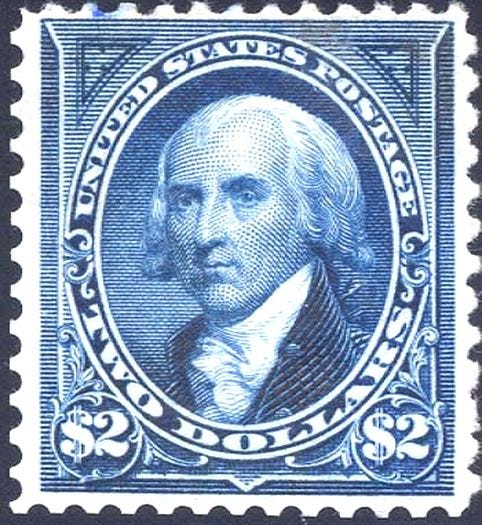
James Madison warned that no nation can preserve its freedom in the midst of continual warfare
What’s needed now is resolute diplomacy — a committed effort to end the war by all parties involved, obviously Russia and Ukraine but also the U.S. and NATO. The longer this disastrous war lasts, the more unpredictable it will become, the more atrocious it will prove, and the more likely ordinary Ukrainians and Russians will suffer and die, whether at various battlefronts or on the homefront.
Negotiation is not weakness nor is it appeasement. Negotiation is sensible, rational, and life-affirming. But there’s little reason for Ukraine to negotiate when it’s enjoying a blank check of support from the U.S. and NATO.
Meanwhile, as Ukraine continues striking deep into Russia, one wonders to what extent the U.S. military and intelligence agencies are involved. Did the U.S. provide technology? Targeting information? Intelligence? Or is Ukraine doing this entirely on its own, a scenario that is less than comforting?
I sure hope the U.S. and Russia are talking. In the confusion and chaos of war, how is Russia to know for sure that an attack on one of their strategic air bases is coming from Ukraine and not from NATO territory? Even if it’s clearly coming from Ukraine, if these attacks are enabled or approved by the U.S./NATO, will the Russians see them as an act of war? Will they respond militarily, creating even more escalatory pressure?
Bizarrely, Ukraine’s defensive war against Russia has been sold as America’s “good” war, a chance to weaken Russia and Putin in the cause of defending Ukrainian “democracy.” But as Ukraine’s tactics turn more offensive, and as the Ukrainian government likely becomes more authoritarian due to the pressures of war, how wise is it for the United States to continue to send massive amounts of military aid there while discouraging diplomacy?
Policies that end in prolonging the Russia-Ukraine War in the name of teaching Putin a lesson and eroding his power may teach us all a lesson in how war is not just anti-democratic. War runs to extremes, and only fools believe they can control it in a way that is conducive to liberty and freedom and justice.
Whatever else it is, the Russia-Ukraine War is a major money-making opportunity
Warfare is welfare for the merchants of death. Consider the Russia-Ukraine War. In the name of Ukrainian liberation, the U.S. Congress is preparing to approve another $37.7 billion in mostly military aid, bringing the total to nearly $100 billion in less than a year. This remarkable sum represents roughly 5% of federal discretionary spending, nearly the same as what the federal government spent on education in America this year. So far, all Democrats in Congress have supported aid to Ukraine, with only a minority of Republicans objecting.
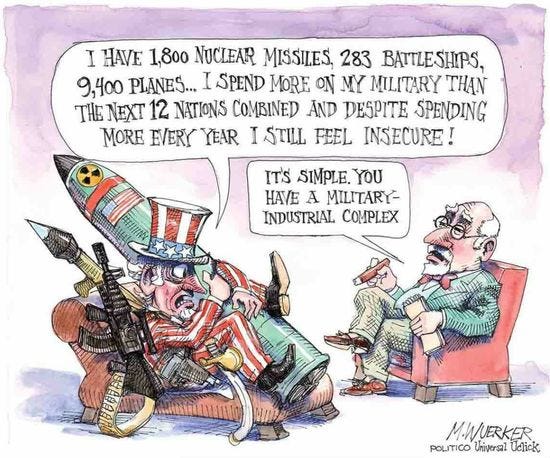
Why is this? America is fertile ground for anti-Russian sentiment, but that’s not the main reason. It’s all about the Benjamins, as war is always immensely profitable for some sectors of society. Recall that President Dwight D. Eisenhower warned us of the disastrous rise of misplaced power represented by the military-industrial-congressional complex (MICC). Congress is heavily influenced by weapons contractors, not only through campaign contributions but by the jobs in their districts tied to the production of weapons of all sorts.
In a refreshing burst of honesty from the 1930s, the U.S. Senate referred to weapons contractors as “merchants of death,” and so they are. Weapons, from mundane bullets and artillery shells to “sexy” stealth fighters like the wildly expensive F-35, are designed to kill our fellow human beings. That’s why Eisenhower famously said in 1953 that humans essentially crucify themselves on a cross of iron when they prioritize weapons building over hospitals, schools, and other necessities of a civilized life.
More and more money to the merchants of death ensures three things: more power to weapons contractors, higher profits for them, and in this particular case a lot more dead Russians and Ukrainians. Some Americans seem to think it’s all worth it, though I’m skeptical about Ukrainian liberation being an important goal to officials in Washington.
Ike exhibited basic common sense when he noted the MICC is fundamentally anti-democratic. That it threatened our liberties and democratic processes. He told us to take nothing for granted, and challenged us to remain alert and knowledgeable. For when you empower the MICC, you weaken democracy. You also choose death over life.
Whether it’s the Russia-Ukraine War or previous ones like Vietnam, Iraq, and Afghanistan, the MICC has been and is making a killing in America and indeed across the globe— and in more ways than one. And as Ike said, that’s no way of life at all.
What is to be done? We need to start by recognizing that the MICC is fundamentally anti-democratic, often wasteful, driven by greed, and consistent with imperialism of the worst sort. Again, I’m not really saying anything new here; Ike, a five-star general and two-term president, said the same almost 70 years ago. His sentiments were echoed by James Madison when Madison wrote in 1795 that a large standing military and incessant warfare were deadly to democracy and liberty.1 Yet wars continue to find a way, and the MICC continues to thrive and expand its reach and power.
To resort to Scripture, not only is the flesh weak in America when it comes to reining in war and weapons: so too is the spirit. The spirit is unwilling because we are saturated in war and violence. An imperial vision like “full-spectrum dominance” has come to dominate American culture and society. Too many people believe that freedom is best projected and protected through the barrel of a gun.
The words of Ike come to me again when he said that only Americans could truly hurt America. The primary dangers are within not without. In that spirit, Ike warned us about a danger within, the MICC. We would do well to heed his warning if we wish to preserve and strengthen the tree of liberty.
How best to heed his warning? With respect to the Russia-Ukraine War, stop sending weapons that drive more killing. Put more effort on diplomacy. With respect to America itself, abandon the concept of a “new cold war” with Russia and China. Recognize America’s strength instead of focusing incessantly on hypothetical weaknesses. Stop listening to the screech of war hawks. Invest in life instead of death. Start from a place of life-affirming confidence rather than of fear and doubt.
There’s a powerful scene in “Enemy at the Gates” about the Battle of Stalingrad where Soviet political officers are debating how to inspire the troops to fight to the last. The Soviets had been relying on fear, and indeed at Stalingrad Soviet units killed thousands of their own troops for “cowardice” in the face of the Nazi enemy. One commissar is brave enough to offer something other than fear and death. “Give them hope!” he cries. Hope that they can and would prevail against a ruthless enemy.
That’s what we need in America today, a lot less fear and a lot more hope.
Madison wrote that: “Of all the enemies of true liberty, war is, perhaps, the most to be dreaded, because it comprises and develops the germ of every other. War is the parent of armies; from these proceed debt and taxes; and armies, and debts, and taxes are the known instruments for bringing the many under the domination of the few. In war, too, the discretionary power of the Executive is extended; its influence in dealing out offices, honors and emoluments is multiplied; and all the means of seducing the minds, are added to those of subduing the force, of the people. The same malignant aspect in republicanism may be traced in the inequality of fortunes, and the opportunities of fraud, growing out of a state of war, and in the degeneracy of manner and of morals, engendered in both. No nation can preserve its freedom in the midst of continual warfare.”
Tuesday’s elections won’t be kind to the aimless Democrats
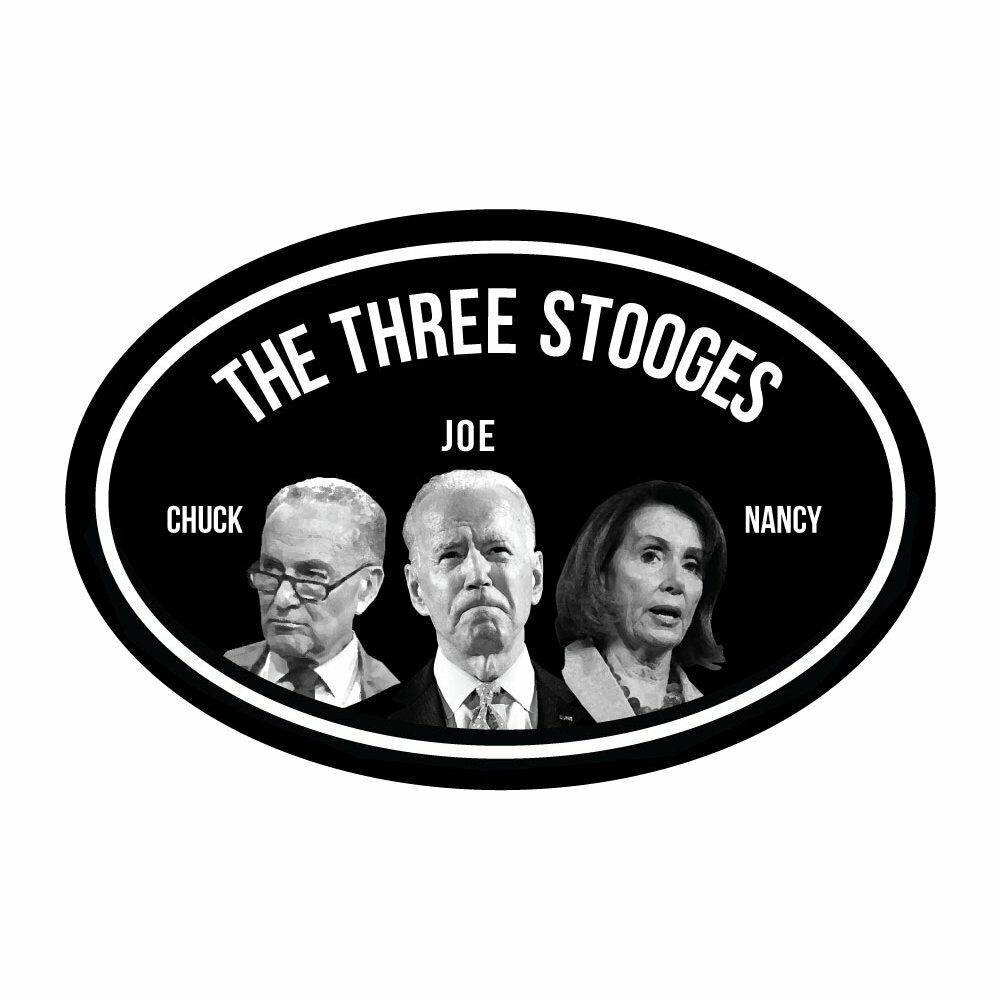
President Joe Biden is not a message guy. Nor is Nancy Pelosi. Nor is Chuck Schumer. The senior leaders of the Democratic Party lack charisma, lack communication skills, and seemingly have no compelling core principles except the usual ones for politicians (raise money, stay in power). I’ve seen plenty of political ads, heard plenty of speeches, read plenty of articles, and what I’ve gathered is that I should vote Democrat because the Republicans are dangerous to democracy and beholden to Trump. And that’s about it for a “message.”
My guess is that this magnet is selling well
Oh, there is one thing. Biden promised he’d attempt to codify Roe v Wade into law if the Democrats can somehow keep control of the House and Senate, which at this point is unlikely for the House and dodgy as well for the Senate. Here’s the problem with that “promise.” In 2007, Barack Obama promised to codify Roe v Wade if he won the presidency, saying it would be his top priority. After he was elected, he changed his mind and did nothing. In 2020, Joe Biden made a similar promise; he has also done nothing in the last two years. Yet now we’re supposed to believe Biden’s new “promise,” even though it’s an obvious and desperate ploy to rally pro-choice forces to vote blue no matter who on Tuesday.
That Democrats are not Republicans is enough for more than a few voters, and I get that. What’s truly shocking is that’s pretty much the Democrats’ message. And it simply isn’t persuasive enough to appeal to undecided voters. More and more voters, fed up with both parties, are “independents” or otherwise unaffiliated, and you have to give them a reason to vote for you other than “the other guy (or gal) is worse.”
Consider, for example, the Democrats and war. Democrats fully support massive budgets for the Pentagon; Democrats fully support $100 billion or more for Ukraine in its war against Russia; Democrats fully embrace the “new Cold War” and aggressive support of Taiwan. Recall that Biden suggested “Putin must go” as a goal of the Ukraine war, and that Nancy Pelosi, that skilled and deft diplomat, traveled to Taiwan to stir up anti-American sentiment in China. If you’re at all interested in slightly downsizing the Pentagon budget, of ratcheting down tensions with Russia and China, of pursuing diplomacy with words instead of weapons, of occasionally fostering the idea of “peace,” today’s Democratic Party is not for you.
As inflation continues to rise, hollowing out the working and middle classes even more, the Democrats have no solutions except higher interest rates and a bit more government aid here and there so that you can keep making (barely) your rent or mortgage payments while putting food on the table and paying for heat. Forget about a higher federal minimum wage. Forget about single-payer health care. Even student loan debt relief is very limited (it may go away completely if the courts rule Biden exceeded his executive authority).
As Democrats lecture people about saving democracy, Americans wonder where democracy went. Obviously, both political parties are beholden to big money, the owners and the donors, and ordinary people have no say, except on Tuesday when we’re each allowed to cast one vote.
I will be voting, of course. As the saying goes, my vote must have some value or the powers that be wouldn’t be spending so much money to buy it. Where possible, I’ll be voting for candidates whose values most closely align with mine. That often means I’ll be voting third party, which my critics tell me is a vote for Trump and his evil minions. Sure, keep on scolding me for wanting honest and principled candidates like Matt Hoh, who’s running for the Senate in North Carolina for the Green Party. It’s all my fault for wanting candidates who truly offer hope and change, instead of more of the same.
Blame the voters, Democrats! It’s a surefire way to victory, if “victory” means another shellacking at the midterms by the Party of Trump. Sigh.
Whatever else is true, it’s not morning again in America.
Shooting for total victory for Ukraine may only lead to total war for the world
Recently, I’ve been discussing the Russia-Ukraine War with a friend. He sees it as a “war of national liberation” for Ukraine and fully supports extensive U.S. military aid in weaponry, intelligence, and logistics. Supporters of Ukraine, he said, are much like those who supported republican Spain against the fascist forces of Franco in the 1930s. Vladimir Putin is a dangerous dictator bent on Ukraine’s total subjugation. He must be stopped, and the best way to ensure that is total military victory for Ukraine. He also opined that Ukraine is winning the war and that the $100 billion or so that the U.S. government has pledged is money well spent.
Once Ukraine wins the war, he concluded, it should be fully integrated into NATO, still a vitally important alliance against Russian imperial expansion and exploitation. Ukraine only seeks to protect its own sovereignty and to join European democracies and the EU, a goal the U.S. should actively seek to facilitate.
I wish I could be as confident and certain as my friend of the nobility of both Ukraine’s cause and U.S. participation in Ukrainian politics and the war. Why am I more skeptical than my friend? For several reasons:
The U.S. government has done nothing to facilitate diplomacy and negotiation between Ukraine and Russia. Indeed, the Biden administration has worked to discourage diplomacy.
Ukraine may see itself as engaged in a “war of national liberation,” but for U.S. officials it’s more of a proxy war to weaken Russia. Various sanctions and the destruction of the Nord Stream pipelines suggest powerful economic and financial motives that have nothing to do with safeguarding Ukrainian territory or its “democracy.”
Undeniably, U.S. aid to Ukraine, commitments of which have already exceeded $100 billion, are a major boon to the military-industrial complex in America. When people profit massively from war and death, it’s reasonable to question their motives.
The U.S. military/government exists to safeguard national security and the U.S. Constitution. In that context, the territorial integrity of Ukraine is not a vital concern.
The danger of military escalation in Europe is real. A longer war means more dead and wounded soldiers on both sides; more destruction and collateral damage; and more inflammatory rhetoric about nuclear red lines, dirty bombs, and the like. The longer the war lasts, the more inflamed passions will become, and the more likely efforts “to end Russian occupation” of Ukraine will escalate into something far more ambitious — and likely far deadlier.
To me, neither side appears to be clearly winning and neither is on the verge of victory. If the war lasts another year, or two, or three, any kind of Ukrainian “victory” may be pyrrhic indeed if the country is a blasted husk as a result.
War is ugly. Long wars are uglier still.
As I explained to my friend, I deplore Putin’s decision back in February to invade. I hope Ukraine prevails. But I believe Russia, Ukraine, and indeed the world would be better off if the war ends via negotiated settlement, the sooner the better. History teaches us that wars often spin out of control when estranged sides insist on total victory.
I added that I’d be careful indeed in placing faith in the wisdom of U.S. leaders or in appeals to ideals of the Lincoln Brigade of the Spanish Civil War of the 1930s. Recent wars (Vietnam, Iraq, Afghanistan, etc.) should teach us how frequently U.S. leaders lie, and how willing they are to wage long and disastrous wars that compromise U.S. security.
Also, talk of “facilitating Ukraine’s liberation” is both open-ended and ill-defined. For the U.S., is that limited to weaponry and training and the like? Or does “facilitating” mean much more than that, including combat by U.S. troops and the risk of dying or being grievously wounded in the cause of Ukraine’s liberation? If the latter, would you send your sons and daughters to fight in such a war?
Talking about Ukrainian national liberation and protecting democracy seems unproblematic, but, as I asked my friend, are you and yours willing to fight and die for it? When did Ukrainian “liberation” become so vitally important to U.S. national defense? So much so that $100 billion or more of your money is sent there, so much so that the 101st Airborne Division is deployed to Romania as a form of tripwire or deterrent, so much so that plans to deploy upgraded U.S. tactical nuclear weapons to Europe are being accelerated even as recent exercises featured dry runs of nuclear weapons attacks.
Already the Russia-Ukraine War has lasted far longer than experts predicted. Already it has cost far more than anyone expected. Shooting for total victory for Ukraine may only lead to total war for the world.
(Please go to Bracing Views on Substack if you’d like to comment.)
Just over 30 years ago, as a young captain in the Air Force, I was celebrating the collapse of the Soviet Union and the arrival of “the new world order.” Those were the days! We talked seriously about peace dividends, about America becoming a normal country in normal times, as in peaceful times. Money on wars and weapons would be redirected to infrastructure improvements and repairs, to critical research in medicine, to improving health care, to renewable sources of energy. America was ready to vault into the 21st century, no longer haunted by a cold war that could end the world in a heartbeat with nuclear war.
Leave it to America to snatch defeat from the jaws of victory. For we truly have defeated ourselves since 1991 in our embrace of militarism, weaponry, and war. And now we face renewed fears of nuclear war without any serious movement to end the proliferation of nuclear weapons. Indeed, the U.S. military speaks of “investing” in more nuclear weapons as if they’re a growth stock, as if there are dividends awaiting us when we cash them in. We’ll all cash in our chips, that’s for sure, if the missiles fly.
We seem possessed by a form of MADness, a certain fondness for mutually assured destruction (MAD). Or, perhaps not fondness but resignation bordering on defeatism, which makes me think of those old posters we had as kids about nuclear war that reminded us there was little we could do once the missiles were launched, so we may as well kiss our ass goodbye.
But the world nevertheless remains full of surprises. Color me amazed by America’s new love of Ukraine, formerly a Soviet republic that most Americans still can’t place on a map. (I’ve seen Americans quizzed on the street who place Ukraine in Mexico or Australia.) We love Ukraine so much that we’re willing to pledge $100 billion or more in aid, most of it in the form of military weapons and training. America has never had a “special relationship” with Ukraine, so what gives? My friends tell me we must defend democracy in Ukraine, but democracy doesn’t exist there (nor does it in America, but that’s another story).
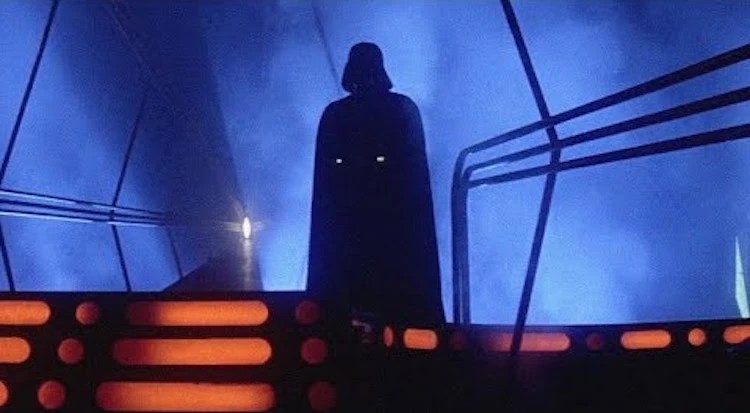
The words of Darth Vader come to mind: “You don’t know the power of the Dark Side [of the Force]. I must obey my master.” And in the case of Congress, that master is obviously the national security state, the MICIMATT of which Congress is a card-carrying member. (MICIMATT: Military-Industrial-Congressional-Intelligence-Media-Academia-Think-Tank Complex.) Think of it as the real “evil empire,” and good luck trying to resist its power and influence.
Yet, how can America have turned to the “dark side”? Isn’t America a collection of Jedi knights fighting for freedom? It sure would be nice to think so! But when you look at America’s wars in places like Vietnam, Iraq, and Afghanistan, what you see is an incredibly rich empire throwing almost everything at countries and peoples who had little if anything compared to the wealth and power of the U.S. and its ferocious military machine. You also see enormous profiteering, especially by the “industrial” side of the America’s militarized complex, and incessant lying by the U.S. government about progress and “winning” in its various misbegotten wars.
Only when military defeat is nearly total do U.S. troops finally come home, after which the peace advocates, relatively few in number, are blamed for weakening fighting spirit at home.
Promises of peace dividends, whether after World War II or the Cold War, have simply withered away as wars of conspicuous destruction (Vietnam, Iraq, etc.) fed a society engaged in conspicuous consumption. A militarized form of Keynesianism provided jobs and wealth for relatively few Americans at the expense of a great many.
Paradoxically, even as America’s wars went bad, no one was ever held accountable. When the warmongers admitted they were wrong (a rarity), they argued they were wrong for the right reasons. And those who were truly right, whether about Vietnam or Iraq or Afghanistan, were obviously right for the wrong reasons. Those “wrong” reasons included preferring peace to war or daring to question the purity of U.S. motives and methods when it came to foreign wars.
And so we’ve come to the point when the so-called Progressives in Congress quickly cave to pressure and withdraw a milquetoast and mealymouthed letter that argued a tiny bit for diplomatic efforts by the Biden administration to end the Russia-Ukraine War. It was as if they’d become quislings; as if calling for negotiation was equivalent to bowing and scraping before Vladimir Putin.
So, I return to my question: Dammit, where’s my peace dividend? And the answer is nowhere because powerful forces in America simply love their war dividends — and they’re not about to surrender them.
Note to readers: If you’d like to comment, please go to Bracing Views on Substack. Thanks.
The U.S. and NATO have apparently decided that the world is better (for them) if Russia is weak and chaotic instead of being comparatively strong and orderly.
Something tells me a strong and orderly Russia might be better. A weak and chaotic Russia, with nuclear weapons, is likely to be far less predictable. For example, who or what comes after Vladimir Putin if he’s overthrown? Is the West sure that a divided or disorganized Russia is a “better” one?
As Margaret Thatcher said of Mikhail Gorbachev, we can do business with him. Putin is a rational actor. Who or what follows him in Russia may be much more vengeful than rational — and vengeance and nukes are a potent, perhaps genocidal, mix.
Recently, I was thinking about the difference between the end stages of the Cold War, when I entered the Air Force in the 1980s, and the current crisis with Russia. To me, one big thing stands out. In the 1980s, the U.S. was willing to negotiate on equal terms with the USSR. Reagan and Gorbachev, despite their differences, talked to each other with respect. Today, Joe Biden refers to Putin and the Russians with disdain. Biden seems to see Putin as little more than a thug, someone not worth talking to. As Biden himself said, “For God’s sake, this man cannot remain in power.”
The U.S. has been a dominant superpower for so long that its leaders simply take it for granted and have little (if any) empathy for others. Weakening Russia is not a sign of American cleverness or strength but rather of shortsightedness.
In the 1980s, Reagan and Gorbachev talked sincerely of nuclear arms reductions, even of their eventual elimination. Nothing like this exists today. Indeed, the U.S. now speaks of “investing” in a new generation of nuclear weapons at a cost of a trillion dollars (or more). Basically, the U.S. is in a nuclear arms race with itself, even as Russia and China are trotted out as the looming nuclear threats.
In demonizing Putin and Russia, the U.S. is closing doors to negotiation and potentially opening missile silo doors to obliteration. By not bargaining at all, Biden and company are not being resolute, they’re being pigheaded.
As Winston Churchill famously said, “Meeting jaw to jaw is better than war.” Politics and war are not and should not be antithetical to each other. A negotiated settlement is better than more dead Ukrainians, more dead Russians, more blasted terrain, and even higher risks of nuclear escalation.
Haven’t we heard enough already about nuclear red lines and dirty bombs? Stability is what’s needed today based on some measure of respect, however grudgingly given. If avowed Cold War warriors like Reagan and Thatcher in the 1980s could do business with Gorbachev and the Soviet Union, America’s leaders today, from a much stronger position, should be able and willing to do business with Putin.
This is not about appeasing or rewarding Putin for his invasion. It’s about stopping a war before it potentially grows wider — and far more deadly.
Note for readers: If you care to comment on this post, please go to Bracing Views on Substack. Thanks.
It seems strange to me how America’s leadership is spoiling for a new world war. Most Americans wanted revenge against Japan after Pearl Harbor in 1941 and understood the dangers of Nazism and Germany’s quest for world dominance, but why is risking a world war necessary in defense of Ukraine or Taiwan?
Here’s my take: Let Ukraine and Russia settle their differences. Let China and Taiwan settle their differences. The fate of Ukraine or Taiwan has almost nothing to do with U.S. national security.
No other nation on the planet defines the entire world as its sphere of influence. Only in America is the fate of faraway countries like Ukraine or Taiwan tied directly to our fate. It’s like Russia being worried about the U.S./Mexican border or China taking a direct hand in defending Cuba against America.
Maybe what we need is a new Monroe Doctrine. Instead of warning others to stay out of “our” hemisphere, Americans need to vow that we remain in “our” hemisphere, because what happens in Taiwan largely stays in Taiwan, and what happens in Ukraine largely stays in Ukraine. Neither fundamentally compromises our national security and neither directly threatens our Constitution and way of life.
But we must stand up to Putin! We must stand up to Xi! If we don’t stop them over there, we’ll have to stop them here! To that I say, let’s wait and see. Any country foolish enough to invade America will face a heavily armed and inflamed people who are ready to rumble.
It’s time to stop spoiling for a new world war. Sadly, at least three big problems constrain Americans in plotting a saner course:
Wars and preparations for war are immensely profitable for weapons makers.
Domestic politics, as both parties accuse the other of being weak on China or Russia or both, driving both parties into the arms of hawks.
The mainstream media, which never met a war it didn’t like, as long as ratings are high.
How do we fix this? Levy a war tax on the richest Americans for all the weaponry and other aid being sent to Ukraine and Taiwan and elsewhere. Stop voting for candidates who always vote for more and more war. Stop listening to the mainstream media and their warmongering.
One thing is certain: war is too important to be left to the generals, the Beltway bandits, and the usual neocon suspects who posture about putting on big boy pants while sitting safely in corner offices.
I haven’t written much about the progress of the Russia-Ukraine War. I have no special insight into what’s going on in Ukraine, or in Putin’s head, but I think I know something about the USA and its leadership.
The war itself: Russia and Ukraine are both losing. Russia is losing men and materiel; Ukraine is losing land and suffering all the destruction of a war fought on their turf. Many Americans seem to be cheering Ukraine and its resolute resistance, but at what cost, and for what purpose?
Historical analogies: American commentators like to refer to 1938 and Munich. Putin, naturally, is Hitler, and the world must stand up to him since Ukraine is only the first country on his list of potential conquests. If Putin wins in Ukraine, Poland would be next. Or the Baltic States. Because Putin wants to re-create the Soviet empire. Or the Russia of the Tsars.
But I think it’s much more like 1914. A regional conflict that may spin wildly out of control as more and more countries get swept into its escalatory spiral. Russian threats and nuclear red lines are more than worrisome. After all, wars are inherently chaotic and unpredictable, often creating their own bizarre logic of what’s right and wrong, what’s rational and irrational. Anyone who thinks they know how this war is going to end is overestimating the predictability of war. We’re all engaged in guess-work, and where nuclear threats are involved, guess-work is less than reassuring.
The Russia-Ukraine War could escalate to a world war: Already we’ve seen major economic sanctions involving the US, NATO countries, and Russia. Already we’ve seen Russia working with China and other countries to sell its fuel and other products as it seeks to evade those sanctions. Already we’ve seen inflation and recession in the US economy that can be tied back to those sanctions. Meanwhile, the US and NATO have sent tens of billions in weaponry to Ukraine to wage its war, which, to be blunt, is a form of proxy war for the US and NATO. The US president has called for regime change in Russia, declaring that Putin must go. Both Nord Stream pipelines have been attacked. This is not a simple regional war between Russia and Ukraine. It’s already a war with global implications openly funded by the US with the explicit goal of weakening Russia and removing Putin from power.
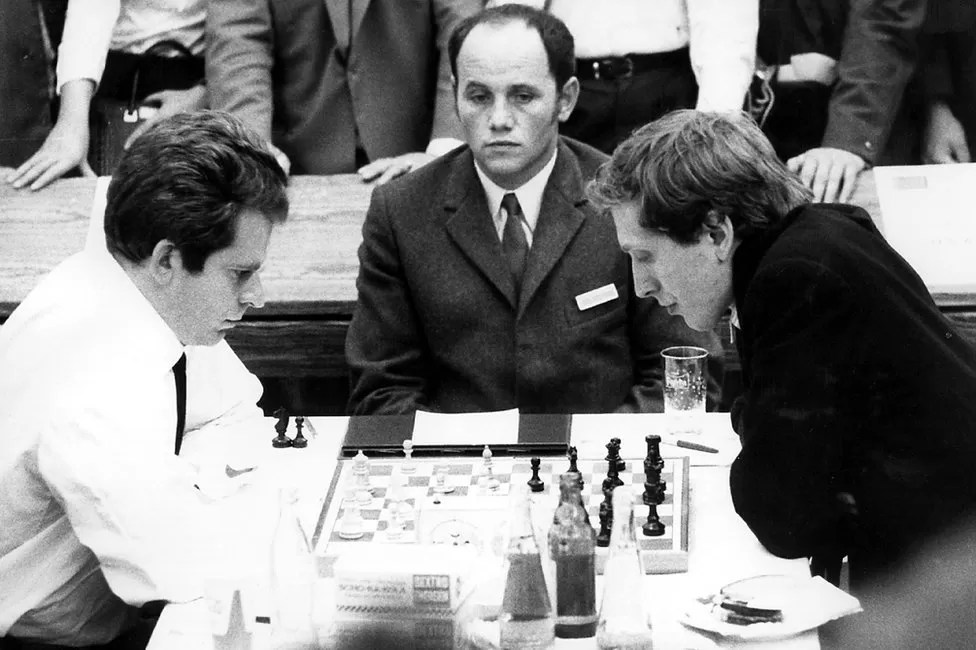
Boris Spassky versus Bobby Fischer: the good old days
To use chess terminology, the war still appears to be in its opening stages. Perhaps the middle game has begun; what’s certain is the end game is nowhere in sight. As Matt Taibbi recently noted, the Washington Post observed that “recent events have only added to the sense that the war will be a long slog,” and “all of this adds up to a war that looks increasingly open-ended.” Even worse, the paper noted:
Privately, U.S. officials say neither Russia nor Ukraine is capable of winning the war outright, but they have ruled out the idea of pushing or even nudging Ukraine to the negotiating table. They say they do not know what the end of the war looks like, or how it might end or when, insisting that is up to Kyiv.
Taibbi’s response is telling: “What??? If the White House doesn’t think the war can be won, but also refuses to negotiate itself, or ‘nudge’ others to do it for them, what exactly is its end strategy? Waiting for things to get worse and then reassessing?”
To return to chess: In games involving highly skilled players, often draws are agreed upon early in the middle game, as both players realize they have no prospects for victory and that further play will merely prolong the inevitable. It’s time for the major players in this conflict to agree to some version of a draw, a negotiated settlement, an end to conflict. Chess, after all, is just a game. The players don’t have to worry about dying in a nuclear cataclysm. We do.
Winning a war based on lies is truly a fool’s errand, which is why the U.S. military’s record since World War II is so poor. Yet no one is ever held responsible for these lies, which suggests something worse than a losing military: one that is without honor, especially among the brass. That’s the theme of my latest article for TomDispatch, which is appended below in its entirety.
As a military professor for six years at the U.S. Air Force Academy in the 1990s, I often walked past the honor code prominently displayed for all cadets to see. Its message was simple and clear: they were not to tolerate lying, cheating, stealing, or similar dishonorable acts. Yet that’s exactly what the U.S. military and many of America’s senior civilian leaders have been doing from the Vietnam War era to this very day: lying and cooking the books, while cheating and stealing from the American people. And yet the most remarkable thing may be that no honor code turns out to apply to them, so they’ve suffered no consequences for their mendacity and malfeasance.
Where’s the “honor” in that?
It may surprise you to learn that “integrity first” is the primary core value of my former service, the U.S. Air Force. Considering the revelations of the Pentagon Papers, leaked by Daniel Ellsberg in 1971; the Afghan War papers, first revealed by the Washington Post in 2019; and the lack of weapons of mass destruction in Iraq, among other evidence of the lying and deception that led to the invasion and occupation of that country, you’ll excuse me for assuming that, for decades now when it comes to war, “integrity optional” has been the true core value of our senior military leaders and top government officials.
As a retired Air Force officer, let me tell you this: honor code or not, you can’t win a war with lies — America proved that in Vietnam, Afghanistan, and Iraq — nor can you build an honorable military with them. How could our high command not have reached such a conclusion themselves after all this time?
So Many Defeats, So Little Honesty
Like many other institutions, the U.S. military carries with it the seeds of its own destruction. After all, despite being funded in a fashion beyond compare and spreading its peculiar brand of destruction around the globe, its system of war hasn’t triumphed in a significant conflict since World War II (with the war in Korea remaining, almost three-quarters of a century later, in a painful and festering stalemate). Even the ending of the Cold War, allegedly won when the Soviet Union collapsed in 1991, only led to further wanton military adventurism and, finally, defeat at an unsustainable cost — more than $8 trillion — in Washington’s ill-fated Global War on Terror. And yet, years later, that military still has a stranglehold on the national budget.
So many defeats, so little honesty: that’s the catchphrase I’d use to characterize this country’s military record since 1945. Keeping the money flowing and the wars going proved far more important than integrity or, certainly, the truth. Yet when you sacrifice integrity and the truth in the cause of concealing defeat, you lose much more than a war or two. You lose honor — in the long run, an unsustainable price for any military to pay.
Or rather it should be unsustainable, yet the American people have continued to “support” their military, both by funding it astronomically and expressing seemingly eternal confidence in it — though, after all these years, trust in the military has dipped somewhat recently. Still, in all this time, no one in the senior ranks, civilian or military, has ever truly been called to account for losing wars prolonged by self-serving lies. In fact, too many of our losing generals have gone right through that infamous “revolving door” into the industrial part of the military-industrial complex — only to sometimes return to take top government positions.
Our military has, in fact, developed a narrative that’s proven remarkably effective in insulating it from accountability. It goes something like this: U.S. troops fought hard in [put the name of the country here], so don’t blame us. Indeed, you must support us, especially given all the casualties of our wars. They and the generals did their best, under the usual political constraints. On occasion, mistakes were made, but the military and the government had good and honorable intentions in Vietnam, Afghanistan, Iraq, and elsewhere.
Besides, were you there, Charlie? If you weren’t, then STFU, as the acronym goes, and be grateful for the security you take for granted, earned by America’s heroes while you were sitting on your fat ass safe at home.
It’s a narrative I’ve heard time and time again and it’s proven persuasive, partially because it requires the rest of us, in a conscription-free country, to do nothing and think nothing about that. Ignorance is strength, after all.
War Is Brutal
The reality of it all, however, is so much harsher than that. Senior military leaders have performed poorly. War crimes have been covered up. Wars fought in the name of helping others have produced horrendous civilian casualties and stunning numbers of refugees. Even as those wars were being lost, what President Dwight D. Eisenhowerfirst labeled the military-industrial complex has enjoyed windfall profits and expanding power. Again, there’s been no accountability for failure. In fact, only whistleblowing truth-tellers like Chelsea Manning and Daniel Hale have been punished and jailed.
Ready for an even harsher reality? America is a nation being unmade by war, the very opposite of what most Americans are taught. Allow me to explain. As a country, we typically celebrate the lofty ideals and brave citizen-soldiers of the American Revolution. We similarly celebrate the Second American Revolution, otherwise known as the Civil War, for the elimination of slavery and reunification of the country; after which, we celebrate World War II, including the rise of the Greatest Generation, America as the arsenal of democracy, and our emergence as the global superpower.
By celebrating those three wars and essentially ignoring much of the rest of our history, we tend to view war itself as a positive and creative act. We see it as making America, as part of our unique exceptionalism. Not surprisingly, then, militarism in this country is impossible to imagine. We tend to see ourselves, in fact, as uniquely immune to it, even as war and military expenditures have come to dominate our foreign policy, bleeding into domestic policy as well.
If we as Americans continue to imagine war as a creative, positive, essential part of who we are, we’ll also continue to pursue it. Or rather, if we continue to lie to ourselves about war, it will persist.
It’s time for us to begin seeing it not as our making but our unmaking, potentially even our breaking — as democracy’s undoing as well as the brutal thing it truly is.
A retired U.S. military officer, educated by the system, I freely admit to having shared some of its flaws. When I was an Air Force engineer, for instance, I focused more on analysis and quantification than on synthesis and qualification. Reducing everything to numbers, I realize now, helps provide an illusion of clarity, even mastery. It becomes another form of lying, encouraging us to meddle in things we don’t understand.
This was certainly true of Secretary of Defense Robert McNamara, his “whiz kids,” and General William Westmoreland during the Vietnam War; nor had much changed when it came to Secretary of Defense Donald Rumsfeld and General David Petraeus, among others, in the Afghan and Iraq War years. In both eras, our military leaders wielded metrics and swore they were winning even as those wars circled the drain.
And worse yet, they were never held accountable for those disasters or the blunders and lies that went with them (though the antiwar movement of the Vietnam era certainly tried). All these years later, with the Pentagon still ascendant in Washington, it should be obvious that something has truly gone rotten in our system.
Here’s the rub: as the military and one administration after another lied to the American people about those wars, they also lied to themselves, even though such conflicts produced plenty of internal “papers” that raised serious concerns about lack of progress. Robert McNamara typically knew that the situation in Vietnam was dire and the war essentially unwinnable. Yet he continued to issue rosy public reports of progress, while calling for more troops to pursue that illusive “light at the end of the tunnel.” Similarly, the Afghan War papers released by the Washington Post show that senior military and civilian leaders realized that war, too, was going poorly almost from the beginning, yet they reported the very opposite to the American people. So many corners were being “turned,” so much “progress” being made in official reports even as the military was building its own rhetorical coffin in that Afghan graveyard of empires.
Too bad wars aren’t won by “spin.” If they were, the U.S. military would be undefeated.
Two Books to Help Us See the Lies
Two recent books help us see that spin for what it was. In Because Our Fathers Lied, Craig McNamara, Robert’s son, reflects on his father’s dishonesty about the Vietnam War and the reasons for it. Loyalty was perhaps the lead one, he writes. McNamara suppressed his own serious misgivings out of misplaced loyalty to two presidents, John F. Kennedy and Lyndon B. Johnson, while simultaneously preserving his own position of power in the government.
Robert McNamara would, in fact, later pen his own mea culpa, admitting how “terribly wrong” he’d been in urging the prosecution of that war. Yet Craig finds his father’s late confession of regret significantly less than forthright and fully honest. Robert McNamara fell back on historical ignorance about Vietnam as the key contributing factor in his unwise decision-making, but his son is blunt in accusing his dad of unalloyed dishonesty. Hence the title of his book, citing Rudyard Kipling’s pained confession of his own complicity in sending his son to die in the trenches of World War I: “If any question why we died/Tell them, because our fathers lied.”
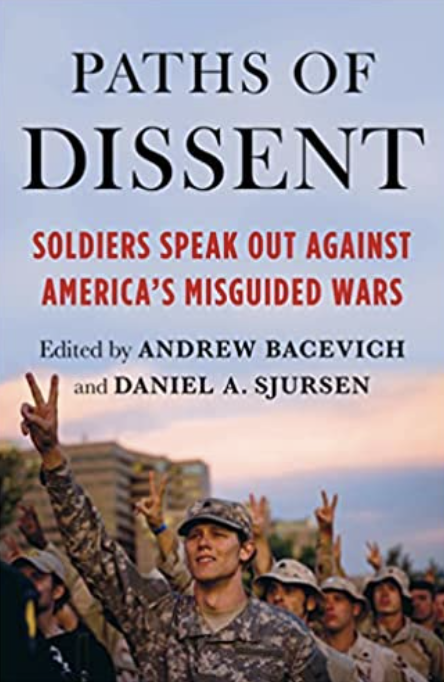
The second book is Paths of Dissent: Soldiers Speak Out Against America’s Misguided Wars, edited by Andrew Bacevich and Danny Sjursen. In my view, the word “misguided” doesn’t quite capture the book’s powerful essence, since it gathers 15 remarkable essays by Americans who served in Afghanistan and Iraq and witnessed the patent dishonesty and folly of those wars. None dare speak of failure might be a subtheme of these essays, as initially highly motivated and well-trained troops became disillusioned by wars that went nowhere, even as their comrades often paid the ultimate price, being horribly wounded or dying in those conflicts driven by lies.
This is more than a work of dissent by disillusioned troops, however. It’s a call for the rest of us to act. Dissent, as West Point graduate and Army Captain Erik Edstrom reminds us, “is nothing short of a moral obligation” when immoral wars are driven by systemic dishonesty. Army Lieutenant Colonel Daniel Davis, who blew an early whistle on how poorly the Afghan War was going, writes of his “seething” anger “at the absurdity and unconcern for the lives of my fellow soldiers displayed by so many” of the Army’s senior leaders.
Former Marine Matthew Hoh, who resigned from the State Department in opposition to the Afghan “surge” ordered by President Barack Obama, speaks movingly of his own “guilt, regret, and shame” at having served in Afghanistan as a troop commander and wonders whether he can ever atone for it. Like Craig McNamara, Hoh warns of the dangers of misplaced loyalty. He remembers telling himself that he was best suited to lead his fellow Marines in war, no matter how misbegotten and dishonorable that conflict was. Yet he confesses that falling back on duty and being loyal to “his” Marines, while suppressing the infamies of the war itself, became “a washing of the hands, a self-absolution that ignores one’s complicity” in furthering a brutal conflict fed by lies.
As I read those essays, I came to see anew how this country’s senior leaders, military and civilian, consistently underestimated the brutalizing impact of war, which, in turn, leads me to the ultimate lie of war: that it is somehow good, or at least necessary — making all the lying (and killing) worth it, whether in the name of a victory to come or of duty, honor, and country. Yet there is no honor in lying, in keeping the truth hidden from the American people. Indeed, there is something distinctly dishonorable about waging wars kept viable only by lies, obfuscation, and propaganda.
An Epigram from Goethe
John Keegan, the esteemed military historian, cites an epigram from Johann Wolfgang von Goethe as being essential to thinking about militaries and their wars. “Goods gone, something gone; honor gone, much gone; courage gone, all gone.”
The U.S. military has no shortage of goods, given its whopping expenditures on weaponry and equipment of all sorts; among the troops, it doesn’t lack for courage or fighting spirit, not yet, anyway. But it does lack honor, especially at the top. Much is gone when a military ceases to tell the truth to itself and especially to the people from whom its forces are drawn. And courage is wasted when in the service of lies.
Courage wasted: Is there a worst fate for a military establishment that prides itself on its members being all volunteers and is now having trouble filling its ranks?
A colleague who teaches at one of America’s many war schools tells me that great power competition is trendy again, the U.S., it goes without saying, being the greatest power of all, and China and Russia being the main “near-peer” rivals to greatness. The competition, of course, is defined primarily in military terms and is measured, at least at the Pentagon, by the amount of money Congress allocates to each year’s defense budget. Thus the U.S. military, in (falsely) arguing that it’s falling behind the Chinese navy in ships, for example, establishes the quick-fix solution as lots more money for the U.S. Navy to build more ships. Similarly, the Air Force wants more F-35 jet fighters, B-21 nuclear bombers, and new land-based ICBMs, also measures of “greatness,” and the Army wants 500,000 troops on active duty, presumably because it’s a nice round number, even as it’s failing miserably to meet yearly recruiting goals, forcing it to settle on a force of roughly 450,000 (more or less) effectives.
Naturally, the solution is never to downsize the mission given a somewhat smaller force; it’s to do whatever is possible to expand the pool of recruits, even if that means “fat camps” and remedial teaching to help potential soldiers reach weight goals and test scores so that they qualify for basic training. Too fat or too dumb? Join the pre-Army! Lose weight fast and get smart quick so that you too can eventually enlist and be sent to foreign lands to kill people.
Recruitment shortfalls is a micro issue garnering attention in Congress even as the macro issue of China and Russia as great power competitors serves as a welcome change of subject from colossal military failures in Iraq and Afghanistan. And there’s the rub: the U.S. military has learned nothing from those failures except, as Barack Obama might say, to look forward, not backward, and to inflate China and Russia from regional powers to near-pears or even to peers. As my war school colleague put it to me, somewhat ambiguously, “they” have big battalions and lots of nukes and have shown the will to use them, so America must be ready to respond in kind. Yet the only country to have used nukes against cities is the United States at Hiroshima and Nagasaki, and the U.S. continues to outspend China on weapons and war roughly by a factor of three and Russia by a factor of ten.
So, which country is really driving all this militarized “competition” among the so-called great powers?




 Bracing Views