Shootings are all over the news today. A young woman killed in rural New York when she drove up the wrong driveway and the owner of the house came out blasting. A Black teenager shot and wounded when he mixed up an address and knocked on the wrong door in Kansas City. And a news flash from The Boston Globe this PM reporting that at least four people have been killed and three more wounded in two shootings in Maine.
America has so many deadly shootings on a daily basis that they hardly qualify as news anymore. What gives?
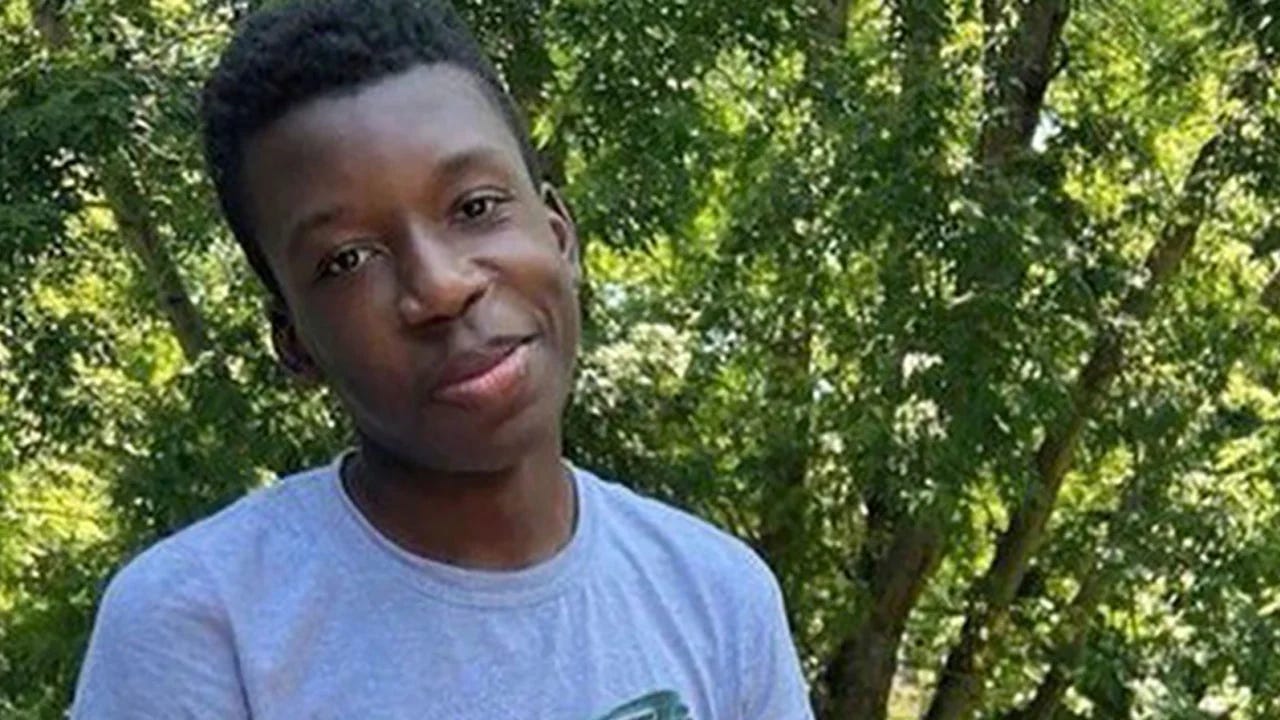
Ralph Yarl, shot and wounded when he mixed up an addressKaylin Gillis, shot and killed in rural NY
No guns, no shootings, of course, but America is awash in guns, and no one is going to pry them from the hands of those who want them.
You’d think brandishing a gun would be enough of a threat, but far too often, those who have guns seem eager to use them as well. Why shoot at a car that pulls in your driveway, even as the car is turning around and leaving? Why shoot at a young Black man for simply walking up and knocking on the door? In both cases, the shooters pulled the trigger at least twice, and apparently used no warning shots or for that matter any other kind of warning. It’s shoot first, ask questions later, in this man’s America.
There’s a weird toxic brew at work here, I think. First, the guns themselves. I’ve fired plenty of them and they do give you a feeling of power. Second, fear. People are fearful. Sometimes the fear may be race-based, sometimes it’s something else, but there’s nothing like fear to paralyze the mind. Then there’s a fantasy element. Some people, mostly men I’m guessing, think they’re akin to Dirty Harry, blowing away bad people with their guns. Finally, sadly, some people just find guns to be fun, even when they’re pointing them at other people.
I know it’s more complicated than this, but fear, fantasy, and fun don’t mix well with guns. In America, guns are WMD: weapons of mass destruction. Because of their deadly power, they should be used only in the rarest of circumstances and as a last resort.
Yet Americans seem to be grabbing their guns and blasting away as a first resort and with no remorse.
Stay safe out there. And to those with guns, why not just call 911? Or keep your door locked? Do you really want to take the life of an innocent just because you felt afraid or angry and fancied yourself a vigilante?
Yet another mass shooting, this one in Louisville, Kentucky, and once again I marvel at the language used to describe such occurrences. The shooting that left five dead at a bank was described as a “tragic event,” akin to a tornado, something that simply can’t be prevented. The “heroes” were the responding police officers, and they certainly deserve credit for their bravery in confronting the shooter and killing him (one officer remains in critical condition).
What is to be said that hasn’t been already said? We live in a violent society with roughly 400 million guns, and we’ve already seen 146 mass shootings in 2023, according to the Gun Violence Archive. Democrats, of course, advocate for an assault rifle ban or other half-measures, knowing that they won’t have to follow through since Republicans control the House and will block gun control measures.
Perhaps the folly of all this is captured by the Onion headline that they repeat for nearly every mass shooting: ‘No Way To Prevent This,’ Says Only Nation Where This Regularly Happens. That about covers it.
Turning to the Pentagon, leaked papers are on the Internet that reveal Ukraine’s position is tenuous in its war with Russia. To summarize quickly, Ukrainian air defenses are short on missiles, Ukrainian forces are short on ammo, and offensive prospects look grim for this year. Senior American officials expect continued stalemate in the war, even as “happy talk” of a smashing Ukrainian spring offensive toward Crimea is spouted in some circles of the mainstream media. The leaked papers also reveal apparent U.S. spying on allies such as South Korea, not exactly a good look for America.
What’s revealing is how the mainstream media takes the Pentagon’s side, basically deploring the leak of this classified information and calling for more censorship on the Internet. I take the opposite tack. In a democracy, government actions are supposed to be transparent to us. I want to know what my government is up to; we all should. Certainly, the media should want to know. Instead, we’re encouraged to side with the Pentagon, perhaps the most powerful and secretive agency of the government.
And so we learned that our government continues to spy on allies even as it continues to provide massive amounts of military aid to Ukraine in a war that is currently a grinding stalemate and about which senior officials are far more pessimistic in private than they are in public. Valuable information, I’d say, that shouldn’t be kept secret from us.
The juxtaposition of these two stories suggests a possible solution to both. America has far too many guns and far too much ammo in private hands. Ukraine needs guns and ammo. Is it time for a “guns and ammo” drive for Ukraine across America? “Save Ukraine—donate your assault rifles and bullets!” Yes, I’m joking. I guess the violent reality of America is making me more than a bit crazy.
A friend sent along an article on Philip K. Dick, the science fiction author whose works have been turned into Hollywood films like “Blade Runner” and “Minority Report.” Dick had this to say about societal trends toward narrative construction and information control:
“We live in a society in which spurious realities are manufactured by the media, by governments, by big corporations. We are bombarded with pseudo-realities manufactured by very sophisticated people using very sophisticated electronic mechanisms. I do not distrust their motives. I distrust their power. They have a lot of it. And it is an astonishing power: that of creating whole universes, universes of the mind. I ought to know. I do the same thing.”
Dick wrote this in the 1970s. If he were writing today, I’m guessing he’d add that he distrusted their motives as well as their power.
Philip K. Dick
False narratives and pseudo-realities are everywhere. Today at TomDispatch, Noam Chomsky highlights the false narrative that global warming simply doesn’t exist, or that it does exist but that it’s a completely natural process that humans can do nothing about. This is perhaps the most dangerous false narrative we face today. That we can simply ignore humanity’s impact on nature—which is convenient for those profiting from the exploitation of the earth’s resources, such as fossil fuels.
Another pseudo-reality we face is that America’s national security is constantly threatened by “near-peer” rivals bent on our destruction. This “reality” drives colossal military spending as next year’s Pentagon budget soars toward $900 billion. A related “reality” is that the world is made safer by more thermonuclear warheads and weapons, a false narrative that the Pentagon is betting on to the tune of $2 trillion over the next thirty years.
Why generate this pseudo-reality? Because the Pentagon gains power and corporations profit greatly. Meanwhile, regular working folk, whose lives could be improved and empowered by a $2 trillion investment in their health and well-being, are left to struggle and suffer. They are, in a word, disempowered.
I remain at a loss how Joe Sixpack’s life is made better by B-21 stealth bombers, Sentinel ICBMs, and Columbia-class nuclear-missile-firing submarines.
With Donald Trump’s peccadilloes once again dominating the news cycle, essential stories about climate change and Armageddon-enabling nuclear weapons are mostly ignored. We are encouraged to take sides, for or against, an aging con man and his payola to a porn star and a Playboy bunny; we are told this is a matter of grave national concern requiring wall-to-wall media coverage, even as natural disasters exacerbated by climate change surge around us and even as nuclear war grows ever more possible.
Time to face reality, America. As Dick also wrote, “Reality is that which, when you stop believing in it, doesn’t go away.” Those nuclear weapons aren’t going away, nor is the threat of climate change.
Welcome to the era of state-sponsored thought police
Yesterday, journalists Matt Taibbi and Michael Shellenberger testified before the House Select Subcommittee on the Weaponization of the Federal Government. Their testimony, and the risible reactions of Democrats on the subcommittee, are well worth watching; I watched the entire hearing, which lasted 140 minutes. Kim Iverson has an excellent summary here which lasts about 23 minutes. As Iverson notes, the Democrats on the subcommittee demonized the journalists while supporting censorship of ordinary Americans for political advantage, a clear violation of freedom of speech and the First Amendment to the U.S. Constitution.
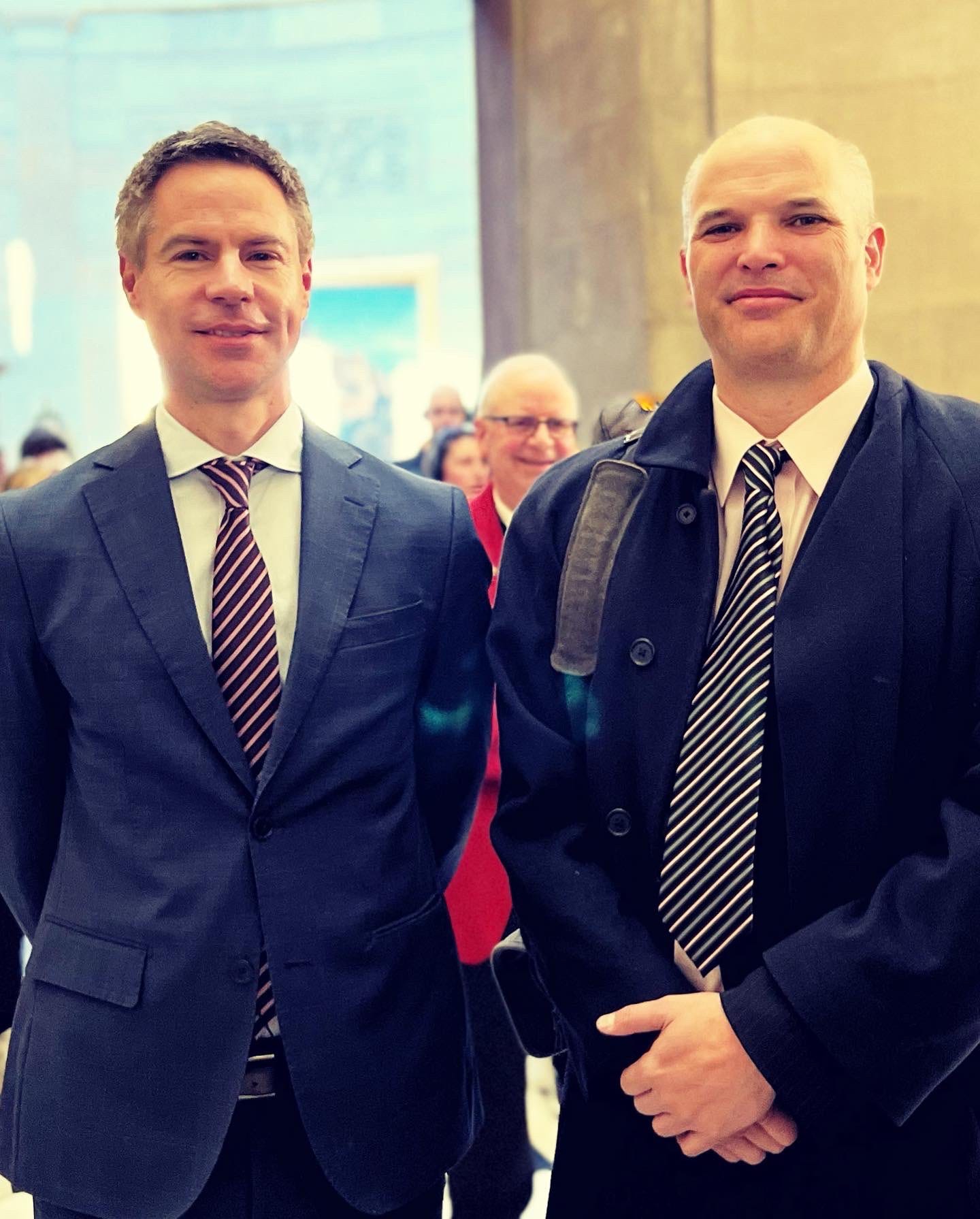
Shellenberger and Taibbi, “so-called” journalists according to Democrats
Clearly, the Twitter Files have revealed government-directed censorship of lawful speech. The reactions and strategy of the Democrats on the subcommittee were as follows:
To smear the two journalists who volunteered to appear before Congress as “so-called” journalists; as being biased witnesses in favor of the right (even though Shellenberger testified he’d voted for Biden, and Taibbi described himself as a traditional ACLU liberal); as having the basest of motives, such as taking payments and otherwise profiting from their journalism; and of being willing or unwilling dupes of Elon Musk.
To repeat, again and again, that Russia massively interfered in the 2016 and 2020 elections, therefore government-directed efforts to suppress “foreign interference” in U.S. elections was both legitimate and praiseworthy.
To associate Elon Musk with Qatar, Saudi Arabia, Russia, China, and other alleged bad actors, thereby suggesting that the Twitter Files are tainted and compromised by foreign information ops and influence.
To defend the FBI and other government agencies like the DHS and CIA as trustworthy and reliable defenders of truth as well as upholders of the First Amendment.
To suggest that the journalists involved posed a “direct threat,” e.g. to workers at Twitter, not the federal government or powerful corporations like Twitter itself or Facebook.
To imply the subcommittee’s purpose wasn’t about free speech at all; that its purpose was purely political and intended to advance right-wing agendas.
Specific to the Hunter Biden laptop story, one Democrat implied the hard drive could have been altered, thus calling into question the validity of emails and other data on that drive.
To change the subject by accusing Republicans of being worse offenders since they’re trying to ban books; also that Donald Trump is worse because he jailed one of his opponents.
Not one Democrat on the subcommittee expressed concern about the peril of state-sponsored censorship and suppression of free expression. Indeed, the Democrats took pains to portray the journalists in front of them as the real peril, along with Russia, Elon Musk, Republican book-banners, and other bad actors.
It was all rather amazing, a “shit storm” to quote Kim Iverson.
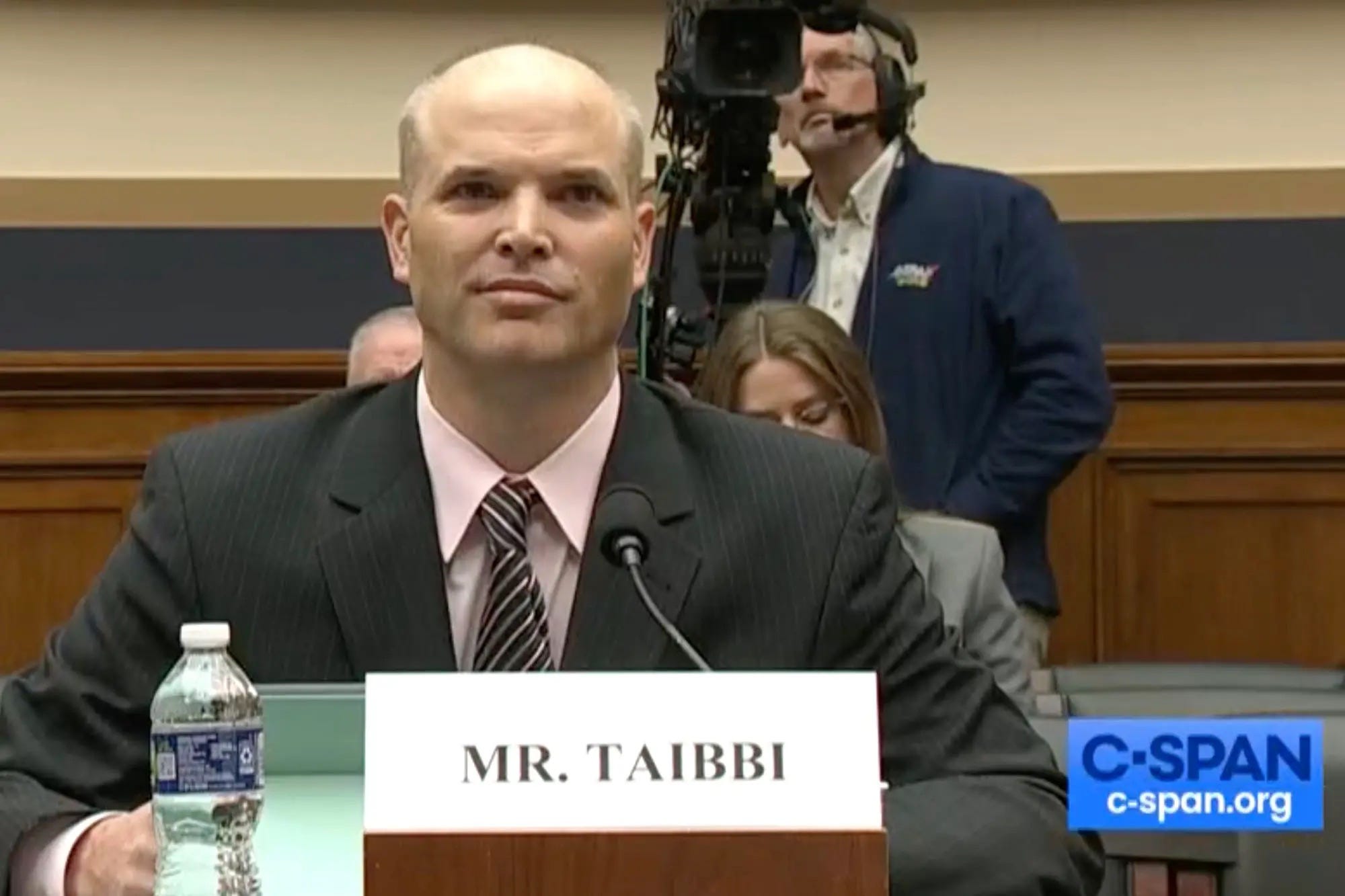
Matt Taibbi, award-winning journalist with 30 years’ experience, dismissed as an Elon Musk tool by Democrats
So many important points made by Taibbi and Shellenberger could easily get lost in this political shit storm, which I suppose was the Democrats’ strategy. Here’s a short list of those points:
As Taibbi said, state-directed censorship on Twitter didn’t just affect the right but also people on the left and publications like Consortium News and Truthout.
We’re looking at an emerging censorship-industrial complex, an unholy alliance between government and private corporations to filter, constrain, and otherwise control information sources. A form of “digital McCarthyism.”
Ordinary Americans are being deprived of their free speech rights without due process. Not only that: some are de-platformed and then denied access to pay sources (like PayPal) as punishment. So, not only can’t you speak freely: you also can’t support yourself financially.
Government calls (in this case by the FTC) to investigate the backgrounds of Taibbi, Shellenberger, and other journalists involved in the Twitter Files creates a chilling effect on journalism. As Shellenberger noted, it’s reminiscent of the Stasi (secret police) in East Germany.
Democrats on the subcommittee had no interest in any of this. Their strategy was to dismiss the hearing as politically motivated and the journalists involved as greedy opportunists handpicked by Elon Musk (whom, you might recall, was associated with Qatar, Saudi Arabia, Russia, China, and perhaps Hitler, Stalin, and Darth Vader).
Interestingly, I learned a new word in the hearings: “pre-bunking.” Apparently, the Democrats in 2020 knew the Republicans had Hunter Biden’s laptop, so they engaged in an exercise to “pre-bunk” the release of embarrassing details from that computer. To wit, mainstream media “journalists” were encouraged not to follow the “Pentagon Papers” model of publishing leaked and legitimate material quickly. Rather, they were primed not to cover such a story, or to cover it as a case of Russian disinformation.
And that’s exactly what the mainstream media did in October 2020: as a group, they wrongly dismissed the Hunter Biden laptop revelations as Russian disinformation as the government worked hand-in-glove with Twitter, Facebook, and others to suppress the story as malicious and false. As we now know (and as was known then), the Hunter Biden laptop story was well-sourced and accurate. There was no Russian connection whatsoever. (Kudos to the Democrats for their dirty tricks here; even Richard Nixon couldn’t have done it better.)
Again, Democrats on the subcommittee showed no interest in or concern about an emerging censorship-industrial complex and its suppression of free speech rights. They painted the journalists before them as bad or sketchy actors and the FBI and other government agencies like DHS and the CIA as the good guys, working selflessly and without bias to protect us all from the “dangerous” ideas of our fellow citizens.
Welcome to the era of state-sponsored thought police, brought to you by your Democratic friends in Congress.
Addendum (3/11): All those Democrats so eager to pillory Taibbi and Shellenberger: they all took an oath to support and uphold the Constitution.
I’m not sure there’s any more fundamental right to that oath than freedom of speech.
If you take your oath seriously as a Member of Congress, your focus at the hearing should — must — have been on upholding that fundamental right against government-directed interference and censorship.
Yet none of them mentioned this or their oath — their sworn duty — to the Constitution.
This is worse than mendacity; they are derelict in their duties as representatives and public servants.
I never miss a Super Bowl, and this year’s game was close until its somewhat anti-climatic end. Of course, there’s always a winning team and a losing one, but perhaps the biggest winner remains the military-industrial complex, which is always featured and saluted in these games.
How so? The obligatory military flyover featured Navy jets flown by female pilots. Progress! The obligatory shot of an overseas (or on-the-sea) military unit featured the colorful crew of the USS Carl Vinson, an aircraft carrier. A Marine Corps color guard marched out the American flag along with the flags of each of the armed services. The announcers made a point to “honor those who fight for our nation.” All this is standard stuff, a repetitive ritual that turns the Super Bowl into Veterans Day, if only for a few minutes.
What was new about this year’s ceremony was the celebration of Pat Tillman’s life, the sole NFL player (and I think the only athlete in any of America’s “major” sports leagues) to give up his career and hefty paycheck to enlist in the U.S. military after 9/11. Yes, Pat Tillman deserves praise for that, and since the game was played in Arizona and Tillman had been with the Arizona Cardinals, honoring him was understandable. Yet, the network (in this case, Fox) quickly said he’d “lost his life in the line of duty.” No further details.
Pat Tillman’s glorious statue
Tillman was killed in a friendly-fire incident that was covered up by the U.S. military in a conspiracy that went at least as high as Secretary of Defense Donald Rumsfeld. The military told the Tillman family Pat had died heroically in combat with the enemy in Afghanistan and awarded him the Silver Star. The Tillman family eventually learned the truth, that Pat had been killed by accident in the chaos of war, a casualty of FUBAR, because troops in combat, hyped on adrenaline, confused and under stress, make deadly mistakes far more often than we’d like to admit.
What makes me sad more than angry is how Tillman’s legacy is being used to sell the military as a good and noble place, a path toward self-actualization. Tillman, a thoughtful person, a soldier who questioned the war he was in, is now being reduced to a simple heroic archetype, just another recruitment statue for the U.S. military.
His life was more meaningful than that. His lesson more profound. His was a cautionary tale of a life of service and sacrifice in a war gone wrong; his death and the military’s lies about the same are grim lessons about the waste of war, its lack of nobility, the sheer awfulness of it all.
Tillman’s statue captures the essence of a man full of life. His death by friendly fire in a misbegotten war, made worse by the lies told to the Tillman family by the U.S. military, reminds us that the essence of war is death.
That was obviously not the intended message of this Super Bowl tribute. That message was of military service as transformative, as full of grace, and I’m sorry but I just can’t stomach it because of what happened to Pat Tillman and how he was killed not only by friendly fire on the ground but how his life was then mutilated by those at the highest levels of the U.S. military.
Who determines U.S. foreign policy? The question seems simple enough. According to my go-to source, the AI chatbot ChatGPT,
U.S. foreign policy is made by the President, with the assistance and advice of the National Security Council and the State Department, and with the approval of Congress. The President has the power to negotiate treaties and executive agreements, and to appoint ambassadors, while Congress has the power to approve or reject treaties and executive agreements, and to confirm ambassadors. The National Security Council and the State Department are responsible for providing the President with advice and information on foreign policy issues.
That’s how many people see it. Except it doesn’t work that way. More than anything, America is an oligarchy rooted in capitalism and driven by greed and profit. Foreign policy, therefore, is most often driven by powerful corporate interests, especially those tied to the military, hence President Eisenhower’s military-industrial complex. When looking at foreign policy, one must always factor in the interests of Wall Street and its small army of lobbyists and especially powerful corporate interests in fossil fuels and similar trillion-dollar industries.
Again, when looking at U.S. foreign policy, its decisions and commitments, one should first ask, Cui bono? Who benefits the most from the decisions made? Second, one should keep in mind the golden rule, as in they who have the gold make the rules. Presidents, Secretaries of State, ambassadors, and the like come and go, but the moneyed interests remain. And with “dark money” now endemic in politics, it’s difficult to parse exactly who is giving what to whom.
I don’t mean this as a great revelation. In the 1950s C. Wright Mills wrote of the “power elite,” which I cited in an article on greed-war. This is what Mills had to say:
the high military, the corporation executives, the political directorate have tended to come together to form the power elite of America … a triangle of power [that is] the key to any understanding of the higher circles in America today.
C. Wright Mills knew the score
That power elite largely drives and determines U.S. foreign policy today. Recall as well that the Pentagon budget today (almost $860 billion) is 14 times greater than the State Department (roughly $60 billion). Basically, State is a tiny branch of the Pentagon. I wonder who calls the shots?
We’d like to think we the people have some say over foreign policy. Don’t we elect our members of Congress? Don’t we elect our president? But when both parties are thoroughly corporatized, when both respond to lobbyists and special interests while ignoring the rest of us, the truth is we essentially have no choice and no influence.
That truth can be hard to believe because we like to think we have some agency. But we have none. Even so, the power elite will pretend that our opinions matter, even as they resolutely ignore them. Consider the most important foreign policy decision any nation can make: whether war is to be declared and our troops are to be sent off to fight and die. We haven’t made that decision as a nation since December of 1941. Every war America has fought since World War II has been undeclared. That should tell us something about who’s in control. Hint: It’s not us.
The rich and powerful will tell you and sell you what “truth” to believe in. So, we’re told and sold the idea that Joe Biden is making vitally important decisions in the White House, even as Joe nowadays has trouble reading from a teleprompter. We’re told and sold the idea that Congress represents our interests when it most definitely doesn’t (as the Princeton Study proved). We’re told and sold the idea that America cares about fostering democracy in places like Afghanistan, Iraq, and Ukraine, but a bit of digging reveals the real forces and interests at play, such as oil, pipelines, strategic metals, market dominance, and the like.
Look, I’ve taken standard college courses on U.S. foreign policy. I learned a lot from them. But even in college I didn’t learn much about the colossal power of America’s military-industrial complex; the enormous influence of mega-corporations; the way in which foreign policy is shaped by economic profit and the pursuit of resources, some of which is captured in that old saw that “What’s good for General Motors is good for America.”
Well, GM may have waned in influence, but other industries and financial interests have taken its place. Again, if America’s foreign policy decisions confuse you, clarity should come when you ask yourself, who benefits (not you, of course), and when you remember the golden rule, as in they who have the gold make the rules.
Another mass shooting in America followed by more empty words by politicians.
What can we do? Even if we cut the number of guns in America in half, there’d still be 200 million guns on our soil. OK, let’s ban assault rifles. But there’s already more than 20 million AR-15-type rifles in circulation. Well then, how about more “good guys with guns” to catch the bad guys? If more guns and more police worked, why do mass shootings in America keep increasing?
We need to change our culture of violence while strengthening communal and family bonds. And we need to talk a lot less about “gun rights,” as if guns are people instead of tools that kill people, and much more about personal responsibility.
I’ve owned guns and I hope I acted responsibly as a gun-owner. Most gun-owners do. We know the rules of gun ownership. Always assume a gun is loaded. Never point a gun near anyone (unless you’re truly in a life-or-death situation). Don’t have a gun unless you’re trained on how to shoot it safely.
But our culture sends very different messages about guns. I can’t count the commercials I’ve seen for cop and military shows where the gun on the TV screen is pointed at me, the viewer (and you too, if you’re watching). I can’t count the shows that feature SWAT teams and lengthy shootouts. Far too often, guns and the violence they enable are depicted as cool, as sexy, as manly, as good.
With six-shooters we had the Wild West mystique of John Wayne, Gary Cooper, and the like; then in the 1970s came Clint Eastwood’s Dirty Harry and similar vigilante-cops. Only in the last three decades or so has military-style action exploded on our TV and Cable screens, featuring machine guns, .50 caliber sniper rifles, and a seemingly endless assortment of assault rifles in highly-stylized gun fights, usually depicted on Main Street USA.
Add all that on-screen violence to military-style shooter video games and you get a culture increasingly immersed in both virtual and actual gunplay. Meanwhile, our wider political culture is increasingly fractured, people are increasingly desperate as prices rise and jobs go away, and politicians, instead of doing something to help us, instead seek to divide us further by blaming the other party.
Politicians talk about red and blue America, but when we talk gun violence, we’re all red because we all bleed red. Guns don’t care about our petty partisan squabbles and our inability to change ourselves and our culture. Someone squeezes the trigger, some angry, some hateful, some violent, guy (it’s almost always a guy), and lots of people end up dead.
That nearly all mass shootings are done by men, often young men, should tell us something. That so many often favor “military-style” assault rifles should tell us something else. America is like one vast gated community, armed to the teeth against enemies from without even as the most dangerous enemies are those living within the gates, those who are locked, loaded, and ready to kill.
Young men need role models. They need a culture that teaches them killing isn’t cool. And the rest of us deserve communities where words and phrases like “lockdown,” “shelter in place,” and “active shooter” make no sense because there’s no need for them.
A question I hear often concerns the lack of a strong antiwar movement in America. The last large protest against war I remember preceded the Iraq invasion in 2003. The nuclear freeze movement of the early 1980s was sharply focused and somewhat effective in raising concerns about nuclear escalation between the US and USSR. But I can’t recall a truly powerful and effective antiwar movement since the Vietnam War days, when the draft was still in force and American troops were dying in the tens of thousands in a useless and atrocious war in Southeast Asia.
And those are, of course, two key reasons why America lacks a strong antiwar movement today: there is no military draft, and Americans are not dying in large numbers in a deeply unpopular war.
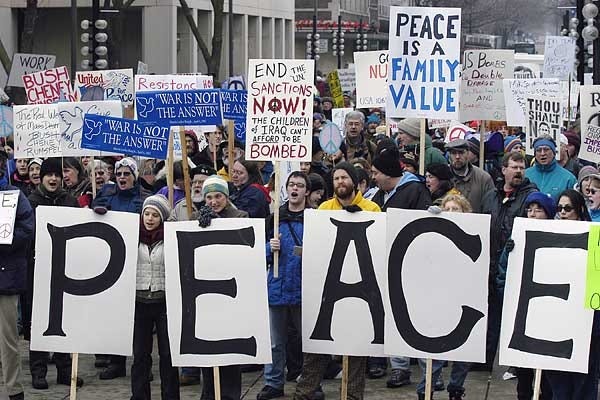
Rally agains the Iraq War in 2003. Photo by Jeff Miller
Another obvious (I think) reason: we get what we pay for. America pays for war and weapons, we even speak of “investing” in them, so at some (deep) level we believe in war and its efficacy. We are caught or even enraptured by it; our culture is infused with it, whether you speak of movies like “Top Gun: Maverick” or video games like the “Call of Duty” franchise or sporting events that routinely celebrate “our” troops and their weaponry. We “invest” in wars and weapons, and that investment sure pays dividends for the military and all its weapons makers.
There’s another reason as well, perhaps more subtle: the antiwar movement is fragmented whereas pro-war forces are united. What unites them is the pursuit of power, greed, profit, and their own sense they are being patriotic in “defending” America. A lot of people make a lot of money off the military-industrial complex, but it’s not solely about money. They also gain an identity from it and relatively high social status. (The military remains deeply respected within American culture.)
By comparison, antiwar forces in America are fragmented. In talking to some members, I found considerable diversity in what motivates them. This is hardly surprising. There’s no one “big” war to be against, as in the Vietnam War years or in the run up to the Iraq War. Being against war in general is not as compelling a message to fence-straddlers. Meanwhile, Americans are being told by the mainstream media that war works in places like Ukraine and that a new cold war is looming with Russia and China, so how can we afford the hypothetical comforts of peace when we’re afflicted by the grim realities of war?
Again, antiwar forces sometimes disagree about what is at the root of America’s hyper-aggressiveness and how best to counter it. I hear that we must tackle racism first; I hear that the white male patriarchy must be dismantled; I hear that indigenous peoples must finally obtain justice and reparations for the land and livelihoods stolen from them; I hear that BIPOC and LGBTQ+ communities must be heard and empowered; these motivations and agendas, and more, animate antiwar voices and communities. Diversity can be a strength, but it can also make working on a common cause problematic when there’s no clear unity of purpose.
I am perhaps most familiar with antiwar voices on the left, though I also listen to Tulsi Gabbard, Tucker Carlson, Rand Paul, and other voices that are considered right or libertarian. Generally speaking, the left doesn’t want to make common cause against war with the right, and vice-versa. There’s simply too much distrust and distaste. This is perhaps a fatal blow to building a truly effective antiwar movement.
I say this because the pro-war movement in America is truly bipartisan. Democrats and Republicans routinely come together in Congress to vote for more money for weapons and for more war. If we are to resist this, the antiwar movement must also be bipartisan. It must also pitch a big tent and let all people in, irrespective of their political affiliations.
I’d add as well that some antiwar voices in America are also anti-military. Perhaps I’m biased as a retired military officer, but I don’t think an anti-military message is attractive or compelling to most Americans. Anti-militarism, yes. Antiwar, yes. Anti-military, no. That said, I strongly believe America needs to reject warrior and warfighter nonsense and return to its roots and traditions with citizen-soldiers and a much smaller standing military.
Back in 2016, I wrote a similar article on the absence of a concerted antiwar war movement in America. Looking at that today, I think I should repeat the point I made about fear and threat inflation. To wit:
“Finally, a nebulous factor that’s always lurking: FEAR. The popular narrative today is that terrorists may kill you at any time right here in America. So you must be ready to “lockdown“; you must be ready to “shelter in place.” You must always defer to the police and military to keep you safe. You must fully fund the military or YOU WILL DIE. Repeated incantations of fear reinforce the master narrative of war.”
So, perhaps the biggest reason America lacks an effective antiwar movement is simply that we get what we pay for. America spends roughly a trillion dollars a year on wars and weaponry and an imperial military presence, so that’s what we get. We’re not spending a trillion a year on peace and diplomacy and conflict resolution. We reap what we sow, and what we sow is almost entirely favorable to more war.
It was only a few years ago that I learned I’m a “cis white male.” As such, I guess I’m a dime a dozen. Ordinary. Not representative of “diversity.”
I get it. I’m a historian so I know something about how various peoples have suffered extreme, even murderous, prejudice and exploitation over time. I’ve taught about slavery, the Holocaust, and various forms of discrimination against women and minorities, among other groups and peoples. The list goes on and on. The recent shootings in Colorado Springs where the LGBTQ community was targeted reminds us that too many people see diversity as a threat.
If only we could see ourselves just as human beings in all the richness that term describes. We are all part of the human community. We contain multitudes, as Walt Whitman said.
These people aren’t diverse. Where are the unhappy people? Seriously, this stock image is supposed to represent diversity, but I don’t see any blue-collar workers. Where’s the cleaning crew? Is everyone in this company lean and fit? Too often, even “diversity” images lack diversity.
Nevertheless, I understand how various people and organizations want to exhibit diversity by hiring or showcasing more women, or more Blacks, or more members of the LGBTQ community, and so on. It seems as if guys like me have ruled the world (or we act as if we have) for so long that we need to be taken down a peg or two. Or three.
What happens, sadly, is that in some cases what we get is what my wife likes to term “optical” diversity. Think about the U.S. government. You get a Black female (think Condi Rice) in a position of power, but she basically thinks and acts the same as a cis white male neo-conservative. You get a Black male (think Lloyd Austin) in a position of power, but he’s basically a card-carrying member of the military-industrial complex. You get “Mayor” Pete Buttigieg in a position of power, but he’s just another government technocrat spouting bromides in the pursuit of power.
Optical diversity shouldn’t be the main goal. What we’re striving for, or should be striving for, is diversity of perspectives, of life experiences, along with an openness to new ideas and viewpoints. A willingness to listen, to learn, to come together based on mutual respect, a shared commitment to work toward justice.
What about me? Am I just another aging cis white male? Just another out-of-touch white guy? Okay, Boomer!
I hope not. I was taught by my parents not to judge a book by its cover. So how do I represent diversity? If you were looking for “diversity,” would I fit the bill (no pun intended)? Here are ten reasons why I might be a “diverse” human:
I’m politically independent. In my life I’ve voted Republican, Democrat, and Green. I’m generally “progressive,” though I find labels reductive.
I’m a military veteran who’s written a lot of articles that are highly critical of the U.S. military.
I’m from a blue-collar family and I’m the first in my family to finish college.
I was educated as a mechanical engineer before I turned to history, where I specialized in the history of science, technology, and religion.
Speaking of religion, I was raised Catholic but now consider myself to be agnostic. I did my master’s thesis on Catholics and science; for my doctorate, I turned to evangelicals and science. I have a keen interest in both science and religion, respecting both of them as ways of knowing, ways of making sense of the world and ourselves.
I love the outdoors and consider myself to be pro-environment. So, for example, I am against fracking because of its demonstrable harm to our planet.
I lived and studied overseas in England for three years and have traveled to Italy, Germany, Scotland, and Wales. I gained a new perspective on America by being away from it.
I’m an introvert. (Do you want your team or organization to be all extroverts?)
I’m a science fiction fan. My favorite character on “Star Trek” is Mr. Spock. Yes, I can be a bit of a geek.
I like sports. Being from New England, I’m a fan of the Red Sox, Patriots, etc. I probably spend too much time watching “my” teams compete. My wife and I broke out bottles of champagne to celebrate the Red Sox winning the World Series.
Here’s my real point: All of you, everyone reading this, could make a similar list to showcase your (and our) diversity. In fact, if you’re reading this and would like to comment and share, please put a couple of things below that mark you as a “diverse” person. Because we all contain multitudes. Thanks so much.
So many people vote for a Democrat or Republican without having a clue what their candidate stands for. Politicians are adept at refusing to take positions; profiles in courage they are not. This is one big reason why I respect Matthew Hoh, candidate for the U.S. Senate in North Carolina. He takes firm stances based on his personal convictions and principles. Here, courtesy of INDY Week in North Carolina, is an article that details these. Not surprisingly, the Democratic and Republican candidates chose not to answer these questions.
My suggestion: Find a candidate in your district who’s willing to go on the record with strong stances that you believe in. If you can’t find such a candidate, write someone in, or don’t vote for that office, or (big ask) consider running for office yourself in the future, or consider joining new parties that seek to break the corrupt hold on our politics that the Democrats and Republicans have enjoyed for far too long.
1) What are your primary concerns for the State of North Carolina?
I have been to all parts of North Carolina throughout the campaign, and the three things I hear everywhere are healthcare, housing, and drugs.
Millions of people in NC live without healthcare due to being uninsured or underinsured, while more than 20% of NC adults are in collections for medical debt. Housing is unaffordable across the state. Home prices are out of reach for most working families, while rents have increased at a criminally staggering rate of 25-50%. Individuals, families and communities, particularly Black, Latino, and Native American communities, have been devastated by the War on Drugs. Every day 12 North Carolinian lives are lost from fatal overdoses. At the same time, the mass incarceration and prohibition policies of Republicans and Democrats have ruined lives and wrecked families, destroyed neighborhoods, and sustained cycles of crime.
These are the same issues I see in my life. My family, friends and neighbors suffer and are hurt by these deliberate bipartisan policies. I’m running to make sure there is a voice in this race for Medicare for All and not for for-profit healthcare; that there are meaningful, affordable housing policies that are not simply tax breaks and subsidies for developers and banks; and that we end the War on Drugs and treat substance abuse and addiction as public health matters rather than as crimes.
2) What in your background qualifies you to represent the people of this state effectively? What would you cite as your biggest career accomplishments?
I’m a disabled Marine Corps combat veteran. I live paycheck to paycheck, often solely on my veteran disability payments. Due to my disability, I went five years unable to earn an income. This, more than anything else, has prepared me to represent working families in Washington, DC.
In 2009, I resigned my position with the State Department in Afghanistan in protest over the escalation of that war. I’ve worked in Washington, DC with members of Congress and their staff for over a decade on war and peace, veterans issues and foreign policy. I’m very familiar with how Congress and the DC establishment operate, and this, perhaps, is the best explanation as to why I am running with the Green Party and not as a Democrat or Republican.
Locally, I have done peer support in the veterans and homeless communities.
If elected, what three policies would you prioritize and how would you work across the aisle to enact those initiatives?
I believe there are Democrats who are willing to break with their party and support meaningful climate and healthcare legislation (not giveaways to the fossil fuel industry and healthcare insurance companies such as the Inflation Reduction Act and the Affordable Care Act.) At the same time, some Democrats and Republicans are willing to reduce the bloated military-industrial complex, rein in the gross violations of constitutional rights and liberties by law enforcement and intelligence agencies, and end corporate subsidies. I look forward to working with progressives and libertarians on ending the War on Drugs, protecting and expanding civil liberties, particularly LGTBQIA+ rights, and ending our militarized foreign policy.
To accomplish this, I will work in a manner similar to how Senators Joe Manchin and Kyrsten Sinema have operated these past two years. However, rather than my efforts being for the benefit of fossil fuel companies and hedge fund managers, as with Senators Manchin and Sinema, my efforts will be for the working and middle classes. I have said repeatedly: no one will get $15 billion aircraft carriers unless our people get healthcare.
3) More than 1 million Americans have died due to COVID-19 and millions more are struggling with astronomical medical bills. Do you believe the American health system is working? What is your plan for making sure health care is affordable and accessible to all American citizens? Are you in favor of a single-payer option?
I’m running because I have many people in my life, people I love, that must check their bank account before calling their doctor. Around a third of all COVID deaths occurred due to people’s inability to afford medical care. That is a consequence of our for-profit healthcare system and a legacy of the Affordable Care Act. Before the pandemic, tens of thousands of Americans were dying each year as a result of not being able to pay for healthcare. I support Medicare for All, which would provide people with affordable and quality healthcare under a single-payer system. This would save our society hundreds of billions of dollars annually while ensuring everyone can get the healthcare they need. I’m also in favor of canceling all medical debt.
4) What factors are fueling the country’s growing political polarization and how will you work to mend it?
Politicians in both parties have increasingly relied on culture war rhetoric to maintain voter loyalty, despite taking millions of dollars from corporations who couldn’t care less about issues like LGBTQ rights or religious freedom. Additionally, partisan gerrymandering has increasingly resulted in noncompetitive districts, denying voters the chance to support candidates from other parties. I support reforms like ranked-choice voting, proportional representation for legislatures, and public campaign financing. These improvements would take the pressure off voters not to “split the vote” and allow them to vote for candidates based on issues and policies and not party identity.
Rent, property taxes, and home sale prices have generally been rising over the past several years. What, if anything, should the federal government do to address this growing affordability crisis?
The federal government plays a dominant role in housing as it backs loans and mortgages, subsidizes development and construction, and provides grants to developers. This allows the federal government to institute rent control, which should be done. Public banking would allow working families to qualify for home loans based on their rental histories. Corporations, banks, and investment firms should be banned from purchasing single-family homes. Housing policy, like other areas of the economy, needs a reversal of the decades of bi-partisan support for corporations, banks and the wealthy at the expense of the working and middle classes. Our homeless epidemic, a massive moral failing, is the direct consequence of this choice to prioritize profit over people.
5) Do you believe the federal minimum wage should be increased? If, by how much? If not, why?
I support a federal living wage that annually increases to match inflation and the rising cost of living, particularly housing costs. That would currently equal around $22 an hour. I fully support the right of workers to organize through unions for higher wages, better benefits, and safer working conditions. Additionally, we need to incentivize employee ownership, cooperatives and workplace democracy.
6) What specific policies or programs do you endorse or would pursue to combat inflation? Do you foresee the US heading into a larger economic recession and if so, what is the best way for Congress to address it?
Food and energy price increases are a result of climate change and war. Droughts, floods, and wildfires will continue to impact our economy, as will foreign wars, while our dependence on fossil fuels will keep us at the mercy of US and foreign oil companies. We need a Real Green New Deal to address these causes.
Supply chain shortages, resulting from decades of infrastructure neglect, are another reason for inflation. Most significantly, however, the current inflation rate is driven by corporate greed and price gouging, not labor costs or productivity issues. Fed interest rate hikes, meant to cause unemployment and which will fully push us into a recession, are not the answer.
Economic inequality has devastated the working and middle classes. This has resulted from deliberate policies over decades meant to ensure those at the top not only remain at the top but see their wealth grow. Working families have been squeezed to the point that 60% of us now live paycheck to paycheck while a third of families can’t make ends meet, with that number rising to more than half of Black and Latino families. I’m the only candidate in the race for US Senate calling for Medicare for All, rent control, public banking, universal public education from pre-K through university, including vocational and trade schools, and living wages adjusted annually for cost of living increases. These measures will substantially and fundamentally address economic inequality and establish healthcare, housing, education and jobs as human rights.
7) The US Supreme Court issued a ruling this summer overturning Roe v. Wade. Do you believe abortion should be a fundamental human right? If elected, would you support a federal ban on abortion? What role, if any, should Congress play in restricting or expanding access to abortion?
Abortion, like other reproductive rights, is healthcare, and healthcare is a human right. Abortion is ultimately the sole decision of a woman. Like all other forms of healthcare, abortion should be available through a universal single-payer healthcare system available to all people without cost at the point of service. Abortion should be available without conditions and judgment. We must ensure women and their families have all the resources they need for healthy and productive lives, and we must protect abortion seekers and providers from violence.
8) Please state three specific policies you support to address climate change.
Ban fossil fuel extraction techniques and infrastructure, such as fracking, offshore drilling, and oil and gas pipelines. Invest in green energy tech, industry, transportation, agriculture and infrastructure to decrease and end our dependence on fossil fuels. Support training programs to help workers in fields like mining and farming transition to high-paying jobs in sustainable energy and agriculture. These and other actions to mitigate the climate collapse and to assimilate to our changing world, particularly transforming and strengthening our economic and societal infrastructure, are key elements of the Green Party’s Green New Deal.
9) What more, if anything, should Congress do to regulate firearms?
I carried rifles and pistols in combat. The American people have the right to use firearms for self-defense and hunting. Still, measures like background checks, proper training standards, and mandatory waiting periods need to be implemented so that these weapons don’t end up in the hands of people who plan to harm others. A thorough in-person licensing and training program should be a requirement for possessing a firearm, especially outside the home. These measures must be consistent across states. We must also work to dismantle the gun lobby, whose continued obstruction of common sense gun regulations puts us all in danger.
Prohibition and poverty are and have long been, the primary root causes of crime. End the decades-long, failed, counterproductive and shameful War on Drugs. We must address the deep state of poverty by ensuring all people are paid a living wage and have healthcare and access to free public education from pre-K through college (including trade/vocational programs.)
10) Are there any issues this questionnaire has not addressed that you would like to address?
Environment: I’ve lost track of the number of NC communities that can’t drink their water. The poisoning of our air, land and water by corporations backed and protected by Democrat and Republican politicians is a mass environmental catastrophe that has caused immense environmental harm, devastated wildlife and sickened and killed North Carolinians.
Immigration: My grandparents were immigrants. If any other nation were treating people at its border the way the US treats people at its southern border, we would decry it as a crime against humanity. The bipartisan Democrat and Republican border policies have not only been failures but are massive human rights violations. We must treat all people with dignity and address the systemic reasons why people leave their home countries.
This nation needs immigrants to grow and develop our economy. There is no reason we cannot achieve an immigration policy that treats people humanely, allows for a pathway to citizenship, and provides economic benefits to our society. It’s simply a question of choosing to do so rather than continuing decades of racist fearmongering for political gain.
Democracy: Voting should be expanded, strengthened and made more inclusive. We need to make voting more accessible and easier for individual voters and we must update and modernize our political process.
A Pew poll found that 70% of Americans support the need for more political parties. Voters should have more options. I support ranked choice voting, proportional representation, abolishing the electoral college, ending gerrymandering, establishing term limits and fighting continuously to get money out of politics.
This past summer, the North Carolina Green Party and my campaign had to go to federal court to participate in this election. This was necessary because of a well-funded legal campaign by the Democratic Party to keep the Green Party off the ballot. At all levels, the Green Party prevailed (multiple county boards of elections, NC State Boards of Elections, Wake County Superior Court, US District Court and US Federal Appeals Court); however, the effect on our ability to participate in elections and to represent voters who otherwise would not be represented was dramatically impacted. Voter suppression occurs in multiple forms by both of the major parties.
Reparations: I support Black and Indigenous-led efforts to provide reparations.