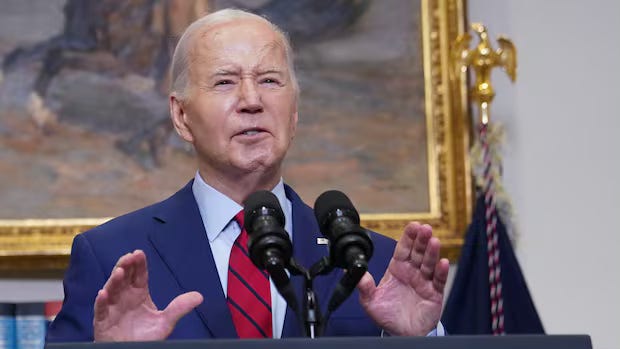
Kamala Harris at Munich tells you what America is and isn’t about
Yesterday, in her remarks before the Munich Security Conference, Vice President Kamala Harris made some remarkable claims while speaking a bold truth about what U.S. foreign policy is all about.
First, let’s turn to the bold truth:
And please do understand, [Vice President Harris said,] our approach is not based on the virtues of charity. We pursue our approach because it is in our strategic interest.
I strongly believe America’s role of global leadership is to the direct benefit of the American people. Our leadership keeps our homeland safe, supports American jobs, secures supply chains, and opens new markets for American goods.
I bolded the key phrase: America’s approach to the rest of the world isn’t charitable in any way. It’s about jobs, supply chains, and new markets. It’s about dominance and profits and “the homeland.” End of story.
It put me to mind of a passage in the Bible (Corinthians) about the inestimable value of charity:
And though I have the gift of prophecy, and understand all mysteries, and all knowledge; and though I have all faith, so that I could remove mountains, and have not charity, I am nothing. (KJV; 1 Corinthians 13:2)
The U.S. can certainly move (or remove) mountains with its nuclear weapons; it certainly thinks it has a gift of prophecy with all its surveillance and spy agencies; but unless it has charity toward those less fortunate, it is nothing. It’s good to hear the Vice President avow so clearly that the U.S. approach to the world isn’t in any way charitable or even well-meaning.
Charity? Nope. “Our approach is not based on the virtues of charity”
The remarkable claims came as Harris attacked the Republicans and Trump but without specifically naming them. Here’s what she said about them:
However, there are some in the United States who disagree. They suggest it is in the best interest of the American people to isolate ourselves from the world, to flout common understandings among nations, to embrace dictators and adopt their repressive tactics, and abandon commitments to our allies in favor of unilateral action.
Let me be clear: That worldview is dangerous, destabilizing, and indeed short-sighted. That view would weaken America and would undermine global stability and undermine global prosperity.
President Biden and I, therefore, reject that view.
Are Trump and his followers arguing that America should isolate itself from the world? That America should embrace dictators? That America should betray its allies? That America should be a repressive autocracy? This is a misleading and disturbing caricature of Republicans as it accuses them of treason to the U.S. Constitution.
Perhaps some believe that Trump and MAGA truly are this malevolent. But should these accusations be made before foreign leaders at a summit in Munich, Germany?
Something is seriously wrong with America’s leadership. Without charity, they are nothing.
I had a great time this weekend with family, including my brother-in-law who’s a combat veteran of the Vietnam War. If I’m on the left, he’s on the right (whatever those often vague political labels may mean). Guess what we agree on? A lot, actually:
+ We both agreed the Iraq and Afghan Wars were disasters.
+ We both agreed $105 billion in more weapons and “aid” to Ukraine, Israel, Taiwan, etc. is a complete waste of money. We’d both rather see that money spent here in the USA, especially on America’s crumbling infrastructure. (“Crumbling” as a descriptor is inseparable from infrastructure here in America.)
+ We both agreed the government response to Covid was badly botched and that Anthony Fauci often lied to the American people. We both agreed government experts should have treated us like adults, admitting they couldn’t answer all the questions about Covid. We both think it’s more likely than not that Covid was a man-modified virus that leaked from a lab in China.
+ We both agreed Joe Biden isn’t the answer in 2024. My brother-in-law is open to Trump; I can’t vote for Trump for so many reasons. A minor disagreement, though we’d both like to see more and younger candidates, not a Biden-Trump rematch.
+ We both agreed a ban on assault weapons would do little or nothing to stop gun violence and mass shootings in America. There are already 20 million AR-15-type assault weapons in America; sorry, a ban won’t fix anything.
+ We both agreed the New England Patriots suck this year, but that Mac Jones isn’t solely to blame for an offense that simply can’t score points.
+ We both agreed Budweiser went well with our turkey and sausage gumbo.
+ We both agreed “White Heat” (1949) with Jimmy Cagney is one of the greatest movies ever made.
Top of the world, Ma. Jimmy Cagney at the explosive conclusion to “White Heat”
+ Finally, we both agreed we are immersed in Operation Ongoing Bullshit, a felicitous phrase my brother-in-law came up with. We are constantly being bullshitted by “our” government. I put “our” in scare-quotes because we agreed we have a pay-to-play government. Pay a lot, as in millions of lobbying dollars, you get to play a lot. Can’t pay? Too bad. You have no say.
Operation Ongoing Bullshit is one of the more honest names I’ve heard to describe what the U.S. government is usually up to. Right and left can heartily agree on this, I think.
Far too often, we’re told there are unbridgeable differences between right and left in America. Differences exist, of course, yet there’s so much Americans can and do agree on. To cite only one example, I think most Americans agree with James Madison that ongoing war (and ongoing BS, for that matter) contributes to the death of democracy. And also to our colossal national deficit, now in the neighborhood of $34 trillion.
There’s a man who famously crowned himself emperor rather than submit to the otherworldly power of a pope. A new movie will soon be out on his “glories.” Napoleon Bonaparte, a military genius, embraced war and drove for total victory until his empire collapsed on him and the French people. Napoleon’s Waterloo came in 1815, a decade after perhaps his greatest victory at Austerlitz in 1805. Empires—they often seem to decline slowly before collapsing all at once, though the Napoleonic version flared so brightly that it burned out quickly.
I once studied the military glories of Napoleon, enthusiastically playing war-games like Waterloo and Empire in Arms, where this time maybe I could win a great victory for the emperor. More than a few books on my shelves cover the campaigns of Napoleon. But as my dad quipped to me, Napoleon wanted to give people liberty, equality, and fraternity at the point of his sword. And that, my dad would say, is an intolerable price to pay for one’s freedom.
Win one for the Emperor
Endless war is, as often as not, the final nail in an empire’s coffin. Early in 1943, after defeat at Stalingrad, which came as a profound shock to a German public sold on the idea it possessed the finest fighting force in history (such rhetoric should sound familiar to Americans today), Joseph Goebbels, the infamous Nazi propaganda minister, gave a fanatical speech calling for “total war” from the German people. Despite disaster at Stalingrad, despite visible and widening cracks in the alleged superiority of the Thousand Year Reich, the German people largely cheered or echoed the cry for more and more war. Two years later, they witnessed total defeat as Germany surrendered unconditionally in May 1945.
As led by Adolf Hitler and his henchmen, Nazi Germany wasn’t interested in peace. These men knew only the feverish pursuit of total victory until it ended in their deaths and total disaster for Germany. They were the original seekers of “full spectrum dominance” as they asserted Germany was the exceptional and essential nation.
We Americans were supposed to learn something from megalomaniacs like Napoleon and Hitler. Committed to democracy, we were supposed to reject war, to repudiate militarism and the warrior mystique, and to embrace instead diplomacy and the settlement of differences peacefully through international organizations like the United Nations.
America today, however, is busy beating plowshares into swords and sending them to global hotspots like Gaza and Ukraine. What gives?
Endless wars can exhaust even the richest and wisest of empires, and America isn’t as rich or wise as it used to be. Interestingly, ordinary Americans haven’t been overcome with bloodthirst. Roughly two-thirds of Americans, for example, support a ceasefire in Gaza. But they are a silent majority compared to the loud minority flowing through the halls of power in DC lobbying for war and more war.
The U.S., which largely created the UN in the immediate aftermath of World War II, now does everything it can to block UN calls for ceasefires, whether in Ukraine or Gaza. The U.S., while allegedly manifesting its allegiance to Judeo-Christian values, embraces war and distributes weaponry like the devil while rejecting calls for peace by church leaders such as Pope Francis.
The U.S. is an empire in serious decline because it devotes so much money to wars and more wars. Military budgets now approach $1 trillion yearly even as the Pentagon just announced it failed its sixth audit in a row. These repetitive failures provoke a bizarre response from Congress and the President: yet more money for war and dominance.
Whether measured in blood or treasure or both, seeking to dominate the world through military hegemony is a surefire recipe for imperial collapse. It’s a lesson taught by the fates of Napoleon and Hitler, one U.S. leaders have dismissed as they’ve been caught up in a belief one can be a superpower, a global hegemon, totally dominant, while remaining a beacon of freedom.
Like Napoleon, U.S. leaders sell the idea they’re giving people liberty at the point of a sword. My dad taught me something about the fallacy and folly of this.
The ongoing Israeli attacks against Gaza put me to mind of one of my favorite science fiction books as a teenager, Robert Heinlein’s “Starship Troopers.” In that book, a military veteran and teacher of “history and moral philosophy” is discussing violence with high school students. One of them blithely says violence never solves anything, which draws this memorable response from her hard-nosed instructor:
Anyone who clings to the historically untrue—and thoroughly immoral—doctrine that ‘violence never settles anything,’ I would advise to conjure the ghosts of Napoleon Bonaparte and the Duke of Wellington and let them debate it. The ghost of Hitler could referee, and the jury might well be the Dodo, the Great Auk, and the Passenger Pigeon. Violence, naked force, has settled more issues in history than has any other factor, and the contrary opinion is wishful thinking at its worst. Breeds that forget this basic truth have always paid for it with their lives and their freedoms.
In Heinlein’s book, humans were at war with an alien species and those who chose military service to fight against “the bugs” got the right to vote and participate as citizens in government.
In a fight to the death, Heinlein suggested, the only choice right-thinking humans had was violence and a commitment to the total destruction of the enemy. There was no other solution.
I remember this cover well (vintage 1970s)
How might this apply to Gaza? Members of Hamas are Heinlein’s enemy bugs; in fact, all of Gaza is apparently an alien land that must be ravaged as the bugs are either killed or driven off the land. Violence will settle the issue of who controls Gaza, and by extension the West Bank, once and for all, with the IDF serving as Israel’s “Starship Troopers.”
Don’t get me wrong. My memory flashback to Heinlein was painful. It was not in any way a vote in favor of massive violence by Israel to solve the Gaza “problem.” Rather, I think Heinlein’s insight captures the mindset of those in authority in Israel at this moment. Kill or drive off the “bugs.” Settle this. No ceasefires, no pauses, no compromises. Total victory through massive violence is the decisive option.
In this mindset they are enabled by the U.S. president and Congress, who boast loudly of having Israel’s back, come what may. Indeed, the president and Congress eagerly wish to provide Israel all the weapons it needs to kill or drive off the “bugs.”
Heinlein’s “Starship Troopers” remains a controversial book for its depiction of a thoroughly militarized neo-fascist society, a vision captured in Paul Verhoeven’s movie version of the same name, a biting satire of militarism run amuck, though the satire is apparently lost on more than a few viewers.
To echo Heinlein, violence certainly did settle things for the dodo and for the passenger pigeon. They are no more. Yet it’s also true that those who live by the sword will often die by it. And if that sword proves to be a nuclear one, we as humans may yet be joining the dodo in extinction.
After attending a seminar at the U.S. Holocaust Memorial Museum with Henry Friedlander, I taught my first course on the Holocaust just over two decades ago. I then continued to teach courses on the Holocaust until I retired as a professor of history in 2014. Having read dozens of books on the Holocaust, seen dozens of moviesand documentaries on it, and having talked to Jewish survivors of the Holocaust, including Henry Friedlander, I learned a few things about how and why such a colossal crime against humanity happened.
When I took his seminar, Friedlander, who as a teenager survived Auschwitz, taught us that “You don’t kill the people you hate—you hate the people you kill.” It may seem paradoxical, but this insight is powerful. Normal human beings don’t want to be or become killers. Thankfully, killing isn’t easy, even at a remove. (Drone operators are known to suffer adverse symptoms from witnessing death at a distance.)
Yet, if you’re taught and told that you must kill, the moral, mental, physical, and other burdens of killing may drive you to hate those you are killing. “Look at what you made me do!” the killer thinks. You made me do this—and I hate you for it. Doesn’t matter that you’re a guiltless child, I still hate you.
Photo by Ali Jadallah in Gaza (Anadolu Agency via Getty Images)
I wonder about Israeli officials today, those who are in control of the demolition of Gaza. A few must truly hate Hamas, but there are many more, I think, who’d prefer not to be put in the position of ordering (or carrying out) massive bombing raids and ground invasions that result in the deaths of tens of thousands of innocent Palestinians.
How many in Israel, notably in the Israeli Defense Forces, will come to hate those that they kill? How many will succumb to hate as a matter of survival, a sort of mental coping mechanism?
Honestly, I don’t pretend to understand it all. Catchphrases like “man’s inhumanity to man” or “the banality of evil” seem too easy. I remember reading an interview with Primo Levi, another Holocaust survivor, who related an anecdote about his experience communicating with an unrepentant Nazi in Germany well after World War II. This man wrote to Levi to defend himself; unbeknownst to him, his wife snuck a note into the letter that read:
“When the devil is loose in the village, a few people try to resist and are overcome, many bow their heads, and the majority follow him with enthusiasm.”*
Whether you prefer “devil” or “evil” or “racist extremist” or some other term, history shows how humans readily unleash the most elemental barbarism when they believe they are threatened, especially when the “threat” is dehumanized.
Do we kill those we hate, or do we come to hate those we kill? Regardless of the causality here, the common words “hate” and “kill” tell us that to stop the hating and killing, we must simply stop. Stop killing. Stop hating. Find another way, a better way, a way that is life-affirming.
In teaching the Holocaust, I came across a multi-volume encyclopedia devoted to humanity’s genocides throughout history. Imagine that! An encyclopedia is needed just to document the almost countless times humans have engaged in mass murder against other humans.
Will Gaza (2023) become the latest entry in this devilish encyclopedia?
*Ferdinando Camon, Conversations with Primo Levi, The Marlboro Press, 1989, p. 37.
Note: I originally wrote a version of this post in 2018. I’ve made a few updates below to include a reader’s comment that was especially apropos.
Labor Day weekend is a reminder that there’s no labor party in U.S. politics. Instead, we have two pro-business parties: the Republican and the Republican-lite, otherwise known as the Democratic Party. Both are coerced if not controlled by corporations through campaign finance “contributions” (bribes) and lobbyists (plus the promise of high-paying jobs should your local member of Congress lose an election or wish to transition to a much higher paying job as a lobbyist/influence peddler). With money now defined as speech, thanks to the Supreme Court, there’s a lot of “speech” happening in Congress that has nothing to do with the concerns of workers.
Nevertheless, a myth exists within the mainstream media that “socialist” progressive politicians are coming to take your money and to give it to the undeserving poor (and especially to “illegal” immigrants, who aren’t even citizens!). First of all, the so-called Democratic Socialists are not advocating nationalization of industry; they’re basically New Deal Democrats in the tradition of FDR. Just like Republicans, they believe in capitalism (and bow to corporatism) and the “free” market; they just want to sand down some of the rougher edges of exploitation.
Consider, for example, Bernie Sanders’s past efforts to get a living wage for Disney employees. In 2018 Disney finally promised to pay workers $15.00 an hour (phased in over the next few years), even as the corporation made record profits and the CEO earned hundreds of millions. Second, the bulk of the Trumpian tax breaks didn’t go to the workers and middle class: the richest Americans (and corporations) benefited the most from Trump’s tax cuts. Some of that money was supposed to “trickle down” to workers, but most of it didn’t. (Funding stock buy-backs, not pay raises, was and is especially popular among corporations.)
(An aside: trickle-down economics is almost an honest term, for that is what both major political parties in America support for workers: a “trickle” of pay and benefits. Forget about a stream or steady flow; of course, gushers and floods of money flow upwards to the richest few and remain there, irrespective of physical laws like gravity.)
My father knew the score. As a factory worker, he lived the reality of labor exploitation and fought his own humble battle for decent wages. His experience led him to conclude that the rich had neither sympathy nor use for the poor.
***
I’d like to share a comment made at Bracing Views by a reader back in 2018. It captured the sad reality of Labor Day as it exists today in America:
Labor Day is perhaps our most hollowed out and meaningless of all the the National Holidays we celebrate…
Celebrating Labor Day as it should be, that is the documentation of Labor’s over 100 years of historical struggle against Capitalism is not something we can do. We cannot celebrate it for two reasons: One it would be admission of the class warfare the 1% vs us Proles, and Two we have no Labor Party here in the USA to represent us. ********************* As Leo W. Gerard is the International President of the United Steelworkers (USW) union has written:
“American corporations weren’t always shareholder-centered. For about three decades after World War II, worker wages rose in tandem with productivity. This was a time during which corporations subscribed to the philosophy that they were obligated to serve their customers, communities, workers and shareholders.
Over the past 30 years, however, US corporations embraced a new notion, which is that they had only one responsibility, to fill the pockets of shareholders.
That is the same 30 years during which workers’ wages stagnated and CEO pay rose no matter how badly the executive performed. That is the same 30 years in which private equity firms bought manufacturers, loaded them up with debt, sold them off at massive profit then shrugged when a stumble threw the firm into bankruptcy, closed factories and killed good, family-supporting American jobs. That is the same 30 years when American corporations moved manufacturing from the United States to low-wage, high-pollution countries like Mexico and China.” *******************************************
Today, Labor Day, you can celebrate it by going to your local Big Box Store and take advantage of the Labor Day Sales, and purchase a product NOT Made in USA and sold to you by cashiers probably not making a Living Wage.
Fourteen years ago, I wrote the following article for TomDispatch. A colleague wrote to me today saying he had saved the article, had re-read it, and still found it useful, which is just about the highest compliment you can pay an author. I continue to believe, as I wrote in 2009, that America is experiencing a form of militarism on steroids. It’s a peculiar form of militarism, since the Pentagon works hard to obscure the costs and realities of war (see the recent book by Norman Solomon, War Made Invisible), but camouflaged or not, it persists.
Gary Cooper in “High Noon”
[Written in August 2009]
I have a few confessions to make: After almost eight years of off-and-on war in Afghanistan and after more than six years of mayhem and death since “Mission Accomplished” was declared in Operation Iraqi Freedom, I’m tired of seeing simple-minded magnetic ribbons on vehicles telling me, a 20-year military veteran, to support or pray for our troops. As a Christian, I find it presumptuous to see ribbons shaped like fish, with an American flag as a tail, informing me that God blesses our troops. I’m underwhelmed by gigantic American flags — up to 100 feet by 300 feet — repeatedly being unfurled in our sports arenas, as if our love of country is greater when our flags are bigger. I’m disturbed by nuclear-strike bombers soaring over stadiums filled with children, as one did in July just as the National Anthem ended during this year’s Major League Baseball All Star game. Instead of oohing and aahing at our destructive might, I was quietly horrified at its looming presence during a family event.
We’ve recently come through the steroid era in baseball with all those muscled-up players and jacked-up stats. Now that players are tested randomly, home runs are down and muscles don’t stretch uniforms quite as tightly. Yet while ending the steroid era in baseball proved reasonably straightforward once the will to act was present, we as a country have yet to face, no less curtail, our ongoing steroidal celebrations of pumped-up patriotism.
It’s high time we ended the post-Vietnam obsession with Rambo’s rippling pecs as well as the jaw-dropping technological firepower of the recent cinematic version of G.I. Joe and return to the resolute, undemonstrative strength that Gary Cooper showed in movies like High Noon.
In the HBO series “The Sopranos,” Tony (played by James Gandolfini) struggles with his own vulnerability — panic attacks caused by stress that his Mafia rivals would interpret as fatal signs of weakness. Lamenting his emotional frailty, Tony asks, “What ever happened to Gary Cooper?” What ever happened, in other words, to quiet, unemotive Americans who went about their business without fanfare, without swagger, but with firmness and no lack of controlled anger at the right time?
Tony’s question is a good one, but I’d like to spin it differently: Why did we allow lanky American citizen-soldiers and true heroes like World War I Sgt. Alvin York(played, at York’s insistence, by Gary Cooper) and World War II Sgt. (later, 1st Lt.) Audie Murphy(played in the film “To Hell and Back,” famously, by himself) to be replaced by all those post-Vietnam pumped-up Hollywood “warriors,” with Sylvester Stallone and Arnold Schwarzenegger-style abs and egos to match?
And far more important than how we got here, how can we end our enduring fascination with a puffed-up, comic book-style militarism that seems to have stepped directly out of screen fantasy and into our all-too-real lives?
A seven-step recovery program
As a society, we’ve become so addicted to militarism that we don’t even notice the way it surrounds us or the spasms of societal ‘roid rage that go with it. The fact is, we need a detox program. At the risk of incurring some of that ‘roid rage myself, let me suggest a seven-step program that could help return us to the saner days of Gary Cooper:
1. Baseball players on steroids swing for the fences. So does a steroidal country. When you have an immense military establishment, your answer to trouble is likely to be overwhelming force, including sending troops into harm’s way. To rein in our steroidal version of militarism, we should stop bulking up our military ranks, as is now happening, and shrink them instead. Our military needs not more muscle supplements (or the budgetary version of the same), but far fewer.
2. It’s time to stop deferring to our generals, and even to their commander in chief. They’re ours, after all; we’re not theirs. When President Obama says Afghanistan is not a war of choice but of necessity, we shouldn’t hesitate to point out that the emperor has no clothes. Yet when it comes to tough questioning of the president’s generals, Congress now seems eternally supine. Senators and representatives are invariably too busy falling all over themselves praising our troops and their commanders, too worried that “tough” questioning will appear unpatriotic to the folks back home, or too connected to military contractors in their districts, or some combination of the three.
Here’s something we should all keep in mind: Generals have no monopoly on military insight. What they have a monopoly on is a no-lose situation. If things go well, they get credit; if they go badly, we do. Retired five-star Gen. Omar Bradley was typical when he visited Vietnam in 1967 and declared: “I am convinced that this is a war at the right place, at the right time and with the right enemy — the Communists.” North Vietnam’s only hope for victory, he insisted, was “to hang on in the expectation that the American public, inadequately informed about the true situation and sickened by the loss in lives and money, will force the United States to give up and pull out.”
There we have it: A classic statement of the belief that when our military loses a war, it’s always the fault of “we the people.” Paradoxically, such insidious myths gain credibility not because we the people are too forceful in our criticism of the military, but because we are too deferential.
3. It’s time to redefine what “support our troops” really means. We console ourselves with the belief that all our troops are volunteers, who freely signed on for repeated tours of duty in forever wars. But are our troops truly volunteers? Didn’t we recruit them using multimillion-dollar ad campaigns and lures of every sort? Are we not, in effect, running a poverty and recession draft? Isolated in middle- or upper-class comfort, detached from our wars and their burdens, have we not, in a sense, recruited a “foreign legion” to do our bidding?
If you’re looking for a clear sign of a militarized society — which few Americans are — a good place to start is with troop veneration. The cult of the soldier often covers up a variety of sins. It helps, among other things, hide the true costs of, and often the futility of, the wars being fought. At an extreme, as the war began to turn dramatically against Nazi Germany in 1943, Germans who attempted to protest Hitler’s failed strategy and the catastrophic costs of his war were accused of (and usually executed for) betraying the troops at the front.
The United States is not a totalitarian state, so surely we can hazard criticisms of our wars and even occasionally of the behavior of some of our troops, without facing charges of stabbing our troops in the back and aiding the enemy. Or can we?
4. Let’s see the military for what it is: a blunt instrument of force. It’s neither surgical nor precise nor predictable. What Shakespeare wrote 400 years ago remains true: when wars start, havoc is unleashed, and the dogs of war run wild — in our case, not just the professional but the “mercenary” dogs of war, those private contractors to the Pentagon that thrive on the rich spoils of modern warfare in distant lands. It’s time to recognize that we rely ever more massively to prosecute our wars on companies that profit ever more handsomely the longer they last.
5. Let’s not blindly venerate the serving soldier, while forgetting our veterans when they doff their spiffy uniforms for the last time. It’s easy to celebrate our clean-cut men and women in uniform when they’re thousands of miles from home, far tougher to lend a hand to scruffier, embittered veterans suffering from the physical and emotional trauma of the battle zones to which they were consigned, usually for multiple tours of duty.
6. I like air shows, but how about — as a first tiny step toward demilitarizing civilian life — banning all flyovers of sporting events by modern combat aircraft? War is not a sport, and it shouldn’t be a thrill.
7. I love our flag. I keep my father’s casket flag in a special display case next to the very desk on which I’m writing this piece. It reminds me of his decades of service as a soldier and firefighter. But I don’t need humongous stadium flags or, for that matter, tiny flag lapel pins to prove my patriotism — and neither should you. In fact, doesn’t the endless post-9/11 public proliferation of flags in every size imaginable suggest a certain fanaticism bordering on desperation? If we saw such displays in other countries, our descriptions wouldn’t be kindly.
Of course, none of this is likely to be easy as long as this country garrisons the planet and fights open-ended wars on its global frontiers. The largest step, the eighth one, would be to begin seriously downsizing that mission. In the meantime, we shouldn’t need reminding that this country was originally founded as a civilian society, not a militarized one. Indeed, the revolt of the 13 colonies against the King of England was sparked, in part, by the perceived tyranny of forced quartering of British troops in colonial homes, the heavy hand of an “occupation” army, and taxation that we were told went for our own defense, whether we wanted to be defended or not.
If Americans are going to continue to hold so-called tea parties, shouldn’t some of them be directed against the militarization of our country and an enormous tax burden fed in part by our wasteful, trillion-dollar wars?
Modest as it may seem, my seven-step recovery program won’t be easy for many of us to follow. After all, let’s face it, we’ve come to enjoy our peculiar brand of muscular patriotism and the macho militarism that goes with it. In fact, we revel in it. Outwardly, the result is quite an impressive show. We look confident and ripped and strong. But it’s increasingly clear that our outward swagger conceals an inner desperation. If we’re so strong, one might ask, why do we need so much steroidal piety, so many in-your-face patriotic props, and so much parade-ground conformity?
Forget Rambo and action-picture G.I. Joes: Give me the steady hand, the undemonstrative strength, and the quiet humility of Alvin York, Audie Murphy — and Gary Cooper.
Tacking to starboard, stuck in place, the USS America under Joe Biden is groaning in protest
In America’s two-color political universe, by which I mean blue versus red, whenever I criticize the blue team, I get accused of supporting the red team. But I believe in a multi-color world, not a bicolor one. Even green is an acceptable color! So, as I critique Joe Biden today, rest assured I never have voted, and never will vote, for the red guy, Donald Trump. I’m going green in 2024 with Cornel West.
With that longwinded prologue, I’d like to announce the Biden/Harris unofficial campaign slogan for 2024: No, we can’t.
It may sound familiar. Fifteen years ago, Barack Obama embraced the energy and optimism of “Yes, we can.” He also promoted “hope” and “change.” After eight years of Bush/Cheney, those simple slogans resonated with Americans, and Obama/Biden rode to victory in 2008 exuding confidence and a can-do spirit. (Of course, the results in office were, shall I say, disappointing.)
The good old days that never quite were.
But that was then, this is now, and when you go to JoeBiden.com, you get a message that suggests we reelect Joe to “finish the job.” Which job needs to be finished is unspecified. Vague words about protecting freedom and democracy and feel-good imagery is about all you get. Add it up and you get a de facto message of little hope and no change—just more of the same.
The Democrats think that a bland message of normalcy will be enough to prevail against Trump, who seems to be indicted now almost daily. Again, I’m no fan of Trump and won’t be voting for him. But why should I vote for Biden? What compelling reason or even message is there to convince me?
I haven’t heard one other than “Trump is very bad.”
A friend tells me Biden’s record as president is respectable and that he’s tilted left of center. I’m baffled by this claim. Biden/Harris have told me we can’t get Medicare for All; indeed, we can’t even get a public option. We can’t get significant student debt relief. We can’t get a $15 federal minimum wage. We can’t reduce the Pentagon budget and spending on wars and weapons. We can’t stop building more nuclear weapons. We can’t stop drilling in sensitive areas such as pristine wildernesses and offshore waters.
You see where I’m going here. When it comes to progressive agendas, “No, we can’t” is the true motto of Biden/Harris. Corporate Joe and his VP sidekick appear to have little empathy for the working classes and the hurting. Imagine a president coming back from vacation, as Biden recently did, and being asked about deadly wildfires in Hawaii and declaring that he had “no comment.” How hard is it for a president to muster words of sympathy for the suffering people of Hawaii while promising speedy federal aid?
For some reason I’m in a nautical frame of mind (forgive me, my Navy brethren).* As the USS Trump takes on water from multiple torpedo hits (indictments), the USS Biden sits dead in the water, having run aground on the shoals of incompetence and indifference. There is no Bernie Sanders this time around to rally the youthful crew to rock and re-float the boat. Perhaps Americans should search for a new ship to board?
A favorite book is “The Caine Mutiny” (please read it if you haven’t; it’s thrilling as well as hilarious in spots). The Caine was a tired old ship headed for the scrap heap after World War II and its commander, Queeg, was addled and (much worse) cowardly. The ship nearly sinks during a powerful storm that paralyzes Queeg; only a mutiny by its crew prevents disaster. America, our ship of state, faces storms of its own. Do we have confidence in captains like Trump or Biden to lead us through the tempest to calmer waters? Maybe it’s time we mutiny?
My friend believes Biden is a competent captain who’s making good headway even as he tacks to port. I see an increasingly tired and confused commander who’s furiously tacking to starboard even as the ship of state groans, making no progress as it’s battered on those aforementioned shoals.
*Feel free, Navy brethren, to offer your own nautical metaphors, which I’m betting will be better than mine.
Oliver Anthony Strikes A Chord with “Rich Men North of Richmond”
A working-class song has gone viral. Oliver Anthony’s “Rich Men North of Richmond” is a lament for the state of the working classes in America: long hours, low pay, dead-end jobs, even as “the rich men north of Richmond” make the real money on the backs of the working poor.
Here’s a link to the video, which just screams sincerity:
Naturally, his song is drawing attention—and criticism. NBC News calls it a “conservative anthem” because I guess there are no liberals or progressives or even moderates who are working class and who can relate to the song. Also, NBC is at pains to criticize Anthony for making a quick reference to obese welfare moochers, which is fair enough, I suppose, though it’s not the point of his song.
This is what Anthony had to say (also at NBC News): In an introduction videouploaded to his YouTube channel a day before the song’s release, Anthony said that his political views tend to be “pretty dead center” and that both sides “serve the same master.”
He said he used to work 12-hour shifts six days a week and today continues to meet laborers struggling to make ends meet.
“People are just sick and tired of being sick and tired,” he said. “So yeah, I want to be a voice for those people.”
Amen to that, Mr. Anthony. My father knew his pain. Before he became a firefighter, my dad worked in factories doing hard physical work. He told me the harder the work, generally the lower the pay you earn in America. So-called “shit” jobs like cleaning motel rooms, being a waiter or waitress, digging ditches and working as a “common” laborer, are looked down upon despite how tough and necessary they are.
As I said, my dad knew the score, as he recounted in a journal he left me about his life. One time, he organized with a few other men for a pay raise at the factory. Here’s what my dad had to say about that experience:
A five cent an hour pay raise
It seems that Mike Calabrese on his own asked Harry Gilson for a pay raise and he was refused. Mike decided to organize the men members and go down in a group. In our group he got ten men to approach Harry G. for a raise. But when it was time to “bell the cat” only three fellows went to see Harry. Well Mike said he couldn’t join the group because he had already tried to get a raise. I knew I was being used but I was entitled to a raise. Well Harry said to me, “What can I do for you men?” So I said to Harry: 1) Living costs were going up; 2) We deserved a raise. So Harry said, “How much?” and I said ten cents an hour would be a fair raise. So he said I’ll give you a nickel an hour raise and later you’ll get the other nickel. We agreed. So, I asked Harry will everyone get a raise and he replied, “Only the ones that I think deserve it.”
Well a month later I was drinking water at the bubbler [water fountain] and Harry saw me and said what a hard job they had to get the money to pay our raises. Well, Willie, Harry Gilson and his brother Sam and their two other Italian brother partners all died millionaires. No other truer saying than, “That the rich have no sympathy or use for the poor.”
My dad’s experience was roughly 80 years ago, but his sentiment is echoed by Oliver Anthony’s song today. This has nothing to do with conservatism and everything to do with giving workers a fair shake in America. It’s not a left-right, Democrat-Republican, issue: it’s a class issue, a moral issue, and a matter of life and death for so many people struggling across America.
We need more people to raise their voices, whether in song like Oliver Anthony or for pay raises like my dad.
Time for Glasnost, Perestroika, and a New Generation of Leaders in America
A year ago, I asked whether Joe Biden and Donald Trump were too old to serve as president. Recently, concerns about advanced age and failing health have come to the fore in Congress. Senator Diane Feinstein, 90 years old, recently had to be told by her aides to vote “aye.” Senator Mitch McConnell, 81 years old, recently froze mid-sentence at a press conference; he may have suffered a mini-stroke, possibly related to a bad fall he had previously that resulted in a concussion. Meanwhile, concerns about President Biden’s age and declining health are being openly aired even among Democrats, with Hillary Clinton opining that Joe’s age is a legitimate campaign issue. At the young age of 75, is she angling to ride to the rescue in the 2024 election?
Glenn Greenwald did a long segment on Washington’s gerontocracy that is well worth watching. A point he made is one that I echoed in my article from a year ago. Back in the 1970s, the U.S. pointed to an alleged gerontocracy in the Soviet Union to criticize the hidebound nature of the Communist party there and the way its leaders were holding back much-needed reforms.
Americans made fun of “old” Soviet leaders of the 1970s and early 1980s. They were younger than Biden, Trump, Feinstein, McConnell, and the U.S. gerontocracy of today
The same, of course, is now true of the U.S. empire and its uniparty of Republican and Democrat enablers. An American gerontocracy with a near-death grip on power are holding back much-needed reforms here, especially reductions to the enormous sums of money being spent on weapons and warfare by the federal government.
Much like the former Soviet Union, the United States is a declining empire that’s been debilitated by constant and unnecessary wars and wanton spending on weaponry. Fresh thinking is needed. Remember glasnost and perestroika? Openness and restructuring? They were ushered in by Mikhail Gorbachev in the 1980s, who at age 54 was relatively young when he assumed the reins of power in the USSR.
I still remember when Americans made fun of “old guard” Soviet leaders and used words like “sclerotic” to describe them. They were a visible symbol of Soviet tiredness and decline, the refuse of the past when compared to a younger, more vigorous, United States with its dominant and thrusting world economy.
Who’s laughing now?
Surely, America needs a new generation of leaders who are willing to fight for glasnost (much greater openness and transparency in government) and perestroika (a restructuring of government away from imperialism, weapons, and war). The collapse of the Soviet Union should teach us something about the fate of sclerotic empires that refuse to change.