Biden denounces violence, destruction, and hate, but only in America
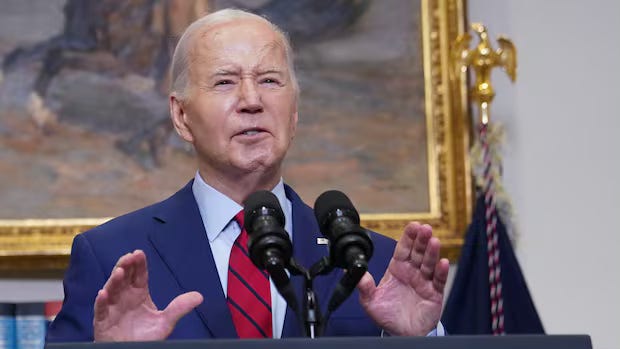
President Biden read a short statement today in which he stated “order must prevail” across America. Sometimes squinting at the teleprompter and occasionally slurring his words, Biden said there’s no place for violence, destruction, and hate in America. Apparently, there is a place for violence, destruction, and hate in Gaza, as his administration continues to send more bullets and bombs to Israel in its war of annihilation there, but no matter.
The best part of Biden’s statement came at the end, when he was asked if student protests had changed his mind at all. “No,” Biden replied.
Who says Joe Biden can’t speak simply, clearly, and honestly?
Biden puts a premium on order in his short statement on campus protests
An important point I was reminded of as I read Helen Benedict at TomDispatch today is how campus protests and coverage of the same in the U.S. is being used to obscure ongoing mass death and suffering in Gaza. The mainstream media here loves a good domestic “law and order” issue featuring controversy and (limited) violence, but forget about honest coverage of massive destruction in Gaza and mass murder of Palestinians.
In sum, Biden has always been a law and order man, with an emphasis on order, boasting of using police and prisons for social control. So his stance today was totally predictable—and totally retrograde and unproductive.
Biden, who in 2018 confessed he had no empathy for youth today and their complaints about tough times, is certainly showing that he indeed has no empathy for them.
Meandering Thoughts on Campus Protests against Genocide and Police Responses
College and university campuses across the USA are increasingly the sites of violence, but that violence is largely being committed by police units called in to disperse and arrest protesters. The police, I assume, are, as they say, just following orders. The question is: Who’s giving those orders? And the answer most often seems to be senior administrators at those colleges and universities. Welcome to your education in liberal values!
Police do what they’re trained to do, just as soldiers do what they’re trained to do. Soldiers aren’t freedom-bringers and diplomats: they are trained in the use of deadly force under the most violent of conditions. Police aren’t educators and negotiators: they are also trained in the use of suppressive force under violent conditions.
On campuses across America, police have done what police are armed and trained to do here. They break out their riot gear, their sniper rifles, their armored cars, their tools of behavior modification (e.g. cuffs, Tasers, truncheons, rubber bullets, tear gas and pepper spray), and they go to work. They literally kick ass and take names (and mug shots, fingerprints, and so on).
Police are here to protect and to serve, so we’re told. But to protect and to serve whom? And for what cause? Ultimately, police protect the powerful, those with property and money, because those are the ones giving them their orders. If and when police begin to refuse orders from above, that’s when the powerful will truly begin to worry.
It’s interesting that some student protesters, as at Columbia, are now being compared (as by MSNBC) to the January 6th protesters and rioters for Trump. It’s a sign of desperation by the establishment to equate anti-genocide protesters with pro-Trump rioters, but there you have it. Recall on January 6th that the police largely stepped aside and allowed protesters for Trump into the Capitol. I don’t see the police stepping aside on campuses or taking selfies with protesters, or even removing barriers, as some police did on January 6th.
In “Rollerball,” John Housemen explains to James Caan that he is not to interfere with management decisions
The overly violent and repressive responses we’re witnessing across America to largely peaceful protests reveals the imperative at the heart of America’s political system. Recalling the movie “Rollerball,” the one thing you’re never supposed to do as a corporate-citizen is to question management decisions. America’s managers have decided to support Israel’s genocide in Gaza, and YOU ARE NOT TO INTERFERE WITH THAT. If you do, your protest will be suppressed, often quickly and violently.
There’s a reason America’s managers “invest” so much in the “thin blue line” of the police. They believe in violence as the way to uphold their power and privilege. It doesn’t matter that violence hasn’t always worked, especially in foreign wars (Vietnam, Afghanistan, Iraq, etc.). They’ll continue to use violence as long as it remains profitable to do so, whether economically or politically.
How long before people are killed or seriously injured in these police actions? How long before those who are killed or wounded are denounced as “bums,” as President Richard Nixon called the dead students of Kent State? How long before we hear that the “silent majority” supports Trump and/or Biden in their call for “law and order”?
How long before Israel renders Gaza Palestinian-free, as various U.S. police forces mobilize to render college campuses protester-free?
And how long before we’re told once again that America is the greatest, most exceptional, nation on earth because of all our freedoms?
I’m already drowning in mainstream media coverage of Trump’s trial for paying hush money to Stormy Daniels and hiding it under the cover of legal fees. The gavel-to-gavel coverage is mindlessly extreme, designed as it is both to tarnish Trump’s image (as if that’s possible) and to capture eyeballs and ratings.
Stormy weather for Trump (Photo by Victor J. Blue)
Meanwhile, Biden’s enabling of genocide in Gaza proceeds apace, and indeed Congress is acting to accelerate it by sending even more weaponry to Israel. Crimes against humanity—what? Where? I don’t see any.
The message: enabling genocide is OK, killing or displacing millions of Palestinians from Gaza isn’t a crime, but don’t you dare pay a woman you had a consensual fling with to keep quiet and then try to hide it. Some crimes can’t be forgiven!
The other big story this week, besides the trial of the millennium against Trump, is the upcoming NFL Draft. I cannot count the number of “mock” drafts I’ve seen, the amount of ink spilled, predicting what will happen in the draft, which players will be chosen in which order, what trades will be made, and so on. The coverage is both endless and exhaustive. And all of it is unnecessary. If you want to know about the draft and which players “your” team selects, why not just wait until the draft is over?
I just wish the mainstream media devoted one-tenth of the resources it commits to the NFL Draft to more serious issues like Gaza or Ukraine or homeless people in America.
Speaking of Ukraine, did you see Members of Congress waving little Ukrainian flags when the House approved over $60 billion in aid to prolong the Russia-Ukraine War? At least now we know whose side they’re on. I had no idea we elected representatives to serve Ukraine, but I’m learning.
If you’re a Trump aficionado, an NFL fanatic, and a Ukraine flag waver, this is your week, America.
Standard Disclaimer: Nope, I’m not a Trump fan. See this article I wrote in March of 2016 about how Trump is constitutionally unsuited for the presidency.
I went to a political debate and a hockey game broke out
America is in deep trouble, yet this year’s election is a rerun of 2020, of Biden against Trump, a singularly uninspiring “choice” for the presidency.
With respect to Biden, his handlers are doing their best to isolate him, to control his campaign events, and to limit the questions he has to face. Consider this example:
— ̶B̶l̶u̶e̶ ̶C̶h̶e̶c̶k̶ Beth! (@torstrick) March 18, 2024
A Biden campaign aide says the president will take a few questions, and other staffers immediately step in to put an end to the event. No unscripted questions allowed!
Then there’s Trump. His campaign appearances are more unhinged than unscripted as Trump rails against immigrants, stolen elections, and various nasty people he doesn’t like. Trump is a collection of petty grievances.
An aspect of Trump’s personality that intrigues me is his almost complete inability to laugh. Rarely if ever do you see him enjoying a good laugh, and never at his own expense. The most you’ll get from Trump is a Cheshire-cat-like grin. He may be a “very stable genius,” but he’s largely a humorless one. His idea of humor is making fun of or insulting other people, notably women, for being ugly or otherwise unattractive to his alpha male gaze.
Meanwhile, both major parties, Republican and Democrat, seem most concerned to attack and vilify the other as extremist, as fascist, as un-American, or otherwise beyond the pale. I went to a political rally and a hockey game broke out. Seriously, last night’s game between the New Jersey Devils and New York Rangers features a line brawl that started as soon as the puck dropped. That’s basically our political scene today.
Mainstream Media Outlets Say No One Was Harmed in the Israeli Embassy while Denying the Reality of Genocide
A young Air Force airman set himself on fire outside the Israeli Embassy in DC to protest genocide in Gaza. Aaron Bushnell, 25, died after being taken to a hospital.
Aaron Bushnell before he set himself on fire. Mainstream media sites chose not to feature any images of Bushnell, focusing instead on the Israeli Embassy or “the crime scene”
This was an extreme and deadly act of political protest directed against the Israeli government’s killing and wounding of 100,000 Palestinians in Gaza and its ongoing war of annihilation there, a war abetted by the U.S. government’s political and military power. Bushnell shouted “Free Palestine!” as he burned.
Bizarrely, an officer at the scene pointed a gun at him as he burned before another first responder asked for fire extinguishers. How a man on fire posed a threat to others is unclear.
[Update 2/27, 0820 EST: Disgracefully, this was the headline of a story at the Washington Post on Bushnell: Airman who set self on fire grew up on religious compound, had anarchist past. At this link. It appears Bushnell grew up in a Christian society in Orleans on Cape Cod, that he joined the Air Force in 2020, served as a cyber defense ops specialist in Texas, and was interested in U.S. history, socialism, and anarchism. The Washington Post article is at pains to portray him as being raised by a weird, possibly abusive, Christian cult while putting a heavy stress on his interest in anarchism. He also liked cats and Tolkien’s The Lord of the Rings, so you just know he was a misfit. In all seriousness, Bushnell seems to me to have been an unusually principled and sensitive man who acted out of strong moral conviction.]
Aaron Bushnell, an unusually principled, determined, and thoughtful young man
Coverage in the mainstream media is revealing. I checked three sites: NBC, CBS, and the Guardian in Britain. Let’s look at NBC first. NBC said that Bushnell’s act was an “apparent protest” against the “Israeli-Hamas war.” NBC later added that Israel’s “crackdown” in Gaza was termed a genocide by Bushnell. NBC itself stuck to the narrative that Israel is engaged in a defensive war, a “crackdown,” against Hamas.
Next, let’s look at CBS. CBS repeated the narrative of “an apparent protest of Israel’s actions in its war against Hamas.” CBS did mention that Bushnell’s stated motivation was that he could no longer be complicit in an ongoing genocide in Gaza, followed by a lengthy denial by Netanyahu and the Israeli government. Claims of genocide are “false” and “outrageous,” as CBS gave Netanyahu the last word.
Turning to the British Guardian, its first sentence is more blunt: An active-duty member of the US air force has died after setting himself on fire outside the Israeli embassy in Washington DC, while declaring he will “no longer be complicit in genocide”.
It also included a key statement Bushnell apparently included on his Facebook page: “Many of us like to ask ourselves, ‘What would I do if I was alive during slavery? Or the Jim Crow South? Or apartheid? What would I do if my country was committing genocide?’ The answer is, you’re doing it. Right now.”
Nevertheless, the Guardian downplayed the 100,000 killed and wounded in Gaza as numbers generated by the “Hamas-run health service” there.
The final site I’d like to consider is Antiwar.com, an example of alternative media, I suppose. This site gets it right, in my view, so I’m posting the article here in its entirety:
US Airman Sets Himself on Fire in Front of Israeli Embassy to Protest Gaza Genocide
The airman said he would ‘no longer be complicit in genocide’
An active duty US airman set himself on fire in front of the Israeli embassy in Washington DC to protest the US-backed slaughter of Palestinians in Gaza.
According to Talia Jane, an independent journalist who obtained the video of the incident, the airman, who was identified as Aaron Bushnell, 25, died of his wounds late Sunday night.
According to Axios, a video of the incident shows the airman saying he would “no longer be complicit in genocide” and that he was about to “engage in an extreme act of protest.”
“But compared to what people have been experiencing in Palestine at the hands of their colonizers, it’s not extreme at all. This is what our ruling class has decided will be normal,” Bushnell said right before lighting himself on fire.
Washington DC’s Fire and Emergency Medical Services Department said in a post on X that the airman was transported to a hospital with “critical life-threatening injuries.” The department also said the officers who extinguished the fire were members of the US Secret Service.
The dramatic protest comes as the number of Palestinians killed in Gaza by the Israeli campaign is approaching 30,000, and over 69,000 have been wounded. About two-thirds of the casualties are women and children.
The International Court of Justice has ruled that it’s “plausible” Israel is committing genocide and decided to take up the case brought to the court by South Africa. Despite the massive civilian casualty rate and international pressure, the US continues to provide unconditional support for the slaughter.
Early in the 19th century, Alexis De Tocqueville famously wrote “Democracy in America.” Early in the 21st century, that title is more appropriate for a fictional or even fantasy work on America.
How so? A BV reader sent along an article from the American Prospect: “America is not a democracy,” by David Dayen. Based on that article and a few reflections of my own, here’s how and why democracy is dead in the USA:
Big money in politics. Members of Congress chase the money and are obedient to it. So are presidents. So too are even SCOTUS justices. Indeed, SCOTUS basically said corporations are citizens and that money is speech in the infamous Citizens United decision. Those with the most money have the most speech in America. Those with no money are essentially mute and powerless.
Gerrymandering. Both Democrats and Republicans draw district lines to inhibit real electoral competition. Thus most seats in Congress are “safe,” dominated by a single party.
Voter Suppression. There are all sorts of tactics to depress voter turnout among the “unwashed.” Unnecessary voter ID laws. The closing of polling stations. Dropping people from the polling lists. Holding the vote on a work day. Even the presence of police officers and “voting monitors” at the polls.
Corporate Ownership of the Mainstream Media: The MSM touts corporate-friendly candidates from the two major parties. Third-party candidates are almost entirely ignored when not openly vilified and condemned as “spoilers.”
For the presidency, the electoral college. Presidents aren’t elected by popular vote; what matters is winning the electoral college. As a result, this year’s election will likely come down to roughly 500,000 voters in six “swing” states.
For the senate, the persistence of the filibuster. Both parties conveniently use the filibuster as an excuse for why they can’t get things done for workers and the middle class.
The decline of unions. Workers only have power when they organize and stand together as one, flexing their muscles with strikes and other actions. The decline of unions has largely neutered the working classes.
Constant wars overseas. As James Madison noted, constant warfare is the enemy of democracy and the friend of authoritarianism and corruption.
Obstacles to third-party challengers. Republicans and Democrats share a contempt for third-party challengers, erecting obstacles via lawsuits and similar activities. Just ask Ralph Nader or RFK Jr.
Sham primaries. The RNC and DNC are private institutions. The DNC is controlled by so-called superdelegates. Neither party is interested in the will of voters; they serve the whims of the owners and donors.
There are several words you can use to describe America’s system of government. Oligarchy, rule by the few, applies. Plutocracy, rule by the rich, applies. Kleptocracy, rule by the greedy and corrupted, applies. Even kakistocracy, rule by the worst, has some applicability. The word that doesn’t apply is democracy.
Well, it’s an idea …
This is not news to my readers, of course. Consider the Princeton Study from 2014, which reached the following conclusions:
When a majority of citizens [in the USA] disagrees with economic elites and/or with organised interests, they generally lose. Moreover, because of the strong status quo bias built into the US political system, even when fairly large majorities of Americans favour policy change, they generally do not get it.
The study concludes:
Americans do enjoy many features central to democratic governance, such as regular elections, freedom of speech and association and a widespread (if still contested) franchise. But we believe that if policymaking is dominated by powerful business organisations and a small number of affluent Americans, then America’s claims to being a democratic society are seriously threatened.
Sure, we have regular elections, but who’s excited by this year’s likely choice of Biden/Trump for the presidency? And do we really have freedom of speech? Try protesting in DC against genocide in Gaza, especially in the hearing rooms of Congress.
America is an oligarchy ruled by powerful interests such as the military-industrial-congressional complex, Wall Street, Big Pharma, the banks, health insurers, the billionaire class, and indeed any entity with deep pockets that can transmute its gold into political reach and speech. All legal, of course!
We’d like to think America is a land of decent George Baileys and small-town egalitarianism like Bedford Falls, but America’s owners and donors much prefer Pottersville USA, where the rich and powerful call the shots. And so Pottersville it is.
P.S. People ask me, OK, smartypants, how do we change this? As they say, power concedes nothing without a demand. A demand backed up by the power of the masses. Specific steps are easy to state, difficult to achieve. Get big money out of politics. End the filibuster. Eliminate the electoral college. End gerrymandering and voter suppression. Revive unions. End wars. And so on. In a word, fight.
Kamala Harris at Munich tells you what America is and isn’t about
Yesterday, in her remarks before the Munich Security Conference, Vice President Kamala Harris made some remarkable claims while speaking a bold truth about what U.S. foreign policy is all about.
First, let’s turn to the bold truth:
And please do understand, [Vice President Harris said,] our approach is not based on the virtues of charity. We pursue our approach because it is in our strategic interest.
I strongly believe America’s role of global leadership is to the direct benefit of the American people. Our leadership keeps our homeland safe, supports American jobs, secures supply chains, and opens new markets for American goods.
I bolded the key phrase: America’s approach to the rest of the world isn’t charitable in any way. It’s about jobs, supply chains, and new markets. It’s about dominance and profits and “the homeland.” End of story.
It put me to mind of a passage in the Bible (Corinthians) about the inestimable value of charity:
And though I have the gift of prophecy, and understand all mysteries, and all knowledge; and though I have all faith, so that I could remove mountains, and have not charity, I am nothing. (KJV; 1 Corinthians 13:2)
The U.S. can certainly move (or remove) mountains with its nuclear weapons; it certainly thinks it has a gift of prophecy with all its surveillance and spy agencies; but unless it has charity toward those less fortunate, it is nothing. It’s good to hear the Vice President avow so clearly that the U.S. approach to the world isn’t in any way charitable or even well-meaning.
Charity? Nope. “Our approach is not based on the virtues of charity”
The remarkable claims came as Harris attacked the Republicans and Trump but without specifically naming them. Here’s what she said about them:
However, there are some in the United States who disagree. They suggest it is in the best interest of the American people to isolate ourselves from the world, to flout common understandings among nations, to embrace dictators and adopt their repressive tactics, and abandon commitments to our allies in favor of unilateral action.
Let me be clear: That worldview is dangerous, destabilizing, and indeed short-sighted. That view would weaken America and would undermine global stability and undermine global prosperity.
President Biden and I, therefore, reject that view.
Are Trump and his followers arguing that America should isolate itself from the world? That America should embrace dictators? That America should betray its allies? That America should be a repressive autocracy? This is a misleading and disturbing caricature of Republicans as it accuses them of treason to the U.S. Constitution.
Perhaps some believe that Trump and MAGA truly are this malevolent. But should these accusations be made before foreign leaders at a summit in Munich, Germany?
Something is seriously wrong with America’s leadership. Without charity, they are nothing.
I had a great time this weekend with family, including my brother-in-law who’s a combat veteran of the Vietnam War. If I’m on the left, he’s on the right (whatever those often vague political labels may mean). Guess what we agree on? A lot, actually:
+ We both agreed the Iraq and Afghan Wars were disasters.
+ We both agreed $105 billion in more weapons and “aid” to Ukraine, Israel, Taiwan, etc. is a complete waste of money. We’d both rather see that money spent here in the USA, especially on America’s crumbling infrastructure. (“Crumbling” as a descriptor is inseparable from infrastructure here in America.)
+ We both agreed the government response to Covid was badly botched and that Anthony Fauci often lied to the American people. We both agreed government experts should have treated us like adults, admitting they couldn’t answer all the questions about Covid. We both think it’s more likely than not that Covid was a man-modified virus that leaked from a lab in China.
+ We both agreed Joe Biden isn’t the answer in 2024. My brother-in-law is open to Trump; I can’t vote for Trump for so many reasons. A minor disagreement, though we’d both like to see more and younger candidates, not a Biden-Trump rematch.
+ We both agreed a ban on assault weapons would do little or nothing to stop gun violence and mass shootings in America. There are already 20 million AR-15-type assault weapons in America; sorry, a ban won’t fix anything.
+ We both agreed the New England Patriots suck this year, but that Mac Jones isn’t solely to blame for an offense that simply can’t score points.
+ We both agreed Budweiser went well with our turkey and sausage gumbo.
+ We both agreed “White Heat” (1949) with Jimmy Cagney is one of the greatest movies ever made.
Top of the world, Ma. Jimmy Cagney at the explosive conclusion to “White Heat”
+ Finally, we both agreed we are immersed in Operation Ongoing Bullshit, a felicitous phrase my brother-in-law came up with. We are constantly being bullshitted by “our” government. I put “our” in scare-quotes because we agreed we have a pay-to-play government. Pay a lot, as in millions of lobbying dollars, you get to play a lot. Can’t pay? Too bad. You have no say.
Operation Ongoing Bullshit is one of the more honest names I’ve heard to describe what the U.S. government is usually up to. Right and left can heartily agree on this, I think.
Far too often, we’re told there are unbridgeable differences between right and left in America. Differences exist, of course, yet there’s so much Americans can and do agree on. To cite only one example, I think most Americans agree with James Madison that ongoing war (and ongoing BS, for that matter) contributes to the death of democracy. And also to our colossal national deficit, now in the neighborhood of $34 trillion.
There’s a man who famously crowned himself emperor rather than submit to the otherworldly power of a pope. A new movie will soon be out on his “glories.” Napoleon Bonaparte, a military genius, embraced war and drove for total victory until his empire collapsed on him and the French people. Napoleon’s Waterloo came in 1815, a decade after perhaps his greatest victory at Austerlitz in 1805. Empires—they often seem to decline slowly before collapsing all at once, though the Napoleonic version flared so brightly that it burned out quickly.
I once studied the military glories of Napoleon, enthusiastically playing war-games like Waterloo and Empire in Arms, where this time maybe I could win a great victory for the emperor. More than a few books on my shelves cover the campaigns of Napoleon. But as my dad quipped to me, Napoleon wanted to give people liberty, equality, and fraternity at the point of his sword. And that, my dad would say, is an intolerable price to pay for one’s freedom.
Win one for the Emperor
Endless war is, as often as not, the final nail in an empire’s coffin. Early in 1943, after defeat at Stalingrad, which came as a profound shock to a German public sold on the idea it possessed the finest fighting force in history (such rhetoric should sound familiar to Americans today), Joseph Goebbels, the infamous Nazi propaganda minister, gave a fanatical speech calling for “total war” from the German people. Despite disaster at Stalingrad, despite visible and widening cracks in the alleged superiority of the Thousand Year Reich, the German people largely cheered or echoed the cry for more and more war. Two years later, they witnessed total defeat as Germany surrendered unconditionally in May 1945.
As led by Adolf Hitler and his henchmen, Nazi Germany wasn’t interested in peace. These men knew only the feverish pursuit of total victory until it ended in their deaths and total disaster for Germany. They were the original seekers of “full spectrum dominance” as they asserted Germany was the exceptional and essential nation.
We Americans were supposed to learn something from megalomaniacs like Napoleon and Hitler. Committed to democracy, we were supposed to reject war, to repudiate militarism and the warrior mystique, and to embrace instead diplomacy and the settlement of differences peacefully through international organizations like the United Nations.
America today, however, is busy beating plowshares into swords and sending them to global hotspots like Gaza and Ukraine. What gives?
Endless wars can exhaust even the richest and wisest of empires, and America isn’t as rich or wise as it used to be. Interestingly, ordinary Americans haven’t been overcome with bloodthirst. Roughly two-thirds of Americans, for example, support a ceasefire in Gaza. But they are a silent majority compared to the loud minority flowing through the halls of power in DC lobbying for war and more war.
The U.S., which largely created the UN in the immediate aftermath of World War II, now does everything it can to block UN calls for ceasefires, whether in Ukraine or Gaza. The U.S., while allegedly manifesting its allegiance to Judeo-Christian values, embraces war and distributes weaponry like the devil while rejecting calls for peace by church leaders such as Pope Francis.
The U.S. is an empire in serious decline because it devotes so much money to wars and more wars. Military budgets now approach $1 trillion yearly even as the Pentagon just announced it failed its sixth audit in a row. These repetitive failures provoke a bizarre response from Congress and the President: yet more money for war and dominance.
Whether measured in blood or treasure or both, seeking to dominate the world through military hegemony is a surefire recipe for imperial collapse. It’s a lesson taught by the fates of Napoleon and Hitler, one U.S. leaders have dismissed as they’ve been caught up in a belief one can be a superpower, a global hegemon, totally dominant, while remaining a beacon of freedom.
Like Napoleon, U.S. leaders sell the idea they’re giving people liberty at the point of a sword. My dad taught me something about the fallacy and folly of this.
The ongoing Israeli attacks against Gaza put me to mind of one of my favorite science fiction books as a teenager, Robert Heinlein’s “Starship Troopers.” In that book, a military veteran and teacher of “history and moral philosophy” is discussing violence with high school students. One of them blithely says violence never solves anything, which draws this memorable response from her hard-nosed instructor:
Anyone who clings to the historically untrue—and thoroughly immoral—doctrine that ‘violence never settles anything,’ I would advise to conjure the ghosts of Napoleon Bonaparte and the Duke of Wellington and let them debate it. The ghost of Hitler could referee, and the jury might well be the Dodo, the Great Auk, and the Passenger Pigeon. Violence, naked force, has settled more issues in history than has any other factor, and the contrary opinion is wishful thinking at its worst. Breeds that forget this basic truth have always paid for it with their lives and their freedoms.
In Heinlein’s book, humans were at war with an alien species and those who chose military service to fight against “the bugs” got the right to vote and participate as citizens in government.
In a fight to the death, Heinlein suggested, the only choice right-thinking humans had was violence and a commitment to the total destruction of the enemy. There was no other solution.
I remember this cover well (vintage 1970s)
How might this apply to Gaza? Members of Hamas are Heinlein’s enemy bugs; in fact, all of Gaza is apparently an alien land that must be ravaged as the bugs are either killed or driven off the land. Violence will settle the issue of who controls Gaza, and by extension the West Bank, once and for all, with the IDF serving as Israel’s “Starship Troopers.”
Don’t get me wrong. My memory flashback to Heinlein was painful. It was not in any way a vote in favor of massive violence by Israel to solve the Gaza “problem.” Rather, I think Heinlein’s insight captures the mindset of those in authority in Israel at this moment. Kill or drive off the “bugs.” Settle this. No ceasefires, no pauses, no compromises. Total victory through massive violence is the decisive option.
In this mindset they are enabled by the U.S. president and Congress, who boast loudly of having Israel’s back, come what may. Indeed, the president and Congress eagerly wish to provide Israel all the weapons it needs to kill or drive off the “bugs.”
Heinlein’s “Starship Troopers” remains a controversial book for its depiction of a thoroughly militarized neo-fascist society, a vision captured in Paul Verhoeven’s movie version of the same name, a biting satire of militarism run amuck, though the satire is apparently lost on more than a few viewers.
To echo Heinlein, violence certainly did settle things for the dodo and for the passenger pigeon. They are no more. Yet it’s also true that those who live by the sword will often die by it. And if that sword proves to be a nuclear one, we as humans may yet be joining the dodo in extinction.











 Bracing Views