Cluster Munitions for Ukraine

W.J. Astore

The dangerous escalatory nature of wars

News that the Biden administration is sending cluster munitions to Ukraine highlights the dangerous escalatory nature of wars. These are special bombs and artillery shells with hundreds of “bomblets” that disperse to kill or maim as many people as possible. They persist in the environment; children have been known to pick them up and to be killed or grievously wounded as a result.

The apparent rationale behind this decision is that cluster munitions will help Ukraine in its counteroffensive against Russia. While these munitions will certainly increase the body count, probably on both sides, they are unlikely to be militarily decisive.

There are other issues as well, notes Daniel Larison at Eunomia:

The decision also opens the U.S. up to obvious charges of hypocrisy. U.S. officials have condemned the Russian use of these weapons and said that they have no place on the battlefield, but now the administration is saying that they do have a place. Providing cluster munitions to Ukraine makes a mockery of the administration’s earlier statements and creates more political problems for its effort to rally support for Ukraine. Many states in Latin America, Africa, and Asia are parties to the treaty banning the use, transfer, and stockpiling of cluster munitions, and now they will have one more reason to dismiss U.S. appeals to defending the “rules-based order” as so much hot air. The decision will probably embarrass and antagonize some of our allies in Europe, as most members of NATO are also parties to the treaty.

It’s rather amazing to think about the incredible variety of weaponry being sent to Ukraine in the name of “victory.” At first, the Biden administration spoke only of providing defensive weaponry. Biden himself declared that sending main battle tanks, jet fighters, and the like was tantamount to provoking World War III. More than a year later, the U.S. has committed to sending Abrams tanks, F-16 fighter jets, and offensive weapons of considerable potency like depleted uranium shells and now cluster munitions. And always with the same justification: the new weapons will help break the stalemate and lead to total victory for Ukraine.
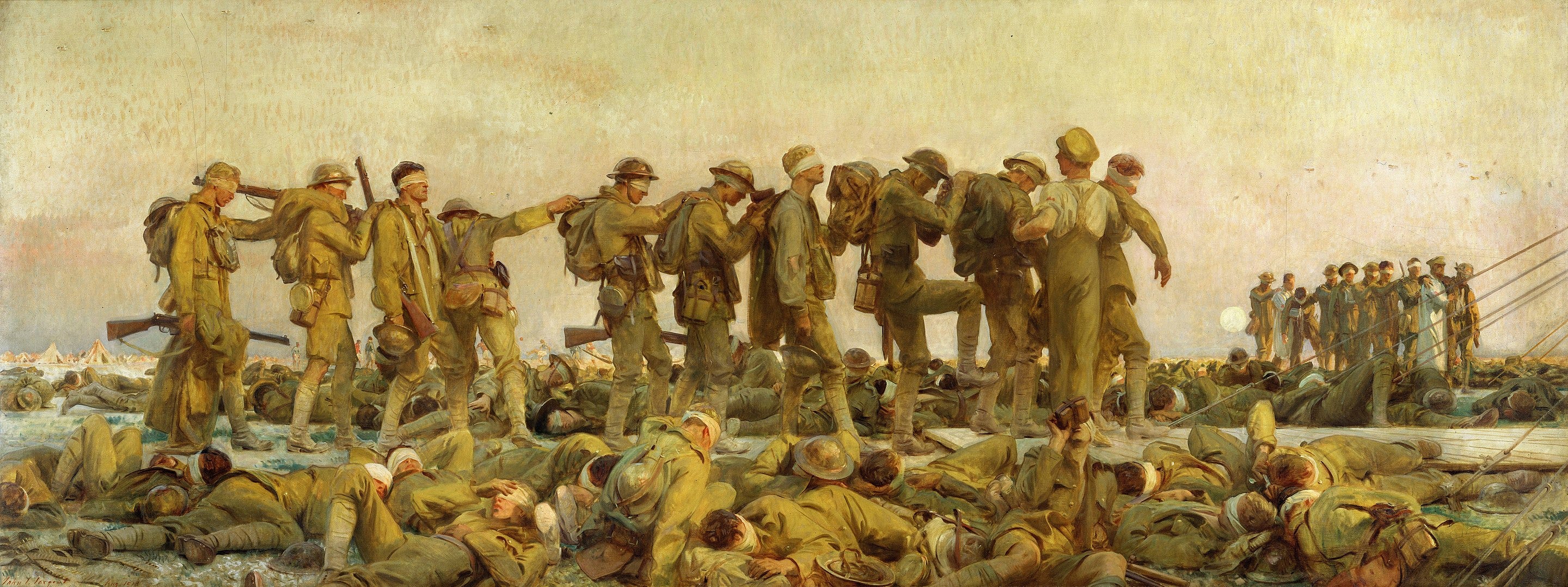
John Singer Sargent, “Gassed” (1919). Gas in World War I produced a million casualties—only aggravating the horrors of trench warfare

This is nothing new, of course, in military history. Think of World War I. Poison gas was introduced in 1915 in an attempt to break the stalemate of trench warfare. It didn’t. But it did stimulate the production of all sorts of dangerous chemical munitions and agents such as chlorine gas, phosgene, and mustard. Tanks were first introduced in 1916. Stalemate persisted. Flamethrowers were introduced. Other ideas to break the stalemate included massive artillery barrages along with “creeping” barrages timed to the advancing troops.

But there was no wonder weapon that broke the stalemate of World War I. After four years of sustained warfare, the German military finally started to falter in the summer of 1918. The Spanish Flu, the contagion of communism from Russia, and an effective allied blockade also served to weaken German resolve. The guns finally fell silent on November 11, 1918, a calm that wasn’t produced by magical weapons.

I wonder which weapon will next be hailed as crucial to Ukrainian victory? Who knows, maybe even tactical nukes might be on the minds of a few of the madmen advising Biden.
Turmoil in Russia!

W.J. Astore

Is Putin’s Grip Weakening?

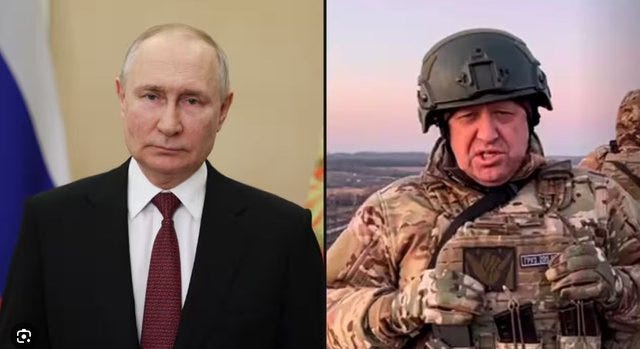
News of the rebellion of the Wagner mercenary group in Russia and the exile of its leader have led to confident announcements of Vladimir Putin’s weakening grip on power. Secretary of State Antony Blinken said the rebellion was “the latest failure” in Putin’s war against Ukraine, and NBC News declared “Putin’s rule is now more uncertain than ever.”

Vladimir Putin and the leader of the Wagner group, Yevgeny Prigozhin

Perhaps so. Wars often act as an accelerant to change, generating political chaos in their wake. The results of chaos, obviously, don’t lend themselves to predictability. Who knew in 1914, when the guns of August sounded, that four years later four empires would have collapsed under the strain of war (the Russian Empire, the Austro-Hungarian Empire, the Ottoman Empire, and the German Second Reich).

President Joe Biden was unusually frank in March of 2022 when he declared that Putin “cannot remain in power” due to his decision to invade Ukraine. Be careful what you wish for, Mr. President. Is overthrowing Putin truly a wise goal for global stability?

I honestly don’t know. A weaker, possibly fragmented Russia could increase the chances of nuclear war. A struggle for power within Russia could lead to the emergence of hardline leader who might make the West nostalgic for the relative predictability of Putin.

Most of us have heard the saying: better the devil you know than the one you don’t know. (This isn’t to suggest Putin is diabolical, of course.) In World War I, many of the allies professed to hate the Kaiser; his eventual successor as leader of the German people was Adolf Hitler. Again, wars may unleash elemental and fundamental changes, and change isn’t always for the better.

So, my position on the Russia-Ukraine War remains unchanged. Negotiate a truce. Use diplomacy to put a permanent end to this war. If Putin is truly weakened, this might be the best of times to seek a diplomatic settlement. After all, if Putin is truly worried about his grip on power within Russia, he might be open to ending the war largely on Ukraine’s terms so he can redirect his attention to consolidating his power base.

War has been given plenty of chances. Why not give peace a chance?

The Ukraine Counteroffensive and the Costs of War

W.J. Astore

“Magical” weapons aren’t enough

Ukraine’s counteroffensive against Russia appears to be stalling, (See this frank article by Medea Benjamin and Nicolas Davies.) This isn’t surprising.

War is inherently unpredictable, but there are certain ingredients that contribute to the success of counteroffensives. Here are a few:

  1. The element of surprise: Catching the enemy off-guard is always helpful. But everyone knew Ukraine was counterattacking, including roughly where and when.
  2. Superiority at the point of attack: As a rough rule, an attacker needs at least a 3-to-1 superiority in force to prevail against a determined defender, along with a willingness and ability to accept casualties. It’s unclear to me that Ukraine had a clear superiority at their points of attack. Whether Ukraine can continue to sustain high numbers of killed and wounded is also unclear.
  3. The synergy of combined arms: Everything in war is difficult, most especially orchestrating and conducting an offensive. “Combined arms” includes infantry, artillery, and tanks, moving with machine-like precision, supported by airpower, enhanced by intelligence, and kept supplied by adequate logistical chains. Ukrainian forces did well on the defensive in resisting often poorly coordinated Russian attacks, but now the combat boot is on the other foot, and it’s Ukraine that’s having trouble breaking through well-prepared Russian positions.
  4. The importance of training and experience: While Ukrainian troops have gained experience over the last year or so, they have primarily been on the defensive while also assimilating new weapons and related equipment. They arguably lack the experience to launch coordinated offensives against determined resistance.
  5. Effective leadership: It was said the presence of Napoleon Bonaparte on the battlefield was equivalent to the French having an extra army corps, i.e. roughly 30,000 men. Offensives go better when they’re led by skilled generals backed up by effective officers and experienced NCOs. I’m not aware of any Napoleon-types on either side of the Russia/Ukraine War, and I fear Ukraine has suffered too many losses to have a solid core of experienced officers and NCOs.

The Western solution to all this appears to be more promises of “magical” weapons like German Leopard tanks and American F-16 fighter jets. But weapons alone are insufficient to provide war-winning advantages. Military history teaches us that the side with superior weapons often loses to the side with superior skill and motivation. Think here of the U.S. experience in Vietnam, for example.

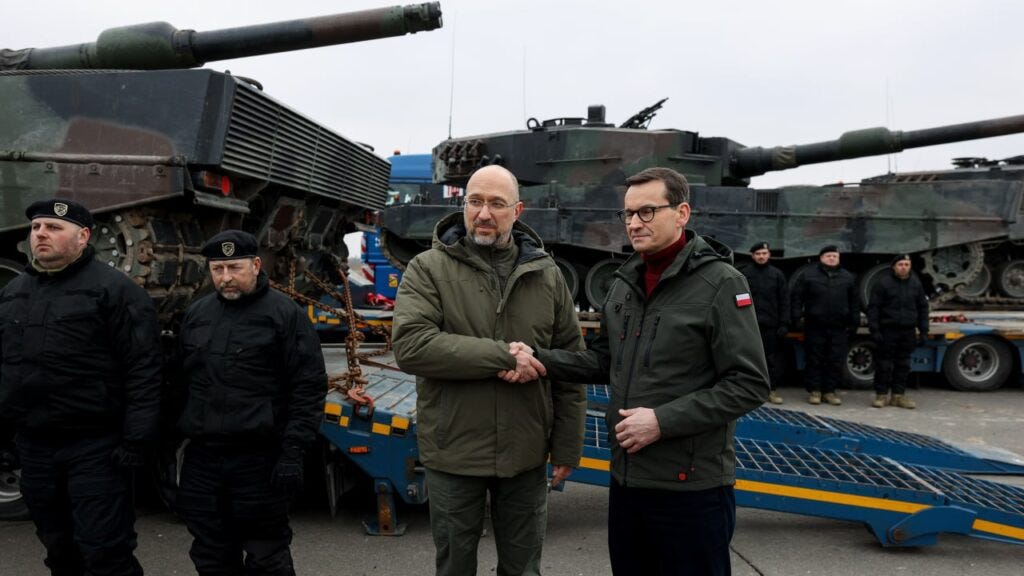
Poland delivers Leopard II tanks to Ukraine. But tanks are not enough.

As I’ve said before, what I fear is that neither side can win this war decisively even as Ukraine suffers most grievously because the war is being fought in their country.

People like Senator Lindsey Graham talk tough about Ukrainians fighting to the last man with U.S. and NATO weaponry. Easy for him to say, since he’s not the one who’s fighting and possibly dying at the front. Meanwhile, U.S. companies profit from the sale of weapons, hence that apt descriptor from the 1930s, “the merchants of death.”

For the sake of argument, let’s say Ukraine is able to make modest territorial gains at high cost. This would be an excellent time to call for a truce and diplomacy. Ukraine can claim a face-saving “victory” (those modest gains) even as the Russians can boast of containing the much-hyped NATO-supported counteroffensive. Let both sides declare victory as they hash out a compromise that ends the killing and destruction.

What’s the real definition of “victory” here? For me, it’s a rapid end to a wasteful war before that war is allowed to escalate in ways that could spark a much wider and potentially catastrophic conflict involving nuclear powers.

Hype and Hope in Ukraine’s Counteroffensive

W.J. Astore

“Certain Gains” in an Uncertain War

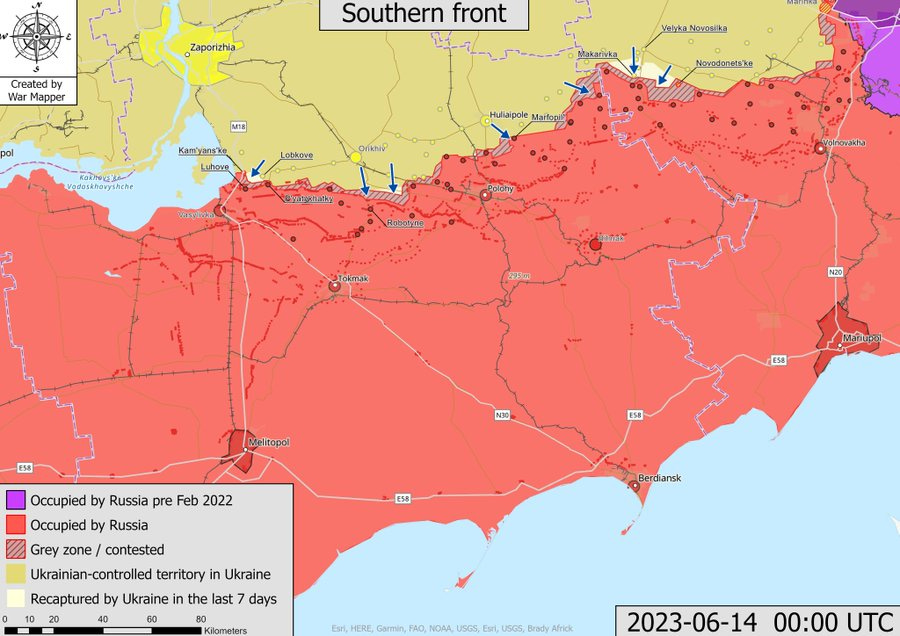
Ukraine’s counteroffensive is in motion; results so far appear to be mixed.  Today’s CNN summary had this to say: Ukrainian forces are claiming some success in their offensives in the south and east. Kyiv’s top general said this week that his troops have seen “certain gains.”

“Certain gains.”  Not only is the U.S. government sending Ukraine weapons and aid; it also is providing lessons in rhetorical BS.  How long before Ukraine speaks of “corners turned” and “the light at the end of the tunnel” in this dreadful war?

“Certain gains”: One thing that is certain is that maps like this are a sterile depiction of the dreadful and ghastly costs of war (Source: War Mapper)

Five days ago, the New York Times provided this short summary of Ukraine’s counteroffensive: As Ukraine Launches Counteroffensive, Definitions of ‘Success’ Vary. Privately, U.S. and European officials concede that pushing all of Russia’s forces out of occupied Ukrainian land is highly unlikely.

What is the definition of “success”? It sounds like a metaphysical puzzle.

Back on May 31st, I spoke with defense journalist Brad Dress at The Hill.  This is what I had to say then: “Sometimes, war is sold like a consumer product, where there’s a lot of hype and a lot of hope. That is contrary to the reality we often see.”

In our conversation, I reminded Dress of counteroffensives from military history that went dreadfully wrong.  Think of the first day of the Somme in July 1916 during World War I, when the British Army lost 20,000 dead and another 40,000 wounded.  Think of the Battle of the Bulge in December 1944 in World War II, when the German Army threw away its strategic reserve in a last gasp counteroffensive that ultimately made it easier for the Allies to defeat them in 1945.  History is replete with examples of failed counteroffensives, especially when the opponent is prepared and entrenched.

War is inherently unpredictable (as well as being hellish and horrific), but it does appear that Ukraine’s counteroffensive won’t be decisive.  It’s not going to defeat Russia in one fell swoop.  Battle lines may move a bit, but the war will continue.  And so will the killing—and the profiteering. Is that “success”?

Mostly unseen and unwritten about are all the dead soldiers on both sides, all the environmental destruction.  Which likely will produce cries for yet more violence in the cause of vengeance. “Success”?

So far, the Biden administration has used all its influence, indeed all means at its disposal, to continue the war.  The only way out, apparently, is over the bodies of dead Ukrainians and Russians.  Not surprisingly, then, the U.S. is providing even more deadly weaponry to Ukraine, including depleted uranium ammunition and (eventually) M-1 Abrams tanks and F-16 fighter jets.  Escalation, in sum, is America’s sole solution to ending the war.

I implore the U.S. government to pursue diplomacy as a means to ending this awful war.  No one is talking about surrendering to Putin.  No one wants to abandon Ukraine.  Indeed, I’m at a loss when people accuse me of not caring for the people of Ukraine when my goal is to end the killing on both sides.

All wars end.  Ukraine and Russia aren’t going anywhere.  They share a long border, a longer history, and now a lengthening war.  Shouldn’t we be doing everything we can to shorten it?

Getting Giddy About War

W.J. Astore

The counteroffensive is coming!

Six days ago, I received an email from the New York Times informing me that “The counteroffensive is coming.” It was all about Ukraine and its plans to take the fight to the Russians. Overall, I’d describe the tone of the article as almost giddy. Isn’t it great that Ukraine will soon be killing more Russians?

Readers here know I’m for diplomacy. Russia and Ukraine share a long border and history. They need to find a way to end this war and live together, and we should be helping them do this. The longer the war lasts, the more bitter it will get, even as events become more unpredictable. Nuclear escalation is quite possible. Yet the New York Times is gushing about Ukraine using the element of surprise and combined arms warfare to teach all those nasty Russians a lesson.

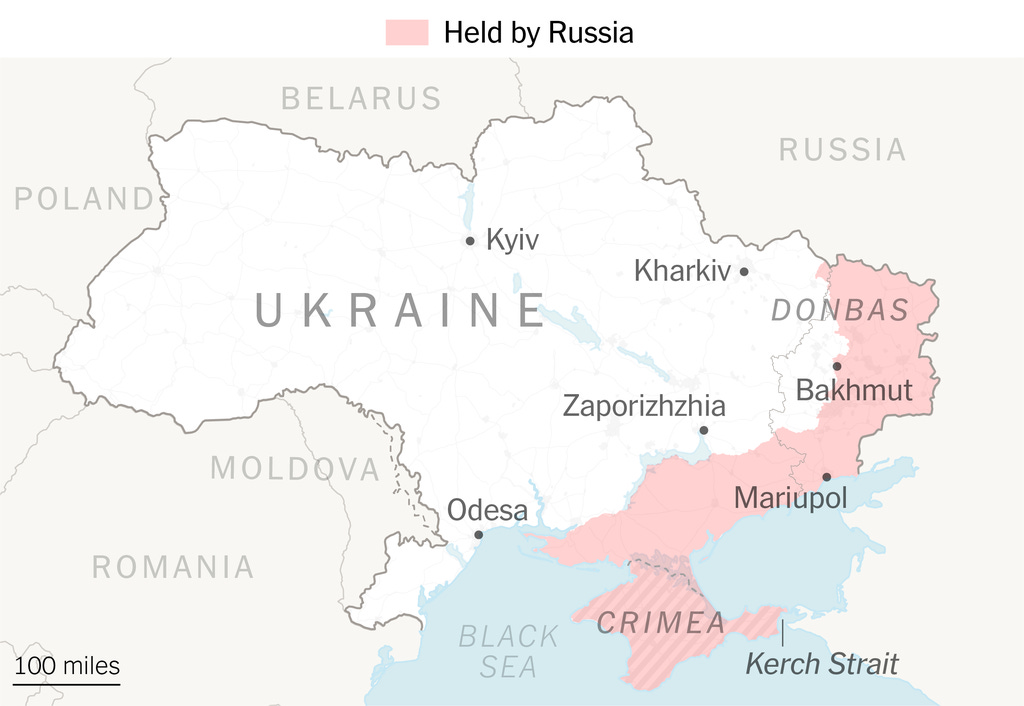
Map from the NYT Newsletter, citing the Institute for the Study of War. Interestingly, the map suggests Crimea as an objective of the promised Ukrainian counteroffensive 

I liked this passage from the NYT article/newsletter: “The troops [of Ukraine] have learned a technique known as combined-arms warfare, in which different parts of the military work together to take territory. Tanks punch through enemy lines by rolling over trenches, for example, and infantry then spread out to hold the area.”

It sure sounds nice and clean. Tanks “punch through” and infantry “then spread out.” I’m sure glad the Russians have no tanks of their own, no anti-tank missiles, no machine guns, and no artillery.

Here’s another example from the NYT article of positive thinking and bloodless prose:

In the favorable scenario for Ukraine, a peace deal in which Russia is expelled from everywhere but Crimea and parts of the Donbas region would become plausible. On the flip side, a failed counteroffensive and an unbroken land bridge would provide Putin with a big psychological victory and a foundation from which to launch future attacks.

Only two scenarios? Either the Ukraine counteroffensive is a success, leading to a favorable peace deal, or it stalls, meaning victory for Russia and future Russian assaults? What about a wider war with Russia? Or a wildly successful attack that leads the Russians to deploy tactical nuclear weapons against it? Or an attack that Ukraine can’t sustain, leaving it vulnerable to Russian counterattacks in which Ukraine is convincingly defeated?

No matter what happens, we can count on at least two things as certain: more dead and wounded Russians and Ukrainians, and more profits for all those arms merchants providing weaponry to Ukraine, much of it paid for by American taxpayers, whether they know it or not.

Nowhere in this NYT newsletter is anything mentioned about the human costs of this much-anticipated Ukrainian counteroffensive. There’s only one mention of losses, and that comes with Russia:

Experts have compared the war’s recent months to World War I, with both sides dug into trenches and neither making much progress. Russia lost tens of thousands of troops this year merely to capture Bakhmut, a marginal city in the Donbas.

I’m glad Ukraine “lost” no troops in defending that “marginal city in the Donbas.” And who’s to say which city is “marginal” and which isn’t?

I’ve heard the NYT described as “liberal,” but when it comes to war, the NYT is a bloodthirsty cheerleader. Perhaps that’s the new face of liberalism in America today.

Mobsters of the Mind

W.J. Astore

Of “Legal” Drug Ads and Anti-Russia Messaging

Mobsters are known for breaking kneecaps to bend people to their will. Marketers break into heads with repetitive and manipulative advertising, images, and narratives. Mobsters of the mind, they are.

I thought of this after watching all those repetitive (and largely interchangeable) ads for “legal” prescription drugs. Rarely do they show the often serious conditions they allegedly treat. Instead it’s image after image of people enjoying life, whether at amusement parks, the beach, dancing, or what-have-you. It’s as if drug companies are selling happiness pills whose only side effect is experiencing the best day of your life. Meanwhile, as images spill into your head of eternal bliss, a narrator quietly intones about potential serious side effects, even possible death in the case of one drug I’ve seen advertised.

Excuse me while I pop a few pills and denounce Russia—or China

Drug ads are the worst. People wonder why Americans take so many illegal drugs and why we have so many drug addictions — well, just look at all the ads for legal drugs, and how they’re advertised as making people incandescently happy. It’s all about the messaging: the repetition of powerful feel-good imagery, with drugs as panaceas.

Speaking of repetition, something similar is true of political manipulation. To cite one example: Russia. Has there ever been a worse “drug” with more serious side effects than Russia? Russia keeps hacking our elections! Russia is led by war criminals! Russia is raping Ukraine! Over and over again, the mainstream media encourages us to hate Russia and Vladimir Putin. Is this truly all we need to know about Russia? As Sting sang, don’t the Russians love their children too? (Back in the 1980s, the media didn’t go easy on Sting for his alleged naïveté and pro-Russian sentiments.)

Whether it’s drug advertisers, the mainstream media, or the U.S. government for that matter, America is infested with various “ministries of truth” that are driven by a mobster-like mentality. They may not break your kneecaps, but they nevertheless find ways to break into your mind.

Now you’ll excuse me while I pop a few pills while denouncing Russia. And China too, perhaps?

Questions to Ask in the Russia-Ukraine War

W.J. Astore

Burnishing My Kremlin Talking Points?

I don’t get bogged down in the operational and tactical details of the Russia-Ukraine War.  I don’t know which side is winning or allegedly winning, or which side is best prepared to launch a spring offensive, or which weapons will allegedly turn the tide (likely answer: none).  In my view, both sides are losing, especially Ukraine since the war is being fought on their turf.  Each side has suffered well over 100,000 killed.  Russia has captured territory; whether they can keep it remains to be seen.

War—it sucks. But let’s keep fighting so someone can “win.” (Natali Sevriukova mourns the loss of her home in Kyiv; Sky News)

My focus is on larger questions and points. Here they are, in no special order:

1. Does Ukraine truly seek to retake Crimea from Russia?  If so, how much are the U.S. and NATO prepared to assist in this?  Assuming Ukraine can launch such an offensive, how might Russia respond?  Is the nuclear option on the table for Putin if Crimea is invaded?  Could war in Crimea escalate to World War III?

2.  If the U.S. doesn’t like China’s peace plan to end the war, where is the U.S. peace plan?  Does the U.S. even have one?

3.  If peace talks can’t proceed until Russia withdraws all its forces from Ukraine, doesn’t that mean they’ll be no peace talks without a total military victory by Ukraine? Aren’t we talking about a prolonged and even more murderous war for both sides?

4. Why is it that the West sees peace talks as weakness?  Ukraine has done better than expected in battle; can’t Ukrainians negotiate from a position of strength?

5. Diplomats like to say that no one wants war, but that simply isn’t true.  Plenty of people make lots of money from war. The longer the war lasts, the more money they’ll make.

6. The U.S. has benefited geopolitically from the weakening of Russia.  Economically too with the destruction of the Nord Stream pipelines. That doesn’t delegitimize efforts to aid Ukraine in this war, but it does make you seriously question U.S. motives and intent.

7.  Observers have noted inept tactics by Russian forces; at the same time, they call for higher U.S. and NATO spending due to Russia’s dangerous military.  Doesn’t Russia’s mediocre performance suggest deliberate threat inflation here?  Couldn’t U.S. and NATO military spending be sinking instead of surging?

8.  Observers suggest Ukraine is an “aspiring” democracy.  Restrictions to free press, high rates of corruption, and similar issues suggest Ukraine’s democratic aspirations are already victims of this war. Since war is the enemy of democracy, it’s unlikely Ukraine’s “aspirations” will survive if this war continues without end.

9.  Putin’s invasion of Ukraine was illegal, immoral, and wrong.  But that doesn’t mean it was “unprovoked.”

10.  Are wars best ended by sending expensive and advanced weaponry to the battlefront?

11.  To the claim that reducing U.S. and NATO weapons shipments while promoting negotiation would “embolden” Putin and Russia: If it did and does, just resume the shipments while denouncing Putin for reneging on peace talks.

12.  Putin doesn’t want peace; he’s “worse than Hitler.”  That claim is more than misleading.  If the war is going poorly for Russia, Putin may calculate that a negotiated peace would be better for him in the long run than more killing, especially if the Ukraine boosters are correct about the formidable nature of Ukraine’s planned spring offensive.

13.   A U.S. policy decision to work for a negotiated truce and peace could conceivably lead to an end to fighting.  That truce/peace could be couched in terms of avoiding a wider war that could escalate to nuclear weapons, while still upholding Ukraine’s right to exist and to pursue its own form of government.  Of course, the devil would be in the details with respect to the terms of the truce/treaty.  Why isn’t the U.S. working to advance this?

14.   Strictly for Americans: What vital national interest does the U.S. have in providing more than $110 billion in aid, and counting, to Ukraine?  How are we supporting and defending the U.S. Constitution in Ukraine?  Ukraine is not a NATO member.  The U.S. has no formal alliance with Ukraine.  Ukrainian democracy is (at best) imperfect.  Continued support of Ukraine runs the risk of a wider, more calamitous, war.  Certainly, Americans can legitimately ask why Ukraine has received $110 billion in one year while U.S. states continue to be starved of funds for the homeless, the mentally ill, education, and other worthy social causes within the U.S. itself.

15.    Strictly for Americans:  In 2023, is the U.S. to send another $110 billion to Ukraine?  How about in 2024?  Until Ukraine “wins”?  What if the war lasts for five years?  Ten years?

In raising these questions and making these points, I seek to promote an approach that lessens the danger of a wider war while saving lives on both sides.  Sadly, challenging official U.S. policy often leads to accusations of spouting Kremlin talking points.  Which makes me wonder: Is democracy even more tenuous and illusory in the U.S. than it is in Ukraine and Russia?  We know Russia is a corrupt dictatorship controlled by Putin.  Are we willing to see clearly how corrupt the U.S. government is and how little say the American people have in matters of state?

Humanity wins when wars end. I’m for humanity. I sincerely hope Russians and Ukrainians stop killing each other, and I believe my country should be doing everything in its power to put a stop to this war. That doesn’t mean freezing it so that Putin can allegedly “win.” It means helping to broker a settlement amenable to both sides.

Or should I prefer yet more killing with yet greater chances of dangerous escalation?

Why I’m Pro-Russia

W.J. Astore

It was bound to happen

Comrades, it has finally happened: I’ve been accused of being pro-Russia.

I was accused because I advocate for diplomacy and a negotiated settlement to the Russia-Ukraine War. Generally, I’m pro-peace and anti-war, but that’s a bad thing to be in the Russia-Ukraine conflict.

Apparently, the only way to be pro-Ukraine is to advocate for and work toward a complete Ukrainian military victory over Russian forces, meaning that all Russian forces must be expelled from Ukraine, no matter the cost. That also means that Ukraine should get every weapon system they request from the U.S. and NATO, no matter the cost and no matter how many people are killed with these weapons. Putin is evil, Russians are bad, and the only thing “they” understand is maximum violence.

Of course it’s my favorite Bond film!

Comrades, I figure I should embrace my pro-Russia identity and really explain it. So here are the top ten reasons “From Russia With Love” is my byword:

  1. I want Ukraine to win the war and Russia to lose, and I accept that Putin’s invasion a year ago was both illegal and immoral. That makes me pro-Russia.
  2. While I want Ukraine to win, I don’t believe the best way to “win” is a long war fought on Ukrainian territory at immense cost to all involved. That makes me pro-Russia.
  3. I believe negotiations are possible between Russia and Ukraine and that an immediate cease fire will save countless Russian and Ukrainian lives. That makes me pro-Russia.
  4. I don’t believe Western military aid to Ukraine is disinterested or driven by a love of democracy. That makes me pro-Russia.
  5. I worry that a lengthy war as well as a more intense one could lead to dangerous escalation, perhaps even to nuclear war, a risk illustrated by the “doomsday clock” moving ever closer to midnight. That makes me pro-Russia.
  6. I worry that a war that ends with Putin being overthrown could lead to a destabilized Russia in which nuclear surety is compromised. That makes me pro-Russia.
  7. I believe that history began before Russia’s illegal invasion of Ukraine and that NATO expansion to Russia’s borders was unnecessary and unwise. That makes me pro-Russia.
  8. I note the enormous profits being made by U.S. fossil fuel companies, especially from LNG (natural gas) shipments, partly due to the destruction of Nord Stream 2, as well as the profiteering by arms merchants and a soaring Pentagon budget, and I question U.S. motivations in this war. That makes me pro-Russia.
  9. I note the mind numbing casualties already produced by this war (roughly 100,000 troops killed or wounded on each side), the millions of refugees, the untold billions in destruction inflicted on Ukraine, and I seek a way to say “no” to more killing, “no” to more war. That makes me pro-Russia.
  10. I call on all sides to show maturity, to seek another way beyond yet more violence and killing, a way that respects the security interests of all involved, a way that fosters peace and reconciliation. That makes me pro-Russia.

Comrades, there you have it. I think you’ll agree I am pro-Russia, an acolyte of Putin, a willing puppet or useful idiot of Russian imperialism. The clincher is that I haven’t added a tiny Ukrainian flag to my Facebook profile photo or to my Twitter feed, so, really, what more proof do you need?

The State of the Union

W.J. Astore

My Daily Helping of Propaganda from the New York Times

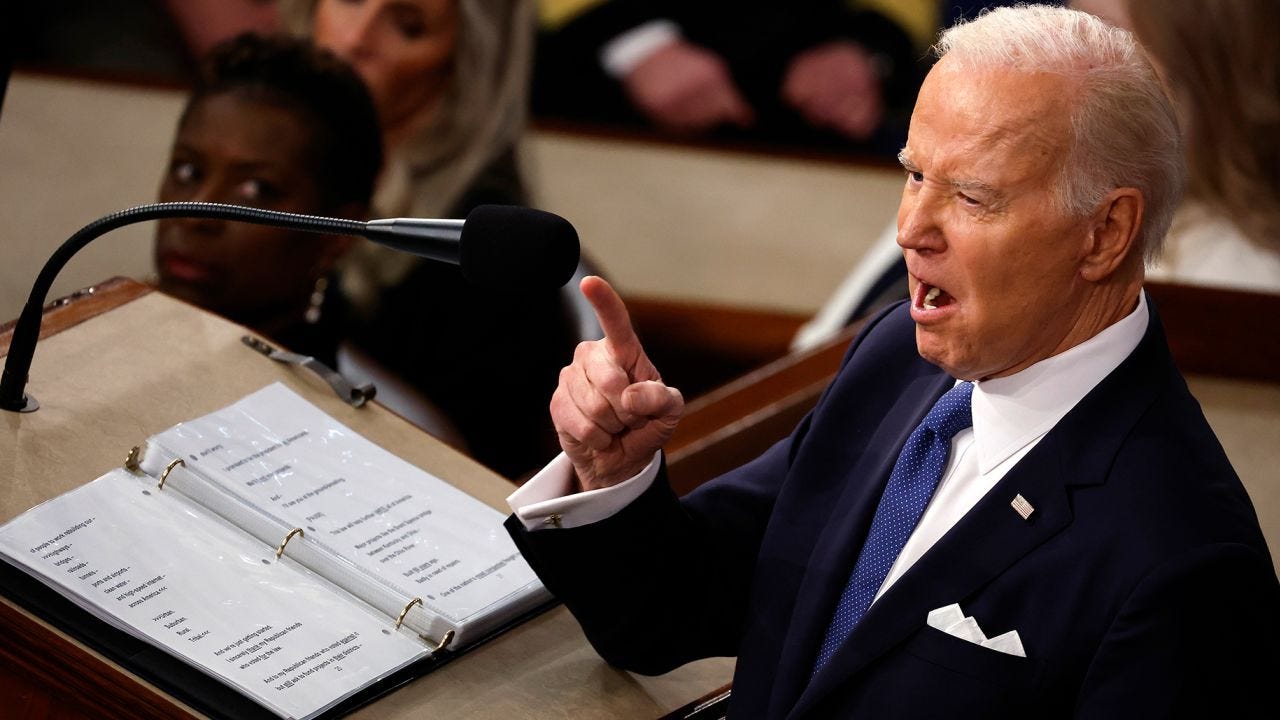
In this image, Joe Biden is “showing vigor,” according to CNN

This morning I read the New York Times’ coverage of Joe Biden’s “State of the Union” address and found this gem of a paragraph on the Russia-Ukraine War:

Ukraine has defied expectations so far, and could continue doing so. But if Ukraine falls, it would signal to the world that autocrats can get away with invading democratic countries. It would suggest the Western alliance isn’t as powerful as it once was — shifting global power away from democracies like the U.S. and members of the E.U. and toward authoritarian powers like Russia and China. And for Biden, it could damage his standing domestically and globally, much as America’s messy exit from Afghanistan did.

A few comments on this:

  1. Note how negotiations aren’t mentioned. Cease fire? Forget about it. 
  2. If Ukraine were to fall, would that truly be a signal to autocrats everywhere that democratic countries were ripe for the plucking? Which autocrats and which democratic countries?
  3. Was Ukraine a democracy? Is the USA a democracy?
  4. What about invasions and occupations of Iraq, Afghanistan, and Libya by the US and its allies? Were those costly and disastrous wars OK because a so-called democratic entity invaded a more autocratic one?
  5. Was Biden’s standing truly damaged by that messy exit from Afghanistan? Or was America’s standing truly damaged by persisting in an unwinnable war for 20 years?
  6. If NATO suffers a blow to its prestige due to Ukraine’s fall, that will be the US and NATO’s fault. There was and remains no formal alliance between NATO and Ukraine. Recall that Ukraine was a Soviet republic and that Ukraine is far more closely linked to Russia historically than it is to Europe, let alone the USA.
  7. To answer my own question at (3), the US is not a democracy. It’s an authoritarian oligarchy controlled by Wall Street, the military-industrial complex, and other big financial and corporate interests. Choosing between Corporate Stooge 1 (D) and Corporate Stooge 2 (R) every two or four years is not democracy.

I was further fascinated by how the NYT’s summary began:

President Biden used his State of the Union speech to portray the U.S. as a country in recovery, and he is right that there has been a lot of good news lately.

Price increases have slowed. Covid deaths are down about 80 percent compared with a year ago. Ukraine is holding off Russia’s invasion. Congress passed legislation addressing climate change, infrastructure and gun violence, and some of it was bipartisan.

That Ukraine “is holding off Russia’s invasion” is a sign of “recovery” for the United States! If that’s not a tacit admission of proxy war, I don’t know what is.

It’s nice to know Ukrainians are fighting and dying so that the NYT can brag of the US as being “in recovery.”

A nod of thanks to the NYT for my daily helping of propaganda.

(Also, please detail any important legislation that seriously addresses climate change and gun violence; climate change continues apace, as does gun violence in the US. Finally, Covid deaths are down mainly because of a less virulent strain and increased immunity due to infections, not because of any decisive action taken by the Biden administration.)

Negotiate to End the Russia-Ukraine War

W.J. Astore

Zelensky is no Chamberlain; talking is not appeasement

A fascinating aspect of the Russia-Ukraine War is the argument that negotiation would be unwise, especially if Ukraine were to initiate it.  Typical arguments include that you can’t negotiate with a dictator like Putin, that negotiation would be a sign of weakness and would somehow reward Putin for his invasion, and that negotiation is ipso facto appeasement that would lead to further (and much wider) Russian attacks.  All these arguments are faulty.

First, my pro-Ukrainian friends tell me that Ukraine is winning the war and therefore resolution will come with total victory at the front.  Perhaps so, but fortunes of war often prove fickle.  If indeed Ukraine has a winning edge, what better time to negotiate?  It’s always preferable to negotiate from a position of strength, so now is the time, assuming Putin is amenable.  What’s to be lost by asking?

Second, negotiation, again from a position of strength, is the very opposite of appeasement.  When Neville Chamberlain infamously negotiated with Adolf Hitler in 1938, he was doing so from a position of relative weakness.  Nazi Germany was rearming and mobilizing for World War II, and Great Britain and its allies were very much behind.  Hitler, of course, lied that territory in Czechoslovakia was his “last demand,” but few in the know were truly fooled about the danger Hitler and the German military represented.  Still, Chamberlain hoped that a viable treaty to prevent war was possible, even as Britain and its allies began in earnest to prepare for war as the “peace” deal was being struck.

Interestingly, Hitler didn’t see Chamberlain’s “appeasement” as a victory.  He was livid.  Hitler wanted to go to war in 1938.  The deal Hitler struck delayed his attack on Poland until September of 1939.  By the time Germany attacked Britain and France in May of 1940, the British were better prepared, materially and mentally, to resist Hitler. (The shockingly quick fall of France is another story entirely.)

One could argue that Chamberlain’s failed appeasement delayed Hitler’s war plans to an extent that ultimately favored eventual allied victory.  Hitler was, after all, decisively defeated five years after he launched his invasion of France.  And, after Hitler betrayed his promises to Chamberlain, there was no doubt whatsoever among the allies that military victory was the only way to end the Nazi threat.

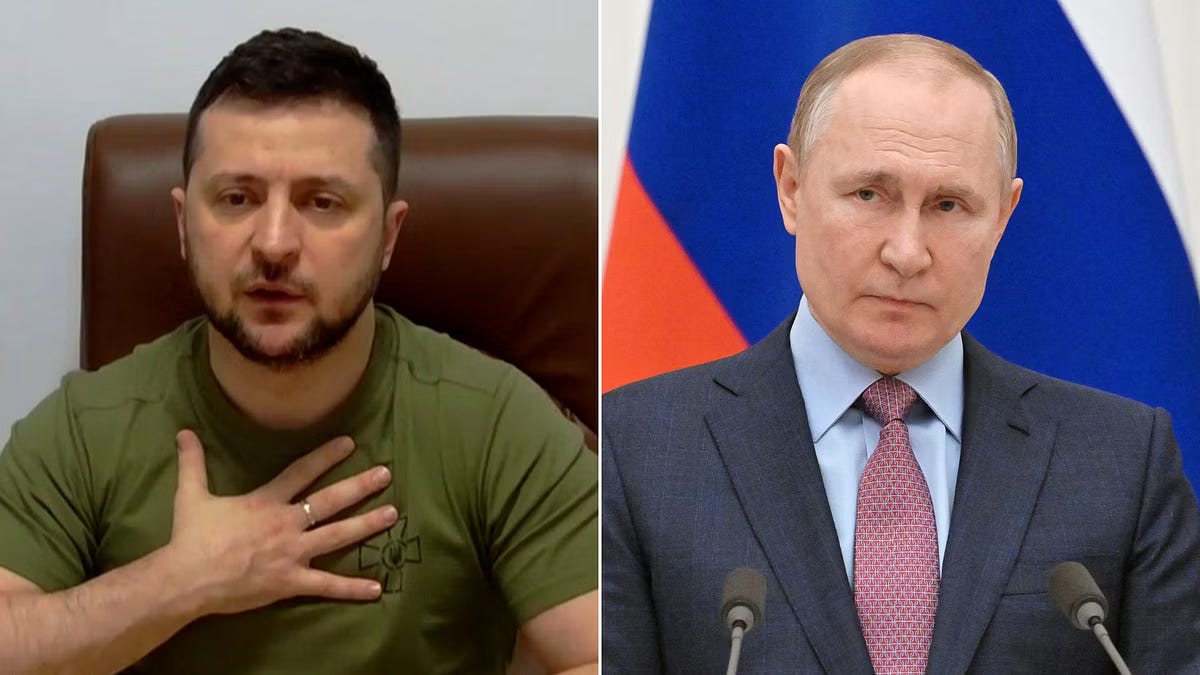
My point is that even Chamberlain’s dreadful “appeasement” wasn’t quite as bad as we’re so often told.  More importantly to this moment: No one mistakes Zelensky and his soldier-like image for Chamberlain with his umbrella.  Again, Zelensky and Ukraine have fought well; their resistance has been steadfast.  Why not negotiate?  Ukraine may win more at the negotiating table than it ever could on the battlefield, while sparing the lives of countless Ukrainian (and Russian) troops.

Third, another argument I’ve heard is that, if the war ends by negotiation, Putin and Russia will just reinvade after a period of rest and rearming.  Anything is possible, but why would Putin relaunch a war that’s already proven to be a quagmire?  And won’t Ukraine also use the time to rest and rearm, with plenty of help from the U.S. and NATO?

Wars don’t have to end in total victory or total defeat.  One side doesn’t have to collapse in exhaustion or to flee ignominiously.  Wars can be ended by negotiation if both parties are open to compromise. Temper tantrums at the negotiating table are better than more bullets and bombs and bodies.

Ukraine and Russia share a long border and a tempestuous history.  They need to learn to live together, else they will surely die together, as they are now.  Why not talk and choose life over more death?