Creator of Bracing Views. Contributor to TomDispatch, Truthout, HNN, Alternet, Huffington Post, Antiwar, and other sites. Retired AF lieutenant colonel and professor of history. Senior fellow, Eisenhower Media Network
America’s thinking about military action is impoverished. The U.S. military speaks of precision munitions and surgical strikes, suggesting a process that is controllable and predictable. Experts cite Prussian military theorist Carl von Clausewitz for his axiom that war is a continuation of political discourse with the admixture of violent means. Here, military action is normalized as an extreme form of politics, suggesting again a measure of controllability and predictability.
But what if war is almost entirely imprecise and unpredictable? What if military action and its impacts are often wildly out of line with what the “experts” anticipate? In fact, this is precisely what military history shows, time and time again, to include recent U.S. military actions in Iraq and Afghanistan.
U.S. military action essentially acts like hammer blows that upset the state of nature within the complex ecologies of societies like Iraq and Afghanistan. These blows ripple in unpredictable directions, creating new states of nature that change the ecologies of these societies in fundamental ways. They further generate fault lines that are often contrary to U.S. goals and interests.
Charles Darwin can lend a hand in explaining why this is so. Darwin is best known for his theory of evolution with its idea of “the survival of the fittest,” although Darwin did not use that term when he originally published The Origin of Species in 1859. Indeed, Darwin’s view of evolution was highly complex and multifaceted, as befits a man who studied the natural world in great detail for his entire adult life.
In an earlier, unpublished version of his masterwork, Darwin employed a complex image, known as the “wedge” metaphor, to explain interactions within the natural world that led to species extinction. Here is the way Darwin described “The Struggle for Existence” in his Notebook prior to The Origin of Species:
Nature may be compared to a surface covered with ten‐thousand sharp wedges, many of the same shape & many of different shapes representing different species, all packed closely together & all driven in by incessant blows: the blows being far severer at one time than at another; sometimes a wedge of one form & sometimes another being struck; the one driven deeply in forcing out others; with the jar & shock often transmitted very far to other wedges in many lines of direction: beneath the surface we may suppose that there lies a hard layer, fluctuating in its level, & which may represent the minimum amount of food required by each living being, & which layer will be impenetrable by the sharpest wedge.
In his model of the face of nature, Darwin showcases the interconnectedness of all species, together with the way in which changes to that face (the hammer blows) favor some species (wedges) while forcing out others. The hard layer, which represents the minimum amount of food for all, and which Darwin says cannot be penetrated, suggests an ecology that will continue to sustain life even as some species (wedges) are forced out and die off. The face of nature constantly changes, some species perish, but life itself endures.
How does Darwin’s wedge metaphor apply to military action? Consider, for example, U.S. airstrikes in the Middle East. They are the hammer blows, if you will, to the face of nature in the region. The wedges are various groups/sects/factions/tribes in the region. The U.S. believes its hammer blows will force out “bad” wedges, driving them toward extinction, which will ultimately improve the prospects of “good” wedges, such as so-called moderates in Syria. But what if U.S. blows (airstrikes and other violent military action) are driving radical sects (wedges) more deeply into the face of nature (in this case, the face of politics and society in the Middle East)? What if these radical sects, like Darwin’s driven wedges, are forcing out rival sects that are more moderate? What if the “jar & shock” of these U.S. military hammer blows is being propagated throughout Middle Eastern societies and Islam in ways that are as unpredictable as they are long-lasting?
Darwin’s complex wedge metaphor should make us think more deeply about the results of blows to complex, interconnected, and interdependent systems. Using military strikes in an attempt to destroy “bad” wedges may have the very opposite effect than the one intended. Instead of being destroyed, such wedges (such as the Islamic State) are driven deeper into the ecology of their communities, helping them to thrive, even as they send out vibrations “in many lines of direction” that harden the new ecology of the region against U.S. interests.
What, then, to make of Darwin’s “hard layer” in his wedge metaphor, which varies in its level but which persists in that no wedge may penetrate it? The “hard layer” represents that which all wedges can’t do without. All species are dependent on a source of food and energy, a source of sustenance to sustain reproduction. Darwin notes that the hard layer fluctuates, and though he doesn’t explicitly state it, those fluctuations must also act much like blows, displacing some wedges while favoring others with effects that ripple across the face of nature.
Rise or fall, the “hard layer” persists, meaning life on earth persists, even as individual species perish. Darwin explicitly states that no wedge can penetrate the hard layer, but here his metaphor breaks down when we consider humans as a wedge. Because humans can and do penetrate that layer. As a species, we do have the capacity to damage, even to destroy, the hard layer of nature upon which all species are dependent. We’re the killer wedge in the wedge metaphor.
Politically speaking, piercing that hard layer in the Middle East would be equivalent to igniting a new Crusade that leads to world war, one involving nuclear weapons or other forms of WMD. Devolution in place of evolution.
Of course, one shouldn’t push any metaphor too far. That said, Darwin’s “wedge” metaphor, in its imagery and subtlety, is more useful in understanding the complexity and unpredictability of military action than analogies that reduce war to exercises in precision surgery or power politics.
William Astore is a retired lieutenant colonel (USAF) and former professor of history who edits the blog The Contrary Perspective.
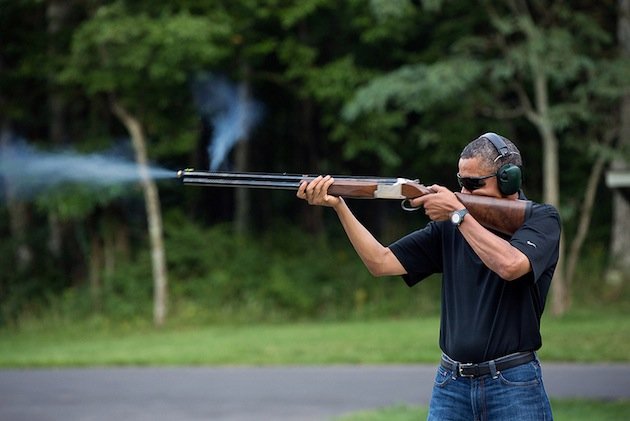
News that President Obama has doubled the number of American troops (whoops — I mean advisers) in Iraq to 3100 is already a tacit admission of defeat in that troubled region. Let’s recall that the Iraqi security forces the U.S. trained and equipped to the tune of $25 billion simply melted away when faced with serious combat this summer. Their performance put me to mind of the National Rifle Association’s slogan against John Kerry in the presidential campaign of 2004. Kerry had gone bird shooting, mainly it seems to be photographed with a gun in his hand, a necessity for any red-blooded American male (just ask Obama). But the NRA wasn’t fooled (or so they claimed). “That dog don’t hunt,” the NRA said about Kerry. And something about that slogan stuck.
You could say the same of that Iraqi army that the U.S. created and funded and trained and equipped: That dog don’t hunt. Or, it won’t hunt for us. Because that’s not its purpose. That’s not how or even why we trained it. But that’s OK. We’ll just send more American troops to Iraq, and waste more money, further destabilizing the region, making it even easier for radical jihadists to recruit more followers, whether to the ISIS banner or some other Islamist flag (Khorasan, perhaps?).
It’s just incredible how inept U.S. foreign policy is today. If George C. Marshall had been like this during World War II, we’d be speaking German today at the Pentagon, instead of simply misinterpreting Clausewitz.
Of course, Congress will have to authorize funding for the latest U.S. military misadventure. Anyone want to offer odds on Congress actually exercising oversight on our foreign entanglements? A long shot, indeed.
Even as Congress seeks to cut funding to the poor, there’s always plenty of money for military adventurism overseas, no matter how often those adventures fail. When it comes to exercising real oversight, Congress is always a lame duck — so lame that even a dog that don’t hunt (that Iraqi military again) succeeds in bagging billions of dollars from the American taxpayer.
The moral to the story? America doesn’t lack for guns; we lack for brains.
Update: Iraq has “shook up” its military, relieving 26 officers of their commands and forcibly retiring 10 others, even as 18 new commanders were appointed by Prime Minister Haider al-Abadi among promises of greater professionalism and less graft and corruption. Progress? Time will tell. But what does it say about a military that, in spite of prolonged training and massive infusions of cash from the U.S., was so ridden with corruption that it collapsed when facing its first challenge? Sadly, the need for ever more U.S. advisers and money suggests this is yet another case of rearranging the deck chairs on the Titanic.
Update 2 (written by b. traven)
What is truly tragic is how the back story to the total failure of the Bush-Cheney wars is not reviewed by Obama, the Senate, or the House as this tragedy for Iraq unfolds. Obama just continues to follow the Bush lies by one week saying no “boots on the ground” while his top military people say “yes, more boots” and the next week Obama announces doubling the number of troops with no sense of embarrassment. And the American people stay entranced with baseball, football, and basketball scores.
And you can say you saw it here first. No sooner had General Dempsey said he wanted more troops in Iraq then Obama complied by doubling the force. Now Dempsey has told Obama what he wants even more troops so you can count on Obama complying in a couple of weeks. There’s nothing like doubling down on a failed policy in hopes that the result will come out differently than the last failure. Here’s Dempsey’s new demand as reported in the Guardian of London newspaper:
“The top-ranking officer in the American military said on Thursday that the US is actively considering the direct use of troops in the toughest upcoming fights against the Islamic State (Isis) in Iraq, less than a week after Barack Obama doubled troop levels there.
General Martin Dempsey, the chairman of the joint chiefs of staff, indicated to the House of Representatives armed services committee that the strength of Isis relative to the Iraqi army may be such that he would recommend abandoning Obama’s oft-repeated pledge against returning US ground troops to combat in Iraq.”
President Truman fired the most renowned five star General of his day, Douglas MacArthur for voicing a policy contradicting Truman’s in regard to China. If we had a real president he would do the same with Dempsey, who is certainly no MacArthur.
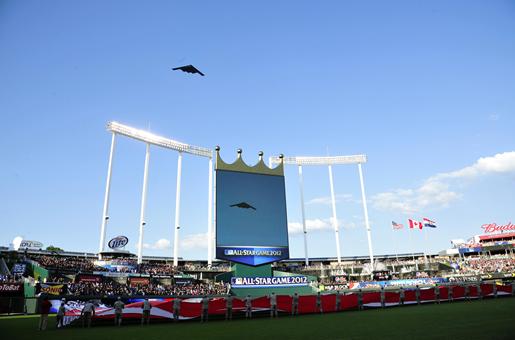
A nuclear-capable B-2 Stealth Bomber flies over a gigantic flag at the 2012 Baseball All-Star Game
W.J. Astore
As Veterans Day approaches, I thought I’d revive a column I wrote for TomDispatch.com back in 2009. I continue to marvel at the militarism of the USA, and the way in which the troops are defined as “warriors” and “warfighters” who increasingly see themselves as being divorced from, and superior to, “civilians” in the USA. Of course, there was a time in America when our troops were proud to define themselves as citizen-soldiers, with the emphasis on citizen. Not anymore. The ethos has changed, pushed toward a “professional” military that sees itself as a breed apart. And that’s not good for democracy.
I still recall the example set by Major Dick Winters, memorialized in the “Band of Brothers” series on HBO. Dick Winters swore that when the war was over against Nazi Germany and Imperial Japan, he’d return to his farm in Pennsylvania and leave soldiering and war behind. And that’s exactly what he did. No “warrior” nonsense for him.
Anyway, here’s the article I wrote five years ago. Sadly, its theme is more relevant today than it was in 2009.
What Ever Happened to Gary Cooper? A Seven-Step Program to Return America to a Quieter, Less Muscular, Patriotism By William Astore
I have a few confessions to make: After almost eight years of off-and-on war in Afghanistan and after more than six years of mayhem and death since “Mission Accomplished” was declared in Operation Iraqi Freedom, I’m tired of seeing simpleminded magnetic ribbons on vehicles telling me, a 20-year military veteran, to support or pray for our troops. As a Christian, I find it presumptuous to see ribbons shaped like fish, with an American flag as a tail, informing me that God blesses our troops. I’m underwhelmed by gigantic American flags — up to 100 feet by 300 feet — repeatedly being unfurled in our sports arenas, as if our love of country is greater when our flags are bigger. I’m disturbed by nuclear-strike bombers soaring over stadiums filled with children, as one did in July just as the National Anthem ended during this year’s Major League Baseball All Star game. Instead of oohing and aahing at our destructive might, I was quietly horrified at its looming presence during a family event.
We’ve recently come through the steroid era in baseball with all those muscled up players and jacked up stats. Now that players are tested randomly, home runs are down and muscles don’t stretch uniforms quite as tightly. Yet while ending the steroid era in baseball proved reasonably straightforward once the will to act was present, we as a country have yet to face, no less curtail, our ongoing steroidal celebrations of pumped-up patriotism.
It’s high time we ended the post-Vietnam obsession with Rambo’s rippling pecs as well as the jaw-dropping technological firepower of the recent cinematic version of G.I. Joe and return to the resolute, undemonstrative strength that Gary Cooper showed in movies like High Noon.
In the HBO series The Sopranos, Tony (played by James Gandolfini) struggles with his own vulnerability — panic attacks caused by stress that his Mafia rivals would interpret as fatal signs of weakness. Lamenting his emotional frailty, Tony asks, “What ever happened to Gary Cooper?” What ever happened, in other words, to quiet, unemotive Americans who went about their business without fanfare, without swagger, but with firmness and no lack of controlled anger at the right time?
Tony’s question is a good one, but I’d like to spin it differently: Why did we allow lanky American citizen-soldiers and true heroes like World War I Sergeant Alvin York (played, at York’s insistence, by Gary Cooper) and World War II Sergeant (later, first lieutenant) Audie Murphy (played in the film To Hell and Back, famously, by himself) to be replaced by all those post-Vietnam pumped up Hollywood “warriors,” with Sylvester Stallone and Arnold Schwarzenegger-style abs and egos to match?
And far more important than how we got here, how can we end our enduring fascination with a puffed up, comic-book-style militarism that seems to have stepped directly out of screen fantasy and into our all-too-real lives?
A Seven-Step Recovery Program
As a society, we’ve become so addicted to militarism that we don’t even notice the way it surrounds us or the spasms of societal ‘roid rage that go with it. The fact is, we need a detox program. At the risk of incurring some of that ‘roid rage myself, let me suggest a seven-step program that could help return us to the saner days of Gary Cooper:
1. Baseball players on steroids swing for the fences. So does a steroidal country. When you have an immense military establishment, your answer to trouble is likely to be overwhelming force, including sending troops into harm’s way. To rein in our steroidal version of militarism, we should stop bulking up our military ranks, as is now happening, and shrink them instead. Our military needs not more muscle supplements (or the budgetary version of the same), but far fewer.
2. It’s time to stop deferring to our generals, and even to their commander-in-chief. They’re ours, after all; we’re not theirs. When President Obama says Afghanistan is not a war of choice but of necessity, we shouldn’t hesitate to point out that the emperor has no clothes. Yet when it comes to tough questioning of the president’s generals, Congress now seems eternally supine. Senators and representatives are invariably too busy falling all over themselves praising our troops and their commanders, too worried that “tough” questioning will appear unpatriotic to the folks back home, or too connected to military contractors in their districts, or some combination of the three.
Here’s something we should all keep in mind: generals have no monopoly on military insight. What they have a monopoly on is a no-lose situation. If things go well, they get credit; if they go badly, we do. Retired five-star general Omar Bradley was typical when he visited Vietnam in 1967 and declared: “I am convinced that this is a war at the right place, at the right time and with the right enemy — the Communists.” North Vietnam’s only hope for victory, he insisted, was “to hang on in the expectation that the American public, inadequately informed about the true situation and sickened by the loss in lives and money, will force the United States to give up and pull out.”
There we have it: A classic statement of the belief that when our military loses a war, it’s always the fault of “we the people.” Paradoxically, such insidious myths gain credibility not because we the people are too forceful in our criticism of the military, but because we are too deferential.
3. It’s time to redefine what “support our troops” really means. We console ourselves with the belief that all our troops are volunteers, who freely signed on for repeated tours of duty in forever wars. But are our troops truly volunteers? Didn’t we recruit them using multi-million dollar ad campaigns and lures of every sort? Are we not, in effect, running a poverty and recession draft? Isolated in middle- or upper-class comfort, detached from our wars and their burdens, have we not, in a sense, recruited a “foreign legion” to do our bidding?
If you’re looking for a clear sign of a militarized society — which few Americans are — a good place to start is with troop veneration. The cult of the soldier often covers up a variety of sins. It helps, among other things, hide the true costs of, and often the futility of, the wars being fought. At an extreme, as the war began to turn dramatically against Nazi Germany in 1943, Germans who attempted to protest Hitler’s failed strategy and the catastrophic costs of his war were accused of (and usually executed for) betraying the troops at the front.
The United States is not a totalitarian state, so surely we can hazard criticisms of our wars and even occasionally of the behavior of some of our troops, without facing charges of stabbing our troops in the back and aiding the enemy. Or can we?
4. Let’s see the military for what it is: a blunt instrument of force. It’s neither surgical nor precise nor predictable. What Shakespeare wrote 400 years ago remains true: when wars start, havoc is unleashed, and the dogs of war run wild — in our case, not just the professional but the “mercenary” dogs of war, those private contractors to the Pentagon that thrive on the rich spoils of modern warfare in distant lands. It’s time to recognize that we rely ever more massively to prosecute our wars on companies that profit ever more handsomely the longer they last.
5. Let’s not blindly venerate the serving soldier, while forgetting our veterans when they doff their spiffy uniforms for the last time. It’s easy to celebrate our clean-cut men and women in uniform when they’re thousands of miles from home, far tougher to lend a hand to scruffier, embittered veterans suffering from the physical and emotional trauma of the battle zones to which they were consigned, usually for multiple tours of duty.
6. I like air shows, but how about — as a first tiny step toward demilitarizing civilian life — banning all flyovers of sporting events by modern combat aircraft? War is not a sport, and it shouldn’t be a thrill.
7. I love our flag. I keep my father’s casket flag in a special display case next to the very desk on which I’m writing this piece. It reminds me of his decades of service as a soldier and firefighter. But I don’t need humongous stadium flags or, for that matter, tiny flag lapel pins to prove my patriotism — and neither should you. In fact, doesn’t the endless post-9/11 public proliferation of flags in every size imaginable suggest a certain fanaticism bordering on desperation? If we saw such displays in other countries, our descriptions wouldn’t be kindly.
Of course, none of this is likely to be easy as long as this country garrisons the planet and fights open-ended wars on its global frontiers. The largest step, the eighth one, would be to begin seriously downsizing that mission. In the meantime, we shouldn’t need reminding that this country was originally founded as a civilian society, not a militarized one. Indeed, the revolt of the 13 colonies against the King of England was sparked, in part, by the perceived tyranny of forced quartering of British troops in colonial homes, the heavy hand of an “occupation” army, and taxation that we were told went for our own defense, whether we wanted to be defended or not.
If Americans are going to continue to hold so-called tea parties, shouldn’t some of them be directed against the militarization of our country and an enormous tax burden fed in part by our wasteful, trillion-dollar wars?
Modest as it may seem, my seven-step recovery program won’t be easy for many of us to follow. After all, let’s face it, we’ve come to enjoy our peculiar brand of muscular patriotism and the macho militarism that goes with it. In fact, we revel in it. Outwardly, the result is quite an impressive show. We look confident and ripped and strong. But it’s increasingly clear that our outward swagger conceals an inner desperation. If we’re so strong, one might ask, why do we need so much steroidal piety, so many in-your-face patriotic props, and so much parade-ground conformity?
Forget Rambo and action-picture G.I. Joes: Give me the steady hand, the undemonstrative strength, and the quiet humility of Alvin York, Audie Murphy — and Gary Cooper.
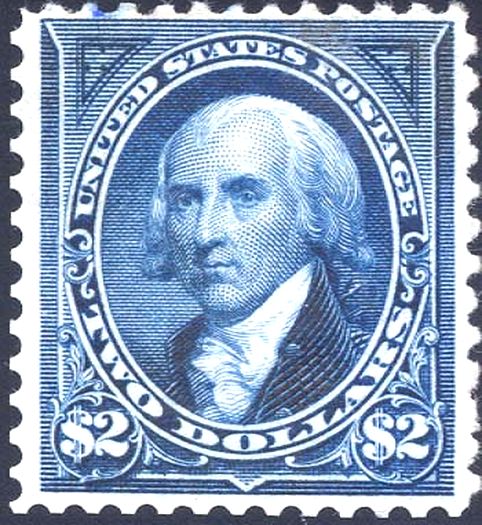
James Madison warned that perpetual war is the worst enemy of personal liberty
W.J. Astore
So, Republicans now control the Senate as well as the House. As we the people endure the forced march to 2016 and the next presidential election, our new political landscape is sure to produce more military escalations.
The reason is as obvious as it is sad. De-escalation of military conflicts is defined, especially by Republicans, as “losing” whereas escalation is defined as “doing something,” as being “decisive,” even when decision is nowhere in sight. Even when military action just makes matters worse.
Once again, as we approach 2016, the Republicans will bash the Democrats as appeaseniks. And the Republicans will be right. The Democrats are appeaseniks — to the national security state.
You can almost guarantee that the hawkish Hillary Clinton — doing her best imitation of Margaret Thatcher — will be the Democratic candidate. Meanwhile, Republican candidates will run to the right of Attila the Hun as they blame Obama for having “lost” both Iraq and Afghanistan (even though both of those countries were never ours to “win”). Dishonest (or disingenuous) the Republicans may be, but they know how to win elections via the Big Lie.
As Tom Engelhardt noted this week, the national security state has built a militarized escalation machine that will execute its function of perpetual war regardless of whom is sworn in as the next commander-in-chief.
As my wife said to me today, our country is in big trouble. Yes, we are, because as James Madison pointed out, perpetual war is the enemy of democracy and freedom.
As for me, I’ll vote for any candidate who has the spine to stand up for an end to perpetual war. Show me a candidate who’s willing to abandon fear-mongering about overseas threats while telling the truth about the threats we face right here at home from America’s power brokers and I’ll show you a candidate worthy of being elected. Either that, or show me a candidate who’s so worried about those overseas threats that he or she takes up arms (I mean literally) in the trenches against the enemy, and I’ll show you a candidate who at least is not a hypocrite.
But I fear 2016 will be the year of Benghazi! Benghazi! and who lost Iraq/Afghanistan/and similar countries we never “found” to begin with.
Did I mention my smarter wife said our country is in trouble?
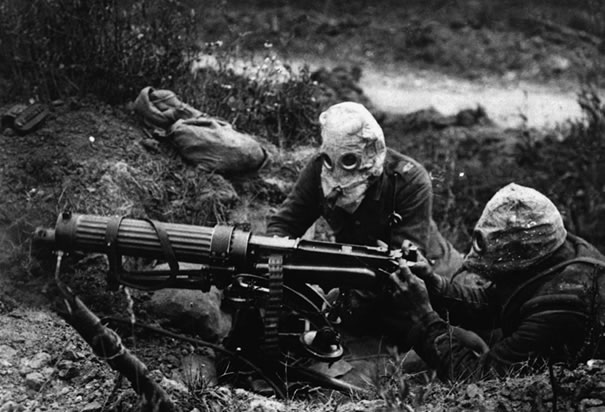
Over the next four years, historians around the world will grapple with the meaning and legacies of the “Great War” fought one hundred years ago (1914-1918). An epochal event in world history, World War I has as many meanings as it has had historians. Among those historians, Dennis Showalter is one of the very best. In this article, Showalter argues that the war was, in many ways, not “modern” at all. The enormity of the war, to include its enormous wastage, generated primitivism as much as it stimulated innovation. On the Western Front, site of industrialized mass destruction, troops fought with modern machine guns and chemical weapons even as they revived maces and mail armor of medieval vintage.
Most remarkable, as Showalter notes, was the resilience of home front support. As dreams of quick, decisive battles turned into long, murderous slogs of nightmarish proportions, control of events was ceded to military men who saw only one way to victory — exhaustion through attrition and economic warfare. When Germany finally collapsed near the end of 1918, few people were as surprised as the victors or as shocked as the losers. As the victors exulted, the losers licked wounds — and vowed vengeance.
So it was that the “war to end all wars” became just one major act in a never-ending tragedy in a century dominated by war. Even today, warfare in places like the Middle East reflects the poor choices and conflicting promises made during the Great War by the major powers. In fact, what was perhaps most “modern” about World War I was the blowback that plagued its putative victors. Consider, for example, France’s decision to ignore requests in 1919 by a young Ho Chi Minh for greater autonomy to be granted to Vietnamese in French Indochina. France had leaned on Vietnamese labor during the Great War (with as many as 140,000 Vietnamese doing grunt work such as digging trenches), and the Vietnamese expected something in return. They got nothing, a decision that set the stage for Vietnam’s revolt and France’s eventual defeat at Dien Bien Phu in 1954. W.J. Astore
Dennis Showalter on the Paradox of World War I: A Semi-Modern War
The looming centennial of the Great War has inspired a predicable abundance of conferences, books, articles, and blog posts. Most are built on a familiar meme: the war as a symbol of futility. Soldiers and societies alike are presented as victims of flawed intentions and defective methods, which in turn reflected inability or unwillingness to adapt to the spectrum of innovations (material, intellectual, and emotional) that made the Great War the first modern conflict. That perspective is reinforced by the war’s rechristening, backlit by a later and greater struggle, as World War I—which confers a preliminary, test-bed status.
Homeward bound troops pose on the ship’s deck and in a lifeboat, 1919. The original image was printed on postal card (“AZO”) stock. Public Domain via Wikimedia Commons.
In point of fact, the defining aspect of World War I is its semi-modern character. The “classic” Great War, the war of myth, memory, and image, could be waged only in a limited area: a narrow belt in Western Europe, extending vertically five hundred miles from the North Sea to Switzerland, and horizontally about a hundred miles in either direction. War waged outside of the northwest European quadrilateral tended quite rapidly to follow a pattern of de-modernization. Peacetime armies and their cadres melted away in combat, were submerged by repeated infusions of unprepared conscripts, and saw their support systems, equine and material, melt irretrievably away.
Russia and the Balkans, the Middle East, and East Africa offer a plethora of case studies, ranging from combatants left without rifles in Russia, to the breakdown of British medical services in Mesopotamia, to the dismounting of entire regiments in East Africa by the tsetse fly. Nor was de-modernization confined to combat zones. Russia, Austria-Hungary, the Ottoman Empire, and arguably Italy, strained themselves to the breaking point and beyond in coping with the demands of an enduring total war. Infrastructures from railways to hospitals to bureaucracies that had functioned reasonably, if not optimally, saw their levels of performance and their levels of competence tested to destruction. Stress combined with famine and plague to nurture catastrophic levels of disorder, from the Armenian genocide to the Bolshevik Revolution.
Semi-modernity posed a corresponding and fundamental challenge to the wartime relationship of armed forces to governments. In 1914, for practical purposes, the warring states turned over control to the generals and admirals. This in part reflected the general belief in a short, decisive war—one that would end before the combatants’ social and political matrices had been permanently reconfigured. It also reflected civil authorities’ lack of faith in their ability to manage war-making’s arcana—and a corresponding willingness to accept the military as “competent by definition.”
Western Battle Front 1916. From J. Reynolds, Allen L. Churchill, Francis Trevelyan Miller (eds.): The Story of the Great War, Volume V. New York. Specified year 1916, actual year more likely 1917 or 1918. Public Domain via Wikimedia Commons.
The extended stalemate that actually developed had two consequences. A major, unacknowledged subtext of thinking about and planning for war prior to 1914 was that future conflict would be so horrible that the home fronts would collapse under the stress. Instead, by 1915 the generals and the politicians were able to count on unprecedented –and unexpected–commitment from their populations. The precise mix of patriotism, conformity, and passivity underpinning that phenomenon remains debatable. But it provided a massive hammer. The second question was how that hammer could best be wielded. In Russia, Austria-Hungary, the Ottoman Empire, neither soldiers nor politicians were up to the task. In Germany the military’s control metastasized after 1916 into a de facto dictatorship. But that dictatorship was contingent on a victory the armed forces could not deliver. In France and Britain, civil and military authorities beginning in 1915 came to more or less sustainable modi vivendi that endured to the armistice. Their durability over a longer run was considered best untested.
Even in the war’s final stages, on the Western Front that was its defining theater, innovations in methods and technology could not significantly reduce casualties. They could only improve the ratio of gains. The Germans and the Allies both suffered over three-quarters of a million men during the war’s final months. French general Charles Mangin put it bluntly and accurately: “whatever you do, you lose a lot of men.” In contemplating future wars—a process well antedating 11 November 1918—soldiers and politicians faced a disconcerting fact. The war’s true turning point for any state came when its people hated their government more than they feared their enemies. From there it was a matter of time: whose clock would run out first. Changing that paradigm became—and arguably remains—a fundamental challenge confronting a state contemplating war.
Dennis Showalter is professor of history at Colorado College, where he has been on the faculty since 1969. He is Editor in Chief of Oxford Bibliographies in Military History, wrote “World War I Origins,” and blogged about “The Wehrmacht Invades Norway.” He is Past President of the Society for Military History, joint editor of War in History, and a widely-published scholar of military affairs. His recent books include Armor and Blood: The Battle of Kursk (2013), Frederick the Great: A Military History (2012), Hitler’s Panzers (2009), and Patton and Rommel: Men of War in the Twentieth Century (2005).
Author’s photo, July 2014, of the American Flag at Dusk
W.J. Astore
I served for twenty years in the Air Force. Service in the military involves sacrifice even when combat isn’t involved, but it also conveys privileges and provides opportunity, or at least it did so for me. I can’t recall people thanking me for my service when I wore a uniform, nor did I expect them to. I just saw myself as doing my duty to the best of my ability, and therefore deserving of no special thanks or commendation.
At TomDispatch.com, former Army Ranger Rory Fanning talks about his discomfort with the thank you parade directed at “our” troops. His honest words are a reminder that a thank you repeated again and again loses its meaning, especially when it’s appropriated by megastars and sponsored by corporations. Think, for example, of that Budweiser ad during last year’s Super Bowl that featured a returning LT. We see him greeting his pretty wife at the airport, then we cut to a surprise parade in his honor down Main Street USA complete with the Budweiser Clydesdales and teary-eyed veterans. The sentiment, however honest to many of the celebrants, is cheapened as heart strings are tugged to sell beer. Or consider those Bank of America ads for wounded warriors airing during this year’s World Series. Images of wounded troops continuing to triumph in spite of war injuries are appropriated to associate a huge bank with the sacrifices endured by ordinary GIs. Again, however well-intentioned such ads may be, heart strings are being tugged by a bank with a dubious record of sympathy for the little guy and gal.
As retired Army Colonel Andrew Bacevich has noted, elaborate thank you ceremonies can be a form of cheap grace in which Americans clap themselves on the back in spasms of feel-good celebratory pageantry. Some of these celebrations are so over the top in their flag-waving thanks that you just can’t help having darker thoughts. Is this a recruitment video? Are we even meant to think at all or just gush with pride? Are we simply meant to bask in the reflected glow of the medals on the chests of our young men and women in uniform?
We thank our troops for complicated reasons as well as simple ones. The simple are easy to write about: genuine thanks, from one person to another, no megastars, no corporations. Just a handshake and a nod or a few kind words. I’ve had people thank me in that way since I retired from service, and I appreciate it and respond graciously.
But the complicated reasons – well, these reasons are not as easy to write about. The guilt of those who avoid service. Pro forma thanks. The thanks that comes from people who believe their involvement with the military both starts and ends there. The related idea that if one thanks the troops, one has done one’s bit for the war (whichever war our president says we’re fighting today).
More disturbingly is the thanks that allows us all to deny the reality of America’s wars (the reality of all wars): the sordidness of wartime bungling and mismanagement and violence and murder. Often the latter is drowned out by the bugle calls of thanks! thanks! thanks! coming from the cheering multitudes.
My father taught me “an empty barrel makes the most noise.” I think that’s true even when the noise is presented as thanks to our troops.
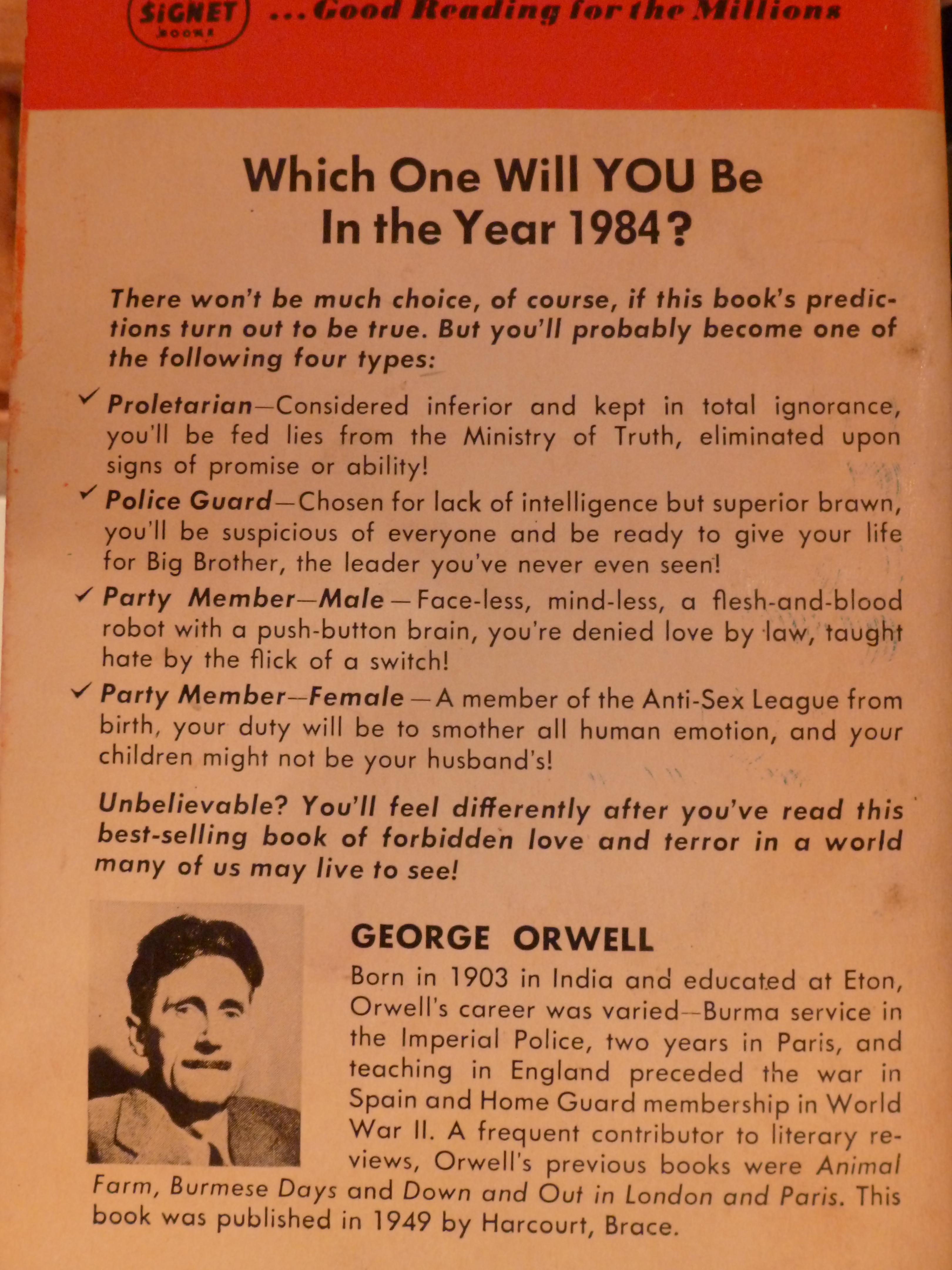
Out shopping today at my local used bookstore and came across an early paperback copy (from 1952) of George Orwell’s 1984. A little overpriced at $15.00, but the cover called to me. What a classic!
My “new” old copy of Orwell’s 1984
If you click on the picture, you can just make out, if you look closely, the slogans on the Ministry of Truth in the upper left: War Is Peace, Freedom Is Slavery, Ignorance Is Strength.
The reverse of the cover is also quite well done:
Which one will you be in 2014?
That tag line haunts me: “in a world many of us may live to see!” Hype, reader? Or prophecy?
I haven’t read Orwell since college, circa 1984 in fact. Time to get crackin’ before my old copy is confiscated and sent down the memory hole.
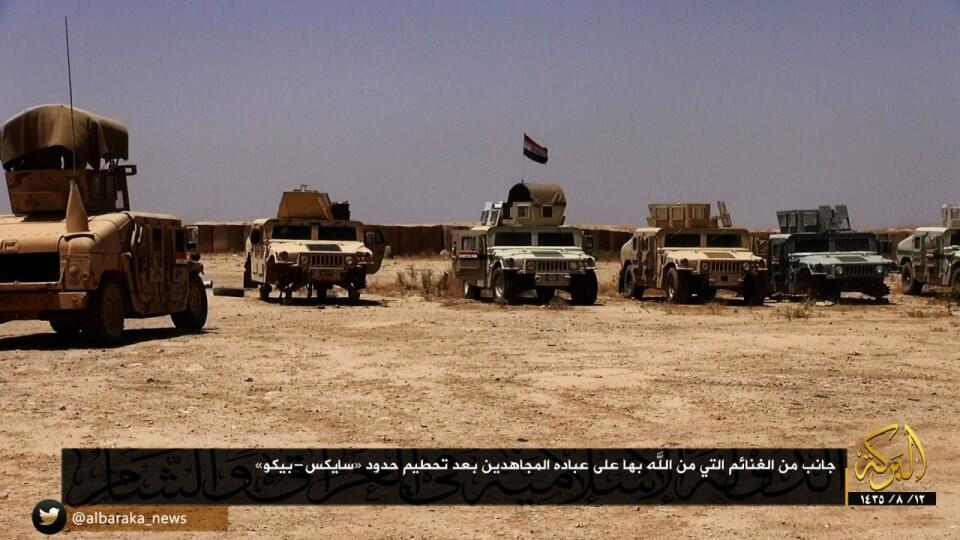
Iraqi equipment provided by the U.S. and captured by ISIS
W.J. Astore
In my latest article for TomDispatch, I examine why the Iraqi security forces that the U.S. trained and equipped at a cost of $25 billion performed so poorly when attacked by ISIS in June. Read on! And be sure to check out other articles at TomDispatch, a contrarian site edited by the inestimable (and indefatigable) Tom Engelhardt.
In June, tens of thousands of Iraqi Security Forces in Nineveh province north of Baghdad collapsed in the face of attacks from the militants of the Islamic State (IS or ISIS), abandoning four major cities to that extremist movement. The collapse drew much notice in our media, but not much in the way of sustained analysis of the American role in it. To put it bluntly, when confronting IS and its band of lightly armed irregulars, a reputedly professional military, American-trained and -armed, discarded its weapons and equipment, cast its uniforms aside, and melted back into the populace. What this behavior couldn’t have made clearer was that U.S. efforts to create a new Iraqi army, much-touted and funded to the tune of $25 billion over the 10 years of the American occupation ($60 billion if you include other reconstruction costs), had failed miserably.
Though reasonable analyses of the factors behind that collapse exist, an investigation of why U.S. efforts to create a viable Iraqi army (and, by extension, viable security forces in Afghanistan) cratered so badly are lacking. To understand what really happened, a little history lesson is in order. You’d need to start in May 2003 with the decision of L. Paul Bremer III, America’s proconsul in occupied Iraq and head of the Coalition Provisional Authority (CPA), to disband the battle-hardened Iraqi military. The Bush administration considered it far too tainted by Saddam Hussein and his Baathist Party to be a trustworthy force.
Instead, Bremer and his team vowed to create a new Iraqi military from scratch. According to Washington Post reporter Tom Ricks in his bestselling book Fiasco, that force was initially conceived as a small constabulary of 30,000-40,000 men (with no air force at all, or rather with the U.S. Air Force for backing in a country U.S. officials expected to garrison for decades). Its main job would be to secure the country’s borders without posing a threat to Iraq’s neighbors or, it should be added, to U.S. interests.
Bremer’s decision essentially threw 400,000 Iraqis with military training, including a full officer corps, out onto the streets of its cities, jobless. It was a formula for creating an insurgency. Humiliated and embittered, some of those men would later join various resistance groups operating against the American military. More than a few of them later found their way into the ranks of ISIS, including at the highest levels of leadership. (The most notorious of these is Izzat Ibrahim al-Douri, a former general in Saddam’s army who was featured as the King of Clubs in the Bush administration’s deck of cards of Iraq’s most wanted figures. Al-Douri is now reportedlyhelping to coordinate IS attacks.)
IS has fought with considerable effectiveness, quickly turning captured American and Syrian weaponry, including artillery pieces, Humvees, and even a helicopter, on their enemies. Despite years of work by U.S. military advisers and all those billions of dollars invested in training and equipment, the Iraqi army has not fought well, or often at all. Nor, it seems, will it be ready to do so in the immediate future. Retired Marine Corps General John R. Allen, who played a key role in organizing, arming, and paying off Sunni tribal groups in Iraq the last time around during the “Anbar Awakening,” and who has been charged by President Obama with “coordinating” the latest American-led coalition to save Iraq, has alreadygone on record on the subject. By his calculations, even with extensive U.S. air support and fresh infusions of American advisers and equipment, it will take up to a year before that army is capable of launching a campaign to retake Mosul, the country’s second largest city.
What went wrong? The U.S. Army believes in putting the “bottom line up front,” so much so that they have even turned the phrase into an acronym: BLUF. The bottom line here is that, when it comes to military effectiveness, what ultimately matters is whether an army — any army — possesses spirit. Call it fire in the belly, a willingness to take the fight to the enemy. The Islamic State’s militants, at least for the moment, clearly have that will; Iraqi security forces, painstakingly trained and lavishly underwritten by the U.S. government, do not.
This represents a failure of the first order. So here’s the $60 billion question: Why did such sustained U.S. efforts bear such bitter fruit? The simple answer: for a foreign occupying force to create a unified and effective army from a disunified and disaffected populace was (and remains) a fool’s errand. In reality, U.S. intervention, now as then, will serve only to aggravate that disunity, no matter what new Anbar Awakenings are attempted.
In the military, it’s called an “after action report” or a “hotwash” — a review, that is, of what went wrong and what can be learned, so the same mistakes are not repeated. When it comes to America’s Iraq training mission, four lessons should top any “hotwash” list:
1. Military training, no matter how intensive, and weaponry, no matter how sophisticated and powerful, is no substitute for belief in a cause. Such belief nurtures cohesion and feeds fighting spirit. ISIS has fought with conviction. The expensively trained and equipped Iraqi army hasn’t. The latter lacks a compelling cause held in common. This is not to suggest that ISIS has a cause that’s pure or just. Indeed, it appears to be a complex mélange of religious fundamentalism, sectarian revenge, political ambition, and old-fashioned opportunism (including loot, plain and simple). But so far the combination has proven compelling to its fighters, while Iraq’s security forces appear centered on little more than self-preservation.
2. Military training alone cannot produce loyalty to a dysfunctional and disunified government incapable of running the country effectively, which is a reasonable description of Iraq’s sectarian Shia government. So it should be no surprise that, as Andrew Bacevich has noted, its security forces won’t obey orders. Unlike Tennyson’s six hundred, the Iraqi army is unready to ride into any valley of death on orders from Baghdad. Of course, this problem might be solved through the formation of an Iraqi government that fairly represented all major parties in Iraqi society, not just the Shia majority. But that seems an unlikely possibility at this point. In the meantime, one solution the situation doesn’t call for is more U.S. airpower, weapons, advisers, and training. That’s already been tried — and it failed.
3. A corrupt and kleptocratic government produces a corrupt and kleptocratic army. On Transparency International’s 2013 corruption perceptions index, Iraq came in 171 among the 177 countries surveyed. And that rot can’t be overcome by American “can-do” military training, then or now. In fact, Iraqi security forces mirror the kleptocracy they serve, often existing largely on paper. For example, prior to the June ISIS offensive, as Patrick Cockburn has noted, the security forces in and around Mosul had a paper strength of 60,000, but only an estimated 20,000 of them were actually available for battle. As Cockburn writes, “A common source of additional income for officers is for soldiers to kickback half their salaries to their officers in return for staying at home or doing another job.”
When he asked a recently retired general why the country’s military pancaked in June, Cockburn got this answer:
“‘Corruption! Corruption! Corruption!’ [the general] replied: pervasive corruption had turned the [Iraqi] army into a racket and an investment opportunity in which every officer had to pay for his post. He said the opportunity to make big money in the Iraqi army goes back to the U.S. advisers who set it up ten years ago. The Americans insisted that food and other supplies should be outsourced to private businesses: this meant immense opportunities for graft. A battalion might have a nominal strength of six hundred men and its commanding officer would receive money from the budget to pay for their food, but in fact there were only two hundred men in the barracks so he could pocket the difference. In some cases there were ‘ghost battalions’ that didn’t exist at all but were being paid for just the same.”
Only in fantasies like J.R.R. Tolkien’s Lord of the Rings do ghost battalions make a difference on the battlefield. Systemic graft and rampant corruption can be papered over in parliament, but not when bullets fly and blood flows, as events in June proved.
Such corruption is hardly new (or news). Back in 2005, in his article “Why Iraq Has No Army,” James Fallows noted that Iraqi weapons contracts valued at $1.3 billion shed $500 million for “payoffs, kickbacks, and fraud.” In the same year, Eliot Weinberger, writing in the London Review of Books, cited Sabah Hadum, spokesman for the Iraqi Ministry of the Interior, as admitting, “We are paying about 135,000 [troop salaries], but that does not necessarily mean that 135,000 are actually working.” Already Weinberger saw evidence of up to 50,000 “ghost soldiers” or “invented names whose pay is collected by [Iraqi] officers or bureaucrats.” U.S. government hype to the contrary, little changed between initial training efforts in 2005 and the present day, as Kelley Vlahos noted recently in her article “The Iraqi Army Never Was.”
4. American ignorance of Iraqi culture and a widespread contempt for Iraqis compromised training results. Such ignorance was reflected in the commonplace use by U.S. troops of the term “hajji,” an honorific reserved for those who have made the journey (or hajj) to Mecca, for any Iraqi male; contempt in the use of terms such as “raghead,” in indiscriminate firing and overly aggressive behavior, and most notoriously in the events at Abu Ghraib prison. As Douglas Macgregor, a retired Army colonel, noted in December 2004, American generals and politicians “did not think through the consequences of compelling American soldiers with no knowledge of Arabic or Arab culture to implement intrusive measures inside an Islamic society. We arrested people in front of their families, dragging them away in handcuffs with bags over their heads, and then provided no information to the families of those we incarcerated. In the end, our soldiers killed, maimed, and incarcerated thousands of Arabs, 90 percent of whom were not the enemy. But they are now.”
Sharing that contempt was Secretary of Defense Donald Rumsfeld, who chose a metaphor of parent and child, teacher and neophyte, to describe the “progress” of the occupation. He spoke condescendingly of the need to take the “training wheels” off the Iraqi bike of state and let Iraqis pedal for themselves. A decade later, General Allen exhibited a similarly paternalistic attitude in an article he wrote calling for the destruction of the Islamic State. For him, the people of Iraq are “poor benighted” souls, who can nonetheless serve American power adequately as “boots on the ground.” In translation that means they can soak up bullets and become casualties, while the U.S. provides advice and air support. In the general’s vision — which had déjà vu all over again scrawled across it — U.S. advisers were to “orchestrate” future attacks on IS, while Iraq’s security forces learned how to obediently follow their American conductors.
The commonplace mixture of smugness and paternalism Allen revealedhardly bodes well for future operations against the Islamic State.
What Next?
The grim wisdom of Private Hudson in the movie Aliens comes to mind: “Let’s just bug out and call it ‘even,’ OK? What are we talking about this for?”
Unfortunately, no one in the Obama administration is entertaining such sentiments at the moment, despite the fact that ISIS does not actually represent a clear and present danger to the “homeland.” The bugging-out option has, in fact, been tested and proven in Vietnam. After 1973, the U.S. finally walked away from its disastrous war there and, in 1975, South Vietnam fell to the enemy. It was messy and represented a genuine defeat — but no less so than if the U.S. military had intervened yet again in 1975 to “save” its South Vietnamese allies with more weaponry, money, troops, and carpet bombing. Since then, the Vietnamese have somehow managed to chart their own course without any of the above and almost 40 years later, the U.S. and Vietnam find themselves informally allied against China.
To many Americans, IS appears to be the latest Islamic version of the old communist threat — a bad crew who must be hunted down and destroyed. This, of course, is something the U.S. tried in the region first against Saddam Hussein in 1991 and again in 2003, then against various Sunni and Shiite insurgencies, and now against the Islamic State. Given the paradigm — a threat to our way of life — pulling out is never an option, even though it would remove the “American Satan” card from the IS propaganda deck. To pull out means to leave behind much bloodshed and many grim acts. Harsh, I know, but is it any harsher than incessant American-led bombing, the commitment of more American “advisers” and money and weapons, and yet more American generals posturing as the conductors of Iraqi affairs? With, of course, the usual results.
One thing is clear: the foreign armies that the U.S. invests so much money, time, and effort in training and equipping don’t act as if America’s enemies are their enemies. Contrary to the behavior predicted by Donald Rumsfeld, when the U.S. removes those “training wheels” from its client militaries, they pedal furiously (when they pedal at all) in directions wholly unexpected by, and often undesirable to, their American paymasters.
And if that’s not a clear sign of the failure of U.S. foreign policy, I don’t know what is.
Columbus Day Parade, a celebration of Italian heritage
W.J. Astore
In 1492, Columbus sailed the ocean blue. And he discovered a new world. New to him, of course, and his fellow Europeans, not to the indigenous peoples already living there. Yes, Columbus gets too much credit for that “discovery.” Yes, he and his fellow Europeans were incredibly ambitious, often vicious, and not overly interested in the fate of indigenous people. The three Gs of overseas exploration usually applied — God, Glory, and Gold, often with greed for gold and other valuables taking first priority over spreading the Gospel or winning a reputation (titles and other personal honors).
But are we truly showing sensitivity to Native Americans by changing the name of Columbus Day to Indigenous Peoples’ Day, as the Seattle city council did earlier this week?
For many years, I taught world history. The key event that touched off the modern world was the Columbian Exchange, the reconnection of the Old and New Worlds and the transfer/diffusion of peoples, animals and plants, products, ideas, and so on between those two worlds. Of course, this transfer greatly favored Europeans and utterly devastated indigenous people, especially since Europeans brought all of their “old world” diseases with them, such as smallpox, which ripped through Native American populations that lacked immunity to those diseases. As indigenous people experienced mass death, mainly due to these diseases, Europeans sought another labor source they could exploit for their plantations and mines and farms in the New World, tapping into a preexisting trade in African peoples. The rapid expansion in exportation of African slaves (more than 12 million being shipped to the New World between Columbus’s voyage and the end of the slave trade in the 19th century) is another ghastly and haunting feature of the Columbian Exchange.
Columbus’s voyage changed the world, usually for the worse for the indigenous peoples of America as well as the peoples of Africa. But are we truly showing cultural sensitivity and enlightenment by renaming Columbus Day in honor of indigenous people? By rectifying a name, are we really doing anything to rectify a wrong?
Long ago in the United States, Columbus Day ceased being connected in any solid way to Columbus. It morphed into a celebration by Italian-Americans of their heritage while much of the rest of America went shopping (at least that’s what we’re told to do by incessant ads and by the media). Dismissing the celebratory traditions of Italian-Americans in the name of cultural sensitivity for indigenous peoples seems more than a little contradictory.
Want to show sensitivity to indigenous peoples? Give them back their land. Treat them with dignity and respect — you know, like they’re human beings just like you and me.
Vigorously patting yourself on the back for your sensitivity in inaugurating an “indigenous peoples’ day” — well, it just seems like another flabby exercise in cheap grace that requires no real sacrifice — and no real penance as well.
A golem to smite enemies; until it becomes the enemy
W.J. Astore
“Global reach, global power”: that was one motto of the U.S. Air Force when I was on active duty. “A global force for good”: that’s the new motto in advertisements for the U.S. Navy. Note that word: global. For the ambitions of the U.S. government and military transcend national security: they truly are global ambitions of dominance, which is exactly what Tom Engelhardt documents so fully in his new book, Shadow Government: Surveillance, Secret Wars, and a Global Security State in a Single-Superpower World (Haymarket Books).
Engelhardt powerfully documents the growing power of a “shadow government,” a government shrouded in secrecy (and which routinely classifies 100 million documents per year), a government that relentlessly prosecutes anyone who tries to lift this shroud of secrecy, a government that continues to grow in size and power despite, or rather because of, its failures. It’s a government of intelligence agencies and Special Forces and drone strikes and private military contractors and a 1000+ military bases overseas and carrier task forces and rendition/black sites, a government that divides the globe into major military commands like CENTCOM and AFRICOM and NORTHCOM, a government that can’t think of the “homeland” without adding the word “security” and lots of guns and tanks.
This week, Engelhardt introduced his new book at TomDispatch with the following shocker:
“What are the odds? You put about $68 billion annually into a maze of 17 major intelligence outfits. You build them glorious headquarters. You create a global surveillance state for the ages. You listen in on your citizenry and gather their communications in staggering quantities. Your employees even morph into avatars and enter video-game landscapes, lest any Americans betray a penchant for evil deeds while in entertainment mode. You collect information on visits to porn sites just in case, one day, blackmail might be useful. You pass around naked photos of them just for… well, the salacious hell of it. Your employees even use aspects of the system you’ve created to stalk former lovers and, within your arcane world, that act of ‘spycraft’ gains its own name: LOVEINT.
“You listen in on foreign leaders and politicians across the planet. You bring on board hundreds of thousands of crony corporate employees, creating the sinews of an intelligence-corporate complex of the first order. You break into the ‘backdoors’ of the data centers of major Internet outfits to collect user accounts. You create new outfits within outfits, including an ever-expanding secret military and intelligence crew embedded inside the military itself (and not counted among those 17 agencies). Your leaders lie to Congress and the American people without, as far as we can tell, a flicker of self-doubt. Your acts are subject to secret courts, which only hear your versions of events and regularly rubberstamp them — and whose judgments and substantial body of lawmaking are far too secret for Americans to know about.”
And yet despite all the trillions invested in America’s global security state, we’re no safer today than we were before 9/11. Indeed, we’re less safe in a thoroughly militarized world in which Americans increasingly find their rights being abridged in the false name of security.
A painful irony is that however much they fail (like in their recent failure to predict the rise of ISIS), America’s global security state continues to grow. As Engelhardt notes:
“Keep in mind that the twenty-first-century version of intelligence began amid a catastrophic failure: much crucial information about the 9/11 hijackers and hijackings was ignored or simply lost in the labyrinth. That failure, of course, led to one of the great intelligence expansions, or even explosions, in history. (And mind you, no figure in authority in the national security world was axed, demoted, or penalized in any way for 9/11 and a number of them were later given awards and promoted.) However they may fail, when it comes to their budgets, their power, their reach, their secrecy, their careers, and their staying power, they have succeeded impressively.
“You could, of course, say that the world is simply a hard place to know and the future, with its eternal surprises, is one territory that no country, no military, no set of intelligence agencies can occupy, no matter how much they invest in doing so. An inability to predict the lay of tomorrow’s land may, in a way, be par for the course. If so, however, remind me: Why exactly are we supporting 17 versions of intelligence gathering to the tune of at least $68 billion a year?”
Good question. The more they fail, the more money and power they get.
In some ways, the U.S. global security state is like a Rube Goldberg machine, absurdly and immensely complicated, with many points of potential failure. Then again, Rube Goldberg might not be the best metaphor, since his devices actually worked. They accomplished a simple task in an absurdly and often amusingly complex way. But there’s nothing amusing about the U.S. global security machine, which can’t win its wars even as it succeeds in perpetuating its own growth.
What the global security state resembles most is a golem, a soulless monster of immense power. The government summoned it in the name of smiting enemies, but it has now grown so powerful that no one fully controls it. It continues to intervene powerfully and destructively, with wildly unpredictable results. Yet its creators are so simultaneously frightened of it and in awe of it that they continue to feed the beast while sending it forth to do battle.
The shadow government as golem: a shambling monster seeking vengeance but lacking a soul and without a hint of compassion. It’s a terrifying idea. After reading Engelhardt’s new book, you should indeed be terrified of what is lurking in the immense and menacing shadow cast by the global security state.