Creator of Bracing Views. Contributor to TomDispatch, Truthout, HNN, Alternet, Huffington Post, Antiwar, and other sites. Retired AF lieutenant colonel and professor of history. Senior fellow, Eisenhower Media Network
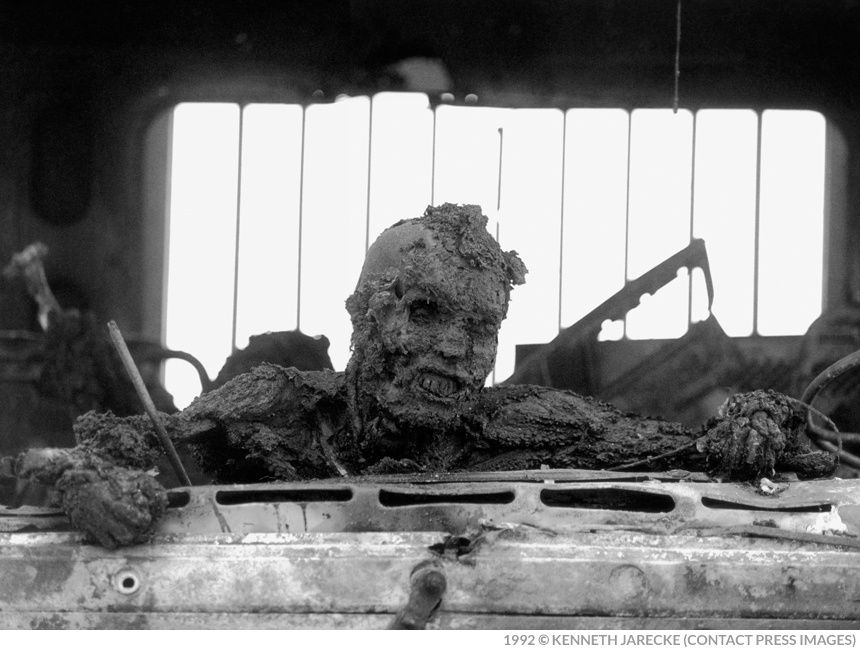
Kenneth Jarecke’s 1991 photo of a dead Iraqi was considered too disturbing to publish in America
W.J. Astore
Americans tend to fear death. It makes us uncomfortable. Yet death is inevitable. Its inevitability should teach us to revel in the richness of the here and now. It should also teach us the foolishness of undue pride.
All is vanity, the Bible teaches. Death reminds us of this — that human vanity, as unavoidable as it may be, is ultimately shallow. There are riches out there that we should seek away from the glaring and garish light of vanity. Riches that give deeper meaning to life.
Of all cultures in the world, I wonder if there’s another that ignores or denies death as much as American culture. We’re the culture of new beginnings, fresh starts, reinvention, and also of the perpetual now, of youth, of defying or denying death through face lifts, cosmetics, adrenalin-driven adventures, and so on. Technology and consumerism also provide distractions. After all, how can I be nearing the end if I have the latest iPhone or iPad or if I’m wearing the latest hip fashions?
Our funeral homes seek to deny death with open casket rituals in which the dead person is made up to look alive. Paul Fussell skewered this cultural tendency in his book, Class. We use euphemisms like “passed away” or “passed on” for “died”; the descriptive term of “undertaker” has morphed into “funeral home director.” Our religions stress life after death, not death itself.
We even deny that our wars produce death. Think of the Bush/Cheney Administration, which refused to show photographs of flag-draped coffins of American troops, ostensibly for “privacy” reasons but mainly to minimize the deadly costs of fighting in Iraq and Afghanistan. (Indeed, we don’t talk of troops dying in combat; we talk instead of troops “paying the ultimate price” or “making the ultimate sacrifice.”)
In minimizing the cost of war to its troops, the U.S. government and media also seek to deny the reality of death to the enemy. War coverage in the media is often stock footage showing drones or aircraft firing missiles, enhanced by graphics and music. You might see an enemy building or truck blowing up, but you’ll never see dead bodies. Too disturbing, even though violent gun play and bleeding corpses are routinely shown in American crime shows and movies as entertainment.
In the first Iraq war (Desert Storm) in 1991, the photographer Kenneth Jarecke caught a powerful image of a dead Iraqi soldier burnt alive in his truck on the infamous “highway of death.” Jarecke believed his photo would change America’s vision of the war, which in the U.S. media had been staged like a Hollywood production, neat and sanitary and clean. But no U.S. media outlet would publish the image. It was relegated to overseas publications.
What price do we pay as a people by ignoring death? We lack a certain depth and maturity; put differently, we are callous and shallow. Death has little meaning to us, especially the deaths of those in other lands. For in seeking to deny the inevitability of our own deaths, how can we possibly recognize and process the death of others?
A death-denying culture that rains death on others using drones named “Predator” and “Reaper”; a culture that finds images of war dead too disturbing even as its TVs and movies and videos are saturated by bloody murders. What are we to make of this?
The most powerful speech I’ve seen in any movie is that of Chief Dan George in “Little Big Man.” In trying to make sense of the White Man’s war on Native Americans, Chief Dan George’s character, Old Lodge Skins, suggests that the White Man kills because he believes everything is dead already. Lacking a moral center, the White Man has no sense of, or appreciation for, the sanctity of life.
Do we deny death because in some sense we are already dead? Dead to the richness and sanctity of life?
Random thoughts, as promised. But I hope they stimulate thought. What say you, readers?
President Obama’s decision to deploy 3,000 troops to Liberia in Africa to assist in efforts to contain Ebola got me to thinking about the military as white blood cells. As a military officer, I took an oath to defend the Constitution against all enemies, foreign and domestic. In a sense, I was vowing to defend the collective body politic just as white blood cells defend our individual bodies against “enemy” invaders.
But when was the last time the United States faced invaders who posed a virulent and direct threat to our existence? Invaders who directly attacked (or planned to attack) and utterly defeat our body politic? You’d have to go back to World War II and Japan’s attack at Pearl Harbor; similarly, Nazi Germany did have plans (that were never implemented) to take its world war to U.S. shores once the Soviet Union and Britain were defeated. Fortunately, our body mobilized its “white blood cells” and defeated (with lots of help from our allies) these enemies before they could afflict our vitals here at home.
Jump ahead to 2001 and the al Qaeda attacks on the Twin Towers and the Pentagon. Yes, they were serious and shocking and traumatic. But compared to the Nazis and the Japanese in World War II (true cancers), al Qaeda was the equivalent to a 24-hour “bug,” violent in the extreme, but ultimately not a serious long-term threat to the health of America.
By calling 9/11 a “bug,” I don’t mean to diminish the tragedy of 9/11 for those who lost loved ones. It’s just that repeats of 9/11-like attacks were not possible: al Qaeda simply lacked the resources to sustain them. There was no “cancer” that could metastasize. So there was no need to deploy our white blood cells (our troops) in extended wars, whether in Afghanistan or Iraq, the latter country of which had nothing whatsoever to do with 9/11.
Now we have the President referring to the Islamic State (ISIS/ISIL) as a “cancer” that must be eradicated, even though that “cancer” has no means of attacking the body that is our country. Despite this fact, the U.S. is deploying its white blood cells yet again to quash a threat that for our nation simply doesn’t exist.
From medicine, we know that overactive white blood cells can be as dangerous as underactive ones. White blood cells are part of our immune systems; when these systems are overactive, they convert non-threats into threats. Sometimes that results in violent allergic reactions that can lead to death. Other times, one’s own immune system turns on healthy tissue within one’s body. The immune system itself becomes a cancer, eating away at the body in misdirected attempts to defend it.
Whenever the U.S. faces a “threat” nowadays, our leaders treat it aggressively as a “cancer” even when the threat poses no direct peril to us. American presidents, whether they’re named Bush or Obama, eagerly deploy America’s antibodies — the military — to search and destroy bad terrorist cells. But the USA is like a patient whose antibodies have run wild, a patient whose antibodies have turned on external threats even when they’re not threats, a patient whose antibodies are now attacking healthy tissue within the American body politic.
Consider the fact that U.S. presidents commit the troops — our nation’s antibodies — to wars against “cancers” without formal declarations of war by Congress. In the name of protecting America, they violate the Constitution that our troops are sworn to uphold. They fail to recognize it’s their actions that pose the true threat to the Constitution. It’s their actions that constitute the cancer.
The invasive “cure” of continuous military action without oversight exercised by the people is truly worse than the disease, for it’s a “cure” that violates our Constitution and weakens our body politic.
And that is indeed the worst cancer of all.
—
A retired lieutenant colonel (USAF) and professor of history, William Astore edits the blog The Contrary Perspective.
The three Afghan officers who went missing (Cape Cod Times)
W.J. Astore
Two Afghan stories this week suggest much about U.S. progress in winning hearts and minds there. The first involves Hamid Karzai. Afghanistan’s departing president, the “Mayor of Kabul,” Karzai asserted that “America did not want peace for Afghanistan, because it had its own agendas and goals here.” It’s easy to paint Karzai as a dissembling ingrate, which is exactly what the American ambassador to Afghanistan did in response. But it truly says something that Karzai, the recipient of more than $100 billion in developmental aid from the U.S. for Afghanistan (not including military aid!), portrays the U.S. as working against the interests of the Afghan people. There’s one heart and mind the U.S. plainly didn’t win.
The second story involves three Afghan officers, one major and two captains, on a training mission at Camp Edwards in Massachusetts. The three officers, carefully vetted by U.S. Central Command, decided they had had enough of working with America. They drove to New York and attempted to enter Canada at Niagara Falls, seeking asylum, or so it seems. There are three more hearts and minds the U.S. plainly didn’t win.
The details of this particular story are farcical. The night before their unauthorized trip to the Canadian border, they enjoyed the pleasures of a genuine American strip club, where they were reportedly “well behaved” according to the club owner. The next day, they were brought to an American shopping mall as part of their introduction to “the cultural aspects of American life.” At the mall, they gave their escort the slip and headed to Canada, where they were eventually intercepted at the border crossing at Niagara Falls. According to The Cape Cod Times, when the three Afghan officers went missing, among the first places the U.S. military looked for them was at the strip club.
Talk about an introduction to American culture! First a strip club on Friday night, then a shopping mall on the weekend, then an unscheduled road trip to a major tourist attraction. These Afghan officers may have absorbed too much of the American way.
In all seriousness, what does it say about the success of American efforts vis-a-vis Afghanistan when its former president denounces the U.S. and visiting Afghan officers, after sampling American fleshpots and temples to consumerism, attempt to flee to Canada?
There’s a lesson here about folly, if only we would care to draw it.
In April 2009, I wrote an article for TomDispatch.com recounting Mary McCarthy’s critique of the American experience in Vietnam, and how her lessons applied to President Obama’s “surge” in Afghanistan. A central lesson cited by McCarthy was the American desire never to be labeled a loser. That desire explains, at least in part, the persistence of folly within the Obama Administration today, as Peter Van Buren explains in his latest article for TomDispatch, “Apocalypse Now, Iraq Edition: Fighting in Iraq Until Hell Freezes Over.”
Here’s what McCarthy had to say in 1968 about the American moment and the Vietnam War:
The American so-called free-enterprise system, highly competitive, investment-conscious, expansionist, repels a loser policy by instinctive defense movements centering in the ganglia of the presidency. No matter what direction the incumbent, as candidate, was pointing in, he slowly pivots once he assumes office.
Obama campaigned in 2008 as a “hope” and “change” candidate who as president would end the war in Iraq (so he could prosecute the “better” war in Afghanistan). Yet the U.S. finds itself yet again bombing widely in Iraq (and now Syria) while deploying thousands of military “advisers” (combat troops in plain speak). And after six weeks of airstrikes in Iraq against ISIS, with indecisive results, how long before those U.S. “advisers” start taking the fight directly to the enemy on the ground?
The questions I posed for President Obama back in 2009 were these:
Have you, like Vietnam-era presidents, pivoted toward yet another surge simply to avoid the label of “loser” in Afghanistan? And if the cost of victory (however defined) is hundreds, or even thousands, more American military casualties, hundreds of billions of additional dollars spent, and extensive collateral damage and blowback, will this “victory” not be a pyrrhic one, achieved at a price so dear as to be indistinguishable from defeat?
Similar questions apply to our latest military operations in Iraq and Syria. Is the U.S. surging militarily just to avoid the label of “loser”? And even if the U.S. “wins” this latest round (whatever “win” means), won’t the price paid be indistinguishable from defeat?
In his article, Van Buren offers an excellent summary of the U.S. experience in Iraq since the overthrow of Saddam in 2003. In his words:
The staggering costs of all this — $25 billion to train the Iraqi Army, $60 billion for the reconstruction-that-wasn’t, $2 trillion for the overall war, almost 4,500 Americans dead and more than 32,000 wounded, and an Iraqi death toll of more than190,000 (though some estimates go as high as a million) — can now be measured against the results. The nine-year attempt to create an American client state in Iraq failed, tragically and completely. The proof of that is on today’s front pages.
According to the crudest possible calculation, we spent blood and got no oil. Instead, America’s war of terror resulted in the dissolution of a Middle Eastern post-Cold War stasis that, curiously enough, had been held together by Iraq’s previous autocratic ruler Saddam Hussein. We released a hornet’s nest of Islamic fervor, sectarianism, fundamentalism, and pan-nationalism. Islamic terror groups grew stronger and more diffuse by the year. That horrible lightning over the Middle East that’s left American foreign policy in such an ugly glare will last into our grandchildren’s days. There should have been so many futures. Now, there will be so few as the dead accumulate in the ruins of our hubris. That is all that we won.
Under a new president, elected in 2008 in part on his promise to end American military involvement in Iraq, Washington’s strategy morphed into the more media-palatable mantra of “no boots on the ground.” Instead, backed by aggressive intel and the “surgical” application of drone strikes and other kinds of air power, U.S. covert ops were to link up with the “moderate” elements in Islamic governments or among the rebels opposing them — depending on whether Washington was opting to support a thug government or thug fighters.
The results? Chaos in Libya, highlighted by the flow of advanced weaponry from the arsenals of the dead autocrat Muammar Gaddafi across the Middle East and significant parts of Africa, chaos in Yemen, chaos in Syria, chaos in Somalia, chaos in Kenya, chaos in South Sudan, and, of course, chaos in Iraq.
And then came the Islamic State (IS) and the new “caliphate,” the child born of a neglectful occupation and an autocratic Shia government out to put the Sunnis in their place once and for all. And suddenly we were heading back into Iraq. What, in August 2014, was initially promoted as a limited humanitarian effort to save the Yazidis, a small religious sect that no one in Washington or anywhere else in this country had previously heard of, quickly morphed into those 1,600 American troops back on the ground in Iraq and American planes in the skies from Kurdistan in the north to south of Baghdad. The Yazidis were either abandoned, or saved, or just not needed anymore. Who knows and who, by then, cared? They had, after all, served their purpose handsomely as the casus belli of this war. Their agony at least had a horrific reality, unlike the supposed attack in the Gulf of Tonkin that propelled a widening war in Vietnam in 1964 or the nonexistent Iraqi WMDs that were the excuse for the invasion of 2003.
And this is how Van Buren concludes his article:
We’ve been here before, as the failures of American policy and strategy in Vietnam metastasized into war in Cambodia and Laos to deny sanctuary to North Vietnamese forces. As with ISIS, we were told that they were barbarians who sought to impose an evil philosophy across an entire region. They, too, famously needed to be fought “over there” to prevent them from attacking us here. We didn’t say “the Homeland” back then, but you get the picture.
As the similarities with Vietnam are telling, so is the difference. When the reality of America’s failure in Vietnam finally became so clear that there was no one left to lie to, America’s war there ended and the troops came home. They never went back. America is now fighting the Iraq War for the third time, somehow madly expecting different results, while guaranteeing only failure. To paraphrase a young John Kerry, himself back from Vietnam, who’ll be the last to die for that endless mistake? It seems as if it will be many years before we know.
That is indeed the question. As Mary McCarthy noted about the Vietnam War, “The more troops and matériel committed to Vietnam, the more retreat appears to be cut off — not by an enemy, but by our own numbers. To call for withdrawal in the face of that commitment… is to seem to argue not against a policy, but against facts, which by their very nature are unanswerable.”
Back to 2014 and the present moment: The more troops committed against ISIS, the more bombing raids made, the more money spent, the more prestige put on the line, the fewer the options the United States has in the Middle East. Indeed, the only option that remains is “to win,” since losing is unacceptable for the reason Mary McCarthy indicated.
But as Michael Murry, a Vietnam Veteran and regular contributor to this site, noted about Vietnam (citing Bernard Fall’s classic book, Street Without Joy), “You can’t do a wrong thing the right way,” and “We lose the day we start (these stupid imperial wars) and we win the day we stop.” Put differently, just as with Vietnam, the Middle East is not an incredibly complex puzzle for us to solve; it’s simply an impossible situation. Impossible for us. Until we admit this, the U.S. can never “win”; it can only lose.
The U.S. finally “won” in Vietnam when we admitted defeat and left. How long before we come to this realization in the Middle East? Tragically, the persistence of American hubris, amplified by resistance to the very idea of being labeled a “loser,” suggests yet another long, bloody, learning curve.
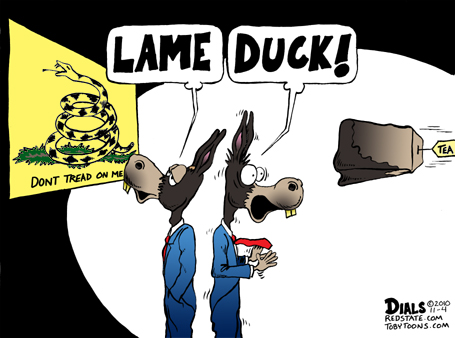
It’s not just the Tea Party that’s lame (Toby Toons)
W.J. Astore
The more the United States has come to talk about dominance, the less dominant we’ve become.
To compensate, we’ve become a steroidal nation, to include the violent side effects associated with steroid use (just look at the latest stories out of the NFL about spousal and child abuse, or our steroidal police forces, including MRAPs and M-16s for school police). If the story of the last fifty years is the gradual decline of the U.S., most notably in the economic and political realms, the story of today is how we’ve compensated with militarized Viagra. We’ve reached “the age of knowing” that we’ve lost much of our potency as our country. To compensate, we’re forever popping pills and flexing our muscles. (Just look at John McCain’s enthusiasm for bombing.)
It’s precisely those steroids that are weakening us as a country. As we’ve overcompensated with military weapons and bases, we’ve allowed our economy to slide. As we’ve sought domination overseas, we’ve weakened our country right here at home. We feverishly build and repair roads in Afghanistan but not here in the USA. Same with schools — we’d rather build prisons, to include Gitmo, than colleges (since 1984, California has built 21 prisons but only one university).
Consider our binary debates on foreign policy. It’s the hawks versus the doves, militarized “engagement” versus isolationist “appeasers,” the implication being that the latter is wrong — that minding one’s own business is not an option in a globalized world. But the world is not some “global village”: it’s a conglomeration of fragments. And U.S. efforts to dominate those fragments by military means are only accelerating that fragmentation. Just look at what our government did and is doing to Iraq and Afghanistan.
Fragmentation facilitates dominance by multinational corporations even as the U.S. military is misused and overextended. The result is more global instability and a retreat (or a return) to ideologies that promise coherence and order. Witness the rise of militant Islam and ISIS. By attacking it, the U.S. is acting as an accelerant to it.
As the U.S. weakens itself as a country, as it accumulates debt by constantly fighting wars while passing the costs along to future generations, large multinational corporations grow in power. They are today’s equivalent to the British East India Company, the Dutch East India Company, and similar entities of the past. Combine powerful multinationals with privatized mercenary outfits and you see echoes of the seventeenth century, to include wars over religion and resources. Three centuries ago, it was Catholics versus Protestants and wars over spices like pepper and nutmeg. Now it’s divisions within Islam and wars over oil.
We’re witnessing the decline of Enlightenment ideals and community-based Democracy, as seen by the way in which the U.S. government routinely betrays those ideals. Any sense of shared, community-based, obligation is tainted by “socialism,” meaning that a Darwinian capitalism based on selfish individualism is promoted instead, which only feeds the growth of multinationals competing to sell “product” to the masses.
Everything is becoming a consumable, including the most vital parts of life. As a consumable, it can be marketed, sold, and controlled by those same multinationals. Even education is now an ephemeral product, marketed and sold as a commodity.
Corporations think and act for short-term profit. But democracies are supposed to think strategically, over the long term. Now the quarterly business cycle controls all. Look at politics: A congressman is elected and instantly starts fund raising to win his next campaign. Obama wins a second term and is almost instantly branded a lame duck.
But it’s not Obama who is the lame duck – it’s America. And all the militarized steroids in the world won’t cure that lameness. Indeed, they just aggravate it.
A sentiment attributed to Vice President Joe Biden is, Show me what’s in your budget, and I’ll tell you what you value. These words resonate with me whenever I consider the yearly budget for the Department of Defense (DoD), Homeland Security, the Department of Energy (which handles nuclear weapons), and the various intelligence agencies (roughly 17; that’s why they form a community).
When you add up what we spend on defense, homeland security, “overseas contingency operations” (wars), nuclear weapons, and intelligence and surveillance operations, the sum approaches $750 billion dollars each and every year, consuming more than two-thirds of the federal government’s discretionary spending.
Here are some figures for Fiscal Year 2015 (FY15):
Defense: “Base” budget of $496 billion
Afghan War (not part of “defense”): $85 billion
VA: $65 billion
Homeland Security: $38 billion
Nuclear Weapons: $12 billion
FBI and Cyber Security (part of Justice Department budget): $18 billion
Total: $714 billion
Some of the budget of the State Department and for foreign aid supports weapons and training (“foreign military sales”), bringing us to roughly three-quarters of a trillion dollars, each and every year, on the military, intelligence, security, weapons, and wars.
How much do we spend at the federal level on education, interior, and transportation? Roughly $95 billion.
When a government spends almost eight times as much on its military, security, wars, weapons, and the like as it does on educating its youth, fixing its roads and bridges and related infrastructure, and maintaining its national parks and land, is there any question what that country ultimately values?
Show me your budget and I’ll tell you what you value. Sobering words. Sobering — and scary.
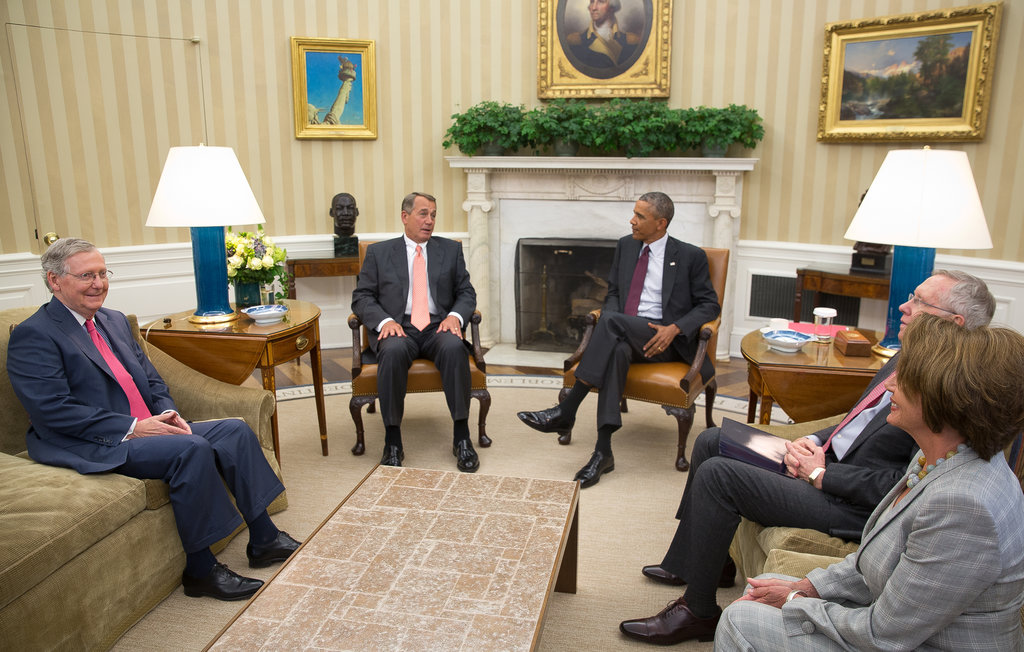
Obama “consults” with Congress before ordering more bombing. Note the irony of George Washington’s portrait, the man who warned us to avoid foreign entanglements (Source: NYT)
W.J. Astore
President Obama’s speech tonight on the Islamic State (or ISIS) promises more military action. More airstrikes, more boots on the ground (mainly Special Forces), more training for the Iraqi military (who have endured more than a decade’s worth of U.S. military training, with indifferent results), and more weapons sales (which often end up in the hands of ISIS, thereby necessitating more U.S. airstrikes to destroy them).
All of this is sadly predictable. Call it the TINA militarized strategy, as in “There is no alternative” (TINA) but to call in the military.
There are three reasons for the TINA strategy. One is domestic politics. Facing elections in November, the Obama Administration and the Democrats must appear to be strong. They must take military action, at least in their eyes, else risk being painted by Republicans as terrorist-appeasers.
The second reason is also obvious: The military option is the only one the U.S. is heavily invested in; the only option we’re prepared, mentally as well as physically, to embrace. The U.S. is militarized; we see the military as offering quick results; indeed, the military promises such results; we’re impatient people; so we embrace the military.
Never mind the talk of another long war, perhaps of three years or longer. When they bother to pay attention, what most Americans see on their TV and computer screens is quick results, like the video released by Central Command showing the U.S. military blowing up ISIS equipment (often, U.S. military equipment provided to Iraq but appropriated by ISIS). And unlike those ISIS “medieval” beheadings, decapitation by laser-guided bomb is both unoffensive and justified.
And if we’re blowing things up with our 21st-century decapitation bombs, we must be winning — or, at least we’re doing something to avenge ISIS barbarism. Better to do something than nothing. Right?
The third reason is more subtle and it comes down to our embrace of “dominance” as our de facto military strategy. Allow me to explain. After World War II, the U.S. military embraced “containment” as the approach to the Soviet Union. “Parity” was the buzzword, at least in the nuclear realm, and “deterrence” was the goal. With the collapse of the Soviet Union, the U.S. did not become “a normal country in normal times,” nor did we cash in our peace dividends. Instead, the U.S. military saw a chance for “global reach, global power,” global dominance in other words. And that’s precisely the word the U.S. military uses: dominance (expanded sometimes to full spectrum dominance, as in land, sea, air, space, cyberspace, and who knows what else).
You can explain a lot of what’s happened since 9/11 with that single word: dominance. The attacks of 9/11 put the lie to U.S. efforts to dominate global security, which drove the Bush/Cheney Administration to double down on the military option as the one and only way of showing the world who’s boss. Clear failures of the military option in Iraq, Afghanistan, and elsewhere did not encourage soul-searching; rather, it simply drove Obama and his generals to promise that “this time, we’ll do it (bombing and raids and interventions) better and smarter” than the previous administration.
There’s simply no learning curve when your overall goal is to exercise dominance each and every time you’re challenged. Ask John McCain.
So as you listen to the president’s speech tonight, keep those three elements in mind: domestic politics, our enormous investment (cultural as well as financial) in the military and our preference for quick results at any price, and finally our desire to exercise dominance across the globe. It may help you to parse the president’s words more effectively. Perhaps it will also explain why our leaders never seem to learn. It’s not because they’re stupid: it’s because their careers and commitments require them not to learn.
Bombs away.
Update: There’s another aspect of our dominance that is fascinating to consider. The US sees its dominance as benevolent or benign, never as bellicose or baneful. This is reflected brilliantly in the US Navy’s current motto, “A global force for good.” Not to deny that the Navy does good work, but I’m not sure we’d applaud if F-18s were dropping laser-guided bombs on our troops. The point is that as a society we have a willed blindness to how our “dominance” plays out in the rest of the world. We only seem to care when that “dominance” comes to Main Street USA, as it did recently in Ferguson, Mo. (The ongoing militarization of police forces, and their aggressiveness toward ordinary people, are surely signs of “dominance,” but who wants to argue this is benevolent or benign in intent?)
If another country sought global reach/global power through military dominance, that country would be instantly denounced by US leaders as inherently hostile and treated as a major threat to world peace.
Update 2 (9/12/14): Dan Froomkin at The Intercepthas a stimulating round-up of criticism about Obama’s latest plans for war (courtesy of Tom Engelhardt at TomDispatch.com). A summary:
Yesterday, Dan Froomkin of the Intercept offered a fairly devastating round-up of news reports from the mainstream (finally coming in, after much deferential and semi-hysterical reportage!) suggesting just what a fool’s errand the latest expansion of the U.S. intervention in Iraq/Syria could be. (And today’s NY Times has more of the same.) Here are just some selections from his post. Tom Engelhardt
“President Obama’s plan to “degrade and destroy” the Islamic State counts on pretty much everything going right in a region of the world where pretty much anything the U.S. does always goes wrong. Our newspapers of record today finally remembered it’s their job to point stuff like that out.
“The New York Times, in particular, calls bullshit this morning — albeit without breaking from the classic detached Timesian tonelessness. Mark Mazzetti, Eric Schmitt and Mark Landler (with contributions from Matt Apuzzo and James Risen) start by pointing out the essential but often overlooked fact that ‘American intelligence agencies have concluded that [the Islamic State] poses no immediate threat to the United States.’
“And then, with the cover of ‘some officials and terrorism experts,’ they share a devastating analysis of all the coverage that has come before: ‘Some officials and terrorism experts believe that the actual danger posed by ISIS has been distorted in hours of television punditry and alarmist statements by politicians, and that there has been little substantive public debate about the unintended consequences of expanding American military action in the Middle East….’
“In the Washington Post this morning, Rajiv Chandrasekaran focuses on all the implausible things that have to go right beyond ‘U.S. bombs and missiles hitting their intended targets’: ‘In Iraq, dissolved elements of the army will have to regroup and fight with conviction. Political leaders will have to reach compromises on the allocation of power and money in ways that have eluded them for years. Disenfranchised Sunni tribesmen will have to muster the will to join the government’s battle. European and Arab allies will have to hang together, Washington will have to tolerate the resurgence of Iranian-backed Shiite militias it once fought, and U.S. commanders will have to orchestrate an air war without ground-level guidance from American combat forces…’
“The McClatchy Newspapers Washington bureau , finally no longer alone in expressing skepticism about Obama’s plans, goes all Buzzfeed with a Hannah Allam story: ‘5 potential pitfalls in Obama’s plan to combat the Islamic State’. Allam notes that Yemen and Somalia are hardly examples of success; that the new Iraqi government is hardly “inclusive”; that training of Iraqi soldiers hasn’t worked in the past; that in Syria it’s unclear which “opposition” Obama intends to support; and that it may be too late to cut off the flow of fighters and funds.”
Update 3 (9/12/14): US Army Colonel (ret.) Andrew Bacevich has a sound critique of the bankruptcy of Obama’s strategy. Here’s an excerpt:
Destroying what Obama calls the Islamic State of Iraq and the Levant won’t create an effective and legitimate Iraqi state. It won’t restore the possibility of a democratic Egypt. It won’t dissuade Saudi Arabia from funding jihadists. It won’t pull Libya back from the brink of anarchy. It won’t end the Syrian civil war. It won’t bring peace and harmony to Somalia and Yemen. It won’t persuade the Taliban to lay down their arms in Afghanistan. It won’t end the perpetual crisis of Pakistan. It certainly won’t resolve the Israeli-Palestinian conflict.
All the military power in the world won’t solve those problems. Obama knows that. Yet he is allowing himself to be drawn back into the very war that he once correctly denounced as stupid and unnecessary — mostly because he and his advisers don’t know what else to do. Bombing has become his administration’s default option.
Rudderless and without a compass, the American ship of state continues to drift, guns blazing.
Eve tempting Adam. I guess Adam didn’t have a mind of his own
W.J. Astore
The other day my wife and I were watching Wadjda, a terrific film about a spirited Saudi girl who dreams of buying and riding her very own bicycle. The film does a great job of highlighting the constraints put on women in traditional Saudi and Islamic culture. Women are not allowed to drive, they must veil themselves whenever they can be seen by men, they are trained to be subservient and not to attract attention to themselves, and so on.
Watching the constraints under which Saudi women live their lives, my spirited wife uttered the following aphorism:
Religion – written by men, for men. And that’s all you need to know.
Having been raised Catholic, it’s hard to disagree with her. The Catholic Church has historically been misogynist. It was Eve, after all, who tempted Adam. She was “the weaker vessel” who was cursed with the pain of childbirth because of her “original sin.” The Church itself, to state the obvious, is run entirely by men. Even the woman most respected by the Church, the Virgin Mary, is an unattainable ideal. A woman who gets pregnant without losing her virtue and virginity? Try aspiring to that.
Whenever a religion, no matter if it’s Islam or Catholicism or some other faith or sect, places half of humanity in inferior and subservient roles, we must question very closely its true intent and inspiration. Surely a just and compassionate God would not sanction a religion that subordinates women to the whims of men.
Obviously, I know many believers, women as well as men, will disagree with this. They will point to their faith, their holy books, the power of tradition. Or they will try to explain how their religion really doesn’t discriminate against women and so on.
Here I recall a saying that Temple Grandin says she will never forget: “Men will wrangle for religion, write for it, fight for it, die for it, anything but live for it.”
How true. And I’d add that any religion worth living for is one that treats men and women equally as believers. I don’t think God, if He or She (!) exists, would want it any other way.
Recent news that the planned Eisenhower Memorial in Washington, D.C. remains in trouble greatly saddens me. When I was young, I considered myself a moderate Republican/conservative Democrat. I recall favoring Gerald Ford over Jimmy Carter in the 1976 presidential election. My idea of a Democrat was someone like Senators Scoop Jackson and Sam Nunn, supporters of a hard line against the Soviet Union. To me, these men appeared to be pragmatic, tough-minded, and willing to put country before partisan politics — much like Ike himself.
Ike, of course, was a Republican but could have run as a Democrat. Indeed, today’s Republican Party would probably reject men like Ike and Gerald Ford. They wouldn’t pass certain litmus tests in the primaries on issues like abortion or gun rights or school prayer and the like. More’s the pity for our country.
Back in February 2012, I wrote this article (at Huff Post) on “Why I Still Like Ike.” When you read Ike’s warning below about too much money being spent on weaponry, and his prophecy about the disastrous influence of the Military-Industrial Complex, ask yourself whether any mainstream political candidate today of either party would dare to denounce major weapons makers and America’s propensity for war with such clarity and guts.
Instead, today we have Democrats wetting themselves in their eagerness to appear tough (witness Vice President Biden’s comment about confronting the Islamic State at “the gates of hell”), and Republicans eager to bomb everything in sight.
Ike wasn’t perfect, but we sure could use a person of his courage and gravitas in 2016. Chris Christie or Hillary Clinton, anyone? Forget about it.
Why I Still Like Ike (2012)
The ongoing controversy over the national memorial to President Dwight D. Eisenhower provides us with an opportunity to recall Ike’s legacy and his deeper meaning to America. Ike was of course a national hero, the supreme allied commander who led the assault at D-Day on June 6, 1944 and who later served as president during the height of the Cold War with the Soviet Union. His legacies are many and profound, from ending the Korean War to the interstate highway system that bears his name to advancing civil rights to creating the space program to the establishment of the department of health, education and welfare.
As important as Ike’s deeds were to our country, in some way his words were (and are) even more important, especially in this time of constant war and bloated budgets for “defense” and our burgeoning trade in deadly weaponry.
Ike was a citizen-soldier first and foremost, not a warrior or warfighter, and like the citizen-soldiers of World War II he came to hate war. This is not to say that Ike was a pacifist. He believed in a strong defense and intervened in countries such as Iran, Guatemala, Lebanon, Formosa, and South Vietnam, in order in his words to prevent “communist efforts to dominate” these countries. And we may certainly question the legality as well as the wisdom of these “wars in the shadows,” especially with respect to Iran and Vietnam.
But let us focus on Ike’s words — his lessons to America. Grossly underestimated by intellectuals who were deceived by his amiable public demeanor and his love of golf (with its country-club associations), Ike was a fine writer and a deep thinker who thoroughly understood the American heartland — and the American heart.
Any memorial to Ike should seek to capture the wisdom of his words and how they struck to the very core of the American (and human) experience. It should confront us with his words and encourage us to contemplate their meaning in a setting conducive to reflection and reconsideration.
First, let’s consider what Ike said about war. In a speech at the Canada Club in Ottawa on Jan. 10, 1946, Ike stated:
“I hate war as only a soldier who has lived it can, only as one who has seen its brutality, its futility, its stupidity.”
Let all Americans pause and reflect on the hard-earned wisdom of that statement before plotting our next military intervention.
Second, let’s consider what Ike said about the true cost of spending on military weaponry. In remarks prepared for the American Society of Newspaper Editors in 1953, Ike declared that:
Every gun that is made, every warship launched, every rocket fired signifies, in the final sense, a theft from those who hunger and are not fed, those who are cold and are not clothed. This world in arms is not spending money alone. It is spending the sweat of its laborers, the genius of its scientists, the hopes of its children… This is not a way of life at all, in any true sense. Under the cloud of threatening war, it is humanity hanging from a cross of iron.
Third, let’s consider Ike’s final warning upon leaving office in 1961 about the dangers of a growing “military-industrial complex” to democracy and freedom in America. In his words:
The conjunction of an immense military establishment and a large arms industry is new in the American experience. The total influence — economic, political, even spiritual — is felt in every city, every statehouse, every office of the federal government.
In the councils of government, we must guard against the acquisition of unwarranted influence, whether sought or unsought, by the military-industrial complex. The potential for the disastrous rise of misplaced power exists and will persist.
We must never let the weight of this combination endanger our liberties or democratic processes. We should take nothing for granted. Only an alert and knowledgeable citizenry can compel the proper meshing of the huge industrial and military machinery of defense with our peaceful methods and goals, so that security and liberty may prosper together.
Ike’s tersely prophetic words are rarely heard in American political discourse today. Indeed, his avowed hatred of war, his condemnation of the deadly weapons trade as contrary to human values, his warning about an emergent military-industrial complex with the power to threaten our liberties, would likely be dismissed in this year’s election season, whether by mainstream Democrats or Republicans, as the ravings of a left-wing, weak-kneed, liberal.
All the more reason why these words need to be enshrined in a national memorial to Eisenhower.
One more lesson Ike can impart to us: the virtue of humility. In spite of his immense accomplishments, Ike remained a humble man. Doubtless this humility stemmed from his upbringing, but so too did it come from his military service. As he himself wrote, “Humility must always be the portion of any man who receives acclaim earned in blood of his followers and sacrifices of his friends.”
In this age of American exceptionalism, in which our nation touts its “generation of heroes” and boasts of its unrivaled military power, Ike’s words remind us that humility is far more becoming a man and a nation.
Even the most powerful nation may fall if it loses itself in its own celebratory braggadocio. Ike knew this, and if despite his efforts such a fate had happened on his watch, he doubtless would have taken full responsibility. Consider here the words Ike prepared in case the D-Day attack had failed on June 6, 1944. This was what Ike was prepared to say:
Our landings in the Cherbourg-Havre area have failed to gain a satisfactory foothold and I have withdrawn the troops. My decision to attack at this time and place was based upon the best information available. The troops, the air and the Navy did all that Bravery and devotion to duty could do. If any blame or fault attaches to the attempt it is mine alone.
Fortunately for history, Ike never had to say those words. Left unsaid, they nevertheless live on as an example of Ike’s willingness to bear unselfishly the burden of defeat, even as he humbly bore the laurels of victory.
Whatever final form the national memorial to Ike eventually assumes, I sincerely and fervently hope it enshrines the wisdom, the courage, the humility, the humanity of Ike’s words, so desperately do we need these qualities today.
For Ike knew that America’s true strength resides not in the size of our arsenals but in the generosity of our spirit.
In December 2010, I wrote the article below for Truthout. Even as the economy was sputtering and jobs were scarce, Congress was seeking to cut unemployment benefits. Eventually, a compromise was forged to maintain the benefits; the price was more tax cuts for the richest Americans. Angered by the hypocrisy and greed on display, and inspired by my father’s words and experiences, I penned my very own tale of two cities. It’s not Dickens, but it has the merit of being far shorter.
The Rich Get Richer, the Poor Poorer (Posted originally at Truthout on 12/7/2010)
William Astore
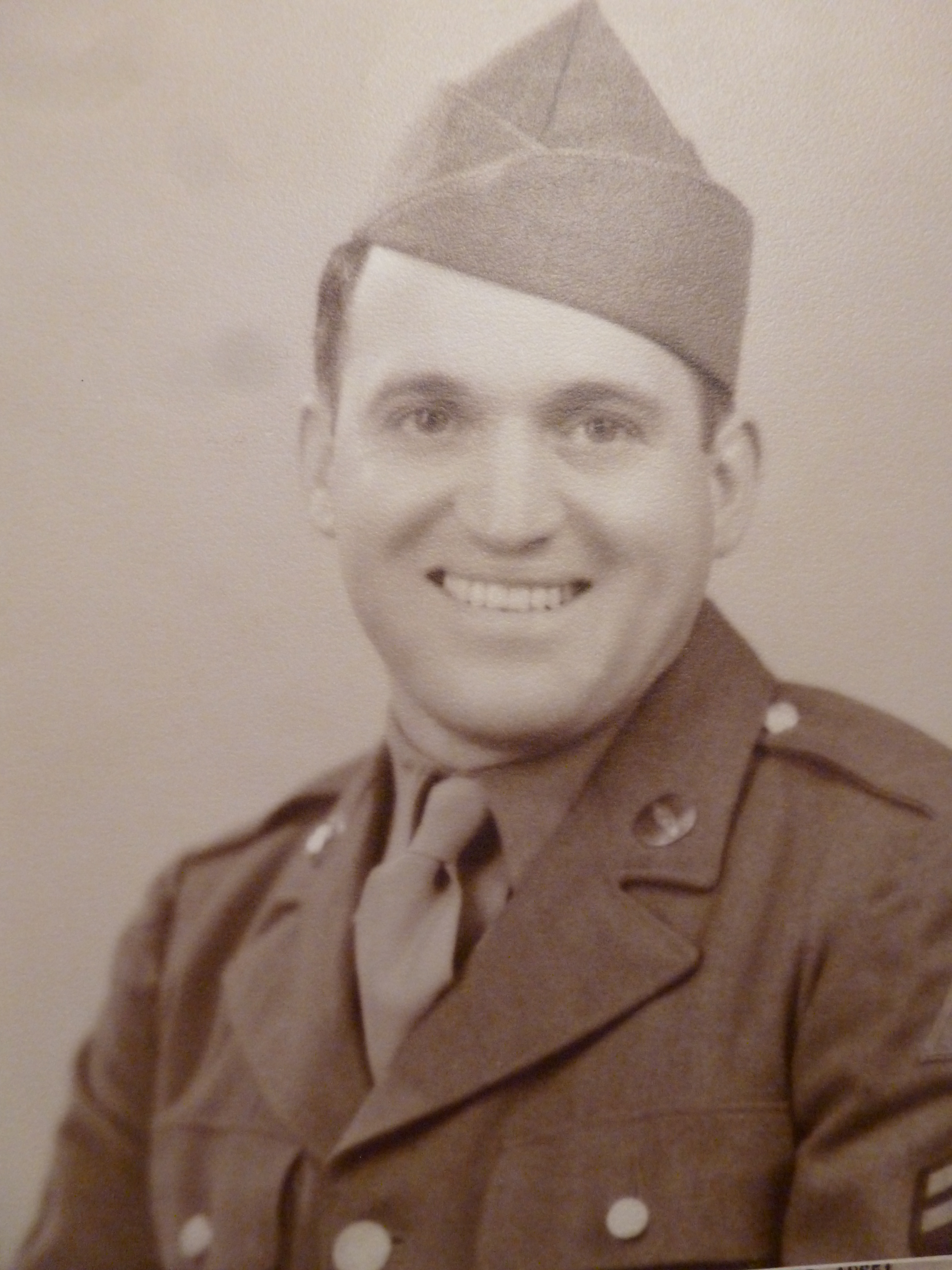
More tax breaks for the rich in exchange for another year’s worth of unemployment benefits for the desperate: Now there’s a compromise that makes me proud to be an American. My father wouldn’t have been surprised. He grew up during the Great Depression and worked in factories before he was drafted and served in the Army during World War II. Dad told me that the harder he worked (physically), the less he got paid. And he told me there was nothing like repetitive and physically-grueling factory work to make you want to improve yourself. By becoming a civil servant (a firefighter), he escaped the factory and its dismal pay for a job that paid enough to provide five children with a lower middle class existence.
Today’s political elites seem to think that the proper way to stimulate economic growth is to empower the exploiters. That way, some of their enormous wealth will trickle down on the little people. My father knew from experience that it usually wasn’t money that trickled down from the high heights of the rich.
In the spirit of the holiday season, here’s a story from my Dad that recounts his attempt to get a dime pay raise at the local factory. Consider it a parable for the realities our working classes face day in and day out in this country:
It seems that Mike Calabrese on his own asked Harry Callahan [one of the owners] for a pay raise and he was refused. Mike decided to organize the men members and go down in a group. In our group he got ten men to approach Harry C. for a raise. But when it was time to “bell the cat” only three fellows went to see Harry. Well Mike said he couldn’t join the group because he had already tried to get a raise. I knew I was being used but I was entitled to a raise. Well Harry said to me, “What can I do for you men?” So I said to Harry: 1) Living costs were going up; 2) We deserved a raise. So Harry said, “How much?” and I said ten cents an hour would be a fair raise. So he said I’ll give you a nickel an hour raise and later you’ll get the other nickel. We agreed. So, I asked Harry will everyone get a raise and he replied, “Only the ones that I think deserve it.”
Well a month later I was drinking water at the bubbler and Harry saw me and said what a hard job they had to get the money to pay our raises. Well, Willie, Harry Callahan and his brother Sam and their two other Italian brother partners all died millionaires. No other truer saying than, That the rich have no sympathy or use for the poor.
Today, Americans are uncomfortable calling attention to pay discrepancies and exploitation because it smacks of class warfare or even Marxism. It’s true that some of the worst abuses have been curbed (for example, my father worked from 6PM to 6AM without the benefit of overtime pay or time-and-a-half), but today’s workers are simply scared: scared that their jobs will be outsourced, scared that they’ll be fired; scared that they’ll be replaced by automated robots. Thus they put up and shut up.
So, what’s the moral to the story? Our president promised hope and change. “Hope” has come in the form of more tax breaks for the rich. And “change”? To paraphrase my father: No truer saying than that politicians have no sympathy or use for the poor.