Creator of Bracing Views. Contributor to TomDispatch, Truthout, HNN, Alternet, Huffington Post, Antiwar, and other sites. Retired AF lieutenant colonel and professor of history. Senior fellow, Eisenhower Media Network
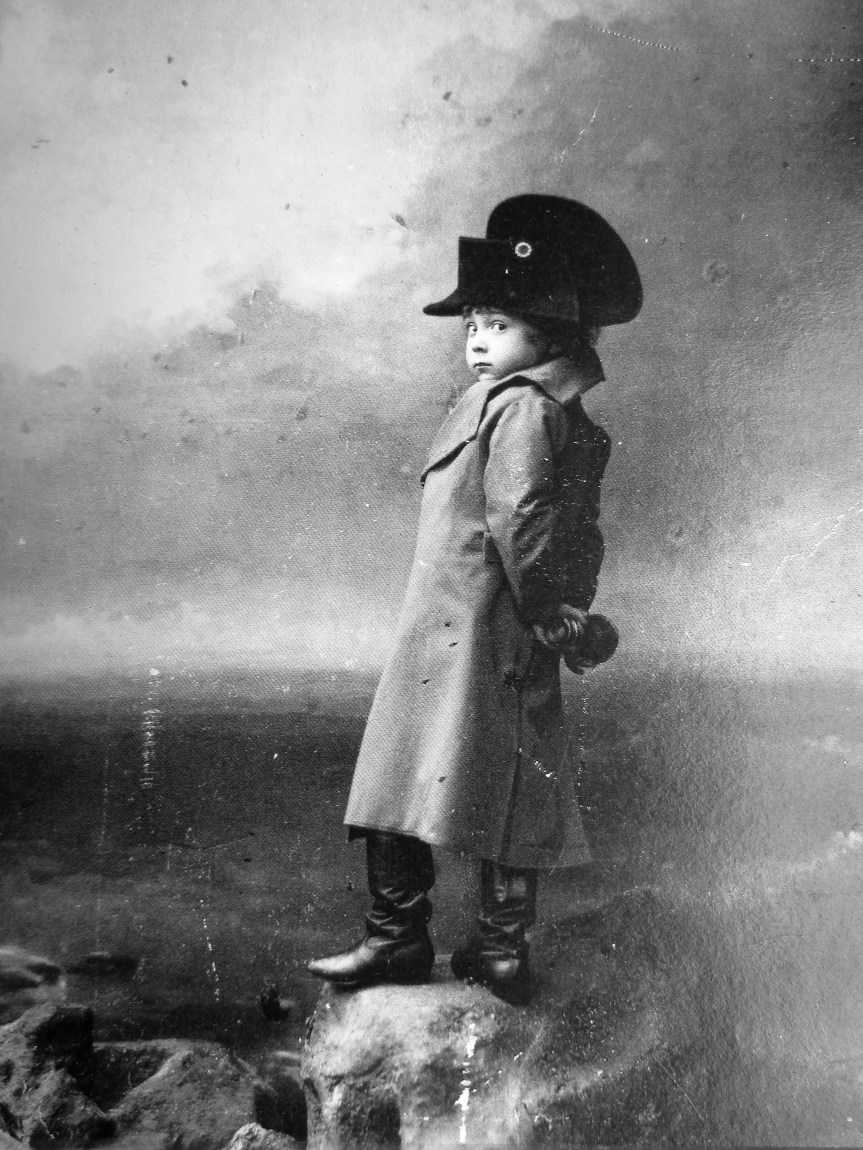
Photo by Paul Nadar (1891), from a French postcard
W.J. Astore
I was reading the novelist Ursula K. Le Guin and came across the following commentary by her:
“A hero whose heroism consists of killing people is uninteresting to me, and I detest the hormonal war orgies of our visual media … War as a moral metaphor is limited, limiting, and dangerous. By reducing the choices of action to ‘a war against’ whatever-it-is, you divide the world into Me or Us (good) and Them or It (bad) and reduce the ethical complexity and moral richness of our life to Yes/No, On/Off. This is puerile, misleading, and degrading. In stories, it evades any solution but violence and offers the reader mere infantile reassurance. All too often the heroes of such fantasies behave exactly as the villains do, acting with mindless violence, but the hero is on the ‘right’ side and therefore will win.”
This passage is copyrighted 2012, and surely Le Guin is commenting in part on the American political and war scene, even if these comments came as an afterword to her novel “A Wizard of Earthsea.”
The stories we tell ourselves – our driving narratives and metaphors – are very powerful. I learned this almost three decades ago from one of my professors at Johns Hopkins. We were talking about the scientific revolution, the label applied after the fact by historians to the era of Copernicus, Kepler, Galileo, and Newton. Did that era truly deserve the label of a “revolution” in thought? On one level, yes. A heliocentric vision replaced a geocentric one. Newtonian physics replaced Aristotelian metaphysics. But on another level, the label was misleading. If you view this era only through a “revolutionary” lens, everything gets magnified and refracted through it. You’re always looking for evidence of the “revolution” that you know is there. The revolutionary narrative/metaphor, in other words, restricts and distorts your vision. It also tends to answer questions before they’re even asked. Certain historical figures get labeled as “revolutionaries,” others as “reactionaries,” some as winners, others as losers, almost without having to think about it.
That’s disturbing enough for a historian dealing with the “dead” past. Think about how that distortion, that resort to easy categorization, applies to the living, to the present, in “wartime.” Viewing everything through a war lens both restricts and distorts our vision. We quickly force people to take sides, or we assign them a side regardless of their complexity (“You’re either for us or against us,” as George W. Bush noted in the aftermath of 9/11). Just as quickly, the “heroes” adopt the violent methods of the bad guys (witness the bombing, the invasions, the use of torture, performed by the U.S. in the stated cause of “liberation”). No ethical complexity is tolerated since “our” troops are on the right side (so we think). Even when they embrace violence and lose control, deadly mistakes and even war crimes are readily excused as aberrations that should be forgotten, rare exceptions that do nothing to besmirch America’s exceptional and heroic nature.
The power of narratives is remarkable. The United States continues to be driven by one that’s dominated by power, violence, and war. Is it any wonder, then, that the two major party candidates for the presidency, Hillary Clinton and Donald Trump, fit so easily and readily into this narrative? Hillary plans to continue to wage war even more aggressively than Obama has, and Trump is all about violent solutions and an “Us” versus “Them” mentality. (Build a wall! Biggest, baddest military! Make America great again! Punch the protesters! Extreme vetting! Throw the illegals out!)
Until we change our national narrative from one of constant war and violence to something more pacific and modulated, our political scene will continue to be, to borrow Le Guin’s words, puerile and misleading and degrading, with candidates serving up heroic violence as pabulum, as infantile reassurance.
Is it possible to talk to working-class supporters of Donald Trump? Of course it is. It’s just that Democrats from Hillary Clinton’s crowd have a very difficult time reaching across the social, economic, and cultural divide that often separates them from Trump’s (often reluctant) supporters.
This lesson came home to me in Arlie Hochschild’s recent article for TomDispatch.com. Arlie got to know Mike Schaff, a man whose home in the bayou of Louisiana was poisoned by an environmental disaster at the hands of big oil. Despite this, Mike Schaff remains deeply skeptical of government oversight and says he wants to eliminate agencies like the EPA that help to prevent environmental damage.
Despite his bitter experience with corporate malfeasance, Schaff remains unsympathetic to the Democratic Party and its arguments for more government intervention in the name of protecting ordinary citizens from harm. Schaff, in short, believes in individualism, hard work, and self-reliance, as well as working together with his neighbors in small communities. He doesn’t buy the argument that big government is his friend. He doesn’t want to be seen as dependent on welfare and other government handouts. He mostly wants to be left alone, even as he professes belief in Trump’s sentiment that America needs to be made “great again,” in part by a government led by Trump.
I think I understand part of what drives Mike Schaff. The “do-gooder” liberal Democrats don’t speak his language. Their reliance on regulations, lawyers, and bureaucracy makes him feel out of sorts, inferior, even dumb. Their talk about “victims” and government “rescuers” turns him off, even though he himself is a victim of an environmental disaster. But the point is that he doesn’t see himself as a victim. He sees himself as a self-reliant man, a man working through a tough time, getting by with a little help from his friends, with no need of help from the Suits in Washington.
A confession: I’m not the most mechanical guy (though I fix small stuff), but around a guy like Mike Schaff, a man who welds and spends his time constantly tinkering with machines, I’d feel a bit uncomfortable. I’m used to slinging words, just as he’s used to working physically, with his hands.
But I could hang with him. I did my time in the military. I come from a working-class family. I know guys like Mike Schaff. I can empathize with him. I can speak his language.
The message of politicians like Hillary Clinton will not resonate with Mike. Guys like Mike prefer plain-speak. Making America great again — hell ya, it’s about time! As cynical and opportunistic as Trump may be, his message of self-reliance, his blunt talk, his braggadocio, and his calls for action (no matter how stupid) do resonate with Mike, even if his pro-corporate policies will only aggravate Mike’s situation.
What ever happened to tough democrats who could talk to guys like Mike? Even Joe Biden, despite his hardscrabble Scranton origins, doesn’t quite fit.
Joe Bageant was great at this — his book “Deer Hunting with Jesus” told the story of a liberal gun-owning Southerner who lived the life of men (and women) like Mike Schaff. But sadly Bageant died a few years ago. (For some articles I’ve written about Bageant, see here and here and here.)
If Hillary Clinton loses in November, a big reason why will be that she simply couldn’t (or wouldn’t) speak the language of working-class Americans, people like Mike Schaff.
Perhaps there should be a “new rule” on the American military scene: When the B-52s are called out (Vietnam, Iraq, Afghanistan), it means America has well and truly lost.
Unbeknownst to most Americans, since April of this year, B-52s flying out of “Al Udeid airbase in Qatar … have conducted more than 325 strikes in almost 270 sorties, using over 1,300 weapons” against ISIS and now in Afghanistan, notes Paul Rogers at Open Democracy.
For those of you unfamiliar with B-52s, they are huge long-range bombers, originally deployed in the 1950s to carry nuclear weapons against the Soviet Union. In the 1960s and early 1970s, they were called upon to carry conventional bomb loads during the Vietnam War. Their enormous bomb tonnages did not serve to win that war, however, nor has the subsequent use of B-52s in places like Iraq and Afghanistan served to win those wars. They have become a sort of stop-gap weapon system, their ordnance called upon to stem the tide of American military reversals even as their presence is supposed to demonstrate American resolve.
In a way, America’s B-52s are like the Imperial Star Destroyers of the “Star Wars” universe.
An imperial star destroyer loses yet another chase
Big, lumbering ships that never seem to provide a winning edge vis-a-vis the smaller, “rebel” forces against which they’re deployed. But the empire, which never seems to learn, keeps using them, even as it seeks even bigger, “Death Star” weaponry with which to annihilate the resistance.
Of course, when Americans think about air power, they don’t think of “Star Wars” battles or B-52s on bombing runs. They think of audacious and cocky fighter pilots, like Tom Cruise’s “Maverick” in the highly popular movie, “Top Gun.” For me, the most telling scene in that movie is when the flashy, undisciplined, and self-centered Maverick puts his F-14 Tomcat jet into an irrecoverable flat spin. That wouldn’t be so bad, except Maverick has a backseater, “Goose,” who dies during the ejection. Maverick, of course, ejects safely and lives to fight another day.
It’s too late for Goose, but Tom Cruise lives on to make more bad movies
Again, most people probably remember the cheesy ending to this movie where Cruise is shooting down MiG after MiG. But take another look at the flat spin scene. America, like Maverick and Goose’s jet, is dropping from the sky, spinning wildly and uncontrollably all the way. And while a few Mavericks may be lucky enough to get away unscathed, many Gooses in the process are going to end up dead.
Goose didn’t deserve to die in “Top Gun,” and neither do the many “gooses” around the world caught in the violent and all-too-real backwash of America’s jet-fueled wars.
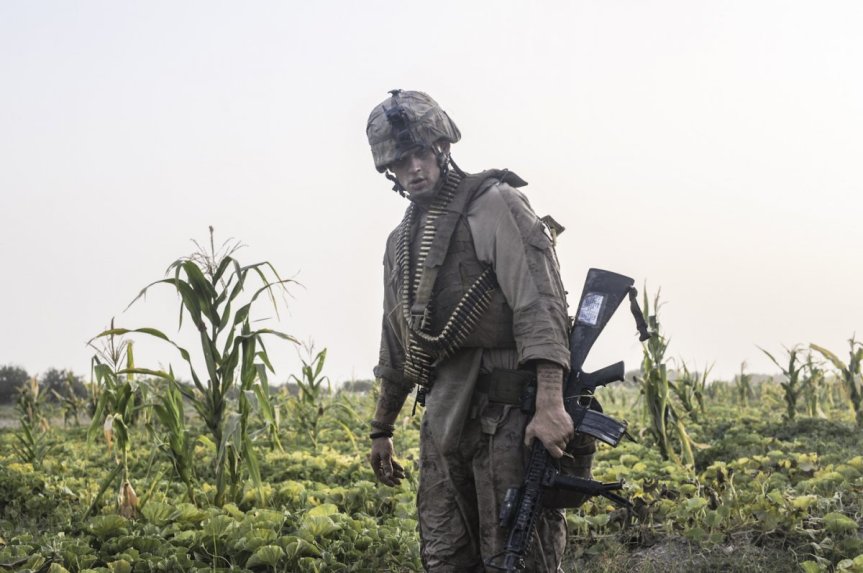
Why can’t we bring them home? (U.S. Marine in Afghanistan; photo by Peter van Agtmael/Magnum)
W.J. Astore
Carl von Clausewitz, the Prussian military theorist who wrote at the end of the Napoleonic Era, is noted for saying that war is a continuation of politics. That saying explains much of current U.S. military war-making, but only if you first and foremost focus on domestic politics – and economics.
Wars make money for weapons makers, and the U.S. dominates the world’s arms trade. Wars require a large “defense” establishment, and the U.S. national security state has essentially become a fourth branch of government that threatens to eat the rest. Wars tend to strengthen reactionary elements within society, shunting to the fringes those who argue for peace amid a climate of fear. Wars, in short, have their purposes – it’s just that the salient ones often differ from the stated ones. For clarity, it often helps to follow the money. Who profits from war? Addressing that question will explain many of the reasons why America’s wars have no promise of ending.
In the meantime, current U.S. war-making looks something like this:
In places like Iraq and Afghanistan, the pursuit of “stability” (whatever that means) mainly through the arming and training of indigenous security forces. Using Afghans and Iraqis as foot soldiers, as well as a heavy reliance on private military contractors (mercenaries), reduces the U.S. military “footprint” on the ground, which reduces U.S. casualties and thus domestic interest in as well as opposition to these wars. Typical U.S. governmental actions include military training, selling weapons, and providing air support (mainly in the form of bombing and reconnaissance).
Waging these wars, at the end of long logistical lines, is profligate in dollars — witness the high cost of indigenous forces in Iraq and Afghanistan, which rarely perform anywhere close to U.S. expectations — which has the added benefit of justifying enormous “defense” budgets in the U.S.
What these wars don’t promise is either “victory” or closure. But that’s not the main point of them. U.S. politicians like George W. Bush and Barack Obama are not concerned with victory: they’re focused on sustaining illusions of progress for domestic political gain. For example, the recent recapture of Falluja from ISIS is defined by the U.S. government as “progress,” even though that city had already been “pacified,” i.e. largely destroyed at high cost to U.S. forces, more than a decade ago.
In the war on terror, the heavy use of special operations forces and drones, both to kill terrorists and to interdict their supplies, logistics, and sources of their funding. Again, the emphasis is on minimizing U.S. casualties, which is the key consideration in U.S. domestic politics. American lives are not risked in drone attacks, and relatively few Americans have been killed in special ops raids, which, because they are often so highly classified, rarely register in the U.S. media unless Americans are indeed killed.
Here again, it’s unclear if any real progress is being made in this war, but the Obama administration in particular has sold such raids and strikes as killing thousands of terrorists while minimizing U.S. casualties. Such claims serve to squelch, if only temporarily, Republican claims that Obama is weak and soft on defense. Domestic political concerns, rather than long lasting effectiveness, once again rule.
Confrontation with “peer” rivals like Russia and China. This is old-school stuff, a variant of Cold War containment and deterrence. “Pivots” to the Pacific and the rhetorical pillorying of Vladimir Putin help to justify massive U.S. military spending that approaches $750 billion each and every year. The war on lightly armed terrorists isn’t enough to sustain this figure, but reports that China’s getting an aircraft carrier or Russia’s working on nuclear weapons justify new U.S. carriers and a trillion-dollar splurge on U.S. nuclear arsenals.
Here again, U.S. war-making is driven far more by domestic politics (and economics) than by needs-driven analysis of national defense. Exaggerating peer threats like China and Russia keeps a sclerotic Pentagon, a supine Congress, and a bloated military-industrial complex happy.
At this point, an astute reader might ask: But what is the real Clausewitzian strategy for war-making in the United States? How is war a continuation of politics? Again, one must look to U.S. domestic politics to address this question. “Toughness” must be demonstrated, therefore wars must be continued, no matter how costly and unpromising, if only to keep up appearances. President Obama, for example, has refused to make key decisions about the Afghan war, leaving it to the next president to decide whether the U.S. commitment of troops continues after 2017. There’s an outstanding chance that the next U.S. president will continue that war, placing it on the backburner to simmer until the next election cycle in 2020.
In sum, the new American way of war-making consists of methods rather than strategies, methods that produce endless war that serve mostly domestic political and economic purposes. A telltale sign that things are going really poorly is when the U.S. military declares another “surge” of its ground forces, which whether in Iraq in 2007 or Afghanistan in 2009-10 seemed calculated not to produce victory or closure but again to squelch domestic political opposition from hawkish rivals. That in itself is considered a “win” for whichever administration is in power.
What is never considered in U.S. war-making is ending the wars. Domestically, attempts at limiting U.S. war-making are instantly tarred with the brush of “cutting and running,” of weakness, even of cowardice. Rare is the U.S. president who dares to stand up to those clamoring for war.
Attempts to downsize the global presence of the U.S. military are similarly equated with weakness. As a result, no U.S. president (or major party candidate for president, like Clinton or Trump) dares to suggest it. Refusing to walk away, fearing loss of face but especially fearing domestic political defeat, presidents as diverse as Lyndon Johnson and Richard Nixon in the 1960s and lately Bush and Obama have embraced the folly of waging unwinnable wars. It’s likely little will change in 2017, irrespective of which major party wins the election.
Both presidential nominees of the major parties, Hillary Clinton and Donald Trump, have promised to make the U.S. military bigger and better. But for what purpose? A bigger, badder military is the purpose, and again it’s driven by domestic political and economic imperatives. You have to go outside the major parties, to the Libertarians or the Greens, to hear any talk of significant military reductions. Libertarians have talked of military reductions of 20%, the Greens of deeper cuts of up to 50%. In today’s militarized America, those parties aren’t going anywhere.
War-making as a continuation of domestic politics for political and economic profit – it sure explains a lot about the actions of the U.S. government and military. It may not be what Carl von Clausewitz had in mind, but it surely is America’s reality.
News about the Clinton Foundation and its finances shows the truth of that old adage, “You get what you pay for.” In this case, giving money to the Clinton Foundation often bought access to Hillary Clinton (or her closest aides), the odds-on favorite to be America’s next president, and sometimes it helped with favors as well. These revelations illustrate perfectly the “pay to play” nature of the American political scene: the usual influence peddling, the usual FOBH, Friends of Bill and Hillary, coming together to pull the strings while being paid handsomely for the performance.
A sports executive who was a major donor to the Clinton Foundation and whose firm paid Bill Clinton millions of dollars in consulting fees wanted help getting a visa for a British soccer player with a criminal past.
The crown prince of Bahrain, whose government gave more than $50,000 to the Clintons’ charity and who participated in its glitzy annual conference, wanted a last-minute meeting with Secretary of State Hillary Clinton.
U2 rocker and philanthropist Bono, also a regular at foundation events, wanted high-level help broadcasting a live link to the International Space Station during concerts.
In each case, according to emails released Monday from Hillary Clinton’s time as secretary of state, the requests were directed to Clinton’s deputy chief of staff and confidante, Huma Abedin, who engaged with other top aides and sometimes Clinton herself about how to respond.
The emails show that, in these and similar cases, the donors did not always get what they wanted, particularly when they sought anything more than a meeting.
But the exchanges, among 725 pages of correspondence from Abedin disclosed as part of a lawsuit by the conservative group Judicial Watch, illustrate the way the Clintons’ international network of friends and donors was able to get access to Hillary Clinton and her inner circle during her tenure running the State Department.
Yes, money sure does matter. If asked why they took more the fifty grand from the prince of Bahrain, among other donors with deep pockets, I suppose Hillary and Bill might just say, “Because that’s what they offered.” Money is the universal solvent of politics, and Hillary and Bill know this better than most.
Of course, Hillary is trying to position herself as the champion of ordinary people, even as she and her husband have amassed a foundation and position worth roughly $2 billion. Who knows? Given the nebulous and chaotic nature of Trump’s finances, the Clintons may be richer than him.
Which brings me to this question: Which hypocritical billionaire do you want to rule America?
Update (8/24/16): The Washington Post has another story on how Hillary Clinton is raising big money through various fundraisers. All you need is $25K or $50K and some good connections and you too might be able to meet Hillary in a semi-private setting. You might even net a bonus like seeing Cher (in Provincetown) or hearing Aretha Franklin sing (in Birmingham, Michigan).
Remember how Bernie Sanders energized a movement, raising millions by relying on individual donations that averaged (and this is an amount he made famous) $27 per donation?
Those days are gone. Establishment Hillary is back, and she’s raising buckets of money from the deep pockets of heavy-hitters.
But never fear! She’s all about helping “everyday people” — a phrase her campaign used until someone noticed it was slightly condescending.
If we’re “everyday people,” who are the Clintons? Well, I can tell you how they think of themselves by how they act: They are the higher life forms, to borrow a phrase from a friend, a retired Army major who remembers M-48 tanks because he served in one.
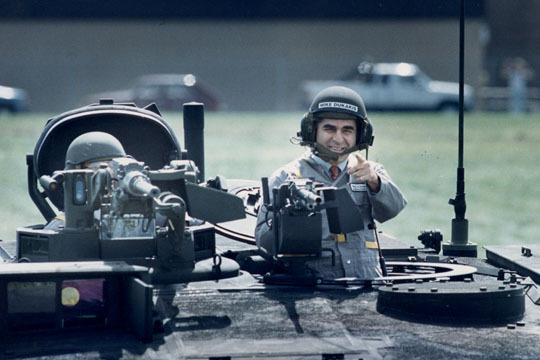
That’s one place we won’t see Hillary: in an Army tank. But if we ever did, I think she’d pull it off better than Michael Dukakis did.
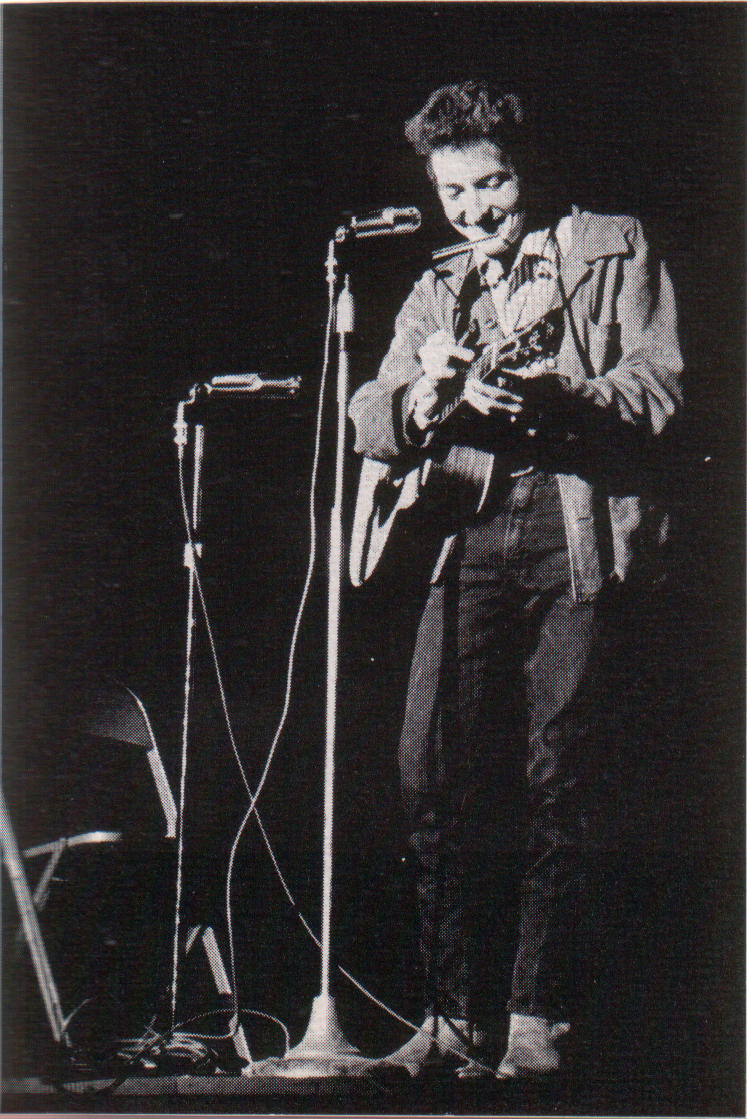
On a snowy evening in January 1965 four friends, including myself, drove across the Hudson River from Tivoli NY, where we were living at the time, to Woodstock. We had heard that the folksinger, Tom Paxton, was singing at the Café Espresso. I had become enamored of Paxton’s music so I was anxious to see and hear him in person. What we didn’t know was that the rising counter-cultural folk star, Bob Dylan, was also going to be there. By the time we arrived I was wondering whether it was good idea to drive the twenty miles for this mini-concert. The roads were treacherous.
As a college student in 1965 I hadn’t heard much about Bob Dylan but I did like some of his music, which my dorm mates at Bard College played constantly. Dylan was sitting at the next table when we entered the cafe. There were only a handful of customers, mostly from the area. As Paxton started singing some of the patrons were still talking. Suddenly, Dylan shouted at them to shut up. Perhaps he was already experiencing his celebrity because his manner was slightly intimidating. Heck, he was just a scrawny, unimpressive kid, about my age—one year older, actually.
Tom Paxton
During a brief intermission of Paxton’s mini-concert I found myself in a backroom with the two (not too distant) future giants of counter-cultural folk music, the heirs of Woody Guthrie and Pete Seeger. Dylan wanted to show Paxton, if memory serves me, some chords on the guitar. There were four of us in the room, including my classmate, Paul, who was the driver of the car to Woodstock. I can’t remember how this little gathering happened, what permission or lack thereof we had to witness this intimate discussion between Dylan and Paxton. I do recall thinking that I should not give up the chance to be as close to Bob Dylan as I could get.
At one point during this strange encounter Dylan looked at me directly with a penetrating stare. I was nervous and amused at the same time. Did he know something about me I didn’t know or did he see me as a kindred spirit? I’ll never know.
Fifty one years later I still listen to the music of the “old Dylan.” I still marvel at the fame he’s achieved since the time I met him in person when we were both barely beyond being “kids”—at least by today’s standard of what it means to be a “kid.” Today, I can appreciate the impact songs such as “Blowin’ in the Wind” and “The Times They Are a’ Changin’” have had on my generation especially.
What I don’t take for granted is that the younger generation, the “kids” I teach today, can appreciate, much less have heard of, the lyrics of those songs. I don’t believe they would find Dylan’s music or even Paxton’s music inspiring. Their clarion call for a change in the status quo wouldn’t seem relevant to them or even “cool.”
Richard Sahn teaches sociology and embodies the mission of Bracing Views. In his own way, he’s as cool as Dylan.
News that Hillary Clinton has selected Ken Salazar to head her transition team should give pause to anyone who believes Hillary’s claim that she’s a “Progressive.” Assuming Hillary wins the presidency, Salazar will chair the team that helps her to fill more than 4000 appointments.
What do we know about Salazar? According to a report at The Intercept,
As a senator, Salazar was widely considered a reliable friend to the oil, gas, ranching and mining industries. As interior secretary, he opened the Arctic Ocean for oil drilling, and oversaw the botched response to the BP oil spill in the Gulf of Mexico. Since returning to the private sector, he has been an ardent supporter of the TPP, while pushing back against curbs on fracking….
“We know that, from everything we’ve seen, there’s not a single case where hydraulic fracking has created an environmental problem for anyone,” Salazar told the attendees, who included the vice president of BP America, another keynote speaker at the conference. “We need to make sure that story is told.”
Really, Mr. Salazar? I lived in Pennsylvania for nine years, during the height of the fracking boom. A friend of mine lost his family farm and land due to poisoned water caused by fracking. Earthquakes have been traced to fracking. Methane seepage and burn-off contributes to global warming. Fracking chemicals are highly toxic and wastewater from fracking is radioactive. And these are just a few of the dangers associated with fracking.
It’s one thing to argue that fracking is hazardous but that those hazards can be controlled through rigorous practices that emphasize environmental safety. It’s a defensible position, though I believe the hazards are not fully known, therefore they can’t be fully controlled, let alone minimized. But Salazar is arguing fracking has not caused a single environmental problem! For anyone!
Yes, Hillary now claims she’s against fracking (when she led the State Department, she was strongly for it). But how does that flip-flop square with her decision to appoint yet another earth wrecker to a key position in her government-to-be? Just what the planet needs: a pro-fracking, pro-industry, corporate shill who will help to ensure that people like himself will occupy key positions of authority in a Clinton government.
I’ve witnessed enough earth wrecking. Count me out of Hillary 2016.
Recently, a good friend gave me a copy of Daniel Anselme’s “On Leave,” a book published in 1957 in the early stages of France’s war in Algeria, which ultimately ended in France’s defeat and Algerian independence in 1962. A novel, it follows three French soldiers on furlough in and around Paris and their desperate (and mostly failed) efforts to reconnect to home prior to returning to a brutal war.
The main themes are disaffection and disorientation. The gulf in understanding between the soldier-conscripts and their families and the wider public is simply too wide to be bridged. Instead, the soldiers find comfort in drink, women, and especially in each other. Having relied on each other in war, they come to rely on each other again in the short downtime they have from its brutalities.
What struck me forcibly was the indifference of France to the soldiers. We see a similar indifference today in the U.S., despite all of the “support our troops” rhetoric. This “support” often is, as the saying goes, a mile wide but only an inch deep. Another similarity between then and now is the gulf in understanding between what the soldiers know about war and what the people think they know. The soldiers know the horrors; the people only know a few talking points. Back then it was about upholding the honor of France; nowadays in the USA it’s about fighting them (the terrorists) over there so we don’t have to fight them here.
For the troops, it’s always the same cause: preservation. Survival. Saving oneself and one’s buddies.
One soldier gives an electric speech about “when will it end.” How many men is France willing to lose in its attempt to hold onto some smidgen of colonial glory? How long will the wars in Africa go on? His speech made me think of our own, seemingly endless, wars.
All three men in this story — a sergeant, a corporal, and a private — are unwounded physically from war. Yet all three are psychological casualties. War and atrocity has already inflicted a serious toll, as all three suffer some of the less obvious costs of war and extended military service (broken marriages, family arguments and estrangement and resentment, guilt at not being able to conform to family expectations, a growing sense of fatalism).
Recognizing a lost cause, French President Charles de Gaulle eventually smartened up and pulled out of Algeria. But the U.S. today doesn’t have leaders of de Gaulle’s grit and smarts to recognize a losing hand. So America’s wars just grind on and on.
“On Leave” is a fine book. Would that it were on President Obama’s summer reading list, or on Hillary’s or Trump’s. They could all use a heavy dose of reality about war’s futility.
My latest article at TomDispatch.com focuses on the need for military dissent in an age of creeping militarism and perpetual war. In my article, I identify some of the key reasons why such dissent is tightly constrained and often severely limited. This is especially problematic for at least two reasons. The first is that Americans say they trust the military more than any other societal institution. If the military censors itself, it misses an invaluable opportunity to educate an attentive public about the disastrous path of America’s wars.
The second reason is that a democracy’s health depends on dissent. A country in which dissent is suppressed, a country that finds itself engaged in perpetual war, is a country that cannot sustain democratic institutions. We’re already witnessing the withering away of democracy in America. That it’s happening in slow motion doesn’t mean that it isn’t happening.
A Marine Corps sergeant and Vietnam War veteran wrote to me in “salty” language that “his damn war [was] fucked up,” but that while he was still in uniform he “spoke little [against the war] and only then about how it was being run.” We need more honesty from today’s veterans about how America’s damn wars are fucked up. Maybe then we’ll finally get off our duffs and work to put a stop to them.
Here are a few excerpts from my article; I invite you to read all of it at TomDispatch.com.
The Pentagon has, in a very real sense, become America’s national cathedral. If we’re going to continue to worship at it, we should at least ask for some minimal level of honesty from its priests. In militarized America, the question of the moment is how to encourage such honesty.
Call it patriotic dissent. By “dissent” I mean honest talk from those who should know best about the hazards and horrors of perpetual war, about how poorly those conflicts have gone and are going. We desperately need to encourage informed critics and skeptics within the military and the [Military-Industrial] Complex to speak their minds in a way that moves the national needle away from incessant bombing and perpetual war.
Yet to do so, we must first understand the obstacles involved. It’s obvious, for example, that a government which has launched a war against whistleblowers, wielding the World War I-era Espionage Act against them and locking away Chelsea Manning for a veritable lifetime in a maximum security prison, isn’t likely to suddenly encourage more critical thinking and public expression inside the national security state. But much else stands in the way of the rest of us hearing a little critical speech from the “fourth branch” of government …
Leaving military insularity, unit loyalty, and the pressure of combat aside, however, here are seven other factors I’ve witnessed, which combine to inhibit dissent within military circles.
1. Careerism and ambition: The U.S. military no longer has potentially recalcitrant draftees — it has “volunteers.” Yesteryear’s draftees were sometimes skeptics; many just wanted to endure their years in the military and get out. Today’s volunteers are usually believers; most want to excel. Getting a reputation for critical comments or other forms of outspokenness generally means not being rewarded with fast promotions and plum assignments. Career-oriented troops quickly learn that it’s better to fail upwards quietly than to impale yourself on your sword while expressing honest opinions. If you don’t believe me, ask all those overly decorated generals of our failed wars you see on TV.
2. Future careerism and ambition: What to do when you leave the military? Civilian job options are often quite limited. Many troops realize that they will be able to double or triple their pay, however, if they go to work for a defense contractor, serving as a military consultant or adviser overseas. Why endanger lucrative prospects (or even your security clearance, which could be worth tens of thousands of dollars to you and firms looking to hire you) by earning a reputation for being “difficult”?
3. Lack of diversity: The U.S. military is not blue and red and purple America writ small; it’s a selective sampling of the country that has already winnowed out most of the doubters and rebels. This is, of course, by design. After Vietnam, the high command was determined never to have such a wave of dissent within the ranks again and in this (unlike so much else) they succeeded. Think about it: between “warriors” and citizen-soldiers, who is more likely to be tractable and remain silent?
4. A belief that you can effect change by working quietly from within the system: Call it the Harold K. Johnson effect. Johnson was an Army general during the Vietnam War who considered resigning in protest over what he saw as a lost cause. He decided against it, wagering that he could better effect change while still wearing four stars, a decision he later came deeply to regret. The truth is that the system has time-tested ways of neutralizing internal dissent, burying it, or channeling it and so rendering it harmless.
5. The constant valorization of the military: Ever since 9/11, the gushing pro-military rhetoric of presidents and other politicians has undoubtedly served to quiet honest doubts within the military. If the president and Congress think you’re the best military ever, a force for human liberation, America’s greatest national treasure, who are you to disagree, Private Schmuckatelli?
America used to think differently. Our founders considered a standing army to be a pernicious threat to democracy. Until World War II, they generally preferred isolationism to imperialism, though of course many were eager to take land from Native Americans and Mexicans while double-crossing Cubans, Filipinos, and other peoples when it came to their independence. If you doubt that, just read War is a Racket by Smedley Butler, a Marine general in the early decades of the last century and two-time recipient of the Medal of Honor. In the present context, think of it this way: democracies should see a standing military as a necessary evil, and military spending as a regressive tax on civilization — as President Dwight D. Eisenhower famously did when he compared such spending to humanity being crucified on a cross of iron.
Chanting constant hosannas to the troops and telling them they’re the greatest ever — remember the outcry against Muhammad Ali when, with significantly more cause, he boasted that he was the greatest? — may make our military feel good, but it won’t help them see their flaws, nor us as a nation see ours.
6. Loss of the respect of peers: Dissent is lonely. It’s been more than a decade since my retirement and I still hesitate to write articles like this. (It’s never fun getting hate mail from people who think you’re un-American for daring to criticize any aspect of the military.) Small wonder that critics choose to keep their own counsel while they’re in the service.
7. Even when you leave the military, you never truly leave: I haven’t been on a military base in years. I haven’t donned a uniform since my retirement ceremony in 2005. Yet occasionally someone will call me “colonel.” It’s always a reminder that I’m still “in.” I may have left the military behind, but it never left me behind. I can still snap to attention, render a proper salute, recite my officer’s oath from memory.
In short, I’m not a former but a retired officer. My uniform may be gathering dust in the basement, but I haven’t forgotten how it made me feel when I wore it. I don’t think any of us who have served ever do. That strong sense of belonging, that emotional bond, makes you think twice before speaking out. Or at least that’s been my experience. Even as I call for more honesty within our military, more bracing dissent, I have to admit that I still feel a residual sense of hesitation. Make of that what you will.
Bonus Reason: Troops are sometimes reluctant to speak out because they doubt Americans will listen, or if they do, empathize and understand. It’s one thing to vent your frustrations in private among friends on your military base or at the local VFW hall among other veterans. It’s quite another to talk to outsiders. War’s sacrifices and horrors are especially difficult to convey and often traumatic to relive. Nevertheless, as a country, we need to find ways to encourage veterans to speak out and we also need to teach ourselves how to listen — truly listen — no matter the harshness of what they describe or how disturbed what they actually have to say may make us feel …
And I conclude my article in this way:
Some will doubtless claim that encouraging patriotic dissent within the military can only weaken its combat effectiveness, endangering our national security. But when, I wonder, did it become wise for a democracy to emulate Sparta? And when is it ever possible to be perfectly secure?
The U.S. Constitution and especially the Bill of Rights is the foundation of our democracy. If you had to pick a right to celebrate, perhaps even to cherish, which would it be? There are so many important ones, such as freedom of speech, freedom of the press, freedom of assembly, freedom of religion, our right to privacy (the fourth amendment), and so on. There are other amendments that righted old wrongs, including prohibitions against slavery and the granting of the vote to Blacks and women.
Yet which right/amendment is the best known in U.S. politics today? The second amendment, or the right to bear arms, which Mike Pence referred to yesterday when he noted, “people who cherish the Second Amendment have a very clear choice in this election.”
OK, I’ve owned guns and enjoy shooting, but I hardly “cherish” my right to spend thousands of dollars on lots of guns. I have friends who hunt and friends who collect guns and I wouldn’t deny them their rights to do both, but again why is this the one right that deserves to be singled out as worthy of being “cherished” in a democracy?
I know: the NRA and its followers claim that an armed citizenry is the best guarantor of all the other rights, a position that is, quite frankly, ridiculous. Believe me, your personal collection of guns is not going to stop a trained military using tanks and artillery and all the other heavy weaponry of war. And no: this is not an argument for you to have the right to purchase your very own M-1 Abrams tank!
Look: No political candidate plans to take away anyone’s guns. Nevertheless, the NRA and Trump/Pence persist in scaring gun owners while encouraging a “cherishing” attitude toward guns. And here’s the telling part: Even as the gun cherishers bloviate about the extreme importance of gun rights, they virtually ignore all the other rights that do need protecting in America, especially our rights to speech, assembly, and privacy.
Stop fixating on guns, America, and start cherishing what really matters: your rights as a citizen to have a real say in politics and the running of this country. Those are the rights that truly need protecting.