Creator of Bracing Views. Contributor to TomDispatch, Truthout, HNN, Alternet, Huffington Post, Antiwar, and other sites. Retired AF lieutenant colonel and professor of history. Senior fellow, Eisenhower Media Network
News out of Trump-land today is that the president is signing an executive order to rollback environmental protections passed by President Obama. All the Republicans can seemingly agree on is to attack Obama’s actions; as a friend said to me, “They’re a bunch of spiteful mofos.”
We only have one Planet Earth, and we seem determined to ruin it, once again in the name of profit and jobs and “growth.” On a planet with shrinking resources, why is “growth” such a wonderful thing?
The other day, I was watching a typical truck commercial on TV. It showed trucks literally tearing up the backroads, along with ATVs spinning and jumping and chewing up the countryside, all synonymous with “adventure” and “freedom.”
I remember those old Coors commercials featuring Mark Harmon. They were set in Colorado (I think) and featured him quietly extolling the virtues of barley and clean water. Now most Coors commercials are about self-indulgent partying (but please drink responsibly).
My point? We need a change in mindset — one that values nature and its preservation. We’re doomed if we keep selling the idea “you can have it all,” so go party and tear up nature — who cares as long as you’re having fun?
We act as if we have many planet earths, but we have only one. And we’re slowly and surely making…
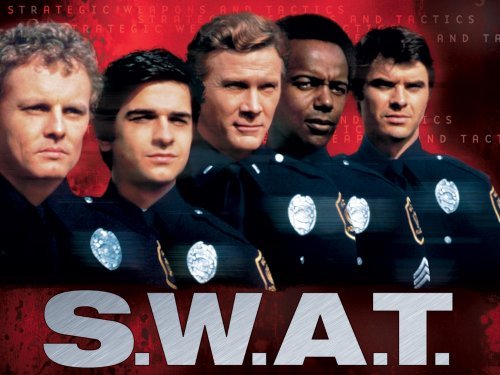
File this under the ongoing militarization of Washington, DC and our American moment: Jared Kushner, Trump’s son-in-law, is to lead a SWAT team to introduce best practices from business into government. Not an efficiency team or innovation team or idea team. A SWAT team. As in special weapons and tactics.
Will Kushner carry an M-16 or sniper rifle while he remakes government in the image of business? The SWAT rhetoric is both juvenile and absurd.
As Dirty Harry said, “A man’s got to know his limitations.” Kushner, whose record apparently wasn’t quite good enough to get into Harvard without Daddy’s money (to the tune of $2.5 million), doesn’t strike me as SWAT material. And I don’t think he knows his limitations …
At Northeastern University in Massachusetts, members of campus security are now routinely carrying military assault rifles in their vehicles. The rationale is that you never know when and where terrorists will strike, so you have to be prepared to outgun them at all times.
Many Americans equate guns with safety — and bigness with value. So, the bigger the gun, the safer you are. Right?
It didn’t used to be this way.
Back in the 1970s, I remember when the police got by with .38 revolvers. Up-arming the police meant going from .38 specials to .357 magnums. Of course, these were six-shot revolvers. Then cops started carrying 9mm handguns with clips that could carry 15-18 rounds. Now some cops carry .40 caliber semi-automatics, which are more powerful than the 9mm but also more difficult to control.
What should Democrats do about Neil Gorsuch? They should filibuster.
The reason is obvious: Merrick Garland, President Obama’s eminently qualified and moderate nominee for the Supreme Court, never even got a hearing from Republicans. Unlike obstructionist Republicans, the official party of no, a party that with a clear majority can’t even pass its own wealth/health care plan, the Democrats gave Gorsuch a fair hearing. It’s now time to oppose him. To do anything else would be an admission of gutlessness.
Democrats, at the risk of stating the obvious: Republicans are not going to respect your sense of fair play, your bipartisanship, your willingness to compromise. Just keep one image in mind: Republicans are Lucy holding the football, and you are Charlie Brown. No matter how many times Lucy tells you she’s going to let you kick the ball, she’s always going to pull it away, betraying her promise while making snide comments about your gullibility.
There’s another reason not to vote for Gorsuch: the man lacks compassion. Sure, he’s urbane, intelligent, and well-read. He knows his way around the law. But he seems to believe humans were made for the law, rather than the law being made for and by us.
The higher a judge rises in our system of justice, the higher the premium on compassion. The law is not a bunch of words and statutes and rulings to be adjudicated soullessly while citing “original intent,” whatever that means. In certain rulings, like the “frozen trucker” case, Gorsuch came across as soulless, allowing strict interpretations to trump common humanity.
I’m a historian, not a lawyer, so my view of the law is somewhat different from the experts. I see it as an artifact of history, a fluid substance, an imperfect product of imperfect humans. That doesn’t mean it’s not vitally important; that it doesn’t deserve our respect and our protection. But, again, the law exists for us: to uphold life, liberty, and the pursuit of happiness. The law shouldn’t exist solely for the powerful, for corporations, for the government, for the richest.
Justice shouldn’t be blind. Justice requires judges to use all their senses, and not just those, but their hearts and souls as well. It’s not enough for a judge to be learned; he or she should have empathy, a strong sense of fairness, and, again, compassion.
Gorsuch is a fan of Dickens. While listening to him, it was difficult for me to tell whether he was Scrooge before his moral awakening, or Scrooge after it. He came across more as the Scrooge of “Are there no prisons, no workhouses,” rather than the Scrooge who embraces charity and who freely gives to those in need.
So, Democrats, your direction should be clear: In the name of Merrick Garland, and in the cause of compassion, resist Gorsuch. For even if you naively choose to support him, in the name of highminded fairness, Lucy will always be there to pull the football away, laughing all the while at your spineless gullibility.
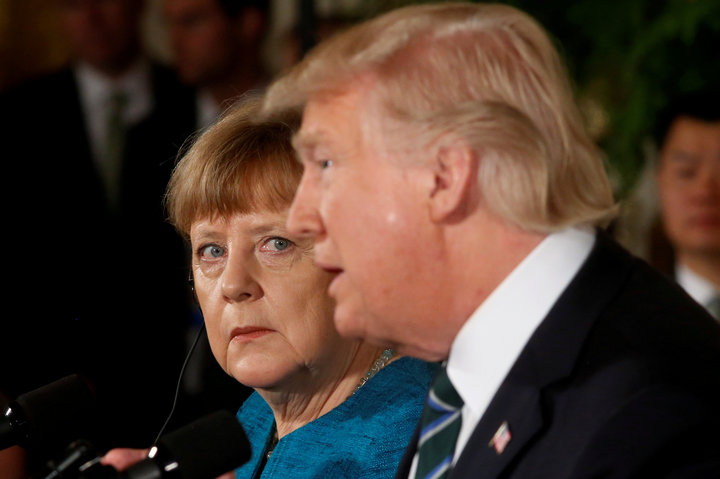
President Donald Trump is incurious, ignorant, and ill-informed. He hides this with rudeness, bluster, and lies. As an anonymous German Foreign Ministry official said during Chancellor Merkel’s visit, Trump “uses rudeness to compensate for his weakness.”
Trump couldn’t hold his own with a brilliant woman of substance like Angela Merkel, so he changed the narrative. He accused Germany of not paying up with NATO; he said Obama wiretapped Merkel, just like he tapped Trump tower; he whined about unfair trade with Germany. In public, Trump showed little substance and no sophistication.
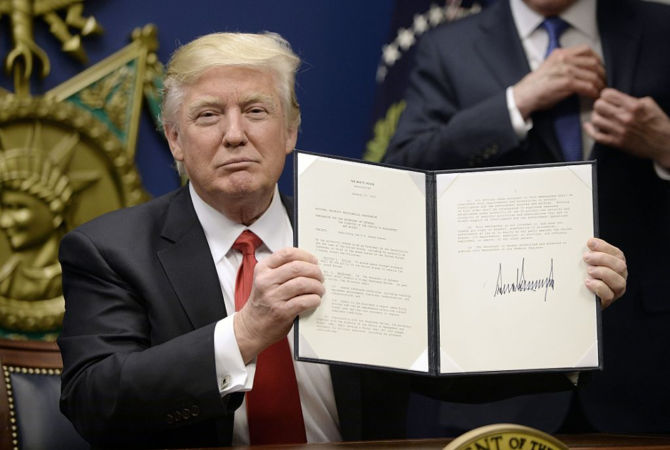
It’s not that Trump can’t learn; he doesn’t want to. He’s happy watching Fox News or movies like “Finding Dory,” golfing at his expensive resorts, signing executive orders and holding them aloft like a proud second-grader (Look Ma! I can sign my name!), and holding rabble-rousing rallies (“Lock her up!”) and basking in applause.
Trump operates in the shallows. His experience is in high-priced real-estate and media. He’s best at hyping a certain image of himself. He’s a bull-shitter, and he’s had lots of practice.
A big part of the presidency is ceremonial: the U.S. president is king and prime minister all in one. Trump is failing at both jobs. As a symbol of America, he’s boorish, boastful, and bullying. As a prime minister, he’s incurious, ignorant, and vain.
Five examples: Candidate Trump knew nothing about America’s nuclear triad. He didn’t know it consists of SLBMs (on Trident submarines), ICBMs (land-based), and “air-breathing” bombers. All he “knew” is that allegedly the U.S. nuclear arsenal is obsolete and inferior to the Russian arsenal. But actually the U.S. arsenal is more accurate, more survivable, and far superior to that of any other country, including Russia.
Second example. According to Trump, before he came along, nobody knew how complicated health care could be. We owe that stunning insight to Trump. Third example. According to Trump, Germany owes vast sums of money to the U.S. for defense costs, a false claim rejected by the Germans.
Fourth example: Based on a false Fox News report, Trump accused the previous president of committing a felony by tapping his phones during the campaign season, a charge for which there is no evidence whatsoever. Yet Trump refuses to rescind the charge, despite its repudiation by the FBI, NSA, British intelligence, and his own party.
Fifth example: Trump refuses to admit his Muslim ban is, well, a Muslim ban. Yet the ban refuses to target the one country that supplied 15 out of the 19 hijackers on 9/11: Saudi Arabia. Most experts agree that Trump’s ban is unconstitutional and counterproductive in the war on terror.
Being Trump means never having to say you’re sorry. In his unapologetic blustering, Trump echoes the foreign leader he seems to admire most: Vladimir Putin. In Putin’s Russia, with its history of Tsars and other strong leaders, uncompromising firmness and unyielding certitude are expected if not always applauded. In democratic America, an ability to compromise and a willingness to yield on matters of fact are generally seen as signs of adult leadership by statesmen who serve the people rather than themselves.
Trump’s behavior is better suited to that of Tsars and other anti-democratic strongmen. Trump the incurious has surrounded himself with loyalists, family members like his daughter Ivanka and her husband Jared Kushner, and commissars who watch over his cabinet appointees to ensure their loyalty. Pettiness, paranoia, and score-settling characterize the Executive branch.
Trump often harkens back to World War II and the likes of Generals Patton and MacArthur. How does he compare to the president back then? Franklin D. Roosevelt had a global view of the world while exhibiting a mastery of detail. (So too did Winston Churchill.) Self-confident, FDR looked for no-men, not yes-men. He and his administration took pains to be inclusive and bipartisan. And FDR, with help from Allies like Churchill and Stalin, won World War II.
By comparison, Trump has a parochial view of the world and can’t even master himself (witness those temper-driven tweets). He hires yes-men and demonizes Democrats and indeed anyone he sees as against him. Alienating allies like Britain, Australia, and Germany, Trump seems least critical of Russia.
Some leaders surprise: they grow in office. But Trump’s smugness, his unwillingness to admit when he’s wrong, his showboating to hide uncomfortable truths, are stunting him. Effective at selling himself and entertaining as a blowhard on (un)reality TV, Trump is failing as a statesman.
Rather than grow, it’s likely Trump will wither in office. The problem is he won’t be alone in his decline and fall.
Update: To state the obvious, Trumpcare is not a health care plan: it’s a massive tax cut for the rich combined with a cut in services for the working classes and poor. Under this “plan,” the CBO estimates that 14 million will initially lose coverage, rising by another 10 million in the next decade. How is this a health care plan? Add cynicism and broken promises to Trump’s qualities.
Update (3/25): As Heather Digby Parton puts it, Trump “truly believes that he’s never ever been wrong about anything and when he lies he’s actually telling the future. He said it over and over again in that astonishing interview [for Time Magazine].”
Matt Taibbi, in his inimitable style, captured Trump during the election season: “On the primary trail we had never seen anything like him: impulsive, lewd, grandiose, disgusting, horrible, narcissistic and dangerous, but also usually unscripted and 10 seconds ahead of the news cycle … maybe he was on the level, birthing a weird new rightist/populist movement, a cross of Huey Long, Pinochet and David Hasselhoff. He was probably a monster, but whatever he was, he was original.” (Insane Clown President, pg. 221)
Throwing money at the Pentagon is never a good idea
W.J. Astore
Anyone who’s been in the military knows what happens as the end of a fiscal year approaches: wild spending. Any money that’s left in your budget must be spent, if only to justify next year’s budgetary appropriation. Woe to any unit with leftover money! Not only is there no incentive to economize at the Pentagon: there’s a negative incentive to save money, and a positive one to spend as much as possible within your yearly allotment, while complaining to anyone within earshot that you never have enough.
Trump has already promised to enlarge Pentagon funding by 10% next year, or roughly $54 billion. According to Mick Mulvaney, director of the Office of Management and Budget, Trump’s budget is all about “hard-power,” a signal to “our allies and our potential adversaries that this is a strong-power administration.” At $54 billion, that is indeed a very expensive signal.
Forget about the global fight against ISIS: The big focus at the Pentagon is now going to be on spending that windfall of taxpayers’ dollars. And, unlike the ISIS fight, which is expected to last for at least another generation, the “fight” to spend lots of money quickly is one that the Pentagon will surely win. Believe me, the military-industrial-Congressional complex knows how to spend.
Want to make the Pentagon a better, more effective, place? Cut its budget by 10%. And keep cutting, year by year, while downsizing its mission. Force it to economize – force it to think.
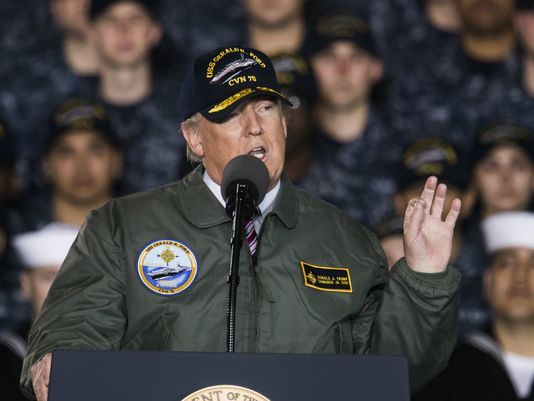
Let me give you a few examples. How does the stealthy, super-expensive, F-35 jet fighter contribute to the war on terror? It doesn’t. Does the U.S. Navy really need more super-expensive aircraft carriers? No, it doesn’t. Do U.S. nuclear forces really need to be modernized and expanded at a cost of nearly a trillion dollars over the next few decades? No, they don’t. More F-35s, more carriers, and more nukes are not going “to make America great again.” What they will do is consume enormous amounts of money for little real gain.
Throwing cash at the Pentagon is not the way to greater security: it’s a guarantee of frivolous military wish lists and “more of the same, only more” thinking. In case you haven’t noticed, the Pentagon’s record since 9/11/2001 is more than a little mixed; some would say it’s been piss-poor. Why is this? One thing is certain: shortage of money hasn’t been the problem.
Want to send a signal about “hard-power,” President Trump? Go hard on the Pentagon by cutting its budget. Spend the savings on alternative energy development and similar investments in American infrastructure. That’s the best way to put America first.
Yesterday’s Trump-Merkel Press Conference was disturbing on several levels. Worst of all was the scene of a German Chancellor listening to an American president boast about how strong his military is, and how much stronger it soon will be. Not that long ago in historical terms, Germany was a country that stressed military dominance. Two lost world wars cured Germany of its militarism. American militarism has taken its place.
As Trump responded to questions, again and again he returned to the U.S. military, vowing that he’s going to strengthen it from its “depleted” condition, perhaps to a level of power that “we’ve never seen before.”
America as a country is “very strong, very strong,” said Trump, a “very powerful company/country,” and soon the U.S. military would be “stronger,” and “perhaps far stronger than ever before.” Naturally, the president added that he hoped he wouldn’t have to use that “far stronger” military, even as the U.S. military garrisons the globe at more than 700 bases while launching ongoing attacks against “radical Islamic terrorism” (Trump loves enunciating those three words) in places like Yemen.
She’s right to be worried …
This coming year, Trump is enlarging the military with a fresh influx of $54 billion. “My generals,” as Trump likes to refer to James Mattis and John Kelly and Company, support him in part because he’s boosting military spending. But will they continue to support Trump and his advisers like Steve Bannon when the President uses that “much stronger” military in unwise ways?
When you forge a bigger hammer, you tend not to leave it unused in the tool shed. No — you look for bigger nails to strike. As Trump noted at the press conference, he’s not an isolationist. “Fake news,” he said.
That Trump, with his “far stronger” military, is not an isolationist is disturbing “real” news indeed. Small wonder that the German Chancellor looked discomfited; her country has seen it all before.
What price military dominance? Perhaps Chancellor Merkel could explain that to President Trump, if only he’d listen.
Is Donald Trump going to be yet another American war president? Come to think of it, is there any other kind?
This is no accident. Tom Engelhardt has an insightful article at TomDispatch today about how Trump the blowhard is a product of blowback from America’s failed wars, notably Iraq. There’s much truth in this insight, since it’s hard to imagine demagogue Trump’s rise to power in a pacific climate. Trump arose in a climate of fear: fear of the Other, especially of the terrorist variety, but also of any group that can be marginalized and vilified. Think of Mexicans and the infamous Wall, for example.
In a separate post, Engelhardt noted the recent death of Marilyn Young, an historian who found herself specializing in America’s wars, notably Vietnam. He cited a New York Timesobituary on Young that highlighted her attentiveness to America’s wars and their continuity.
Since her childhood, Young noted, America had been at war: “the wars were not really limited and were never cold and in many places have not ended — in Latin America, in Africa, in East, South and Southeast Asia.”
She confessed that:
“I find that I have spent most of my life as a teacher and scholar thinking and writing about war. I moved from war to war, from the War of 1898 and U.S. participation in the Boxer Expedition and the Chinese civil war, to the Vietnam War, back to the Korean War, then further back to World War II and forward to the wars of the 20th and early 21st centuries.”
“Initially, I wrote about all these as if war and peace were discrete: prewar, war, peace or postwar,” she said. “Over time, this progression of wars has looked to me less like a progression than a continuation: as if between one war and the next, the country was on hold.”
As George Orwell wrote in 1984, all that matters is for a state of war to exist (whether declared or, nowadays in the USA, undeclared). A war mentality is the driver for autocratic excesses of all sorts. It serves to focus the attention of people to various perceived enemies, whether from without or from within. It promotes simplified thinking and generates fear, and fear is the mind-killer. “Us and Them,” as Pink Floyd sang.
Aggravating simplistic and hateful “us and them” thinking in the USA is the lack of a major political party dedicated to peace. In the USA, we have two war parties. Trump knew this and readily exploited (and continues to exploit) it. He knows the modern Democratic Party won’t seriously challenge the war rhetoric that drove and drives America’s new militarized reality.
Why? Because the Democrats nurtured it. Recall that in 2004 John Kerry “reported for duty” by saluting the Democratic National Convention. Barack Obama in 2008 quickly morphed from a “hope and change” liberal to a drone-wielding assassin-in-chief while pursuing his “good” war in Afghanistan. Hillary Clinton in 2016 proudly embraced Henry Kissinger and projected a harsh exterior as a hardheaded hawk. “We came, we saw, he died,” she famously chuckled about Libya and the death of Qaddafi. Even Bernie Sanders, with all his dreams, said little about cutting the Pentagon’s budget.
You can go back further and tag other recent Democratic presidents, such as LBJ during the Vietnam War or JFK during the Cuban Missile Crisis. Candidate Kennedy wantonly exaggerated the “missile gap” in nuclear capability between the US and USSR (JFK had it backwards; it was the US that had clear superiority). Jimmy Carter took a different approach, but he too soon learned his lesson, ordering a huge military buildup (overseen by the Reagan Administration) and declaring the “Carter Doctrine” to safeguard Persian Gulf oil supplies as a vital US interest. That policy contributed in its own way to America’s recent disasters in the Greater Middle East.
Did Jimmy Carter, then, lead to Donald Trump? Indirectly, yes. America’s insatiable hunger for global resources (especially oil) and its desire for global power bred the conditions under which blowback came to America’s shores. Blowback helped to generate the fear and confused desires for revenge that Trump tapped with great success in his campaign.
Today, America’s state of incessant warfare is consuming its democracy, yet President Trump’s answer is to call for more military spending, more violent attacks overseas, and more walls at home, all in a vain quest to “win” again. Small wonder then that he’s ramping up military spending while ordering more attacks.
Trump knows what got him to the Oval Office, and it wasn’t his keen intelligence or gentlemanly charm or skill at diplomacy. Recall that his favorite generals, George Patton and Douglas MacArthur, were all about “winning” even as they both wanted to wage the wrong wars (Patton was ready to take on the Soviets in 1945; MacArthur wanted to cross the Yalu River and invade China during the Korean War).
Will Trump, like his favorite World War II generals, seek to wage the wrong wars? Will he recognize that fighting the wrong war is a loss even when you “win”? Does he want to be a “war president,” and, if so, who will stop him?
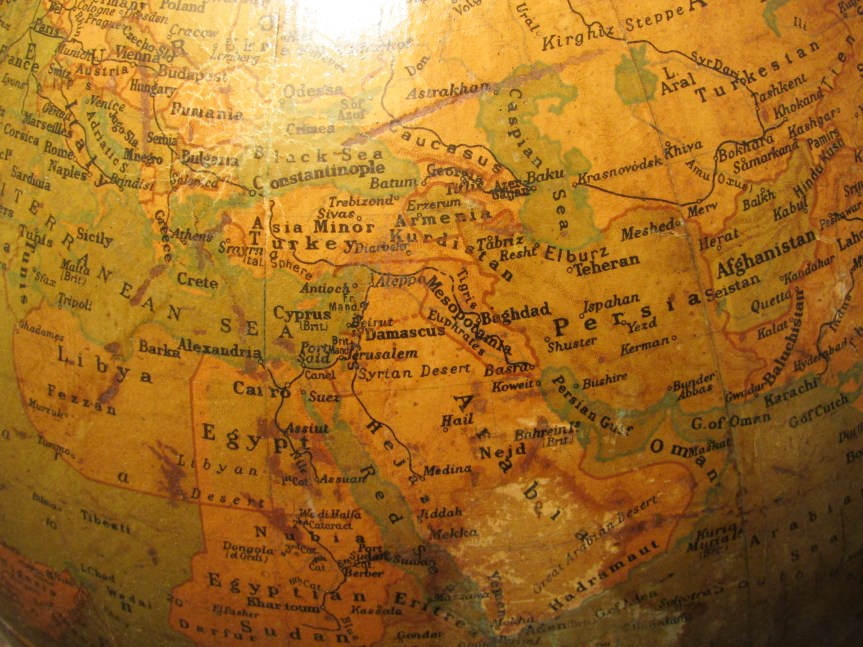
I bought a new (used) globe today to add to my humble collection, which called to mind this article that was inspired by my old globe from c.1924. Globes often don’t have dates on them, since those dates would remind you of their obsolescence, especially in these days of rapid change. Still, as a historian I have a keen interest in old globes. I’d love to have one that shows the height of Napoleon’s Empire, say in 1810, before it all came crashing down.
Nowadays, with GPS and Smart phones and all that, we take globes for granted. I’ve sometimes thought if you could take one thing of value back into the past, let’s say 500 years ago, would there be anything more valuable than an accurate globe? An interesting question to ponder …
How about a contrary perspective on the Middle East, courtesy of my old globe? It dates from the early 1920s, just after World War I but before Russia became the Soviet Union. Taking a close look at the Middle East (a geographic term that I use loosely), you’ll notice more than a few differences from today’s maps and globes:
Iraq and Syria don’t exist. Neither does Israel. Today’s Iran is yesterday’s Persia, of course.
Instead of Iraq and Syria, we have Mesopotamia, a name that resonates history, part of the Fertile Crescent that encompassed the Tigris and Euphrates Rivers as well as the Nile in Egypt. Six thousand years ago, the cradle of human civilization, and now more often the scene of devastation caused mainly by endless war.
Ah, Kurdistan! The Kurds today in northern Iraq and southern Turkey would love to have their own homeland. Naturally, the…
Whether you call it Trumpcare or Ryancare or They-Don’t-Care, the new Republican health care plan is not about providing more care or coverage: It’s about providing a huge tax cut for the rich, while cutting coverage and care for the poor and vulnerable.
About four years ago, I wrote this article on our flawed approach to health care. Instead of using our national wealth to promote national health, we do our level best to turn health care into a for-profit system driven by market priorities. Long ago, health care became a political football to be tossed about and fought over by the heaviest hitters. The weak and the infirm? You can find them, crushed on the field of “play.”
Sadly, a motto I first saw on a bumper sticker still rings true: “Our national health care plan? Don’t get sick.”
Americans generally, and politicians in particular, proudly proclaim that we live in “the greatest” country. But how should we measure the greatness of a country? I’d suggest that quality of life should be a vitally important measure.
And what is more fundamental to quality of life than ready access to health care? When you’re sick or suffering, you should be able to see a medical specialist. And those costs should be — wait for it — free to you. Because health care is a fundamental human right that transcends money. Put succinctly, the common health is the commonwealth. And we should use the common wealth to pay for the common health.
Here’s the truth: We all face the reality of confiscatory taxation. If you’re like me, you pay all sorts of taxes. Federal, state, and local income taxes. Property taxes. School taxes. Social…
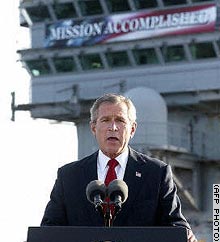
Donald Trump and Kellyanne Conway didn’t invent alternative facts. The U.S. government has been peddling those for decades. Consider the recent history of the Iraq War. Recall that in 2002 it was a “slam dunk” case that Iraq had active programs to develop weapons of mass destruction (WMD). (We couldn’t allow the smoking gun to become a mushroom cloud, said Condoleezza Rice.) In 2003, President George W. Bush landed on an aircraft carrier and declared that major combat operations were over in Iraq – mission accomplished! And in 2007, the “surge” orchestrated by General David Petraeus was sold as snatching victory from the jaws of defeat in Iraq. All of those are “alternative facts.” All were contradicted by the facts on the ground.
Nowadays, most people admit Iraq had no active WMD programs in 2002 and that the mission wasn’t accomplished in 2003, but the success of the surge in 2007 is still being sold as truth, notes Danny Sjursen at TomDispatch.com. Sjursen, who participated in the surge as a young Army lieutenant, notes that it did succeed in temporarily reducing sectarian violence in Iraq, but that was precisely the problem: it was temporary. The surge was supposed to allow space for a stable and representative Iraqi government to emerge, but that never happened.
A short-term tactical success, the surge was a strategic failure in the long-term. Partly this was because long-term success was never in American hands to achieve, and it certainly wasn’t attainable by U.S. military action alone. In sum, the blood and treasure spilled in Iraq was for naught. But that harsh truth hasn’t stopped the surge from becoming a myth of U.S. military triumph, one that led to another unsuccessful surge, this time in Afghanistan in 2009-10, also conducted by General Petraeus.
These surges sustain an alternative fact that the U.S. military can “win” messy insurgencies and sectarian/ethnic wars, whether in Iraq or Afghanistan or Libya or Yemen or elsewhere. They contribute to hubris and the idea we can remake the world by using our military, a belief that President Trump and his bevy of generals (all veterans of Iraq and Afghanistan) seem to share and want to put into practice again. This time, they promise to get it right.
The President and the Pentagon are currently considering sending several thousand more troops to Afghanistan. This mini-surge is being advertised as America’s best chance of defeating terrorists in the AfPak region. Even though previous, and much bigger, surges in Iraq and Afghanistan were failures, the alternative fact narrative of “successful” surges remains compelling, even authoritative, among U.S. national security experts. They may grudgingly admit that, yes, those previous surges weren’t quite perfect, but we’ve learned from those – promise!
Prepare for more troop deployments and more surges, America. And for more “victories” as alternative facts, as in lies.



 Guess What? There’s Only One Earth
  Keeping American TV “safe” since 1975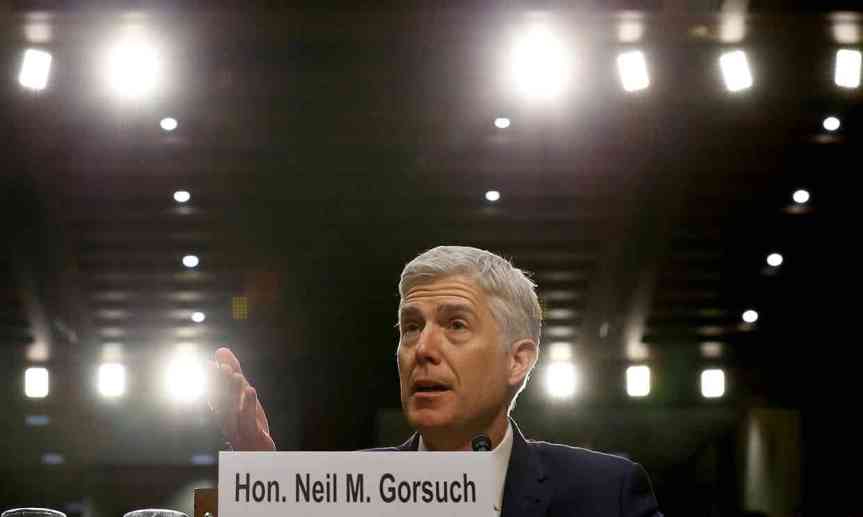

 W.J. Astore