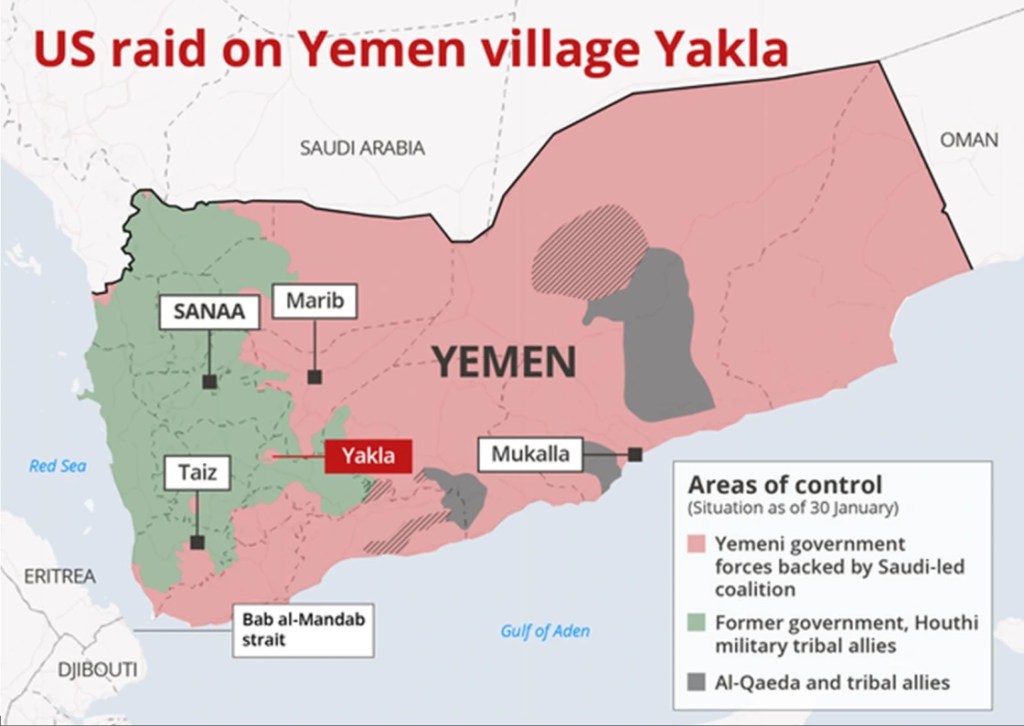
Map of Yemen from 2017 that shows the site of the botched SEAL Team raid at Yakla
W.J. Astore
I haven’t followed the Saudi war in Yemen that closely. But I’d wager most Americans know far less about it than I do. I know the U.S. has been supporting Saudi Arabia in its bloody repression of Iranian-backed Yemeni forces (the Houthis), providing critical resources such as aerial refueling, intelligence sharing, and, most importantly, an endless supply of weaponry. I know this support has been couched as consistent with a “war on terror,” when it’s driven much more by the U.S. need to appease Saudi rulers for economic reasons (primarily the petrodollar and oil exports). I know the Yemeni people have suffered greatly due to famine and diseases exacerbated by constant warfare and economic blockades. I know Joe Biden campaigned against the war and criticized Saudi officials but as president has done nothing to stop it. And I know a bipartisan force in Congress is trying to take steps to end America’s involvement in what essentially constitutes a genocide against the Yemeni people.
Occasionally, Yemen has appeared in my articles here, as with the SEAL Team fiasco launched by President Trump in late January 2017. (One Navy SEAL died in the raid; his father later accused the Trump administration of hiding behind the death of his son instead of admitting the raid had been a murderous failure.) In passing, I’ve mentioned Yemen in a few articles like this one, but again it’s not something I’ve written about in detail. I’ve been focused on the Afghan war, the military-industrial complex, the new Cold War, plans to build a new generation of nuclear weapons, and on and on.
Fortunately, a freelance journalist based in Yemen, Naseh Shaker, contacted me with a few questions that got me thinking a bit more about Yemen and the U.S. government’s role there. His article addresses whether Congress has any chance of invoking the War Powers Act to limit or end America’s involvement in this brutal war, given the reality that President Biden is once again courting and kowtowing to the Saudis. You can read his article here, which includes a few comments by me, but it may be useful to include his original questions to me, and my responses to them. He asked me to keep my responses short, 2-3 sentences, which I did:
Questions by Naseh Shaker
1- Why the US is sanctioning Russia for invading Ukraine but when it comes to the Saudi invasion of Yemen, the US is providing the Saudis with all logistics and weapons as if it is the American war, not the Saudi war?
2- Why Biden doesn’t fulfill his promise to end the war in Yemen?
3- Is invoking the War Powers Resolution (WPR) an attempt from Democrats to cover Biden’s scandal of not ending the war in Yemen as he promised?
4- If WPR is passed, does it mean the US is responsible for Saudi war crimes in Yemen given that it is providing the coalition “intelligence sharing” and “logistical support for offensive Saudi-led coalition strikes”?
Answers by William Astore
Question 1: The US sees Russia as a rival and an enemy. The US sees Saudi Arabia as an ally and a friend. Put differently, the US economy owes much to the petrodollar and the Saudi appetite for expensive American-made weaponry.
Question 2: Because he doesn’t really care about the Yemeni people. He cares about maintaining good relations with the Saudis.
Question 3: Unclear. But I don’t think Democrats consider it a “scandal” that Biden failed to keep his promise. There are many other promises Biden failed to keep, such as a $15 federal minimum wage for Americans, and these failed promises are not treated as “scandals.”
Question 4: The US government refuses to take responsibility for its own war crimes, so it certainly isn’t going to admit to responsibility or culpability for Saudi crimes.
Ignorance is a major enemy in the USA. We owe it to ourselves as citizens (and to what’s left of our democracy) to inform ourselves about what our government is up to, especially when what it’s up to is killing, whether directly or indirectly, untold numbers of people around the world.
The war in Yemen has killed at least 377,000 people. To what end? For what purpose? How is aiding the Saudis in this war remotely related to the defense of our country?
End the killing. End the wars. Let’s do something right for a change.
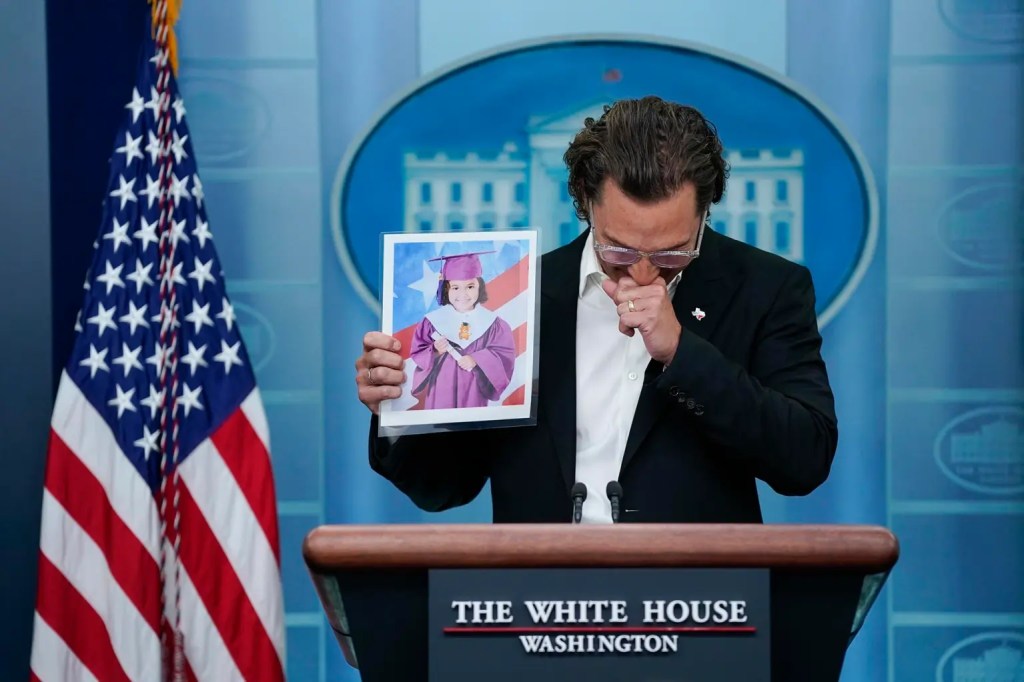
Matthew McConaughey holds a photo of Alithia Ramirez, 10, killed in the Uvalde mass shooting
W.J. Astore
The bottom line on gun laws in the USA is, surprise, profit. What matters most is not banning any guns, including military-style assault weapons. There are already more than 20 million AR-15-type assault weapons in the hands of Americans, with more being sold legally every day. They and their related gear (ammo, ammo magazines, and so on) are a big source of profit to American gun makers and gun sellers, so you can be sure that those guns will be protected, unlike the victims of them.
To illustrate this, two stories popped up in my email today. The first, from CNN, is a quick summary of where we stand on gun control measures in Congress:
The current changes to gun laws under consideration include hardening school security, providing more funding for mental health care and ensuring that juvenile records can be considered when a person between the ages of 18 and 21 wants to buy a semi-automatic weapon. Federal incentives for states to pass so-called red flag laws are also being discussed. However, despite the ongoing talks, it remains unclear whether there will be enough Republican support to push the legislation forward.
Note that Orwellian term: the “hardening” of school security. Schools are now being talked about in military terms as “soft” targets for mass shooters. Naturally, the solution isn’t to deny shooters their assault weapons. No: let’s turn every school into a “hardened” fortress, with more fences, cameras, locking doors, and armed guards (perhaps with AR-15s?). How long before our schools are indistinguishable from our prisons?
You’ll note, of course, that none of the “new” gun laws being considered by Congress will reduce the number of guns in circulation. Gun sales will continue to soar. When you think about it, guns now have more rights in America than people do.
The second story involves a Hollywood celebrity, Matthew McConaughey, who was born in Uvalde, Texas, and who’s been working with the Biden administration in the cause of “responsible” gun control. He’s called for “universal background checks, raising the minimum age for purchasing an AR-15 to 21, a waiting period for purchasing AR-15s and the implementation of red flag laws.” These steps are better than nothing, but again they will not impact the profit margins of gun makers/sellers. Even so, they are likely to be judged too radical by Republicans in Congress.
President Biden has called for a ban on new assault weapons, but it’s simply empty words. He knows a ban stands no chance of getting through Congress. If the Democrats really wanted to accomplish something, they’d get rid of the filibuster in the Senate, but they’re not about to do that, especially since they’re likely to lose control of the Senate after the November elections.
Speaking of Joe Biden, I saw this hilarious headline at NBC News today: “Biden’s gaffes might actually be his selling point.” The gist of the op-ed is that Biden often misspeaks and sounds both angry and confused, but these qualities make him “authentic” to voters, therefore “let Biden be Biden” and don’t try to handle or edit him.
That’s where we’re at as a country. Guns have more rights than people and our president is to be embraced for all the gaffes he makes. What a country!
My esteemed colleague Davout and I have different ways of looking at the Russia-Ukraine War. We thought it would be a worthwhile exercise to share our differing perspectives here, allowing our readers to think over the merits of our approaches and the validity of our conclusions. Davout has framed the questions and made the initial response; I get the last word, so to speak, for each question. Our mutual intent is not to “win” a pseudo-debate but to pose questions and provide answers that inform and stimulate. To that end, here we go.
What caused the Russian invasion of Ukraine?
Davout: Putin’s desire to reestablish Russian hegemony over Eastern Europe and ensure the stability of his autocratic regime has been the main driver of the invasion. In 2005, Putin declared that the collapse of the Soviet Union was “the greatest geopolitical catastrophe of the century.” What was catastrophic about it for Putin? The eastern flank of the former Soviet Union, including Latvia, Lithuania, Estonia, Moldova, and Ukraine shifted from being an appendage of an authoritarian Soviet regime to being a collection of independent democracies or democracies-in-process. Membership in the European Union and in NATO has either been achieved (the Baltic states) or been pursued (Ukraine pursuing both, Moldova pursuing European Union membership only). None of these countries (not to mention the formerly occupied countries of Poland, Hungary, East Germany, Czechoslovakia) singly or together have the capacity or will to invade Russia or otherwise project military power across Russian borders. The real threat to which Putin is responding is the example set by the people of former Soviet territories opting for more democratic, less corrupt regimes and societies. That example endangers his own hold on power and pushes his own society toward historical irrelevance.
Astore: Putin was obviously the prime mover of the invasion. He chose the military option, and he surely believed it would strengthen his authority over a former Soviet republic that was tracking toward joining NATO.
When we speak of causes, however, it’s often wise to take a broad view over a breadth of time. When the Soviet Union collapsed in 1991, NATO’s reason for being ended with it. Nevertheless, NATO persisted, expanding to the very borders of Russia despite assurances to Russian leaders that the alliance would not expand eastwards beyond a newly unified Germany. Russian leaders, including Putin, had issued clear warnings that NATO expansion into Ukraine would constitute a “red line,” the crossing of which would likely lead to a military response. Putin’s decision to invade, therefore, was eminently predictable, thus it was also potentially preventable. The United States, which leads NATO, could have sent a clear signal to Russia that Ukraine should and would remain a neutral buffer state. The US chose not to do so.
One may question the premise of Ukraine as a “more democratic, less corrupt regime.” In Ukraine, corruption is endemic, exacerbated by extensive U.S. meddling, as in the notorious coup of 2014 orchestrated in part by Victoria Nuland, citing the support of then-Vice President Joe Biden. And while it’s important to recognize Russian regional hegemonic ambitions, one should never forget the global hegemonic ambitions of the U.S. empire. In sum, the US has not been an innocent bystander here.
US proxy war or Ukrainian war of independence?
Davout: A proxy war is a conflict instigated by a state in which it does not directly engage in hostilities. This war was a war of choice on the part of Putin. It has had the unintended result of inspiring patriotic resistance (even amongst Russian-speaking Ukrainians who were formerly pro-Russian like the mayor of Odessa). In the lead up to the invasion, the US and its NATO allies attempted to dissuade Putin from invading. In the invasion’s aftermath, they have provided critical arms and support to Ukraine and have sought economically to undermine Russia’s war-making capacities. While current official US policy may be the crippling of Russia’s capacity to engage in another such invasion in the near future, the US did not instigate this war in pursuit of this aim. While US and NATO armaments are a necessary factor in Ukraine’s continued defense against the Russian invasion, it is Ukrainian solidarity and resolve and Russian refusal to end its invasion that keep this war going.
Astore: Clearly, most Ukrainians believe they are fighting for their independence. Ukraine has no desire to become a Putin puppet state. Nor, however, do they wish to become a puppet state to the USA.
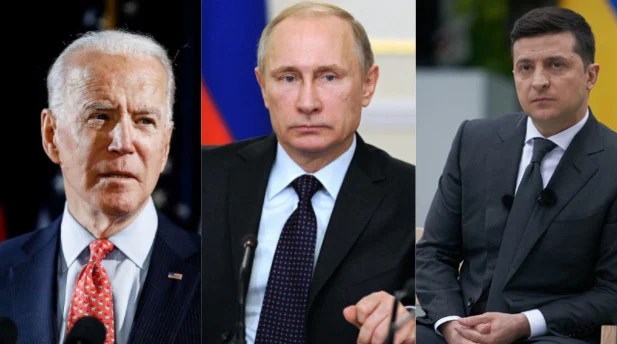
Lloyd Austin, the US Secretary of Defense, spoke clearly that weakening Russia was a key goal of this conflict. To that end, the US government, in a rare show of bipartisan unity, provided $54 billion in largely military aid to a Ukrainian military with a yearly budget of $6 billion. Such profligacy is not an example of generosity driven by disinterested ideals. Clearly, the US sees this war as the latest front in a new cold war, a way to stress Russia to the breaking point. As President Biden openly stated, that man (Putin) must go.
So, it’s worse than a proxy war: it’s yet another US regime-change war. The stated goal is to topple Putin and turn Russia into a divided and dysfunctional state, much like it was in the 1990s when Western corporations and financial institutions invaded Russia and exploited it in the name of capitalism and reform.
Are there any legitimate parallels to draw between Putin and Hitler?
Davout: Yes, though the parallels with Hitler are not the same parallels so often drawn to delegitimize non-interventionists as appeasers. Historian John Lukacs’s various histories of Hitler’s strategizing in that crucial period after the invasion of France to the start of the Battle of Britain paint a picture of Hitler less as the hubristic dictator irrationally striving for world conquest than as a canny but flawed geopolitical strategist, driven by geopolitical grievance and with a large capacity to hate those who opposed him. Lukacs argues that Hitler was prepared to cut a deal with Great Britain on terms that would allow Germany to exercise hegemonic powers on the continent. It was Churchill’s longstanding aversion to Hitler and Hitlerism and his ability to maintain British popular support for the war that blocked Hitler’s strategy to cut a deal. Once his overture was blocked by Churchill, Hitler underestimated British morale in the Battle of Britain. Then, in an effort to circumvent Britain’s resistance, Hitler gambled that he could cripple Stalin’s war making capacity and knock him out of the war and thereby present England with a fait accompli of German hegemony on the continent. The picture of Hitler Lukacs draws can plausibly be applied to Putin—a grievance-driven leader attempting to restore a lost geopolitical sphere of influence, who has miscalculated the resolve of democratic leaders and peoples and has doubled down on violence.
Astore: In a word, no.
Whenever American leaders want to justify military action and high spending on weaponry, they turn to Hitler and World War II. The claim is made that we must stop the “new” Hitler. We must not be appeasers. Saddam Hussein was allegedly the new Hitler in 2003; his WMD was supposed to be a mushroom cloud on our horizon. But there was no WMD and eliminating Saddam by invasion tipped Iraq into a disastrous civil war from which that country has yet to recover.
Putin isn’t the new Hitler, and his invasion of Ukraine doesn’t represent the kind of existential threat the Third Reich presented to democracies in 1938-39.
Hitler had the finest military machine of his day backed by the economic powerhouse that was Germany in the late 1930s. Putin’s military machine is mediocre at best, and Russia’s economy is smaller than that of California. Putin doesn’t appear to be seeking a huge empire or world domination, as Hitler was. And while Hitler may have temporarily played nice with Britain, that didn’t prevent the Nazis from hatching plans to invade and loot Britain and to massacre its Jews as well.
Of course, Putin was wrong to have invaded Ukraine, but George W. Bush was wrong to have invaded Iraq in 2003. Both these leaders have essentially nothing in common with Hitler, who was sui generis–a tyrannical dictator driven by genocidal fantasies of world dominance by a “master race.”
To what extent is US democracy hurt or helped by the Biden Administration’s policy of military support for Ukrainian resistance?
Davout: Seeing his country in hostile competition with western democracies, Putin has deployed various forms of soft power and hard power to undermine confidence in, and injure the working of, democratic regimes. Hackers and internet influencers employed by the Russian state have intervened in the elections of established democracies either to foster social distrust or to promote candidates (e.g., Trump) and policies (e.g., Brexit) that weaken adversary countries. Military interventions are carried out on Russia’s border to maintain regimes favorable to Putin (as was the case when a popular uprising against fraudulent elections in Belarus was put down with the help of Russian soldiers). Meanwhile, as was documented by the Panama and Pandora Papers, the huge amounts of money pilfered from the Russian people by oligarchs moves through the banking, legal, and commercial institutions of democratic countries (including South Dakota!) with corrupting effect on people and officials alike. To be sure, the US has corruption problems of its own. And US military support of Ukraine will have the unfortunate result of strengthening the position of defense contractors and their lobbyists, Pentagon brass, and congressional hawks. However, it would be worst for US democracy if Russian ambitions to occupy or dismember Ukraine succeed. This would undermine European democracies whose continued survival and flourishing provide democratic reformers in the US with critically important role models and partners.
Astore: US democracy hasn’t been hurt or helped by this war because the US is a democracy in name only.
In reality, the US is an oligarchy in which the rich and powerful rule at the expense of the many. The unofficial fourth branch of government is the US National Security State, a leviathan of enormous power. Its biggest component is what President Dwight D. Eisenhower in 1961 termed the military-industrial complex (to which he added Congress as well). This MICC is profiting greatly from this war, not only in the $54 billion in aid provided to Ukraine, but also in the ever-rising Pentagon budget for FY 2023, which will exceed $813 billion, a gargantuan sum justified in part by the Russia-Ukraine War.
The new cold war with Russia, and increasingly with China as well, is strengthening the state of permanent war in America. As James Madison warned, permanent warfare serves autocracy while insidiously destroying democracy. As militarism becomes more deeply entrenched in the US government, and as that same government continues to send more destructive weaponry to Ukraine such as artillery and missile systems, options for de-escalation narrow even as chances for a nightmarish escalation to nuclear war, whether by design or accident, increase.
What would truly strengthen democracy in America, assuming it could somehow be reanimated, is if the USA pressed ahead with all its strength to broker a peace treaty between Russia and Ukraine. Ukraine is getting wrecked by this war, and our aggressive actions, mainly in providing more and more lethal weaponry together with onerous sanctions, are guaranteed to shred more bodies and aggravate economic dislocation both here and in Europe.
Readers, what are your thoughts here?
Coda by M. Davout (6/6/22)
W. J. Astore has asked me to compose a “coda” of sorts, in which I might add some concluding reflections about the commentary provoked by our different views on the war in Ukraine.
Yes, there is a relevant pre-2022 history to the current conflict—decades old promises from US officials to Russian officials about not expanding NATO east of the Oder, a popular pro-West Ukrainian uprising (supported by Western intelligence agencies, some have plausibly argued) against a Ukrainian administration’s decision to reject closer ties with the European Union (as was the will of the Ukrainian parliament) in favor of the Ukrainian president’s decision to push the country toward closer ties with Russia, a counter-uprising in the Donbas that drew Russian political and military support, etc. But there is also the fact of a full-scale military invasion against a country that posed little if any military threat to Russian borders, a military invasion that has led to the needless deaths of tens of thousands of civilians and combatants and the uprooting of millions of Ukrainians.
It is undeniable that the invasion has promoted patriotic solidarity among different language speakers within Ukraine against the invasion, including Russian speaking Ukrainians whose rights Putin’s invasion was presumably intended to defend. It is also undeniable that voter support for Ukraine’s resistance to the invasion is very high in Eastern European countries. More noteworthy is the fact that in Western European countries, governments have been forced to respond to the pro-Ukrainian sentiments of their voters by sending arms to Ukraine and destroying longstanding economic relationships with Russia to the financial detriment of both European businesses and consumers.
So the situation is nowhere near as neat or clear as either my contributions or Astore’s contributions or the contributions of the majority of the commentators would have it be. In this regard, the comments of Denise Donaldson strike me as the most interesting. You can tell that she can see the issue from both sides and is struggling with that ambiguity.
That is the place to be on the Ukraine war, I think: struggling with ambiguity. There is no clearly right answer: the war is not solely a product of American empire, nor is it solely a product of Russian empire. And there are no good outcomes, only bad or worse outcomes.
But, in politics, one has to make choices and, for now, I choose align myself with current US and NATO policy. Not because I am a dupe of the mainstream media or a supporter of the Establishment or the MIC (my earlier posts on this website should put those notions to rest) but because I believe the expulsion of the Russian military from the Ukrainian lands it currently occupies (maybe including Crimea, maybe not) is both possible and more likely to lead to a lasting peace in eastern Europe. And my taking that position does not mean that I do not also see some merit in the points my esteemed colleague WJ Astore (and his many followers) make.
Response by Astore (6/6/22)
I would like to thank M. Davout for his reasoned response and for continuing this important discussion. One thing I can say with certainty: you won’t hear such a nuanced and broad debate in the mainstream media, which basically just sells U.S. weaponry while waving Ukrainian flags in our faces.
Davout suggests that Ukraine posed no threat to Russia. Alone, that is true. But Ukraine was planning to join NATO, a powerful alliance led by the world’s most hegemonic country. Surely, that combination was something for Russia to be wary of, and even to fear.
When Americans think of Russia, many negative images come to mind. The evils of communism. A charging and rampaging Russian bear. But Russia has had its share of devastation. Davout certainly knows the rampage of Napoleon’s empire in 1812. Russia and the Soviet Union were almost destroyed by World Wars I and II. Russian leaders have been reassured by Western leaders before that “we come in peace,” but surely 1812, 1914, and 1941 taught Russia much about trusting Western assurances.
Look at a map. From a Russian perspective, NATO surrounds them. Look at military budgets. The U.S. and NATO combined spend more than 20 times what Russia spends. If the roles were reversed and we were the Russians, might we see this differently?
My point is not to excuse Russia’s invasion but to offer a partial explanation.
I agree with Davout that by this point “there are no good outcomes, only bad or worse outcomes.” Therefore, I choose not to align myself with current US and NATO policy, since I see this as recklessly escalatory and focused primarily on providing more and more weaponry to kill more and more Russians (and Ukrainians too). I propose an immediate cease fire, the end of arms shipments to Ukraine, and negotiation that would end with some territory being ceded to Russia, a promise from NATO and Ukraine that the latter will remain neutral, and a promise from Russia that Ukraine will not be attacked again, and that its territorial integrity will be respected. I would also insist on Russia paying reparations dedicated to rebuilding Ukraine. Finally, the U.S. should end all sanctions on Russia and redirect its aid entirely to rebuilding Ukraine rather than to more weaponry.
I think this approach would save lives and restore equilibrium to Europe while avoiding dangerous escalation that could conceivably end in nuclear war. It’s time for statesmanship and compromise, rather than militaristic grandstanding and mendacious obstinacy.
Sadly, I see no one in the US government with the sagacity and cojones to join Putin and Zelensky in working to stop this war reasonably and quickly.
Twenty years ago, I left the Air Force Academy in Colorado Springs for my next assignment. I haven’t been back since, but today I travel there (if only in my imagination) to give my graduation address to the class of 2022. So, won’t you take a few minutes and join me, as well as the corps of cadets, in Falcon Stadium?
Congratulations to all you newly minted second lieutenants! As a former military professor who, for six years, taught cadets very much like you at the Academy, I salute you and your accomplishments. You’ve weathered a demanding curriculum, far too many room and uniform inspections, parades, restrictions, and everything else associated with a military that thrives on busywork and enforced conformity. You’ve emerged from all of that today as America’s newest officers, part of what recent commanders-in-chief like to call “the finest fighting force” in human history. Merely for the act of donning a uniform and taking the oath of office, many of your fellow Americans already think of you as heroes deserving of a hearty “thank you for your service” and unqualified expressions of “support.”
And I must say you do exude health, youth, and enthusiasm, as well as a feeling that you’re about to graduate to better things, like pilot training or intelligence school, among so many other Air Force specialties. Some of you will even join America’s newest service, the Space Force, which resonates with me, as my first assignment in 1985 was to Air Force Space Command.
In my initial three years in the service, I tested the computer software the Air Force used back then to keep track of all objects in earth orbit, an inglorious but necessary task. I also worked on war games in Cheyenne Mountain, America’s ultimate command center for its nuclear defense. You could say I was paid to think about the unthinkable, the end of civilization as we know it due to nuclear Armageddon. That was near the tail end of the Cold War with the Soviet Union. So much has changed since I wore gold bars like you and yet, somehow, we find ourselves once again in another “cold war” with Russia, this time centered on an all-too-hot war in Ukraine, a former Soviet republic, instead of, as in 1962, a country in our immediate neighborhood, Cuba. Still, that distant conflict is only raising fresh fears of a nuclear nightmare that could well destroy us all.
What does this old light colonel, who’s been retired for almost as long as he wore the uniform, have to teach you cadets so many years later? What can I tell you that you haven’t heard before in all the classes you’ve attended and all the lectures you’ve endured?
How about this: You’ve been lied to big time while you’ve been here at the Academy.
Ah, I see I have your attention now. More than a few of you are smiling. I used to joke with cadets about how four years at a military school were designed to smother idealism and encourage cynicism, or so it sometimes seemed. Yes, our lead core value may still be “integrity first,” but the brass, the senior leadership, often convinces itself that what really comes first is the Air Force itself, an ideal of “service” that, I think you’ll agree, is far from selfless.
What do I mean when I say you’ve been lied to while being taught the glorious history of the U.S. Air Force? Since World War II began, the air forces of the United States have killed millions of people around the world. And yet here’s the strange thing: we can’t even say that we’ve clearly won a war since the “Greatest Generation” earned its wings in the 1930s and 1940s. In short, boasts to the contrary, airpower has proven to be neither cheap, surgical, nor decisive. You see what I mean about lies now, I hope.
I know, I know. You’re not supposed to think this way. You eat in Mitchell Hall, named after General Billy Mitchell, that airpower martyr who fought so hard after World War I for an independent air service. (His and our collective dream, long delayed, finally came to fruition in 1947.) You celebrate the Doolittle Raiders, those intrepid aviators who flew off an aircraft carrier in 1942, launching a daring and dangerous surprise attack on Tokyo, a raid that helped restore America’s sagging morale after Pearl Harbor. You mark the courage of the Tuskegee Airmen, those African American pilots who broke racial barriers, while proving their mettle in the skies over Nazi Germany. They are indeed worthy heroes to celebrate.
And yet shouldn’t we airmen also reflect on the bombing of Germany during World War II that killed roughly 600,000 civilians but didn’t prove crucial to the defeat of Adolf Hitler? (In fact, Soviet troops deserve the lion’s share of the credit there.) We should reflect on the firebombing of Tokyo that killed more than 100,000 people, among 60 other sites firebombed, and the atomic bombing of Hiroshima and Nagasaki that, both instantly and over time, killed an estimated 220,000 Japanese. During the Korean War, our air forces leveled North Korea and yet that war ended in a stalemate that persists to this day. During Vietnam, our air power pummeled Vietnam, Laos, and Cambodia, unleashing high explosives, napalm, and poisons like Agent Orange against so many innocent people caught up in American rhetoric that the only good Communist was a dead one. Yet the Vietnamese version of Communism prevailed, even as the peoples of Southeast Asia still suffer and die from the torrent of destruction we rained down on them half a century ago.
Turning to more recent events, the U.S. military enjoyed total air supremacy in Afghanistan, Iraq, and other battlefields of the war on terror, yet that supremacy led to little but munitions expended, civilians killed, and wars lost. It led to tens of thousands of deaths by airpower, because, sadly, there are no such things as freedom bombs or liberty missiles.
If you haven’t thought about such matters already (though I’ll bet you have, at least a little), consider this: You are potentially a death-dealer. Indeed, if you become a nuclear launch officer in a silo in Wyoming or North Dakota, you may yet become a death-dealer of an almost unimaginable sort. Even if you “fly” a drone while sitting in a trailer thousands of miles from your target, you remain a death-dealer. Recall that the very last drone attack the U.S. launched in Afghanistan in 2021 killed 10 civilians, including seven children, and that no one in the chain of command was held accountable. There’s a very good reason, after all, why those drones, or, as we prefer to call them, remotely piloted aircraft, have over the years been given names like Predator and Reaper. Consider that a rare but refreshing burst of honesty.
I remember how “doolies,” or new cadets, had to memorize “knowledge” and recite it on command to upper-class cadets. Assuming that’s still a thing, here’s a phrase I’d like you to memorize and recite: Destroying the town is not saving it. The opposite sentiment emerged as an iconic and ironic catchphrase of the Vietnam War, after journalist Peter Arnett reported a U.S. major saying of devastated Ben Tre, “It became necessary to destroy the town to save it.” Incredibly, the U.S. military came to believe, or at least to assert, that destroying such a town was a form of salvation from the alleged ideological evil of communism. But whether by bombs or bullets or fire, destruction is destruction. It should never be confused with salvation.
Will you have the moral courage, when it’s not strictly in defense of the U.S. Constitution to which you, once again, swore an oath today, to refuse to become a destroyer?
Two Unsung Heroes of the U.S. Air Force
In your four years here, you’ve learned a lot about heroes like Billy Mitchell and Lance Sijan, an Academy grad and Medal of Honor recipient who demonstrated enormous toughness and resilience after being shot down and captured in Vietnam. We like to showcase airmen like these, the true believers, the ones prepared to sacrifice everything, even their own lives, to advance what we hold dear. And they are indeed easy to respect.
I have two more courageous and sacrificial role models to introduce to you today. One you may have heard of; one you almost certainly haven’t. Let’s start with the latter. His name was James Robert “Cotton” Hildreth and he rose to the rank of major general in our service. As a lieutenant colonel in Vietnam, Cotton Hildreth and his wingman, flying A-1 Skyraiders, were given an order to drop napalm on a village that allegedly harbored enemy Viet Cong soldiers. Hildreth disobeyed that order, dropping his napalm outside the target area and saving (alas, only temporarily) the lives of 1,200 innocent villagers.
How could Hildreth have possibly disobeyed his “destroy the town” order? The answer: because he and his wingman took the time to look at the villagers they were assigned to kill. In their Skyraiders, they flew low and slow. Seeing nothing but apparently friendly people waving up at them, including children, they sensed that something was amiss. It turns out that they were oh-so-right. The man who wanted the village destroyed was ostensibly an American ally, a high-ranking South Vietnamese official. The village hadn’t paid its taxes to him, so he was using American airpower to exact his revenge and set an example for other villages that dared to deny his demands. By refusing to bomb and kill innocents, Hildreth passed his “gut check,” if you will, and his career doesn’t appear to have suffered for it.
But he himself did suffer. He spoke about his Vietnam experiences in an oral interview after he’d retired, saying they’d left him “really sick” and “very bitter.” In a melancholy, almost haunted, tone, he added, “I don’t talk about this [the war] very much,” and one can understand why.
So, what happened to the village that Hildreth and his wingman had spared from execution by napalm? Several days later, it was obliterated by U.S. pilots flying high and fast in F-105s, rather than low and slow as Hildreth had flown in his A-1. The South Vietnamese provincial official had gotten his way and Hildreth’s chain of command was complicit in the destruction of 1,200 people whose only crime was fighting a tax levy.
My second hero is not a general, not even an officer. He’s a former airman who’s currently behind bars, serving a 45-month sentence because he leaked the so-called drone papers, which revealed that our military’s drone strikes killed far more innocent civilians than enemy combatants in the war on terror. His name is Daniel Hale, and you should all know about him and reflect on his integrity and honorable service to our country.
What was his “crime”? He wanted the American people to know about their military and the innocent people being killed in our name. He felt the burden of the lies he was forced to shoulder, the civilians he watched dying on video monitors due to drone strikes. He wanted us to know, too, because he thought that if enough Americans knew, truly knew, we’d come together and put a stop to such atrocities. That was his crime.
Daniel Hale was an airman of tremendous moral courage. Before he was sentenced to prison, he wrote an eloquent and searing letter about what had moved him to share information that, in my view, was classified mainly to cover up murderous levels of incompetence. I urge you to read Hale’s letter in which he graphically describes the deaths of children and the trauma he experienced in coming to grips with what he termed “the undeniable cruelties that I perpetuated” while serving as an Air Force intelligence analyst.
It’s sobering stuff, but we airmen, you graduates in particular, deserve just such sobering information, because you’re going to be potential death-dealers. Yet it’s important that you not become indiscriminate murderers, even if you never see the people being vaporized by the bombs you drop and missiles you’ll launch with such profligacy.
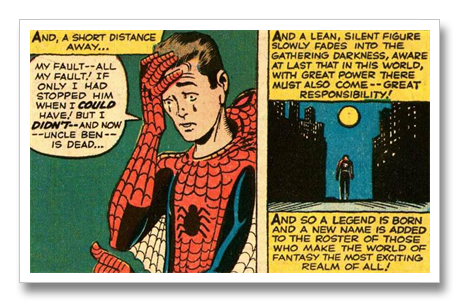
In closing, do me one small favor before you throw your caps in the air, before the Thunderbirds roar overhead, before you clap yourselves on the back, before you head off to graduation parties and the congratulations of your friends and family. Think about a saying I learned from Spider-Man. Yes, I really do mean the comic-book hero. “With great power comes great responsibility.”
Like so many airmen before you, you may soon find yourself in possession of great power over life and death in wars and other conflicts that, at least so far in this century, have been all too grim. Are you really prepared for such a burden? Because power and authority, unchecked by morality and integrity, will lead you and our country down a very dark path indeed.
Always remember your oath, always aim high, the high of Hildreth and Hale, the high of those who remember that they are citizen-airmen in service to a nation founded on lofty ideals. Listen to your conscience, do the right thing, and you may yet earn the right to the thanks that so many Americans will so readily grant you just by virtue of wearing the uniform.
And if you’ll allow this aging airman one final wish: I wish you a world where the bombs stay in their aircraft, the missiles in their silos, the bullets in their guns, a world, dare I say it, where America is finally at peace.
Copyright 2022 William J. Astore. Originally at TomDispatch.com. Please read TomDispatch.com, a regular antidote to the mainstream media. Thank you!
“Follow the money” is sage advice in an America that prides itself on unfettered capitalism where everything is a commodity. A huge chunk of money, namely $54 billion, has already been dedicated to Ukraine in its fight against a Russian invasion, with more to follow if Congress has its way. Roughly half this money is going directly to U.S. weapons makers, hence the haste of Congress to vote for its approval. Only a small number of Republicans have objected to this boondoggle; all Democrats in the House and Senate voted in favor of it.
Here’s the thing. The entire defense budget of Ukraine before the war was just under $6 billion. How can Ukraine possibly absorb (mostly) military “aid” that represents NINE TIMES their annual defense budget? It simply can’t be done.
Russia’s military budget for an entire year, roughly $66 billion, only slightly exceeds the U.S. “aid” for Ukraine after three months of war. If the pace of U.S. spending on Ukraine remains the same, the amount of “aid,” assuming the war continues, could touch $200 billion by this time next year. Again, this is for a country that spent $6 billion on its military forces prior to being invaded.
From a military perspective, the gusher of money and equipment being sent to Ukraine makes little sense because there’s no way Ukraine has the infrastructure to absorb it and use it effectively. The U.S. approach seems to be to flood the zone with weaponry and assorted equipment of all sorts, irrespective of how it might be used or where it might ultimately end up. I can’t see how all this lethal “aid” will stay in the hands of troops and out of the hands of various criminal networks and black markets.
In America’s recent wars, such as Iraq and Afghanistan but also as far back as Vietnam, the U.S. military has been remarkably proficient at providing weaponry to enemies. When U.S. forces retreat in defeat, or “evacuate to success,” they usually leave behind mountains of military equipment, as they did in Vietnam, Iraq, and Afghanistan. Weaponry left behind or provided to Afghan and Iraqi security forces helped to arm ISIS, the Taliban, and similar elements the U.S. government says are terroristic. Interestingly, few seem to question the wisdom of all the billions in weaponry provided as “aid” that often ends up fueling more violence and more war.
If guns saved lives and brought safety, America would have the lowest number of people killed by guns and the safest country. We obviously don’t. Flooding countries like Iraq, Afghanistan, and now Ukraine with scores of billions in weaponry and related equipment is not the smartest way toward success. Unless you’re the CEO of a weapons contractor, in which case it’s the very definition of success.
But something must be done! cry those who want to help Ukraine in its war with Russia. Ukraine has already demonstrated its resolve while suffering the evils of war; does it make sense to keep the war going when Ukraine ultimately can’t win it? Just look at a map and the vast resources Russia has available to it; there is no shame, and indeed much sense, in Ukraine, having fought a good fight, negotiating a peace treaty now before the war spreads even further and the country is even more devastated.
In sum, I don’t see $54 billion in U.S. “aid” to Ukraine as being in the best interest of the Ukrainian people. If it serves to prolong a murderous war that ultimately Ukraine can’t win, it may prove more hurtful than helpful.


 Bracing Views