The real enemy of America isn’t Russia or China or Iran or any other country. It’s America’s own pursuit of persistent, pernicious, perpetual, and more or less permanent war or preparations for the same.
It’s undeniable. America’s war and weapons budget is a trillion dollars a year. And rising. There are no plans in the foreseeable future to reduce spending on wars and weapons. Predictably, Americans are told this colossal spending on wars and weapons is for “defense” and “national security.” This is a lie. This spending enriches the few at the expense of the many. It sustains imperialism at the expense of democracy. It serves the desires of Wall Street while ignoring the real needs of Main Street USA. And it is supported by a bipartisan majority in Congress as well as the Trump administration (and the Biden administration before it).
War and weapons are making the American people poorer and less free. Sure, some people are getting rich selling murderous weaponry around the globe, yet America itself is being hollowed out. The warmongers in charge tell us that we can’t have nice things because America, or Israel, or Ukraine, or all three need more weapons (never mind the price tag). Yet it’s our money—it’s our taxpayer dollars.
Ike knew the score
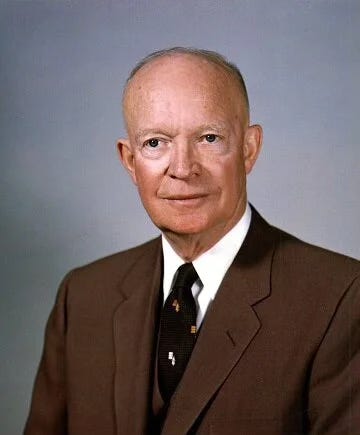
We can’t say we weren’t warned about this. President Dwight D. Eisenhower in 1953 told us that pursuing war and weapons would lead to our crucifixion on a “cross of iron.” Eight years later, Ike warned that a military-industrial complex already existed that was undermining American democracy and that we urgently needed to act to curb its power.
Sadly, what gives the military-industrial complex its unity is, among other things, greed and power. Congress is more than happy to serve it. So are America’s presidents. The last U.S. president to speak sincerely and powerfully about peace, John F. Kennedy, was assassinated just over six decades ago. There hasn’t been a peace president since then.
Meanwhile, since 9/11/2001, if not before then, the U.S. military has enthusiastically embraced a warrior ethos, abandoning its own citizen-soldier tradition. America, of course, is supposed to be a constitutional republic, not Sparta or Prussia. But instead of a nation of justice and the rule of law, we have an empire and culture in which wars and warriors rule.
War is not peace. Warriors don’t seek peace. War is war, and perpetual war will destroy both the U.S. empire and the kernel of democracy that remains (however weak or shrinking) at its core.
The choice is clear. We must seek peace. We must cut war and weapons spending dramatically—I’d suggest by 50%—and reinvest that money in Main Street USA. We can have nice things again, if we’re willing to stop empowering the warmongers among us.
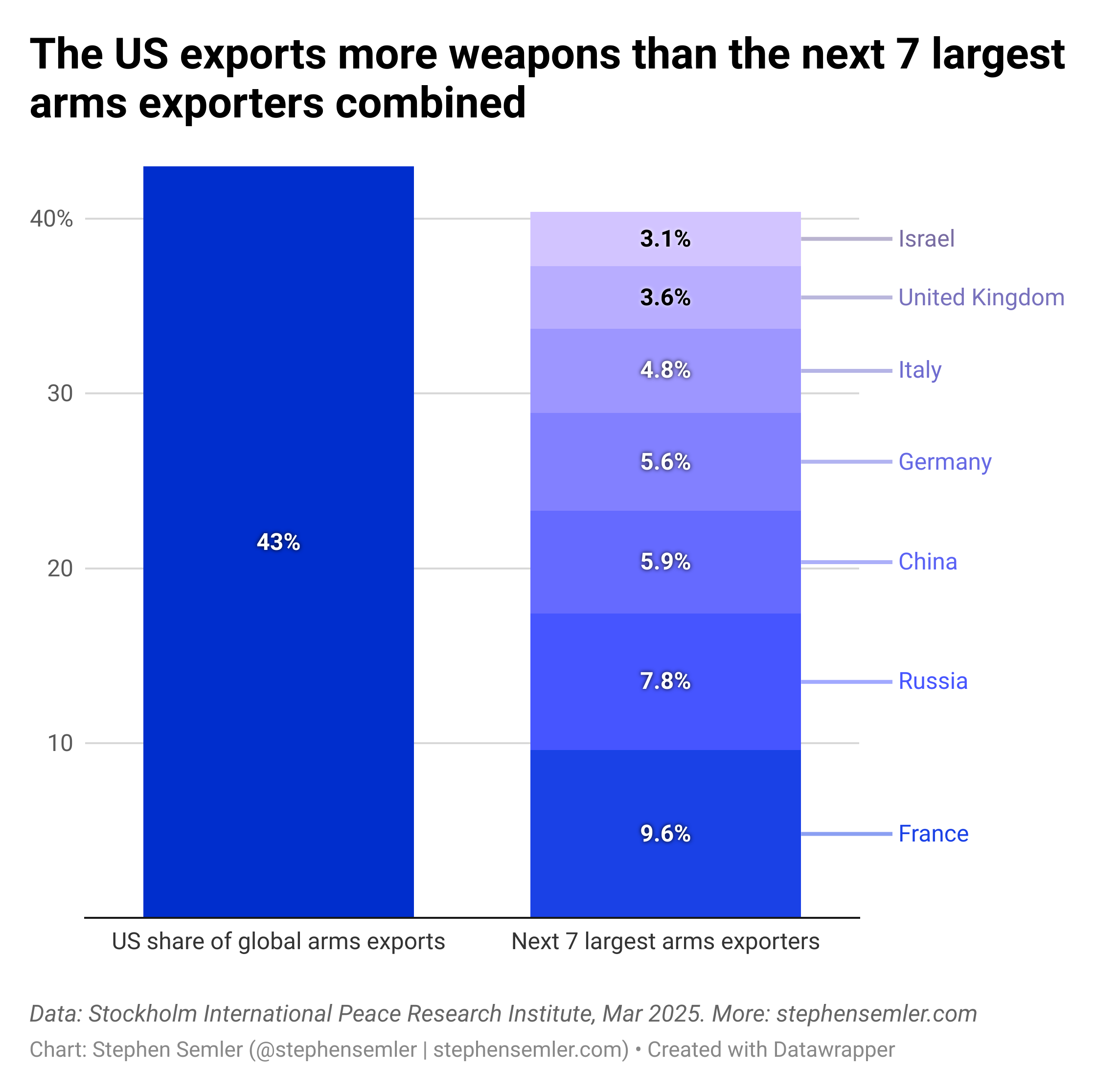
We’re #1 (once again) in selling weapons! Amazingly, the USA now accounts for 43% of the world’s trade in deadly weaponry. No country beats more plowshares into swords and pruning hooks into spears than America, which is also, obviously, the most Christian nation in the world.
Let’s take a look at a useful chart from Stephen Semler (be sure to check out his blogon Substack):
*****
Finding #1: The US is the world’s largest arms dealer
The US accounts for 43% of global arms exports, more than the next seven largest arms-exporting countries combined. All the countries outside the top eight account for less than 17% of the worldwide total.
^Alt text for screen readers: The U.S. exports more weapons than the next 7 largest arms exporters combined. This graph has two columns, one showing the U.S.’s 43% share of global arms transfers, and the other showing the combined share of France, Russia, China, Germany, Italy, U.K., and Israel, totaling 40.4%.
For another perspective on America’s record-breaking year of selling deadly weaponry, check out this column by Lenny Broytman.
*****
Way back in 2012, I wrote a column for TomDispatch: “Weapons ‘r’ us,” in which I examined America’s dominance of the weapons trade. Here’s what I wrote back then:
Yes, we’re the world’s foremost “merchants of death,” the title of a best-selling exposé of the international arms trade published to acclaim in the U.S. in 1934. Back then, most Americans saw themselves as war-avoiders rather than as war-profiteers. The evil war-profiteers were mainly European arms makers like Germany’s Krupp, France’s Schneider, or Britain’s Vickers.
Not that America didn’t have its own arms merchants. As the authors of Merchants of Death noted, early on our country demonstrated a “Yankee propensity for extracting novel death-dealing knickknacks from [our] peddler’s pack.” Amazingly, the Nye Committee in the U.S. Senate devoted 93 hearings from 1934 to 1936 to exposing America’s own “greedy munitions interests.” Even in those desperate depression days, a desire for profit and jobs was balanced by a strong sense of unease at this deadly trade, an unease reinforced by the horrors of and hecatombs of dead from the First World War.
We are uneasy no more. Today we take great pride (or at least have no shame) in being by far the world’s number one arms-exporting nation. A few statistics bear this out. From 2006 to 2010, the U.S. accounted for nearly one-third of the world’s arms exports, easily surpassing a resurgent Russia in the “Lords of War” race. Despite a decline in global arms sales in 2010 due to recessionary pressures, the U.S. increased its market share, accounting for a whopping 53% of the trade that year. Last year saw the U.S. on pace to deliver more than $46 billion in foreign arms sales. Who says America isn’t number one anymore?
Who, indeed? And we remain, of course, our own best customers, as this year’s Pentagon budget soars to $900 billion, even as the Trump administration argues for “peace through strength,” or, put bluntly, peace through superior firepower.
Only in America is Jesus heavily armed and packing heat. Truly exceptional!
Obviously, American Jesus preached peace through strength
I recently ordered a few items from Amazon. Random stuff like a shower caddy, an iPhone case, and lamp sockets. It won’t surprise you to learn they were all “Made in China.”
I ordered some clothes from a fancy online retailer. The clothes said “Designed in California” but they were, of course, Made in China.
What is America making? What are we sending overseas? Bombs and bulldozers for the devastation and dismantlement of Gaza and other Palestinian Territories. Consider this article from Ken Klippenstein (excerpt follows), which details roughly $10 billion in “foreign aid” to Israel.
Here’s what Klippenstein had to say:
*****
While the entire news media is focused on Trump’s suspension of arms for Ukraine, the administration is arming Israel to the teeth. The nature of the bombs being sold indicates Israel’s military is preparing to continue its bombing campaigns in Gaza, Lebanon, Syria, and Yemen; as well as preparing for possible war with Iran.
Included in the sales are tens of thousands of controversial 2,000 lb. bombs so heavily criticized during the Gaza war for their destructive capacity, and thousands of “Hellfire” missiles that are used for targeted killings.
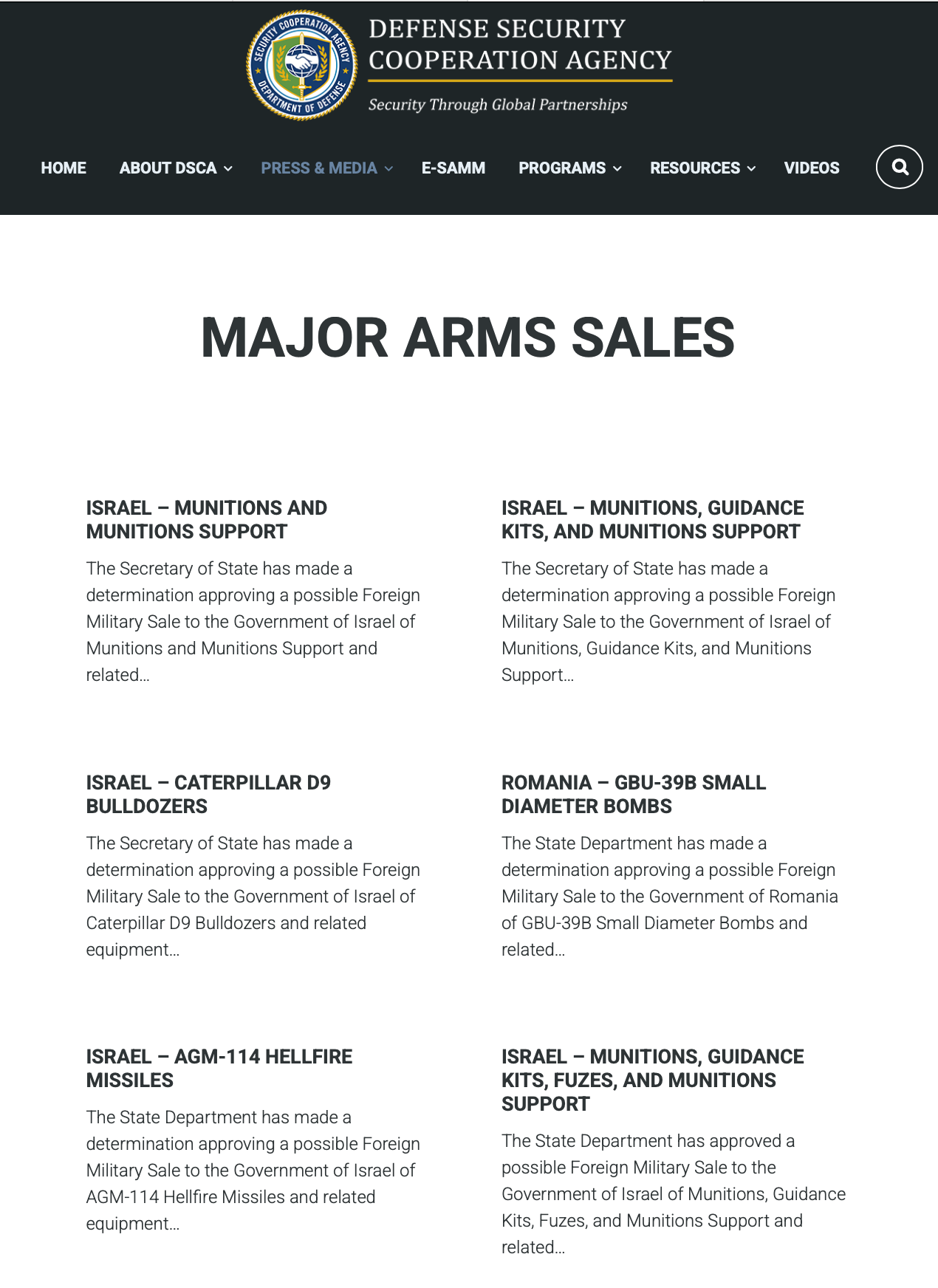
When I visited the Defense Security Cooperation Agency website’s section for major arms sales to see a breakdown of the weapons, I was immediately struck by the fact that five of the last six sales were to Israel.
Screenshot of DSCA’’s “Major Arms Sales” landing page
The U.S. bombs and missiles being sent to Israel, almost all made by Boeing, are included in:
2,166 GBU-39/B 250-pound Small Diameter Bombs (SDB) Increment 1.
2,800 MK 82 General Purpose, 500-pound bomb bomb bodies.
13,000 KMU-556 JDAM Guidance Kits to attach to MK-84 (2,000-pound) bomb bodies.
3,475 KMU-557 JDAM Guidance Kits to attach to BLU-109 (2,000-pound) bomb bodies.
1,004 KMU JDAM Guidance Kits to attach to 500-pound GBU-38v1 bomb bodies.
17,475 FMU-152A/B multi-function fuzes for bombs.
*****
Holy shit! Nearly thirty-six thousand 2000-pound bombs! That is 36 kilotons, roughly the equivalent of the two atomic bombs dropped on Hiroshima and Nagasaki in 1945. And that’s not including the assorted 1000- and 500-pound bombs tossed into the mix.
This is an astonishing amount of ordnance for Israel to continue its ethnic cleansing campaign in Gaza and the West Bank.
President Trump, of course, has the full support of most Democrats in sending this stockpile of destruction to Israel. Call it bipartisan genocidal enablement.
America sure is an “exceptional” nation. No nation is better at bombing others—or supplying the bombs for others like Israel to do so—then flattening what remains with “Made in USA” bulldozers.
Honestly, I wish my country made shower caddies, iPhone cases, and lamp sockets instead of bombs and bulldozers. Don’t you?
Yesterday, the Merchants of Death Tribunal concluded with a verdict of “guilty” for all those U.S. dealers and exporters of weapons globally. Yes, the merchants of death are guilty as sin, even as they account for 40% of the global trade in deadly weaponry. Who says nothing is made in America today? We make plenty of things that go “bang.”
In our culture today, it’s considered “patriotic” to make loads of money, especially by selling guns. Just look at the National Rifle Association (NRA) and its enablers in Congress and all the gun companies domestically.
Assault weapons are highly profitable, much more so than pistols, and isn’t it all about making money? Thoughts and prayers to those innocents caught in the crossfire, of course. No worries–more “good guys with guns” will save us from the bad guys with guns.
If we Americans embrace (or, refuse to stop) the sale of firearms, especially dangerous assault weapons, domestically, indeed, if we fetishize it with ideas of potency and manliness, is it any surprise we brag of weapons sales overseas and our dominance of that trade? If we don’t care (or care enough) about the safety of our own children, why should we care about dead kids in Gaza?
Our culture is violent and sick, and until we reform it, there’s little hope of meaningful change.
That said, it’s encouraging to hear of a ceasefire in Gaza. Perhaps the Trump administration can achieve a ceasefire in Ukraine as well. The problem is there always seems to be another war or wars looming on the horizon for the U.S., more conflicts that America’s merchants of death can make a killing on.
America has the war but not the peace
If there’s an American Leo Tolstoy out there, he couldn’t write a book on this epoch with the title of War and Peace. Today’s version for America has a single-word title: War.
Peace is rarely if ever mentioned in mainstream political discourse and culture. That’s not surprising. Roughly 60% of U.S. federal discretionary spending goes to the Pentagon, Homeland Security, nuclear weapons, and weapons shipments to places like Israel and Ukraine. President Biden once said: Show me your budget and I’ll tell you what you value. Looks like America values war very highly indeed.
Until we stop valuing and valorizing war and start embracing peace, the merchants of death will continue to thrive. Sure, they’re guilty, but so are we all if we keep feeding them our money and keep looking to them for “safety” and “security.”
Peace Activist John Rachel Challenges Us to Imagine a Better World
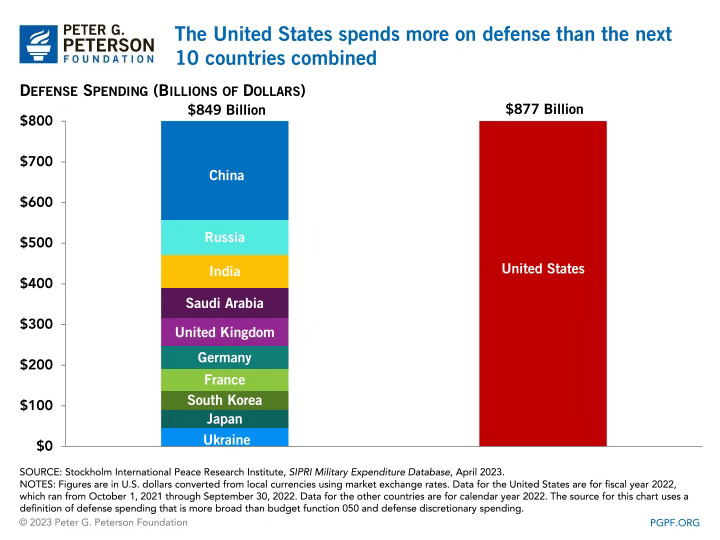
War is the health of the (anti-democratic) state. On those terms, America is very healthy indeed. America dominates the global trade in weaponry, accounting for 40% of that trade over the last five years (“We’re #1 in bombs, bullets, and blowing things up!”). America spends more on its military than the next ten nations combined (most of them being U.S. allies). Roughly 60% of federal discretionary spending is devoted to the Pentagon, sold to the American people as an “investment” in national security, even as it’s truly all about imperial dominance and resource extraction and exploitation.
John Rachel knows this. He asked me to write a foreword to his new book. “War Is Making Us Poor,” and what follows is that foreword. Check out his website and consider buying his book. Its succinct title sums up much about what’s wrong in America.
FOREWORD
Recently, I was reading the letters of Thomas Henry Huxley, who made a wise assertion in 1888: “Battles, like hypotheses, are not to be multiplied beyond necessity.”
My country, the United States of America, has been needlessly multiplying its battles around the world without necessity. The result has been a series of devastating wars in places like Vietnam, Iraq, and Afghanistan, wars that killed millions for little purpose other than the enrichment of what President Dwight D. Eisenhower in 1961 termed the military-industrial complex. Thus, Martin Luther King Jr. was right to conclude in 1967 that the United States had become the greatest purveyor of violence on the planet, its unbridled pursuit of militarism producing a form of spiritual death.
As James Madison, one of America’s founders, wrote near the close of the eighteenth century, no nation can preserve its freedom and maintain a healthy democracy when it embraces and pursues endless warfare. John Rachel knows this, feels this, and embraces the challenge of fighting against it. He knows America is dedicating more than half of its federal discretionary spending to wars, as the Pentagon budget soars toward $900 billion in 2024. He knows America is suffering from a form of spiritual death. He knows militarism will be the death, not only of democracy in America, but possibly of our planet itself, whether in quick time due to global nuclear war or in slow motion due to war-driven calamities aggravated by climate change.
America needs to change course. It needs to learn the word “peace” again. It needs to embrace diplomacy and reject militarism. It needs to stop being the world’s greatest purveyor of violence. It needs to dismantle its global network of 800 military bases, it needs to reject its vision of “full-spectrum dominance,” it needs to end its glorification of warriors and warfighters as heroes, it needs to stop exporting weapons to the world’s worst hotspots. But how?
As I write this, the U.S. government is sending massive arms shipments to Israel to enable ethnic cleansing in Gaza. Palestinian innocents, including thousands of women and children, are being pummeled and eviscerated by bombs and missiles carrying the label, “Made in USA.” America, which fancies itself a beacon of freedom, has become an abattoir of death through endless war.
I served in the U.S. military for twenty years. I taught thousands of military cadets the lessons of history. Yet I failed to question and challenge the system in meaningful ways until after I retired from the military. Somehow, collectively, Americans need to find the courage to change our violent ways. We need to act—now.
John Rachel’s book, by provoking us to think and to examine our often-unquestioned biases and assumptions, is just what we need to execute an “about-face” in America’s constant march to war.
The intent of this “tribunal” is to draw attention to America’s overwhelming dominance of the world’s trade in deadly weaponry and the cost we all pay when “weapons ‘r’ us.” How did the U.S. come to embrace this deadly trade, to the point of boasting of our market dominance as a sign of America’s health and fitness? How did we come to equate arsenals with democracy? And isn’t it high time we denounced this trade in death, as the U.S. Senate did back in the 1930s with the Nye Commission?
Back in 2012, I wrote an article for TomDispatch, “Confessions of a Recovering Weapons Addict,” in which I admitted my own childish enthusiasm for weaponry and all things that go “bang”—and kill. It’s reposted today at TomDispatch and also here below.
Perhaps you’ve heard of “Makin’ Thunderbirds,” a hard-bitten rock & roll song by Bob Seger that I listened to 30 years ago while in college. It’s about auto workers back in 1955 who were “young and proud” to be making Ford Thunderbirds. But in the early 1980s, Seger sings, “the plants have changed and you’re lucky if you work.” Seger caught the reality of an American manufacturing infrastructure that was seriously eroding as skilled and good-paying union jobs were cut or sent overseas, rarely to be seen again in these parts.
If the U.S. auto industry has recently shown sparks of new life (though we’re not making T-Birds or Mercuries or Oldsmobiles or Pontiacs or Saturns anymore), there is one form of manufacturing in which America is still dominant. When it comes to weaponry, to paraphrase Seger, we’re still young and proud and makin’ Predators and Reapers (as in unmanned aerial vehicles, or drones) and Eagles and Fighting Falcons (as in F-15 and F-16 combat jets), and outfitting them with the deadliest of weapons. In this market niche, we’re still the envy of the world.
Yes, we’re the world’s foremost “merchants of death,” the title of a best-selling exposé of the international arms trade published to acclaim in the U.S. in 1934. Back then, most Americans saw themselves as war-avoiders rather than as war-profiteers. The evil war-profiteers were mainly European arms makers like Germany’s Krupp, France’s Schneider, or Britain’s Vickers.
Not that America didn’t have its own arms merchants. As the authors of Merchants of Death noted, early on our country demonstrated a “Yankee propensity for extracting novel death-dealing knickknacks from [our] peddler’s pack.” Amazingly, the Nye Committee in the U.S. Senate devoted 93 hearings from 1934 to 1936 to exposing America’s own “greedy munitions interests.” Even in those desperate depression days, a desire for profit and jobs was balanced by a strong sense of unease at this deadly trade, an unease reinforced by the horrors of and hecatombs of dead from the First World War.
We are uneasy no more. Today we take great pride (or at least have no shame) in being by far the world’s number one arms-exporting nation. A few statistics bear this out. From 2006 to 2010, the U.S. accounted for nearly one-third of the world’s arms exports, easily surpassing a resurgent Russia in the “Lords of War” race. Despite a decline in global arms sales in 2010 due to recessionary pressures, the U.S. increased its market share, accounting for a whopping 53% of the trade that year. Last year saw the U.S. on pace to deliver more than $46 billion in foreign arms sales. Who says America isn’t number one anymore?
For a shopping list of our arms trades, try searching the Stockholm International Peace Research Institute database for arms exports and imports. It reveals that, in 2010, the U.S. exported “major conventional weapons” to 62 countries, from Afghanistan to Yemen, and weapons platforms ranging from F-15, F-16, and F-18 combat jets to M1 Abrams main battle tanks to Cobra attack helicopters (sent to our Pakistani comrades) to guided missiles in all flavors, colors, and sizes: AAMs, PGMs, SAMs, TOWs — a veritable alphabet soup of missile acronyms. Never mind their specific meaning: they’re all designed to blow things up; they’re all designed to kill.
Rarely debated in Congress or in U.S. media outlets is the wisdom or morality of these arms deals. During the quiet last days of December 2011, in separate announcements whose timing could not have been accidental, the Obama Administration expressed its intent to sell nearly $11 billion in arms to Iraq, including Abrams tanks and F-16 fighter-bombers, and nearly $30 billion in F-15 fighter jets to Saudi Arabia, part of a larger, $60 billion arms package for the Saudis. Few in Congress oppose such arms deals since defense contractors provide jobs in their districts — and ready donationsto Congressional campaigns.
Let’s pause to consider what such a weapons deal implies for Iraq. Firstly, Iraq only “needs” advanced tanks and fighter jets because we destroyed their previous generation of the same, whether in 1991 during Desert Shield/Storm or in 2003 during Operation Iraqi Freedom. Secondly, Iraq “needs” such powerful conventional weaponry ostensibly to deter an invasion by Iran, yet the current government in Baghdad is closely aligned with Iran, courtesy of our invasion in 2003 and the botched occupation that followed. Thirdly, despite its “needs,” the Iraqi military is nowhere near ready to field and maintain such advanced weaponry, at least without sustained training and logistical support provided by the U.S. military.
As one U.S. Air Force officer who served as an advisor to the fledging Iraqi Air Force, or IqAF, recently worried:
“Will the IqAF be able to refuel its own aircraft? Can the Iraqi military offer adequate force protection and security for its bases? Can the IqAF provide airfield management services at its bases as they return to Iraqi control after eight years under US direction? Can the IqAF ensure simple power generation to keep facilities operating? Will the IqAF be able to develop and retain its airmen?… Only time will tell if we left [Iraq] too early; nevertheless, even without a renewed security agreement, the USAF can continue to stand alongside the IqAF.”
Put bluntly: We doubt the Iraqis are ready to field and fly American-built F-16s, but we’re going to sell them to them anyway. And if past history is a guide, if the Iraqis ever turn these planes against us, we’ll blow them up or shoot them down — and then (hopefully) sell them some more.
Our Best Arms Customer
Let’s face it: the weapons we sell to others pale in comparison to the weapons we sell to ourselves. In the market for deadly weapons, we are our own best customer. Americans have a love affair with them, the more high-tech and expensive, the better. I should know. After all, I’m a recovering weapons addict.
Well into my teen years, I was fascinated by military hardware. I built models of what were then the latest U.S. warplanes: the A-10, the F-4, the F-14, -15, and -16, the B-1, and many others. I read Aviation Week and Space Technology at my local library to keep track of the newest developments in military technology. Not surprisingly, perhaps, I went on to major in mechanical engineering in college and entered the Air Force as a developmental engineer.
Enamored as I was by roaring afterburners and sleek weaponry, I also began to read books like James Fallows’sNational Defense (1981) among other early critiques of the Carter and Reagan defense buildup, as well as the slyly subversive and always insightful Augustine’s Laws (1986) by Norman Augustine, later the CEO of Martin Marietta and Lockheed Martin. That and my own experience in the Air Force alerted me to the billions of dollars we were devoting to high-tech weaponry with ever-ballooning price tags but questionable utility.
Perhaps the best example of the persistence of this phenomenon is the F-35 Lightning II. Produced by Lockheed Martin, the F-35 was intended to be an “affordable” fighter-bomber (at roughly $50 million per copy), a perfect complement to the much more expensive F-22 “air superiority” Raptor. But the usual delays, cost overruns, technical glitches, and changes in requirements have driven the price tag of the F-35 up to $160 million per plane, assuming the U.S. military persists in its plans to buy 2,400 of them. (If the Pentagon decides to buy fewer, the cost-per-plane will soar into the F-22 range.) By recent estimates the F-35 will now cost U.S. taxpayers (you and me, that is) at least $382 billion for its development and production run. Such a sum for a single weapons system is vast enough to be hard to fathom. It would, for instance, easily fund all federal government spending on education for the next five years.
The escalating cost of the F-35 recalls the most famous of Norman Augustine’s irreverent laws: “In the year 2054,” he wrote back in the early 1980s, “the entire defense budget will [suffice to] purchase just one aircraft.” But the deeper question is whether our military even needs the F-35, a question that’s rarely asked and never seriously entertained, at least by Congress, whose philosophy on weaponry is much like King Lear’s: “O, reason not the need.”
But let’s reason the need in purely military terms. These days, the Air Force is turning increasingly to unmanned drones. Meanwhile, plenty of perfectly good and serviceable “platforms” remain for attack and close air support missions, from F-16s and F-18s in the Air Force and Navy to Apache helicopters in the Army. And while many of our existing combat jets may be nearing the limits of airframe integrity, there’s nothing stopping the U.S. military from producing updated versions of the same. Heck, this is precisely what we’re hawking to the Saudis — updated versions of the F-15, developed in the 1970s.
Because of sheer cost, it’s likely we’ll buy fewer F-35s than our military wants but many more than we actually need. We’ll do so because Weapons ‘R’ Us. Because building ultra-expensive combat jets is one of the few high-tech industries we haven’t exported (due to national security and secrecy concerns), and thus one of the few industries in the U.S. that still supports high-paying manufacturing jobs with decent employee benefits. And who can argue with that?
The Ultimate Cost of Our Merchandise of Death
Clearly, the U.S. has grabbed the brass ring of the global arms trade. When it comes to investing in militaries and weaponry, no country can match us. We are supreme. And despite talk of modest cuts to the Pentagon budget over the next decade, it will, according to President Obama, continue to grow, which means that in weapons terms the future remains bright. After all, Pentagon spending on research and development stands at $81.4 billion, accounting for an astonishing 55% of all federal spending on R&D and leaving plenty of opportunity to develop our next generation of wonder weapons.
But at what cost to ourselves and the rest of the world? We’ve become the suppliers of weaponry to the planet’s hotspots. And those weapons deliveries (and the training and support missions that go with them) tend to make those spots hotter still — as in hot lead.
As a country, we seem to have a teenager’s fascination with military hardware, an addiction that’s driving us to bust our own national budgetary allowance. At the same time, we sell weapons the way teenage punks sell fireworks to younger kids: for profit and with little regard for how they might be used.
Sixty years ago, it was said that what’s good for General Motors is good for America. In 1955, as Bob Seger sang, we were young and strong and makin’ Thunderbirds. But today we’re playing a new tune with new lyrics: what’s good for Lockheed Martin or Boeing or [insert major-defense-contractor-of-your-choice here] is good for America.
Roughly half of President Biden’s recent budget request for more than $105 billion for Ukraine, Israel, Taiwan, and border security is dedicated to weapons sales. Nothing screams Christian values like massacres and mass weapons sales.
Speaking of massacres, Aaron Maté has a powerful article on Gaza and the U.S. role in facilitating Israel’s destruction of the same. Here’s an excerpt:
According to Save the Children, the number of Palestinian children killed in just three weeks has already surpassed the annual number of children killed across the world’s conflict zones since 2019. “Gaza has become a graveyard for children,” a UNICEF spokesperson says. “It’s a living hell for everyone else.” In a statement demanding a ceasefire, seven UN special rapporteurs now warn that “the Palestinian people are at grave risk of genocide.”
I remember when Sting got into trouble in the 1980s for singing that the Russians love their children too. Is it OK to say the Palestinians love their children too and would prefer that they not be obliterated by “Made in USA” bombs provided for free to Israel?
I wrote this just this morning to a friend who’s been taking fire because she believes the Palestinians in Gaza are human beings who shouldn’t be targeted for ethnic cleansing:
The Israel/Palestine issue is both complex and simple. To keep it simple, we’re all human beings. No group of people are “human animals.” If any country should know the dangers of dehumanizing an enemy, it’s Israel. Yet that’s precisely what Israel is doing.
There are plenty of Jews who are bravely denouncing Israel, but their voices are not being heard. Meanwhile, the US government supinely serves the worst elements in Israel. Our own government is complicit in ethnic cleansing, not that I’m surprised about this, given our nation’s history.
They say Dexter was a serial killer, but he’s got nothing on the jackals in the US and Israel who’ve already killed roughly 10K Palestinians with many more deaths to come. (With apologies to real jackals.)
I’ve been writing to my senators and representative as well, imploring them not to vote for more murderous weaponry, whether for Israel or Ukraine (or anyone else). Just about all our politicians make noises about our country advancing Judeo-Christian values yet they conveniently forget about values like “thou shalt not kill” and “blessed are the peacemakers.”
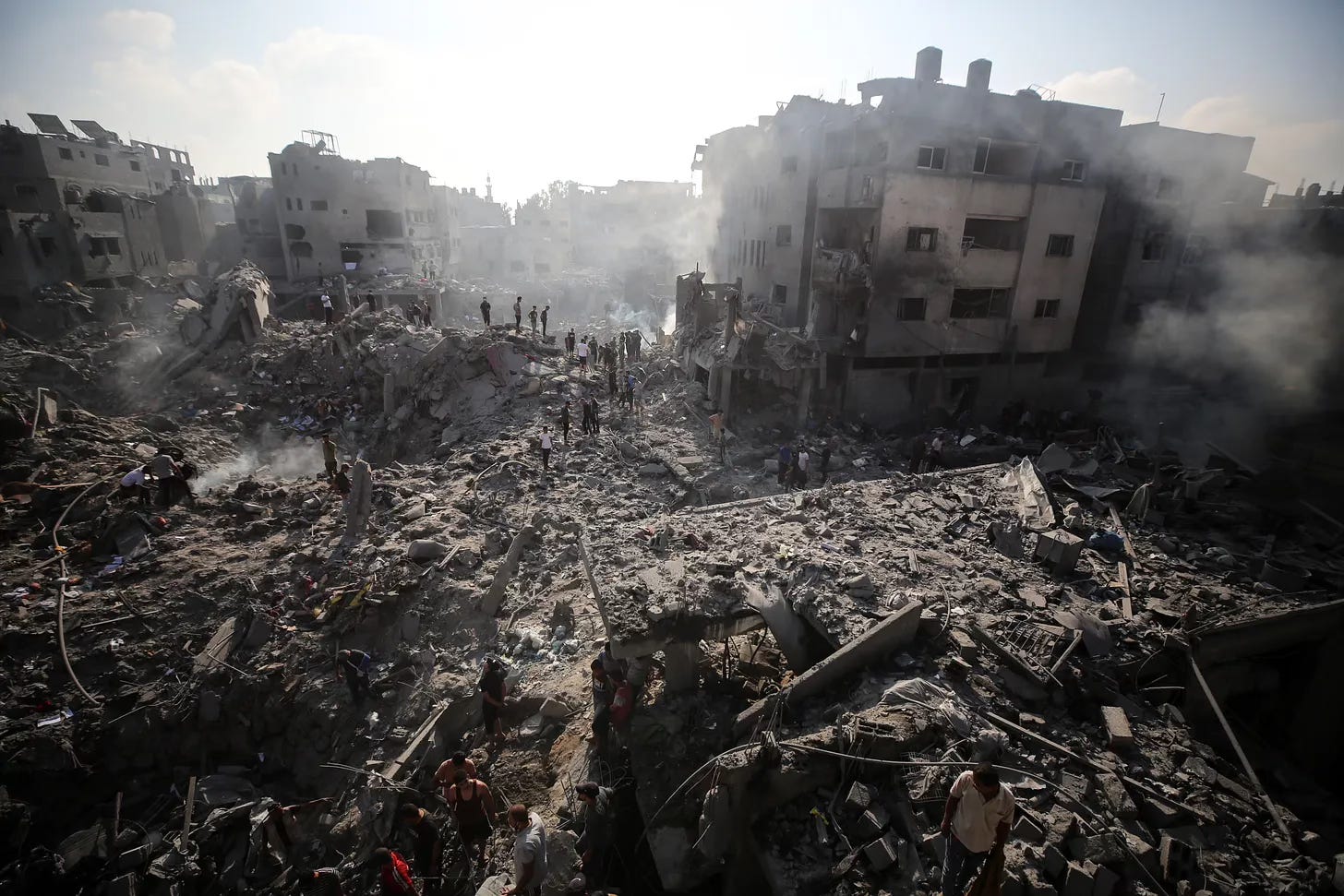
Hellscape in Gaza (Photo by Majdi Fathi/NurPhoto via Getty Images)
It would be far better if the U.S. stood on the sidelines and did nothing, yet Congress and the President must show their “strength” by using taxpayer dollars to ship scores of billions in weaponry to facilitate mass murder. As they do so, they pat each other on the back for being strong while boasting of creating jobs for various weapons makers in the “homeland.”
That’s how perverted and twisted government officials are. They’d rather spend scores of billions on death overseas than help struggling Americans here at home.
We need to vote the warmongers out, except I can’t forget what Emma Goldman said about voting: “If voting changed anything, they’d make it illegal.”
As the Ukrainian counteroffensive against Russia grinds on (or falters?), as U.S. disaster relief for Hawaii is tied to more military aid for Ukraine, as depleted uranium shells join cluster munitions as America’s latest gift to a blasted war zone, as calls for diplomacy continue to be muted when they’re not actively discouraged and dismissed, I was reminded of the alchemy of war.
Alchemists of the early modern period were sophisticated experimenters driven by an often quasi-religious quest for perfection. We tend to remember only the most craven part of their experiments: the attempt to transmute lead into gold. This transmutation could not be effected, but alchemy itself transmuted into chemistry as its practitioners, through trial and error, developed a better understanding of the nature of the elements, reflected in part by today’s Periodic Table.
Seeking a divine spark
Yet the business of war succeeded where alchemists failed. In their alchemy, the merchants of death turned bullet lead into corporate gold. And what gold! Yearly war budgets continue to soar in the United States toward the trillion dollar mark. Weapons shipments to Ukraine continue at a pace that promises many more shattered and blasted bodies, Ukrainian and Russian.
In a sense, dead bodies are also being transmuted into corporate gold.
Transmutation, I was taught as a Catholic, is a miracle. The Word became flesh and dwelt among us (Jesus Christ, the Son of God, of course). We have made the miraculous the mundane, and indeed the profane. We take lead and spill blood which becomes gold. And some even celebrate this as good for business in the United States.
All these weapons: they’re job-creators! So we crucify the Word and elevate the life-takers and widow-makers as gods.
We are far more deluded than the alchemists of the past.
If you read the mainstream media, it would seem the answer to the Russia-Ukraine War, now about to enter its second year of mass death and widespread destruction, is weapons of various sorts. Western tanks like the German Leopard and American Abrams. Fighter jets like the F-16 produced by Lockheed Martin. If only Ukraine had more tanks, more jets, and the like, they would be able decisively to defeat the Russian military, ejecting it from Ukrainian territory, even from the Crimea, so the argument goes.
As a historian of technology and warfare, I’ve studied this belief in magical weapons. History teaches us that weapons alone usually do not determine winners and losers in war. Weapons themselves are rarely decisive, especially when the sides engaged fight symmetrically. In such cases, new weaponry often increases the carnage.
Consider the events of World War I. Various weapons were tried in an attempt to win the war decisively through military action. These weapons included poison gas (of various types), tanks, flamethrowers, and submarines, among others. None of these weapons broke the stalemate on the Western Front. Countermeasures were found. And World War I dragged on for more than four long years, producing hecatombs of dead.
Image from “All Quiet on the Western Front,” 2022, Netflix
What did work? In a word, exhaustion. In the spring of 1918, Germany launched massive, last-ditch, offensives to win the war before U.S. troops arrived in Europe in large numbers. (The U.S. had entered the war in 1917 but was still mobilizing in 1918.) The Germans came close to winning, but when their offensives grounded to a halt, they had little left in the tank to endure Allied counterattacks. Yes, the Allies had more tanks than the Germans, and were learning to use them effectively with airpower in combined arms assaults. But what truly mattered was exhaustion within the German ranks, exacerbated by the Spanish flu, hunger, and demoralization.
No magical weapon won World War I. And no magical weapon is going to provide Ukraine a decisive edge in its struggle with Russia. Certainly not a hundred or so Western tanks or a few dozen fighter jets.
Indeed, looking at some of the media coverage of the Russia-Ukraine War in the West, you might be excused from mistaking it for advertising videos at a weapons trade show. Over the last year, we’ve learned a lot about Javelin and Stinger missiles, HIMARS rocket launchers, and of course various tanks, fighter jets, and the like. But we’ve seen very little coverage of the mass carnage on both sides. It’s been said the real costs of war will never get in the history books, for who wishes to confront fully the brutality and madness of industrialized warfare?
I’m in the middle of watching the new German version of “All Quiet on the Western Front,” a film deservedly nominated for an Oscar for best picture (available on Netflix). It’s one of the better war films I’ve seen in its depiction of the horrific and dehumanizing aspects of modern industrial warfare. Something like this movie is happening currently in Ukraine, but our leaders, supported by the media, think the answer to the carnage is to send even more destructive weaponry so that more troops (and civilians) can die.
Magical weapons are not the answer. For of course there’s nothing magical about weapons of mass destruction.
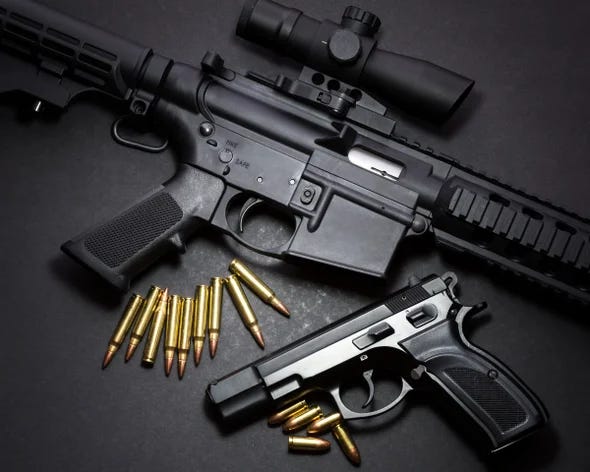
“Honk if you like guns” is on a message board outside a local gun range. It’s a distinctly American sentiment. Since this country has over 400 million guns of various sorts and calibers in circulation, it’s a safe bet that America does indeed “like” guns. And that’s not a liking you’re encouraged to keep to yourself, hence the encouragement to “honk” as you drive past to advertise full throttle your affection for them.
Honk away, I guess (Mariusz Blach, Getty Images)
As I wrote a decade ago, “weapons ‘r’ us.” America, the so-called arsenal of democracy during World War II, is now often simply an arsenal. Guns are expensive and life is cheap. And we literally export that sentiment as America dominates the international trade in arms of all sorts, everything from F-35 jet fighters to M-1 tanks to the humblest of bullets. Indeed, we’re buying so many guns in America there’s even a shortage of those humble bullets.
Americans believe they are unsafe; Americans are also less than happy and are the world’s best customers for anti-depressants, and happiness is a warm gun, as John Lennon wrote.
There is considerable psychic distress in our country, and no wonder. The police video released yesterday of the beating of Tyre Nichols during a routine traffic stop is more than disturbing. A helpless man lies on the ground as police surround him, kicking and hitting him repeatedly. “Savage” is a good descriptor for the beating he took, after which it took nearly half an hour for an ambulance to arrive to render medical aid. Tyre Nichols died in a hospital three days later.
I know it’s an odd juxtaposition: the “honk if you like guns” sentiment and the (alleged) murder of Tyre Nichols by five (or more) police officers in Memphis. Maybe they have little in common, except, perhaps, a liking for violence and the potential of deadly force.
And so, to change the subject, I keep hearing the best way to help Ukraine is to send them more weapons so their armed forces can kill more Russians. It’s a war, after all, and tanks are needed more than talks. Putin only understands one language, the language of murderous violence, and he must be stopped so send Ukraine whatever its military officials request because we can trust them to know best.
And I begin to wonder, which country truly knows the language of murderous violence best? Which country has more mass shootings than any other? Which country spends more on wars and weaponry, has more of its citizens in prison, has more military bases, exports more weaponry around the world, than any other?
Honk if you like guns — it’s a sentiment that says much about our American moment.







 Bracing Views