America the FUBAR

An Ailing, Flailing, Failing Empire Lashes Out

BILL ASTORE

AUG 06, 2025

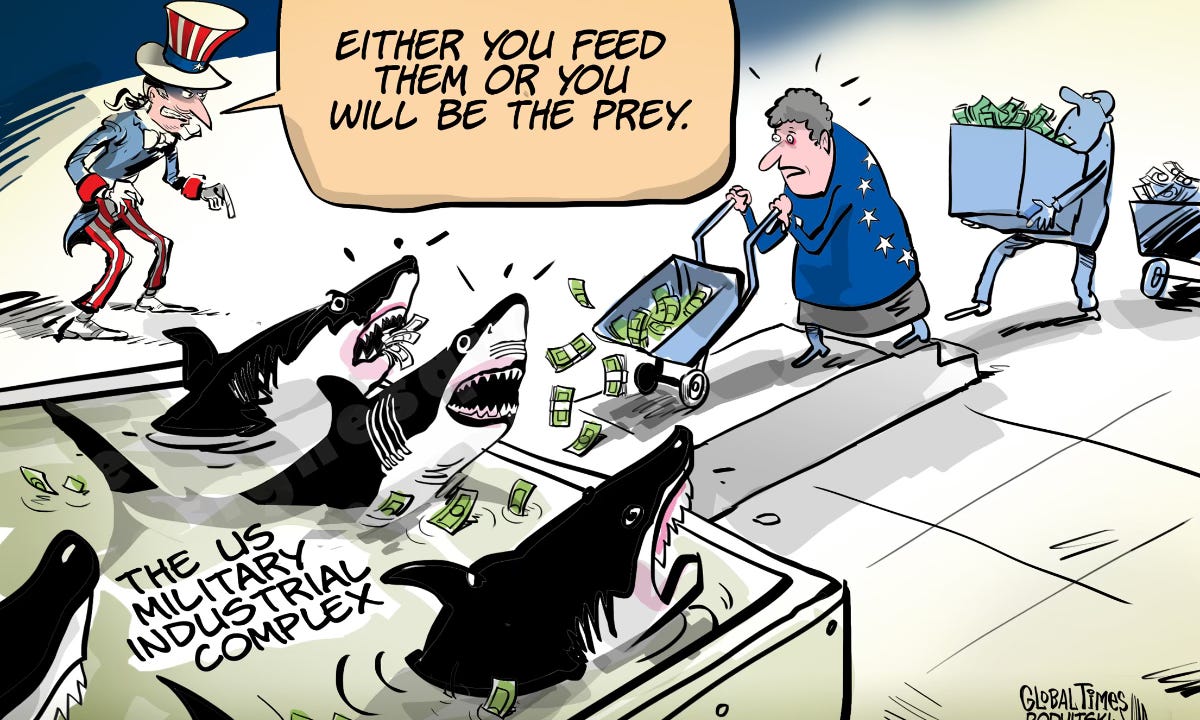
Hello Everyone: Here’s my latest article at TomDispatch.com. Whereas my articles for BV are usually 400-600 words, my articles for TomDispatch are usually just over 2000 words, which allows me to develop my points further, supported by plenty of links. Oh, and my wife and I really do use the expression, “But Bibi needs bombs,” whenever the government says it can’t fund something for the American people. It’s funny but I’ve never heard anyone in Congress ask: Bombs for Bibi—how are you going to pay for that? America’s bipartisan warmongers always find plenty of money for weapons and war, even as money for health care and other needs evaporates. It’s almost as if America has a powerful military-industrial complex combined with pushy lobbying groups like AIPAC.
*****

As a retired U.S. Air Force officer, I firmly believe in civilian control of our military. This country should be a nation of laws — not of special interests, oligarchs, or kings. Before committing our forces to battle, Congress should always declare war in the name of the people. Our military should indeed be a citizen-soldier force, not an isolated caste driven by a warrior ethos. And above all, the United States should be a republic ruled by law and shaped by sound moral values, not a greed-driven empire fueled by militarism.

Yet when I express such views, I feel like I’m clinging to a belief in the tooth fairy, the Easter Bunny, and Santa Claus. It feels idealistic, naïve, even painful to think that way. Yes, I served this country in uniform for 20 years, and now, in the age of Donald Trump, it has, as far as I can tell, thoroughly lost its way. The unraveling began so long ago — most obviously with the disastrous Vietnam War of the 1960s and 1970s, though in truth this country’s imperial desires predated even the Spanish-American War of 1898, stretching back to the wanton suppression of indigenous peoples as part of its founding and expansion.

A glance at U.S. history reveals major atrocities: the displacement and murder of Native Americans, slavery, and all too many imperial misadventures abroad. I knew of such realities when I joined the military in 1985, near the end of the Cold War. Despite its flaws, I believed then that this country was more committed to freedom than the Soviet Union. We could still claim some moral authority as the leader of what we then referred to as “the free world,” however compromised or imperfect our actions were.

That moral authority, however, is now gone. U.S. leaders fully support and unapologetically serve an ongoing genocide against the Palestinian people in Gaza. They sell weapons to nearly every regime imaginable, irrespective of human rights violations. They wage war without Congressional approval — the recent 12-day assault on Iran being just the latest example. (The second Trump administration has, in fact, launched almost as many air strikes, especially in Yemen and Somalia, in its first five months as the Biden administration did in four years.) Those same leaders have been doing a bang-up job dismantling the America I thought I was serving when I took that oath and put on second lieutenant’s bars four decades ago. That America — assuming it ever existed — may now be gone forever.

FUBAR: A Republic in Ruins

My fellow citizens, America is FUBAR (a term that dates from World War II). We are not faintly who we claim to be. Rather than a functioning republic, we are an ailing, flailing, perhaps even failing empire. We embrace war, glorify warriors, and profit mightily from the global arms trade, no matter the civilian toll, including tens of thousands of dead and wounded children in Gaza, among the latest victims of U.S.-made bombs, bullets, and missiles.

Signs of moral rot are everywhere. Our president, who would like to be known for his budget cuts, nonetheless giddily celebrates a record trillion-dollar war budget. Our secretary of defense gleefully promotes a warrior ethos. Congress almost unanimously supports or acquiesces in the destruction of Gaza. Images from the region resemble bombed-out Stalingrad in 1942 or Berlin in 1945. Meanwhile, for more than two decades now, America’s leaders have claimed to be waging a successful global “war on terror” even as they fuel terror across the globe. What do they think all those U.S. weapons are for — spreading peace?

My wife and I cope through dark humor. We see news on cuts to Medicaid, the mentally ill in the streets, and crumbling infrastructure, and quip: “But Bibi [Netanyahu] needs bombs. Or Ukraine does. Or the Pentagon needs more nukes.” That’s why Americans can’t have nice things like health care. That’s why all too many of us are unhoused, in debt, out of work, and desperate. In 1967 — yes, that’s almost 60 years ago! — Martin Luther King warned of exactly this: America’s approaching spiritual death through militarism (aggravated by extreme materialism and racism). That death is visibly here, now.

A book cover of a city

AI-generated content may be incorrect.

Buy the Book

Washington is not even faintly committed to “peace through strength,” a vapid slogan touted by the Trump administration, and an unintentional echo of George Orwell’s dystopian “war is peace.” It is committed instead to what passes for dominance through colossal military spending and persistent war. And let’s face it, that warpath may well end in the death of the American experiment.

The Mediocrity of Our Generals

In this era of creeping authoritarianism and mass surveillance, perhaps the U.S. is lucky that its generals are, by and large, so utterly uninspired. Today’s American military isn’t open to the mercurial and meteoric talents of a Napoleon or a Caesar. Not in its upper ranks, at least.

One struggles to name a truly great American general or admiral since World War II. That war produced household names like George C. Marshall, Dwight D. Eisenhower, George S. Patton, and Chester W. Nimitz. In contrast, America’s recent generals — Norman Schwarzkopf and Colin Powell of Desert Storm fame, Tommy Franks in Iraq in 2003, David Petraeus and Stanley McChrystal of the “fragile” and “reversible” Iraq and Afghan “surges” — have left anything but a legacy of excellence or moral leadership, not to speak of decisive victory. At best, they were narrowly competent; at worst, morally compromised and dangerously deluded.

Mind you, this isn’t a criticism of this country’s rank-and-file troops. The young Americans I served with showed no lack of courage. It wasn’t their fault that the wars they found themselves in were misbegotten and mismanaged. Twenty years have passed since I served alongside those young troops, glowing with pride and purpose in their dedication, their idealism, their commitment to their oath of service. Many paid a high price in limbs, minds, or lives. Too often, they were lions led by donkeys, to borrow a phrase once used to describe the inept and callous British leadership during World War I at bloody battles like the Somme (1916) and Passchendaele (1917).

Today, I fear that America’s lions may, sooner or later, be led into even deeper catastrophe — this time possibly a war with China. Any conflict with China would likely rival, if not surpass, the disasters produced by World War I. The world’s best military, which U.S. presidents have been telling us we have since the 9/11 attacks of September 2001, stands all too close to being committed to just such a war in Asia by donkeys like Donald Trump and Secretary of Defense Pete Hegseth.

And for what? The island of Taiwan is often mentioned, but the actual reason would undoubtedly be to preserve imperial hegemony in the service of corporate interests. War, as General Smedley Butler wrote in 1935 after he retired from the military, is indeed a racket, one from which the rich exempt themselves (except when it comes to taking profits from the same).

A disastrous conflict with China, likely ending in a U.S. defeat (or a planetary one), could very well lead to a repeat of some even more extreme version of Trump’s Make America Great Again campaign, amplified and intensified by humiliation and resentment. From the ashes of that possible defeat, an American Napoleon or Caesar (or at least a wannabe imitator) could very well emerge to administer the coup de grace to what’s left of our democracy and freedom.

Avoiding a Colossal Act of Folly

War with China isn’t, of course, inevitable, but America’s current posture makes it more likely. Trump’s tariffs, his bombastic rhetoric, and this country’s extensive military exercises in the Pacific contribute to rising tensions, not de-escalation and rapprochement.

While this country invests in war and more war, China invests in infrastructure and trade, in the process becoming what the U.S. used to be: the world’s indispensable workhorse. As the 10 BRICS countries, including China, expand and global power becomes more multipolar, this country’s addiction to military dominance may drive it to lash out. With ever more invested in a massive military war hammer, impetuous leaders like Trump and Hegseth may see China as just another nail to be driven down. It would, of course, be a colossal act of folly, though anything but a first in history.

And speaking of folly, the U.S. military as it’s configured today is remarkably similar to the force I joined in 1985. The focus remains on ultra-expensive weapons systems, including the dodgy F-35 jet fighter, the unnecessary B-21 Raider bomber, the escalatory Sentinel Intercontinental Ballistic Missile, and Trump’s truly fantastical “Golden Dome” missile defense system (a ghostly rehash of President Ronald Reagan’s “Star Wars” proposal, vintage 1983). Other militaries, meanwhile, are improvising, notably in low-cost drone technology (also known as UAS, or uncrewed autonomous systems) as seen in the Russia-Ukraine War, a crucial new arena of war-making where the U.S. has fallen significantly behind China.

The Pentagon’s “solution” here is to continue the massive funding of Cold War-era weapons systems while posing as open to innovation, as an embarrassing video of Hegseth walking with drones suggests. America’s military is, in short, well-prepared to fight a major conventional war against an obliging enemy like Iraq in 1991, but such a scenario is unlikely to lie in our future.

With respect to drones or UAS, I can hear the wheels of the military-industrial complex grinding away. A decentralized, low-cost, flexible cottage industry will likely be transformed into a centralized, high-cost, inflexible cash cow for the merchants of death. When the Pentagon faces a perceived crisis or shortfall, the answer is always to throw more money at it. Ka-ching!

Indeed, the recent profit margins of major military contractors like Lockheed Martin, Boeing, and RTX (formerly Raytheon) have been astounding. Since 9/11, Boeing’s stock has risen more than 400%. RTX shares are up more than 600%. Lockheed Martin, maker of the faltering F-35, has seen its shares soar by nearly 1,000%. And Northrop Grumman, maker of the B-21 Raider bomber and Sentinel ICBM, two legs of America’s “modernized” nuclear triad, has seen its shares increase by more than 1,400%. Who says that war (even the threat of a global nuclear war) doesn’t pay?

Meanwhile, the Pentagon’s war budget, soaring to unprecedented levels, has been virtually immune to DOGE cuts. While Elon Musk and his whiz kids searched for a few billion in savings by gutting education or squelching funding for public media like PBS and NPR, the Pentagon emerged with about $160 billion in new spending authority. As President Biden once reminded us: Show me your budget and I’ll tell you what you value. Far too often, America’s leaders, whatever they’ve said in their election campaigns, have valued weapons and wars over almost anything else.

What Is To Be Done

I’ve written against warriorswarfighters, and U.S. militarism since 2007. And yes, it often feels futile, but silence means surrender to warmongering fools like Hegseth, Senator Tom Cotton, and the farrago of grifters, clowns, toadies, con men, and zealots who inhabit the Trump administration and much of Congress as well. The fight against them must go on.

All leaders, military and civilian, must remember their oath: loyalty to the Constitution, not to any man. Illegal orders must be resisted. Congress must impeach and remove a president who acts unlawfully. It must also reassert its distinctly lost authority to declare war. And it must stop taking “legal” bribes from the lobbyists/foot soldiers who flood the halls of Congress, peddling influence with campaign “contributions.”

For tyranny to be stopped, for a catastrophic war with China (and who knows what else) to be avoided, America must have profiles in courage, not cowardice. Yet even despair is being weaponized. As a retired colonel and friend of mine wrote to me recently: “I don’t even know where to start anymore, Bill. I have no hope for anything ever improving.”

And don’t think of that despair as incidental or accidental. It’s a distinct feature of the present system of government.

Trump and Hegseth are not faintly what the founders of this country envisioned when they placed the military under civilian control. Yet power ultimately resides in the people (if we remember our duties as citizens). Isn’t it high time that we Americans recover our ideals, as well as our guts?

After all, the few can do little without the consent of the many. It’s up to the many (that’s us!) to reclaim and restore America.
U.S. Elites Learned Much from the Vietnam Defeat

W.J. Astore

To them, the right lessons; to everyone else, the wrong ones

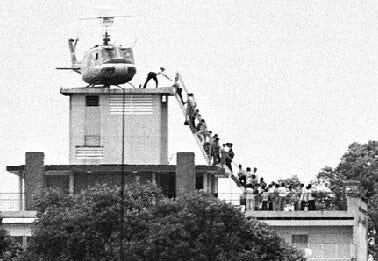
We just marked the 50th anniversary of the Fall of Saigon on April 30, 1975. Did American officials learn anything from the disastrous Vietnam War?

Saigon, April 1975

Of course they did. Just not the lessons you’d have wished they’d learned.

So, what did they learn?

  • They learned that wars can indeed last forever, but that Vietnam wasn’t the best “forever war” for the military-industrial complex because it became deeply unpopular and was disrupting cohesion within the military itself. The best forever wars are open-ended “wars” like the global war on terror. And perhaps a “new Cold War” with Russia and/or China. Wars that don’t involve the deployment of over half a million men (unless that “new” Cold War turns hot).
  • They learned to control the narrative. No more journalists traveling freely in war zones as in the 1960s in Vietnam. Journalists are now most often embedded in U.S. military units. Embedded reporters, dependent on the military for access and protection, know what they can and can’t say, even as they tend to sympathize with the troops they’re with.
  • They learned that forced conscription via a draft doesn’t work well for unpopular wars. So they transformed the military into an “all-volunteer” force. Draftees may well be resentful, rightly so, but volunteers? Too bad—they volunteered for this.
  • Along with “volunteers,” they learned to indoctrinate U.S. troops to be “warriors” and “warfighters” rather than citizen-soldiers. Warriors exist to fight wars, so shut up and blast away.
  • They learned to keep the American people isolated from war and its deadly effects. Recall that under Bush/Cheney, Americans weren’t even allowed to see flag-draped caskets. During Vietnam, war was in America’s living rooms during dinner, complete with body counts. Coverage of wars in Iraq, Afghanistan, and elsewhere was sanitized, almost bloodlessly so.
  • They learned never to talk of sacrifice (except by those volunteer warriors) by the American people. Taxes aren’t raised in the name of war. There are no war bond drives. America’s leaders tell the rest of us to enjoy life, to visit Disney and to go shopping, while “our” warriors fight overseas.

Together with those “lessons,” they continue to preach “peace through strength,” attacking those who truly seek peace as misguided (at best) and treasonous (at worst). As ever, they tend to attack those who’d dare criticize the U.S. military as ungrateful backstabbers. And of course they consistently obscure the truth of how poorly wars like Iraq and Afghanistan were going while holding no one in the upper echelons responsible and accountable for rampant corruption and disastrous endings.

All these “lessons” ensured that Vietnam wouldn’t be the last example of hubris, folly, and atrocity, and indeed it hasn’t been. Until the right lessons are learned, expect future repeats, tragic variations on a theme of Vietnam.

America’s Faith in War

W.J. Astore

Wars Destroy, They Don’t Create

For various reasons, America’s ruling class has a great love of war, even as America’s non-ruling-classes have a general indifference to it, as long as its destructiveness is kept overseas and out of sight.

It’s strange indeed that we have such faith in war: such faith in destruction as being progressive.  Americans are a hyper-aggressive and trigger-happy bunch, quick to anger, slow to think. Fear, anger, and pride make us a menace to various peoples on the receiving end of American firepower, yet somehow we see ourselves as reasonable peacemakers.  Such a mass delusion can only be sustained through massive propaganda, a “victory culture” if you will, supported by all those Hollywood war movies, TV shows featuring SEALs and the like, military pageantry at sporting events, and so on.

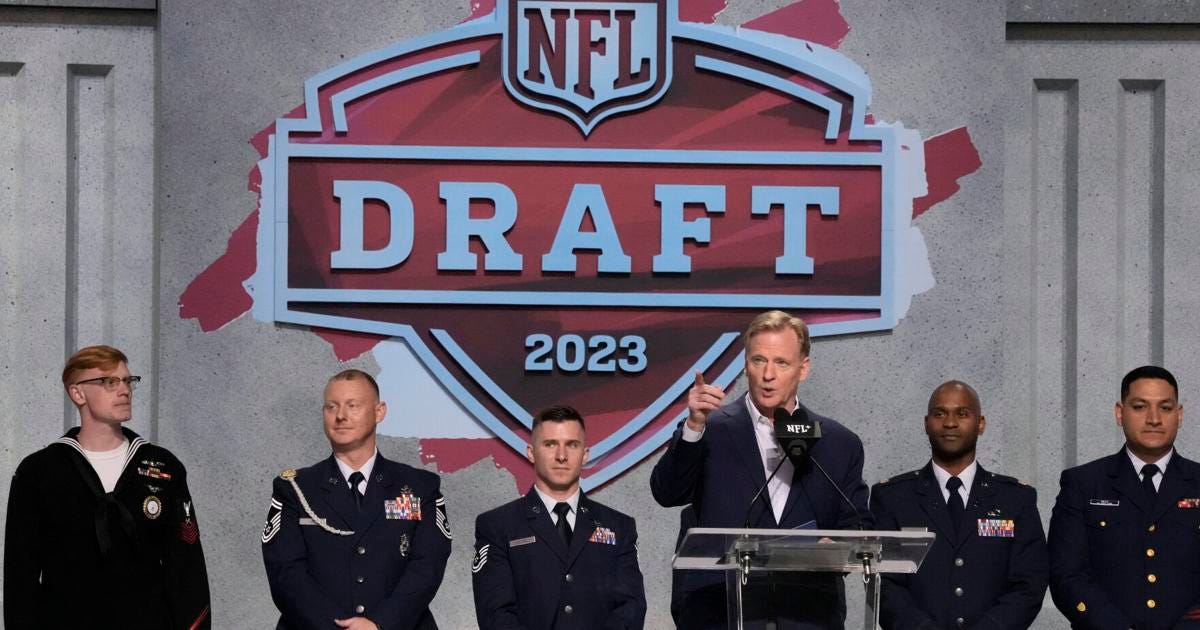
Speaking of the military and sports, day 2 of the NFL draft opened with an array of military personnel in dress uniform on the big stage in Kansas City as fans broke into “USA! USA!” chants. Yes, I understand there are a lot of football fans in the military, and I’m sure there were more than a few service members and veterans in civvies in the audience. Yet, ask yourself: What are military members in uniform doing on the stage at the NFL draft? What role are they playing?

WTF? Troops being used as props by the NFL. Cue the “USA! USA!” chants

The answer is obvious. The military uses sports to help with recruiting, and the NFL uses the military to burnish its patriotic image. It’s supposed to generate feel-good moments for the live audience there and all the millions watching at home, but it just left me shaking my head at the opportunism and cynicism of both the NFL and the Pentagon. 

Speaking again of the NFL draft, it’s curious how each team has a draft room of experts that is sometimes referred to as a “war” room. The NFL loves its military metaphors and its “warrior” players featuring quarterbacks with “howitzers” for arms who throw “missiles” downfield.

I’ve never been keen on the whole “warrior” mystique because I find it in direct opposition to the citizen-soldier ideal of America’s founders. America was not supposed to have a “warrior” caste like the British had, occupied by the second sons of the aristocracy who had nothing better to do than to wage colonial and imperial wars overseas in the cause of plunder and profit. But the warrior ideal has been all the rage in the U.S. military since the collapse of the Soviet Union, and especially since 9/11.

In a recent article for TomDispatch, Joshua Frank cited just such a sentiment (from 2007) by a troop suffering from Gulf War Syndrome: “I’m a warrior, and warriors want to fulfill their mission.”

This mentality that they’re mission-driven warriors has been drilled into U.S. troops.  But our troops are supposed to be loyal to the U.S. Constitution, not to the mission. If you’re simply a warrior, you exist for war, full stop. You’re no longer a citizen-soldier (or citizen-airman, etc.).  You’re not really a citizen at all.  Warriors are disposable, simply grunts, so who cares what happens to them? You live by the sword, you die by it, end of story.

I wish more people recognized the danger and implications of this warrior mentality.

Finally, a couple of recent articles to consider.  Chris Hedges writes about the enemy within, America’s vast military-industrial complex, that is sucking the life out of what’s left of American democracy. And Caitlin Johnstone writes about how America’s aggressive and imperial presence is always advertised and disguised as “defensive” in nature. Both articles are worth reading as an antidote to all the reflexive “USA! USA!” war chants.

America’s Forever Wars Have Come Home

Introduction by Tom Engelhardt at TomDispatch.com

Here’s a little portrait of the United States in June 2020, a passage from a New York Times report on the National Guard’s treatment of a recent protest march of people chanting “We can’t breathe!” in Washington, D.C.:

“A Black Hawk helicopter, followed by a smaller medical evacuation helicopter, dropped to rooftop level with its searchlights aimed at the crowd. Tree limbs snapped, nearly hitting several people. Signs were torn from the sides of buildings. Some protesters looked up, while others ran into doorways. The downward force of air from the rotors was deafening. The helicopters were performing a ‘show of force’ — a standard tactic used by military aircraft in combat zones to scatter insurgents.”

Talk about America’s wars coming home! George Floyd’s recent killing is both a long way, and yet not far at all, from the police shooting of the unarmed 18-year-old Michael Brown in Ferguson, Missouri, in 2014. Many Americans felt shocked then on seeing that city’s police force respond to the ensuing protests togged out in Pentagon-supplied gear of every sort, including sniper rifles and Humvees, often directly off the battlefields of this country’s ongoing wars. As Missouri Congressman Emanuel Cleaver put it then, referring to an Iraqi city largely destroyed by the U.S. military in 2004, “Ferguson resembles Fallujah.”

The question is: What does the U.S. resemble six years later? You know, I’m talking about the place that Secretary of Defense Mark Esper recently referred to as a “battle space” (as in “dominate the battle space”) in a contentious discussion he and President Trump had with the nation’s governors. I’m talking about the country where that same president has been threatening to call out the troops as police forces. (When retired military brass screamed bloody murder, Esper began backing down.) I’m talking about the land into which Arkansas Republican Senator Tom Cotton has the urge to send the 101st Airborne Division, or Screaming Eagles, whose assault troops have previously seen action in Afghanistan, Iraq, and Syria. (“If local politicians will not do their most basic job to protect our citizens, let’s see how these anarchists respond when the 101st Airborne is on the other side of the street.”)

Could you ever doubt that America’s wars would sooner or later come home in a big way? I suspect retired Air Force lieutenant colonel and historian William Astore didn’t. After all, he’s been writing for years at TomDispatch about how our former citizens’ military has, in those very wars, become the equivalent of a foreign legion. Fully militarizing the police and bringing the legionnaires home, a subject he explores today, seems like just the next obvious step in this country’s precipitous decline. Tom

“Light ‘Em Up”
Warrior-Cops Are the Law — and Above the Law — as Violence Grips America
By William J. Astore

From their front porches, regular citizens watched a cordon of cops sweep down their peaceful street in Minneapolis, Minnesota. Rankled at being filmed, the cops exceeded their authority and demanded that people go inside their houses. When some of them didn’t obey quickly enough, the order — one heard so many times in the streets of Iraqi cities and in the villages of Afghanistan — was issued: “Light ’em up.” And so “disobedient” Americans found themselves on the receiving end of non-lethal rounds for the “crime” of watching the police from those porches.

It’s taken years from Ferguson to this moment, but America’s cops have now officially joined the military as “professional” warriors. In the wake of George Floyd’s murder on May 25th, those warrior-cops have taken to the streets across the country wearing combat gear and with attitudes to match. They see protesters, as well as the reporters covering them, as the enemy and themselves as the “thin blue line” of law and order.

The police take to bashing heads and thrashing bodies, using weaponry so generously funded by the American taxpayer: rubber bullets, pepper spray (as Congresswoman Joyce Beatty of Ohio experienced at a protest), tear gas (as Episcopal clergy experienced at a demonstration in Washington, D.C.), paint canisters, and similar “non-lethal” munitions, together with flash-bang grenades, standard-issue batons, and Tasers, even as they drive military-surplus equipment like Humvees and MRAPs. (Note that such munitions blinded an eye of one photo-journalist.) A Predator drone even hovered over at least one protest.

Who needs a military parade, President Trump? Americans are witnessing militarized “parades” across the U.S.A. Their theme: violent force. The result: plenty of wounded and otherwise damaged Americans left in their wake. The detritus of America’s foreign wars has finally well and truly found its place on Main Street, U.S.A.

Cops are to blame for much of this mayhem. Video clips show them wildly out of control, inciting violence and inflicting it, instead of defusing and preventing it. Far too often, “to serve and protect” has become “to shoot and smack down.” It suggests the character of Eric Cartman from the cartoon South Park, a boy inflamed by a badge and a chance to inflict physical violence without accountability. “Respect my authoritah!” cries Cartman as he beats an innocent man for no reason.

So, let’s point cameras — and fingers — at these bully-boy cops, let’s document their crimes, but let’s also state a fact with courage: it’s not just their fault.

Who else is to blame? Well, so many of us. How stupid have we been to celebrate cops as heroes, just as we’ve been foolishly doing for so long with the U.S. military? Few people are heroes and fewer still deserve “hero” status while wearing uniforms and shooting bullets, rubber or otherwise, at citizens.

Answer me this: Who granted cops a specially-modified U.S. flag to celebrate “blue lives matter,” and when exactly did that happen, and why the hell do so many people fly these as substitute U.S. flags? Has everyone forgotten American history and the use of police (as well as National Guard units) to suppress organized labor, keep blacks and other minorities in their place, intimidate ordinary citizens protesting for a cleaner environment, or whack hippies and anti-war liberals during the Vietnam War protests?

Or think of what’s happening this way: America’s violent overseas wars, thriving for almost two decades despite their emptiness, their lack of meaning, have finally and truly come home. An impoverished empire, in which violence and disease are endemic, is collapsing before our eyes. “When the looting starts, the shooting starts,” America’s self-styled wartime president promised, channeling a racist Miami police chief from 1967. It was a declaration meant to turn any American who happened to be near a protest into a potential victim.

As such demonstrations proliferate, Americans now face a grim prospect: the chance to be wounded or killed, then dismissed as “collateral damage.” In these years, that tried-and-false military euphemism has been applied so thoughtlessly to innumerable innocents who have suffered grievously from our unending foreign wars and now it’s coming home.

How does it feel, America?

The End of Citizen-Soldiers, the End of Citizen-Cops

I joined the military in 1981, signing up in college for the Reserve Officer Training Corps, or ROTC. I went on active duty in 1985 and served for 20 years, retiring as a lieutenant colonel. I come from a family of firefighters and cops. My dad and older brother were firefighters, together with my brother-in-law and nephew. My niece and her husband are cops and my sister worked for her local police department for years. My oldest friend, a great guy I’ve known for half a century, recently retired as a deputy sheriff. I know these people because they’re my people.

Many cops — I’d say most — are decent people. But dress almost any cop in combat gear, cover him or her in armor like a stormtrooper out of Star Wars, then set all of them loose on the streets with a mandate to restore “LAW & ORDER,” as our president tweeted, and you’re going to get stormtrooper-like behavior.

Sure, I’d wager that more than a few cops enjoy it, or at least it seems that way in the videos captured by so many. But let’s remind ourselves that the cops, like the rest of America’s systems of authority, are a product of a sociopolitical structure that’s inherently violent, openly racist, deeply flawed, and thoroughly corrupted by money, power, greed, and privilege. In such a system, why should we expect them to be paragons of virtue and restraint? We don’t recruit them that way. We don’t train them that way. Indeed, we salute them as “warriors” when they respond to risky situations in aggressive ways.

Here’s my point: When I put on a military uniform in 1985, I underwent a subtle but meaningful change from a citizen to a citizen-airman. (Note how “citizen” still came first then.) Soon after, however, the U.S. military began telling me I was something more than that: I was a warrior. And that was a distinct and new identity for me, evidently a tougher, more worthy one than simply being a citizen-airman. That new “warrior” image and the mystique that grew up around it was integral to, and illustrative of, the beginning of a wider militarization of American culture and society, which exploded after the 9/11 attacks amid the “big-boy pants” braggadocio of the administration of President George W. Bush and Vice President Dick Cheney as they set out to remake the world as an American possession.

Why all the “warrior” BS? Why “Generation Kill” (one of those memorable phrases of the post-9/11 era)? Was it to give us a bit more spine or something to rally around after the calamity of those attacks on iconic American targets, or perhaps something to take pride in after so many disastrous wars over the last 75 years? It took me a while to answer such questions. Indeed, it took me a while to grasp that such questions were almost beside the point. Because all this warrior talk, whether applied to the military or the cops, is truly meant to separate us from the American people, to link us instead to wider systems of impersonal authority, such as the military-industrial-congressional complex.

By “elevating” us as warriors, the elites conspired to reduce us as citizens, detaching us from a citizen’s code of civics and moral behavior. By accepting the conceit of such an identity, we warriors and former warriors became, in a sense, foreign to democracy and ever more divorced from the citizenry. We came to form foreign legions, readily exploitable in America’s endless imperial-corporate wars, whether overseas or now here.

(Notice, by the way, how, in the preceding paragraphs, I use “we” and “us,” continuing to identify with the military, though I’ve been retired for 15 years. On rereading it, I thought about revising that passage, until I realized that was precisely the point: a career military officer is, in some way, always in the military. The ethos is that strong. The same is true of cops.)

In 2009, I first asked if the U.S. military had become an imperial police force. In 2020, we need to ask if our police are now just another branch of that military, with our “homeland” serving as the empire to be conquered and exploited. That said, let’s turn to America’s cops. They’re now likely to identify as warriors, too, and indeed many of them have served in America’s violent and endless wars in Afghanistan, Iraq, and elsewhere. These days, they’re ever more likely to identify as well with authority, as defined and exercised by the elites for whom they serve as hired guns.

In the aftermath of George Floyd’s murder, the warrior-mercenary mindset of the police has been fully exposed. For what was Floyd’s great “crime”? At worst, if true, an attempt at petty theft through forgery. He’d lost his job due to the Covid-19 crisis and, like most of us, was lucky if he saw a one-time check for $1,200, even as the rich and powerful enjoyed trillions of dollars in relief.

Rarely are the police sent to prosecute scofflaws in high places. I haven’t seen any bankers being choked to death on the street under an officer’s knee.  Nor have I seen any corporate “citizens” being choked to death by cops. It’s so much easier to hassle and arrest the little people for whom, if they’re black or otherwise vulnerable, arrest may even end in death.

By standing apart from us, militarized, a thin blue line, the police no longer stand with us.

A friend of mine, an Air Force retired colonel, nailed it in a recent email to me: “I used to — maybe not enjoy but — not mind talking to the police. It was the whole ‘community partners’ thing. Growing up and through college, you just waved at cops on patrol (they’d wave back!). Over the last five years, all I get is cops staring back in what I imagine they think is an intimidating grimace. They say nothing when you say hello. They are all in full ‘battle rattle’ even when directing traffic.”

When military “battle rattle” becomes the standard gear for street cops, should we be that surprised to hear the death rattle of black men like George Floyd?

Speaking Truth to Power Isn’t Nearly Enough

Perhaps you’ve heard the saying “speaking truth to power.” It’s meant as a form of praise. But a rejoinder I once read captures its inherent limitations: power already knows the truth — and I’d add that the powerful are all too happy with their monopoly on their version of the truth, thank you very much.

It’s not enough to say that the police are too violent, or racist, or detached from society. Powerful people already know this perfectly well. Indeed, they’re counting on it. They’re counting on cops being violent to protect elite interests; nor is racism the worst thing in the world, they believe, as long as it’s not hurting their financial bottom lines. If it divides people, making them all the more exploitable, so much the better. And who cares if cops are detached from the interests of the working and lower middle classes from which they’ve come? Again, all the better, since that means they can be sicked on protesters and, if things get out of hand, those very protesters can then be blamed. If push comes to shove, a few cops might have to be fired, or prosecuted, or otherwise sacrificed, but that hardly matters as long as the powerful get off scot-free.

President Trump knows this. He talks about “dominating” the protesters. He insists that they must be arrested and jailed for long periods of time. After all, they are the “other,” the enemy. He’s willing to have them tear gassed and shot with rubber bullets just so he can pose in front of a church holding a Bible. Amazingly, the one amendment he mentioned defending in his “law and order” speech just before he walked to that church was the Second Amendment.

And this highlights Trump’s skill as a wall-builder. No, I don’t mean that “big, fat, beautiful wall” along the U.S. border with Mexico. He’s proven himself a master at building walls to divide people within America — to separate Republicans from Democrats, blacks and other peoples of color from whites, Christians from non-Christians, fervid gun owners from gun-control advocates, and cops from the little people. Divide and conquer, the oldest trick in the authoritarian handbook, and Donald Trump is good at it.

But he’s also a dangerous fool in a moment when we need bridges, not walls to unite these divided states of ours. And that starts with the cops. We need to change the way many of them think. No more “thin blue line” BS. No more cops as warriors. No more special flags for how much their lives matter. We need but a single flag for how much all our lives matter, black or white, rich or poor, the powerless as well as the powerful.

How about that old-fashioned American flag I served under as a military officer for 20 years? How about the stars and stripes that draped my father’s casket after his more than 30 years of fighting fires, whether in the forests of Oregon or the urban tenements of Massachusetts? It was good enough for him and me (and untold millions of others). It should still be good enough for everyone.

But let me be clear: my dad knew how to put out fires, but once a house was “fully involved,” he used to tell me, there’s little you can do but stand back and watch it burn while keeping the fire from spreading.

America’s forever wars in distant lands have now come home big time. Our house is lit up and on fire. Alarms are being sounded over and over again. If we fail to come together to fight the fire until our house is fully involved, we will find ourselves — and what’s left of our democracy — burning with it.

A retired lieutenant colonel (USAF) and history professor, William Astore is a TomDispatch regular. He is proud to count many “first responders” in his immediate family. His personal blog is Bracing Views.

Copyright 2020 William J. Astore


Democracy and War

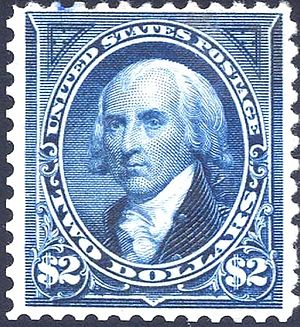
300px-James_Madison_1894_Issue-2$
James Madison knew that endless war is the harshest enemy of liberty

W.J. Astore

Democracies should be slow to start wars and quick to end them.  James Madison taught us that.  Why is America today the very opposite of this?

I thought of this as I read Danny Sjursen’s fine article at TomDispatch.com.  Sjursen, a retired Army major, is a strong critic of America’s forever wars.  He served in Iraq and Afghanistan and lost soldiers under his command.  He knows the bitter cost of war and expresses it well in his article, which I encourage you to read.  Here’s an excerpt:

Recently, my mother asked me what I thought my former students [West Point cadets] were now doing or would be doing after graduation. I was taken aback and didn’t quite know how to answer.

Wasting their time and their lives was, I suppose, what I wanted to say. But a more serious analysis, based on a survey of U.S. Army missions in 2019 and bolstered by my communications with peers still in the service, leaves me with an even more disturbing answer. A new generation of West Point educated officers, graduating a decade and a half after me, faces potential tours of duty in… hmm, Afghanistan, Iraq, or other countries involved in the never-ending American war on terror, missions that will not make this country any safer or lead to “victory” of any sort, no matter how defined.

Repetition.  Endless repetition.  That is the theme of America’s wars today.

Remember the movie “Groundhog Day,” with Bill Murray?  Murray’s character repeats the same day, over and over again.  He’s stuck in an infinite loop from which he can’t escape.  Much like America’s wars today, with one exception: Murray’s character actually learns some humility from the repetition.  He shows a capacity for growth and change.  And that’s how he escapes his loop.  He changes.  He grows.  The U.S. military’s leadership?  Not so much.

But I don’t just blame the senior leaders of the U.S. military.  They’re not that dumb.  It’s the system of greed-war they and we inhabit.  Why change endless war when certain powerful forces are endlessly profiting from it?  War, after all, is a racket, as General Smedley Butler knew.  It’s a racket that’s contrary to democracy; one that buttresses authoritarianism and even kleptocracy, since you can justify all kinds of theft in the cause of “keeping us safe” and “supporting our troops.”

Danny Sjursen, a true citizen-soldier, remembers that war is supposed to be waged in accordance with the Constitution and only to protect our country against enemies.  But being a citizen-soldier has gone out of style in today’s military.  Everyone is supposed to identify as a warrior/warfighter, which has the added benefit of suppressing thought about why we fight.

Eager to fight, slow to think, might be the new motto of America’s military.  Such a motto,  consistent with forever war, is inconsistent with democracy.

A Perpetual War Machine

52504708-6849-4bf7-99db-c88804164a6c
Fighting in Kabul in August. The Afghan capital is increasingly under attack by militants, highlighting the lack of Coalition progress in the war (Wakil Kohsar/AFP/Getty Images)

W.J. Astore

Scientists tell us a perpetual motion machine is impossible (that pesky 2nd law of thermodynamics about entropy), but America’s leaders are proving a perpetual war machine is quite possible, as events in Afghanistan prove.  The USA is now entering the 18th year of its Afghan war, with regress rather than progress being the reality of nearly a trillion dollars committed to this war.  At TomDispatch.com, Tom Engelhardt notes that “Though few realized it at the time [in 2001], the American people married war. Permanent, generational, infinite war is now embedded in the American way of life, while just about the only part of the government guaranteed ever more soaring dollars, no matter what it does with them, is the U.S. military.”  At Slate.com, Fred Kaplan notes that the Afghan War

has been going on for 17 years now… making it the longest war in American history. Yet we are no closer than we have ever been to accomplishing our objectives, in part because those objectives have been so sketchily, inconsistently, and unrealistically defined.

In fact, the Taliban is gaining strength; other jihadist groups, including ISIS and a revivified al-Qaida, are joining the fight (against the Afghan government, Western forces, and the Taliban); the Afghan Army is suffering casualties at an alarming rate; the chaos is spiraling to unsustainable levels.

Nevertheless, the USA persists in its folly.  There are many reasons for this, but I’d like to focus on one: the warrior ethos in the U.S. military.  “Warriors wanted,” say new U.S. Army TV ads and web campaigns.  The warrior ethos, according to the Army, compels us to never accept defeat.  Check out goarmy.com/warriors to get your lesson on America’s warrior ethos.  The site says the Army must be “unbeatable.”  The site says “We never accept defeat.”

But this is ridiculous.  All armies lose battles.  The greatest generals of history suffered setbacks. In fact, it’s often wise to accept defeat or to make a strategic retreat.  And some wars aren’t worth fighting to begin with.

Apply the warrior ethos to Afghanistan: The USA will never accept defeat. Which means the war will go on forever, since it never was ours to win to begin with.

Waging a no-win war is not a measure of warrior toughness; it’s a sign of stubborn stupidity.

America’s Surging Warrior Ethos

W.J. Astore

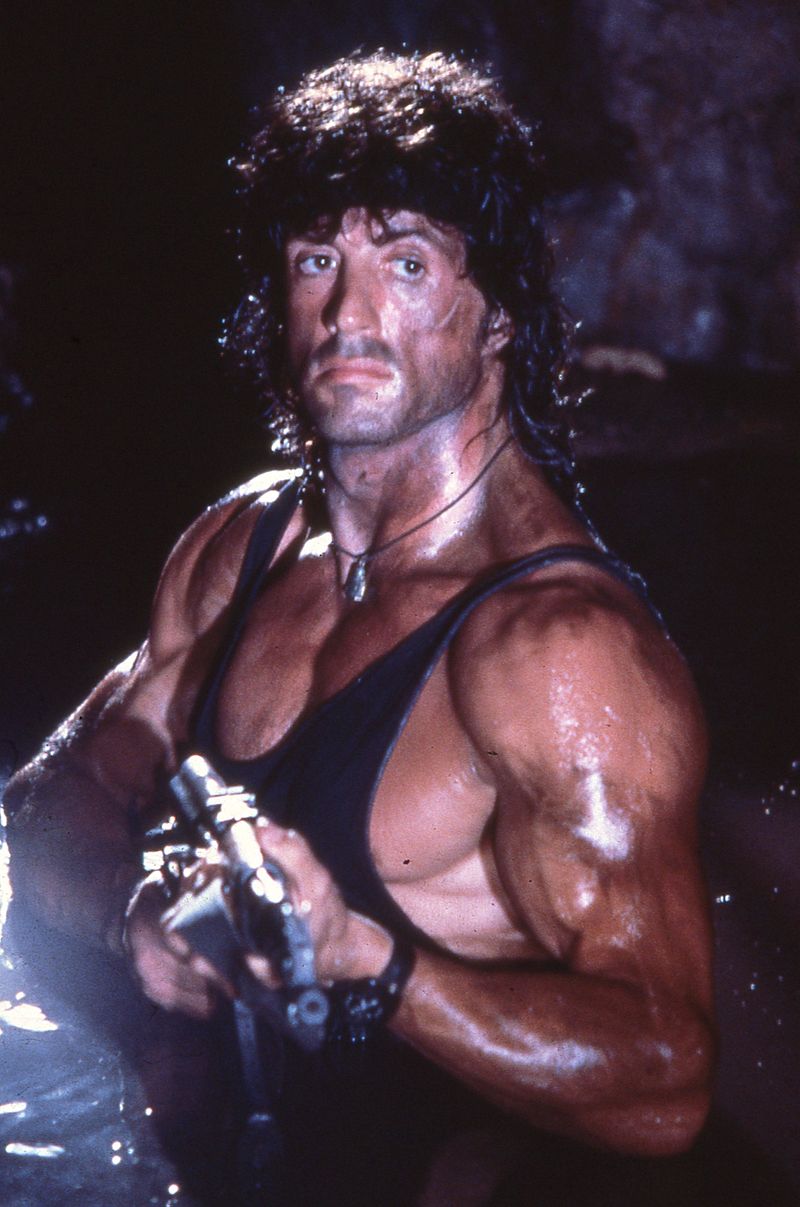
I’ve written a lot about America’s warrior ethos and how it represents a departure from a citizen-soldier ideal as embodied by men like George Washington and Major Dick Winters (of “Band of Brothers” fame).  This warrior ethos grew in the aftermath of defeat in Vietnam and the ending of the draft.  It gained impetus during the Reagan years and was symbolized in part by the development of fictional rogue symbols of warrior-toughness such as John Rambo.  Today’s U.S. military has various warrior codes and songs and so on, further reinforcing ideals of Spartan toughness.

John_Rambo
The Rambo Ideal: “Sir, Do We Get to Win This Time?” (Wiki)

My writings against this warrior hype have, on occasion, drawn fire from those who identify as warriors.  I’d like to share two examples.

Here is the first:

The day that we encourage our soldiers to be anything but warriors is the day that we start losing battles and wars. If we are controlled by citizens who are our ultimate leaders then it is up to them to handle the niceties of diplomacy and nation building.  But most of them don’t have the balls to get into the thick of things and try and convert the citizens of the place we are fighting to play at being nice children in the sand pile.  We had to dominate Japan to the nth degree to get them to surrender and so the same for Germany.  You academics never to cease to amaze me with your naïveté.

This reader cites World War II and America’s victory over Japan and Germany without mentioning the Greatest Generation’s embodiment of the citizen-soldier ideal and their rejection of Japanese and Nazi militarism.  Back then, America’s victory was interpreted as a triumph of democracy over authoritarian states like Japan and Germany.  While it’s true the Soviet Union played the crucial role in defeating Nazi Germany, the Soviets ultimately lost the Cold War, another “victory” by a U.S. military that didn’t self-identify as warriors.  Despite this history, this reader suggests that America’s recent military defeats are attributable to weak civilian leadership and a lack of warrior dominance.  He fails to notice how America’s new ethos of the warrior, inculcated over the last 30 years, has produced nothing close to victory in Iraq, Afghanistan, and elsewhere.

My second example comes from a U.S. Marine:

I watched the transition we made from life takers and widow makers to peace keepers and other terms that did us no good whatsoever.  Then, in 1987, along came a new Commandant, General Al Grey, who resurrected the warrior ethos in our Corps.

We were told, and accepted the fact, that the best way to win a war or battle was to kill the enemy in numbers that could not be sustained.  We did just that during Desert Storm.  I flew 67 combat missions in an F/A-18 and took great pride and satisfaction in killing as many Iraqis as I could so that when our infantry and other ground units pushed through the berms and other obstacles, they had a clear path to their objectives.

We need more emphasis on killing the enemy and maintaining a warrior ethos and less drivel from folks like you who think it’s some type of a debating match rather than combat we undertake when our nation goes to war.

Basically, this Marine argues that war is killing.  Kill enough of the enemy and you win.  Of course, winning by attrition and body count failed during the Vietnam War, but I’m guessing this Marine would argue that the U.S. military simply didn’t kill enough of the enemy there.

This Marine further sets up a straw man argument.  Nowhere did I write or even suggest that war is “some type of debating match.”  Nowhere did I write or even suggest that war doesn’t involve combat and killing.  But criticism of the warrior ideal is often caricatured in this way, making it easier to dismiss it as “naïve” or “drivel.”

The warrior ethos is surging in America today, and not just within the military.  Witness the U.S. media’s positive reaction to President Trump’s missile strikes on Syria or the use of “the mother of all bombs” against ISIS in Afghanistan.  Gushing media praise comes to presidents who let slip the “beautiful” missiles and “massive” bombs of war.

Two centuries ago, the rocket’s red glare, the bombs bursting in air, did so over an American fortress that was under attack on our soil.  They gave proof through the night that America’s citizen-soldiers were defending our country (our flag was still there).  Nowadays, our rocket’s red glare appears in Syrian skies, our bombs bursting do so in remote regions of Afghanistan, giving proof through the night that America’s warrior ethos is anywhere and everywhere, killing lots of foreign peoples in the name of “winning.”

Call me naïve, say I write drivel, but I don’t see this as a victory for our democracy, for our country, or even for our “warriors.”