Fat Generals Are the Problem!

Hegseth’s Absurdity Masks a Far Scarier Issue

BILL ASTORE

OCT 01, 2025

The military historian Dennis Showalter once told me that he didn’t care about the amount of fat around a general’s belly—he cared about the fat between a general’s ears. It was a telling quip, and one that highlights the shortsighted nature of Pete Hegseth’s emphasis on fitness and military bearing to the generals and admirals he assembled yesterday.

(By the way, what about Trump as commander-in-chief. Is he going to exercise and lose weight? Good luck with that one, Pomade Pete.)
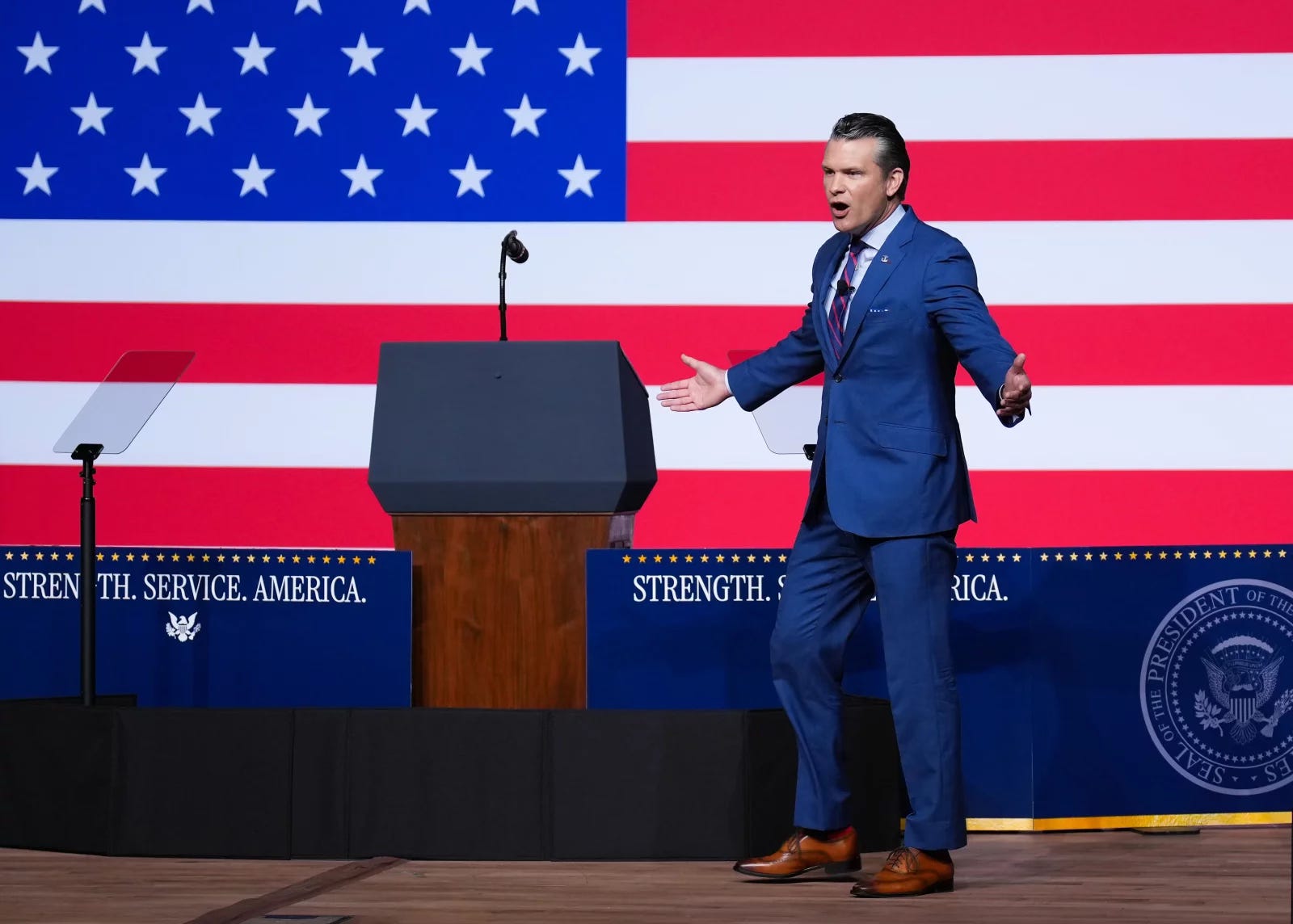
Pomade Pete Hegseth, Self-declared Secretary of War

Of course, physical fitness is important in military settings, especially if you’re at the pointy end of the spear, as they say in the military. But America’s senior leaders today are not “boy generals” like George Armstrong Custer in the U.S. Civil War. They are men and women in their fifties and early sixties, presumably promoted for their integrity, knowledge, insight, skill, and experience, not because they can still run sub-six minute miles or perform 100 pushups.

(Aside: It might be time to buy stock in Ozempic and similar drugs used for weight loss.)

Recall all the media praise showered on William Westmoreland, David Petraeus, and Stanley McChrystal. These three generals were lauded for their physical fitness and military bearing, their “spartan” qualities as warriors. And they all demonstrated strategic mediocrity in fighting and losing the Vietnam, Afghan, and Iraq Wars. They may not have had flabby bellies, but they had flabby minds.

Hegseth is all about “warrior” image over substance. Don’t get me wrong: I think everyone should exercise if they can, and being substantially overweight isn’t healthy. When I was in my early forties and a lieutenant colonel, I ran with the troops and did pushups and sit ups. But there’s a lot more to military effectiveness than being “a lean mean fighting machine.”

But I’ll admit I’m burying the lede here. Trump and Hegseth’s message to senior leaders was far more disturbing than complaints about a fat and woke military. Here’s what I sent to a friend about this:

The “national security” state has kept our country in a state of permanent war since 1947. Trump and Hegseth are just ripping the facade of “security” away and replacing it with “war.”

“Peace” is the word that dare not speak its name. And “war,” of course, has come to the streets of America, with troops deployed to Portland next. Add that to the many police who got their initial training in the military and the rapid expansion of ICE along with detention centers and it’s obvious how the war on terror has truly become global since now the focus is on terror in America.

We are reaping what we sowed …

I was then asked for a more formal comment and came up with this:

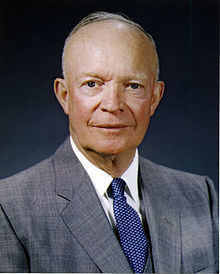
The statements of Trump and Hegseth show that the “global” war on terror was and is truly global (as well as permanent) because that war has now come home to America’s cities. Now places like LA and Portland are to be pacified by American “warriors” and warfighters, with detention centers (concentration camps) for those who resist. President Dwight D. Eisenhower was never more right or prescient when he noted, “Only Americans can hurt America.”

Trump and Hegseth see America’s streets as a battleground for the U.S. military against “the enemy within.” The real enemy to democracy, of course, is the very deployment of troops to the streets. American colonists launched a revolution 250 years ago partly because they didn’t want the king’s troops among them as enforcers.

Anyone who doesn’t see the fundamental dangers of Trump and Hegseth’s actions to democracy and our Constitutional rights truly has some flab between their ears.
The Global War on Terrorism

W.J. Astore 

“Global” includes the “homeland” here in America

There’s an important point about America’s Global War on Terrorism (GWOT) that people often miss.

When the Bush/Cheney administration announced the GWOT after 9/11, I think nearly all Americans assumed that “global” meant everywhere but the “good” countries.  That global meant the axis of evil (Iraq, Iran, North Korea) and similar so-called bad actors, but that it didn’t mean countries like Canada — and certainly not the U.S. homeland.

But global really did mean everywhere on earth as we’ve watched the war on terror escalate domestically.  The U.S. government/security state has built the foundation and superstructure for a permanent war on terror, and it simply isn’t going to go away. The Iraq and Afghan wars are essentially over (both lost), and fears of North Korea have subsided as the military-industrial-congressional complex focuses on Ukraine, Russia, and China, but the GWOT continues. It’s now turned inwards, within and along our own borders, and those techniques that were practiced (if not perfected) in Iraq, Afghanistan, and elsewhere are now being used and inflicted upon ordinary Americans who are attempting to resist state-corporate authoritarianism.

The GWOT has come home — but perhaps it’s always been here.  What’s changed is how state-corporate entities can define almost any form of determined protest—even civil and nonviolent ones—as “terror.” Labeling someone a “domestic terrorist” gives state-corporate actors a whole host of powerful ways to punish activists, notes by Michael Gould-Wartofsky at TomDispatch.com.

At the same time, America has witnessed the “rise of the warrior-cop,” as Radley Balko noted in his book by that title. 

Three years ago, I wrote about the militarization of police forces at TomDispatch. This is what I wrote then:

America’s violent overseas wars, thriving for almost two decades despite their emptiness, their lack of meaning, have finally and truly come home. An impoverished empire, in which violence and disease are endemic, is collapsing before our eyes. “When the looting starts, the shooting starts,” America’s self-styled wartime president [Donald Trump] promised, channeling a racist Miami police chief from 1967. It was a declaration meant to turn any American who happened to be near a protest into a potential victim 

As such demonstrations proliferate, Americans now face a grim prospect: the chance to be wounded or killed, then dismissed as “collateral damage.” In these years, that tried-and-false military euphemism has been applied so thoughtlessly to innumerable innocents who have suffered grievously from our unending foreign wars and now it’s coming home.

A few days ago, The Onion, a satirical news site, compared America’s obedience and passivity to power to the current situation in France. Here’s how they put it:

In an ongoing struggle against ruling-class oppression, the people of France again protested in a way that Americans are welcome to at any time, sources confirmed Thursday. According to reports, French citizens across the country were spotted hitting the streets en masse as a unified front against the institutional bondage that seeks to subjugate them while never failing to apply forceful pressure every time injustice strikes, which Americans can and should feel free to do whenever they so choose.

Yes, but are Americans truly “welcome” to protest “whenever they so choose”? We’d like to think so, especially as July 4th approaches (America! Land of the Free!), but who wants to be detained and thrown in jail for domestic terrorism? Anyone in America hankering to be labeled as a terrorist by the state, whether on the right or left of the political spectrum, even if the charge is eventually dismissed?

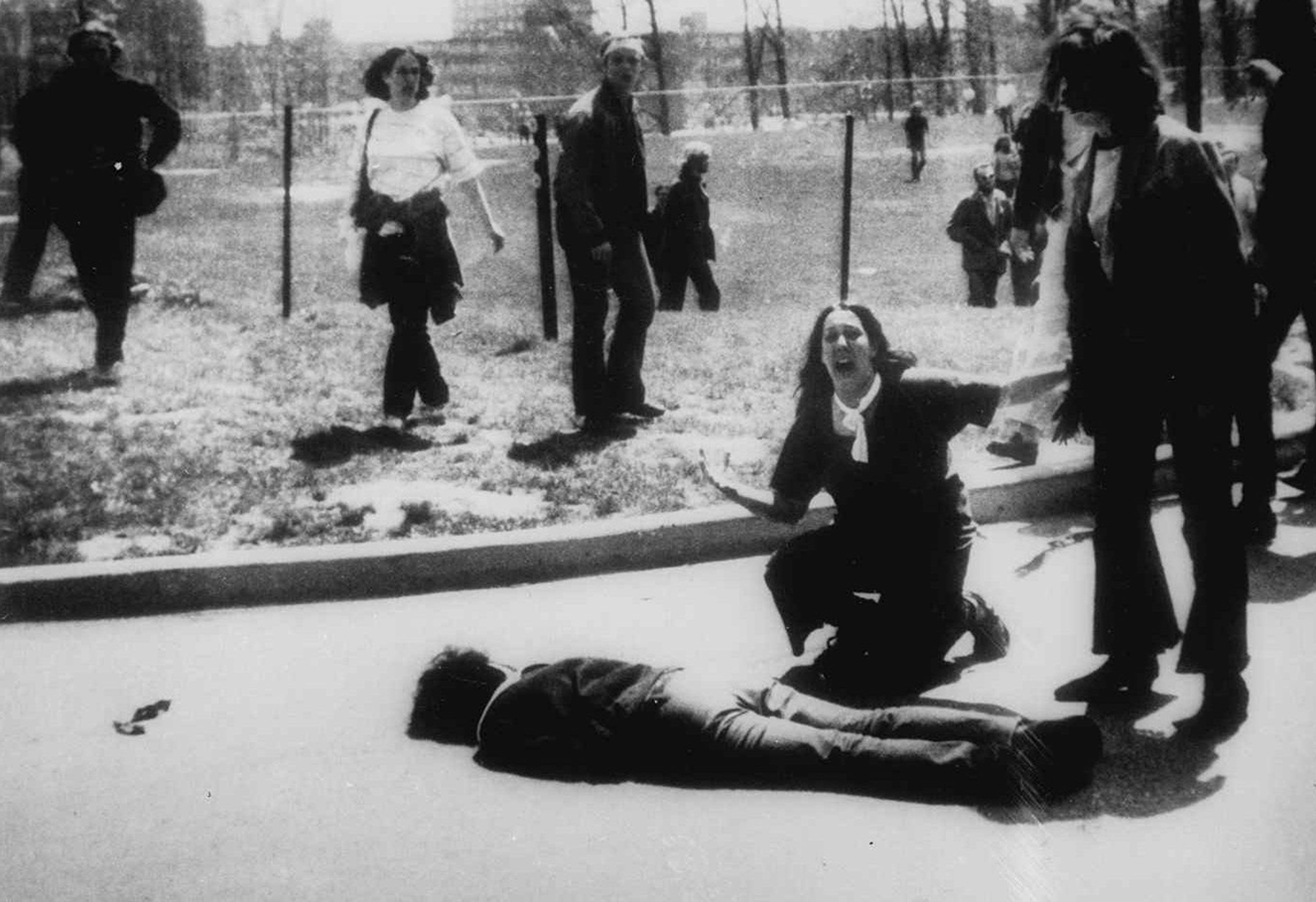
Searing photo of state violence at Kent State in 1970. The dead student’s name was Jeffrey Miller. The young woman crouched in shock and horror was Mary Ann Vecchio. Richard Nixon called the protesters “bums.” What would the state call them today—domestic terrorists?

Remember those innocent days of the 1960s when for some the police were “pigs” and the protesters were “bums” (Richard Nixon’s word for the students killed at Kent State)? Now those protesters could be charged with domestic terrorism even as various heavily armed enforcers of the law would likely be celebrated (consider all those “blue lives matter” flags, for example).

Remember when “defund the police” was briefly a thing? By which people meant less funding for militarized police forces and more for mental health services and the like. President Joe Biden and the Democrats realized any serious effort to restrain police power would leave them open to charges of being soft on crime, so Biden and the party simply declared: Fund the police. (Republicans concur, of course, even as they still accuse Biden and the Dems of being soft on crime.)

And there you have it. Fund the police at all levels, local, state, and federal, and grant them the kind of powers given to America’s “warriors” in the GWOT. Set them loose on all of America’s domestic “terrorists.” After all, the GWOT went so well in Iraq, Afghanistan, Libya, Yemen, and elsewhere. Surely it will go equally well in the Homeland. Right?

Addendum: In writing this, I came across a superb article by Patricia McCormick at the Washington Post on Mary Ann Vecchio, “the girl in the Kent State photo.” She was just 14 when the above photo was taken. She paid a high price, as the article recounts. Letters to her family accused her of being a “drug addict,” a “tramp,” or a “communist.” The then-governor of Florida suggested she was a “professional agitator” and therefore responsible for the students’ deaths. A Gallup poll back then, cited by McCormick, said that 58% of Americans blamed the students at Kent State and only 11% blamed the National Guardsmen who opened fire and killed the four students.

“Professional agitator” sounds much like today’s domestic terrorist. And let’s reflect on those 58% of Americans who believed the students at Kent State were responsible for their own deaths. How dare they block the free flight of “Made in USA” bullets with their young bodies? The “bums”! (“Domestic terrorists.”)

Civilians, the Forgotten Victims of War

W.J. Astore

You could fill libraries with books written about war campaigns, battles, generals, and weapons, but the amount of attention dedicated to civilians as victims of war is slim indeed. I’ve been browsing bookshelves for nearly fifty years for books on war, and for all the books on Rommel and Panzers and Patton and tanks and Lee and Grant and Jackson and Sherman that I’ve seen time and time again, I’ve only seen a couple of books dedicated to war and civilians as victims. One book I found was in a used bookshop in Woodstock in Oxfordshire in c.1993. Its title is “The Forgotten Victim: A History of the Civilian,” by Richard Shelly Hartigan, published in 1982.

In his preface, Hartigan wrote that he discovered In his research on “just war” theory that no single work existed on civilians as “innocent” noncombatants and how this status manifested itself in the history of warfare. More recently, Hugo Slim in 2008 wrote a book, “Killing Civilians: Method, Madness, and Morality in War” that also tackled this subject. I reviewed Slim’s book for the Michigan War Studies Review. Here’s how I began it:

Due to their vulnerability, civilians, not professional soldiers, usually suffer the most from war. They are, in fact, “the forgotten victim[s]” of war. Take today’s war and occupation in Iraq: whereas the U.S. military has lost about four thousand troops killed, the war and its resulting social and political chaos have caused at least 100,000 Iraqi civilian deaths (some estimates are higher by a factor of five or more). The wide variance in estimates for Iraqi civilian deaths in itself indicates the physical and moral messiness of modern wars (as well as the political agendas of the estimators). And, naturally, militaries count and commemorate their own dead more assiduously than those of civilians caught in the crossfire of combat …

Next, Slim details the “seven spheres of civilian suffering” in war, including genocide, massacre, torture, mass rape and sexual violence, involuntary movement, impoverishment, famine, disease, and emotional distress. His accounts are informed by historical examples as well as his own experiences working in humanitarian relief efforts in West and Central Africa. He reminds us that civilians often suffer long after wars are over, whether from psychological issues such as post-traumatic stress disorder (PTSD) or such detritus of war as unexploded munitions and mines.

Most civilians, Slim notes, “die from war rather than in battle“—with loss of identity and livelihood ultimately proving more deadly in the aggregate than bullets and bombs (91). His emphasis on loss of identity is especially telling. In war, people “lose themselves. Socially and personally, they are no longer the people they were …. If destitution, personal injury or rape has humiliated them and brought them very low, they may have lost that essential dignity and self-esteem which was the anchor of their sense of self and gave them the confidence with which to take their place in the world” (109-10). They have become strangers to themselves, and estranged as well from traditional communal networks of support.

Rarely did (or do) we hear in the U.S. mainstream media about civilian suffering and death from the Iraq and Afghan Wars, among other countries and peoples swept up in America’s still ongoing war on terror. Interestingly, the U.S. media is now reporting in harrowing detail about Ukrainian civilian casualties and alleged atrocities committed by Russian troops. What was very much kept in the background, and largely offstage, for America’s various wars has been foregrounded, often taking center stage, in the Russia-Ukraine War.

What we truly need is intense media coverage of civilian casualties in all wars, especially our own, and today’s article by Andrea Mazzarino at TomDispatch.com helps to rectify that need (along with a searing introduction by Nick Turse). Mazzarino’s title is telling: “the true costs of war,” including the suffering of innocents that so often goes unreported or is otherwise ignored. Here’s an excerpt:

It’s easy to forget how regularly soldiers kill and maim innocent civilians, sometimes deliberately.

According to our count, by 2022, some 387,000 civilians had been killed thanks to war’s violence in Afghanistan, Iraq, Pakistan, Syria, and Yemen. Civilian deaths similarly occurred in countries like Somalia where President Biden just redeployed hundreds of American troops in another round of the military offensive against the Islamic terror group al-Shabab (which has grown stronger in these years of all-American violence).

People living where the U.S. has fought have died in their homes and neighborhoods from bombings, shellings, missile attacks, and shootings. They’ve died while shopping for groceries or walking or driving to school or work. They’ve stepped on mines or cluster bombs while collecting wood or farming their fields. Various parties in our conflicts have kidnapped or assassinated people as they went about their everyday lives. Girls and women have purposely been raped as an attack on their communities. Human Rights Watch has documented how, in Afghanistan, parties on all sides of the war on terror, including troops and police allied with the United States, have raped, kidnapped, shot, or tortured civilians, including children.

The International Committee of the Red Cross defines war crimes as acts that are disproportionate to the military advantage sought, that do not distinguish between military and civilian targets, or that fail to take precautions to minimize injuries and loss of life among civilians. It was symbolically apt that the last U.S. drone strike in the Afghan capital, Kabul, as U.S. troops were withdrawing from our 20 year-old war there, reportedly killed three adults and seven children. And yet most Americans never seemed to take in how much civilians suffered from our war tactics, widely publicized as “surgical” and “precise” in their targeting of Islamic extremists, even as they now take in how the Russians are slaughtering Ukrainian civilians.

It’s high time we examine war in all its destructiveness and inhumanity. It’s high time we had far fewer books on “great captains” and “decisive weapons” and far more on the true costs of war. If we can stop glorifying war and start opening our eyes to all its horrors, we might finally act in a concerted nature to put a stop to it. A man can dream, right?

Let’s (Not) Go To War!

W.J. Astore

Remember the days when America had to be attacked before it went to war? And when it did, it made formal Congressional declarations of the same?

In December 1941, the Japanese attacked the U.S. Pacific Fleet at Pearl Harbor as well as elsewhere in the Pacific. In response to those attacks, President Franklin Roosevelt asked Congress for a formal declaration of war. Nazi Germany then declared war on the U.S., after which the U.S. responded in kind. Compared to the future wars of U.S. empire, Americans were generally united and had some understanding of what the war (World War II, of course) was about.

We haven’t had that kind of unity and clarity since 1945, which is certainly the biggest reason America has suffered so many setbacks and defeats in unpromising places like Vietnam, Iraq, and Afghanistan. In all three of those places, there really wasn’t a clear and compelling cause for war, hence there was no Congressional declaration of the same. Hmm … maybe that should have told us something?

In Vietnam, the Gulf of Tonkin Resolution by Congress followed on the heels of an “attack” that had never happened. In Iraq, the “evil dictator” didn’t have the weapons of mass destruction we accused him of having, nor had he played any role in the 9/11 attacks. In Afghanistan, the Taliban had played a secondary role in providing a safe haven to Osama bin Laden prior to 9/11, but it was Al Qaeda, not the Taliban, that was behind the 9/11 attacks.

Indeed, since 15 of the 19 Al Qaeda terrorists were Saudi, as well as their leader, Osama bin Laden, it would have made much more sense to have declared war on Saudi Arabia and invade that country than to have invaded Afghanistan. Of course, it made no sense at all to have declared a general “war on terror,” and rather unsurprisingly, that 20-year-war has only succeeded in spreading terror further.

Now we turn to today’s situation between Russia and Ukraine. Frankly, I don’t see a border dispute between these two countries as constituting a major threat to U.S. national security. It’s certainly no reason for America to go to war. Yet the Biden Administration is taking a hard line with its economic sanctions, its weapons shipments, and its troop deployments to the region.

Somehow, America’s leaders seem to think that such actions will deter, or at least punish, Russia and its leader. But there’s another possibility, one equally as likely, that sanctions and weapons and troops will lead to escalation and a wider war, and for what reason? A Russian-Ukrainian border dispute? This dispute might resolve itself if the U.S. and NATO just had the sense and patience to mind its own business.

A rush to war made sense in 1941, when the U.S. faced powerful and implacable enemies that were focused on its destruction. It hasn’t made sense since then, nor does it make sense today.

In short, let’s not go to war.

Bombing Kills Lots of Innocents: Who Knew?

W.J. Astore

Extensive U.S. bombing overseas kills lots of innocent people: who knew?

So this blinding statement of the obvious popped up in my email today from the New York Times:

A five-year Times investigation found that the U.S. air wars in Iraq, Syria and Afghanistan led to thousands of civilian deaths.
Hidden Pentagon records show a pattern of failures in U.S. airstrikes — a sharp contrast to the American government’s image of war waged by all-seeing drones and precision bombs.
The military’s own confidential assessments of over 1,300 reports of civilian casualties since 2014, obtained by The Times, lays bare how the air war has been marked by deeply flawed intelligence, rushed and often imprecise targeting and the deaths of thousands of civilians, many of them children. None of these failures resulted in a finding of wrongdoing. We are making these Pentagon records public.
This is the first of a two-part investigation. Here are the key takeaways.

Finally, at the end of 2021, the Times is willing to speak up against America’s murderous regimen of bombing overseas. I wrote about this myself at this site in 2016 and 2017, and I’m hardly the only person to have pointed this out. At TomDispatch.com, Tom Engelhardt has been reporting for years and years on wedding parties being wiped out by U.S. bombing missions based on “faulty intelligence.” The mainstream media have largely played down these atrocities until now, when the war in Afghanistan is finally (mostly) over, at least for the U.S.

As I wrote in 2013 for TomDispatch.com, airpower is neither cheap nor surgical nor decisive. Indeed, because it provides an illusion of effectiveness, and because America dominates the “high ground” of the air, all of this “precision” bombing serves to keep America in wars for far longer than is tenable on tactical grounds. Imagine how long the Iraq and Afghan wars would have lasted if America didn’t dominate the air, if the U.S. military had to rely exclusively on ground troops, and thus had suffered much higher casualties in ground combat. My guess is that these wars would have ended earlier, but “progress” could always be faked with all those statistics of bombs dropped and alleged “high value targets” eliminated.

I suppose it’s good to see the “liberal” New York Times cover this issue of murderous bombing after 20 years of the global war on terror. The question remains: why did it take them two decades to cover this issue in depth?

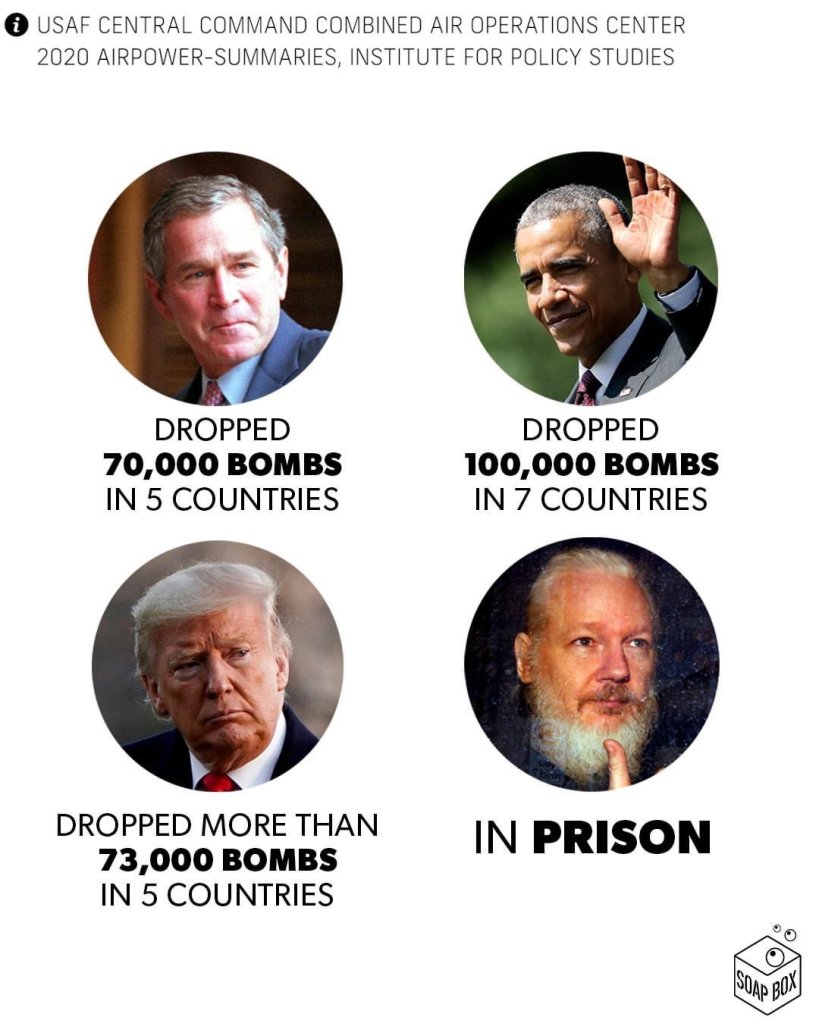
Presidents become “presidential” when they bomb other countries. Meanwhile, Julian Assange rots in prison. Maybe he needs to bomb a few countries?

Update (12/21/21)

More notes on U.S. bombing and the Times report, courtesy of ReThink Round Up:

“Not a single file [from the military about the bombings] includes a finding of wrongdoing. An effort within the military to find lessons learned to prevent future civilian harm was suppressed. An analyst who captures strike imagery even told the Times that superior officers would often “tell the cameras to look somewhere else” because “they knew if they’d just hit a bad target.”

Responding to the report, a Pentagon spokesperson acknowledged that preventing civilian deaths is not just a “moral imperative” but a strategic issue because civilian casualties can fuel recruiting for extremist groups. [New York Times/ Azmat Khan]”

*****

Again, to state the obvious here:

1. There’s no accountability in the system. Murderous mistakes are covered up and no one is held responsible (“tell the cameras to look somewhere else”).

2. The bombing attacks were counterproductive. Guess what? Killing innocents creates more “terrorists.” Who knew?

Murderous inaccuracy, making matters worse, with no accountability: WTF? So much for America’s “awesome” military, as Andrew Bacevich writes about today at TomDispatch.com.

How Awesome Is “Awesome”?

Never Forget — What?

W.J. Astore

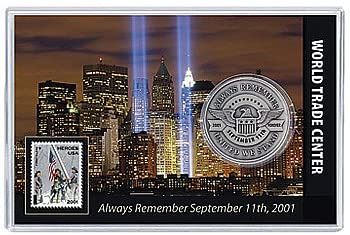
The 20th anniversary of the 9/11 attacks has come and gone. The theme I often heard was “never forget.” Never forget what, exactly? That we were attacked? All of us of a certain age remember 9/11. We remember where we were when we first heard the news. We remember the shock, the confusion, the sense of loss. We really don’t need to be reminded to “never forget.”

A similar phrase is “always remember.” Like “never forget,” it’s remarkably labile, much like Obama’s slogans of “hope” and “change.” And that’s the point. It’s vague while being emotive. It plays on our emotions without encouraging us to think.

So, let’s think critically for a moment. What should we “never forget”? We should never forget the victims, of course. The heroes. The first responders who gave their lives. And, by the way, why is Congress always so reluctant to provide health care to those first responders who worked so tirelessly in the dangerously unhealthy rubble of the Twin Towers? Let’s not forget them in their moments of need.

But what else shouldn’t we forget and “always remember”? I think we should remember the colossal failure of the Bush/Cheney administration to act on intelligence that indicated Al Qaeda was determined to strike in the U.S. We should remember the chaos generated by those attacks, and how our government responded so slowly, and with a measure of panic. And we should remember how quickly men like Bush and Cheney and Rumsfeld deflected any blame and took no responsibility for what can only be described as a massive defeat.

Also, it’s important to recall that 15 of the 19 hijackers were Saudi nationals, yet America’s leaders chose to invade Afghanistan and Iraq after announcing a global war on terror. In short, they used 9/11 as a pretext to embark on wars that they wanted to fight, wars of choice that proved disastrous, and for which they’ve largely evaded responsibility.

As a military historian, I’m also taken aback by our leaders choosing to rebrand 9/11 as “Patriot Day.” When the Japanese attacked Pearl Harbor on December 7th, 1941, America’s leaders didn’t rebrand that day as an occasion for patriotism. They recognized it was a date of infamy and declared war on the attacker.

It’s almost as if 9/11 has become a date of victimhood for the U.S. An old Air Force buddy of mine put it well recently in a message to me:

“It felt like it wasn’t about remembrance as much as just wallowing in self-pity. Interesting you bring up Pearl Harbor. Back then we went off and fought a 4-year war, beat our enemy, and helped them rebuild. For 9/11, we went off and fought a 20-year war, came home with our tails between our legs, and left our enemy more empowered. A celebration of victimhood, but not of honor.”

I like my friend’s appeal to honor. It’s an old-fashioned word that you hear rarely in America’s offices and corridors of power. Where is the honor in turning the 9/11 calamity into some kind of celebration of victimhood and patriotism?

As a historian, of course I want 9/11 to be remembered. But let’s not allow propaganda and cheap sentiment to shape our memories. And let’s “never forget” the failures of our leaders both before and after that date of infamy.

Twenty Years After 9/11

W.J. Astore

When the first hijacked plane hit the World Trade Center on 9/11/2001, I was at the Air Force Academy in Colorado Springs.  I was in my car, listening to the radio, just outside the North Gate, where a B-52 sits on static display as a symbol of American power. The first reports suggested it was an accident, but it soon became apparent it was a deliberate act.  As a second and then a third plane hit the WTC and the Pentagon, I remember hearing speculation that 9/11 could have a higher death toll than the Battle of Antietam, the single bloodiest day of the U.S. Civil War.  It was bad enough, if not that bad.

I remember confusion and chaos in the government, and the use of the word “folks” by President George W. Bush to describe the hijackers.  Very quickly, his rhetoric changed, and soon America would be launched on a global crusade against terrorists and other evildoers.

The flags came out and America came together, but that team spirit, so to speak, was quickly seized upon and exploited by Bush/Cheney to justify war anywhere and everywhere.  Good will was squandered and wise counsel was rejected in a calculated plot for power-projection disguised as righteous vengeance. Sweep everything up, related and unrelated, go big: those were the sentiments of Donald Rumsfeld, Dick Cheney, and crew.  They had failed so badly at protecting America on 9/11; they were not going to fail to use 9/11 for their own nefarious purposes.

And now, 20 years later, we’re witnessing how badly their hubris and dishonesty have damaged democracy in America, as well as damaging or destroying millions of lives around the globe.

After finishing my tour at the AF Academy in 2002, I became the Dean of Students at the Defense Language Institute at the Presidio of Monterey. I wonder how many of “my” young troops who so proudly crossed the stage with newly acquired language skills in Pashto and Dari and Arabic never made it home from Bush and Cheney’s GWOT, their “global war on terror.”

9/11 remains a traumatic day for America. It’s a day we remember where we were and what we were doing when we first learned of this horrific attack on our country. However briefly, 9/11 brought America together, but militarism and constant warfare along with prejudice and ignorance have served only to weaken our democracy while impoverishing our country.

This madness was on my mind as I recently re-watched “The City on the Edge of Forever,” a classic Star Trek episode in which history’s changed when Dr. McCoy travels back in time to 1930s America.  Here he saves the life of Edith Keeler, a social activist who, in an alternate timeline, delays U.S. entry into World War II, which allows the Nazis to develop the atomic bomb first, thereby winning the war.  Captain Kirk and Mr. Spock learn they must prevent McCoy from saving Keeler, which is complicated by the fact that Kirk falls hard for her.  She’s a visionary who speaks of space travel and a better world.  As Kirk courts her, Keeler says she dreams of a future in which all the money currently spent on war and death … and Kirk completes her thought by saying that that money will be spent instead on life.  Kindred spirits they are, Kirk and Keeler, yet to restore history to its proper place, he must let her die.

Joan Collins as Edith Keeler and William Shatner as Captain Kirk: Reaching for the stars

Keeler’s dream of peace – of all the trillions of dollars spent on weapons and war and death being instead spent on life – is the proper one, the right one, even as it was tragically premature.  For this she must die, forgotten to history, a bit player remembered only for running a small neighborhood mission for those with nowhere else to go.

I’ve always been attracted to science fiction and to plots both utopian, or at least hopeful, and dystopian.  But in the dystopia in which we increasingly find ourselves today, we need hopeful visions.  We need Edith Keelers.  But to use Star Trek-speak again, what I see issuing from the U.S. government is far more consistent with a Klingon Empire driven by war than a peaceful and life-affirming “federation” of planets.  The U.S. empire is not about to go quietly, nor will it go peacefully.

It’s time for a new course, a far less bellicose one, but a no less determined one, where Americans look within rather than without. Echoing Edith Keeler, let’s spend our money and resources on life, not death, love, not war. Let’s try that for the next 20 years. If we do, I bet we’ll be a lot better off in 2041 than we are today.

Why Can’t American Troops Just Leave Iraq?

W.J. Astore

The Biden administration says it wants to remove U.S. combat troops from Iraq. Hooray! Mission finally accomplished, right? It may be 18 years after George W. Bush declared it to be so, but who’s counting the years?

Not so fast. For President Biden still wants to keep roughly 2000 or so U.S. troops in Iraq for training and advisory purposes. So much for mission accomplished.

Why can’t U.S. troops just leave — for good? If Iraq can’t defend itself after nearly two decades of U.S. “training” in the war on terror, maybe it’s finally time to admit our limits (or our folly) and simply leave.

It almost seems like America’s system of “defense” is an imperial project — an effort to enlarge American power at almost any cost (and the Iraq war has cost America in the trillions of dollars).

This is the telling argument of Tom Engelhardt’s latest post at TomDispatch.com. The U.S. is the empire that dare not speak its name, even as it begins to collapse due to perpetual war externally and perpetual rancor internally. And, believe me, as former President Trump would say, those two are related. He should know, given how he tapped that rancor and aggravated it for his own purposes.

Here’s an excerpt from Engelhardt’s latest, where he points out what might be termed the Pentagon Paradox: The more America’s generals fail, the more they succeed (more money, more promotions, more power):

Still, let’s face it, this isn’t the set of conflicts that, once upon a time, involved invasions, massive air strikes, occupations, the killing of staggering numbers of civilians, widespread drone attacks, the disruption of whole countries, the uprooting and displacement of more than 37 million people, the deployment at one point of 100,000 U.S. troops in Afghanistan alone, and the spending of untold trillions of American taxpayer dollars, all in the name of fighting terror and spreading democracy. And think of it as mission (un)accomplished in the truest sense imaginable.

In fact, that idea of spreading of democracy didn’t really outlast the Bush years. Ever since, there’s been remarkably little discussion in official Washington about what this country was really doing as it warred across significant parts of the planet. Yes, those two decades of conflict, those “forever wars,” as they came to be called first by critics and then by anyone in sight, are at least winding, or perhaps spiraling, down — and yet, here’s the strange thing: Wouldn’t you think that, as they ended in visible failure, the Pentagon’s stock might also be falling? Oddly enough, though, in the wake of all those years of losing wars, it’s still rising. The Pentagon budget only heads ever more for the stratosphere as foreign policy “pivots” from the Greater Middle East to Asia (and Russia and the Arctic and, well, anywhere but those places where terror groups still roam).

Buy the Book

In other words, when it comes to the U.S. military as it tries to leave its forever wars in someone else’s ditch, failure is the new success story.

And how! Maybe we need a new saying in America: Nothing succeeds like failure. It’s truly paradoxical until you realize that someone is always winning and profiting from this failure, even as the rest of America suffers.

Engelhardt’s book above has a well-judged title: “A Nation Unmade By War.” But perhaps we can improve it? How about “An Empire Unmade By War”?

America Is Programmed for War

W.J. Astore

In my latest article for TomDispatch, I write that America is programmed for war. It’s a feature of our polity and our politics and our culture, not a bug. In some sense, we are a country made by war, and that’s not a good feature for a self-avowed democracy to have. Here’s an excerpt:

Why don’t America’s wars ever end?

I know, I know: President Joe Biden has announced that our combat troops will be withdrawn from Afghanistan by 9/11 of this year, marking the 20th anniversary of the colossal failure of George W. Bush and Dick Cheney to defend America.

Of course, that other 9/11 in 2001 shocked us all. I was teaching history at the U.S. Air Force Academy and I still recall hushed discussions of whether the day’s body count would exceed that of the Battle of Antietam, the single bloodiest day of the Civil War. (Fortunately, bad as it was, it didn’t.)

Hijacked commercial airliners, turned into guided missiles by shadowy figures our panicky politicians didn’t understand, would have a profound impact on our collective psyche. Someone had to pay and among the first victims were Afghans in the opening salvo of the misbegotten Global War on Terror, which we in the military quickly began referring to as the GWOT. Little did I know then that such a war would still be going on 15 years after I retired from the Air Force in 2005 and 80 articles after I wrote my first for TomDispatch in 2007 arguing for an end to militarism and forever wars like the one still underway in Afghanistan.

Over those years, I’ve come to learn that, in my country, war always seems to find a way, even when it goes badly — very badly, in fact, as it did in Vietnam and, in these years, in Afghanistan and Iraq, indeed across much of the Greater Middle East and significant parts of Africa. Not coincidentally, those disastrous conflicts haven’t actually been waged in our name. No longer does Congress even bother with formal declarations of war. The last one came in 1941 after Pearl Harbor. During World War II, Americans united to fight for something like national security and a just cause. Today, however, perpetual American-style war simply is. Congress postures, but does nothing decisive to stop it. In computer-speak, endless war is a feature of our national programming, not a bug.

Two pro-war parties, Republicans and Democrats, have cooperated in these decades to ensure that such wars persist… and persist and persist. Still, they’re not the chief reason why America’s wars are so difficult to end. Let me list some of those reasons for you. First, such wars are beyond profitable, notably to weapons makers and related military contractors. Second, such wars are the Pentagon’s reason for being. Let’s not forget that, once upon a time, the present ill-named Department of Defense was so much more accurately and honestly called the Department of War. Third, if profit and power aren’t incentive enough, wars provide purpose and meaning even as they strengthen authoritarian structures in society and erode democratic ones. Sum it all up and war is what America now does, even if the reasons may be indefensible and the results so regularly abysmal.

Support Our Troops! (Who Are They, Again?)

The last truly American war was World War II. And when it ended in 1945, the citizen-soldiers within the U.S. military demanded rapid demobilization — and they got it. But then came the Iron Curtain, the Cold War, the Korean War, fears of nuclear Armageddon (that nearly came to fruition during the Cuban Missile Crisis in 1962), and finally, of course, Vietnam. Those wars were generally not supported — not with any fervor anyway — by the American people, hence the absence of congressional declarations. Instead, they mainly served the interests of the national security state, or, if you prefer, the military-industrial-congressional complex.

Ike knew the score

That’s precisely why President Dwight D. Eisenhower issued his grave warning about that Complex in his farewell address in 1961. No peacenik, Ike had overseen more than his share of military coups and interventions abroad while president, so much so that he came to see the faults of the system he was both upholding and seeking to restrain. That was also why President John F. Kennedy called for a more humble and pacific approach to the Cold War in 1963, even as he himself failed to halt the march toward a full-scale war in Southeast Asia. This is precisely why Martin Luther King, Jr., truly a prophet who favored the fierce urgency of peace, warned Americans about the evils of war and militarism (as well as racism and materialism) in 1967. In the context of the enormity of destruction America was then visiting on the peoples of Southeast Asia, not for nothing did he denounce this country as the world’s greatest purveyor of violence.

Collectively, Americans chose to ignore such warnings, our attention being directed instead toward spouting patriotic platitudes in support of “our” troops. Yet, if you think about it for a moment, you’ll realize those troops aren’t really ours. If they were, we wouldn’t need so many bumper stickers reminding us to support them.

With the military draft gone for the last half-century, most Americans have voted with their feet by not volunteering to become “boots on the ground” in the Pentagon’s various foreign escapades. Meanwhile, America’s commanders-in-chief have issued inspiring calls for their version of national service, as when, in the wake of 9/11, President George W. Bush urged Americans to go shopping and visit Disney World. In the end, Americans, lacking familiarity with combat boots, are generally apathetic, sensing that “our” wars have neither specific meaning to, nor any essential purpose in their lives.

As a former Air Force officer, even if now retired, I must admit that it took me too long to realize this country’s wars had remarkably little to do with me — or you, for that matter — because we simply have no say in them. That doesn’t mean our leaders don’t seek to wage them in our name. Even as they do so, however, they simultaneously absolve us of any need to serve or sacrifice. We’re essentially told to cheer “our” troops on, but otherwise look away and leave war to the professionals (even if, as it turns out, those professionals seem utterly incapable of winning a single one of them).

Please read the rest of my article here at TomDispatch.com.

War and Meaninglessness in America

W.J. Astore

Joe Biden is America’s new president, but nothing has changed on the war front. In Iraq, a U.S. airstrike has killed the top leader of the Islamic State, notes today’s New York Times. The paper notes that “the United States has about 2,500 troops left on three Iraqi military bases. While Iraqi capability in fighting the Islamic State group has improved, the country still relies on intelligence, surveillance assets and air support from the US-led coalition.”

Remember when U.S. forces pulled out of Iraq at the end of 2011? Of course, despite all the military training and equipment the U.S. showered on a new Iraqi military, that military totally collapsed in 2014 under pressure from the Islamic State. Naturally, the U.S. military took no blame, even as the collapse opened a door for more U.S. military intervention. And so the fighting persists, but at a low-enough level that it stays off of most American radar screens.

Revealingly, this is how the Iraqi parliament responded to the latest U.S. “victory” on terror: “After the drone strike, the Iraqi parliament passed a resolution demanding the government expel US forces from Iraq, a move that has not been implemented.”

Do you think President Biden will listen to the Iraqi parliament and withdraw U.S. troops once and for all?

War has been made much too easy in America. Imagine if Joe Biden, or Donald Trump, or Barack Obama, or George W. Bush, actually had to lead troops from the front, exposing themselves to potential harm as they waged America’s wars overseas. It’s easy to sit in the Oval Office and push paper that translates into killing people. I’m not getting nostalgic for the age of Napoleon or the time of kings and queens, but there’s something to be said for physical and moral courage and a willingness to sacrifice oneself for what one believes.

This put me to mind of a passage from Tana French’s novel, “The Likeness,” from 2008. French writes the following “rant” for one of her characters:

“Look at the old wars, centuries ago: the king led his men into battle.  Always.  That was what the ruler was: both on a practical level and on a mystical one, he was the one who stepped forwards to lead his tribe, put his life at stake for them, become the sacrifice for their safety.  If he had refused to do that most crucial thing at that most crucial moment, they would have ripped him apart—and rightly so: he would have shown himself to be an impostor, with no right to the throne.  The king was the country; how could he possibly expect it to go into battle without him?  But now…Can you see any modern president or prime minister on the front line, leading his men into the war he’s started?  And once that physical and mystical link is broken, once the ruler is no longer willing to be the sacrifice for his people, he becomes not a leader but a leech, forcing others to take his risks while he sits in safety and battens on their losses.  War becomes a hideous abstraction, a game for bureaucrats to play on paper; soldiers and civilians become mere pawns, to be sacrificed by the thousands for reasons that have no roots in any reality.  As soon as rulers mean nothing, war means nothing; human life means nothing.  We’re ruled by venal little usurpers, all of us, and they make meaninglessness everywhere they go.” (pages 320-21, emphasis added)

Tana French

It’s a powerful passage that has much to say about America’s seemingly eternal wars against someone somewhere.

For America’s rulers, war has largely become “kinetic action” at an entirely safe distance, so far away as to become almost an imaginary construct, except for the vast profits earned from it. To most Americans, as French suggests, it has become an exercise in meaninglessness. And whatever else war is or should be, it should have meaning, otherwise it’s just killing for nothing.