War and Rumors of War

Dick Cheney Is Dead

BILL ASTORE

NOV 04, 2025

War and rumors of war dominate the headlines. Venezuela. Nigeria. Iran. Somalia. A “new Cold War” involving Russia and China. What are we to believe?

The events of the 62 years of my short life (Vietnam, Afghanistan, Iraq, Libya, peace dividends that never arrive, military budgets that keep soaring, U.S. domination of the world’s weapons trade, the National Security State as America’s fourth and arguably most powerful branch of government, and on and on) make me highly suspect of official narratives about any war, especially as those same Pentagon budgets soar and those same arms exports keep flooding the world in the (false) name of democracy.

Nevertheless, warmongers in our country continue to shout and bray for more war. Those who make the most noise are typically the furthest from the fighting. Typically, the closer you are to the fighting, the more you want it to stop. Especially if you’re doing the fighting. Consider Erich Maria Remarque’s “All Quiet on the Western Front.” When the main character, Paul, a frontline grunt, goes home on leave, he realizes the blood-thirstiness of the REMFs is far different from the war he’s seeing at the front. (REMF, rear-echelon mother-fucker, is a colorful and meaningful military acronym.)

Often those who talk about war use the most bloodless expressions. So, for example, I’ve read that Ukrainians must “prosecute their war of defense,” helped by generous supplies of American-made weaponry. When I think of war, I think of the concrete. Blasted bodies, a poisoned environment, disease, dead animals, PTSD and TBI, moral injury, atrocities and war crimes (because wars always produce atrocity), and so on. Phrases like “help Ukraine prosecute their war of defense” strike me as Orwellian in the sense of his classic essay on politics and the English language. It sounds good and noble, but how ready are those who support Ukraine to join the cause in the trenches?

An American president now speaks of “the enemy within” and city streets as a training ground for U.S. military action. When everything is war, nothing is safe as the worst crimes and atrocities become possible.

As a young man, Cheney had “other priorities” than serving in the U.S. military. Later, the further he was from battle, the more hawkish he became.

Postscript: As I was writing this, I learned that Dick Cheney has died at the age of 84. NBC News described him as the “Iraq war architect,” as if he was a highly skilled and creative builder instead of a war criminal. A reader sent along a BBC headline that suggests there was “faulty” intelligence leading up to the Iraq war in 2003, as if Cheney had no hand in manufacturing a malicious and mendacious narrative of weapons of mass destruction in Iraq.

Even warmongers like Cheney, proud of their mailed fists, get treated and fitted with kid gloves by a fawning media. Of course, Cheney, when he had an opportunity to serve in Vietnam, famously said he had other priorities.

Maybe the American people, collectively, need to say we have other priorities than waging war around the globe.

Should Senior Military Officers Consider Resigning?

Several Coordinated Resignations Based on Principle Could Make a Difference

BILL ASTORE

OCT 07, 2025

Should senior military officers consider resigning?

The short answer is yes—if they believe the orders they are given violate their oath to the U.S. Constitution.

In practice, however, resigning for cause is exceedingly rare. The military is a culture of conformity and hierarchy, where resignation is often seen as an act of rebellion—a threat to cohesion and discipline. Officers are taught to work quietly within the system, to suppress doubts, and to remain “loyal” to superiors and to the institution itself. Few are willing to resign openly on moral or legal grounds.

For senior officers, the decision to resign in protest is especially difficult. Colonel David Hackworth, one of the most decorated soldiers of the Vietnam era, resigned after concluding the war was unwinnable—not because he viewed it as unconstitutional. Earlier, General Harold K. Johnson, the Army Chief of Staff under President Lyndon Johnson, considered resigning in protest of the administration’s Vietnam policies but ultimately stayed, hoping to influence policy from within. He later regretted that decision, admitting he had lacked the moral courage to resign.

Both Hackworth and Johnson objected to how the war was fought, not to whether it was lawful. That distinction is crucial.

Senior officers today may likewise convince themselves that remaining in uniform allows them to do the most good—to temper reckless orders from within the system. Resignation, after all, feels like quitting. And there’s an unspoken incentive to stay: the lucrative post-retirement opportunities awaiting those who keep faith with the military-industrial complex.

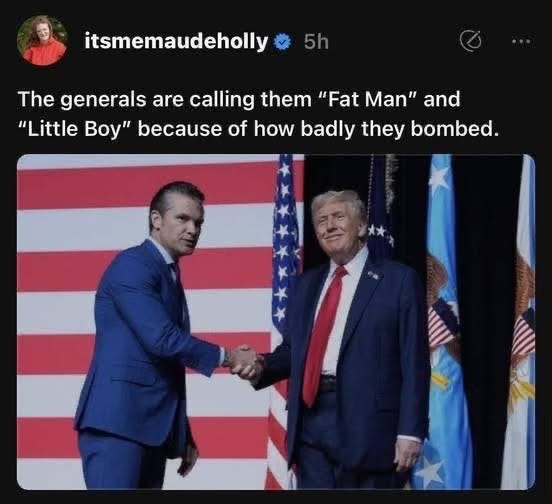
Given the recent clownish and dangerous behavior of Trump and his defense war secretary, Pete Hegseth, one hopes that senior military leaders are at least preparing for the possibility of resignation—keeping their powder dry until a clear line is crossed. Arguably, that line may already have been crossed.

One resignation might not change much. But several coordinated resignations—anchored in principle—could. The question is whether today’s generals and admirals have the moral courage to do so when the moment arrives.

Trump and Hegseth appear to have neutralized much of the brass by flooding the Pentagon with money. But will those same leaders, drunk on budgets and contracts, have the courage to resist illegal orders and yet another series of wars launched on dubious grounds?

Already, Trump and Hegseth have issued extrajudicial orders—such as the recent killings of suspected smugglers on three speedboats in the Caribbean, ostensibly part of the “war on drugs.” They have deployed active-duty troops to U.S. cities under partisan pretexts that appear to violate the spirit, if not the letter, of the Posse Comitatus Act of 1878. And more attacks on Iran—without any declaration of war—may be imminent.

Given all this, there is ample reason for senior officers to consider coordinated resignations in protest. The question is whether they will summon the moral courage to do what is right—to uphold their oath by walking away.

Perhaps they could call it Operation Just Cause—an operation without bombs or killing, requiring that rarest of things: moral courage.

Learning the Wrong Lessons from the Vietnam War

My Interview with Dick Price at the LA Progressive

BILL ASTORE

MAY 16, 2025

Yesterday, I talked to Dick Price, a Vietnam War veteran, at the LA Progressive about the U.S. military, the Vietnam War, the all-volunteer military, media coverage, and why America just can’t stop making war.

When no one is held accountable for failure, when lies are used as the basis for killing, when war produces colossal profits for a select few, when Congress refuses to take responsibility for oversight, when war budgets keep climbing to the trillion dollar mark, it isn’t all that surprising that wars prove essentially endless as democracy withers.

U.S. Elites Learned Much from the Vietnam Defeat

W.J. Astore

To them, the right lessons; to everyone else, the wrong ones

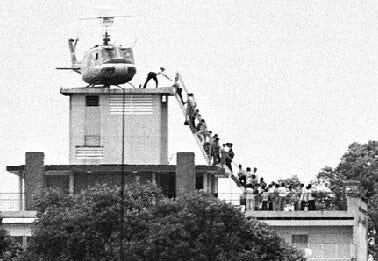
We just marked the 50th anniversary of the Fall of Saigon on April 30, 1975. Did American officials learn anything from the disastrous Vietnam War?

Saigon, April 1975

Of course they did. Just not the lessons you’d have wished they’d learned.

So, what did they learn?

  • They learned that wars can indeed last forever, but that Vietnam wasn’t the best “forever war” for the military-industrial complex because it became deeply unpopular and was disrupting cohesion within the military itself. The best forever wars are open-ended “wars” like the global war on terror. And perhaps a “new Cold War” with Russia and/or China. Wars that don’t involve the deployment of over half a million men (unless that “new” Cold War turns hot).
  • They learned to control the narrative. No more journalists traveling freely in war zones as in the 1960s in Vietnam. Journalists are now most often embedded in U.S. military units. Embedded reporters, dependent on the military for access and protection, know what they can and can’t say, even as they tend to sympathize with the troops they’re with.
  • They learned that forced conscription via a draft doesn’t work well for unpopular wars. So they transformed the military into an “all-volunteer” force. Draftees may well be resentful, rightly so, but volunteers? Too bad—they volunteered for this.
  • Along with “volunteers,” they learned to indoctrinate U.S. troops to be “warriors” and “warfighters” rather than citizen-soldiers. Warriors exist to fight wars, so shut up and blast away.
  • They learned to keep the American people isolated from war and its deadly effects. Recall that under Bush/Cheney, Americans weren’t even allowed to see flag-draped caskets. During Vietnam, war was in America’s living rooms during dinner, complete with body counts. Coverage of wars in Iraq, Afghanistan, and elsewhere was sanitized, almost bloodlessly so.
  • They learned never to talk of sacrifice (except by those volunteer warriors) by the American people. Taxes aren’t raised in the name of war. There are no war bond drives. America’s leaders tell the rest of us to enjoy life, to visit Disney and to go shopping, while “our” warriors fight overseas.

Together with those “lessons,” they continue to preach “peace through strength,” attacking those who truly seek peace as misguided (at best) and treasonous (at worst). As ever, they tend to attack those who’d dare criticize the U.S. military as ungrateful backstabbers. And of course they consistently obscure the truth of how poorly wars like Iraq and Afghanistan were going while holding no one in the upper echelons responsible and accountable for rampant corruption and disastrous endings.

All these “lessons” ensured that Vietnam wouldn’t be the last example of hubris, folly, and atrocity, and indeed it hasn’t been. Until the right lessons are learned, expect future repeats, tragic variations on a theme of Vietnam.

Wars As Money-Laundering Operations

W.J. Astore

Even in Losing Wars, Somebody Always Wins …

“Fighting a war to fix something works about as good as going to a whorehouse to get rid of a clap.” — Norman Mailer, The Naked and the Dead

I read Norman Mailer’s fine book about World War II, “The Naked and the Dead,” several years ago, though I’d forgotten the quote above until I ran across it again in an article by Andrew Bacevich at Harper’s in 2009.

Bacevich’s article was titled “The War We Can’t Win,” in which he critiqued and rejected President Barack Obama’s decision to “surge” in Afghanistan. As Bacevich wrote back in 2009:

What is it about Afghanistan, possessing next to nothing, that the United States requires, that justified such lavish attention? In Washington, this question goes not only unanswered but unasked. Among Democrats and Republicans alike, with few exceptions, Afghanistan’s importance is simply assumed—much the way fifty years ago otherwise intelligent people simply assumed that the United States had a vital interest in ensuring the survival of South Vietnam. Today, as then, the assumption does not stand up to even casual scrutiny.

Bacevich was right, of course. And once America pulled out of Afghanistan in 2021, we were encouraged to forget about it, just as we were encouraged to forget about Vietnam after the fall of Saigon in 1975.

If it doesn’t matter much to the U.S. when we lose wars, doesn’t that suggest the wars meant little to begin with? That there never truly were vital matters of national interest at stake?

The same was true of the Iraq War, as Bacevich describes it in the same article for Harper’s. This war, Bacevich writes, was “utterly needless” as “no Iraqi weapons of mass destruction [were] found, no ties between Saddam Hussein and the [9/11] jihadists established, no democratic transformation of the Islamic world set into motion, no road to peace in Jerusalem discovered in downtown Baghdad,” yet the U.S. was nevertheless hyping the success of the “surge” there from 2007 and how it should be applied to Afghanistan, an example of obtuseness and self-delusion that Bacevich said “is nothing short of obscene.”

He was right, of course, as both surges proved as fragile and reversible as weasel-worded General David Petraeus hinted they would be. Petraeus might be America’s best example of Grima Wormtongue from “The Lord of the Rings,” though of course there’s a lot of competition for that honor.

Bacevich, a retired Army colonel, political scientist, and Vietnam War veteran, criticizes U.S. leaders for their “failure of imagination,” for their crusading zeal, for their hubris, and for their tendency to substitute technique for sound strategy. He is right about all this, but someone always profits from war. Somebody always wins. And so perhaps the best way to understand these wars is to focus on the winners.

So, who won these wars? Certainly, the military-industrial complex won them. Every war, winning or losing, wise or unwise, strengthens the MIC by expanding its budgetary authority and scope of action. Military contractors, the merchants of death, especially profit from war, notably long “stalemated” ones like Vietnam, Iraq, and Afghanistan. 

In a short video clip, Wikileaks Founder Julian Assange explained the purpose of the Afghan War which, as Bacevich mentions above, is inexplicable in terms of U.S. national interest:

A vast money-laundering operation that enriches oligarchs who profit from war, death, and mayhem: it makes a lot of sense, doesn’t it? Note too how Assange explains that the ultimate purpose here is to make war permanent, to make it normal, to make it unremarkable, even to make it the height of sanity.

This has happened and is happening. Today, Iraq and Afghanistan are largely forgotten in the U.S. and Europe. New fears are focused on bigger fish: Russia and/or China, even as the U.S. pummels Yemen. Few Western leaders are talking about peace; Europe is fixated on Russia even as America is more concerned with pivoting to Asia and doing the bidding of Israel in the Middle East.

And so the money-laundering continues.

A lesson here is to follow the money, especially when wars seem strategically stupid, because the people and forces in charge aren’t stupid—their priorities are just far different from our priorities.

And this is something Bacevich catches in a different context as he explains that the costs of war are not borne “by the people who inhabit the leafy neighborhoods of northwest Washington, who lunch at the Palm or the Metropolitan Club and school their kids at Sidwell Friends.” Indeed not. The costs are borne by the peoples of Iraq, Afghanistan, Yemen, and so on, as well as those U.S. troops who get caught waging these wars, and who likely come from small towns in Alabama and Texas and similar rural areas.

I’m Already Against the Next War

W.J. Astore

Reflections on Vietnam, Iraq, and Afghanistan

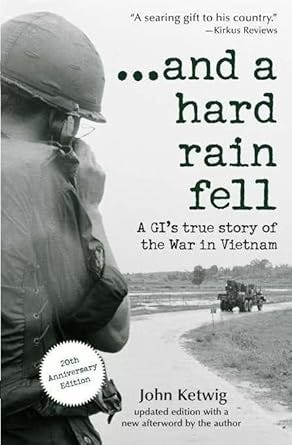
I’ve been reading John Ketwig’s memoir “…and a hard rain fell: A GI’s true story of the War in Vietnam,” and it’s reminding me just how plain dumb, destructive, and duplicitous America’s wars have been since World War II.

America’s wars are always dressed up with a necessary, even allegedly noble, cause. In Vietnam, we had to stop communism and all those dominoes from falling. In Iraq, it was about WMD and stopping Saddam Hussein, “the next Hitler.” In Afghanistan, it was about vengeance for 9/11, then creating democracy and even helping women. (How about helping women in America? Never mind.)

Vietnam is nominally communist today—and a big trading partner of the U.S. and an ally of sorts against China. No dominoes fell. Iraq didn’t have WMD and Saddam wasn’t the next Hitler; he was merely a regional strongman and a former U.S. ally who got a little too big for his britches, especially for Israel. Afghanistan was a war in search of a clear mission and attainable goals. After twenty years of effort and roughly $2 trillion in expenditures, the U.S. replaced the Taliban with—the Taliban. (I heard Norman Finkelstein say this first.)

We’re always told versions of the same lie: We need to fight them over there so that we don’t have to fight them here. Communism had to be rolled back in Vietnam else commies would be landing in Manhattan. Iraq had to be pummeled and Saddam overthrown before WMD landed in Boston. Afghanistan had to be pacified and modernized before the Taliban enforced conservative Sharia law in Biloxi. 

None of this was true. The United States would have been perfectly safe without committing any troops to Vietnam, Iraq, and Afghanistan. In fact, the U.S. would have been far better off if those wars had never been fought. Certainly Vietnam, Iraq, and Afghanistan would have been far better off if they’d never become free-fire zones for American munitions (including the poisonous Agent Orange in Vietnam and, more recently, depleted uranium and other poisons in Iraq and Afghanistan).

Now we’re hearing about a possible U.S. war with Iran, allegedly to stop that country from acquiring an atomic bomb. It’s OK for the U.S. to have more than 5000 nuclear warheads and for Israel to have 200 or so, but it’s not OK for Iran to have even one, because reasons.

The U.S. military, vast as it is, with a vision of global dominance, always needs enemies. Of course, it’s not simply the military but the whole military-industrial complex, the MICIMATT,* which needs war and conflict to sustain itself. 

I recently read “American War,” a powerful novel by Omar El Akkad. It imagines a second U.S. civil war starting roughly 50 years from now. It’s a fascinating book, well worth reading because it captures the horror of war, with all its atrocities, its massacres, its war crimes, and the deep wounds war leaves behind even among the most resolute survivors. John Ketwig’s book does the same as he recounts the fears and horrors of his year in Vietnam and the personal struggles he endured in coming to terms with what he’d seen and endured.

So, count me among those who are already against the next war, whether against Iran, China, or for that matter any other country. Sure, I think America needs to defend itself; I don’t think peace is going to break out spontaneously around the world; but I know for a fact that fighting constant wars is not a way toward greater peace and prosperity. Quite the opposite.

If you want to know what desperate and profoundly wounded war survivors are capable of, read “American War.” If you want to know what desperate and profoundly confused troops are capable of, read “…and a hard rain fell.” And ponder the continued propaganda here of the “good war,” the wonders of warriors and warfighters, and the repetition of slogans like “peace through strength,” a specific form of strength measured in kilotons and megatons of explosives, in massive body counts and military production figures.

Ask yourself: Is that “strength”? Are constant wars truly the path toward peace? How can we possibly be so dumb as to believe this?

MICIMATT: military-industrial-congressional-intelligence-media-academe-think-tank complex. It employs millions of people and spends more than a trillion dollars a year. It’s not easily confronted. Nor is it easily contained, let alone curtailed.

Declaring Our Independence from War

W.J. Astore

“War is a madhouse”

It’s Independence Day in America, so it seems like a good day to declare our independence from the insanity of war.

Sadly, since the presidency of George W. Bush if not before, it’s become routine for U.S. commanders-in-chief to boast of having the world’s finest military in all of history. Obama did it routinely, and Biden recently said the same during his disastrous debate with Trump. Few Americans stop to think about the implications of boasting about having the world’s greatest military—is such a boast truly consistent with democracy, liberty, and freedom?

Certainly, empires rely on strong militaries. Think of the Roman Empire or the Mongol Empire, or the Third Reich (Empire) of Nazi Germany. Do we want to be like them?

Those empires lived by the sword (quite literally so with the Roman Empire) and died by it as well. Their militaries, I would argue, were also more effective than the U.S. one, which hasn’t won a major war since 1945, the latter with a lot of help from our “friends” like the Soviet Union. The Roman, Mongol, and German empires are no more, worn down in part through the constant costs and demands of war. We need to learn more from history than the “fact” that America’s military is supposedly the world’s best since forever and a day ago.

I’ve been reading Oriana Fallaci’s “Nothing, and So Be It,” in which she recounted her time reporting on the Vietnam War. Two conversations with U.S. troops in Vietnam caught my attention. On pages 22-23, she recounts a conversation with Army Captain Scher, during which Scher confesses his disgust with war: 

God, how disgusting war is. Let me say it—I’m a soldier. People who enjoy making war, who find it glorious and exciting, must have twisted minds. There’s nothing glorious, nothing exciting; it’s just a filthy tragedy you can only cry over. You cry for the man you refused a cigarette to and who didn’t come back with the patrol. You cry for the man you bawled out and who is blown to pieces in front of you. You cry for the man who killed your friends …

Later in the book, she interviews a Marine Lieutenant whose surname is Teanek (pages 174-75). Here’s what he had to say:

Teanek: “Men have been saying that [we should abolish war] for thousands of years, and with the justification that they’re abolishing war, they’ve soaked the greatest periods of their civilization in blood.”

Fallaci: “That’s no good reason to keep on doing it.”

Teanek: “Theoretically, you’re right, but in practice what you’re saying is very silly. It’s like convincing yourself—as I bet you do—that when you describe people dying in war you’re helping to abolish war. On the contrary. The more you see people who’ve been killed in war, the more you want to go on fighting wars: it’s a mystery of the human soul.”

It is indeed “a mystery of the human soul” why we humans persist in killing each other in such vast numbers through war. Of course, it’s partly because we glorify it, when we should recognize, as Fallaci does on page 187, that “War is a madhouse.”

I am sane!

One of my favorite scenes in any war film came in “The Big Red One,” a World War II movie by Samuel Fuller starring Lee Marvin as a grizzled Army sergeant of the 1st Infantry Division. It’s a scene in which U.S. troops liberate an insane asylum.

The unforgettable part of this scene for me is when one of the madhouse residents picks up a submachine gun and starts blasting away, crying “I am one of you. I am sane!”

We need to declare our independence from that.

“Fighting a war they did not believe in, a war they were ashamed of”

W.J. Astore

A 52-Year-Old Letter Says Much About America’s Failed Wars

A friend sent along an old Time magazine from May 8th, 1972, which I’ve thoroughly enjoyed perusing. Back in the 1970s, I had a subscription to Time, but my old copies were long ago consigned to the trash. Anyhow, in reading the “Letters” section, I came across a stunning missive written by Oriana Fallaci, an Italian war correspondent who wrote for Europeo Magazine.

Fallaci in 1960, showing some serious attitude (Wiki)

Here’s what Ms. Fallaci had to say about the U.S. war effort in Vietnam:

As an Italian, as a longtime war correspondent in Viet Nam, as the author of a book on the Viet Nam War, I have to answer the sort of judgment made by the unnamed Rand Corp. analyst who said that the South could hold out against the North Vietnamese “unless the North Vietnamese are all Prussians and the South Vietnamese are all Italians.”

I assume that he refers to the fact that the Italian soldiers fought with total lack of enthusiasm during the second World War and particularly in its last phase. Yes, indeed they did. They showed the same lack of enthusiasm that the American soldiers have shown in Viet Nam. Many times, while following your GIs in combat, I have had the impression that I was seeing Italians and not Americans. Do you know why? Because both those Italians and those Americans were fighting a war they did not believe in, a war they were ashamed of.

She nails it. When you realize the war you’re fighting is a dishonest one, an unnecessary one, even one that is shameful, you generally don’t fight well. It doesn’t matter what nationality you are.

Ms. Fallaci’s book on the Vietnam War

When and what was the last war U.S. troops truly believed in, one that they weren’t entirely ashamed of? I think you’d have to go back to World War II, and of course even then more than a few U.S. troops had their doubts, as citizen-soldiers of a democracy are wont to have, because there’s no such thing as a “good” war.

Anyhow, note as well how the prediction of that Rand Corporation “expert” proved wrong. Instead of South Vietnam holding out against the north, it folded fairly quickly three years later in 1975. I guess its soldiers all fought like Italians and those of North Vietnam all fought like Prussians.

Waging war is a horrible thing—especially when the war one is called on to wage is false and shameful. Ms. Fallaci knew that.

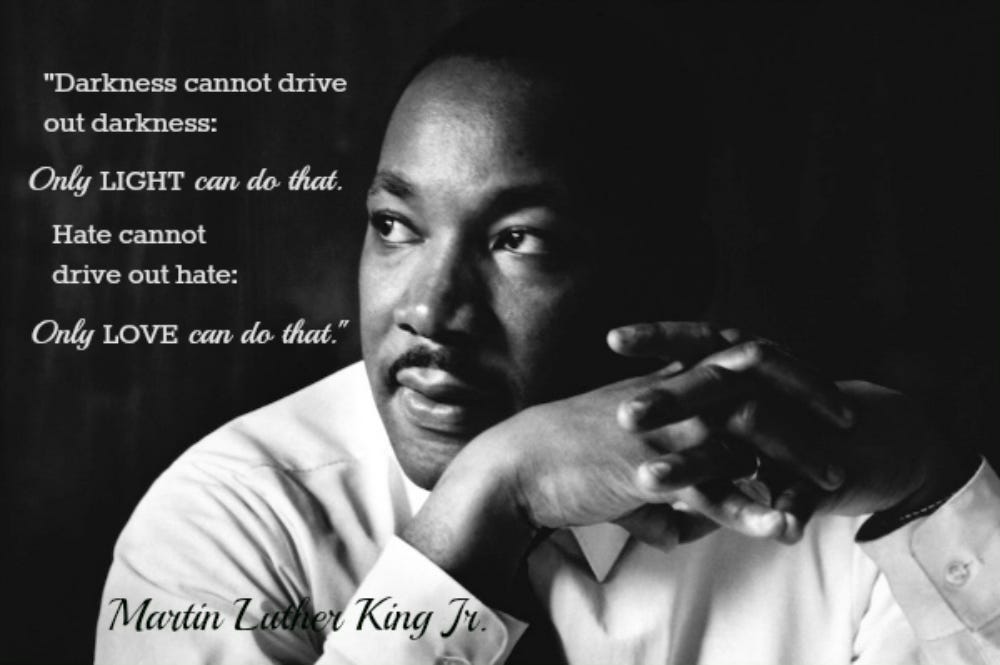
Peace Hero Martin Luther King Jr.

W.J. Astore

MLK recognized the evils of racism, extreme materialism, and militarism

Martin Luther King, Jr., hero for peace.

It’s sad that the word “hero” is so often modified by or married to “war” in history. He’s a war hero, we say, without giving it too much thought. As if wars are somehow ennobling and sublime.

Waging peace is far more noble than waging war. MLK Jr. recognized this in his famous speech against the Vietnam War on April 4, 1967. Back in 2015, I posted this article on MLK and his warning that America was close to suffering a spiritual death in its constant warmongering. Today, we see America enabling genocide by Israel in Gaza with nary a complaint from those in power. Spiritual death, indeed.

*****

On April 4, 1967, Martin Luther King Jr. gave a powerful speech (“Beyond Vietnam – A Time to Break Silence”) that condemned America’s war in Vietnam. Exactly one year later, he was assassinated in Memphis.

What follows are excerpts from MLK’s speech. I urge you to read it in its entirety, but I’d like to highlight this line:

A nation that continues year after year to spend more money on military defense than on programs of social uplift is approaching spiritual death.

MLK called for a revolution of values in America. In his address, he noted that:

There is nothing except a tragic death wish to prevent us from reordering our priorities so that the pursuit of peace will take precedence over the pursuit of war.

MLK didn’t just have a dream of racial equality. He had a dream for justice around the world, a dream of a world committed to peace, a world in which America would lead a reordering of values in the direction of universal brotherhood.

Both of MLK’s dreams remain elusive. Racial inequalities and biases remain, though America is better now than it was in the 1960s in regards to racial equity. And what of a commitment to peace? Sadly, America remains dedicated to war, spending nearly a trillion dollars yearly on defense, Homeland Security, nuclear weapons, and “overseas contingency operations,” i.e. wars.

America has failed to dream the dreams of Martin Luther King, Jr., and we are the worse for it. (Bolded passages below are my emphasis.)

Excerpts from MLK’s Speech on Vietnam, April 4, 1967

At this point I should make it clear that while I have tried in these last few minutes to give a voice to the voiceless in Vietnam and to understand the arguments of those who are called “enemy,” I am as deeply concerned about our own troops there as anything else. For it occurs to me that what we are submitting them to in Vietnam is not simply the brutalizing process that goes on in any war where armies face each other and seek to destroy. We are adding cynicism to the process of death, for they must know after a short period there that none of the things we claim to be fighting for are really involved. Before long they must know that their government has sent them into a struggle among Vietnamese, and the more sophisticated surely realize that we are on the side of the wealthy, and the secure, while we create a hell for the poor.

Somehow this madness must cease. We must stop now. I speak as a child of God and brother to the suffering poor of Vietnam. I speak for those whose land is being laid waste, whose homes are being destroyed, whose culture is being subverted. I speak of the — for the poor of America who are paying the double price of smashed hopes at home, and death and corruption in Vietnam. I speak as a citizen of the world, for the world as it stands aghast at the path we have taken. I speak as one who loves America, to the leaders of our own nation: The great initiative in this war is ours; the initiative to stop it must be ours…

If we continue, there will be no doubt in my mind and in the mind of the world that we have no honorable intentions in Vietnam. If we do not stop our war against the people of Vietnam immediately, the world will be left with no other alternative than to see this as some horrible, clumsy, and deadly game we have decided to play. The world now demands a maturity of America that we may not be able to achieve. It demands that we admit that we have been wrong from the beginning of our adventure in Vietnam, that we have been detrimental to the life of the Vietnamese people. The situation is one in which we must be ready to turn sharply from our present ways. In order to atone for our sins and errors in Vietnam, we should take the initiative in bringing a halt to this tragic war…

It is with such activity in mind that the words of the late John F. Kennedy come back to haunt us. Five years ago he said, “Those who make peaceful revolution impossible will make violent revolution inevitable.” Increasingly, by choice or by accident, this is the role our nation has taken, the role of those who make peaceful revolution impossible by refusing to give up the privileges and the pleasures that come from the immense profits of overseas investments. I am convinced that if we are to get on the right side of the world revolution, we as a nation must undergo a radical revolution of values. We must rapidly begin…we must rapidly begin the shift from a thing-oriented society to a person-oriented society. When machines and computers, profit motives and property rights, are considered more important than people, the giant triplets of racism, extreme materialism, and militarism are incapable of being conquered.

A true revolution of values will soon cause us to question the fairness and justice of many of our past and present policies. On the one hand, we are called to play the Good Samaritan on life’s roadside, but that will be only an initial act. One day we must come to see that the whole Jericho Road must be transformed so that men and women will not be constantly beaten and robbed as they make their journey on life’s highway. True compassion is more than flinging a coin to a beggar. It comes to see that an edifice which produces beggars needs restructuring.

A true revolution of values will soon look uneasily on the glaring contrast of poverty and wealth. With righteous indignation, it will look across the seas and see individual capitalists of the West investing huge sums of money in Asia, Africa, and South America, only to take the profits out with no concern for the social betterment of the countries, and say, “This is not just.” It will look at our alliance with the landed gentry of South America and say, “This is not just.” The Western arrogance of feeling that it has everything to teach others and nothing to learn from them is not just.

A true revolution of values will lay hand on the world order and say of war, “This way of settling differences is not just.” This business of burning human beings with napalm, of filling our nation’s homes with orphans and widows, of injecting poisonous drugs of hate into the veins of peoples normally humane, of sending men home from dark and bloody battlefields physically handicapped and psychologically deranged, cannot be reconciled with wisdom, justice, and love. A nation that continues year after year to spend more money on military defense than on programs of social uplift is approaching spiritual death.

America, the richest and most powerful nation in the world, can well lead the way in this revolution of values. There is nothing except a tragic death wish to prevent us from reordering our priorities so that the pursuit of peace will take precedence over the pursuit of war. There is nothing to keep us from molding a recalcitrant status quo with bruised hands until we have fashioned it into a brotherhood.

Perhaps it seemed in 1967, even to MLK Jr., with all his experience to the contrary, that America could lead the world in a revolution of values, a pursuit of peace. MLK’s dream of such a revolution is dead, drowned in the vast profits of the merchants of death.

The Rambo Mystique

W.J. Astore

Forgotten Lessons from “First Blood”

I remember seeing the first Rambo flick (“First Blood”) in a movie theater in 1982 when I was nineteen and rooting for Sly Stallone’s character against the police and national guardsmen who are sent to kill him.  The police think it’ll be easy to subdue one man, but we the viewers know better.  As Colonel Trautman, Rambo’s former commanding officer, says in the movie: In war, it’s wise to have “a good supply of body bags” on hand, a telling reminder about the harsh reality of combat.

In “First Blood,” military clothing and the flag offer no protection to John Rambo, who’s treated as a lowlife by the local sheriff 

Yet, there’s a deeper meaning to “First Blood” captured near the end of the movie, when John Rambo, having improbably acted as a one-man invincible army (a true “Army of One”), bitterly reflects on his own post-Vietnam experiences.  Rambo, breaking down, admits he can’t adapt to regular civilian life.  A loner, he feels himself to be a loser, even though he was decorated for heroism in war with the Medal of Honor.  Wounded and haunted by war, his soul seared by violence, he surrenders to Colonel Trautman.

The original Rambo movie wasn’t necessarily deep, but it did remind us that soldiers like Rambo carried hidden wounds of war; it also highlighted a societal suspicion, whether just or unjust, of military veterans.  The sheriff in “First Blood” has no respect for Rambo as a military “hero”; he sees him as a disreputable and dangerous outsider and just wants to be rid of him, one way or another.

Subsequent Rambo films would portray him as a virtually unstoppable killing machine. In the first sequel, Rambo is sent back to Vietnam to rescue American POWs betrayed and abandoned by the U.S. government.  Perhaps the most famous line from that movie is when Rambo asks Colonel Trautman whether, in returning to Vietnam, the government will finally allow U.S. soldiers to win this time.  It was a concise statement of the stab-in-the-back myth, the idea the U.S. military would have won the war in Vietnam if only it hadn’t been betrayed by a duplicitous and spineless government.

“Do we get to win this time?”  That’s a question that should haunt all Americans, since we haven’t won a war since 1945.  But who is to blame for not winning?  And have the wars America has fought since World War II really been worth fighting to begin with?

Update (9/2923): A lot has changed in forty years, as a couple of my friends pointed out in response to this article. We could imagine at least two scenarios for a revised Rambo made in 2023:

Version 1: In 2023, the sheriff wouldn’t have to call in the National Guard.  All his deputies would gear up with assault rifles, sniper rifles, body armor, and MRAPs donated by the Pentagon as excess gear and the local SWAT team would be mobilized and deployed to find and kill Rambo.

Version 2: Perhaps the most likely one: Rambo would be wearing a “blue lives matter” flag, the sheriff’s patrol car would be festooned with “support our troops” stickers, and they’d call a town meeting to give Rambo the keys to the town as a Medal of Honor winner.