Yet Another Smear Piece on Tulsi Gabbard

W.J. Astore

Where else but the New York Times

In my morning news feed from the New York Times came this article on Tulsi Gabbard:

How Tulsi Gabbard Became a Favorite of Russia’s State Media

President-elect Donald J. Trump’s pick to be the director of national intelligence has raised alarms among national security officials.

Here’s the key paragraph from the article, which, of course, is delayed until the sixth paragraph:

No evidence has emerged that she has ever collaborated in any way with Russia’s intelligence agencies. Instead, according to analysts and former officials, Ms. Gabbard seems to simply share the Kremlin’s geopolitical views, especially when it comes to the exercise of American military power. [Emphasis added]

Did you get that? NO EVIDENCE. Tulsi has never collaborated with Russia in any way. The problem is that she’s a critic of unnecessary and disastrous wars like Iraq and Afghanistan. She’s a critic of massive U.S. military aid to Ukraine. And since those criticisms are vaguely useful to Russia, she must therefore be a “Russian asset,” a dupe of Putin, according to Hillary Clinton and now the New York Times.

Within the so-called intelligence community (IC), you are allowed to be a cheerleader, a booster, even a selective critic in the sense that you may call for more money for the IC because of certain limitations or oversights, but you are not allowed to question America’s disastrously wasteful imperial foreign policy.

No matter how poorly the IC performs (consider the colossal failure of 9/11, or the total obliviousness about the impending collapse of the Soviet Union in the late 1980s, or recent disastrous wars in Afghanistan, Iraq, and Libya), no one is ever held accountable, even as the IC gets more money and authority.

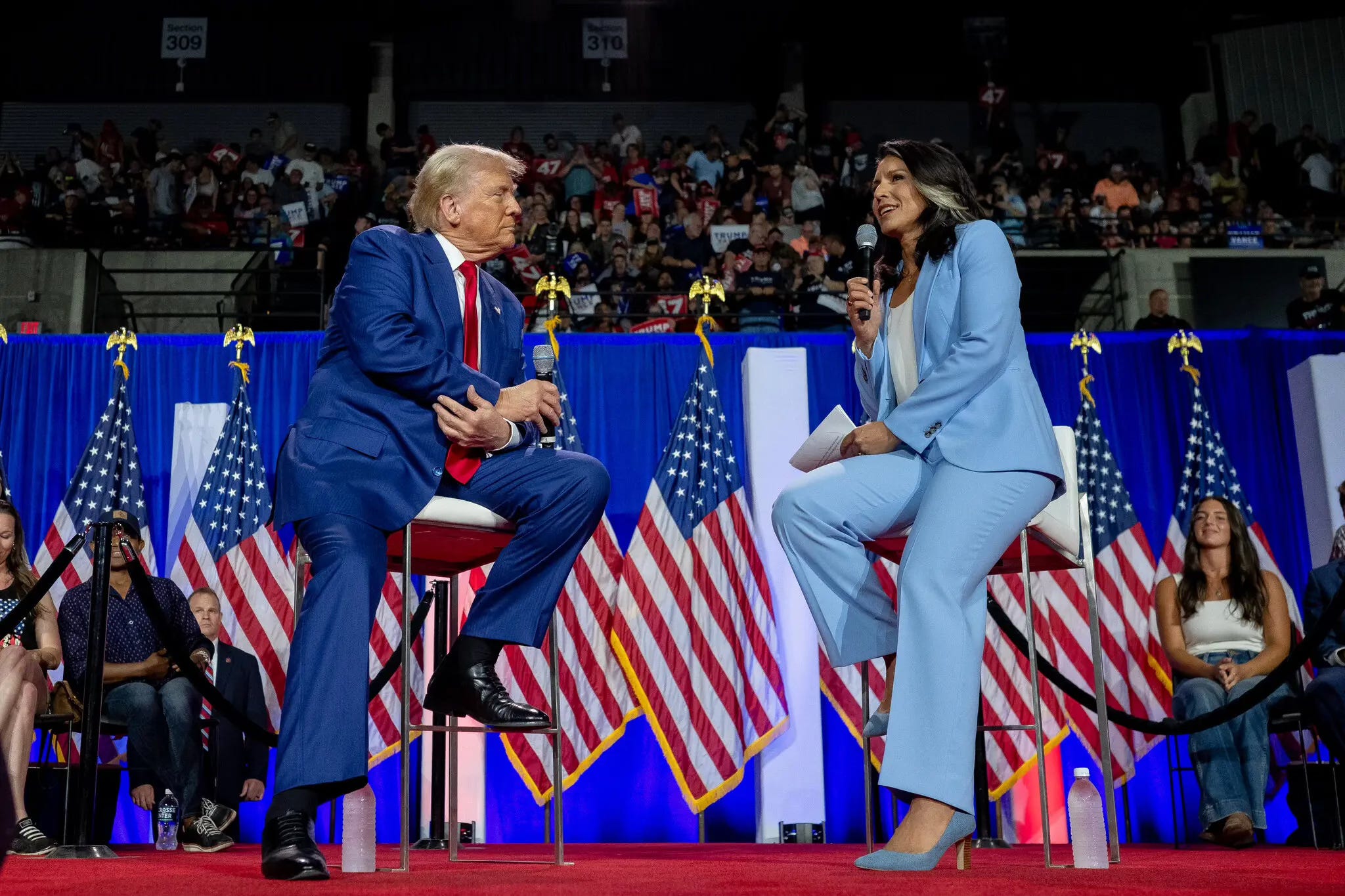
Tulsi Gabbard with President-elect Trump. (Jim Vondruska for the NYT)

Tulsi Gabbard promises to be a game-changer. Skeptical of the blatant misuse of American military power, she’s been an articulate critic of forever wars. She is especially sensitive to deploying U.S. troops in harm’s way for purposes other than the defense of the United States.

The “liberal” New York Times is having none of that. Consider this remarkable paragraph:

“Nominating Gabbard for director of national intelligence is the way to Putin’s heart, and it tells the world that America under Trump will be the Kremlin’s ally rather than an adversary,” Ruth Ben-Ghiat, a professor of history at New York University and the author of “Strongmen,” a 2020 book about authoritarian leaders, wrote on Friday. “And so we would have a national security official who would potentially compromise our national security.” [Emphasis added]

Who knew that “Putin’s heart” could be won so easily? And note the weasel wording that Tulsi could “potentially compromise” U.S. national security. Again, no evidence is presented. 

Well, we certainly don’t want the U.S. to have a rapprochement with Putin. He must always be our adversary, am I right? How dare that Trump and Gabbard might, just might, pursue a policy that is less antagonistic toward the Kremlin? Don’t you enjoy teetering on the brink of a world-ending nuclear exchange? I much prefer that to listening and negotiation.

In making enemies of Hillary Clinton and now the New York Times, Tulsi Gabbard has demonstrated she has what it takes to serve as director of national intelligence.

“Taking the Handcuffs Off” U.S. Missiles in Ukraine

W.J. Astore

Feeding the Obscenity of War

I woke to this disconcerting story from CNN:

President Joe Biden has authorized Ukraine to use powerful long-range US weapons deep inside Russia.

Why now? Biden is a lame duck president, shuffling out the door, and now he decides to allow Ukraine to use American ATACMS missiles, with a range of roughly 190 miles, inside Russia. It’s also expected that these and similar longer-range missiles provided by the French and British will have no decisive impact on the war. They may kill and wound more Russians and inspire responses in kind by Russia against Ukraine, but their use won’t contribute to “victory” for Ukraine. So what’s the point?

My wife put it well when she learned of the decision: “stupid” and “ridiculous” were her words of choice. It’s amazing how well our “experts” feed the obscenity of war.

How dare you handcuff our missiles!

I take my title from a comment made by President-elect Trump’s nominee for National Security Adviser, Mike Waltz, who said we should take the handcuffs off of U.S. missiles in Ukraine, as if those missiles were people being held prisoner.

Whether in the Biden or Trump administrations, the advisers at the top are moral midgets, murderously so. I wonder how they’d feel being targeted by ATACMS. Hey, we just took the handcuffs off, Mr. Waltz. Enjoy your time being bombarded by these liberated missiles.

At the end of September, I noted how Vladimir Putin had redefined Russian nuclear policy to include a possible nuclear response to the use of “tactical” missiles like ATACMS. Here’s what I wrote then:

Vladimir Putin is redefining Russian policy for the use of nuclear weapons. He’s sending a clear warning that Ukraine’s use of U.S. and Franco-British missiles like ATACMS and Storm Shadow deep within Russia could draw a nuclear response. To my knowledge, the U.S. has not yet approved of the use of ATACMS deep within Russia, though Ukraine is pushing for it.

It seems many brain-dead, zombie-like advisers and “experts” insist that Russia is bluffing. They’re willing to bet the health and safety of the world that Russia won’t respond with nuclear weapons. And for what? ATACMS and Storm Shadow missiles aren’t war-winning weapons. The Russia-Ukraine War is a slog, an attritional struggle, featuring trenches and artillery and high casualties, a situation akin to World War I. It’s not going to be won by conventional tactical missile strikes.

Yet certain “experts” seemingly want it to escalate to World War III with nukes.

Just about 80 years ago, we humans entered the atomic age at the Trinity test site in July of 1945. We still haven’t come to grips with how the world changed when the first atomic “gadget” exploded in the desert in New Mexico. We had better hurry up and grow up before we all burn.

So, Putin has warned that deep strikes within Russia could draw a nuclear response, and Biden has now approved said strikes just before he leaves the White House. “Stupid” and “ridiculous” are indeed good descriptors here.

The obscenity of war knows no handcuffs in America.

“Peace” Seems to Be the Hardest Word

W.J. Astore

Bipartisan Support in America for More War

With apologies to Elton John and Bernie Taupin, “peace” seems to be the hardest word, for both Democrats and Republicans.

This is hardly surprising. The National Security State is the unofficial fourth branch of government and arguably the most powerful. Presidents and Congress serve it, and the SCOTUS carves out special exceptions for it. Back in the days of a bit more honesty, it was called the Department of War. And so it remains.

Let’s say you’re like me and you see war as humanity’s greatest failing. We kill and maim each other, we scorch and kill every living thing in the path of our weapons, we destroy the environment, we even have the capacity to destroy life on earth via nuclear weapons. War—it really is good for absolutely nothin’, unless, of course, you profit from it.

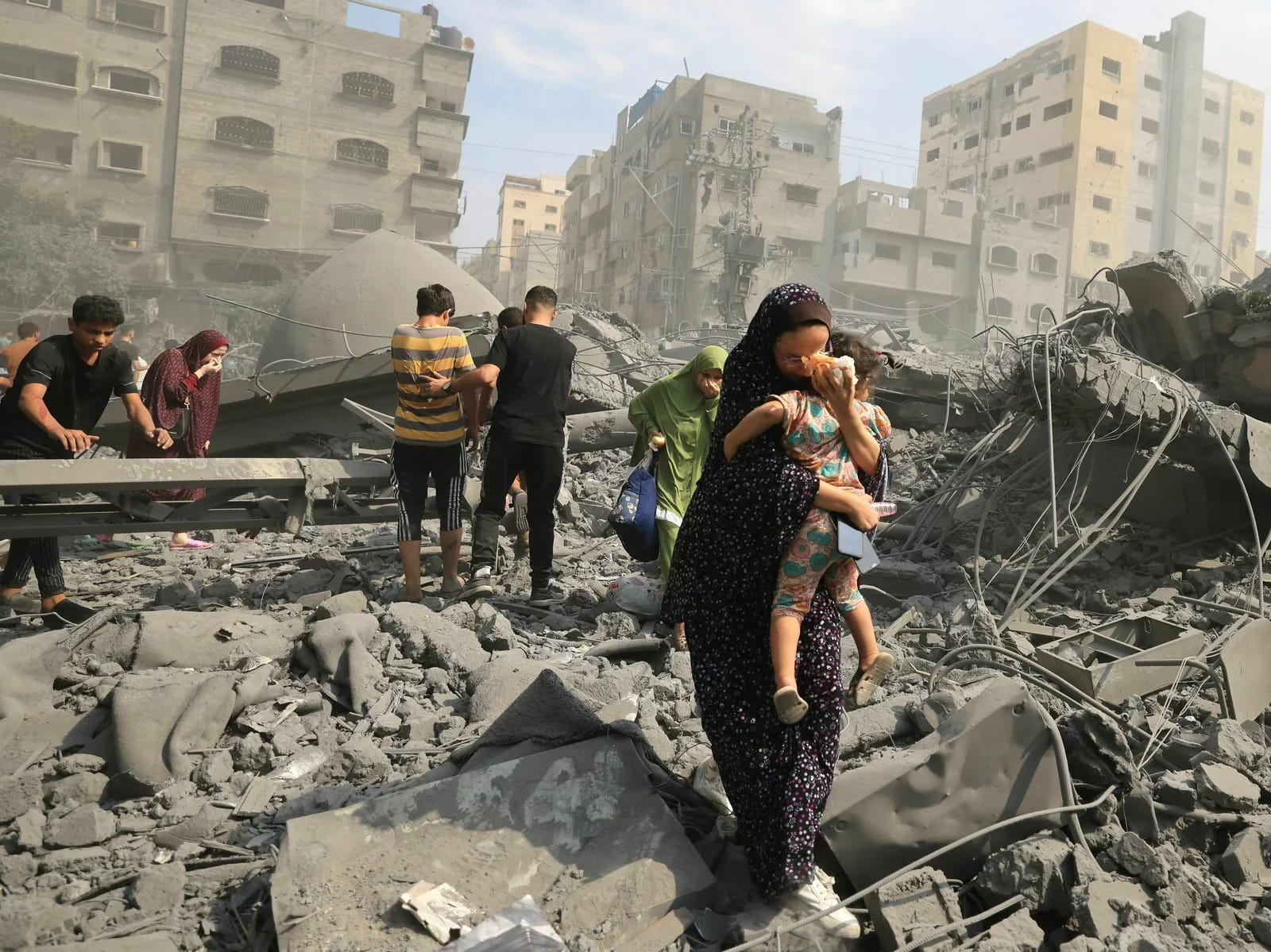
Gaza after an Israeli bombing attack. Anyone want more war?

So, who are you going to vote for in America who sees the awfulness of war and who’s willing to pursue diplomacy and peace instead? Democrats? Republicans?

Generally speaking, Democrats are fixated on war with Russia. They support massive aid to Ukraine and are against negotiations. They also support massive aid to Israel in its ongoing genocide against Palestinians in Gaza. And they fully support the military-industrial-congressional complex (MICC) and soaring spending on weapons and war, including “investing” in new nuclear weapons.

Republicans are much the same, except they tend to see China rather than Russia as the main threat, e.g. Donald Trump and J.D. Vance are willing to negotiate an end to the Russia-Ukraine War. But, in the main, Republicans fervently support Israel in its genocide, are outspoken critics of Iran (Got to punch them hard, Vance recently said), are willing enablers of the MICC, and also vote for massive spending on weaponry and war, including nuclear weapons.

Neither major U.S. political party, the red or blue teams, is pro-peace. Both are pro-aggression and pro-empire. They just occasionally choose different targets for their ire, even as they accuse the other team of “weakness,” of being “Putin puppets” or “Manchurian candidates.” 

As I’ve said before, the only word or sentiment apparently forbidden among the red and blue teams is “peace.” If you want an antiwar candidate in America, you have to go outside the two main parties to the Greens or similar fringe parties.

In America, “antiwar” is defined by America’s propaganda machine, otherwise known as the corporate media, as weak and unAmerican, because “the health of the state” is war.  Every election, whether the red or blue team prevails, the National Security State, the old War Department, wins. And humanity loses. 

The last mainstream candidate for the presidency who spoke consistently of peace was George McGovern in 1972. Unless we the people demand peace, we will continue to get war. In fact, in a bizarrely Orwellian way, colossal military spending and incessant wars are sold to us as keeping America safe. “War is peace” is quite literally the message of the National Security State and its Ministry of Truth, the corporate-owned media.

What is the solution? Here’s one possible approach: Whenever America deploys troops overseas, those troops most immediately in harm’s way must be drawn from the ranks of America’s most privileged and their children. So, corporate CEOs, Members of Congress, lawyers at White Shoe firms, private equity billionaires and millionaires and their progeny, Hollywood celebrities and America’s best-known sports stars: those Americans who prosper and profit the most from empire should be the first to serve it. And that service must be made mandatory, no exceptions, no way to buy your way out or plead that you have “higher” priorities.

Those who want war should serve in war, leaving the rest of us alone. This rule, more than any other, might just keep the chickenhawks from screeching for more war with Russia, or China, or Iran, or North Korea, or Syria, or somebody. A few minutes at the front, facing bullets and shells and cluster munitions while hearing the screams of the dying, might just cure these wannabe “warriors” of their fever.

Want a war? Go to war. And leave the rest of us in peace.

Ukraine, Gaza, and Elsewhere

W.J. Astore

There Will Be Wars and Rumors of Wars

Checking my daily email from Reuters this past Thursday revealed these two stories:

“Diplomacy falters” is one of the sub-headings, which is assuredly the case, assuming diplomacy was even tried.

The BLUF, or bottom-line upfront, to use an Army acronym, is more death, dying, and destruction in Ukraine and Gaza.

Reuters still refers to Israeli ethnic cleaning in Gaza as the “Gaza war,” but only one side has tanks, combat aircraft, 2000-pound bombs, heavy artillery, bulldozers, and even nuclear weapons. It’s not exactly a fair fight, is it? The Israeli government says it’s out to destroy Hamas, but what it’s really after is the destruction of Gaza and the forced relocation of Palestinians there, after which Gaza will be annexed and assimilated into Israel.

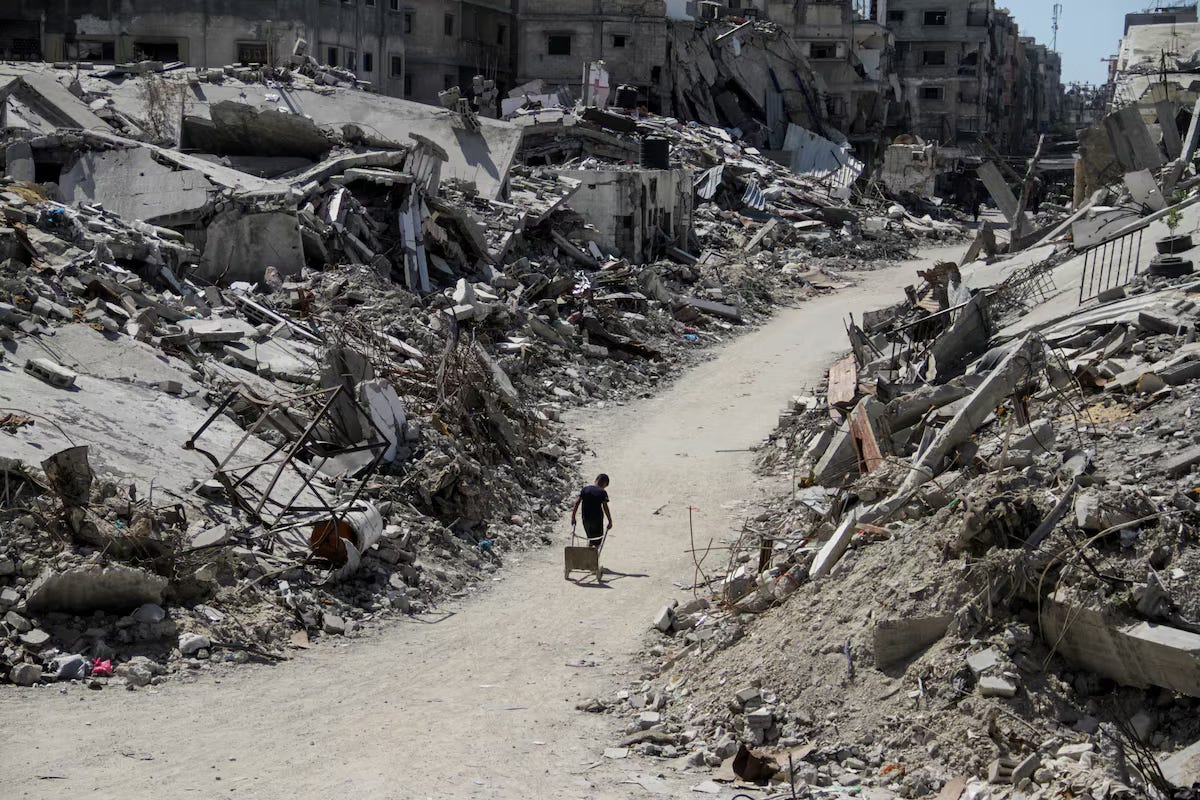
What Israel has done and is doing to Gaza

Turning to the Ukraine War, the longer it lasts, the greater the suffering, and the higher the risk of further escalation. Yet the focus is always on deterring Russia and defeating Putin, as if it’s 1938 yet again, with Putin as Hitler and Ukraine as Czechoslovakia. Any diplomatic settlement with Russia will be the equivalent of appeasement, another Munich Agreement, so the war must go on, I guess until one side or the other collapses from the strain. Perhaps 1918 and the chaotic end of World War I is a better year to think about than 1938.

Meanwhile, Reuters tells me there are “challenges” in Africa and that China must be corralled and contained. Poor Africa. European nations (and the United States) are always offering answers to Africa’s “challenges,” but those answers address the interests of the West, not of African peoples. The U.S. has a whole military command, AFRICOM, to address those “challenges,” mainly in the form of U.S. weapons sales and “security assistance.”

Finally, resurrecting the racist “yellow peril” trope with regards to China is only driving that country into closer contact with Russia, which has the added benefit of justifying immense Pentagon spending due to the dual threat of Russia-China. (Democrats tend to stress Russia as the big threat; Republicans prefer China.). Thus we hear of a new Cold War, which of course necessitates colossal military spending, because do you want China and Russia to rule the world?

There will be wars and rumors of wars: And so it goes with U.S. foreign relations, in perpetuity, seemingly.

War of the Words

W.J. Astore

Language as a Weapon

When Barack Obama took over as president in 2009, the global war on terror, or GWOT, just didn’t seem to fit the tenor of his “hope” and “change” message. So wars in Iraq and Afghanistan were rebranded as “overseas contingency operations.” Talk about the banality of evil! Even Orwell’s Big Brother might be impressed by OCOs as a substitute for invasion and war.

A euphemistic word Obama didn’t banish was “surge.” The “surge” in Iraq allegedly had worked under General David Petraeus, even though its gains proved as “fragile” and “reversible” as Petraeus hinted they would be. So Obama conducted his own surge in Afghanistan, the so-called good or smart war after the Bush/Cheney disaster in Iraq. And of course the “gains” in Afghanistan also proved both fragile and reversible, though no one was held to account for the miserable failure of the Afghan War. Whoops. I mean the Afghan contingency operation for democracy and enduring freedom.

Showing that he too could learn from America’s folly, Vladimir Putin termed his invasion of Ukraine a “special military operation.” U.S. leaders laughed at this, criticizing Putin for his propagandistic euphemism, even as they persisted in using terms like “overseas contingency operation” for America’s “kinetic” military actions. The eye of the beholder, I guess.

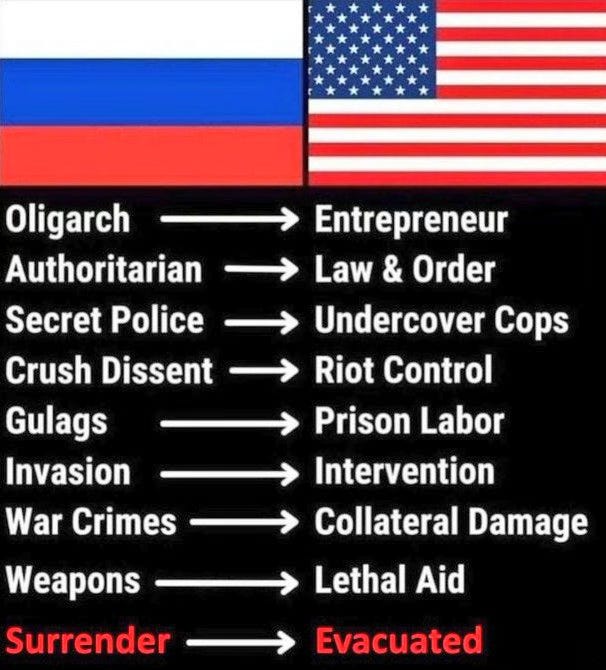
These thoughts came to mind as I perused my Twitter/X feed yesterday and spied this illustration posted by Chay Bowes:

Though the Russian flag is on the left, it could be the flag of China, Iran, North Korea, or any other alleged evildoer. The Russians invade, we intervene (for the sake of democracy, naturally). The Russians commit war crimes, we have unfortunate instances of collateral damage. In the war of the words, the U.S. military is clearly rather clever in a self-aggrandizing and self-exculpatory way.

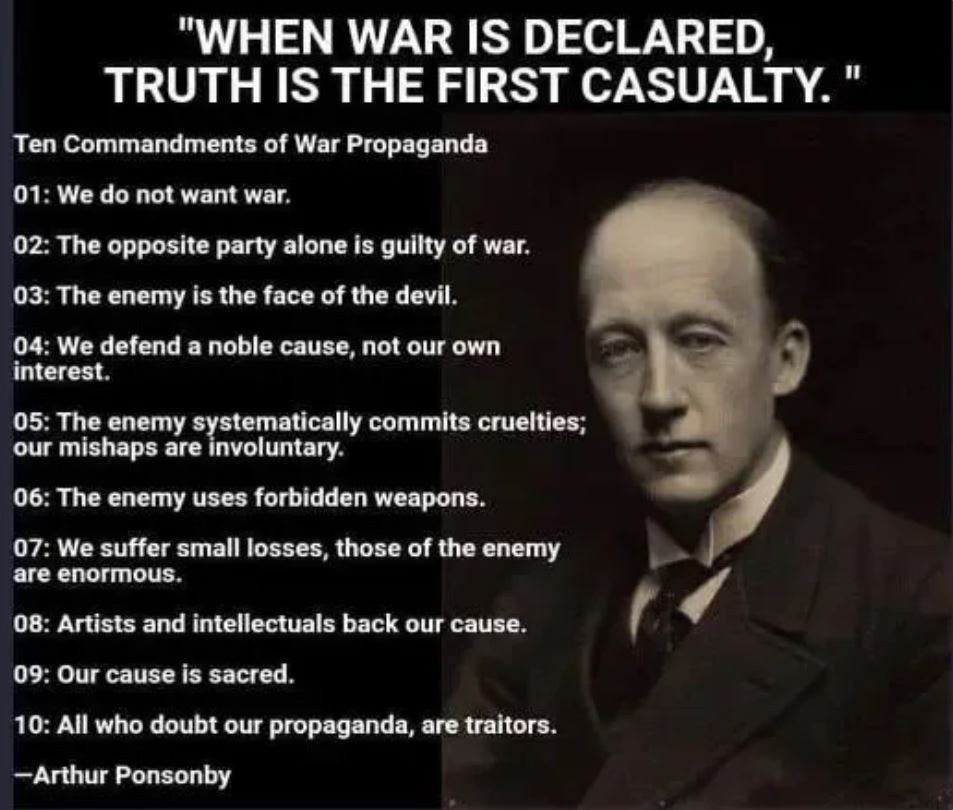
Looking at comments from this Twitter feed, I came across another useful illustration of manipulating language and information in the cause of war. Take a gander:

I confess I’d never heard of Arthur Ponsonby and his book, Falsehood in War-Time. I need to check it out. 

This may prove a handy list to keep around as America’s national (in)security state acts to gin up the next war.

U.S. Power Sets All the Wrong Examples to the World

W.J. Astore

An Open Letter from the Eisenhower Media Network

I’m a member of the Eisenhower Media Network, or EMN. We’re a small network of retired military types and former U.S. government officials who are openly critical of the military-industrial-congressional complex, America’s open-ended forever wars (the global war on terror; the cold war against Russia and China), and rising militarism within and across our society.

Recently, EMN issued a new letter in opposition to the Washington bipartisan consensus for war and more war. I’m proud to say I had a hand in writing it, as did Matthew Hoh and other members of EMN. Here’s what we had to say:

Military and Foreign Policy Experts Open Letter on U.S. Diplomatic Malpractice

Does America inspire the world by the power of its example or the example of its power? Far too often, and despite President Joe Biden’s words during his inaugural address, America’s overmilitarized power and diplomatic malpractice are its examples to the world.

We must change that. To make America truly essential and indispensable, we must not remain the world’s leading arms maker and weapons exporter. We must instead become the world’s greatest and most committed peacemaker and diplomat.

The problem is that America continues to make war, continues being “essential” only as the world’s leading merchant of death, and continues seeking dominance through military supremacy that ends, in places like Afghanistan, Iraq, and earlier in Vietnam, in mass death and colossal folly.

In our first open letter last spring in The New York Times, we, the undersigned, argued that a thoroughly militarized U.S. foreign policy would generate ruinous and worsening consequences and increasingly limited options for the U.S. and the world. Recent events bear this out.

The results of U.S. diplomatic malpractice are cruelly displayed in Eastern Europe, the Middle East and the Indo-Pacific. Risks of further escalation and a world war are rising. Predictably, a militarized foreign policy characterized by rejecting or ignoring international laws and treaties and by disingenuous negotiations and talks has offered no solutions to volatile wars in Eastern Europe and the Middle East while making war more likely in the Indo-Pacific.

Militarized solutions breed and feed more war. Earnest and deliberate diplomacy is the best hope to bring peace, stability and reconciliation to the world.

We chose Ike as our inspiration because he warned Americans of the dangers of the military-industrial complex and because he rejected a world dedicated to manufacturing weapons to commit mass murder. 

War in Ukraine

The failure to pursue diplomacy in Eastern Europe, both before and after Russia’s invasion of Ukraine, has resulted in a costly and destructive stalemate for which there are two likely futures:

  1. The collapse of the Ukrainian state due to a deteriorating economic and military situation hastened by corruption.Here, Ukraine’s fragility resembles that of previous houses of cards built by the U.S. in Afghanistan, Iraq, and Vietnam.
  2. A harrowing and bloody stalemate in Ukraine where firepower, made more lethal by technological advances, rules a battlefield where neither side can achieve decisive tactical or operational gains. The pursuit of ways out of this stalemate likely entails horizontal and vertical escalation, neither of which offers solace to those seeking an end to death and destruction in Ukraine and the establishment of peace and stability.

Horizontal escalation sees the war extending further to civilian population centers and infrastructure and includes the possibility of other nations joining the conflict. Vertical escalation sees the expansion of arsenals to weapons of greater range, lethality, and consequence, including nuclear weapons. These two forms of escalation may be intertwined and reinforcing. So, as the war may expand horizontally to resemble The War of Cities between Iran and Iraq in the 1980s, it may expand vertically as well with more powerful weapons being introduced by both sides. The use of nuclear weapons is increasingly conceivable under these conditions.

These two likely futures may intersect. For example, a Ukrainian collapse could see NATO forces, likely Polish and Romanian, marching into western and central Ukraine to counter a Russian push to fill a collapsing Ukrainian state. Such an event could lead to a war between NATO and Russia, a war that conceivably could go nuclear.

Hamas, Israel and the Middle East

The Russia-Ukraine War now rages concurrently with the war between Hamas and Israel. This war, too, is born of a U.S. refusal to foster diplomacy. Unlike the conventional war between Russia and Ukraine, we are witnessing an asymmetrical conflict more akin to the wars of insurgency many of us experienced in Vietnam, Afghanistan, and Iraq.

Worse, the Hamas/Israel bloodletting in Gaza is characterized by an ethnic cleansing campaign that would be impossible without U.S. diplomatic, economic, media, military and political support. We are disgusted by and find repugnant the brazen and bipartisan support by the U.S. government for rampant violations of international law by Israel. Ethnic cleansing in Gaza, long planned by senior members of the Israeli government and powerful elements of Israel’s reactionary right wing, follows in the ghastly wake of Hamas atrocities against civilians on October 7.

Here, the U.S. government isn’t just passively witnessing war crimes; it is enabling them. With the frightening possibility of escalation to a regional or even a world war, the violence in Gaza has fed and feasted upon decades of deliberate diplomatic malpractice in America. Decades of putting Israel first, second, and last while ignoring the plight and pleas of Palestinians have made political settlements to the blockade of Gaza and the occupation of East Jerusalem and the West Bank nearly impossible.

Whereas a month ago, we lived with the risk of nuclear war as an outcome of escalating conflict in Ukraine, we now face the elevated risk of a rightfully feared world war as a consequence of entangling alliances between nuclear-armed Moscow and Washington in the Middle East.

China and the Path Ahead

To this, we must add the dangers of war with China, something hyped by leading U.S. politicians; the still unpaid costs of the $8 trillion wars in Afghanistan and Iraq; a militarized federal budget for which 60% of discretionary spending goes to war and all its wounds; and a hollowed American economy.

Decades of reckless U.S. war-making, both direct and via proxies, while coddling corrupt, ruthless, and unjust foreign governments has, not surprisingly, made the world more dangerous and less stable. Failure to invest in and maintain our country has weakened and corroded America’s infrastructure, institutions, and industries. A hypocritical flaunting of international law and an espousal of an ethereal rules-based order, coupled with an arrogant disregard for past U.S. crimes and blunders, have caused dozens of nations to flock to competitors – a movement away from America that will undoubtedly accelerate if we remain on our current militaristic path.

Moreover, decades of colossal military spending have witnessed few strategic gains for the U.S. Our military, often saluted as the world’s greatest by politicians, hasn’t won a major war since World War II. That same military annually faces significant recruiting shortfalls that cast considerable doubt on the integrity and staying power of the All-Volunteer Force. America’s legacy of failed wars is not redeemed by ongoing displays of vacuous military boosterism. Feel-good patriotism can’t suppress the bitterness many of us military veterans feel toward the past, nor does it calm the worries we have about our nation’s future.

Pope Francis has spoken of a “famine of peace” that exists in the world today. In this spirit, we call for immediate ceasefires, without conditions, in Gaza and Ukraine.

The surest way to prevent wars from exploding into uncontainable wildfires is to starve them of fuel. To think or speak that these conflagrations can be managed, adjusted as if by damper or thermostat, is a fool’s conceit or a liar’s word. We have been burned too many times in our professional lives to believe hot wars can be “won” by throwing more gasoline on them, whether rhetorically or in the form of cluster munitions, depleted uranium shells, and similar forms of “aid.”

A better path ahead is clear. Peace, not war, must be fostered. In embracing peace through diplomacy conducted in good faith, America would indeed exhibit the power of its example, becoming essential to a world that cries out for liberty and justice for all.

Mobsters of the Mind

W.J. Astore

Of “Legal” Drug Ads and Anti-Russia Messaging

Mobsters are known for breaking kneecaps to bend people to their will. Marketers break into heads with repetitive and manipulative advertising, images, and narratives. Mobsters of the mind, they are.

I thought of this after watching all those repetitive (and largely interchangeable) ads for “legal” prescription drugs. Rarely do they show the often serious conditions they allegedly treat. Instead it’s image after image of people enjoying life, whether at amusement parks, the beach, dancing, or what-have-you. It’s as if drug companies are selling happiness pills whose only side effect is experiencing the best day of your life. Meanwhile, as images spill into your head of eternal bliss, a narrator quietly intones about potential serious side effects, even possible death in the case of one drug I’ve seen advertised.

Excuse me while I pop a few pills and denounce Russia—or China

Drug ads are the worst. People wonder why Americans take so many illegal drugs and why we have so many drug addictions — well, just look at all the ads for legal drugs, and how they’re advertised as making people incandescently happy. It’s all about the messaging: the repetition of powerful feel-good imagery, with drugs as panaceas.

Speaking of repetition, something similar is true of political manipulation. To cite one example: Russia. Has there ever been a worse “drug” with more serious side effects than Russia? Russia keeps hacking our elections! Russia is led by war criminals! Russia is raping Ukraine! Over and over again, the mainstream media encourages us to hate Russia and Vladimir Putin. Is this truly all we need to know about Russia? As Sting sang, don’t the Russians love their children too? (Back in the 1980s, the media didn’t go easy on Sting for his alleged naïveté and pro-Russian sentiments.)

Whether it’s drug advertisers, the mainstream media, or the U.S. government for that matter, America is infested with various “ministries of truth” that are driven by a mobster-like mentality. They may not break your kneecaps, but they nevertheless find ways to break into your mind.

Now you’ll excuse me while I pop a few pills while denouncing Russia. And China too, perhaps?

The Pentagon’s National Defense Strategy

W.J. Astore

Bombs, Bullets, and Bellicosity Instead of Brains

In my latest article for TomDispatch.com, I parse the meaning of America’s latest National Defense Strategy. Hint: It’s not about defense.

More than two millennia ago, in the History of the Peloponnesian War, Thucydides recounted a disastrous conflict Athens waged against Sparta. A masterwork on strategy and war, the book is still taught at the U.S. Army War College and many other military institutions across the world. A passage from it describing an ultimatum Athens gave a weaker power has stayed with me all these years. And here it is, loosely translated from the Greek: “The strong do what they will and the weak suffer as they must.”

Recently, I read the latest National Defense Strategy, or NDS, issued in October 2022 by the Pentagon, and Thucydides’s ancient message, a warning as clear as it was undeniable, came to mind again. It summarized for me the true essence of that NDS: being strong, the United States does what it wants and weaker powers, of course, suffer as they must. Such a description runs contrary to the mythology of this country in which we invariably wage war not for our own imperial ends but to defend ourselves while advancing freedom and democracy. Recall that Athens, too, thought of itself as an enlightened democracy even as it waged its imperial war of dominance on the Peloponnesus. Athens lost that war, calamitously, but at least it did produce Thucydides, a military leader who became a historian and wrote all too bluntly about his country’s hubristic, ultimately fatal pursuit of hegemony.

Imperial military ambitions contributed disastrously to Athens’s exhaustion and ultimate collapse, a lesson completely foreign to U.S. strategists. Not surprisingly, then, you’ll find no such Thucydidean clarity in the latest NDS approved by Secretary of Defense Lloyd Austin. In place of that Greek historian’s probity and timeless lessons, the NDS represents an assault not just on the English language but on our very future. In it, a policy of failing imperial dominance is eternally disguised as democratic deterrence, while the greatest “strategic” effort of all goes (remarkably successfully) into justifying massive Pentagon budget increases. Given the sustained record of failures in this century for what still passes as the greatest military power on the planet — Afghanistan, Iraq, and Libya, of course, but don’t forget SomaliaSyriaYemen, and indeed the entire $8 trillion Global War on Terror in all its brutality — consider the NDS a rare recent “mission accomplished” moment. The 2023 baseline “defense” budget now sits at $858 billion, $45 billion more than even the Biden administration requested.

With that yearly budget climbing toward a trillion dollars (or more) annually, it’s easy to conclude that, at least when it comes to our military, nothing succeeds like failure. And, by the way, that not only applies to wars lost at a staggering cost but also financial audits blown without penalty. After all, the Pentagon only recently failed its fifth audit in a row. With money always overflowing, no matter how it may be spent, one thing seems guaranteed: some future American Thucydides will have the material to produce a volume or volumes beyond compare. Of course, whether this country goes the way of Athens — defeat driven by military exhaustion exacerbated by the betrayal of its supposedly deepest ideals leading to an ultimate collapse — remains to be seen. Still, given that America’s war colleges continue to assign Thucydides, no one can say that our military and future NDS writers didn’t get fair warning when it comes to what likely awaits them.

Bludgeoning America with Bureaucratese

If you can’t dazzle them with brilliance, baffle them with BS.

That’s a saying I learned early in my career as an Air Force officer, so I wasn’t exactly surprised to discover that it’s the NDS’s guiding philosophy. The document has an almost Alice in Wonderland-like quality to it as words and phrases take on new meanings. China, you won’t be surprised to learn, is a “pacing challenge” to U.S. security concerns; Russia, an “acute threat” to America due to its “unprovoked, unjust, and reckless invasion of Ukraine” and other forms of “irresponsible behavior”; and building “combat-credible forces” within a “defense ecosystem” is a major Pentagon goal, along with continuing “investments in mature, high-value assets” (like defective aircraft carriers, ultra-expensive bombers and fighter jets, and doomsday-promising new ICBMs).

Much talk is included about “leveraging” those “assets,” “risk mitigation,” and even “cost imposition,” a strange euphemism for bombing, killing, or otherwise inflicting pain on our enemies. Worse yet, there’s so much financial- and business-speak in the document that it’s hard not to wonder whether its authors don’t already have at least one foot in the revolving door that could, on their retirement from the military, swing them onto the corporate boards of major defense contractors like Boeing and Raytheon.

Perhaps my favorite redefined concept in that NDS lurks in the word “campaigning.” In the old days, armies fought campaigns in the field and generals like Frederick the Great or Napoleon truly came to know the price of them in blood and treasure. Unlike U.S. generals since 1945, they also knew the meaning of victory, as well as defeat. Perish the thought of that kind of campaigning now. The NDS redefines it, almost satirically, not to say incomprehensibly, as “the conduct and sequencing of logically-linked military initiatives aimed at advancing well-defined, strategy-aligned priorities over time.” Huh?

Campaigning, explains the cover letter signed by Secretary of Defense Austin (who won’t be mistaken for Frederick II in his bluntness or Napoleon in his military acuity), “is not business as usual — it is the deliberate effort to synchronize the [Defense] Department’s activities and investments to aggregate focus and resources to shift conditions in our favor.”

Got it? Good!

Of course, who knows what such impenetrable jargon really means to our military in 2023? This former military officer certainly prefers the plain and honest language of Thucydides. In his terms, America, the strong, intends to do what it will in the world to preserve and extend “conditions in our favor,” as the NDS puts it — a measure by which this country has failed dismally in this century. Weaker countries, especially those that are “irresponsible,” must simply suffer. If they resist, they must be prepared for some “cost imposition” events exercised by our “combat-credible forces.” Included in those are America’s “ultimate backstop” of cost imposition… gulp, its nuclear forces.

Again, the NDS is worthy of close reading (however pain-inducing that may be) precisely because the secretary of defense does claim that it’s his “preeminent guidance document.” I assume he’s not kidding about that, though I wish he were. To me, that document is to guidance as nuclear missiles are to “backstops.” If that last comparison is jarring, I challenge you to read it and then try to think or write clearly.

Bringing Clarity to America’s Military Strategy

To save you the trauma of even paging through the NDS, let me try to summarize it quickly in my version — if not the Pentagon’s — of English:

  1. China is the major threat to America on this planet.
  2. Russia, however, is a serious threat in Europe.
  3. The War on Terror continues to hum along successfully, even if at a significantly lower level.
  4. North Korea and Iran remain threats, mainly due to the first’s growing nuclear arsenal and the second’s supposed nuclear aspirations.
  5. Climate change, pandemics, and cyberwar must also be factored in as “transboundary challenges.”

“Deterrence” is frequently used as a cloak for the planetary dominance the Pentagon continues to dream of. Our military must remain beyond super-strong (and wildly overfunded) to deter nations and entities from striking “the homeland.” There’s also lots of talk about global challenges to be met, risks to be managed, “gray zone” methods to be employed, and references aplenty to “kinetic action” (combat, in case your translator isn’t working) and what’s known as “exploitable asymmetries.”

Count on one thing: whatever our disasters in the real world, nobody is going to beat America in the jargon war.

Missing in the NDS — and no surprise here — is any sense that war is humanity’s worst pastime. Even the mass murder implicit in nuclear weapons is glossed over. The harshest realities of conflict, nuclear war included, and the need to do anything in our power to prevent them, naturally go unmentioned. The very banality of the document serves to mask a key reality of our world: that Americans fund nothing as religiously as war, that most withering of evils.

Perhaps it’s not quite the banality of evil, to cite the telling phrase political philosopher Hannah Arendt used to describe the thoughts of the deskbound mass-murderers of the Holocaust, but it does have all of war’s brutality expunged from it. As we stare into the abyss, the NDS replies with mind-numbing phrases and terms that wouldn’t be out of place in a corporate report on rising profits and market dominance.

Yet as the military-industrial complex maneuvers and plots to become ever bigger, ever better funded, and ever more powerful, abetted by a Congress seemingly lustful for ever more military spending and weapons exports, hope for international cooperation, productive diplomacy, and democracy withers. Here, for instance, are a few of the things you’ll never see mentioned in this NDS:

  1. Any suggestion that the Pentagon budget might be reduced. Ever.
  2. Any suggestion that the U.S. military’s mission or “footprint” should be downsized in any way at all.
  3. Any acknowledgement that the U.S. and its allies spend far more on their militaries than “pacing challengers” like China or “acute threats” like Russia.
  4. Any acknowledgment that the Pentagon’s budget is based not on deterrence but on dominance.
  5. Any acknowledgement that the U.S. military has been far less than dominant despite endless decades of massive military spending that produced lost or stalemated wars from Korea and Vietnam to Afghanistan and Iraq.
  6. Any suggestion that skilled diplomacy and common security could lead to greater cooperation or decreased tensions.
  7. Any serious talk of peace.

In brief, in that document and thanks to the staggering congressional funding that goes with it, America is being eternally spun back into an age of great-power rivalry, with Xi Jinping’s China taking the place of the old Soviet Union and Vladimir Putin’s Russia that of Mao Zedong’s China. Consistent with that retro-vision is the true end goal of the NDS: to eternally maximize the Pentagon budget and so the power and authority of the military-industrial-congressional complex.

Basically, any power that seeks to push back against the Pentagon’s vision of security through dominance is defined as a threat to be “deterred,” often in the most “kinetic” way. And the greatest threat of all, requiring the most “deterrence,” is, of course, China.

In a textbook case of strategic mirror-imaging, the Pentagon’s NDS sees that country and its People’s Liberation Army (PLA) as acting almost exactly like the U.S. military. And that simply cannot be allowed.

Here’s the relevant NDS passage:

“In addition to expanding its conventional forces, the PLA is rapidly advancing and integrating its space, counterspace, cyber, electronic, and information warfare capabilities to support its holistic approach to joint warfare. The PLA seeks to target the ability of the [U.S.] Joint Force to project power to defend vital U.S. interests and aid our Allies in a crisis or conflict. The PRC [China] is also expanding the PLA’s global footprint and working to establish a more robust overseas and basing infrastructure to allow it to project military power at greater distances. In parallel, the PRC is accelerating the modernization and expansion of its nuclear capabilities.”

How dare China become more like the United States! Only this country is allowed to aspire to “full-spectrum dominance” and global power, as manifested by its 750 military bases scattered around the world and its second-to-none, blue-water navy. Get back to thy place, China! Only “a free people devoted to democracy and the rule of law” can “sustain and strengthen an international system under threat.” China, you’ve been warned. Better not dare to keep pace with the U.S. of A. (And heaven forfend that, in a world overheating in a devastating way, the planet’s two greatestgreenhouse gas emitters should work together to prevent true catastrophe!)

Revisiting the Oath of Office

Being a retired U.S. military officer, I always come back to the oath of office I once swore to uphold: “To support and defend the Constitution of the United States against all enemies, foreign and domestic.” Naturally, if China, Russia, or any other country or entity attacks or otherwise directly menaces the U.S., I expect our military to defend this country with all due vigor.

That said, I don’t see China, Russia, or weaker countries like Iran or North Korea risking attacks against America proper, despite breathless talk of world “flashpoints.” Why would they, when any such attack would incur a devastating counterattack, possibly including America’s trusty “backstop,” its nuclear weapons?

In truth, the NDS is all about the further expansion of the U.S. global military mission. Contraction is a concept never to be heard. Yet reducing our military’s presence abroad isn’t synonymous with isolationism, nor, as has become ever more obvious in recent years, is an expansive military structure a fail-safe guarantor of freedom and democracy at home. Quite the opposite, constant warfare and preparations for more of it overseas have led not only to costly defeats, most recently in Afghanistan, but also to the increasing militarization of our society, a phenomenon reflected, for instance, in the more heavily armed and armored police forces across America.

The Pentagon’s NDS is a classic case of threat inflation cloaked in bureaucratese where the “facts” are fixed around a policy that encourages the incessant and inflationary growth of the military-industrial complex. In turn, that complex empowers and drives a “rules-based international order” in which America, as hegemon, makes the rules. Again, as Thucydides put it, the strong do what they will and the weak suffer as they must.

Yet, to paraphrase another old book, what does it profit a people to gain the whole world yet lose their very soul?  Like Athens before it, America was once a flawed democracy that nevertheless served as an inspiration to many because militarism, authoritarianism, and imperial pretense didn’t drive it. Today, this country is much like Thucydides’s Athens, projecting power ever-outwards in a misbegotten exercise to attain mastery through military supremacy.

It didn’t end well for Athens, nor will it for the United States.

The Nasty Voices in Our Heads

There’s way too much fear mongering in America, which helps to drive the paranoid nature of U.S. foreign and domestic policy. This is the subject of my latest article at TomDispatch.com, which I’ve included below in its entirety. If you don’t read TomDispatch, I urge you to subscribe (top right corner on the home page). Tom Engelhardt has been running the site for 20 years (I’ve been writing for it for 15 of them), and I’ve found the content to be stimulating and thought-provoking. Many thanks for your continued interest in “Bracing Views” as well, which, I joke to Tom, is a little like a baby TomDispatch.

Dystopia, Not Democracy

I have a brother with chronic schizophrenia. He had his first severe catatonic episode when he was 16 years old and I was 10. Later, he suffered from auditory hallucinations and heard voices saying nasty things to him. I remember my father reassuring him that the voices weren’t real and asking him whether he could ignore them. Sadly, it’s not that simple.

That conversation between my father and brother has been on my mind, as I’ve been experiencing America’s increasingly divided, almost schizoid, version of social discourse. It’s as if this country were suffering from some set of collective auditory hallucinations whose lead feature was nastiness.

Take cover! We’re being threatened by a revived red(dish) menace from a “rogue” Russia! A “Yellow peril” from China! Iran with a nuke! And then there are the alleged threats at home. “Groomers”! MAGA kooks! And on and on.

Of course, America continues to face actual threats to its security and domestic tranquility. Here at home that would include regular mass shootings; controversial decisions by an openly partisan Supreme Court; the Capitol riot that the House January 6th select committee has repeatedly reminded us about; and growing uncertainty when it comes to what, if anything, still unifies these once United States. All this has Americans increasingly vexed and stressed.

Meanwhile, internationally, wars and rumors of war continue to be a constant plague, made worse by the exaggeration of threats to national security. History teaches us that such threats have sometimes not just been inflated but created ex nihilo. Those would, for instance, include the non-existent Gulf of Tonkin attack cited as the justification for a major military escalation of the war in Vietnam in 1965 or those non-existent weapons of mass destruction in Iraq used to justify the 2003 U.S. invasion of that country.

All this and more is combining to create a paranoid and increasingly violent country, an America deeply fearful and perpetually thinking about warring on other peoples as well as on itself.

My brother’s doctors treated him as best they could with various drugs and electroshock therapy. Crude as that treatment regimen was then (and remains today), it did help him cope. But what if his doctors, instead of trying to reduce his symptoms, had conspired to amplify them? Indeed, what if they had told him that he should listen to those voices and so aggravate his fears? What if they had advised him that sanity meant arming himself against those very voices? Wouldn’t we, then or now, have said that they were guilty of the worst form of medical malpractice?

And isn’t that, by analogy, true of America’s leaders in these years, as they’ve driven this society to be ever less trusting and more fearful in the name of protecting and advancing their wealth, power, and security?

Fear Is the Mind-Killer

If you’re plugged into the mental matrix that’s America in 2022, you’re constantly exposed to fear. Fear, as Frank Herbert wrote in Dune, is the mind-killer. The voices around us encourage it. Fear your MAGA-hat-wearing neighbor with his steroidal truck and his sizeable collection of guns as he supposedly plots a coup against America. Alternately, fear your “libtard” neighbor with her rainbow peace flag as she allegedly plots to confiscate your guns and brainwash your kids. Small wonder that more than 37 million Americans take antidepressants, roughly one in nine of us, or that, in 2016, this country accounted for 80% of the global market for opioid prescriptions.

A climate of fear has led to 43 million new guns being purchased by Americans in 2020 and 2021 in a land singularly awash in more than 400 million firearms, including more than 20 million assault rifles. A climate of fear has led to police forces being heavily militarized and fully funded rather than “defunded” (which actually would mean a bit less money going to the police and a bit more to non-violent options like counseling and mental-health services). A climate of fear has led Democrats and Republicans in the House of Representatives who can agree on little else to vote almost unanimously to fork over $840 billion to the Pentagon in Fiscal Year 2023 for yet more wars and murderous weaponry. (Of course, the true budget for what is still coyly called “national defense” will soar well above a trillion dollars then, as it often has since 9/11/2001 and the announcement of a “global war on terror.”)

The idea that enemies are everywhere is, of course, useful if you’re seeking to create a heavily armed and militarized form of insanity.

It’s summer and these days it just couldn’t be hotter, so perhaps you’ll allow me to riff briefly about a scene I’ve never forgotten from The Big Red One, a war film I saw in 1980. It involved a World War II firefight between American and German troops in a Belgian insane asylum during which one of the mental patients picks up a submachine gun and starts blasting away, shouting, “I am one of you. I am sane!” In 2022, sign him up and give him a battlefield commission.

Where fear is omnipresent and violence becomes routinized and normalized, what you end up with is dystopia, not democracy.

We Must Not Be Friends but Enemies

At this point, consider us to be in a distinctly upside-down world. Reverse Abraham Lincoln’s moving plea to Southern secessionists in his first inaugural address in 1861 — “We must not be enemies but friends. We must not be enemies” — and you’ve summed up all too well our domestic and foreign policy today. No, we’re neither in a civil war nor a world war yet, but America’s national (in)security state does continue to insist that virtually every rival to our imperial being must be transformed into an enemy, whether it’s Russia, China, or much of the Middle East. Enemies are everywhere and must be feared, or so we’re repetitiously told anyway.

I remember well the time in 1991-1992 when the Soviet Union collapsed and America emerged as the sole victorious superpower of the Cold War. I was a captain then, teaching history at the U.S. Air Force Academy. Those were also the years when, even without the Soviet Union, the militarization of this society somehow never seemed to end. Not long after, in launching a conflict against Saddam Hussein’s Iraq, this country officially kicked ass in the Middle East and President George H.W. Bush assured Americans that, by going to war again, we had also kicked our “Vietnam Syndrome” once and for all. Little did we guess then that two deeply destructive and wasteful quagmire wars, entirely unnecessary for our national defense, awaited us in Afghanistan and Iraq in the century to come.

Never has a country squandered victory — and a genuinely global victory at that! — so completely as ours has over the last 30 years. And yet there are few in power who consider altering the fearful course we’re still on.

A significant culprit here is the military-industrial-congressional complex that President Dwight D. Eisenhower warned Americans about in his farewell address in 1961. But there’s more to it than that. The United States has, it seems, always reveled in violence, possibly as an antidote to being consumed by fear. Yet the intensity of both violence and fear seems to be soaring. Yes, our leaders clearly exaggerated the Soviet threat during the Cold War, but at least there was indeed a threat. Vladimir Putin’s Russia isn’t close to being in the same league, yet they’ve treated his war with Ukraine as if it were an attack on California or Texas. (That and the Pentagon budget may be the only things the two parties can mostly agree on.)

Recall that, after the collapse of the Soviet Union, Russia was in horrible shape, a toothless, clawless bear, suffering in its cage. Instead of trying to help, our leaders decided to mistreat it further. To shrink its cage by expanding NATO. To torment it through various forms of economic exploitation and financial appropriation. “Russia Is Finished” declared the cover article of the Atlantic Monthly in May 2001, and no one in America seemed faintly concerned. Mercy and compassion were in short supply as all seemed right with the “sole superpower” of Planet Earth.

Now the Russian Bear is back — more menacing than ever, we’re told. Marked as “finished” two decades ago, that country is supposedly on the march again, not just in its invasion of Ukraine but in President Vladimir Putin’s alleged quest for a new Russian empire. Instead of Peter the Great, we now have Putin the Great glowering at Europe — unless, that is, America stands firm and fights bravely to the last Ukrainian.

Add to that ever-fiercer warnings about a resurgent China that echo the racist “Yellow Peril” tropes of more than a century ago. Why, for example, must President Joe Biden speak of China as a competitor and threat rather than as a trade partner and potential ally? Even anti-communist zealot Richard Nixon went to China during his presidency and made nice with Chairman Mao, if only to complicate matters for the Soviet Union.

If imperial America were willing to share the world on roughly equal terms, Russia and China could be “near-peer” friends instead of, in the Pentagon phrase of the moment, “near-peer adversaries.” Perhaps they could even be allies of a kind, rather than rivals always on the cusp of what might potentially become a world-ending war. But the voices that seek access to our heads prefer to whisper sneakily of enemies rather than calmly of potential allies in creating a better planet.

And yet, guess what, whether anyone in Washington admits it or not: we’re already rather friendly with (as well as heavily dependent on) China. Here are just two recent examples from my own mundane life. I ordered a fan — it’s hot as I type these words in my decidedly unairconditioned office — from AAFES, a department store of sorts that serves members of the military, in service or retired, and their families. It came a few days later at an affordable price. As I put it together, I saw the label: “Made in China.” Thank you for the cooling breeze, Xi Jinping!

Then I decided to order a Henley shirt from Jockey, a name with a thoroughly American pedigree. You guessed it! That shirt was plainly marked “Made in China.” (Jockey, to its credit, does have a “Made in America” collection and I got two white cotton t-shirts from it.) You get my point: the American consumer would be lost without China, the present workhouse for the world.

You’d think a war, or even a new Cold War, with America’s number-one provider of stuff of every sort would be dumb, but no one is going to lose any bets by underestimating how dumb Americans can be. Otherwise, how can you explain Donald Trump? And not just his presidency either. What about his “Trump steaks,” “Trump university,” even “Trump vodka”? After all, who could be relied upon to know more about the quality of vodka than a man who refuses to drink it? 

Learning from Charlie Brown

Returning to fears and psychiatric help, one of my favorite scenes is from “A Charlie Brown Christmas.” In that classic 1965 cartoon holiday special, Lucy ostensibly tries to help Charlie with his seasonal depression by labeling what ails him. The wannabe shrink goes through a short list of phobias until she lands on “pantophobia,” which she defines as “the fear of everything.” Charlie Brown shouts, “That’s it!”

Deep down, he knows perfectly well that he isn’t afraid of everything. What he doesn’t know, however, and what that cartoon is eager to show us, is how he can snap out of his mental funk. All that he needs is a little love, a little hands-on kindness from the other children.

America writ large today is, to my mind, a little like Charlie Brown — down in the dumps, bedraggled, having lost a clear sense of what life in our country should be all about. We need to come together and share a measure of compassion and love. Except our Lucys aren’t trying to lend a hand at the “psychiatric help” stand. They’re trying to persuade us that pantophobia, the fear of everything, is normal, even laudable. Their voices keep telling us to fear — and fear some more.

It’s not easy, America, to tune those voices out. My brother could tell you that. At times, he needed an asylum to escape them. What he needed most, though, was love or at least some good will and understanding from his fellow humans. What he didn’t need was more fear and neither do we. We — most of us anyway — still believe ourselves to be the “sane” ones. So why do we continue to tolerate leaders, institutions, and whole political parties intent on eroding our sanity and exploiting our fears in service of their own power and perks?

Remember that mental patient in The Big Red One, who picks up a gun and starts blasting people while crying that he’s “sane”? We’ll know we’re on the path to sanity when we finally master our fear, put down our guns, and stop eternally preparing to blast people at home and abroad.

Copyright 2022 William J. Astore

The Keyboard Commandos

W.J. Astore

As war in Ukraine drags on, the possibility for dangerous escalation increases. The goal should be the quickest possible ceasefire and a diplomatic solution that puts an end to hostilities. Or, to cite Vera Brittain in “Testament of Youth” again: “No to killing. No to war.”

An obstacle to this are all the keyboard commandos in the West who are recklessly calling for dangerous escalations against Russia. These include a “no-fly” zone above the city of Kyiv enforced in part by the U.S. Air Force, and direct attacks by European air forces against Russian armored columns on their way to Kyiv. Such calls for military action are indeed reckless since Vladimir Putin has issued a none-too-veiled threat of a nuclear response to them. Is he bluffing? I for one do not want to find out.

The West is already providing advanced weaponry to Ukraine such as Stinger anti-aircraft missiles and Javelin anti-tank missiles. EU countries even talked of sending fighter aircraft to Ukraine, but that deal seems to be falling apart. Such weaponry may increase the costs of war to Russia, but weapons alone are not likely to prove decisive in any way.

For all those keyboard commandos out there, safely tweeting about attacks on Russian forces in the cause of “helping” Ukraine, I have a challenge for you. Come out from behind your keyboards, book a flight to Ukraine, grab a Kalashnikov or perhaps even a Stinger, and show how determined you really are to defend Ukraine. Barring that, and assuming you’re of military age and that you’re American, why not take this opportunity to enlist in the U.S. military, as NFL star Pat Tillman famously did in the aftermath of 9/11. Show us how tough you really are; show us how much you truly care.

Because, if you’re not willing to put up, it really is better (and also much more honest) if you shut up.