Last January, I published “My Father’s Journal,” which recounts my dad’s experience surviving the Great Depression, serving in the Civilian Conservation Corps in Oregon fighting forest fires, military service in the Army during World War II, and bringing up five children during the “Baby Boom” years of the 1950s and 1960s while serving as a city firefighter. If you’re interested, it’s available at Amazon for $10 for the paperback and $5 for the Kindle version. Follow this link, and thanks!
*****
I received two interesting queries this week, one on Blitzkrieg and the other on how much the U.S. spends on weapons and war. On the first subject, I was asked about the characteristics of Blitzkrieg, when the concept was developed and seen in battle, and for post-World War II examples. I was also asked about Russia-Ukraine and the recent U.S. attack on Venezuela. Here are my answers:
1. Speed, surprise, combined arms, and disruption are the main characteristics of Blitzkrieg. “Combined arms” refers to all combat arms working synergistically, i.e. infantry, armor, artillery, supported by air forces (nowadays, drones might be involved in large numbers). Special forces like airborne units may also be involved. Deception and misdirection are also aspects of Blitzkrieg. The fundamental idea is to move and maneuver so quickly that the enemy can’t keep pace–to disrupt the enemy’s cohesion. To place them in an untenable position where they have to withdraw or perhaps even surrender.
2. Blitzkrieg, though associated with Nazi Germany in World War II, is an old concept in warfare. Perhaps the best practitioners were the Mongols in the 13th century. The Western concept has its roots in World War I and the stalemate of trench warfare. Ideas associated with what became known as Blitzkrieg were tried on various World War I battlefields. The idea was to break the stalemate of fixed lines and fortifications without getting into costly battles of attrition. These ideas came to maturity in World War II.
3. Blitzkrieg, perhaps ironically, is sometimes attached to the Israeli Defense Forces, as in their attacks in 1967 in the Six Day War. You might say the USA used Blitzkrieg against Iraq in 1991. Russia’s initial attack on Ukraine in 2022 was not a Blitzkrieg–it was more of an uncoordinated show of force that backfired. The USA attack on Venezuela was a “snatch and grab” kidnapping, not a military campaign per se.
*****
The second query focused on how much the U.S. spends on weaponry and war and how we measure that as a percentage of the federal budget. Here’s my answer to that:
Yes, it’s a numbers game. If you include all federal spending (including non-discretionary spending like social security and Medicare/Medicaid), it’s a smaller percentage. Roughly 15% of the federal budget.
If you focus on discretionary spending, it’s more than 50%. It depends on how you count it. If you add Pentagon spending to Homeland Security, the VA, the DOE (nukes), and interest on the federal debt due to wars and military spending, the percentage is 60% or even higher.
When the warmongers really want to minimize war spending, they compare it to GDP.
*****
No matter how you measure it (or attempt to minimize it), a trillion dollars is a lot of money. Of course, the best way to think of “defense” spending is from President Dwight D. Eisenhower’s “Cross of Iron” speech in 1953:
Every gun that is made, every warship launched, every rocket fired signifies, in the final sense, a theft from those who hunger and are not fed, those who are cold and are not clothed. This world in arms is not spending money alone. It is spending the sweat of its laborers, the genius of its scientists, the hopes of its children… This is not a way of life at all, in any true sense. Under the cloud of threatening war, it is humanity hanging from a cross of iron.
That is the true cost of spending on weapons and war.
Hello Everyone: In 2007, I was fed up with the lies of the Bush/Cheney administration and the way civilian leadership was using the bemedaled chest of David Petraeus to deflect blame for that disastrous war. I knew then the “success” of the surge was an illusion, or, as Petraeus put it back then, “fragile” and “reversible” (and so it proved to be). I wrote an op-ed about how we the people had to save the military from itself and its own self-serving illusions. No one was interested in what I had to say; no one, that is, except Tom Engelhardt at TomDispatch. And so that led to my first “tomgram.”
Eighteen years later, I’ve reached the unlikely number of 115 essays for TomDispatch, something neither Tom nor I ever expected. And just about all those essays have been introduced by a mini-essay by Tom himself. It’s been a remarkable partnership—it’s what got my career as a writer and essayist (rather than a traditional historian) started.
This piece, my 115th, returns again to Cheyenne Mountain and nuclear war. I first wrote about my time “in the mountain” in 2008; seventeen years later, I’m even more dismayed at (and disgusted by) my country’s newfound enthusiasm for nuclear weapons and their “recapitalization.” Read on!
*****
It’s been 20 years since I retired from the Air Force and 40 years since I first entered Cheyenne Mountain, America’s nuclear redoubt at the southern end of the Front Range that includes Pikes Peak in Colorado. So it was with some nostalgia that I read a recent memo from General Kenneth Wilsbach, the new Chief of Staff of the Air Force (CSAF). Along with the usual warrior talk, the CSAF vowed to “relentlessly advocate” for the new Sentinel ICBM (intercontinental ballistic missile) and the B-21 Raider stealth bomber. While the Air Force often speaks of “investing” in new nukes, this time the CSAF opted for “recapitalization,” a remarkably bloodless term for the creation of a whole new generation of genocidal thermonuclear weapons and their delivery systems.
(Take a moment to think about that word, “creation,” applied to weapons of mass destruction. Raised Catholic, I learned that God created the universe out of nothing. By comparison, nuclear creators aren’t gods, they’re devils, for their “creation” may end with the destruction of everything. Small wonder J. Robert Oppenheimer musedthat he’d become death, the destroyer of worlds, after the first successful atomic blast in 1945.)
In my Cheyenne Mountain days, circa 1985, the new “must have” bomber was the B-1 Lancer and the new “must have” ICBM was the MX Peacekeeper. If you go back 20 to 30 years earlier than that, it was the B-52 and the Minuteman. And mind you, my old service “owns” two legs of America’s nuclear triad. (The Navy has the third with its nuclear submarines armed with Trident II missiles.) And count on one thing: it will never willingly give them up. It will always “relentlessly advocate” for the latest ICBM and nuclear-capable bomber, irrespective of need, price, strategy, or above all else their murderous, indeed apocalyptic, capabilities.
At this moment, Donald Trump’s America has more than 5,000 nuclear warheads and bombs of various sorts, while Vladimir Putin’s Russia has roughly 5,500 of the same. Together, they represent overkill of an enormity that should be considered essentially unfathomable. Any sane person would minimally argue for serious reductions in nuclear weaponry on this planet. The literal salvation of humanity may depend on it. But don’t tell that to the generals and admirals, or to the weapons-producing corporations that get rich building such weaponry, or to members of Congress who have factories producing such weaponry and bases housing them in their districts.
So, here we are in a world in which the Pentagon plans to spend another $1.7 trillion(and no, that is not a typo!) “recapitalizing” its nuclear triad, and so in a world that is guaranteed to remain haunted forever by a possible future doomsday, the specter of nuclear mushroom clouds, and a true “end-times” catastrophe.
I Join AF Space Command Only to Find Myself Under 2,000 Feet of Granite
My first military assignment in 1985 was at Peterson Air Force Base in Colorado with Air Force Space Command. That put me in America’s nuclear command post during the last few years of the Cold War. I also worked in the Space Surveillance Center and on a battle staff that brought me into the Missile Warning Center. So, I was exposed, in a relatively modest way (if anything having to do with nuclear weapons can ever be considered “modest”), to what nuclear war would actually be like and forced to think about it in a way most Americans don’t.
Each time I journeyed into Cheyenne Mountain, I walked or rode through a long tunnel carved out of granite. The buildings inside were mounted on gigantic springs (yes, springs!) that were supposed to absorb the shock of any nearby hydrogen bomb blast in a future war with the Soviet Union. Massive blast doors that looked like they belonged on the largest bank vault in the universe were supposed to keep us safe, though in a nuclear war they might only have ensured our entombment. They were mostly kept open, but every now and then they were closed for a military exercise.
The author (right) with Tom Engelhardt
I was a “space systems test analyst.” The Space Surveillance Center ran on a certain software program that needed periodic testing and evaluation and I helped test the computer software that kept track of all objects orbiting the Earth. Back then, there were just over 5,000 of them. (Now, that number’s more like 45,000 and space is a lot more crowded — perhaps too crowded.)
Anyhow, what I remember most vividly were military exercises where we’d run through different potentially world-ending scenarios. (Think of the movie War Gameswith Matthew Broderick.) One exercise simulated a nuclear attack on the United States. No, it wasn’t like some Hollywood production. We just had monochrome computer displays with primitive graphics, but you could certainly see missile tracks emerging from the Soviet Union, crossing the North Pole, and ending at American cities.
Even though there were no fancy (fake) explosions and no other special effects, simply realizing what was possible and how we would visualize it if it were actually to happen was, as I’m sure you can imagine, a distinctly sobering experience and not one I’ve ever forgotten.
That “war game” should have shaken me up more than it did, however. At the time, we had a certain amount of fatalism about the possibility of nuclear war, something captured in the posters of the era that told you what to do in case of a nuclear attack. The final step was basically to bend over and kiss your ass goodbye. That was indeed my attitude.
Rather than obsess about Armageddon, I submerged myself in routine. There was a certain job to be done, procedures to be carried out, discipline to adhere to. Remember, of course, that this was also the era of the rise of the nuclear freeze protest movement that was demanding the U.S. and the Soviet Union reach an agreement to halt further testing, production, and deployment of nuclear weapons. (If only, of course!) In addition, this was the time of the hit film The Day After, which tried to portray the aftermath of a nuclear war in the United States. In fact, on a midnight shift in Cheyenne Mountain, I even read Tom Clancy’s Red Storm Rising, which envisioned the Cold War gone hot, a Third World War gone nuclear.
Of course, if we had thought about nuclear war every minute of every day, we might indeed have been cowering under our sheets. Unfortunately, as a society, except in rare moments like the nuclear freeze movement one, we neither considered nor generally grasped what nuclear war was all about (even though nine countries now possess such weaponry and the likelihood of such a war only grows). Unfortunately, that lack of comprehension (and so protest) is one big reason why nuclear war remains so chillingly possible.
If anything, such a war has been eerily normalized in our collective consciousness and we’ve become remarkably numb to and fatalistic about it. One characteristic of that reality was the anesthetizing language that we used then (and still use) when it came to nuclear matters. We in the military spoke in acronyms or jargon about “flexible response,” “deterrence,” and what was then known as “mutually assured destruction” (or the wiping out of everything). In fact, we had a whole vocabulary of different words and euphemisms we could use so as not to think too deeply about the unthinkable or our possible role in making it happen.
My Date With Trinity
After leaving Cheyenne Mountain and getting a master’s degree, I co-taught a course on the making and use of the atomic bomb at the Air Force Academy. That was in 1992, and we actually took the cadets on a field trip to Los Alamos where the first nuclear weapon had largely been developed. Then we went on to the Trinity test sitein Alamogordo, New Mexico, where, of course, that first atomic device was tested and that, believe me, was an unforgettable experience. We walked around and saw what was left of the tower where Robert Oppenheimer and crew suspended the “gadget” (nice euphemism!) for testing that bomb on July 16, 1945, less than a month before two atomic bombs would be dropped on the Japanese cities of Hiroshima and Nagasaki, destroying both of them and killing perhaps 200,000 people. Basically (I’m sure you won’t be surprised to learn), nothing’s left of that tower except for its concrete base and a couple of twisted pieces of metal. It certainly does make you reflect on the sheer power of such weaponry. It was then and remains a distinctly haunted landscape and walking around it a truly sobering experience.
And when I toured the Los Alamos lab right after the collapse of the other great superpower of that moment, the Soviet Union, it was curious how glum the people I met there were. The mood of the scientists was like: hey, maybe I’m going to have to find another job because we’re not going to be building all these nuclear weapons anymore, not with the Soviet Union gone. It was so obviously time for America to cash in its “peace dividends” and the scientists’ mood reflected that.
Now, just imagine that 33 years after I took those cadets there, Los Alamos is once again going gangbusters, as our nation plans to “invest” another $1.7 trillion in a “modernized” nuclear triad (imagine what that means in terms of ultimate destruction!) that we (and the rest of the world) absolutely don’t need. To be blunt, today that outrages me. It angers me that all of us, whether those like me who served in uniform or your average American taxpayer, have sacrificed so much to create genocidal weaponry and a distinctly world-ending arsenal. Worse yet, when the Soviet Union collapsed in 1991, we didn’t even try to change course. And now the message is: Let’s spend staggering amounts of our tax dollars on even more apocalyptic weaponry. It’s insanity and, no question about it, it’s also morally obscene.
The Glitter of Nuclear Weapons
That ongoing obsession with total destruction, ultimate annihilation, reflects the fact that the United States is led by moral midgets. During the Vietnam War years, the infamous phrase of the time was that the U.S. military had to “destroy the town to save it” (from communism, of course). And for 70 years now, America’s leaders have tacitly threatened to order the destruction of the world to save it from a rival power like Russia or China. Indeed, nuclear war plans in the early 1960s already envisioned a massive strike against Russia and China, with estimates of the dead put at 600 million, or “100 Holocausts,” as Daniel Ellsberg of Vietnam War fame so memorably put it.
Take it from this retired officer: you simply can’t trust the U.S. military with that sort of destructive power. Indeed, you can’t trust anyone with that much power at their fingertips. Consider nuclear weapons akin to the One Ring of Power in J.R.R. Tolkien’sThe Lord of the Rings. Anyone who puts that ring on is inevitably twisted and corrupted.
Freeman Dyson, a physicist of considerable probity, put it well to documentarian Jon Else in his film The Day After Trinity. Dyson confessed to his own “ring of power” moment:
“I felt it myself. The glitter of nuclear weapons. It is irresistible if you come to them as a scientist. To feel it’s there in your hands, to release this energy that fuels the stars, to let it do your bidding. To perform these miracles, to lift a million tons of rock into the sky. It is something that gives people an illusion of illimitable power, and it is, in some ways, responsible for all our troubles — this, what you might call technical arrogance, that overcomes people when they see what they can do with their minds.”
I’ve felt something akin to that as well. When I wore a military uniform, I was in some sense a captive to power. The military both captures and captivates. There’s an allure of power in the military, since you have a lot of destructive power at your disposal.
Of course, I wasn’t a B-1 bomber pilot or a missile-launch officer for ICBMs, but even so, when you’re part of something that’s so immensely, even world-destructively powerful, believe me, it does have an allure to it. And I don’t think we’re usually fully aware of how captivating that can be and how much you can want to be a part of that.
Even after their service, many veterans still want to go up in a warplane again or take a tour of a submarine, a battleship, or an aircraft carrier for nostalgic reasons, of course, but also because you want to regain that captivating feeling of being so close to immense — even world-ending — power.
The saying that “power corrupts, and absolute power corrupts absolutely” may never be truer than when it comes to nuclear war. We even have expressions like “use them or lose them” to express how ICBMs should be “launched on warning” of a nuclear attack before they can be destroyed by an incoming enemy strike. So many years later, in other words, the world remains on even more of a nuclear hair-trigger, the pistol loaded and cocked to our collective heads, just waiting for news that will push us over the edge, that will make those trigger fingers of ours too itchy to resist the urge to put too much pressure on that nuclear trigger.
No matter how many bunkers we build, no matter that the world’s biggest bunker tunneled out of a mountain, the one I was once in, still exists, nothing will save us if we allow the glitter of nuclear weapons to flash into preternatural thermonuclear brightness.
Last week, I talked to Judge Napolitano about the Russia-Ukraine War, the Trump administration’s designs on Venezuela, and the rule of law in America.
A point I could have made more clearly involves casualty figures in the Russia-Ukraine War. There are no official figures that are trustworthy; each side is exaggerating the casualties of the other, which is unsurprising, since the first casualty of war is truth.
Figures that I’ve seen suggest that Ukraine has suffered over 100,000 killed and another 400,000 wounded/missing/captured. Russian figures may be double those of Ukraine but I honestly don’t know. My guess is that Russian casualty figures are higher because they have been on the offensive more and Ukrainian defenses have generally been robust and the troops increasingly skilled. Added to these battlefield casualties are the more than 30,000 Ukrainian citizens killed in the war, plus another six to seven million Ukrainians who have fled the country.
My point here isn’t to celebrate one side as “winning” or “losing.” To my mind, both sides are losing as they wage this devastating war, a war that will enter its fourth year next February. While some commentators see this war as a necessary one for Ukraine, a war for high ideals like democracy and freedom, I see a country that has lost roughly 20% of its territory, a country that suffers because the war is being fought largely on Ukrainian land, a country where roughly 7 in 10 people seek an end to this costly struggle.
A common narrative in the West is that Putin must not be allowed to profit from war, and if he does, the Russian military will next be on the march against NATO countries. This narrative suggests war and more war until either Putin is defeated or Ukraine collapses under the strain.
I would prefer to see negotiations to end the killing, the suffering, and the destruction, allowing Ukraine to recover, even if Ukraine must give up its desire to join NATO. I remain concerned that this war could expand further, as lengthy wars tend to do, becoming a wider regional war that could conceivably escalate toward nuclear weapons.
America’s war budget now exceeds $1 trillion a year—an almost unimaginable sum.
The Pentagon plans to spend $1.7 trillion “modernizing” a nuclear triad that should instead be downsized. A proposed “Golden Dome” missile defense system may cost $500 billion while making nuclear war more likely. And a “new” Cold War with China and Russia is already underway, with threat inflation as one of its defining features.
With military spending so high—and the military so valorized—Washington offers it as the solution to nearly everything: crime in D.C., eliminating drug cartels south of the border, containing China and Russia, “winning” in Somalia, preventing Iran from acquiring nuclear weapons—the list is endless. Supporting and defending the Constitution, however, is rarely mentioned.
War has become America’s new normal. “Peace” is now a word that dare not speak its name. According to the Pentagon, the only peace worth pursuing is “peace through [military] strength.” A warrior ethos is marketed as if it were synonymous with democratic virtue.
I once called for a 10% reduction in Pentagon spending. That’s no longer enough. We need a 50% cut—we need a military dedicated to genuine national defense, not imperial dominance. Surely we can protect America for $500 billion a year rather than the $1 trillion we’re spending now.
Changing the narrative is crucial. Why do we need 750+ bases overseas? Why expand our nuclear arsenal when we already have 5,000 warheads? We don’t need these things—they are the hallmarks of wasteful militarism. They escalate tensions, endanger us, and drain the nation’s wealth.
And why do we have 17 or 18 intelligence agencies? Despite all that intelligence, we still lost in Vietnam, Iraq, and Afghanistan. Where is the accountability? Why are no generals relieved of command for such failures? In fact, they’re more likely to fail upwards.
“All governments lie,” as I.F. Stone warned. Combine that with the truth that war’s first casualty is truth itself, and you begin to see the rot in America today. Perpetual war fuels deception and government overreach. Almost anything can be justified when the cry is, “We’re at war!”—even when the reasons for going to war are false.
Consider the Gulf of Tonkin incident—revealed later as phony—and the Pentagon Papers during the Vietnam War. Consider Iraq’s mythical WMDs. Consider the lies revealed in the Afghan War Papers. Consider the weasel words of generals like David Petraeus, forever hedging “gains” as “fragile” and “reversible.” Consider the U.S. military’s record since World War II—generally ineffective because there’s been little accountability for failure. (And yes, civilian leaders share the blame.)
The military-industrial complex grows ever more powerful, sidelining the American people while democracy withers.
Something is rotten in the States of America.
Many thanks to Judge Napolitano for asking me to discuss some of these issues on his show, “Judging Freedom.”
Roughly three and a half years have passed since Russia’s invasion of Ukraine in February 2022 and the war shows little sign of ending. President Trump has gone from boasting he could end the war in a day to following the policy of the Biden administration in providing weapons and aid to Ukraine. To most Americans, the war has become background noise, barely perceptible. Most Ukrainian flags have been put away or deleted from Facebook and similar social media sites.
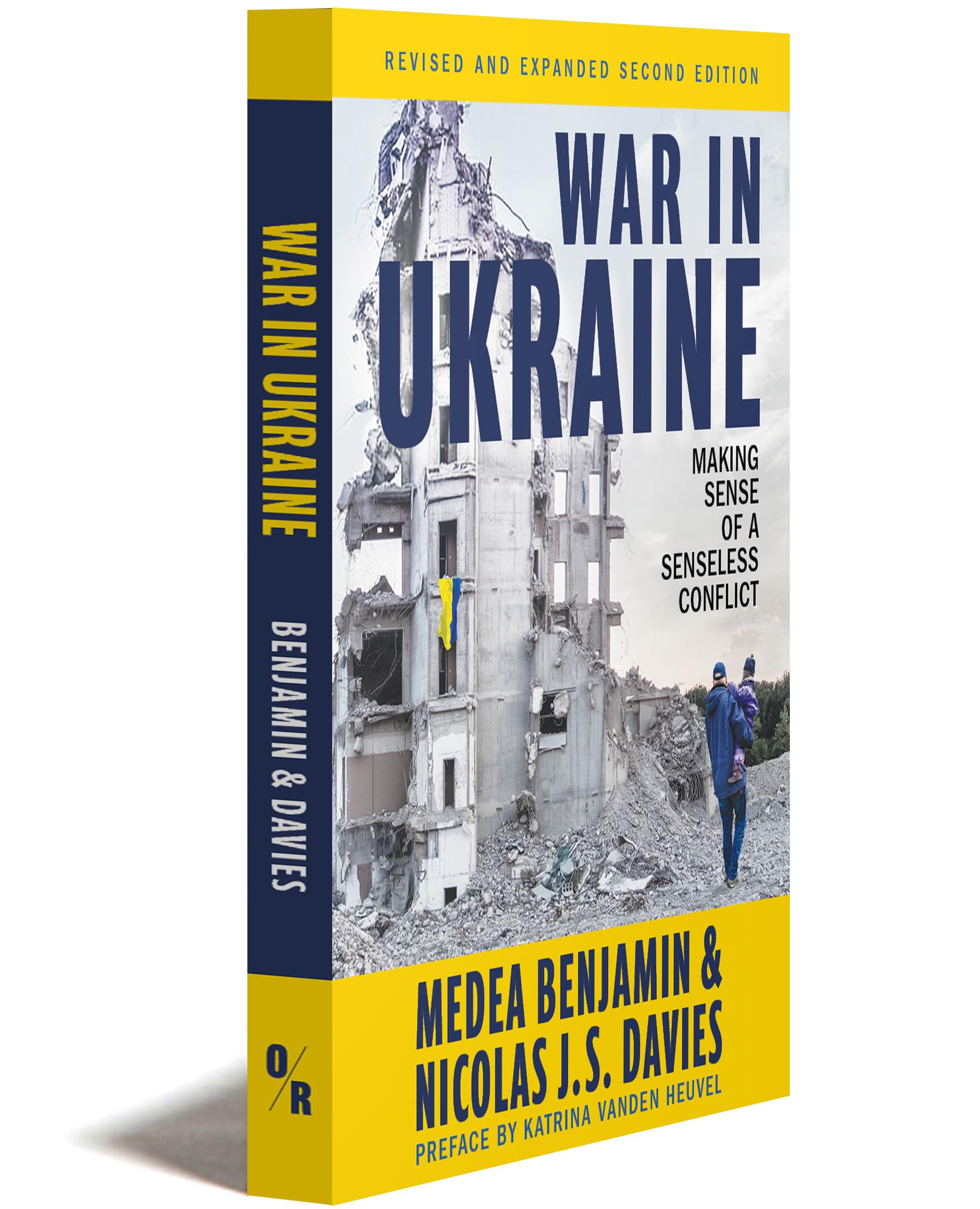
If you’re looking for a primer on the war that’s both critical and balanced, check out Medea Benjamin and Nicolas J.S. Davies’ book, “War in Ukraine: Making Sense of a Senseless Conflict,” now available in a revised and expanded second edition. ($20 paperback; $10 ebook, from OR Books.)
Benjamin and Davies recognize the war didn’t erupt out of nowhere in February 2022 nor was it completely “unprovoked.” As much as they deplore and denounce Vladimir Putin’s decision to invade, they recognize Putin had his reasons. Putin is more rational actor than a power-hungry dictator, and he’s arguably driven more by securing Russia’s position (and regional dominance) than recreating a Tsarist Russian or Soviet empire. Unlike most American commentators, Benjamin and Davies favor a diplomatic solution that would end mass killing on both sides. Not surprisingly, their views have gained little traction in the pro-war, anti-Putin mainstream media.
Speaking of the U.S. mainstream media, NBC News posted an article yesterday citing Condoleezza Rice, former Secretary of State under President George W. Bush. An unrepentant neocon, Rice is happy that Trump is sending more weapons to Ukraine while threatening more sanctions as well. In short, Trump is following a traditional neocon script while also keeping weapons factories in the U.S. going full blast. Rice approves!
What I found most staggering from Rice was this claim cited by NBC:
Rice also criticized the Biden administration for, in her view, having taken its time to get desperately needed weapons to Ukraine from the outset. “If you had given them everything at the beginning of the war,” she said, when “the Russians were on their back foot, [Ukraine] could’ve won this war outright.”
Excuse me, but WTF? What does giving Ukraine “everything” at the beginning of the war in 2022 mean? Fighter jets, main battle tanks, long-range missiles, nuclear weapons? Ukraine wasn’t even an ally of the U.S., nor was it ever a part of NATO. And would Ukraine really have won the war against Russia with “everything”? What about the risk that Russia would have escalated as well, perhaps calling on its arsenal of 6000 or so nuclear weapons?
Rice’s call for more smoking guns to have been sent to Ukraine early in 2022 almost certainly would have ended in a mushroom cloud or two. But I suppose that’s OK with her as long as the mushroom clouds were limited to Ukraine.
Remember 2023 and the failure of the much-hyped Ukrainian counteroffensive? I do. Remember all the hype about U.S., German, and British wonder weapons like Abrams, Leopard, and Challenger tanks? I do.
Let’s hope that Trump’s gambit to push Putin to some kind of compromise settlement bears fruit. No war should go on forever. Haven’t enough people died on both sides?
America’s Revival Will Begin When It Finally Embraces Peace
Arguably the biggest problem in America today is that the government remains on a wartime footing. The possibility of America being a normal country in normal times, at peace, is simply never mentioned. In current politics and in the mainstream media, there is no vision of America being at peace with the world. Ever.
There is always an enemy, usually plural. Russia. China. Iran. North Korea. The inchoate threat of terror and terrorists. Islamist extremism. All these and more are cited by the “experts” in the “national security state” as requiring a military response. If some kind of peace deal is orchestrated for the Russia-Ukraine War, America and its war machine will immediately pivot to Asia. Or the Middle East. Or perhaps Africa. Or all three.
I’m amazed when friends tell me they’re concerned about U.S. isolationism. Usually this concern is couched in America’s alleged withdrawal from (or even betrayal of) Europe in light of the Russia-Ukraine War. Their message to me is simple: America must keep sending weapons and intel to Ukraine until Russia and Putin are defeated, “as long as it takes.” The “it” is left undefined, but apparently “it” refers to an unqualified Ukrainian victory over Russia, followed by Ukraine’s eventual admission into NATO. Whether that “it” is even possible—whether that “it” could well lead to a nuclear exchange—doesn’t seem to matter because “We’re at war.”
I don’t know how anyone can think America will return to isolationism when the U.S. has 800 military bases globally and a vision of global reach, global power, and total dominance everywhere. And when America spends more on its military than the next ten countries combined (and most of those are U.S. allies). Dominating the globe isn’t exactly consistent with isolationism.
The problem with all the war rhetoric, the war narrative, the war framing, the warrior and lethality talk, is what it enables and facilitates, which is atrocity. Waste. Destruction. War is no way of life at all. As Ike said, the persistence of war is humanity crucifying itself on a cross of iron.
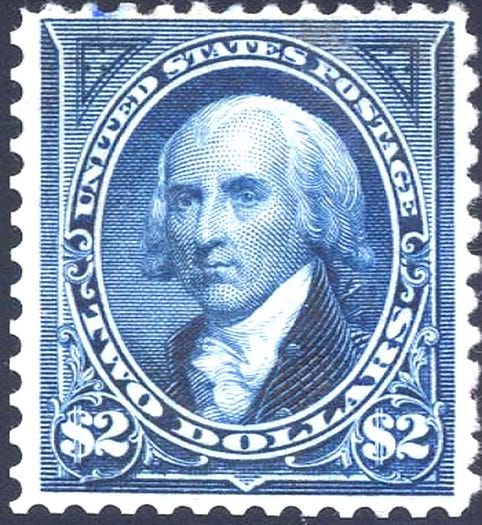
War is immensely corrosive to democracy. It is the enemy of freedom. Just listen to James Madison:
James Madison
Of all the enemies of true liberty, war is, perhaps, the most to be dreaded, because it comprises and develops the germ of every other. War is the parent of armies; from these proceed debt and taxes; and armies, and debts, and taxes are the known instruments for bringing the many under the domination of the few. In war, too, the discretionary power of the Executive is extended; its influence in dealing out offices, honors and emoluments is multiplied; and all the means of seducing the minds, are added to those of subduing the force, of the people. The same malignant aspect in republicanism may be traced in the inequality of fortunes, and the opportunities of fraud, growing out of a state of war, and in the degeneracy of manner and of morals, engendered in both. No nation can preserve its freedom in the midst of continual warfare …
*****
If you’re concerned about authoritarianism, if you’re concerned about maintaining and strengthening freedom, if you’re concerned about combatting corruption and waste, if you’re concerned about America’s huge deficits, stopping war should be your number one concern.
War is a terrible thing, and a state of war enables all kinds of butchery. Just ask the indigenous peoples of America, or the peoples of Palestine today. Even genocide can be disguised as a wartime exigency, a wartime necessity. How many times throughout history has the declaration, “We’re at war!” been used to justify the most heinous crimes against humanity? Even the Nazis hid behind wartime exigency to justify the mass euthanasia of the old, the mentally ill, and other forms of “life unworthy of life” as part of the T4 program (which anticipated the Holocaust).
The true revival of America will begin when this country declares itself to be at peace with the world. Until then, precipitous decline will continue for as long as our government remains at (and continues to celebrate) war.
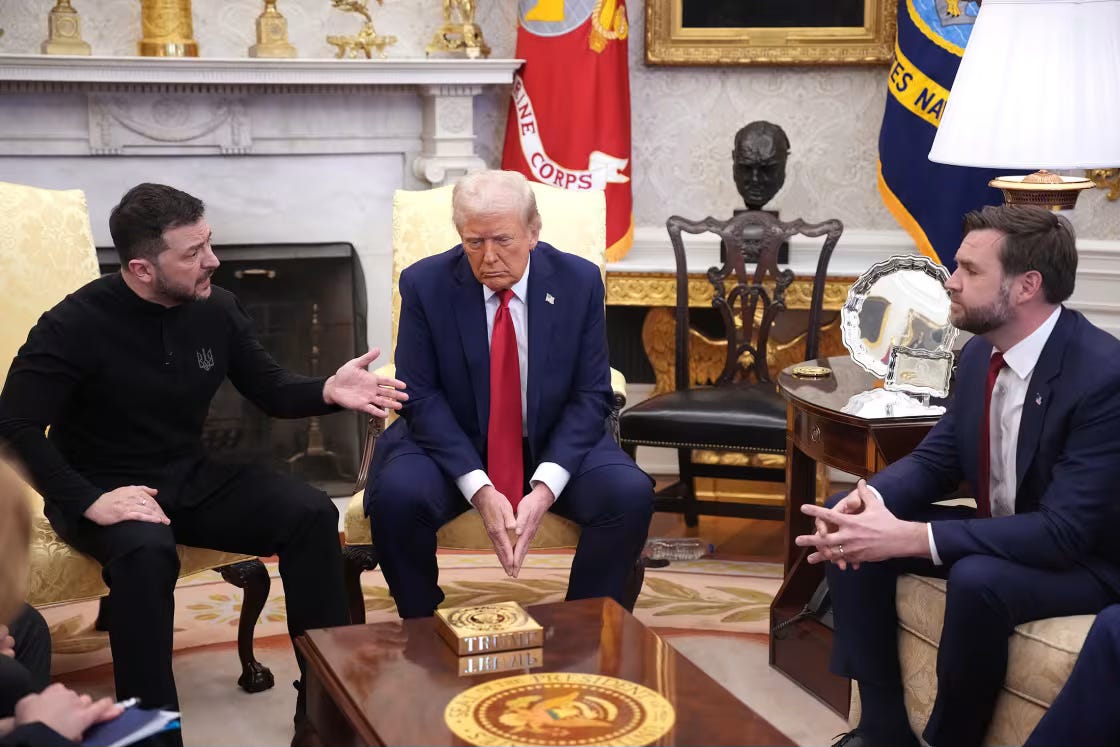
The Disastrous Oval Office Meeting Between Trump and Zelensky
It’s never a good idea to bite the hand that feeds you. In effect, that’s what President Zelensky did yesterday in a contentious meeting with President Trump and Vice President Vance.
Bloodbath? Showdown? Blow-up? Or a rare example of backroom brawling in plain sight?
My email this morning featured many takes on the meeting from the media. Here are a few choice words: Showdown. Dispute. Debacle. Blow-up. Botched visit. Bloodbath. Feud.
It must have been strange for Zelensky. He’s used to coming to DC and getting his way. Of being feted and fawned over. Who does he think he is, Bibi Netanyahu? Bibi has AIPAC and Congress behind him, and lord knows who and what else. Zelensky, to borrow from Trump, doesn’t have those cards. His hand is weaker and he didn’t play it well.
Matt Taibbi has an article on the meeting with a full (if imperfect) transcript. Check it out here. Taibbi is generally critical of Zelensky; the historian Timothy Snyder is critical of the “inhospitable” and “indecent” Trump/Vance. Check out Snyder’s video here.
As I watched the video from the Oval Office, and heard Zelensky’s complaints, I almost thought he was going to break out his rendition of the Streisand/Diamond duet, “You don’t bring me flowers anymore,” except with new lyrics:
You don’t send me weapons anymore.
Joking aside, it’s rare when you see backroom brawling in the open. These meetings before the press are usually so staged, so vapid, and often so dishonest that it was refreshing to see something unscripted, spontaneous, and impassioned.
Here, I recall Winston Churchill’s quip that “There is only one thing worse than fighting with allies, and that is fighting without them.” Zelensky may find that he’s lost his most powerful ally; then again, perhaps he believed he’d already lost Trump/Vance, thus he seized his chance to be defiant and to go out strong.
I don’t know. It takes a clever man to play a weak hand well and a lucky one to win with it. And I don’t think Zelensky is either clever or lucky enough here.
When I was a kid, at the height of the U.S. space program and the Apollo missions to the moon, I was an avid consumer of space food sticks and Tang. They were “cool,” or so it seemed to me, because the astronauts (and product advertisers) said so. Of course, space food sticks tasted something like cardboard and Tang was a poor imitation of orange juice, but the power of image and advertising sold them to me, at least for a time. Then I smartened up and returned to Charleston Chews and real OJ. Breakfast of champions!
It’s truly amazing what the powers that be can sell to Americans. Lately, we’ve been sold a series of wars based on lies, most recently Iraq and Afghanistan and Ukraine. We’ve even been sold a genocide in Gaza, billed as a defensive operation for America’s guiltless and democratic ally, Israel, which only wants to assert its “right to exist.” Whether we’ll ever smarten up about these “products” we’re being sold remains to be seen.
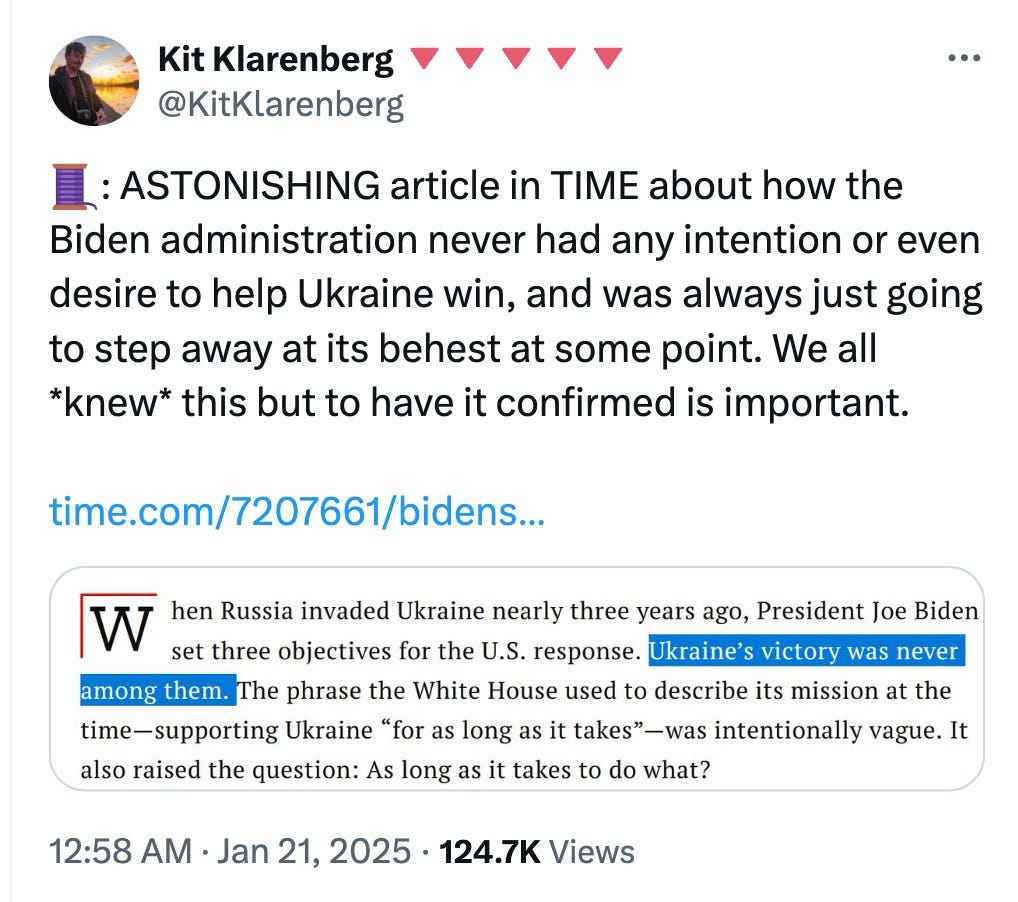
These thoughts were on my mind as I read Caitlin Johnstone’s recent article where she mentions the Russia-Ukraine War. She references Time Magazine, the mainstream media in a nutshell, and a telling admission that U.S. support of Ukraine has been all about weakening Russia and Putin, with no thought given to military victory or the cost of that war to Ukraine.
Not that there haven’t been plenty of mask-off moments during the dementia-muddled chaos of the Biden administration as well. A new article in Time titled “Why Biden’s Ukraine Win Was Zelensky’s Loss” is a good example of this; the report cites a former member of Biden’s National Security Council saying that victory for Ukraine was never part of the Biden administration’s plan.
The opening paragraph reads as follows:
“When Russia invaded Ukraine nearly three years ago, President Joe Biden set three objectives for the U.S. response. Ukraine’s victory was never among them. The phrase the White House used to describe its mission at the time — supporting Ukraine ‘for as long as it takes’ — was intentionally vague. It also raised the question: As long as it takes to do what?”
Well, at least Zelensky and his wife enjoyed the Vogue treatment:
America, a good motto to keep in mind is this one:
I’m Already Against the Next War
Don’t let them sell a new war to you, no matter how many crummy commercials they use to convince you that space food sticks, Tang—heck, even genocide and war—are great.
It’s always the right time to stop building more weapons of mass destruction
William Astore and Matthew Hoh
[Note to readers: Back in early September, Congressman Mike Turner penned an op-ed for the “liberal” New York Times supporting a massive “investment” in new nuclear weapons. Matt Hoh and I quickly submitted letters to the Times to protest this op-ed and its arguments; the Times ignored them. We then wrote our own op-ed below, shopping it to various mainstream media outlets without success. Here it finally appears for the first time.]
*****
Representative Mike Turner’s essay on nuclear weapons in The New York Times (We Must Invest in Our Aging Nuclear Arsenal, September 6, 2024) is dangerously loyal to counterproductive US national security policies and narratives.
Turner’s lamentation over foreign nuclear weapons programs ignores destabilizing US arms control choices this century. The US spends more on nuclear weapons than the rest of the world combined. Its $1.7 trillion modernization program (the Sentinel ICBM; the B-21 Raider bomber; Columbia-class nuclear submarines) has done little more than upset the decades-long nuclear deterrence balance among nations.
In his essay, Turner neglects to mention the US government’s unilateral withdrawal from multiple arms control treaties. Then-Senator Joe Biden rightly predicted the effects of George W. Bush’s abandonment of the Anti-Ballistic Missile (ABM) Treaty: “A year ago [in 2000], it was widely reported that our intelligence community had concluded that pulling out of ABM would prompt the Chinese to increase their nuclear arsenal tenfold.” The Chinese are now clearly headed in that escalatory direction.
To prevent the apocalyptic consequences of yet another nuclear arms race, the US should act to decrease “investments” in new weapons while cutting current arsenals by negotiating and enacting new arms reduction treaties. Together, the US and Russia already possess ten thousand nuclear warheads, enough to destroy life on earth and several other earth-sized planets. We need desperately to divest from nuclear weapons, not “invest” in them.
Consider as well that America’s current nuclear triad, especially the Navy’s Trident submarine force, is potent, survivable, and more than sufficient to deter any conceivable adversary.
Simply put, the US must stop building genocidal nuclear weapons. It must instead renew international efforts and treaties to downsize these dreadful and dangerous arsenals. Spending yet more trillions on more world-shattering nukes is worse than a mistake—it’s a crime against humanity.
Here we are haunted by the words of Hans Bethe, who worked on the Manhattan Project that created the atomic bomb during World War II. The first reaction Bethe said he’d had after Hiroshima was one of fulfillment—that the project they had worked on for so long had succeeded. The second reaction, he said, was one of shock and awe: “What have we done? What have we done,” he repeated. And the third reaction: It should never be done again.
That is the imperative here. The US must act so that future Hiroshimas will never happen.
It’s not America’s fate alone that’s at stake here, but the fate of humanity itself, and indeed most life on earth, as only a few dozen thermonuclear warheads exploding would likely produce nuclear winter and an eventual “body count” in the billions.
During the First Cold War, one heard it said: “Better dead than red.” That mentality remains, even as the “reds” today are more capitalist than communist. Meanwhile, the weapons makers for the military-industrial-congressional complex (MICC), in their greed, are the adversary within. From Israel and events in Gaza, we’ve learned the MICC will literally empower a people to commit mass murder. With more and newer thermonuclear weapons, the MICC may yet kill the world.
Higher quarterly profits will mean little when everybody is dead.
During the Vietnam War, a US Army major was heard to say: “We had to destroy the town to save it [from communism].” If America can destroy towns in Vietnam to “save” them from communism, if it can facilitate the destruction of Gaza to “save” it from Hamas, it can similarly destroy the earth to “save” it from China, or Russia, or some other “threat.” That is the indefensible (il)logic of building yet more weapons of mass destruction.
Contra Congressman Turner, there is no logical, sensible, defensible reason for America’s proposed “investment” in new nuclear weapons. But there are nearly two trillion reasons why it’s going forward, because that’s the projected total cost of modernizing America’s nuclear triad. Money talks—loudly, explosively, perhaps catastrophically.
Today, more than half of US federal discretionary spending is devoted to war and weapons. Americans, in essence, live both in a permanent war state and a persistent state of war. As bad as that reality is, a state of nuclear war is unimaginable and must not be allowed to happen.
At the height of the Cold War, one of us served in Cheyenne Mountain, America’s nuclear command center, and witnessed a simulated nuclear attack on the US. Even on the primitive monitors the Air Force had back in 1986, seeing Soviet missile tracks crossing the North Pole and terminating at American cities was unforgettable.
A generation earlier, Robert Oppenheimer, the “father of the atomic bomb,” tragically noted in 1965 that it was 20 years too late to control nuclear arms. Those efforts, he said, should have been started “the day after Trinity” in July of 1945.
Let’s not make it 80 years too late. Congressman Turner is exactly wrong here. We must cut America’s nuclear arsenal and pursue new nuclear disarmament treaties. Never should our children be haunted as we were (and still are) by the darkness and doom of radioactive mushroom clouds.
William Astore, a retired lieutenant colonel (USAF) and historian, is a senior fellow at the Eisenhower Media Network.
Matthew Hoh, a former Marine Corps captain and State Department official, resigned in protest in 2009 against America’s ill-conceived war in Afghanistan. He is Associate Director at the Eisenhower Media Network.
Like too many people, I sometimes make the mistake of talking about nuclear war, when it’s really annihilation and genocide we’re talking about.
Wars have winners and losers. In nuclear “war,” everyone loses. The planet loses. Life loses and death triumphs on a scale we simply can’t imagine.
Language is so important here. I grew up learning about nuclear exchanges. EXCHANGES! The U.S. military talks of nuclear modernization and “investing” in nukes when the only dividend of this “investment” is mass death.
One of the few honest acronyms is MAD, or mutually assured destruction. Lately, it’s an acronym that’s largely disappeared from American discourse.
More than anything, though, realistic images of a nuclear attack are perhaps the most compelling evidence against building more nukes, as in this powerful and unforgettable scene from Terminator 2:
To me, nothing beats that scene. That is nuclear “war.”
The U.S. has over 5000 nuclear weapons; the Russians close to 6000. That’s more than enough to destroy the earth and a few other earth-sized planets. Imagine the scene above repeated eleven thousand times on our planet.
The insanity, the immorality of spending another $2 trillion on new nukes … well, it boggles my mind. We’ve become like the mutants in Beneath the Planet of the Apes, worshipping the bomb, acolytes of death and destruction.
If we all don’t end up killing ourselves and the planet in “an exchange,” we’ll likely degenerate into utter barbarism, as depicted in Cormac McCarthy’s The Road. And even that grim novel has a life-affirming ending that is most unlikely.
Amazingly, after I wrote the above passages about nuclear “war” and “exchanges,” I came across Admiral TR Buchanan’s recent keynote address at the Center for Strategic and International Studies (CSIS), where he uses the word “exchange” in a remarkably banal (and frightening!) way.
BUCHANAN: Yeah, so it’s certainly complex because we go down a lot of different avenues to talk about what is the condition of the United States in a post-nuclear exchange environment. And that is a place that’s a place we’d like to avoid, right? And so when we talk about non-nuclear and nuclear capabilities, we certainly don’t want to have an exchange, right?
I think everybody would agree if we have to have an exchange, then we want to do it in terms that are most acceptable to the United States. So it’s terms that are most acceptable to the United States that puts us in a position to continue to lead the world, right? So we’re largely viewed as the world leader.
And do we lead the world in an area where we’ve considered loss? The answer is no, right? And so it would be to a point where we would maintain sufficient – we’d have to have sufficient capability.
We’d have to have reserve capacity. You wouldn’t expend all of your resources to gain winning, right? Because then you have nothing to deter from at that point.
So very complex problem, of course. And as I think many people understand, nuclear weapons are political weapons. I think Susan Rice said that at one point.
The motto of Admiral Buchanan might be: We had to destroy the world in order to lead it. Buchanan here is less sane than General Buck Turgidson in Dr. Strangelove.
This admiral thinks we might have to have “an exchange” with Russia, and that, if we do, we could do so “in terms that are most acceptable to the United States,” and that even after “an exchange,” the U.S. can still “continue to lead the world.”
Truly this is the banality of evil. I like how even after “the exchange,” we need to have a “reserve capacity” so that we can nuke the world again.
This is madness–sheer madness–but it’s received as probity and sane “strategic” thinking by the national security blob.
This guy was promoted to admiral precisely because he thinks this way. He thinks without thinking. With no humanity.
Well, as General Turgidson says in Dr. Strangelove, we might just get our hair mussed during a nuclear “exchange,” but does it really matter as long as we can kill more of them than us?





 Bracing Views